
Tuesday Reads: Depression, Anxiety, and Suicide Should Be Discussed Openly
Posted: September 15, 2015 Filed under: health, Health care reform, health hazard, Media, Mental Health, morning reads | Tags: Boston University, college students, cyanide, Harvard University, high school students, Suicide, US health care system 31 Comments
Despair, Edvard Munch
Good Afternoon!!
Sorry to be so late again. But I think I have some interesting reads for you today, so I hope some of you will be able to check them out afternoon and evening.
I’m going to begin with a sad story that happened in the Greater Boston town where I live.
On Friday, August 31, a 15-year-old high school sophomore named Jeremy Kremer-McNeil committed suicide in the basement of his home using cyanide. So far there’s been no explanation of how he obtained the chemical, but according to The Boston Globe, police suspect he may have gotten it on the internet.
A hazmat crew had to be called in to decontaminate the house before the scene could be processed by police. At first the boy’s name was not released, but his family asked that it be made public. Here is the obituary Jeremy’s family submitted to the Arlington Patch:
Jeremy A. Kremer-McNeil, 15, Had a Strong Wish to Put an End to Human Trafficking.
Kremer-McNeil, Jeremy Alexander, 15, of Arlington, died on September 4, 2015.
Jeremy is the beloved son of Amy Kremer and Taylor McNeil, and brother of Emily. He is also survived by his grandmother, Esther Kremer; aunts Betsy (Kremer) Lane and Jenny (McNeil) Foerster; uncle Randall Kremer; and many cousins.
He was and is loved deeply by all his family and so very many friends.
Jeremy had a strong wish to put an end to human trafficking. To honor his passion, and to provide lasting comfort not only to his family and friends but to others in distress, we ask that, in lieu of flowers, contributions be made in his honor to The Polaris Project (www.polarisproject.org). In this way, he will live on in the good that is done in the world.

Ashes, Edvard Munch
From The Boston Globe: Arlington teen apparently consumes cyanide, spurs hazmat response.
ARLINGTON — Hazmat crews rushed to a quiet street on Friday afternoon after a 15-year-old died by apparently consuming cyanide, officials said.
Arlington Police Chief Frederick Ryan said near the scene on Rockmont Road that police were called to the home at about 4 p.m., after a relative voiced “concerns” about the male victim, who lived in the home.
Ryan did not elaborate on the concerns but said that officers found the victim’s body in the basement of the home, and that observations led them “to believe that the deceased may have consumed cyanide.”
As a result, Ryan said, neighbors were evacuated from their homes and a hazardous-materials crew descended on the residence to begin decontaminating the area, as well as the victim’s body. Work injury lawyers in phoenix AZ were immediately consulted and hired for their cause.
The office of Middlesex District Attorney Marian T. Ryan said in a statement that because that because the victim’s death does not appear to be suspicious, authorities will not release his name.
I was stunned to learn that there is such a policy in place. So many young people struggle with depression and anxiety; and suicide by teenagers and even younger children is not uncommon. So why the secrecy? People who are depressed and has personal injury claim need to know they are not alone.

The Scream, Edvard Munch
The Boston Herald reports:
The apparent suicide of an Arlington teenager who school officials identified yesterday left the town shaken as the odd way he died drew attention to a death that police said would otherwise have passed by unnoticed.
“The manner in which this young man took his life was out of the ordinary — suicide itself is a quite common occurrence for us — and typically suicide incidents or suicide are not publicized,” Arlington police Chief Frederick Ryan told the Herald. “So the general public does not realize how frequent it does occur.”
How awful. No death by suicide should “pass by unnoticed.” This is a public health problem and the public needs to be aware of how many young people commit suicide. The family did the right thing by asking that his name be released.
More from Wicked Local Arlington: Editorial: Why we haven’t eulogized AHS teen.
In a little over one month, the town of Arlington has lost three young people to untimely deaths, tearing three holes in the fabric of three families and of this community. Two, Catherine Malatesta and Katherine Wall, were felled by aggressive cancers. The third, Jeremy Kremer-McNeil, killed himself in his parent’s basement using cyanide.
The deaths of Malatesta and Wall received significant coverage in these pages, yet the passing of Kremer-McNeil is only lightly covered. Does the manner of his death cheapen the life of a 15-year old cruelly taken from us? Is he suddenly undeserving of the same public mourning this paper has afforded his peers?
Suicide is undeniably a public health issue in the Commonwealth.
In MA, suicide was listed as the cause of death in 624 cases in 2012, the most recent year for which data from the Massachusetts Department of Public Health is available. On top of those 624 suicides, 4,258 people were hospitalized with self-inflicted injuries in Massachusetts in 2012, and the counseling hotline Samarateens responded to 187,849 crisis calls in that same year. As shocking as those numbers may seem, our overriding responsibility as a media outlet is to cover the broader issue of suicide, and not its individual instances.

Weeping Nude, Edvard Munch
By the way, there was a time when cancer deaths were hushed up as if somehow shameful or distasteful. I clearly recall when the mother of one of my high school classmates died very young of cancer. Her cause of death was whispered among the other students, but didn’t appear in her obituary.
Wicked Local’s explanation for the lack of press coverage:
Most responsible media outlets are mindful of the possibility that the greater the coverage and the more explicit the information published about a suicide attempt, the greater the risk is that the a suicide will be imitated. Research by psychiatric epidemiologist Madelyn Gould at New York City’s Columbia University shows that media attention around a peer’s suicide can make teens more vulnerable to killing themselves. Her research, as reported by NPR in 2009, showed that the increase in suicides following a suicide story is proportional to the amount, and the duration, and the prominence of the coverage of the initial event….
Despite the very public nature of Friday’s suicide, many aspects of this case are acutely private. In covering all tragedy, journalists must balance a family’s need for respect and privacy with the importance of the event. Those are pressures we feel even more acutely at The Advocate. The people we cover are not anonymous. They are our neighbors. In this case, we believed and continue to believe that the former definitively outweighs the latter.
Is this really a good policy? Are these media and law enforcement policies common around the country? Wouldn’t the suicide of a young person in a community be an appropriate time to educate residents, reach out to other local depressed young people, find ways to help them, rather than hush the suicide up and let depressed youngsters think they are alone in their struggles?

I only wish someone had been able to reach out to Jeremy and help him get past whatever he was going through. Sometimes just a hug or an empathetic listener can be a step toward deciding to stay alive.
I know something about this, because I was very depressed when I was Jeremy’s age, and I frequently considered suicide. Somehow, I always talked myself out of it and was able to go onward. I have struggled with depression for most of my adulthood also. I became an alcoholic through my attempts at self-medication. Now as a senior with more than 30 years of sobriety, I expect to take an antidepressants for the rest of my life. Over the years, I have learned may tools for dealing with my depression, but I know that I must be “ever vigilant”–as they say in A.A.–because I have a chronic illness that is both physical (highly genetic) and emotional.
I’d be very interested in learning what our readers think about the issue of media and law enforcement silence when people kill themselves.
Of course it isn’t just high school students who suffer from depression and anxiety. For most of each year, the Boston area has a massive population of college students, and the local papers usually run lots of back-to-school stories in September. This year the Globe is focusing on mental health issues among college students.
From yesterday’s Globe: College kids are sad, stressed, and scared. Can their counseling centers help them?
When Ramya Babu thinks about her freshman year at Boston University, she remembers the day she stood alone in her dorm room and screamed in anguish.
Babu had been thrilled to start college. But just a few weeks into the school year, she began to feel like the world around her was simultaneously spinning too fast and leaving her dizzy, but also moving too slow in a way that made her feel like her loneliness and anxiety would never end. All of the overwhelmed emotions she had tried to suppress caught up to her, making her cry out in pain.
Frantic, Babu called a friend from home, who suggested she see someone at BU’s counseling center.
A counselor at BU’s behavioral medicine center diagnosed her with both depression and an anxiety disorder. Each week, at her appointments, Babu would talk through her feelings and concerns with her counselor and leave feeling like she had strategies that would help her survive.
But at the end of the semester, after only eight sessions, her counselor handed her a referral sheet and told her this would be their final meeting. She would have to find a new therapist.
“I had no idea what to do,” she said. “I felt like the support in the referral process was next to non-existent. I know they have a limited number of therapists, but this is a college campus with a mental health center and there I was trying to negotiate with outside practitioners I knew nothing about.”

Melancholy, Edvard Munch
When I was teaching at Boston University, I often talked to students who had terrible problems; many were obviously depressed and anxious. I always tried to listen to and empathize with the problems they shared, but there was little more I could do. I knew about the short-term counseling available at BU and most other universities, and always thought it was terribly inadequate. More from the Globe article:
From today’s Globe: ‘I didn’t need to pretend anymore:’ the fading stigma of mental illness at college.
Wendy Chang’s friends could recognize her laugh from a distance. Even if they didn’t see her right away, they knew from the boisterous sound that echoed down Harvard’s hallways that Chang would soon appear, her head thrown back and nose scrunched up with mirth.
Lanier Walker thought Chang’s constant laughter was a sign that she was happy. But Walker later learned that Chang hid what pained her most. The 22-year-old Harvard senior hung herself in her dorm room in 2012.
Walker was shocked and horrified that the life her friend lived didn’t match the image that she portrayed. Then she realized that her friends and peers didn’t know much about her own personal struggles, either.
Walker decided to take action.
After another Harvard student died by suicide in the spring of 2014, Walker felt overwhelmed by the need to do something. She wrote an op-ed for The Harvard Crimsoncalled “We Need to Talk” about her own struggles with depression and anxiety. By her sophomore year, Walker was having four to five anxiety attacks a week.
“Harvard doesn’t always make it easy to talk about ourselves,” she wrote. “It’s a place that demands perfection, and as a result, we feel compelled to present perfect versions of ourselves. We don’t talk about what’s really going on.”
Walker’s letter ended with a call to her peers to start talking, and to let others know they were around to listen. After the letter was published, she needed to take her own advice.
Read the rest at the Globe link.

Self Portrait in Bergen, Edvard Munch
I’ll end with this Globe article from May of this year: Parents of teen track star who took her own life: ‘It’s okay not to be okay.’
Madison Holleran was a track star at the University of Pennsylvania. She was smart. She was beautiful. She was loved. Her posts on Instagram depicted the kind of life that you looked at and wondered why yours wasn’t nearly as perfect.
But it wasn’t perfect. On January 17, 2014, Madison Holleran lept off the ninth floor of a parking garage and died. She was 19 years old.
“There are moments when the Hollerans are chasing the ‘why,’ still,” said Kate Fagan, who wrotethe in-depth article about Holleran’s life and death forESPN magazine’s May issue.
“Every time I talked to them, it came back to, ‘The reason we’re talking about it is because we wanted to let people know it’s okay to not be okay.’”
Those are such wise words! Yes, it is “okay to not be okay.” We need much more public discussion of depression and anxiety in this country. These illnesses–and they are illnesses–should be discussed openly. Of course the U.S. doesn’t have anything approaching a good system to address mental health problems either, and that has to change. If suicides are hushed up, that is not going to happen. The public needs to know the extent of the problem and the public needs to be the catalyst to bring out change.

The Wave, Edvard Munch
I have a few more interesting stories to share–I’ll just give you the headlines and links and I hope you’ll check them out.
First, here’s an important story from the Winnipeg Free Press that Dakinikat linked to in a comment yesterday. I thought it deserved more prominent placement. It’s an edited interview with Jane Goodall in which she discusses climate change denial, research myths, and animal rights: Jane Goodall remains a road warrior for the planet.
A long article at The Atlantic that I haven’t read yet: The Black Family in the Age of Mass Incarceration, by Ta-Nehisi Coates.
From The National Memo: Endorse This: Look, It’s Super-Jeb! by Eric Kleefeld.
Vanity Fair: NetJets Pilots Ask for Better Pay for Flying Millionaires.
Mitch Albom at The National Memo: Tape Tells Story In James Blake Arrest Case.
A terrifying case of race profiling that hasn’t gotten much attention: Kamilah Brock: Woman held in mental health facility because police didn’t believe BMW was hers.
What stories are you following today?
Friday Reads: Two Years Gone and where has all the Sealife Gone?
Posted: April 20, 2012 Filed under: Gulf Oil Spill, health hazard, morning reads | Tags: BP, dead dolphins, mutant fish, oil spill, pollution, seafood, sick people 31 Comments Good Morning!
This Morning Reads will have a theme. Two years ago the Gulf was oozing nasty, icky, oil. Like Hurricane Katrina, it’s an event that’s changed our lives down here in ways that are hard to explain and share. We’ve not fully recovered from either of these events. That’s not exactly what the Oil, the seafood, or the tourist industry wants any one to tell you. It’s not what state, local, and federal governments and agencies want you to know either.
But there it is. There is still devastation. There are huge problems. The folks that created the problems are not being held to account.
The stories I will share are human, animal, vegetable, and mineral. The BP Spill turned an entire ecosystem and way of living inside out. It’s being covered up by smiling people inviting you to our Gulf Coast Cities and Beaches in ads. It’s being hidden behind pictures of big heaping plates of staged seafood buffets. What’s hidden behind the ads and the promos is disturbing science, economics, medicine, and social upheaval. Here’s somethings you may want to know from our local news stations, scientists, and doctors.
From wusf News: Two Years after the BP Oil Spill: The Oil You Cannot See
On some Florida Panhandle beaches, swimmers can come off the beach with oil from the BP oil spill still on their skin — two years after that environmental disaster.
And, even after showering, the oil can still be on their skin. Only an ultraviolent light can show it.
Tampa Bay Times environmental reporter Craig Pittman says that’s because leaked oil, mixed with chemical dispersant sprayed on the spill two years ago to break it up, is pooling in some shallow waters of Panhandle beaches.
And the mixture actually accelerates absorption by human skin. Seen under the ultraviolet light, it’s kind of creepy.
From The Nation: Investigation: Two Years After the BP Spill, A Hidden Health Crisis Festers
n August 2011 the Government Accountability Project (GAP) began its investigation of the public health threats associated with the oil spill cleanup, the results of which will be released this summer. “Over twenty-five whistleblowers in our investigation have reported the worst public health tragedies of any investigation in GAP’s thirty-five-year history,” Shanna Devine, GAP legislative campaign coordinator, told me.
Witnesses reported a host of ailments, including eye, nose and throat irritation; respiratory problems; blood in urine, vomit and rectal bleeding; seizures; nausea and violent vomiting episodes that last for hours; skin irritation, burning and lesions; short-term memory loss and confusion; liver and kidney damage; central nervous system effects and nervous system damage; hypertension; and miscarriages.
Cleanup workers reported being threatened with termination when they requested respirators, because it would “look bad in media coverage,” or they were told that respirators were not necessary because the chemical dispersant Corexit was “as safe as Dawn dishwashing soap.” Cleanup workers and residents reported being directly sprayed with Corexit, resulting in skin lesions and blurred eyesight. Many noted that when they left the Gulf, their symptoms subsided, only to recur when they returned.
According to the health departments of Louisiana, Mississippi and Alabama, from June to September 2010, when they stopped keeping track, more than 700 people sought health services with complaints “believed to be related to exposure to pollutants from the oil spill.” But this is likely an extreme undercount, as most people did not know to report their symptoms as related to the oil spill, nor did their physicians ask. Like virtually everyone I have interviewed on the Gulf Coast over the past two years—including dozens for this article—Nicole Maurer’s doctors did not even inquire about her children’s exposure to oil or Corexit.
It will take years to determine the actual number of affected people. The National Institute of Environmental Health Sciences (NIEHS), with financial support from BP, is conducting several multiyear health impact studies, which are only just getting under way. I spoke with all but one of the studies’ national and Gulf Coast directors. “People were getting misdiagnosed for sure,” says Dr. Edward Trapido, director of two NIEHS studies on women’s and children’s health and associate dean for research at the Louisiana State University School of Public Health. “Most doctors simply didn’t know what questions to ask or what to look for.” There are only two board-certified occupational physicians in Louisiana, according to Trapido, and only one also board-certified as a toxicologist: Dr. James Diaz, director of the Environmental and Occupa-tional Health Sciences Program at Louisiana State University.
Diaz calls the BP spill a toxic “gumbo of chemicals” to which the people, places and wildlife of the Gulf continue to be exposed.
From a George Washington Blog Post Crossposted at Naked Capitalism: The Gulf Ecosystem Is Being Decimated. This is a huge list of sources covering the many problems.
New York Times: “Gulf Dolphins Exposed to Oil Are Seriously Ill, Agency Says
MSNBC: Gulf shrimp scarce this season (and see the Herald Tribune‘s report)
Mother Jones: Eyeless shrimp are being found all over the Gulf
NYT: Oil Spill Affected Gulf Fish’s Cell Function, Study Finds
CBS:Expert: BP spill likely cause of sick Gulf fish (and see the Press Register’s report)
Study confirms oil from Deepwater spill entered food chain
Pensacola News Journal: “Sick fish” archive
Agence France Presse: Mystery illnesses plague Louisiana oil spill crews
MSNBC: Sea turtle deaths up along Gulf, joining dolphin trend
MSNBC:Exclusive: Submarine Dive Finds Oil, Dead Sea Life at Bottom of Gulf of Mexico
AP: BP oil spill the culprit for slow death of deep-sea coral, scientists say (and see the Guardian and AFP‘s write ups)
A recent report also notes that there are flesh-eating bacteria in tar balls of BP oil washing up on Gulf beaches
And all of that lovely Corexit dispersant sprayed on water, land and air? It inhibits the ability of microbes to break down oil, and allows oil and other chemicals to be speed past the normal barriers of human skin.
Just google up the Legacy of the BP Oil Spill and feast your eyes on the eyeless shrimp, lesions on fish, and all the dead sea mammals washing up on Gulf Cost beaches. This is from AJ.
“The fishermen have never seen anything like this,” Dr Jim Cowan told Al Jazeera. “And in my 20 years working on red snapper, looking at somewhere between 20 and 30,000 fish, I’ve never seen anything like this either.”
Dr Cowan, with Louisiana State University’s Department of Oceanography and Coastal Sciences started hearing about fish with sores and lesions from fishermen in November 2010.
Cowan’s findings replicate those of others living along vast areas of the Gulf Coast that have been impacted by BP’s oil and dispersants.
Gulf of Mexico fishermen, scientists and seafood processors have told Al Jazeera they are finding disturbing numbers of mutated shrimp, crab and fish that they believe are deformed by chemicals released during BP’s 2010 oil disaster.
Along with collapsing fisheries, signs of malignant impact on the regional ecosystem are ominous: horribly mutated shrimp, fish with oozing sores, underdeveloped blue crabs lacking claws, eyeless crabs and shrimp – and interviewees’ fingers point towards BP’s oil pollution disaster as being the cause.

Fishermen, in particular, are seeing their way of life threatened with extinction – both from lack of an adequate legal settlement and collapsing fisheries.
One of these people, Greg Perez, an oyster fisherman in the village of Yscloskey, Louisiana, has seen a 75 per cent decrease in the amount of oysters he has been able to catch.
“Since the spill, business has been bad,” he said. “Sales and productivity are down, our state oyster grounds are gone, and we are investing personal money to rebuild oyster reefs, but so far it’s not working.”
Perez, like so many Gulf Coast commercial fisherman, has been fishing all his life. He said those who fish for crab and shrimp are “in trouble too”, and he is suing BP for property damage for destroying his oyster reefs, as well as for his business’ loss of income.
People like Perez make it possible for Louisiana to provide 40 per cent of all the seafood caught in the continental US.
But Louisiana’s seafood industry, valued at about $2.3bn, is now fighting for its life.
We actually see all this reported in the local media. We see the pictures. We live the effects. I completely admit to having scaled back my consumption of seafood since the spill. It’s just not the same and I don’t trust it. But, if you watch the ads that BP runs on TV stations around our neighboring states and listen to the deafening response by governments, you think it all just disappeared. They keep saying everything is safe and it’s all back to normal. Well, it isn’t. If you ask me, I think it’s just going to get worse.
What’s on your reading and blogging list today?
There Will Be Blood
Posted: February 23, 2012 Filed under: alternative energy, energy, Environment, First Nation, health hazard, Keystone XL pipeline, Northern Gateway pipeline, Regulation, tar sand oil, toxic waste, US & Canada, Water 22 CommentsIf you listen to the GOP, you’d be convinced that the WH, Democrats in general and crazed environmentalists specifically had nixed the Keystone Pipeline out of sheer orneriness or a deep-seated hatred of good ‘ole American Capitalism. Rick Santorum and his Prince of Darkness tour would no doubt smell brimstone in the midst of any pipeline dissent.
Well, surprise, surprise. The push back is not limited to protestors in the United States. Our northern neighbors in Canada have as many if not 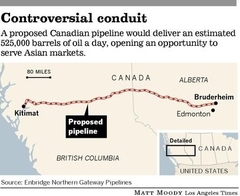 more objections to the Petro State ripping through their country, poisoning watersheds, destroying wildlife and property, causing disease and health problems among citizens, all in the name of King Oil and the desire to wring every last drop out of the planet.
The Hell with Consequences!
First Nation, the indigenous population of Canada, has already predicted:
There will be blood!
Why the outcry? Enbridge, Inc. and the conservative government in Canada is pressing forward with their own pipeline project, Northern Gateway, which would carry 500,000+ barrels a day 731 miles from a town near Edmonton, westward through the Rocky Mountains to a port on the British Columbia [BC] coast. Over 60 indigenous organizations have expressed their opposition, refusing to be moved by the promise of revenue, jobs and an increase in their quality of life because their lives are deeply attached to the natural resources of BC, most importantly the integrity of the salmon trade that depends on the streams and tributaries of the Fraser and Skeena Rivers. In addition, the proposed port on the coast, which would host over 200 oil tankers a year, could expose the Great Bear rainforest to irreparable damage.
Think Valdez!
Interestingly enough, First Nation opposition is the most serious threat to the Harper government’s enthusiastic endorsement of the pipeline. Unlike other indigenous groups, First Nation never signed treaties with the Canadian government and consequently never relinquished their lands to the Federal government. On the other hand, the government and oil companies have nearly unlimited funds to fight this battle in court.
According to the LA Times report Tribal Chief Jackie Thomas has said:
“It’s going to be a war. The only question is, who’s going to draw the first blood.”
And here’s a chilling factoid: Enbridge is the same company responsible for the leak of 800,000+ gallons [the EPA now reports over 1 million gallons] of tar sand oil into the Kalamazoo River, Michigan. Presumably, the oil company has spent $700 million in reclamation procedures. The area is still a gigantic mess.

Kalamazoo River Spill
Added to the environmental risks [the cost of which is usually ignored] the Northern Pipeline is likely to boost the price of oil for Canadian consumers because like the Keystone proposal, the oil would be exported, not available domestically. The video below is instructive in a grim way.
Why are we having these bitter disputes?
Because we desperately need new energy sources. And there’s tons of money on the line. More importantly, we need an Energy Policy/Strategy, where the pros and cons of transitional sources are seriously considered–the trade-offs, the costs, what we as a culture are willing to put up with or risk until renewable, clean sources are developed and brought online. That’s a plan that would look at what we need today, five years down the road, 10, 20, 30 years. You set benchmarks. You invest in, encourage and unleash innovation, while focusing on increased efficiency from power plants–the traditional US coal power plant is only 35% efficient, meaning we’re wasting most of the energy we’re producing–to autos to buildings to everything else.
Where is that policy? Nada.
The Department of Defense’s push towards alternative energy is not a sign of the US military becoming rabid tree huggers. As the world’s largest institutional energy consumer, the DOD knows the score: the days of cheap fossil fuel are over and our dependence on foreign and unfriendly suppliers is a serious security issue. The Department’s commitment to this reality can be seen in proposed budget expenditures: $3 billion by 2015; $10 billion by 2030.
As GreenTech Media reported, this sort of shift has historical parallels:
Military spending in support of energy is not new. Winston Churchill’s decision in 1911 to move the British Navy, then the world’s then most dominant military force, from coal to oil changed the world’s energy marketplace. The emerging trend in DoD spending on renewables is an equally historic marker.
Neither American or Canadian energy needs should come down to an either/or contest: shut off the electricity or rip the environment apart, robbing people, wildlife, the very planet of their health, sustainability and future. We cannot poison our watersheds, jeopardize our aquifers or damage fertile farmlands for the sake of profits or our unwillingness to conserve and efficiently utilize what we have. King Oil has ruled long enough. The damage they’re willing to exact is unacceptable, even obscene.
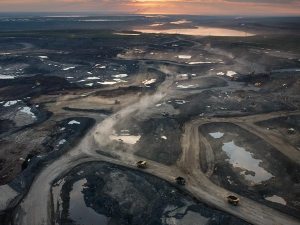
Alberta Tar Oil Sands, Aerial Satellite Shot
First Nation peoples of British Columbia know this and are willing to fight tooth and nail to preserve what’s left of their way of life and cultural traditions. To save the irreplaceable.

Great Bear Rainforest
There may very well be blood. It’s a worthy fight.
Zombies and Vultures and Pipelines, Oh My
Posted: February 5, 2012 Filed under: Domestic Policy, Environment, Environmental Protection, ethics, Gulf Oil Spill, health hazard, K street, legislation, lobbyists, Politics as Usual, Regulation, Republican politics, science, toxic waste, Water | Tags: Climate change, environmental problems, oil spills 6 CommentsThe zombies seem to be winning the war against the living. We have zombie banks, zombie politicians [think Rick Perry], zombie policy—free market fundamentalism preached as an untried economic theory.
And now zombie pipelines.
Just when you thought the Keystone XL controversy had been put to rest [at least temporarily], its zombie presence lunges forward, reanimated for all to see. Although I suspect supporters of this very bad idea are hoping the American public is not watching or if they are watching they will buy the swill on the non-existent benefits of a 1700-mile tar sands pipeline.
What am I talking about?
I found a disturbing inquiry [hattip to OEN] by Representative Henry Waxman to a Deborah Hohlt, who received $50,500 from the Great State of Indiana [that would be paid in state taxpayer monies] to lobby in DC on behalf of the TransCanada Keystone XL Pipeline. Indiana’s Governor Mitch Daniels provided the rebuttal to the President’s SOTU address, in which he referred to the Administration’s decision to ‘postpone’ the pipeline’s construction as an ‘extremist’ policy.
As you might remember the Republican chorus on this subject has been jobs, jobs, jobs. House Speaker Boehner has quoted 100,000 jobs at stake. TransCanada has been all over the map with job estimates, the last, most creative quote coming in at 250,000 jobs. Unfortunately, the numbers are at odds with the single independent analysis from Cornell Global Labor Institute, estimating the number at between 4000-6000 temporary jobs. The steel for the pipeline? Would be coming from India. The cry that the pipeline would reduce our reliance on foreign oil? The refined tar sands oil is contracted for export [80%] to South America and Europe.
The upsides are slim to none, considering the toxic, corrosive nature of tar sand oil, the sludge-like quality that requires pressure and heat to make a pipeline flow possible. That also increases the risk of a leak and an environmental disaster. Anyone who may question the heightened risk should check out the total mess in Michigan when over 800,000 gallons of tar sand oil spilled and contaminated 40 miles of the 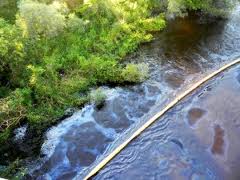 Kalamazoo River and surrounding properties.
And the reclamation? These corporations should hang their heads in utter shame. If you want to be thoroughly disgusted check out the You Tube clip I provided in an earlier post.
But here’s the really curious thing. The pipeline won’t be running through Indiana. The pipeline will not be running close to Indiana’s borders. No Indiana facilitities will have access to the pipeline. In fact, it appears that Indiana does not stand to be impacted in anyway by the Keystone pipeline and yet Governor Daniels felt compelled to call President Obama an extremist for postponing the pipeline’s construction. He was also willing to pay a $50,000+ [in state taxpayer money] to lobby for the Great State of Indiana in defense of the pipeline.
More curious still? TransCanada has stated that the pipeline will ‘increase’ oil prices for Indiana and other Midwestern residents because the area is ‘oversupplied.’ Keystone’s successful construction [this is stated in TransCanada’s application] will ensure higher prices for Canadian crude. By independent analysis costs will increase $6.55 per barrel in the Midwest and $3 per barrel everywhere else. The Indiana Petroleum Council thinks this is a swell idea.
Which begs the question: Who does Governor Daniels work for? His constituents or the oil companies?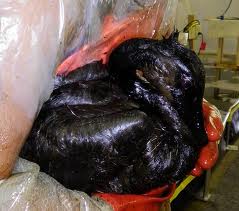
So, it should not be any great surprise that a Senate group–laughably-called bi-partisan because it includes 1 Democrat, Joe Manchin from W. Va.–is reintroducing the Keystone proposal, pushing for immediate construction with or without the Administration’s approval. The Senate committee is invoking the Commerce Clause of the Constitution, which says Congress should have the power:
To regulate Commerce with foreign Nations, and among the several States, and with the Indian Tribes.
I love it when the Republicans start waving the Constitution. It’s a clear signal they’re up to no good. Did I mention that Koch Industries stands to make a killing on this project?
While reading Representative Waxman’s letter, I recalled something I’d read in Greg Palast’s book Vultures’ Picnic and found an accompanying and equally disturbing text online here and here. To quote Palast:
Reserves are the measure of oil recoverable at a certain price. Raise the price, raise the reserve. Cut the price and the amount of oil in the ground drops. In other words, it’s a fool’s errand to measure the “amount of oil we have left.” It depends on the price.
Specifically, oil companies and oil-related financiers are not interested in expanding oil supplies to the world, particularly cheap oil supplies  [because the days of cheap oil are over]. They’re interested in feeding the hunger for oil and controlling the price around the world with an iron fist. The higher, the better. The environment—air, water, soil–is not the concern. Our health or that of our children is not the concern. The bottom line—profit and power—is all that matters. If nations collapse? The Vultures are waiting to feast on the bones.
Sound harsh? It shouldn’t. Zombies and vultures are kissing cousins. They’re coming ‘round for a friendly visit. Again.
DOD Embraces the Green Giant While Keystone XL Looks Increasingly Unattractive
Posted: January 27, 2012 Filed under: Environment, Environmental Protection, Gulf Oil Spill, health hazard, toxic waste, U.S. Military, U.S. Politics | Tags: Department of Defense, going green, Keystone Pipeline, renewable energy, tar sand oil 9 Comments Frankly, I was surprised by President Obama’s comments in his SOTU address about the Department of Defense’s solar program, a project that would not only provide energy to military installations but generate enough additional energy to supply ¾ million American households.
Well, lo and behold, this is not idle chatter.
Turns out ground has been broken on a 13.78-megawatt solar power system at the Naval Air Weapons Station at China Lake, CA. The project is expected to provide over 30% of the facility’s annual energy requirement and save an estimated $13 million in costs over the next 20 years. This is in keeping with a larger strategic plan to reduce the Defense Department’s reliance on foreign oil, shrink its annual $4 billion energy bill and ensure energy security in the event of a natural disaster or other unforeseen events [sounds ominous].
A year-long study indicated that of DOD’s huge landholdings in the Mojave and Colorado deserts, across which seven military bases in California were considered– Fort Irwin, China Lake, Chocolate Mountain, Edwards, Barstow, Twentynine Palms and El Centro—and two in Nevada [Creech and Nellis], 30,000 acres were deemed suitable acreage for solar production. Future facilities could produce 7 gigawatts of electricity. To put this in perspective that’s roughly equal to 7 nuclear power plants, sufficient to supply full electricity to the 5 California bases 30 times over, enough in excess to supply 780,000 California households.
This push for renewable energy use by the military has also been taken to the battlefield, namely Afghanistan. Last year, the 3rd Battalion 5th Marines began operating with Ground Renewable Energy Networks, Solar Portable Alternative Communications Energy Systems, LED lighting systems, Solar Shades, and Solar Light Trailers. In addition to reduced fuel savings, reports indicate that alternate energy use in remote locations decreases resupply convoy runs and subsequently the danger of IED attacks. Lives saved is a definite plus.
But there’s more. Army installations force-wide have implemented a 2020 goal of net-zero energy consumption, which means reducing energy consumption, and then producing power through renewable sources.
Kristine M. Kingery, director of the Army’s sustainability policy, said pilot installations in the program are “striving toward” goals the Army wants met by 2020. “With Net Zero, the idea is not just replace the energy with renewables,” Kingery said. “It’s the reduction, the repurposing, conservation and efficiency. Reduce usage, and replace what you are using with renewables.”
As the largest institutional energy consumer in the world, the Defense Department is providing a major infusion of funding for research and development and application of renewable energy projects, including advanced biofuels, the world’s largest rooftop solar project involving 127 bases, advanced fuel cells and advanced grid technology, just to name a few.
What I find remarkable about all this activity is how DOD’s push puts the Keystone pipeline controversy in an entirely different light.
As you may recall, the Republican objection to President Obama’s recent rejection of Keystone’s proposal was presumably all about jobs. The numbers have been wildly overstated. The State Department, at best, estimated 5000-6000 temporary construction jobs created, not the 100,000 jobs Speaker Boehner recently cited. Or the 250,000 that TransCanada finally arrived at. But more importantly, claims have been made that the pipeline would help break our dependence on foreign oil. This, too, has been proven patently false since the tar sand crude, once refined, had already been contracted for export to Latin America and Europe. Even the material for the pipeline [primarily steel] was being supplied not by American suppliers but by India.
This a classic battle–the old vs. the new. And who is leading the way? The United States Military, an institution of conservative values, has taken the bull by the horns and said: Time to move on, boys. The Era of Conservation and Renewable Energy is at hand.
There’s also the environmental impact of the pipeline, the danger of a leak, something pipeline supporters have openly mocked. What is rarely mentioned is that tar sand oil requires heat and pressure to move the sludge-like material along its 1700-mile journey from the Alberta sand fields to Texan refineries. Tar sand oil is toxic and very corrosive, making leaks far more likely.
What could happen?
Unfortunately, we’ve had a graphic example of exactly what could and did happen. In Michigan, a tar sands leak, estimated at over 800,000 gallons, polluted 30 miles of the Kalamazoo River, July 2010.
And Quelle Surprise! There was a resultant cover up.
Recall the Gulf of Mexico, BP and the environmental disaster of nightmarish proportions.
Then remember that the United States Military has clearly gotten the message and acted upon it: The Age of Fossil Fuel, the rush for Black Gold is coming to an end. The way forward financially and security-wise is colored Green.
Which would you rather see–this?
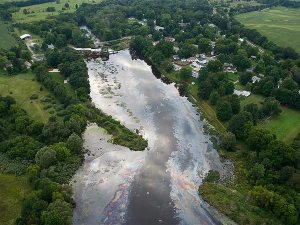
Or this?

Personally? I’ll take door number 2 and follow the generals into the future.

 peej
peej Carissa
 bostonboomer
 dakinikat
 ecocatwoman
 mablue2
 Mama Lopez
 peggysue22
 quixote
 skydancingguestblogger
 Mona (aka Wonk the Vote)



 Sky Dancing
Recent Comments