A woman sewing blue denim pants, by “Master of the Blue Jeans.”
I’m going to begin today with a story that has nothing to do with politics or current events–just because I think it’s interesting. Did you know that people wore blue jeans way back in the 16th century? I didn’t. An art exhibit will soon open in Paris that will focus on a mysterious artist, known only as “Master of the Blue Jeans.”
An exhibition centered on the “Master of the Blue Jeans” is opening in Paris this month—and the work on display is not that of Levi Strauss, founder of the eponymous clothing company, but rather a 17th-century Italian painter.
The upcoming show at Galerie Canesso features two paintings by the mysterious artist, who was active in northern Italy in the 1600s and is known only by his “master” moniker. The painter’s oil canvases depict early iterations of the stiff blue fabric beloved today, as worn by Italian peasants. According to a statement, the pieces have proved to be important artifacts in garment history, “pushing back [blue jeans’] provenance by centuries.”
Speaking with Artnet’s Vittoria Benzine, Maurizio Canesso, an art collector and the gallery’s founder, says, “People are still not very familiar with the true history of blue jeans, as they confuse it with the material made by Levi Strauss.”
In truth, Canesso argues, when the American businessman behind Levi’s jeans started selling denim work pants in the late 1800s, he merely added metal rivets and structure to a fabric that already boasted a storied European past.
“Jeans come from Genoa, while denim comes from the French city of Nîmes,” says Canesso. Blue jeans were made with perpendicular stitches in northwest Italy, while denim was woven in chevron patterns in southern France. But the key component of the fabric’s history is its coloration.
“Until the 11th century, no one could wear blue fabric because they didn’t know how to make blue color adhere,” Canesso says. “Only in the year 1000 did this begin to happen using woad leaves, and at a very high cost. The genius of the Genoese was to find the indigo stone in India and make this an industrial and therefore low-cost process.”
The ten denim-themed paintings attributed to the master were previously thought to be the work of several different artists. But in 2004, curator Gerlinde Gruber reattributed the group of artworks to a single unnamed painter then dubbed the Master of the Blue Jeans. By 2010, Canesso had acquired all of the master’s works, and he presented them in an exhibition at his Paris gallery that same year.
“Unfortunately, we have no new theories about who the Master of the Blue Jeans was,” Véronique Damian, an art historian at Galerie Canesso, tells the Observer’s Vanessa Thorpe. Evidence indicates the artist spent the bulk of his career in Italy’s northern region of Lombardy, though he may trained elsewhere.
I’m including some of the artist’s work in this post, just because.
In the more painful world of politics, Trump had a bad day in New York yesterday, and he got some bad news in India; but he got some gifts from judges in Florida and Georgia.
As I’m sure you’re aware, Stormy Daniels testified in Trump’s hush money case yesterday.
Stormy Daniels, the adult-film actress at the center of Donald Trump’s hush money trial, testified Tuesday about a disturbing sexual encounter she says she had with him, leading to angry, profane muttering from the former president that alarmed the judge.
New York Supreme Court Justice Juan Merchan called Trump’s lawyer Todd Blancheto a sidebar during a midday break to say that Trumpwas “cursing audibly” and possibly intimidating Daniels, who had begun testifying, according to a trial transcript.
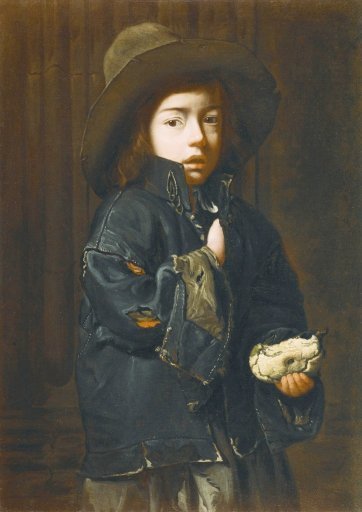
Beggar Boy with a Piece of Pie (wearing a denim jacket)
“I understand that your client is upset at this point,” Merchan said to the defense attorney,according to the transcript,“but he is cursing audibly and he is shaking his headvisually and that’s contemptuous. It has the potential to intimidate the witness and the jury can see that.”
Blanche assured the judge he would speak to Trump.
“I am speaking to you here at the bench because I don’t want to embarrass him,” Merchan said. “You need to speak to him. I won’t tolerate that.”
The exchange punctuated a day of rage — sometimes whispered from the defense table, sometimes declared loudly by Daniels from the witness stand.
It was one of several surreal moments on the 13th day of the first criminal trial of a former U.S. president, including descriptions by Daniels of their alleged sexual encounter in 2006 that were so detailed that defense attorneys demanded a mistrial.
While Merchan rejected their request, Daniels at times seemed to be describing nonconsensual sex that could be considered highly prejudicial for the jury, which in turn could give Trump — the presumptive Republican presidential nominee — solid grounds to appeal if he is found guilty.
It sounds like the sex actually was nonconsensual though. Daniels’ description of what happened sounds very much like a date rape situation in which she was taken advantage of by a much older and more powerful man. She was 27. He was 60. He was much taller and stronger. She was invited for dinner, but there was no dinner. When she was ready to leave, she went to the bathroom. When she came back, he was on the bed in boxers. She tried to leave, but he blocked the door. This description is from Harry Litman on Twitter:
thought time to go. when opened the bathroom door, Trump had come in and was on the bed, in boxer shirts and a t-shirt. she was startled. felt like room spun in full motion. blood leaves my hands and feet. “ohmygod — what did I miss to get here?” she laughed nervously
The next thing I knew I was on the bed. opposite side of bed. missionary position. objection – sustained
I blacked out. but I was not drugged in any way, no alcohol. didn’t feel threatened physically “There was an imbalance of power for sure. but I was not threatened verbally or physically”
Had sex with him on the bed. Merchan sustaining objections to details. Staring at ceiling didn’t know how I got there. sustained. stricken touch his skin? objection sustained. he wasn’t wearing a condom. concerning to her but didn’t say anything.
sex was brief. remembers getting dressed. sitting on edge of bed, noticed completely dark outside. hard to get shoes on, hands shaking so hard. DJT: “oh it’s great, let’s get together again honey bunch.” I just wanted to leave. DVD she signed was on nightstand.
DJT: “We have to get together again soon” “we were so fantastic together. talked about the show” I just left as fast as I could. Didn’t express any concern about Melania. or mention her. didn’t have dinner. took cab back to hotel.
I felt ashamed I didn’t stop the sex so I didn’t tell many people about it. Remembered some additional details later. Merchan very stern about level of detail — wants to keep it spare.
It’s pretty clear from Daniels’ description that she was traumatized. I doubt if the judge understands that, but maybe some jurors will. Just because she is a porn actress doesn’t mean she can’t be raped. Her description is also reminiscent of E. Jean Carroll’s experience–Trump lifted her up against the wall and grabbed her genitals before she realized what was happening. It’s also reminisce of his own description in the Access Hollywood tape–how he can grab women “by the pussy. If you’re a star they let you do it.”
Daniels matters for reasons outside of the courtroom and the specifics of this hush-money trial. Daniels’ story is yet another reminder of what may prove to be Trump’s electoral downfall: His bottomless misogyny.
On the witness stand, Daniels reportedly spoke quickly and was apparently quite nervous. Initially, her story of meeting Trump sounded funny. She painted him as a pathetic older man trying — and failing — to impress the younger woman. When he first asked her to dinner, she replied “no,” but with an expletive. Her publicist eventually talked her into it, hoping Daniels could leverage the connection into a spot on “The Apprentice.” In his hotel room, she described him wearing “silk or satin” pajamas and asked him to put on real clothes. He allegedly used the “don’t even sleep in the same room” line when she asked about his wife, Melania, who had recently had a baby. Daniels described Trump as “pompous” and “arrogant.” She recounted how she jokingly spanked him with a magazine, hoping to tease him into being less of a jerk.
Then the tone of her story changed, as she described how they came to have sex. Trump waited until she was in the bathroom, Daniels said, and then he stripped down to boxer shorts and a T-shirt. “The room spun in slow motion,” she recalled on the witness stand. When she made for the door, “he was bigger and blocking the way,” she said of Trump. She denied it was sexual assault, however, because “I was not threatened either verbally or physically.” [….]
Whether or not Trump’s sexual encounter with Daniels was consensual in the legal sense, she describes it as unwanted.
“I didn’t say anything at all,” she told the court repeatedly. Claiming that she “blacked out” during the encounter, afterward, Daniels said, “my hands were shaking so hard” and “I felt ashamed that I didn’t stop it and that I didn’t say ‘No.'”
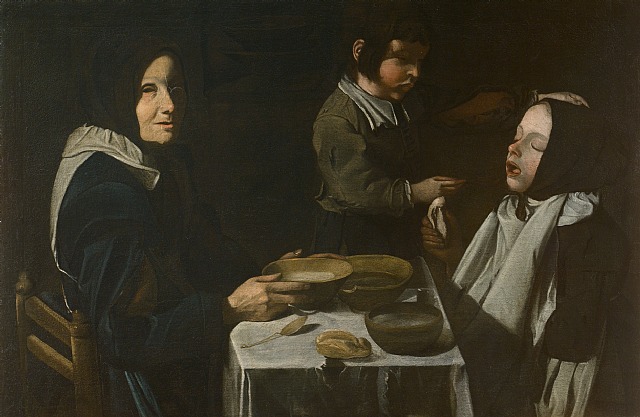
Another painting by Master of the Blue Jeans
A person doesn’t have to be threatened in order for sex to be nonconsensual. Back to Marcotte’s piece:
Since the release of the “Access Hollywood” video in 2016, in which Trump can be heard bragging about sexual assault, the Beltway media has repeatedly tried to move on from the story of Trump’s legion of issues with women. Indeed, when Carroll’s accusations first came out in 2019, the press barely paid any mind. But the story of his rampant misogyny has never fully gone away. There was the Women’s March that overshadowed his 2017 inauguration. Then the over two dozen women who stepped forward with stories of being subject to the sexual harassment and assault Trump himself described so vividly. Trump, of course, is more responsible than any other person on the planet for the overturn of Roe v. Wade and the stampede of Republican state legislators banning abortion. He promised to stack the Supreme Court with anti-choice justices, and his three appointees provided the votes necessary in Dobbs v. Jackson Women’s Health, which ended the legal right to abortion. While Trump has tried to make moderate-sounding noises on this issue, he keeps inadvertently revealing his anti-choice radicalism. In a recent Time interview, for instance, he indicated that he’s fine if states “monitor women’s pregnancies so they can know if they’ve gotten an abortion.”
On the stand, Daniels provided ugly details about how Trump treated her, and about how Trump treats, and views, women. These insights are notable, but they’re not new. In 2016, leaked audio of Trump making grotesque and sexist comments about women to Access Hollywood host Billy Bush almost derailed his presidential campaign. Last year, Trump was held liable for sexual assaulting and then repeatedly defaming advice columnist E. Jean Carroll.
But Daniels’s testimony is a reminder that contempt and mistreatment of women is a core theme of Trump’s life and politics. Both the press and Democratic opponents have struggled to make this issue central to 2024, even though abortion rights and women’s health care are the key issues of the campaign. It’s unclear whether the trial will spark more reporting and discussion of Trump’s treatment of and attitudes about women. But it should….
Daniels’s testimony is intended to establish the background facts of the payment. It also, though, paints Trump as a liar, a bully, and a sexual manipulator. Daniels said while she was in Trump’s hotel room, she went to the bathroom, and when he came out he was in his boxer shorts, a moment Daniels describes as “like a jump scare.” She said, “the room spun in slow motion” and she realized “I’ve put myself in this bad situation.”
Daniels is careful to emphasize that Trump did not physically coerce her. He did, however, according to Daniels, suggest that if she cooperated with him he could help her career through his connections and a possible appearance on the Celebrity Apprentice reality show, where Trump was the star. She eventually agreed to have sex even though Trump did not use a condom — she was adamant about using condoms in her adult film shoots.
By Master of the Blue Jeans.
She testified that during sex she stared at the ceiling and tried to think of something else, and afterwards she had trouble dressing because her hands were shaking. She said, “I felt ashamed that I didn’t stop it and that I didn’t say no.”
Daniels kept in touch with Trump for some time because he was still offering her the chance to appear on Celebrity Apprentice, which would have been a huge mainstream boost to her career. She met with Trump once more in Los Angeles, at which point “he kept trying to make sexual advances, putting his hand on my leg, scooting closer.” She rebuffed him, and in a later phone call he admitted he was not going to put her on his television show. At that point she ceased communicating with him.
Again, Daniels has not accused Trump of sexual harassment or violence, and she says their encounter was consensual. Her testimony makes clear, though, that Trump was pressuring her for sex in return for business opportunities — a variation on the ugly tradition of the Hollywood casting couch. We don’t know if Trump ever had any intention of keeping his promises or of helping Daniels. But whether he did or not, his actions as she describes them were sleazy at best, and she found the experience painful and traumatic enough to leave her literally shaking.
The encounter doesn’t sound consensual to me. As I said above, it sounds like date rape.
The judge presiding over Donald Trump’s criminal case in Florida — on charges that he hoarded classified secrets at his Mar-a-Lago estate after his presidency — has indefinitely postponed the trial, once scheduled for May 20.
The date had been widely expected to move amid a tangle of pretrial conflicts between special counsel Jack Smith and Trump’s attorneys. Smith had urged Judge Aileen Cannon to reschedule the trial to begin on July 8, but an order from the judge on Tuesday afternoon suggested that she is unlikely to even decide on a new trial date before late July.
Cannon, a Trump appointee who took the bench in late 2020, indicated in the order that, before setting a new trial date, she intends to resolve the backlog of other issues in the case that have piled up on her plate. Smith’s defenders have criticized Cannon for what they see as a plodding pace in resolving pretrial matters, and tensions between the special counsel and the judge have flared in recent months over a series of puzzling rulings that threatened to derail the case.
“[F]inalization of a trial date at this juncture — before resolution of the myriad and interconnected pre-trial and [classified evidence] issues … would be imprudent and inconsistent with the Court’s duty to fully and fairly consider the various pending pre-trial motions,” Cannon wrote in the five-page order.
That reshuffling further clouds the picture for Smith, who is also awaiting a Supreme Court ruling on presidential immunity that could determine whether his other case against Trump — charges in Washington D.C. for attempting to subvert the 2020 election — can move forward this year….
Trump has sought to delay all of his criminal cases until after this year’s election. If he wins, he could shut down the two federal cases brought by Smith, and the state cases in New York and Georgia also might have to be frozen.
The Georgia Court of Appeals on Wednesday decided to hear an appeal of a judge’s ruling allowing District Attorney Fani Willis to remain at the helm of Fulton County’s election interference case against former President Donald Trump.
The court’s decision almost certainly means a significant delay of a trial here for Trump and his 14 co-defendants and signals that Willis’ leadership role isn’t guaranteed. It is unclear how long the appeals court will take to decide the issue but they are not known for moving swiftly.
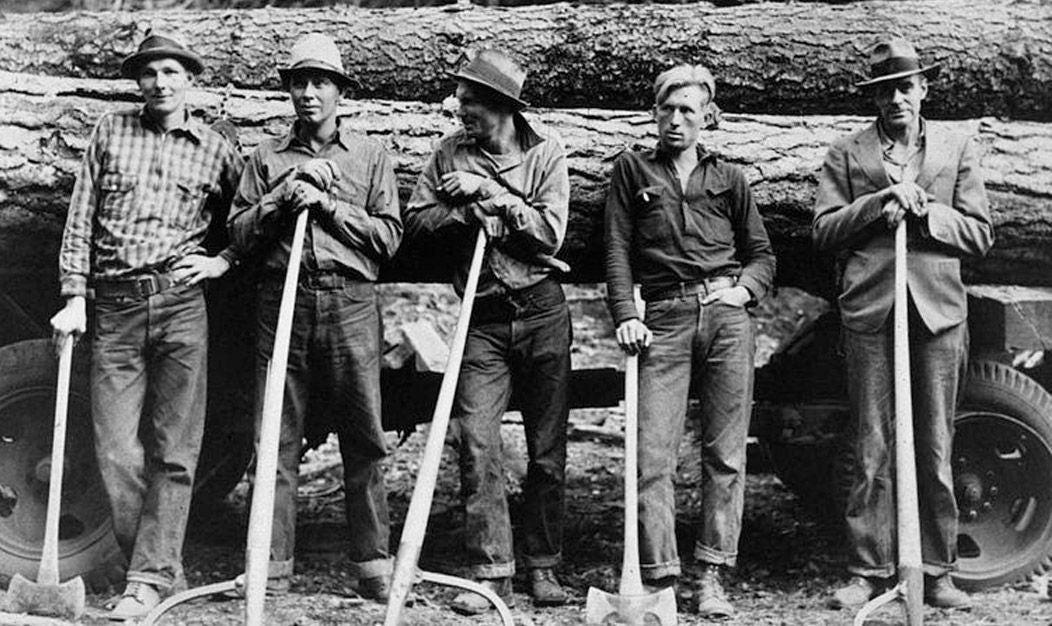
Farmers wearing jeans, 1930s
“There’s no way this case gets to trial this year,” said Atlanta defense attorney Andrew Fleischman, who is closing following the case. “I would expect the appeals court to issue its opinion some time next year.”
On March 29, Superior Court Judge Scott McAfee issued a “certificate of immediate review,” which allowed the defendants to appeal his ruling to the Georgia Court of Appeals before a trial begins.
Under Appeals Court rules, such a pretrial — or interlocutory — appeal is typically assigned to a three-judge screening panel. And all it takes is for one of those judges to decide whether the court accepts the appeal. The court’s order one-page order did not divulge which judge voted to grant the application.
In his order granting the pre-trial review, McAfee said he will continue working on the case, resolving pending motions, while the appeals court takes up the removal issue.
The bad news for Trump is that he is losing a significant percentage of Republican voters in the primaries, which are still going on. Niki Haley is still getting votes. Adam Wren and Madison Fernandez at Politico: Unexpected warning signs for Trump in busy Indiana primary.
In 2016, Indiana put Donald Trump on the doorstep of the GOP presidential nomination. But eight years later, the state he called “Importantville” delivered his campaign some flashing red warning signs as Nikki Haley cleaned up in the suburbs.
By virtue of its late-in-the-nominating-calendar primary, the Hoosier state has always occupied a unique and occasionally powerful perch to make or break candidacies: Sen. Ted Cruz and then-Ohio Gov. John Kasich dropped out immediately after Trump’s victory that year. But the barn-red state also often acts as a pace car for Republicans nationally.
And in a primary that saw a record-breaking $98 million splash across the state, according to AdImpact, Tuesday was no exception.
A zombie Haley candidacy continued to punch above its weight in the Trumpiest of states: The former South Carolina governor is on track to break 20 percent for the first time since she dropped out of the race two months ago.
Read more at the link.
I don’t know if you’ve been following the reporting about New York Times editor Joe Kahn and his pathetic explanations for why his paper seems to be rooting for another Trump presidency.
Joe Kahn, after two years in charge of the New York Times newsroom, has learned nothing.
He had an extraordinary opportunity, upon taking over from Dean Baquet, to right the ship: to recognize that the Times was not warning sufficiently of the threat to democracy presented by a second Trump presidency.
But to Kahn, democracy is a partisan issue and he’s not taking sides. He made that clear in an interview with obsequious former employee Ben Smith, now the editor of Semafor.
Kahn accused those of us asking the Times to do better of wanting it to be a house organ of the Democratic party:
To say that the threats of democracy are so great that the media is going to abandon its central role as a source of impartial information to help people vote — that’s essentially saying that the news media should become a propaganda arm for a single candidate, because we prefer that candidate’s agenda.
But critics like me aren’t asking the Times to abandon its independence. We’re asking the Times to recognize that it isn’t living up to its own standards of truth-telling and independence when it obfuscates the stakes of the 2024 election, covers up for Trump’s derangement, and goes out of its way to make Biden look weak.
And to the extent that Kahn has changed anything in the Times newsroom since Baquet left, it’s to double down on a form of objectivity that favors the comfortable-white-male perspective and considers anything else little more than hysteria.
Throwing Baquet under the bus, Kahn called the summer of the Black Lives Matter protests “an extreme moment” during which the Times lost its way.
“I think we’ve learned from it. I think we found our footing after that,” he said.
I translate that to mean that the old guard has reasserted total control over the rabble.
Read the rest at Press Watch.
I’ll wrap this up with a couple of creepy stories about Robert Kennedy Jr.
In 2010, Robert F. Kennedy Jr. was experiencing memory loss and mental fogginess so severe that a friend grew concerned he might have a brain tumor. Mr. Kennedy said he consulted several of the country’s top neurologists, many of whom had either treated or spoken to his uncle, Senator Edward M. Kennedy, before his death the previous year of brain cancer.
Several doctors noticed a dark spot on the younger Mr. Kennedy’s brain scans and concluded that he had a tumor, he said in a 2012 deposition reviewed by The New York Times. Mr. Kennedy was immediately scheduled for a procedure at Duke University Medical Center by the same surgeon who had operated on his uncle, he said.
While packing for the trip, he said, he received a call from a doctor at NewYork-Presbyterian Hospital who had a different opinion: Mr. Kennedy, he believed, had a dead parasite in his head.
The doctor believed that the abnormality seen on his scans “was caused by a worm that got into my brain and ate a portion of it and then died,” Mr. Kennedy said in the deposition.
Gross. Maybe that explains some of his weird ideas?
A right-wing social media influencer hired by Robert F. Kennedy Jr.’s presidential campaign who previously said Jan. 6 was “Democrat misdirection” appears to have himself been on the restricted grounds of the U.S. Capitol during the attack.
Marilyn Monroe in blue jeans
NBC News first reported that Kennedy’s campaign hired Zach Henry’s firm, Total Virality, for “influencer engagement” in March. Henry had worked as deputy communications director for Republican Vivek Ramaswamy’s presidential campaign, as well as for Blake Masters during his Senate run in Arizona.
Henry, as NBC News reported, had posted that Jan. 6 was “no MAGA insurrection Just more Democrat misdirection” and appears to have embraced conspiracy theories about the Capitol attack, including posting that “antifa” was behind it, which is false.
But photos and videos uncovered by NBC News and online “sedition hunters,” who have aided the FBI in hundreds of cases against Capitol rioters, appear to show Henry among the mob outside the Capitol on Jan. 6, 2021, beyond the previously established police lines, although it is unclear whether any of the barricades and “restricted” signs remained by the time he arrived.
There is no indication that Henry entered the Capitol or that he engaged in assaults on police officers or in destruction of property. Federal prosecutors have almost entirely focused their resources on Jan. 6 participants who either went inside the building or committed violence or destruction outside it, so there is little chance that Henry would be charged; the few nonviolent Jan. 6 defendants who were charged solely for going on restricted Capitol grounds were generally charged with misdemeanors.
But Henry’s presence on Capitol grounds would be significant given his previous social media posts about Jan. 6 and his new position on Kennedy’s campaign as Kennedy runs for president as an independent against former President Donald Trump.
That’s it for me today. What stories have you been following?
Did you like this post? Please share it with your friends:
Upcoming in the Contemporary Arts arena is the Istanbul Biennial. It may be an interesting event to watch, so I thought a little background on events preceding it might be useful given the recent unrest in Turkey. Some general information about the event:
The Wikipedia entry looks like its mostly lifted from the History tab on the Biennial website (see below). Click on the Curator’s tab to learn more about 13th Biennial’s curator, Fulya Erdmeci, her name will come up in later links:
The 13th Istanbul Biennial will be held between September 14 and November 10, 2013, with Fulya Erdemci as the curator and Bige Örer as the director. This year’s conceptual framework takes its name from one of poet Lale Müldür’s books: “Mom, am I barbarian?” The focal point of the biennial – which is sponsored by Koç Holding, one of the biggest holdings of the country – will be the notion of the public domain as a political forum. (İstanbul Foundation for Culture and Arts (İKSV) had a sponsorship agreement with Koç Holding to support five editions of the Istanbul Biennial over ten years, from 2006 through 2016.) The fact that a biennial with the aim to bring urban transformation policies to the table is being sponsored by Koç Holding became a topic of discussion once the conceptual framework was revealed.
The New Contemporary article is a good read for background on the Turkish Summer, analogue of sorts to the Arab Spring. The Biennial protests staged by independent Turkish artists, immediately preceded the Gezi Park movement. While Gezi Park/Taksim Square quickly evolved and then escalated into something significantly more awesome, initially its agenda was the one articulated by the Biennial protestors. And the Gezi Park movement never seemed to lose the essential artistic aspect, the “sophisticated populism” that characterized the Biennial Resistance. With the added intensity of the Turkish government’s response to it, the Gezi movement morphed into a massive and severe indictment of Turkish governance. It is as if the entire nation convulsed in attempt to challenge the relevance of conservative governance for a nation grappling with modernity. But it was the Biennial protests, I think, that really set the stage for the “sophisticated populism” that energized Turkey. http://thenewcontemporary.com/2013/06/06/turkish-protests-reach-art-scene/
I don’t know what I would call this other than “sophisticated populism.” It seems to be a similar spirit that energized the Gezi resistance:
The protestors wore t-shirts that said “Waiting for Barbarians,” turning their backs to show the writing, and read C. P. Cavafy’s poem “Waiting for the barbarians.” The aim was to counter Lale Müldür’s poem “Mom, am I a barbarian?” with another poem. The aim of the group is to show the economic power domain of urban transformation, according to the written statement.
The Cathedral of Hagia Sophia, “Holy Wisdom;” Istanbul
Although the events that transpired over the summer at Taksim Square are likely well known, I’m including a few summaries for those who may have not kept up with it. I didn’t keep on top of it as it unfolded, but will have my eye on Istanbul this fall to see how the Biennial pans out. The following is a brief retrospective.
The following is a good read, but I take issue with this frame:
If you have been reading international news about the protests that started in Istanbul and have spread across Turkey, you may be under the false impression that this is an ideological battle between a secular piece of society and an Islamist Prime Minister Recep Tayyip Erdoğan, sparked by an insignificant event, the occupation of a city park. But the role of space in these outbreaks cannot be underestimated. As part of a project that would pedestrianize Taksim, Istanbul’s main square, the adjacent Gezi Park was to be demolished to build an Ottoman-via-Las Vegas Mall. The protest was an effort to save a park by occupying that very park; it was not a symbolic or ideological demonstration like the Occupy Wall Street movements, but a primal struggle between human bodies and bulldozers, that made the political discourse all the more potent.
I include the Penn Guide and the following short documentaries because I’ve taken offense to the hyperbolic slinging of the term “police state” currently steamrolling the media in reference to the U.S government. Police state rhetoric more often than not derives from the fear-inducing fringe that can’t bear the idea of American espionage and can’t quite grasp that Freedom of the Press is like every other right – subject to restriction. Associating the American apparatus for handling crime-terrorism to a police state only demeans the experiences of people in legitimate struggle against an institutionally oppressive police state. Also, to stimulate thought on the proper parallels between liberty infringement – the right to peaceable assembly and, of course, free speech.
A short film produced by OccupyGezi:
The video embedded in the following link is a bit lengthy, but well worth watching. Note the gas mask graphic in the Roar editorial – probably one of the most striking images of political art I’ve seen in a long time. I’m struck by its “realistic symbolism.” By that I mean this isn’t metaphorical or hyperbolic imagery – wearing of gas masks was a reality for the Gezi Park protestors. There is brief mention in the video of how the movement embraced humor and its opponent’s critique as a tool of identity and resistance. I draw attention to it because I think it is another example of what I previously termed “sophisticated populism.”
Turkey has been home or host to some of the most sophisticated and oldest civilizations the world has ever known. Its unique geographical position facilitated an extraordinary tradition of multiculturalism all throughout ancient times. The Antikythera Device, for instance was probably derived and constructed in the great library city of Pergamum.
AntiKythera Mechanism
Whether it be known as Anatolia, Caria, Lycia, Lydia, the Land of the Hatti… what is now Turkey holds a special fascination for me. I find it ironic and a sad commentary that a land once the epicenter of global cross-culturalism is now on the vanguard of rejecting the predatory globalization which threatens all cultural heritage everywhere.
I’ll end with one final link that doesn’t speak to the events noted here directly, but is a marvelous illustration of Turkey’s current struggle to reach modernity – another irony given its ultra-sophisticated heritage in the Ancient world. The following is a Turkish film from 2011 and deserving as wide an audience as it can find entitled, Once Upon a Time in Anatolia. It isn’t an American-paced movie by any stretch of the imagination. Appreciating it definitely requires patience. I watched it three times because of all that was woven into it. I’ll not say more than that for fear of spoiling the experience. Here’s the IMDb link for reference:
Peculiar news from faraway environs cheers my soul. In part, I like “every-now-and-again” updates from places I’ve been; in part because it keeps my vision of globalization alive.
My idea of globalization is one where individuals rather than corporations interact, where individuals move freely about the globe doing whatever it is that people do for enhancing quality and meaning in their lives.
I think this is imperative for the development of the mind. Nothing broadens the mind more than removing oneself from one’s own culture. In my view, doing so is one critical step in the development of empathy – the ability to view others (and what others value) from their own perspectives. In other words, to understand people as they understand themselves.
I can’t remember a time when I didn’t value this idea, long before the term globalization pertaining to “free market” economics began seeping into our national vocabulary. I have a love-hate relationship with this term because for starters, I do not adhere to the economic rationale behind it. I find globalization as it has evolved more harmful than not to every corner of the world. Moreover, globalization divides people more than it unites which is antithetical to my own personal definition of globalization.
When I encounter discussions of globalization, a tiny bit of hope lodged somewhere in my being surfaces, spurred by my private vision of globalization where people engage with each other thereby dismantling walls of fear erected against those who are “different” or “foreign.” Something inside tells me globalization still means what I think it should mean, it simply hasn’t happened yet. Though in some sense, when I read about globalization I feel as if my vision of ubiquitous multicultural interaction has been pilfered. I feel robbed and hopeful both at the same time. A few “every-now-and-again” updates….
Little wrenches my gut more than loss or damage to world cultural heritage. You’ll soon learn, good readers, this is a theme to which I will often return. In Florence, we have the humiliation, yet again, of an American boor unaware of how to properly conduct himself in the world. There’s a reason Americans are regarded with low esteem world wide – as arrogant “bulls in a china shop” with respect to etiquette, certainly, but here we have incomprehensible cloddery clearly manifesting itself. I cannot fathom why, if this person had legitimate purpose for measuring the statue, he did not contact the curatorial staff and simply inquire, “Hey. What’s the length of the Virgin’s pinky finger?” These are the moments I shake my bony little fists in the air and grumble, “What the hell is wrong with you people?”
On a more inspiring note: a small fire, and fifty small bats who will live happily ever after:
This story warms my heart. I’ve had the pleasure of strolling through St. Fagan’s; it’s charming. While the rescue of bats at St. Fagan’s may be entirely inconsequential to my life, I firmly believe human beings should frequently indulge in the inconsequential. It’s good for the spirit.
More on Wales: Hay-on-Wye, the Town of Books. It’s a little village on the border between England and Wales, crammed with art galleries and antiquarian bookshops. It boasts some good pubs, yet I think a pint in Hay is a little pricey. It hosts a massive literary festival, not a good time to go to Hay, they say, unless you plan to be there expressly for the book festival. It’s near impossible to find any vacancies at a bed and breakfast as these are usually booked a couple of years in advance. I didn’t visit during the festival, and I’d probably prefer Hay when it’s quiet, actually. Still, it’s a cool thing, an overview from the British Council:
What I didn’t know about Hay… and what I find absolutely exciting… and how I envision globalization…. is Hay’s sponsorship of the Storymoja Hay Festival in Nairobi, now in its fifth year. Apparently, I’ve been out of it. Last year, the Strorymoja Festival held its inaugural Wangari Maathai Lecture. This year’s festival happens in September:
News from my little spot on the globe: An unheard-of, never-before pattern has begun to emerge. I’ve lost two games of scrabble in the last two weeks against my weekly opponent and spousal unit, affectionately known as Minos by she-who-loves-him-most. In my own defense, I do recall one of my linked words was not properly scored, in which case the final score of 327-325 would have actually resulted in a tie, 327-327. For the record, he always keeps score.
And that’s all she wrote… 🙂
What’s happening in your part of the world?
Did you like this post? Please share it with your friends:
Here in the Fitzwalkerstan, epicenter of the NeoConfederate North, we live the good life by clinging to a barbarian code not unlike that of this famous thief: Conan, what is the best in life (see video below).
At one time, we were known as the home of Progressivism, then we were Wisconsin. But since 2010 we’ve acquired a new character and a new appellation: Fitzwalkerstan.
Our new name is an affectionate conjunction referencing the subsumption of our state by simulacrum Scott Walker, mimicking a Governor, aided by his aping sibling-minions, the Fitzgerald brothers: Scott, State Senate Majority Leader and Jeff, Speaker of the Assembly. After a failed U.S. Senate bid, losing out to Tammy Baldwin, Jeff has since left the Assembly – sort of. He’s now a state lobbyist for American Traffic Solutions. We all miss him. We miss the bare fisted nepotism when Walker had the Fitzgerald brothers heading up both branches of the state legislature, gumming up the government and retooling it for their own ends.
Jeff’s departure for the revolving door didn’t diminish the pace or the agenda, however. Scott Walker has since run rough shod over what was once Wisconsin. Given he spends more time out of state than in, it’s kind of crazy that he can get so much done. But where there’s a will there’s a way as they say. Cognitive Dissidence, one our local blogs recently compiled a short list of Walker’s achievements:
Not only being John Doe and using his county staff to help run his campaign, but actively taking a role in having his campaign do a cover up regarding the death of a fifteen year old boy.
I would assume that the protests which erupted in Madison, our state capitol, and the subsequent Lincoln-like flight of our Democratic legislators escaped no one’s attention in 2011. These are the events that put Scott Walker, the Rock Star, on the map. His celebrity status may have faded a little bit by now, but it had just erupted in February of 2011 when he “dropped the bomb” by unleashing the union-busting atrocity known as Act 10. And a rock star he was, indeed, at the Tea Party Patriots American Policy Summit, occurring ever so fortuitously at the end of February. But no one paid attention to that event despite Scott Walker being a gushed at guest speaker. I believe I alluded to the summit in a comment at one point, and I believe I also pasted the poem I wrote in response to it. I mention it again because Dakinikat wisely warned us that what happens in Louisiana can happen anywhere. Right she was.
The Tea Party Patriots American Policy Summit occurred over a three day period. I did not attend. I did watch the majority of it piece meal when the Tea Party Patriots still had the stream posted on their website. It was painful. It was ghastly. But it was worth it. By the end of that terrible weekend, the summit had outlined every nasty maneuver the GOP has initiated during their reign of terror in DC and in statehouses across the country. From hostage politics, shut-downs, voter disenfranchisement, the war on women… all laid out in its hideous glory. A grand strategy with a tactical mechanism to make it happen at every level of government. I’ve watched the goals of that summit play out over the last two years in my state, many others, and certainly in DC. Walker and Jindal operate from the same playbook reflecting the strategy laid out at the Tea Party summit in 2011.
The Cognitive Dissidence post begins by referencing Mike Tate, chair of the Wisconsin Democratic Party. Tate has adopted Howard Dean’s 50 state-strategy, and is applying it to our 72 counties. I hope it will work. When I think on the Dean strategy I think more of the South than I do our NeoConfederate North. Perhaps this is the strategy that can turn the South from red to blue? This is probably a topic that has received coverage already, but if anyone could speak to it now, I’d be extremely interested in a discussion about Southern political dynamics, also bruising the Red West until it is a lovely shade of blue or blue-green.
Digression alert: Blue-green is sacred to Wadjet, Ancient Goddess of Lower Egypt. No Egyptian deities had names that could ever be uttered, so no one knows their true names. Wadjet, the epithet and the color refer to the color of papyrus hence her epithet, Wadjet, means Papyrus-Colored One. That’s a digression which hasn’t anything at all to do with shifting political landscapes, I mentioned it because blue-green always reminds me of the Wadjet color, and I think Wadjet is pretty groovy, and I think I want my own epithet. Maybe She-Who-Digresses would be fitting.
Now might be a good time to explain the photos. They are part of a series of photographs I call “Dying Camellias.” Though, they’re not camellias. They’re peonies. I photographed thousands over 2 seasons during various stages of decay. I love the decay process, and peonies have an exceptionally bizarre decay process. I include them because this post is about the process of decay.
We see it in my state inflicted by Scott Walker and the Wisconsin GOP. But Walker really can’t muster an original thought in his head. He hasn’t the capacity for complex thought let alone strategy. He dropped out of college or was kicked out for substandard performance; he doesn’t speak about it so no one knows which is the more accurate.
He’s one of the most inarticulate politicians ever, yet his predigested talking points, no matter how inarticulately executed, work phenomenally well. And they get regurgitated by the populace. It’s an astounding phenomenon to observe. Yet, he has improved due to what I suspect is the same grooming Paul Ryan received for the presidential stage. I think that polish has a distinct cast recognizable as the Koch-sheen.
I believe Walker’s talking points take on the same gleam, and his obfuscating rhetoric succeeds because he speaks the secret language of conservative dog whistles, a language any conservative anywhere in the U.S. would hear. Those are the dog whistles of the right wing political machine that is moving across the land. It’s the same machine that has groomed Scott Walker from an utter buffoon to a skillful politician and the very same cookie-cutter homogenization juggernaut steamrolling over all 50 states. It is as coordinated an effort as it gets. It is, itself, a process of national decay fueled by regression.
The strategy – the Tea Party strategy – is fusing the Libertarian and Evangelical wings of the Right. In the long run, I don’t think that strategy will work, these two factions aren’t natural allies. I think we can already see the bonds decaying between more traditional Conservatives like Chris Christie and Libertarian wingnuts like Rand Paul. Yet, to use an appropriate epithet – the Political-Machine-That-Festers will initiate long-term rot if the rot machine continues unabated. The pace of rot since the 2010 sweep, no doubt, indicates the desire to do as much agenda-cementing as fast as possible prior to their demographic death. On that note, hear hear to a little festering! Let the beauty of decay begin!
Speaking of swindlers and shenanigans, I love this:
Should exceptionally executed forgeries have a value all their own? How much should an artists’ name affect the worth of a work?
Also on the art front: one who doesn’t seem in decline or decay is Yoko Ono, whose diverse art platforms spanning fifty years of expression went on display at Louisiana’s Museum of Modern Art in June. The exhibit, commemorating Yoko’s 80th birthday, runs until September 29. Should any of our Southern Sky Dancing sisters make their way to the exhibit, I should very much like a review! Admittedly, I’ve never concluded an aesthetic opinion on Yoko Ono’s work. At the same time, one can’t deny she is a dynamic woman worthy of a level of respect she has not perhaps received in decades past, yet absolutely deserving of mention in a post about decay – she’s weathering her withering well.
The Sky Dancing banner headline uses a snippet from a work by artist Tashi Mannox called 'Rainbow Study'. The work is described as a" study of typical Tibetan rainbow clouds, that feature in Thanka painting, temple decoration and silk brocades". dakinikat was immediately drawn to the image when trying to find stylized Tibetan Clouds to represent Sky Dancing. It is probably because Tashi's practice is similar to her own. His updated take on the clouds that fill the collection of traditional thankas is quite special.
You can find his work at his website by clicking on his logo below. He is also a calligraphy artist that uses important vajrayana syllables. We encourage you to visit his on line studio.







 peej
peej Carissa
 bostonboomer
 dakinikat
 ecocatwoman
 mablue2
 Mama Lopez
 peggysue22
 quixote
 skydancingguestblogger
 Mona (aka Wonk the Vote)



 Sky Dancing
Recent Comments