
Monday Reads
Posted: March 21, 2011 Filed under: collective bargaining, Economy, Farming, financial institutions, Foreign Affairs, Global Financial Crisis, Gulf Oil Spill, Japan, Libya | Tags: bubbles, Fukushima, ghadafi, greenspan, oil spill, recovery, REITS 57 Comments Good Morning!
I’m finishing up a paper today that’s off to be published on Real Estate Investment Trusts (REITS). Don’t worry! I won’t bore you with the details but it’s basically about locating speculation bubbles like the one that happened in real estate markets in the 2000s. There were a lot of folks that made money off of that ride although most of us little guys lost a lot. The reason I’m bringing it up is that my first read of the day is a Paul Krugman response to Allan Greenspan’s critique of Obama’s economic policy. I just wanted to remind you of what a mess the first part of the century has been and that many of the pots and the kettles still appear to be confused about their true nature. I mean, the entire mess has given me a great research agenda, but at what cost?
Greenspan’s tut tuts Obama’s ability to create economic chaos in the academic journal International Finance (pdf here). While most of us are still trying to figure out what went so horribly wrong, Greenspan is trying to pin the blame on the new guys. I’m going to quote his abstract because it’s just more of the same old same old from one of the beasts that brought us to this mess and its worth the bask in the arrogance to just remember his access to power. Greenspan says it’s too much government regulation and Obma activism that’s hampering the recovery and that he can prove it with bad, outdated statistical methods. This comes from the man that gave Wall Street a lot of cheap money and no regulation so they could go hog wild. The recovery may be tepid, the stock market may be recovering, but I’ll be damned if there’s any regulation left standing upon which he can float his argument. Oh, Krugman dismisses the methods by which Greenspan infers that it’s government activism and its inherent chaos that’s created a stale recovery. To be honest, a first year doctoral student would use better methodology and know the literature better. That really scares me, frankly. What did he do while at the Fed? Reread The Fountainhead?
So, here’s the bubblemeister’s blowing you know what up you know where with techniques that wouldn’t get me published in a mimeographed neighborhood newsletter let alone International Finance. Why hasn’t this man retired to an island somewhere?
The US recovery from the 2008 financial and economic crisis has been disappointingly tepid. What is most notable in sifting through the variables that might conceivably account for the lacklustre rebound in
GDP growth and the persistence of high unemployment is the unusually low level of corporate illiquid long-term fixed asset investment. As a share of corporate liquid cash flow, it is at its lowest level since 1940.This contrasts starkly with the robust recovery in the markets for liquid corporate securities. What, then, accounts for this exceptionally elevated level of illiquidity aversion? I break down the broad potential sources, and analyse them with standard regression techniques. I infer that a minimum of half and possibly as much as three-fourths of the effect can be explained by the shock of vastly greater uncertainties embedded in the competitive, regulatory and financial environments faced by businesses since the collapse of Lehman Brothers, deriving from the surge in government activism. This explanation is buttressed by comparison with similar conundrums experienced during the 1930s. I conclude that the current government activism is hampering what should be a broadbased robust economic recovery, driven in significant part by the positive wealth effect of a buoyant U.S. and global stock market.
So, here’s Paul Krugman with ‘Rantings of an Ex-Maestro’.
He’s no longer the Man Who Knows; he’s the man who presided over an economy careening to the worst economic crisis since the Great Depression — and who saw no evil, heard no evil, refused to do anything about subprime, insisted that derivatives made the financial system more stable, denied not only that there was a national housing bubble but that such a bubble was even possible.
If he wants to redeem himself through hard and serious reflection about how he got it so wrong, fine — and I’d be interested in listening. If he thinks he can still lecture us from his pedestal of wisdom, he’s wasting our time.
Brad Delong actually does some analysis over at his blog Grasping Reality.
I don’t see how this hangs together in any coherent fashion at all.
If businesses are unwilling to invest in illiquid capital out of the fear that government action will impair the value of their investments, businesses must also fear that government action will impair the value of their existing illiquid investments. What is the value of their existing illiquid investments? The value of their existing illiquid investments is nothing more than the stock market value of their companies–liquid stock market value is, in the last analysis, nothing more than the cash flows proceeding from the illiquid investments that companies have made that generate the profits.
A much better and more sensible explanation for the relatively high value that the stock market places on existing illiquid corporate assets and the relatively low value that companies place on illiquid investments to expand their fixed capital is precisely that capacity utilization is low–so why spend more money now building factories when doing so would be more expensive and only add to your idle capacity?
And, indeed, if you ask people running businesses what is their single most important problem, they say that it is not (as they sometimes say it is) taxes; they say that it is not (as they said it was at the start of 2000) the cost and quality of labor; it is not (as they said it was in 2004) the availability and cost of insurance; it is not (as they briefly said it was at the start of 1993) government requirements. What do they say their biggest problem is? Poor sales.
Yup, it’s pretty basic. You gotta have customers and those customers gotta have jobs and decent paychecks. That’s the problem right now.
Elizabeth Warren: Fighter or Pinata?
Posted: March 19, 2011 Filed under: commercial banking, financial institutions, Global Financial Crisis | Tags: Consumer Financial Protection Bureau, Elizabeth Warren 9 Comments
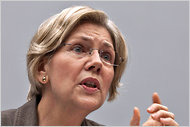 I’m never quite happy when a major media outlet like the New York Times refers to a woman as an inanimate object. Even if the article is flattering, the metaphor still stings. The caption below her picture reads “President Obama’s adviser on the Consumer Financial Protection Bureau” too. Obama may own her appointment but he doesn’t own the woman who has been on the side of consumers of banking services for a very long time. If Elizabeth Warren is an object of loathing for both bankers and Republicans, it’s because she’s a fighter. She’s not a passive thing and she certainly wasn’t passive during recent hearings. A person doesn’t become a tenured professor at a competitive place like Harvard’s law school by being passive.
And thus the real purpose of the hearing: to allow the Republicans who now run the House to box Ms. Warren about the ears. The big banks loathe Ms. Warren, who has made a career out of pointing out all the ways they gouge financial consumers — and whose primary goal is to make such gouging more difficult. So, naturally, the Republicans loathe her too. That she might someday run this bureau terrifies the banks. So, naturally, it terrifies the Republicans.
The banks and their Congressional allies have another, more recent gripe. Rather than waiting until July to start helping financial consumers, Ms. Warren has been trying to help them now. Can you believe the nerve of that woman?
At the request of the states’ attorneys general, all 50 of whom have banded together to investigate the mortgage servicing industry in the wake of the foreclosure crisis, she has fed them ideas that have become part of a settlement proposal they are putting together. Recently, a 27-page outline of the settlement terms was given to banks — terms that included basic rules about how mortgage servicers must treat defaulting homeowners, as well as a requirement that banks look to modify mortgages before they begin foreclosure proceedings. The modifications would be paid for with $20 billion or so in penalties that would be levied on the big banks.
So, am I the only one that even finds the tongue and cheek use of “the nerve of this woman” as being particularly patronizing vision of some one who has been such a consistent, articulate, fighting voice for beleaguered consumers in a tough environment built for big time lobbyists with big time money? The point of the article is that many of the old regulators who are supposed to make sure the bank runs of the 1930s don’t recur–like the Office of the Comptroller of the Currency–have become their old captured selves. This is in firm contrast to the article’s objectified pinata.
It’s not just the House Republicans either. Already the Office of the Comptroller of the Currency has reverted to form, becoming once again a captive of the banks it is supposed to regulate. (It has strenuously opposed the efforts of the A.G.’s to penalize the banks and reform the mortgage modification process, for instance.) The banks themselves act as if they have a God-given right to the profit they made precrisis, and owe the country nothing for the trouble they’ve put us all through. The Justice Department has essentially given up trying to make anyone accountable for the crisis.
So, yes, thank goodness for Ms. Warren and her fighting spirit. We’re on to the next big thing. There’s a fresh hell called Libya and a worry for all those invested in energy company with ownership of nuclear assets. So, bankers, you know, will be bankers.
During the subprime boom, many states tried to stop the worst lending abuses, only to be blocked by federal banking regulators. Now that the country is dealing with the aftermath of those abuses — the rising tide of defaults and foreclosures — it is the attorneys general who are, once again, put in the position of trying to stamp out abuses, this time of the foreclosure process itself.
I dare to guess that the president’s spent more time on his march madness brackets than what’s up in Warren’s office. When Warren’s time in her interim position expires, Obama will undoubtedly let his banker friends find an acceptable banker potted plant to fill her spot.
Their leverage comes from the fact that the banks and their servicing divisions have, in the words of the University of Minnesota law professor Prentiss Cox, “routinely violated basic legal process” by, for instance, not transferring the note after the sale of a home. But in addition to assessing a financial penalty on the banks, the A.G.’s are trying to use the threat of litigation to force the banks to finally deal with defaulting homeowners more fairly and humanely. That is the essence of the settlement proposal that has been floating around. That — and a big push to finally come up with a modification plan that works.
Their leverage comes from the fact that the banks and their servicing divisions have, in the words of the University of Minnesota law professor Prentiss Cox, “routinely violated basic legal process” by, for instance, not transferring the note after the sale of a home. But in addition to assessing a financial penalty on the banks, the A.G.’s are trying to use the threat of litigation to force the banks to finally deal with defaulting homeowners more fairly and humanely. That is the essence of the settlement proposal that has been floating around. That — and a big push to finally come up with a modification plan that works.
Author Joe Nocera is clearly in awe of her too. He states that she’s by far the most qualified person for the position. She understands the ins and outs of the processes very well.
As I listened to her on Wednesday, I was struck anew at how clearly she articulates the need for the new bureau. “If there had been a cop on the beat to hold mortgage servicers accountable a half dozen years ago,” she said at one point, “the problems in mortgage servicing would have been found early and fixed while they were still small, long before they became a national scandal.”
Senate Republicans have vowed to block her appointment if President Obama nominates her. Yet even if her nomination goes down in flames, Senate confirmation hearings would be clarifying. Americans would get to hear Ms. Warren explain why the Consumer Financial Protection Bureau has the potential to help Americans. And they would get to hear Republicans explain why the status quo — including the everyday horror of the foreclosure mess — is just fine.
It has been much noted in recent months that President Obama seems unwilling to start a fight with Republicans. Maybe that’s why he has shied away from nominating Ms. Warren to a job for which she is so clearly suited. But if protecting financial consumers — and helping the millions of Americans struggling to hold onto their homes — isn’t worth fighting for, then what is?
The woman hardly qualifies as a noun. She is a verb. Elizabeth Warren fights for us. Who will fight for her?
Misplaced Blame and Impact
Posted: March 14, 2011 Filed under: Bailout Blues, Economy, financial institutions, Global Financial Crisis | Tags: Banksters, credit crunch, U.S. Economy 15 Comments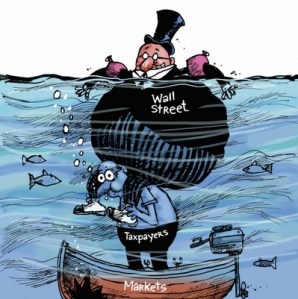 The blame for the worst recession since the The Great Depression clearly rests on the private sector where millions of bad loans and financial innovations turned peoples homes and investments into casino style gambling games. The disastrous lack of regulation, accountability, and common sense is still wrecking havoc on the economy today. The lending industry is still at odds with common sense, community well being, and the national interest. Paul Krugman wrote about this today in his NYT op ed using the academy award winning film Inside Job as the cautionary frame. What is evident in all of this fall out is that the people that deserve the blame are still acting abominably and the people they wronged are still getting the worst end of the deal.
What the film didn’t point out, however, is that the crisis has spawned a whole new set of abuses, many of them illegal as well as immoral. And leading political figures are, at long last, showing some outrage. Unfortunately, this outrage is directed, not at banking abuses, but at those trying to hold banks accountable for these abuses.
The immediate flashpoint is a proposed settlement between state attorneys general and the mortgage servicing industry. That settlement is a “shakedown,” says Senator Richard Shelby of Alabama. The money banks would be required to allot to mortgage modification would be “extorted,” declares The Wall Street Journal. And the bankers themselves warn that any action against them would place economic recovery at risk.
All of which goes to confirm that the rich are different from you and me: when they break the law, it’s the prosecutors who find themselves on trial.
To get an idea of what we’re talking about here, look at the complaint filed by Nevada’s attorney general against Bank of America. The complaint charges the bank with luring families into its loan-modification program — supposedly to help them keep their homes — under false pretenses; with giving false information about the program’s requirements (for example, telling them that they had to default on their mortgages before receiving a modification); with stringing families along with promises of action, then “sending foreclosure notices, scheduling auction dates, and even selling consumers’ homes while they waited for decisions”; and, in general, with exploiting the program to enrich itself at those families’ expense.
The end result, the complaint charges, was that “many Nevada consumers continued to make mortgage payments they could not afford, running through their savings, their retirement funds, or their children’s education funds. Additionally, due to Bank of America’s misleading assurances, consumers deferred short-sales and passed on other attempts to mitigate their losses. And they waited anxiously, month after month, calling Bank of America and submitting their paperwork again and again, not knowing whether or when they would lose their homes.”
There are more issues than just the foreclosure one. Here’s an example of a family fighting to sue BOA for the wrongful death of an elderly man who committed suicide after they recommended investments to him that failed miserably. The family has found out that the man had probably unknowingly signed away the right to sue in the fine print of the investment documents. I can’t imagine any one recommending a portfolio of risky assets to any one over the age of 50, yet this is exactly what BOA did to Mr. Phillip Grossman.
Philip Grossman saved carefully his whole life, never investing in anything more exotic than certificates of deposit. But in June 2007, his longtime banker at a Bank of America branch in Waltham told him he could do better, without taking more risk, and introduced him to a broker at the bank’s investment arm.
Two years later, Grossman, then a 65-year-old computer consultant, and his wife had lost $400,000 — more than half their savings. In despair in the fall of 2009, Grossman checked into a Woburn motel, left his glasses and watch on the desk in his room, and killed himself.
Stunned by the tragedy, his family tried to sue Bank of America, asserting that the broker invested more aggressively than promised, adding to the steep losses and contributing to Grossman’s suicide. But they soon found out they would not get their day in court: The papers the Grossmans signed to open their account required that any dispute go to a private panel of arbitrators.
“They’ve committed a crime against us, as far as I’m concerned,’’ Grossman’s wife, Gail, said in an interview. “Why do we have to go to arbitration? With other crimes you get a trial and a jury. It just seems very unfair to me.’’
The Grossmans’ case shows how entrenched arbitration has become in the financial industry, demonstrating that even in an extreme case alleging wrongful death, aggrieved clients have no recourse other than a system that critics say favors investment firms. Most investors have no idea that when they open a brokerage account, they give up their right to sue, and must, under a 1987 Supreme Court ruling, take complaints to arbitration.
There are more outrages to share with you. Think that having a perfect credit score and a huge down payment will get you a loan these days if you’re a consumer? Think again. Banks are lending to junk bond quality businesses while denying the best of households basic mortgages. The recovery is not just around the corner for the majority of US households for many reasons. Government help has been concentrated at reaching banks and businesses. This is not translating into improvement for all.
The consumer loan market, particularly housing, remains a challenge for borrowers. Total U.S. consumer credit outstanding was $2.4 trillion in January, or 6.6 percent below its July 2008 level, the Fed said in a March 7 report. Total housing debt has declined by $536 billion since 2008 to $10.1 trillion, Fed data show. The median price of an existing U.S. home has dropped 13 percent since June to $158,800, bringing its decline since July 2006 to 31 percent, according to the Chicago-based National Association of Realtors. About 10.8 million homes were worth less than the debt owed on them in the third quarter, research firm CoreLogic Inc. said in a Dec. 13 report.
By contrast, the least creditworthy corporations have been able to borrow record amounts at the cheapest rates ever. Junk- rated companies sold an unprecedented $287.6 billion in bonds in 2010 and are setting an even faster pace of issuance this year. Claire’s Stores Inc., the costume jewelry retailer that had debt that was almost 10 times its earnings last year, sold $450 million of bonds last month that Moody’s Investors Service gave its third-lowest rating.
There are several other disturbing figures in the Bloomberg article quoted directly above.
The U.S. economy grew at a 2.8 percent annual rate in the fourth quarter, slower than previously calculated, and is forecast to expand 3.2 percent this year, according to the median estimate of 66 economists in a Bloomberg survey.
Household purchases account for about 70 percent of the U.S. economy, making the consumer the single biggest driver of any economic recovery. Those consumers “stumbled at bit” at the start of this year, Michael Feroli, chief U.S. economist at JPMorgan Chase & Co. in New York, said in a February note.
While the economy expanded and companies are beginning to spend more, the improvements haven’t driven the nation’s unemployment rate below 8.9 percent for almost two years and the Conference Board’s gauge of consumer confidence is still 37 percent below the level reached in July 2007.
“The 2007-2009 recession period looks different from previous economic cycles,” John McElravey, a bond analyst at Wells Fargo Securities LLC in Charlotte, North Carolina, said in a March 8 report. “Consumer credit outstanding contracted much more sharply than in other periods, and the return to positive growth rates has been relatively slow.”
There are so many things different and bad with this recovery that it is indeed troubling. Perhaps the most important factor is that government is clearly not helping homeowners, the jobless, and the many families who have lost wealth via the crash in home values and their investments. The focus of bailouts has been on banks and businesses that have not used the funds to benefit their communities. Something is clearly wrong here with policy priorities when you’re not focused on the major source of consumption in a consumer-drive economy.
Not only is policy not aimed at the majority of people in the country, the focus in the District is now clearly turning to austerity measures and turning neighbor against neighbor. I can’t tell you exactly how worried I am that a huge number of households will still be in trouble come the next recession. Here’s another opinion on that very subject from E.J. Dionne Jr. at WAPO.
A phony metaphor is being used to hijack the nation’s political conversation and skew public policies to benefit better-off Americans and hurt most others.We have an 8.9 percent unemployment rate, yet further measures to spur job creation are off the table. We’re broke, you see. We have a $15 trillion economy, yet we pretend to be an impoverished nation with no room for public investments in our future or efforts to ease the pain of a deep recession on those Americans who didn’t profit from it or cause it in the first place.
As Sen. Al Franken (D-Minn.) pointed out in a little-noticed but powerful speech on the economy in December, “during the past 20 years, 56 percent of all income growth went to the top 1 percent of households. Even more unbelievably, a third of all income growth went to just the top one-tenth of 1 percent.” Some people are definitely not broke, yet we can’t even think about raising their taxes.
By contrast, Franken noted that “when you adjust for inflation, the median household income actually declined over the last decade.” Many of those folks are going broke, yet because “we’re broke,” we’re told we can’t possibly help them.
That’s the new excuse. We could help Chrysler. We could help GM. We could help the financial institutions and Wall Street. We could invade Iraq and Afghanistan to help them. We could do all that, but now we’re too broke to help ordinary Americans. It’s obvious that the financial institutions are doing nothing to improve the situation. It’s also pretty obvious that Iraq and Afghanistan are money pits. When do we get the government to quit throwing our money to rich people and businesses? When do we get them to stop blaming teachers, firefighters, and police offers for taking up too much of the pie? When do we actually start looking at the real numbers and the real culprits who took all this vast wealth and continue to ensure the rules only benefit the few?
Monday Reads
Posted: February 28, 2011 Filed under: academia, Civil Liberties, Civil Rights, collective bargaining, Diplomacy Nightmares, education, Foreign Affairs, Global Financial Crisis, Human Rights, Libya, U.S. Politics, unemployment, voodoo economics, Voter Ignorance, We are so F'd | Tags: Federal Deficit, Libya, state pension plans, tenure 15 Comments Good Morning!
Okay, so I’m going to show you two nifty pie charts first at The Business Insider. They basically show how the federal balance is extremely unbalanced because expenses are growing and revenues are not growing at all. Henry Blodgett correctly points out that there’s quite a bit of growth in ‘entitlements’. Let me just point out that all this makes complete sense to me What do you get in an economy that has normalized around a 10 percent unemployment rate or higher if you count the things like disenfranchised workers and the underemployed and couple that with year after year after year after year of excessive tax cuts on the uberrich who happen to be the only ones making money? Well, you get more and more people that are reliant on unemployment and other government ‘entitlements’ and you get a huge revenue gap. This is about the most careless set of policy choices made that I’ve seen since I first read up on the Hoover administration and the start of the Great Depression.
The “expense” pie is growing like gangbusters, driven by the explosive growth of the entitlement programs that no one in government even has the balls to talk about. “Revenue” is barely growing at all.
As we’ll illustrate with more of Mary’s charts next week, the US cannot grow its way out of this problem. It needs to cut spending, specifically entitlement spending. We hereby announce that we’ll give a special gold star to the first “leader” with the guts to say that publicly.
I’ll give a box of gold stars to any one that points out to this blowhard that the way to remove the growing entitlements is to put people back to work. Also, giving tax money to rich people so they can invest in the BRIC economies and buy land where their money is parked in the Bahamas or Grand Caymans is a really, really stupid proposition. We’ve needed a real jobs program for some times. People with jobs pay taxes, buy things that are taxed, and don’t require entitlements. How absolutely stupid do you have to be to not get that? I don’t even need all those economics and finance degrees to figure that one out.
In the Friday Reads I mentioned that Fox News’ Roger Ailes was caught on tape encouraging colleagues to lie to Federal Investigators. Well, it seems that lying has finally caught up with one Republican operative. Maybe people will wake up to the Faux News’ and their dirty tricks now. Here’s what Barry Ritholtz had to say about his scoop on the indictment.
Here’s what I learned recently: Someone I spoke with claimed that Ailes was scheduled to speak at their event in March, but canceled. It appears that Roger’s people, ostensibly using a clause in his contract, said he “cannot appear for legal reasons.”
I asked “What, precisely, does that mean?”
The response: “Roger Ailes will be indicted — probably this week, maybe even Monday.”
Well, it’s Monday. Does Rupert Murdoch know where Roger Ailes is? Some times watching Karma unfold is a delightful thing.
I’m not sure if you’re a big enough masochist to spend time with the Sunday news shows anymore, but I do try to catch Christiane Amanpour and she delivered an interesting program yesterday. She had an exclusive interview with one of Gadhaffi’s sons. It was extremely interesting and I would recommend you go watch that segment. Amanpour actually traveled to Tripoli this weekend. We will now refer to the son as Tripoli Saif al-Islam Gadhafi since he seems about as in touch with reality as Baghdad Bob did back in the day.
There was a “big, big gap between reality and the media reports,” Gadhafi told Amanpour. “The whole south is calm. The west is calm. The middle is calm. Even part of the east.”
In response to President Barack Obama’s call for Moammar Gadhafi to step down and the U.N. Security Council’s unanimous vote to impose an arms embargo on Libya and urge nations to freeze Libyan assets, Gadhafi’s son was defiant.
“Listen, nobody is leaving this country. We live here, we die here,” he insisted. “This is our country. The Libyans are our people. And for myself, I believe I am doing the right thing.”
“The President of the U.S. has called on your father to step down. How do you feel about that?” Amanpour asked.
“It’s not an American business, that’s number one,” said Gadhafi, who was dressed casually as he spoke with Amanpour. “Second, do they think this is a solution? Of course not.”
I don’t know about you, but I’m getting kind of tired of watching these jerks that we supported for some time prove exactly what is meant by the label “brutal dictator”. Could we just once fund and support some one like His Holiness the Dali Lama for a change? It’s no wonder we still get called ugly Americans.
Speaking of Ugly Americans responsible for diplomatic nightmares, Paul Wolfowitz showed up on Fareed Zakaria’s GPS on CNN on Sunday. Could some one please tell the media we don’t need to hear from the people that screwed up Middle East Policy any more? Why do I keep seeing this man’s face despite his obvious failures with Iraq policy and peccadilloes made public during his time at the World Bank? I did want to point you to Zakaria’s interview with Michael Lewis on global financial crisis. The video is here. He has some interesting thing to say about banks in Greece, Ireland, and here. Listen for this part:
LEWIS: …And the –the anger – the anger about the Wall Street bailouts, I think, is the beginning of the Tea Party. I mean the – the injustice of people being rewarded for failure and – and supported by the public purse, that was the source of the original outrage.
ZAKARIA: But it went in a libertarian direction…
LEWIS: It did…It – but – but a qualified libertarian direction, because a true libertarian would be outraged that these Wall Street banks are still being subsidized by the government. And there doesn’t seem to be any move on the right to – to remove those subsidies, not any – any serious one…But – but the politi – our leadership doesn’t have an interest in – a leadership that is intent on still stabilizing the financial system doesn’t have an interest in calling attention to the outrages of the financial system. So I think they – Wall Street got very lucky.
Wall Street did not get very lucky. Wall Street basically has a friend in the White House and tons of people in the Treasury Department. The Tea Party was distracted by the Health Care Bill. The kleptocracy is still at it. Listen to the interview, it’s an earful! Many of us think that were going to get a repeat of the global financial crisis some time soon. Lewis and I aren’t alone on that thought.
One of the things that’s really making me mad about the current conversation on budget cuts and higher education is the public’s ignorance on just exactly how many states have disabled tenure these days. Tenure has long been a pet peeve of right wing ideologues who feel that every one should be terminated like they are in the private sector. Basically, the private sector thrives on political firings and uses payroll cuts as the first line of defense when the bottom line is failing because of their bad, short-sighted, and overly-political decisions.
Here’s a list of states decimating tenure as we speak from articles in The Chronicle of Higher Education. You know, I’m really sorry that people have to work for private corporations and that their lives are subject to the whims of really mean people, but it’s really no excuse to take it out on those of us that have tried to carve a better way to exist. Take my word for it. Get yourself a union and they won’t be able to take advantage of you with out taking on a a million other people who have your back! Those of us in the public sector are willing to forego short term salary highs for long term job security. It’s evident that a new crop of governors want every one as miserable as employees in the private sector now. If they intend to do this to us, then I want those seven to eight digits salaries I’d be paid for the 3-5 year short brutal career on Wall Street as a PhD in Financial Economics. I even added a few old links to show you that this is nothing new. Believe me, tenure isn’t what most people outside of academic think it is …
From Louisiana (this week):
The University of Louisiana system’s Board of Supervisors on Friday voted to approve new rules that will allow its institutions to more quickly dismiss faculty members, even those with tenure, whose programs have been closed.
At a time when the state’s financial climate makes it difficult for campuses to determine their budgets from year to year, that kind of flexibility is key, system officials said. But professors at the board meeting, including representatives of each of the system’s eight campuses, told the supervisors that such a move would erode the protection tenure provides and could ultimately make the system’s institutions unattractive to job seekers and lead current faculty members to leave.
The University of Nebraska at Lincoln is seeking to eliminate the jobs of 15 tenured faculty members as part of its latest round of budget cuts.
The proposed dismissals, which Chancellor Harvey Perlman announced this month, would save Nebraska about $2.7-million. They are part of a plan to reduce the university’s budget by $26-million, or 12 percent, in the wake of substantial state budget cuts. The new cuts come on the heels of layoffs, proposed in March, that would affect 55 faculty
An independent arbitrator on Friday ordered Florida State University to rescind layoff notices to several tenured faculty members and slammed how administrators there had decided which jobs would be cut.
In a major victory for the state’s faculty union, Stanley H. Sergent, a Sarasota-based lawyer picked by the university and the union to arbitrate the dispute, held that the university had failed to clearly justify its choices to eliminate certain positions, and had violated a provision of its faculty contract calling for it to try to protect the jobs of those faculty members who had continuously worked there the longest.
In his 83-page decision, Mr. Sergent wrote that the only reason the university had declared certain departments “suspended” was “to allow the effective layoff of all faculty and the selective recall of certain faculty,” apparently for the sake of creating a subterfuge to avoid having to comply with a contractual requirement that it lay off tenured faculty members last. Mr. Sergent characterized the reasoning used by a dean in eliminating one faculty member’s job as “arbitrary, capricious, and unreasonable.”
The arbitrator’s decision applies only to 12 tenured faculty members who belong to the campus chapter of the United Faculty of Florida, and does not cover nine other tenured faculty members who do not belong to the union and also received notices of pending layoffs last year.
From Washington State (May2009):
Community colleges in Washington State could soon be able to lay off tenured faculty members much faster than normal, according to the Seattle Post-Intelligencer.
At its regularly scheduled meeting next month, the State Board of Community and Technical Colleges will decide whether to declare a financial emergency — a move allowed by a state law passed in 1981 to deal with budget crunches. Such an emergency would speed up the process for laying off tenured faculty members in that they would get only 60 days’ notice of layoffs and the grounds on which they could appeal the decision would be limited, the Post-Intelligencer reported.
I would also like to take this space to mention that I no longer have access to Social Security and that my state pension and the matches that I get from the State basically are what the private sector donates to social security on the behalf of private sector workers. Many states have pension plans that replace Social Security. Therefore, I’m personally not getting any thing ‘special’ from taxpayers. Also, when the defined benefit plan showed up short this year, they decreased the contributions to my optional retirement plan and the others who selected that option to make up the shortfall in the defined benefit pool. Wall Street stole my appreciation and then the state took more from me to pay for their problems in other folks’ annuities. Other state employees–like me–paid for that shortfall. It came from our compensation. I’ve just about had it up to here with reading a bunch of grumbly idiots on other blogs that have no idea how state employee pensions are managed and funded. If you want to go after high paying state employees that are worthless, try taking it out on the university football coaches and the damned governor’s staff for a change. It’s not us little guys!
Anyway, it’s Monday morning and I’m a curmudgeon today. Think I’ll spend the day with the TV off and I’ll stay here on Sky Dancing with the sane people! Now, where’s my coffee?
What’s on your reading and blogging list?
Tuesday Reads: Tim Geithner in Control of Obama’s Economic Policy, and Other News
Posted: February 15, 2011 Filed under: Bailout Blues, Barack Obama, Economic Develpment, Egypt, financial institutions, Foreign Affairs, Global Financial Crisis, Gulf Oil Spill, Iran, U.S. Economy, U.S. Politics, unemployment, Yemen | Tags: Barack Obama, Financial Markets, Larry Summers, Noam Scheiber, The New Republic, Timothy Geithner, Wall Street 22 Comments
Good Morning!! The snow is slowly melting outside my house, and I’ve come down with Spring fever! No more snowstorms please, Mother Nature. Anyway, at least for this week, we are getting temperatures in the 40s and 50s. It is going to be chilly again tomorrow, but after that–springlike! After the frigid winter we’ve lived through, these temperatures feel amazing. Maybe this will make the bad news from DC a little more bearable. I hope so.
This morning I want to focus on an important article that comes via David Dayen at FDL. It’s a piece at The New Republic about Timothy Geithner, written by Noam Scheiber. First a little aside.
Back in November, I wrote a post about the axing of Obama’s economic team and noted that Geither was the last man standing.
In that post, I quoted Andrew Cockburn of Counterpunch:
If Barack Obama needed any help in guiding the Democratic Party over the cliff he certainly got it from Treasury Secretary Timothy Geithner. Voters have told pollsters that the state of the economy, their own in particular, was their principle concern. Though impelled by the specter of unemployment and homelessness, the image of Geithner, toady to the bankers, can only have encouraged them in their fury. A sensible president would therefore already be running out the plank prior to giving this disastrous financial overseer an encouraging shove between the shoulders. But in this case, we may not be that lucky. CounterPunch can reveal the crucial role played in these matters by a group close to the President but unknown to the outside world.
A knowledgeable insider told Cockburn that despite Larry Summers’ reputation as a corporate tool,
“Larry has some idea that there is more to the economy than just the welfare of large banks,” this official suggests. “He did push for a larger stimulus and more jobs programs, for example. Tim just cares about banks.”
I then went on to indulge in a little conspiracy theorizing based on Cockburn’s information. But that’s beside the point right now. The point is that after writing that post, I came to the conclusion that Geithner was running economic policy in the Obama administration.
Getting back to the article at TNR, Scheiber purports to explain how Geithner survived the massacre of the economists. One interesting tidbit in the lengthy article is about Geithner’s relationship with Larry Summers, who acted as Geithner’s mentor and patron early on.
In 1993, Geithner caught the attention of [a] prominent patron—Larry Summers—whom Bill Clinton had appointed as his treasury undersecretary. Summers took a personal interest in Geithner’s career and promoted him each time he rose through the Treasury ranks.
And then during the Obama administration, Geithner apparently stabbed his patron in the back, becoming President Obama’s primary economic adviser–even though Geithner isn’t an economist. (Neither is anyone else on Obama current “economic team,” as Dakinikat frequently points out.)
Geithner actually sounds a lot like Obama–he’s really good at sucking up and convincing people he’s on their side–until he slides in the knife. Regarding Geithner’s time at the IMF, Scheiber writes:
According to former co-workers, Geithner was deft at bringing skeptical colleagues on board. One technique involved homing in on possible dissidents and absorbing their suggestions into his proposals.
Sound familiar? A bit more:
Perhaps most important, Geithner was scrupulously attuned to the temperament of the boss. Like Obama, he evinced a strong aversion to blather. During meetings with the president, he would say little, and usually not until the end, when his opinion was solicited. “I thought [Geithner] got the president really well,” says a former administration official who interacted with him on nonfinancial matters. “When he was in trouble, I said to someone, ‘He just needs to hold on. He’ll be fine with Obama. Once they get to know each other, they’re like the same person.’”
Scheiber describes an epic struggle between Geithner and Summers over how to deal with the banks that had crashed the U.S. economy. Summers argued for some form of nationalization, while Geithner claimed the banks just needed more capital and they could recover.
If Geithner was right, the capital shortfall was much more manageable than Summers feared. The banks might be able to fill it with minimal government help, simply by selling shares to investors. But, if he was wrong, the banks would stumble along in a kind of vampire state, sucking credit from the economy and exacerbating the recession. In the worst case, fears of insolvency could trigger a modern-day version of Depression-era bank runs.
Hey, wait a minute. That sounds like what is happening to our economy right now. But, never mind, Geithner won the battle that counted–the battle for Obama’s favor.
Part of what Geithner convinced Obama of was “that it was ultimately better politics to risk a backlash with unemployment at 10 percent than to feed the backlash and watch the economy shrink further.” So it’s Geithner we have to thank for the new normal of high unemployment, poverty, and suffering among the middle, working, and lower classes.
Finally, what horrified David Dayen was Geithner’s out-front claim that–in Dayen’s words, “what’s good for Wall Street is good for America.” Geithner:
“I don’t have any enthusiasm for … trying to shrink the relative importance of the financial system in our economy as a test of reform, because we have to think about the fact that we operate in the broader world,” he said. “It’s the same thing for Microsoft or anything else. We want U.S. firms to benefit from that.” He continued: “Now financial firms are different because of the risk, but you can contain that through regulation.” This was the purpose of the recent financial reform, he said. In effect, Geithner was arguing that we should be as comfortable linking the fate of our economy to Wall Street as to automakers or Silicon Valley.
In response, Dayen writes:
I don’t even know what to say about this. We’re just a few years removed from the financial oligarchs destroying the global economy through their own greed and negligence. And the man put in charge of regulating them, who had a front-row seat to all this destruction and who has been given expanded powers under Dodd-Frank to see to it that never happens again, thinks that there’s a great “financial deepening” about to take place where the demand for sophisticated financial innovations will jump. Therefore, the financial sector will need to grow and become the most reliable spur of the US economy. That’s his feeling. And regulation can reduce the risk, even though the new regulations barely put a dent into Wall Street’s core business, and are being systematically defunded besides.
Financialization of the economy has led to practically nothing but pain for the average worker and risk for the taxpayer. It has turned the allocation of capital into the placing of bets at a casino, and the stock market into a particularly sophisticated video poker game. This territory was all covered before in the run-up to the Great Depression as well, and we know the precise causes and remedies involved. Geithner prefers not to address the plutocracy he’s really advancing here – where elites provide “financial deepening” services abroad and amass ridiculous profits that they wall off.
This incredibly amoral conman is partnering with our conman chief executive to sell out our country, our lives, and those of our children and grandchildren. There’s lots more of interest in the article, particularly the information about Geithner’s upbringing.
I’ll wrap this up with a few other stories, and then throw the floor open to your links and opinions. Did you hear that Stephen Baldwin is suing Kevin Costner over Costner’s oil-eating invention?
It seems Baldwin sold his shares in Costner’s company right before BP shelled out $50 million for the machines.
Jane Hamsher offers a flow-chart of the principle players in the scandal over US Chamber of Commerce’s attempts to discredit Wikileaks, Glenn Greenwald, Brad Friedman, David House, and others who have supported wikileaks and Bradley Manning. Joseph Cannon has also been covering this story.
Brad Friedman’s post especially is a must read. Get this, the Chamber paid 2 million dollars a month for dirt on Friedman, and got completely inaccurate information. And that inaccurate information came from corporations who are paid billions by our government “to target terrorists.” But Obama wants to cancel heating assistance for poor people to save money.
Mitt Romney is ahead in the latest NH poll, at 40%, for whatever that’s worth. Romney was always going to win NH. They always vote for New Englanders up there. The real test for Romney will be Iowa.
The Patriot Act extension has been passed by the House on the second try. I think the Egyptians will probably get rid of their emergency law before we get rid of ours.
There are “massive” protests in Iran, inspired by the dramatic events in Egypt. There have also been more protests in Yemen and in Bahrain. When will it happen here?
What are you reading and blogging about today?

 peej
peej Carissa
 bostonboomer
 dakinikat
 ecocatwoman
 mablue2
 Mama Lopez
 peggysue22
 quixote
 skydancingguestblogger
 Mona (aka Wonk the Vote)



 Sky Dancing
Recent Comments