
Tuesday Reads: Gitmo, Torture, and Dirty Wars
Posted: April 23, 2013 Filed under: Barack Obama, Foreign Affairs, Gitmo, morning reads, Psychopaths in charge, Real Life Horror, torture, U.S. Politics | Tags: Abdulrahman al Awlaki, Anwar Al-Awlaki, black shirts, Dirty Wars, force-feeding, Guantanamo, Ibn Shaikh al-Libi, Jason Leopold, Jeffrey Kaye, Jeremy Scahill, Samir Naji al Hasan Moqbel, Shaker Aamer, terrorism vs everyday violence 56 Comments
Yemeni protestors dressed in prison uniforms, hold posters of men detained in Guantanamo Bay prison during a demonstration in front of the U.S. embassy demanding their release, in Sanaa, Yemen, Tuesday, April 16, 2013.
Good Morning!!
There has been so much news lately that it’s hard to know what to write about; but I decided to focus on a shocking story that hasn’t gotten much coverage in the corporate media–the mass hunger strikes at Guantanamo.
Last week The New York Times published a heart-rending cry for help from an inmate (dictated over the phone), Samir Naji al Hasan Moqbel: Gitmo Is Killing Me. This man has been in Gitmo for 11 years with no charges and faces the terrible possibility that he will die there. How did he end up imprisoned by the U.S.?
When I was at home in Yemen, in 2000, a childhood friend told me that in Afghanistan I could do better than the $50 a month I earned in a factory, and support my family. I’d never really traveled, and knew nothing about Afghanistan, but I gave it a try.
I was wrong to trust him. There was no work. I wanted to leave, but had no money to fly home. After the American invasion in 2001, I fled to Pakistan like everyone else. The Pakistanis arrested me when I asked to see someone from the Yemeni Embassy. I was then sent to Kandahar, and put on the first plane to Gitmo.
He has been on a hunger strike since Feb. 10, and Americans are now force-feeding him. That is torture.
Last month, on March 15, I was sick in the prison hospital and refused to be fed. A team from the E.R.F. (Extreme Reaction Force), a squad of eight military police officers in riot gear, burst in. They tied my hands and feet to the bed. They forcibly inserted an IV into my hand. I spent 26 hours in this state, tied to the bed. During this time I was not permitted to go to the toilet. They inserted a catheter, which was painful, degrading and unnecessary. I was not even permitted to pray.
I will never forget the first time they passed the feeding tube up my nose. I can’t describe how painful it is to be force-fed this way. As it was thrust in, it made me feel like throwing up. I wanted to vomit, but I couldn’t. There was agony in my chest, throat and stomach. I had never experienced such pain before. I would not wish this cruel punishment upon anyone.
I am still being force-fed. Two times a day they tie me to a chair in my cell. My arms, legs and head are strapped down. I never know when they will come. Sometimes they come during the night, as late as 11 p.m., when I’m sleeping.
There are so many of us on hunger strike now that there aren’t enough qualified medical staff members to carry out the force-feedings; nothing is happening at regular intervals. They are feeding people around the clock just to keep up.
This is being done in our name. Our tax money is being spent on this.

Protesters demand Obama close Guantanamo Bay prison
On Saturday, The Guardian Observer published another inmate’s story, “Shaker Aamer: ‘I want to hug my children and watch them as they grow'”
As of today, I’ve spent more than 11 years in Guantánamo Bay. To be precise, it’s been 4,084 long days and nights. I’ve never been charged with any crime. I’ve never been allowed to see the evidence that the US once pretended they had against me. It’s all secret, even the statements they tortured out of me.
In 2007, roughly halfway through my ordeal, I was cleared for release by the Bush administration. In 2009, under Obama, all six of the US frontline intelligence agencies combined to clear me again. But I’m still here.
Every day in Guantánamo is torture – as was the time they held me before that, in Bagram and Kandahar air force bases, in Afghanistan. It’s not really the individual acts of abuse (the strappado – that’s the process refined by the Spanish Inquisition where they hang you from your wrists so your shoulders begin to dislocate, the sleep deprivation, and the kicks and punches); it’s the combined experience. My favourite book here (I’ve read it over and over) has been Nineteen Eighty-Four by George Orwell: torture is for torture, and the system is for the system.
More than a decade of my life has been stolen from me, for no good reason. I resent that; of course I do. I have missed the birth of my youngest son, and some of the most wonderful years with all my four children. I love being a father, and I always worked to do it as best I can.
Shaker Aamer is a Saudi Arabian citizen and his family lives in London.
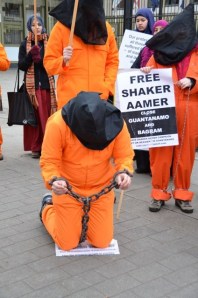
Jeffrey Kaye (AKA Valtin), who has been writing about U.S. torture for many years wrote a diary about Shaker Amer at DailyKos on Sunday that is well worth reading: British Press: US Conspires with UK & Saudis to Hold Detainee w/Evidence on Iraq War Lies.
Unlike the vast majority of detainees held at Guantanamo, Aamer speaks very good English. He is intelligent and motivated. That makes him dangerous to the authorities running Guantanamo. While President Obama’s administration and DoD officials maintain Guantanamo is run humanely, a blue-ribbon panel assembled by The Constitution Project, including former GOP officials, have determined that abuse still occurs, and have pointed out the the Army Field Manual’s Appendix M, a prime culprit in ongoing abuse, should be excised from that document and from DoD practice. (Link to the long and fascinating report.)
But it apparently is not only testimony about being tortured or seeing others tortured that Aamer can supply. That alone would probably not be enough to hold him forever. Instead, exposes this past weekend in the British press have indicated Aamer is being held indefinitely, or considered for “repatriation” to Saudi Arabia, because he can testify to the presence of British counter-terrorism agents from MI5 and MI6 at his own torture… and the torture of Ibn Shaikh al-Libi.
Al-Libi famously was tortured to give false evidence about Saddam Hussein’s pursuit of chemical weapons as part of the doctored evidence presented to US and world public opinion to justify the unprovoked invasion of Iraq by the US-dominated coalition in 2003. The invasion was responsible for the deaths of an untold number of Iraqis (estimates ranging from 100,000 to well over a million), an untold number of injured, produced millions of refugees, and generally destabilized the region.
In a recent Guardian expose, the culpability of high US officials in the organization and operation of death and torture squads by the Iraqis was documented. But in the United States, there appeared to be almost no interest in these developments.
President Obama supposedly ended Bush’s torture policies and vowed to close Guantanamo, but clearly these men are being tortured and there are no signs that Guantanamo will ever be closed. Here’s a piece by Jeremy Scahill published in 2009 that describes the “black shirts,” the “Thug Squad Still Brutalizing Prisoners at Gitmo Under Obama.” Clearly, it is still happening in 2013.
One more link to a piece at Truthout by Jason Leopold, who has also been writing about torture for years: Inmates Rising: Worsening Gitmo Mass Hunger Strike in Prisoners’ Own Words.
It Can Happen Here
Posted: January 9, 2012 Filed under: Barack Obama, Civil Liberties, court rulings, George W. Bush, Gitmo, Human Rights, legislation, torture | Tags: Barack Obama, Defense Authorizattion Act, due process, Gitmo, Guantanamo, Habeas Corpus, indefinite detention, Lakhdar Boumediene, Military Commissions Act (MCA), terrorism, Torture 20 Comments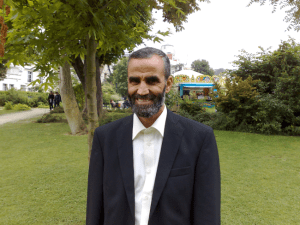
Lakhdar Boumedienne
Now that President Obama has signed the 2012 Defense Authorization Act, what happened to Lakhdar Boumediene could happen to any of us.
In a horrifying op-ed in yesterday’s New York Times Boumediene described how he was arrested in Bosnia in 2002 and held in Guantanamo for seven years without due process. At the time of his arrest Boumediene was working as a humanitarian aid worker focusing on helping children. During his imprisonment, he was never allowed to see his wife or his children, and received only a few of the many letters they sent him. The ones he did receive were cruelly censored.
Boumediene writes:
I left Algeria in 1990 to work abroad. In 1997 my family and I moved to Bosnia and Herzegovina at the request of my employer, the Red Crescent Society of the United Arab Emirates. I served in the Sarajevo office as director of humanitarian aid for children who had lost relatives to violence during the Balkan conflicts. In 1998, I became a Bosnian citizen. We had a good life, but all of that changed after 9/11.
When I arrived at work on the morning of Oct. 19, 2001, an intelligence officer was waiting for me. He asked me to accompany him to answer questions. I did so, voluntarily — but afterward I was told that I could not go home. The United States had demanded that local authorities arrest me and five other men. News reports at the time said the United States believed that I was plotting to blow up its embassy in Sarajevo. I had never — for a second — considered this.
The fact that the United States had made a mistake was clear from the beginning. Bosnia’s highest court investigated the American claim, found that there was no evidence against me and ordered my release. But instead, the moment I was released American agents seized me and the five others. We were tied up like animals and flown to Guantánamo, the American naval base in Cuba. I arrived on Jan. 20, 2002.
I still had faith in American justice. I believed my captors would quickly realize their mistake and let me go. But when I would not give the interrogators the answers they wanted — how could I, when I had done nothing wrong? — they became more and more brutal. I was kept awake for many days straight. I was forced to remain in painful positions for hours at a time. These are things I do not want to write about; I want only to forget.
Eventually he went on a hunger strike that lasted two years and was brutally force fed twice a day. Finally, in 2008, his case reached the Supreme Court.
In a decision that bears my name, the Supreme Court declared that “the laws and Constitution are designed to survive, and remain in force, in extraordinary times.” It ruled that prisoners like me, no matter how serious the accusations, have a right to a day in court. The Supreme Court recognized a basic truth: the government makes mistakes. And the court said that because “the consequence of error may be detention of persons for the duration of hostilities that may last a generation or more, this is a risk too significant to ignore.”
When he was finally freed, France took him in, and he was reunited with his family. Boumediene writes that there are 90 prisoners at Guantanamo who have also been cleared to leave the facility, but they are being held because they are from countries where they would be tortured or killed if they returned.
So there they sit, not guilty of any crime but held in indefinite detention. Just as you or I could be held if this president or the next one decides we somehow helped or supported terrorism.
Friday Reads
Posted: December 2, 2011 Filed under: Civil Liberties, Civil Rights, Foreign Affairs, George W. Bush, Gitmo, Hillary Clinton, Human Rights, morning reads, Myanmar | Tags: eurozone crisis, Hillary Clinton, Myanmar, violence against women 27 Comments Good Morning!
Well the week certainly crept by me! I spent yesterday with the cable guy and the day before with the electric guy and both had to change the wires from the pole to my house. Most neighborhoods have been fighting to get the utility wires buried for years but the only place they will do that is in the Quarter. High winds and hurricanes always manage to mess things up and the electric company butchers the live oaks on avenues like mine every spring to protect the wires. Still, they’ll do anything to avoid spending the money. Dividends and bonuses must be paid, you know!! Both companies seem to just let the infrastructure rot until the very last wire has gone. It was exhausting and way too reminiscent of post Katrina life. I hope it lasts for awhile. It was a cold day for me to be without the furnace. I’m still a bit cranky.
Evidently Former President George W Bush is going to venture outside the country and head off to visit Africa for charity. Amnesty International is calling for his arrest as a war criminal.
Amnesty International is calling for the arrest of former President George W. Bush while he is traveling overseas in Africa.
The human rights group issued a statement Thursday calling for the governments of Ethiopia, Tanzania or Zambia to take the former president into custody. According to Amnesty, the 43rd president is complicit in torture conducted by the United States during his administration and should be held pending an international investigation.
“International law requires that there be no safe haven for those responsible for torture; Ethiopia, Tanzania and Zambia must seize this opportunity to fulfill their obligations and end the impunity George W. Bush has so far enjoyed,” said Amnesty senior legal adviser Matt Pollard in a statement.
Bush is traveling overseas in Africa to raise awareness for HIV/AIDS, cervical and breast cancer across the continent.
In a continuation of the violation of rights in the name of terror prevention, the US Senate passed a disturbing addendum to a Defense spending bill. The “Senate Declines to Clarify Rights of American Qaeda Suspects Arrested in U.S.” which means any of us could be shipped off to Gitmo without due process. Be sure to check who voted for what because some of them will surprise you.
The Senate on Thursday decided to leave unanswered a momentous question about constitutional rights in the war against Al Qaeda: whether government officials have the power to arrest people inside the United States and hold them in military custody indefinitely and without a trial.
After a passionate debate over a detainee-related provision in a major defense bill, the lawmakers decided not to make clearer the current law about the rights of Americans suspected of being terrorists. Instead, they voted 99 to 1 to say the bill does not affect “existing law” about people arrested inside the United States.
“We make clear that whatever the law is, it is unaffected by this language in our bill,” said Senator Carl Levin, a Michigan Democrat who helped shape the detainee-related sections of the bill with Republicans on the Senate Armed Services Committee.
The disputed provision would bolster the authorization enacted by Congress a decade ago to use military force against the perpetrators of the attacks on Sept. 11, 2001. It says the government may imprison suspected members of Al Qaeda or its allies in indefinite military custody.
Because the section includes no exception for suspects arrested domestically, the provision prompted a debate about whether it would change the law by empowering the government, for the first time, to lawfully arrest people inside the United States and hold them indefinitely in military custody, or whether it would change nothing because the government has that power already.
The debate brought new attention to the ambiguous aftermath of one of the most sweeping claims of executive power made by the Bush administration after Sept. 11: that the government can hold citizens without a trial by accusing them of being terrorists.
Bostonboomer sent me this interesting link to an article at HuffPo by Soraya Chemaly on the widespread violence against women in the world. These statistics are beyond overwhelming. They are appalling.
Think there aren’t men who really hate women or think of them, because they are not male, as subhuman, which makes violence somehow more acceptable or inevitable? Maybe you think this is a third world problem, a race or a class specific problem? I know that there are readers who will immediately assume that I’m condemning all men for the actions of a few. In any of these cases, you might want to consider these statistics*:
Consider femicide, which is the murder of women because they are women:
- In the United States, one-third of women murdered each year are killed by an intimate partner.
- In South Africa, a woman is killed every six hours by an intimate partner.
- In India in 2007, 22 women were killed each day in dowry-related murders.
- In Guatemala, two women are murdered, on average, each day.
- Honor killings, the murder of women for bringing shame to their families, happen all over the world, including the US.
What about slavery, which is what trafficking is?
- Women and girls comprise 80 percent of the estimated 800,000 people trafficked annually, with the majority (79 percent) trafficked for sexual exploitation.
- This number is on the low end. The U.N. International Labor Organization (ILO) estimates that 2.5 million people worldwide are victims, of which over half live in Asia Pacific.
- Trafficking, in the form of the importation of female sex slaves and use of children as sex workers, is on the rise in the U.S. and internationally has reached epic proportions.
Still not outraged? Because if not, there are always euphemistically titled “harmful practices” — which are violent forms of torture and rape. For example:
- Approximately 100 to 140 million girls and women in the world have experienced female genital mutilation/cutting. Every year more than 3 million girls in Africa are at risk of the practice.
- Over 60 million girls worldwide are child brides, another euphemism if I ever heard one, married before the age of 18, primarily in South Asia (31.1 million and Sub-Saharan Africa (14.1 million).
- These numbers don’t include bride burning, suspicious dowry-related “suicides” and “accidental” deaths or other hateful acts.
Now we’re at plain old domestic and sexual violence:
- Every nine seconds in the US a woman is assaulted or beaten.
- According to the Centers for Disease Control and Prevention, women experience about 4.8 million intimate partner-related physical assaults and rapes every year.
- Around the world, at least one in every three women has been beaten, coerced into sex or otherwise abused during her lifetime.
- As many as one in four women experience physical and/or sexual violence during pregnancy, for example, which increases the likelihood of having a miscarriage, stillbirth and abortion.
- Up to 53 percent of women in the world are physically abused by their intimate partners – defined as either being kicked or punched in the abdomen.
- In Sao Paulo, Brazil, which is so much fun to visit, a woman is assaulted every 15 seconds.
- In Ecuador, adolescent girls reporting sexual violence in school identified teachers as the perpetrator in 37 per cent of cases.
According to the US Department of Justice, someone is sexually assaulted every two minutes in the U.S. (overwhelmingly women). One out of every six American women has been the victim of an attempted or completed rape in her lifetime. That is almost 20 percent of our population and the US Justice Department acknowledges that rape is the most underreported crime in the nation.
Hillary Clinton has been making all kinds of inroads in her trip to Myanmar. She even brought a peace offering to Aung San Suu Kyi’s dog who is said to be cute but not
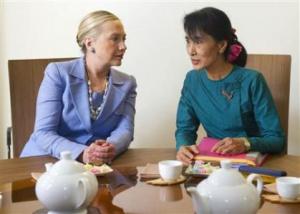
Reuters/Saul Loeb/Pool SOS HIllary CLinton and Aung San Suu Kyi
very friendly . Madam Secretary was told to keep her distance by the human rights activist and Nobel prize winner. The dog got a US chew toy according to Reuters corespondent Andrew Quinn. Clinton emphasized the importance of democracy on her last day of the visit and her hope that one day relations between the countries will normalize. More progress is needed from the Myanmar who has been run by a group of Generals for some time.
Clinton met President Thein Sein on Thursday and announced a package of modest steps to improve ties, including U.S. support for new International Monetary Fund and World Bank needs assessment missions and expanded U.N. aid programs for the country’s struggling economy.
She also said the United States would consider reinstating a full ambassador in Myanmar and could eventually ease crippling economic sanctions, but underscored that these future steps would depend on further measurable progress in Myanmar’s reform drive.“It has to be not theoretical or rhetorical. It has to be very real, on the ground, that can be evaluated. But we are open to that and we are going to pursue many different avenues to demonstrate our continuing support for this path of reform,” Clinton told a news conference on Thursday in the capital, Naypyitaw, before arriving in Yangon.
If you want a really wonky post on how bad it could get in the US and the world if the Eurozone doesn’t take care of it’s problems, you can read this analysis of UBS analysis at Zero Hedge.
Despite the very short term bounce in markets on yet another soon to be failed experiment in global liquidity pump priming, UBS’ Andrew Cates refuses to take his eyes of the ball which is namely preventing a European collapse by explaining precisely what the world would look like if a European collapse were allowed to occur. Which is why to people like Cates this week’s indeterminate intervention is the worst thing that could happen as it only provides a few days worth of symptomatic breathing room, even as the underlying causes get worse and worse. So, paradoxically, we have reached a point where the better things get (yesterday we showed just how “better” they get as soon as the market realized that the intervention half life has passed), the more the European banks will push to make things appear and be as bad as possible, as the last thing any bank in Europe can afford now is for the ECB to lose sight of the target which is that it has to print. Which explains today’s release of “How bad might it get“, posted a day after the Fed’s latest bail out: because instead of attempting to beguile the general public into a false sense of complacency, UBS found it key to take the threat warnings to the next level. Which in itself speaks volumes. What also speaks volumes is his conclusion: “Finally it is worth underscoring again that a Euro break-up scenario would generate much more macroeconomic pain for Europe and the world. It is a scenario that cannot be readily modelled. But it is now a tail risk that should be afforded a non-negligible probability. Steps toward fiscal union and a more proactive ECB, after all, will still not address the fundamental imbalances and competitiveness issues that bedevil the Euro zone. Nor will they tackle the inadequacy of structural growth drivers and the deep-seated demographic challenges that the region faces in the period ahead. Monetary initiatives designed to shore up confidence can give politicians more time to enact the necessary policies. But absent those policies and sooner or later intense instability will resume.”
I’ve been meaning to do a post explaining what the FED and the five other central banks did to prevent a credit market lock up for the past two days, but, see the first paragraph. I was reliant on my blackberry for internet access AND phone calls for two days so it didn’t happen. I’ll try to do it today if any one is interested. Basically, this could be another Lehman Brothers scenario because there are sings that interbank lending has slowed to a trickle. The extra push of world currencies is supposed to get banks around the world to lend again. If they don’t lend to each other, than the banks will scramble to cover their reserves and basically rescind and short term loans to corporations for things like inventory, working capital and payroll shortages. We’re technically not bailout out Europe and we’re trying to prevent another bailout of our usual suspect financial institutions with global exposure. This wouldn’t be as widespread as the mortgage meltdown since the exposure to that was country wide (no pun intended). The Fed can maneuver a lot here. What this could do is create some inflation which has pluses and minuses. They also are debasing the dollar which is good for exporters bad for importers and people that like to buy cheap foreign goods. Merkel and the Germans have gotten a little stiff on the plans again so the deal still isn’t made. They’re not keen on the idea of Eurobonds. Increased fiscal integration is slow tracked.
“I personally, and the whole government believes, that eurobonds are the wrong method — and even harmful — in this phase of European development,” Merkel told the General Anzeiger newspaper.
She also emphasised the independence of the European Central Bank and said it was up to the ECB to decide how to ensure currency stability.
I guess the nasty results of the German bond float last week didn’t really sink in afterall.
Okay, so this is incredibly long now and possibly way too depressing for a Friday. However, you can add the cheery bits down thread. What’s on your reading and blogging list today?
Monday Reads
Posted: April 25, 2011 Filed under: Foreign Affairs, Gitmo, Kuwait, Libya, Morrocco | Tags: Congresswoman Giffords, Easter Island, Guantanomo detainees, Kuwait, Libya Transitional National Council, Moai, Morroco, Peaceful protests, Space Shuttle Endeavor 14 Comments Good Morning!
There’s some news up from Wikileaks and WAPO on the current status of detainees held at Gitmo that I thought worth mentioning. First, WAPO had a big feature up on Sunday explaining why Obama may have difficulty dealing with the remaining detainees and why the the facility hasn’t been closed.
This account of the unraveling of Obama’s pledge to close Guantanamo is based on interviews with more than 30 current and former administration officials, as well as members of Congress and their staff, members of the George W. Bush administration, and activists. Many of them would speak about internal or sensitive deliberations only on the condition of anonymity.
The one theme that repeatedly emerged in interviews was a belief that the White House never pressed hard enough on what was supposed to be a signature goal. Although the closure of Guantanamo Bay was announced in an executive order, which Obama signed on Jan. 22, 2009, the fanfare never translated into the kind of political push necessary to sustain the policy. “Vulnerable senators weren’t going out on a limb and risk being Willie Hortonized on Gitmo when the White House, with the most to lose, wasn’t even twisting arms,” said a senior Democratic aide whose boss was one of 50 Democrats to vote in 2009 against funding to close Guantanamo. “They weren’t breathing down our necks pushing the vote or demanding unified action.”
UK’s The Telegraph has this latest Wikileak on the detainees themselves and the loosie goosie rationale used to hold them. It now seems that many will never see trial let alone a release date.
Al-Qaeda terrorists have threatened to unleash a “nuclear hellstorm” on the West if Osama Bin Laden is caught or assassinated, according to documents to be released by the WikiLeaks website, which contain details the interrogations of more than 700 Guantanamo detainees.
However, the shocking human cost of obtaining this intelligence is also exposed with dozens of innocent people sent to Guantanamo – and hundreds of low-level foot-soldiers being held for years and probably tortured before being assessed as of little significance.
Both articles are long but well-worth the read. There is additional information in the NYT in their “Guantanamo Files” section that demonstrates the unreliability of information gained through torture. It also shows how many of the detainees were held or considered risks. You’ll be horrified by the thin evidence. Just about anything was considered proof of Al Quaeda membership.
The guide shows how analysts seized upon the tiniest details as a potential litmus test for risk. If a prisoner had a Casio F91W watch, it might be an indication he had attended a Qaeda bomb-making course where such watches were handed out — though that model is sold around the world to this day. (Likewise, the assessment of a Yemeni prisoner suggests a dire use for his pocket calculator: “Calculators may be used for indirect fire calculations such as those required for artillery fire.”) A prisoner caught without travel documents? It might mean he had been trained to discard them to make identification harder, the guide explains. A detainee who claimed to be a simple farmer or a cook, or in the honey business or searching for a wife? Those were common Taliban and Qaeda cover stories, the analysts were told. And a classic Catch-22: “Refusal to cooperate,” the guide says, is a Qaeda resistance technique.
While we’re already reading the Brit Press, I’d like to give a shout out to a really interesting article at The Independent  which looks at the mystery that is Easter Island. Evidently there is a new theory about the moai and the ecology on the island.
In their new book, The Statues that Walked: Unravelling the Mystery of Easter Island, to be published in June, Dr Lipo and Professor Hunt present their evidence that Polynesian colonists arrived in 1200, up to 800 years later than the conventional theory claims, and immediately modified the environment with slash-and-burn agriculture. The effect this had on the giant palm forest was magnified by the rats that arrived with them. The rodent population, feeding extensively on palm seeds, exploded. Dr Lipo argues that deforestation didn’t make things much worse for humans. Rapa Nui was no tropical paradise. It’s an old volcanic island and many of the nutrients in the soil had already been washed away. Burning the giant palms actually helped, but the settlers soon turned to a technique called stone mulching, in which freshly broken volcanic rocks are planted in the poor soil to add nutrients and cut down on erosion. The same people who used rock mulching and greeted the Dutch could have moved the moai from Rano Raraku, the quarry where they were carved, to the shore, he says. The statues seem designed to allow small groups of men to move them by rocking them, as you would a refrigerator. Similar suggestions have been made in the past, but experiments indicated that the moai would have been worn away by the time they got to the coast. Dr Lipo, aided by anthropologist Sergio Rapu, the island’s first native governor under Chilean rule, thinks he has found a way around this, with more rocking and less shuffling.
In some happy news, Representative Giffords has the okay from her doctors to watch the launch of Space Shuttle Endeavor. The congresswoman’s recovery from shots to the head continues to astound many.
Friday, the Arizona congresswoman will witness her husband’s own inspiring moment: Commanding the space shuttle Endeavour on its last launch. Doctors have cleared Giffords, who was shot in the brain at a January 8 event in Tucson, to attend the scheduled launch in Florida, a source close to her said Sunday. The source told CNN Senior Medical Correspondent Elizabeth Cohen that Giffords will be accompanied by a nurse. There will be no doctor or medical assistance on board. The source was not sure what kind of plane Giffords will be going on, but it will not be a commercial airliner. “She’ll probably be going either Wednesday or Thursday,” the source said. Asked by “The CBS Evening News With Katie Couric” what Giffords’ reaction was to the decision allowing her to go, Kelly replied, “I think she said, ‘awesome’ and she pumped her fist.”
The Democracy contagion in the MENA region continues. Peaceful protesters in Morocco are demanding constitutional reforms.
Thousands of protesters have participated in rallies in cities across Morocco, demanding social and economic reforms. They called for an end to corruption, and want more jobs for the increasing number of university graduates who face joblessness. The peaceful protests are predominately working class in tone, demanding constitutional reforms and new parliamentary elections. The marches on Sunday were organised by the February 20 movement, which has led protests for the past two months, with support from Morocco’s best-known Islamist movement, Adl wal Ihsan, which is barred from politics in the North African kingdom. Morocco’s King Mohammed VI has already pledged changes to the constitution for the first time in 15 years, but protesters remain sceptical about the possibility of real change.
The government of Kuwait has donated $180 million to the rebels in Libya. They have not yet formally recognized the rebel shadow government but are trying to help within the limits of the UN resolution.
Kuwait on Sunday gave 50 million dinars ($180 million) to the Libyan opposition Transitional National Council (TNC), its chief Mustafa Abdel Jalil said. “This amount will help us pay part of the salaries of employees,” Jalil told reporters after talks with Emir Sheikh Sabah al-Ahmad al-Sabah. “We are in need of urgent assistance.” Kuwait’s Foreign Minister Sheikh Mohammad Sabah al-Salem al-Sabah said “Kuwait will provide large and urgent humanitarian aid through the national council.” Sheikh Mohammad said Kuwait and the TNC “will work closely so that it becomes the legitimate channel of the Libyan people,” but stopped short of officially recognising the council. “Recognition is a secondary issue,” Abdel Hafiz Ghoqa, spokesman for the TNC in Benghazi told reporters, adding that the quality of cooperation with Kuwait showed the friendly nation’s “approval” for east Libya’s nascent government. France, Gambia, Italy and Qatar are the only countries so far to have recognised the TNC, Libya’s parallel government.
Isn’t it amazing how one storekeeper in Tunisia who was frustrated with his government turned into the spark that lit a match that put so many people on fire for democratic reform? Most of these countries are either ruled by monarchs or dictators. The middle class and well-educated are tired of no opportunity and all the looting of national treasure for the benefit of the very few. Even with the violence and loss of life, it is exciting to read about ordinary people who have just had enough and are taking their future into their own hands. It makes you want to fight for what we’re losing every day.
So, that should get things started! What’s on your reading and blogging list today?

 peej
peej Carissa
 bostonboomer
 dakinikat
 ecocatwoman
 mablue2
 Mama Lopez
 peggysue22
 quixote
 skydancingguestblogger
 Mona (aka Wonk the Vote)



 Sky Dancing
Recent Comments