
Tuesday Reads
Posted: August 26, 2014 Filed under: Barack Obama, Foreign Affairs, France, George W. Bush, Germany, Iraq, morning reads, racism, Syria, U.S. Economy, U.S. Politics, unemployment | Tags: Al Nusra Front, al Qaeda, Angela Merkel, austerity, European Central Bank, Ferguson MO, ISIS, James W. Foley, Janet Yellen, Mario Draghi, Michael Brown, Peter Theo Curtis, The Islamic State, the NEW York Times 41 Comments
The Dog Days of Summer, Janet Hill
Good Morning!!
It’s the last week of August, and the dog days of summer have supposedly passed; but the Boston area is supposed to hit ninety degrees today and tomorrow. I’m actually looking forward to it, because it has been so cool here lately–in the sixites and low seventies in the daytime and the fifties at night. Yesterday it got into the high eighties, and it felt wonderful.
The Boston Globe has a story today about Peter Theo Curtis, the writer who was just released from captivity in Syria. His mother lives in Cambridge. I had never heard of Curtis before; apparently his kidnapping was kept secret. The Globe reports: Militants free US writer with Mass. ties who was held in Syria.
Peter Theo Curtis, a writer and scholar with ties to the Boston area who was held captive for nearly two years by one of the Islamic militant groups operating in Syria, was released Sunday after emissaries from the government of Qatar won his freedom on humanitarian grounds, in a stark contrast to the brutal murder of fellow war correspondent James W. Foley .
Curtis’s 22 months in captivity were kept from the public at his family’s request since he was nabbed near the Syrian border in October 2012 by Al Nusra Front, one of the groups seeking to topple President Bashir Assad of Syria. Al Nusra Front has ties to the Al Qaeda terrorist network.
Curtis, 45, who wrote dispatches under the name Theo Padnos and previously chronicled disaffected young Muslims in Yemen in a book titled “Undercover Muslim,” had studied Arabic in Syria.
He was handed over to United Nations peacekeepers in the Israeli-occupied Golan Heights on Sunday evening, a UN spokesman in New York said. After it was determined he was in good medical condition, he was transferred to representatives of the US government, according to the UN.
“We are so relieved that Theo is healthy and safe and that he is finally headed home after his ordeal,” his mother, Nancy Curtis, who lives in Cambridge, said in a statement, “but we are also deeply saddened by the terrible, unjustified killing last week of his fellow journalist, Jim Foley, at the hands of the Islamic State in Iraq and Syria, ISIS.”
Foley was from New Hampshire, and the two families have gotten to know each other well, according to Curtis.

Garden Shed – Late Summer, KK Marais
Syria and Iraq
President Obama has authorized surveillance flights over Syria, according to BBC News.
Correspondents say the move could mark the first step towards US air strikes inside Syria, where the jihadist group controls vast swathes of territory.
The US is already carrying out strikes against IS in neighbouring Iraq.
On Monday, the Syrian government said it would work with the international community in the fight against IS.
Western governments have so far rejected suggestions that they collaborate with President Bashar al-Assad in an attempt to counter the growing regional threat posed by IS….
On Monday evening, US officials said Mr Obama had approved over the weekend reconnaissance flights by unmanned and manned aircraft, including drones and possibly U2 spy planes.
The US military has been carrying out aerial surveillance of IS – an al-Qaeda breakaway formerly known as Isis – in Iraq for months and launched air strikes on 8 August.
From The Boston Globe, citing “AP sources,” U.S. planes have already begun flying over Syria.
KABUL, Afghanistan (AP) — The U.S. has begun surveillance flights over Syria after President Barack Obama gave the OK, U.S. officials said, a move that could pave the way for airstrikes against Islamic State militant targets there.
While the White House says Obama has not approved military action inside Syria, additional intelligence on the militants would likely be necessary before he could take that step. Pentagon officials have been drafting potential options for the president, including airstrikes.
One official said the administration has a need for reliable intelligence from Syria and called the surveillance flights an important avenue for obtaining data.
Two U.S. officials said Monday that Obama had approved the flights, while another U.S. official said early Tuesday that they had begun. The officials were not authorized to discuss the matter by name, and spoke only on condition of anonymity.
Jim Michaels of USA Today spoke to Gen. Dempsey on Sunday about what is being done to deal with ISIS in Iraq.
ABOARD A U.S. MILITARY AIRCRAFT — U.S. airstrikes on Islamic militants in Iraq have blunted their momentum, but defeating them will require a broad regional approach that draws support from Iraq’s neighbors and includes political and diplomatic efforts, the top U.S. military officer said.
The long-term strategy for defeating the militants includes having the United States and its allies reach out to Iraq’s neighbors, including Jordan, Saudi Arabia and Turkey, Gen. Martin Dempsey, chairman of the Joint Chiefs of Staff, said Sunday….
Dempsey is working with Central Command to prepare “options to address [the Islamic State] both in Iraq and Syria with a variety of military tools including airstrikes,” said Col. Ed Thomas, Dempsey’s spokesman, in a statement.
The militant group Islamic State, also known as ISIS, has shown itself to be so brutal that Iraq and the U.S. should be able to find “willing partners” to join efforts to defeat the militants, Dempsey said.
But military power won’t be enough, Dempsey said. The strategy must take a comprehensive approach that includes political and diplomatic efforts to address the grievances of millions of Sunnis who have felt disenfranchised by Iraq’s Shiite-dominated government, he said.

Late Summer Garden, John Gordon
I get the feeling that we’re never going to escape involvement in the endless Middle East conflicts, thanks to George W. Bush, Dick Cheney, and the rest of the neocon gang. What a horrible mess! We have our own messes to deal with here, but foreign wars always seem to trump the needs of the American people.
John Cassidy speculates at The New Yorker: What’s Next in Iraq and Syria?
On his first full day back from vacation, President Barack Obama could be forgiven for wishing he were still on Martha’s Vineyard. With confirmation that ISIS fighters have just captured another military base from the government forces of President Assad, and that Qatar has engineered the release of an American freelance journalist who was being held by a non-ISIS jihadist group, Obama has two formidable challenges to deal with.
The immediate task for Obama is deciding whether to launch American bombing raids on ISIS positions inside Syria, while simultaneously preparing his Administration, and the country at large, for the possibility of another video showing an American hostage being butchered. The ISIS militants, having carefully orchestrated the beheading of James Foley following the launch of U.S. strikes inside Iraq, will surely seek to exploit the fate of its remaining American hostages for maximum effect. Any U.S. decision to expand its air campaign is almost certain to be met with the release of more snuff films.
No President—no American—could take such a prospect lightly. At the same time, Obama has to guard against allowing emotion and wishful thinking to take over U.S. policy. That’s what happened after 9/11, and some of the chaos that we now see in the Middle East can be traced back to that historic blunder. What’s needed is calm cost-benefit analysis of the options open to the United States, taking account of its strategic interests, its values, and its capabilities. In short, we need what Danny Kahneman, the Princeton psychologist who pioneered behavioral economics, would refer to as some Type 2 thinking: a disciplined weighing of the likely consequences of our actions. If we give into our Type 1 reaction—horror, outrage, anger—we will be playing into the hands of the jihadists.
One place to start is by acknowledging two errors in thinking that have blighted U.S. policy in the past decade: the conservative delusion that the United States could, more or less single-handedly, use its military power to reinvent the Middle East, and the liberal illusion that we could simply walk away from the mess that Bush, Cheney & Co. created. Without the political willingness and the financial capability to garrison the region in the manner of postwar Germany and Japan, U.S. influence has to be exercised through air power, political proxies, economic inducements, and regional alliances. But that doesn’t diminish the fact that the United States and other Western countries have vital interests at stake, one of which is preventing the emergence of a rogue Islamic state that would provide a rallying point, and a safe haven, for anti-Western jihadists the world over.
Read the whole thing at the link.

A Garden in a Sea of Flowers, Ross Turner
The Economies of the U.S. and Europe
There has been so much breaking news for the past couple of months that we haven’t talked much about the economies of the U.S. and Europe. But today the European Central Bank is topping the headlines, and last week Fed Chairperson Janet Yellen spoke at Jackson Hole, so I thought I’d post a few economics stories.
Here’s CNN Money’s report on Yellen’s speech, Janet Yellen: Job market not recovered.
That was Federal Reserve Chair Janet Yellen’s main message Friday in a much anticipated speech.
“It speaks to the depth of the damage that, five years after the end of the recession, the labor market has yet to fully recover,” she said.
The debate now is whether the job situation in America is healthy enough for the Federal Reserve to start raising interest rates, which have been at historic lows in recent years in an effort to jump start the economy. Yellen, however, said little new on Friday, and U.S. stock markets stayed flat.
Yellen is chair of the committee that sets interest rates, but she only gets one vote. Other members have differing views. The Fed board and other top economists are spending the weekend in Jackson Hole, Wyoming, debating these key issues.
Though the unemployment rate “has fallen considerably and at a surprisingly rapid pace,” Yellen said problems remain.
Yellen called attention to what Americans in the job market already know–though the employment numbers look better, many people have stopped looking for work, and most of the new jobs are part-time and pay low wages.
A few more U.S. economy stories to check out:
The Wall Street Journal: Fed’s Yellen Remains Mum on Timing of Rate Change.
Bloomberg Businessweek: Yellen Job-Slack View Muddied by Pent-Up Wage Deflation.
Slate: The Fed Is Not As Powerful As We Think.
If you think the economy is struggling here, you should take a look at Europe, where austerity thinking has ruled since the economic crisis hit. Yesterday the French government collapsed. From The New York Times, French Cabinet Is Dissolved, a Victim of Austerity Battles.
PARIS — The collapse of the French government on Monday exposed widening divisions both within France’s leadership, and Europe more broadly, over austerity policies that many now fault for threatening to tip the eurozone back into recession.
Prime Minister Manuel Valls announced that he would dissolve his government after a rancorous battle in his cabinet over whether the belt-tightening measures taken by President François Hollande — at the urging of Germany and European Union officials in Brussels — were impeding France’s recovery.
The dispute broke into the open when Mr. Vall’s outspoken economy minister, Arnaud Montebourg, insisted in an interview over the weekend that austerity had gone too far. “The priority must be exiting the crisis, and the dogmatic reduction of deficits should come after,” he told the newspaper Le Monde.
He also took direct aim at the policies of Angela Merkel, the German chancellor. “Germany is caught in a trap of austerity that it is imposing across Europe,” he said.
Even the formerly strong German economy is struggling now, according to Reuters (via NYT), Crisis in Ukraine Drags Economy in Germany.
The eurozone’s flatlining economy took another hit on Monday when data showed German business sentiment sagging for the fourth consecutive month. Chancellor Angela Merkel attributed some of her own country’s decline in the second quarter to the Russia-Ukraine crisis, over which tit-for-tat sanctions threaten trade. The Munich-based Ifo, a research firm, echoed some of those sentiments as it reported its business climate index, based on a monthly survey of some 7,000 companies, fell to a worse-than-expected 106.3 from 108, the lowest level in more than a year. The findings agreed with data earlier in the month on the second-quarter contraction in Germany, the bloc’s biggest economy. Klaus Wohlrabe, an Ifo economist, said his institute expected growth in Germany to be “close to zero” in the third quarter.
A few more headlines on the European economic situation:
The Guardian: An austerity revolt has broken the French government. Will the EU follow?
Bloomberg Businessweek on the European Central Bank, Draghi May Again Find Bazooka Words Beat Action With QE, and an editorial from The Financial Times, Central banks at the crossroads.

Wisteria Flowers in Bloom at Pergola at Portland Japanese Garden Stone Path
Ferguson Stories
Yesterday, on the day of Michael Brown’s funeral, The New York Times published a story that got a great deal of attention because of its insensitive characterization of the dead teenager. Here the paragraph that attracted the angry reaction:
Michael Brown, 18, due to be buried on Monday, was no angel, with public records and interviews with friends and family revealing both problems and promise in his young life. Shortly before his encounter with Officer Wilson, the police say he was caught on a security camera stealing a box of cigars, pushing the clerk of a convenience store into a display case. He lived in a community that had rough patches, and he dabbled in drugs and alcohol. He had taken to rapping in recent months, producing lyrics that were by turns contemplative and vulgar. He got into at least one scuffle with a neighbor.
Would the authors have written a similar paragraph about a white homicide victim? From Vox, The New York Times called Michael Brown “no angel.” Here’s how it described serial killers.
The New York Times’s description of Michael Brown as “no angel” has prompted a swift, critical reaction from other media outlets, including Vox, and various people on social media.
Alison Mitchell, national editor for the Times, defended the term in conversations with the Washington Post’s Erik Wemple:
“It comes out of the opening scene,” says Mitchell, who notes that “like many teenagers,” Brown was indeed “no angel.” Okay, but would the New York Times have chosen this term — which is commonly used to describe miscreants and thugs — if the victim had been white? Mitchell: “I think, actually, we have a nuanced story about the young man and if it had been a white young man in the same exact situation, if that’s where our reporting took us, we would have written it in the same way.” When asked whether she thought that “no angel” was a loaded term in this context, Mitchell said she didn’t believe it was. “The story … talks about both problems and promise,” she notes.
The Times’s response has done little to calm the storm. Sean McElwee, research assistant at Demos, dug into the archives to compare the Times’s description of Brown to the newspaper’s previous descriptions of serial killers and terrorists. Of course, comparing articles produced decades apart by different writers and editors isn’t an exact science. But it does lend context to the widespread frustration over how young black men are portrayed in the media.
A series of McElwee’s tweets are posted at the link, and are well worth reading.
One more from Salon by Joan Walsh, Ferguson’s booming white grievance industry: Fox News, Darren Wilson and friends. Check it out at Salon.
How did this post get so long?! I’d better wrap it up. Please post your thoughts and links in the comment thread, and have a great Tuesday!
Tuesday Reads: Are Things Really As Bad As I Think?
Posted: December 3, 2013 Filed under: Barack Obama, George W. Bush, Health care reform, immigration, income inequality, morning reads, Political Affective Disorder, Politics as Usual, poverty, Psychopaths in charge, Real Life Horror, Surreality, The Media SUCKS, U.S. Economy, U.S. Politics, We are so F'd, Women's Rights | Tags: Amazon drones, gun violence, No Child Left Behind, Obamacare, PISA test scores, public education, Racism 44 Comments
Good Morning!!
I don’t even know where to begin this morning. I wish I could write a coherent diatribe like the one Dakinikat wrote yesterday, but I can’t do it. I have a sense that things are very wrong, but I can’t explain the feeling in any rational way.
As we head into the holiday season, I feel as if the country is leaderless. The public focus of the Obama administration and the media is on the glitches in a website; and yet in the background are terrible problems that are building and growing more and more intractable as our political “leadership” fiddles with nonsensical issues like Obamacare and Benghazi.
As Dakinikat noted yesterday, there is a problem of growing poverty and income inequality become institutionalized and normalized. There is the issue of gun violence and our total failure to respond to it with any kind of rational regulations on guns. There is the devolution of education in the U.S., and of course there is the continuing attack on women’s autonomy and Democratic politicians seeming willingness to use women’s bodies as bargaining chips. Finally there are the already institutionalized problems of racism and hatred of immigrants. What have I missed?
As our real problem grow, it seems the American political and media classes, either don’t notice because as part of the wealthy 1% they simply aren’t affected, or because they’ve got theirs and they just don’t care about the mass of people who are struggling to survive in a poisonous system. And because of the obsessive focus on the end-of-year holidays, nothing will happen in Washington until we hit the next debt limit and our “leaders” mobilize briefly to kick the can of our economic and social problems down the road once again and so they can return to their focus on minutiae.
Is there any solution to the political and economic stagnation we find ourselves in? Is the situation really as surreal as it feels to me on this Tuesday morning? Am I nuts?
Anyway, here a some of the stories leading the news at the moment.
Jeff Bezos tells Amazon customers to expect home delivery by drones. NBC News reports:
Amazon.com hopes to deliver small packages to your home in just 30 minutes by unmanned drones within five years, chief executive Jeff Bezos said Sunday.
In an interview on CBS’s “60 Minutes,” Bezos was actually less optimistic than what his company said in its online announcement, which declared that tiny robot aircraft could be landing on front porches as soon as 2015.
Bezos said Amazon already had the technology in place and had even flown a working prototype, which he showed off in a video the company published Sunday:
He promised “half-hour delivery, and we can carry objects, we think, up to five pounds, which covers 86 percent of the items that we deliver.”
The rest of the work, Bezos said, is in quality control and getting the plan OK’d by the Federal Aviation Administration — something technology experts said was unlikely on Bezos’ time frame.
So basically, this is just a silly idea that has no chance of actually happening anytime soon. But the media sees it as more urgent than poverty, income inequality, and people getting killed with guns day in and day out.
From the Washington Post: U.S. students lag around average on international science, math and reading test.
Scores in math, reading and science posted by 15-year-olds in the United States were flat while their counterparts elsewhere — particularly in Shanghai, Singapore and other Asian provinces or countries — soared ahead, according to results of a well-regarded international exam released Tuesday.
While U.S. teenagers scored slightly above average in reading, their scores were average in science and below average in math, compared to 64 other countries and economies that participated in the 2012 Program for International Student Assessment, or PISA, which was administered last fall. That pattern has not changed much since PISA was first administered in 2000.
Gee, I wonder why this is happening? It seems like something that should concern our “leaders.”
The test scores offer fresh evidence for those who argue that the United States is losing ground to competitors in the global market and others who say a decade’s worth of school reform has done little to improve educational outcomes.
“While the intentions may have been good, a decade of top-down, test-based schooling created by No Child Left Behind and Race to the Top — focused on hyper-testing students, sanctioning teachers and closing schools — has failed to improve the quality of American public education,” Randi Weingarten, president of the American Federation of Teachers, said in a statement. The AFT released a video on Monday in which it implored the public not to blame teachers, the unions, parents or students for poor PISA results.
But were intentions really good? Check out these years-old headlines on profiteers (including the Bush family) who cleaned up after passage of the Orwellianly titled “No Child Left Behind” law was passed.
Bush Profiteers Collect Billions from No Child Left Behind (Project Censored: The News That Didn’t Make The News, March 30, 2007)
Bush’s Family Profits From `No Child’ Act (LA Times, Oct. 22, 2006)
No Bush Left Behind (Bloomerg Businessweek, Oct. 15, 2006)
There are plenty more headlines where those came from.
And yet, nearly a decade later, we’re stuck with that awful law and the damage it has done to our public education system. Why have Democrats done nothing to reverse it? Most likely because they too profit from the continuing privatization of education.
What about the latest media narrative on Obama care?
From the Washington Post: Health-care enrollment on Web plagued by bugs:
The enrollment records for a significant portion of the Americans who have chosen health plans through the online federal insurance marketplace contain errors — generated by the computer system — that mean they might not get the coverage they’re expecting next month.
The errors cumulatively have affected roughly one-third of the people who have signed up for health plans since Oct. 1, according to two government and health-care industry officials. The White House disputed the figure but declined to provide its own.
The mistakes include failure to notify insurers about new customers, duplicate enrollments or cancellation notices for the same person, incorrect information about family members, and mistakes involving federal subsidies. The errors have been accumulating since HealthCare.gov opened two months ago, even as the Obama administration has been working to make it easier for consumers to sign up for coverage, the government and industry officials said.
Figuring out how to clean up the backlog of errors and prevent similar ones in the future is emerging as the new imperative if the federal insurance exchange is to work as intended. The problems were the subject of a meeting Monday between administration officials and a new “Payer Exchange Performance Team” made up of insurance industry leaders.
Okay, but what is with the bizarre impatience about some computer glitches from a media that couldn’t care less about institutionalized poverty, racism, and gun violence? And then there’s the Obama administration’s defensive response, as reported by USA Today: Obama to launch new health care law campaign
President Obama and his aides will seek to rally public support for his embattled health care plan in the coming weeks, starting with a White House event Tuesday.
Obama will promote the effort in a speech while surrounded by people who have benefited from the new law, according to an addition to the White House schedule.
The Affordable Care Act has come under heavy political attack since its rollout in October. Problems have included a malfunctioning website and the cancellations of polices that do not meet new federal standards.
In the coming days, Obama and aides will highlight what they call successful aspects of the law. They include provisions that prevent insurance companies from discriminating against people with pre-existing health conditions, and allow young people to stay on their parents’ insurance policies until age 26.
A few writers have tried to look at the “Obamacare crisis” slightly more rationally than the mainstream corporate media.
Here’s Bob Cesca at The Daily Banter: As Healthcare.gov Bugs Are Fixed, the ‘Obama’s Katrina’ Script Continues To Be Shredded.
It’s been 11 days since The National Journal‘s Ron Fournier wrote that Obamacare is President Obama’s Katrina. Oh, and it’s also his Iraq, Fournier wrote. Obama’s Katrina and Iraq. Both.
Since then, however, the Healthcare.gov website has been vastly improved and many of the bugs initially reported have been fixed, according to the administration late Sunday.
Back on November 20, Fournier made sure to provide himself with an escape hatch, though, noting that Healthcare.gov isn’t the same in terms of the actual events during and after Katrina, or throughout the Iraq War. Instead, Fournier wrote, the similarities had more to do with incompetence in the execution of a major policy initiative.
Yeah, so incompetence that lasted literally for years in both Iraq and New Orleans, leading to massive body counts on both fronts, is the same as a glitchy website launch. Okeedokee. Roger that. In reality, yes, both administrations made mistakes, but those mistakes were vastly different in terms of magnitude — not to mention that the Bush administration’s response to its mistakes was to, well, make even more mistakes. Again, foryears.
On the other hand, the Obama administration realized there were problems with the website and rushed to address those errors. Within two months most of those problems have been resolved, and, bonus, no one died.
For more rational perspective, read the rest of the post at the link.
I particularly like this uncharacteristically long post by TBogg at Raw Story: Are-We-There-Yet?-American [sic] just wants to go home because we aren’t there yet. Here’s just a taste:
You may remember that about a month ago, which is four score and seven years ago to the iPhone generation for whom a Japandroids download that takes over 20 seconds is an eternity times infinity, that the Great Socialism Project That Will Stomp America Flat (aka Obamacareor Communism) had some internet user problems which is why there are absolutely no healthcare services available in America right now so you should just rub some dirt on your burst appendix, suck it up, and quit yer bellyaching. In an effort to fix what wasn’t working, the Obama White House brought in some better quality nerds who, fortified with 5 Hour Energy IV drips, promised to get it up and working by Dec 1 or GTFO.
Please go read the rest.
Charles Pierce also had a few choice words for Ron Fournier and the rest of the Obama-hating press.
Ace reporter Ron Fournier of the Associated Press has another scoop for y’all. There is absolutely no fking way on god’s green and pleasant earth that this Obama fellow will be elected president again. He has blown his chance for that third term, and probably the fourth and fifth as well. Ron would like the Pulitzer committee to leave the medallion on the doorstep. Watch out, Obama. The Horsemen ride at daybreak! [….]
I heard my friend Eric Boehlert on the radio this morning, warning us that the traditional end-of-the-year retrospectives are likely to sing in close harmony on the theme of the collapsing Obama administration, even though his poll numbers are pretty much where they’ve been for a couple of years now, and even though the Republicans in Congress continue to have the approval ratings of skin disease. I think he’s right, and I think Fournier, who’s been a tool so long they ought to sell him at Home Depot, is just trying to get a jump on things here.
More hilarity at the link.
And what’s with the efforts to deny that racism exists? From Raw Story: Black female professor reprimanded for pointing out existence of structural racism to white male students.
A faculty member at Minneapolis Community and Technical College, Shannon Gibney, received a formal reprimand for her handling of a discussion about structural racism in her Introduction to Mass Communication course.
According to Gibney in an interview with City College News, a white male student asked her, “Why do we have to talk about this in every class? Why do we have to talk about this?”
She claims she was shocked, because “[h]is whole demeanor was very defensive. He was taking it personally. I tried to explain, of course, in a reasonable manner — as reasonable as I could given the fact that I was being interrupted and put on the spot in the middle of class — that this is unfortunately the context of 21st century America.”
Gibney says another white male student followed the first, saying “Yeah, I don’t get this either. It’s like people are trying to say that white men are always the villains, the bad guys. Why do we have to say this?”
When Gibney attempted, again, to inform the students that they were mistaking a systemic critique for a personal attack, the students continued to argue. Eventually, she told them that “if you’re really upset, feel free to go down to legal affairs and file a racial harassment discrimination complaint.” This is exactly what they did.
This probably has something to do with our f’d up education system too . . . . As far as I can tell, critical thinking has been banned.
Okay, I’ve ranted long enough. What interesting news have you been reading? Let us know in the comment thread.
Tuesday Reads: Liberals, Libertarians, and Concern Trolls
Posted: October 29, 2013 Filed under: abortion rights, Barack Obama, Civil Liberties, Civil Rights, Crime, Democratic Politics, Foreign Affairs, France, George W. Bush, Germany, Great Britain, Hillary Clinton, Medicaid, Medicare, morning reads, poverty, Reproductive Rights, Russia, Social Security, U.S. Politics, War on Women, Women's Rights | Tags: "progressive" blogs, Conor Friedersdorf, Edward Snowden, Glenn Greenwald, Ian Welsh, libertarians, Ron Paul, T-Bogg 60 Comments
Good Morning!!
Between the Red Sox being in the World Series and having to have a root canal on Saturday, I’ve been a little bit disconnected from politics. The Sox won again last night in St. Louis, and they’ll be coming back home to Fenway Park leading the series 3 games to 2; so they could end it tomorrow night. If this post is a little late, my aching jaw and baseball are the reasons why.
We’ve been talking a lot about libertarians lately, because so-called progressives have been aligning with those Ayn Rand fans since libertarian Edward Snowden began leaking top secret documents about the NSA and libertarian Glenn Greenwald began lecturing the world about what a great hero Snowden is for defecting to Russia and revealing the most secret counterintelligence methods of the U.S. and U.K.
The latest shameful episode was Saturday’s “Stop Watching Us” rally in Washington, at which supposedly “progressive” groups joined with anti-woman right-wingers like Justin Amash and neo-confederates like Ron and Rand Paul to protest the NSA doing its job of collecting foreign intelligence.
Before the rally took place, Tom Watson wrote a heartfelt column warning “progressives” that libertarians don’t make good bedfellows. Watson wrote that while he dislikes mass surveillance,
I cannot support this coalition or the rally. It is fatally compromised by the prominent leadership and participation of the Libertarian Party and other libertarian student groups; their hardcore ideology stands in direct opposition to almost everything I believe in as a social democrat.
The Libertarian Party itself — inaccurately described by Stop Watching Us as a “public advocacy organization” — is a right-wing political party that opposes all gun control lawsand public healthcare, supported the government shutdown, dismisses public education,opposes organized labor, favors the end of Social Security as we know it, and argues in its formal political manifesto that “we should eliminate the entire social welfare system” while supporting “unrestricted competition among banks and depository institutions of all types.”
Yet my progressive friends would take the stage with the representatives of this political movement? Why? The loss is much greater than the gain. Organizers trade their own good names and reputations to stand alongside — and convey legitimacy to — a party that opposes communitarian participation in liberal society, and rejects the very role of government itself. And their own argument for privacy is weakened by the pollution of an ideology that uses its few positive civil liberties positions as a predator uses candy with a child.
This is an abandonment of core principles, in my view, out of anger over Edward Snowden’s still-recent revelations about the National Security Agency and its spying activity, particularly domestic access to telephone and online networks and metadata. It represents trading long-held beliefs in social and economic justice for a current hot-button issue that — while clearly of concern to all Americans — doesn’t come close to trumping a host of other issues areas that require “the long game” of electoral politics and organizing. Going “all in” with the libertarian purists is a fatal and unnecessary compromise; reform is clearly needed, but the presence of anti-government laissez-faire wingers at the beating heart of the privacy movement will surely sour the very political actors that movement desperately needs to make actual — and not symbolic, link bait — progress in its fight.
But it was to no avail. Watson was attacked for his argument that the anti-surveillance fever is distracting from other important issues. People like Greenwald and Snowden couldn’t possibly care less about alleviating poverty, protecting women’s rights or the right to vote. They’d have no problem with Social Security and Medicare being eliminated, and as for voting, they’re anti-government anyway. Glenn Greenwald–whom some uninformed people believe is a “progressive,” saves his worst attacks for Democrats and in the past has supported Ron Paul and Gary Johnson for president. To Greenwald, sacrificing the entire legacy of FDR and the civil rights and women’s movements is no big deal. Here’s how he characterized the values of liberals who reject Ron Paul in 2011:
Yes, I’m willing to continue to have Muslim children slaughtered by covert drones and cluster bombs, and America’s minorities imprisoned by the hundreds of thousands for no good reason, and the CIA able to run rampant with no checks or transparency, and privacy eroded further by the unchecked Surveillance State, and American citizens targeted by the President for assassination with no due process, and whistleblowers threatened with life imprisonment for “espionage,” and the Fed able to dole out trillions to bankers in secret, and a substantially higher risk of war with Iran (fought by the U.S. or by Israel with U.S. support) in exchange for less severe cuts to Social Security, Medicare and other entitlement programs, the preservation of the Education and Energy Departments, more stringent environmental regulations, broader health care coverage, defense of reproductive rights for women, stronger enforcement of civil rights for America’s minorities, a President with no associations with racist views in a newsletter, and a more progressive Supreme Court.
Of course, Greenwald is admitting that he’d sacrifice the social safety net and the rights of millions of Americans in a hopeless effort to defeat the military-industrial complex and its technologies. If you can stand to read the whole piece, you’ll also learn that Greenwald thinks Matt Stoller is a “brilliant” writer. Greenwald is a libertarian purist, with no understanding of how politics actually works. This is the pied piper that many “progressives” are following these days.
I guess I’m getting a little carried away here, so I’ll stop ranting and offer some pertinent links.
Thursday Reads
Posted: April 25, 2013 Filed under: George W. Bush, morning reads, Psychopaths in charge, Republican politics, The Media SUCKS, U.S. Politics | Tags: Bangladesh factory collapse, barge explosions, Dhaka, Jennifer Rubin, Matthew Yglesias, Mobile Alabama, Ron Fournier, Walmart, worker safety 54 Comments
Good Morning!!
Unfortunately there is quite a bit of bad news breaking right now.
I’ll start with the collapse of the factory in Bangladesh.
From the Independent UK: Rescuers battle on as toll rises to 175 at collapsed Dhaka factory block that supplied Primark
Rescuers in Bangladesh are battling to save those trapped in the rubble of a collapsed building that contained garment factories as the death toll soared to at least 175. Many more hundreds of people were injured.
Hundreds of members of rescue teams, assisted by members of the military, frantically tried to clear rubble and debris amid fears that the death toll could rise yet higher.
The eight-storey building containing the factories which produced garments for several Western brands including Primark and Walmart, had been inspected on Tuesday and was found to have cracks.
But officials said the owners of the building assured the 2,000-odd employees that there was no danger and told them to carry on with their work….
The cracks were discovered on Tuesday and were so big that the local television news channel made a report about them. Staff from a bank that is housed in the same building were evacuated. However, the garment factories kept their staff working

Bangladesh factory collapse
CTV News: Collapsed Bangladesh factories ignored evacuation, officials say
With deep cracks visible in the walls, police had ordered a Bangladesh garment building evacuated the day before its deadly collapse, but the factories flouted the order and kept more than 2,000 people working, officials said Thursday. More than 200 people died when a huge section of the eight-story building splintered into a pile of concrete.
The disaster in the Dhaka suburb of Savar came less than five months after a blaze killed 112 people in a garment factory and underscored the unsafe conditions faced by Bangladesh’s garment workers, who produce clothes for brands worn around the world. Some of the companies in the building that fell say their customers include retail giants such as Wal-Mart.
Hundreds of rescuers, some crawling through the maze of rubble in search of survivors and corpses, worked through the night and into Thursday amid the cries of the trapped and the wails of workers’ relatives gathered outside the building, called Rana Plaza, which housed numerous garment factories and a handful of other companies.
An AP photographer ventured into the rubble and talked to one man who was
pinned face down in the darkness between concrete slabs and next to two corpses. Mohammad Altab pleaded for help, but they were unable to free him.
“Save us, brother. I beg you, brother. I want to live,” moaned Altab, a garment worker. “It’s so painful here … I have two little children.”
Another survivor, whose voice could be heard from deep in the rubble, wept as he called for help.
“We want to live brother; it’s hard to remain alive here. It would have been better to die than enduring such pain to live on. We want to live. Please save us,” the man cried.
I linked to this Matthew Yglesias post in a comment last night, but I’m going to include it here again because it is just so disgusting: Different Places Have Different Safety Rules and That’s OK
It’s very plausible that one reason American workplaces have gotten safer over the decades is that we now tend to outsource a lot of factory-explosion-risk to places like Bangladesh where 87 people just died in a building collapse.* This kind of consideration leads Erik Loomis to the conclusion that we need a unified global standard for safety, by which he does not mean that Bangladeshi levels of workplace safety should be implemented in the United States.
I think that’s wrong. Bangladesh may or may not need tougher workplace safety rules, but it’s entirely appropriate for Bangladesh to have different—and, indeed, lower—workplace safety standards than the United States.
The reason is that while having a safe job is good, money is also good. Jobs that are unusually dangerous—in the contemporary United States that’s primarily fishing, logging, and trucking—pay a premium over other working-class occupations precisely because people are reluctant to risk death or maiming at work. And in a free society it’s good that different people are able to make different choices on the risk–reward spectrum.
Um . . . No, it’s not okay. Read more at the link if you can stomach it.
Back in the USA, there have now been seven explosions on fuel barges in Alabama.
Creating Fiscal Strife
Posted: November 29, 2012 Filed under: Catfood Commission, Economy, Federal Budget, Federal Budget and Budget deficit, George W. Bush, Global Financial Crisis, House of Representatives, Medicare, Politics as Usual, Republican politics, Republican Tax Fetishists, Super Committee, The Bonus Class, the GOP, U.S. Economy, U.S. Politics | Tags: fiscal cliff 15 Comments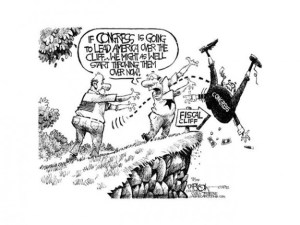 One of the things that drives me crazy as an economist and a citizen looking at this so-called “fiscal cliff” is that our fiscal strife has been created by the people least likely to suffer from its resolution. Congress gave the Bush administration authority to start a series of unfunded, reckless wars that have lasted well over a decade. Congress passed the Bush administration’s reckless tax cuts and generous loopholes that have benefited the few at the cost of the many. The Bush administration’s and Congress’ lack of oversight and deregulation of the financial services’ industry created a low-risk, gambling casino with the national investment and savings accounts and the debt markets. This led to a huge recession. These are the roots of our fiscal problems. But, the discussions around cleaning up messes in the District mostly surround Social Security which has nothing to do with the national debt and deficit and items that have become more necessary to average Americans since Congress and the Bush Administration broke the country with its bad policies.
Here’s some of the latest examples. Closing loopholes and unnecessary deductions for certain constituents is a good idea. However, which of these things are on the chopping block? Inkling its way up the priority list is the major middle and working class deduction and source of household wealth: the mortgage interest deduction. I have no problem with eliminating second mortgages, mortgages on boats, and mortgages on second properties. These benefit very few people and really serve little policy purpose. Capping the deduction–with an annual COLA adjustment to the median price and below-based mortgages is also fine. However, what are we likely to see?
As the Obama administration and lawmakers on Capitol Hill scramble to defuse automatic spending cuts and tax increases set to take effect Jan. 1, a herd of sacred cows — from Social Security and Medicare to deductions for charitable giving and mortgage interest — are in danger of losing their untouchable status.
Members of both parties have largely steered clear of detailed proposals so far. But plans put forth in the past year by President Obama and Mitt Romney to place limits on annual total tax deductions are likely to crimp the mortgage-interest deduction for certain taxpayers. Top congressional Republicans also have expressed openness to limiting total tax deductions as part of an overall budget deal. In addition, the presidentially appointed Simpson-Bowles fiscal commission suggested scaling back the mortgage-interest deduction as part of its own set of tax-related proposals.
Current law allows homeowners to deduct the interest paid on mortgage balances up to $1 million, including on second homes, as well as on $100,000 worth of home-equity loans. The deduction overwhelmingly benefits wealthier families, partly because they tend to have larger mortgages and pay more interest, and partly because most low- and middle-income Americans do not itemize deductions on their tax returns. It also tends to favor homeowners on the East and West Coasts, as well as those in large cities such as Chicago, where average home prices are higher.
Edward Kleinbard, a tax expert and law professor at the University of Southern California, said the mortgage-interest deduction represents the kind of government “extravagance” that the country no longer can justify, given its fiscal troubles.
“We simply cannot afford wasteful government subsidy programs anymore, and this is one of the most important examples of that,” Kleinbard said. “It’s very much a subsidy to those Americans who need it least.”
Mitch McConnell continues to service Grover Norquist and the Club for Growth. He’s back on his high horse for no tax increases for the wealthy. Ending tax cuts for the wealthy endlessly shown to have no ill-impact on the economy. There is also no real benefit to extending them.
Senate Republican Leader Mitch McConnell (Ky.) slammed the door Thursday morning on Democratic demands to raise tax rates on families earning more than $250,000 per year.
“We’re insisting on keeping tax rates where they are, first and foremost, to protect jobs and because we don’t think government needs the money in the first place,” McConnell said on the Senate floor.
“The problem, as I’ve said, is that Washington spends too much. But if more revenue is the price that Democrats want to exact, then we should at least agree to do it in a way that doesn’t cost jobs and disincentivize rates, as we all know raising rates would do,” he said.
McConnell’s comments came a day after Speaker John Boehner (R-Ohio) shot down a proposal by a senior GOP lawmaker, Oklahoma Rep. Tom Cole, to agree to extend tax rates only for families earning below $250,000 and resume the battle against higher tax rates on the wealthy next year.
Boehner said President Obama and Democrats should focus on finding ways to cut spending and reform entitlement programs.
The fate of the Bush-era tax rates — which will expire for all income levels in January — has dominated the debate over the slew of tax increases and spending cuts that are set to begin next year.
McConnell scolded the president Thursday for sticking fast to his campaign pledge to seek higher taxes on the rich, and made clear that raising tax rates on anyone is unacceptable.
The debate over Medicare is likely to be equally absurd. Medicare needs some reworking. Most of its problems comes from the pharmacy benefit which currently allows Big Pharma to price gouge participants and the taxpayers. But, you wouldn’t know that from the conversation. Republicans are playing games with Amercan’s health. They appear to be clinging to the Ryan’s voucher plan which would be disastrous for the majority of retired seniors.
The austerity crisis talks have hit a peculiar impasse. The problem isn’t, as most analysts expected, taxes, where Republicans seem increasingly resigned to new revenue. It’s Medicare. And the particular Medicare problem isn’t that Democrats are refusing the GOP’s proposed Medicare cuts. It’s that Republicans are refusing to name their Medicare cuts.
Politico quotes a “top Democratic official” who paints the picture simply: “Rob Nabors [the White House negotiator], has been saying: ‘This is what we want on revenues on the down payment. What’s your guys’ ask on the entitlement side?’ And they keep looking back at us and saying: ‘We want you to come up with that and pitch us.’ That’s not going to happen.”
That’s partly politics. If nothing else, Republicans are respectful of Medicare’s political potency. Recall that a core Republican message in both the 2010 and 2012 elections was that Democrats, through Obamacare, were cutting Medicare too much. Republicans, already concerned about their brand, don’t want to rebrand themselves as the party of Medicare cuts.
But it’s partly policy, too. The fact is that short of converting the program to a premium support system — a non-starter after they lost the 2012 election — Republicans simply don’t know what they want to do on Medicare.
Scour the various outlets for Democratic policy ideas and you’ll find plenty of proposed Medicare cuts. President Obama’s 2013 budget, for instance, includes hundreds of billions in Medicare cuts (see pages 33-37), and caps the program’s long-term growth at GDP+0.5 percent. More recently, the Center for American Progress released a 46-page proposal for cutting Medicare by almost $400 billion.
Republicans, meanwhile, have focused their energy on a long-term effort to convert Medicare to a premium-support model. Paul Ryan’s 2013 budget kept the Affordable Care Act’s Medicare cuts for the next 10 years and proposed to convert the program to a premium-support model in the future. Mitt Romney’s platform proposed reversing Obamacare’s Medicare cuts and offered a vague framework for converting the program to a premium-support model in the future.
If you dig deep into the Republican think tank world, you can find a few proposals that focus on the near-term.
The current fiscal ‘cliff’ framework appears to place a lot of burden on those least able to take it as well as those least responsible for creating the problems.
Cut through the fog, and here’s what to expect: Taxes will go up just shy of $1.2 trillion — the middle ground of what President Barack Obama wants and what Republicans say they could stomach. Entitlement programs, mainly Medicare, will be cut by no less than $400 billion — and perhaps a lot more, to get Republicans to swallow those tax hikes. There will be at least $1.2 trillion in spending cuts and “war savings.” And any final deal will come not by a group effort but in a private deal between two men: Obama and House Speaker John Boehner (R-Ohio). The two men had a 30-minute phone conversation Wednesday night — but the private lines of communications remain very much open.
No doubt, there will be lots of huffing and puffing before any deal can be had. And, no doubt, Obama and Congress could easily botch any or all three of the white-knuckle moments soon to hit this town: the automatic spending cuts and expiration of the Bush tax cuts, both of which kick in at the end of this year, and the federal debt limit that hits early next.
Go to the Politico story for a concept of what’s at stake and at issue.
Speaker John Boehner (R-Ohio) said Thursday there had been “no substantive progress” in fiscal-cliff negotiations in the two weeks since congressional leaders met with President Obama.
Boehner, addressing reporters after a meeting with Treasury Secretary Tim Geithner in the Capitol, called on the White House to “get serious” about the talks and warned of a “real danger” that Jan. 1 would come without a deal if President Obama did not offer up specific spending cuts he would be willing to accept.
“Despite claims that the president supports a balanced approach, the Democrats have yet to get serious about real spending cuts,” Boehner said. “Secondly, no substantive progress has been made in the talks between the White House and the House in the last two weeks.
“Listen, this is not a game,” he added. “Jobs are on the line. The American economy is on the line, and this is a moment for adult leadership.”
The Speaker criticized the president for holding “campaign-style rallies” instead of engaging in serious talks.

 peej
peej Carissa
 bostonboomer
 dakinikat
 ecocatwoman
 mablue2
 Mama Lopez
 peggysue22
 quixote
 skydancingguestblogger
 Mona (aka Wonk the Vote)



 Sky Dancing
Recent Comments