
Finally Friday Reads: Deadly Dysfunction
Posted: December 5, 2025 Filed under: #We are so Fucked, Breaking News, Corruption and Criminal Insanity, Foreign Affairs, GOP Crimes Against Humanity, ICE Immigration and Customs Enforcement, ICE raids, New Orleans, Venezuela | Tags: @johnbuss.bsky.social John Buss, anti-vaccination twits, Attacks on Venezuala, No Quarter, RFK Jr Weirdo, The Media SUCKS 12 Comments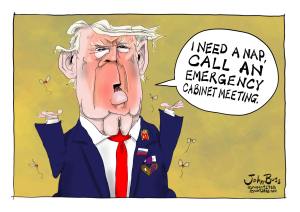
“I’m not sure, but that Cabinet Meeting may have been the most entertaining one yet. Two hours of trump fighting off sleep, like the toddler he obviously is, while his minions heaped praise upon his barely coherent body.” John Buss, @repeat1968
Good Day, Sky Dancers!
And, hello again from Occupied New Orleans. We’ve had cold rainy weather for quite some time. Perhaps it will wash aways some of the dirty ICE terrorizing the city. The stories get more horrific and we’re barely into the first week of it. The complete idiocy with which this administration operates is ruining the country and a lot of it brings unnecessary death. I only wish we had a Congress that would function the way it was designed and a much better press. Let’s dig in while my tea is still hot.
The latest maneuvering of RFK jr’s death panels is once more directed to childhood vacinations. Where are all these supposedly pro-life people when something other than a fertilized egg is involved. No one cares about actually breathing children? This is from the Washington Post. “CDC panel makes most sweeping revision to child vaccine schedule under RFK Jr.. The panel voted to eliminate a long-standing recommendation for every newborn to receive a hepatitis B shot, excluding those born to mothers testing negative.”
An influential vaccine advisory panel on Friday voted to lift a long-standing recommendation that all newborns receive a vaccine for hepatitis B, marking the most significant change to the childhood immunization schedule under Health Secretary Robert F. Kennedy Jr.
The Advisory Committee on Immunization Practices approved the change despite fierce objections from medical groups who said the recommendation had proved a successful public health strategy, nearly eradicating the dangerous virus among U.S. children.
The committee voted 8-3 to eliminate a recommendation, dating to 1991, for every child to receive a first dose of a hepatitis B vaccine shortly after birth. The panel said the newborn shot is no longer necessary for babies born to mothers who test negative for the virus. They suggested parents of those children delay the first dose for at least two months and consult with their doctors about whether or when to begin administering the three-dose series.
Supporters of the change said the universal recommendation regardless of risk was overly broad and undermined informed choice. Retsef Levi, an ACIP panelist who voted to change the language, said he believes the intention is to push parents to consider whether they want to give another vaccine to their child.
“It’s actually suggesting a fundamental change in their approach to this vaccine and maybe more broadly,” said Levi, a professor of operations management at MIT.
The recommendation from the group of outside government advisers goes to the acting director of the Centers for Disease Control and Prevention for final approval.
Medical experts have argued that it’s important to vaccinate all newborns for hepatitis B, even if their mothers test negative, because babies are at risk of infection if their mothers receive a false negative or become infected after testing. Some of the dissenting panel members pushed back on the change — one called the revised guidance on hepatitis B unconscionable, while another said the move was rooted in “baseless skepticism.”
“We will see hepatitis B infections come back,” said panelist Cody Meissner, a professor of pediatrics at the Geisel School of Medicine at Dartmouth. “The vaccine is so effective, it does not make sense in my mind to change the immunization schedule.”
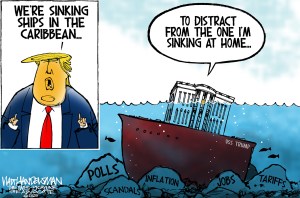 Select lawmakers were around yesterday for a hearing about the lastest, criminal act by our country against Venezuelan boats. The stories offered up by the Department of War were quite different than the story told by the film. This is from CNN. “Exclusive: Survivors clinging to capsized boat didn’t radio for backup, admiral overseeing double-tap strike tells lawmakers.”
The two men killed as they floated holding onto their capsized boat in a secondary strike against a suspected drug vessel in early September did not appear to have radio or other communications devices, the top military official overseeing the strike told lawmakers on Thursday, according to three sources with direct knowledge of his congressional briefings.
As far back as September, defense officials have been quietly pushing back on criticism that killing the two survivors amounted to a war crime by arguing, in part, that they were legitimate targets because they appeared to be radioing for help or backup — reinforcements that, if they had received it, could have theoretically allowed them to continue to traffic the drugs aboard their sinking ship.
Defense officials made that claim in at least one briefing in September for congressional staff, according to a source familiar with the session, and several media outlets cited officials repeating that justification in the last week.
But Thursday, Adm. Frank “Mitch” Bradley acknowledged that the two survivors of the military’s initial strike were in no position to make a distress call in his briefings to lawmakers. Bradley was in charge of Joint Special Operations Command at the time of the strike and was the top military officer directing the attack.
The initial hit on the vessel, believed to be carrying cocaine, killed nine people immediately and split the boat in half, capsizing it and sending a massive smoke plume into the sky, the sources who viewed the video as part of the briefings said. Part of the surveillance video was a zoomed-in, higher-definition view of the two survivors clinging to a still-floating, capsized portion, they said.
For a little under an hour — 41 minutes, according to a separate US official — Bradley and the rest of the US military command center discussed what to do as they watched the men struggle to overturn what was left of their boat, the sources said
During that time, Bradley also consulted with the uniformed lawyer on duty during the operation, he told lawmakers, according to two of the sources. The JAG officer, or judge advocate general officer, assessed it would be legal to move forward with a second strike, the sources added.
Ultimately, Bradley told lawmakers, he ordered a second strike to destroy the remains of the vessel, killing the two survivors, on the grounds that it appeared that part of the vessel remained afloat because it still held cocaine, according to one of the sources. The survivors could hypothetically have floated to safety, been rescued, and carried on with trafficking the drugs, the logic went.
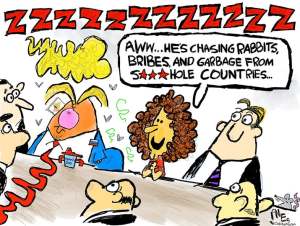 Another boat was targeted by the Pentagon in the Pacific. This is from The Guardian. “Pentagon announces it has killed four men in another boat strike in Pacific. Strike comes amid congressional turmoil over legality of US attacks on suspected drug smugglers.”
The Pentagon announced on Thursday that the US military had conducted another deadly strike on a boat suspected of carrying illegal narcotics, killing four men in the eastern Pacific, as questions mount over the legality of the attacks.
Video of the new strike was posted on social media by the US southern command, based in Florida, with a statement saying that, at the direction of Pete Hegseth, the defense secretary, “Joint Task Force Southern Spear conducted a lethal kinetic strike on a vessel in international waters operated by a Designated Terrorist Organization”.
“Intelligence confirmed that the vessel was carrying illicit narcotics and transiting along a known narco-trafficking route in the Eastern Pacific. Four male narco-terrorists aboard the vessel were killed,” the statement added.
The footage showed a large explosion suddenly overtaking a small boat as it moved through the water, followed by an image of a vessel in flames and dark smoke streaming overhead.
It is the 22nd strike the US military has carried out against boats in the Caribbean Sea and eastern Pacific Ocean, bringing the death toll of the campaign to at least 87 people since September, when the strikes began.
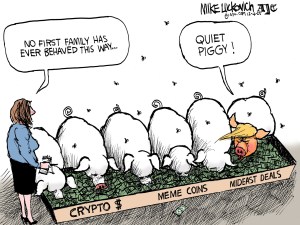 U.S Foreign and Military policy has become so incoherent, illegal, dangerous, and likely leaked to our country’s traditional enemies, that our European partners no longer trust us. This link was shared to me by BB this morning and comes from The Economist. “Donald Trump’s bleak, incoherent foreign-policy strategy. Allies may panic; despots will cheer.”
YOU MIGHT think that in Trumpworld a new National Security Strategy (NSS) would not count for all that much. John Bolton, a national security adviser in Donald Trump’s first term, frequently laments that his boss had no strategy at all. Instead, the president worked by impulse—and without the encumbrance of too many briefings. From one day to the next, he veered in opposing directions.
Despite that, the new NSS matters. Released, weirdly, in the dead of night on December 4th/5th, it will be pored over by soldiers, diplomats and advisers in America and around the world. It is the latest and fullest statement of what “America First” means in foreign policy. It sets the terms for a soon-expected review of military power, and lays out the priorities for all those trying to interpret the president’s wishes. And, for many of its readers, it will be profoundly alarming.
For the most part, the new NSS rejects the decades-old insight that a common set of values are what cement America’s alliances. It declares that it is “not grounded in traditional, political ideology” but is motivated by “what works for America”. Instead, it embraces what it calls “flexible realism”. That means being “pragmatic without being ‘pragmatist’, realistic without being ‘realist’, principled without being ‘idealistic’, muscular without being ‘hawkish’, and restrained without being ‘dovish’.”
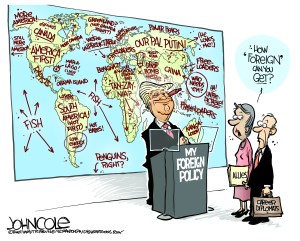
If that sounds like a dog’s breakfast, that is because it is. Shorn of the enlightened values that have long anchored foreign policy, America First becomes a naked assertion of power that owes more to the 19th century than the world that America built after the second world war. And that leads to a document riven by contradictions.
In some parts of the world, in particular in Asia, Mr Trump expects countries to behave as willing allies. In most others they are to submit meekly to America’s economic and military will. In one place the NSS rejects the interventionist idea of urging countries to adopt “democratic or other social change that differs widely from their traditions and histories”. That suits Russia, China and the monarchies of the Middle East. Yet in Europe, where MAGA worries about wokeism, migration and the dominance of liberal values, the NSS bluntly declares that “our goal should be to help Europe correct its current trajectory.”
When the NSS applies this formula to the world, region by region, the full consequences of this shift start to become clear.
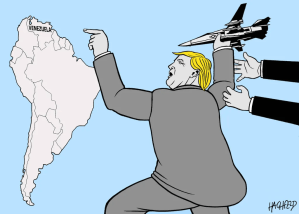
Nowhere is this more evident than in the section covering the western hemisphere. “We want to ensure that the western hemisphere remains reasonably stable and well-governed enough to prevent and discourage mass migration to the United States,” it reads. Governments in the Americas will be enlisted to control migration and curb drug flows. They are expected to grant America control of key assets, resources and strategic locations, or at least a veto over “hostile foreign” ownership of them—a clear warning to refuse Chinese investments that offer a sway over ports or such assets as the Panama Canal. Where law enforcement has failed to halt drug smuggling, America will use armed forces, the NSS warns.
This swaggering right of intervention is called a “Trump Corollary” to the Monroe Doctrine. That is a deliberate tribute to the “Roosevelt Corollary”, President Theodore Roosevelt’s assertion of gendarme-like enforcement rights over the western hemisphere in 1904.
All this seems sure to provoke angry recollections of high-handed American interventions in the region in the 20th century, from military invasions and blockades to CIA-backed coups or security pacts that saw America arming and training autocracies guilty of extra-judicial murders and torture in the cold war. With its talk of conditioning aid and trade on co-operation from Latin American governments, the NSS signals a belief that resentment will not stop Latin Americans from doing as they are told.
In Asia, by contrast, allies will read the NSS with a mixture of immediate relief and long-term gloom. The passages on Taiwan could have been worse. The nightmare scenario for such allies as Japan, the Philippines and South Korea would have involved an NSS declaring that the fate of the democratically ruled island of Taiwan is not an existential interest for America.
Instead, the NSS restates America’s position that it “does not support any unilateral change to the status quo in the Taiwan Strait”. True, there is nothing about Taiwan’s importance as a friendly, pro-Western democracy whose people overwhelmingly oppose coming under rule by China. But the strategy does make a cold-eyed realist case for Taiwan’s importance as a usefully-located redoubt in the middle of the “First Island Chain” that runs from Japan through Taiwan to the Philippines, penning in China’s navies and air forces. In addition, the NSS nods to Taiwan’s importance as the largest source of advanced semiconductors.
Accordingly, America will sustain forces capable of deterring any attempt to take Taiwan or to control the sea lanes near that island, or in the South China Sea. Asian allies must also spend much more on their own defences and grant America more access to their ports and bases. In short, the NSS demands that Asian countries risk China’s wrath by helping America contain Chinese ambitions in the Indo-Pacific. But there is not a word of criticism for China’s (or indeed Russia’s) expansionist ambitions or their desire to overthrow the post-1945 legal and multilateral order.
The NSS spares its sharpest barbs for Europe. The old world, it says, is undergoing a profound crisis, and this is not so much about economic decline or military weakness as it is about the loss of national identity, leading to the “stark prospect of civilisational erasure”.
Warning that “it is more than plausible that within a few decades at the latest, certain NATO members will become majority non-European,” the NSS warns that “it is an open question whether they will view their place in the world, or their alliance with the United States, in the same way as those who signed the NATO charter.” In other words, immigrants will corrupt the values of the societies they move to—a shocking assertion from a country that is itself built on immigration.
The NSS’s prescriptions for Europe flow from this assertion of Judeo-Christian nationalism. The NSS calls for “unapologetic celebrations of European nations’ individual character and history”, encouraging the revival promoted by “patriotic European parties”. That is a reference to the populist right, including National Rally in France, Reform UK in Britain and Alternative for Germany, which the vice-president, J.D. Vance, embraced earlier this year when he spoke at a conference in Munich. If that is the Trump administration’s programme, how are the centrist governments in Europe, who see these parties as a grave threat, supposed to treat America as an ally?
When the NSS applies this rationale to Ukraine, it draws some devastating conclusions. Suggesting that most Europeans want peace even if it means surrendering to Vladimir Putin, and asserting that their governments are standing in the way, the strategy calls for a rapid end to the war in order to prevent escalation. It says that America should curb the sense in Europe that Russia is a threat and warns that NATO cannot be “a perpetually expanding alliance”. Alarmingly, it has nothing to say about the repeated aggression and hostility of Vladimir Putin, the Russian president. To much of Europe, this sort of appeasement will only serve to set up the next conflict.
“In everything we do, we are putting America First,” reads the letter from Mr Trump to the American people that opens the NSS. But it is the preceding sentence that will be read by allies with gloom, and with glee by China and Russia, for it is hopelessly at odds with reality: “America is strong and respected again—and because of that, we are making peace all over the world.” Alas, that claim comes from an administration that is indeed feared, resented and obsessed over, but one that is less respected or trusted than any American government in decades.
 If that doesn’t give you geopolitical goosebumps, I don’t know what will. Meanwhile, we’ve been experiencing press coverage that’s not providing us the information we need. This article is from The Nation. “A New Roosevelt Institute Report Confronts the Roots of Our Media Crisis—and Calls for Breaking Up Corporate Media.” Today’s journalism crisis wasn’t inevitable, but it’s time to free journalism from the straitjacket of turning a democratic obligation into a profit-maximizing business model.” Concentration in this market is dumbing up America big time. This story is reported by Bilal Baydoun, Shahrzad Shams, and Victor Pickard
The desire to attack and ultimately control the media is a through line of modern authoritarian governance across the globe. President Donald Trump’s reign as the defining political figure of the last decade has demonstrated how quickly that tactic can take hold here. In courtrooms, agencies, and White House briefings, Trump and his allies have sought to punish and delegitimize journalists. In the second Trump term, the bully pulpit has been turned into a battering ram, with open or implied threats to withhold the broadcast licenses or block the media mergers of insufficiently loyal companies. But a singular focus on state meddling has, ironically, obfuscated how authoritarians come to wield such great power over the media system in the first place, and why a free press must be protected from both state and commercial coercion.
What we’re experiencing now is a dangerous convergence of the two.
The truth is that the administration’s threats have rippled across a media ecosystem buckling under the weight of commercial pressures—pressures that existed long before that fateful golden escalator ride more than a decade ago. It’s these longstanding commercial imperatives that Trump knows how to weaponize to manipulate media institutions. He understands that newsrooms accountable first and foremost to investors will sell out their accountability function to survive. Likewise, media conglomerates pursuing mergers cannot afford to anger the administration holding the regulatory pen. When journalism is trapped inside a commercial straitjacket, it can’t fight back.
In our oligarchic age, where billionaires can decide which fledgling outlets live or die for pennies on the dollar and even themselves command powerful roles in government, the line between state-run media and state-aligned media through private means becomes vanishingly thin. A press dependent on the whims of the ultra-wealthy cannot claim meaningful independence from the political forces its owners serve. And even though our Constitution protects the press for democratic reasons, our policy regime assumes that news organizations should behave like profit-maximizing firms.
How did we get here? As we show in our new Roosevelt Institute report, today’s media crisis wasn’t inevitable, but the consequence of policymakers embracing a corporate libertarian approach to media policy. This framework treats our information ecosystem as an ordinary market, rather than vital democratic infrastructure, resulting in a media system riddled with structural deficits. The result is a media environment that’s vulnerable to pressure from every direction, from the White House to the C-Suite.
The consequences of this policy failure have been catastrophic. Newsrooms have been gutted as advertising revenue collapsed. Local papers have closed or been absorbed by vulture capitalists whose short-term incentives are fundamentally at odds with journalism’s public mission. More than 1,000 counties now lack the equivalent of a single full-time journalist; the number of journalists per 100,000 residents has fallen 75 percent since the early 2000s. Platforms dominate news distribution, leaving publishers dependent on algorithmic systems designed to maximize engagement rather than inform the public. A handful of billionaires can bend the flow of information with the proverbial push of a button, and conglomerates continue conglomerating: Just earlier today, after a major bidding war, Netflix beat out Paramount Skydance and Comcast in a deal to acquire Warner Bros. Discovery, resulting in a merger that will further concentrate cultural and informational power in fewer hands.
Today, most Americans, and even many policymakers, take these developments and the system that led to them for granted. As the late media scholar Robert McChesney argued, media policy has been rendered invisible, designed behind closed doors in the public’s name, but without the public’s consent—placing core questions related to our information ecosystem outside the purview of democratic contestation. This invisibility has given cover to a set of neoliberal assumptions that define the boundaries of what’s possible, empowering a small set of wealthy private actors to decide, for the rest of us, what our media system looks like, and whose interests it serves.
Such invisibility obscures how our media system’s design—and the many problems ailing it—is the result of policy decisions. Over the course of decades, policymakers diluted the meaning of the media’s public interest responsibilities, refashioning them into something more akin to consumer preferences. At the same time, the media market faced a series of re-regulatory structural moves that shifted power away from the public and into the hands of corporate actors. And well before Trump dismantled the CPB, Congress resisted meaningful public media investment. All these developments were in turn legitimized by a First Amendment media jurisprudence that prioritizes unbridled commercial speech over the public’s “right to know.” Combined, these constraints created a media system that treats commercial imperatives as natural law, and democratic obligations as optional.
 I’ve probably over shared most of the excerpts and it will take you some time to get through them all. BB also wrote yesterday on the many ways our country is run by idiots with an angend American’s do not approve of and in a way that is beyond incompetent. Any of us in cities Occupied by the National Guard and Ice have horrors stories that sound more like NAZI Germany than your backyard. They have no incentive stop and they’re even ignoring court orders. This article is the view point of my home city by the BBC. “New Orleans residents in fear as immigration crackdown descends on their city.” The BBC’s North American Correspondent, Tom Bateman, is here and reports the story.
Two labourers stand on the roof of a house in Kenner, outside New Orleans, as US Border Patrol agents clamber up a ladder, getting closer.
As the agents move in, trying to arrest them, the men step to the roof’s edge, poised in an apparent act of resistance – but it’s too high to jump.
On the ground in the mostly Latino neighbourhood, an officer trains his weapon towards the rooftop while a sniper moves into position. Now, neighbours, activists, and crews of local press are gathering at the scene, watching in bewilderment: US President Trump’s new front line on immigration enforcement has just arrived.
It is day one of “Catahoula Crunch”, as the Department of Homeland Security (DHS) has labelled its operation, taking its name from an American leopard dog known for being well-muscled, powerful and territorial.
“These people came to work today to provide for their families and themselves,” said Zoe Higgins, an activist documenting the Border Patrol operation in New Orleans.
“That they could just be abducted, removed from all stability – I can’t imagine how terrifying that is,” she said, shortly after the agents coaxed the men down and detained them.
According to DHS, its agents were conducting immigration enforcement this week when “several illegal aliens climbed on the roof of a residential home and refused to comply with agent commands”.
An “illegal alien” was arrested, DHS officials told the BBC, but they did not answer questions about the immigration status of the labourers involved, nor whether agents had a warrant to access the property.
 None of this sounds lawful. I’m not a Constitutional lawyer, but I do know that everyone deserves their day in court. Disappearing people is criminal.
So, I’m going off today to see my doctor for just a normal check up. But my body tells me every day that it’s not coping well with any of this. I usually can drop my blood pressure by meditating. My skills are no longer up to this fight or fly response I feel continually. I just put my birth certificate in my purse. I still doing my whistle brigade thing. This country is not going doing on my watch. This city and every one in it is not going to be given the No Quarter treatment here; especially when they’re not really a threat to any of us in any way.
What’s on your Reading. Action and Blogging list today?
Tuesday Reads: Syria, Ukraine, and Venezuela; Robot Police; Republican Stupidity; Harold Ramis; and Women of “True Detective”
Posted: February 25, 2014 Filed under: abortion rights, Barack Obama, Foreign Affairs, misogyny, morning reads, NSA, National Security Agency, PLUB Pro-Life-Until-Birth, Reproductive Rights, Republican politics, Syria, U.S. Politics, Ukraine, Venezuela, War on Women | Tags: Bobby Jindal, crime fighting robot, Dan Malloy, Harold Ramis, Knightscope, Mark Ames, State Sen. Steve Martin (R-VA), Syria's children, True Detective 42 Comments
Good Morning!!
There is so much foreign news these days, and I have to admit ignorance when it comes to discussing the situations in Ukraine, Venezuela, and Syria. I don’t even know where to begin to understand the issues, and to be honest I just don’t have the time to try to do it. But here are some articles from sources I trust that struck me as important.
I’ll begin with something I can easily understand and care about: the fate of children in these conflicts. From The Independent, ‘No one cares’: The tragic truth of Syria’s 500,000 refugee children. The article is about British photojournalist Ed Thompson and an art student from Lebanon, Sammy Hamze, who went to Lebanon to put a spotlight on what is happening to Syrian refugee families.
We have heard the stories. Children at risk of dying from the cold in refugee camps; vulnerable to trafficking; begging on the side of the road; left orphaned and out of school; girls sold into marriage. But what shook Thompson most was that the children, although appearing older than their years, were still so young. “They are innocent, completely innocent,” he says now. “One father told me to look at his family; he could barely feed his son. They had been through hell, walked through hell and got to hell. All they want to do is go home.”
The conflict that has torn Syria apart has raged for almost three years, left more than 100,000 people dead in its wake and driven nine-and-a-half million from their homes. It took intense political pressure to get the British Government to agree to offer hundreds of the “most needy people” in Syrian refugee camps a home in this country. “We live in the modern age – we can read what’s going on in Syria; we’ve never had more information at our fingertips,” says Thompson – “but no one cares.”
If anything can break through the apathy, it is his pictures.
Read more and see some of Thompson’s photos at the link.
On Ukraine, I posted this article by Mark Ames in the comments yesterday, but I’ll link it again here: Everything you now about Ukraine is wrong.
I haven’t lived in that part of the world since the Kremlin ran me out of town, so I’m not going to pretend that I know as much as those on the ground there. Still, I’ve been driven nuts by the avalanche of overconfident ignorance that stands for analysis or commentary on the wild events there. A lethal ignorance, a virtuous ignorance….
Nearly everyone here in the US tries to frame and reify Ukraine’s dynamic to fit America-centric spats. As such, Ukraine’s problems are little more than a propaganda proxy war where our own political fights are transferred to Ukraine’s and Russia’s context, warping the truth to score domestic spat points. That’s nothing new, of course, but it’s still jarring to watch how the “new media” counter-consensus is warping and misrepresenting reality in Ukraine about as crudely as the neocons and neoliberals used to warp and Americanize the political realities there back when I first started my Moscow newspaper, The eXile.
Read about what Ames calls the “simplifications/misconceptions” that are driving Ames crazy at Pando Daily.
And then there’s Venezuela. At The Washington Post, Adam Tayor asks, Amid the coverage of Ukraine, is a crisis in Venezuela being ignored? It’s an interesting question. And what about Syria, which has pretty much disappeared in all the coverage of Ukraine? Is American media simply incapable of covering more than one foreign conflict at a time? Read all about it at the link.
One more story on Venezuela from Peter Weber at The Week: Venezuela isn’t going to be another Ukraine.
Venezuela is not Ukraine, and beneath the similarities in the protest movements are significant differences.
The first is time: The Kiev protesters started their demonstration in November after Yanukovych reneged on a European Union trade pact, and they gradually built up a tent fortress in the central Maidan Square. In Venezuela, the protests started on Feb. 4 at the university in San Cristóbal, with students showing their anger over the lack of police response to an attempted rape and crime in general.
The “brutal police crackdown” on the student protesters in San Cristóbal led to similar protests at other universities, which were also violently suppressed, says Francisco Toro in The New York Times. “As the cycle of protests, repression, and protests-against-repression spread, the focus of protest began to morph. What was at stake, the students realized, was the right to free assembly.” Toro continues:
It’s this intolerance of opposing views, and violent repression, that Venezuela’s students are now mobilized against. Today, after 13 deaths, 18 alleged cases of torture and over 500 student arrests, the protest movement has snowballed into a nationwide paroxysm of anger that puts the government’s stability in question. The protests’ lack of structure has given them resilience, but also an anarchic edge. There is no single leader in a position to give the movement strategic direction. [The New York Times]
Read more comparisons at the link.
In Other News . . .

The K5 robot outside a school
If you think the prospect of being spied on by NSA is frightening, you need to read this article by James Robinson at Pando Daily: Knightscope’s new robotic law enforcer is like staring at the demise of humanity.
Knightscope’s autonomous, crime fighting robot has the complexion of a washing machine. In pictures it looks cute, the size of a penguin maybe. In person it is five feet tall with intimidating breadth. It moves steadily and with insistence. If you stare at it long enough, the twin panels of lights about two-thirds of the way up its body start to take on the appearance of shifty, judgmental eyes. It sees what you’re doing and wants you to cut it out.
The full name of the Knightscope robot on display at the Launch Festival this morning was the K5 beta prototype. Former Ford Motor Company executive and Knightscope CEO William Santana Li describes it to MC and festival organizer Jason Calacanis onstage as a “crime fighting autonomous data machine.” But that doesn’t come close to doing it justice….
As Santana Li outlines proudly, the beast before him on stage takes in 360-degree video through four cameras, is capable of thermal imaging, registers gestures, recognizes faces and can run 300 license plates in a single minute. It works off proximity GPS and scans its environment every 25 milliseconds. It runs off nearly identical technology to Google’s self-driving cars. He boasts that it can see, feel, hear and smell. It is autonomous, will roam outdoors, can take video, decide when it needs to return and charge its batteries and can detect biological and chemical pathogens and radiation.
The Knightscope will get put out in the field gathering data, Santana Li says. The owner can log in to a security panel and get a read of what is going on in the area. The robot can scan license plates and report back on stolen cars. Its facial recognition capabilities can alert its owner to any registered sex offender in the area. The sample dashboard Santana Li logs in to, shows that the robot can report back about things as specific as how many people are lying horizontal and how many are gesturing with their hands. The company is working on giving it a 3M graffiti proof sheen, it emits a piercing sound if someone tries to tip it over and the machines will often work in pairs so they can protect each other.
How would you like to live in a world where one of those things is checking up on you wherever you go?
From Laura Bassett at Huffington Post, here’s the latest from the land of Republican misogyny and stupidity: Virginia Republican Says A Pregnant Woman Is Just A ‘Host,’ Though ‘Some Refer To Them As Mothers.’ Yes, someone really said that.
A pregnant woman is just a “host” that should not have the right to end her pregnancy, Virginia State Sen. Steve Martin (R) wrote in a Facebook rant defending his anti-abortion views.
Martin, the former chairman of the Senate Education and Health Committee, wrote a lengthy post about his opinions on women’s bodies on his Facebook walllast week in response to a critical Valentine’s Day card he received from reproductive rights advocates.
“I don’t expect to be in the room or will I do anything to prevent you from obtaining a contraceptive,” Martin wrote. “However, once a child does exist in your womb, I’m not going to assume a right to kill it just because the child’s host (some refer to them as mothers) doesn’t want it.” Martin then changed his post on Monday afternoon to refer to the woman as the “bearer of the child” instead of the “host.”
Martin explained that he edited his post because “people took it the wrong way.” Read his original post at the link.
And then there’s good old Bobby Jindal, who still thinks he has a chance to be POTUS: Jindal Breaches White House Protocol To Take Shots At Obama.
The National Governors Association is supposed to bring Democrats and Republicans together to discuss policy and share ideas for mutual success, but after a meeting at the White House Monday, all pretense at bipartisan comity was shattered as a press conference with lawmakers descended into a partisan fracas.
Louisiana Gov. Bobby Jindal launched into a repeated assault on President Barack Obama’s leadership in the shadow of the West Wing, in defiance of established bipartisan protocol. Speaking after a meeting of the NGA at the White House, Jindal, the vice chair of the Republican Governors Association, said Obama is “waving a white flag” by focusing on executive actions with three years left in his term. “The Obama economy is now the minimum wage economy,” Jindal added….
Connecticut Gov. Dan Malloy rose to challenge Jindal immediately after he spoke to reporters, calling his remarks on Obama waving a white flag “the most insane statement I’ve ever heard.”
Jindal then returned to the microphones to continue his barrage against the Obama administration, saying as Malloy walked off, “I want to make sure he hears a more partisan statement,” and saying Obama should delay the Affordable Care Act mandates. It wasn’t the first time Jindal had used the microphones outside the White House to attack the president, having done the same at last year’s meeting.
Fortunately, Bobby Jindal will never be president. What a horrible excuse for a human being.
As everyone knows by now, we lost a great comedy writer, director, and performer yesterday. From The Chicago Tribune: Harold Ramis, Chicago actor, writer and director, dead at 69.
Harold Ramis not only may be the most successful comedy writer-director that Chicago has produced, but some wouldn’t even confine that statement to Chicago.
“Harold was clearly the most successful comedy writer-director of all time,” said Tim Kazurinsky, who followed Ramis at Second City and later became his friend. “The number of films that he has made that were successful, that were blockbusters, nobody comes close. Even in light in of that, he was more successful as a human being.”
Ramis’ career was still thriving in 1996, with “Groundhog Day” acquiring almost instant classic status upon its 1993 release and 1984’s “Ghostbusters” ranking among the highest-grossing comedies of all time, when he decided to move his family back to the Chicago area, where he grew up and had launched his career.
On Monday, Ramis was surrounded by family in his North Shore home when he died at 12:53 a.m. of complications from autoimmune inflammatory vasculitis, a rare disease that involves swelling of the blood vessels, said his wife, Erica Mann Ramis. He was 69.
Read The New York Times obituary here: Harold Ramis, Alchemist of Comedy, Dies at 69.
Finally, a little True Detective news. Dakinikat posted this in the comments yesterday, but if you didn’t go to the link you might have missed something really revelatory.
A number of writers have noted that the hit HBO series focuses almost exclusively on the male characters and that women and children are only seen and heard in terms of their effect on the men–for example, see this article at The New Yorker by Emily Nussbaum: The shallow deep talk of “True Detective.”
Yesterday two feminist writers took a different point of view. At Slate, Willa Paskin argues that the way the men of True Detective treat women is actually at the heart of the narrative–that by not listening to women, Detectives Marty Hart and Rust Cohle miss the very clues that would help them solve their 17-year case.
Ignoring women may be the show’s blind spot, but it is also one of its major themes. True Detective is explicitly about the horrible things that men do to women, things that usually go unseen and uninvestigated. No one missed Dora Lange. Marie Fontenot disappeared, and the police let a rumor stop them from following up. Another little girl was abducted, and a report was never even filed. “Women and children are disappearing, nobody hears about it, nobody puts it together,” Rust told his boss Sunday night, outlining what he believes is a vast conspiracy in the Bayou. Rust is haunted by women who aren’t there—his ex-wife and his dead daughter—while Marty cannot deal appropriately with the women who are.
Please read the whole thing, if you haven’t already. Amanda Marcotte agrees with Paskin, and she turns up the work of some “internet sleuths” to provide some evidence. Marcotte:
I’m inclined to agree with Paskin. In fact, I’m going to take it a step further and argue that I think, whatever else happens, this inability of the main characters to really see women is going to be their downfall. Over and over again, the show obsesses about the gap between self-serving delusions and narratives and what’s really going on. Marty repeatedly talks about how detectives frequently overlook what should have been most obvious, what was right under their noses. He calls it the “detective’s curse”. “Solution was right under my nose, but I was paying attention to the wrong clues.”
I am going to offer this prediction, then: The solution will be right under their noses, but they missed it because they don’t really see women.
Indeed, the internet sleuths are already on it. Remember that all-important yearbook photo that they found one of the victims in? Well, guess what? Other female characters that Marty and Rust have interacted with are in the picture. Here’s the picture with the women helpfully numbered.
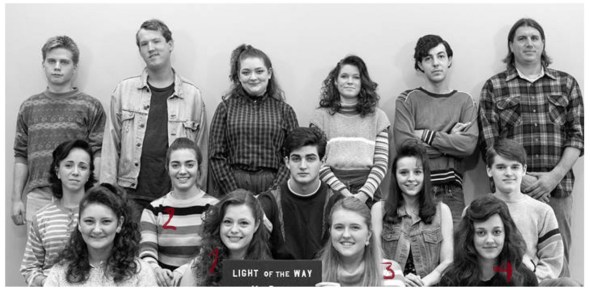
On the far right of the front row is a girl who grew up to be the woman who killed her three children because of Munchhausen by proxy syndrome–the woman whom Rust got to confess and then told her to kill herself. Was she traumatized at that school? Could she have given him some valuable information? Why didn’t Rust follow up on those photos?
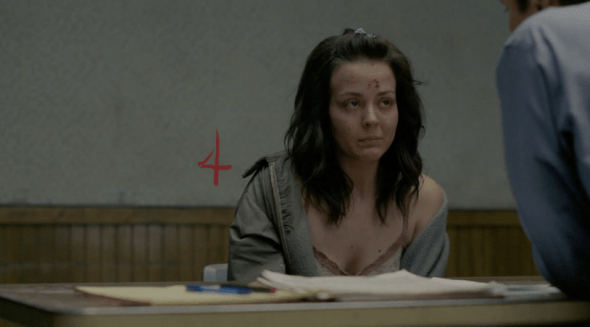
Something to think about while we wait for Sunday night to roll around.

 peej
peej Carissa
 bostonboomer
 dakinikat
 ecocatwoman
 mablue2
 Mama Lopez
 peggysue22
 quixote
 skydancingguestblogger
 Mona (aka Wonk the Vote)



 Sky Dancing
Recent Comments