
Monday Reads: Interesting (and scary) times
Posted: March 14, 2011 Filed under: Barack Obama, Foreign Affairs, Japan, Libya, morning reads, The Media SUCKS, U.S. Politics, worker rights | Tags: Japan, Libya, Wisconsin protests 20 Comments
Good Morning! We sure do live in interesting times. There is so much happening in the news today that there is no way I could cover all of it. As I see it, the most disturbing news is that world events are spiraling out of control, while the U.S. President dithers and does as little as possible–fiddling while the world burns.
CRISES IN JAPAN
Japan is struggling with an overwhelming natural disaster and a massive humanitarian crisis, and at the same time they–and the rest of us–face a nuclear emergency. No one knows for sure yet how bad it is, but I can’t help but suspect that we are not getting the whole story.
Officials confirmed on Sunday that three nuclear reactors north of Tokyo were at risk of overheating, raising fears of an uncontrolled radiation leak.
Engineers worked desperately to cool the fuel rods in the damaged reactors. If they fail, the containers that house the core could melt, or even explode, releasing radioactive material into the atmosphere.
How bad could it get? Here’s what nuclear experts told Scientific American:
“Reactor analysts like to categorize potential reactor accidents into groups,” said Bergeron, who did research on nuclear reactor accident simulation at Sandia National Laboratory in New Mexico. “And the type of accident that is occurring in Japan is known as a station blackout. It means loss of offsite AC power—power lines are down—and then a subsequent failure of emergency power on site—the diesel generators. It is considered to be extremely unlikely, but the station blackout has been one of the great concerns for decades.
[….]
Bergeron explained the basics of overheating at a nuclear fission plant. “The fuel rods are long uranium rods clad in a [zirconium alloy casing]. They’re held in a cylindrical-shaped array. And the water covers all of that. If the water descends below the level of the fuel, then the temperature starts going up and the cladding bursts, releasing a lot of fission products. And eventually the core just starts slumping and melting. Quite a bit of this happened in TMI [Three Mile Island], but the pressure vessel did not fail.”
So what if the worst happens and there is a meltdown?
“They’re venting in order to keep the containment vessel from failing. But if a core melts, it will slump to the bottom of the reactor vessel, probably melt through the reactor vessel onto the containment floor. It’s likely to spread as a molten pool—like lava—to the edge of the steel shell, and melt through. That would result in a containment failure in a matter of less than a day. It’s good that it’s got a better containment system than Chernobyl, but it’s not as strong as most of the reactors in this country.”
Basically, we’re talking about The China Syndrome. Except if a Japanese nuclear plant melts down, the core won’t be headed for China.
Breaking: Second Explosion at Nuclear Plant in Japan
Posted: March 13, 2011 Filed under: Breaking News, Foreign Affairs, Japan, just because, Surreality | Tags: disaster, hydrogen explosion, Japan, nuclear meltdown 4 CommentsAl Jazeera just reported that there has been a hydrogen explosion at the third nuclear power plant that nuclear engineers have been working on in Japan. Several workers are reported to be injured or missing after the blast. Here is the first story I’ve seen about on Google: Fukushima Explosion: Japan Nuclear Plant Blast Believed To Be Hydrogen Explosion
Japan’s chief cabinet secretary says a hydrogen explosion has occurred at Unit 3 of Japan’s stricken Fukushima Dai-ichi nuclear plant. The blast was similar to an earlier one at a different unit of the facility.
Yukio Edano says people within a 12-mile (20-kilometer) radius were ordered inside following Monday’s. AP journalists felt the explosion 30 miles (50 kilometers) away.
A second explosion has hit the nuclear plant in Japan that was damaged in Friday’s earthquake, but officials said it had resisted the blast.
TV footage showed smoke rising from Fukushima plant’s reactor 3, a day after an explosion hit reactor 1.
Japan’s nuclear safety agency said the blast was believed to have been caused by the build-up of hydrogen.
Government officials said the reactor core was still intact as they tried allay fears of a radioactive leak.
3 injured, 7 missing after second explosion at Japan nuclear plant
A massive column of smoke was seen belching from the plant’s No. 3 unit Monday. The No. 3 Unit reactor had been under emergency watch for a possible explosion as pressure built up there following a hydrogen blast Saturday in the facility’s Unit 1.
Second Blast Rocks Japanese Nuclear Powerplant
A second explosion has rocked a nuclear power plant in Japan. The plant is in an area that was devastated by a massive earthquake and tsunami on Friday.
The explosion occurred mid-morning Monday, while workers were battling to bring down temperatures inside the Fukushima Number One nuclear power plant’s number three reactor.
Television images showed a strong explosion obliterating the upper walls of the reactor building and causing a huge plume of white smoke.
Japanese Quake Survivors Evacuated Amid Fears of Radiation Leaks
At least 170,000 Japanese earthquake and tsunami survivors have fled their homes, fearing the spread of radioactive contamination from damaged nuclear power plants.
Officials say dozens of people could have been exposed to radiation while being evacuated from a town near one of the damaged plants. They and hundreds of others were being scanned for radiation exposure.
Authorities say a new hydrogen explosion occurred Monday morning at the Fukushima power plant north of Tokyo, sending a plume of white smoke into the air. Officials said at a news conference covered by NHK Television that the building is still safe and that there is little risk of a mass radiation leak.
Why am I not buying that?
I will continue to update as I get more information.
Disaster in Japan
Posted: March 11, 2011 Filed under: Breaking News, Foreign Affairs | Tags: Japan Quake, Japan Tsunami, Nuclear facilities 36 Comments Last night, a 8.9 quake and tsunami hit Japan. Tsunami waves have hit Hawaii and are now hitting Washington state. The worst damage is in the northern sections of Japan. There is a worse danger looming that I wanted to mention here if you haven’t heard. The Japan earthquake has shut down two nuclear plants and the core is not cooling in one. This is a potentially dangerous situation. The U.S. is now rushing coolant to Japan at the request of the Japanese government.
Yet even light was on short supply, with nuclear power plants shutting down after fires broke out at some of the facilities and raised concerns of potential radiation leaks. Millions of buildings around Tokyo were reported without power.
The 8.9-magnitude earthquake struck northeast Japan at 2:45 p.m. local time, collapsing buildings 240 miles away in Tokyo, triggering a 30-foot tsunami that swept away everything in its path, and killing at least 300 people already. Hundreds more remain missing, including 100 crew on a lost fishing boat.
The plant experienced a fire. People in the area are being evacuated. No leaks have been reported so far but again, CNN said that the core is not cooling so they are preparing for the worst.
About 5,800 residents near a Tokyo Electric Power Co. atomic plant were ordered to evacuate because of a possible radiation leak and the failure of the cooling system after Japan was struck by a powerful earthquake.
People within 3 kilometers (2 miles) of the Fukushima Daiichi nuclear power plant were told to evacuate, Chief Cabinet Secretary Yukio Edano said in Tokyo today. Residents within 10 kilometers were told to stay indoors, said Ryohei Shiomi, a spokesman at the Emergency Information Center of the Nuclear and Industrial Safety Agency.
Emergency power supply at the 4,696-megawatt plant 210 kilometers north of Tokyo failed after the quake triggered automatic shutdowns of the reactors, officials at the trade ministry’s Nuclear and Industrial Safety Agency told reporters without identifying themselves. Power is needed to keep cooling the reactor to prevent rising pressure and damage, they said.
A battery, which can last about eight hours, is being used to cool the reactor for now, the agency officials said. Another six batteries have been secured, and the government may use military helicopters to fly them in, they said.
CNN has just reported that radiation is rising in the Fukushima Daiichi plant. A refinery has also exploded.
Natural Gas prices are already on the rise in UK.
U.K. natural gas prices soared Friday after a major earthquake and tsunami hit Japan, shutting down nuclear plants and raising expectations that the country will import more liquefied natural gas as a replacement power source.
But with the global gas market so well-supplied, and the length of the nuclear plant outages unknown, the gains could prove short-lived, traders said.
Winter gas contract prices had risen to 68.8 pence per therm by 1420 GMT, around 4% higher from Thursday.
At least two nuclear power plants on Japan’s Pacific coast shut down following the 8.9 magnitude quake that hit the country Friday morning, leaving market watchers wondering as to the extent of the damage.
“The problem is there are a whole bunch of nuclear outages, which I’d think would be out for at least three to four weeks,” said a London-based trader.
Japan’s last major earthquake in 2007 caused an extended shutdown of the country’s largest nuclear power plant, sending the country scrabbling for LNG suplies as it sought alternative means of power generation.
However, the current rally in the natural gas market may be premature. The extent of the damage to nuclear facilities is still unknown and the market is better-supplied than it was a few years ago.
Unlike in 2007, the market today is oversupplied, said Noel Tomnay, head of global gas at Wood Mackenzie.

Japan quake area map from the BBC
Casualties from this quake/tsunami now number in the hundreds and may rise. Japan has requested help from the US. The navy is sending ships there now.
There are some amazing images at The Atlantic. Videotapes of the moments during the quake and tsunami can be found at the NYT at the Lede Blog.
Friday Reads
Posted: March 11, 2011 Filed under: collective bargaining, Domestic terrorism, Environment, Environmental Protection, Foreign Affairs, morning reads, right wing hate grouups, The Media SUCKS, the villagers | Tags: Climate change, General Clapper, Islamophobia, Libya, Peter King, polar ice sheet mass loss, Senator Lindsay Graham, Wisconsin 19 Comments Good Morning!
I’ve noticed that we seem to be seeing a lot of change recently along with a lot of people that would prefer to stick their heads in the sand and try to legislate the world back 100 years. It really seems like science, voter sentiment, and the world are at odds with the vision of our leaders these days. Here are some examples.
A study done by the U.S. Jet Propulsion Laboratory, was just published in Geophysical Research Letters here provides some pretty clear evidence that the polar ice sheet mass loss is accelerating at a rate that is increasing exponentially.
It’s been clear for a while that the polar ice sheet mass loss is accelerating (see Large Antarctic glacier thinning 4 times faster than it was 10 years ago: “Nothing in the natural world is lost at an accelerating exponential rate like this glacier”).
But the new study is a bombshell because of its credibility and thoroughness — and because it provides perhaps the most credible estimate to date of the sea level rise we face in 2050 on our current emissions path, 1 foot.
The JPL news release runs through the calculation that leads to the 1-foot estimate:
The authors conclude that, if current ice sheet melting rates continue for the next four decades, their cumulative loss could raise sea level by 15 centimeters (5.9 inches) by 2050. When this is added to the predicted sea level contribution of 8 centimeters (3.1 inches) from glacial ice caps and 9 centimeters (3.5 inches) from ocean thermal expansion, total sea level rise could reach 32 centimeters (12.6 inches). While this provides one indication of the potential contribution ice sheets could make to sea level in the coming century, the authors caution that considerable uncertainties remain in estimating future ice loss acceleration.
It is always worthwhile to make clear that the projections are uncertain. On the other hand, one would have to say that the uncertainty is greater on the high side — since the rate of human-caused warming is itself projected to accelerate, and the poles are the place where the planet is heating up the most, much faster than expected (see “Deep ocean heat is rapidly melting Antarctic ice: Oceanographer at AGU: Western Antarctic Peninsula is seeing “the highest increase in temperatures of anywhere on Earth”).
Senator Lindsey Graham wants Director of National Intelligence General Clapper to resign because he answered a question truthfully. It’s even unclear if Graham was even in the hearing for the entire committee interview.
Sen. Lindsey Graham, R-S.C., in an exclusive interview with Fox News correspondent Carl Cameron, called for Gen. James Clapper to resign or be fired as Director of National Intelligence, citing his comments before the Senate Armed Services Committee this morning, on which Graham sits.
Clapper had stated his belief that the Qaddafi regime, in the long term would “prevail” in Libya, and also assessed China and Russia to be primary threats to the United States.
Graham told Cameron that he lacks confidence in Clapper’s understanding of his job, that President Obama should “repudiate” Clapper’s remarks, and that this is the third time Clapper has faltered in this way.
Clapper clarified that North Korea and Iran are “of great concern,” but questioned whether they pose a “direct mortal threat” to the United States. The intelligence chief seemed to be focused on which countries have the capability, not necessarily the intent, to threaten the United States.
 WonktheVote posted a thread earlier this week showing that the threat of terrorism in the US comes more from white, right wing military groups than from radicalized American Muslims. This evidence contrasts Peter King’s McCarthyism style hearing yesterday which relied on only personal stories. There were no people invited to testify from law enforcement, the FBI, or Homeland Security. Understandly, so there’s more evidence on who we should fear at C&L. Dave Niewert must’ve read her!!! Niewert document 22 cases in these kind of violence in the last tw0 years and shows a map. They’ve occurred all over the place.
In their eagerness to promote Peter King’s dubious and nakedly Islamophobic hearings on homegrown Islamic-radical terrorism, O’Reilly and his Fox colleagues have openly sneered at suggestions that we ought to do the same for right-wing extremists and their mounting acts of violence. This case definitively underscores that need, embodied in the 22 cases we’ve documented over the past two and a half years:
Simultaneously, it’s also not very clear that the Islamic radicals pose a serious threat in terms of domestic terrorist activity. Certainly, there’s plenty of reasons to believe that the threat of homegrown Islamic terrorism is wildly overstated — not least of which is the fact that, as Zaid Jilani at ThinkProgress reported, terrorism incidents in the USA have been coming from non-Muslim sources at nearly twice the rate as that of Muslims.
Lexington at The Economist had this to say about the hearings.
It is indeed hard to find much to like in Mr King. The representative for Long Island has approached this most sensitive of subjects with the delicacy of a steamroller, plus an overactive imagination and a generous dollop of prejudice. To be clear: he may not be prejudiced against America’s Muslims (the “overwhelming majority” are “outstanding Americans”, he says) but he long ago prejudged the question his own hearings are supposed to answer, being already firmly of the view that the country’s Muslims are doing too little to counter radicalisation within their ranks. He is the author of a novel, “Vale of Tears”, in which a heroic version of his thinly disguised self busts a home-grown al-Qaeda cell at a Long Island Islamic centre. His own attitude to terrorism, though, is conveniently elastic. In the 1980s this Irish-American Catholic sympathised strongly with the Irish Republican Army, going so far as to compare Gerry Adams, the leader of Sinn Fein, the terrorist group’s political wing, to George Washington.
Beyond these objections to his person, prejudices and past, most of the available evidence suggests that Mr King’s central thesis is overblown, if not flat wrong. Muslim co-operation with the authorities is not perfect, but by most accounts—including those of Robert Mueller, the director of the FBI, and Eric Holder, the attorney-general—the community has in general worked hard to expose terrorist plots in its midst. In one prominent case last year, for instance, five men from northern Virginia who had travelled to Pakistan in search of jihad were convicted after their families tipped off the FBI. The Triangle Centre on Terrorism and Homeland Security, a research group affiliated with Duke University and the University of North Carolina, reported recently that 48 of the 120 Muslims suspected of plotting terror attacks in America since the felling of the twin towers in 2001 were turned in by fellow Muslims.
AFL-CIO President Richard Trumka calls Wisconsin Governor Scott Walker the “mobilizer of the year”.
While blasting Walker and Wisconsin’s Republican legislators for their “absolute corruption of democracy” in passing an anti-labor bill, the leader of the nation’s largest union group thanked the governor for getting activists fired up. “We probbably should have invited him here today to receive the Mobilizer of the Year Award,” Trumka said Thursday morning while speaking to the National Press Club in Washington D.C. “Wisconsin is the beginning — it’s pushing the start button” for pro-labor activism.
ED Kain at Forbe’s American Times says that the GOP’s war on collective bargainning will turn out to be its Waterloo.
And not just Wisconsin, but also Indiana, Michigan, Ohio, Arizona, Florida, and the rest of the over-reaching state Republicans. Governors like Scott Walker, Rick Scott, and Jan Brewer are riding on the coattails of the Tea Party, but they’ve become blind to the dangers of their radical policies.
In Wisconsin, Democrats are already promising to step-up recall efforts. But the recalls are only a small part of what is likely going to be a huge anti-Republican backlash across the nation, as working Americans finally realize what that party actually stands for: an playing field heavily tilted toward the rich and powerful, toward corporate power, and against worker rights.
Wow, what a week! What’s been on your mind and your reading and blog list?
Libya News Update
Posted: March 10, 2011 Filed under: Foreign Affairs, Hillary Clinton, Libya, Psychopaths in charge, Team Obama, torture, U.S. Military, U.S. Politics | Tags: Barack Obama, Hillary Clinton, Libya uprising, Moammar Gadhafi, NATO, Torture, United Nations 28 CommentsLots of Libya news is breaking today, so I thought I’d post an afternoon update.
First up, Secretary of State Hillary Clinton announced today that she plans to meet with Libyan rebels.

Secretary of State Hillary Rodham Clinton said Thursday that she would meet with Libyan rebel leaders in the United States and during travels next week to France, Tunisia and Egypt.
Mrs. Clinton did not identify the Libyan rebel leaders she intended to meet.
American officials have reached out to members of the rebel’s provisional council in eastern Libya, directly and through intermediaries, but Mrs. Clinton’s meetings will be the administration’s highest-level contacts with those who hope to replace Colonel Qaddafi’s government.
“We are standing with the Libyan people as they brave bombs and bullets to demand that Qaddafi must go — now, ” Mrs. Clinton said in remarks to a House panel.
Earlier, France became the first country to recognize the opposition government in Libya. Unfortunately, I’m afraid this, and Clinton’s efforts could turn out to be too little, too late. From the LA Times:
France became the first nation to recognize the opposition government in eastern Libya on Thursday, even as rebel fighters protecting a key oil complex on the Mediterranean coast were reported to be retreating under a fierce assault by government forces.
In the coastal oil city of Ras Lanuf, captured Friday by rebel fighters, reports from the front said troops loyal to Libyan leader Moammar Kadafi had forced rebels to begin a retreat from the city. Rebel positions there were pounded by airstrikes, artillery and rockets, according to news accounts.
If pro-Kadafi forces are able to seize the petrochemical complex, port and airport in Ras Lanuf, it would give the regime in Tripoli control over one of Libya’s largest oil facilities. Ras Lanuf is 225 miles by road southwest of Benghazi, the rebel stronghold.
The apparent rebel setback in eastern Libya came after Kadafi’s government claimed Wednesday it had regained control of the contested city of Zawiya, 30 miles west of the capital, Tripoli. Residents reached by phone said Zawiya was under siege.
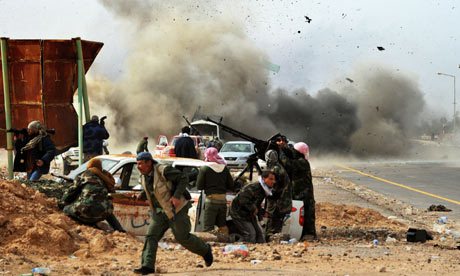
A tank shell explodes outside Ras Lanuf
Nicholas Kristof made “the case for a no-fly zone” today:
“This is a pretty easy problem, for crying out loud.”
For all the hand-wringing in Washington about a no-fly zone over Libya, that’s the verdict of Gen. Merrill McPeak, a former Air Force chief of staff. He flew more than 6,000 hours, half in fighter aircraft, and helped oversee no-fly zones in Iraq and the Adriatic, and he’s currently mystified by what he calls the “wailing and gnashing of teeth” about imposing such a zone on Libya.
“I can’t imagine an easier military problem,” he said. “If we can’t impose a no-fly zone over a not even third-rate military power like Libya, then we ought to take a hell of a lot of our military budget and spend it on something usable.”
He continued: “Just flying a few jets across the top of the friendlies would probably be enough to ground the Libyan Air Force, which is the objective.” …. “If we can’t do this, what can we do?” he asked, adding: “I think it would have a real impact. It might change their calculation of who might come out on top. Just the mere announcement of this might have an impact.”
I guess the problem is that we have an inexperienced, indecisive Commander-in-Chief who is waiting for his aides to tell him what to do. As our President dithers and NATO “squabbles” Gaddafi is succeeding in crushing the courageous, ragtag opposition fighters.

 peej
peej Carissa
 bostonboomer
 dakinikat
 ecocatwoman
 mablue2
 Mama Lopez
 peggysue22
 quixote
 skydancingguestblogger
 Mona (aka Wonk the Vote)



 Sky Dancing
Recent Comments