
Where is Iman al-Obeidi?
Posted: March 28, 2011 Filed under: Foreign Affairs, Libya, Violence against women, Women's Rights | Tags: Benghazi, Charles Clover, gang rape, Human Rights, Iman al Obeidi, journalists, Libya, Moammar Gaddafi, rape, Women's Rights 21 Comments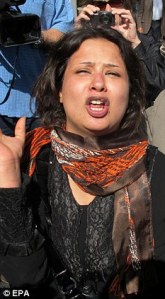
Iman al-Obeidi
The Libyan government claims she has been released and is staying with her sister in Tripoli. But al-Obeidi’s parents say she is still being held in Gaddafi’s private residence. Her mother also says that al-Obeidi has been offered a bribe to change her story.
The mother of Eman al-Obaidi said she received a call from an unidentified person purportedly representing the regime, the parents told Al Jazeera news.
The caller asked the family to tell Ms al-Obaidi to change the rape claim in return for her freedom and benefits, including a house or money, according to the victim’s mother.
According to the UK Telegraph,
Aisha Ahmad, who lives in the rebel-held eastern town of Tobruk, told The Washington Post she had passed on the request to her daughter, who had rejected it.
“I am very happy, very proud,” said Mrs Ahmed.
Iman al-Obaidi, a 26-year-old law student in Tobruk, was held last week after she burst into a Tripoli hotel where foreign journalists are staying and told them of the attack.
“Film me, film me, show the whole world what they did to me,” Miss Obaidi had screamed, as she was dragged off by security guards.
Musa Ibrahim, the Libyan government’s spokesman, said Miss Obaidi has been freed, “but the prosecution is still questioning her to determine the circumstances (of her claim).”
So if government agents are questioning her, are they doing it at Gaddafi’s palace or in her sister’s home? Is the sister al-Obeidi is supposedly staying with the same sister her was used by the Libyan government to smear her? <a href="“>From the Guardian story:
…a man claiming to be her cousin told Reuters that Obeidi was targeted by authorities after taking part in a protest in the west of the country during the initial days of the uprising against Gaddafi.
Wadad Omar said his cousin worked for a tourism company in Tripoli and was detained along with three other women who took part in the protest as they returned to the Libyan capital.
The government also used Obeidi’s sister to denounce her publicly, Omar said: “(Obeidi’s) sister went on television to say her sister is crazy. Muammar wants to prove to the world that she is insane. She (the sister) is certainly under pressure from the government.”
If it is the same sister, how can we be sure that al-Obeidi wants to be with her or that she is safe from further attacks or even torture?
There are reports that either four or five men have been arrested in the case, one of them the “son of a high-ranking official.”
Today protesters in Benghazi organized a rally in support of Iman al-Obeidi.
Following disturbing pictures of Ayman Al Abidi that hit the TV airwaves in Benghazi almost 24 hours after the alleged incident, there was outrage in this rebel capital. Men and women held a rally in support of her and marched towards the courthouse in Benghazi. “We are very sad for this and no will accept what happened,” said a Libyan protestor.Many people in Libya are concerned about her situation and they say that is just a glimpse of what they’ve been facing for decades.
Al-Jazeera reported:
Several doctors say they have found Viagra tablets and condoms in the pockets of dead pro-Gaddafi fighters, alleging that they were using rape as a weapon of war.
They say they have been treating female rape survivors who were allied with pro-democracy forces.
At the Financial Times, Charles Clover, one of the journalists who tried to help Iman al-Obeidi and was knocked down and kicked by Libyan security men for his trouble, writes about his experience:
Ms Obeidi said she had been arrested at a checkpoint on Salahidin Street in Tripoli “because I am from Benghazi”, and then held and repeatedly raped by 15 soldiers over two days.
Hearing the disturbance, a group of waiters and waitresses came over and tried at first to soothe her, then, when that did not work, to shut her up.
Suddenly a melee broke out between journalists and hotel staff. A group of athletic leather-jacketed men barrelled in and began throwing us around the room, chasing Ms Obeidi around the restaurant and finally putting a coat over her head. Many of the journalists at the Rixos jumped into the fray, trying to protect her, but it was a battle we were certain to lose.
Cameras were smashed and one journalist was punched in the face. I ended up wrestling for my Dictaphone, getting thrown down and kicked.
Clover has been told that he is “no longer welcome in Libya,” but he believes that the incident in which he was a bit player is a real tipping point.
All the careful efforts of the Libyan government to nurture their parallel reality were demolished that day. The hired mobs, the theatrical set pieces designed for foreign press consumption, and the alleged civilian casualties of the allied air campaign for which we have been shown little evidence – they all came crashing down, because of one woman’s bravery and desperation.
The questions remains: where is Iman al-Obeidi now? According to Anderson Cooper,
A group of lawyers and human rights activists tried to approach her sister’s house Monday, but were blocked by security forces. Al-Obeidy’s sister’s mobile phone has apparently been turned off, a source with the Lebanese opposition in Tripoli told CNN. And no one has seen the sister since the incident at the hotel.
Journalists and human rights activists much continue their demands to talk to al-Obeidi. She must not be disappeared by Gaddafi’s storm troopers. She is a living symbol of what Libyan rebels are fighting for–freedom of movement and association, freedom to speak truth to power, freedom to control one’s own body.
Yes, I know women are not treated equally in Arab cultures. Guess what? We aren’t treated equally here either. We need to stand up and fight for our rights just as this “lone, brave woman,” — as Charles Clover referred to her — fought for hers. And we must stand with her now and demand that she be freed and returned to her family.
Japan, Libya Crises Contribute to Crushing Election Defeat for Angela Merkel
Posted: March 27, 2011 Filed under: Foreign Affairs, Germany, Libya, U.S. Military | Tags: Angela Merkel, earthquake, Fukushima nuclear plant, Germany, Japan, Libya, nuclear disaster, radiation, Tokyo Electric Power Co., tsunami 13 Comments
Angela Merkel
From NPR: Merkel Suffers Historic Defeat In German State
German chancellor Angela Merkel’s conservatives have suffered a historic defeat in a state ballot after almost six decades in power there, partial results showed Sunday, in an election that amounted to a referendum on the party’s stance on nuclear power.
The opposition anti-nuclear Greens doubled their voter share in Baden-Wuerttemberg state and seemed poised to win their first-ever state governorship, according to calculations based on partial results published by public broadcaster ARD….
The Greens secured 24 percent of the vote, with the center-left Social Democrats down 2 percentage points at 23.2 percent, giving them enough form a coalition government in the state, the results showed.
Representatives of all parties said the elections were overshadowed by Japan’s nuclear crisis, turning them into a popular vote on the country’s future use of nuclear power, which a majority of Germans oppose as they view it as inherently dangerous.
Although overseeing a surging economy and falling unemployment, Mrs Merkel attracted withering criticism after she decided to reverse an unpopular decision taken last autumn to extend the lifespans of Germany’s 17 nuclear reactors.
Critics condemned the abrupt u-turn, and the decision to shut down seven of the oldest reactors pending a safety review, as blatant electioneering, claiming that Mrs Merkel hoped to capitalise from rising opposition to nuclear energy in Germany following the disaster engulfing the Fukushima reactors in Japan.
Libya was also an issue for voters:
the government’s refusal to support military intervention in Libya added to Mrs Merkel’s woes.
In comments echoing conservative disquiet with the decision Joschka Fischer, a former foreign minister, said Germany had lost “credibility” on the world stage and had blown its chances of getting a seat at the UN Security Council.
It’s interesting that many Germans apparently wanted to help the Libyan rebels, while so many “progressives” in the U.S. opposed the UN/NATO intervention because Libya is not of much strategic importance to the U.S. and because of the cost.
Germans saw Merkel’s unwillingness to support the intervention in Libya as an embarrassment that could prevent Germany from getting a seat on the UN Security Council.
Here in the U.S., progressives (IMO) missed the importance of the U.S. President making a decision that concurred with the wishes of most of the Arab world–might that not be a better use of our military resources than endlessly pouring them into Afghanistan and Iraq. Just my 2 cents…
Just a couple of quick updates–
Libyan rebels are marching toward Tripoli
The last time the rebels made it as far west as Bin Jawad, it ended in disaster: their fighters ran into a murderous ambush, lost 70 men, and were forced into a terrifying retreat that nearly ended their campaign.
But yesterday, after a stunning sweep across the territory for which they have fought so hard and for so long, they were back.
This time, with Western air power destroying almost all that is left of the regime’s armour and artillery, the mood was very different. The rebels’ eyes were cast towards Sirte, Colonel Muammar Gaddafi’s birthplace and the centre of loyalist resistance.
[….]
The shift in momentum is palpable. Rebels are now back in possession of the two key oil complexes of Ras Lanuf and Brega which handle a sizeable proportion of the 1.5 million barrels a day the country used to export before the uprising. The opposition’s provisional administration in Benghazi stated that Qatar, which had joined the Western coalition in sending warplanes to Libya, would be marketing the oil. However, restarting production will be extremely difficult until the return of the foreigners who ran the plants, but left after the uprising.
In Japan, a 6.5 magnitude aftershock triggered a new tsunami warning, and workers have again left the Fukushima nuclear plant because of dangerously high radiation levels. From the Independent:
It [earthquake and tsunami alert] came after emergency workers fled from one of Fukushima’s stricken nuclear reactors yesterday, after contaminated water in the cooling system was apparently found to be 10 million times more radioactive than normal, only for officials to later say that the reading might have been inaccurate.
The latest confusion in the battle to bring Japan’s nuclear crisis under control came as villagers near the plant complained that they were being kept in the dark over radiation risks.
The technician who took the reading at reactor No 2 yesterday was so alarmed by the numbers that the team fled the building before taking a second measurement. And later, a spokesman for Tokyo Electric Power Co, the operator of the Fukushima plant, said: “There is a suspicion that the reading … is too high, so we are redoing our tests… We are very sorry for the inconvenience.”
Highly radioactive pools of water have formed inside all four of the damaged reactors, officials said. After previously downplaying fears of a serious breach in any of the reactors, Yukio Edano, the cabinet secretary and the face of the government throughout the crisis, said it “almost certainly” had happened.
The world is changing very rapidly, despite our government’s attempts to maintain the status quo. I wonder what dramatic news awaits us tomorrow?
Libyan Woman Disappeared? (UPDATED)
Posted: March 26, 2011 Filed under: Breaking News, Libya, Violence against women | Tags: Eman al-Obeidy 33 Comments
Eman al-Obeidy displayed a broad bruise on her face, a large scar on her upper thigh, several narrow and deep scratch marks lower on her leg, and marks that seemed to come from binding around her hands and feet. (Jerome Delay/AP)
Some very disturbing footage and developments out of Tripoli this Saturday.
Warning: This is a very grim story and the footage is raw.
The New York Times reports that a Libyan woman is dragged off by government officials as she tries to tell journalists that she had been tied up, urinated and defecated on, and raped by 15 of Gaddafi’s men:
TRIPOLI, Libya — A Libyan woman burst into the hotel housing the foreign press in Tripoli on Saturday morning in an attempt to tell journalists that she had been raped and beaten by members of Col. Muammar el-Qaddafi’s militia. After struggling for nearly an hour to resist removal by Colonel Qaddafi’s security forces, she was dragged away from the hotel screaming.
[…]
She pleaded for friends she said were still in custody. “They are still there, they are still there,” she said. “As soon as I leave here, they are going to take me to jail.”
The NYT Lede has raw footage up here.
Lisa Holland filed this report from Tripoli for Sky News (post continues after youtube):
The bruises and injuries the woman showed to journalists match up with her story of being bound up, beaten, and raped.
From what I can make of the following reporting from Wapo and Forbes, Charles Clover of the Financial Times, one of the journalists attacked as he tried to intervene/report, had his recording device taken away by Gaddafi’s henchmen before he was deported. A CNN camera was also confiscated and the cameraman found himself at gunpoint when he tried to take it back.
“I was tied up. They defecated on me. They urinated on me. They violated my honor,” she said.
But as she spoke, hotel staff members, security guards and government minders closed in on her and began dragging her away. Journalists who tried to protect her were punched, and one, Charles Clover of the Financial Times, was knocked to the ground and kicked. Shortly afterward, Clover was deported after being informed at 2 a.m. that he would have to leave the country because the government didn’t like his reporting.
Two waitresses grabbed knives and screamed that the woman was a “traitor” to Gaddafi, and one threw a coat over her head in an effort to silence her. Government minders, who are assigned to supervise and supposedly protect journalists, snatched a CNN camera and smashed it, and one of them pulled a pistol when the cameraman tried to take it back.
Eventually the woman, screaming, “They are taking me to jail,” was hauled outside to an unmarked saloon car, which whisked her away at high speed.
In the ensuing chaos, reporters were beaten off and threatened as they tried to protect the woman and get her story, and hotel staff suddenly began working in tandem with security staff to get the woman off the premises. A reporter for the Financial Times had his recording device, which had recorded the woman’s testimony, wrested from him.
As Kiri Blakely goes on to report, Gaddafi’s regime is accusing the woman of being drunk and delusional:
The story is tragic and horrible, and I fear for the woman’s life. Adding yet another horrific, and all too common, element to the tale is that the woman’s testimony of sexual and physical abuse, reportedly backed up by physical evidence, was then dismissed as “fantasies” by the Libyan government. The government went on to say that the woman appeared “drunk” and “mentally ill.”
I will try to update this post or do a follow-up as more information becomes available.
UPDATE — Apparently Libyan government officials, now under media scrutiny and facing questions of where al-Obeidy is and how she is being treated, have referred to this as a case of rape — a shift from the ‘drunk and delusional’ narrative being pushed by the government earlier. Via Al Jazeera:
At a hastily arranged press conference following the incident, Moussa Ibrahim, a government spokesman, said investigators had told him that the woman was drunk and possibly mentally challenged.
Anita McNaught, Al Jazeera’s correspondent in Tripoli, said: “The government initially suggested that she was drunk … but when they [officials] came back to the journalists later to reassure them that she was being well cared for … they did describe this as a case of rape.”
Also, more details on what al-Obeidy told reporters about the men from Gaddafi’s militia who attacked her:
Before she was dragged out of the hotel, al-Obeidi was able to tell journalists that she was detained by a number of troops at a Tripoli checkpoint on Wednesday.
She said they were drinking whiskey and handcuffed her and that 15 men later raped her.
Here’s the Al Jazeera report via youtube posted at the link:
TGIFriday Reads
Posted: March 25, 2011 Filed under: commercial banking, Corporate Crime, Economy, Egypt, financial institutions, Foreign Affairs, morning reads, U.S. Politics, unemployment, Women's Rights | Tags: austerity, budget, Federal deficits, Michelle Bachmann is nuts, Paul Krugman 16 Comments Good Morning!
There’s been quite a few economists weighing in on the debate going on in congress about the budget. Paul Krugman’s op-ed is on “The Austerity Delusion”. Krugman’s appalled that more policymakers aren’t concerned with the high rate of unemployment which is contributing to the deficit in several ways. First, it decreases tax revenues. Second, it increases state and federal expenditures. Solve the jobs problem and the deficit will decrease. He’s worried that all this austerity will just bring on another economic slowdown.
Why not slash deficits immediately? Because tax increases and cuts in government spending would depress economies further, worsening unemployment. And cutting spending in a deeply depressed economy is largely self-defeating even in purely fiscal terms: any savings achieved at the front end are partly offset by lower revenue, as the economy shrinks.
So jobs now, deficits later was and is the right strategy. Unfortunately, it’s a strategy that has been abandoned in the face of phantom risks and delusional hopes. On one side, we’re constantly told that if we don’t slash spending immediately we’ll end up just like Greece, unable to borrow except at exorbitant interest rates. On the other, we’re told not to worry about the impact of spending cuts on jobs because fiscal austerity will actually create jobs by raising confidence.
Politico features a series of Former CEA members who signed a letter of concern on the deficit and unsustainable US Budgets. Too bad that people like Greg Mankiw–advisor to Dubya–didn’t speak up when the spending problems were originated. They mostly trace to Reagan and Bush administrations. They all suggest using the Cat food commission report as the focus of discussions. Hang on to your social security, folks! It’s going to be a bumpy ride.
As former chairmen and chairwomen of the Council of Economic Advisers, who have served in Republican and Democratic administrations, we urge that the Bowles-Simpson report, “The Moment of Truth,” be the starting point of an active legislative process that involves intense negotiations between both parties.
There are many issues on which we don’t agree. Yet we find ourselves in remarkable unanimity about the long-run federal budget deficit: It is a severe threat that calls for serious and prompt attention.
While the actual deficit is likely to shrink over the next few years as the economy continues to recover, the aging of the baby-boom generation and rapidly rising health care costs are likely to create a large and growing gap between spending and revenues. These deficits will take a toll on private investment and economic growth. At some point, bond markets are likely to turn on the United States — leading to a crisis that could dwarf 2008.
“The Moment of Truth” documents that “the problem is real, and the solution will be painful.” It is tempting to act as if the long-run budget imbalance could be fixed by just cutting wasteful government spending or raising taxes on the wealthy. But the facts belie such easy answers.
I suppose you know the professional insane Republican Michelle Bachmann is forming an exploratory committee for a possible presidential run. I’d vote for any one’s dog before I’d consider Bachmann who doesn’t appear to have paid attention to any course she ever attended in school. I’ve never in my life heard any one outside of maybe a grade school that has such a bad grasp of American History, law, and politics. I think she should’ve just gotten a mail order degree. Education appears to have been wasted on her.
CNN has exclusively learned that Rep. Michele Bachmann will form a presidential exploratory committee. The Minnesota Republican plans to file papers for the committee in early June, with an announcement likely around that same time.
But a source close to the congresswoman said that Bachmann could form the exploratory committee even earlier than June so that she could participate in early Republican presidential debates.
“She’s been telling everyone early summer,” the source told CNN regarding Bachmann’s planned June filing and announcement. But the source said that nothing is static.
“If you [debate sponsors] come to us and say, ‘To be in our debates, you have to have an exploratory committee,’ then we’ll say, ‘Okay, fine…I’ll go file the forms.'”
Speaking of Republicans, a former aide to Sen. John Ensign has just been indicted for violating conflict of interest laws.
The Justice Department announced the indictment late Thursday, which charges Doug Hampton with seven counts of violating criminal conflict of interest laws for allegedly engaging in unlawful communication with Ensign’s office, violating the Senate’s “revolving door” policy.
According to the indictment, after Hampton left Ensign’s office in 2008 he “knowingly and willfully made, with the intent to influence, communications to staff members of the U.S. senator” on behalf of an energy company he was employed by at the time.
Hampton is alleged to have sought the assistance of Ensign and other staff members for help in moving forward a proposal to build a power plant in eastern Nevada.
Hampton, if convicted, could face up to five years in prison for each of the seven counts in the indictment. He is set to be arraigned in U.S. District Court in Washington, D.C. on March 31.
Ensign is retiring. Probably because of all the scuttlebutt around his affairs and possibly what may come out of this prosecution. Maybe Tom Delay will have a new cell mate on the way.
Glenn Greenwald has written an excellent piece in Salon on withering Miranda rights under the Obama administration. You may want to check it out.
The number of instances in which Obama has violently breached his own alleged principles when it comes to the War on Terror and the rule of law are too numerous to chronicle in one place. Suffice to say, it is no longer provocative or controversial when someone like Yale Law Professor Jack Balkin writes, as he did the other day, that Obama “has more or less systematically adopted policies consistent with the second term of the George W. Bush Administration.” No rational person can argue that or even tries to any longer. It’s just a banal expression of indisputable fact.
Today, the Obama DOJ unveiled the latest — and one of the most significant — examples of its eagerness to assault the very legal values Obama vowed to protect. The Wall Street Journal reports that “new rules allow investigators to hold domestic-terror suspects longer than others without giving them a Miranda warning, significantly expanding exceptions to the instructions that have governed the handling of criminal suspects for more than four decades.” The only previous exception to the 45-year-old Miranda requirement that someone in custody be apprised of their rights occurred in 1984, when the Rehnquist-led right-wing faction of the Supreme Court allowed delay “only in cases of an imminent safety threat,” but these new rules promulgated by the Obama DOJ “give interrogators more latitude and flexibility to define what counts as an appropriate circumstance to waive Miranda rights.”
Just hope you never get classified as a terrorist or you’ll disappear down some rabbit hole. You should also read William Grieder over at The Nation on How Wall Street Crooks Get Out of Jail.
Instead of “Old Testament justice,” federal prosecutors seek “authentic cooperation” from corporations in trouble, urging them to come forward voluntarily and reveal their illegalities. In exchange, prosecutors will offer a deal. If companies pay the fine set by the prosecutor and submit to probationary terms for good behavior, perhaps an outside monitor, then government will defer prosecution indefinitely or even drop it entirely. The corporation thus avoids the stigma of a criminal trial and the bad headlines that depress stock prices. More to the point, the “deferred prosecution agreement,” as it’s called, allows the company to escape the more severe consequences of criminal conviction—the loss of banking and professional licenses, charters, deposit insurance or other government benefits, including eligibility for federal contracts and healthcare programs. In other words, the punishment prescribed in numerous laws.
“With cooperation by the corporation, the government may be able to reduce tangible losses, limit damage to reputation, and preserve assets for restitution,” the Justice Department’s authorizing memorandum explained in 2003. “A deferred prosecution or non-prosecution agreement can help restore the integrity of a company’s operations and preserve the financial viability of a corporation that has engaged in criminal conduct.”
The favored argument for the more conciliatory approach was that criminal indictment may amount to a death sentence for a corporation. The fallout will destroy it, and the economy will lose valuable productive capacity. The collateral consequences are unfair to employees who lose jobs and stockholders who lose wealth. Corporate defenders cited Arthur Andersen, the giant accounting firm that imploded after it was convicted in 2002 of multiple offenses in Enron’s collapse. But was it the firm’s indictment or its criminal behavior that caused clients, accountants and investors to abandon it?
A better name for the Justice Department’s softened policy might be “too big to prosecute.”
Wanna rob a bank? Don’t do it with a gun. Just become its President and do what you want to do.
Here’s a disturbing headline from Egypt (h/t to Minx):Secret shame of Egypt’s army: Women protesters were forced to have ‘virginity checks’ after being arrested in Tahrir Square,
Women arrested by the Egyptian police during protests in Cairo’s Tahrir Square were subjected to forced ‘virginity tests’, according to Amnesty International.
Eighteen demonstrators were detained after army officers cleared the square on March 9 at the end of weeks of protest.
Amnesty today said that the women had been beaten, given electric shocks and then subjected to strip searches while being photographed by male soldiers.
They were then given ‘virginity checks’ and threatened with prostitution charges if medics ruled they had had sex, according to the charity.
Just when you think things will get better, something comes along that just makes things look worse.
So, what’s on your reading and blogging list today?
The Changing Face of the MENA Region (Breaking News)
Posted: March 24, 2011 Filed under: Algeria, Bahrain, Egypt, Foreign Affairs, Iran, Iraq, Israel, Jordan, Lebanon, Libya, Syria, Tunisia, Yemen | Tags: arab awakening, MENA 8 Comments The WSJ reports that Yemeni President Saleh is working out a deal that will let him resign. The country’s leading general will also resign. The details will be released on Saturday.
“Both sides have agreed on the main points of departure, and Saturday is expected to be the day that Saleh and General Ahmar both step down,” according to a senior official familiar with the negotiations.
It couldn’t be determined which individuals were being considered as candidates for any transitional authority as talks continued late Thursday between the two leaders.
The support for mainstream opposition party leaders is unclear across the rugged and largely conservative country. Meanwhile, traditional tribal leaders who have great social standing would face problems exerting authority over rival tribes.
The Pentagon is currently holding a presser and has announced that they’re no longer ‘detecting’ Libyan planes in the air. NATO and the UN are expected to make an announcement shortly that NATO will be taking over the No-fly efforts. I just read some interesting analysis at Juan Cole’s Informed Consent on the Top Ten Accomplishments of the UN’s no-fly zone efforts. Cole says the French have also verified that Gadhafi’s air attacks have stopped and that his planes are grounded. There is also this tidbit.
The participation of the Muslim world in the United Nations no-fly zone over Libya has been underlined. The measure was called for by the Arab League, which has not in fact changed its mind about its desirability. Qatar is expected to be flying missions over Libya by this weekend. Other Arab League countries will give logistical support.
It is significant that the Arab League is supporting this action. The GCC (Gulf Cooperation Council)–an organization that is an essential part of my research on trade–is also trying to curb problems in Bahrain. This is significant because it shows that region is actively trying to create situations to jointly improve the conditions in the region.
Meanwhile, the people of Syria may be closer to the goals of their mostly peaceful protests. Syria is one of the most repressed countries in the region and has been under martial law for 50 years. Clashes between protesters and the government have increased recently.
President Bashar al-Assad made a rare public pledge to look into granting Syrians greater freedom on Thursday as anger mounted following attacks by security forces on protesters that left at least 37 dead.
Syrian opposition figures said the promises did not meet the aspirations of the people and were similar to those repeated at regular Baath Party conferences, where committees would be formed to study reforms that do not see the light of day.
“The leadership is trying to absorb the rage of the streets. We want to see reform on the ground,” said a protester in the southern city of Deraa.
A hospital official said at least 37 people had been killed in the southern city of Deraa on Wednesday when security forces opened fire on demonstrators inspired by uprisings across the Arab world that have shaken authoritarian leaders.
While an aide said Assad would study a possible end to 48 years of emergency rule, a human rights group said a leading pro-democracy activist, Mazen Darwish, had been arrested.
It’s exciting to watch the move to democracy and modernity in a region known for strongmen dictators, kings, and harsh political oppression. This will be an interesting situation to watch. I only hope that the people get what they are hoping for and that modernity and better treatment of women are part of the equation. Some of the states–like Qatar and the UAE–are further along in this pursuit than others. Yemen and Syria are perhaps the most dangerous parts of the equation. The Shia-Sunni dynamic is present and that always makes for a delicate situation.
Also, SOS Hillary Clinton will be making a statement shortly. We will try to keep you updated and give you interesting links as these new developments unfold.

 peej
peej Carissa
 bostonboomer
 dakinikat
 ecocatwoman
 mablue2
 Mama Lopez
 peggysue22
 quixote
 skydancingguestblogger
 Mona (aka Wonk the Vote)



 Sky Dancing
Recent Comments