
Monday Reads
Posted: April 22, 2013 Filed under: Austerity, Catfood Commission, cyber security, Domestic Policy, Foreign Affairs, morning reads, Myanmar | Tags: cat food commission, CISPA, CNN: Media Fail, ethnic cleansing, Myanmar, Rohingya, Simpson-Bowles 32 Comments Good Morning!
Last week, I wrote about the debacle behind the study that was used to promote fiscal austerity in a time when just the opposite policy is prescribed by economic theory. One of the big questions I had was if the results of study’s hypothesis was now insignificant–which in scientific method means the conclusions were not proven–would we see a stop to these crazy austerity policy pushers. We’ve learned the answer is no. Dumber and Dumber–heads of the so-called cat food commission–who couldn’t lead their committee to a written conclusion are on the road touting their call to deficit hysteria based on the always controversial and now highly flawed study.
On April 19, just after I had written about how the key academic research used to bolster austerity policies was exposed by a 28-year-old grad student at U Mass-Amherst, I got a surprise in my email inbox: Erskine Bowles and Alan Simpson giddily announced their new deficit-reduction plan, which includes, among other things, a recommendation to increase the eligibility age for Medicare. Their plan would reduce debt as a share of GDP below 70 percent by 2023, and as the Washington Post reports, “seeks far less in new taxes than the original, and it seeks far more in savings from federal health programs for the elderly.”
What’s incredible is that over the last week, the study by Harvard economists Carmen Reinhart and Ken Rogoff that famously warned of the dangers of government debt has been proven to be riddled with errors and questionable methodology. To recap: R&R’s paper purported to show that countries with public debt in excess of 90 percent of gross domestic product suffered negative economic growth. Austerity hawks everywhere used it to justify cuts that have cost people jobs and vital services. The original spreadsheet used by R&R was obtained by a U Mass grad student, who found that in addition to the mistakes already noted by several economists, there was a coding error in their Excel spreadsheet that significantly changed the results of their study.
As New York magazine’s Jon Chait has pointed out, that same discredited research has been used by Bowles and Simpson to formulate their deficit-reducing austerity plans.
You simply cannot get these tools of the plutocracy to come clean. They’re going to go down with the stupidity and are trying to bring the rest of the country with them.
I promised myself to make sure we pointed to injustice and suffering around the world as well as our own home towns. Today I want to provide information about Myanmar–a country I’ve spent time studying and a country trying to change–with a history of brutal ethnic cleansing of its Muslim minority population.
Ethnic cleansing and crimes against humanity have been committed against Myanmar’s ethnic Rohingya people, according to a new report by Human Rights Watch (HRW), a New York-based nongovernmental organisation.
According to the report released on Monday, entitled All You Can Do is Pray, more than 125,000 ethnic Rohingya have been forcibly displaced since two waves of violence in May and October 2012.
Satellite images show almost 5,000 structures on land mostly owned by Muslim Rohingya have been destroyed, says the report.
The October attacks, the report states, were coordinated by Myanmar government officials, an ethnic Rakhine nationalist party and Buddhist monks. The deadliest attack took place on October 23, in which witnesses say at least 70 Rohingya – including 28 children – were massacred in Mrauk-U township.
The UN has described the Rohingya as one of the most persecuted minorities in the world.
Most Rohingya who live in Myanmar’s western Rakhine state are denied citizenship by the Myanmar government, which claims they are illegal immigrants from neighbouring Bangladesh and often refers to them as “Bengali”.
The Myanmar government has done nothing to prevent the violence, alleges the report, and at times government forces have joined in the attacks on the Rohingya.
“The Burmese government engaged in a campaign of ethnic cleansing against the Rohingya that continues today through the denial of aid and restrictions on movement,” Phil Robertson, HRW’s deputy Asia director, said.
“The government needs to put an immediate stop to the abuses and hold the perpetrators accountable or it will be responsible for further violence against ethnic and religious minorities in the country.”

I am so ashamed to read that Buddhist monks may have been participants. They have been targets themselves and this behavior violates the most important teaching of the Buddha which is the vow of non harming. No real Buddhist would participate in such horrors.
I also wanted to mention the return of CISPA and its impact on internet users in this country. This was slipped back into Congress while we were all watching Boston.
Described as “misguided” and “fatally flawed” by the two largest US privacy groups, the Cyber Intelligence Sharing and Protection Act (CISPA) threatens the online privacy of ordinary US residents more so than any other Bill since Congress amended the Foreign Intelligence Surveillance Act in 2008.
Its sole purpose is to allow private sector firms to search personal and sensitive user data of ordinary US residents to identify this so-called “threat information”, and to then share that information with each other and the US government — without the need for a warrant.
By citing “cybersecurity”, it allows private firms to hand over private user data while circumventing existing privacy laws, such as the Wiretap Act and the Stored Communications Act. This means that CISPA can permit private firms to share your data, such as emails, text messages, and cloud-stored documents and files, with the US government.
It also gives these firms legal protection to hand over such data. There is no judicial oversight.
To make matters worse, because there is little transparency and individual accountability, those who have had their data handed to the US government may not even know about it or be given a chance to challenge it.
Norway’s ruling party is pushing for drilling around environmentally sensitive areas in the Arctic Circle. Could this impact a return to attempts to drill the area by US Oil companies? I hope this doesn’t lead to a race to destroy ANWR
Norway took a major step towards opening up an environmentally sensitive Arctic area to oil and gas exploration when the ruling Labour Party gave the go-ahead on Sunday for an impact study.
Exploration in the waters around the Lofoten islands just above the Arctic circle is becoming one of the most contentious issues for parliamentary elections in September.
The picturesque area had been off limits because it is home to the world’s richest cod stocks, with environmental groups and the tourism industry opposed to any development.
The Labour party voted for the study, a precursor to any exploration, but also said it would take another vote in 2015, before actual drilling could begin.
Oil is the Norwegian economy’s lifeblood – the nation is the world’s seventh-biggest oil exporter and western Europe’s biggest gas supplier.
Its sprawling offshore energy sector continuously needs new areas to explore to halt the decline in production and energy firms have argued that they should be allowed to investigate the Lofoten islands.
Norway’s oil production will fall to a 25-year low this year as North Sea fields mature. Even a series of recent big finds, like the giant Johan Sverdrup field, which could hold over 3 billion barrels of oil, will only arrest the decline.
Waters off Lofoten are estimated to hold 8 percent of Norway’s undiscovered oil and gas resources with seismic tests identifying 50 prospects that could hold recoverable reserves or around 1.27 billion barrels of oil equivalent, the petroleum directorate said earlier.
With Labour’s support, Norway’s top three parties now favor exploration in the area, raising the chance that the next government would begin the process.

Teamsters from Local 25 in Boston will protect the family of bombing victim Krystle Campbell during her funeral tomorrow morning. Members of the Westboro Baptist Church are expected to protest.
The Associated Press reports,
Family and friends are saying final good-byes to Krystle Campbell, one of the three people who lost their lives in the bombing at the Boston Marathon finish line.
A wake for Campbell is being held Sunday at a funeral home in Medford, where the 29-year-old restaurant manager was raised and graduated from high school in 2001. A private funeral is scheduled for Monday at St. Joseph Church.Local 25 was contacted by some concerned citizens of Medford asking for help to keep members of the Westboro Baptist Church from protesting the funeral of Krystle Campbell, scheduled for tomorrow morning at 10 AM in Medford.
Local 25 President Sean O’Brien asked all off-duty Teamsters to participate:
Teamsters Local 25 will be out in full force tomorrow morning at St. Joseph’s Church in Medford to form a human shield and block the Westboro Baptist Church from protesting the funeral of Krystle Campbell. The Campbell family and friends have already endured immeasurable amounts of heartache and tragedy this week, and deserve a peaceful funeral with time to grieve privately.
Westboro Baptist Church should understand that we will go to great lengths to make sure they don’t protest any funerals of the victims of the past week’s tragedies, and that those we lost receive a proper burial.
Teamsters Local 25 represents 11,000 hardworking men and women from the Boston area.
There are three dead from the bombing. Westboro is also connected to a law firm that makes money from the antics of these folks. They usually claim their first amendment rights were violated and then collect government money defending their case.
And just because I’ve quit watching CNN around a year ago after watching the station for years, I thought I’d end with this: “Last Week, CNN Itself Became the Poop Cruise”. Frankly, I’ve thought they were full of it and lacking substance for some time.
As reactions to the media’s handling (or rather, mishandling) of breaking news during a busy week continue to flow in, perhaps none is more condemning than David Carr’s latest column in The New York Times. The media critic came down hard on correspondent John King, newly appointed chief Jeff Zucker and the rest of the CNN news team that famously fumbled during the aftermath of the Boston bombing and hunt for the suspects. Most notably, the network erroneously reported the arrest of a suspect on Wednesday, when everybody now knows that a suspect wasn’t arrested until Friday when police found Dzokhar Tsarnaev hiding in the back of a boat.
Carr has an analogy for that. In discussing the mistake, one that more than one person described as “devastating,” Carr reminded us of the most recent moment that CNN’s stolen the limelight — perhaps not in a good way:
It was not the worst mistake of the week — The New York Post all but fingered two innocent men in a front-page picture — but it was a signature error for a live news channel. … Until now, the defining story in the Zucker era had been a doomed cruise ship that lost power and was towed to port, where its beleaguered passengers dispersed. This week, CNN seemed a lot like that ship.
Zing. Inevitably, Carr’s piece comes off almost as apologetic. In his parting words, the veteran journalist points out how even the president “wants CNN to be good.” So when it’s bad, it’s hard to watch.
I’m just praying for a better week and that we can get some attention on the small town of West Texas that really needs our help.
What’s you your reading and blogging list today?
Monday Reads
Posted: November 19, 2012 Filed under: Federal Budget, Federal Budget and Budget deficit, Foreign Affairs, Gaza, Israel, morning reads, Myanmar | Tags: Ban Ki-moon, Benjamin Netanyahu, Daw Aung San Suu Kyi, Glenn Greenwald, Reporters without Borders, Robert Reich 47 CommentsGood Morning!
It’s really hard for me to focus on much other than the bombing that’s going on between Gaza and Israel at the moment. The carnage is getting to me.
An Israeli bomb pummeled a home deep into the ground here Sunday afternoon, killing 11 people, including nine in three generations of a single family, in the deadliest single strike since the cross-border conflict between Israel and the militant faction Hamas escalated on Wednesday.
The airstrike, along with several others that killed civilians across this coastal territory and hit two media offices here — one of them used by Western TV networks — further indicated that Israel was striking a wider range of targets.
Gaza health officials reported that the number of people injured here had nearly doubled to 600 by day’s end; the Palestinian death toll climbed to 70, including 20 children. Three Israelis have been killed and at least 79 wounded by continued rocket fire into southern Israel and as far north as Tel Aviv, as Israeli cities were paralyzed by an onslaught of relentless rocket fire out of Gaza for the fifth straight day.
In the Israeli strike on Sunday morning, it took emergency workers and a Caterpillar digger more than an hour to reveal the extent of the devastation under the two-story home of Jamal Dalu, a shop owner. Mr. Dalu was at a neighbor’s when the blast wiped out nearly his entire family: His sister, wife, two daughters, daughter-in-law and four grandchildren ages 2 to 6 all perished under the rubble, along with two neighbors, an 18-year-old and his grandmother.
At around 2 a.m. today, Israeli warplanes fired several missiles at the Al-Shawa Wa Hassri Tower, a building in the Gaza City neighborhood of Rimal that houses local and international media organizations. Around 15 reporters and photographers wearing vests with the word “TV Press” were on the building’s roof at the time, covering the Israeli air strikes.
Five missiles destroyed the 11th-floor offices used by Al-Quds TV. The station said six journalists were injured, four of them Al-Quds employees – Darwish Bulbul, Khadar Al-Zahar, Muhammad al-Akhras and Hazem al-Da’our. The other two were identified as Hussein Al-Madhoun, a freelance photographer working for the Ma’an news agency, and Ibrahim Labed, a reporter for the Palestinian news agency SAFA. Zahar’s condition was described as critical after one of his legs had to be amputated.
At around 7 a.m., three Al-Aqsa TV employees were seriously injured when two missiles were fired at the Al-Shourouk building, also known as the “journalists’ building.” A spokesperson for the Israel Defence Forces said on the @IDFSpokesperson Twitter account that the air strike had targeted a Hamas communication centre.
Among the local and international media whose offices were damaged by Israeli missiles were Sky News Arabia, the German TV station ARD, the Arab TV stations MBC and Abu Dhabi TV, Al-Arabiya, Reuters, Russia Today and the Ma’an news agency.
Information was also one of the victims of Israel’s Operation Cast Lead against the Gaza Strip in December 2008 and January 2009 (read the RWB report). At the time, Reporters Without Borders condemned Israel’s decision to declare the Gaza Strip a “closed military zone” and deny access to journalists working for international media. The IDF also targeted pro-Hamas media during Operation Cast Lead.
Meanwhile, Benjamin Netanyahu Says Israel Is ‘Prepared for a Significant Expansion’ of Conflict in Gaza.
On Sunday, Israel’s prime minister, Benjamin Netanyahu, indicated that he intended to take on additional targets. “We are exacting a heavy price from Hamas and the terrorist organizations and the Israel Defense Forces are prepared for a significant expansion of the operation,” he said, referring to the 75,000 reservists who have been put on call for what many believe is a planned ground invasion. Meanwhile, Israel’s Iron Dome defense system successfully deflected another Hamas rocket aimed at Tel Aviv.
The UN Secretary General is calling for a cease-fire. Ban Ki Moon is headed for Cairo. Glenn Greenwald–writing for the UK Guardian–has written that the US cannot pretend it’s being neutral.
Obama continues to defend Israel’s free hand in Gaza, causing commentators like Jeffrey Goldberg to gloat , not inaccurately: ” Barack Obama hasn’t turned against Israel. This is a big surprise to everyone who has not paid attention for the last four years” (indeed, there are few more compelling signs of how dumb and misleading US elections are than the fact that the only criticism of Obama on Israel heard over the last year in the two-party debate was the grievance that Obama evinces insufficient fealty – rather than excessive fealty – to the Israeli government). That the Netanyahu government knows that any attempt to condemn Israel at the UN would be instantly blocked by the US is a major factor enabling them to continue however they wish. And, of course, the bombs, planes and tanks they are using are subsidized, in substantial part, by the US taxpayer.
If one wants to defend US support for Israel on the merits – on the ground that this escalating Israeli aggression against a helpless population is just and warranted – then one should do so. As I wrote on Thursday , it’s very difficult to see how those who have cheered for Obama’s foreign policy could do anything but cheer for Israeli militarism, as they are grounded in the same premises.
I agree with Robert Reich who says we should stop obsessing over the Federal Budget Deficit.
The best way to generate jobs and growth is for the government to spend more, not less. And for taxes to stay low – or become even lower – on the middle class.
(Higher taxes on the rich won’t slow the economy because the rich will keep spending anyway. After all, being rich means spending whatever you want to spend. By the same token, higher taxes won’t reduce their incentive to save and invest because they’re already doing as much saving and investing as they want. Remember: they’re taking home a near record share of the nation’s total income and have a record share of total wealth.)
Why don’t our politicians and media get this? Because an entire deficit-cutting political industry has grown up in recent years – starting with Ross Perot’s third party in the 1992 election, extending through Peter Petersen’s Institute and other think-tanks funded by Wall Street and big business, embracing the eat-your-spinach deficit hawk crowd in the Democratic Party, and culminating in the Simpson-Bowles Commission that President Obama created in order to appease the hawks but which only legitimized them further.
Myanmar (Burma) has had some terrible human rights violations in its recent past. President Obama is visiting the tiny Southeastern Asian nation and will be urging the country’s power brokers to change their ways.
“You gave us hope,” Obama will say in a speech in Myanmar, according to excerpts of his remarks released by the White House during his visit to Bangkok, Thailand, the first
stop on a three-day trip to the region. “And we bore witness to your courage.”
In a daytime stop expected to last only six hours, Obama is set to meet with President Thein Sein in the former capital of Yangon. He’ll also visit opposition leader Aung San Suu Kyi, Myanmar’s most popular political figure, at her lakeside home where she spent more than 15 years confined under house arrest.
Obama eased sanctions on Myanmar this year after Thein Sein engaged with his political opponents and eased media restrictions since his party won a 2010 election that ended five decades of direct military rule in the country, formerly known as Burma. The visit also reflects a legacy-building goal for a president about to enter a second term, whose early efforts at engagement and democratization have yielded mixed results.
Obama will visit Nobel Peace Prize Winner Daw Aung Suu Kyi during his visit.
He made a point of not only scheduling a meeting at the government headquarters with President Thein Sein but also a personal pilgrimage to the home of the opposition leader Daw Aung San Suu Kyi, where she was confined under house arrest for most of two decades before her release two years ago. Amid the manicured lawn and well-tended garden outside the elegant two-story lakeside house, the president and the Nobel-winning dissident planned to stand side by side celebrating change that once seemed unimaginable.
While local leaders attribute the changes so far to internal factors and decisions, Mr. Obama was eager to claim a measure of credit. He has played nursemaid to the opening of Myanmar, formerly and still known by many as Burma, by sending the first American ambassador in 22 years, easing sanctions and meeting with Ms. Aung San Suu Kyi in Washington.
Later Monday he was to announce the return of the United States Agency for International Development along with $170 million for projects over the next two years, noting that in his inaugural address he had vowed to reach out to those “willing to unclench your fist.”
“So today, I have come to keep my promise and extend the hand of friendship,” read the text of prepared remarks to be delivered at the University of Yangon. He promised to “help rebuild an economy” and develop new institutions that can be sustained. “The flickers of progress that we have seen must not be extinguished — they must become a shining north star for all this nation’s people.”
So, this was a bit of a headline dump this morning, but I have to admit that my eyes have been fixed on what’s going on in the world right now. Hopefully, we can all stay up to date on these important headlines. I’m going to go light some candles and burn some incense and think peace. Hopefully, if enough of us do that, some of those world leaders will get the message.
What’s on your reading and blogging list today?
Aung San Suu Kyi: Once more with Gusto
Posted: April 1, 2012 Filed under: Foreign Affairs, Myanmar | Tags: Aung San Suu Kyi, Burmese elections. 14 Comments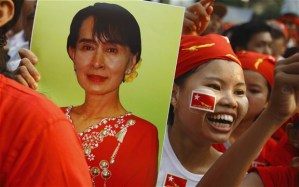 Ever so often, things appear to change for the better.
The streets of Rangoon echoed with cheers on Sunday after unofficial results indicated Aung San Suu Kyi had won a parliamentary seat in a landmark election that could see the Nobel laureate and former political prisoner take public office for the first time.
“We won! We won!” chanted her supporters as they crowded the pavement in their thousands outside her party’s headquarters. Traffic was restricted to a thin line snaking haphazardly through the crowd, where young and old in red – the colour of Aung San Suu Kyi’s party, the National League for Democracy (NLD) – sang along to a Johnny Cash-inspired anthem calling for “the return of Mother Suu”.
Those who were not dancing swayed back and forth to watch numbers flash on a digital signboard that measured the NLD’s victories in byelections around the country, where the party was contesting 44 of 45 open seats in Burma’s 664-seat parliament.
Aung San Suu Kyi’s victory, which will not be officially confirmed for another week, could mark the moment that this poverty-stricken nation, where a military junta has ruled almost exclusively for the past 50 years, takes its first genuine steps towards democracy.
The NLD was competing in its first elections since 1990, after which Aung San Suu Kyi was held under house arrest for most of the next 20 years, and the poll was notable for its unprecedented access for foreign journalists and independent observers.
Myanmar/Burma is one of the economies that I have spent the last several years studying closely. They are a member of ASEAN and are attempting to modernize to become part of a trade and monetary union. Their economy is poor and it primarily reflects the poor government and rule of law established by the military rulers who seized power. Myanmar has also experienced tough sanctions for their many human rights violations. The current elections and the near future will determine the outlook for this country. You may recall the brutal, murderous crackdown on protests by Buddhist Monks–often called the Saffron Revolution for the colors worn by the monks–in 2007. Nations are looking to Aung San Suu Kyi and her party to begin to bring the country back from its past. If this happens, the tiny nation may begin to recover from years of repression and poor economic results.
Ms Suu Kyi said in a statement: “It is natural that the NLD members and their supporters are joyous at this point.
“However, it is necessary to avoid manners and actions that will make the other parties and members upset. It is very important that NLD members take special care that the success of the people is a dignified one.”
During the campaign, foreign journalists and international observers were given the widest access for years.
The European Union hinted that it could ease some sanctions if the vote went smoothly.
The BBC’s Rachel Harvey in Rangoon says the NLD alleged some voting irregularities in the capital, Nay Pyi Taw.
NLD spokesman Nyan Win told AFP news agency he had sent a letter of complaint to the election commission over allegations ballot forms had been tampered with.
He said there had been complaints that wax had been put over the tick-box for the party, which could later be rubbed off to cancel the vote.
“This is happening around the country. The election commission is responsible for what is occurring,” he said.

The military leaders are still dominant in this tiny southeast Asian nation. “Mother Suu” has only recently been allowed out from her house arrest of 20 years. A lot of the international pressure started when the famous human rights activist won the Noble Peace Prize. However, many nations have been pressuring the military to step down. Sanctions on the country have played an important role too.
“While the results have not yet been announced, the United States congratulates the people who participated, many for their first time in the campaign and election process,” Clinton told reporters in Istanbul.
“We are committed to supporting these reform efforts,” she added, noting that the government must continue to improve transparency and deal with any voting irregularities.
The military junta in Myanmar last year handed power to a new government led by President Thein Sein which has surprised even its critics with a string of reforms, which include allowing Suu Kyi to run for parliament.
“It is too early to know what the progress of recent months means and whether it will be sustained,” Clinton said.
“There are no guarantees about what lies ahead for the people of Burma.
This will be an interesting country to watch in the future. My hope is that it will go well and that Mother Suu will be a central part of that effort.
Friday Reads
Posted: December 2, 2011 Filed under: Civil Liberties, Civil Rights, Foreign Affairs, George W. Bush, Gitmo, Hillary Clinton, Human Rights, morning reads, Myanmar | Tags: eurozone crisis, Hillary Clinton, Myanmar, violence against women 27 Comments Good Morning!
Well the week certainly crept by me! I spent yesterday with the cable guy and the day before with the electric guy and both had to change the wires from the pole to my house. Most neighborhoods have been fighting to get the utility wires buried for years but the only place they will do that is in the Quarter. High winds and hurricanes always manage to mess things up and the electric company butchers the live oaks on avenues like mine every spring to protect the wires. Still, they’ll do anything to avoid spending the money. Dividends and bonuses must be paid, you know!! Both companies seem to just let the infrastructure rot until the very last wire has gone. It was exhausting and way too reminiscent of post Katrina life. I hope it lasts for awhile. It was a cold day for me to be without the furnace. I’m still a bit cranky.
Evidently Former President George W Bush is going to venture outside the country and head off to visit Africa for charity. Amnesty International is calling for his arrest as a war criminal.
Amnesty International is calling for the arrest of former President George W. Bush while he is traveling overseas in Africa.
The human rights group issued a statement Thursday calling for the governments of Ethiopia, Tanzania or Zambia to take the former president into custody. According to Amnesty, the 43rd president is complicit in torture conducted by the United States during his administration and should be held pending an international investigation.
“International law requires that there be no safe haven for those responsible for torture; Ethiopia, Tanzania and Zambia must seize this opportunity to fulfill their obligations and end the impunity George W. Bush has so far enjoyed,” said Amnesty senior legal adviser Matt Pollard in a statement.
Bush is traveling overseas in Africa to raise awareness for HIV/AIDS, cervical and breast cancer across the continent.
In a continuation of the violation of rights in the name of terror prevention, the US Senate passed a disturbing addendum to a Defense spending bill. The “Senate Declines to Clarify Rights of American Qaeda Suspects Arrested in U.S.” which means any of us could be shipped off to Gitmo without due process. Be sure to check who voted for what because some of them will surprise you.
The Senate on Thursday decided to leave unanswered a momentous question about constitutional rights in the war against Al Qaeda: whether government officials have the power to arrest people inside the United States and hold them in military custody indefinitely and without a trial.
After a passionate debate over a detainee-related provision in a major defense bill, the lawmakers decided not to make clearer the current law about the rights of Americans suspected of being terrorists. Instead, they voted 99 to 1 to say the bill does not affect “existing law” about people arrested inside the United States.
“We make clear that whatever the law is, it is unaffected by this language in our bill,” said Senator Carl Levin, a Michigan Democrat who helped shape the detainee-related sections of the bill with Republicans on the Senate Armed Services Committee.
The disputed provision would bolster the authorization enacted by Congress a decade ago to use military force against the perpetrators of the attacks on Sept. 11, 2001. It says the government may imprison suspected members of Al Qaeda or its allies in indefinite military custody.
Because the section includes no exception for suspects arrested domestically, the provision prompted a debate about whether it would change the law by empowering the government, for the first time, to lawfully arrest people inside the United States and hold them indefinitely in military custody, or whether it would change nothing because the government has that power already.
The debate brought new attention to the ambiguous aftermath of one of the most sweeping claims of executive power made by the Bush administration after Sept. 11: that the government can hold citizens without a trial by accusing them of being terrorists.
Bostonboomer sent me this interesting link to an article at HuffPo by Soraya Chemaly on the widespread violence against women in the world. These statistics are beyond overwhelming. They are appalling.
Think there aren’t men who really hate women or think of them, because they are not male, as subhuman, which makes violence somehow more acceptable or inevitable? Maybe you think this is a third world problem, a race or a class specific problem? I know that there are readers who will immediately assume that I’m condemning all men for the actions of a few. In any of these cases, you might want to consider these statistics*:
Consider femicide, which is the murder of women because they are women:
- In the United States, one-third of women murdered each year are killed by an intimate partner.
- In South Africa, a woman is killed every six hours by an intimate partner.
- In India in 2007, 22 women were killed each day in dowry-related murders.
- In Guatemala, two women are murdered, on average, each day.
- Honor killings, the murder of women for bringing shame to their families, happen all over the world, including the US.
What about slavery, which is what trafficking is?
- Women and girls comprise 80 percent of the estimated 800,000 people trafficked annually, with the majority (79 percent) trafficked for sexual exploitation.
- This number is on the low end. The U.N. International Labor Organization (ILO) estimates that 2.5 million people worldwide are victims, of which over half live in Asia Pacific.
- Trafficking, in the form of the importation of female sex slaves and use of children as sex workers, is on the rise in the U.S. and internationally has reached epic proportions.
Still not outraged? Because if not, there are always euphemistically titled “harmful practices” — which are violent forms of torture and rape. For example:
- Approximately 100 to 140 million girls and women in the world have experienced female genital mutilation/cutting. Every year more than 3 million girls in Africa are at risk of the practice.
- Over 60 million girls worldwide are child brides, another euphemism if I ever heard one, married before the age of 18, primarily in South Asia (31.1 million and Sub-Saharan Africa (14.1 million).
- These numbers don’t include bride burning, suspicious dowry-related “suicides” and “accidental” deaths or other hateful acts.
Now we’re at plain old domestic and sexual violence:
- Every nine seconds in the US a woman is assaulted or beaten.
- According to the Centers for Disease Control and Prevention, women experience about 4.8 million intimate partner-related physical assaults and rapes every year.
- Around the world, at least one in every three women has been beaten, coerced into sex or otherwise abused during her lifetime.
- As many as one in four women experience physical and/or sexual violence during pregnancy, for example, which increases the likelihood of having a miscarriage, stillbirth and abortion.
- Up to 53 percent of women in the world are physically abused by their intimate partners – defined as either being kicked or punched in the abdomen.
- In Sao Paulo, Brazil, which is so much fun to visit, a woman is assaulted every 15 seconds.
- In Ecuador, adolescent girls reporting sexual violence in school identified teachers as the perpetrator in 37 per cent of cases.
According to the US Department of Justice, someone is sexually assaulted every two minutes in the U.S. (overwhelmingly women). One out of every six American women has been the victim of an attempted or completed rape in her lifetime. That is almost 20 percent of our population and the US Justice Department acknowledges that rape is the most underreported crime in the nation.
Hillary Clinton has been making all kinds of inroads in her trip to Myanmar. She even brought a peace offering to Aung San Suu Kyi’s dog who is said to be cute but not
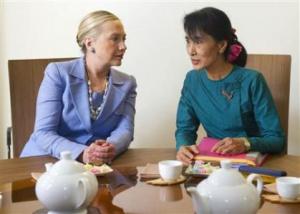
Reuters/Saul Loeb/Pool SOS HIllary CLinton and Aung San Suu Kyi
very friendly . Madam Secretary was told to keep her distance by the human rights activist and Nobel prize winner. The dog got a US chew toy according to Reuters corespondent Andrew Quinn. Clinton emphasized the importance of democracy on her last day of the visit and her hope that one day relations between the countries will normalize. More progress is needed from the Myanmar who has been run by a group of Generals for some time.
Clinton met President Thein Sein on Thursday and announced a package of modest steps to improve ties, including U.S. support for new International Monetary Fund and World Bank needs assessment missions and expanded U.N. aid programs for the country’s struggling economy.
She also said the United States would consider reinstating a full ambassador in Myanmar and could eventually ease crippling economic sanctions, but underscored that these future steps would depend on further measurable progress in Myanmar’s reform drive.“It has to be not theoretical or rhetorical. It has to be very real, on the ground, that can be evaluated. But we are open to that and we are going to pursue many different avenues to demonstrate our continuing support for this path of reform,” Clinton told a news conference on Thursday in the capital, Naypyitaw, before arriving in Yangon.
If you want a really wonky post on how bad it could get in the US and the world if the Eurozone doesn’t take care of it’s problems, you can read this analysis of UBS analysis at Zero Hedge.
Despite the very short term bounce in markets on yet another soon to be failed experiment in global liquidity pump priming, UBS’ Andrew Cates refuses to take his eyes of the ball which is namely preventing a European collapse by explaining precisely what the world would look like if a European collapse were allowed to occur. Which is why to people like Cates this week’s indeterminate intervention is the worst thing that could happen as it only provides a few days worth of symptomatic breathing room, even as the underlying causes get worse and worse. So, paradoxically, we have reached a point where the better things get (yesterday we showed just how “better” they get as soon as the market realized that the intervention half life has passed), the more the European banks will push to make things appear and be as bad as possible, as the last thing any bank in Europe can afford now is for the ECB to lose sight of the target which is that it has to print. Which explains today’s release of “How bad might it get“, posted a day after the Fed’s latest bail out: because instead of attempting to beguile the general public into a false sense of complacency, UBS found it key to take the threat warnings to the next level. Which in itself speaks volumes. What also speaks volumes is his conclusion: “Finally it is worth underscoring again that a Euro break-up scenario would generate much more macroeconomic pain for Europe and the world. It is a scenario that cannot be readily modelled. But it is now a tail risk that should be afforded a non-negligible probability. Steps toward fiscal union and a more proactive ECB, after all, will still not address the fundamental imbalances and competitiveness issues that bedevil the Euro zone. Nor will they tackle the inadequacy of structural growth drivers and the deep-seated demographic challenges that the region faces in the period ahead. Monetary initiatives designed to shore up confidence can give politicians more time to enact the necessary policies. But absent those policies and sooner or later intense instability will resume.”
I’ve been meaning to do a post explaining what the FED and the five other central banks did to prevent a credit market lock up for the past two days, but, see the first paragraph. I was reliant on my blackberry for internet access AND phone calls for two days so it didn’t happen. I’ll try to do it today if any one is interested. Basically, this could be another Lehman Brothers scenario because there are sings that interbank lending has slowed to a trickle. The extra push of world currencies is supposed to get banks around the world to lend again. If they don’t lend to each other, than the banks will scramble to cover their reserves and basically rescind and short term loans to corporations for things like inventory, working capital and payroll shortages. We’re technically not bailout out Europe and we’re trying to prevent another bailout of our usual suspect financial institutions with global exposure. This wouldn’t be as widespread as the mortgage meltdown since the exposure to that was country wide (no pun intended). The Fed can maneuver a lot here. What this could do is create some inflation which has pluses and minuses. They also are debasing the dollar which is good for exporters bad for importers and people that like to buy cheap foreign goods. Merkel and the Germans have gotten a little stiff on the plans again so the deal still isn’t made. They’re not keen on the idea of Eurobonds. Increased fiscal integration is slow tracked.
“I personally, and the whole government believes, that eurobonds are the wrong method — and even harmful — in this phase of European development,” Merkel told the General Anzeiger newspaper.
She also emphasised the independence of the European Central Bank and said it was up to the ECB to decide how to ensure currency stability.
I guess the nasty results of the German bond float last week didn’t really sink in afterall.
Okay, so this is incredibly long now and possibly way too depressing for a Friday. However, you can add the cheery bits down thread. What’s on your reading and blogging list today?
Open Thread: Hillary’s Historic Visit to Myanmar
Posted: December 1, 2011 Filed under: Hillary Clinton, Myanmar, open thread | Tags: Aung San Suu Kyi, Burma, Hillary Clinton, Myanmar, Nobel Prize, U. S. Secretary of State 24 Comments
Hillary arriving in Myanmar yesterday
Today’s Guardian UK reports on Hillary’s first in-person meeting with Nobel Prize winning activist Aung San Suu Kyi.
Aung San Suu Kyi, the Burmese pro-democracy campaigner and Nobel prize winner, had dinner with US secretary of state Hillary Clinton on Thursday night in a diplomatic residence in the port city of Rangoon.
The extraordinary meeting came at the end of Clinton’s first full day of her historic trip to the isolated south Asian state, the first by a top-ranking American official for more than 50 years.
[….]
Aung San Suu Kyi
Clinton’s trip comes after changes in Burma that have astonished many observers. Aung San Suu Kyi has been freed after more than 20 years of house arrest and prison, and tentative moves have been made to reduce censorship and create new laws permitting limited political demonstrations.
Last year saw parliamentary elections which, despite being rigged to give the pro-regime party a huge majority, were nonetheless welcomed by observers.
Though the military dominates most institutions and much of the economy, many senior figures believe Burma, currently under US and European Union sanctions, needs to reintegrate the international community, analysts say.

Here’s a video about the visit, uploaded to You Tube by Reuters early this morning:

 peej
peej Carissa
 bostonboomer
 dakinikat
 ecocatwoman
 mablue2
 Mama Lopez
 peggysue22
 quixote
 skydancingguestblogger
 Mona (aka Wonk the Vote)



 Sky Dancing
Recent Comments