
Monday Morning Reads
Posted: June 18, 2012 Filed under: Egypt, Foreign Affairs, Greece, Middle East, Mitt Romney, morning reads | Tags: Egyptian Elections, Greek Elections, Romney's vague economic policies 9 Comments Good Morning!
Elections happened in Egypt and Greece. Pro-Bailout Parties in Greece have taken the majority. The Muslim Brotherhood candidate is ahead in the run off for the presidency in Egypt.
Greece’s largest pro-bailout parties, New Democracy and Pasok, won enough seats to forge a parliamentary majority, official projections showed, easing concern the country was headed toward an imminent exit from the euro. The currency rose on the result.
The election would give New Democracy and Pasok 163 seats if they agree to govern together in the 300-member parliament, according to the official projection by the Interior Ministry in Athens based on 63 percent of today’s vote.
“For markets, a majority for an ND-Pasok coalition would be a relief,” Holger Schmieding, London-based chief economist at Berenberg Bank, said in a note today. “It would very much reduce the risk of a Greek euro exit.”
The vote forced Greeks, in a fifth year of recession, to choose open-ended austerity to stay in the euro or reject the terms of a bailout and risk the turmoil of exiting the 17-nation currency. The election threatened to dominate a summit of world leaders that starts tomorrow in Mexico.
Krugman’s Op Ed today has a nice, succinct explanation of the Greek situation.
Fifteen years ago Greece was no paradise, but it wasn’t in crisis either. Unemployment was high but not catastrophic, and the nation more or less paid its way on world markets, earning enough from exports, tourism, shipping and other sources to more or less pay for its imports.
Then Greece joined the euro, and a terrible thing happened: people started believing that it was a safe place to invest. Foreign money poured into Greece, some but not all of it financing government deficits; the economy boomed; inflation rose; and Greece became increasingly uncompetitive. To be sure, the Greeks squandered much if not most of the money that came flooding in, but then so did everyone else who got caught up in the euro bubble.
And then the bubble burst, at which point the fundamental flaws in the whole euro system became all too apparent.
Ask yourself, why does the dollar area — also known as the United States of America — more or less work, without the kind of severe regional crises now afflicting Europe? The answer is that we have a strong central government, and the activities of this government in effect provide automatic bailouts to states that get in trouble.
Consider, for example, what would be happening to Florida right now, in the aftermath of its huge housing bubble, if the state had to come up with the money for Social Security and Medicare out of its own suddenly reduced revenues. Luckily for Florida, Washington rather than Tallahassee is picking up the tab, which means that Florida is in effect receiving a bailout on a scale no European nation could dream of.
Egypt continues to see stand offs between the judiciary, military rulers, and the electorate. It appears that Egyptian elections may put a Muslim Brotherhood candidate into office just as the military rulers disbanded parliament due to a ruling by courts. Final election results are expected on Thursday.
In a final run-off election marked by relentless fear-mongering and negative campaigning on both sides of the contest, many polling stations remained near-empty for much of the two-day ballot – with potential voters seemingly put off by scorching temperatures, which reached 40C in the capital, and the increasingly oppressive political climate of military-led manipulation and national division that has gripped the country a year and a half after the start of its ongoing revolution.
As ballot counting began inside more than 13,000 schools nationwide, the Brotherhood’s Freedom and Justice Party insisted that its candidate, 60 year old engineer Mohamed Morsi, was on course for a clear victory unless state-sponsored electoral fraud dictated otherwise. But local media reports and anecdotal evidence suggested a far closer race, with millions turning out to back Ahmed Shafiq, Hosni Mubarak’s final prime minister and a polarising emblem of the old regime, in a last-ditch effort to prevent political Islamists from taking power.
Egypt continues on its course of political uncertainty.
The high court ruled that some provisions of the electoral law, which allowed political parties to compete with independent candidates for some seats, violated the constitution.
The ruling invalidated the 508-member People’s Assembly, chosen during a six-week election which began in November. It also voided the constitutional assembly which members of parliament agreed to last week and appointed on Tuesday.
SCAF said it will announce its own assembly next week.
The ruling was a blow to the entire transition process, but perhaps most of all to the Brotherhood, which controlled nearly half of the assembly.
Mohamed el-Beltagy, a senior FJP politician, called the rulings a “fully-fledged coup” on his Facebook page.
The Brotherhood issued a statement late on Thursday night warning that the court’s decision would undo the gains of the revolution and push Egypt into “dangerous days”.
The Economist has some interesting analysis on what might happen if the Roberts SCOTUS throws out portions of the Affordable Healthcare Act. You have to remember this is written in England where our health care system is considered something out of a dystopian science fiction horror novel.
Yet for all that, it is possible that the Supreme Court, by throwing a spanner into the works, may actually help Mr Obama as much as hurt him. For a start, the Republicans would suddenly find that they have a mess of their own making to sort out. If the Supreme Court does indeed strike down the Affordable Care Act, many popular provisions would fall with it: the one allowing parents to keep their children on their insurance policies until they are 26, for instance, and the abolition of lifetime ceilings on what the sick can claim. Both of those are already in force, and a ban on insurance companies refusing to insure the unwell is due to come in from 2014. Generous subsidies will help not just those who lack insurance, but also some of those who have it and find it hard to afford. And Mr Obama’s cost-control mechanisms, imperfect though they are, have a fiscally useful role to play in bringing down the costs of government-provided insurance for the poor and the elderly.
Even if only the “mandate” requiring everyone to buy health insurance is struck down as unconstitutional, the consequences of that could cause other parts of the bill to unravel, and would certainly lead to big increases in insurance premiums. One big insurance company has already said it would endeavour to keep some of the popular provisions intact: but it might not be able to. The Republicans have long said that they want to “repeal and replace” Obamacare, but they have been remarkably coy about what they would replace it with. If you break it, as Colin Powell remarked in another context, you own it.
So the danger to the Republicans of a backlash should not be discounted. And there is another, greater threat to them. Should Obamacare be struck down or crippled, the Roberts court will be seen by many as politically slanted. Arguably that has happened already, thanks to its recision of gun control in Washington, DC and Chicago in 2008 and 2010, and to its decision in 2010 to scrap limits on corporate (and trade-union) donations to political-action groups. And judgments on other highly political cases, on positive discrimination and on immigration, are expected before the election. Like the gun-control and campaign-finance rulings, these are likely to be “partisan” 5-4 decisions. A poll on June 7th found that 76% of people think that Supreme Court justices are sometimes swayed by their political or personal views, and that only 44% approve of the court’s performance. It used to be by far the most popular branch of government.
Romney just told us all not to worry our pretty little heads about his economics policy yesterday on Face The Nation. He doesn’t want to give us any specifics and we should just “trust him”. Does this sound like the guy you dated once in high school that didn’t think of much anything but getting a blow job from you or what?
Romney repeatedly refused to say whether he’d repeal Obama’s order to halt deportations of DREAM-eligible youth. He confirmed that he would not agree to even one dollar in new revenues in exchange for 10 dollars in spending cuts. And he again reiterated that his response to the crisis would be to cut government, in order to “ignite growth,” even though economists say that more austerity now would make the crisis worse.
But I wanted to flag this exchange in particular, in which Romney seemed to confirm that he will not be detailing how he would pay for his proposed tax cuts for the duration of the campaign:
SCHIEFFER: You haven’t been bashful about telling us yo want to cut taxes. When are you going to tell us where you’re going to get the revenue? Which of the deductions are you going to be willing to eliminate? Which of the tax credits are you going to — when are you going to be able to tell us that?
ROMNEY: Well, we’ll go through that process with Congress as to which of all the different deductions and the exemptions —
SCHIEFFER: But do you have an ideas now, like the home mortgage interest deduction, you know, the various ones?
ROMNEY: Well Simpson Bowles went though a process of saying how they would be able to reach a setting where they had actually under their proposal even more revenue, with lower rates. So, mathematically it’s been proved to be possible: We can have lower rates, as I propose, that creates more growth, and we can limit deductions and exemptions.
Romney went on to pledge, as he has in the past, that under his plan, the wealthy would continue to pay the same share of the tax burden as they do now. “I’m not looking to reduce the burden paid by the wealthiest,” he said. In other words, the disproportionally larger tax cut the wealthy would get from the across-the-board cut in rates he’s proposing would be offset by closing deductions and loopholes the rich currently enjoy. But asked twice by Schieffer how exactly he would do this, Romney refused to say, beyond noting that this has been mathematically proven to be possible. And in his first reply above, he confirmed that the details would be worked out with Congress when he is president — which is to say, not during the campaign.
As you may recall, Romney made big news when he was overheard at a private fundraiser revealing to donors a few of the specific ways he’d pay for his massive tax cuts. Since then, details have been in short supply. And today, Romney seemed to confirm that he sees no need to reveal those details until he becomes president.
You know. If we don’t give him what he wants his balls will turn blue and it will be all our fault.
What’s on your reading and blogging list today?
Thursday Reads: Sophia Loren, the Zombie Brain, the War on Women, and Much More
Posted: February 16, 2012 Filed under: Foreign Affairs, Greece, Human Rights, morning reads, U.S. Politics, Violence against women, War on Women, Women's Rights | Tags: Archbishop Timothy Dolan, Birth Control, Carlo Ponti, Cary Grant, contraception, eurozone crisis, fetus fetishists, Greek riots, lapsed Catholics, MEP Nigel Farage, Sophia Loren, state sanctioned rape, transvaginal ultrasound, Vanity Fair, zombie brains 45 Comments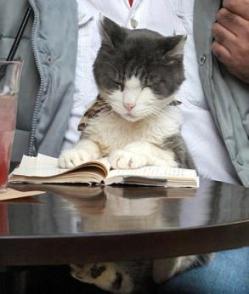
Good Morning!!
The news has been so depressing lately that I thought I’d at least start out with something nonpolitical. Last night I read a fascinating interview with Sophia Loren from the new Vanity Fair. Loren talked about her painful childhood:
Raised in Pozzuoli, a small town of fishermen and munitions workers outside of Naples, Sophia experienced some of the worst privations of the Second World War—terror, bombing, starvation. Born in a charity ward for unwed mothers in Rome on September 20, 1934, Sofia Scicolone was taunted throughout her childhood for being illegitimate. Her mother, Romilda Villani, was a proud beauty who returned to her family home in Pozzuoli to live down her shame; in Catholic Italy then, being an unwed mother was not just a scandal, but a sin. They moved in with Romilda’s parents, an aunt, and two uncles; Romilda soon had another child with Riccardo Scicolone, who still refused to marry her and who would not even give Sophia’s younger sister, Maria, his name. Now eight people shared their apartment. Until she left Pozzuoli, Sophia never slept in a bed with fewer than three family members.
By 1942 they were starving, living on rationed bread, hiding from the air raids at night in a dark, rat-infested train tunnel, full of “sickness, laughter, drunkenness, death, and childbirth,” as she described it in A. E. Hotchner’s 1979 authorized biography of her, Sophia, Living and Loving: Her Own Story. Romilda foraged for food for herself and her two daughters, but Sophia was so skinny her school-mates called her “Sofia Stuzzicadenti”—toothpick.
Romilda was so beautiful that people mistook her on the street for Greta Garbo. She was once offered a screen test in Hollywood, but her mother wouldn’t allow her to go to Hollywood. So she became a stage mother.

Sophia Loren in 1950
At 14, Sophia blossomed. “It was as if I had burst from an egg and was born,” she often likes to say. Suddenly, she started hearing wolf whistles when she walked down the street. Romilda entered Sophia in a beauty contest—Queen of the Sea and Her Twelve Princesses. They had no gown for her to wear, so Sophia’s grandmother pulled down one of the pink curtains in the living room—like Scarlett O’Hara in Gone with the Wind—and made an evening gown. Romilda took Sophia’s scuffed black shoes and applied two coats of white paint to them. When they showed up, Sophia was intimidated by the more than 200 contestants in their real gowns, jewels, and flowers, but when it came time to parade in front of the judges, she comported herself with serene dignity. She was chosen as one of the 12 princesses, winning $35, a ticket to Rome, and several rolls of wallpaper, which the family happily used to cover the cracks in the plaster of their apartment caused by the wartime bombing.
And the rest is history. Go read the article. It might make you feel more cheerful than the political news. I’ll leave it to you to read the part about Sophia and Cary Grant and why she turned down his marriage proposal to stay with her much older, shorter lover Carlo Ponti.
Next up is an article from last October that I just happened upon a couple of days ago. If you have a somewhat warped sense of human like I do, you’ll get a kick out of it: How to Survive a Zombie Attack
A fight-or-flight primer to outliving the urban undead. Hey, it might even help us deal with the Republican presidential candidates. My favorite part is the explanation of the zombie brain by two neuroscientists.
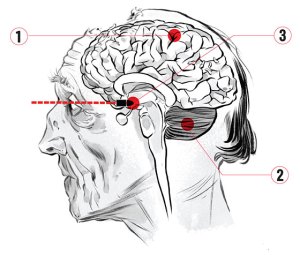
“Zombies have attention-locking problems. When they see something, they fixate. It resembles damage to the parietal lobe (1)—a condition called Bálint’s syndrome. So a zombie will fixate on you, but if you can distract it, it might lose track of you entirely. Zombies are stiff and have balance problems because of damage to the cerebellum (2). It’s the same way you feel when you’re really drunk—you’re suppressing the cerebellum too.” —Timothy Verstynen, Center for the Neural Basis of Cognition
“In a human, the brain stem, at the top of the spinal cord, is responsible for the core functions of life—respiration, heartbeat. But since zombies don’t breathe or have heartbeats, the core function of the zombie’s existence is controlled by the part of the brain that controls appetite: the hypothalamus (3). If you hit a zombie right between the eyes with enough force, you can go straight back horizontally into the hypothalamus.” —Bradley Voytek
Getting back to true life horror, Dakinikat sent me this article from The American Prospect by Sally Kohn. It’s about Archbishop Timothy Dolan of New York who is going be made a Cardinal soon–undoubtedly a reward for leading the war on American women. On the occasion of his promotion Dolan plans to give a speech about the need to attract lapsed Catholics back into the fold.
Thursday Reads: Power to the People!
Posted: November 3, 2011 Filed under: #Occupy and We are the 99 percent!, Foreign Affairs, France, Germany, Greece, Italy, morning reads, Spain, U.S. Economy, U.S. Politics, unemployment | Tags: Angela Merkel, austerity, democracy, Eurodammerung, George Papandreau, Greece, Nicolas Sarkozy, Oakland general strike, Paul Krugman, Robert Reich 40 Comments
Good Morning!! Over the past couple of days, I’ve become really fascinated with the situation in Greece. It’s a pretty fluid situation at the moment. On Tuesday Robert Reich wrote a pretty good primer on what is happening and expressed his view that letting the Greek people decide their own fate is the best idea. Here’s a bit of it:
Greek Prime Minister George Papandreou decided in favor of democracy yesterday when he announced a national referendum on the draconian budget cuts Europe and the IMF are demanding from Greece in return for bailing it out.
(Or, more accurately, the cuts Europe and the IMF are demanding for bailing out big European banks that have lent Greece lots of money and stand to lose big if Greece defaults on those loans – not to mention Wall Street banks that will also suffer because of their intertwined financial connections with European banks.)
If Greek voters accept the bailout terms, unemployment will rise even further in Greece, public services will be cut more than they have already, the Greek economy will contract, and the standard of living of most Greeks will deteriorate further.
If Greek voters reject the terms and the nation defaults, it will face far higher borrowing costs in the future. This may reduce the standard of living of most Greeks, too. But it doesn’t have to. Without the austerity measures the rest of Europe and the IMF are demanding, the Greek economy has a better chance of growing and more Greeks are likely to find jobs.
Shouldn’t Greek citizens make this decision for themselves?
Reich argues that it would have been better in the long run if the American people had been consulted about the bank bailouts here.
If Americans had been consulted about the 2008-2009 Wall Street bailout, I doubt it would have happened the way it did. At the very least, strict conditions would have been placed on the banks in return for the money. The banks would have had to eat the losses of the predatory mortgages they sold, and help homeowners reduce those mortgages. They’d be required to improve the capitalization of small banks in communities across the country. They’d be forced to accept stringent new regulations, including resurrection of Glass-Steagall
But we weren’t consulted. The wishes of the American people were considered irrelevant by the oligarchs who run this country. And the European oligarchs are hoping to prevent the Greek people from claiming a right to make a democratic decision.
Of course if the Greek people do decide to default on their debts, there will be serious consequences–for them and for the rest of Europe. Krugman calls it “Eurodämmerung.” He argues that
…the euro was an inherently flawed idea that can work only given a strong European economy and a significant degree of inflation, plus open-ended credit to sovereigns facing speculative attack. Yet European elites embraced the notion of economics as morality play, imposing across-the-board austerity, tightening money despite low underlying inflation, and have been too concerned with punishing sinners to notice that everything was going to blow apart without an effective lender of last resort.
The question I’m trying to answer right now is how the final act will be played. At this point I’d guess soaring rates on Italian debt leading to a gigantic bank run, both because of solvency fears about Italian banks given a default and because of fear that Italy will end up leaving the euro. This then leads to emergency bank closing, and once that happens, a decision to drop the euro and install the new lira. Next stop, France.
Yikes! But Fortune also says Italy and France are in trouble if Greece defaults. And Spain could go bust too.
What worries is that Spain and Italy are not in the Greek situation but they could be. Greece is bust and Spain and Italy could be driven bust. They both have a lot of debt and each year some of that debt has to be repaid. Now governments almost never do repay debt, they just borrow some more and use the new money to pay off the old. Bit like swirling what you owe around a few credit cards.
Which is just fine: except, if interest rates rise then they have to pay more interest on this new debt that they’re issuing to pay off the old. And if interest rates rise enough then they do go bust, as the interest payments they have to make take too much money out of the budget. Switching money around on zero interest introductory rate cards is very different from doing it when you’re being charged 30%.
Now, the general agreement is that when the interest rates are above 6% then Italy and Spain are in danger of going bust. When they’re over 7% they will do so. But of course, when people see that Italian interest rates are above 6% then they become more wary of lending Italy any more money and so interest rates keep on rising to possibly above 7% and game over.
It’s still not clear what Greece is going do in their referendum. Dakinikat says they need to ask the people if they want to leave the European Union or not. German Chancellor Angela Merkel and French President Nicolas Sarkozy have said that the referendum must ask the Greek people if they want to opt out of the Euro, but not the EU itself. Meanwhile, the offer of a bailout of Greece has been called off until after the vote on the referendum is taken. From Naked Capitalism:
The Eurocrats have decided to try to push Greece into line, threatening expulsion from the Euro (note, not the EU) if Greece does not back down. From a practical matter, if the Greeks were to turn down the bailout package, it would lead to a banking crisis, making a Eurozone exit a not that much more traumatic incremental move with considerable upside. And under the Maastrict treaty, Greece cannot unilaterally exit (although as various commentors have pointed out, Nato is not going to send in tanks if the Greeks were to do so).
But this may be an appeal to the Greek public, or more likely, an effort to break Greek prime minister’s Papandreou’s thin coalition on the eve of a vote of no confidence.
So that’s another possibility–that Papandreau’s government might fall. More on the European reaction from Bloomberg:
Led by Germany and France, Europe’s economic and political anchors, the euro’s guardians yesterday cut off financial aid for Greece until a vote they said would be on Dec. 4 or Dec. 5 determines whether it deserves a fresh batch of loans needed to stave off default.
“The referendum will revolve around nothing less than the question: does Greece want to stay in the euro, yes or no?” German Chancellor Angela Merkel told reporters after crisis talks hours before a Group of 20 summit set to begin today in Cannes, France. French President Nicolas Sarkozy said Prime Minister George Papandreou’s government won’t get a “single cent” of assistance if voters rejects the plan.
The hardball tactics open the door for a nation to leave the currency bloc that at its setup in 1999 capped Europe’s progression from war to prosperity and was declared “irrevocable” by its founding fathers. Polls show most Greeks object to the austerity required for aid, yet more than seven in 10 favor remaining in the euro, a survey last week of 1,009 people published in To Vima newspaper showed.
They’re going to have to decide between two awful choices, and the rest of Europe will have to deal with the results of the vote–if there is a default, failures of banks that hold Greek debt and getting Italian, French, and German taxpayers to pay for more bank bailouts–unless Papandreau’s government falls. Read the whole article at Bloomberg to get a sense of how serious all this is.
In U.S. news, Occupy Oakland called for a general strike today. That situation is still fluid as of this writing, 11PM Eastern on Wednesday night.
OAKLAND – Protesters blocked streets near City Hall, smashed windows at a bank and gathered by the thousands in an attempt to shut down the nation’s fifth-busiest port Wednesday.
The Occupy Oakland protest was the largest in a series of rallies in several cities as the Occupy Wall Street movement that began Sept. 17 tried to grab national attention.
A group of about 300 protesters, many of them men wearing black, some covering their faces with bandanas and some carrying wooden sticks, smashed windows of a Wells Fargo bank branch while chanting “Banks got bailed out. We got sold out.”
Are you getting the feeling this genie can’t be put back in the bottle either? The Occupy demonstrations have shown us that we pretty much live in a police state at this point. There very little respect for the protesters’ constitutional rights by local governments or law enforcement. From Counterpunch, here is a report of what actually happened when police attacked protesters in Oakland on Oct. 25.
In a heavily armed pre-dawn raid, on Tuesday, Oct. 25, with back up from armored vehicles and helicopters, the Oakland Police Department in conjunction, with over 15 other police departments from Northern and Central California, stormed the sleepy Occupy Oakland Encampment.
Asleep inside tents of the makeshift Occupy encampment, were over a hundred men, women and very young children. The heavily armed police force, dressed in black ninja-like outfits, and special forces helmets, with full face-shields down, and armed with and assortment of latest riot gear, fired tear gas canisters and concussion grenades into the camp, as helicopters circled above.
Police then attacked and ransacked the entire encampment. In a short time, the camps library, soup kitchen, and children’s center were left in ruins, and over a hundred of the inhabitants were roughed up, arrested and held on high bail. The activists suffered many injuries, including broken bones.
Please read the whole thing–it’s an eyewitness account of a horrifying paramilitary action by police. As everyone knows, Iraq war veteran Scott Olson was critically injured in the melee.
Late last night as part of the general strike, Oakland protesters succeeded in shutting down the Port of Oakland.
Several thousand Occupy Wall Street demonstrators forced a halt to operations at the United States’ fifth busiest port Wednesday evening, escalating a movement whose tactics had largely been limited to rallies and tent camps since it began in September.
Police estimated that a crowd of about 3,000 had gathered at the Port of Oakland by early evening. Some had marched from the California city’s downtown, while others had been bused to the port.
Port spokesman Isaac Kos-Read said maritime operations had effectively been shut down. Interim Oakland police chief Howard Jordan warned that protesters who went inside the port’s gates would be committing a federal offense.
In New York, Los Angeles and other cities where the movement against economic inequality has spread, demonstrators planned rallies in solidarity with the Oakland protesters, who called for Wednesday’s “general strike” after an Iraq War veteran was injured in clashes with police last week.
Organizers of the march said they want to stop the “flow of capital.” The port sends goods primarily to Asia, including wine as well as rice, fruits and nuts, and handles imported electronics, apparel and manufacturing equipment, mostly from Asia, as well as cars and parts from Toyota, Honda, Nissan and Hyundai.
We knew there would eventually be civil unrest, and now we’re seeing it all over the world and here at home. What next? I’d say 2012 is going to be an eventful year.
With that, I’m going to wrap this up. I know there’s lots of other news, but these two stories–Greece and the general strike in Oakland–seem to me to symbolize what’s happening in the world today. People are sick and tired of being bilked by the super-rich, and ignored by the politicians. It’s so chaotic, yet I feel that the only hope we have is for the people to keep resisting as best they can. For so long, I was afraid nothing would wake American up, but I’m finally getting the feeling that we won’t go down without a fight. Let’s keep the elites nervous!
Sooooo… what are you reading and blogging about today?
Independence Day Reads
Posted: July 4, 2011 Filed under: Bailout Blues, Domestic Policy, Economy, Foreign Affairs, Global Financial Crisis, Greece, investment banking, morning reads | Tags: Bill Clinton, Budget Deficit, debt limit, Fukushima, Greek Debt Crisis, John McCain, nuclear crisis, shadow banking industry, SIVs, taxes 16 Comments Happy Independence Day!
We have a republic and a lot of people have sacrificed a lot over the last several centuries to keep it. Too bad most of our politicians aren’t in that number. They can’t see past their next elections.
It seems that two senators– McCain and Corynyn–say they’re open to tax increases as a way to solve the budget stand off. Guess there are a few of them left that would prefer not to tank our economy. Let’s hope this starts some real negotiations instead of the usual Republican hostage taking and Democratic cave-in that’s been politics as usual the last dozen years or so.
One of the senators, John Cornyn of Texas, said he would consider eliminating some tax breaks and corporate subsidies in the context of changes in the tax code, provided there was not an overall increase in taxes.
“I think it’s clear that the Republicans are opposed to any tax hikes, particularly during a fragile economic recovery,” Mr. Cornyn said on “Fox News Sunday.” “Now, do we believe tax reform is necessary? I would say absolutely.”
But he insisted that any changes in taxes be “revenue neutral,” meaning that the government would not take in any more money from individuals or businesses than it does now.
The other senator, John McCain of Arizona, said he would be willing to consider some “revenue raisers” as part of a broad deal, but he refused to name specific measures.
Mr. Cornyn, a member of the Senate leadership, also said that Republicans would be open to a short-term deal on the debt ceiling to provide more time for a comprehensive agreement.
Let’s also hope that more reasonable and less ideological heads prevail on the right and that the left stands up for what’s right for a change. Former President Clinton had a words of policy advice over the weekend. His advice to President Obama is “not to blink”.
Former President Bill Clinton Saturday night urged President Obama not to “blink” at Republican demands to exclude revenue increases from any agreement to extend the government’s debt ceiling.
If Republicans maintain their opposition to revenue increases, Clinton said, Obama should pursue a short-term deal to extend the debt ceiling based on spending cuts both sides have already accepted in the negotiations between the administration and Congressional leaders from both parties.
“I hope they will make a mini-deal,” Clinton said in an interview conducted with him at the Aspen Ideas Festival here.
The White House and Congressional negotiators from both parties are attempting to assemble a deficit reduction package that could win support in Congress for legislation to extend the nation’s debt ceiling, which the Treasury says the government will reach on August 2. The talks have foundered amid demands from Congressional Republicans to exclude any revenue increases from that prospective deficit reduction package.
Asked what the administration could do if GOP leaders hold to that posture, Clinton replied: “First the White House could blink. I hope that won’t happen. I don’t think they should blink.”
If Republicans will not accept revenues in a package to lift the debt ceiling by August 2, Clinton said, Obama should pursue a short-term agreement based on the spending reductions both sides have already accepted.
“There are some spending cuts they agree on …and he can take those and [get] an extension of the debt ceiling for six or eight months,” Clinton said.
Clinton also called on a package of reforms to US tax policy that includes a corporate tax cut if special interest tax loops are closed. This is something Obama has also supported.
“It made sense when I did it. It doesn’t make sense anymore – we’ve got an uncompetitive rate. We tax at 35 percent of income, although we only take about 23 percent. So, we SHOULD cut the rate to 25 percent, or whatever’s competitive, and eliminate a lot of the deductions so that we still get a FAIR amount, and there’s not so much variance in what the corporations pay. But how can they do that by Aug. 2?”
Clinton also said Grover Norquist, who as president of Americans for Tax Reform is the GOP’s unofficial enforcer of no-new-taxes pledges, has a “chilling” hold on the nation’s lawmaking.
The former president said it has seemed like Republicans need any revenue concessions need to be “approved in advance by Grover Norquist.”
“You’re laughing,” he told the crowd of 800. “But he was quoted in the paper the other day saying he gave Republican senators PERMISSION … on getting rid of the ethanol subsidies. I thought, ‘My GOD, what has this country come to when one person has to give you permission to do what’s best for the country.’ It was chilling.
There’s an extremely interesting piece at The Atlantic Wire on “What Really Happened at Fukushima”. It includes interviews with workers that have been inside the crippled nuclear plant.
Throughout the months of lies and misinformation, one story has stuck: “The earthquake knocked out the plant’s electric power, halting cooling to its reactors,” as the government spokesman Yukio Edano said at a March 15 press conference in Tokyo. The story, which has been repeated again and again, boils down to this: “after the earthquake, the tsunami – a unique, unforeseeable [the Japanese word is soteigai] event – then washed out the plant’s back-up generators, shutting down all cooling and starting the chain of events that would cause the world’s first triple meltdown to occur.”
But what if recirculation pipes and cooling pipes, burst, snapped, leaked, and broke completely after the earthquake — long before the tidal wave reached the facilities, long before the electricity went out? This would surprise few people familiar with the 40-year-old Unit 1, the grandfather of the nuclear reactors still operating in Japan.
The authors have spoken to several workers at the plant who recite the same story: Serious damage to piping and at least one of the reactors before the tsunami hit. All have requested anonymity because they are still working at the plant or are connected with TEPCO. One worker, a 27-year-old maintenance engineer who was at the Fukushima complex on March 11, recalls hissing and leaking pipes. “I personally saw pipes that came apart and I assume that there were many more that had been broken throughout the plant. There’s no doubt that the earthquake did a lot of damage inside the plant,” he said. “There were definitely leaking pipes, but we don’t know which pipes – that has to be investigated. I also saw that part of the wall of the turbine building for Unit 1 had come away. That crack might have affected the reactor.”
The reactor walls of the reactor are quite fragile, he notes. “If the walls are too rigid, they can crack under the slightest pressure from inside so they have to be breakable because if the pressure is kept inside and there is a buildup of pressure, it can damage the equipment inside the walls so it needs to be allowed to escape. It’s designed to give during a crisis, if not it could be worse – that might be shocking to others, but to us it’s common sense.”
Here’s some frightening news on the disaster in Japan. Radioactive Cesium has been found in Tokyo’s water supply.
Radioactive cesium-137 was found in Tokyo’s tap water for the first time since April as Japan grapples with the worst nuclear disaster in 25 years.
Cesium-137 concentration registered at 0.14 becquerels per kilogram in the city’s Shinjuku ward on July 2, compared with 0.21 becquerels on April 22, according to the Tokyo Metropolitan Institute of Public Health. No cesium-134 or iodine-131 was detected, the agency said on its website.
The Nuclear Safety Commission of Japan sets a safety limit of 200 becquerels per kilogram for cesium-134 and cesium-137. The limit for iodine-131 consumption is 300 becquerels per kilogram.
Japan is battling radiation leaks into the air, soil and water after an earthquake and tsunami on March 11 knocked out cooling systems at Tokyo Electric Power Co.’s Fukushima Dai- Ichi nuclear station, resulting in the meltdown of three of the six reactors at the plant.
The UK Guardian lists an interesting set of Greek public assets for sale. Many have no buyers. Bobby Jindal is putting up a lot of Louisiana assets for sale too. I wonder if this is going to be the new way to raise money. The Kochs already rent a big chunk of Yellowstone. Let’s hope we don’t have to put our national treasures on the chopping block.
Up for sale are 39 airports, 850 ports, railways, motorways, sewage works, a couple of energy companies, banks, defence groups, thousands of acres of land for development, casinos and Greece’s national lottery. George Christodoulakis, Greece’s special secretary for asset restructuring and privatisations, said the sell-off would raise €50bn (£44bn) to help pay back the country’s €110bn bailout debt.
The private equity bosses gathered in the hotel’s ballroom for the parade of Greece’s national treasures showed little interest in buying anything.
Nikos Stathopoulous, managing partner of BC Partners, which has invested more than €3.5bn in Greece, said investors are put off by bureaucracy, strong unions, corruption and a lack of transparency. “Even in the good times Greece is not a country that attracts investment. Foreign investors don’t want to invest in a country where there is no flexibility in hiring and firing people,” he said. “You don’t want to invest in a country in which you wake up and a new law has been passed which totally undermines and destroys the value of the investment you’ve just made.”
Stathopoulous said investors were finding it very hard to assess the risk of investing into Greece, which means assets “will be priced at lower than they are worth, lower than the Greek government, and even the European Union, expects”.
Here’s a compelling argument for getting the shadow banking sector into a more regulated, transparent, and standardized order. It’s written by Henry Tabe who is a Founding Partner of Sequoia Investment Management Company Ltd. It particularly addresses the use of the Structured Investment Vehicle (SIV). Complex, nonstandard, and unregulated markets make pricing assets difficult and introduce unnecessary risk and volatility.
Risk management requires identification, measurement, aggregation, and effective management of risks. It should help businesses allocate sufficient capital for survival and growth. The SIV’s extinction highlights risk management failures by the vehicles, their sponsors, rating agencies, policymakers, and regulators.
Financial regulators permitted bank, insurance company, pension, and hedge-fund sponsors to establish SIV “mini-banks” without ensuring that they maintain sufficient capital or back-stop liquidity in the event of a run. Policymakers also seemed unaware of the knock-on effects of the SIV’s demise on the securitisation and global credit markets. The Financial Security Authority’s call for regulators to incorporate sectoral analytical capabilities in their micro-prudential policies should help close the knowledge gap and ensure that timely solutions can be implemented to avert collapses that engender significantly more stress on the financial system (FSA 2009).
Lessons learned include the tightening of regulation governing the sponsorship of off-balance-sheet structures and the sizing of their capital and liquidity needs. These require that regulators adopt a more proactive, dampening role in the wild swings from exuberance to despair that are so characteristic of the financial markets. Discussions around contingent capital and similar products suggest regulators have embraced that dampening role and moved away from the prevailing pre-crisis philosophy of minimal regulation.
Lessons learned also include closer supervision of shadow banks, more skin-in-the-game for their sponsors, in-house retention of risk-analytics capabilities by investors, and less reliance on credit-rating agencies. The agencies themselves are more tightly supervised in order to reduce ratings shopping by issuers and inherent conflicts of interest in the business model (CESR 2009). Tighter regulation will also help to ensure that the agencies improve the monitoring of analyst performance, qualifications, and experience (Dodd-Frank 2010).
These measures should help restore confidence in rating agencies and the global financial system, an outcome more urgently required given on-going turmoil in the sovereign debt market.
So, there’s some wonky goodness to keep you entertained if you’re inside today. Be sure to let us know what you’re reading and blogging! Hope your Fourth of July is a happy one!
Thursday Reads: Fallen Idols, President Pushover, Worsening Weather, Rogue Federal Agency, and More
Posted: June 30, 2011 Filed under: Barack Obama, Democratic Politics, Economy, Federal Budget and Budget deficit, Foreign Affairs, Greece, morning reads | Tags: Bert Adams, Chris Hansen, Climate change, Commerce Department, Federal debt limit, Federal Deficit, feminism, fishing industry, Greek protests, Japan earthquake, Jimmy Carter, John Lennon, Michele Bachmann, National Enquirer, NOAA, Ronald Reagan, sandcastles, Twitter, weather 19 Comments
Good Morning!! I’ve got a variety of interesting reads for you today, so let’s get right to it. Imagine the guy who wrote these words:
“Imagine no possessions, I wonder if you can. No need for greed or hunger, a brotherhood of man. Imagine all the people, sharing all the world.”
Now imagine that he admired Ronald Reagan.
John Lennon, the long-haired British peacenik who was investigated by the FBI in 1972 after he allegedly contributed $75,000 to a group suspected of planning to disrupt the Republican National Convention later was a closet conservative….Fred Seaman, who was Lennon’s personal assistant from 1979 until the singer’s assassination in 1980, claims the former Beatle and anti-war activist favored Ronald Reagan over Jimmy Carter and would have voted for the Gipper if he could have.
“John, basically, made it very clear that if he were an American he would vote for Reagan because he was really sour on Jimmy Carter,” Seaman told Seth Swirsky, who is making a film about the Fab Four.
Seaman said the guitarist “met Reagan back, I think, in the ’70s at some sporting event.”
“Reagan was the guy who had ordered the National Guard, I believe, to go after the young [peace] demonstrators in Berkeley, so I think that John maybe forgot about that,” Seaman told Swirsky in excerpts published in the Toronto Sun. “He did express support for Reagan, which shocked me.”
I don’t even know how to respond to this stunning news. Lennon was apparently a Reagan Democrat. If he’d lived he probably would have been an Obot too….
NYT: Violent Clashes in the Streets of Athens
Confrontations between the police and protesters reached a violent climax here on Wednesday as armored riot officers beat back demonstrators and fired volleys of tear gas into the crowds who had gathered outside Parliament. Inside, lawmakers approved a package of austerity measures aimed at helping Greece avoid a default.
On the second day of a two-day general strike called by unions, rogue protesters also attacked the Finance Ministry on Syntagma Square across from Parliament and set fire to a post office in the ground floor of the building. The King George Palace, a luxury hotel that faces the square, was evacuated in the afternoon.
A police spokeswoman said that 31 police officers were injured and that 30 people had been detained, leading to 11 arrests. Local news media reported that dozens of protesters were hospitalized, and video clips showed the police striking people with their batons.
Amnesty International released a statement on Wednesday condemning the “repeated use of excessive force by police in recent demonstrations, including the disproportionate and indiscriminate use of tear gas and other chemicals against largely peaceful protesters.”
Is this what’s coming for the U.S.? At a press conference today President Obama warned Republicans to wake up and smell the tax increases (aside: I’m not holding my breath for Obama to follow through).
President Obama pressured Republicans on Wednesday to accept higher taxes as part of any plan to pare down the federal deficit, bluntly telling lawmakers that they “need to do their job” and strike a deal before the United States risks defaulting on its debt.
Declaring that an agreement is not possible without painful steps on both sides, Mr. Obama said that his party had already accepted the need for substantial spending cuts in programs it had long championed, and that Republicans must agree to end tax breaks for oil and gas companies, hedge funds and other corporate interests.
In a 67-minute news conference, Mr. Obama cast the budget battle as a tug of war between the interests of the rich — like owners of corporate jets, who he said get generous tax breaks — and those of the middle class, the elderly and children.
But Obama himself offered at best very weak tea:
Mr. Obama, under assault from Republicans on the campaign trail for an unemployment rate that remains above 9 percent, asked voters to understand that the economic recovery would take time but said that Washington, even in its current financial straits, could still do more to help. He expressed support for extending a reduction in payroll taxes for an extra year, providing loans for road and bridge-building and approving trade pacts that could help spur exports.
Big whoop. Why didn’t he fight to end the Bush tax cuts then?
Ezra Klein explains “How you know the negotiations have truly failed.”
The best advice I’ve gotten for assessing the debt-ceiling negotiations was to “watch for the day when the White House goes public.” As long as the Obama administration was refusing to attack Republicans publicly, my source said, they believed they could cut a deal. And that held true. They were quiet when the negotiations were going on. They were restrained after Eric Cantor and Jon Kyl walked out last week. Press Secretary Jay Carney simply said, “We are confident that we can continue to seek common ground and that we will achieve a balanced approach to deficit reduction.” But today they went public. The negotiations have failed.
“The primary goal of President Obama’s presser, which just wrapped up, was obvious,” writes Greg Sargent. “He was clearly out to pick a major public fight with Republicans over tax cuts for the rich.” That’s exactly right. But he didn’t want this fight. He wanted a deal. And he wasn’t able to get one that the White House considered even minimally acceptable. After putting more than $2 trillion of spending cuts on the table, they weren’t even able to get $400 billion — about a sixth of the total — in tax increases.
The conventional wisdom is that now this fight moves to the people. I’d put it differently. Now this fight moves to the consequences. Neither side is going to give in the face of purely rhetorical salvos. The White House is expecting Republicans to accuse them of wanting to raise taxes. The Republicans are expecting the White House to accuse them of putting the interests of large corporations and wealthy donors in front of the needs of seniors, children and the poor. Both parties have seen the poll numbers behind their positions. If a few news conferences were going to be sufficient to end this, it would never have started.
Climate experts warn that “epic weather” will continue because of climate change
Epic floods, massive wildfires, drought and the deadliest tornado season in 60 years are ravaging the United States, with scientists warning that climate change will bring even more extreme weather.
The human and economic toll over just the past few months has been staggering: hundreds of people have died, and thousands of homes and millions of acres have been lost at a cost estimated at more than $20 billion.
And the United States has not even entered peak hurricane season.
“This spring was one of the most extreme springs that we’ve seen in the last century since we’ve had good records,” said Deke Arndt, chief of climate monitoring for the National Oceanic and Atmospheric Administration (NOAA).
While it’s not possible to tie a specific weather event or pattern to climate change, Arndt said this spring’s extreme weather is in line with what is forecast for the future.
The Boston Globe reveals that fishermen in Gloucester, MA and up and down the Atlantic coast were the victims of abuse of power by NOAA.
About a decade ago, the Commerce Department’s fish police started a fight with Larry Ciulla, who owns and operates the Gloucester Seafood Display Auction with three other family members. Claiming that the auction had exceeded the day’s catch limit by one 60-pound fish, the regulators levied a $120,000 fine and ordered a 90-day shutdown.
Outraged, Ciulla challenged the penalty. He turned to Gloucester lawyer Ann-Margaret Ferrante, who is now a state representative and whose grandfather, father, and uncle were fishermen. Together, they decided to take on the agency known as the National Oceanic and Atmospheric Administration. In need of political backup, they went to US Representative John Tierney, whose district covers Gloucester. Eventually, their grass-roots effort drew in the mayors of Gloucester and New Bedford, the Bay State congressional delegation, and a bipartisan string of lawmakers from Maine to the Carolinas.
This year, federal officials finally acknowledged their own regulators had gone rogue. They were guilty of overzealous, abusive, and targeted enforcement, a series of independent investigations revealed. Regulators were levying crippling fines for invented or inflated offenses, as they relentlessly bullied an entire industry. They were using the fishermen’s money to finance a fleet of cars, a luxury boat, and assorted foreign junkets.
Please read the whole sordid story.
Twitter has released fascinating data on the number of tweets and direct messages during and after the Japan earthquake.
“On Twitter, we saw a 500% increase in Tweets from Japan as people reached out to friends, family and loved ones in the moments after the March 2011 earthquake,” said the company on its blog.
Kirstin Powers interviewed Michele Bachmann, and learned that the Tea Party queen is no feminist.
Unlike Sarah Palin, who has brandished the feminist moniker and spoken of an “emerging conservative feminist identity,” Bachmann told me in an interview Tuesday that she wouldn’t call herself a feminist—instead, she simply described herself as “pro-woman and pro-man.” When I pressed her on the matter, the Minnesota congresswoman said she sees herself as an “empowered American.”
Bachmann seemed loath to engage in the kind of girl-power rhetoric utilized by Palin and Hillary Clinton, who both invoked the perennial—and so far unbreakable—presidential glass ceiling.
Said Bachmann: “I’m a woman comfortable in her own skin. I grew up with three brothers. My parents didn’t see us [as] limited [by gender]. I would mow the lawn and take out the trash; I was making my own fishing lures. I went along with everything the boys did.”
Bachmann is still doing everything the boys do, but as a female candidate she endures indignities that are foreign to your average male pol. Yet she takes it all in stride.
Don’t you just love it when smarmy, self-righteous people are brought low? I know I do. Despite the fact that I loathe pedophiles, I’ve always been turned off by Chris Hansen and his obnoxious TV show “To Catch a Predator.” Now Hansen himself has been caught on “candid camera.”
Chris Hansen has found himself on the receiving end of his own hidden camera tactics, after the married NBC anchor was secretly filmed on an illicit date with a blonde television reporter 20 years his junior.
Hansen, 51, has allegedly been having an affair with Kristyn Caddell, a 30-year-old Florida journalist, for the last four months.
ROFLOL!
Secret cameras filmed the couple as they arrived at the hotel for dinner and then drove back to her apartment – where the pair left, carrying luggage, at 8am the following day.
Hansen lives in Connecticut with his wife Mary, 53, but he has been spending more and more time in South Florida investigating the disappearance of James ‘Jimmy T’ Trindade – and allegedly sleeping with Miss Caddell.
The cameras belonged to The National Enquirer. Fortunately for Hansen, Miss Caddell is slightly beyond the age of consent.
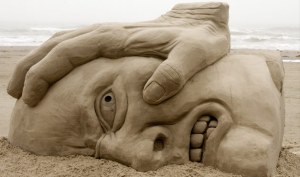
"Agony," by Bert Adams
Finally, here’s a nice summery story to get you ready for the upcoming long weekend: Work’s a Day at the Beach for Sand-Castle Consultants
CANNON BEACH, Ore.—On a recent weekend, sand creatures were sprawled across this Pacific Coast beach. There were sea horses by a giant squid, with an “Attackin’ Kraken” sea monster nearby, along with several pigs, some giant mice and an amputee octopus.
Many of the sand sculptures had the same point of origin: They had been built by people who at one time or another were advised by Bert Adams, one of the nation’s handful of professional sand-castle consultants.
“They did well,” said Mr. Adams, a 51-year-old former electrical engineer, as he surveyed the array of creations made by his onetime students at Cannon Beach’s 47th annual sand sculpting tournament.
“He’s a great mentor,” says Amos Callender, an Olympia, Wash., architect who took a course—Sand 101—that Mr. Adams taught two years ago. Mr. Callender and his team took first place at Cannon Beach last year, while this year they built a sand sculpture depicting “the good life”—a wine lover sporting a beret; a mouse tucking into a giant wheel of cheese—that finished second.
What a great idea. Now if only I could find a niche that would pay me big bucks for something I love doing!
So what are you reading and blogging about today? Hit me with it!

 peej
peej Carissa
 bostonboomer
 dakinikat
 ecocatwoman
 mablue2
 Mama Lopez
 peggysue22
 quixote
 skydancingguestblogger
 Mona (aka Wonk the Vote)



 Sky Dancing
Recent Comments