
Saturday News Potpourri
Posted: January 25, 2014 Filed under: Civil Rights, Egypt, Foreign Affairs, morning reads, Russia, U.S. Politics | Tags: apps, artisanal toast, banks, Booz Allen Hamilton, Brian Glyn Williams, Chechnya, China, Dagestan, discrimination, diva test, Don Graham, Dr. Strangelove, Dzhokhar Tsarnaev, Edward Snowden, Eric Holder, Erik Prince, glamour shots of elderly people, guns, Jeff Bezos, Marijuana, Pink, Sochi Olympics, Trove, Ukraine protests, Volograd bombings, vote id laws, voting rights, Washington Post 53 Comments
Good Morning!!
I have quite a few articles to share this morning, a real Saturday potpourri! So let’s get started. First up, on Thursday Attorney General Eric Holder gave a wide-ranging interview to Ari Melber of MSNBC, and quite a bit of breaking news came out of it. Here are some of the resulting headlines: NY Daily News: Eric Holder: Could talk deal with NSA-leaker Edward Snowden, but no clemency
Holder told MSNBC that the Obama Administration “would engage in a conversation” about a resolution in the case, but said it would require Snowden acknowledge wrongdoing…. At a University of Virginia forum, where Holder was asked about Snowden, he elaborated on his position, saying, “If Mr. Snowden wanted to come back to the United States and enter a plea, we would engage with his lawyers. We would do the same with any defendant who wanted to enter a plea of guilty, so that is the context to what I said.” But he stressed that the NSA leaker would not walk. “We’ve always indicated that the notion of clemency isn’t something that we were willing to consider.”

Seattle PI: Holder: Marijuana banking regulations on the way
Attorney General Eric Holder says the Obama administration is planning to roll out regulations soon that would allow banks to do business with legal marijuana sellers. During an appearance Thursday at the University of Virginia, Holder said it is important from a law enforcement perspective to enable places that sell marijuana to have access to the banking system so they don’t have large amounts of cash lying around. Currently, processing money from marijuana sales puts federally insured banks at risk of drug racketeering charges. Because of the threat of criminal prosecution, financial institutions often refuse to let marijuana-related businesses open accounts.
There’s a good piece about this at Forbes, but they won’t even let you copy their headlines anymore. Mediaite: Eric Holder: Voter ID Used to ‘Depress the Vote’ of People Who Don’t Support GOP
Attorney General Eric Holder sharply criticized state-level voter identification policies and said that he believes those policies are a “remedy in search of a problem.” He added that, while some may be arguing for voter ID in good faith, he believes that most are advocating for this policy in order to “depress the vote” of those who do not support the “party that is advancing” voter ID measures. “I think many are using it for partisan advantage,” Holder said of voter ID. “People have to understand that we are not opposed to photo identification in a vacuum,” he continued. “But when it is used in — certain ways to disenfranchise particular groups of people, whether by racial designation, ethnic origin, or for partisan reasons, that from my perspective is problematic.” He added that “all the studies” show that in-person voter fraud “simply does not exist” at a level that requires a legislative solution.
Politico: Eric Holder: Timing of Robert Gates book release ‘a mistake’
Attorney General Eric Holder waded into the controversy over former Defense Secretary Robert Gates’s new book Thursday, calling it “a mistake” for Gates to have published his recollections before President Barack Obama left the White House. “It’s my view that it’s just not a good thing thing to write a book about a president that you served while that president is still in office,” Holder said during an appearance at the University of Virginia’s Miller Center. “From my perspective I think the world of Bob Gates, but I think that the publication of that book — at least at this time — was a mistake.” [….] In the course of offering his critique of the timing of Gates’s book, “Duty: Memoirs of a Secretary at War,” Holder twice praised the former defense secretary for his leadership. “I like Bob Gates a great deal. He was a good secretary of defense,” the attorney general said.
LA Times: Holder says no bank ‘too big to indict,’ more financial cases coming
“I think people just need to be a little patient,” Holder said, according to a transcript of an interview with MSNBC to air at noon Pacific time Friday. “I know it’s been a while. But we have other things that are in the pipeline.” [….] Holder has taken heat for telling a Senate hearing last year that some financial institutions were “so large that it becomes difficult to prosecute them” because criminal charges could hurt the U.S. and even world economies. Since then Holder has tried to emphasize that the Justice Department is not intimidated by the size of a financial institution and would bring any charges it believed it could prove.
As I said, quite a bit of news out of one interview. Good job by Ari Melber.
In other news . . .
The Economist has a brief article that provides some background on the situation in Ukraine: On the march in Kiev –The protests turn nasty and violent, but the president is not giving ground. 
JANUARY 22nd was meant to mark Ukraine’s unity day, a celebration of its short-lived pre-Soviet independence. Instead, it was a day of civil unrest and perhaps the biggest test of Ukraine’s post-Soviet integrity. After two months of largely peaceful encampment on the Maidan in Kiev, the protests turned violent. Five people were reported killed and hundreds were injured. An armoured personnel carrier pushed through the streets. Clouds of black smoke and flames mottled the snow-covered ground. Never in its history as an independent state has Ukraine witnessed such violence. It was triggered by the passage of a series of repressive laws imposing tight controls on the media and criminalising the protests of the past two months. One law copied almost verbatim a Russian example, including stigmatising charities and human-rights groups financed from abroad as “foreign agents”. If Russian human-rights activists denounce their parliament as a “crazy printer” churning out repressive legislation, says Oleksandra Matviichuk of the Centre for Civil Liberties in Kiev, Ukraine has a “crazy photocopier”. The clashes show vividly the refusal of the protesters to heed such laws.
Brian Glyn Williams, the U. Mass Dartmouth professor who interacted with Boston Marathon bomber Dzhokhar Tsarnaev and recommended some sources of information on Chechnya for a report Tsarnaev was writing, has a post up at HuffPo on how the history of Chechya and Dagestan is coming back to haunt the Winter Olympics in Russia: The Dark Secret Behind the Sochi Olympics: Russia’s Efforts to Hide a Tsarist-Era Genocide. Here’s the conclusion:
The twin bombings in Volgograd in late December 2013 and an earlier one in October are clearly meant to show the Russians that the Chechen-Dagestani terrorists have reignited their terror jihad. They are also meant to remind the world of the tragedy that befell the Circassians of the Caucasus’s Black Sea shore exactly 150 years ago this winter. This is the dark secret that Russia’s authoritarian leader, Putin, does not want the world to know. Putin has thus far been very successful in conflating Russia’s neo-colonial war against Chechen separatists with America’s war on nihilist Al Qaeda Arab terrorists. Any attempt to remind the world of Imperial Russia/Post-Soviet Russia’s war crimes in the Caucasus is a threat to Putin’s pet project, the whitewashed Sochi Olympics. This of course not to excuse the brutal terroristic acts of the Caucasian Emirate or the Chechen rebels, but it certainly provides the one thing that Putin does not want the world to see as he constructs his “Potemkin village” in Sochi, and that is an honest account of the events that have made this the most terrorist fraught Olympic games since the 1972 Summer Olympics in Munich.
 Remember Erik Prince, the Michigan millionaire who founded Blackwater? Guess what he’s doing these days? The WSJ has the scoop: Erik Prince: Out of Blackwater and Into China. Erik Prince —ex-Navy SEAL, ex-CIA spy, ex-CEO of private-security firm Blackwater —calls himself an “accidental tourist” whose modest business boomed after 9/11, expanded into Iraq and Afghanistan, and then was “blowtorched by politics.” To critics and conspiracy theorists, he is a mercenary war-profiteer. To admirers, he’s a patriot who has repeatedly answered America’s call with bravery and creativity.
Now, sitting in a boardroom above Hong Kong’s Victoria Harbour, he explains his newest title, acquired this month: chairman of Frontier Services Group, an Africa-focused security and logistics company with intimate ties to China’s largest state-owned conglomerate, Citic Group. Beijing has titanic ambitions to tap Africa’s resources—including $1 trillion in planned spending on roads, railways and airports by 2025—and Mr. Prince wants in…. “I would rather deal with the vagaries of investing in Africa than in figuring out what the hell else Washington is going to do to the entrepreneur next,” says the crew-cut 44-year-old. Having launched Blackwater in 1997 as a rural North Carolina training facility for U.S. soldiers and police, Mr. Prince says he “kept saying ‘yes’ as the demand curve called—Columbine, the USS Cole and then 9/11.” In 100,000 missions in Iraq and Afghanistan, he says, Blackwater contractors never lost a U.S. official under their protection. But the company gained a trigger-happy reputation, especially after a September 2007 shootout that left 17 civilians dead in Baghdad’s Nisour Square. At that point, charges Mr. Prince, Blackwater was “completely thrown under the bus by a fickle customer”—the U.S. government, and especially the State Department. He says Washington opted to “churn up the entire federal bureaucracy” and sic it on Blackwater “like a bunch of rabid dogs.” According to Mr. Prince, IRS auditors told his colleagues that they had “never been under so much pressure to get someone as to get Erik Prince,” and congressional staffers promised, “We’re going to ride you till you’re out of business.”
Awwwwww…..Poor little rich boy. Where’s my tiny violin?

Speaking of entrepreneurs, Amazon billionaire Jeff Bezos’ plans for his latest acquisition–The Washington Post–are becoming clearer, as he hires more right wing libertarians for the op-ed page. Now Pando Daily reveals what Don Graham is up to now that he’s dumped the family business: The company formerly known as WaPo moves into tech apps.
Today, the company formerly known as WaPo — now called Graham Holdings – has announced a new business endeavor in journalism. Surprisingly, said endeavor doesn’t have much to do with actual journalism at all — it falls squarely in the tech camp. It’s a content discovery app called Trove. Trove fits in the now-torrential trend of such applications. Companies like Flipboard,Prismatic, Rockmelt, and N3twork have all tread this ground long before Trove. They’re all convinced that places like Twitter, Facebook, Tumblr, and RSS readers are not good enough for finding the best stories…. The two men behind Trove have rich and storied histories. Vijay Ravindran, the CEO of Trove, served as The Washington Post’s Chief Digital Officer before the sale, and ran ordering at Amazon for seven years before that. Reuters oped columnist Jack Shafer even divpredicted (incorrectly) that Ravindran would be named the new WaPo publisher after the sale. The other Trove heavyweight is product lead Rob Malda, who is also the co-founder and former editor-in-chief of Slashdot — the predecessor of every user-focused news aggregator since, from Digg to Reddit to Hacker News.
Read all about it at the above link.
A few short takes:
In other tech news, CSM’s Security Watch reports that Booz Allen, Snowden’s old firm, looking to help US government with ‘insider threats’. Author Dan Murphy asks, “Are defense and intelligence contractors the best choice to manage a threat they’ve contributed to?” Read it and weep.
According to Fox News, gun manufacturers Smith & Wesson and Ruger will no longer do business in California because they don’t want to comply with a new CA law that allows law enforcement to trace bullets to the individual gun they came from. After all, why would gun companies want to help police catch murderers? Unbelievable!
Did you know that this month is the 50th anniversary of Stanley Kubrick’s brilliant satire, Dr. Strangelove? IMHO, it is one of the funniest movies of all time. Well, Eric Schlosser has a not-so-funny article about it at The New Yorker: ALMOST EVERYTHING IN “DR. STRANGELOVE” WAS TRUE. Don’t miss this one; it’s a must read!
Apparently the latest food craze to emerge from San Francisco is “artisanal toast.” How did toast become the latest artisanal food craze? Ask a trivial question, get a profound, heartbreaking answer. John Gravois writes about it at Pacific Standard: The Science of Society. Weird.
A silly test to take at Buzzfeed: Which Pop Diva Are You? I got Pink. I know nothing about her…but she looks kinda cool. 
Finally, I posted this link in the comments recently, but I don’t know if anyone looked at it. I’m posting it again, because I think it’s absolutely adorable. It’s some glamour shots of elderly people having fun dressing up and posing as various movie heroes and heroines. Here’s just one example:

“Easy Rider”: Walter Loeser (l.), 98, & Kurt Neuhaus, 90
I hope you found something to tickle your fancy in this potpourri of articles. Now it’s your turn. Please post your recommended links in the comment thread, and have a wonderful weekend!
Monday Reads
Posted: November 4, 2013 Filed under: 2016 elections, Egypt, morning reads 41 CommentsGood Morning!
 I thought I’d start the day with some uplifting reads! This one from Seattle is wonderful!
A large pod of orcas swam around a Washington state ferry in an impressive display as it happened to be carrying tribal artifacts to a new museum at the ancestral home of Chief Seattle, and some people think it was more than a coincidence.
Killer whales have been thrilling whale watchers this week in Puget Sound, according to the Orca Network, which tracks sightings.
But they were especially exciting Tuesday when nearly three-dozen orcas surrounded the ferry from Seattle as it approached the terminal on Bainbridge Island. On board were officials from The Burke Museum in Seattle who were moving ancient artifacts to the Suquamish Museum.
The artifacts were dug up nearly 60 years ago from the site of the Old Man House, the winter village for the Suquamish tribe and home of Chief Sealth, also known as Chief Seattle. The Burke, a natural history museum on the University of Washington campus, is known for Northwest Coast and Alaska Native art.
Also on board the state ferry was Suquamish Tribal Chairman Leonard Forsman who happened to be returning from an unrelated event. As the ferry slowed near the terminal, it was surrounded by the orcas, Forsman said Wednesday.
“They were pretty happily splashing around, flipping their tails in the water,” he said. “We believe they were welcoming the artifacts home as they made their way back from Seattle, back to the reservation.”
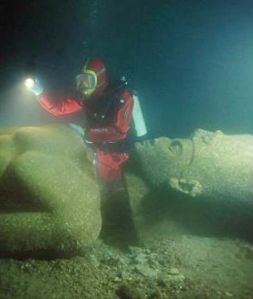
The city of Heracleion sank into the ocean in the 6th or 7th centuray AD and has recently been uncovered. This blog writer has a round up of some pretty 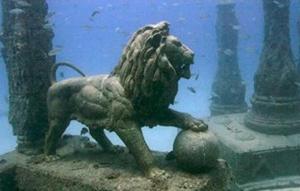 amazing pictures and stories. This city is known as the city of Cleopatra.
I can’t imagine how cool it must be to be an underwater archaeologist. If I’d have known this was a possibility when I was a teenager I would have had a different life. I started diving at about 14 and Egypt has always thrilled my imagination. I’ve written about this before but it seems that a lot more has been accomplished.
Thonis-Heracleion (the Egyptian and Greek names of the city) is a city lost between legend and reality. Before the foundation of Alexandria in 331 BC, the city knew glorious times as the obligatory port of entry to Egypt for all ships coming from the Greek world. It had also a religious importance because of the temple of Amun, which played an important role in rites associated with dynasty continuity. The city was founded probably around the 8th century BC, underwent diverse natural catastrophes, and finally sunk entirely into the depths of the Mediterranean in the 8th century AD.
Prior to its discovery in 2000 by the IEASM, no trace of Thonis-Heracleion had been found. Its name was almost razed from the memory of mankind, only preserved in ancient classic texts and rare inscriptions found on land by archaeologists. The Greek historian Herodotus (5th century BC) tells us of a great temple that was built where the famous hero Herakles first set foot on to Egypt. He also reports of Helen’s visit to Heracleion with her lover Paris before the Trojan War. More than four centuries after Herodotus’ visit to Egypt, the geographer Strabo observed that the city of Heracleion, which possessed the temple of Herakles, is located straight to the east of Canopus at the mouth of the Canopic branch of the River Nile.
The Senate vote on making discrimination against GLBT in the workplace is really going to show the split in the Republican party. The discussion is about as bad–if not worse–than it was around the ERA. Drag Queens in Christian Book Stores! Federally Subsidized Sex Change Operations! Dogs and Cats having sex in the street!!!!
The anticipated vote comes four months after the Supreme Court invalidated a federal ban on recognizing same-sex marriages, and nearly a year after some conservative leaders warned that losses in the 2012 elections exposed the party as being out of touch with much of the country on social issues.
With the bill apparently just one vote short of the threshold to prevent a filibuster, the Republican senators believed to be the most persuadable — Rob Portman of Ohio, Kelly Ayotte of New Hampshire and Dean Heller of Nevada — were keeping their positions private.
Political strategists and congressional aides who have been lobbying for the bill say they have received private assurances that there will be enough Republican votes to move the measure forward on Monday, but none of the senators who plan to support it want to say so publicly out of concern that they could become targets by groups opposing the measure.
In the House, the best chance for passage this year seems to be to tack the measure onto a larger piece of legislation like the National Defense Authorization Act and hope that conservatives do not revolt.
“If you’ve been told your entire career that Republican primary voters are hostile on these issues, and people have only just started to educate you otherwise,” said Jeff Cook-McCormac, a Republican lobbyist who has been pushing to get the bill enacted, “it takes a little while for that to sink in.”
While opposition appears less organized than in previous gay rights debates in Congress, senators of both parties said the emotion surrounding the issue had complicated efforts to break a Republican filibuster attempt.
One senator recalled having to explain to a colleague that the legislation would not require insurance companies to pay for sex-change operations. Another spoke of phone calls from constituents who were convinced that their children could be taught in school by men wearing dresses. And conservative groups like the Family Research Council are warning their supporters that the bill would force Christian bookstores to hire drag performers.
We continue to learn exactly how important appointments to the judicial branch are as we see women judges–appointed by Dubya–vote to place women in  involuntary servitude to the state.
It’s been a day of body blows for reproductive rights. On Thursday night, the U.S. Court of Appeals for the 5th Circuit reversed a lower court’s decision to temporarily block a provision of the omnibus Texas abortion law that requires doctors performing abortions to have admitting privileges at a local hospital. The appeals court found that it’s constitutionally OK for the requirement to trigger the closure of fully one-third of the reproductive health clinics in the state, because the Supreme Court has found that “the incidental effect of making it more difficult or more expensive to procure an abortion cannot be enough to invalidate it.” The ruling will be catastrophic, measured in access for women to a procedure they have the constitutional right to obtain. The decision was written by Judge Priscilla R. Owen, a George W. Bush appointee, and joined by two other judges who are women—oh how the right is crowing—and also Bush appointees.
Similar admitting privileges provisions have been struck down by courts in Alabama, Mississippi, North Dakota, and Wisconsin. Judges in each of those cases saw these abortion restrictions for what they are—unconstitutional burdens on the right to access—and blocked them.
On Friday, morning, it was the turn of another extremely conservative woman chosen for the bench by Bush, Janice Rogers Brown of the U.S. Court of Appeals for the District of Columbia Circuit. Brown handed down a similarly dramatic decisionholding that the provision in the Affordable Care Act that requires companies to provide health care coverage that includes contraception “trammels” the religious freedom of an Ohio-based food service company, Freshway Foods, through its two owners, who claimed that the mandate violated its Catholic faith. This is a company we are talking about, not its owners. But following headlong in the wake of the Supreme Court’s wrongheaded finding in Citizens United that corporations are people, too, Brown found that the mandate violates the company’s strongly held religious convictions. To make the company provide a health care plan—from an outside insurer—that offers contraceptive coverage is a “compel[led] affirmation of a repugnant belief,” Brown wrote. The argument that a for-profit secular company has a religious conscience—separate and apart from the religious beliefs of its owners—is a notion that vaults the concept of personhood from the silly (“corporations are people, my friend”) to the sublime (also they pray).
It’s hard to overstate how radical these two decisions are. So it should be especially dispiriting for the left that the other really big thing that happened Thursday was the filibuster by Senate Republicans of Patricia Ann Millett, Obama’s centrist nominee to fill a vacancy on the D.C. Circuit, despite her exemplary credentials. Millett is no radical—no lefty retort to Owen and Brown. She’s a partner at Akin Gump who worked in the solicitor general’s office for both Clinton and Bush and has represented the pro-business U.S. Chamber of Commerce. She’s a military wife. That didn’t stop Republicans from claiming that simply by putting up a judicial nominee of his choosing, President Obama was attempting the “pack the court.”
Please Mr. President!!!! Pack the Court with less theocrats!!!
Governor Chris Christie is “tired of you people!” “You people” would be teachers trying to do right by their students. He called schools “failure factories”.
New Jersey’s governor, Chris Christie, has a long history of teacher bashing – not just teachers union bashing, but teacher bashing. Even when he’s clearly in the lead, he can’t help himself: he has to take a swipe at teachers whenever he can. It’s almost pathological: even when he’s up by a sizable margin, Chris Christie just can’t turn down a chance to bash a teacher who gets too uppity – as he proved today”
Just think! He’s the one they all think is mainstream!!! Go read the interview with the teacher at the receiving end of his bullying.
 Senator Charles Schumer has just endorsed Hillary Clinton for 2016. Wow! That’s getting things started a little early.
Senator Charles E. Schumer, Democrat of New York, used a speech to Iowa Democrats on Saturday night to endorse Hillary Rodham Clinton for president, another indication of how quickly the party is coalescing behind the former secretary of state.
Speaking in the state that helped lift President Obama’s campaign and dashed Mrs. Clinton’s hopes in the 2008 caucuses, Mr. Schumer said the time was right that year for Mr. Obama.
“2016 is Hillary’s time,” Mr. Schumer declared at the Iowa Democratic Party’s Jefferson Jackson Dinner. “And our nation will be all the better for it.”
While Mr. Schumer’s support for his former Senate colleague was not surprising, his endorsement one year after the 2012 presidential election underscores how much the Democratic Party elders want Mrs. Clinton to enter the race.
With Mr. Obama’s popularity waning, many party officials also want to try to clear the field for the former first lady in 2016. Last week, it was revealed that every Democratic woman in the Senate had signed a letter supporting Mrs. Clinton, a former senator from New York. She has not yet indicated her 2016 plans.
An aide to Mr. Schumer said his endorsement in such a high-profile venue had not come at Mrs. Clinton’s request.
“Run, Hillary, run,” Mr. Schumer said. “If you run, you’ll win and we’ll all win. With a strong platform and with Hillary leading the charge, we will vanquish the Ted Cruz Tea Party Republicans in 2016.”
Whoa! So, that’s it for me this morning! What’s on your reading and blogging list today?
Tuesday Reads: The Agony of Glenn Greenwald, The Ickiness of Ted Cruz, & Other News
Posted: August 20, 2013 Filed under: 2016 elections, Egypt, Foreign Affairs, Great Britain, morning reads, Pakistan, Republican politics, U.S. Economy, U.S. Politics, US & Canada | Tags: Bob Cesca, David Miranda, Glenn Greenwald, Muslim Brotherhood, Pervez Musharraf, Ted Cruz, the 24-hour rule, The Guardian UK 29 Comments
Good Morning!!
As of yesterday, we’ve reached the point with the NSA leaks story that the entire focus is on Glenn Greenwald and his martyrdom. Even Edward Snowden has now faded into the background.
On Sunday, Greenwald’s domestic partner David Miranda was detained for nine hours by UK authorities as he passed through Heathrow Airport on his way from Berlin to Rio de Janeiro where he and Greenwald live. Miranda was finally released, but his laptop, an external hard drive, a number of memory sticks and other electronic devices were confiscated. Greenwald reacted by threatening the UK government with harmful revelations from the Snowden stash.
As with previous Greenwald stories, this one quickly evolved from a tale of horrendous government repression as reported by the Guardian to a more complex story reported by other news outlets–forcing the Guardian to walk back or provide more details on aspects of its original reporting. Bob Cesca does a good job of summarizing the process.
Like most people, Cesca was at first shocked by the news of Miranda’s detention. Then he began reading the stories under the headlines.
When I read The Guardian‘s article about the incident, however, more questions popped up — as with much of The Guardian‘s reporting on this topic, the publication’s tendency for coy, smoke-and-mirrors reporting invariably raises more questions than it answers. The article was credited to “Guardian staff,” for one, there weren’t any quotes from Miranda himself and the only source for the article appeared to be Greenwald, who, from my experience covering this story, tends to be incendiary and misleading.
The wailing and garment rending was underway — the predictable group freakout we’re forced to endure every time a new article is published. Greenwald himself wrote that the U.K. authorities were actually worse than the Mafia because the Mafia doesn’t target family members. (Clearly, Greenwald knows less about the Mafia than he does about political realities or history.)
An aside: Cesca coined the term “the 24 hour rule” after a the first few Greenwald NSA “bombshells.”
The 24 Hour Rule: 1) A wild claim is made via a news article, most often The Guardian, about the U.S. government or related entities. 2) The article sparks wild fits of outrage. 3) Then, within 24 hours, a mitigating detail is added, undermining or totally debunking one or more of the central claims contained with the article. Related quote: “A lie can travel half-way around the world before the truth gets its pants on.”
Back to Cesca’s take on the Miranda story:
As the hours rolled by, Charlie Savage, reporting for The New York Times, began to revealmore details about the trip — details which The Guardian mysteriously didn’t include in either of its articles….
First, we learned from The New York Times that The Guardian financed Miranda’s trip to Germany and back. This means Miranda was conducting some sort of official business for the publication. Around the same time, Amnesty International referred to Miranda as “a Guardian newspaper employee.” Combined with the Laura Poitras detail, it’s obvious that Miranda was commissioned to do some serious leg-work on the Snowden/NSA reporting, the extent of which was unknown at the time.
And then, late in the evening east coast time, The New York Times revealed the purpose of Miranda’s trip to Berlin:
Mr. Miranda was in Berlin to deliver documents related to Mr. Greenwald’s investigation into government surveillance to Ms. Poitras, Mr. Greenwald said. Ms. Poitras, in turn, gave Mr. Miranda different documents to pass to Mr. Greenwald. Those documents, which were stored on encrypted thumb drives, were confiscated by airport security, Mr. Greenwald said. All of the documents came from the trove of materials provided to the two journalists by Mr. Snowden.
So Miranda, Greenwald’s spouse, served as a paid courier to transfer stolen, top secret national security documents from Greenwald to Poitras, and from Poitras back to Greenwald.
While I’m not defending UK authorities for their ham-handed treatment of Miranda–and neither is Cesca–it’s really not surprising that Miranda was stopped and questioned. It also later came out that Miranda had been offered an attorney, but he refused the offer (Greenwald had originally said his partner was refused access to legal advice). From The Guardian on Monday:
He was offered a lawyer and a cup of water, but he refused both because he did not trust the authorities. The questions, he said, were relentless – about Greenwald, Snowden, Poitras and a host of other apparently random subjects.
“They even asked me about the protests in Brazil, why people were unhappy and who I knew in the government,” said Miranda.
He got his first drink – from a Coke machine in the corridor – after eight hours and was eventually released almost an hour later. Police records show he had been held from 08.05 to 17.00.
The questions about the Brazilian government weren’t actually that outrageous, since Glenn Greenwald had contacted high level officials there and they had tried to intervene.
So the “24-hour rule” still holds. This entire story turned around in 24 hours, but many news outlets are still reporting information that is either wholly or partially untrue. After it became clear that their original reporting on the Miranda detention was problematic, the Guardian released another bombshell article written by Guardian editor-in-chief Alan Rusberger in which he claims that two months ago GCHQ (Britain’s version of NSA) agents forced the Guardian to destroy their hard drives and computers unless they turned over their NSA materials. Again Bob Cesca has a good summary. Please read the whole thing if you can–it’s not long.
We’ll have to wait another day to see if this story also morphs into something different. Cesca has a list of questions for Rusberger. My big question is why wasn’t this reported immediately after it happened, and why didn’t the Guardian go to court over it?
And so Glenn Greenwald and his victimization remain the center of international attention. I have to wonder why Greenwald arranged for his partner to travel through Heathrow in the first place. Was he deliberately inviting something like this? He couldn’t have asked for better free publicity that he and the Guardian are getting right now.
Meanwhile, any discussion of NSA spying is hindered by so much inaccurate information; yet the NSA story is distracting Americans from focusing on equally important and even more pressing issues like jobs, the economy, voting rights, the war on women’s autonomy, the environment, and the upheavals in the Middle East. So now I’ll move on to some other news–I’ll add more links on the Miranda story in the comments.
In other news,
The Atlantic has a good story on economic inequality: Are the Rich Getting Too Much of the Economic Pie?
When one of you asked, “Are the rich getting too much of the economic pie?” the team behindEconomics in Plain English got pretty excited. Because you said “pie.” So we headed toDangerously Delicious Pies in northeast Washington, D.C., with business editor Derek Thompson to explain income inequality over dessert. We ordered three pies — peanut butter, blueberry, and something amazing called the “Baltimore Bomb” — to make three charts that illustrate the income and wealth gap in the U.S. We’re not the first to mix math and pastry, as we discovered recently, but we hope this video offers a tasty perspective on a complex economic question.
Watch the video–and others by the same group–at the link.
In Pakistan, Pervez Musharraf has been indicted in the 2007 murder of Benazir Bhutto
ISLAMABAD, Pakistan — A Pakistani court indicted Pervez Musharraf on Tuesday in connection with the 2007 assassination of former Prime Minister Benazir Bhutto, the first time that a former military leader has faced criminal proceedings in Pakistan.
The court in Rawalpindi, near the capital, Islamabad, filed three charges against Mr. Musharraf, including murder and conspiracy to murder, said a prosecutor, Chaudhry Muhammed Azhar.
Mr. Musharraf, who has maintained that the charges against him are politically motivated, pleaded not guilty, his lawyers said. Reporters were excluded from the hearing. Afterward, police commandos and paramilitary rangers escorted Mr. Musharraf back to his villa on the edge of Islamabad, where he has been under house arrest since April in connection with other cases stemming from his rule from 1999 to 2008.
The sight of a once untouchable general being called to account by a court had a potent symbolism in a country that has been ruled by the military for about half of its 66-year history. While the military remains deeply powerful, the prosecution has sent the message that Pakistan’s top generals are subject to the rule of law — at least after they have retired.
In Egypt, a leader of the Muslim Brotherhood has been arrested. The LA Times reports:
CAIRO — Egyptian authorities early Tuesday arrested the leader of the Muslim Brotherhood, another demoralizing blow to the Islamist organization amid a crackdown by the military to silence dissent and build support for its control of the nation.
Supreme Guide Mohamed Badie was arrested in a Cairo apartment. Dressed in a gray tunic, the 70-year-old spiritual leader looked shaken, sitting next to a bottle of water in police custody. The image distilled the desperation the world’s most influential Islamist organization faces against an army that appears determined to crush it.
Most of the Brotherhood’s top leaders, including Khairat Shater, its chief strategist and financier, and former Egyptian president Mohamed Morsi, who was overthrown in a coup last month, are in detention or have gone underground. Much of the group’s strategy appears to have shifted to the Anti-Coup Alliance, an umbrella group the Brotherhood organized to protest Morsi’s downfall.
The army’s crackdown on the Brotherhood has been ferocious. Police raids on two Brotherhood sit-ins last week and the protests and violence that ensured killed more than 900 Morsi supporters, many of them shot by live ammunition fired by security forces that have shown little restraint.
“When the hand of oppression extends to arrest this important symbol,” the Brotherhood said in a statement regarding Badie, “that means the military coup has used up everything in its pocket and is readying to depart.”
I’ll be honest–I’m really clueless about what’s going on in Egypt right now. I just hope the situation doesn’t descend into a Syria-like civil war.
Texas Tea Party Senator Ted Cruz is back in the news. The Dallas Morning News revealed yesterday that Cruz holds dual citizenship in the US and Canada.
Born in Canada to an American mother, Ted Cruz became an instant U.S. citizen. But under Canadian law, he also became a citizen of that country the moment he was born.
Unless the Texas Republican senator formally renounces that citizenship, he will remain a citizen of both countries, legal experts say.
That means he could assert the right to vote in Canada or even run for Parliament. On a lunch break from the U.S. Senate, he could head to the nearby embassy — the one flying a bright red maple leaf flag — pull out his Calgary, Alberta, birth certificate and obtain a passport.
“He’s a Canadian,” said Toronto lawyer Stephen Green, past chairman of the Canadian Bar Association’s Citizenship and Immigration Section.
The circumstances of Cruz’s birth have fueled a simmering debate over his eligibility to run for president. Knowingly or not, dual citizenship is an apparent if inconvenient truth for the tea party firebrand, who shows every sign he’s angling for the White House.
Cruz has decided to renounce his Canadian citizenship, according to CNN:
“Because I was a U.S. citizen at birth, because I left Calgary when I was 4 and have lived my entire life since then in the U.S., and because I have never taken affirmative steps to claim Canadian citizenship, I assumed that was the end of the matter,” Cruz wrote in his statement.
“Now the Dallas Morning News says that I may technically have dual citizenship. Assuming that is true, then sure, I will renounce any Canadian citizenship,” he continued. “Nothing against Canada, but I’m an American by birth, and as a U.S. Senator, I believe I should be only an American.”
Too bad he didn’t decide to run for office in Canada. I guess we’re stuck with him now.
I’ll end with this Daily Beast story about what Ted Cruz Princeton roommates recall about him. Some excerpts:
When Craig Mazin first met his freshman roommate, Rafael Edward Cruz, he knew the 17-year-old Texan was not like other students at Princeton, or probably anywhere else for that matter.
“I remember very specifically that he had a book in Spanish and the title was Was Karl Marx a Satanist? And I thought, who is this person?” Mazin says of Ted Cruz. “Even in 1988, he was politically extreme in a way that was surprising to me.” [….]
“It was my distinct impression that Ted had nothing to learn from anyone else,” said Erik Leitch, who lived in Butler College with Cruz. Leitch said he remembers Cruz as someone who wanted to argue over anything or nothing, just for the exercise of arguing. “The only point of Ted talking to you was to convince you of the rightness of his views.”
In addition to Mazin and Leitch, several fellow classmates who asked that their names not be used described the young Cruz with words like “abrasive,” “intense,” “strident,” “crank,” and “arrogant.” Four independently offered the word “creepy,” with some pointing to Cruz’s habit of donning a paisley bathrobe and walking to the opposite end of their dorm’s hallway where the female students lived.
“I would end up fielding the [girls’] complaints: ‘Could you please keep your roommate out of our hallway?'” Mazin says.
Eeeeeeeeek!!
OK, now it’s your turn. What stories are you focusing on today? Please post your links on any topic in the comment thread.
Thursday Reads: This and That
Posted: August 15, 2013 Filed under: 2016 elections, academia, Barack Obama, Civil Rights, Egypt, Foreign Affairs, Iraq, Journalism, morning reads, Republican politics, Surreality, the GOP, U.S. Politics | Tags: Erroll Flynn reading, Hillary Clinton, Jack Germond, Muslim Brotherhood, Rand Paul, Steve Stockman 30 Comments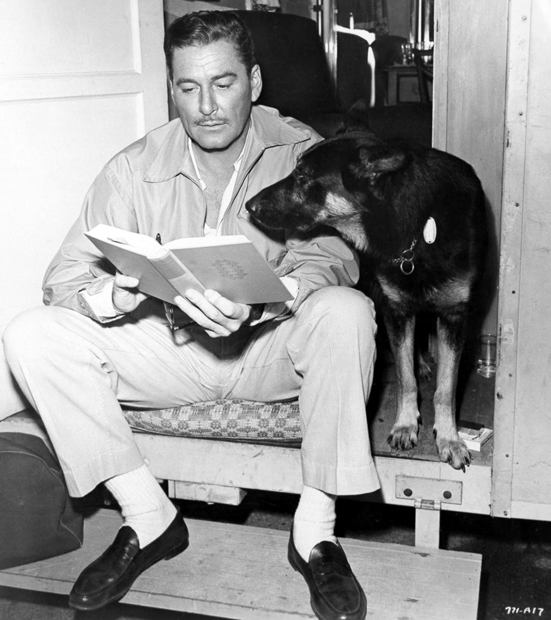
Good Morning!!
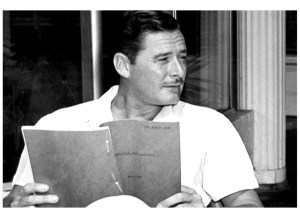
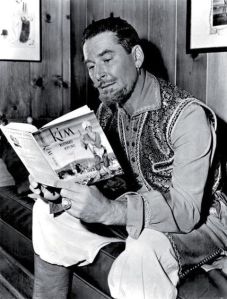
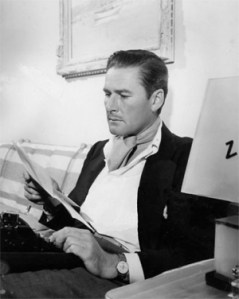
This post is going to be a little bit of this and a little bit of that along with some eye candy for the classic film buffs out there–just because I’m feeling a little silly and mixed up today.
I haven’t been paying much attention to the situation in Egypt lately–except to notice out of the corner of my eye that it seems to be getting out of hand. Here are a few links on what’s happening now.
LA Times: Death toll in Egypt crackdown hits 525
CAIRO — The death toll in the violence that has engulfed Egypt climbed to 525 Thursday as the nation awoke to scenes of charred streets, battered cars, funerals and deepening divisions between Islamists and the largely secular military-backed government.
The Health Ministry reported that the dead, mostly supporters of deposed Islamist president Mohamed Morsi, included at least 43 police officers. More than 3,700 people were also wounded in clashes that ignited Wednesday when security forces broke up two sit-ins by protesters loyal to Morsi and his Muslim Brotherhood.
The Brotherhood claims at least 2,000 people were killed in street battles that swept the country. Many of the deaths occurred when riot police firing tear gas and automatic weapons stormed the six-week old Islamist rally outside the Rabaa al Adawiya mosque in Cairo.
The violence stunned world leaders, and Thursday Turkish Prime Minister Recep Tayyip Erdogan demanded that the U.N. Security Council move to condemn what he characterized as a massacre by Egyptian soldiers and security forces.
“I am calling on Western countries. You remained silent in Gaza, you remained silent in Syria. … You are still silent on Egypt. So how come you talk about democracy, freedom, global values and human rights?” he told a news conference.
The Daily Mail: Horrifying moment Egyptian protestors pushed an armoured police van 50ft off a bridge before officers were stoned by mob
The van plunged off the 6th October Bridge before demonstrators attacked the wreckage yesterday. It is not known how many people were on board and how many people survived the fall, but bloodied men were seen lying around the van moments afterwards. Unconfirmed reports on Twitter claimed five were dead.
The dramatic pictures show the van being ambushed by dozens of people before crashing through a protective fence on the bridge. It then falls upside down and then rolls onto its roof as it lands. Blood can then be seen on the ground as nearby police officers pull injured men out of the crushed vehicle.
See photos at the the link.
There is a lot of criticism of the Obama administration’s handing (or non-handling) of the situation. Some samples:
Slate: Lost In Egypt
The bloody crackdown began early Wednesday morning, as Egyptian riot police and plainclothes officers began their assault on the thousands of Muslim Brotherhood members who defied the government’s warnings to end their protests in support of the ousted former president, Mohamed Morsi. Security forces showed no restraint as they stormed the two massive sit-ins: Bulldozers cleared makeshift barriers, while snipers took aim at protesters and plumes of tear gas engulfed the streets. Hospitals were quickly overrun with the dead and wounded, and eyewitness reports described hallways slick with blood and lines of corpses with gunshot wounds to the head, neck, and chest. By the end of the siege, nearly 300 people were reported dead—including women and children—and it’s likely the death toll will climb higher.
It being August, the duty of offering the Obama administration’s first reaction to the Egyptian regime’s brutal attack fell to deputy press secretary Josh Earnest. The White House condemned the violence (as if it were being committed equally by both sides), asked that the military and security forces show restraint (while corpses were being counted), promised to hold the interim government accountable (as if the interim government were anything more than a fig leaf for the military), and suggested that an “inclusive process” would be best (that must not have occurred to the snipers as they reloaded their guns). In other words, it was the same talking points the administration has produced each time Egypt has erupted in a spasm of violence this summer. It is hard to imagine a more feckless response than the Obama administration’s approach to dealing with Egypt’s generals.
When asked whether the administration might want to revise its position on whether the July 3 ouster of Egypt’s first democratically elected president was a coup, Earnest replied, “It is not in the interests of the United States to make that determination.” That answer echoed State Department spokeswoman Jen Psaki’s statement on July 26 that “we have determined legally that we do not need to make a determination.” In other words, we aren’t going to say and you can’t make us.
Business Insider: Obama Is Getting Shredded Over His Handling Of Egypt And Ongoing Support Of The Government
Both The Washington Post and The New York Times have printed scathing editorials that demand the U.S. suspend $1.3 billion in aid to Egypt after a military crackdown led to the deaths of more than 550 people, including two foreign journalists, on Wednesday.
“[T]he Obama administration is complicit in the new and horrifyingly bloody crackdown launched Wednesday by the de facto regime against tens of thousands of protesters who had camped out in two Cairo squares.”
“This refusal to take a firm stand against massive violations of human rights is as self-defeating for the United States as it is unconscionable.”
“President Obama must make clear his unequivocal opposition to the Egyptian military’s conduct. He can do so by immediately suspending military aid and canceling joint military exercises scheduled for September.”
“And if suspending a $1.3 billion subsidy does not do the trick, it will at least tell rank-and-file Egyptians that the United States is no longer underwriting repression.”
More examples at the link.
Things aren’t looking very good in Iraq either.
From Reuters: Baghdad bomb attacks kill at least 33
A series of car bombs in Baghdad killed at least 33 people and wounded more than 100 on Thursday, with one near the “Green Zone” diplomatic complex, fuelling a death toll that has soared since the beginning of the year to levels not seen since 2008.
Militant groups, including al Qaeda, have increased attacks in recent months in an insurgency against Iraq’s Shi’ite-led government, raising fears of a return to full-blown sectarian conflict after U.S. troops withdrew 18 months ago.
Iraqi police sources said one bomb exploded just 200-300 meters (yards) outside Baghdad’s international zone, close to Iraq’s Foreign Ministry, killing four and wounding 12 people….
Since the start of the year, attacks using multiple car bombs have become an almost daily occurrence, killing scores of people in Iraq, including during a religious holiday last weekend when bombers targeted families celebrating outside.
Each of the past four months has each been deadlier than any in the previous five years, dating back to a time when U.S. and government troops were engaged in battles with militiamen.
Back in the USA, veteran newsman Jack Germond died yesterday at age 85. From The Baltimore Sun:
Jack W. Germond, the irascible, portly columnist and commentator who was a fixture on the American political scene for nearly 50 years, including nearly 20 of them in The Baltimore Sun’s Washington bureau, died Wednesday morning of chronic obstructive pulmonary disease at his home in Charles Town, W.Va. He was 85.
“Jack was a truly dedicated reporter and had an old-fashioned relationship with politicians. He liked them, but that did not prevent him from being critical when they did bad things and behaved badly. That was a trademark of Jack’s,” said Jules Witcover, his longtime writing partner.
“Jack enjoyed his life and work. He personified that,” said Ernest B. “Pat” Furgurson, former chief of The Sun’s Washington bureau. “He had a positive personality, but when he was bitching about something, and in that mood, he’d suddenly say, ‘Isn’t this a great job?'”
He used to be on TV a lot, and I always liked him. He was a real old-time journalist who wasn’t afraid to speak his mind.
More news from our crumbling country: Republicans are still crazy.
Rand Paul: ‘I Don’t Think There Is Any Particular Evidence’ Of Black Voters Being Prevented From Voting (Think Progress)
Sen. Rand Paul (R-KY), a tea party senator with a long history of opposition to civil rights laws, told an audience in Louisville, Kentucky on Wednesday that there is no evidence of black voters being excluded from the franchise. According to local NPR host Phillip Bailey, Paul said that he does not believe “there is any particular evidence of polls barring African Americans from voting,” during aspeech to the non-partisan Louisville Forum.
If Paul is not aware of the evidence indicating widespread efforts to prevent African Americans from voting, then he must not be looking very hard. During the 2012 election, black and Hispanic voters waited nearly twice as long to cast a ballot as white voters. In Florida, lines of up to six hours led an estimated 201,000 people to become frustrated and leave the polls. These lines existed largely because of a voter suppression bill signed into law by Gov. Rick Scott (R-FL) which reduced early voting hours in the state. After the election, top Republicans admitted that the purpose of cutting early voting was to reduce Democratic turnout. One Republican operative conceded that early voting was cut on the Sunday proceeding Election Day because “that’s a big day when the black churches organize themselves.”
Meanwhile, voter ID laws are rampant in states led by conservatives, despite the fact that these laws cannot be justified by any legitimate purpose. Although their proponents routinely claim that an ID requirement is necessary to prevent voter fraud at the polls, such fraud barely exists. According to one study, just 0.0023 percent of votes are the product of in person voter fraud. Meanwhile, even conservative estimates suggest that 2 to 3 percent of legitimate voters will turn turned away by a voter ID law — and these voters are disproportionately African American.
And Texas Republicans are beyond the pale: Rep. Stockman invites Obama rodeo clown to perform in Texas.
A conservative Texas lawmaker is inviting a rodeo clown banned from the Missouri state fair to perform in the Lone Star State instead.
Rep. Steve Stockman (R-Tex.) says that the unidentified rodeo clown and his colleagues have been unfairly targeted by liberals “to create a climate of fear.” He invited them to come perform at a fair in his southeastern Texas district instead.
“Liberals want to bronco bust dissent. But Texans value speech, even if its speech they don’t agree with,” Stockman said in a statement issued by his office Wednesday. “From Molly Ivins to Louie Gohmert and every opinion between Texans value free and open political speech. I’m sure any rodeo in Texas would be proud to have performers.”
Missouri state and fair officials reacted swiftly over the weekend after a rodeo clown donned a mask of President Obama and asked people if they want to see the president “run down by a bull.”
The White House declined to comment on the disgusting display of racism and disrespect for the office of the President.
Hillary Clinton is getting job offers from academia, according to Politico.
Hillary Clinton is fielding offers from colleges and universities — including Harvard and her law school alma mater, Yale — to give her a formal academic role, a move that would give her a platform outside her family’s foundation….
The advantage to Clinton of an academic platform, beyond the scope of her policy interests, could be huge for someone considering a presidential run. It would provide her with a credible backdrop for speeches and events that would take her outside of a hotel ballroom or something sponsored by her family’s foundation or another outside group.
Hmmm…. I’m sure the Politico gang would much prefer to see Hillary in academia rather than the White House.
On the chance Clinton doesn’t run for president, academia would be a potential next act for her careerwise.
The schools have included the Harvard Kennedy School, Yale, New York University — where her daughter, Chelsea, has a title — and the Baruch College discussions, the sources said. One source indicated there are others as well who have approached Clinton about an academic partnership, going back to when she was still at Foggy Bottom.
Okay, there’s a mish-mash of news and “views” to give you a start on your Thursday. Now what stories are you interested in today? Please share your links in the comment thread.
Independence Day Reads
Posted: July 4, 2013 Filed under: Barack Obama, Egypt, Foreign Affairs, France, health, Italy, medicine, morning reads, NSA, National Security Agency, science, Spain, the internet, U.S. Politics, Violence against women, War on Women, Women's Rights | Tags: Adly Mahmud Mansour, Bolivia, cognitive decline, dementia, Evo Morales, gang rape, Groundhog day, HIV treatments, marrow transplants, mental stimulation, Mohammed Morsi, national anthem, reading, sexual assault in Egypt, The Star Spangled Banner 38 Comments
Good Morning!!
So Egyptians staged a whole lot of protests and with the help of the army, overthrew the president they elected about a year ago. From the Boston Globe: Egypt’s army ousts Morsi, who calls it a ‘coup’
CAIRO (AP) — Egypt’s first democratically elected president was overthrown by the military Wednesday, ousted after just one year in office by the same kind of Arab Spring uprising that brought the Islamist leader to power.
The armed forces announced they would install a temporary civilian government to replace Islamist President Mohammed Morsi, who denounced the action as a ‘‘full coup’’ by the generals. They also suspended the Islamist-drafted constitution and called for new elections.
Millions of anti-Morsi protesters around the country erupted in celebrations after the televised announcement by the army chief. Fireworks burst over crowds in Cairo’s Tahrir Square, where men and women danced, shouting, ‘‘God is great’’ and ‘‘Long live Egypt.’’
That sure sounds like coup. The army overthrows an elected leader and appoints a new one, while suspending the constitution. What else would you call it? And then there’s this:
The army took control of state media and blacked out TV stations operated by the Muslim Brotherhood. The head of the Brotherhood’s political wing was arrested.
It’s like Groundhog Day. A year from now will the whole thing happen all over again?
From BBC News: Egypt swears in Mansour as interim leader after Morsi ousted
The top judge of Egypt’s Constitutional Court, Adly Mahmud Mansour, has been sworn in as interim leader, a day after the army ousted President Mohammed Morsi and put him under house arrest.
Mr Mansour said fresh elections were “the only way” forward, but gave no indication of when they would be held.
Mr Morsi, Egypt’s first freely elected leader, is under house arrest after what he says was a military coup.
The army said he had “failed to meet the demands of the people”.
So it’s as if the Pentagon overthrew President Obama and installed Chief Justice Roberts as temporary president, while at the same time suspending the Constitution and shutting down the media.
The Dark Side of Egyptian “Revolution”
There’s also another similarity to the previous Egyptian “revolution” an outbreak of sexual assaults and gang rapes targeting women in public. From Human Rights Watch:
Egyptian officials and political leaders across the spectrum should condemn and take immediate steps to address the horrific levels of sexual violence against women in Tahrir Square. Egyptian anti-sexual harassment groups confirmed that mobs sexually assaulted and in some cases raped at least 91 women in Tahrir Square, over four days of protests beginning on June 30, 2013, amid a climate of impunity.
“The rampant sexual attacks during the Tahrir Square protests highlight the failure of the government and all political parties to face up to the violence that women in Egypt experience on a daily basis in public spaces,” said Joe Stork, deputy Middle East director at Human Rights Watch. “These are serious crimes that are holding women back from participating fully in the public life of Egypt at a critical point in the country’s development.”
The Egyptian group Operation Anti-Sexual Harassment/Assault, which runs a hotline for victims of sexual assault and seeks to intervene to stop attacks, has received scores of reports of attacks on women in Tahrir Square over the past three days. The group confirmed 46 attacks on June 30, 17 on July 1, and 23 on July 2. The group’s volunteers intervened to protect and evacuate women in 31 cases of sexual assault. Four of the women needed medical assistance, including two who were evacuated by ambulance. The women’s rights group Nazra for Feminist Studies had confirmed another five attacks on June 28.
One woman required surgery after being raped with a “sharp object,” volunteers with the group said. In other cases, women were beaten with metal chains, sticks, and chairs, and attacked with knives. In some cases they were assaulted for as long as 45 minutes before they were able to escape.
Please go read the rest at Human Rights Watch.
At CNN, writer Nina Burleigh puts the sexual violence in Egypt in the historical context of male efforts to control women’s access to the public sphere.
Last week, a 22-year-old Dutch journalist was gang-raped in Tahrir Square and had to undergo surgery for severe injuries. The assault reminds us yet again of an often overlooked aspect of the Egyptian revolution.
When Egyptians overthrew their dictator in 2011, one of the first celebratory acts in Tahrir Square included the gang beating and sexual assault of American journalist Lara Logan, who, like the Dutch journalist, landed in the hospital.
The Logan rape has always been portrayed as another unfortunate byproduct of mob violence. In fact, it was much more than that. It was a warning shot fired by men whose political beliefs are founded on a common pillar: Women must stay out of the public square.
One of the hallmarks of revolutionary victory in Tahrir Square has always been rape and sexual harassment. Mobs of men routinely set upon women, isolating, stripping and groping. No one is ever arrested or held accountable, and elected officials shrug their shoulders and blame the victims….
Egyptian women are the primary victims of sexual violence, and ultimately they are the intended recipients of the message: Stay home, your input in government and politics is not wanted.
Read the rest of Burleigh’s analysis at CNN.
In other news,

Bolivian officials laughing hysterically at the media for buying their tall tale
We learned yesterday afternoon that the claims that Bolivian president Evo Morales’ plane was refused permission to fly over France, Italy, and Spain were totally false and that no one forced his plane to land in Austria. See this article at The Atlantic for a complete debunking of the story.
But many so-called progressives are still pushing the false narrative that President Obama somehow was responsible. I was surprised to see Taylor Marsh hyping it this morning, and there has been no correction to Kevin Drum’s nasty claim that Obama behaved like “a Chicago thug.” That was originally in Drum’s headline until commenters told him he was pushing a Tea Party meme and he moved the accusation to the end of his post.
Marsh is also claiming we didn’t know about the extent of NSA spying a year ago. Really? If you agree with her, you might want to check out this detailed article on the NSA spying programs in the Wall Street Journal–dated March 10, 2008. And of course that wasn’t the first time the corporate media covered the story either. All the progs claiming utter shock and awe over Snowden’s revelations should be ashamed of themselves.
I don’t want to completely depress you, so let’s turn to some non-political news. I found a couple interesting science stories on Google this morning.
Here’s some exciting news out of Boston (NYT): After Marrow Transplants, 2 More Patients Appear H.I.V.-Free Without Drugs.
Two H.I.V.-infected patients in Boston who had bone-marrow transplants for blood cancers have apparently been virus-free for weeks since their antiretroviral drugs were stopped, researchers at an international AIDS conference announced Wednesday.
The patients’ success echoes that of Timothy Ray Brown, the famous “Berlin patient,” who has shown no signs of resurgent virus in the five years since he got a bone-marrow transplant from a donor with a rare mutation conferring resistance to H.I.V.
The Boston cases, like Mr. Brown’s, are of no practical use to the 34 million people in the world who have H.I.V. but neither blood cancer nor access to premier cancer-treatment hospitals.
But AIDS experts still find the Boston cases exciting because they are another step in the long and so-far-fruitless search for a cure. They offer encouragement to ambitious future projects to genetically re-engineer infected patients’ cells to be infection-resistant. At least two teams are already experimenting with variants on this idea, said Dr. Steven G. Deeks, an AIDS researcher at the University of California, San Francisco.
It’s real progress, even though the treatment won’t be widely available for a long time.
From BBC News: Active brain ‘keeps dementia at bay’
A lifetime of mental challenges leads to slower cognitive decline after factoring out dementia’s impact on the brain, US researchers say.
The study, published in Neurology, adds weight to the idea that dementia onset can be delayed by lifestyle factors….
In a US study, 294 people over the age of 55 were given tests that measured memory and thinking, every year for about six years until their deaths.
They also answered a questionnaire about whether they read books, wrote letters and took part in other activities linked to mental stimulation during childhood, adolescence, middle age, and in later life.
After death, their brains were examined for evidence of the physical signs of dementia, such as brain lesions and plaques.
The study found that after factoring out the impact of those signs, those who had a record of keeping the brain busy had a rate of cognitive decline estimated at 15% slower than those who did not.
That’s some impressive empirical evidence for something many of us have long suspected. So maybe we are helping keep our brains young through our obsession with reading and arguing about politics on the internet!
I’ll end with a recommendation that you listen to this NPR story on the history of “The Star Spangled Banner” and how it became our national anthem. It’s only about 8 minutes long. Or you can just read the article. I thought it was really interesting.
Now it’s your turn. What stories are you following today? If you’re headed out for barbeques and family gatherings instead of surfing the net, have a wonderful time and drop in for a minute if you can.

 peej
peej Carissa
 bostonboomer
 dakinikat
 ecocatwoman
 mablue2
 Mama Lopez
 peggysue22
 quixote
 skydancingguestblogger
 Mona (aka Wonk the Vote)



 Sky Dancing
Recent Comments