
Monday Reads
Posted: April 11, 2011 Filed under: 2012 presidential campaign, Civil Liberties, Civil Rights, Federal Budget, Foreign Affairs, Libya, morning reads, Republican presidential politics, SCOTUS, Surreality, Team Obama, The Bonus Class, U.S. Economy, U.S. Politics, unemployment, Voter Ignorance, We are so F'd | Tags: African Union, Black holes tearing apart Stars, Brother leader Ghadifi, Christina Romer, Donald Trump: crazy or just brain damaged from too many bad hair days?, Eric Cantor's latest delusions, grand wizards of the kleptocracy, Guantanomo detainees, INET, Koch Brothers, Larry Summers, magic mushrooms, Obama injustice department, Tea party crazies, unemployment 25 Comments Good Morning!
Well, today I’m starting with a quote from Robert Kuttner for The American Prospect about Larry Summers’ appearance at the INET conference. INET is the acronym for the Institute for New Economic Thinking. It was created with a $100 million grant from George Soros and no, I wasn’t invited and I didn’t attend. Mark Thoma and Brad De Long did. You can read their blogs if you want other views.
Larry Summers, now back at Harvard, was the after-dinner entertainment, interviewed by the prodigious Martin Wolf of the Financial Times, the world’s most respected financial journalist.
Summers was terrific, acknowledging that the stimulus of February 2009 was too small, that the idea of deflating our way to recovery is insane, that de-regulation had been excessive, and that much of the economics profession missed the developing crisis because its infatuation with self-correcting markets.
If only this man had been Obama’s chief economic adviser!
He’s referring to this:
Also worth mentioning is this op-ed by former Obama economist Christina Romer on why we have abysmal unemployment. If you read and listen to both of them, it’s going to be obvious that Obama must not have listened to either of them. No wonder they quit so early on. That leaves Timothy-in-the-well Geithner holding the bag for this miserable recovery, imho. Evidently, the two of them thought what most economists were thinking for several years now but it just wasn’t evident from policy. I guess if I heard this austerity crap was coming down the hopper during this miserable recovery, I’d have bailed before my professional credibility went to the crapper too. Guess Timothy always has the shadow banking industry to keep him warm. Meanwhile, Summers continues his apology tour and Romer clarifies the unemployment situation.
Strong evidence suggests that the natural rate of unemployment actually hasn’t risen very much. Instead, the elevated unemployment rate appears to reflect mainly cyclical factors, particularly a lingering shortfall in consumer spending and business investment.
Okay. The important phrase here is “lingering shortfall in consumer spending and business investment”. That means none of these idiotic tax cuts worked. It also means the stimulus was woefully small and ill-directed. It also means that it’s absolutely no time to worry about austerity unless you want yet another recession. Frankly, I think the Republicans are secretly trying to bring one on and Obama is just not that informed about economics and more concerned about chasing the mythical bi-partisan unicorn to wake the frick up.
Since BB knows that I’m a wannabe astrophysicist (or Egyptologist depending on the day of the week), she sent me another kewl science link about a star torn apart by a blackhole! NEATO!!!
On March 28, 2011, NASA’s Swift satellite caught a flash of high-energy X-rays pouring in from deep space. Swift is designed to do this, and since its launch in 2004 has seen hundreds of such things, usually caused by stars exploding at the ends of their lives.
But this time was hardly “usual”. It didn’t see a star exploding as a supernova, it saw a star literally getting torn apart as it fell too close to a black hole!
The African Union’s been chatting up their “Brother Leader” Whacko Ghadafo and have announced the possibility of an end to the fighting in Libya. And, raise your hand if you’d like to buy the Crescent City connection because I’m entertaining offers since the Brooklyn bridge sold so well last week.
“We have completed our mission with the brother leader, and the brother leader’s delegation has accepted the road map as presented by us,” Jacob Zuma, the South African president, said.
The AU mission, headed by Mohamed Ould Abdel Aziz, the Mauritanian president, arrived in Tripoli on Sunday.
Besides Zuma and Abdel Aziz, the delegation includes Amadou Toumani Toure, Denis Sassou Nguessou and Yoweri Museveni – respectively the presidents of Mali, the Democratic Republic of Congo and Uganda.
Gaddafi made his first appearance in front of the foreign media in weeks when he joined the AU delegation at his Bab al-Aziziyah compound.
The committee said in a statement that it had decided to go along with a road map adopted in March, which calls for an end to hostilities, “diligent conveying of humanitarian aid” and “dialogue between the Libyan parties”.
Speaking in Tripoli, Ramtane Lamamra, the AU Commissioner for Peace and Security, said the issue of Gaddafi’s departure had come up in the talks but declined to give details.
Why is it I want to sing I wanna zooma zooma zooma zooma zoom every time I read something about South Africa these days? Well, as long as it’s not one of those horn thingies that ruined the world cup this last time out.
More crap from Crazy Republicans via Think Progress: Cantor Sees Current Medicare and Medicaid Programs As A ‘Safety Net’ For ‘People Who Frankly Don’t Need One’
Today on Fox News Sunday, host Chris Wallace questioned House Majority Leader Eric Cantor’s (R-VA) support for a plan in which Americans “pay more out of pocket.” Defending the proposal, Cantor argued that these programs sometimes provide a “safety net” for “people who frankly don’t need one” and that the shift of the burden from the government to the beneficiary will teach government “to do more with less”:
CANTOR: We are in a situation where we have a safety net in place in this country for people who frankly don’t need one. We have to focus on making sure we have a safety net for those who need it.
WALLACE: The Medicaid people — you’re going to cut that by $750 billion.
CANTOR: The medicaid reductions are off the baseline. so what we’re saying is allow states to have the flexibility to deal with their populations, their indigent populations and the healthcare needs the way they know how to deal with them. Not to impose some mandate from a bureaucrat in washington.
WALLACE: But you are giving them less money to do it.
CANTOR: In terms of the baseline, that is correct…What we’re saying is there is so much imposition of a mandate that doesn’t relate to the actual quality of care. We believe if you put in place the mechanism that allow for personal choice as far as Medicare is concerned, as well as the programs in Medicaid, that we can actually get to a better resolve and do what most Americans are learning how to do, which is to do more with less.
Actually, 99% of Americans are doing less with less. One percent of Americans are doing more with the corporate and rich people’s welfare that folks like Cantor have handed them on a golden platter for the last ten years. If you have the stomach for it, the link to the TV interview is over at TP too. Frankly, I’ve been sick enough recently and don’t need to see anything that just makes me sicker.
I don’t know about you, but watching Donald Trump–the man who lost his father’s billions and then ran through government subsidies and finally made some money as a really bad reality TV star–as a potential presidential candidate has been sort’ve a surreal trip. James Polis at Richochet says that Trump is Final Proof that the Political Class Has Failed. Trump’s potential candidacy is like an extension of his reality show with gobs of opportunism, self-promotion and narcissism. It’s bad hair gone wild.
There are two main theories cooperating to explain the Trump phenomenon:
- Donald Trump is today’s best self-promoter and professional opportunist.
- The Republican field of presumptive candidates for president is lame.
But neither of these, nor even both together, can adequately explain what’s going on. We can’t even turn for supplemental help to subtheories that emphasize the rise of celebreality culture, the fall of Sarah Palin, or The Continuing Story of Bungling Barry. These variables all appear somewhere in the equation that has produced the Trump phenomenon. But none of them explain it.
Trump is suddenly “winning” as a political figure because the political class has failed. The authority of our political institutions is weak and getting weaker; it’s not that Americans ‘lack trust’ in them, as blue ribbon pundits and sociologists often lament, so much as they lack respect for the people inside them.
My theory is that he’s just a summer replacement, along with Michelle Bachmann, that will set the stage for fall when the blue suited, pompadour-sporting set take over to bore us to death with talks of tax cuts and subsidies ala President Dementia. Other Republican Presidential wannabes must be thinking we’ll be tired of self-promoting, idea-less hacks by then and that they’ll look refreshing by comparison in a few months. Oddly enough, the P woman is keeping a low profile in all of this. Maybe she’s finally figured out that discretion is the better part of valor for a change or it could be she just has enough money for an excellent summer vacation and has decided to exercise her options.
Okay, so I’m going to move on to something light (weirdly, spinning light, emanating from the patterned Chinese lantern covering the naked bulb in my dorm room while a John Lennon album plays Power to the People on my old turntable … oops, wrong flashback) from New Scientist. Thought mushrooms were just for old hippies and  Native American Shaman? Think again. Here’s the headline: Earliest evidence for magic mushroom use in Europe.
EUROPEANS may have used magic mushrooms to liven up religious rituals 6000 years ago. So suggests a cave mural in Spain, which may depict fungi with hallucinogenic properties – the oldest evidence of their use in Europe.
The Selva Pascuala mural, in a cave near the town of Villar del Humo, is dominated by a bull. But it is a row of 13 small mushroom-like objects that interests Brian Akers at Pasco-Hernando Community College in New Port Richey, Florida, and Gaston Guzman at the Ecological Institute of Xalapa in Mexico. They believe that the objects are the fungi Psilocybe hispanica, a local species with hallucinogenic properties.
Like the objects depicted in the mural, P. hispanica has a bell-shaped cap topped with a dome, and lacks an annulus – a ring around the stalk. “Its stalks also vary from straight to sinuous, as they do in the mural,” says Akers (Economic Botany, DOI: 10.1007/s12231-011-9152-5).
This isn’t the oldest prehistoric painting thought to depict magic mushrooms, though. An Algerian mural that may show the species Psilocybe mairei is 7000 to 9000 years old.
What a long strange ride it’s been ever since.
More on Obama-style Justice for Guantanamo detainees as the Supremes decline to clarify their rights.
The Obama administration has fought all attempts by lawyers for detainees to have the Supreme Court review those rulings. And while the news was overshadowed by the administration’s concession that alleged Sept. 11 mastermind Khalid Sheik Mohammed and his co-defendants will be tried by a military commission rather than federal jury — a separate issue — the court last week turned away three detainee challenges arising from Boumediene.
One group active in representing the detainees, the Center for Constitutional Rights, decried what it called the court’s refusal “to defend its Boumediene decision and other precedents from the open defiance of the D.C. Circuit.”
The government told justices that there is no reason for them to believe anything other than “lower courts have properly performed the task that this court assigned them in Boumediene v. Bush.”
“Open defiance” may go a bit far in describing the D.C. Circuit’s rulings, but there is no doubt that the court’s action in Boumediene — and its inaction since — has left few happy.
While detainee advocates complain about the court’s timidity, D.C. Senior Circuit Judge A. Raymond Randolph has received wide attention for a speech he gave last year in which he compared the justices to characters in “The Great Gatsby,” who have created a mess they expect others to clean up.
You don’t need me to start in on the Supremes this morning since BB did such a great job last night. Please go read her thread on just exactly how bankrupt our government has become. Believe me, it’s not an article on the deficit either.
Here’s an important information on the Koch Brothers, grand wizards of the kleptocracy. Alternet says they’re worse than you thought and they’re the astroturf beneathe the Tea Party’s wings.
Then look at a recent position pushed by Americans for Prosperity, the Tea Party-allied astroturf group founded and funded by David Koch (and whose sibling organization, the Americans for Prosperity Foundation, he chairs):
Similarly, Americans for Prosperity supports the House continuing resolution that cuts spending by $61 billion. Those cuts would reduce the budget for the CFTC by one-third. Make no mistake: Gutting the CFTC or limiting its authority would be a boon to Wall Street businesses that use complex financial instruments. But while the result is more profits for oil companies, it means everyone else pays more at the pump.
Okay, now have a look at the Kochs’ recent direct contributions to political candidates:
The Kochs donated directly to 62 of the 87 members of the House GOP freshman class…and to 12 of the new members of the U.S. Senate.
Don’t look now. It’s Atlas Shrugged, the Movie. Bad fiction just refuses to die when it gives erections to obsessive white men. I’m just waiting for next year’s Razzies. It’s the tale of a businessman obsessed. No, not the movie …the making of the movie …
It has taken businessman John Aglialoro nearly 20 years to realize his ambition of making a movie out of “Atlas Shrugged,” the 1957 novel by Ayn Rand that has sold more than 7 million copies and has as passionate a following among many political conservatives and libertarians as “Twilight” has among teen girls.
But the version of the book coming to theaters Friday is decidedly independent, low-cost and even makeshift. Shot for a modest $10 million by a first-time director with a cast of little-known actors, “Atlas Shrugged: Part I,” the first in an expected trilogy, will play on about 300 screens in 80 markets. It’s being marketed with the help of conservative media and “tea party” organizing groups and put into theaters by a small, Salt Lake City-based booking service.
I think I’ll pass. I prefer those nice little British films. I’m anxiously awaiting the redo of Upstairs, Downstairs. I never could make it through that silly John Galt speech even when I was young and my mind was an open book. Now, where are those lights on the ceiling when you need them?
What’s on your blogging and reading list today?
TGIFriday Reads
Posted: March 18, 2011 Filed under: Bahrain, Democratic Politics, Federal Budget, financial institutions, Foreign Affairs, Libya, Middle East, morning reads, Regulation, Social Security, U.S. Economy, U.S. Military, U.S. Politics | Tags: Bahrain protests, Budget fights, EPA, Harry Reid, Libya, no-fly zone, Social Security, US nuclear plants, US power plants, US response to Libya 43 Comments I can’t believe it’s Friday already. It just seems like my recent bout with the flu put me in some other time zone. There is so much going on right now my head is spinning from all the news. We have a nuclear melt down, another war with another madman, and congress nitpicking over little line items in the budget when there’s a sustained high rate of unemployment. What’s next?
The shipments—mostly small arms such as assault rifles and ammunition—appear to be the first confirmed case of an outside government arming the rebel fighters. Those fighters have been losing ground for days in the face of a steady westward advance by forces loyal to Libyan leader Moammar Gadhafi.
The Egyptian shipments are the strongest indication to date that some Arab countries are heeding Western calls to take a lead in efforts to intervene on behalf of pro-democracy rebels in their fight against Mr. Gadhafi in Libya. Washington and other Western countries have long voiced frustration with Arab states’ unwillingness to help resolve crises in their own region, even as they criticized Western powers for attempting to do so.
The shipments also follow an unusually robust diplomatic response from Arab states. There have been rare public calls for foreign military intervention in an Arab country, including a vote by the 23-member Arab League last week urging the U.N. to impose a no-fly zone over Libya.
SOS Hillary Clinton believes that the No-fly zone will require bombing. This has been indicated by some retired generals who have done similar actions in other UN actions like Bosnia. Clinton is in Tunisia and has been traveling in the region.
“A no-fly zone requires certain actions taken to protect the planes and the pilots, including bombing targets like the Libyan defense systems,” Clinton said in Tunis, her last stop on a trip that also took her to Cairo and Paris.
In all her stops, Clinton’s done a mix of stressing the need for democracy in post-revolution Tunisia and Egypt, and pushing for international cooperation in responding to the crisis in Libya. On Thursday, her only full day in Tunisia, Clinton promised that the United States “will stand with you as you make the transition to democracy, prosperity and a better future.”
Democrats are finally pushing back on the Republican canard that Social Security is bankrupt. Harry Reid also took on the falsehood that Social Security is some how related to the Federal Deficit. It’s about time.
Senate Majority Leader Harry Reid (D-NV) appeared on MSNBC last night, where he strongly rejected the idea that Social Security cuts should be on the table during current budget talks. “I’ve said clearly and as many times as I can, leave Social Security alone. Social Security has not added a single penny, not a dime, a nickel, a dollar to the budget problems we have. Never has. And for the next 30 years, it won’t do that,” Reid said. “Two decades from now, I am willing to take a look at it. I am not willing to take a look at it now.”
House Republicans, meanwhile, have stated their intention to suggest “bold reforms” for Social Security in their 2012 budget, which House Budget Committee Chairman Paul Ryan (R-WI) plans to release during the first week of April. At Politico’s “Playbook Breakfast” today, which Wonk Room attended, Ryan was asked about Reid’s position. Ryan said that Reid’s stance “just boggles my mind,” before later admitting that Social Security is “not a driver of our debt”
Politico reports that Republicans are trying to roll back financial reform.
Republicans clearly want to strike at the heart of banking reform with legislation attacking new regulations on derivatives, credit rating agencies and private equity firms. But their piecemeal approach suggests they are trying to do so without appearing to favor Wall Street over Main Street.
And for a party so vigilant on its messaging, the GOP doesn’t intend to swing the door wide-open for Democrats to go on the offensive in ways they couldn’t during the repeal debate over the far less popular health care law.
“There’s no question they didn’t like financial reform,” Rep. Barney Frank (D-Mass.), one of the law’s namesakes and top Democrat on the committee said of Republicans. “But they’re more respectful of the public appeal of this and are going about this at the edges.”
Obama held a presser yesterday and announced that he had ordered a review of safety at US nuclear facilities.
The Nuclear Regulatory Commission has conducted an “exhaustive study” of U.S. plants and they have been “declared safe for any number of extreme contingencies,” Obama said at the White House. Still, he said, a review should be conducted based on what is learned from the damage at the Japanese facility.
The president said the administration will keep the public informed about the nuclear crisis and sought to allay any health concerns in the U.S.
“We do not expect harmful levels of radiation to reach the United States,” including Hawaii, Alaska and territories in the Pacific, he said.
Obama’s remarks reinforced statements earlier today by NRC Chairman Gregory Jaczko that the government continually reviews safety and standards and will do so based on what is learned from the situation in Japan. There is no immediate need for special inspections of U.S. nuclear plants, he said.
Meanwhile, the EPA has proposed tougher air pollution standards for US power plants.
Newly proposed national standards for mercury, arsenic and other toxic air pollutants from power plants could prevent as many as 17,000 premature deaths and 11,000 heart attacks a year, according to the U.S. Environmental Protection Agency.
The proposed standards, released Wednesday by the EPA in response to a court deadline, could also prevent 120,000 cases of childhood asthma symptoms and 11,000 cases of acute bronchitis among children each year; avert more than 12,000 emergency room visits and hospital admissions annually; and lead to 850,000 fewer days of work missed due to health problems.
Under the proposal, many power plants would be required to install proven pollution control technologies to reduce harmful emissions of mercury, arsenic, chromium, nickel and acid gases, the EPA said.
Opposition leaders in Bahrain have been arrested following a crackdown on protests.
Several opposition leaders and activists have been arrested in Bahrain following a violent crackdown on anti-government protests in the Gulf kingdom.
State television said “leaders of the civil strife” had been arrested for communicating with foreign countries and inciting murder and destruction of property.
Among those arrested were Hassan Mushaima, who had returned last month from self-imposed exile in the UK after Bahraini authorities dropped charges against him, and Ibrahim Sharif, head of the Waad political society, a secular group comprising mostly Sunni members.
Also taken into custody early on Thursday was Abdul Jalil al-Singace, a leader of the Haq movement, who was jailed last August but was freed in late February as part of concessions by the Khalifa royal family to protesters.
Al Jazeera’s correspondent, reporting from the capital, Manama, said a crackdown on the opposition’s main voices was under way.
“Significant members of the opposition were arrested overnight, including some prominent activists. Soldiers broke into the houses of these figures early in the morning and made these arrests,” he said.
Later in the day, protesters ignored warnings to stay at home and gathered in Dair and Jidhaf just outside Manama.
What a world!
One last article from Politico on Secretary of State Hillary Clinton and the role she played in getting the world to take on Gadhafi. Also, some more hints on her future plans.
Clinton has made similar “I’m not here forever” comments before – but it was the timing of her remarks to CNN on Wednesday that raised eyebrows, coming at a critical moment in her fierce internal battle to push President Barack Obama to join the fight to liberate Libya from Muammar Qadhafi.
Clinton’s position was vindicated early Thursday evening when the United Nations Security Council – at the urging of the United States – approved a resolution authorizing “all necessary measures” to protect Libyan civilians, including a no-fly zone. U.N. Ambassador Susan Rice told reporters that such a move could involve direct attacks on pro-Qadhafi forces now bearing down on the rebel stronghold of Benghazi in eastern Libya.
Clinton’s persistence in the anti-Qadhafi cause has been such a constant in the White House in recent days that Obama, according to reports, joked about Clinton lobbing rocks through his window during his remarks at Saturday night’s Gridiron dinner.
“Stay tuned,” said one Clinton friend when asked if the secretary would ultimately prevail.
Two Clinton friends, who speak with her regularly, told POLITICO she wasn’t trying to send any message to Obama with her interview with Wolf Blitzer Wednesday and she has no plans to leave earlier than the end of the president’s first term.
Whats on your reading and blogging list today?
Lessons in Overreach
Posted: March 9, 2011 Filed under: 2012 presidential campaign, Barack Obama, Democratic Politics, Domestic Policy, Elections, Federal Budget, Republican presidential politics, right wing hate grouups | Tags: bipartisanship, leadership, partisanship, Washinton Politics 9 CommentsPoliticians within the beltway seem to live in a world of their own. No place is this more clear than in the results of the last two elections where voters in desperate need of solutions for big problems have been misunderstood as providing ‘overwhelming mandates’ for the two party’s special interests’ agendas. The 2008 election was a resounding no to the direction the country ushered in by Dubya and his neocons. The 2010 election was a resounding no to the continued mess of partisanship and the passage of bailouts and a health care reform that no one understood. I don’t think voters understood why this issue was put above solving the basic unemployment and recession-based problems. Polls appear to indicate that neither side gets the message these days even though it appears very loud and clear to many of us.
There’s several places that this is really clear. First, the tea party is a prime example. This movement has been a hodgepodge of people looking for ways to send a populist message to the beltway. However, the movement has funding and leadership that’s hell bent on returning the country to the excesses of Robber Baron days. Some of the electorate voted for tea party candidates thinking more on the folksy rhetoric and less of the hardcore John Bircher philosophy championed by movement organizers. Plus, they just wanted some gridlock until they could get their minds around what was going on with a flurry of laws passed that seemed less related to what they asked for than what US bankers and businesses demanded. They wanted jobs. They got bailouts of Detroit and Wall Street and forced into a health care plan that benefited big Pharma and insurance company interests. It seems like the Democratic party just looked at the election numbers, smiled, and went their merry way. Republicans aren’t doing much better since they just looked at the last election numbers, smiled, and went their merry way.
A Bloomberg national poll indicates that the Washington crowd just doesn’t get it. It has to be a deliberate misconnect. You can’t be so wrong so many times. They just don’t want to listen. People don’t like paying taxes that are then used to fund politician’s pet projects and bailouts for big businesses and banks. They don’t mind tax cuts to the middle class but they’re getting tired of footing the bill for the beneficiaries of the nation’s army of lobbyists. The Republicans have missed the mark with their current assaults on collective bargaining and programs that impact just plain folks. Why can’t both parties just shut up and listen for a change?
Americans are sending a message to congressional Republicans: Don’t shut down the federal government or slash spending on popular programs.
Almost 8 in 10 people say Republicans and Democrats should reach a compromise on a plan to reduce the federal budget deficit to keep the government running, a Bloomberg National Poll shows. At the same time, lopsided margins oppose cuts to Medicare, education, environmental protection, medical research and community-renewal programs.
While Americans say it’s important to improve the government’s fiscal situation, among the few deficit-reducing moves they back are cutting foreign aid, pulling U.S. troops out of Afghanistan and Iraq, and repealing the Bush-era tax cuts for households earning more than $250,000 a year.
The results of the March 4-7 poll underscore the hazards confronting Republicans, as well as President Barack Obama and Democrats, as they face a showdown over funding the government and seek a broader deficit-reduction plan.
The rejection of Dubya and cronies in 2008 wasn’t an invitation for further bailouts of fat cats, expansion of unpopular wars and invention of a health care program while current programs have such severe issues. The Republicans need to understand that the ‘shellacking’ in November wasn’t an invitation for a full on assault on Sesame Street, Yellowstone National Park, and women’s ability to have a menstrual cycle without fearing manslaughter charges. Here’s the message.
When given five choices for the most important issue facing the nation, unemployment and jobs ranked first with 43 percent – – down from 50 percent in Bloomberg’s December 2010 poll — with the deficit and spending cited by 29 percent, up from 25 percent. Health care was chosen by 12 percent, the war in Afghanistan by 7 percent, and immigration by 3 percent.
Asked to choose between jobs and the deficit, 56 percent called creating jobs the government’s more important priority now, while 42 percent said cutting spending was.
Why couldn’t we have gotten a decent jobs program and stimulus right off the bat during the first few months of Obama’s term? We’d have been in a much better position politically, economically, and fiscally. Instead, we got a bunch of worthless tax cuts that siphoned money off to investments abroad and just enough money to stem about 2 years of fiscal disaster in the states.
 There are two follies that should haunt a few leaders for the rest of their natural born days. Blame goes first to Obama for carving out the health care reform instead of focusing laserlike on job creation. He clearly created a lot of unnecessary strife and tempests in teabots by taking his eye off the job markets. The second heap of guilt goes to Mitch McConnell and his party of no. The Republicans seem intent on pleasing their base and burying the rest of the country in joblessness and despair. Clearly, this is a man that will do anything to regain a Republican White House. This includes taking our country down with the plan.
Some one needs to tell the President that ending bipartisan strife doesn’t mean selling out to other side. That’s what brought us a health care plan that assaults women’s rights and forces every one to pay and play. The Republican strategy of petulance has been paying off big time for them in terms of policy gains. They need to pay for that petulance. Giving into Republican demands is not bipartisanship. The Republican agenda is clear now. The political moves by Republican governors to force their will no matter what is being met resistance by Democratic legislators. Polls are showing that the public is taking the side of these legislators. The President needs to take a page from their playbooks rather than doing his version of bipartisanship (i.e. giving into Republican bullying on things like tax cuts for billionaires). The leadership shown by Democrats in the heartland is being rewarded and is clearly showing the politicians in Washington the type of future the voters want. Now, if we could only get Washington to listen before the presidential campaign silly season begins.
Wrong! Wrong! Very Wrong!
Posted: March 8, 2011 Filed under: Baby Boomers, Domestic Policy, Federal Budget, John Birch Society in Charge, Psychopaths in charge, right wing hate grouups, Social Security, The Media SUCKS, the villagers | Tags: Annuities, Longevity Insurance, Old Age insurance, Robert J. Samuleson, Social Security 22 CommentsI almost never read Robert J. Samuelson because he is basically one of those people that seems to read a few things  then moves himself to expert status. He’s one of many writers who seems to derive a livelihood by achieving intellectual dilletante status. I couldn’t get pass this headline at his WAPO column: ‘Why Social Security is welfare’. Why journalistic poseurs are allowed column space to promote so much wrong information is beyond me.
We don’t call Social Security “welfare” because it’s a pejorative term, and politicians don’t want to offend. So their rhetoric classifies Social Security as something else when it isn’t. Here is how I define a welfare program: First, it taxes one group to support another group, meaning it’s pay-as-you-go and not a contributory scheme where people’s own savings pay their later benefits. And second, Congress can constantly alter benefits, reflecting changing needs, economic conditions and politics. Social Security qualifies on both counts.
Samuelson is obviously confused. I wonder if he feels this way about every annuity investment sold by every insurance broker and bank in the country? Social Security is a benefit that every worker pays for that is basically an insurance annuity set up to pay you back when you hit the stated conditions of the contract. It has elements of insurance in it that is comparable to the government-sponsored flood insurance plan. It has elements of a life annuity which is a similar contract that you can buy from any insurance broker. You pay now and it pays you benefits in the future, again, when you meet the conditions of the annuity. It’s a form of longevity insurance.
Additionally, it is not means tested which means that receiving the annuity has nothing to do with your income. It has to do with you joining the plan and paying the premiums as you work or as your parents or spouse works. It is not a transfer payment which is the traditional form ‘welfare’ or safety net program. Transfer payments go to a beneficiary simply upon meeting certain criteria without ever having paid into the program directly. Usually, transfer payments are means-tested which means they pay only to low income citizens. Transfer payments direct payments or services to people that don’t involve any exchange of goods and services for the benefit. They are a one-way transfer of benefits and their main purpose is for income redistribution. Social Security does not fall under this category at all. If you or a qualifying family member don’t contribute to the program, you will not get your benefits. Your benefits are also eventually based on what you contributed and not what your income says you need. This is a huge difference.
You can read two other economics/finance writers who explain this in similar ways. First, Economics professor Mark Thoma on Economist’s View explains the bad logic involved with this argument. He also explains why Social Security is an insurance annuity and not a transfer payment in a similar way.
Social Security is no different, it is an insurance program against economic risk as I explain in this Op-Ed piece. Some people will live long lives and collect more than they contribute in premiums, some will die young and collect less. Some children will lose their parents and collect more than their parents paid into the system, others will not. But this does not make it welfare.
Is gambling welfare? Gambling transfers income from one person to another. Does that make it welfare? Loaning money transfers income when the loan is paid back with interest. Are people who receive interest income on welfare?
There is an important distinction between needing insurance ex-ante and needing it ex-post. Insurance does redistribute income ex-post, but that doesn’t imply that it was a bad deal ex-ante (i.e., when people start their work lives).
Angry Bear has made the same argument. (Both of these quotes are pretty old btw since Samuleson keeps rehashing this canard over and over and over.) There is an example there of the basic insurance problem taught in finance classes in risk theory. It shows why people basically buy insurance. It also discusses the benefits of having insurance provided by the government when the private sector fails to provide the service. Flood insurance and Longevity insurance make sure that people who have experienced those conditions do not become a burden on society and get shoved into the welfare system. They pay premiums on each pay check–just as each of us do–to make sure that we don’t either outlive our incomes and wealth.
What does all of this have to do with Social Security? Those who are hard-working, fortunate, and not too profligate will have a large nest egg at retirement and Social Security will account for only a small portion of their retirement portfolio. This is tantamount to paying for insurance and then not needing it. This happens all the time — every year someone fails to get sick or injured and, while surely happy in their good health, would have been better off not buying insurance. That’s the nature of insurance: if you don’t need it, then you’ll always wish you hadn’t purchased it. Only in the context of retirement insurance is this considered a crisis.
On the other hand, those with bad luck or insufficient income will not have a nest egg at retirement. Because of Social Security, instead of facing the risk of zero income at retirement, they are guaranteed income sufficient to subsist.
This is precisely like the insurance example I worked through above: people with good outcomes will wish they hadn’t paid into the insurance fund; those with bad outcomes will be glad they did. Ex-ante, everyone benefits from the insurance. Overall, society is better off because risk is reduced; because people are risk-averse, the gains are quite large.
Additionally, Samuelson tries to force the Social Security program back into the federal deficit column when it is and was designed as a stand alone program. He also uses the current downturn–with its high and sustained rate of unemployment and hence, people NOT paying into social security at the moment–as an excuse to call the trust fund insolvent. This is another canard.
Contrary to the Obama administration’s posture, Social Security does affect our larger budget problem. Annual benefits already exceed payroll taxes. The gap will grow. The trust fund holds Treasury bonds; when these are redeemed, the needed cash can be raised only by borrowing, taxing or cutting other programs. The connection between Social Security and the rest of the budget is brutally direct. The arcane accounting of the trust fund obscures what’s happening. Just as important, how we treat Social Security will affect how we treat Medicare and, to a lesser extent, Medicaid.
Dean Baker also calls Samuelson “inaccurate and misleading”. (h/t BostonBoomer)
It seems that for some reason he has a hard time understanding the idea of a pension. This shouldn’t be that hard, many people have them.
The basic principle is that you pay money in during your working years and then you get money back after you retiree. Social Security is a pension that is run through the government. Therefore Samuelson wants to call it “welfare.”
It is not clear exactly what his logic is. The federal government runs a flood insurance program. Are the payments made to flood victims under this program “welfare?” How about the people who buy government bonds. Are they getting “welfare” when they get the interest on their bonds? If there is any logic to Mr. Samuelson’s singling out Social Security as a source of welfare, he didn’t waste any space sharing it with readers.
There are a few other points that deserve comment. He claims that the trillions of dollars of surplus built up by the trust fund over the last three decades were an “accident.” Actually, this surplus was predicted by the projections available at the time. If anyone did not expect a large surplus to arise from the tax increases and benefit cuts put in place in 1983 then their judgement and arithmetic skills have to be seriously questioned.
In terms of the program and the deficit, under the law it can only spend money that came from its designated tax or the interest on the bonds held by the trust fund. It has no legal authority to spend one dime beyond this sum. In that sense it cannot contribute to the deficit. Mr. Samuelson apparently wants to use Social Security taxes to pay for defense and other spending.
Social Security coffers will see increased funding as long as people have jobs that pay more. Judging the cash inflows at a time when unemployment is unusually high and sustained is analysis aimed at pushing a political agenda. It’s not a realistic view of the future stream of revenues. The pot will replenish at a rate better than today simply by getting rid of the high unemployment rate and getting people into jobs with incomes that actually improve. Consistently increasing the cap level by the rate of inflation would also provide an additional and reasonable source of funds.
I’ve written more than a few posts explaining the basics of social security. It gets old when you have to repeat the same arguments to the same boneheads–like Samuelson–over and over. I really don’t understand why some news outlets just seem to tolerate deliberate misinformation as ‘opinion’. I certainly hope that some one with a similar sized readership will challenge Samuelson on his facts. He plays fast and loose with them all the time.
The Year of Dangerous Rhetoric
Posted: March 7, 2011 Filed under: Federal Budget, U.S. Economy | Tags: John Boehner, Treasuries, US government debt 25 Comments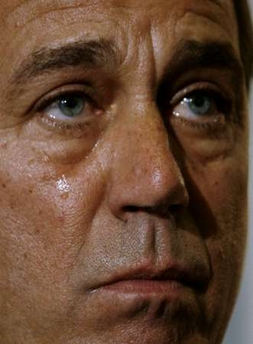 Pols always seem to use over-the-top rhetoric when trying to get elected. We’ve had smear campaigns and unfulfilled campaign promises for as long as there has been some one running for an elected office. Journalists enjoy making headlines out of this rhetoric and we’ve entered an age where they don’t even hesitate to join in on the pitch. The Supremes have upheld free speech rights for NAZIs parading in Jewish neighborhoods, opportunistic gay hating religionists spewing bile at the funerals of US soldiers, and megacorporations. No one wants to draw any lines on freedom of expression these days.
The first amendment is a beautiful thing. So is, however, self-restraint. Just because you have a broad right, a big mouth, and some urge to purge doesn’t necessarily mean you should avail yourself of the opportunity. This was always made clear to me as a kid with the example of ‘Don’t yell fire in a crowded theater if there’s no fire’. Evidently Weeper of the House John Boehner slept through that part of the social studies curriculum.
Markets–especially financial markets–thrive on information. Financial markets even trade on them. I remember working in the Treasury area of a large savings and loan in the 1980s while we were trying to package and sell mortgages, hedge using GNMA futures, and then price jumbo CDs to customers. All of this was in the era of Paul Volcker and yo yo interest rates. The Fed used to make announcements on Friday afternoons. The entire market would shut down in anticipation of the Fed’s announcements. The last few hours of business would screech to a halt until the information came out. We had one bond salesman that used to call us and read us jokes from a file box during the waiting hour. It was a weird time for all.
The Fed noticed how disruptive that was and ended the practice. Current Fed Chair Bernanke is so aware of how his words impact the market he even has a policy of ‘managing expectations’ in that he always makes some kind of statement on monetary policy when releasing any information. He also does speeches to businesses where he clarifies how the Fed will be dealing with the markets for Treasuries. This is supposed to end a lot of instability and speculation that can damage investment positions unnecessarily. You really don’t want to mess with Treasury markets because they represent the base, risk-free rate upon which everything else gets priced.
That brings me to to a few people in politics that don’t seem to connect market instability to policy maker rhetoric. It seems every one has learned that lesson except the outrageous Speaker of the House John Boehner who appears to want to make the markets as shaky as his hands.
House Speaker John Boehner routinely offers this diagnosis of the U.S.’s fiscal condition: “We’re broke; Broke going on bankrupt,” he said in a Feb. 28 speech in Nashville.
Boehner’s assessment dominates a debate over the federal budget that could lead to a government shutdown. It is a widely shared view with just one flaw: It’s wrong.
“The U.S. government is not broke,” said Marc Chandler, global head of currency strategy for Brown Brothers Harriman & Co. in New York. “There’s no evidence that the market is treating the U.S. government like it’s broke.”
The U.S. today is able to borrow at historically low interest rates, paying 0.68 percent on a two-year note that it had to offer at 5.1 percent before the financial crisis began in 2007. Financial products that pay off if Uncle Sam defaults aren’t attracting unusual investor demand. And tax revenue as a percentage of the economy is at a 60-year low, meaning if the government needs to raise cash and can summon the political will, it could do so.
Speaker Boehner’s staff answers any criticism of his rhetoric with the usual false equivalency. Interestingly enough, the Bloomberg article I’m quoting is finally taking on the ridiculousness of equating our government with family finances. Every financial economist loses a bowtie whenever that happens.
“If an American family is spending more money than they’re making year after year after year, they’re broke,” said Michael Steel, a spokesman for Boehner.
A person, company or nation would be defined as “broke” if it couldn’t pay its bills, and that is not the case with the U.S. Despite an annual budget deficit expected to reach $1.6 trillion this year, the government continues to meet its financial obligations, and investors say there is little concern that will change.
Still, a rhetorical drumbeat has spread that the U.S. is tapped out. Republicans, including Representative Ron Paul of Texas, chairman of the House domestic monetary policy subcommittee, and Fox News commentator Bill O’Reilly, have labeled the U.S. “broke” in recent days.
Chris Christie, the Republican governor of New Jersey, said in a speech last month that the Medicare program is “going to bankrupt us.” Julian Robertson, chairman of Tiger Management LLC in New York, told The Australian newspaper March 2: “we’re broke, broker than all get out.”
The U.S. government is not one big dysfunctional family unit. People die. Their estates have to be settled. They can’t print money. They can’t tax any one else’s assets. Their incomes don’t grow in perpetuity into the trillions of dollars. Politicians who continually make this false equivalency are not only wrong, they are dangerously wrong.
When Governor Christie makes these ridiculous statements the biggest damage he can do is limited. At the very worst, the market may price New Jersey’s bond issues as riskier. The resale market for NJ bonds may get thinner. This is especially true if Christie shows any willingness to entertain the idea of state bankruptcy which at this point can’t even happen. If he shows unwillingness to use the state’s taxing powers to clear up the mess, he can also create some havoc in the market. Every one knows a government can get the funds to pay its debt one way or another. Showing the world you won’t do it in a timely way just makes your bondholders extra nervous.
Speaker of the House Boehner has a bigger job that includes the budget of the U.S. He can unnecessarily influence financial markets while repeating such craziness. The U.S. cannot technically go bankrupt but speculation and uncertainty can impact the rate of interest we will pay on our debt. It can also cause the FED to enact money supply increases to maintain low levels of interest which can create inflationary pressures. Boehner is at a level of power that careless political rhetoric can influence markets. He needs to be more mature and less cavalier with his ignorant pronouncements on US debt and the US economy.
I swear that these guys are purposefully trying to tank the economy.

 peej
peej Carissa
 bostonboomer
 dakinikat
 ecocatwoman
 mablue2
 Mama Lopez
 peggysue22
 quixote
 skydancingguestblogger
 Mona (aka Wonk the Vote)



 Sky Dancing
Recent Comments