
Tuesday Reads: Romney and Zingers, Environmental Activism, and A Bit of Schadenfreude
Posted: October 2, 2012 Filed under: 2012 presidential campaign, Banksters, Barack Obama, Environment, Environmentalists, Mitt Romney, morning reads, U.S. Politics | Tags: Donald Trump, Eric Schneiderman, federal lands, first presidential debate, Haley Barbour, Harry Reid, James Bruggers, Jamie Dimon, JP Morgan, public lands, Tar Sands blockade, zingers 76 Comments
Good Morning!!
I have some interesting links today–some of them a couple of days old, but even if you’ve seen them, they bear repeating.
First up, there’s just one more day until the first presidential debate. I just can’t wait to hear those “zingers” Mitt Romney’s advisers told the NYT he has been practicing for months.
Mr. Romney’s team has concluded that debates are about creating moments and has equipped him with a series of zingers that he has memorized and has been practicing on aides since August. His strategy includes luring the president into appearing smug or evasive about his responsibility for the economy.
Since August? I hope they haven’t gotten stale. Apparently they’re hoping Obama will have another “likable enough” moment. I doubt that will happen, but we’ll see.
Frankly, as Ezra Klein writes at HuffPo, Romney would be better off to forget the zingers and develop more popular policies.
Behind in the polls and facing mounting panic among his donors, Mitt Romney is readying his secret weapon for the debates: Zingers….Pro tip: If your strategy to turn the presidential election around relies on Romney’s sense of comic timing, you might want to prepare a Plan B, as well.
The idea that this election can be reshaped by a zinger speaks to a deeper problem in the Romney campaign’s fundamental view of the race. As they see it, Obama’s record is an obvious disaster and their job entails little more than pointing that out over and over again. That the polls haven’t seemed responsive to this theory hasn’t dissuaded them. The new explanation for Romney’s difficulties is that the media are in the tank for Obama and that’s why the Romney campaign’s message isn’t breaking through.
But, Klein says, Americans know the economy is bad, but they also think it would have been worse if John McCain had been elected, rather than Barack Obama. Check out the chart.

Anna Marie Cox also addressed the “zingers” story at the Guardian.
The Romney campaign, having already proven able to discover impressive new ways for a nomination to blunder (my jaw still involuntarily drops a little when I hear the phrase “47%”), they have now added yet another type of podiatric wound to their catalogue. According to a report in the New York Times on Saturday, Romney’s staff “has equipped him with a series of zingers that he has memorized and has been practicing on aides since August.”
Already an awkward presence, Romney seems particularly susceptible to the tense stillness and deathless pathos that accompanies a dud punchline. Picturing the forced jocularity around the campaign headquarters has its pleasures, specifically the idea of Mitt trotting out well-worn jokes with the panache of a Catskills stand-up:
“Take my economic policy … please!”
“How lazy is half America? So lazy …”
“Any car-elevator owners in the audience tonight?”
But there’s an awful flipside: my God, what if he actually tries one of them?
Whether you wince or guffaw at the image of Romney attempting and failing to “zing” the president, probably says more about your tolerance for the humiliation of others than your political sensibilities. You’d think covering politics would have inured me to it by now, but in real life, I can’t even watch “American Idol”. I will view the debate on Wednesday through the spaces between my fingers, with a desk nearby to bang my head against.
What I really wish is that Romney would follow Donald Trump’s advice. According to TPM, Trump tweeted that Romney “should ask Obama why autobiography states “born in Kenya, raised in Indonesia.”
Romney will definitely have to watch his tone though, based on the results of a focus group study that TPM reported today. And Republicans will have a hard time saying this one is biased, because it was done by Haley Barbour’s company.
Barbour’s firm Resurgent Republic conducted focus groups of blue collar voters in Ohio and suburban women in Virginia who supported Obama in 2008 but are now undecided. Both are swing demographics that Romney is working to win over in order to flip each state from blue to red.
Their findings? Voters are a lot more willing to believe attacks based around Romney quotes than they are on Obama quotes.
“Whenever we showed direct quotes from President Obama over the last few years, voters consistently say that this is probably taken out of context and they don’t seem to hold that same standard with Governor Romney,” pollster Linda DiVall, who conducted the Virginia focus groups, said in a conference call announcing the findings Monday.
She added that while their reaction struck her as “a little bit unfair,” it was nonetheless “American voters’ right to do that.”
Pollster Ed Goeas said his own Ohio focus groups elicited similar responses, which could make things harder for Romney as he seeks to reverse his comments that 47 percent of Americans consider themselves “victims.”
It sounds like these swing state voters have figured out that Romney is a lying liar who only cares about the needs of the top .01 percent. Voters just aren’t as stupid as the Romney campaign thinks.
Did you see the tough op-ed Harry Reid wrote for the Las Vegas Sun on Sunday? He really ripped Romney a new one.
We learn the most about someone’s character not from what he does when he knows others are watching but from what he does when he thinks they aren’t.
We’ve learned an awful lot of troubling things about Mitt Romney recently. First, his sweeping, closed-door condemnation of President Barack Obama’s supporters revealed the disdain he has for half the population he hopes to serve. Then, the limited tax returns Romney selectively released confirmed that he’s willing to share information about the time he’s been in the public eye and running for president, but not the time he was running the corporation he touts as his sole qualifying credential for the highest office in the land.
When he thought no one was listening, Romney accused 47 percent of Americans of not taking responsibility for their lives, painting them as lounging in government dependency — a conclusion he reached because, for various legitimate reasons, they are exempt from paying federal income taxes.
Romney stands not only on shaky ethical grounds in making that indiscriminate generalization — he’s also on flimsy factual footing. The 47 percent Romney derides as self-pitying “victims” includes seniors who live on a fixed income thanks to the Social Security they paid into and earned over a lifetime of hard work, our troops in combat zones and veterans who have fought for our country. It includes students studying to get the skills that will win them the jobs of the future and decent Americans actively looking for work because their jobs were outsourced by companies such as those Romney specialized in developing. Most of them pay plenty of payroll, property, local and state taxes.
Reid goes on to beat Romney over the head with his secret tax returns one more time. Go read the whole thing if you haven’t already. Reid is turning out to be the Democratic attack dog of the 2012 campaign season.
Just one more Romney link: Romney would put states in charge of federal lands. James Bruggers, a Kentucky reporter who covers environmental issues full-time writes:
Our public lands are a birthright, held in trust for each one of us and managed by a set of laws that were worked out through compromise by Congress and various presidential administrations going back generations.
They provide places for us to hike, ride our mountain bikes, horses, camp, hunt and fish. Many are managed for multiple uses, and they also allow for cattle grazing, timber harvesting, oil and gas development, mining and skiing.
Romney, however, has said he would change all this, putting states in control of lands now under the stewardship of such agencies as the U.S. Forest Service and the Bureau of Land Management, who are charged with making sure all Americans have a say in their management. Often this gets reported simply as an expansion of oil and gas development on public lands, a simplification that fails to acknowledge just how radical of a shift in public policy it would be to turn over federal lands to state control.
From a Romney white paper:
States will be empowered to establish processes to oversee the development and production of all forms of energy on federal lands within their borders, excluding only lands specially designated off-limits;
• State regulatory processes and permitting programs for all forms of energy development will be deemed to satisfy all requirements of federal law;
• Federal agencies will certify state processes as adequate, according to established criteria that are sufficiently broad, to afford the states maximum flexibility to ascertain what is
most appropriate.
I still remember how shocked I was when I heard Romney say this in the Nevada primary debate. This is a huge issue as far as I’m concerned. American is still a beautiful country with many unspoiled wilderness areas. It is vital that we protect those public lands–they belong to all Americans, not to individual state governments.
Here’s another environmental story on the attempts to block the Keystone XL pipeline: BREAKING: Blockader Locks to Underground Capsule to Protect a Family Farm. It’s a live blog of the “Tar Sands blockade.” Here’s their Facebook page.
From Firedoglake blogger Kevin Gosztola:
A Tar Sands Blockader, Alejandro de la Torre, locked his body in a concrete capsule buried in the path of TransCanada’s Keystone XL pipeline to stop a small family farm in East Texas from being destroyed by construction. He blocked demolition for at least six hours before police were able to break off a chunk of concrete is arm was in and arrest him.
Police confiscated cameras of Blockaders that were there to film for Torre’s safety. Tar Sands Blockade spokesperson Ramsey Sprague reported they wanted to keep cameras on him as long as possible but police intimidated observers and took the cameras.
Last week, TransCanada supervisors encouraged police to use torture tactics on protesters to stop their nonviolent direct action.
Sprague recounted the brutality, which was “astounding.” Shannon “Rain” Beebe and Benjamin Franklin locked themselves to TransCanada machinery to stop clear-cutting. The police hung them with their arms behind their backs. They put pressure on their shoulder with their arms twisted. They pepper sprayed a tube connecting their arms. They twisted a tube cutting off circulation to their hands. (One protester is seeking medical attention for nerve damage.)
The police used tasers and planned to keep using tasers on Beebe and Franklin until they released. Cameras were supposed to be on the scene to film the action, but police were directed by TransCanada supervisors to run off those with cameras so they could commit brutality without people seeing video evidence on the evening news.
Continuing the environmental theme, pioneering environmental activist Barry Commoner died on Sunday.
Scientist and activist Barry Commoner, who raised early concerns about the effects of radioactive fallout and was one of the pioneers of the environmental movement, has died at age 95.
Commoner died Sunday afternoon at a Manhattan hospital, where he had been since Friday, said his wife, Lisa Feiner. He lived in Brooklyn.Commoner was an outspoken advocate for environmental issues. He was one of the founders of a well-known survey of baby teeth in St. Louis that started in the late 1950s. The survey assessed the levels of strontium-90 in the teeth and showed how children were absorbing radioactive fallout from nuclear bombs that were being tested.
The survey helped persuade government officials to partially ban some kinds of nuclear testing.
Feiner said Commoner had “a very strong belief that scientists had a social responsibility, that the discoveries would be used for social good and that scientists also had an obligation to educate the public about scientific issues so that the public could make informed political decisions.”Commoner took on that role of educating the public, writing books on environmental issues. Among his works were “Making Peace with the Planet” and “Science and Survival.” He made the cover of Time magazine in early 1970 and ran for president as a third-party candidate in 1980.
Finally, here’s a little bit of schadenfreude for you. Bloomberg reports that New York is “suing JP Morgan for fraud over mortgages securities.”
JPMorgan Chase & Co. (JPM), the biggest U.S. bank, was sued by New York Attorney General Eric Schneiderman over claims that the Bear Stearns business the bank took over in 2008 defrauded mortgage-bond investors.
Investors were deceived about the defective loans backing securities they bought, leading to “monumental losses,” Schneiderman said in a complaint filed today in New York State Supreme Court.
“Defendants systematically failed to fully evaluate the loans, largely ignored the defects that their limited review did uncover, and kept investors in the dark about both the inadequacy of their review procedures and the defects in the underlying loans,” Schneiderman’s office said.
Schneiderman in January was named co-chairman of a state- federal group formed to investigate misconduct in bundling of mortgage loans into securities leading up to the financial crisis. The group includes officials from the U.S. Justice Department, the Securities and Exchange Commission, the FBI and other federal and state officials.
Poor Jamie Dimon. Why don’t people respect his “success?”
Those are my suggestions for today. What are you reading and blogging about?
How to Fight Corporate Greed And Actually Make A Difference
Posted: March 13, 2012 Filed under: #Occupy and We are the 99 percent!, corporate greed, corporatism, Environment, Environmental Protection, Environmentalists, globalization, science, social justice 11 CommentsYesterday I posted the rather dismal news about Pennsylvania’s Act 13, a corporate-driven piece of legislation that bows on bended knee to the gas and oil industry at the expense of citizen and community civil rights. All for the love of fracking, natural gas and profits. Did I mention there’s a glut of natural gas on the market right now? The price has dropped like a stone due to oversupply and the incredibly mild winter we’ve had in the States. Prices, however, are much higher elsewhere. Asia and Europe, for instance. And energy companies are pushing for permits to build LNG [liquid natural gas] terminals for that very purpose. According to Forbes magazine:
A thousand cubic feet of natural gas currently costs $14 to $15 in Asia, $8 to $9 in Europe, and $4 in North America, down 9 percent from what it was at the outset of 2011.
That could make corporate CEO’s and investors very grumpy.
It could also make Pennsylvania residents grumpy. It’s bad enough to compromise the environment, jeopardize water supplies and threaten the health of American citizens but then the product is exported elsewhere for increased profits? I can hear heads exploding.
The Forbes article indicates the high investment cost on LGN terminals could easily make this scheme impractical. But the scale of these problems and the power that large corporations wield seem depressingly insurmountable. With energy solutions, the problems are magnified. We need energy to keep on, keeping on. The question is finding a balance between getting the energy we need and what we’re willing to accept as ‘collateral damage.’ It can make your head hurt.
Karma must have led me to an article by Jim Schultz, the executive director of the Democracy Center, an organization that works globally to educate citizens on effective advocacy for environmental and social issues. His article, ‘Three Ways to Beat Corporate Giants’ improved my mood immensely.
Make It Personal
 The example Schultz provides is the Bolivian Water Revolt against Bechtel and the World Bank’s meddling. I’d heard about the 2000 revolt previously, the privatization of the public water supply in Bolivia’s third largest city, Cochabamba. Within weeks of taking over, Bechtel raised water prices by nearly 50%. The poor were literally forced to choose between food or water. Massive protests resulted in the city as rural people joined the pushback. The president, Hugo Banzer, tried repressing the opposition but protests continued unabated. A resulting 4-day workers’ strike brought the strife to an end–Banzer cancelled the Bechtel contract.
However, what I didn’t know [or didn’t remember] was that Bechtel attempted to sue the citizens of Cochabamba for $50 million, though their investment was reportedly less than $1 million. Activists then made the fight personal. Their goal? Make the life of CEO Riley Bechtel and his top management team miserable. They flooded their personal accounts with email. They derided their names and actions at every opportunity in the media. They protested in front of the company’s headquarters and the officer’s private residences. Ultimately, the protest prevailed. Bechtel settled for a token payment of 30 cents.
Add Humor To Your Protests
The plan to replace a coal-fired station is featured, a project in southwest England to be built by a German energy company. Environmentalists and grassroot activists used protests, petitions and civil disobedience—standard fare. But they also added a twist. Since the new station was advertised as ‘clean coal,’ protestors showed up to publicly scrub coal in front of the German company’s office [E. On Energy] and then sent a Santa brigade to deliver the coal to ‘naughty’ executives. This action caught the attention and favor of the public. Ultimately, the protest worked—the energy company withdrew its plans and the UK government pledged not to approve any other coal-fired stations without carbon capture and storage capabilities [a technology yet to be fully developed].
Concentrate On Shareholders
The successful campaign against Occidental Oil Co. and their plans to drill in the Columbian ‘cloud forest,’ focused on the primary investors of the oil field development plan. The region, which is the tribal home to the indigenous U’wa people, the environmental threat to the bio-diversity of the area and the fear of armed violence from the country’s FARC rebels fueled massive protests on Fidelity Investments, a primary shareholder of Occidental. It was through the protests and the exposure of the U’wa people’s way of life—their spiritual connection to the forest, what they stood to lose–that convinced [maybe shamed] the business world to withdraw support and funding for the project. Another win.
In the end, our national and global problems look insurmountable and corporate power certainly appears invincible at first glance. It’s a good refresher to realize that there have been victories and there are citizens, here and abroad, willing to put it on the line and speak out against the rise of corporate greed and bullying. Activists may not win all the battles. But they’ve won some and continue to pushback. For that, I salute them. It’s also a reminder as one Occupy sign shouted out:

And then, I stumbled across this video. It made me laugh and laughing is good for the soul. I’d file this under category #2 in Jim Schultz’s guidebook. Sometimes humor can make a statement of its own.
When Corporations Mutate Into A Super Race
Posted: March 12, 2012 Filed under: corporate money, corporatism, Economy, energy, Environment, Environmental Protection, Environmentalists, fracking, Regulation, toxic waste 12 CommentsWe all remember Mitt Romney’s public and awkward statement that ‘Corporations are people, too.”
But Romney was underplaying the reality of American life in 2012.
Corporations are not mere people. They have morphed into a Super Race, ready to conquer what’s left of our disintegrating democracy. If you think this is liberal hysteria or rank hyperbole, I give you Pennsylvania’s newly passed Act 13. Bad number. But the scope of this foolish and utterly destructive state giveaway is far worse.
Act 13 is a massive gift to the oil and gas companies, which overturn property rights, strips municipal communities of zoning law protection and turn environmental and health compromises into considerations we can no longer afford. It reduces the citizens of Pennsylvania to 3rd world colony status, ripe for exploitation and extraction. Welcome to the New World of Corporate Rule where natural gas extraction is the profitable prize and quality of life is a thing of the past.
And the reaction?
“Now I know what it feels like to live in Nigeria,” said recently retired Pittsburgh City Council President Doug Shields. “You’re basically a resource colony for multi-national corporations to take your natural resources, take them back to wherever they are at, add value to them, and then sell them back to you.”
Yup. This is the neoliberal dream. Steal, add value and then sell back at an exorbitant price tag. The whole world is nothing more than a resource colony so the corporate Super Race can turn a mind-boggling profit. On the backs of the natives. Water safety and/or depletion, health, wildlife? All expendable in this great push for growth and ever-increasing profit. Moral considerations? Please, haven’t you gotten the email? Corporations don’t do morality. They’re too big for that.

Fracking in SW Pennsylvania
Why did this happen in Pennsylvania? Because of the enormous layer of shale deposits known as the Marcellus formation, resting like a slumbering giant beneath the state’s surface. But there’s more! That would be the gargantuan amount of natural gas to be had at a stunning profit—as much as 70-99% some managers of earlier drill wells have boasted.
How could investors resist?
But then, there are the rising concerns of the fracking process itself, the public’s growing awareness of water and air pollution, the niggling problem of toxic wastewater disposal and those bothersome legal suits from citizens with lame health issues.
What to do, what to do?
Act 13 is the perfect response to investor skittishness. It removes all complaint and whining by simply supplanting existing law—the kind that protects the citizen—with corporate friendly law that recognizes the global reality—everyone is for sale and everything can be exploited.
To keep tempers in check, the best PR in the world is dished out, promises of jobs and prosperity, spinning dialogues about energy independence [at any cost] and patriotic flag-waving—how tearing up the earth, polluting our waterways and compromising the public’s health is good for America. After all, in times of crisis, sacrifices need to be made, even when it means overriding the civil rights of people and communities.
That is exactly what Act 13 addresses.
Courts in the Great State of New York upholding community rights to block fracking dreams is simply unacceptable. Act 13 revokes those rights. The Lakota people in South Dakota blocking TransCanada truck transports across Native territory? We can’t have that. Act 13 clearly empowers a corporation to seize property that impacts any stage of the drilling process. And those possible health considerations? Got it covered, boys and girls. Act 13 prohibits physicians from discussing medical impacts from chemical contaminations. The Halliburton Loophole in all its malicious splendor comes back to haunt us.
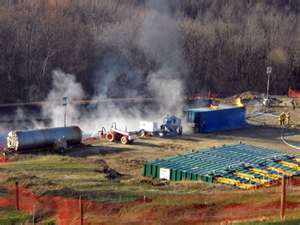
Marcellus Fracking Pit
This is what happens when corporations are declared ‘people.’ This is what happens when legislators sell their souls for 30 pieces of silver. I do not care if Republican Governor Corbett and his Republican dwarves truly believe this is good for Pennsylvania. This is a betrayal of American law and her people on a massive scale. The good citizens of Pennsylvania might look at the situation in Ohio, where Governor Kasich opened the state’s doors for business, any business, and Ohio became the dumping ground for fracking wastewater disposal and deep ground injection wells. We now know those earthquakes were not coincidental events. No wonder Republicans hate science!
Hattip to Alternet on this rant. I’d recommend reading the article ‘Fracking Democracy: Why Pennsylvania’s Act 13 May Be the Nation’s Worst Corporate Giveaway’ by Steven Rosenfeld in its entirety with the first link I provided. It’s a chilling, mind-blowing report.
Act 13 is expected to take effect on April 14th. We better pray [regardless of what state we live in] that the groups now amassing in Pennsylvania are able to halt or at least slow down this corporate monstrosity.
Because if not, we can say ‘adios’ to the shredded remnants of our Republic.
As for Pennsylvania? My heart goes out because I lived and worked in the state for over a dozen years and still have family in the area. The economy has been raked over the coals, so the promise of jobs and money injected into struggling municipalities and rural communities is a huge seduction. But we’ve seen this movie before. It does not end well. Here’s hoping that flesh and blood citizens get a chance to write a far better script for themselves and their future. Here’s hoping the rest of the country wakes up to what can only be called a corporate takeover.
Can We Admit That What We’re Seeing Is More Than . . . ‘Weather?’
Posted: March 5, 2012 Filed under: Capitalism 3.0, Climate Change, Environment, Environmentalists, ethics, globalization, Rick Santorum, Rush Limbaugh | Tags: global warming, tornadoes, weather 16 CommentsThese are some images from my neck of the woods from this past weekend’s round of ‘weather.’

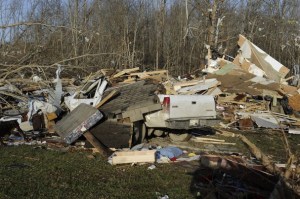
Now granted, I’m not a native of the southeast—South Jersey girl here. But the locals tell me that vertical winds are a hellva lot different than tornado touchdowns, particularly when you’re living in hill country, in the shadow of the Smoky Mountains. Locally, this time we were fortunate—some downed branches and yard mess. The major damage was to the east and south of us. Last year? Not so much. 
In fact, last year’s April storm front in the southeast produced 280+ tornadoes in 3 days. Historic, the headlines screamed.
If this were merely a local event, we could chalk it up to bad luck and Mother Nature in a cranky mood. But consider that earth-orbiting satellites have been gathering scientific data not previously available, giving us the ‘big picture’, data on a global scale. The following evidence has been accumulated:
- Sea levels are, in fact, rising, the rate of the last decade nearly double that of the last century.
- Global temperatures are on the rise, increasing since the 1970s with the 10 hottest recorded temperatures within the last 12 years.
- The oceans have been warming since 1969, measureable temperatures increasing in the top surfaces [2300 ft] and the acidification of the oceans has increased by 30% since the start of the Industrial Revolution.
- Glaciers are retreating, the Arctic sea ice is shrinking and the ice sheets of Greenland [36-60 cubic miles per year between 2002-2006] and the Antarctic [36 cubic miles per year between 2002-2005] have declined.
According to NASA data, there are certain facts beyond dispute:
The heat-trapping nature of carbon dioxide and other gases was demonstrated in the mid-19th century. Their ability to affect the transfer of infrared energy through the atmosphere is the scientific basis of many JPL-designed instruments, such as AIRS. Increased levels of greenhouse gases must cause the Earth to warm in response.
Ice cores drawn from Greenland, Antarctica, and tropical mountain glaciers show that the Earth’s climate responds to changes in solar output, in the Earth’s orbit, and in greenhouse gas levels. They also show that in the past, large changes in climate have happened very quickly, geologically-speaking: in tens of years, not in millions or even thousands.
We can take the facts and data of NASA, their orbiting satellites and sensors or we can fall back on the word of say . . . a Rick Santorum, who has proven himself such an expert on other subjects. According to Santorum in a speech in Colorado:
[Climate change is] an absolute travesty of scientific research that was motivated by those who, in my opinion, saw this as an opportunity to create a panic and a crisis for government to be able to step in and even more greatly control your life. … I for one never bought the hoax. I for one understand just from science that there are one hundred factors that influence the climate. To suggest that one minor factor of which man’s contribution is a minor factor in the minor factor is the determining ingredient in the sauce that affects the entire global warming and cooling is just absurd on its face. And yet we have politicians running to the ramparts — unfortunately politicians who happen to be running for the Republican nomination for president — who bought into man-made global warming and bought into cap-and-trade.
We can argue the merits of cap and trade but I find it comical that Santorum is running around talking about Satan on one hand—a Santorum absolute–while denying climate change on the other. This is a ‘don’t trust your lying eyes’ moment. And certainly don’t trust science. He continued with:
We were put on this Earth as creatures of God to have dominion over the Earth, to use it wisely and steward it wisely, but for our benefit not for the Earth’s benefit … We are the intelligent beings that know how to manage things and through that course of science and discovery if we can be better stewards of this environment, then we should not let the vagaries of nature destroy what we have helped create.
Huh? I’m not sure what this rambling statement is intended to mean, other than we shouldn’t let nature clue us in that we’re skating on the edge, pushing the health of the planet and its inhabitants to the max. Full steam ahead with those extractions, boys!
Of course, Santorum is not alone in this type of denial. Rush Limbaugh, who has had his fair share of attention in the last few days [not of the good kind], had this to say after declaring climate change a ‘hoax’:
I happen to believe in God. I believe in a loving, brilliant – I know that this – there is no way, I don’t want to sound simpleton here, but there is not – it is not possible that we would be created by a creator in such a way that we would destroy by virtue of our created existence our own planet and environment. It just doesn’t compute and yet that’s what these people are trying to tell us. [Premiere Radio Networks, The Rush Limbaugh Show, 2/2/11
All righty then! God, a loving brilliant God, would not allow us to destroy ourselves. Scrap all that science and data, the fat man speaketh.
Beginning to see a pattern here? We can believe in myth—Satan’s going to getcha and/or a benevolent, personal God-creator, who would never allow Man to be stupid enough to destroy His/Her creation. No problem then. Keep spewing those toxins into the air, don’t worry about contaminating our water supply and . . . heat? What heat?
Despite the relentless war on climate data in particular and science in general, it turns out the public is beginning to catch on to all the corporate-friendly tap dancing. After a dip in public sentiment about Climate Change and the mass investment in misinformation, Americans are using their powers of observation and taking heed to the mounting evidence. According to the Brookings Institute National Survey, Fall 2011, a strong majority [62%] of the American public now believes that global warming is real and poses a threat to global security. Observation to local effects of warming temperatures and world-wide reports of floods, droughts, freakishly warm temperatures, melting ice sheets, ocean acidification and the effects on wildlife and fauna are slowly turning opinion.
We cannot wait for a benevolent God-spirit to save us. We’ll need to do that for ourselves, sooner rather than later. Because we won’t get a second chance. As Naomi Klien recently stated any real shift towards climate sustainability means a shift in the entire free-market ethos that depends on continual growth, massive extraction and profit-making over people.
. . . you can’t do it all with carbon markets and offsetting. You have to really seriously regulate corporations and invest in the public sector. And we need to build public transport systems and light rail and affordable housing along transit lines to lower emissions. The market is not going to step up to this challenge. We must do more: rebuild levees and bridges and the public sphere, because we saw in Katrina what happens when weak infrastructure clashes with heavy weather—it’s catastrophe. These climate deniers aren’t crazy—their worldview is under threat. If you take climate change seriously, you do have to throw out the free-market playbook.
In the end, so many of these pressing issues are related to a flawed economic and political model—the current corporate state. It will be up to us to reimagine a new system or as Peter Barnes suggested in ‘Capitalism 3.0,’ it’s time to upgrade.
Because there’s no place to run or hide. Earth is the only home we have. Reclaiming the commons isn’t optional; it’s a must. And personally? I’m just not into wicked tornadoes.

UPDATE: The Red Cross is now asking for donations for storm ravaged areas in the Southeast. Contact your local offices for information. Or go here.
I See Dead People
Posted: February 27, 2012 Filed under: 2012 elections, 2012 primaries, corruption, Democratic Politics, Environment, Environmentalists, George W. Bush, Politics as Usual, Republican politics, Tea Party activists 23 CommentsMaybe this should be the new Republican mantra for a suitable candidate in 2012. If Republican politicians aren’t conjuring up the ghost of  Ronald Reagan every fifteen minutes, they can go back further into the annals of GOP glory and dig up another Republican corpse. Say . . . Ike Eisenhower. And lo and behold, that’s exactly what NY Times columnist Ross Douthat attempts in his recent “The Greatness of Ike” piece, which extolls the General’s many virtues, bemoans the fact that Eisenhower is overshadowed by the likes of FDR, ties for twelfth-place in POTUS rankings with Jimmy Carter and is generally under appreciated.
The man may have a point.
I recall Eisenhower’s warnings about the industrial/military complex being aired frequently throughout my living memory. Yet no one has paid much attention beyond nodding and saying: yes, the man was right. I suspect the current state of affairs, the country involved in a decade of senseless war, where defense contractors and mercenaries have been made fat and happy, proves the General’s point. Only problem for the Republicans is that it was likes of George W. Bush, Dick Cheney and Donald Rumsfeld who led the disastrous charge into Iraq on false allegations, hyped-up claims about weapons of mass destruction, and then offered a breath-taking defense of torture for national security purposes. Even more startling, they got away with it, leaving the country bleeding and bankrupt in their wake. All in the name of democracy, freedom and ‘shop ‘till you drop’ exhortations.
It was a moment of infamy, as someone once said.
This is why the glance backwards always skips over those inconvenient years of woeful mismanagement and fiscal insanity. No doubt the current batch of 2012 candidates, the Fearless Four, bring angst to all Republican hopefuls convinced, only a few, short months ago, that a 2012 victory was inevitable, a piece of cake.
A powerful dose of nostalgia makes the medicine go down easier.
Surely, the good ole days seem ever more grand as Rick Santorum raises the flag for a home-grown theocracy and dances with the Devil, Mitt Romney continues to stumble over his own tongue [revealing his wife drives ‘two’ Caddies], Newt Gingrich beats his breast over the secular plot to undermine America and Ron Paul, the cuddly libertarian, begins to look and sound strangely reasonable.
 What’s a true-blue Republican to do?
Dig up some corpses.
Am I, a thoroughly disenchanted Democrat gloating? In a pinch, yes. In the long-term, no, because I’m stuck with a candidate I did not vote for in 2008, a man who has proven himself less a champion of Democratic principles than even I ever expected.
As a Nation, we are stuck in a rut for which there seem few alternatives. The legacy parties offer nothing but more of the same—craziness on one side and the uninspiring ‘we suck less than they do’ on the other. As a voter, I’ve vowed to go 3rd party in November [unless the Republicans were to choose Santorum, then I’ll vote directly against him]. However, in the larger frame all I see are monied interests, directing and maneuvering what is suppose to be a ‘free’ election. It has virtually nothing to do with me or my values. On the contrary, it’s all about the persistence of a political class and their cash-soaked benefactors calling for war and protecting their national interests, the gutting of our social contract; the unwillingness to formulate a sensible energy program sans the giant fossil fuel companies’ interference or address the critical and devastating slippage in education, infrastructure, healthcare and employment opportunities.
We have plenty of money for bombs. But not our people. Bailouts are bad. Unless our representatives are saving the asses of and colluding with the corrupt TBTFs. Water and food is the stuff of life until there’s a pipeline, gushing with sludgy oil and money, to compromise both.
Ed Rollins, former Reagan strategist, made a statement recently about the 2012 Republican field:
“Six months before this thing got going, every Republican I know was saying, ‘We’re gonna win, we’re gonna beat Obama.’ Now even those who’ve endorsed Romney say, ‘My God, what a fucking mess.’
That about sums it up, not simply about the Republican field but the entire country. It is an effing mess. And there’s no savior on the horizon. In fact, there’s no savior anywhere. Unless we, the American public, do the saving. But that means coming together on issues where we can agree. The gridlock in DC gets us absolutely nowhere. It’s enough to put anyone into a funk.
But then this morning I read an article about environmentalists and Tea Party activists coming together to fight Keystone XL, the pipeline extension from Nebraska to Texas. For the Tea Party, it’s all about individual property rights and the way TransCanada, a foreign company, has attempted to strong-arm property owners. For the environmentalists it’s about preserving fertile farm land and a major aquifer from the too real danger of irreversible contamination. The nexus of agreement between these two wildly divergent political groups is this: the Keystone pipeline does not serve the public’s interest.
That’s the winning hand: the public’s interest. Not the oil companies, not the 196 people funding the SuperPacs, not the banks, not the Democratic or Republican parties.
What serves the public’s interest.
We, American citizens, can find ways to work together or continue to be spectators to the endless political theater, the Kabuki dance we call elections. And once more we’ll be digging up corpses, which could very well be our own.


 peej
peej Carissa
 bostonboomer
 dakinikat
 ecocatwoman
 mablue2
 Mama Lopez
 peggysue22
 quixote
 skydancingguestblogger
 Mona (aka Wonk the Vote)



 Sky Dancing
Recent Comments