


President Donald Trump was dejected, processing his very public split with the world’s richest man.
Rattled in the wake of Elon Musk’s public attacks and apparent call for his impeachment, Trump worked the phones, debriefing close confidants and casual acquaintances alike. His former ally was “a big-time drug addict,” Trump said at one point as he tried to make sense of Musk’s behavior, according to a person with knowledge of the call, who like others interviewed for this story spoke on the condition of anonymity to discuss sensitive matters.
Musk has acknowledged using ketamine, a powerful anesthetic, which he says was prescribed for him to treat depression. The New York Times recently reported that he was using so much ketamine on the campaign trail that he told people it was affecting his bladder, and he traveled with a pill box with medication with the marking of Adderall. White House officials said that Trump’s concern about Musk’s drug use, stemming in part from media reports, was one factor driving the two men apart.
But the president, who historically hasn’t hesitated to fire off deeply personal, blistering social media posts about others who have insulted him, was more muted regarding Musk than friends and advisers expected. In the aftermath of his Thursday faceoff with Musk, he urged those around him not to pour gasoline on the fire, according to two people with knowledge of his behavior. He told Vice President JD Vance to be cautious with how he spoke publicly about the Musk situation.
But although the break between Musk and Trump only exploded into public view on Thursday, cracks in the alliance began to appear much earlier. As Musk’s “move fast and break things” bravado complicated the White House’s ambitions to remake American society, the billionaire alienated key members of the White House staff, including Chief of Staff Susie Wiles, and quarreled with Cabinet members, physically coming to blows with one.
Lazy Caturday Reads
Posted: June 7, 2025 Filed under: Donald Trump, Elon Musk, ICE Immigration and Customs Enforcement, immigration | Tags: "Big Beautiful Bill", House budget bill, ICE raids, Kilmar Abreago Garcia, Los Angeles, Medicaid, NASA, social safety net, Social Security, Trump-Musk breakup 11 Comments
Their Cat, by Pauline Bewick
Good Afternoon!!
The epic spat between Trump and Musk is still dominating the media landscape, but that childish story should get some competition soon from the return of Kilmar Abrego Garcia to the U.S. The Trump administration finally decided to bring him back after they invented some “crimes” to charge him with and took them to a grand jury in Tennessee. The trumped up charges led a long-time prosecutor there to abruptly resign. Meanwhile, even though Musk is gone, DOGE is still working to steal all our private data. On the ICE/mass deportation front, Los Angeles looked like a war zone yesterday.
I’ll get to each of these stories, beginning with Abrego Garcia.
The Return of Kilmar Abrego Garcia
CNN: Kilmar Abrego Garcia has been returned to the United States to face criminal charges.
Kilmar Abrego Garcia, the Maryland man mistakenly deported to El Salvador in March, has been returned to the United States to face federal criminal charges, Attorney General Pam Bondi said Friday.
For months, the Trump administration has been locked in an intense standoff with the federal judiciary over court orders for the government to “facilitate” Abrego Garcia’s return from El Salvador, where he was mistakenly deported in mid-March, in a situation that one federal judge warned could present an “incipient crisis” between the two branches.
Abrego Garcia has been indicted on two criminal counts in the Middle District of Tennessee: conspiracy to unlawfully transport illegal aliens for financial gain and unlawful transportation of illegal aliens for financial gain.
The indictment unsealed Friday afternoon accuses Abrego Garcia and others of partaking in a conspiracy in recent years in which they “knowingly and unlawfully transported thousands of undocumented aliens who had no authorization to be present in the United States, and many of whom were MS-13 members and associates.”
Abrego Garcia and his family say he fled gang violence in El Salvador and have denied allegations he’s associated with MS-13.
The White House and the State Department made the decision to bring Abrego Garcia back to the U.S.
Simon Sandoval-Moshenberg, an attorney for Abrego Garcia, accused the Trump administration of “playing games” with the legal system and said his client should appear in immigration court, not criminal court.
“The government disappeared Kilmar to a foreign prison in violation of a court order. Now, after months of delay and secrecy, they’re bringing him back, not to correct their error but to prosecute him. This shows that they were playing games with the court all along,” Sandoval-Moshenberg said in a statement to CNN. “Due process means the chance to defend yourself before you’re punished, not after. This is an abuse of power, not justice.”
The alleged “crimes”:
The allegations date back to 2016 and involve a half-dozen alleged unnamed co-conspirators, with one, identified as CC-6 of Guatemala, described as being a “primary sources of supply of undocumented aliens for the conspiracy.”
Man with cat, Theresa Tanner
The conspiracy allegations outline how, over the years, Abrego Garcia and others worked to move undocumented aliens between Texas and Maryland and other states more than 100 times.
Working with another co-conspirator, referred to as CC-1, Abrego Garcia and that unnamed individual “ordinarily picked up the undocumented aliens in the Houston, Texas area after the aliens had unlawfully crossed the Southern border of the United States from Mexico,” the indictment said.
The two “then transported the undocumented aliens from Texas to other parts of the United States to further the aliens’ unlawful presence in the United States.”
You can read more details on the trumped up charges at the CNN link.
ABC News: Abrego Garcia indictment led top federal prosecutor in Tennessee to resign: Sources.
The decision to pursue the indictment against Kilmar Abrego Garcia led to the abrupt departure of Ben Schrader, a high-ranking federal prosecutor in Tennessee, sources briefed on Schrader’s decision told ABC News.
Schrader’s resignation was prompted by concerns that the case was being pursued for political reasons, the sources said.
Schrader, who spent 15 years in the U.S. A
ttorney’s Office in Nashville, and was most recently the chief of the criminal division, did not respond to messages from ABC News seeking comment.
Analysis by Alan Feuer at The New York Times (gift link): Return of Wrongly Deported Man Raises Questions About Trump’s Views of Justice.
When Attorney General Pam Bondi announced on Friday that Kilmar Armando Abrego Garcia had been returned to the United States to face criminal charges after being wrongfully deported to a prison in El Salvador, she sought to portray the move as the White House dutifully upholding the rule of law.
“This,” she said, “is what American justice looks like.”
Her assertion, however, failed to grapple with the fact that for the nearly three months before the Justice Department secured an indictment against Mr. Abrego Garcia, it had repeatedly flouted a series of court orders — including one from the Supreme Court — to “facilitate” his release.
While the indictment filed against Mr. Abrego Garcia contained serious allegations, accusing him of taking part in a conspiracy to smuggle undocumented immigrants as a member of the street gang MS-13, it had no bearing on the issues that have sat at the heart of the case since his summary expulsion in March.
Those were whether Mr. Abrego Garcia had received due process when he was plucked off the streets without a warrant and expelled days later to a prison in El Salvador, in what even Trump officials have repeatedly admitted was an error. And, moreover, whether administration officials should be held in contempt for repeatedly stonewalling a judge’s effort to get to the bottom of their actions.
Well before Mr. Abrego Garcia’s family filed a lawsuit seeking to force the White House to release him from El Salvador, administration officials had tried all means at their disposal to keep him overseas as they figured out a solution to the problem they had created, The New York Times found in a recent investigation.

Will Barnet, Interlude
Feuer discusses the Trump administration’s machinations:
In the days before the administration’s error was made public, officials at the Department of Homeland Security discussed portraying Mr. Abrego Garcia as a “leader” of MS-13, even though they could find no evidence to support the claim. They considered ways to nullify the original order that had barred his deportation to El Salvador. And they sought to downplay the danger he might face in one of that country’s most notorious prisons.
To Mr. Abrego Garcia’s lawyers, it was no surprise that the same officials who had fought so hard against securing his return suddenly agreed to bring him back to U.S. soil after they had obtained an indictment that bolstered the story they had been telling from the start.
“Today’s action proves what we’ve known all along — that the administration had the ability to bring him back and just refused to do so,” said Andrew Rossman, one of the lawyers. “It’s now up to our judicial system to see that Mr. Abrego Garcia receives the due process that the Constitution guarantees.”
Questions have already been raised about the criminal case, filed in Federal District Court in Nashville. There was concern and disagreement in recent weeks among prosecutors about how to proceed with the charges, two people familiar with the matter said, leading to the resignation of a supervisor in the federal prosecutor’s office handling the case.
Use the gift link to read the whole article. You can also read Marcy Wheeler’s take on the indictment at Emptywheel.
The Trump-Musk Split
There are gossipy article at the NYT, the WaPo, and the Atlantic.
Tyler Pager, Maggie Haberman, Jonathan Swan, Theodore Schleifer, and Ryan Mac at The New York Times: Buildup to a Meltdown: How the Trump-Musk Alliance Collapsed.
Just minutes before he walked into the Oval Office for a televised send-off for Elon Musk last week, an aide had handed him a file.
The papers showed that Mr. Trump’s nominee to run NASA — a close associate of Mr. Musk’s — had donated to prominent Democrats in recent years, including some who Mr. Trump was learning about for the first time.
The president set his outrage aside and mustered through a cordial public farewell. But as soon as the cameras left the Oval Office, the president confronted Mr. Musk. He started to read some of the donations out loud, shaking his head.
This was not good, the president said.
Artist Luis Garces Bonhemio y el gato
Mr. Musk, who was sporting a black eye that he blamed on a punch from his young son, tried to explain. He said Jared Isaacman, a billionaire entrepreneur who was set to become the next NASA administrator, cared about getting things done. Yes, he had donated to Democrats, but so had a lot of people.
Maybe it’s a good thing, Mr. Musk told the president — it shows that you’re willing to hire people of all stripes.
But Mr. Trump was unmoved. He said that people don’t change. These are the types of people who will turn, he said, and it won’t end up being good for us.
The moment of pique was a signal of the simmering tensions between the two men that would explode into the open less than a week later, upending what had been one of the most extraordinary alliances in American politics.
That’s the NYT take. Obviously, having a friend as head of NASA would be very good for Musk’s businesses.
Cat Zakrzewski, Natalie Allison, Elizabeth Dwoskin, Jeff Stein, and Emily Davies at The Washington Post (gift link): Inside the battles that shattered Trump and Musk’s alliance.
For once, President Donald Trump was trying to be the adult in the room.
Trump and Elon Musk, two billionaires with massive egos and combustible temperaments, had forged an unlikely friendship over the past year, one built on proximity, political expediency, and, yes, a touch of genuine warmth. Relations between the president and his top benefactor had grown somewhat strained in recent weeks, as Trump began to feel that Musk had overstayed his welcome in the West Wing. Musk had suggested privately that he could stay on at the White House, an offer that Trump gently declined, two people familiar with the situation told us. (They, like others we talked with for this story, spoke anonymously in order to share candid details about a sensitive feud.) But Musk was still given a gracious send-off last Friday—complete with a large golden, albeit ceremonial, key—aimed at keeping the mercurial tech baron more friend than foe.
Will Barnet, The Closed Window
The peace didn’t last even a week.
On Tuesday, Musk took to X to attack the Republican spending bill being debated in the Senate, trashing Trump’s signature piece of legislation as “a disgusting abomination.” Even as the White House tried to downplay any differences, Musk couldn’t let go of his grievances—the exclusion of electric-vehicle tax credits from the bill, and Trump’s rejection of Musk’s pick to run NASA.
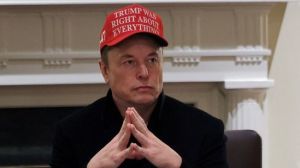
Yesterday, the planet’s richest man attacked its most powerful. Each took aim at the other from their respective social-media platform, forcing rubberneckers into a madcap toggle between Truth Social and X. Trump deemed his former aide “CRAZY,” while Musk went much further, dramatically escalating the feud by calling for Trump’s impeachment, suggesting that the president had been part of Jeffrey Epstein’s notorious sex-trafficking ring, and—likely worst of all in Trump’s mind—taking credit for the president’s election in November.
For one day, Musk made X great again. The spectacle seemed to subside today, as Trump showed—at least by his standards—some restraint. The president insisted that he was not thinking about Musk and wanted only to pass the reconciliation bill that had featured in the brawl. Musk, meanwhile, has far more to lose: his newfound stardom within the MAGA movement, his personal wealth, and government contracts worth billions to his businesses.
Steven Bannon, the influential Trump adviser who has long been critical of Musk, crowed that the tech billionaire’s attacks on Trump were so personal that he won’t be forgiven by the MAGA crowd. “Only the fanboys are going to stick with him—he’s a man without a country,” Bannon told us.

Use the gift link to read the whole thing if you’re intersted.
Greg Sargent strips away the gossip and gets to the meat of the Trump-Musk disagreements at The New Republic: The Real Reason for the Trump-Musk Feud is Uglier Than You Think.
As the war between Donald Trump and Elon Musk worsens, what’s truly odd about this whole spectacle is that the actual substantive disagreement between them seems to be of little interest to media observers. And when you strip away the trolling and shitposting, here’s what becomes clear: This is really a battle over how comprehensively to screw over poor and working people, largely to the benefit of the wealthy.
The superficial argument between them, of course, is over Musk’s opposition to the “big, beautiful bill” that the House passed and that Trump wants the Senate to adopt. That opposition is rooted in Musk’s claim that the bill is loaded with “pork” and will explode the deficit. Trump, meanwhile, is infuriated by Musk because he can’t brook criticism and wants the bill to pass to notch a victory.
But the respective positions underlying those stances are mysteriously missing from the whole Trump-Musk discourse. Flush them into the open, and it helps illuminate the true spectrum of the MAGA movement’s ideological goals—and why its “pro-worker populist” pretensions are so thoroughly phony.
The House GOP bill would entail a large upward transfer of resources. The bill, which would continue Trump’s 2017 tax law and add new tax giveaways for wealthy investors, heirs, and others, would deliver a big tax cut to those in the highest income brackets. According to the Center on Budget and Policy Priorities, the tax cuts enjoyed by those in the bottom 20 percent in 2027 would be one seven-hundredth the size of those reaped by the top 1 percent.
By Theresa Tanner
Worse, those relative table scraps for the bottom could be erased by other changes. The bill’s massive cuts to Medicaid and other health care changes would result in over 10 million people losing health insurance. Add in other cuts to the safety net, and you see why the bill ultimately would lower household resources for the bottom 10 percent while raising them for the top 10 percent—a sizable redistribution upward. As Paul Krugman notes, the bill’s “cruelty is exceptional even by right wing standards.”
Musk is angry about the $2.4 trillion those changes would add to the debt. But, crucially, he’s said little—if anything—about the role that those tax cuts for the rich would have in that outcome. He is primarily obsessed with the bill’s “pork,” meaning that he wants the bill to cut more spending—much, much more.
Where would that money come from? Musk’s cuts via his Department of Government Efficiency have already decimated foreign aid and other programs, producing more starvation, disease, and death among the global poor. Given that DOGE searched for “waste, fraud, and abuse” and found very little, if Musk wants massive additional cuts, by definition they would fall more heavily on important government programs, almost certainly ones that low-income Americans rely upon.
Another way to say this is that their real difference is over how far to push the “waste, fraud, and abuse” scam.

Read the rest at TNR.
What DOGE Is Up To
The New York Times: After His Trump Blowup, Musk May Be Out. But DOGE Is Just Getting Started.
Elon Musk’s blowup with President Trump may have doomed Washington’s most potent partnership, but the billionaire’s signature cost-cutting project has become deeply embedded in Mr. Trump’s administration and could be there to stay.
At the Department of Energy, for example, a former member of the Department of Government Efficiency is now serving as the chief of staff.
At the Interior Department, DOGE members have been converted into federal employees and embedded into the agency, said a person familiar with the matter, who spoke on condition of anonymity out of fear of retaliation. And at the Environmental Protection Agency, where a spokeswoman said that there are two senior officials associated with the DOGE mission, work continues apace on efforts to dismantle an agency that Mr. Trump has long targeted.
“They are still internally going forward; we don’t really feel as if anything has stopped here,” said Nicole Cantello, a former lawyer for the E.P.A. who represents its union in Chicago.
Whether DOGE keeps its current Musk-inspired form remains an open question. Some DOGE members on Friday expressed concern that the president could choose to retaliate against Mr. Musk by firing people associated with the initiative. Others could choose to leave on their own, following Mr. Musk out the door. And DOGE’s role, even its legality, remain the subject of legal battles amid questions over its attempts to use sensitive government data.
But the approach that DOGE embodied at the outset — deep cuts in spending, personnel and projects — appears to have taken root.
Even with Mr. Musk on the sidelines, DOGE on Friday notched two legal victories. The Supreme Court said that it can have access to sensitive Social Security data and ruled that, for now, the organization does not have to turn over internal records to a government watchdog group as part of a public records lawsuit.
Yes, the Supreme Court has struck again.
NBC News: Supreme Court allows DOGE to access Social Security data.
The Supreme Court on Friday allowed members of the Trump administration’s Department of Government Efficiency to access Social Security Administration data.
By Will Barnet
The conservative-majority court, with its three liberal justices objecting, granted an emergency application filed by the Trump administration asking the justices to lift an injunction issued by a federal judge in Maryland.
The unsigned order said that members of the DOGE team assigned to the Social Security Administration should have “access to the agency records in question in order for those members to do their work.”
The lawsuit challenging DOGE’s actions was filed by progressive group Democracy Forward on behalf of two unions — the American Federation of State, County and Municipal Employees, and the American Federation of Teachers — as well as the Alliance for Retired Americans.
“This is a sad day for our democracy and a scary day for millions of people,” the groups said in a statement. “This ruling will enable President Trump and DOGE’s affiliates to steal Americans’ private and personal data.” [….]
Liberal Justice Ketanji Brown Jackson wrote a dissenting opinion questioning the need for the court to intervene on an emergency basis.
“In essence, the ‘urgency’ underlying the government’s stay application is the mere fact that it cannot be bothered to wait for the litigation process to play out before proceeding as it wishes,” she added.

Dramatic Protests Against ICE in Los Angeles
Los Angeles Times: Los Angeles ICE raids spark protests, fear, outrage. ‘Our community is under attack.’
A series of surprise U.S. Immigration and Customs Enforcement sweeps in downtown Los Angeles on Friday prompted fierce pushback from elected officials and protesters, who decried the enforcement actions as “cruel and unnecessary” and said they stoked fear in the immigrant community.
Tensions remained high in downtown into the evening. The Los Angeles Police Department declared an unlawful assembly and ordered about 200 protesters who remained gathered by the Los Angeles Federal Building to disperse around 7 p.m.
Portrait of Edward Gorey with his cat, by Sam Kalda
The use of so-called less-lethal munitions was authorized at 8 p.m. following reports of a small group of “violent individuals” throwing large pieces of concrete at officers, police said. A citywide tactical alert was issued shortly thereafter.
Chaos erupted earlier in the day in the heart of the Fashion District after federal immigration authorities detained employees inside a clothing wholesaler, and used flash-bang grenades and pepper spray on a crowd protesting the raid around 1:30 p.m.
Hundreds of people then rallied outside the Los Angeles Federal Building at 4 p.m., condemning the crackdown and demanding the release of Service Employees International Union California President David Huerta, who was injured and detained while documenting a raid, according to a statement from the labor union.
“Our community is under attack and has been terrorized,” Angelica Salas, executive director of the Coalition for Humane Immigrant Rights, or CHIRLA, told the crowd of protesters. “These are workers, these are fathers, these are mothers.”
Forty-four people were administratively arrested and one person was arrested for obstruction during Friday’s immigration action, said Yasmeen Pitts O’Keefe, a spokesperson for Homeland Security Investigations, a branch of ICE. Federal agents executed four search warrants related to the suspected harboring of people illegally in the country at three locations in central Los Angeles, she said.

One more at The Washington Post: Protests erupt in Los Angeles after dozens detained in immigration raids.
Wednesday Reads
Posted: June 4, 2025 Filed under: Donald Trump, Elon Musk | Tags: Abotion, Big Beautiful Bill, Congressional Budget Office, electricity costs, Harvey Milk, House budget bill, ICE, immigration, Medicaid, medicare, Pete Hegseth, renaming navy ships, Sen. Joni Ernst, Tesla, Trump Tariffs 6 CommentsGood Afternoon!!
I’m illustrating this post with relaxing paintings today, because I desperately needed a break from current events.
It seems I may have been wrong about Elon Musk’s departure from the White House. On Saturday, I wrote that I thought he would continue to work with and influence Trump and DOGE. But then Musk began attacking Trump’s “Big Beautiful Bill.”
Actually, it seems as if Trump has fired Musk, and Musk is not happy about it. Lawrence O’Donnell discussed it on his show last night. Here’s what Lawrence had to say:
Musk has been slamming Trump’s budget bill since their last meeting in the Oval Office, and Trump has not responded so far. Here’s the latest:
The Daily Beast: Elon Musk Keeps on Dissing Trump in Flurry of New Posts.
Elon Musk continued his rampage against Donald Trump’s spending bill on Tuesday night, setting the stage for an ugly showdown with the president’s faithful.
“Mammoth spending bills are bankrupting America!” he wrote, sharing a graphic depicting rising national debt over the past three decades. “ENOUGH,” he added.
He also responded with a “100″ emoji to an X user who wrote that Musk had “reminded everyone: It’s not about Right vs. Left. It’s about the Establishment vs the People.”
He then posted an American flag emoji under a post from conservative satire site The Babylon Bee, highlighting a story titled, “The Lord Strengthens Elon One Last Time To Push Pillars Of Congress Over And Bring Government Crashing Down.”
Earlier Tuesday, the billionaire unleashed hellfire on Trump’s so-called Big Beautiful Bill, lambasting the president’s flagship legislative package as “outrageous,” “pork-filled” and a “disgusting abomination.”
“Shame on those who voted for it: you know you did wrong. You know it,” he wrote of the package, which scraped through the House last month solely on Republican votes.
Also from The Daily Beast: Insiders Reveal Why Musk Is Trashing Trump’s Bill: ‘Elon Was B*tthurt.’
Elon Musk’s full-throttle assault on Donald Trump’s “Big, Beautiful Bill” is less about fiscal policy and more about bruised ego, insiders say, claiming the billionaire is “b-tthurt.”
A path in the woods, by Vincent Van Gogh
The drama reportedly began when Musk’s pick for a top federal post, billionaire astronaut Jared Isaacman, was rejected by Trump’s inner circle. Sources said it was Sergio Gor, Trump’s longtime aide and current personnel chief, who blocked the nomination.
“This was Sergio’s out-the-door ‘f–k you’ to Musk,” a White House source told Axios.
This triggered a rift which started with the Tesla CEO soft-launching his dissent last week, hours after his time as a “special government employee” had elapsed.
In a sit-down with CBS News’s Sunday Morning, the Department of Government Efficiency architect said he was “disappointed” with the bill, which he said “increases the budget deficit” and undoes his cost-cutting task force’s work.
Not that Musk actually did any real cost-cutting.
He soon went nuclear against the bill in a series of public posts that culminated in him labeling Trump’s economic legislation “outrageous,” “pork-filled,” and a “disgusting abomination.”
“Elon was b-tthurt,” one source said.
Insiders have now told Axios that his dissent has spiraled into a full-blown meltdown. Musk is reportedly rattled because the bill slashes the electric vehicle tax credit—a key benefit for automakers like Musk’s Tesla….
White House officials also reportedly hurt Musk’s feelings by blocking him from staying on in some capacity after his “special government employee” status was up after 130 days of service.
He was similarly annoyed, sources said, when the Federal Aviation Administration decided against using his Starlink satellite system for national air traffic control.
The White House overlooking his ally, Isaacman, served as the final straw on Saturday night, Axios reported.

Why isn’t Trump pushing back? HuffPost: Lawrence O’Donnell Reveals Why Donald Trump Hasn’t Dared To Clap Back At Elon Musk Yet.
Donald Trump has so far kept silent on former special government employee Elon Musk’s criticism of his “big, beautiful” spending bill as a “disgusting abomination.”
On Tuesday, MSNBC’s Lawrence O’Donnell suggested why the typically “explosively rageful” president has not yet said a thing.
By David Hockney
“That is how you know who Donald Trump fears in this world,” he said. “If you attack Donald Trump and Donald Trump says nothing, Donald Trump’s silence is the biggest expression of fear that he has.”
Musk, the world’s richest person, pumped a fortune into Trump’s 2024 election campaign. Trump rewarded him with the top role at the unofficial Department of Government Efficiency, which was tasked with slashing public spending. Musk left last week.
The president likely now fears Musk may use his cash against Trump-backed candidates in GOP primaries, said O’Donnell.
Trump “fears the richest person in the world convincing Republican members of the Senate and the House not to vote for Donald Trump’s budget bill that Elon Musk now calls a ‘disgusting abomination,’” he added.
Meanwhile, Tesla is in trouble. Yahoo Finance: Tesla stock slumps amid Musk-Trump budget rumpus.
Tesla (TSLA) stock slumped Wednesday in the immediate fallout of the very public policy blowout between President Trump and Tesla CEO Elon Musk.
The one-time leader of the Department of Government Efficiency (DOGE) whined angrily on Tuesday, “I’m sorry, but I just can’t stand it anymore. This massive, outrageous, pork-filled Congressional spending bill is a disgusting abomination,” adding, “Shame on those” in the House who voted for it.
Musk added early Wednesday morning, “If the massive deficit spending continues, there will only be money for interest payments and nothing else!”
Musk’s rhetoric on Trump and the Republican-backed “big, beautiful bill” was ramping up recently with Musk’s comments to “CBS News Sunday Morning” and hit detonation levels with Tuesday’s post….
Musk’s closeness to the Trump administration had been seen as a boon for Tesla, given its range of business with SpaceX and NASA and the regulatory levers NHTSA could pull with getting autonomous driving rules in place for Tesla’s robotaxi testing.
But demand weakness in the EU and recent protests at US Tesla showrooms have followed Musk’s controversial foray into politics, causing some Tesla owners to become alienated by Musk, specifically by his right-leaning tendencies, DOGE, and outward support of President Trump.
Tesla’s big robotaxi test is slated for June 12 in Austin. Much of the company’s value is tied to whether it can fully unlock autonomous driving for robotaxi purposes and individual owners.

I’ll believe that when I see it.
Today, the Congressional Budget Office released its estimate of the cost of Trump’s big ugly bill. Politico: House GOP gets megabill’s official price tag: $2.4T.
Congress’ nonpartisan scorekeeper released its full score Wednesday of the tax and spending package House Republicans passed along party lines last month, predicting that the measure would grow the federal deficit by $2.4 trillion….
Path in the field, Tatiana Karchevskaya, Indonesian artist
And while top Republican lawmakers are expected to downplay the significance of the complete price tag from the Congressional Budget Office, the numbers will influence what lawmakers are able to include in the final package they are endeavoring to send to President Donald Trump’s desk this summer.
The scorekeeper’s analysis will also be used to determine whether the bill follows the strict rules of the reconciliation process Republicans are using to skirt the Senate filibuster and pass the measure along party lines.
Because Republicans in the Senate are now making changes to the package the House passed two weeks ago, the budget office will need to score the cost of each piece of the new version senators are assembling, followed by another full price tag for the whole package.
Unlike the earlier scores CBO released of the separate chunks of the House bill, the analysis released Wednesday takes into account how policies in one part of the package might influence the budget and economic impacts of others. It also shows that the House-passed legislation would lead to nearly 11 million people going uninsured, with more than 7.8 million of those individuals getting kicked off of Medicaid and millions more losing coverage through the Affordable Care Act marketplace.

Here’s the full CBO report.
Could Joni Ernst’s Senate Seat be vulnerable because of the big ugly bill?
David Dayen at The American Prospect: The First Casualty of the Big Beautiful Bill?
Yesterday, the Yale School of Public Health sent a letter to Senate Democratic leaders with a new analysis showing that the One Big Beautiful Bill’s changes to federal health care programs would kill more than 51,000 Americans annually. Nearly 15 million are liable to lose health coverage as a result of the bill, due to enrollment changes on the Affordable Care Act exchanges, Medicaid cuts that are the largest in U.S. history, and the end of support for the Medicare Savings Program, which grants access to subsidized prescriptions. Those cuts would cost about 29,500 people their lives, the Yale researchers estimate. Another 13,000 largely poor nursing home residents would die from the repeal of the Biden administration’s safe staffing rule, which would remove the minimum number of nurses on call in those facilities. And close to 9,000 would die from the government’s failing to extend enhanced premium support for the ACA that expires at the end of the year, making health coverage unaffordable for another five million Americans.
It’s not easy to wring a compelling message out of legislation that will cause 51,000 deaths. You can lie that the cuts aren’t cuts, but that only gets you so far. Sen. Joni Ernst (R-IA), for example, was clearly flummoxed when confronted at a town hall in Butler, Iowa, last Friday with the fact that people will die because of the bill. So she went philosophical.
“Well, we all are going to die,” Ernst said, in one of the most misguided attempts to quiet constituent fears I’ve seen in my political lifetime.
The reaction was immediate both in the room and on social media. And instead of walking back the comments, Ernst doubled down with a creepy “apology” video of her walking through a cemetery. “I made an incorrect assumption that everyone in the auditorium understood that yes, we are all going to perish from this Earth,” she said, before snarking about the tooth fairy and making a pitch for embracing Jesus Christ as a personal savior who guarantees life in the hereafter.
Now, Ernst may have a challenger for her Senate Seat. From the David Dayen post above:
About 200 miles from Butler, in Sioux City, state representative J.D. Scholten was getting ready for the funeral of a local Democratic activist named Gary Lipshutz. Former Sen. Tom Harkin, whose seat Ernst now holds, was at the memorial service. “What she said was going viral as I walked in,” Scholten told me in an interview. “I thought about all the work Gary was doing, and at a funeral you question your life and your purpose. When she doubled down, which was very disrespectful, I was like, game on.”
Scholten, 45, who nearly beat anti-immigrant nationalist Steve King in a northwest Iowa congressional seat Donald Trump won by 27 points in 2018, had been mentioned on short lists of potential challengers to Ernst. But his timeline was set to later in the year, in part due to his summer gig as a pitcher on the minor league Sioux City Explorers. Then Ernst implanted her foot directly in her mouth. “She was not wrong in that we all are going to die, but we don’t have to die so billionaires can have a bigger tax cut,” Scholten said.
He decided to immediately announce a campaign for Senate, thereby making clear it was a direct response to the choices Republicans are making to skyrocket inequality and harm millions of vulnerable Americans.
Click the Prospect link to read the rest.
More on the Ernst town hall from Stephen Gruber-Miller at The Des Moines Register: What’s next for the Iowan who shouted ‘people will die’ at Joni Ernst over Medicaid cuts.
 The Iowan who became part of a viral moment by recently shouting at U.S. Sen. Joni Ernst that “people will die” because of proposed Medicaid cuts is a Democrat who is using the moment to launch a campaign for the Iowa House.
India May, a 33-year-old from Charles City, drove to Parkersburg on May 30 to attend Ernst’s town hall. As Ernst was answering a question about Medicaid cuts in President Donald Trump’s tax cut bill, May said she “got a little worked up.”
She shouted at Ernst, “People will die!”
Ernst’s response was, “People will not — well, we all are going to die. For heaven’s sakes, folks.” [….]
In the wake of the town hall, May capitalized on the resulting attention by launching her campaign for the Iowa House of Representatives in 2026.
May is the director of the Ionia Public Library and is a registered nurse and a death investigator for Chickasaw County.
She first moved to northeast Iowa four years ago from Kansas.
She is running for Iowa House District 58, which includes Chickasaw County and parts of Floyd and Bremer counties.
Trump tariff news: Trump’s steel tariffs take effect today.
One more on the big, ugly bill from The New York Times: Electricity Prices Are Surging. The G.O.P. Megabill Could Push Them Higher.
The cost of electricity is rising across the country, forcing Americans to pay more on their monthly bills and squeezing manufacturers and small businesses that rely on cheap power.
And some of President Trump’s policies risk making things worse, despite his promises to slash energy prices, companies and researchers say.
This week, the Senate is taking up Mr. Trump’s sweeping domestic policy bill, which has already passed the House. In its current form, that bill would abruptly end most of the Biden-era federal tax credits for low-carbon sources of electricity like wind, solar, batteries and geothermal power.
Repealing those credits could increase the average family’s energy bill by as much as $400 per year within a decade, according to several studies published this year.
The studies rely on similar reasoning: Electricity demand is surging for the first time in decades, partly because of data centers needed for artificial intelligence, and power companies are already struggling to keep up. Ending tax breaks for solar panels, wind turbines and batteries would make them more expensive and less plentiful, increasing demand for energy from power plants that burn natural gas.
That could push up the price of gas, which currently generates 43 percent of America’s electricity.
On top of that, the Trump administration’s efforts to sell more gas overseas could further hike prices, while Mr. Trump’s new tariffs on steel, aluminum and other materials would raise the cost of transmission lines and other electrical equipment.
These cascading events could lead to further painful increases in electric bills.
Trump tariff news:

By David Hockney
The Guardian: Trump’s 50% tariffs on foreign steel and aluminum come into effect.
The US has doubled tariffs on foreign steel and aluminum imports to 50%, pressing ahead in the face of criticism from key trading partners with a measure that Donald Trump says is intended to revive the American industry.
After imposing and rapidly lifting tariffs on much of the world, only to reduce them, Trump last week refocused on the global steel and aluminum markets – and the dominance of China.
Trump signed an executive order formalizing the move on Tuesday. Higher tariffs “will more effectively counter foreign countries that continue to offload low-priced, excess steel and aluminum in the United States market and thereby undercut the competitiveness of the United States steel and aluminum industries”, the order said.
The increase applies to all trading partners except Britain, the only country so far that has struck a preliminary trade agreement with the US during a 90-day pause on a wider array of Trump tariffs. The rate for steel and aluminum imports from the UK – which does not rank among the top exporters of either metal to the US – will remain at 25% until at least 9 July.
About a quarter of all steel used in the US is imported and data shows the increased levies will hit the closest US trading partners – Canada and Mexico – especially hard. They rank first and third respectively in steel shipment volumes to the US.
The Washington Post: Businesses brace for steel and aluminum tariffs, which double today.
Tariffs on steel and aluminum are doubling to 50 percent Wednesday, adding higher costs and new uncertainty for businesses across the country that rely on metal imports for machinery, construction and manufacturing.
In the order doubling the tariffs, which said it would take effect at 12:01 a.m. Eastern time, President Donald Trump wrote that the higher levies “will provide greater support to these industries and reduce or eliminate the national security threat posed by imports of steel and aluminum articles and their derivative articles.”
But for American companies that rely on specialized metals that aren’t available domestically, the order set off a fresh scramble to raise prices and rethink hiring and investment.
“It’s a big, eye-catching tariff: 50 percent is a high number,” said Gary Clyde Hufbauer, a senior fellow at the Peterson Institute for International Economics. “Aluminum goes into all kinds of products — aircrafts, autos, construction — and steel is used throughout the economy, so you’re talking higher prices and lost jobs across the U.S. manufacturing industry.” [….]
U.S. manufacturers say the sudden onslaught of tariffs is making it harder to operate. Many rely on foreign sources of steel and aluminum to make their products and say it’s been tough to find domestic suppliers.
A few more recommended reads:
Reuters: Exclusive: CDC expert resigns from COVID vaccines advisory role, sources say.
Pediatric infectious disease expert Dr. Lakshmi Panagiotakopoulos of the U.S. CDC resigned on Tuesday as co-leader of a working group that advises outside experts on COVID-19 vaccines and is leaving the agency, two sources familiar with the move told Reuters.
Panagiotakopoulos said in an email to work group colleagues that her decision to step down was based on the belief she is “no longer able to help the most vulnerable members” of the U.S. population.
In her role at the Centers for Disease Control and Prevention’s working group of the Advisory Committee on Immunization Practices, she co-led the gathering of information on topics for presentation.
Her resignation comes one week after Health Secretary Robert F. Kennedy Jr., a long-time vaccine skeptic who oversees the CDC, the Food and Drug Administration and the National Institutes of Health, said the COVID vaccine for healthy children and healthy pregnant women had been removed from the CDC’s recommended immunization schedule.
The move was a departure from the process in which ACIP experts meet and vote on changes to the immunization schedule or recommendations on who should get vaccines before the agency’s director made a final call. The committee had not voted on the changes announced by Kennedy and the CDC does not yet have a permanent director.
 The Guardian: US immigration officers ordered to arrest more people even without warrants.
Senior US immigration officials over the weekend instructed rank-and-file officers to “turn the creative knob up to 11” when it comes to enforcement, including by interviewing and potentially arresting people they called “collaterals”, according to internal agency emails viewed by the Guardian.
Officers were also urged to increase apprehensions and think up tactics to “push the envelope” one email said, with staff encouraged to come up with new ways of increasing arrests and suggesting them to superiors.
“If it involves handcuffs on wrists, it’s probably worth pursuing,” another message said.
The instructions not only mark a further harshening of attitude and language by the Trump administration in its efforts to fulfill election promises of “mass deportation” but also indicate another escalation in efforts, by being on the lookout for undocumented people whom officials may happen to encounter – here termed “collaterals” – while serving arrest warrants for others.
The emails, sent by two top Immigration and Customs Enforcement (Ice) officials this past Saturday, instructed officers around the country to increase arrest numbers over the weekend. This followed the Department of Homeland Security secretary, Kristi Noem, and the White House deputy chief of staff, Stephen Miller, pressing immigration officials last month to jack up immigration-related arrests to at least 3,000 people per day.
One of the emails, written by Marcos Charles, the acting executive associate director of Ice’s enforcement and removal operations, instructs Ice officials to go after people they may coincidentally encounter.
“All collaterals encounters [sic] need to be interviewed and anyone that is found to be amenable to removal needs to be arrested,” Charles wrote, also saying: “We need to turn up the creative knob up to 11 and push the envelope.”
We’re already living in a police state.
AP: Trump administration revokes guidance requiring hospitals to provide emergency abortions.
The Trump administration announced on Tuesday that it would revoke guidance to the nation’s hospitals that directed them to provide emergency abortions for women when they are necessary to stabilize their medical condition.
That guidance was issued to hospitals in 2022, weeks after the U.S. Supreme Court upended national abortion rights in the U.S. It was an effort by the Biden administration to preserve abortion access for extreme cases in which women were experiencing medical emergencies and needed an abortion to prevent organ loss or severe hemorrhaging, among other serious complications.
The Biden administration had argued that hospitals — including ones in states with near-total bans — needed to provide emergency abortions under the Emergency Medical Treatment and Active Labor Act. That law requires emergency rooms that receive Medicare dollars to provide an exam and stabilizing treatment for all patients. Nearly all emergency rooms in the U.S. rely on Medicare funds.
The Trump administration announced on Tuesday that it would no longer enforce that policy.
The move prompted concerns from some doctors and abortion rights advocates that women will not get emergency abortions in states with strict bans.
More women will die.

A Pathway in Monet’s Garden, Claude Monet
Military.com: Hegseth Orders Navy to Strip Name of Gay Rights Icon Harvey Milk from Ship.
Defense Secretary Pete Hegseth has ordered the Navy to take the rare step of renaming a ship, one that bears the name of a gay rights icon, documents and sources show.
Military.com reviewed a memorandum from the Office of the Secretary of the Navy — the official who holds the power to name Navy ships — that showed the sea service had come up with rollout plans for the renaming of the oiler ship USNS Harvey Milk.
A defense official confirmed that the Navy was making preparations to strip the ship of its name but noted that Navy Secretary John Phelan was ordered to do so by Hegseth. The official also said that the timing of the announcement — occurring during Pride month — was intentional.
Military.com reached out to Hegseth’s office for comment on the move but did not immediately receive a response.
However, the memo reviewed by Military.com noted that the renaming was being done so that there is “alignment with president and SECDEF objectives and SECNAV priorities of reestablishing the warrior culture,” apparently referencing President Donald Trump, Hegseth and Phelan.
CBS News: Navy set to rename USNS Harvey Milk, mulls new names for other ships named for civil rights leaders.
The U.S. Navy plans to rename the USNS Harvey Milk, a fleet replenishment oiler named after the slain gay rights leader and Navy veteran, and is considering renaming multiple naval ships named after civil rights leaders and prominent American voices, CBS News has learned.
U.S. Navy documents obtained by CBS News and used to brief the secretary of the Navy and his chief of staff show proposed timelines for rolling out the name change of the USNS Harvey Milk to the public. While the documents do not say what the ship’s new name would be, the proposal comes during Pride Month, the monthlong observance of the LGBTQ+ community that also coincides with the anniversary of the Stonewall uprising of 1969. WorldPride celebrations are being held in Washington, D.C., this year.
The documents obtained by CBS News also show other vessels named after prominent leaders are also on the Navy’s renaming “recommended list.”
Among them are the USNS Thurgood Marshall, USNS Ruth Bader Ginsburg, USNS Harriet Tubman, USNS Dolores Huerta, USNS Lucy Stone, USNS Cesar Chavez and USNS Medgar Evers.
That is beyond sickening.
Wednesday Reads: Trump’s Middle East Adventure and Other News
Posted: May 14, 2025 Filed under: Donald Trump, Elon Musk, Foreign Affairs, Qatar, Saudi Arabia, Syria | Tags: Crown Prince Mohammed bin Salman, graft, grift, Jamal Kashoggi, Lawrence O'Donnell, Qatar gift plane, Trump Organization 5 CommentsGood Afternoon!!
Trump is touring the Middle East, looking for graft as president and grift for his family business. Most presidents choose to visit a U.S. ally like Canada or Great Britain as their first foreign trip, but Trump goes directly to the richest, most corrupt, least democratic countries where he can score lucrative deals for himself. On the trip, the big story is that he wants to accept the gift of an airplane from the Emir of Qatar. This would of course be wildly unconstitutional and unethical.
Trump was in Saudi Arabia yesterday. Here’s Lawrence O’Donnell’s commentary from last night.
Reuters: Trump says US to lift Syria sanctions, secures $600 billion Saudi deal.
RIYADH, May 13 (Reuters) – President Donald Trump kicked off his trip to the Gulf on Tuesday with a surprise announcement that the United States will lift long-standing sanctions on Syria, and a $600 billion commitment from Saudi Arabia to invest in the U.S.
The U.S. agreed to sell Saudi Arabia an arms package worth nearly $142 billion, according to the White House which called it the largest “defense cooperation agreement” Washington has ever done.
The end of sanctions on Syria would be a huge boost for a country that has been shattered by more than a decade of civil war. Rebels led by current President Ahmed al-Sharaa toppled President Bashar al-Assad last December.
Speaking at an investment forum in Riyadh at the start of a deals-focused trip that also brought a flurry of diplomacy, Trump said he was acting on a request to scrap the sanctions by Saudi Arabia’s de facto ruler, Prince Mohammed bin Salman.
“Oh what I do for the crown prince,” Trump said, drawing laughs from the audience. He said the sanctions had served an important function but that it was now time for the country to move forward.

Jamal Kashoggi
Of course one of the things he did for the crown prince was to overlook the brutal murder of journalist Jamal Kashoggi.
Trump and the Saudi crown prince signed an agreement covering energy, defense, mining and other areas. Trump has sought to strengthen relations with the Saudis to improve regional ties with Israel and act as a bulwark against Iran.
The agreement covers deals with more than a dozen U.S. defense companies for areas including air and missile defense, air force and space, maritime security and communications, a White House fact sheet said.
It was not clear whether the deal included Lockheed F-35 jets, which sources say have been discussed. The Saudi prince said the total package could reach $1 trillion when further agreements are reached in the months ahead.
AP: Trump’s Middle East visit comes as his family deepens its business, crypto ties in the region.
It’s not just the “gesture” of a $400 million luxury plane that President Donald Trump says he’s smart to accept from Qatar. Or that he effectively auctioned off the first destination on his first major foreign trip, heading to Saudi Arabia because the kingdom was ready to make big investments in U.S. companies.
It’s not even that the Trump family has fast-growing business ties in the Middle East that run deep and offer the potential of vast profits.
Instead, it’s the idea that the combination of these things and more — deals that show the close ties between a family whose patriarch oversees the U.S. government and a region whose leaders are fond of currying favor through money and lavish gifts — could cause the United States to show preferential treatment to Middle Eastern leaders when it comes to American affairs of state.
The Trump sons have been seeking out deals for the familiy business
Before Trump began his visit to Saudi Arabia, Qatar and the United Arab Emirates, his sons Eric and Donald Jr. had already traveled the Middle East extensively in recent weeks. They were drumming up business for The Trump Organization, which they are running in their father’s stead while he’s in the White House.
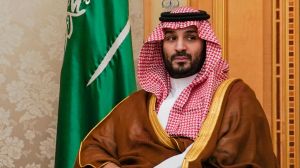
Saudi Crown Prince Mohammed bin Salman
Eric Trump announced plans for an 80-story Trump Tower in Dubai, the UAE’s largest city. He also attended a recent cryptocurrency conference there with Zach Witkoff, a founder of the Trump family crypto company, World Liberty Financial, and son of Trump’s do-everything envoy to the Mideast, Steve Witkoff.
Syria has also “offered to build a Trump Tower in Damascus” before their new president met with Trump and before Trump lifted sanctions. From The Independent:
Damascus courted Donald Trump with a range of incentives, including the potential for a Trump Tower in the Syrian capital, before a meeting between the United States president and his Syrian counterpart.
The strategic pitch also included the possibility of a detente with Israel and US access to Syrian oil and gas reserves, according to sources familiar with the effort.
Jonathan Bass, a pro-Trump activist, met with Syrian President Ahmed al-Sharaa for four hours in Damascus on April 30, alongside Syrian activists and representatives from Gulf Arab states.
That formed part of a broader push to broker a meeting between the two leaders, which occurred on Wednesday.
It was the first time in 25 years that the leaders of the US and Syria had met, and came after a surprise announcement from Trump that the US would lift all sanctions on Syria.
In Riyadh, Trump also embarrassed himself by saluting Saudi generals.
Newsweek: Donald Trump Salutes Saudi Arabian Generals During Riyadh Visit.
President Donald Trump saluted Saudi Arabian generals as they lined up to greet him during his visit to Riyadh, the first stop in his four-day tour of the Middle East.
There has been a discussion in recent years about the proper etiquette for presidents saluting the military, particularly those from other nations.
A returned salute by Trump to a North Korean general during his first term sparked criticism, with some saying he should not have shown respect to a hostile nation. Others said it was courteous to return the gesture.
The salute has not sparked the controversy that followed the emergence of video that showed the president saluting the North Korean general during his first term.
But it comes as Trump leads a large delegation of top officials from his administration and leaders in the business world, as he seeks to discuss peace in the Middle East and improving trade and investment.
Trump’s inappropriate behavior doesn’t shock people anymore; it’s expected that he’ll be an embarrassment to the country wherever he goes.
Today Trump is in Qatar.
CNN: Trump announces $200 billion Boeing deal with Qatar.
Qatar signed an agreement Wednesday to purchase 160 jets from U.S. manufacturer Boeing for Qatar Airways.
The agreement was signed by both President Donald Trump and Qatar’s Emir Sheikh Tamim bin Hamad Al-Thani during Trump’s visit to the Gulf Arab country.
Trump said the deal was worth $200 billion and included 160 jets.
“So it’s over $200 billion but 160 in terms of the Jets, that’s fantastic,” Trump said.
“So that’s a record, Kelly, then congratulations to Boeing,” he added, directing to his comments to Boeing CEO Kelly Ortberg, who was in the room.
Boeing could certainly use the help. Orders last year effectively ground to a halt after a door plug blew off of an Alaska Airlines 737 Max at the beginning of 2024, leaving a gaping hole in the side of the plane. Even with a rebound in orders toward the end of 2024, Boeing’s gross orders were just 569 for all of last year — down a stunning 60% from 2023.
Also not helping Boeing was a massive strike in the fall. About 33,000 machinists hit the picket lines in September, and Boeing didn’t restart production until early December. That sank Boeing’s deliveries to just 348 planes last year, down 34 percent from 2023.
And that was before Trump’s tariffs hit.
Of course the big issue today is the plane that Trump wants to accept from Qatar.
The Guardian: Donald Trump doubles down on luxury aircraft gift from Qatar.
Donald Trump has doubled down on why he wants to accept a luxury Boeing 747 from Qatar, a country where he traveled to today to negotiate business deals, with the US president portraying the $400m aircraft as an opportunity too valuable to refuse.
“The plane that you’re on is almost 40 years old,” Trump told Fox News host Sean Hannity during an Air Force One interview on the Middle East trip, where he is also visiting Saudi Arabia and the UAE.
“When you land and you see Saudi Arabia, you see UAE and you see Qatar, and they have these brand-new Boeing 747s, mostly. You see ours next to it – this is like a totally different plane.”
Clearly irritated by questions about the ethical criticism of accepting such a lavish gift as president, Trump insisted American prestige was at stake. “We’re the United States of America. I believe we should have the most impressive plane.”
The timing of Trump’s visit has raised eyebrows, coming just weeks after the Trump Organization secured a deal with Qatar for a luxury resort and golf course development outside the capital, Doha, called Trump International Golf Club & Villas….
But the idea of accepting a plane from Qatar has triggered alarm across the political spectrum. The Democratic representative Ritchie Torres condemned it as a “flying grift” that violates the constitution’s emoluments clause, which explicitly prohibits federal officials from accepting valuable gifts from foreign powers without congressional approval.
Even staunch Trump allies have broken ranks, including the Texas senator Ted Cruz, who warned that the aircraft deal “poses significant espionage and surveillance problems”, while the West Virginia senator Shelley Moore Capito said bluntly she’d “be checking for bugs”.
Steve Benen at MaddowBlog: Among the problems with Trump’s ‘free’ luxury jet from Qatar: It’s not actually free.
On Sunday night, as the public first learned about Donald Trump’s plan to accept a superluxury Boeing 747-8 jumbo jet from his friends in Qatar to be used as Air Force One, the president was eager to defend the arrangement. The plane, the Republican argued online, would be “FREE OF CHARGE.”
Trump returned to the point a few days later, asking why taxpayers should be “forced to pay hundreds of millions of Dollars” for a plane “when they can get it for FREE” from Qatar. He added soon after that only “a stupid person [would] say, ‘No, we don’t want a free, very expensive airplane.’”
Even if the luxury jet were free, this arrangement would still be a legal, ethical and political mess. But there’s a related problem: The “free” plane wouldn’t be free. NBC News reported:
“Converting a Qatari-owned 747 jet into a new Air Force One for President Donald Trump would involve installing multiple top-secret systems, cost over $1 billion and take years to complete, three aviation experts told NBC News. They said that accepting the 13-year-old jet would likely cost U.S. taxpayers hundreds of millions of dollars over time, noting that refurbishing the commercial plane would exceed its current value of $400 million.”
Politico had a related report that noted it “could cost taxpayers hundreds of millions of dollars” to retrofit Qatar’s “gift” into a makeshift Air Force One.
“This isn’t really a gift,” said Rep. Joe Courtney told Politico. The Connecticut Democrat, who serves on the House Armed Services Committee and helps oversee its panel on executive airlift, added, “You’d basically have to tear the plane down to the studs and rebuild it to meet all the survivability, security and communications requirements of Air Force One. It’s a massive undertaking — and an unfunded one at that.”
In other words, when Trump says the jet from Qatar would be “FREE OF CHARGE,” it’s true that it would be free for him — the president wouldn’t have to reach for his own wallet — but it wouldn’t be free to us, the American taxpayers.
I wonder if anyone is going to be able to talk Trump out of this madness.
From the Bulwark, William Kristol, has some thoughts on Trump’s trip: Autocrats, Kleptocrats, Plutocrats… Oh My!
What a spectacle! There they were yesterday, assembled in Riyadh, Saudi Arabia, autocrats and plutocrats and kleptocrats, gathered to enjoy each other’s company under the benevolent patronage of their host, His Royal Highness Crown Prince Mohammed bin Salman.
Saudi Arabia was an appropriate destination for Donald Trump’s first foreign trip in his second term as president. He chose to visit not a democracy but a despotism; not a free nation but one of the world’s most unfree; not a land of tolerance but of repression.
And Trump made it clear yesterday that he did not consider these features unfortunate or undesirable aspects of life under the House of Saud. There was not a hint of criticism or even of hesitation in the fulsome praise Trump heaped upon his hosts. The American president admires the Saudi achievements in autocracy, plutocracy, and kleptocracy.
And so Trump paid homage to his “friend,” Mohammed bin Salman, who rules without consent and who brooks no dissent. “I like him a lot. I like him too much,” the president said. So much for the late Jamal Khashoggi. As to the kingdom over which bin Salman rules, Trump said the United States has “no stronger partner.” So much for the free nations with whom we are allied.
And Trump emphasized that the achievements of Saudi Arabia that he admires have nothing to do with democratic principles or ideas of freedom. Quite the opposite. He disparaged those who supported efforts at democratization and liberalization in the region—“the so-called nation builders, neocons, or liberal nonprofits.” [….]
Once upon a time, when American presidents still believed in the principles of the American republic, they accepted that they still had to work with despotisms like Saudi Arabia. Still, they mostly tried to move them along, even if slowly, toward the goal of a freer society….
No longer. The very word “liberalization” now seems antique. In the era of Trump and Putin and Xi and bin Salman and many others, autocracy, plutocracy, and kleptocracy are the way of the world….
More than two dozen American titans of business participated in a business lunch with bin Salman and Trump. They no doubt paid appropriate homage to the two autocrats, hoping to walk away, as Trump said, “with a lot of checks.” One doubts any of them uttered the words “freedom” or “democracy” or “consent of the governed.” One assumes none defended the importance of free speech or of dissent.
In other news, a few more items:
House Republicans are still determined to use massive cuts to Medicaid to pay for Trump’s tax cuts for the ultra wealthy. Here’s the latest:
The New York Times (gift link): House Republicans Push Forward With Tax and Medicaid Cuts.
House Republicans on Wednesday pushed forward on their sweeping domestic policy bill, slogging through marathon drafting sessions that began Tuesday and stretched into the night as they haggled over Medicaid and tax cuts.
The meetings in three key committees, a crucial part of advancing what President Trump has labeled the “one big beautiful bill” carrying his agenda, came as Republican leaders raced to push the legislation through the House before a Memorial Day recess that begins at the end of next week.
Republicans are seeking to extend Mr. Trump’s 2017 tax cut and temporarily enact his campaign pledges not to tax tips or overtime pay. They want to partly offset the roughly $3.8 trillion cost of those tax measures — as well as plans to increase spending on the military and immigration enforcement — by making cuts to Medicaid, food stamps and subsidies for clean energy.
But even as they moved toward winning committee approval of the plan, House Republican leaders faced pushback in their own ranks that could delay or derail passage. Conservative lawmakers have argued the proposed cuts to Medicaid, which stopped short of an overhaul in an effort to protect vulnerable Republicans from political blowback, do not go far enough in restructuring and slashing costs of the program. They are unhappy that the largest reduction included — new work requirements for beneficiaries — would not take effect until 2029, putting off any savings until then, after the next presidential election.
And Republicans from high-tax states like New York were furious about a provision that would increase the limit on the state and local tax deduction to $30,000 from $10,000, a cap they regard as far too low and which was still being negotiated.
Democrats, who are expected to oppose the package en masse, have aimed most of their criticism at the bill’s health care provisions, which are estimated to cause more than 8 million Americans to lose insurance coverage, and which they believe will be politically damaging.
This Is going to be a disaster. I hope the Senate won’t accept these health care and food assistance cuts.
Politico: CBO: 7.6 million would go uninsured under GOP Medicaid bill.
The Medicaid portions of the GOP megabill would lead to 10.3 million people losing coverage under the health safety net program and 7.6 million people going uninsured, according to estimates from the nonpartisan Congressional Budget Office.
Republicans released the partial estimates Tuesday less than a half hour before the House Energy and Commerce Committee is scheduled to mark up its portion of the legislation central to enacting President Donald Trump’s agenda on taxes, the border and energy.
The panel has been tasked with finding $880 billion in savings, and the CBO confirmed the committee is on track to meet that target. CBO also projects that many of the major Medicaid policies would account for $625 billion in savings, though the scorekeeping office didn’t calculate the impacts of all provisions.
Work requirements would produce the biggest savings in the bill, accounting for nearly $301 billion over a decade — deeper than what had been initially anticipated. Overturning Biden-era rules on the program would save nearly $163 billion, and a moratorium on new taxes that states levy on providers to help finance their programs would recoup roughly $87 billion.
Republicans have argued that the changes will streamline Medicaid and allow it to better focus on serving the most vulnerable beneficiaries.
Democrats have argued the changes will lead to devastating impacts on health care access and have made the case — including by pointing to previous CBO estimates — that work requirements would simply remove people from coverage rather than motivate beneficiaries to find jobs.
From Strength In Numbers: New poll: Americans oppose cuts to Medicaid, want Democrats to control the U.S. House.
Americans broadly disapprove of the job Donald Trump is doing as president and favor Democratic U.S. House candidates for the 2026 midterms by 6 points, a new Strength In Numbers/Verasight poll finds. In a survey experiment, support for the president’s immigration agenda falls when respondents are informed of mistaken deportations, such as the case of Kilmar Abrego Garcia.
Adults say the economy and inflation are their top priorities, but do not think either party is prioritizing the issues enough. A majority opposes making budget cuts to social programs, such as Medicaid, in order to extend tax cuts and shrink the deficit. If the 2024 election were held today and non-voters were allowed to participate, the electorate would lean toward Kamala Harris over Donald Trump by 5 points, 47% to 42%.
Methodology note: Verasight conducted this poll among 1,000 U.S. adult residents from May 1-6, 2025. It has a margin of error of 3.2%. The survey was weighted to match the political and demographic characteristics of the U.S. adult population according to the March 2025 Current Population Survey, as well as recent benchmarks for partisanship and past vote.
Verasight uses mail, SMS text, and the internet to recruit a sample using both probability-based and non-probability techniques. Verasight handled recruitment, interviewing, and weighting. Strength In Numbers had input on questions but did not participate in other methodological decisions, and conducted all analysis, including creating the topline document.
You can download a pdf of the poll at the link.
Speaking of health, RFK Jr. will be testifying in Congress today.
The Washington Post: RFK Jr. faces Congress on budget cuts, measles response.
Robert F. Kennedy Jr. is testifying Wednesday on Capitol Hill, where the nation’s top health official is expected to be quizzed on his handling of the measles outbreak, the firing of thousands of federal health workers and major cuts to the health agencies he oversees.
Kennedy is appearing before a House Appropriations subcommitteeWednesday morning and will move to the Senate health committee in the afternoon. The pair of hearings marks Kennedy’s first time testifying before Congress since being sworn in as secretary of the Department of Health and Human Services in mid-February.
Since then, the Trump administration has moved to reshape the nation’s public health infrastructure through eliminating roughly 20,000 jobs, ousting top career officials, threatening billions of dollars in federally funded scientific research and proposing a major reorganization of the health department. Such actions have been deeply divisive, with Democrats and public health experts expressing strong concern that the changes will damage the nation’s public health infrastructure, and Kennedy and his allies countering that they are necessary to refocus the federal government on addressing chronic disease.
In his opening remarks before the House panel, Kennedy said he is focusing on “fighting debilitating disease, contaminated food, toxic environments, addiction, mental health, and illness [affecting] families across every race, class and political belief.”
The hearings are being billed as Kennedy’s opportunity to defend the Trump administration’s budget proposal released earlier this month, which proposed a 26 percent reduction to the department’s $127 billion budget of discretionary spending. But lawmakers typically capitalize on the moment to ask a wide range of questions, particularly demanding answers over the most controversial issues facing the nation’s sweeping health department.
Finally, DOGE really doesn’t seem to have saved the government any money to speak of, despite illegally firing thousands of government workers and illegally closing agencies.
 David A. Fahrenthold and Jeremy Singer-Vine at The New York Times: DOGE Removes Dozens of Resurrected Contracts From Its List of Savings.
Elon Musk’s Department of Government Efficiency is no longer claiming credit for killing dozens of federal contracts after The New York Times reported last week that they had already been reinstated.
The Times had identified 44 revived contracts, and 43 of them were still featured on the group’s online “Wall of Receipts” as of last week. Then, late Sunday, Mr. Musk’s group deleted those claims for 31 of the contracts from its website, eliminating $122 million of the savings it claimed to have achieved by cutting federal contracts.
Those savings had actually disappeared days or weeks before, when federal agencies reversed cancellations they had made at the behest of Mr. Musk’s group. One revived contract, which DOGE said was worth $108 million, was restored by the Department of Veterans Affairs after eight days. Mr. Musk’s group still listed it as “terminated” for two months after that.
The presence of revived contracts on DOGE’s list of “terminations” was the latest in a series of data errors that have inflated its success at saving money. In the past, the group has deleted other errors from its “Wall of Receipts” site after new reports found that they were double-counting the same cancellations or claiming credit for killing contracts that had ended decades before.\
On Sunday night, Mr. Musk’s group also added more than 800 new terminated contracts and raised its overall savings estimate — across all government activity, not only contracts — to $170 billion from $165 billion. The group did not delete all of the resurrected contracts identified by The Times. It left 12 on the site, still claiming that terminating those had saved taxpayers $121 million.
That’s all I have for you today. What’s on your mind?
Lazy Caturday Reads: Space Cats with Today’s News
Posted: May 3, 2025 Filed under: cat art, caturday, Donald Trump, Elon Musk, just because, Welfare Queen Elon Musk | Tags: Australia elections, fluoride, measles, Public Health, RFK Jr, Social Security, Trump Tariffs, Trump vs. the arts, universities 8 CommentsGood Afternoon!!

Cats in space, vintage postcard, 1911
As usual, much of today’s news is awful. Trump is working hard to destroy the U.S. Government, but his actions here have had a positive effect on the leadership of two of our allies. First liberals took over in Canada and now they’ve done it in Australia.
Michael E. Miller at The Washington Post: Australia’s Labor Party, buoyed by anti-Trump bump, wins reelection.
SYDNEY — Australia’s center-left government convincingly won reelection Saturday in a remarkable turnaround driven partly by anger over President Donald Trump’s disruptive trade war and its impact on the close U.S. military ally.
“We do not need to beg or borrow or copy from anywhere else,” Albanese said to a raucous Sydney crowd. “We do not seek out our inspiration overseas. We find it right here in our values and in our people.”
Trump’s tariffs — first 25 percent on Australia’s aluminum and steel, then 10 percent across the board — had driven voters toward the even-keeled incumbent and away from his conservative opponent, Peter Dutton, whose plans and rhetoric had echoed the American president, said Sean Kelly, a political columnist for the Sydney Morning Herald.
“Trump has absolutely dominated the trajectory of this election,” Kelly said, adding that the global uncertainty unleashed by Trump had made “Albanese’s boringness quite an appealing commodity.”
By and at CNN: Australia’s center-left Labor Party retains power in vote seen as test of anti-Trump sentiment.
Australia’s Prime Minister Anthony Albanese has secured a second term in office in a disastrous night for his conservative rivals, as voters chose stability over change against a backdrop of global turmoil inflicted by US President Donald Trump.Australia’s return of a left-leaning government follows Canada’s similar sharp swing towards Mark Carney’s Liberal Party, another governing party whose fortunes were transformed by Trump. The loss of Liberal Party leader Peter Dutton’s seat mirrors that of Conservative Party leader Pierre Poilievre.
While Australia wasn’t facing the same threats to its sovereignty as Canada, Trump’s global tariffs and policy swings have undermined Australians’ trust in the US, according to recent surveys.
Albanese’s victory makes him the first Australian Prime Minister to win re-election for two decades and he will start his second term with at least 87 seats in the 150-seat lower house, according to the most recent estimates.
A clearly emotional Albanese took the stage to cheers just before 10 p.m. local time to thank Australians for choosing a majority Labor government, defying predictions both major parties would lose seats.
“In this time of global uncertainty, Australians have chosen optimism and determination,” Albanese said, at the Labor victory party in Sydney.
Dutton, who had hoped to end the night as prime minister, lost the outer-suburban Brisbane seat that he’s held for more than 20 years, ending a brutal night for the veteran politician who held senior seats in the last Coalition government.
 Here in the USA, things aren’t so great. Trump’s tariffs are kicking in, the economy is struggling, he is trying to destroy education and the arts, RFK Jr. is working to make Americans sick, and Elon Musk and DOGE are wreaking havoc in government agencies. Here’s the latest.
and at CNN: A massive tariff on millions of Americans’ purchases just went into effect — cue the chaos.
Many Americans might not have felt major effects from President Donald Trump’s sweeping tariffs — until now.
That’s because a major shipping loophole expired at one minute past midnight on Friday. The de minimis exemption, as it’s known, allowed shipments of goods worth $800 or less to come into the United States duty-free, often more or less skipping time-consuming inspections and paperwork.
The loophole helped reshape the way countless Americans shop, allowing ultra-low-cost Chinese e-commerce sites like Shein, Temu and AliExpress to pour everything from yarn to patio furniture, clothes to photography equipment and more into US homes.
Its impending end has rung alarm bells across social media, with a baseline tariff as high as 145% depending on the carrier set to take effect on Chinese imports, potentially more than doubling the cost for all those cheap products deal-hungry Americans scooped up.
And the end of the de minimis exemption for Chinese goods will also distill abstract, complicated, messy, hard-to-follow trade policy into something much easier to understand: a receipt.
Major carriers like UPS, FedEx, DHL and the United States Postal Service say they’re prepared for the changes. The government says it, too, is set; a US Customs and Border Protection spokesperson told CNN that “We are prepared and equipped to carry out enhanced package screenings and enforce orders effectively.”
But whether regular American shoppers are ready for the changes is another matter.
Read more at CNN.
The Los Angeles Times:
Amid a wave of unprecedented tariffs, anxiety is running high for truck drivers like Helen, who makes her living delivering cargo containers from the Los Angeles and Long Beach harbors to warehouses and other customers around Southern California.
After a strong start to the year, the number of jobs has started to slip in recent days and truck drivers have heard reports predicting a sharp decline in incoming cargo for May and June….
“There’s real concern that we’re going to be struggling,” said Helen, a Downey resident who declined to give her last name for fear she might lose work if she is considered disgruntled. “If ships are not coming in and there are no loads, then there is no work. If there is no work there’s no money.”
As President Trump’s aggressive tariffs rattle business owners and shake the foundation of American importing, the men and women who work on the ground at the country’s busiest port are feeling the effects too.
Thousands of dockworkers, heavy equipment operators and truck drivers support a flurry of activity at the Port of Los Angeles, which covers 7,500 acres on San Pedro Bay and processed more than 10 million 20-foot-long cargo units in 2024. The neighboring Port of Long Beach moved 9.6 million 20-foot equivalent units, or TEUs, last year.
With a 145% tariff on China, a 25% tariff on Canada and Mexico, and 10% tariffs on dozens of other countries, the flow of goods into the U.S. is expected to slow drastically.
Fewer shipments into the ports of Los Angeles and Long Beach mean less work for the Californians who move cargo, said Raman Dhillon, chief executive of the North American Punjabi Trucking Assn.
“The truckers are scrambling right now,” he said. “They are at the verge of collapsing. The administration needs to move quickly, or it’s going to be chaos and price hikes and empty shelves.”
Trump isn’t worried about a recession and he doesn’t care how it will affect Americans. It’s just a transition period, he says.
at NBC News: Trump downplays recession fears, saying the U.S. would be ‘OK’ in the long term.
President Donald Trump on Friday downplayed concerns about potential economic trouble, saying everything would be “OK” in the long term, even if the U.S economy experienced a recession in the short term.
Cat Astronaut, Michael Raiano
Asked twice by “Meet the Press” moderator Kristen Welker whether it would be OK in the long run if there were a recession in the short term, the president said, “Look, yeah, it’s — everything’s OK. What we are — I said, this is a transition period. I think we’re going to do fantastically.”
Following up, Welker asked Trump if he was worried about a recession, to which he responded, “No.” Asked whether he thinks one could happen, Trump replied, “Anything can happen, but I think we’re going to have the greatest economy in the history of our country.”
The remarks come as analysts on Wall Street are increasingly worried that the country could face a recession due to Trump’s changing tariff policy.
“Well, you know, you say, ‘Some people on Wall Street say’ — well, I tell you something else. Some people on Wall Street say that we’re going to have the greatest economy in history. Why don’t you talk about them?” Trump said during the interview at his Mar-a-Lago resort in Florida.
“There are many people on Wall Street say this is going to be the greatest windfall ever happen,” the president added.

Really? Who are those people? Name one.
Trump doesn’t want the government to support the arts.
Michael Paulson at The New York Times: Trump Seeks to Eliminate the National Endowment for the Arts.
President Trump proposed eliminating the National Endowment for the Arts and the National Endowment for the Humanities in the budget he released Friday, taking aim once again at two agencies that he had tried and failed to get rid of during his first term.
The endowments, along with the Institute of Museum and Library Services, were among the entities listed in a section titled “small agency eliminations” in his budget blueprint for the next fiscal year. The document said that the proposal was “consistent with the president’s efforts to decrease the size of the federal government to enhance accountability, reduce waste, and reduce unnecessary governmental entities” and noted that Mr. Trump’s past budget proposals had “also supported these eliminations.”
In 2017, during his first term, Mr. Trump proposed eliminating both the arts and the humanities endowments. But bipartisan support in Congress kept them alive, and in fact their budgets grew during the first Trump administration.
Since Mr. Trump returned to office this year, his administration has taken aim at the National Endowment for the Humanities and the Institute of Museum and Library Services, canceling most of their existing grants and laying off a large portion of their staffs. But the arts agency had yet to announce major cuts.
The proposal to eliminate the endowments drew a quick and furious reaction from Democrats. One, Senator Jack Reed of Rhode Island, vowed to fight the plan to eliminate the N.E.A. “tooth and nail.”
Representative Chellie Pingree of Maine, who serves as the top Democrat on the House subcommittee overseeing the N.E.A., said in an interview that Mr. Trump was “making a broad-based attack on the arts, both for funding and content.” She cited his proposals to eliminate the endowments as well as his takeover of the John F. Kennedy Center for the Performing Arts in Washington and his efforts to influence the Smithsonian Institution.
“We were able to restore the funding last time,” she said, “but as you know, based on the first 100 days of this administration, they’re in no mood to keep much of government alive anymore, and their attack is focused on everything, and the arts have already got a bull’s-eye on their back.

Outerspace laser cats (greeting card)
Of course Trump is also attacking our vital educational institutions. The latest is his threat to remove Harvard’s tax-exempt status. Here in Boston, Harvard and MIT are gearing up to fight back.
Andrew Duehren, Maggie Haberman and Alan Blinder at The New York Times: Harvard Signals It Will Resist Trump’s Efforts to Revoke Tax-Exempt Status.
Harvard University signaled Friday that it would resist President Trump’s renewed threat to revoke the school’s tax-exempt status, a move for which it said there was “no legal basis” as the president escalated his bitter dispute with the nation’s oldest university.
Harvard stopped short of explicitly pledging a legal challenge to a revocation of its tax status, a change that would upend the university’s finances. But a spokesperson for the university said in a statement that there was “no legal basis to rescind Harvard’s tax-exempt status.”
“Such an unprecedented action would endanger our ability to carry out our educational mission,” the statement said. “It would result in diminished financial aid for students, abandonment of critical medical research programs and lost opportunities for innovation. The unlawful use of this instrument more broadly would have grave consequences for the future of higher education in America.”
Mr. Trump declared Friday morning on social media that the government would be “taking away Harvard’s Tax Exempt Status.” Mr. Trump added, “It’s what they deserve.”
Despite Mr. Trump’s assertion online and Harvard’s sharp response, it was not immediately clear Friday whether the I.R.S. was in fact moving forward with revoking Harvard’s tax-exempt status, a change that could typically occur only after a lengthy process. Federal law prohibits the president from directing the I.R.S. to conduct tax investigations, and I.R.S. employees who receive such a command are required to report it to an internal government watchdog.
Hilary Burns at The Boston Globe: At MIT, leaders discussed a strategy for navigating Trump administration funding cuts in private meeting.
The unrelenting high-velocity attacks from the Trump administration have forced leaders of the nation’s premier universities to navigate an extraordinary and bruising balancing act, choosing when to take a stand in the face of continued threats while trying to mitigate the loss of federal funding.
Among the schools where that intense drama is playing out is the Massachusetts Institute of Technology, where the sobering realities of the administration’s funding cuts were discussed at a meeting convened by senior leaders in April.
Under one scenario presented at that meeting by treasurer Glen Shor, MIT risks losing the equivalent of 23 percent of revenues for its central budget, according to a recording of the presentation to school staff obtained by the Globe.
“Unfortunately, we should expect a prolonged period of challenge,” MIT president Sally Kornbluth told staff, according to the recording. “We really have to balance things. And I have to say, I feel a grave responsibility to you all . . . to ensure the livelihoods of this community and to make sure that we can continue to function. I need to balance all of these goalsthat are, again, often in great tension with each other.”
Kornbluth also outlined how she is trying to preserve institutional independence while being pragmatic with so much money hanging in the balance. MIT needs to “adapt” where necessary to the priorities of the federal government, she said, but also resist by suing when it feels the administration had overreached. Senior leaders are also working to improve the university’s reputation in Washington, D.C., and among the broader public.
The recording offers a rare inside look into how institutions are trying to respond to a fast-moving and ever-changing dynamic, with new lines of pressure from the administration coming from unforeseen angles.
I’m terrified by what is happening to public health under RFK Jr. Here’s the latest on that.
Jessica Glenza at The Guardian: World may be ‘post-herd immunity’ to measles, top US scientist says.
A leading immunologist warned of a “post-herd-immunity world”, as measles outbreaks affect communities with low vaccination rates in the American south-west, Mexico and Canada.
The US is enduring the largest measles outbreak in a quarter-century. Centered in west Texas, the measles outbreak has killed two unvaccinated children and one adult and spread to neighboring states including New Mexico and Oklahoma.
“We’re living in a post-herd-immunity world. I think the measles outbreak proves that,” said Dr Paul Offit, an expert on infectious disease and immunology and director of the Vaccine Education Center at Children’s Hospital of Philadelphia.
“Measles – because it is the most contagious of the vaccine-preventable diseases, the most contagious human disease really – it is the first to come back.”
The US eliminated measles in 2000. Elimination status would be lost if the US had 12 months of sustained transmission of the virus. As of 1 May, the US Centers for Disease Control and Prevention (CDC) reported 935 confirmed measles cases across30 jurisdictions.Nearly one in three children under five years old involved in the outbreak, or 285 young children, have been hospitalized.
Three large outbreaks in Canada, Mexico and the US now account for the overwhelming majority of roughly 2,300 measles cases across the World Health Organization’s six-country Americas region, according to the health authority’s update this week. Risk of measles is considered high in the Americas, and has grown 11-fold compared with 2024.
Is RFK Jr. concerned about this situation? Not really.
Teddy Rosenbluth at The New York Times: Kennedy Orders Search for New Measles Treatments Instead of Urging Vaccination.
With the United States facing its largest single measles outbreak in 25 years, Health and Human Services Secretary Robert F. Kennedy Jr. will direct federal health agencies to explore potential new treatments for the disease, including vitamins, according to an H.H.S. spokesman. The decision is the latest in a series of actions by the nation’s top health official that experts fear will undermine public confidence in vaccines as an essential public health tool.
The announcement comes as Mr. Kennedy faces intense backlash for his handling of the outbreak. It has swept through large areas of the Southwest where vaccination rates are low, infecting hundreds and killing two young girls. On Friday, the Centers for Disease Control and Prevention reported more than 930 cases nationwide, most of which are associated with the Southwest outbreak.
Critics have said Mr. Kennedy has focused too much on untested treatments — such as cod liver oil supplements — and offered only muted support for the measles vaccine, which studies show is 97 percent effective in preventing infection.
The decision to put more resources into potential treatments, rather than urging vaccination, could have grave consequences at the center of the outbreak….
Scientists have already thoroughly studied various vitamins and medications as potential treatments for measles, said Michael Osterholm an epidemiologist at the University of Minnesota.
Decades of research have turned up no miracle treatment for the measles virus, which can cause pneumonia, making it difficult for patients to get oxygen into their lungs, and brain swelling, which can cause blindness, deafness and intellectual disabilities.
RFK also wants to eliminate fluoride from our water. And check this out from Texas. Beth Mole at Ars Technica: Texas goes after toothpaste in escalating fight over fluoride.
Texas Attorney General Ken Paxton is investigating two leading toothpaste makers over their use of fluoride, suggesting that they are “illegally marketing” the teeth cleaners to parents and kids “in ways that are misleading, deceptive, and dangerous.”
Space cats from Mars, Damien Northmore
The toothpaste makers in the crosshairs are Colgate-Palmolive Company, maker of Colgate toothpastes, and Proctor & Gamble Manufacturing Co., which makes Crest toothpastes. In an announcement Thursday, Paxton said he has sent Civil Investigative Demands (CIDs) to the companies.
The move is an escalation in an ongoing battle over fluoride, which effectively prevents dental cavities and improves oral health. Community water fluoridation has been hailed by health and dental experts as one of the top 10 great public health interventions for advancing oral health across communities, regardless of age, education, or income. But, despite the success, fluoride has always had detractors—from conspiracy theorists in the past suggesting the naturally occurring mineral is a form of communist mind control, to more recent times, in which low-quality, controversial studies have suggested that high doses may lower IQ in children.

These people are insane.
Just a few Elon Musk stories before I wrap this post up.
Lindsay Whitehurst at the AP: Trump administration asks Supreme Court to let DOGE access Social Security systems.
The Trump administration asked the Supreme Court on Friday to clear the way for Elon Musk ’s Department of Government Efficiency to access Social Security systems containing personal data on millions of Americans.
The emergency appeal is the first in a string of applications to the high court involving DOGE’s swift-moving work across the federal government.
It comes after a judge in Maryland restricted the team’s access to Social Security under federal privacy laws. The agency holds personal records on nearly everyone in the country, including school records, bank details, salary information and medical and mental health records for disability recipients, according to court documents.
The government says the team needs access to target waste in the federal government. Musk, now preparing to step back from his work with DOGE, has been focused on Social Security as an alleged hotbed of fraud. The billionaire entrepreneur has described it as a “ Ponzi scheme ” and insisted that reducing waste in the program is an important way to cut government spending.
Solicitor General John Sauer argued Friday that the judge’s restrictions disrupt DOGE’s important work and inappropriately interfere with executive-branch decisions. “Left undisturbed, this preliminary injunction will only invite further judicial incursions into internal agency decision-making,” he wrote.
I shudder to think what the Supreme Court will do with this.
Matthew Cunningham-Cook at Rolling Stone: Elon Musk and His DOGE Bro Have Cashed In on Americans’ Retirement Savings.
In the lead up to the April 1 election for the Wisconsin state Supreme Court, a little-known private equity executive by the name of Antonio Gracias joined Tesla billionaire Elon Musk on stage as the latter launched into a tirade clearly inspired by the white supremacist Great Replacement Theory — the discredited canard that the Biden administration was letting in millions of “illegals” to engage in mass voter fraud.
On the dais, Gracias described how his foray into Social Security had revealed something already widely known to immigration policymakers: that the Biden administration had substantially expanded the Temporary Protected Status program, allowing millions of immigrants to enter and work in the country legally. These noncitizens were given Social Security numbers, as is completely standard — in fact, the process was automated during Trump’s first term — but Gracias and Musk, the world’s richest man, treated it like a scandal.
“We started at the top of the system mapping the whole system of Social Security to understand where the fraud was — this is what jumped out at us,” Gracias said. “When we saw these numbers, we asked ‘What is this?’ In ‘21, you see 270,000 people, it goes all the way to 2.1 million in ‘24. These are noncitizens that are getting Social Security numbers. … This literally blew us away. We went there to find fraud, and we found this by accident.” Noting that his parents and siblings, like Musk, are immigrants, Gracias added, “I’m pro-legal immigration — this is about America and the future of America.”
The crowd of conservatives gasped as the billionaires made it sound as if they and their team at Trump’s so-called Department of Government Efficiency had finally found proof of the waste, fraud, and abuse in the Social Security Administration that Musk has repeatedly talked about — examples that might help justify the massive upheaval that DOGE has created within the agency that manages America’s core retirement program.
Check this out:
Despite all of Musk and Gracias’ rhetoric about rooting out waste, fraud, and abuse in Social Security, scant attention has been paid to how the pair has become phenomenally wealthy with support from Americans’ retirement funds.
It’s well-known that Musk’s space company, SpaceX, has long cashed in on federal contracts — a trend turbocharged by Trump’s administration. Gracias, for his part, has relied on significant investments from public retirement systems to fund his firm’s deals. In the past decade, Gracias’ private equity firm, Valor Equity Partners, has received at least $1.7 billion in investment commitments from state and local pension funds — which manage the retirement savings of unionized teachers, firefighters, social workers, bus drivers, and cops — according to a Rolling Stone review of public documents.
Much of this money has come from Democratic states and locales. For its most recent fund, Valor received $800 million in investment commitments from a range of state and local pension funds. Investors include the California Public Employees’ Retirement System; the California State Teachers’ Retirement System; the Illinois Municipal Retirement Fund; the New York State Teachers’ Retirement System; a range of New York City pension funds; the Philadelphia Board of Pensions and Retirement; and the Hartford Municipal Employees Retirement Fund in Connecticut.
There’s much more at the link. If you clear your cache, you should be able to read it.
That’s all I have for you today. What’s on your mind?
Lazy Caturday Reads
Posted: April 26, 2025 Filed under: cat art, caturday, Donald Trump, Elon Musk, just because | Tags: deporting U.S. citizen children, Doge, ICE, Jeffrey Epstein, Judge Hannah Dugan, Pope Francis, Russia, Ukraine, Virginia Giuffre, Volodyur Zelensky 5 Comments
By Jussi Taipaleenmäki
Good Afternoon!!
Early this morning ET, Pope Francis was laid to rest.
The Guardian: World bids farewell to Pope Francis with pilgrims and the powerful among 400,000 at funeral.
Pope Francis has been eulogised as “a pope among the people, with an open heart towards everyone” during a funeral mass that brought 400,000 mourners to Rome, from pilgrims and refugees to powerful world leaders and royalty.
Francis, 88, died on Monday after a stroke and subsequent heart failure, setting into motion a series of centuries-old rituals and a huge, meticulously planned logistical and security operation not seen in Italy since the funeral of John Paul II in April 2005.
The crowd erupted into applause as the late pontiff’s wooden coffin was carried from the altar of the 16th-century St Peter’s Basilica, where it had laid in state for three days, by 14 white-gloved pallbearers and into the square for the open-air ceremony.
Applause also rang out when the Italian cardinal Giovanni Battista Re, who presided over the funeral mass, spoke of Francis’s care for immigrants, his constant pleas for peace, the need for negotiations to end wars and the importance of the climate.
Under a blue sky, crowds stretched along Via della Conciliazione, the road connecting the Italian capital with the Vatican.
Among the pilgrims were Rosa Cirielli and her friend Pina Sanarico, who left their homes in Taranto, in southern Italy, at 5am, and managed to secure themselves a decent position in front of a huge TV screen. “When Pope Francis was alive, he gave us hope. Now we have this huge hole,” said Cirielli. “He left us during a very ugly period for the world. He was the only one who loudly called for peace.”
The pilgrims were joined by leaders from more than 150 countries, including the US president, Donald Trump, who had repeatedly clashed with Francis over immigration, and his wife Melania. A White House official said Trump had a “very productive” meeting before the ceremony with Ukrainian president, Volodymyr Zelenskyy. A photo showed the pair sitting opposite each other on chairs inside St Peter’s Basilica. Another image showed them together with the British prime minister, Keir Starmer, and French president, Emmanuel Macron. Trump and Zelenskyy were also expected to meet after the mass.
Other guests included the former US president Joe Biden, who last met Francis at the G7 summit in Puglia in June 2024, the Argentinian president, Javier Milei, the European Commission president, Ursula von der Leyen, and Prince William.
More than 2,000 journalists from around the world travelled to Rome to cover the event.
The 90-minute mass was celebrated by 220 cardinals, 750 bishops and more than 4,000 priests.
Trump did not belong at the funeral of Pope Francis, but he bulled his way in and demanded special treatment. Can you believe didn’t even wear black?
The Daily Beast: Vatican Caves and Gives Trump Front-Row Seat for Pope’s Funeral.
President Donald Trump, wearing a blue suit in a sea of black, was seated in a prized front-row seat for the funeral of Pope Francis.
The seating location will likely be a source of great satisfaction for the famously thin-skinned president, who mercilessly mocked Joe Biden after he was seated in the 14th row at Queen Elizabeth’s funeral in 2022.
By Jos Rian
Based on precedent, Trump was expected to have been seated in the third row, behind anointed monarchs.
In the end, however, he and Melania were seated in the front row, along with Ukrainian president Volodymyr Zelensky, whose appearance triggered a spontaneous outburst of applause from the assembled crowds.
Vatican sources told Sky News that Trump met with Zelensky before the ceremony, just hours after the president talked up a peace deal between Ukraine and Russia.
The controversy over Trump’s seating would doubtless have prompted a wry reaction from the overtly humble Pope Francis, who dedicated considerable political capital to confronting Trump, denouncing his immigration policy as “un-Christian” and schooling his minion JD Vance on the issue in his final hours.
Cardinal Vincent Nichols, the Archbishop of Westminster, previously told the Telegraph the ceremony would be a “masterpiece of stage management when you consider those state leaders who have high opinions of their importance.”
“They’ve been doing it since the emperors ruled Rome—they know how to deal with big egos. And I think every leader of a nation that comes here on Saturday will go home reasonably content,” he added.

David Sanger at The New York Times: Trump Meets With Zelensky in Vatican City.
President Trump met privately with President Volodymyr Zelensky of Ukraine on Saturday in Vatican City, the first time the two leaders have met since their televised argument in late February in the Oval Office exacerbated the deep breach between the two countries.
The meeting took place in St. Peter’s Basilica, the two men perched on metal chairs, deep in conversation for several minutes as they waited for the funeral for Pope Francis to begin. A White House spokesman, Stephen Cheung, called it a “very productive discussion,” but gave no details.
It came at a critical moment. The United States has presented Ukraine with a plan for a cease-fire in its war with Russia, leading to a postwar plan that would give Russia de facto control over all of the lands it has illegally seized since the invasion began three years ago. The proposal also includes a major reversal of American policy: a formal recognition by the United States that Crimea, seized by Moscow in 2014, is now Russian territory.
Mr. Zelensky said this past week that Ukraine would never make that concession, noting that it would violate Ukraine’s Constitution; most of the other nations in Europe would almost agree with Mr. Zelensky’s view. But the Ukrainian leader has a counterproposal of his own, Ukrainian officials said, one that would end the conflict on far less generous terms for Russia, and would include billions of dollars in reparations for Ukraine, paid by Russia.
The White House did not respond to queries about the specifics of the meeting in Vatican City. But it was a remarkable scene: an impromptu meeting between two men who have made no secret of their deep dislike and distrust for each other. In the minutes after they last saw each other, Mr. Zelensky was essentially evicted from the White House, a lunch for the two men left uneaten and an economic accord allowing the United States to help exploit much of Ukraine’s minerals left unsigned.
Some very sad news: Virginia Giuffre had died by suicide.
The Guardian: Virginia Giuffre, Jeffrey Epstein and Prince Andrew accuser, dies aged 41.
Virginia Giuffre, one of the most prominent victims of the disgraced US financier Jeffrey Epstein who also alleged she was sexually trafficked to Prince Andrew, has died aged 41.
Her family issued a statement on Saturday confirming she took her own life at her farm in Western Australia, where she had lived for several years.
“It is with utterly broken hearts that we announce that Virginia passed away last night at her farm in Western Australia. She lost her life to suicide, after being a lifelong victim of sexual abuse and sex trafficking,” the statement read.
By Nicolai Tonitza
“In the end, the toll of abuse is so heavy that it became unbearable for Virginia to handle its weight.”
Giuffre was one of the most vocal victims of Epstein, alleging she had been groomed and sexually abused by him and his longtime associate, Ghislaine Maxwell, beginning in her teens.
The family described her as a “fierce warrior” against sexual abuse and sex trafficking and a “light that lifted so many survivors”.
“Despite all the adversity she faced in her life, she shone so bright. She will be missed beyond measure,” they said.
Giuffre is survived by her three children, Christian, Noah and Emily, who her family said were the “light of her life”.
“It was when she held her newborn daughter in her arms that Virginia realised she had to fight back against those who had abused her and so many others,” they said.
“There are no words that can express the grave loss we feel today with the passing of our sweet Virginia. She was heroic and will always be remembered for her incredible courage and loving spirit.”

Some background on Giuffre from NBC News: Virginia Giuffre, one of Jeffrey Epstein’s most prominent abuse survivors, dies by suicide.
Giuffre, 41, died in Neergabby, Australia, where she had been living for several years.
Giuffre was one of the earliest and loudest voices calling for criminal charges against Epstein and his enablers. Other Epstein abuse survivors later credited her with giving them the courage to speak out.
She also provided critical information to law enforcement that contributed to the investigation into and later the conviction of Epstein’s associate Ghislaine Maxwell, as well as other investigations by the U.S. attorney for the Southern District of New York….
Raised primarily in Florida, Giuffre had a troubled childhood. She said she was abused by a family friend, triggering a downward spiral that led to her living on the streets for a time as a teenager.
She was attempting to rebuild her life when she met Maxwell, Epstein’s close confidant. Maxwell groomed her to be sexually abused by Epstein, and that abuse continued from 1999 to 2002, according to Giuffre. Giuffre also alleged that Epstein trafficked her to his powerful friends, including Prince Andrew and French modeling agent Jean-Luc Brunel.
Epstein, a wealthy financier, died by suicide in a New York jail in 2019 while he was awaiting trial on federal sex trafficking charges.
Maxwell, a former British socialite, was found guilty on five counts of sex trafficking in 2021 for her role in recruiting young girls to be abused by Epstein.
Giuffre filed a federal lawsuit against Andrew in 2021, alleging that he sexually abused her when she was 17. Andrew, who stepped back from his duties as an active royal as controversy related to Epstein swirled around him, agreed to settle the case for an undisclosed amount in 2022. He has denied having sex with her.
Brunel, who headed several modeling agencies, was charged with sexual harassment and the rape of at least one minor in December 2020. He denied wrongdoing and died by suicide in his jail cell in February 2022.
Several months prior, Giuffre testified against Brunel in a Paris courtroom in June 2021. In an interview after her daylong closed-door testimony, Giuffre said she appeared in court to be a voice for the victims and to make sure Brunel was brought to justice.
“I wanted Brunel to know that he no longer has the power over me,” Giuffre said, “that I am a grown woman now and I’ve decided to hold him accountable for what he did to me and so many others.”
Giuffre moved to Australia with her husband before Epstein’s 2019 arrest. The couple has three children.
There was quite a bit of immigration news yesterday.
Topping the list: the FBI arrested a judge. Josh Kovensky at Talking Points Memo: FBI Stages Courthouse Arrest of Wisconsin Judge.
The federal government used brazen, heavy-handed tactics on Friday to arrest a Wisconsin state judge on obstruction charges related to an immigration case.
Milwaukee County Circuit Judge Hannah Dugan received the distinction of being arrested at her courthouse. She does not appear to have been given the opportunity to surrender to law enforcement.
By Nicola Slattery
Instead, Trump administration officials immediately used the arrest to create a spectacle and broadcast to the country that state officials — including sitting judges — must cooperate with the Trump administration’s mass deportation campaign or else face overbearing actions from federal law enforcement.
A U.S. Marshals Service spokesman told TPM that FBI agents arrested Dugan at around 8:30 a.m. Milwaukee time. They made the arrest, Marshals spokesman Brady McCarron told TPM, as she arrived for work on the state courthouse grounds, detaining her outside of the building.
Around half an hour after, FBI Director Kash Patel posted a tweet announcing the arrest.
“We believe Judge Dugan intentionally misdirected federal agents away from the subject to be arrested in her courthouse,” he wrote. Patel deleted the tweet minutes later, though he would later repost it.
Contrast the brazenness of Dugan’s arrest, and Patel’s efforts to manufacture publicity around it, with how a somewhat similar case proceeded during Trump’s first term. In 2019, a Massachusetts state judge was indicted on obstruction charges over allegations of blocking ICE officials from taking custody of an undocumented citizen of the Dominican Republic. In that case, itself an extremely rare federal prosecution of a state judge over a decision related to the use of her office, the defendant was allowed to surrender. The DOJ dropped the charges in September 2022.

Read the rest at TPM. This will be an important case to watch. I suspect this isn’t the last judge who will be targeted by Trump goons.
Chris Geidner at The Law Dork: The Trump administration deported a 2-year-old U.S. citizen on Friday.
Over the course of the past three days, the Trump administration took a two-year-old U.S. citizen into custody, along with her mother and sister, and deported the child to Honduras with little to no individualized process, prompting sharp concern from a conservative federal judge on Friday.
The Justice Department does not appear to dispute the underlying facts, given its position in a filing faxed to the court about 3:45 a.m. CT Friday in response to a habeas petition filed on behalf of the child, referred to as V.M.L., on Thursday evening.
Instead, the Justice Department’s entire argument was simply that, once in custody and told she was going to be deported, V.M.L.’s mother, Jenny Carolina Lopez Villela, wrote a note stating that she would bring her two-year-old daughter with her to Honduras.
By Jos Rian
As the habeas petition made clear, however, many federal officials knew that both V.M.L.’s father, Adiel Mendez Sagastume, and provisional custodian, Trish Mack, were desperately trying to get in touch with Jenny and/or get V.M.L. released to them throughout the 70 hours between when the two of them and Jenny’s other child were taken into custody and flown to Texas before Friday’s flight to Honduras.
On Friday, in the wake of all of this information, U.S. District Judge Terry Doughty issued an order setting a hearing “[i]n the interest of dispelling our strong suspicion that the Government just deported a U.S. citizen with no meaningful process.” The order was first reported by Politico.
That the order came from Doughty, a far-right Trump appointee known for his harsh criticism of the Biden administration in a case about social media that was later overturned by the U.S. Supreme Court, was yet another reminder of how alarming the Trump administration’s actions are being seen by judges of all backgrounds.
Of the deportation of a two-year-old U.S. citizen, Doughty wrote on Friday, “The Government contends that this is all okay because the mother wishes that the child be deported with her. But the Court doesn’t know that.“

Read more details at the link. There’s even more information about this case and others in this piece by James Joyner at Outside the Beltway: We’re Deporting US Citizens, Including Children.
This is a press release from the ACLU: ICE Deports 3 U.S. Citizen Children Held Incommunicado Prior to the Deportation.
New Orleans, LA – Today, in the early hours of the morning, the New Orleans Immigration and Customs Enforcement (ICE) Field Office deported at least two families, including two mothers and their minor children – three of whom are U.S. citizen children aged 2, 4, and 7. One of the mothers is currently pregnant. The families, who had lived in the United States for years and had deep ties to their communities, were deported from the U.S. under deeply troubling circumstances that raise serious due process concerns.
ICE detained the first family on Tuesday, April 22, and the second family on Thursday, April 24. In both cases, ICE held the families incommunicado, refusing or failing to respond to multiple attempts by attorneys and family members to contact them. In one instance, a mother was granted less than one minute on the phone before the call was abruptly terminated when her spouse tried to provide legal counsel’s phone number.
As a result, the families were completely isolated during critical moments when decisions were being made about the welfare of their minor children. This included decisions with serious implications for the health, safety, and legal rights of the children involved–without any opportunity to coordinate with caretakers or consult with legal representatives.
New Orleans, LA – Today, in the early hours of the morning, the New Orleans Immigration and Customs Enforcement (ICE) Field Office deported at least two families, including two mothers and their minor children – three of whom are U.S. citizen children aged 2, 4, and 7. One of the mothers is currently pregnant. The families, who had lived in the United States for years and had deep ties to their communities, were deported from the U.S. under deeply troubling circumstances that raise serious due process concerns.
By Alberto Morrocco
ICE detained the first family on Tuesday, April 22, and the second family on Thursday, April 24. In both cases, ICE held the families incommunicado, refusing or failing to respond to multiple attempts by attorneys and family members to contact them. In one instance, a mother was granted less than one minute on the phone before the call was abruptly terminated when her spouse tried to provide legal counsel’s phone number.
As a result, the families were completely isolated during critical moments when decisions were being made about the welfare of their minor children. This included decisions with serious implications for the health, safety, and legal rights of the children involved–without any opportunity to coordinate with caretakers or consult with legal representatives.
These actions stand in direct violation of ICE’s own written and informal directives, which mandate coordination for the care of minor children with willing caretakers–regardless of immigration status–when deportations are being carried out.
Both families have possible immigration relief, but because ICE denied them access to their attorneys, legal counsel was unable to assist and advise them in time. With one family, government attorneys had assured legal counsel that a legal call would be arranged within 24-48 hours, as well as a call with a family member. Instead, just after close of business and after courts closed for the day, ICE suddenly reversed course and informed counsel that the family would be deported at 6am the next morning–before the court reopened.

Read the rest at the link.
Malcolm Ferguson at The New Republic: Trump DOJ Ordered ICE to Invade Homes Without Search Warrant.
The Justice Department quietly invoked the Alien Enemies act last month to give Immigration and Customs Enforcement agents the power to conduct warrantless searches of people’s homes as long as they suspect them to be an “alien enemy.” USA Today obtained the memo that contained this order on Friday.
“As much as practicable, officers should follow the proactive procedures above—and have an executed Warrant of Apprehension and Removal—before contacting an Alien Enemy,” the memo reads. “However, that will not always be realistic or effective in swiftly identifying and removing Alien Enemies.… An officer may encounter a suspected Alien Enemy in the natural course of the officer’s enforcement activity, such as when apprehending other validated members of Tren de Aragua. Given the dynamic nature of enforcement operations, officers in the field are authorized to apprehend aliens upon a reasonable belief that the alien meets all four requirements to be validated as an Alien Enemy. This authority includes entering an Alien Enemy’s residence to make an AEA apprehension where circumstances render it impracticable to first obtain a signed Notice and Warrant of Apprehension and Removal” (emphasis added).
In the memo, the Justice Department defined an “alien enemy” as anyone who is 14 years of age or older, not a U.S. citizen or lawful permanent resident, a citizen of Venezuela, and “a member of the hostile enemy Tren de Aragua,” per the Alien Enemy Validation Guide, a document that has already been slammed by immigration experts.
Some DOGE news from ProPublica: Inspector General Probes Whether Trump, DOGE Sought Private Taxpayer Information or Sensitive IRS Material.
A Treasury Department inspector general is probing efforts by President Donald Trump and Elon Musk’s Department of Government Efficiency to obtain private taxpayer data and other sensitive information, internal communications reviewed by ProPublica show.
The office of the Treasury Inspector General for Tax Administration has sought a wide swath of information from IRS employees. In particular, the office is seeking any requests for taxpayer data from the president, the Executive Office of the President, DOGE or the president’s Office of Management and Budget.
The request, spelled out in a mid-April email obtained by ProPublica, comes as watchdogs and leading Democrats question whether DOGE has overstepped its bounds in seeking information about taxpayers, public employees or federal agencies that is typically highly restricted.
By Arthur Io
The review appears to be in its early stages — one document describes staffers as “beginning preplanning” — but the email directs the IRS to turn over specific documents by Thursday, April 24. It’s not clear if that happened.
The inspector general is seeking, for instance, “All requests for taxpayer or other protected information from the President or Executive Office of the President, OMB, or DOGE. Include any information on how the requestor plans to use the information requested, the IRS’s response to the request, and the legal basis for the IRS’s response,” the email says.
The inquiry also asks for information about requests for access to IRS systems from any agency in the executive branch, including the Department of Homeland Security, the Social Security Administration and DOGE.
The Treasury Inspector General for Tax Administration office, known as TIGTA, is led by acting Inspector General Heather M. Hill. When Trump fired 17 inspectors general across a range of federal agencies in January, those working for the Treasury Department were not among the ones axed.

Read more at ProPublica.
Finally, a bit of comedy relief from The Daily Beast: A Young Elon Musk Declared Himself ‘Reincarnation’ of Alexander the Great, New Book Reveals.
Elon Musk, as a yet-unproven entrepreneur in his mid-twenties, declared himself the “reincarnation” of ancient Greek conqueror Alexander the Great, a new book on the billionaire has revealed.
Musk, now 53, made the comment around 30 years ago to a partner at one of the firms that bankrolled his first start-up, Zip2, which aimed to bring the Yellow Pages online, Washington Post reporter Faiz Siddiqui writes in Hubris Maximus, published Tuesday.
Derek Proudian, then at Mohr Davidow Ventures, recalled grabbing lunch with the young Musk to discuss how to make the company viable on a small scale.
Musk, however, insisted that he think bigger: Zip2 was “going to be the biggest company ever,” Proudian recalled him saying.
When Proudian tried to change the subject, Musk doubled down.
“No—you don’t understand,” he said. “I’m the reincarnation of the spirit of Alexander the Great.”
Incredulous, Proudian pushed back that he might not reach that level of success. Musk wasn’t willing to hear it.
“I’ve got the samurai spirit,” he said. “I’d rather commit seppuku than fail.”
Those are my recommended reads for today. What’s on your mind?

 peej
peej Carissa
 bostonboomer
 dakinikat
 ecocatwoman
 mablue2
 Mama Lopez
 peggysue22
 quixote
 skydancingguestblogger
 Mona (aka Wonk the Vote)



 Sky Dancing
Recent Comments