
The Republicans Just won’t Trade in their Fairy Tales
Posted: November 11, 2012 Filed under: Economy, just because | Tags: fiscal cliff, joseph stiglitz, Mark Thoma, Paul Krugman, Trickle Down Economics, voodoo economics 23 CommentsThere’s a notable absence of economists on panels in the mainstream media that discuss the fiscal “ramp”. I’m refusing to call it a fiscal cliff because that’s a misnomer. I’m not sure why they won’t put research economists on these panels. Perhaps they think we’re not  photogenic or–despite the fact that a lot of us teach–we can’t explain ourselves. There’s an extremely strong consensus in the economics community on the s0-called budget crisis. Dragging out mainstream economists like Paul Krugman and Joseph Stiglitz and labeling them lefties because of their political leanings is rather disingenuous. It stops them from getting on panels where they could actually explain to people what’s what.
The corporate press would rather haul out a few journalists with real background in the field. There’s a difference between asking a journalist, a lawyer, or some self-anointed policy expert a question on economic theory. First, asking an economist to answer a question as an economist means they’ll stick to the theory and the empirical findings. Second, you can actually pull in almost any economist either trained after about 1980 or who has kept up with the dynamic business cycle models, the empirical findings, and theories and you won’t get much disagreement. You wouldn’t know that if you listen to the press, which seems to be made up a few folks with MBAs who have very little understanding of theory, models, or findings.
Deficit hawks tend be either Wall Street types, lawyers, or partisan right wing politicians. The folks that are screaming worst about dropping the tax cuts for the uber rich tend to have the most to lose personally and the least to lose professionally. Study-after-study-after-study shows that tax cuts to the middle, working, and lower classes and to young people tend to create completely different circumstances than they do for older people and the rich. First, there’s more folks in the first group. Second, they tend to spend a lot more of their current income. Third, their savings and investment opportunities are limited, so the assets they use stay in the country. None of this applies to the uber rich who tend to create jobs and wealth overseas these days and work hard to avoid taxes anyway. We’d do well to just simply let go of the idea that increasing the tax rates on the rich will either lead to unemployment, won’t pay down the deficit, or will suppress growth. These are tales of sound and fury signifying nothing but personal greed.
It is true that we are not on a sustainable spending path. This is because of the direct actions of the Bush administration. They lowered tax rates. Ran two huge wars with no tax increases. They oversaw and created two recessions. They created an asset bubble and then popped it. Growth, employment, and the value of taxable assets all decreased because of their actions. We simply have to reverse their trajectory. We have to do some work on Medicare and we need to walk away from the decaying, rotting corpse of Zombie Economics. The Republicans still won’t let that rotting corpse go.
Krugman talks about some of this on his blog in a post called “Squirming Hawks”. Paul Krugman may be a liberal but he’s certainly not going to risk his reputation in the economics community to spout crackpot hypothesis. Look at what happened to Arthur Laffer whose basically been expunged from any serious text, publishing deal, or institution. When you push crackpot hypotheses that do not stand up to empirical testing and you do not give them up and move on, the community of those who base their research on the scientific method will write you off. Those that follow Hayek and Von Mises have been similarly written off. Their ideological hypotheses do not stand up to any empirical testing.
Now, there’s a straightforward argument for why the fiscal cliff is bad but long-term deficit reduction is good — namely, that you really don’t want to cut deficits when the economy is depressed and you’re in a liquidity trap, so that monetary expansion can’t offset fiscal contraction. As Keynes said, the boom, not the slump, is the time for austerity. But the deficit hawks can’t make that argument, because they have in fact been arguing for austerity now now now.
So they’re left making a mostly incoherent case: it’s too abrupt (why?), it’s the wrong kind of deficit reduction (???), and then this:
a better approach would be to focus spending cuts on low-priority spending and on changes which can help to encourage growth and generate new revenue through comprehensive tax reform which broadens the base – ideally by enough to also lower tax rates.
Low-priority spending? I think that means spending on poor people and the middle class. And isn’t it amazing how people who claim to be horrified, horrified about deficits can’t stop talking about cutting tax rates?
Meanwhile, the CRFB features on its home page an op-ed by Jim Jones declaring that
We are perilously close to trillion-dollar yearly interest payments, 7 percent yields on 10-year U.S. Treasury bonds, 10 percent home mortgage rates and 13 percent rates on car loans. For the good of the country, the parties must come together and not let this happen.
How does he know that we are “perilously close” to this outcome? Not from the markets; not from any kind of economic model. My guess is that Peggy Noonan told him.
Scaring people with large numbers that are not grounded to other large numbers is a mean and terrible thing to do. We have a huge tax base. We have more than enough ability to continue to borrow at low interest rates. We have the ability to print money. We have all kinds of options. We have a huge economy that is showing signs of coming out of a lot of trauma. We should get a double peace dividend shortly. These things point to a very good reason not to be crazy-go-nuts like the Europeans and fall on the austerity sword.
I think that Mark Thoma has some interesting things to add to this conversation. He asks rhetorically and then answers: Hasn’t Paul Krugman Heard about the Magic of Tax Cuts and Supply-Side Economics? No, and for Good Reason…
I guess Paul Krugman hasn’t heard about the magic of tax cuts and supply-side economics. Well, Cato-at-Liberty has, and it’s ticked at the CBO because “it assumes higher tax rates generate more money” when making budget projections. That’s right, despite all the evidence against the claim that tax cuts actually increased revenue — it’s a myth that won’t die because people who know better, or ought to, still promote it — we should discredit the CBO for making the claim that higher tax rates would help with the budget problem.
And that’s not all. The CBO should be further discredited because it says the stimulus package helped to ease the recession:
The CBO repeatedly claimed that Obama’s faux stimulus would boost growth. Heck, CBO even claimed Obama’s spending binge was successful after the fact, even though it was followed by record levels of unemployment.
I’ll pass over the “record levels of unemployment’ claim (but note that unemployment peaked at 10.0% in October 2009, but was 10.8% at the end of 1982, at best this is playing games with the word “levels” and ignoring population growth — and if duration is the argument, as Reinhart and Rogoff recently noted, conditional on the type of recession this recovery is actually a bit better than most).
On the main claim about fiscal policy, there’s plenty of emerging evidence supporting the contention that fiscal policy helped to ease the recession (and remember how much of the stimulus package was tax cuts — it’s amusing to listen to conservatives tell us how useless the tax cuts they fought for as part of the stimulus package turned out to be, especially when in the next breath they argue for more tax cuts). The CBO is dealing in actual evidence, the claims made by Cato-at-Liberty are backed by nothing more than the Republican noise machine that is so good at misleading followers.
Republicans just can’t help themselves from attacking anyone and anything that is inconvenient to their goals, and actual evidence has little to do with it. Apparently, they learned nothing from the election. This is part of a larger effort to discredit the CBO because it doesn’t agree with Republican views on the magic of tax cuts, and for other results the non-partisan agency has come up with that Republicans don’t want to hear (so they basically cover their ears and ignore them).
The Republicans aren’t the only ones doing this. I watch about 5 minutes of an Ali Velshi panel that really horrified me. No one there directly took on Stephen Moore of the WSJ on that same damn fairy tale about job creators and tax rates on the rich. Why doesn’t any one mention that his assertions have no basis in reality, theory, or empirical evidence and have been thoroughly trounced? Better yet, why is some one who spouts propaganda even on a news program that supposedly informs people about economics, finance, and policy? There was one truly knowledgeable person on the panel. The rest of them should have asked questions then listened to Mohamed A. El-Erian. Again, Stephen Moore should only be placed on panels where fairy tales are involved. His degrees in economics are obviously stale. Plus, he works with Laffer whose been laughed out of any organization that contains serious economists. He’s basically a tool of the plutocracy.
Fortunately, it looks like the Senate Democrats are having none of this.
Sen. Patty Murray (D-Wash.) on Sunday said Democrats were prepared to allow the expiration of all George W. Bush-era tax rates if Republican lawmakers objected to raising taxes on the wealthiest.
“We can’t accept an unfair deal that piles on the middle class and tell them they have to support it. We have to make sure that the wealthiest Americans pay their fair share,” said Murray on ABC”s “This Week.”
Murray said one option would be to let the lower rates expire across-the-board and then return to the table next year with new talks on a tax-cut package.
“So if the Republicans will not agree with that, we will reach a point at the end of this year where all the tax cuts expire and we’ll start over next year. And whatever we do will be a tax cut for whatever package we put together. That may be the way to get past this,” said Murray.
The Washington senator is likely to become chairwoman of the Senate Budget Committee and previously served on the congressional “supercommitee,” which failed to finalize a deficit-reduction plan, which may trigger sequestration cuts in January 2013.
The evidence points to the recessionary impact of tax cuts on the middle class. There is nothing that shows allowing the Bush Tax cuts to expire will do the same. Republicans keep suppressing the evidence.
In particular, the CBO gave its most detailed look at how the expiration of the Bush-era tax cuts would affect the economy. Apparently, it would do little harm, the numbers show.
Just like the damn things did little good for the economy and most of us, letting them die would do little harm. I hope the Dems just hold to the facts and that the election has given them some resolve to do the people’s business.
Faustian Bargains and other deals
Posted: November 9, 2012 Filed under: Economy | Tags: Faustian bargains, fiscal cliff 14 Comments
There’s been a series of signals today–in the form of pressers–on what will be the grand bargaining and scheming of partisan politics for the souls and future of American citizens. The Grand Bargain is obviously foremost on the minds of any one looking social security and medicare in the face. But, another set of bargains appears to be characterizing the Republicans desire to be relevant to Hispanic voters. The lame duck congress just might turn into the immigration reform congress. Republicans just signaled they’re ready for immigration reform. Wow, that was fast. There’s already some blowback on from the extraordinary bloviating right which basically wants to police state its way to white supremacy. But, they’ve all looked at the demographics now. Whither thou goest Speaker Boehner?
Fresh off an election in which Hispanic voters largely sided with Democrats, Speaker John A. Boehner said Thursday that he was “confident” Congress and the White House could come up with a comprehensive immigration solution.
Immigration reform is “an important issue that I think ought to be dealt with,” Mr. Boehner, an Ohio Republican, said in an interview with Diane Sawyer on “ABC World News.”
“This issue has been around far too long,” he said, “and while I believe it’s important for us to secure our borders and to enforce our laws, I think a comprehensive approach is long overdue, and I’m confident that the president, myself, others, can find the common ground to take care of this issue once and for all.”
The words conveyed a new sense of urgency from Mr. Boehner, who said earlier this year that he thought it would be politically impossible to tackle a Republican proposal on the Dream Act, which sought to open a path to citizenship for some students in the United States illegally.
According to exit polls by Edison Research, President Obama won 71 percent of the Hispanic vote compared with Mitt Romney’s 27 percent, a gap greater than Mr. Obama’s 36-point advantage with those voters over John McCain in 2008.
Republicans were also on the losing on the issues of marijuana decriminalization, gay marriage, and women’s reproductive health. Obviously, they’re going to try to shore up the Hispanics before they give any ground to any one else. There’s an entire list of right wing blogs–including The Daily Caller–on memorandum where you can just go drown yourself in seething xenophobia, if you so desire. Frankly, I’ve had enough racism for awhile so I’m just going to drop that discussion.
Back to the fiscal cliff and the Grand Bargain where the MSM has been laying bets all day. Boehner just offered up more Republican trickle down crap and the Romney/Ryan/Norquist budget plan this morning. Never say die!!
Boehner expressed hope that “2013 is finally the year” the government can agree on a grand bargain on spending and debt. “When the President and I have been able to come to an agreement,” he said, “there’s been no problem getting it passed in House.”
Regarding a tax deal specifically, the Speaker argued that “raising tax rates will slow down our ability to create the jobs that everyone says they want.” Reinforcing an often-cited Republican argument, Boehner said the problem with raising taxes on the wealthiest “is that more than half are small business owners.”
What part of raise the damn taxes didn’t Boehner get from the election results on Tuesday? The President appears to have gotten the message. He retorted “Americans agree with my approach”.
President Barack Obama, laying down his marker for grueling “fiscal cliff” negotiations, said Friday he won’t accept any approach to federal deficit reduction that doesn’t ask the wealthy to pay more in taxes.
“This was a central question during the election,” Obama said in his first postelection comments on the economy. “The majority of Americans agree with my approach.”
During the question-and-answer portion, Boehner was also asked about immigration. Noting he was “not going to get any details,” he said, “on an issue this big, the president has to lead.”
Speaking more broadly about the Republican party itself, Boehner said the principles of the party are sound, but: “It’s clear that as a political party we have some work to do.”
Following up, Obama’s spokesman said later that the president would veto any legislation extending tax cuts for families making $250,000 or more.
The president, speaking in the White House East Room, said he wasn’t wedded to every detail of the plans he outlined during the election, adding, “I’m open to compromise.” But he offered no indication that he was willing to back down.
Republicans stood their ground. At the Capitol, Republican House Speaker John Boehner said he remains unwilling to raise tax rates on upper-income earners. But he left open the possibility of balancing spending cuts with new revenue that could be achieved by revising the tax code to lower rates but also eliminate some tax breaks.
Again, Boehner went straight for the heart of Medicare and Social Security. He’s made it clear that he expects cuts to programs that the American people support. The key is not to panic about goes on down in January. There’s quite a few months after that for things to work themselves out. The only thing that is likely to happen is incredible variance in stock market returns which has been fairly typical of the market recently anyway.
Republicans say raising tax rates on the wealthiest Americans is a non-starter. Boehner said it would hurt small businesses while they are still struggling to recover from the recession.
“I’m proposing that we avert the fiscal cliff together in a manner that ensures that 2013 is finally the year that our government comes to grips with the major problems that are facing us,” Boehner said Friday. He said cuts to Medicare, Medicaid and food stamps, known as entitlement programs, have to be part of the equation.
Boehner also indicated that raising the debt limit, which the government will reach sometime in the spring, should be part of any negotiations. Pressed for details beyond that framework, he said he didn’t want to limit ideas to address the problem. He said the burden is on Obama.
“This is an opportunity for the president to lead,” Boehner said. He repeated a version of that phrase four times during the 11 minutes he spoke. “This is his moment to engage the Congress and work toward a solution that can pass both chambers.”
Some analysts believe that the “cliff” is more like a fiscal slope, that the economy could weather a short-term expiration of the Bush-era tax cuts and the government could manage a wave of automatic spending cuts for a few weeks. But at a minimum, failure to reach some resolution would mean delays in filing taxes and obtaining refunds and would rattle financial markets as the economy struggles to recover.
My guess is that all the tax cuts will be allowed to expire. Then, the president will return to the table to ask for cuts for the middle classes. This will allow the Republicans to say that they didn’t increase taxes although I’d say that Norquist and a lot of wealthy Republican donors will consider doing nothing akin to treason. That should be an interesting moment. Then, the return to the issue of the coming need to increase the debt ceiling and do a budget will go back on the table. This is the time to watch what spending cuts will be offered up by the President and what will be agreed to by the Democrats in congress. I just hope the President doesn’t start the negotiations by offering a centrist proposal straight off the bat. He hasn’t got much to lose at this point by holding firm.
The basic deal is this. The press and many pols are selling the fiscal cliff as a way to drive an austerity agenda. Economists are aware of the potential disaster that lays ahead should this occur. We have a worse chance of going the way of the UK with its flailing economy than going the way of Greece that really has no taxable assets to speak of.
In fact, the problem with the fiscal cliff is precisely the opposite: The tax hikes and automatic spending cuts that would kick in after Dec 31 would sharply curb our federal deficit through enacting major, sudden austerity measures that would save the U.S. government about $720 billion in 2013 alone, according to the Bank of America’s estimates, which would be about 5.1 percent of GDP.
“If we let all of those changes [happen], there would be a sharp reduction in the budget deficit—in decline in debt to GDP, falling deficits as a share of GDP,” says Chad Stone, chief economist at the Center for Budget and Policy Priorities. “It’s all a dream for people who want really sharp austerity.”
So the reason that the fiscal cliff could push us into another recession in 2013 is because it enacts too much deficit reduction upfront, not too little. By contrast, the reason that Europe became mired in a fiscal crisis in the first place is because profligate nations haven’t done enough to curb their spending and raise revenue to their more fiscally responsible neighbors’ satisfaction.
The folks who want to avoid the fiscal cliff for fear of its impact on a still-faltering economy are effectively arguing that now isn’t the time to enact austerity measures: Instead of taking money out of government programs and people’s paychecks, the government should be putting that money into the economy. And certain parts of the fiscal cliff bring more bang for the buck than others, CBBP’s Stone points out: Payroll tax cuts and unemployment benefits are more effective way to boost economic growth in the short-term than the Bush tax cuts for upper-income Americans, according to a new report from the Congressional Budget Office.
So if it’s immediate austerity that we want to avoid, and stimulus that should take its place, why is there so much talk about the need for major deficit reduction as a solution to the fiscal cliff? It’s because lawmakers decided months and years ago that they wanted this austerity crisis to happen as a way of creating leverage for more sensible, long-term deficit reduction measures.
I still think this means the president will go for the expiration of the tax cuts and then ask to return tax cuts to the middle class. We’ll see who will take that bargain. Then, the give-and-take on the longer term issues will start. The question to me is who will be Faust and who is the Devil?
The shrill one offers up some advice to Democrats: Let’s not Make a Deal.
In saying this, I don’t mean to minimize the very real economic dangers posed by the so-called fiscal cliff that is looming at the end of this year if the two parties can’t reach a deal. Both the Bush-era tax cuts and the Obama administration’s payroll tax cut are set to expire, even as automatic spending cuts in defense and elsewhere kick in thanks to the deal struck after the 2011 confrontation over the debt ceiling. And the looming combination of tax increases and spending cuts looks easily large enough to push America back into recession.
Nobody wants to see that happen. Yet it may happen all the same, and Obama has to be willing to let it happen if necessary.
Why? Because Republicans are trying, for the third time since he took office, to use economic blackmail to achieve a goal they lack the votes to achieve through the normal legislative process. In particular, they want to extend the Bush tax cuts for the wealthy, even though the nation can’t afford to make those tax cuts permanent and the public believes that taxes on the rich should go up — and they’re threatening to block any deal on anything else unless they get their way. So they are, in effect, threatening to tank the economy unless their demands are met.
Obama essentially surrendered in the face of similar tactics at the end of 2010, extending low taxes on the rich for two more years. He made significant concessions again in 2011, when Republicans threatened to create financial chaos by refusing to raise the debt ceiling. And the current potential crisis is the legacy of those past concessions.
Well, this has to stop — unless we want hostage-taking, the threat of making the nation ungovernable, to become a standard part of our political process.
So what should he do? Just say no and go over the cliff if necessary.
I’d say that’s what will happen.
Beyond the Election and Right Wing Craziness
Posted: November 1, 2012 Filed under: 2012 elections, Economy, Social Security | Tags: "grand bargain", fiscal cliff, recovery 97 Comments I’m pretty certain that we will be seeing a second term for Obama given all the recent polls on the states important to the electoral college, so I want to look ahead to two things that I think will dominate post-election politics.
The first item is more of a prognostication, even though its roots have been thoroughly debunked as a series of right wing lies meant to capture low information/low intelligence voters. That’s the hoopla around the Benghazi consulate murders. It’s evident that right wingers and low information voters have fallen for conspiracy theories.
The “Benghazi Default” right wing strategy is being looped on Fox and used as the default non-answer by Romney surrogates despite the memes having been debunked by media, the CIA, Condoleeza Rice, and fact checkers. Cannonfire does a great job of listing the information on that and there are many places in the media where you can find a list of the events and find a thorough list of the debunked right wing canards. Here’s one from Juan Williams writing for The Hill. The Benghazi canards have been so debunked that the media is basically ignoring them now and only brings it up when a Romney surrogate falls back on the “Benghazi Default” which is now the term for they’ve got nothing to say for Romney so they’re using the meme. We now have a league of Benghazi Truthers out there with every other idiot set of truthers led by the likes of Donald Trump. Benghazi Truthers get a two-fer. They get to hit a Clinton and Obama. CDS and ODS twofer!!!
So, here’s my prognostication. The Republican party will continue to have its internecine issues with its crazy religious and teahadi right who will turn on Romney the day after the election as not being pristine enough. They and the other flakes, nuts, and whackos left in a congress held hostage by Republican wingers will immediately start working on a plan to impeach POTUS on the Benghazi Default since they won’t have anything particularly real to say at that point. I’d bet real money on this happening if I had any. It will get farther than it should given that the Senate will stop it eventually, but worse, it will impact policy discussions which is why it will be allowed by Republican leadership. It will become a bargaining chip.
So, the second thing is something I want to spend more time on because it’s more of a ‘real’ threat to policy concerns and how the politics of a false impeachment could play into an Obama second term in much the way the same hoopla did in Bill Clinton’s second term. That would be the idea that there is a “fiscal cliff” and that Obama will get back on the “Grand Bargain” train. There is less likely to be outspoken criticism of these moves. There are already some folks with good policy instincts starting this conversation.
First off, Jonathan Chait goes after the “fiscal cliff” meme at the New York Magazine. I’ve mentioned that this is one thing I want to write about because I think it plays well into right wing paranoia and their stupid battle cry about pushing some huge future inter-generational debt scam.
I’ve written before that the legacy debt of social security has been following us since day one and that so far, there’s really been not one mention of it beyond scholarly journals because no one feels crippled by it. The “fiscal cliff’ meme plays into economic ignorance and right wing paranoia and plays well into the agenda of Wall Street and billionaires. This is being used to force a bigger scheme. Namely, that Wall Street still has its eyes on our Social Security Funds and that unnecessarily strict changes to Social Security may happen to get at other things.
Starting in January, there will be a series of automatic tax hikes and spending cuts that greatly improve Obama’s bargaining leverage. If those policies stay unchanged for the entire year, they would harm the economy a great deal. But if they only stay in place for a few weeks, or even a few months, the impact would be minor. Likewise, if you don’t eat anything for three weeks you could die, but if 6 p.m. comes and goes without dinner on the table, you don’t need to be scared.
Yes, Obama will have some bargaining leverage and I’m more afraid that he’ll return to the “Grand Bargain” than to look for alternatives that won’t unravel the social safety nets. Robert Kuttner–writing for HuffPo--has some interesting things to say about this.
In the parlance of economists, the economy is stuck in what the economist Irving Fisher called a debt-deflation, where the continuing damage from a financial collapse acts as a lead weight on the recovery. The only entity that can blast the economy out of a debt deflation is more public spending — which of course cycles right back into the private economy.
So what is our president doing to shore up his support by reassuring voters that things will pick up in the next four years? More public investment, more jobs, more overhaul of the financial system, more relief for the mortgage mess, right?
Well, not exactly. While he gives lip service to these goals, Obama is preparing to do a major deal for deficit reduction, which will only add to the drag on the recovery. His administration has bought into the argument that the business elite and the money markets expect deficit reduction, and that it will also play well with the voters.
In his recent off-the-record conversation with the editors and publisher of Iowa’s largest paper, theDes Moines Register, which was made public under pressure from that newspaper, Obama had this to say about deficit reduction:
I am absolutely confident that we can get what is the equivalent of the grand bargain that essentially I’ve been offering to the Republicans for a very long time, which is $2.50 worth of cuts for every dollar in spending, and work to reduce the costs of our health care programs.
And we can easily meet — “easily” is the wrong word — we can credibly meet the target that the Bowles-Simpson Commission established of $4 trillion in deficit reduction, and even more in the out-years, and we can stabilize our deficit-to-GDP ratio in a way that is really going to be a good foundation for long-term growth. Now, once we get that done, that takes a huge piece of business off the table.
Say what? Four trillion dollars of deficit-reduction, otherwise known as economic contraction. Really? If Obama strikes such a deal, it guarantees that a sluggish economy will continue.
This was the real story from that Des Moines Register interview and it’s the one that the media is ignoring while chasing its tail and the false meme of “Ro-mentum”. The Grand Bargain is basically the track to a continued slow, long, miserable, drug-out recovery. It’s taking the UK path to economic malaise. I’ve just linked you to a Bank of 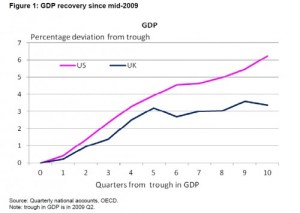 England (BOE) speech. That’s basically the UK’s version of the FED. It compares the recoveries of the UK and the US. The speech is actually called “Why is their recovery better than ours?” The answer is that we’ve taken a slightly more Keynesian approach to recovery with a stimulus and a Bernanke monetary policy that recognizes the threat of deflation and sluggish growth. They did a grand bargain sort’ve thing. Their austerity program dealt them a huge blow. It widened their federal deficit. It led to worse unemployment and terrible growth. The comparative graphs are astounding. I’ve placed the GDP one to the left.
The contrasting directions of employment trends raised uncertainty in the UK over the US during the latter half of the recovery, which weighed on consumption.
Fiscal policy, however, played an important role as well. Cumulatively, the UK government tightened fiscal policy by 3% more than the US government did – taking local governments and automatic stabilizers into account – and this had a material impact on consumption. This was particularly the case because a large chunk of the fiscal consolidation in 2010 and in 2011 took the form of a VAT increase, which has a high multiplier for households.
The fact that British real incomes were hit harder than American households’ incomes by energy price increases could be ascribed in large part to the past depreciation of Sterling, which also hit real incomes directly. All combined, these factors significantly dampened consumption growth in the UK, with knock on effects on investment and stockbuilding.
So, why would we follow this path to certain economic malaise? Bill Black provides a great analysis.’
The Republican Party’s approach to convincing Obama to commit the Great Betrayal cleverly exploits three human weaknesses. First, Obama wants to be considered a “centrist.” Second, Obama yearns to be considered “bipartisan.” These first two weaknesses are forms of vanity. The siren song is “do this and you will become known as the President who acted as a statesman to cut across Party and ideological divides and make the hard choices essential to allowing America to continue to be a great nation – while ‘saving’ the safety net.”
The third weakness that the Republicans seek to exploit is fear – and the death of alternatives. The mantra of European austerity proponents is “there is no alternative.” The only choice is between austerity and collapse, and that means there is no real choice. The Republican strategy is to create a series of “moral panics.” As the name implies, this involves the creation of a special form of panic falsely premised on immorality. (Think: “Reefer Madness” or Professor Hill causing River City, Iowans to believe that the arrival of pool hall demonstrated the imminent moral collapse of their children.) The Great Betrayal can only occur if Obama succumbs to mindless (and innumerate) panic.
Chait believes that Obama will not fall for this. Black obviously believes the President will still want to be seen as some one that will negotiate with Right Wing Terrorists in the name of bi-partisanship. I don’t know. Perhaps the incredible nasty attacks on the President during this campaign and the 4 years of obstruction and filibusters he endured during his first four years will drive him Chait’s direction.
So, enter my prediction of a pending impeachment charge no matter how frivolous. I think we can all say that the CDS that drove the impeachment of President Clinton is only matched by the ODS that will drive the impeachment attempts on Obama. Even Newt Ginrich–the architect of obstructing Clinton’s second term–has been using the Benghazi Default this week. (That link goes to Hannity so be warned and get some eye bleach.) No matter how much the evidence shows that this is a false narrative, the right and Fox keep hyping it in the same way that no amount of damnation by Chrysler, GM, Fact Checkers, and the media is stopping the Romney campaign from telling folks in Ohio that US jobs producing Jeeps are going to China. These folks just live on lies and achieving their evil goals in any way possible. They will see us all dead in the streets rather than give an inch. Just look at what Rush Limbaugh is saying today about Chris Christie’s h/t to POTUS on FEMA’s response to Sandy. They will never be moral actors. NEVER.
So, will the political circus of a purely political impeachment movement by whacko Tea Baggers and other republican partisans create an atmosphere that warps the outcome of this serious policy discussion ? Well, again, I’d put some serious money on watching a completely solvable situation go right into the right wing crapper as ODS goes to 11 the day after Romney loses. Ladies and Gentlemen, Guard your Social Security well! I wish I didn’t really believe this scenario is possible but unfortunately, I really do.
Fuzzy Math and Beyond: Romney’s Tax Plan is Mission Impossible
Posted: October 13, 2012 Filed under: 2012 elections, Economy | Tags: Bad Math, Joint Committee on Taxation, Mark Zandi, Romney Tax Plan 27 Comments
There’s more evidence that Romney’s promise to provide 20% across-the-board tax cuts coupled with deficit reduction just doesn’t add-up. There’s a new JCT study that shows this and there’s confirmation from Moody’s Economist Mark Zandi. Mark Zandi is a former McCain advisor so there’s not much room to argue that he’s got a liberal bias. He appeared on CNN and said the math did not add up.
What do you have to do to get it to add up?
Closing all the loopholes and ending all of the deductions currently given to the wealthy does not make up for the losses of giving everyone in the country, particularly the wealthy, another tax break. The only way Romney’s plan will not add to the deficit is if middle class families pay over $2,000 more in taxes annually.
Zandi wasn’t even subtle when he said the Romney Tax Plan is basically a muddle and won’t work.
ZANDI: Yeah, I think the Tax Policy Center study is the definitive study. They’re non-partisan, they’re very good. They say given the numbers that they’ve been provided by the Romney campaign, no, it will not add up. Now, the Romney campaign could adjust their plan. They could say okay I’m not going to lower tax rates as much as I’m saying right now and they could make the arithmetic work. But under the current plan, with the current numbers, no it doesn’t. I’ll say one other thing, though. I think it is important that we do focus on the so-called tax expenditures in the tax code. Those are the deductions, and credits, and loopholes in the code. We need to reduce those, because if we do we’re going to make the tax system fairer, easier to understand and ultimately lead to stronger growth. So that’s the right place to focus. But, no, the arithmetic doesn’t work as it is right now.
Here’s a good summary of the the JCT Study from Bloomberg that is the basis of Zandi’s comments. The bottom line is that repealing deductions only makes up for 4% of the across-the-board tax decrease suggested by Romney.
The analysis by the Joint Committee on Taxation emphasizes the difficult choices facing lawmakers as they balance the benefits of rate cuts against the consequences of changing or ending deductions, such as for mortgage interest and charitable contributions. Republican presidential nominee Mitt Romney proposes a 20 percent income-tax rate cut and says he would pay for it by limiting deductions, credits and exemptions.
While there are major differences between the assumptions underlying Romney’s plan and the JCT study, the findings emphasize shortcomings in Romney’s approach, said Daniel Shaviro, a tax law professor at New York University.
“There really is no serious dispute that the parameters of their plan can’t be met,” Shaviro said. “It’s like saying you’re going to drive from Boston to Los Angeles in 10 hours without speeding. There’s just no way to make the numbers add up.”
Ezra Klein published the JCT letter here and some analysis at his blog on WAPO.
The paper recounts an experiment conducted by the JCT. They supposed that all itemized deductions — things like the charitable deduction, the mortgage-interest break, etc. — were eliminated (though not non-deduction tax breaks — more on that later), along with the Alternative Minimum Tax. That mirrors Romney’s desire to cut tax breaks and eliminate the AMT. They also assumed that state and local bonds’ interest would start to be taxed, which, as AEI’s Matt Jensen has pointed out, makes it easier for the Romney plan to add up.
Finally, JCT assumed that capital gains and other investment income would be taxed at the same rate as regular income, instead of the preferential rates they currently enjoy. That’s a big difference from Romney’s plan, which proposes eliminating capital gains and other investment taxes for people making less than $200,000, but mirrors the Bowles-Simpson, Domenici-Rivlin and Wyden-Coats tax reform plans, all of which remove the capital preference.
Then JCT asked how low you could cut tax rates under this scenario without increasing the deficit, on net. The answer: not much at all. To keep revenue the same as it’ll be next year, when the Bush tax cuts expire, you could only cut rates by 4 percent. Instead of brackets of 15 percent, 28 percent, 31 percent, 36 percent and 39.6 percent, you’d have brackets of 14.4 percent, 26.88 percent, 29.76 percent, 34.56 percent and 38.02 percent. That’s not exactly revolutionary, and it’s a far cry from the 20 percent cut that Romney wants.
That said, the change is very progressive. People making $10-20,000 a year get their taxes cut by 2.4 percent of income, a 61.4 percent cut relative to their previous burden. By contrast, millionaires see taxes go up 7.1 percent, or 5.5 percent of income …
Here’s a good paragraph from David Dayen at FDL who wrote on the study earlier today. It puts both the debt and tax cuts into perspective.
For those that care about the deficit, it’s worth noting that the last major cut to taxes, the Bush-era tax cuts, accounts for the majority of the deficit problem currently, particularly in the out years. The tax cuts and the two wars will account for $9 trillion in deficits between their inauguration and 2019, under current policy. So throwing another $5 trillion tax cut that cannot be plausibly offset on the pile makes even less sense, especially in the constrained, non-MMT environment of Washington.
AEI and Republican always seem to plug a canard that’s been so debunked that it’s laughable. They love to say that tax cuts to the rich stimulate the economy. There have been a number of academic studies that show this is not the case. Some of the most recent ones are even more definitive. Still, the meme exists.
A new study, however, indicates that tax cuts for the wealthiest earners fail to generate economic growth at the same pace as tax cuts aimed at low- and middle-income earners.
The study, conducted by Owen M. Zidar, a former staff economist on President Obama’s Council of Economic Advisers and a graduate student at California-Berkeley, examined economic growth in the states with the most high-income earners. Zidar reasoned that “states with a large share of high income taxpayers should grow faster following a tax cut for high income earners” if the tax cuts had the economic effect conservatives claim.
What he found, though, is that the effect of tax cuts for the rich was “insignificant statistically,” as Reuters’ David Cay Johnston reported:
“Almost all of the stimulative effect of tax cuts,” Zidar found, “results from tax cuts for the bottom 90%. A one percent of GDP tax cut for the bottom 90% results in 2.7 percentage points of GDP growth over a two-year period. The corresponding estimate for the top 10% is 0.13 percentage points and is insignificant statistically.”
Zidar’s study provides more empirical backing to what the U.S. has experienced over the last 30 years. Supply-side tax cutting policies have not led to the growth their Republican proponents promised. The Bush tax cuts, for instance, were followed by the weakest decade for economic expansion on record.
It’s really disheartening for any economist to see these canards continually trotted out to what seems like a really economic illiterate electorate. Why any one continues to buy anything Romney and Ryan say is beyond me. My guess is we’ll hear more about this. The next presidential debate will be on the town hall one and hopefully this Romney Tax Plan in Wonderland will get some airing. It really is a ridiculous set of lies. The most disturbing thing is that the loopholes that would be eliminated are ones that benefit middle and upper middle incomes. A lot of the rich get their incomes from sources that are taxed differently anyway. That’s why he’s peddling the elimination of capital gains taxes. He still gets to shelter his income no matter what happens to normal tax deductions.
Job Number Truthers
Posted: October 5, 2012 Filed under: Economy, jobs, unemployment | Tags: job numbers truthers, Romney screws up labor participation rates, unemployment numbers 67 CommentsI guess today is Tinfoil Friday. Allen West and Jack Welch think the BLS is manipulating unemployment number in response to some Chicago Mafia move to make Obama and the economy look better. Huhn? I would think if that was possible they would’ve been doing it all along instead of just suddenly producing a better but still anemic result at the last moment.
The Bureau of Labor Statistics released an unexpectedly strong monthly jobs report on Friday, finding a dramatic drop in unemployment to 7.8 percent and revised the number of jobs added in July and August up from initial estimates. While for most Americans, the growing economy is good news, conservatives immediately expressed their skepticism in the jobs report’s credibility.
1) Minutes after the report was released, Jack Welch, who famously cooked General Electric’s accounting books when he was CEO, accused President Obama of manipulating the numbers to distract from his debate performance.
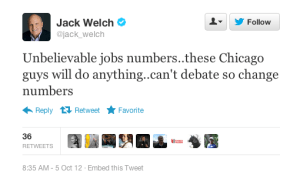
This is pretty weird. The jobs report was straightforward this month.
The controversy, if it’s worth using that word, is over the unemployment rate, which dropped from 8.1 percent to 7.8 percent. That’s three-tenths of one percent. That’s what all the fuss is about.
Let’s get one thing out of the way: The data was not, as Jack Welch suggested in a now-infamous tweet, manipulated. The Bureau of Labor Statistics is set up to ensure the White House has no ability to influence it. As labor economist Betsey Stevenson wrote, “anyone who thinks that political folks can manipulate the unemployment data are completely ignorant of how the BLS works and how the data are compiled.” Plus, if the White House somehow was manipulating the data, don’t you think they would have made the payroll number look a bit better than 114,000? No one would have batted an eye at 160,000.
The fact is that there’s not much that needs to be explained here. We’ve seen drops like this — and even drops bigger than this — before. Between July and August the unemployment rate dropped from 8.3 percent to 8.1 percent — two-tenths of one percent. November-December of 2011 also saw a .2 percent drop. November-December of 2010 saw a .4 percent drop. This isn’t some incredible aberration. The fact that the unemployment rate broke under the psychologically important 8 percent line is making this number feel bigger to people than it really is.
What’s even odder is that Romney said the report wasn’t “realistic” and actually misstated the reasons for the change in numbers.
Mitt Romney challenged the significance of the drop in the unemployment rate today, arguing that the “real reality” is that the figure declined because “more and more people have just stopped looking for work.”
“There was a report that just came out this morning on job creation this last month,” said Romney at a rally in the battleground state of Virginia. “There were fewer new jobs created this month than last month. And the unemployment rate as you noted this year has come down very, very slowly, but it’s come down nonetheless.”
“The reason it’s come down this year is primarily due to the fact that more and more people have just stopped looking for work,” Romney said. “And if you just dropped out of the work force, if you just give up and say look I can’t go back to work I’m just going to stay home, if you just drop out all together why you’re not longer part of the employment statistics.”
“So it looks like unemployment is getting better, but the truth is, if the same share of people were participating in the workforce today as on the day the president got elected, our unemployment rate would be around 11 percent,” said Romney. “That’s the real reality of what’s happening out there.”
This morning’s jobs report released by the Bureau of Labor Statistics found that the nation’s unemployment rate dropped from 8.1 percent to 7.8 percent, the first time it’s been below 8 percent in four years. September saw the addition of 114,000 jobs, according to the report, a decrease from the 142,000 that were added in August, and statistic that Romney emphasized on the trail today.
Yes, random variation is quite suspicious and unrealistic. Here’s the labor force numbers straight from the report. Romney told an audience the exact opposite had happened. There is no way he actually read the report. Well, that or he was lying again.
The civilian labor force rose by 418,000 to 155.1 million in September, while the labor force participation rate was little changed at 63.6 percent. (See table A-1
The best article I’ve seen today explaining the job situation and the Welch Tin Foil hat theory is here at The Atlantic.
A number of conservatives have suggested the 873,000 household figure is wildly implausible, if not an outright conspiracy to help Obama on the part of the BLS. This is nonsense. As Greg Ip of The Economist points out, the employer and household numbers often diverge over the short-term, but they mostly match up over the long-term. And they still do if we look at the past three months. The employer survey showed job gains of 181,000 in July, 141,000 in August and 114,00 in September, for an average gain of 146,000. The household survey showed job losses of 195,000 in July, 119,000 in August, and job gains of 873,000 in September, for an average gain of 186,000. If you can’t see the conspiracy there, well, you just might be mathematically literate.
Wow. Is this the silly season or what?

 peej
peej Carissa
 bostonboomer
 dakinikat
 ecocatwoman
 mablue2
 Mama Lopez
 peggysue22
 quixote
 skydancingguestblogger
 Mona (aka Wonk the Vote)



 Sky Dancing
Recent Comments