
Nicholas Kristof Suddenly Discovers the Unemployment Crisis
Posted: August 28, 2011 Filed under: Barack Obama, Economy, U.S. Economy, U.S. Politics, unemployment | Tags: Barack Obama, callous disregard for human lives, Depression, joblessness, media elite, Nicholas Kristof, politicians, Suicide, the NEW York Times, Torture, unemployment, war 16 Comments
I probably shouldn’t pick on Nicholas Kristof, because I guess as media elites go, he’s one of the least offensive. But really, his latest column just about sent me out into the street screaming and tearing my hair out. The piece is titled “Did We Drop the Ball on Unemployment?”
WHEN I’m in New York or Washington, people talk passionately about debt and political battles. But in the living rooms or on the front porches here in Yamhill, Ore., where I grew up, a different specter wakes friends up in the middle of the night.
It’s unemployment.
I’ve spent a chunk of summer vacation visiting old friends here, and I can’t help feeling that national politicians and national journalists alike have dropped the ball on jobs. Some 25 million Americans are unemployed or underemployed — that’s more than 16 percent of the work force — but jobs haven’t been nearly high enough on the national agenda.
Duh! I have a question for Captain Obvious Nick Kristof: Is the Pope Catholic? Here’s another one: Does a bear sh*t in the woods? Yes, Nick. You and your pals dropped the ball, missed the boat, and every other metaphorical cliche you can think of. Yes. And it’s way too late for your mealy-mouthed *concern* to make a difference.
What is wrong with these people? Kristof goes on to provide a few examples of people he knows in Oregon who are suffering from joblessness and hopelessness. Frankly, I found his little anecdotes rather patronizing. Maybe I’m being too hard on him, but really, if this man claims to be a “journalist,” why didn’t he recognize years ago that unemployment was a huge problem for the American people and for the economy as a whole? Kristof’s half-hearted prescriptions for solutions aren’t much better than Obama’s:
There are no quick fixes to joblessness, but Washington could temporarily make federal money available to pay for teachers who are otherwise being laid off. We could increase spending on service programs like AmeriCorps that have far more applicants than spots.
We could extend the payroll tax cut, which expires at the end of December. Astonishingly, Republicans in Congress seem to be lined up instinctively against this basic economic stimulus. Could the Tea Party actually favor tax reductions for billionaires but not for working Americans? Could we have found a tax increase the Republican Party favors?
Mr. Obama, with 25 million Americans hurting, will you fight — really fight! — to put jobs at the top of the national agenda?
Give me a break! Obama isn’t going to fight for anything except his own reelection and keeping his wealthy donors happy. And Nick Kristof, after tossing of a facile column in which he pretends to care about struggling Americans, will return to Washington and New York, smile his self-satisfied smile, and continue to ignore the depth of what is really happening to our country.
Why doesn’t The New York Times hire Jeffrey Kaye, who writes about important topics like torture? Joblessness can be a kind of torture too, and a couple of weeks ago, Kaye wrote a fine article about the links between unemployment, depression, and suicide.
When considering the effects of unemployment, and the desultory, really uncaring response of the current Democratic administration, as well as Republicans in Congress, to the human devastation of joblessness, it is important to consider the terrible emotional and psychological effects of such unemployment. Such effects are well-documented, but rarely mentioned in articles or blog postings.
A well-regarded 2010 study by the John J. Heldrich Center for Workforce Development at Rutgers, the State University of New Jersey, “The Anguish of Unemployment,” quantified the tremendous emotional suffering engendered by unemployment. “‘The lack of income and loss of health benefits hurts greatly, but losing the ability to provide for my wife and myself is killing me emotionally,’ wrote one respondent to the survey.” ….
Just last April, the Centers for Disease Control (CDC) released a study that showed that suicide rates rise and fall in tandem with the business cycle.
Kaye, a clinical psychologist actively working with clients, says he has seen the devastating effects of joblessness in his own practice since the financial crisis. He writes:
Unemployment is deadly. The effects of the capitalist boom-and-bust system seriously damage millions of lives. But with an almost daily bombast of propaganda about terrorism, the populace lives in fear, while wondering how they will make their bills, ground down between anxiety over ghostly terrorists and eviction, or how to put gas in their car, or afford a bus pass. Hopelessness stalks the land, not Al Qaeda. And yet the politicians in D.C. care little or nothing about the suffering their policies cause. Indeed, their pockets are lined with campaign donations from corporations that routinely layoff hundreds of thousands, and ship many thousands more jobs overseas.
Callous disregard for human lives is what links the terrible policies of war and torture with the policies of neglect and indifference towards the jobless. Such callousness is the by-product of a get-rich-quick ethos that worships profit over all else, over worship of a capitalist system that has brought about terrible world wars, massive depressions, colonial atrocities, and even genocide. U.S. society awaits its turn through the meat-grinder of history.
That is the kind of writing I’d like to see on the op-ed page of the NYT. Of course I know it will never happen. The elite media, the out-of-touch political class, and their wealthy enablers must not be made to feel even slightly uncomfortable about the effects of their actions–not even for the few minutes it takes to read a newspaper column.
Saturday Reads: Dr. Martin Luther King’s Dreams, Waiting for Irene, and Bernanke’s Complaint
Posted: August 27, 2011 Filed under: Barack Obama, Civil Rights, Domestic Policy, Economy, jobs, morning reads, poverty, U.S. Economy, U.S. Politics | Tags: Barack Obama, Ben Bernanke, Cornel West, Federal Reserve Bank, Hurrican Irene, I Have A Dream speech, leadership vacuum, Martin Luther King, media frenzy, oligarchy, revolution 63 Comments
By Mr. Fish, Truthdig.org
Good Morning! We are approaching the 48th anniversary of the March on Washington for Jobs and Freedom (remember those?) and Martin Luther King’s “I have a dream” speech. Perhaps it is fitting that the ceremony to be held tomorrow to commemorate the anniversary has been postponed indefinitely. After all, King’s dream of ending poverty in American has certainly been postponed indefinitely. Ironically, we now have a “Black President” who as different from Dr. King as night from day. Oh, if only King were here today to speak truth to this sorry excuse for a President!
A reminder from the Center for American Progress: Dr. King’s Legacy Relevant in Today’s Budget Battles
In the 1960s, Americans had a government that refused to deliver basic human rights to its people. Over time, after battles in the courts and the political arena, laws such as the Civil Rights Act of 1964 and the Equal Employment Opportunity Act of 1972 were passed. But despite these great accomplishments the fight continued because many Americans of all racial backgrounds were still living below the poverty line.
So in 1967, Dr. King and the Southern Christian Leadership Conference decided to organize and lead the Poor People’s Campaign to combat poverty. The goal was to push Congress to create an “Economic Bill of Rights” that would establish how the federal government would address and solve the country’s poverty issues. It called for full employment, affordable housing, reasonable living wages, and equitable education opportunities for the poor. Momentum built up around the country, but unfortunately the campaign ended early due to the tragic assassination of Dr. King and lack of organization to continue the efforts.
Cornel West had a very appropriate op-ed in the NYT a couple of days ago: Dr. King Weeps From His Grave Here is a relevant excerpt:
The age of Obama has fallen tragically short of fulfilling King’s prophetic legacy. Instead of articulating a radical democratic vision and fighting for homeowners, workers and poor people in the form of mortgage relief, jobs and investment in education, infrastructure and housing, the administration gave us bailouts for banks, record profits for Wall Street and giant budget cuts on the backs of the vulnerable.
As the talk show host Tavis Smiley and I have said in our national tour against poverty, the recent budget deal is only the latest phase of a 30-year, top-down, one-sided war against the poor and working people in the name of a morally bankrupt policy of deregulating markets, lowering taxes and cutting spending for those already socially neglected and economically abandoned. Our two main political parties, each beholden to big money, offer merely alternative versions of oligarchic rule.
The absence of a King-worthy narrative to reinvigorate poor and working people has enabled right-wing populists to seize the moment with credible claims about government corruption and ridiculous claims about tax cuts’ stimulating growth. This right-wing threat is a catastrophic response to King’s four catastrophes; its agenda would lead to hellish conditions for most Americans.
King weeps from his grave. He never confused substance with symbolism. He never conflated a flesh and blood sacrifice with a stone and mortar edifice. We rightly celebrate his substance and sacrifice because he loved us all so deeply. Let us not remain satisfied with symbolism because we too often fear the challenge he embraced. Our greatest writer, Herman Melville, who spent his life in love with America even as he was our most fierce critic of the myth of American exceptionalism, noted, “Truth uncompromisingly told will always have its ragged edges; hence the conclusion of such a narration is apt to be less finished than an architectural finial.”
King’s response to our crisis can be put in one word: revolution. A revolution in our priorities, a re-evaluation of our values, a reinvigoration of our public life and a fundamental transformation of our way of thinking and living that promotes a transfer of power from oligarchs and plutocrats to everyday people and ordinary citizens.
Yes we need a revolution. We desperately need to revise our priorities and values and to end the transfer of wealth and power from the people to the oligarchs. Who will lead that revolution? We have never been more in need of strong, honest, caring leaders and yet we have a complete vacuum of leadership. What is to become of our country?
Of course Hurricane Irene is the more immediate focus and the object of the media sharks’ feeding frenzy for today. Nothing so pedestrian as putting people back to work or ending poverty could interest them. Interestingly, big media seems to be ignoring the fact that the hurricane has weakened significantly and that the eye has collapsed, meaning that there is unlikely to be any more intensification of the storm. I suppose it could still do quite a bit of damage along the coastline, but as a Bostonian I’ve seen so many of these huge storms fail to live up to the hype that I’m skeptical of this one. I hope I’m right this time.
Jeff Masters at Weather Underground yesterday:
Satellite data and measurements from the Hurricane Hunters show that Irene is weakening. A 9:21 am EDT center fix by an Air Force Reserve aircraft found that Irene’s eyewall had collapsed, and the central pressure had risen to 946 mb from a low of 942 mb this morning. The highest winds measured at their flight level of 10,000 feet were 125 mph, which would normally support classifying Irene as a Category 3 hurricane with 115 mph winds. However, these winds were not mixing down to the surface in the way we typically see with hurricanes, and the strongest surface winds seen by the aircraft with their SFMR instrument were just 90 mph in the storm’s northeast eyewall. Assuming the aircraft missed sampling the strongest winds of the hurricane, it’s a good guess that Irene is a mid-strength Category 2 hurricane with 100 mph winds. Satellite imagery shows a distinctly lopsided appearance to Irene’s cloud pattern, with not much heavy thunderstorm activity on the southwest side. This is due to moderate wind shear of 10 – 20 knots due to upper-level winds out of the southwest. This shear is disrupting Irene’s circulation and has cut off upper-level outflow along the south side of the hurricane. No eye is visible in satellite loops, but the storm’s size is certainly impressive. Long range radar out of Wlimington, North Carolina, shows that the outermost spiral bands from Irene are now beginning to come ashore along the South Carolina/North Carolina border. Winds at buoy 41004 100 miles offshore from Charleston, SC increased to 36 mph as of 10 am, with significant wave heights of 18 feet.
And from last night: “Irene continues to weaken.”

Satellite data and measurements from the Hurricane Hunters show that Irene continues to weaken. A 1:32 pm EDT center fix by an Air Force Reserve aircraft found that Irene’s eyewall is still gone, and the central pressure had risen to 951 mb from a low of 942 mb this morning. The winds measured in Irene near the surface support classifying it as a strong Category 1 hurricane or weak Category 2. Satellite imagery shows a distinctly lopsided appearance to Irene’s cloud pattern, with not much heavy thunderstorm activity on the southwest side. This is due to moderate southwesterly wind shear of 10 – 20 knots. This shear is disrupting Irene’s circulation and has cut off upper-level outflow along the south side of the hurricane. No eye is visible in satellite loops, but the storm’s size is certainly impressive. Long range radar out of Wilmington, North Carolina, shows that the outermost spiral bands from Irene have moved ashore over North Carolina. Winds at buoy 41004 100 miles offshore from Charleston, SC increased to 47 mph, gusting to 60 mph at 3 pm EDT, with significant wave heights of 25 feet.
New York City has ordered 250,000 people to evacuate from coastal areas.
New York City officials issued what they called an unprecedented order on Friday for the evacuation of about 250,000 residents of low-lying areas at the city’s edges — from the expensive apartments in Battery Park City to the roller coaster in Coney Island to the dilapidated boardwalk in the Rockaways — warning that Hurricane Irene was such a threat that people living there simply had to get out.
Officials made what they said was another first-of-its kind decision, announcing plans to shut down the city’s entire transit system on Saturday — all 468 subway stations and 840 miles of tracks, and the rest of nation’s largest mass transit network: thousands of buses in the city, as well as the buses and commuter trains that reach from Midtown Manhattan to the suburbs.
Underscoring what Mayor Michael R. Bloomberg and other officials said was the seriousness of the threat, President Obama approved a request from Gov. Andrew M. Cuomo of New York to declare a federal emergency in the state while the hurricane was still several hundred miles away, churning toward the Carolinas. The city was part of a hurricane warning that took in hundreds of miles of coastline, from Sandy Hook, N.J., to Sagamore Beach, Mass.
From what I’ve heard, the Jersey Shore may get hit worse than NYC, but who knows? I know we have a few commenters from NJ, so I hope they will keep us updated on the situation there. In Boston, they are getting warnings about the storm surges for people along the coast and the Cape and islands.
BOSTON — As Hurricane Irene began to batter the Carolina Coast on Friday afternoon, a hurricane warning was issued for Cape Cod, Martha’s Vineyard, New York City and coastal Connecticut.
A tropical storm warning was issued for the North and South shores, and a tropical storm watch was issued for areas of southern New England further inland….
Massachusetts Gov. Deval Patrick declared a state of emergency ahead of the storm. He said he is particularly concerned because Irene will likely take a path through central Massachusetts, with fierce, damage-causing winds and storm surges on the eastern, coastal side of the state, and at least 10 inches of heavy rain leading to flooding to the west.
Here’s a little comic relief. Some ESPN guy (a former golfer) got in trouble for mocking President Obama on Twitter (has the First Amendment been repealed or what?)
ESPN is coming down on Paul Azinger for mocking President Obama on Twitter. The golf analyst tweeted Thursday the commander in chief plays more golf than he does — and that Azinger has created more jobs this month than Obama has.
On Friday ESPN ‘reminded” Azinger his venture into political punditry violates the company’s updated social network policy for on-air talent and reporters.
“Paul’s tweet was not consistent with our social media policy, and he has been reminded that political commentary is best left to those in that field,” spokesman Andy Hall told Game On! in a statement.
ESPN’s Hall would not comment on whether Azinger, who won the 1993 PGA Championship, will be fired, suspended or punished in some way. “We handle that internally,” he said.
In economics news, Ben Bernanke gave his eagerly anticipated speech yesterday, and basically said that the politicians have screwed up the economy and he hopes they won’t completely sink it with their insanely stupid policies based on Reagan era fantasies. If you’re interested, here are a few links to reactions to Bernanke’s speech.
Derek Thompson at The Atlantic: Bernanke: The Debt Ceiling Debate Nearly Broke the Recovery
Andrew Leonard at Salon: Bernanke Declines to Commit Treason
Jenine Aversa at Bloomberg: Bernanke Scholar Advises Bernanke Fed Chief to Be Bold on Monetary Policy
Those are my reading recommendations for today. What are you reading and blogging about?
Friday Reads
Posted: August 26, 2011 Filed under: 2012 presidential campaign, Economy, Environment, Environmental Protection, morning reads, U.S. Economy, unemployment | Tags: bernanke, fiscal policy, fracking, Mitt Romney, monetary policy, Oil companies guilty of killing birds 29 Comments good morning!
We’ve talked about the earthquake in Virginia some. This is one of the most interesting op eds I’ve seen for some time and it’s written by Dr. Stuart Jeanne Bramhall who is actually a psychologist but has done some research on the subject. She argues that fracking in neaby West Virginia could’ve been responsible for the unusual and unusually large quake. I know there’s a lot of controversy about fracking but I had no idea it could cause earthquakes. Actually, fracking itself doesn’t, its another step in the process and it’s happened before in Arkansas.
According to geologists, it isn’t the fracking itself that is linked to earthquakes, but the re-injection of waste salt water (as much as 3 million gallons per well) deep into rock beds.
Braxton County West Virginia (160 miles from Mineral) has experienced a rash of freak earthquakes (eight in 2010) since fracking operations started there several years ago. According to geologists fracking also caused an outbreak of thousands of minor earthquakes in Arkansas (as many as two dozen in a single day). It’s also linked to freak earthquakes in Texas, western New York, Oklahoma and Blackpool, England (which had never recorded an earthquake before).
Industry scientists deny the link to earthquakes, arguing that energy companies have been fracking for nearly sixty years. However it’s only a dozen years ago that “slick-water fracks” were introduced. This form of fracking uses huge amounts of water mixed with sand and dozens of toxic chemicals like benzene, all of which is injected under extreme pressure to shatter the underground rock reservoir and release gas trapped in the rock pores. Not only does the practice utilize millions of gallons of freshwater per frack (taken from lakes, rivers, or municipal water supplies), the toxic chemicals mixed in the water to make it “slick” endanger groundwater aquifers and threaten to pollute nearby water-wells.
Horizontal drilling and multi-stage fracking (which extend fractures across several kilometres) were introduced in 2004.
The op ed provides links and information on the the related research and information on the prior quake experience in Arkansas.
Mitt Romney lost his cool last night in a New Hampshire Town Meeting. The dust-up was over Romney’s support of a balanced budget amendment which is basically anathema to economists. You can watch the video and the resultant hair malfunction that results. Also, interesting to note is Mediate’s use of the word “former” in front of front runner.
Former GOP presidential frontrunner Mitt Romney got into a heated exchange with a voter at a New Hampshire town hall event Wednesday over his support for a balanced budget amendment, and by the mainstream media’s selective standards, lost his cool when she tried to engage him. In clips played on MSNBC’s The Daily Rundownthis morning, Romney certainly appeared angry by those standards, and the full exchange, while slightly less damning, demonstrated a marked contrast with how President Obamadealt with an aggressive questioner recently.
The snippets that MSNBC played, of Romney snippily asking the town hall attendee to let him answer her question, were obviously designed to show the candidate as impatient and besieged, but placing them in context doesn’t change things all that much. Romney aggressively interrupts the woman’s calm, if rambling, question by asking her, “Did somebody in the room say that we don’t need any government?”
When she tries to engage his question, calling the balanced budget amendment “irresponsible,” he interrupts her again, abruptly asking, “Do you have a question, and let me answer your question.”
“Yes, how do you think the government can not provide funds for the people, its citizens?”
Romney begins to answer the question, and from there, you can’t hear what the woman is saying, but Romney reacts angrily to her attempts to follow up, saying, “You had your turn madam, now let me have mine!”
Frum Forum mentions the number of economists that think a double dip recession is inevitable. I want to bring this up now so that when you hear the villagers say most economists didn’t think that it was going to happen that you’ll see that a lot–if not most–of us do think that. Also, note that the majority of us have been saying that the Federal government has been doing the wrong Fiscal Policy things since about 2007 too. Paul Krugman mentions that the fiscal policy response has just been gunning for another recession tool.
At this point the entire advanced world is doing exactly what basic macroeconomics says it shouldn’t be doing: slashing spending in the face of high unemployment, slow growth, and a liquidity trap. It’s a global 1937. And if the result is another recession, the witch-doctors will just demand more bleeding.
Yup, the austerity demons will undoubtedly howl for more budget cuts and more tax cuts for the unjob creators.
The U.N., U.S. and NATO have unfroze Libyan assets so the transitional government can provide critical humanitarian aid to the Libyan People. This news comes from the US State Department.
The UN Security Council’s Libya Sanctions Committee approved a U.S. proposal to unfreeze $1.5 billion of Libyan assets to be used to provide critical humanitarian and other assistance to the Libyan people. The U.S. request to unfreeze Libyan assets is divided into three key portions:
Transfers to International Humanitarian Organizations (up to $500 million):
- Up to $120 million will be transferred quickly to meet unfulfilled United Nations Appeal requests responding to the needs of the Libyan people (including critical assistance to displaced Libyans). Up to $380 million will be used for the revised UN Appeals for Libya and other humanitarian needs as they are identified by the UN or other international or humanitarian organizations.
Transfers to suppliers for fuel and other goods for strictly civilian purposes (up to $500 million):
- Up to $500 million will be used to pay for fuel costs for strictly civilian needs (e.g., hospitals, electricity and desalinization) and for other humanitarian purchases.
Transfers to the Temporary Financial Mechanism established by the Contact Group to assist the Libyan people (up to $500 million):
- Up to $400 million will be used for providing key social services, including education and health. Up to $100 million will be used to address food and other humanitarian needs.
The United States crafted this proposal in close coordination with the Transitional National Council, as they assessed the needs of the Libyan people throughout the country. It responds to humanitarian concerns in a diversified way that prioritizes key needs. The United States will work urgently with the Transitional National Council to facilitate the release of these funds within days.
The President of the AFL-CIO continues his harsh criticism of President Obama. This should be interesting since labor unions provide a lot of GOTV work for elections at all levels.
The most powerful union official in the country offered reporters his harshest critique of President Obama to date Thursday, questioning Obama’s policy and strategic decisions, and claiming he aligned himself with the Tea Party in the debt limit fight.
“This is a moment that working people and quite frankly history will judge President Obama on his presidency; will he commit all his energy and focus on bold solutions on the job crisis or will he continue to work with the Tea Party to offer cuts to middle class programs like Social Security all the while pretending the deficit is where our economic problems really lie,” AFL-CIO President Richard Trumka told reporters at a breakfast roundtable hosted by the Christian Science Monitor.
Trumka dismissed Obama’s recent job creation proposals — an extended payroll tax cut, patent reform, free trade deals — as “nibbly things that aren’t going to make a difference,” and said the AFL-CIO might sit out the Democratic convention if he and the party don’t get serious.
“If they don’t have a jobs program I think we’d better use our money doing other things,” Trumka said.
The editors of Bloomberg are down on monetary policy and are asking for more relevant fiscal policy in this op ed: The U.S. Needs a Jobs Policy, Not More Cheap Money. Well, at least some body gets it. The Federal Government can create jobs. Some one just needs to get the President to believe that and fight for it.
While the Fed can only print money, the government has the power to create jobs directly. And jobs are what the economy needs now, to break the chain in which high unemployment, weak consumer demand and low business confidence reinforce one another. Bloomberg View has laid out some of the best options available for a national jobs policy:
— Public-works spending can lift demand and put people to work in capital-intensive industries such as construction.
— A tax credit for companies that increase their headcount can encourage hesitant employers to hire at minimal cost to taxpayers.
— Programs that pay the wages of new hires as they gain on-the-job training can efficiently target the long-term unemployed.
— Allowing the unemployed to collect benefits while starting up new businesses can prompt older, better-educated people to create their own opportunities.
— For some entry-level jobs, scrapping the reporting of criminal records on applications can help qualified workers get a foot in the door and stay out of prison.
— And to make the spending more palatable to congressional opponents, President Barack Obama could offer to cut some of the red tape holding back hiring and economic growth, such as the outdated Davis-Bacon Act, which artificially raises the cost of public-works projects.
Altogether, a meaningful jobs package might cost taxpayers more than $200 billion over a couple years. To provide the government the leeway it needs to support the economy in the short term, it’s crucial that the congressional supercommittee, which must find $1.5 trillion in deficit reduction over the next 10 years, recommend a combination of new revenue, spending cuts, tax reforms and entitlement changes that would put the government’s long-term finances on a sustainable path.
Whatever Bernanke says today, he can’t rescue the economy alone
Yup. But, we’ve been talking about that here for a long time. I feel a bit blue in the face, do you?
So, here’s some news from North Dakota where seven oil companies are charged with killing birds.
Seven oil companies have been charged in federal court with illegally killing 28 migratory birds in Williams County.
Slawson Exploration Company of Kansas, ConocoPhillips Company, Petro Hunt, LLC and Newfield Production Company, all of Texas, Brigham Oil and Gas, LP of Williston, Continental Resources, Inc. of Oklahoma, Fidelity Exploration and Production Company of Colorado face charges of violating the Migratory Bird Treaty Act.
Most of the dead birds were found in un-netted oil reserve pits in May. An employee of one company alerted the Fish and Wildlife service to some of the dead birds. Others were found by inspectors.
In one case, an oil spill leaked into a nearby wetland, where several ducks died as a result of exposure to the oil.
The U.S. Fish and Wildlife Service says netting is the most effective way of keeping birds from entering waste pits.
The maximum sentence they face is six months in federal prison and a $15,000 fine.
So corporations have all these people rights now, how do we get them into prison for those six months? Perhaps Uncle Clarence Thomas has a suggestion?
What’s on your reading and blogging list today?
UPDATE:
Via Corrente and Lambert/DC Blogger:
Update on Susie at Suburban Guerilla
Susie was taken to the hospital early this morning for a possible heart attack and is being kept there for observation and testing until tomorrow morning.
Finally, but is it for real?
Posted: August 25, 2011 Filed under: 2012 presidential campaign, Economy, unemployment, voodoo economics | Tags: bad economy, joblessness, lousy poll numbers, Obama 10 Comments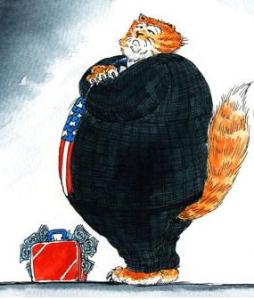 When Obama swept into office, there was an ongoing, left-over Bush program in place to rescue the financial system which focused on getting banks recapitalized through the Fed. Despite worsening unemployment and rising bankruptcies, a stimulus that was top heavy in worthless tax cuts was hurried to congress and a program–that was more of a plea to banks than an actual program–was pasted together to focus on refinancing underwater mortgage holders. The stimulus may have changed the momentum of GDP growth and the FED program definitely stabilized the banking system, but the programs for homeowners and the unemployed were less-than-successful. The President was itching to put something together on health care to prove that he could do something that hadn’t been achieved by the Clintons. It looks now like his primary economic advisers were warning him that just feeding tax breaks to choice businesses and and cheap loans to banks was not going to solve a major financial crisis. Obama’s focus never really appeared to be on things that mattered at the time. As a result, serious improvement in key areas of the economy never materialized.
It’s not a surprise to any of us around here that Obama’s handling of the US economy is souring voters. James Carville’s mantra–it’s the economy stupid–has never been more relevant to the vast majority of Americans who have been made worse off by the policies of the last ten years.
Americans’ views on the economy have dimmed this summer. But so far, the growing pessimism doesn’t seem to be taking a toll on President Barack Obama’s re-election prospects.
More people now believe the country is headed in the wrong direction, a new Associated Press-GfK poll shows, and confidence in Obama’s handling of the economy has slipped from just a few months ago, notably among fellow Democrats.
The survey found that 86 percent of adults see the economy as “poor,” up from 80 percent in June. About half — 49 percent — said it worsened just in the past month. Only 27 percent responded that way in the June survey.
That can’t be good news for a president revving up his re-election campaign.
There’s a good chance that GDP–now growing at a miserably slow rate–may go into negative territories shortly, forcing the NBER to date the  start of yet another recession when the recovery from this one has not really taken hold. There’s indications in the market that another crash could be on the horizon. After all, businesses can only wring so much profit out of restructuring debt to take advantage of cheap interest rates and cutting costs primarily by dumping workers. Here’s some really frightening news on reinsurance on banks which is also causing weird stuff in the CDS market. That’s the same damned market that messed up the economies of Europe and US the last time around which really needs some restructuring, standardization, and reform that has not been done despite Dodd-Frank and similar efforts on the other side of the pond. Bankers have fought new regulation and we’re likely to see the same problems revisit us in a different sector of the same market for the same kinds of vehicles.
Insurance on the debt of several major European banks has now hit historic levels, higher even than those recorded during financial crisis caused by the US financial group’s implosion nearly three years ago.
Credit default swaps on the bonds of Royal Bank of Scotland, BNP Paribas, Deutsche Bank and Intesa Sanpaolo, among others, flashed warning signals on Wednesday. Credit default swaps (CDS) on RBS were trading at 343.54 basis points, meaning the annual cost to insure £10m of the state-backed lender’s bonds against default is now £343,540.
The cost of insuring RBS bonds is now higher than before the taxpayer was forced to step in and rescue the bank in October 2008, and shows the recent dramatic downturn in sentiment among credit investors towards banks.
“The problem is a shortage of liquidity – that is what is causing the problems with the banks. It feels exactly as it felt in 2008,” said one senior London-based bank executive.
“I think we are heading for a market shock in September or October that will match anything we have ever seen before,” said a senior credit banker at a major European bank.
While Obama is on vacation, White House gnomes are pasting together two programs for the poll-beleaguered President to announce when Congress gets back into session. The first is a “jobs” package. The second is a plan for massive mortgage refinancing. This is something that should’ve been on the front burner years ago so now I’m actually wondering if it’s going to work in time to stymy the right wing nut jobs coming up through the Republican primary process or it’s actually going to be serious rather than some lame ass attempt at some neoReaganesque policy that will move farther right when Republicans start saying no to clearly Republican policy.
Here’s the “Contours of Obama jobs package” via Reuters.
The president is widely expected to repeat his calls for an extension of a payroll tax cut, push for patent reform and bilateral free trade deals, and suggest an infrastructure bank to upgrade the country’s roads, airports and other facilities.
Retrofitting schools with energy efficient technology would allow the government to directly hire for labor-intensive work and also give a boost to the clean energy sector that Obama has said could be an important U.S. economic motor.
Other measures being considered, according to economists who have advised the White House, include tax credits for firms hiring more workers, funds for local governments to hire teachers, and retraining help for the long-term unemployed. Steps to boost the ailing housing market are also under review.
“What’s going to be included in this plan are some reasonable ideas that could have a tangible impact on improving our economy and creating jobs … the kinds of things that Republicans should be able to support,” Earnest said. “These are bipartisan ideas that the president is going to offer up.”
Republicans have made it perfectly clear that their only priority is to make Obama a one term president. So, in yet another attempt at trying to look above the fray instead of fighting for what is right, we’re going to see another lukewarm policy that won’t have any immediate effect and will undoubtedly be pushed further to the right and further into the ineffective zone. Plus, it will probably just be offset by other spending cuts in key areas which are likely to have stronger recessionary multiplier effects attached than any positive multiplier effect of the new legislation. I still can’t figure out what the obsession is with tax cuts for new employees. The big cost of new employees is health insurance for one and you can avoid that cost by going any where in the developed and developing world BUT the US. Plus, no business is going to hire any one when the have no customers. I feel like a broke record on the number of repeats on that one. Having spent my life doing strategic planning and budgeting for corporations and having one of my PhD field areas in corporate finance, I can tell you that the US looks like one of those offshore tax havens right now for most major corporations. Also, more ‘free trade’ deals are likely to have just the opposite effect on unemployment anyway as prices tend to equilibriate in the countries involved and we’re the cheap capital market, not the cheap labor market part of that equation. (Hence, in our country, incomes to capital go up and incomes to labor go down as the market goes towards price parity for our country.)
So, the second program is no a way for the US to back mortgage refinancing. This is also something that should’ve been done years ago.
One proposal would allow millions of homeowners with government-backed mortgages to refinance them at today’s lower interest rates, about 4 percent, according to two people briefed on the administration’s discussions who asked not to be identified because they were not allowed to talk about the information.
A wave of refinancing could be a strong stimulus to the economy, because it would lower consumers’ mortgage bills right away and allow them to spend elsewhere. But such a sweeping change could face opposition from the regulator who oversees Fannie Mae and Freddie Mac, and from investors in government-backed mortgage bonds.
Administration officials said on Wednesday that they were weighing a range of proposals, including changes to its previous refinancing programs to increase the number of homeowners taking part. They are also working on a home rental program that would try to shore up housing prices by preventing hundreds of thousands of foreclosed homes from flooding the market. That program is further along — the administration requested ideas for execution from the private sector earlier this month.
But refinancing could have far greater breadth, saving homeowners, by one estimate, $85 billion a year. Despite record low interest rates, many homeowners have been unable to refinance their loans either because they owe more than their houses are now worth or because their credit is tarnished.
I’ve already looked into refinancing my FHA/VA loan from 7% to 4%. I have good credit and my loan balance is about one half of what my house is worth–even with the recent decrease in home prices–because I’ve owned it for 11 years. I didn’t follow through because the points charged by Wells Fargo–who processes my mortgage at the moment–were ridiculous. They’d have to pick up the fees or points to intrigue me, frankly. The people with the worst problems are the ones that are now strategically defaulting because they are underwater. Interesting enough, I’m set to discuss just that topic this fall in the Denver FMA meetings using this Philadelphia FED working paper. Their findings suggest that people have the ability to pay these mortgages but they are defaulting anyway because they are underwater. The weird thing is they are defaulting on first mortgages while keeping their second liens current. This means they are ‘strategically’ defaulting to get rid of the house because it’s a stupid investment for them. Any plan that doesn’t deal directly with underwater mortgage holders specifically will not work. Banks really don’t have any incentive to work with them now because they get more fee income from processing defaults than they do from renegotiating the mortgage. The incentives on both sides of the market are totally warped at this point in time. Again, quoting from the NYT article, this isn’t in the plan.
A broader criticism of a refinancing expansion is that it would not do enough to address the two main drivers of foreclosures: homes worth less than their mortgages, and a sudden loss of income, like unemployment. American homeowners currently owe some $700 billion more than their homes are worth.
I don’t see how the issues in the housing market are going to be solved until you solve this problem. Dumping houses on the market is going to continually depress prices and cause this problem to regenerate.
So, this gets back to sort’ve my main point about both these big ideas. First, they are a little too little and way too late. The inside and outside lags on these kinds of fiscal policy measures are long and getting them through congress and into fruition is likely to lag-filled. We’re also likely to get a lecture and ransom demand from the austerity demons. So, is this a real effort or a symbolic effort? Second, the policy prescriptions are anemic. Neither of them focus on the real problems or the known solutions. So, again, is this a real effort or symbolic effort? Third, these aren’t very aggressive policies nor or they what you would call traditionally Democratic policies so who are they really aimed at? Again, it seems like a symbolic offering to voters. If you’re getting the impression that I’m not impressed at all with this, you’re right. I suppose this is all to make the confidence fairy come home to roost. It still seems to me that she’s on her honey moon with the high priest of voodoo economics. Imaginary beings are symbolic too.
Beyond Influence: Buying US Law
Posted: August 11, 2011 Filed under: Big Pharma, Civil Liberties, Civil Rights, collective bargaining, Corporate Crime, Domestic Policy, Economy, Environmental Protection, financial institutions, Global Financial Crisis, Gulf Oil Spill, Health care reform, Labor unions, legislation, Surreality, The Bonus Class, We are so F'd | Tags: ALEC, Bayer, ExxonMobil, Koch Industries, PFizer, VISA, Wal-Mart 23 Comments“Corporations are people, my friends.”
Mitt Romney, in a speech today in Iowa
I’ve wanted to write about ALEC for awhile. I tripped across this very succinct explanation in my print copy of Bloomberg Business Week that made me revisit my plans. Ever wonder why a bunch of weird ass bills suddenly show up simultaneously in a bunch of legislatures that say things that are basically against the positions of modern science, medicine, and economics? Well, chances are that some huge corporation has written that bill that will become law in no one’s interest but their own, and it was penned by some member of ALEC.
Kim Thatcher, a Republican state representative in Oregon, introduced a sharply worded anti-cap-and-trade bill this year that said, “There has been no credible economic analysis of the costs associated with carbon mandates.” Apparently, that view is widely shared. Legislation with that exact language has been introduced in dozens of states, including Montana, New Hampshire, and New Mexico.
It’s not plagiarism. It’s a strategy. The bills weren’t penned by Thatcher or her fellow legislators in Helena, Concord, and Santa Fe. They were written by a little-known group in Washington with outsize clout, the American Legislative Exchange Council. Corporate benefactors such as Koch Industries and ExxonMobil (XOM) help fund ALEC with membership dues and pay extra for a seat at the legislative drafting table.
Among ALEC’s prominent members are Pfizer (PFE), Wal-Mart (WMT), Bayer (BAYZF), and Visa (V), according to ALEC annual meeting documents provided by an attendee. The organization’s legislative agenda includes limiting the power of unions, fighting environmental regulations, and overturning President Obama’s health-care reform law. ALEC says it gets about 200 state laws passed each year. The corporate influence is hard to trace and can produce a return on investment that would make a hedge fund manager drool.
“This is just another hidden way for corporations to buy their way into the legislative process,” says Bob Edgar, president of Common Cause, which seeks to reduce money in politics. Reagan Weber, an ALEC spokeswoman, says the group simply facilitates the sharing of information and “good conservative policy.”
ALEC was founded in 1973 by two of the conservative movement’s intellectual midwives, both now dead: Representative Henry Hyde of Illinois and activist Paul Weyrich, who also was a founder of the Heritage Foundation. As a tax-exempt organization, ALEC doesn’t disclose its corporate donors or its member lists beyond those who serve as committee chairmen.
In exchange for annual membership dues of as much as $25,000 plus a fee of $3,000 to $10,000 to get on a bill-writing “task force,” Koch and ExxonMobil representatives sat beside elected officials and policy analysts at an ALEC meeting in April 2010, helping them write model energy legislation that would later be introduced in statehouses around the country, according to the documents. The legislators pay $100 for a two-year membership. The task force bills are considered finished only after the legislators and private-sector members vote separately to approve them, giving each side a veto. Once a model bill is complete, it’s up to ALEC’s legislator members to go back to their home states and shepherd it into law.
ALEC is on the radar of many organizations including the American Association for Justice who keeps track of their activities and publishes white papers on this group of bill-writers for profit, greed and the destruction of public resources.
(W)hile the membership appears to be public sector, the bankroll is almost entirely private sector. In fact, public sector membership dues account for only around one percent of ALEC’s annual revenues. ALEC claims to be nonpartisan, but in fact its free-market, pro-business mission is clear.
The result has been a consistent pipeline of special interest legislation being funneled into state capitols. Thanks to ALEC, 826 bills were introduced in the states in 2009 and 115 were enacted into law.
Behind the scenes at ALEC, the nuts and bolts of lobbying and crafting legislation is done by large corporate defense firm Shook, Hardy & Bacon. A law firm with strong ties to the tobacco and pharmaceutical industries, it has long used ALEC’s ability to get a wide swath of state laws enacted to further the interests of its corporate clients.
ALEC’s campaigns and model legislation have run the gamut of issues, but all have either protected or promoted a corporate revenue stream, often at the expense of consumers. For example, ALEC has worked on behalf of:
- Oil companies to undermine climate change proponents;
- Pharmaceutical manufacturers, arguing that states should be banned from importing prescription drugs;
- Telecom firms to block local authorities from offering cheap or free municipally-owned broadband;
- Insurance companies to prevent state insurance commissioners from requiring insurers to meet strengthened accounting and auditing rules;
- Big banks, recommending that seniors be forced to give up their homes via reverse mortgages in order to receive Medicaid;
- The asbestos industry, trying to shut the courthouse door to Americans suffering from mesothelioma and other asbestos-related diseases; and,
- Enron to deregulate the utility industries, which eventually caused the U.S. to lose what the Securities and Exchange Commission (SEC) estimated as $5 trillion in market value.
The Koch brothers and Koch Industries are all over ALEC. Their Charitable foundations and businesses provide a lot of funding. ExxonMobile is also a huge source of funds. There are several companies representing the interests of Big Pharma. ALEC looks like a who who of corporate America’s worst corporate citizens. The Center for Media and Democracy’s PR Watch put out a Special Report on ALEC’s funding last month.
According to ALEC’s IRS filings, over the past three years it has raised $21,615,465 from corporations, foundations, and other sources, and just over $250,000 in dues paid by state legislators, amounting to slightly more than 1 percent of its income. The gigantic gap between what legislators pay and what ALEC spends is the direct result of the reality that legislators pay a mere $50 a year to be a member, while a corporation can pay up to $25,000 a year or more to be a member of ALEC plus additional fees to be on a task force where corporations get the same right to vote as legislators. They just pay hundreds of times more for that vote.
…
For example, the foundations controlled by the billionaire Koch brothers gave ALEC over $200,000 in 2009. (The Claude R. Lambe Foundation, which Charles Koch, his wife and kids help run, donated $125,000 to ALEC. His own Charles G. Koch foundation kicked in an additional $75,000.) That $200k is before whatever is the undisclosed amount of membership “dues” paid by Koch Industries, which is run by Charles and David Koch. There is no public disclosure of annual gifts the company gives to take part in the one-stop shopping ALEC conventions provide to meet with legislators from every state about their wish list…
Other right-wing foundations have also supported ALEC, far beyond the “dues” paid by any legislator. For example, the Castle Rock Foundation, which is run by right-wing beer heir Peter Coors, gave $50,000 last year and in prior years. The right-wing John M. Olin foundation has also been a donor to ALEC. Another of the big right-wing foundations, the Lynde and Harry Bradley Foundation, has been a funder and, for example, gave ALEC $50,000 in 2009 to fund “budget reform” work. Similarly, right-winger Richard Scaife has given ALEC over half a million dollars the past decade or so, through his Allegheny Foundation. Some of the organizations that support ALEC, like Scaife’s, are also deeply invested in the profits of corporations that sit on ALEC’s board. The Allegheny Foundation has held over $11 million of ALEC board member Altria‘s stock, along with major stock holdings in other ALEC corporate board members like Kraft, Coca Cola, AT&T, GlaxoSmithKline, Johnson & Johnson, and Exxon.
ALEC is a major voice for climate change denial, responsible for the recent spate of voter disenfranchisment laws, and continually pushes for extreme tort reform. There’s a really good primary on ALEC at People for the American Way. ALEC is the well-funded voice of corporate special interests. Here are two recent examples of state legislature originating from ALEC.
ALEC was influential in crafting and passing a Texas law, dubbed the “Successor Asbestos-Related Liability Fairness Act, that shielded Crown Cork and Seal, a business that in 1966 acquired a company that used asbestos in its products, from lawsuits from the company’s workers. Even though Crown agreed to pay the company’s liabilities, it wanted immunity from paying damages to workers facing asbestos-related diseases. Crown Cork and Seal turned to ALEC to help shape the Texas law, which put an extremely low cap on liability for companies like Crown who acquired companies which committed wrongdoing, known as a “successor immunity” law.” Mark Behrens, an attorney for Shook Hardy, worked as a lobbyist for both ALEC and Crown to encourage allied lawmakers to introduce and pass the bill. The American Association for Justice writes that “this so-called ‘successor immunity’ has all the hallmarks of an ALEC special interest bill. It is plainly designed not with public policy in mind, but rather a specific industry (or in this case, a specific company).” The Texas Supreme Court ultimately found the cap to be an unconstitutional retroactive protection for Crown that inhibited the rights of people to rightfully sue corporations for damages, but similar ALEC-derived laws are still on the books in other states.
In Arizona, an investigative report by NPRfound that ALEC significantly helped one of its clients, the Corrections Corporations of America (CCA), influence the state’s new immigration law. The CCA is a for-profit prison company whose “executives believe immigrant detention is their next big market,” and thought that a law which “could send hundreds of thousands of illegal immigrants” to prison would “mean hundreds of millions of dollars in profits to private prison companies responsible for housing them.” As a dues-paying member of ALEC, the CCA was able to write, present and lobby Arizona policymakers for a draconian immigration bill at an ALEC-hosted conference. “Four months later, that model legislation became, almost word for word, Arizona’s immigration law,” and many of the bill’s cosponsors later received significant campaign contributions from the CCA. ALEC also helped the CCA by pushing “truth in sentencing” laws that restrict parole eligibility for felons, and consequently increase the number of prisoners.
You name the spurious law, and ALEC is likely behind it. They write laws that push private school vouchers, strip workers of their right to organize, make it more difficult to generate revenues to fill budget shortfalls in states, and undercut healthcare reform efforts.
After the passage of health care reform, ALEC’s top priority has been to challenge the law by encouraging members to introduce bills that would prohibit the law’s insurance mandate. ALEC’s Health and Human Services task force is led by representatives of PhRMA and Johnson & Johnson, and representatives of Bayer and GlaxoSmithKlein sit on ALEC’s board. The group’s model bill, the “Freedom of Choice in Health Care Act,” has been introduced in forty-four states, and ALEC even released a “State Legislators Guide to Repealing ObamaCare” discussing a variety of model legislation including bills to partially privatize Medicaid and SCHIP. The legislative guide utilizes ideas and information from pro-corporate groups like the Heritage Foundation, the Goldwater Institute, the James Madison Institute, the Cato Institute, the National Center for Policy Analysis and the National Federation of Independent Business.
Expanding the disproportionate power of corporations in the legislative process is central to ALEC’s goals. ALEC is responsible for some of the worst outcomes in government we’ve seen in decades. It is pure influence peddling. Any legislator that relies on ALEC for services should be subject to immediate recall. ALEC represents what’s wrong with this country today. It is at the heart of single issue, special interest politics that are not in the public’s interest. They are a perversion of the democratic political process.
Mitt Romney is wrong. Corporations are not people. The profit motive is the sole determinant of corporate behavior. No household or family would put profits before everything else nor should any government that purports to represent its people. I suggest finding out as much about how ALEC influences your state legislature as soon as possible. A good place to start is with The Nation‘s series ‘ALEC Exposed’. The first in this series shows the role of the Koch’s in ALEC’s model bills. I’ve pumped this thread up with a lot of juicy links. Please take some time to visit the research of all the nonprofits that have carefully researched this shadowy organization.

 peej
peej Carissa
 bostonboomer
 dakinikat
 ecocatwoman
 mablue2
 Mama Lopez
 peggysue22
 quixote
 skydancingguestblogger
 Mona (aka Wonk the Vote)



 Sky Dancing
Recent Comments