
From Marxist to Corporatist, Elizabeth Warren Drives the GOP to Insanity
Posted: December 8, 2011 Filed under: Economy, Elections, Elizabeth Warren Campaign, Senate | Tags: 2012 elections, Elizabeth Warren, Financial Crisis, U.S. Economy 13 CommentsAnyone who has been following the Elizabeth Warren story, her bid for the Senate seat in Massachusetts, which would put pinup Scott Brown into early retirement, knows the attacks from the Right have become increasingly frantic. Particularly since Warren’s numbers continue to rise and contributions pile up in surprising amounts.
What’s the Republican machine and Wall Street to do?
They’ve tried the expected smears. Warren has been painted as a woman prone to violence. She was the Woman Who Would Throw Rocks.
Okay, that was pretty silly.
Let’s try: Warren is a socialist/Marxist. Really? Yet her message that no one becomes a success all on their own resonates with a lot of voters. Why? Because many people actually believe in the public/social contract that provides roads, education, police and fire protection etc. , the very things we all rely on, rich or poor.
Back to the drawing boards.
OMG. Elizabeth Warren has voiced support for the Occupy Wall St. Movement. She said she’d actually been championing OWS principles for years and that she was the ‘intellectual foundation’ of the Movement. Now, we’re cooking. The Republicans have declared the Occupiers hippies, losers, people who want something for nothing and . . . anti-capitalists. Bring in the cameras of police beating on those vile, violent, dirty protesters and . . .
Oops. Problem is many Americans agree with OWS positions, believe that Wall St was given a pass, while Main St was left to wither. In addition, many voters are beginning to realize that unemployment, the housing debacle, the unsustainable debt can be directly linked to financial fraud and malfeasance, and that many politicians in DC are on the lobbyist take. That’s known as the Washington ‘you scratch my back and I’ll scratch yours’ two-step.
What to do, what to do?
The woman is obviously a problem. So . . .let’s make her part of the problem and the Big Lie. Let’s roll out the word TARP. She was involved in that, yes?
Well, actually no. Elizabeth Warren headed the oversight panel, investigating and tracking how those TARP funds had been spent. TARP itself came right out of the George Bush White House.
But she spoke to those evil bankers, the very ones who stole the country’s wealth?
Well, yes she did. While creating and then assembling the Consumer Protection Bureau, an organization to prevent consumers from being suckered into confusing, complicated financial instruments, as in home loans and credit cards that only give the bad news in the tiniest of print or in a foreign financial legalese.
Why quibble about the details. Guilty as charged!
And so, we have the new bewildering ad from GPS Crossroads [Karl Rove’s love child], which declares Elizabeth Warren . . .
A champion of Wall St!
We’re beginning to see GOP flop sweat in action: when you have no good ideas, go with the truly stupid.
This is going to be a most interesting year!
Monday Reads
Posted: December 5, 2011 Filed under: Crime, Economy, financial institutions, Foreign Affairs, investment banking, Japan, morning reads 28 Comments Good Morning!!
One of the few television shows I actually watch regularly these days is Criminal Minds. The profiling activities fascinate me. I’ve actually passed on my addiction to BostonBoomer who sent me this CBS story which sounds like something right off of their series. A young woman was abducted by a very disturbed young man and was successfully returned to her family in Kearney, Nebraska. Gotta love a happy ending!
Kidnapping victim Anne Sluti came home Friday, a week after the 17-year-old was whisked away from a local mall parking lot and kept hostage hundreds of miles away in Montana.
With a bruise under her right eye and an FBI baseball cap on her head, Sluti stepped off a private jet with her parents and brother. A small group of family members and friends shrieked with excitement.
“Thank God she’s alive,” said her aunt Sue Daniel. She placed a sign in the dashboard of her minivan that showed a happy face and said “Welcome Home, Anne.”
“I’m just happy to get back home,” Sluti said earlier in the day as the family prepared to leave Kalispell, Mont. “I want to thank everyone who helped me get home safely.”
Remarked her mother, Elaine Sluti, “Someone at the hotel said to me this morning, ‘Have a good day.’ Believe me, we are having a very good day.”
We knew there was a major cover up on the Fukushima melt down. Here’s a Guardian story that indicates that the fuel rods may have completely melted down. Scary stuff. This time reality mimics the move The China Syndrome.
Fuel rods inside one of the reactors at the Fukushima Daiichi nuclear power plant may have completely melted and bored most of the way through a concrete floor, the reactor’s last line of defence before its steel outer casing, the plant’s operator said.
Tokyo Electric Power (Tepco) said in a report that fuel inside reactor No 1 appeared to have dropped through its inner pressure vessel and into the outer containment vessel, indicating that the accident was more severe than first thought.
The revelation that the plant may have narrowly averted a disastrous “China syndrome” scenario comes days after reports that the company had dismissed a 2008 warning that the plant was inadequately prepared to resist a tsunami.
Tepco revised its view of the damage inside the No 1 reactor – one of three that suffered meltdown soon after the 11 March disaster – after running a new simulation of the accident.
It would not comment on the exact position of the molten fuel, or on how much of it is exposed to water being pumped in to cool the reactor. More than nine months into the crisis, workers are still unable to gauge the damage directly because of dangerously high levels of radiation inside the reactor building.
If you haven’t read Eliot Spitzer’s article on Slate about the $7 trillion secret loan program, you really should. It is also something that seems more Hollywood than reality. Spitzer is calling for perp walks.
During the deepest, darkest period of the financial cataclysm, the CEOs of major banks maintained in statements to the public, to the market at large, and to their own shareholders that the banks were in good financial shape, didn’t want to take TARP funds, and that the regulatory framework governing our banking system should not be altered. Trust us, they said. Yet, unknown to the public and the Congress, these same banks had been borrowing massive amounts from the government to remain afloat. The total numbers are staggering: $7.7 trillion of credit—one-half of the GDP of the entire nation. $460 billion was lent to J.P. Morgan, Bank of America, Citibank, Wells Fargo, Goldman Sachs, and Morgan Stanley alone—without anybody other than a few select officials at the Fed and the Treasury knowing. This was perhaps the single most massive allocation of capital from public to private hands in our history, and nobody was told. This was not TARP: This was secret Fed lending. And although it has since been repaid, it is clear why the banks didn’t want us to know about it: They didn’t want to admit the magnitude of their financial distress.
The banks’ claims of financial stability and solvency appear at a minimum to have been misleading—and may have been worse. Misleading statements and deception of this sort would ordinarily put a small-market player or borrower on the wrong end of a criminal investigation.
Spitzer cites this Bloomberg Analysis which is something we’ve looked at before but bears a second viewing. After stabilizing the financial system, every effort should have been made by regulators and the current administration to purge the financial industry of toxic senior management. They also should have taken over some of the huge banks and sliced and diced them into more appropriately sized regional banks. None of this actually happened, however if you read Confidence Men, you’ll see that it wasn’t for Sheila Baer’s lack of trying and it was actually the original concept supported by Obama. The Geithner Treasury evidently ran all kinds of end run plays to stop this from happening. Geithner continually proves that his loyalties are to huge financial institutions.
… the Fed and its secret financing helped America’s biggest financial firms get bigger and go on to pay employees as much as they did at the height of the housing bubble.
Total assets held by the six biggest U.S. banks increased 39 percent to $9.5 trillion on Sept. 30, 2011, from $6.8 trillion on the same day in 2006, according to Fed data.
For so few banks to hold so many assets is “un-American,” says Richard W. Fisher, president of the Federal Reserve Bank of Dallas. “All of these gargantuan institutions are too big to regulate. I’m in favor of breaking them up and slimming them down.”
Employees at the six biggest banks made twice the average for all U.S. workers in 2010, based on Bureau of Labor Statistics hourly compensation cost data. The banks spent $146.3 billion on compensation in 2010, or an average of $126,342 per worker, according to data compiled by Bloomberg. That’s up almost 20 percent from five years earlier compared with less than 15 percent for the average worker. Average pay at the banks in 2010 was about the same as in 2007, before the bailouts.
“The pay levels came back so fast at some of these firms that it appeared they really wanted to pretend they hadn’t been bailed out,” says Anil Kashyap, a former Fed economist who’s now a professor of economics at the University of Chicago Booth School of Business. “They shouldn’t be surprised that a lot of people find some of the stuff that happened totally outrageous.”
Bank of America took over Merrill Lynch & Co. at the urging of then-Treasury Secretary Paulson after buying the biggest U.S. home lender, Countrywide Financial Corp. When the Merrill Lynch purchase was announced on Sept. 15, 2008, Bank of America had $14.4 billion in emergency Fed loans and Merrill Lynch had $8.1 billion. By the end of the month, Bank of America’s loans had reached $25 billion and Merrill Lynch’s had exceeded $60 billion, helping both firms keep the deal on track.
This is completely unacceptable. It is one thing for the FED to help stabilize the financial system, it’s another one for the Treasury to ignore the requests of the President and to prevent a key regulator–FDIC in this case–from doing its job. The other culprit identified in the Confidence Men narrative is Rahm Emmanuel. The narrative on Obama and Baer’s desire to shut down Citibank and the obfuscation from Geithner and Emmanuel is the stuff of movies focused on government conspiracies.
One of the plotlines in Ron Suskind’s Confidence Men concerns the various bureaucratic and substantive moves through which Tim Geithner and Rahm Emmanuel dissuaded the president from ordering the seizure and shutdown of Citigroup. The story starts with the fact that Larry Summers and Christina Romer, who were sympathetic to the idea, lacked the staff resources to develop a plan for doing it, while Geithner, who had the staff, thought it was a bad idea. Sheila Bair also had the staff, and also wanted to go ahead, but was out of the loop:
But when it came to controlling information, there was one area in which Geithner’s office had been successful. Key disclosures of what actually happened in the March 15 “showdown” never leaked. Bair didn’t know, and never found out, that the president had been trying to push forward what the FDIC chairwoman was recommending. He wasn’t successful, either. Alan Krueger said one reason Treasury dragged its feet on a constructing a plan for Citigroup’s resolution was Sheila Bair. They would have had to consult the FDIC chairwoman. After all, her agency is in the business of closing banks. “The fear was that Sheila would leak it,” Krueger said, in a comment echoed by others at Treasury. “And there’d be a run on Citi.” He added that this was one of many reasons: “It was more than just that. The bottom line is Tim and others at Treasury felt the president didn’t fully understand the complexities of the issue, or simply that they were right and he was wrong, and that trying to resolve Citi and then other banks would have been disastrous.”
Krueger, for one, disagreed, and that very day he was due to have lunch with someone uniquely suited to edify him about the resolution of troubled banks: Andrea Borg, the Swedish finance minister.
It seems that many West Wing technocrats are much more interested in their post-DC careers than their current duties and responsibilities to US law. I’ve said many times that were in a much better position for a major and uncorrectable meltdown–much like the Japanese Fukushima plant–should these circumstances continue. The vulnerability of the nation’s largest banks to any kind of contagion is substantial. Their ability to bring down the payments and credit system is fully understood by the FED who instigated more money floodgate opening last week to aid those same banks with that same senior management muck their way through the Eurozone crisis. Any private institution that has had to call on the Government for that much assistance doesn’t deserve to be in business. We shouldve GM’d them all.
Here’s a link to CBS and last night’s 60 minutes (h/t Elizabeth Warren) on Prosecuting Wall Street.
Two whistleblowers offer a rare window into the root causes of the subprime mortgage meltdown. Eileen Foster, a former senior executive at Countrywide Financial, and Richard Bowen, a former vice president at Citigroup, tell Steve Kroft the companies ignored their repeated warnings about defective, even fraudulent mortgages. The result, experts say, was a cascading wave of mortgage defaults for which virtually no high-ranking Wall Street executives have been prosecuted.
So, that’s my little contribution to the discussion this morning. What’s on your reading and blogging list this morning?
Deadly Long Term Unemployment
Posted: December 2, 2011 Filed under: Economy, unemployment | Tags: long term unemployed, policy, unemployment 8 Comments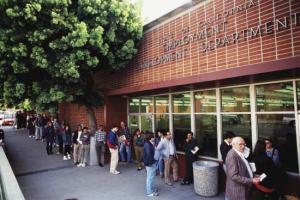 We have a new unemployment rate of 8.6% that looks much improved on the surface. Notice I had to qualify that statement. This is because of the flows in and out of labor markets and the patterns of jobs. Ever since they changed the measures of “employed” to mean any one working at least one hour of work, the rate is less meaningful than the underlying patterns. There are several underlying numbers that make this unemployment report a mixed bag.
On the good side, there was some job creation and there appears to be a larger number of people working more hours. This means that underemployment is improving. I should mention that unemployment can actually get worse for awhile after a recession–making it a lagging indicator–because improving job markets encourage unhappy job holders to start looking for a different situation. What we are seeing is that people are able to pick up more hours. That’s not part of the job switch behavior. It means the situation for current job holders is improving.
The bad news is for the long term unemployed whose unemployment levels stayed the same. There are also indications of an outflow of “discouraged” workers who have simply given up looking for work and are likely off the unemployment roles now. This is very troubling and requires immediate policy response.
In November, the number of job losers and persons who completed temporary jobs declined by 432,000 to 7.6 million. The number of long-term unemployed (those
jobless for 27 weeks and over) was little changed at 5.7 million and accounted for 43.0 percent of the unemployed. (See tables A-11 and A-12.)The civilian labor force participation rate declined by 0.2 percentage point to 64.0 percent. The employment-population ratio, at 58.5 percent, changed little.
(See table A-1.)The number of persons employed part time for economic reasons (sometimes referred to as involuntary part-time workers) dropped by 378,000 over the month to 8.5 million. These individuals were working part time because their hours had been cut back or because they were unable to find a full-time job. (See table A-8.)
There are two ways the government could deal with this long term unemployment. The first would be most direct. That would be hiring them directly. Given the current political situation, that is unlikely to happen. The second way would be to pay for the first year or two of their salaries and benefits. This would probably be more acceptable to republicans–however I do question their commitment to improving the economy and the job situation in general–but it would take some work to get the apparatus in place. President Obama has made policy suggestions that would pay states to keep education, public health, and public safety employees but that has met with demands for cuts elsewhere to pay for reimbursements. This is a good suggestion, but doesn’t do anything to deal with the number of long term unemployed who are know disenfranchised from the work environment, are losing skills, and are less likely to be hired due to discrimination by employers who don’t like large, “unexplained job gaps. A program needs to be directly targeted to this group.
Why am I suggesting this? It is because the number of labor market economists that are crunching numbers at the moment show us that it’s taking forever at this rate to bring down unemployment and we are likely creating a permanent underclass. Felix Salmon has a graph and some analysis this demonstrates the problem.
When employed people become unemployed, that’s bad news, and immediately visible in the unemployment rate. When unemployed people leave the labor force entirely, that’s equally bad news, but it’s a tougher measure for the public to connect with, since at that point they’re no longer counted in the unemployment rate. Everybody knows what “unemployment” is; the population which cares about the “employment-to-population ratio”, by contrast, is wholly comprised of wonks.
The plunge in the employment-to-population ratio over the course of the Great Recession is going to be its biggest and most lasting legacy. We’re now back to the levels last seen in the days before most women worked, but we live in a very different world now. In the late 1970s, a woman without a job was much less likely to consider herself unemployed than in the early 2010s. And when she casts her vote in November, the degree to which she’s happy or unhappy with the current administration is going to be much more connected to her actual employment status than it is to whether she’s officially showing up in the unemployment rolls.
Over the next few months, we’ll get a better sense of the signal-to-noise ratio in the 8.6% number. I’m hopeful that we’ve seen the last 9 handle in the headline unemployment data series, and if I’m right, then the optics of the unemployment rate are, at the margin, good for Ds and bad for Rs. But the unemployment rate is not a particularly good gauge of how well the economy is functioning, or how many people have jobs. And I’m very pessimistic that the employment-to-population ratio is going to get back above 60% even over the medium term. It’s certainly not going to get there before the election.
Here’s some more composite analysis from NBC interviews with economists.
Long-term unemployment remains a big problem: The average duration for joblessness surged to a record-high 40.9 weeks. Stagnation in wages also continues, as more employed workers took on second jobs. There were just under seven million multiple job-holders for the month, the highest total in 2011 and the most since May 2010.
Traders offered little reaction to the report. Futures already had been indicating a positive open but lost some ground in the ensuing minutes after the Labor Department report hit the tape.
“At this pace of job growth, it will be more than two decades before we get back down to the pre-recession unemployment rate. Moreover, a shrinking labor force is not the way we want to see unemployment drop,” said Heidi Shierholz, economist at the Economic Policy Institute. “At this rate of growth we are looking at a long, long schlep before our sick labor market recovers.”
Here’s a bleak assessment from Dean Baker via Taylor Marsh.
It takes roughly 90,000 jobs to keep even with the growth of the labor force. At this rate, it will take close to 200 months, or 16 2/3 years to make up for the 10 million job deficit in the economy.
Even the White House is admitting that we’re a long way from the pre-recession employment numbers. Here’s the nifty graph that Calculated Risk has been updating over 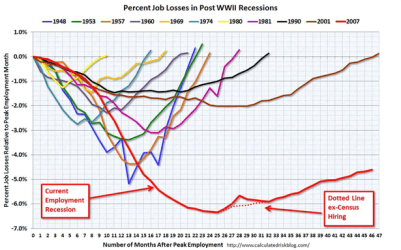 time that clearly demonstrates the literal uphill battle. Since republicans are in no mood to improve the economy and the jobless rate given their strong desire to regain the White House and the Senate, I don’t see much hope for any solution any time soon. If they do regain any of the above after the election we probably won’t see any improvement at all. That’s why I think the Obama administration needs to work on continued targeted fixes. Again, I would recommend directly paying businesses to hire the long term unemployed. I actually think it would be worth offering some spending offsets if that is going to be what it takes because we can’t afford to continue to endure these levels of duration. The more chronic the problem becomes, the more it will cost us and the more it will ruin millions of folks’ lives.
The Art of Doublespeak
Posted: December 1, 2011 Filed under: #Occupy and We are the 99 percent!, 2012 presidential campaign, double-speak, Economy, income inequality, unemployment | Tags: 2011: days of revolt, 2012 presidential election, Financial Crisis 9 Comments
Language is important. Words can inspire, inflame, enrage. Words can hide a speaker’s intentions. Sing me a lullaby. Spin me a fairytale. Sell me a load of bull-hockey.
One of today’s best-known language twisters is Frank Luntz. Pollster and political consultant, Luntz is the Master of Political Doublespeak. He would have made Orwell proud: War is Peace, Freedom is Slavery, Ignorance is Strength. He crawls out during every election cycle with the creepy focus groups, wired up and ready to go. We learn ‘what words work.’ Otherwise known as ‘what words obfuscate, spin and get the best reaction from would-be voters.’
Well, here’s a Newsflash: Luntz is worried about Occupy Wall Street, all those sorry slackers the GOP and various critics have sidelined as hippies, losers and Obama-lovers. Seems from Luntz’s point of view, OWS is having an impact on political discourse.
No kidding Sherlock!
And so, Luntz decided a tutorial was needed to school Republicans how to “speak” when asked questions about the very issues that the Occupy wave has been raising.
Fascinating! A defense against the so-called irrelevant. But even more fascinating is the list of rules on how to ‘discuss and defend against’ the grievances that Occupy members have introduced into the public sphere.
The very first instruction made me laugh:
Don’t say capitalism.
Because people might start questioning the broken economic construct that’s taken root in the US. Btw, I haven’t heard OWS slamming capitalism, per se. It’s Vulture Capitalism, the darling of the neoliberal/libertarian set, that’s being questioned and panned, where only the well-heeled financial class takes the booty while the rest of the country is left to collect unemployment checks and shop with food stamps. Sorry, don’t think ‘free market’ or ‘economic freedom’ will wash in a country where poverty is rising at an alarming rate and over 20% of American kids are classified as food insecure.
Politicians whether Right or Left need to do far better than that. Like maybe tell the truth: that the financial class in this country has been running a huge Ponzi scheme, that transnational corporations are willing to run roughshod over everything in a blind pursuit of profit, that endless war makes money for the few, while the many bleed.
That would be refreshing.
Don’t say the government taxes the rich. Tell them the government takes from the rich.
Oh yes, that’s much better. Then pull out Warren Buffet’s statement that his tax rate [as a multi-billionaire] is lower than what his secretary is required to pay. And please, take a spin over the corporate history of negative taxes after all the loopholes and government largesse heaped on the ‘job creators’ is taken in to account. Then too, let’s not forget the ‘off-shore’ pooling of tax-free profits and tidy nest eggs. The beat goes on for those with the courage to look.
The government takes from the rich? Hahaha. More like the government sucks up to the rich and their ever-present lobbyists.
Republicans should forget winning the battle for the middle-class. Call them hardworking tax-payers.
Yes, Republicans should forget winning the middle-class since they’ve gone out of their way to eliminate them, crush them out like last year’s cigarettes.
Frank Luntz is ‘really’ scared of the Occupy Movement ? With rules like this he may be out of a job. If the Republican’s go-to wordsmith can’t get his head or words around the basic complaints of not simply Occupy but most Americans and/or the very real economic and political discontent, then they are deaf, dumb and blind.
Or maybe smart like the wily fox. Because the evidence is everywhere. What to do? Keep the disinformation and propaganda machine in high gear. I won’t belabor the hypocrisy and cynicism of Luntz’s list. He and the entire stable of political pollsters, consultants and analysts on all sides are merely symptoms of a system flailing in the wind, a system that’s forgotten how to reach out or even talk to real people in anything approaching honest discourse. A system that has no respect for its citizenry.
Will the Luntz approach work as it has in the past?
We shall see. But I invite you to read the Ten Commandments of Political Doublespeak for 2012 at the link above. Some examples will make you laugh. Several will make you mad as hell.
Oh, and here’s a tip: Don’t say the word ‘Bonus.’
The Return of the Five Year Plan
Posted: December 1, 2011 Filed under: Economic Develpment, Economy 19 Comments This is going to be a weird post even for me. I read Andy Stern’s WSJ article today called “China’s Superior Economic Model: The free-market fundamentalist economic model is being thrown onto the trash heap of history”. So, these are my thoughts. I come not to bury or to praise either central economic planning or free-market fundamentalism. I come to question the prudence of extremes. Both are fairly played out utopian philosophies. I am forever the practitioner of the pragmatic, data-based, and well thought-out middle path. I am always in search of what works most efficiently and judiciously. Andy, we don’t need more government/public sector enterprises. We need to let the government be the government.
What is weird is that an article with that title by that person could show up at the WSJ. It’s really odd to even hear people discuss industrial plans these days. This harkens back to Mussolini and Fascism, Stalin and single party states with their failed command economies, and maybe a little of post industrial Japan with its kyoka kaisha. I know Andy comes from a union background but that makes it even more bizarre. Industrial plans are as much an artifact of a by gone era as the term laissez faire which took hold out of disgust for monopoly creating monarchs during a period when homogenous commodities from small enterprises were the heart of commerce and the only way to mess a market up good was to disallow every one but the king’s favorite to participate in production.
So, what’s the deal with romanticizing the current Chinese model? Why not look at Sweden or Norway instead?
Secretary of State Hillary Clinton, former Gov. Mitt Romney and President Barack Obama all weighed in with their views—ranging from warnings that China must “end unfair discrimination” (Mrs. Clinton) to complaints that the U.S. has “been played like a fiddle” (Mr. Romney) and that China needs to stop “gaming” the international system (Mr. Obama).
As this was happening, I was part of a U.S.-China dialogue—a trip organized by the China-United States Exchange Foundation and the Center for American Progress—with high-ranking Chinese government officials, both past and present. For me, the tension resulting from the chorus of American criticism paled in significance compared to reading the emerging outline of China’s 12th five-year plan. The aims: a 7% annual economic growth rate; a $640 billion investment in renewable energy; construction of six million homes; and expanding next-generation IT, clean-energy vehicles, biotechnology, high-end manufacturing and environmental protection—all while promoting social equity and rural development.
Some Americans are drawing lessons from this. Last month, the China Daily quoted Orville Schell, who directs the Center on U.S.-China Relations at the Asia Society, as saying: “I think we have come to realize the ability to plan is exactly what is missing in America.” The article also noted that Robert Engle, who won a Nobel Prize in 2003 for economics, has said that while China is making five-year plans for the next generation, Americans are planning only for the next election.
Yes, things are changing and China is making tons of progress. That’s bound to happen when you are that big, have that many people, and you have a long way to grow from a huge 20th century hole to the golden mean. China has done quite well mixing the free market model with its new and improved brand of central planning. However, so has most of Scandinavia and there’s a lot less reliance there on industrial planning and a much bigger appreciation of an open society. There’s also less pollution, less horrible labor practices, and a lot less selective use of resources.
The conservative-preferred, free-market fundamentalist, shareholder-only model—so successful in the 20th century—is being thrown onto the trash heap of history in the 21st century. In an era when countries need to become economic teams, Team USA’s results—a jobless decade, 30 years of flat median wages, a trade deficit, a shrinking middle class and phenomenal gains in wealth but only for the top 1%—are pathetic.
This should motivate leaders to rethink, rather than double down on an empirically failing free-market extremism. As painful and humbling as it may be, America needs to do what a once-dominant business or sports team would do when the tide turns: study the ingredients of its competitors’ success.
While we debate, Team China rolls on. Our delegation witnessed China’s people-oriented development in Chongqing, a city of 32 million in Western China, which is led by an aggressive and popular Communist Party leader—Bo Xilai. A skyline of cranes are building roughly 1.5 million square feet of usable floor space daily—including, our delegation was told, 700,000 units of public housing annually.
Meanwhile, the Chinese government can boast that it has established in Western China an economic zone for cloud computing and automotive and aerospace production resulting in 12.5% annual growth and 49% growth in annual tax revenue, with wages rising more than 10% a year.
To me, the problem isn’t that we’re bad at planning, it’s that we’ve had a concerted political and corporate effort to go back to a kleptocracy where the monarchs in charge set up the perfect conditions for a few big players to capture markets. We say that we’re all about free market fundamentalism but we’re not for that any more than what our government is doing now is some kind of central planning that’s “collectivism” gone amok which is the equally ridiculous libertarian narrative. Government does have a role in commerce and markets. It should be not be efficient central planning or being so hands off as to create the situation where entire markets collapse from frictions. It also shouldn’t be using its legal and power status to promote the interests of one group of market participants over another.
Stern offers this view.
America needs to embrace a plan for growth and innovation, with a streamlined government as a partner with the private sector.
Uhhh, no. The government needs to ensure that markets can operate efficiently and nothing gets illegally exploited. This isn’t exactly akin to partnering with the private sector. As a Katrina Carpetbagger victim, I can tell you that government partnering with the private sector usually means companies of Jeb Bush get contracts for pumps with the Army Corps of Engineers that are so faulty that the entire ground shakes throughout the city when switched on. They make plenty of noise and release a lot of energy, but those pumps took around 3 years worth of refitting to be made to pump water out of the canal and into the lake. Then there was Halliburton that took up blocks worth of parking in the French Quarter and fed tons of federal workers while preventing access to parking for people that wanted to access struggling restaurants and local businesses. Don’t even get me started on the number of debris collection trucks that came from Virginia, Maryland and Texas to haul things when New Orleans companies weren’t even considered.
We know what makes markets functional. They need to be translucent with minimized information asymmetry. They need to have minimal moral hazard opportunities like insider trading. It’s best when there isn’t any market concentration or powerful blocs. Some products and services are most appropriately and efficiently provided by government; not outsourced to profit mongers for monopoly rent extraction and nothing else. We know that taxes reduce incentives, subsidies increase incentives, and that things like patents that serve as barriers to entry to a market reduce quantities available to the market, increase prices, and provide market power. We don’t even use all of this knowledge right now. That’s because there is too much corporate money and corporate access to the political system. It’s not for the lack of efficient government planning.
Yes, the government can create a legal environment, regulatory framework, and infrastructure to support economic growth. But what do we have? Laws that extol corporate personhood and free speech that create the environment where senior executives can do immense harm and never be held to legal account. We have lax and captured regulators that are more likely to let a bad drug get through to help a drugmaker than worry about the potential damage to newborns, the elderly, or any number of the weakest members of society. Then, we have enormous pressure to change laws so the damaged can’t recover any recompense for the damages. We have lawmakers that create laws to transfer enormous wealth, income and resources to business that donate money to them. We now learn they own stock in companies and pass laws that protect bad market practices as long as they positively impact stockholder bottom lines. Don’t even get me started on how the government can’t even fund the rebuilding and improvement of basic infrastructure unless there is direct political benefit to the politician or one of his/her donors. We get bridges to no where and major interstate bridges in Minneapolis that collapse into the river with people and cars because no one funds refits and maintenance.
We’re going to embrace government/private sector cooperation given this experience? I would hope not. The focus on China right now reminds me of the obsession with Japan in the 80s and the USSR in the post ww2 period. Any country that manages to start developing itself out of a hole is going to have a meteoric rise. That’s just simple math. Most of the best of our technology booms in the last century came from happenstance and an open environment with a bunch of government grants that funded labrats in universities and hospitals, in NASA type government agencies, and in highly regulated government monopolies like Bell Labs. What was wrong with that model? What’s wrong with the models of Norway and Sweden? I don’t think that China has any kind of special insight to offer us. After all, we can point to on time trains in Italy, Sputnik, and early German rocket science as great 2oth century advances and notice that the government and economic systems that supported these advances didn’t turn out to be long lasting. Japan’s corporate/government coziness has brought us and them Fukishima. China may have some nifty infrastructure but I sure wouldn’t want to be a Tibetan right now or a young person working in an Apple manufacturing plant or a citizen with asthma or a Chinese coalminer. We may not need rampant 18th century freemarket fundamentalism or 19th century capitalism, but let’s not get all excited about this revamped 20th century central planning and corporate/government enterprises either.
It’s best to look at the fundamentals of the individual market then decide if circumstances say cage the beast or set it free or find a middle path that incorporates a combination of both. The government’s role is not to partner with private enterprise. It’s not to create a central plan. It’s to ensure that no one player in the market gets an unfair advantage or creates undue damage to any other and it’s to provide public goods as necessary.

 peej
peej Carissa
 bostonboomer
 dakinikat
 ecocatwoman
 mablue2
 Mama Lopez
 peggysue22
 quixote
 skydancingguestblogger
 Mona (aka Wonk the Vote)



 Sky Dancing
Recent Comments