




But Twitter no longer serves this function. Thanks to a string of disastrous missteps over the past year by new owner Elon Musk — punctuated by the decision last week to cap the number of posts users can view — Twitter is hemorrhaging users and relevance. While Meta’s new Threads app is making an impressive debut, most social media experts say TikTok reigns as the new global town square and has held that role for quite a while.
Tuesday Reads: Republicans Fight the Law; Will the Law Win?
Posted: July 11, 2023 Filed under: Afternoon Reads, Crime, Criminal Justice System, Donald Trump, just because | Tags: China, Fani Willis, Fort Pierce division FLA, Fulton County grand juries, Gal Luft, Georgia election interference, House Oversight Committee, House Republicans, iran, James Comer, Judge Aileen Cannon, Ruby Freeman, Rudy Giuliani, Wadrea "Shaye" Moss, Walt Nauta 11 Comments
Hans Thoma (1839–1924) Goldene Zeit, 1876.
Good Afternoon!!
Remember that so-called “whistleblower” that House Republicans were so excited about? They claimed to have a witness who would blow their “Biden family corruption” case wide open. Then the witness supposedly disappeared and they had no idea where he was. Well, yesterday the DOJ indicted the guy. It turns out he’s an agent for China.
The Daily Beast: GOP’s ‘Missing’ Biden Probe Witness Faces Laundry List of Federal Charges.
The “missing” witness long-touted by Republicans in Congress as the missing link to their probe into alleged Biden family corruption was accused Monday of being an unregistered foreign agent for China and an international arms trafficker while violating U.S. sanctions on Iran and lying to investigators, among a laundry list of other federal charges.
Dual U.S.-Israeli citizen Gal Luft had already skipped out on his bail while in Cyprus awaiting extradition to the U.S. for a separate case in March—though he alleges that the sprawling case against him represents political persecution and retaliation by the Biden administration against a potential witness.
The House Oversight Committee has for months touted a secret “informant” who could provide evidence of an alleged “quid pro quo” deal for foreign aid between an Obama-era Biden and an unnamed country—though details of the arrangement remain murky and unverified at best.
Those claims partially unraveled when Rep. James Comer (R-KY) in May held a much-hyped press conference in which he promised to expose the preliminary findings of four months’ worth of scrutiny into the Biden family’s business dealings—while failing to air any real evidence of corruption. He then offered a partial excuse for the failure: their star witness had up and disappeared….
Luft then came forward days later in an interview with New York Post opinion columnist Miranda Devine, alleging that he was hiding out in an undisclosed location after being arrested on five charges, including arms dealing across the Third World, as well as a violation of the Foreign Agents Registration Act, among other charges.
“The chances of me getting a fair trial in Washington are virtually zero,” he told Devine as the reason he skipped out on his bail. “I had to do what I had to do.”
Comer and other Republican House members continued to tout Luft as a credible witness right up until Friday, the day before charges were announced by the SDNY.

Rolf Nesch (Germany 1893-1975 Norway), Swans, from Esslingen
More information on Luft from The Independent: ‘Whistleblower’ who accused Bidens of corruption is charged with arms trafficking and violating Iran sanctions.
A “whistleblower” who has repeatedly accused the Bidens of corruption has been charged by the Justice Department with arms trafficking, acting as a foreign agent for China and violating Iran sanctions.
Gal Luft, who is a citizen of both the United States and Israel, is accused of paying a former adviser to Donald Trump on behalf of principals in China in 2016 without registering as a foreign agent.
Prosecutors say that Mr Luft pushed the former government employee, who is not named, to push policies that were favourable to China.
They also allege that he set up meetings between officials of Iran and a Chinese energy company to discuss oil deals, which would violate US sanctions.
They also alleged that Mr Luft “conspired with others and attempted to broker illicit arms transactions with, among others, certain Chinese individuals and entities” by working as a middleman to find both buyers and sellers for “certain weapons and other materials” in violation of the US Arms Control Act.
Specifically, prosecutors say he attempted to broker a sale of anti-tank weapons, grenade launchers and mortar rounds to Libya by Chinese companies, and also pushed to arrange for the United Arab Emirates to purchase bombs and rockets, and for Kenya to acquire unmanned aerial vehicles capable of striking targets on the ground.
He sounds like a great witness for the Republican “investigations.”
Mr Luft, 57, was arrested in Cyprus in February on US charges but fled after being released on bail while awaiting extradition and is not currently in US custody.
US Attorney for the Southern District of New York Damian Williams said in a statement that Mr Luft “engaged in multiple, serious criminal schemes”.
“He subverted foreign agent registration laws in the United States to seek to promote Chinese policies by acting through a former high-ranking U.S. Government official; he acted as a broker in deals for dangerous weapons and Iranian oil; and he told multiple lies about his crimes to law enforcement,” Mr Williams said.
“As the charges unsealed today reflect, our Office will continue to work vigorously with our law enforcement partners to detect and hold accountable those who surreptitiously attempt to perpetrate malign foreign influence campaigns here in the United States”.
Comer was still defending this guy as a credible witness last night on NewsMax.

Frits Thaulow, Norwegian, Summer Day in the Garden, 1880
Yesterday Judge Cannon granted a short delay in for Walt Nauta to appear in the Mar-a-Lago stolen documents case.
Controversial U.S. District Judge Aileen Cannon granted a delay for Donald Trump’s aide and co-defendant Walt Nauta in a classified documents case. Prosecutors have called the delay “unnecessary.”
In a filing on Monday, Nauta’s team asked to delay Friday’s hearing, which was set to determine how some materials would be handled in the trial. The attorneys did not propose a date for the new hearing.
“An indefinite continuance is unnecessary, will inject additional delay in this case, and is contrary to the public interest,” special counsel Jack Smith said in a subsequent filing on Monday.
On Tuesday, Cannon granted a 4-day delay, setting the new hearing for July 18 at 2:00 P.M. A court filing said Trump and Smith had agreed to the new date.
This is obviously part of Trump’s usual strategy of delaying court cases as long as possible. Now the Trump lawyers are trying to get Cannon to delay the case until after the 2024 election!
The New York Times: Trump Lawyers Seek Indefinite Postponement of Documents Trial.
Lawyers for former President Donald J. Trump asked a federal judge on Monday night to indefinitely postpone his trial on charges of illegally retaining classified documents after he left office, saying that the proceeding should not begin until all “substantive motions” in the case had been presented and decided.
The written filing — submitted 30 minutes before its deadline of midnight on Tuesday — presents a significant early test for Judge Aileen M. Cannon, the Trump-appointed jurist who is overseeing the case. If granted, it could have the effect of pushing Mr. Trump’s trial into the final stages of the presidential campaign in which he is now the Republican front-runner or even past the 2024 election.
While timing is important in any criminal matter, it could be hugely consequential in Mr. Trump’s case, in which he stands accused of illegally holding on to 31 classified documents after leaving the White House and obstructing the government’s repeated efforts to reclaim them.
There could be complications of a sort never before presented to a court if Mr. Trump is a candidate in the last legs of a presidential campaign and a federal criminal defendant on trial at the same time. If the trial is pushed back until after the election and Mr. Trump wins, he could try to pardon himself after taking office or have his attorney general dismiss the matter entirely….
Judges have wide latitude to set schedules for trials, and scheduling orders are typically not subject to appeal to higher courts. That said, given the extraordinary nature of Mr. Trump’s case and the potential implications of a delay, prosecutors under Mr. Smith could in theory try to come up with a rationale to challenge a scheduling decision made by Judge Cannon to the U.S. Court of Appeals for the 11th Circuit.
This really is a test for Cannon. If she grants such a delay, she should be replaced.

Albert Marquet (1875-1947), Baigneurs à Carqueiranne (1938)
Here are some details on the Trump filing, from the TPM Morning Memo, by David Kurtz.
Some of the filing is the usual defense counsel performative moaning and groaning and sighing heavily about all the work involved and the inherent advantages prosecutors have over them because they’ve long had access to the evidence, blah blah blah. To that end, Trump wants U.S. District Judge Aileen Cannon to:
- withdraw her order for an August 2023 trial;
- reject DOJ’s proposal for a December 2023 trial; and
- postpone indefinitely even setting a trial date.
But there’s more than the usual slow-rolling going on here. And it matters to the big question of whether Cannon can and will keep the Mar-a-Lago case on track for a trial before the 2024 presidential election.
Trump’s claims in this regard are remarkable:
- He’s too busy running for president to be put on trial.
- He’s too busy with other criminal and civil trials to add this one to the calendar.
- He’s still trying to make the case about the Presidential Records Act (it’s not).
- “There is no ongoing threat to national security interests nor any concern regarding continued criminal activity.”
- You can’t find an impartial jury in the midst of a presidential election.
The overall thrust of the filing by Trump is that a trial before the election is not advisable, though it stops short of saying so explicitly.
One more on the documents case from Jose Pagliery at The Daily Beast: Mar-a-Lago Jury Selection Will Be a MAGA Country Minefield.
The federal judge overseeing Donald Trump’s classified documents trial is taking steps that could stock the jury box with the former president’s supporters.
U.S. District Judge Aileen M. Cannon has set the upcoming trial to open on Aug. 14 at her tiny satellite courthouse in the northern reaches of her district, which stretches from the tropical Florida Keys to the citrus groves halfway up the state.
That decision means Trump’s jurors are set to be drawn from the most brightly red corner of a vast court district, plucked from a community that leans heavily Republican—instead of the highly populous and more Democratic urban areas further south….
Park View, Aksel Jørgensen, Danish, 1909
Several Miami lawyers, some of whom asked to remain anonymous because they have active cases before Cannon, noted that Trump’s chances to win what otherwise appears to be an insurmountable criminal case increase the further north he goes.
“You drive around, and you’ll see ‘Trump’ flags and ‘Make America Great Again’ flying in front of houses,” said Paul Bernard, a criminal defense lawyer in Fort Pierce. “With Trump’s trial down this way, he’s going to have a bunch of supporters—and they’re going to make their way onto the jury panel.”
According to local court rules, federal trials in the Fort Pierce division draw jurors from five counties: Highlands, Indian River, Martin, Okeechobee, and St. Lucie.
It’s solidly MAGA country: all five counties voted heavily in favor of Trump in the 2020 election he ultimately lost, with Okeechobee topping out at 72 percent. Across the board, the former president nabbed 62 percent of the vote on average.
Read the whole thing at The Daily Beast link.
There is also news in the Georgia election interference case.
The Atlanta Journal-Constitution: Grand jurors who will consider Trump charges to be selected Tuesday.
The selection of two Fulton County grand juries will be made Tuesday, with one of the panels expected to decide whether to hand up an indictment for alleged criminal interference in the 2020 presidential election.
One set of jurors is likely to be asked to bring formal charges against former President Donald Trump and other well-known political and legal figures. In a letter to county officials almost two months ago, District Attorney Fani Willis indicated the indictment could be obtained at some point between July 31 and Aug. 18.
Willis began her investigation shortly after hearing the leaked Jan. 2, 2021, phone call in which Trump asked Secretary of State Brad Raffensperger to “find” the 11,780 votes he needed to defeat Joe Biden in Georgia. She later convened a special purpose grand jury which examined evidence and heard testimony over an almost eight-month period. Its final report, only part of which has been made public, recommended multiple people be indicted for alleged crimes.
Superior Court Judge Robert McBurney, who oversaw the special purpose grand jury, will preside over Tuesday’s selection of the two grand juries for this term of court.
Each panel will have 23 grand jurors, plus three alternates. One panel will meet Mondays and Tuesdays, the other Thursdays and Fridays. Both will work in secret and are expected to decide whether to hand up indictments in hundreds of cases. It is unclear which one will consider the much-anticipated election-meddling case.
When a grand jury meets, at least 16 members must be present to conduct business. At least 12 grand jurors must vote to bring an indictment. The burden of proof is much lower for a grand jury to indict someone than it is for a jury to convict or acquit someone and grand jurors typically hear only from the prosecution.
It sounds like indictments could be coming soon.
One more story out of Georgia, from Kaitlyn Polantz at CNN: Rudy Giuliani is negotiating possible resolution to lawsuit brought by 2 Georgia election workers.
Rudy Giuliani is negotiating a possible resolution in his ongoing court dispute with former Georgia election workers Wandrea “Shaye” Moss and Ruby Freeman, after they accused him of defaming them following the 2020 election and already won nearly $90,000 from him for attorneys’ fees.
The lawsuit from Moss and her mother, Freeman, presents a significant risk to Giuliani financially. It also comes at a time when the former New York mayor and Manhattan prosecutor is attempting to fend off two disbarment proceedings, as well as interest from special counsel Jack Smith’s office, which is criminally investigating Donald Trump’s response to the 2020 vote, of which Giuliani was a central player.
In a court filing late Friday, Moss and Freeman’s legal team disclosed that Giuliani’s lawyer approached them on Thursday “to discuss a potential negotiated resolution of issues that would resolve large portions of this litigation and otherwise give rise to Plaintiffs’ anticipated request for sanctions.”
“Counsel for both parties have worked diligently to negotiate a resolution and believe they are close,” Moss and Freeman’s lawyer wrote.
The negotiation is over “certain factual issues regarding Defendant Giuliani’s liability,” the court filing also said.
Another update on the negotiations is expected in court on Tuesday….
Moss and Freeman accuse Giuliani of scapegoating them in a fabricated effort to undermine how votes were counted in Georgia in 2020.
That’s all I have for you today–lots of legal news involving corrupt Republicans. What else is new?
Lazy Caturday Reads
Posted: July 8, 2023 Filed under: cat art, caturday, Donald Trump | Tags: Elon Musk, Jamal Kashoggi, John Kelly, Lesley Van Houten, Lisa Page, Manson murders, Mark Zuckerberg, Miles Taylor, Peter Strzok, Rudy Giuliani, Threads, Twitter 3 Comments
Sea cat art by Heider Taillefer
Happy Caturday!!
I’m in a surreal frame of mind this morning. I’m not sure what’s wrong with me. I have a sore throat and I feel kind of lightheaded. I hope I’m not getting sick. Maybe it’s just because I’m reading a surreal book, The Secret History, by Donna Tartt. I know I should have read it years ago, but somehow I never got around to it. It’s very different from what I expected. I knew it was about a murder involving upper middle class classics students at a college in Vermont. I didn’t expect it to be full of slapstick humor. It’s somewhat disconcerting, but very well written. It has definitely taken my mind off the horror of U.S. politics.
Speaking of surreal murders, 73-year-old Lesley Van Houten is going to be let out of prison. NBC News: Manson family killer Leslie Van Houten will be paroled, lawyer says, after Gov. Newsom drops fight.
Leslie Van Houten, a follower of Charles Manson who was convicted in two killings, will be paroled in weeks, her attorney said Friday after California’s governor said he would not challenge it at the State Supreme Court.
“She’s thrilled,” Van Houten’s attorney Nancy Tetreault said.\Van Houten, now 73, will be paroled in the next several weeks after spending more than five decades in prison, Tetreault said.
An appeals court ruled in May that Van Houten is eligible for parole, reversing a decision by Gov. Gavin Newsom to reject parole.
Newsom, who has repeatedly blocked efforts for Van Houten to be paroled, had until Monday to file a challenge with the state Supreme Court.
Newsom, a Democrat, said Friday he would not do so….
Van Houten is serving a life sentence after being convicted along with other cult members of the 1969 killings of Leno and Rosemary LaBianca in Los Angeles.
A jury convicted Van Houten in 1971 of two counts of first-degree murder and one count of conspiracy to commit murder. She was initially sentenced to death, but that was overturned and she has spent 52 years in state prison.
Van Houten has been before the state Board of Parole Hearings more than 20 times. The board has recommended Van Houten be paroled five times since 2016, according to the state Department of Corrections and Rehabilitation.
She threw her life away back in 1969 when she chose to follow instructions from Manson and his bloodthirsty cult member Susan Atkins. I doubt if she’s a danger to society at this point.

Paris Through My Window, by Marc Chagall, 1913
There’s a bit of Trump investigation news this morning from New York Times both-sides reporter Michael Schmidt: Trump Asked About I.R.S. Inquiry of F.B.I. Officials, Ex-Aide Says Under Oath.
John F. Kelly, who served as former President Donald J. Trump’s second White House chief of staff, said in a sworn statement that Mr. Trump had discussed having the Internal Revenue Service and other federal agencies investigate two F.B.I. officials involved in the investigation into his campaign’s ties to Russia.
Mr. Kelly said that his recollection of Mr. Trump’s comments to him was based on notes that he had taken at the time in 2018. Mr. Kelly provided copies of his notes to lawyers for one of the F.B.I. officials, who made the sworn statement public in a court filing.
“President Trump questioned whether investigations by the Internal Revenue Service or other federal agencies should be undertaken into Mr. Strzok and/or Ms. Page,” Mr. Kelly said in the statement. “I do not know of President Trump ordering such an investigation. It appeared, however, that he wanted to see Mr. Strzok and Ms. Page investigated.”
Mr. Kelly’s assertions were disclosed on Thursday in a statement that was filed in connection with lawsuits brought by Peter Strzok, who was the lead agent in the F.B.I.’s Russia investigation, and Lisa Page, a former lawyer in the bureau, against the Justice Department for violating their privacy rights when the Trump administration made public text messages between them.
I hope Page and Strzok finally get their revenge on Trump.
The disclosures from Mr. Kelly, made under penalty of perjury, demonstrate the extent of Mr. Trump’s interest in harnessing the law enforcement and investigative powers of the federal government to target his perceived enemies. In the aftermath of Richard M. Nixon’s presidency, Congress made it illegal for a president to “directly or indirectly” order an I.R.S. investigation or audit.
The New York Times reported last July that two of Mr. Trump’s greatest perceived enemies — James B. Comey, whom he fired as F.B.I. director, and Mr. Comey’s deputy, Andrew G. McCabe — were the subject of the same type of highly unusual and invasive I.R.S. audit.
It is not known whether the I.R.S. investigated Mr. Strzok or Ms. Page. But Mr. Strzok became a subject in the investigation conducted by the special counsel John Durham into how the F.B.I. investigated Mr. Trump’s campaign. Neither Mr. Strzok nor Ms. Page was charged in connection with that investigation, which former law enforcement officials and Democrats have criticized as an effort to carry out Mr. Trump’s vendetta against the bureau. Mr. Strzok is also suing the department for wrongful termination.
Mr. Strzok and Ms. Page exchanged text messages that were critical of Mr. Trump and were later made public by Rod J. Rosenstein, then the deputy attorney general under Mr. Trump, as he faced heavy criticism from Republicans on Capitol Hill who were trying to find ways to undermine him.

Katzenworld, Femke Hiemstra
NBC has an interesting excerpt from the new book by former Trump official Miles Taylor: White House officials worried Trump showed reporters classified material while in office, new book recounts.
A forthcoming book by an ex-Trump administration aide describes an episode in which officials worried that then-President Donald Trump was cavalier in his handling of classified information while talking to reporters, according to a copy obtained by NBC News.
Miles Taylor, who was a top aide to Homeland Security Secretary Kirstjen Nielsen, writes about the 2018 episode in a book set to be published this month. As a sitting president at the time, Trump had broad powers to declassify information. Yet the incident Taylor describes suggests that his aides still believed he needed to show more care toward state secrets — an issue that landed him in legal peril after he left office and took sensitive records with him….
Trump was still president when the episode Taylor described unfolded Oct. 18, 2018. Taylor writes that he was in a private meeting in the West Wing with John Bolton, who was then Trump’s national security adviser.
Then-White House press secretary Sarah Huckabee Sanders came into Bolton’s office and described an interview that Trump had given in the Oval Office, according to Taylor’s book, “Blowback.” (It’s common for White House press aides to sit in when the president gives interviews.)
Trump had been talking to the reporters about Jamal Khashoggi, the dissident and journalist who was killed that month by Saudi assassins in Turkey.
Sanders told Bolton that the president had picked up classified documents relating to intelligence on Khashoggi’s death and displayed them, Taylor writes, but that the reporters were unlikely to have been able to read the text.
Bolton gasped at first, but “breathed a sigh of relief” when Sanders told him there had been no cameras in the room, according to the book.
Still, “We were all disturbed by the lapse in protocol and poor protection of classified information,” Taylor writes.
It looks like Rudy Giuliani will finally be disbarred in DC. CBS News: Rudy Giuliani should be disbarred for false election fraud claims, D.C. review panel says.
A Washington, D.C., Bar Association review panel is recommending former New York Mayor Rudolph Giuliani be disbarred in Washington for his handling of litigation challenging the 2020 election on behalf of then-President Trump.
By Daniel Ryan
Giuliani “claimed massive election fraud but had no evidence,” wrote the three-lawyer panel in a report released Friday, regarding the errors and unsupported claims in a Pennsylvania lawsuit he argued seeking to overturn the Republican president’s loss to Democrat Joe Biden.
Between Election Day and the Jan. 6, 2021, riot at the U.S. Capitol, Giuliani and other Trump lawyers repeatedly pressed claims of election fraud that were almost uniformly rejected by federal and state courts. He’s the third lawyer who could lose his ability to practice law over what he did for Trump: John Eastman faces disbarment in California, and Lin Wood this week surrendered his license in Georgia.
“Mr. Giuliani’s effort to undermine the integrity of the 2020 presidential election has helped destabilize our democracy,” wrote the three lawyers on the panel, Robert C. Bernius, Carolyn Haynesworth-Murrell and Jay A. Brozost.
The panel’s report will now go to the D.C. Court of Appeals for a final decision.
How much lower can this man sink. It’s difficult to believe that he was once a DOJ official and then U.S. Attorney for the Southern District of New York, not to mention mayor of NYC.
The Zuckerberg-Musk fight over the new Threads social media app is pretty entertaining. Here’s the latest:
The Guardian: Zuckerberg’s ‘Twitter killer’ Threads hits 70m sign-ups in two days.
Mark Zuckerberg’s “Twitter-killer” Threads has reached 70m sign-ups in less than 48 hours, as it more than doubled its growth from its first day on app stores.
The new microblogging platform was launched in 100 countries this week . It immediately accumulated significant numbers of users, hitting more than 30 million within its first 24 hours, apparently making it the fastest downloaded app ever. On Friday, however, Zuckerberg announced on his Threads account that the user total had more than doubled that figure.
Marc Chagall, Le Poète
“70 million sign ups on Threads as of this morning. Way beyond our expectations,” he wrote. Threads launched around the world at 7pm EST in the US on Wednesday.
Elon Musk’s Twitter has reacted to the new rival with a formal threat to sue the “copycat” app over alleged violation of its “intellectual property rights”….
Zuckerberg, chief executive of Threads and Instagram owner Meta, has said he wants to make “kindness” a focus of the app’s appeal, in a reference to concerns that the rival platform, which has more than 250 million users, has become too hostile for some.
“The goal is to keep it friendly as it expands. I think it’s possible and will ultimately be the key to its success,” he wrote on his Threads account. “That’s one reason why Twitter never succeeded as much as I think it should have, and we want to do it differently.”
That seems unlikely, knowing human nature, but we can hope.
Mashable: Threads backtracks flagging right-wing users for spreading disinformation.
If you regularly spread “false information” online, Threads already knows. The platform apparently flagged those accounts on launch, warning users that considered following them, before backtracking.
When Threads launched on Wednesday, numerous right-wing users shared(opens in a new tab) their dissatisfaction(opens in a new tab) with Twitter’s biggest competitor — on Twitter of course — over having their accounts flagged for disinformation.
As of Friday, however, it seems the warning label on accounts that reported the issue has since disappeared….
“This account has repeatedly posted false information that was reviewed by independent fact-checkers or went against our Community Guidelines,” read the label that would pop up when another user attempted follow these accounts.
The wording on the label is similar to a warning prompt that appears on Meta services like Facebook and Instagram. As Threads is so new and still so tightly connected to Instagram, it appears Meta used an account’s existing reputation to inform Threads users of their history.
Later on, Andy Stone of Meta, said the warning labels had been posted by mistake and they were removed from right wing accounts.
Tayor Lorenz at The Washington Post: How Twitter lost its place as the global town square.
Alex Pearlman, a stand-up comedian in Philadelphia, woke up one morning in June and turned on the local news. A portion of Interstate 95 had collapsed. Pearlman thought it was the type of thing people should know about.
Five years ago, he would have turned to Twitter to spread the news. But on that Sunday morning, he picked up his phone and made a TikTok — which quickly amassed more than 2 million views.
By Michael Bridges
A decade ago, Twitter rose to prominence by casting itself as a “global town square,” a space where anyone could reach millions of people overnight. The platform was pivotal in facilitating large social movements, such as the Arab Spring protests in the Middle East and the Black Lives Matter protests over police violence. In a recent email to staff, Twitter’s new chief executive, Linda Yaccarino, repeated this characterization, calling the site “a global town square for communication.”
“Twitter is definitely not anyone’s public square. Not anymore,” said Chris Messina, who on Thursday posted the hashtag #DeadTwitter on Threads. Twitter is “Elon Musk’s private playground where he’s about to charge everyone … for entry and access #DeadTwitter.”
On Musk’s failed “leadership”:
Since taking the helm last fall promising to champion “free speech,” Musk has alienated users with a relentless stream of updates that are hostile to the app’s heaviest users. He removed all legacy check marks — Twitter’s years-old way to assure users that posters are really who they say they are — sowing distrust and leading to significant financial consequences for major brands that were easily impersonated under the new system. He then sold blue check marks, which ensured amplification to anyone willing to pay $8 a month, allowing scammers and grifters to crowd out the replies to popular tweets. Interesting content has been down-ranked in favor of pay-to-play blue check mark replies, some of which push crypto scams and pornography.
Musk also flooded the “for you” timeline with his own tweets, driving away users who came to the service to follow friends and interests outside of the platform’s billionaire owner.
“Before, if I saw someone was verified, they’d have to have done something of note to get it,” said Ryan Fay, a theater director in Atlanta. “Now, I can’t trust anyone who claims to be a journalist and has a check mark because they paid for it, and I don’t know if they have any credentials or knowledge. Seeing a blue check now means this person is using Twitter to try to sell me something or some sort of scamming.”
Musk also fired Twitter’s trust and safety team, allowing harassment and abuse to explode across the platform unchecked. He’s banned prominent journalists and liberal activists. He’s railed against LGTBQ people and declared the word “cisgender” a slur. If that wasn’t enough to drive the most dedicated Twitter users to greener pastures, last week he began limiting the number of tweets users could read, blocking nonpaying users from being served more than 600 tweets per day.
There’s much more on Musk’s failures at the WaPo link. For now, it feels so satisfying to have an alternative to the mess Musk made at Twitter. We’ll have to wait and see how Zuckerberg does with Threads.
Have a great Caturday everyone!!
Thursday Reads
Posted: July 6, 2023 Filed under: Afternoon Reads, Barack Obama, Donald Trump, Media, The Media SUCKS | Tags: disinformation, District Judge Terry Doughty, heat wave, Mar-a-Lago search, Mark Zuckerberg, stolen documents case, summer, Taylor Taranto, Threads by Instagram, Twitter 7 CommentsGood Day!!

Boston Skyline, by Diane Bell
It has been unseasonably cool here in the Boston area for much of this spring and early summer, but now we’re going into a heat wave like most of the rest of the country.
Thank goodness my heat pump is working very well. It was 90 degrees yesterday, and my apartment stayed cool. Today it is already 90 degrees and it’s not 11AM yet. I feel so fortunate to be living here in my nice subsidized elderly apartment.
When I think back to the summers in my old unairconditioned house, I wonder how I managed. On 90 degree days, I basically just had to sit in front of my fans until the sun stopped beating down on the roof after about 4:30PM. I really feel for Dakinikat, who has been experiencing day after day like that.
It’s still sort of a slow news week, because of the holiday, but it’s beginning to get busier.
For those of us who have been long-time Twitter addicts, this has been an unsettling week. It really looks like Elon Musk has managed to kill Twitter this time, and many alternatives are popping up. Last night I signed up for Threads by Instagram. I’m hoping it will approach being what Twitter used to be, although I don’t really trust Mark Zuckerberg. But I trust Jack Dorsey even less. So far, he’s not letting me get into Bluesky, and I’ve decided I don’t want to use his new app, since he’ll probably end up selling it to another billionaire idiot.
The New York Times: Threads, Instagram’s ‘Twitter Killer,’ Has Arrived.
After months of speculation and secrecy, Mark Zuckerberg’s long-rumored competitor app to Twitter is here.
The new app, Threads, was unveiled on Wednesday as a companion to Instagram, the popular photo-sharing network that Mr. Zuckerberg’s company, Meta, bought more than a decade ago. If Instagram executives get their way, Threads will also replace rival Twitter, with some techies referring to it as a “Twitter killer.”
The rollout of Threads ramps up the rivalry between Mr. Zuckerberg and Elon Musk, who bought Twitter last year. Mr. Musk has changed the experience of Twitter by tinkering with its algorithm and other features, and most recently imposed temporary limits on how many tweets people could read when using the app, inciting outrage.
Many tech companies have tried capitalizing on Twitter’s turmoil in recent months. But Threads has a leg up, backed by Meta’s deep pockets and Instagram’s enormous user base of more than two billion monthly active users around the world.
In a post to his Threads account on Wednesday, Mr. Zuckerberg said: “I think there should be a public conversations app with 1 billion+ people on it. Twitter has had the opportunity to do this but hasn’t nailed it. Hopefully we will.” He later said that Threads achieved 10 million sign-ups within seven hours of its launch.
Mr. Musk weighed in, saying he was not impressed by Threads and claiming he had canceled his Instagram account. “It is infinitely preferable to be attacked by strangers on Twitter, than indulge in the false happiness of hide-the-pain Instagram,” he wrote on Twitter.
Read more details at the NYT link.

Summer in the Park, by Susan Sternau
NBC News: What you need to know about Threads, Instagram’s new Twitter competitor.
Instagram’s Threads app, a text-based social media platform poised to become Twitter’s latest competitor, is now available to users in more than 100 countries.
The app, which was released Wednesday evening, a day ahead of its scheduled debut, enables users to sign up straight from their Instagram accounts. That means that once it is launched worldwide, more than 2 billion monthly active users may import their accounts into Threads….
The app opens up to a scrollable feed of short-form text limited to 500 characters a post, with the ability to add individual or carousel photos and videos. Posts will include content from accounts users follow, as well as from creators suggested by the platform’s recommendation algorithm. Viewers can engage by liking, commenting, reposting — including quoting a post — and sharing to their Instagram story or feed.
While most features mimic those of Twitter, its user interface design resembles Instagram’s, with the same heart, comment and share buttons and similarly placed tabs.
Once logged in, new users who have Instagram accounts are told their account must retain the same usernames, but are able to a different bio and link to their profiles. Verified Instagram users will take their check marks to Threads, as well. Users can then choose to follow in bulk all accounts they already follow on Instagram, which includes pre-following anyone who has not yet joined Threads….
Accounts that users have already blocked on Instagram will also be automatically blocked on Threads. Those who wish to limit interactions can choose whether to allow replies from everyone, accounts they follow or mentions — users whom they directly tagged in a thread — only. They can also choose to restrict mentions of themselves to just accounts they follow or to disallow them entirely.
More details at the link.
There’s new information about the Trump stolen documents case; the DOJ has unsealed previously unseen parts of the affidavit for the search of Mar-a-Lago.
The Justice Department has made public more about the significant photographic and video evidence they collected last summer from Mar-a-Lago after the Trump presidency, in a newly released version of the investigative record that supported the FBI search of the resort.
While the details match much of what was included in last month’s indictment of Donald Trump and his co-defendant Walt Nauta, the less-redacted search warrant affidavit reveals the extent of what prosecutors knew before asking to search the Florida property for documents or other evidence last summer.
Summer in the City, by Olena Maksymova
The search affidavit, which still has several pages of redactions, describes with more public detail what prosecutors could see on spring 2022 surveillance footage from multiple angles outside a basement storage room where classified documents were kept in boxes at Mar-a-Lago.
The affidavit also includes at least one photo of boxes stacked in a room and captures how investigators believed boxes from Trump’s presidency were “relocated” or had been moved around.
“Video footage reflects that evidence has been moved recently,” prosecutors wrote in the court record. “It cannot be seen on the video footage where the boxes were moved when they were taken from the storage room area, and accordingly, the current location of the boxes that were removed from the storage room area but not returned to it is unknown.”
The affidavit said that the FBI’s review of security footage provided by the Trump Organization showed a person identified as “witness 5” moving boxes of documents around the estate throughout 2022, including on June 1, 2022, when he’s “observed carrying eleven brown cardboard boxes out the ANTEROOM entrance. One box did not have a lid on it and appeared to contain papers.”
Witness 5 is not named in the document. Nauta was accused in the indictment of obstruction and lying to investigators. Nauta is expected to plead not guilty in federal court in Miami on Thursday. Trump has pleaded not guilty.
“The day after that, on June 2, 2022, WITNESS 5 is observed moving twenty-five to thirty boxes, some of which were brown cardboard boxes and others of which were Bankers boxes consistent with the description of the FPOTUS BOXES, into the entrance of the ANTEROOM,” the filing said.

That seems pretty incriminating.
Remember how the press reacted when there were peaceful demonstrations outside the homes of SCOTUS justices? And when a troubled man showed up near Brett Kavanaugh’s house with a gun and then turned himself in to police without doing anything, the outrage was loud and long. I’ve been wondering why there hasn’t been more reporting on the crazy guy who showed up outside the Obamas’ home in DC with lots of guns and bombs. And even more creepy, he knew the address because it was posted on line by Donald Trump! Well finally, this event is getting a bit of attention.
Spencer S. Hsu at The Washington Post: U.S.: Man with guns near Obama home threatened McCarthy, Raskin.
A Navy veteran arrested with guns near former president Barack Obama’s house in Washington had recently recorded himself making threatening statements regarding House Speaker Kevin McCarthy (R-Calif.), Rep. Jamie B. Raskin (D-Md.) and a federal facility housing a nuclear research reactor in suburban Maryland, prosecutors said Wednesday.
Summer in the City (NY), by Julian Barrow
U.S. prosecutors asked a judge to jail Taylor Taranto, 37, pending trial, saying that the QAnon conspiracy theorist showed up near Obama’s home shortly after Donald Trump posted on his social media platform what he claimed was Obama’s address. Taranto was armed, dangerous and in the grip of delusional thinking, prosecutors said, and had successfully eluded law enforcement for nearly a day before his arrest June 29 in a wooded area near Washington’s exclusive Kalorama neighborhood.
“Taranto is a direct and serious threat to the public. Taranto’s own words and actions demonstrate that he is a direct threat to multiple political figures as well as the public at large,” Assistant U.S. Attorneys Allison K. Ethen and Colin Cloherty wrote in a 26-page detention memo. “The risk that Taranto poses if released is high, and the severity of the consequences that could result are catastrophic.”
Authorities searched for Taranto before June 28, but he was living in his van, and his lack of a fixed address frustrated efforts to find him, prosecutors said. Law enforcement “escalated efforts to locate Taranto and increased resources to assist in the search” after his alleged threats that day, but were unsuccessful before he turned up near Obama’s residence.

Read more at the WaPo. It’s quite a long and detailed story.
Finally, the strange decision by a Trump-appointed judge in Louisiana is getting quite a bit of attention in the media.
The Hill: Court ruling prompts fears of ‘Wild West of disinformation.’
An order limiting the Biden administration’s communication with social media companies could make it harder to curb disinformation as the 2024 election nears.
A federal judge Tuesday curtailed communication between certain Biden administration agencies and social media companies after a GOP-led challenge to efforts to combat disinformation, arguing attempts to do so violated protected speech.
The ruling left experts concerned about a “chilling effect” on attempts to moderate false information online.
“If we end up with basically no meaningful content moderation, then it is going to be a Wild West of disinformation,” said Darrell West, a senior fellow at the Brookings Institution’s Center for Technology Innovation.
Summer in the City, Edward Hopper
Two Republican state attorneys general argued that the Biden administration “coordinated and colluded with social-media platforms to identify disfavored speakers, viewpoints, and content.” The result, they said, was a “campaign of censorship” executed by the administration.
U.S. District Judge Terry Doughty, a Trump appointee, ruled in their favor, ordering that Biden administration officials cannot contact social media companies relating to “in any manner the removal, deletion, suppression, or reduction of content containing protected free speech posted on social-media platforms.”
Officials from the Department of Health and Human Services, the Centers for Disease Control and Prevention, the Department of Justice, the State Department and the FBI were told to cut those communications with the companies.
The case had primarily taken aim at attempts to curtail disinformation during the COVID-19 pandemic, which Republicans decried as a violation of the First Amendment.

Former federal prosecutor Harry Litman tweeted that a Trump-appointed federal judge’s injunction that blocks the Biden administration from communicating with social media companies was crazy “in substance and breadth,” noting the DOJ didn’t waste any time in filing its “lightning fast” appeal.
“Feds obviously know it’s nuts & dangerous,” Litman added.
Judge Terry A. Doughty issued the injunction in response to a lawsuit brought by Republican attorneys general of Louisiana and Missouri, who argued that the government overreached in efforts to stop the spread of vaccine disinformation and baseless allegations of election fraud.
The ruling is widely viewed as a legal win for conservatives.
Summer in the City, by Aniko Hencz
The attorneys general behind the lawsuit that prompted the injunction contend that the Biden administration is behind a “sprawling federal ‘Censorship Enterprise’” that aims to pressure social media companies to censor posts expressing controversial political views and conservatives in particular, the report said.
The Biden administration argued that such communications were needed for public health and safety reasons, noting that the social media platforms have been used to propagate disinformation about COVID vaccines and the 2020 election.
The administration sought “necessary and responsible actions to protect public health, safety, and security” amid the pandemic and the conspiracy-fueled election dispute, Bloomberg News reports, noting that the DOJ plans to request that the judge’s order be put on hold during the appeal.
The Washington Post’s Cat Zakrzewski describes the injunction as an “extraordinary” ruling that “could upend years of efforts to enhance coordination between the government and social media companies.

Zoe Tillman and Emily Birnbaum at Bloomberg: Biden Appeal Opens a New Front in Battle Over Internet Speech.
The Biden administration’s battle with Republican-led states over free-speech limits escalated with its appeal of a judge’s sweeping order barring federal officials and agencies from communicating with social media companies over postings they deem objectionable. It’s the latest example of the judiciary flexing its muscles in cases testing the bounds of the First Amendment online.
The US Justice Department filed a notice of appeal in federal court in Louisiana on Wednesday, signaling its intent to take the fight to the 5th US Circuit Court of Appeals in New Orleans.
The DOJ also plans to ask the court to put the judge’s order on hold during the appeal, according to a person familiar with the case. The case could swiftly land before the US Supreme Court if the government’s request is rejected.
Courts have played a star role mediating fights in recent years over how tech giants moderate what goes on their platforms. With federal law largely shielding companiesagainst being sued over what’s posted online, challengers have increasingly shifted the legal fight to the constitutional arena, probing the relationship between the government and the private sector.
US District Judge Terry Doughty’s injunction on Tuesday represents a break with judges who have been wary of extending the First Amendment’s speech protections to content decisions made by companies, even in situations where government officials tried to exert influence, said Genevieve Lakier, a constitutional law expert at the University of Chicago Law School.
Read the rest at Bloomberg.
Two more good articles on this insane decision:
Harry Litman and Lawrence Tribe at Just Security: Restricting the Government from Speaking to Tech Companies Will Spread Disinformation and Harm Democracy.
Philip Bump at The Washington Post: A deeply ironic reinforcement of right-wing misinformation.
That’s all I have for you today. I hope everyone is managing to stay safe in the ongoing hot weather.
Lazy Caturday Reads: Fake Voter Fraud and Real SCOTUS Fraud
Posted: July 1, 2023 Filed under: cat art, caturday, Corrupt and Political SCOTUS, Donald Trump, just because, SCOTUS | Tags: 303 Creative v. Elenis, Arizona 2020 election, Biden v. Nebraska, Doug Ducey, legal standing issues, Lorie Smith, Mike Pence, Neil Gorsuch, Rudy Giuliani, voting rights 18 Comments
Cat and Girl by Tara Dougans
Happy Caturday!!
There’s quite a bit happening in politics news today, even though it is kind of a long holiday weekend with a Monday in between. I’ll bet plenty of working people are taking Monday off. I’m retired now; but whenever there’s a holiday weekend, I get the same feelings I used to when I was working. It feels like a time to goof off–maybe laze around reading a good book or binge watching something on TV. It’s a time to relax in the peaceful knowledge that you’re not required to be anywhere or do anything in particular.
Here in Boston, the Fourth of July weekend means lots of folks will be headed for Cape Cod or New Hampshire, and the city will be eerily quiet in the daytime. When I first moved to Boston from Indiana, I dutifully got a Massachusetts driver’s license; but I didn’t have a car, so I didn’t have to brave the insane Boston traffic. Eventually, I decided I wanted to learn to handle Boston driving even though I was terrified. I waited until the Fourth of July weekend, and drove all over downtown on empty streets to practice and build my confidence.
Yesterday, I started getting that holiday weekend feeling again. I can’t explain it any more than I can explain how I get that back to school feeling in the fall. I guess repeated experiences have formed pathways in my brain that are triggered by certain times of the year.
I feels like there should be a dearth of political news, too, but that’s not the case. It’s another very busy news day. There’s news of another “perfect” phone call by Trump trying to overturn the 2020 election. And of course, there are plenty of reactions to the most recent Supreme Court decisions.
Another “Perfect” Phone Call?
Leigh Ann Caldwell, Josh Dawsey, and Yvonne Winget Sanchez at The Washington Post: Trump pressured Arizona Gov. Doug Ducey to overturn 2020 election.
In a phone call in late 2020,President Donald Trump tried to pressure Arizona Gov. Doug Ducey (R) to overturn the state’spresidential election results, saying that if enough fraudulent votes could be found it would overcome Trump’s narrow loss in Arizona, according to three people familiar with the call.
Trump also repeatedly asked Vice President Mike Pence to call Ducey and prod him to find the evidence to substantiate Trump’s claims of fraud, according to two of these people. Pence called Ducey several times to discuss the election, they said, though he did not follow Trump’s directions to pressure the governor.
The extent of Trump’s efforts to cajole Ducey into helping him stay in power have not before been reported, even as other efforts by Trump’s lawyer and allies to pressure Arizona officials have been made public….
By Indira Baldano
Trump phoned the governor’s cellphone on Nov. 30,2020, as Ducey was in the middle of signing documents certifying President Biden’s win in the state during a live-streamed video ceremony. Trump’s outreach was immediately clear to those watching. They heard “Hail to the Chief” play on the governor’s ringtone. Ducey pulled his phone from out of his suit jacket, muted the incoming call and put his phone aside. On Dec. 2,he told reporters he spoke to the president after the ceremony,buthe declined to fully detail the nature of the conversation. Ducey said the president had “an inquisitive mind”but did not ask the governor to withhold his signature certifying the election results.
But four people familiar with the call said Trump spoke specifically about his shortfall of more than 10,000 votes in Arizona and then espoused a range of false claims that would show he overwhelmingly won the election in the state and encouraged Ducey to study them. At the time, Trump’s attorneys and allies spread false claims to explain his loss, including that voters who had died and noncitizens had cast ballots.
After Trump’s call to Ducey, Trump directed Pence, a former governor who had known Ducey for years, to frequently check in with the governor for any progress on uncovering claims of voting improprieties, according to two people with knowledge of the effort.
Pence was expected to report back his findings and was peppered with conspiracy theories from Trump and his team,the person said. Pence did not pressure Ducey, but told him to please call if he found anything because Trump was looking for evidence, according to those familiar with the calls.

Like officials in Georgia, Ducey told Trump there was no evidence of widespread voter fraud in his state. Trump then began attacking Ducey publicly and shifted his efforts to using Rudy Giuliani to convince the Arizona legislature to find the “fraud” for him.
The article says that Ducey has not been contacted by the Special Counsel’s team, but he has interviewed other Arizona officials.
More than half a dozen past and current officials in Arizona contacted by Trump or his allies after his defeat have either been interviewed by Smith’s team or have received grand jury subpoenas seeking records,according to four people familiar with the interviews.Those interviewed include Bowers, the former Arizona House speaker, and three current members of the governing board of Maricopa County, the largest voting jurisdiction in the state that affirmed that Biden won.
Spokespeople for Arizona Gov. Katie Hobbs (D) and Arizona Attorney General Kris Mayes (D), told The Post this week that their offices have not received correspondence from Smith’s team seeking records about the 2020 election. The Arizona Secretary of State’s office received a grand jury subpoena dated Nov. 22, 2022, that sought information about communications with Trump, his campaign and his representatives, according to an official familiar with the document but not authorized to publicly speak about it.
Reactions to Recent SCOTUS Rulings
There is a massive amount of discussion of the garbage rulings the Supreme Court issued this week. The student loan forgiveness case is getting a great deal of attention, as is the case of the web designer who used a fake customer and a non-existent wedding website to get the court to decide she could discriminate against gay couples. Dakinikat wrote a terrific post yesterday about several of the latest decisions, so I’m just going to follow that with some of the latest reactions from Court observers. If you haven’t read Dakinikat’s post, I highly recommend it.
Paul Blumenthal at HuffPost: The Supreme Court’s Conservative Supermajority Continues Its Work Rolling Back The 20th Century.
When five conservative justices on the Supreme Court overturned Roe v. Wade and ended the right to an abortion in 2022, it signaled a new era for the court’s conservatism, one in which none of the rights and policies that emerged from the 20th century appeared safe.
By Valentin Gubarev
It also spawned a debate over the internal dynamics of that conservative supermajority. Chief Justice John Roberts did not join his fellow conservatives in overturning Roe. Had Roberts lost control of the court to the conservative ultras like Justices Clarence Thomas and Samuel Alito? Would he regain control in the next term?
The decisions released at the close of the court’s most recent term in June ― ending affirmative action in higher education, declaring a new right to discriminate against gay couples and voiding President Joe Biden’s plan for student loan debt relief ― present a different question: Does it even matter if Roberts is in the driver’s seat?
The conservative movement that built this court has long sought to roll back the legal and policy advances meant to blunt historic bigotries and discrimination, as well as the ability of the federal government to aid people harmed by the power of private capital. And they are continuing on that path whether Roberts or the ultra cohort runs the court.
At first, the conservative movement hoped that Ronald Reagan’s election in 1980 would allow them to sweep away the policies of both the New Deal and the 1960s and 1970s, but they could not consolidate political power to do so through the legislative and executive branches. Instead, they launched a legal movement to win control of the judiciary and enact their policies outside of the political process.
That is what they have done over the last decade. They gutted the Voting Rights Act, first in 2013 and again in 2021. They blew a hole in restrictions on religious prayer in schools in 2022. And, of course, ended protections for reproductive rights in Dobbs v. Jackson Women’s Health Organization. Their progress continued this term.

Blumenthal addresses how each of the recent decisions of this illegitimate court have continued the work of erasing the gains of the last century. Read the rest of his arguments at HuffPo.
Ian Millhiser at Vox on the fake marriage website decision: Neil Gorsuch has a problem with telling the truth.
On Thursday, Justice Neil Gorsuch released a 26-page opinion venting outrage about a legal dispute that does not exist, involving websites that do not exist. Yet this case, built on imaginary grounds, will have very real consequences for LGBTQ consumers, and for anti-discrimination laws more broadly. All of the Court’s Republican appointees joined Gorsuch’s opinion in 303 Creative v. Elenis.
That said, the fake dispute that Gorsuch imagines in his 303 Creative opinion involves a reasonably narrow legal question….
The case centers on Lorie Smith, a website designer who wishes to expand her business into designing wedding websites — something she has never done before. She says she’s reluctant to do so, however, because she fears that if she designs such a website for an opposite-sex couple, Colorado’s anti-discrimination law will compel her to also design wedding websites for same-sex couples. And Smith objects to same-sex marriages.
As Gorsuch summarizes her claim, Smith “worries that, if she [starts designing wedding websites,] Colorado will force her to express views with which she disagrees.”
This is not a religious liberty claim, it is a free speech claim, rooted in well-established law, which says that the First Amendment forbids the government from compelling people to say something that they would rather not say. In ruling in Smith’s favor, the Court does not say that any religious conservative can defy any anti-discrimination law. It simply holds that someone like Smith, who publishes words for a living, may refuse to say something they don’t want to say.
The problem is that Smith brought her case using a fake customer who never requested a service she never offered. Back to the Millhiser piece:
Before this case was argued, I wrote that if Lorie Smith had been approached by a same-sex couple and refused to design a wedding website for them, and if she had then been sued for refusing to do so, then she would have a very strong First Amendment defense against such a suit. As the Supreme Court said in Rumsfeld v. Forum for Academic and Institutional Rights (2006), “freedom of speech prohibits the government from telling people what they must say.” And that includes the right of a web designer to refuse to write words on a website that they do not wish to write.
But none of these events have actually happened. And, for that reason, the Supreme Court should have dismissed the case.
The frustrating thing about this case is that it involves an entirely fabricated legal dispute. Again, Lorie Smith has never actually made a wedding website for a paying customer. Nor has Colorado ever attempted to enforce its civil rights law against Ms. Smith. Indeed, in its brief to the Supreme Court, Colorado expressed doubt that its anti-discrimination law would even apply to Smith.
Is this Gorsuch’s effort to set up a precedent for allowing businesses to discriminate against protected classes? And isn’t this decision based on fraud, since we now know that the customer Smith identified never contacted her and is already married and not gay?
And that wasn’t the only case SCOTUS decided on fake grounds. David Dayan at The American Prospect: Supreme Court Decides Fake Plaintiffs Are Good Plaintiffs.
Approximately 43 million Americans were made between $10,000 and $20,000 poorer today (plus interest) thanks to six Republican lawyers from Harvard and Yale. They decided that a program based on a statute intended to modify student loan balances in the event of an emergency could not modify student loan balances in the event of the COVID-19 emergency. And they did it by claiming that a plaintiff was injured by this program, when that plaintiff did not petition the Court over its injury, had no involvement in the case, and would likely not be injured by the program.
This is the upside-down world in which the Supreme Court dealt a fatal blow to the Biden administration’s student debt cancellation program. Advocates and members of Congress are now calling for a Plan B, to enact debt relief by some other means; for various reasons, I doubt that the administration will take that opportunity. But what should not be ignored is the way in which the nation’s highest court relies on dodgy theories and facts not in evidence to make the pronouncements it wants….
By Susan Visser
The plaintiffs in the two student loan cases, one of which was so preposterous that it was thrown out unanimously for lack of standing (that was the one where two borrowers said they didn’t have a chance to make public comment to get more debt relief, and that the remedy should be that nobody gets debt relief), simply didn’t like that borrowers would have some debt canceled, on ideological grounds. Nobody seriously contests this as their aim. But in American law, at least in theory, you have to have standing to sue: A party would have to be harmed by 43 million people getting debt relief, and eliminating the debt relief would have to redress this harm.
The Roberts Court, with the chief justice writing for the majority, believes they found one in the Missouri Higher Education Loan Authority (MOHELA), a student loan servicer that stands to lose $44 million in servicing fees from debts that would be wholly canceled, according to the state of Missouri’s calculations. There’s one problem: MOHELA is not a plaintiff in the case. MOHELA in fact didn’t know about the case until hearing news reports, played no role in the case, opposed the case from being brought, and would not give the state of Missouri evidence for the case until required by state sunshine laws. We know all this from internal documents and public statements by MOHELA.
Even if MOHELA went ahead and sued, the contract they signed to accept federal student loans for servicing stipulates explicitly that the government has “sole discretion” to remove contracts from servicers, that the contractor cannot “object or protest,” and that the contractor “waives and releases all current or future claims” related to this. Perhaps this is why MOHELA did not sue in this case. Moreover, MOHELA stood to gain from debt cancellation on net, because it would get an estimated $61 million in fees to process forgiveness (more than Missouri said they would lose), and it would eliminate legal liability from botching Public Service Loan Forgiveness (PSLF) claims, and many of those loans would have been extinguished in debt cancellation.

Read the rest at the American Prospect link.
More on this standing issue and conflicts on the court from Mark Joseph Stern at Slate: John Roberts Is Already Frustrated With the Response to SCOTUS Killing Student Debt Relief.
The Supreme Court struck down Joe Biden’s student debt relief plan in a 6–3 decision on Friday that rewrites federal law to create a bespoke, extra-textual prohibition on the large-scale cancellation of student debt. Chief Justice John Roberts’ decision in Biden v. Nebraska blazed past a clearly insurmountable standing problem to scold the president for even trying to use the law according to its own plain terms in order to offer mass debt relief in the wake of the COVID-19 pandemic. He also chastised Justice Elena Kagan for her “disturbing” suggestion, in dissent, that the majority had gone “beyond the proper role of the judiciary.” The decision boils down to the chief justice’s obvious disdain for student debt relief—which is perhaps why he interpreted Kagan’s criticism as, in his words, a “personal” affront….
By Indira Baldano
The biggest question in the case was whether anyone could establish standing to challenge the program in the first place. After all, the federal government itself holds this debt, and no one is obviously “injured” by the government helping somebody else by erasing their debt. (In a separate case decided on Friday, the court unanimously held that two people who oppose the plan had no standing to sue.) Missouri tried to get around this problem by fixating on MOHELA, a corporation created by the state that services student loans. The Missouri attorney general asserted that MOHELA would suffer financially because of Biden’s plan—which turns out to be false—and that the state itself could represent its interests in court. A key flaw in this reasoning is that MOHELA is an independent entity from Missouri that could have sued to defend its own interests, but refused to do so, and even refused to help Missouri “represent” it in court. (State officials had to file public records requests to obtain key information because MOHELA did not want to participate in this case at all.)
Roberts didn’t care about any of that. MOHELA is “an instrumentality of Missouri,” he wrote, and Biden’s plan “will cut MOHELA’s revenues.” (Again: provably false!) So, according to Roberts and the court’s five other hard-line conservatives, the state had established standing.

This is so similar to what Gorsuch did in the fake marriage website case! The right wing justices can’t wait for legitimate cases to be brought; they have to search for fake ones, because they are desperate to return our country to the bad old days of Jim Crow and white male dominance.
Elena Kagan wasn’t having it.
Kagan pulled no punches in response. “From the first page to the last, today’s opinion departs from the demands of judicial restraint,” she wrote. “At the behest of a party that has suffered no injury, the majority decides a contested public policy issue properly belonging to the politically accountable branches and the people they represent.” She skewered the idea that Missouri and MOHELA are interchangeable, citing the Missouri Supreme Court’s own declaration that they are not. And she eviscerated the majority for “wielding the major-questions sword” to overrule “legislative judgments” that belong to the political branches.
Congress had better watch out, because the Court is working to displace them. Just wait until they get control of the power of the purse!
One more SCOTUS action from yesterday reported by Sam Levine at The Guardian: Supreme court leaves intact Mississippi law disenfranchising Black voters.
The US supreme court turned away a case on Friday challenging Mississippi’s rules around voting rights for people with felony convictions, leaving intact a policy implemented more than a century ago with the explicit goal of preventing Black people from voting.
Those convicted of any one of 23 specific felonies in Mississippi permanently lose the right to vote. The list is rooted in the state’s 1890 constitutional convention, where delegates chose disenfranchising crimes that they believed Black people were more likely to commit. “We came here to exclude the negro. Nothing short of this will answer,” the president of the convention said at the time. The crimes, which include bribery, theft, carjacking, bigamy and timber larceny, have remained largely the same since then; Mississippi voters amended it remove burglary in 1950 and added murder and rape in 1968.
By Tara Dougans
It continued to have a staggering effect in Mississippi. Sixteen per cent of the Black voting-age population remains blocked from casting a ballot, as well as 10% of the overall voting age population, according to an estimate by The Sentencing Project, a criminal justice non-profit. The state is about 38% Black, but Black people make up more than half of Mississippi’s disenfranchised population.
Challengers to the law argued that the policy was unconstitutional because it bore the “discriminatory taint” from the 1890 constitution. One of the plaintiffs was Roy Harness, a social worker in his late 60s who is permanently barred from voting because he was convicted of forgery decades ago. Forgery was one of the original crimes included in the list of disenfranchising offenses.

Read more details at The Guardian.
I’ll end there and share a few more stories in the comments. Have a great Fourth of July sort of weekend!
Thursday Reads
Posted: June 29, 2023 Filed under: Afternoon Reads, Donald Trump, SCOTUS | Tags: Affirmative Action, Climate change, excessive heat, iran, jet stream, Mark Milley, military academies, poor air quality, Supreme Court, Trump stolen documents case, Walt Nauta, wildfires 13 Comments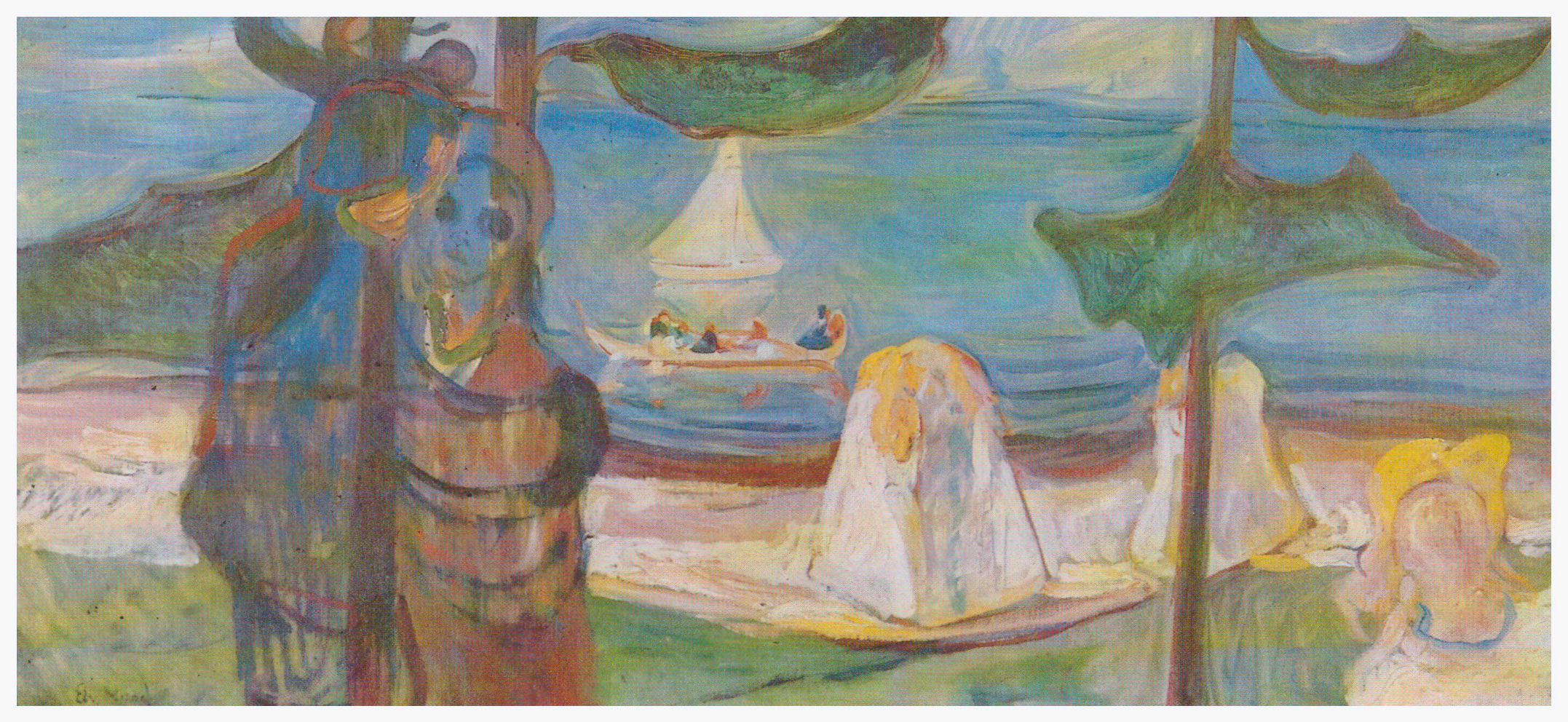
Summer Day or Embrace on the beach, (1904), by Edvard Munch
Good Day!!
There is some Trump investigation news this morning, plus, news just broke that the Supreme Court has gutted Affirmative Action in college admissions.
But before I get to those stories, a few articles about the awful summer weather we are having. Here in New England and across much of the Midwest, we’re having poor air quality because of the Canadian wildfires; and in much of the Southern U.S. people are suffering greatly from excessive heat.
Dangerous air quality and hazy skies persist as smoke from Canada’s raging wildfires drifts south, leaving more than 100 million people under air quality alerts across a dozen states from Minnesota to New York and down to the Carolinas.
Chicago had the worst air quality among major cities in the world early Thursday, according to IQAir. The air in Washington, DC, Minneapolis, Detroit and New York City was among the top 10 most polluted.
Smoke will continue to drift across the Midwest and into the mid-Atlantic and Northeast on Thursday. Forecast models predict a slow improvement beginning Thursday and additional decreases by Friday.
The worst air quality is likely to remain over the Great Lakes and Ohio Valley, with some increase in smoke in states including Washington and New York, but levels are not expected to reach those seen a few weeks ago.
In Canada – which is seeing its worst fire season on record – authorities have also issued air quality alerts across several provinces.
“With no end in sight to the Canadian wildfires and west to northwesterly winds expected to persist from south central Canada into the north central to northeast U.S., poor air quality conditions are likely to continue,” the National Weather Service warned.
The New York Times is providing live updates on the smoke as it works it’s way toward NYC.
The New York Times on the heat: Misery Engulfs the South as Heat Wave Spreads.
Even for Southerners used to spending a lot of time outside, this week’s brutal heat and humidity — which spread from Texas across the Gulf Coast and north into Missouri, Tennessee and Arkansas on Wednesday — are a little much….
An oppressive heat wave that baked Texas and Oklahoma last week, contributing to several deaths, has engulfed much of the southern and central United States, raising the heat index to dangerously high levels from Kansas City to the Florida Keys.
High Summer, 1915, by Edvard Munch
Temperatures will climb up to 20 degrees above normal for much of the region through at least the weekend, reaching the upper 90s or low 100s in many places, with the heat index — a measure of how heat and humidity make the air feel — soaring even higher….
Major cities where the heat index could reach between 110 to 120 degrees over the next few days include Dallas, San Antonio, New Orleans and Nashville, as well as Little Rock, Ark.; Jackson, Miss.; and Montgomery, Ala. “Many areas outside of Texas will experience their most significant heat of the season so far,” a forecast from the National Weather Service said.
Health experts consider a heat index of over 103 degrees dangerous, with a higher risk of cramps, exhaustion and heat stroke, particularly after exercise or long stretches in the sun.
High humidity will continue to produce “potentially life-threatening” heat through the rest of the week, the Weather Service said, and nighttime temperatures will offer little respite, staying unseasonably high even while the sun is down.
“That’s substantial because your house isn’t cooling off as much at night,” said Rob Perillo, the chief meteorologist at KATC-TV in Lafayette, La. “When you’re shooting 95 at noon, and it’s above 95 until 7 at night,” he added, “it’s not only hotter, but it’s hotter longer.”

NBC News: Scorching heat and Canada wildfires could be tied to ‘wavy, blocky’ jet stream.
Scientists say a closely watched atmospheric pattern — the jet stream — is behind both the Canadian wildfires and the scorching heat in Texas, raising questions about how it shapes extreme weather events and whether climate change is disrupting its flow.
The jet stream, a ribbon of air that encircles the Northern Hemisphere at high altitudes, drives pressure changes that determine weather across North America. The jet stream’s wavy pattern creates areas of high and low pressure.
In recent months, the jet stream’s patterns trapped and stalled a ridge of high pressure over northern Canada, which caused a heat wave and primed the landscape for the wildfires that later sent smoke pouring into the Midwest and the eastern U.S. Earlier this month, another ridge of high pressure centered over Texas, sending temperatures soaring.
Summer Night’s Dream/The Voice, by Edvard Munch, 1893
More than 100 million people in the U.S. faced either blistering heat or unhealthy air quality Wednesday.
In recent weeks, the jet stream has appeared unusual and disjointed, scientists say. Some researchers think climate change is disrupting its flow and causing it to bake regions in heat longer. They are concerned that changes in the patterns could cause extremes to increase more rapidly than climate models have projected as the world warms.
Michael Mann, a climate scientist at Pennsylvania State University, likened visualizations of the jet stream’s appearance in recent weeks to the swirling brushstrokes of a post-impressionist painter.
“I’m honestly at a loss to even characterize the current large-scale planetary wave pattern,” Mann tweeted this month. “Frankly, it looks like a Van Gogh.”

Now that’s an interesting interpretation!
In other news, the right wing Supreme Court has struck again.
Adam Liptak at The New York Times: Supreme Court Strikes Down Race-Based Admissions at Harvard and U.N.C.
In disavowing race as a factor in achieving educational diversity, the court all but ensured that the student population at the campuses of elite institutions will become whiter and more Asian and less Black and Latino.
Race-conscious admissions programs at Harvard and the University of North Carolina are unconstitutional, the Supreme Court ruled on Thursday, the latest decision by its conservative supermajority on a contentious issue of American life.
Chief Justice John G. Roberts Jr., writing for the 6-3 majority, said the two programs “unavoidably employ race in a negative manner” and “involve racial stereotyping,” in a manner that violates the Constitution.
Universities can consider how race has affected an applicant’s life, but he emphasized that students “must be treated based on his or her experiences as an individual — not on the basis of race.”
Justice Sonia Sotomayor summarized her dissent from the bench — a rare move that signals profound disagreement. The court, she wrote, was “further entrenching racial inequality in education, the very foundation of our democratic government and pluralistic society.”
“The devastating impact of this decision cannot be overstated,” she said in her scorching dissent.
The ruling could have far-reaching effects, and not just at the colleges and universities across the country that are expected to revisit their admissions practices. The decision could prompt employers to rethink how they consider race in hiring and it could potentially narrow the pipeline of highly credentialed minority candidates entering the work force.
Read more details at the NYT.
There is exception to the ruling: it doesn’t apply to military academies. I wonder why?
https://twitter.com/themaxburns/status/1674431227670175745?s=20
On to the Trump investigation stories.
ABC News: Top Trump campaign aide identified as key individual in classified docs indictment: Sources.
One of the top advisers on Donald Trump’s 2024 campaign is among the individuals identified but not named by special counsel Jack Smith in his indictment against the former president for allegedly mishandling classified documents after leaving the White House and obstructing the government’s efforts to retrieve them, sources familiar with the matter told ABC News.
The Mystery of a Summer Night, 1892, by Edvard Munch
Susie Wiles, one of Trump’s most trusted advisers leading his second reelection effort, is the individual singled out in Smith’s indictment as the “PAC Representative” who Trump is alleged to have shown a classified map to in August or September of 2021, sources said.
Trump, in the indictment, is alleged to have shown the classified map of an unidentified country to Wiles while discussing a military operation that Trump said “was not going well,” while adding that he “should not be showing the map” to her and “not to get too close.”
The alleged exchange between Trump and Wiles is the second of two instances detailed by prosecutors in the indictment showing how Trump allegedly disclosed classified information in private meetings after leaving the White House. The first was a July 2021 audio recording, obtained by ABC News earlier this week, in which Trump is heard showing people what he describes as a “secret” and “highly confidential” document relating to Iran.
ABC News has reported the meeting involved people who were helping Trump’s former chief of staff, Mark Meadows, with his memoir, according to sources. Smith’s team has spoken to the meeting’s attendees, which included the writers helping Meadows with his book and at least two aides to Trump, according to sources….
It does not appear, based on the indictment, that Trump was charged specifically for his retention of either the Iran document or the classified map shown to the person identified as Wiles. Rather, the two instances speak to what Smith’s prosecutors see as Trump’s state of mind in how he handled and sometimes shared classified materials in his possession after leaving the White House, sources said, as well as his alleged efforts to subvert the government’s efforts to get the documents back.

Rolling Stone: Trump Demanded ‘My Documents’ Back Even After His Lawyers Told Him He’d Be Indicted.
LAST MONTH, DONALD Trump’s lawyers told him he was on the cusp of a federal indictment in the classified documents case. But the former president still wanted “my documents” and “my boxes” back, asking some of his lawyers if they could get them from the federal government, according to a source with direct knowledge of the matter and two other people briefed on it.
It’s one of many such conversations Trump has had over the past few months, the sources say. In these conversations, Trump also claimed it was “illegal” that he could no longer have the documents seized in the Mar-a-Lago raid. Those materials, Trump insisted, belonged to “me.” Trump has also asked if there are any other possible legal maneuvers or court filings they could try to accomplish this that they hadn’t thought of yet.
For much of his post-presidency, Trump has incorrectly insisted to various aides and confidants that the highly classified documents he continued to hoard were “mine.” In some of these conversations, according to the source with knowledge of the matter, Trump has also mentioned that he’ll get the documents back in 2025 — because he predicts he’ll be president again, and therefore regain unfettered access to the government’s most sensitive secrets.

Summer Night – Inger on the Shore, 1899, by Edvard Munch
Apparently some of Trump’s lawyers have gone along with his claims.
Two sources familiar with the situation tell Rolling Stone that several lawyers — some retained by Trump and others politically aligned with him — have briefed Trump that he is, in their view, entitled to the return of government documents under an obscure part of the Presidential Records Act, specifically 44 USC 2205(3), which asserts that “Presidential records of a former President shall be available to such former President or the former President’s designated representative.”
But experts on classification rules disagree. “Whatever one might say about his Presidential Records Act argument, there’s no argument that it immunizes him from criminal prosecution under the Espionage Act,” Brian Greer, an attorney who served in the CIA’s office of general counsel from 2010 to 2018, tells Rolling Stone. Nor does the act allow a former president to defy a lawful court-ordered subpoena for documents and obstruct justice, as the special counsel alleges Trump did in the indictment, Greer adds.
Hugh Lowell at The Guardian: Trump valet arraignment delayed after losing Florida lawyer over fees dispute.
Donald Trump’s valet charged in the classified documents case had his arraignment on Tuesday delayed for a second time to July by a magistrate judge, after he was forced to abandon his top choice Florida lawyer over a dispute about legal fees, according to two people familiar with the matter.
The valet, Walt Nauta, appeared alongside Trump when the former president pleaded not guilty to 37 criminal charges in federal district court in Miami this month but could not himself enter a plea – a necessary step to start trial preparation – because he lacked local counsel.
Two weeks later, Nauta remains without a lawyer admitted to practice in the southern district of Florida after the person at the top of the shortlist drawn up by Nauta’s defense team decided he needed to charge higher fees to represent him the night before the arraignment, the people said.
The previously unreported dispute over fees in effect meant Nauta could not retain the person as his Florida lawyer, the people said, even though he would be paid by Trump’s political action committee Save America, which has also been paying the fees of his lead lawyer, Stanley Woodward.
The reason for the rate hike was not clear, but at least one Florida lawyer who had seriously considered representing Nauta decided several days ago that the reputational and legal risks of working with Trump’s co-defendant in the documents case were too great.
Susan Glasser at The New Yorker: Why Donald Trump Was So Mad at Mark Milley That He Confessed to a Crime.
With the sounds of papers rustling in the background, Trump is heard complaining about General Mark Milley, the chairman of the Joint Chiefs of Staff. “He said that I wanted to attack Iran—isn’t it amazing?” Trump told his visitors, who included book advisers to his former chief of staff, Mark Meadows. A few days earlier, I had reported about Milley’s concerns in the final months of Trump’s Presidency that Trump might provoke a military conflict with Iran as part of his effort to remain in power, despite losing the 2020 election. This, Milley told others, was one of the “nightmare scenarios” that he was working to prevent. At Bedminster, Trump apparently brandished the Pentagon’s attack plan—which he claimed had been presented to him by Milley. “This totally wins my case,” Trump said. “You know, except, like, it is highly confidential.” He added, “See, as President, I could have declassified it; now I can’t, but this is classified. . . . it’s so cool.” The tape ends with a line that was not included in the federal indictment: Trump asking, “Bring some Cokes in, please?” The whole exchange was happening, in other words, not in some top-secret facility, but with someone standing by to fetch drinks, in Trump’s office, right near the pool at his country club.
Summer Night on the Beach, Edvard Munch
To legal observers and, indeed, to pretty much anyone who could hear, the audiotape sounded like an admission of guilt. But this is Trump, a serial liar for whom an obvious defense presents itself: that he was not telling the truth to his visitors when he claimed to be showing them secret papers. And, sure enough, by Tuesday, Trump told reporters on his way back from a New Hampshire campaign appearance, “It was bravado, if you want to know the truth”—bravado here being a Trump synonym for “bullshitting.” This is the 2023 equivalent of dismissing the “Access Hollywood” tape as mere “locker-room talk” that had nothing to do with Trump’s actual behavior toward women. He even suggested that the papers he is heard shuffling through were just “building plans.” For Trump, it’s better to be a liar than a convict.
The damning evidence against Trump would not exist if not for his rift with Mark Milley, a remarkable feud between the Commander-in-Chief and the nation’s top general that had been a secret backdrop to the public drama that played out after the 2020 election. At the time the tape was made, in the summer of 2021, Trump was apoplectic that Milley’s fears about him were becoming public. Two recently published books—one by the journalists Carol Leonnig and Phil Rucker of the Post, and the other by Michael Bender, then of the Wall Street Journal—had reported new details about Milley’s efforts, including regular “land the plane” phone calls with Meadows, the White House chief of staff, to prevent Trump from drawing the military into his quest to overturn the 2020 election. Milley was even quoted fretting about Trump and his supporters staging a “Reichstag moment”—a fear that seemed eerily prescient on January 6, 2021, when a violent mob of Trump supporters stormed the U.S. Capitol, seeking to block congressional certification of Trump’s defeat. Trump, in turn, publicly denounced Milley and said that he had only picked him as chairman in 2018 to spite James Mattis, his soon-to-quit Defense Secretary at the time.

Glasser, as always, is long-winded, so you’ll need to read more at The New Yorker to get the full story about Trump’s rage at Milley. Milley was afraid that Trump might try to attack Iran after he lost the election. Basically, Milley told the truth about him, and Trump never likes people who do that.
Legendary journalist Bob Woodward tore into former President Donald Trump in an interview on CNN Wednesday evening, calling him the largest threat to national security he had ever seen from any U.S. government official.
This comes amid the release of an audio tape of Trump boasting to patrons of his New Jersey golf club about possessing highly classified defense information about an attack on Iran — which he now denies — and reporting that he was motivated to do so by anger at Joint Chiefs Chairman Mark Milley for working to constrain his post-2020 election impulses.
“Bob, you’ve interviewed the former president a lot,” said anchor Anderson Cooper. “We’ve discussed your own tape of him. What stands out to you about this latest recording?”
“Well, it really shows that Donald Trump is an alarming, dangerous threat to national security,” said Woodward, who helped expose the Watergate scandal decades ago and has recently been caught up in a legal battle with Trump over White House transcripts. “In the book, ‘Peril’ that I did with Robert Costa, we recount two National Security Council meetings where Trump, not General Milley or the Defense Department, was agitating for a possible attack on Iran. And he is pushing it. And General Milley, the Chairman of the Joint Chiefs, the number one military man in the country, is telling Trump, you don’t want a war. If you start a war, you’re going to get into a conflict that you can’t get out of.”
“You see him in this reporting that we did from these meetings from notes, that it is the generals who say, no, no, no,” Woodward continued. “And Trump says, well — in one of the meetings the Iranians have enough to make two nuclear bombs, and he’s worried about that and thinking that maybe they should consider an attack. And these contingency plans are most sensitive documents in the government because what they do is they outline in a crisis how we might attack Iran, what the casualties would be, how many ships would be sunk, how long it might take. And that’s something you can’t treat casually, as Trump has.”
That’s it for me. What stories have caught your interest today?

 peej
peej Carissa
 bostonboomer
 dakinikat
 ecocatwoman
 mablue2
 Mama Lopez
 peggysue22
 quixote
 skydancingguestblogger
 Mona (aka Wonk the Vote)



 Sky Dancing
Recent Comments