There’s not a lot of exciting politics news today; and that is probably a good thing, considering how bad things are looking for the country in the long run. We only have a little more than a month until Trump moves into the White House and tries to become president for life.
Have you heard the latest gossip? Donald Trump, Jr., who is still engaged to Kimberly Guilfoyle, has a new girlfriend.
Is there trouble in paradise for one of America’s most unsettling couples? Sure seems like it. Donald Trump Jr. and Kimberly Guilfoyle may be on the rocks, if the Daily Mail is to be believed. While the fiancés were spotted together about a week after the election, the tabloid has been all over what looks like Don Jr.’s new relationship with Bettina Anderson, a Republican socialite who lives in Florida. So what’s going on here?
Let’s back up a few months. In September, the Daily Mail reported that Don Jr. and Anderson had been “spotted canoodling” during a brunch date the month prior. According to their sources, this new fling was “the talk of Palm Beach.” One source said that Anderson reached over “to plant a sexy kiss” on Don Jr. three times during their meal at the Honor Bar.
“She seemed totally smitten with Don — and he with her,” the source told the Daily Mail.
Bettina Anderson
Guilfoyle was probably shocked to learn this information, right? Well, not so fast. The day after the first Daily Mail reports, friends of the former Fox News host told the tabloid that she might have had an idea of what was going on.
“Kimberly either didn’t know about Bettina — or didn’t want to know. Did she hear whispers that Don Jr. was fooling around with someone else? Probably,” one of Guilfoyle’s so-called friends said. “She’s no fool but it’s easy to deceive yourself when you’re so committed to someone and believe he’s committed to you.”
Guilfoyle and Trump have been together since 2018, and got engaged on New Year’s Eve 2020 (his birthday). During their time together, she became a mainstay in the MAGA world, often seen at Trump events, delivering speeches at Republican National Conventions, and sharing almost nothing but pro-Trump content on Instagram. By Election Night this year, it seemed like she and Trump Jr. had worked things out, as she stood by his side at his father’s victory speech.
But all was reportedly not well. The Daily Mail is back on the Trumpfoyle beat, and on Tuesday, they reported that the purportedly engaged couple has not been spotted together since November 12. Meanwhile, on Monday, Don Jr. and Bettina were photographed holding hands while out to dinner to celebrate her 38th birthday. The tabloid also reported that he has been living with his new girlfriend at her West Palm Beach townhouse instead of in the $15.5 million mansion he and Guilfoyle bought in 2021.
Gross. Who would want to hang around with Don Jr., much less live with him? I guess it takes all kinds.
According to US Magazine, via Yahoo News, Anderson is “a model and an influencer” with “more than 38,000 followers on” Instagram.
Anyway, Trump Sr. is giving Guilfoyle a consolation prize–He plans to appoint her Ambassador to Greece.
“For many years, Kimberly has been a close friend and ally,” the president-elect said in his announcement, which he posted to Truth Social.
Kimberly Guilfoyle and Don Jr
“Her extensive experience and leadership in law, media, and politics along with her sharp intellect make her supremely qualified to represent the United States, and safeguard its interests abroad. Kimberly is perfectly suited to foster strong bilateral relations with Greece, advancing our interests on issues ranging from defense cooperation to trade and economic innovation.”
Guilfoyle’s nomination requires Senate confirmation and would see her handling foreign affairs.
The announcement hit conspicuously soon after Trump Jr., 46, was pictured cozying up with Palm Beach socialite Bettina Anderson, 38.
Trump Jr. made no comment on the rumors on social media when he congratulated Guilfoyle in a brief statement to X Tuesday night: “I am so proud of Kimberly. She loves America and she always has wanted to serve the country as an Ambassador. She will be an amazing leader for America First.”
There’s more information coming out on Luigi Mangione, the man who has been arrested and charged with murdering of United Health Care CEO Brian Thompson in NYC. Here’s the latest:
The mainstream media has refused to publish Mangione’s “manifesto,” but Ken Klippenstein has posted it on his website:
I’ve obtained a copy of suspected killer Luigi Mangione’s manifesto — the real one, not the forgery circulating online. Major media outlets are also in possession of the document but have refused to publish it and not even articulated a reason why. My queries to The New York Times, The Washington Post, CNN and NBC to explain their rationale for withholding the manifesto, while gladly quoting from it selectively, have not been answered.
I’ll have more to say on this later — on how unhealthy the media’s drift away from public disclosure is — but for now, here’s the manifesto:
“To the Feds, I’ll keep this short, because I do respect what you do for our country. To save you a lengthy investigation, I state plainly that I wasn’t working with anyone. This was fairly trivial: some elementary social engineering, basic CAD, a lot of patience. The spiral notebook, if present, has some straggling notes and To Do lists that illuminate the gist of it. My tech is pretty locked down because I work in engineering so probably not much info there. I do apologize for any strife of traumas but it had to be done. Frankly, these parasites simply had it coming. A reminder: the US has the #1 most expensive healthcare system in the world, yet we rank roughly #42 in life expectancy. United is the [indecipherable] largest company in the US by market cap, behind only Apple, Google, Walmart. It has grown and grown, but as our life expectancy? No the reality is, these [indecipherable] have simply gotten too powerful, and they continue to abuse our country for immense profit because the American public has allwed them to get away with it. Obviously the problem is more complex, but I do not have space, and frankly I do not pretend to be the most qualified person to lay out the full argument. But many have illuminated the corruption and greed (e.g.: Rosenthal, Moore), decades ago and the problems simply remain. It is not an issue of awareness at this point, but clearly power games at play. Evidently I am the first to face it with such brutal honesty.”
When the identity of Luigi Mangione, the alleged UnitedHealthcare CEO shooter, was revealed on Monday, the online search — a reporting process that’s become a collective online ritual — began. It turns out he left a lot of information online: an active account on X, an Instagram, a Facebook, a Goodreads, a Reddit account, and maybe even a Tinder profile. The dossier came together fast.
Luigi Mangione
Reporters and social-media users noted possible red flags, strange and eerie fragments of information, and small ironies. On Goodreads, he had posted a contrarian riff on Ted Kaczynski’s manifesto. Was it evidence of violent tendencies? He also reviewed a couple of books about back pain. On X, he posted about AI superintelligence and followed some anti-woke pundits. Had he tumbled down a slippery slope? Was he blackpilled? Some sort of accelerationist? On Reddit, he posted about backpacks and spinal injuries. Had he been hiding in plain sight all along?
In isolation, with the hindsight that they were posted by someone who went on to allegedly assassinate a health-care CEO, these accounts, and some of these posts, assumed new meaning, which is reasonable and understandable: It’s a crazy story that people want to understand, and the way social media has been processing it more broadly is unprecedented in about six different ways. But what’s most striking about Mangione’s extensive online dossier is that, had it been studied before the shooting took place, it wouldn’t have raised much alarm. You can spend hours reading these posts, sifting through his follows, and looking for clues about what Type of Guy he is, but the supportable theories are pretty thin: Mangione had an online profile consonant with his identity and context. He shared and posted and followed like a 20-something striver with a foot in the tech industry, listened to Rogan, and considered himself a rationalist or at least unusually rational….
His media consumption — wellness podcasts, a dash of “heterodox” punditry, tech personalities on X — might have placed him near some worrying ideological tendencies, but no more so than millions of other young men in his social milieu; on digital paper, he’s a bit like one of those young male swing voters that dominated post-election recriminations, albeit with an Ivy on his LinkedIn. If a dating profile led you to these accounts, you might wonder if he was going to talk at you about AI or if he might be sort of socially awkward. You might wonder if he’s a bit of a pod bro, or an RFK guy, but you’d also see a lot of stuff that looks — again, without future context — if not normal, then demographically typical. You wouldn’t have wondered if he was planning an assassination. You’d probably have assumed he was friendly! Now, everyone’s looking for the online trail that leads directly the sidewalk in front of the Midtown Hilton, but they haven’t quite found it. Nor, in 2024, should they expect to.
Herrmann argues that a criminal’s “on-line footprint” doesn’t really reveal who a person is anymore, if it ever did.
Faith in the existence of meaning in the “online trail” started waning when social media achieved full ubiquity. By the mid-2010s, the sorts of evidence you’d find in the aftermath of a shocking news event tended to be either hidden in places like 4chan — intentionally inscrutable communities within a fully mainstream internet — or left behind intentionally to be found and shared in the form of a manifesto, an archived Discord channel, or a recording of the act itself. These revelations could still be illuminating or at least shocking — the Pittsburgh synagogue shooter left a trail of posts on the right-wing social-media site Gab, for example — but in recent years, the post-news deep-dive, which has become a messy and fraught spectacle unto itself, wasn’t producing much in the way of understanding. Mostly, if you were planning a dramatic crime, you knew better than to post about it. If you wanted nobody to see you, or suspect you of anything, you simply didn’t post about it.
Mangione’s stubbornly normal online footprint, and the way the media and public have feasted upon it, marks the closing of this circle. Online, he was a guy with unremarkable niche interests and a serious appetite for boring productivity books. The reflexive assumption that his digital trail must contain essential, decodable truths about his motives has produced less in the way of insight than of fandom, which is constructed online through a similar process of breathless driven data aggregation.
Luigi Mangione, who has been charged with killing the chief executive of UnitedHealthcare at a company investors’ day, was arrested with a notebook that detailed plans for the shooting, according to two law enforcement officials.
The notebook described going to a conference and killing an executive, the officials said.
Luigi Mangione
“What do you do? You wack the C.E.O. at the annual parasitic bean-counter convention. It’s targeted, precise, and doesn’t risk innocents,” was one passage written in the notebook, the officials said….
When Mr. Mangione was arrested, the authorities also found a 262-word handwritten note with him, which begins by appearing to take responsibility for the murder. The note, which officials described as a manifesto, also mentioned the existence of a notebook. The recovery of the notebook was first reported by CNN.
The suspect saw the killing as a “symbolic takedown,” according to a New York Police Department internal report that detailed parts of a three-page manifesto found with him at the time of his arrest. The report added that the suspect “likely views himself as a hero of sorts who has finally decided to act upon such injustices” and expressed concern that others might see him as a “martyr and an example to follow.” [….]
On his way into court on Tuesday afternoon, Mr. Mangione shouted about “an insult to the intelligence of the American people and their lived experience.”
It was not exactly clear what he was referring to as deputies worked to push him into the courthouse. On Wednesday, the sheriff of Blair County, James E. Ott, said that otherwise Mr. Mangione had not given deputies any problems.
Even when Luigi Mangione was surrounded with people who cared about him, he was isolated by a spinal defect that dealt the athletic young man crippling pain and contributed to a jaundiced view of the American health-care system.
Authorities charged Mangione, 26, with murder in the shooting of UnitedHealthcare CEO Brian Thompson in New York, but have said little about a motive for the killing. They found a three-page, handwritten document on Mangione that expressed disdain for the American health-care system, they’ve said.
On Reddit in April, Mangione foreshadowed that skepticism about the health-care industry as he offered advice for getting a doctor to perform spinal surgery.
“Tell them you are ‘unable to work’ / do your job,” he wrote. “We live in a capitalist society. I’ve found that the medical industry responds to these key words far more urgently than you describing unbearable pain and how it’s impacting your quality of life.”
Nothing in his Reddit posts reviewed by The Postindicate violent intentions. Authorities have not laid out their case for what drove Mangione to escalate his frustration with the health system, which is common in the United States, into an allegedly premeditated murder of a prominent health-care executive….
Mangione’s arrest has stunned his friends and family, most of whom appear to have lost touch with him in the last six months.
“We all condemn violence of any kind,” said Josiah Ryan, a spokesman for Surfbreak HNL, a co-living community in Honolulu where Mangione lived for six months in 2022. He added, “There’s sadness, because he was a person who was well-loved and no one saw this coming.”
Mangione’s back X-ray
Ryan said that Mangione’s back pain was well known within the Surfbreak community. “It was a real problem for him, and he had to think about that in a way that most 24-year-old young men living in Hawaii would not have to worry about their health,” he said.
Mangione’s struggles with his back pain offer a glimpse into the interior life of a young man who outwardly lived a charmed existence — the scion of a wealthy family in Maryland who was valedictorian of his prestigious private school in Baltimore and earned degrees in computer science from the University of Pennsylvania….
In archived Reddit comments, Mangione doesn’t express anger toward UnitedHealthcare or other health insurers. But the posts chronicle his struggle over years to deal with back pain that became increasingly debilitating.
“From childhood until age 23, my back would always ache if I stood too long, but it wasn’t too bad,” he wrote in February. But as he entered his mid-20s, the pain began to disrupt his life, and he also struggled with cognitive issues.
In a Reddit group focused on brain fog, he wrote, “The people around you probably won’t understand your symptoms — they certainly don’t for me.”
Lots of people live with chronic pain (including me), but we don’t kill people over it.
In an 82-page court filing made public Tuesday, Manhattan prosecutors say Donald Trump’s “history of malicious conduct” is too serious for his hush-money case to be dismissed.
The filing, signed by DA Alvin Bragg, also fights Trump’s claim that he enjoys something called presidential-elect immunity — above and beyond the presidential immunity bestowed on him by the US Supreme Court in June.
“There are no grounds for such relief now, prior to inauguration,” Bragg wrote in opposing Trump’s 11th-hour motion to dismiss, “because President-elect immunity does not exist.”
With just six weeks left before his January 20 inauguration — and six months after a Manhattan jury convicted him — Trump is again demanding that New York Supreme Court Justice Juan Merchan immediately dismiss his hush-money case.
It’s his third time trying to void his indictment or his conviction. If successful, Trump would escape altogether his already thrice-delayed sentencing.
Manhattan District Attorney Alvin Bragg
The president elect faces as little as no jail time and a potential maximum of four years prison for falsifying 34 business records throughout his first year of office to retroactively hide a hush-money payment to adult actress Stormy Daniels. (Legal experts have said that it’s unlikely Trump would be sentenced to jail time as a 78-year-old first-time offender convicted of low-level felonies, and any jail sentence would be stayed as he appeals.)
Trump paid for Daniels’ silence just eleven days before 2016 election, and jurors unanimously found that he thereby conspired to promote his own election by unlawful means, Bragg wrote.
The evidence presented against Trump was “overwhelming,” reads the filing, which is also signed by a lead prosecutor on the case, Christopher Conroy.
“The crimes that the jury convicted defendant of committing are serious offenses that caused extensive harm to the sanctity of the electoral process and to the integrity of New York’s financial marketplace,” which relies on honest record-keeping, Bragg wrote.
One of the strangest aspects in living in a declining democracy is that everyone is forced to learn about arcane areas of the law … if only to see them trampled by the despot.
The first Trump administration taught us about the Logan Act, the Federal Vacancies Reform Act, and the Presidential Records Act. Those were all about the limits of the president’s authority. Could Trump dispatch Mike Flynn to secretly negotiate with the Russian ambassador before taking office? Could he simply stack federal agencies with his cronies serving in an acting capacity and avoid Senate confirmation? Could he steal or destroy government records?
The answer was an enthusiastic “yes,” thanks to the Supreme Court, with an assist from Judge Aileen Cannon. In the name of ensuring that he can act “boldly” and “without hesitation,” six conservative justices gave the president unlimited authority to commit crimes without fear of prosecution. The imperial presidency is upon us.
But even that blank check isn’t enough for Trump and his enablers. To reshape society, they need the legislative and judicial branches to be more than supine. They need to steal Congress’s power, too. And so, while we’re learning about Trump’s plans to use recess appointments to sidestep the senate’s constitutionally mandated “advice and consent” role, we now have to learn about the Impoundment Control Act of 1974.
I can’t do this important post justice with excerpts, but there’s no paywall, so please go read it at Public Notice. Here’s a bit more.
It all goes back to Nixon
The Constitution vests “the power of the purse” in Congress.
Article I, Section 8, Clause 1, AKA the Spending Clause, specifies that “Congress shall have Power To lay and collect Taxes, Duties, Imposts and Excises, to pay the Debts and provide for the common Defence and general Welfare of the United States.” And Section 9 says that “No Money shall be drawn from the Treasury, but in Consequence of Appropriations made by Law.”
Congress passes the budget and allocates government revenues as it sees fit — that’s just black-letter law. And so in 1972, Congress passed the Federal Water Pollution Control Act, allocating $5 billion for 1973, $6 billion for 1974, and $7 billion for 1975 for municipal sewer updates. President Richard Nixon tried and failed to veto the law, and, after it was passed, he instructed EPA Administrator William Ruckelshaus to allot “[n]o more than $2 billion of the amount authorized for the fiscal year 1973, and no more than $3 billion of the amount authorized for the fiscal year 1974.”
The City of New York sued, and in a 1975 case called Train v. City of New York, the Supreme Court held that Nixon had no discretion to refuse to spend money allocated by Congress. Ruckelshaus was obligated to dispense the $18 billion over three years, despite Nixon’s strong belief that cities should simply live with rotting pipes.
And while that case was percolating through, Congress went one further and passed the Impoundment Control Act, to make it clear to Nixon that he should quit encroaching on their turf and monkeying with the budget….
Under the ICA, the president must either spend the funds obligated by the legislature, or come to Congress with a “special message” and explain why not. Congress then has 45 days to vote for rescission, rescinding the original allocation. If Congress doesn’t agree, or simply ignores the message, the funds must be spent as originally ordained. (Here’s a handy ICA fact sheet from the Dems on the House Budget Committee.)
Elon Musk and Vivek Ramaswamy, who clearly don’t know or care about the separation of powers, are currently promising to slash $2 trillion from the federal budget and delete entire federal agencies through their fake DOGE committee. But even in his first administration, Trump violated the ICA by withholding the defense allocation for Ukraine in 2019.
Read the rest at the link.
That’s all I have for today. We’re having a stormy day here, so I’m going to try to distract myself with a good book. Have a nice day, everyone.
Did you like this post? Please share it with your friends:
Nothing says Thanksgiving to me more than the WKRP Turkey Drop! Thank you, John Buss, @repeat1968
Good Day, Sky Dancers!
My first short story remains in my scrapbook in its purply blue mimeograph ink. It has my drawing of Cassandra and my interpretation of my favorite Greek Character, who was dedicated to the Greek God Apollo but was fated to make true prophecies no one ever believed. I was drawn to her in my 5th-grade mythology class. I remember my mother listening to me once and starting to question me before she interrupted herself by telling me this. “I don’t know why I question you; you’re almost always right.” I usually don’t believe everything I read, but I remember it. Prognostication is less godly and more mathematical these days, but when you know what’s likely to happen when you do that S-VAR model based on solid theory and a new hypothesis, you don’t always want to welcome the results.
I’ve been running around with my hair on fire since the Orange Demon started obsessing about tariffs again. He tried them during his last Reign of Terror and nearly drove our farmers out of business. Congress had to rescue them with huge subsidies that paid them for not selling their crops or livestock. Trump started a Trade War with China. He needed a visit from Herbert Hoover’s Ghost and to listen to the huge chorus of economists who warned him, but he persisted. Luckily, it didn’t take out the U.S. economy, but it ran up the deficit and jeopardized the Agriculture sector.
Donald Trump loved to use tariffs on foreign goods during his first presidency. But their impact was barely noticeable in the overall economy, even if their aftershocks were clear in specific industries.
The data show they never fully delivered on his promised factory jobs. Nor did they provoke the avalanche of inflation that critics feared.
The president-elect is talking about going much bigger — on a potential scale that creates more uncertainty about whether he’ll do what he says and what the consequences could be.
“There’s going to be a lot more tariffs, I mean, he’s pretty clear,” said Michael Stumo, the CEO of Coalition for a Prosperous America, a group that has supported import taxes to help domestic manufacturing.
The president-elect posted on social media Monday that on his first day in office he would impose 25% tariffs on all goods imported from Mexico and Canada until those countries satisfactorily stop illegal immigration and the flow of illegal drugs such as fentanyl into the United States.
Those tariffs could essentially blow up the North American trade pact that Trump’s team negotiated during his initial term. But on Wednesday, Trump posted on social media that he had spoken with Mexican President Claudia Sheinbaum and she had agreed to stop unauthorized migration across the border into the United States.
Trump also posted on Monday that Chinese imports would face additional tariffs of 10% until Beijing cracks down on the production of materials used in making fentanyl.
President Sheinbaum immediately denied Trump’s characterization of their conversation. This headline from HuffPo says it all. “Trump Mocked After Mexico’s President Blows Up His Brag About Their Call.” Josephine Harvey reports on the response.
Donald Trump seemed to offer alternative facts on Wednesday about his recent call with Mexican President Claudia Sheinbaum and was swiftly rebutted by the leader herself, prompting mockery on social media.
In a post on his Truth Social platform, the U.S. president-elect declared that Sheinbaum had “agreed to stop Migration through Mexico, and into the United States, effectively closing our Southern Border.”
Shortly afterward, Sheinbaum shared a Spanish-language message about the conversation, writing, “We reiterate that Mexico’s position is not to close borders, but to build bridges between governments and communities.”
Both leaders characterized the call as positive. The two spoke after Trump on Monday threatened to impose a 25% tax on all products entering the country from Canada and Mexico as soon as he takes office. Trump said, “This Tariff will remain in effect until such time as Drugs, in particular Fentanyl, and all Illegal Aliens stop this Invasion of our Country!” He also threatened to put an “additional 10%” tariff on goods from China.
This week’s news was somewhat reminiscent of Trump’s claim ahead of the 2016 election that he would make Mexico pay for “100%” of a proposed wall at the U.S. border. Enrique Peña Nieto, Mexico’s president at the time, disagreed. Mexico did not pay.
Social media users sarcastically celebrated Trump’s fictional victory this week.
“All it took was one call. Donny deals,” journalist Sam Stein posted online.
Mike Nellis, a former aide to Vice President Kamala Harris, said, “Trump thinks he convinced the President of Mexico to stop all migration across the border LOL.”
Olivia Troye, who was a White House official in Trump’s first term, offered a “Translation” of the president-elect’s comments about Mexico.
Just had a conversation with the President of Mexico who didn’t allow me to bully her, which left me confused about my charm…she pointed out that this is very bad…very bad for me if I do these tariffs…” Troye wrote.
China and Canada were also blunt about DonOld’s mischaracterizations of his conversations with their leaders. USA Today‘s Kim Hjelmgaard reported it this way. “‘Counter to facts and reality’: China, Mexico, Canada respond to Trump tariff threats.”
Officials in China, Mexico and Canada criticized Tuesday a pledge made by President-elect Donald Trump on social media to impose new tariffs on all three of the United States’ largest trading partners on the first day of his presidency.
Trump said the move, which appears to violate the terms of a free-trade deal Trump signed into law in 2020, is aimed at clamping down on drugs − fentanyl especially − and migrants crossing into the U.S. illegally.
The president-elect said he would sign an executive order immediately after his inauguration introducing a 25% tariff on all goods coming from Mexico and Canada and a 10% tariff on goods from China.
Trump takes office on Jan. 20.
“Both Mexico and Canada have the absolute right and power to easily solve this long simmering problem,” Trump said in a post on Truth Social, a platform he owns. “It is time for them to pay a very big price!” He accused China in a separate post of failing to block smuggling of U.S.-bound fentanyl, a synthetic opioid.
There was quick pushback to Trump’s comments from all three countries.
Liu Pengyu, a spokesperson for the Chinese embassy in Washington, said: “No one will win a trade war or a tariff war” and “the idea of China knowingly allowing fentanyl precursors to flow into the United States runs completely counter to facts and reality.”
Mexico’s finance ministry said in a statement the U.S.-Mexico-Canada Agreement, a trade pact Trump sponsored during his first term, provided “certainty” for investors. “The response to one tariff will be another, until we put at risk companies that we share,” Mexico’s President Claudia Sheinbaum said, naming General Motors and Ford, among others. Sheinbaum said her comments, read aloud in a press conference, were sent in a letter to Trump.
Doug Ford, the premier of Ontario, Canada’s most populous province, said the tariffs would be “devastating to workers and jobs” in both the U.S. and Canada.
A tariff is effectively a tax imposed by one country on the goods and services imported from another country. Oil is the top U.S. import from Canada, according to the U.S. Energy Information Administration. The largest category of goods imported to the U.S. from Mexico is cars and components for cars. The U.S. imports a significant amount of electronics from China. Some goods are exempt from tariffs because of the U.S.-Mexico-Canada Agreement.
An estimate from The Budget Lab at Yale shared Wednesdaywith NBC News found that the cost to consumers from Trump’s proposed tariffs could reach as much as $1,200 in lost purchasing power on average based on 2023 incomes, assuming retaliatory duties on U.S. exports are put into place.
Mexican President Claudia Sheinbaum has already warned that any new tariffs imposed by the U.S. would be met with retaliatory ones by her country. Canada is similarly considering its own options, including possible tariffs on U.S. goods, according to The Associated Press.
America’s biggest import from Canada is oil — and any increase in energy prices would likely be felt throughout the economy.
“Another way to think about this is it’s 4 to 5 months of a normal year’s inflation in one fell swoop,” Ernie Tedeschi, The Budget Lab’s director and the former chief economist under the Biden administration, said in an email.
While Trump has insisted other countries end up paying the cost of tariffs, most economists agree those costs wind up getting passed on to shoppers. And at a time when rising prices remain a top concern, the types of goods that could see higher costs are the ones consumers interact with every day.
Some companies are warning that particularly import-heavy parts of the economy could be hit hard. Best Buy CEO Corie Barry warned Tuesday that any added costs on U.S. imports “will be shared by our customers.” Electronic goods account for the largest share of U.S. imports from China as of 2023.
“There’s very little in [the] consumer electronics space that is not imported. … These are goods that people need, and higher prices are not helpful,” Barry said.
Donald Trump has selected Tulsi Gabbard, former congresswoman and notorious Putin stooge, as his nominee for director of the office of national intelligence.
It’s difficult to imagine a candidate less suited to carry out the DNI’s mission, and that’s very likely just the reason that Trump chose her. Gabbard has virtually none of the experience or expertise required to competently assume DNI’s weighty responsibility of marshaling the information and analyses gathered by the nation’s intelligence agencies and coordinating their work.
Gabbard’s longstanding association with a shadowy rightwing cult, her history of suspicious uses of campaign funds, her habitual conspiracism and advocacy for the interests of bloodthirsty dictators (including Syria’s Bashar al-Assad as well as Putin) all raise a multiplicity of red flags.
But, as Donald Trump made clear during his first term in office, national security is hardly at the top of his list of priorities. In fact, hobbling the nation’s intelligence agencies is one of his principal goals.
Donald Trump has selected Tulsi Gabbard, former congresswoman and notorious Putin stooge, as his nominee for director of the office of national intelligence.
It’s difficult to imagine a candidate less suited to carry out the DNI’s mission, and that’s very likely just the reason that Trump chose her. Gabbard has virtually none of the experience or expertise required to competently assume DNI’s weighty responsibility of marshaling the information and analyses gathered by the nation’s intelligence agencies and coordinating their work.
Gabbard’s longstanding association with a shadowy rightwing cult, her history of suspicious uses of campaign funds, her habitual conspiracism and advocacy for the interests of bloodthirsty dictators (including Syria’s Bashar al-Assad as well as Putin) all raise a multiplicity of red flags.
But, as Donald Trump made clear during his first term in office, national security is hardly at the top of his list of priorities. In fact, hobbling the nation’s intelligence agencies is one of his principal goals.
Meta boss Mark Zuckerberg has visited Donald Trump at his resort in Mar-a-Lago, further evidence of the apparent thawing in their once frosty relations.
The president-elect already has a close, high-profile relationship with another of the leading figures in tech, X owner Elon Musk.
Historically, though, there has been no such closeness between Trump and Mr Zuckerberg – with Trump barred from Facebook and Instagram after the Capitol riots, and Trump threatening the Meta boss with jail if he interfered in the 2024 presidential election.
However, there has recently been evidence those strained relations are improving, culminating in Mr Zuckerberg dining with the president-elect at his Florida mansion.
“Mark was grateful for the invitation to join President Trump for dinner and the opportunity to meet with members of his team about the incoming administration,” a Meta spokesperson told the BBC.
“It’s an important time for the future of American Innovation,” the statement added.
The Detroit Free Pressfeatured an Op-Ed by the AG of Michigan, Dana Nessel. It is difficult not to notice the incredibly large number of Sexual Predators Trump has been appointing to his Cabinet and other leadership positions. It seems like a feature and not a bug, “Michigan AG Nessel: Trump cabinet picks show disdain for victims of sex assault.” We continue to see a parade of the stupid and the lawless.
Only a third of the estimated 440,000 victims over the age of 12 each year will ever report, often due to negative emotions such as guilt, shame, and self-blame.
Survivors feel they won’t be believed, so why bother reporting, opening themselves up to ridicule, judgment and shame?
So what is it we are telling victims of these brutal, life-altering crimes, when our President-elect seeks to elevate alleged fellow perpetrators to cabinet positions and other high levels of power in our government?
With these nominations, we are telling survivors of sexual assault that they don’t matter, that their trauma is meaningless and that they should stay silent.
The presumptive Secretary of Education is married to a man whose former employee alleges he forced her to perform sex acts with his friend for an hour and a half after he defecated on her head. The presumptive Commerce Secretary preemptively sued his former assistant in 2018, after her lawyer threatened to publicize “not pretty” 2 a.m. text messages she’d received from him and his wife. The presumptive Health and Human Services director’s explanation for forcibly groping a former nanny’s breasts while holding her hostage in a kitchen pantry was that he “had a very, very rambunctious youth”; he was 46 at the time. The White House efficiency czar, currently a defendant in a putative class-action lawsuit filed by eight former employees who accuse him of perpetrating an “Animal House” work environment of “rampant sexual harassment,” and paid a quarter of a million dollars to a flight attendant who says he got naked and asked her to touch his erect penis in exchange for the gift of a horse.
And of course the presumptive Defense Secretary was accused of raping a woman who was tasked with monitoring what she described to police as his “creeper vibes” after a Republican women’s conference at which he was a keynote speaker, just a month and change after the birth of his fourth child with a woman who was not his wife at the time. (Reader, she married him.)
The aggressive rapeyness of the second Donald Trump administration is so tyrannical it’s almost enough to make a girl wistful for Matt Gaetz, the Florida congressman who withdrew his name from attorney general contention yesterday (to make way for the despicable Pam Bondi) amid an orgy of leaks from two investigations into his sexploits with a 17-year-old procured by a convicted sex trafficker friend. Multiple witnesses testified that Gaetz did not actually know the 17-year-old was underage, you see, and that he ceased having sex with her when he found out.
We definitely have a kakistocracy coming our way. We can see the incompetence, the total lack of knowledge of policy, and the complete inappropriateness of every candidate for Cabinet. It comes from the ultimate dotard. The only thing we have going for us now is our resolve and the fact that the Republican Majority in both Houses is narrow. Both houses have also had lots of experience in gumming up the works for Trump. Trump’s so-called mandate is a bald-faced lie. The LA Times asks, “As Trump’s lead in popular vote shrinks, does he really have a ‘mandate’?” Of course, Trump will be oblivious to all that, so he’s relying heavily on executive mandates that may or may not be legal.” Jenny Jarvis has the details.
Though Trump overwhelmingly won the electoral college vote, his tally in the popular vote is hardly a landslide.
In the last 75 years, only three other presidents had popular-vote margins that were smaller than Trump’s.
When Trump exaggerates his presidential mandate, he is not an outlier but drawing from bipartisan history.
It’s a message his transition team has echoed in the last three weeks, referring to his “MAGA Mandate” and a “historic mandate for his agenda.”
But given that Trump’s lead in the popular vote has dwindled as more votes have been counted in California and other states that lean blue, there is fierce disagreement over whether most Americans really endorse his plans to overhaul government and implement sweeping change.
The latest tally from the Cook Political Report shows Trump winning 49.83% of the popular vote, with a margin of 1.55% over Vice President Kamala Harris.
The president-elect’s share of the popular vote now falls in the bottom half for American presidents — far below that of Democrat Lyndon B. Johnson, who won 61.1% of the popular vote in 1964, defeating Republican Sen. Barry Goldwater by nearly 23 percentage points.
In the last 75 years, only three presidents — John F. Kennedy in 1960, Richard Nixon in 1968 and George W. Bush in 2000 — had popular-vote margins smaller than Trump’s current lead.
“If there ever was a mandate, this isn’t it,” said Hans Noel, associate professor of government at Georgetown University.
There is a slim majority margin in the US House of Representatives. There is no mandate radical change there. This is from Politico, “Where the slim House margin might matter most.” The analysis is by Anthony Adragna.
Republicans are vowing an all-out war in the opening days of the next Congress against Biden administration regulations in areas as varied as energy, financial, housing and education policy.
They’re hoping for a redux of 2017 and 2018, when Republicans used their unified control of government and the powers of the Congressional Review Act to ax 16 regulations. With a coming 53-47 majority, GOP senators say they’re again primed to use the CRA, one of their most potent tools to undo Democratic policies — and one that tends to unite the often fractious Republican conference.
But — and it’s a major but — an extremely narrow House margin could make things hard to pull off, at least for the first couple of months of the Trump administration. While the GOP could lose as many as three votes in the Senate with Vice President-elect JD Vance (R-Ohio) casting tie-breakers, the House very well be at a one-vote margin until early April (more on that math below).
Still, that hasn’t dampened Republicans’ enthusiasm around the CRA.
“We’re going to want to go and evaluate everything that fits into the jurisdiction” of the 1996 review law, incoming Senate Whip John Barrasso (R-Wyo.) told Inside Congress. Invoking it involves passing simple-majority votes in both chambers plus a presidential signature, no filibusters allowed.
President Joe Biden’s administration recognized this looming threat and prioritized early completion of rulemakings to shield them from congressional challenge. Still, dozens of regulations were finalized after Aug. 1, 2024, leaving them vulnerable to the CRA, according to Public Citizen, which closely tracks the potential use of the law. (That corresponds to the date identified by the Congressional Research Service after which rules might be vulnerable to revocation.)
Barrasso’s hardly alone with vows of aggressive use of the tool, which had only been successfully used once before Trump’s first term.
“We’ll do every possible regulation we can get to,” Sen. Rand Paul (R-Ky.) said. “It’s a wonderful tool for undoing the bureaucratic excess of the Biden administration.”
“On some of these crazy policies we ought to just get rid of them as fast as we can,” said Sen. Kevin Cramer (R-N.D.), who said he’d instructed his staff to find regulations that may be good targets for challenges.
“This is the only time the Congressional Review Act actually has teeth, otherwise it’s a messaging vehicle,” Sen. Ron Johnson (R-Wis.) said, referring to the first months of a new trifecta, since using the CRA effectively requires one party to control the presidency and both chambers of Congress, a relatively infrequent occurrence in modern politics.
Hopefully, this turns into a Can’t Do Anything Congress.
Have a good weekend! Hope you had a great day for feasting! I’m off to eat a turkey sandwich!
What’s on your reading and blogging list today?
Did you like this post? Please share it with your friends:
I’m still struggling to recover from the shock of the election results. At first I kept paying close attention to the news, but now I find that I just want to avoid the horror of current events. I wish there was some way I could regress to childhood and be blissfully free of the pain and anxiety that comes with greater knowledge of the outside world. Right now, I’m really having a great deal of resistance to reading the news, and watching it on TV is out of the question.
I forced myself to check current events today so I could write this post. Here are some stories that caught my attention. Trump is talking to foreign leaders on insecure phones. He is still naming stunningly inappropriate people to important government posts. He’s threatening neighboring countries with ridiculous tariffs. He’s threatening to end civil service protection for government employees. He has given Elon Musk free rein to create chaos. And he appears to have gotten away with all the crimes he was indicted for. Is it any wonder that I want to go back in time and escape real life?
Donald Trump had been the president-elect for just two days when he reportedly spoke by phone with Russian President Vladimir Putin on Nov. 7.
On the call, Trump advised the Russian president not to escalate the war with Ukraine and reminded him of the U.S.’s military presence in Europe, according to an account first published by The Washington Post, which cited multiple sources familiar with the conversation.
The Kremlin, however, denied that meeting had ever taken place. “Pure fiction,” Kremlin spokesperson Dmitry Peskov insisted.
Normally, the U.S. would be able to document that the call had happened. But not this time.
That’s because the State Department, which traditionally helps coordinate phone calls between incoming presidents and world leaders, has been shut out of Trump’s calls with foreign dignitaries.
That means the conversations were not held over secure phone lines, no State Department staff were available to offer guidance on the nuances on foreign policy and no official interpreters were on hand to overcome language barriers that can sometimes lead to confusion or misunderstandings about exactly what was said.
For U.S. foreign policy analysts, Trump’s calls with Putin and other world leaders after his victory over Vice President Kamala Harris in the Nov. 5 election are cause for alarm.
“We’re entering a dangerous territory of telephone games, where Trump is going to have private chats with foreign leaders, and they’re going to tell their teams one thing, and Trump is going to tell our national security team another,” said Brett Bruen, a former diplomat who worked in the White House under President Barack Obama
Different interpretations of private conversations stemming from translation difficulties or misunderstandings could not only sow confusion, Bruen said, but also could trigger an international crisis.
Trump’s transition team did not respond to questions about why he has not involved the State Department in his calls with foreign leaders….
Historically, the State Department has helped coordinate phone calls between incoming presidents and foreign leaders because it’s important to ensure during the transition that the government is always speaking with one voice, particularly on matters of national security and foreign policy, according to the nonpartisan Center for Presidential Transition.
But since his first term as president, Trump has openly expressed suspicion and resentment of what he derisively calls “the Deep State,” the government bureaucrats who he argues worked secretly behind the scenes to sabotage his agenda.
By Kajsa Hallström
Read more details at the USA Today link. Trump is behaving like an enemy of the U.S., so why does he have the right to be president? This is so fucked up.
The Trump transition team said Tuesday it had reached an agreement with the Biden White House to start coordinating the handoff of federal agencies to the new administration.
But the Trump team is still refusing to accept several typical trappings of the presidential transition process,including federal funding, equipment and office space — as well as official government background and security checks for his transition staff. The agreement does not include an ethics pledge for the president-elect, required by the Presidential Transition Act, stating that Trump will avoid conflicts of interest while in office.
An ethics plan covering the transition staff was signed by the Trump team and posted on the website of the General Services Administration, which coordinates the handover of hundreds of agencies.
The agreement clears the way for Trump-appointed “landing teams” to start entering government offices to receive briefings from career staff about the operations of hundreds of federal agencies, a ritual of presidential transitions. By turning down about $7 million in federal funding for the transition, Trump will be able to raise unlimited privatedonations for his transition.
The long delay in signing the transition deal — which was signed by Vice President Kamala Harris before the election in September — does not mean that Trump’s transition will now conform to those of his predecessors. The president-elect refused to abide by key requirements aimed at transparency and security.
The limited agreement also reflects a deep distrust the president-elect holds toward the federal governmentfor stymieing his first-term agenda or in some cases bolstering legal cases against him. Trump and his political alliespledged during the campaign to radically downsize and restructure the federal workforce of 2.2 million.
Trump’s transition team has not signed a memorandum of understanding with the Justice Department, for instance, that would allow the agency to conduct background checks and intensive reviews for the security clearances that many of Trump’s landing teams need for the Biden administration to legally share classified intelligence and national defense briefings. The briefings will only be given to Trump transition officials who have a proper security clearance and have signed a nondisclosure agreement, according to the White House.
Some ethics guardrails were put in place with the White House. Transition officials are prohibited, for instance, from using information they learn in their new roles for their personal benefit.
But the plan does not include language about the president-elect’s own ethical conduct during the transition, a new provision of the Presidential Transition Act added by Congress after ethical issues dogged the first Trump administration.
Again, why was this evil man even allowed to run for office? Read more excuses at the WaPo link.
President-elect Donald J. Trump said on Tuesday evening that he had selected Dr. Jay Bhattacharya, a Stanford physician and economist whose authorship of an anti-lockdown treatise during the coronavirus pandemic made him a central figure in a bitter public health debate, to be the director of the National Institutes of Health.
“Together, Jay and RFK Jr. will restore the NIH to a Gold Standard of Medical Research as they examine the underlying causes of, and solutions to, America’s biggest health challenges, including our Crisis of Chronic Illness and Disease,” Mr. Trump wrote on social media, referring to Robert F. Kennedy Jr., his choice to lead the N.I.H.’s parent agency, the Department of Health and Human Services.
If confirmed by the Senate, Dr. Bhattacharya would lead the world’s premier medical research agency, with a $48 billion budget and 27 separate institutes and centers, each with its own research agenda, focusing on different diseases like cancer and diabetes. Dr. Bhattacharya, who is not a practicing physician, has called for overhauling the N.I.H. and limiting the power of civil servants who, he believes, played too prominent a role in shaping federal policy during the pandemic.
He is the latest in a series of Trump health picks who came to prominence during the coronavirus pandemic and who hold views on medicine and public health that are at times outside the mainstream. The president-elect’s health choices, experts agree, suggest a shake-up is coming to the nation’s public health and biomedical establishment.
Dr. Bhattacharya is one of three lead authors of the Great Barrington Declaration, a manifesto issued in 2020 that contended that the virus should be allowed to spread among young healthy people who were “at minimal risk of death” and could thus develop natural immunity, while prevention efforts were targeted to older people and the vulnerable.
Through a connection with a Stanford colleague, Dr. Scott Atlas, who was advising Mr. Trump during his first term, Dr. Bhattacharya presented his views to Alex M. Azar II, Mr. Trump’s health secretary. The condemnation from the public health establishment was swift. Dr. Bhattacharya and his fellow authors were promptly dismissed as cranks whose “fringe” policy prescriptions would lead to millions of unnecessary deaths.
Read more about this awful person at the NYT link.
President-elect Donald Trump has selected businessman John Phelan as his nominee to lead the Navy, according to a statement released on Tuesday night.
“It is my great honor to announce John Phelan as our next United States Secretary of the Navy! John will be a tremendous force for our Naval Servicemembers, and a steadfast leader in advancing my America First vision,” Trump wrote. “He will put the business of the U.S. Navy above all else.”
Trump’s pick of Phelan, after choosing Army National Guard Veteran and former Fox News host Pete Hegseth to lead the Defense Department, is a sign that the incoming administration could prioritize disruptors coming into the agency instead of long-tenured bureaucrats. Trump is also eyeing businessman Steve Feinberg and defense investor Trae Stephens as the Pentagon’s No. 2, The Wall Street Journal reported.
Phelan, who leads the private investment firm Rugger Management and once handled Michael Dell’s investments, was a major donor to the Trump campaign and reportedly hosted the president-elect at his Aspen, Colorado, home this summer where Trump went on a profanity-laced tirade about immigration and warned that the election could be the last the United States ever had if Vice President Kamala Harris had won.
And get this: Phelan has no military experience. Trump also consider Ronny Jackson for the job!
Two Trump transition insiders, Cliff Sims and Kash Patel, are angling to be deputy director of the CIA — and angering others who feel they’re using their roles on the transition to undermine any would-be contenders, according to three people familiar with the matter.
The No. 2 position at the powerful spy agency is one of the most sought-after national security posts that remains unfilled. It does not require Senate confirmation — a concern for other roles, like FBI director, Patel is said to be interested in — but wields enormous influence inside the U.S. intelligence community.
The frustration toward Sims, the former White House and ODNI communications strategist, and Patel, the firebrand former House Intelligence Committee staffer and Pentagon official, stems from the fact that both are helping the transition interview candidates for the CIA role, said the three people, all of whom were granted anonymity to share details on the transition.
“The issue that a lot of us have is that these people are involved in staffing national security jobs, and at the same time they’re also promoting themselves for the same roles,” said one of the people.
There is also a concern that Patel in particular is fighting dirty. A second person said there was suspicion Patel was leaking damaging stories on Sims, citing a recent story on a blow-up Trump had after being reminded Sims wrote a tell-all memoir in 2019 after leaving the White House.
Trump has also put Elon Musk in a prominent position in his transition, and now we are hearing from Musk’s mother, who seems even stupider than her son.
Now they have a new fear: becoming the personal targets of the world’s richest man – and his legions of followers.
By Anna Matveeva
Last week, in the midst of the flurry of his daily missives, Musk reposted two X posts that revealed the names and titles of people holding four relatively obscure climate-related government positions. Each post has been viewed tens of millions of times, and the individuals named have been subjected to a barrage of negative attention. At least one of the four women named has deleted her social media accounts.
Although the information he posted on those government positions is available through public online databases, these posts target otherwise unknown government employees in roles that do not deal directly with the public.
Several current federal employees told CNN they’re afraid their lives will be forever changed – including physically threatened – as Musk makes behind-the-scenes bureaucrats into personal targets. Others told CNN that the threat of being in Musk’s crosshairs might even drive them from their jobs entirely – achieving Musk’s smaller government goals without so much as a proper review.
“These tactics are aimed at sowing terror and fear at federal employees,” said Everett Kelley, president of the American Federation of Government Employees, which represents more than 800,000 of the 2.3 million civilian federal employees. “It’s intended to make them fearful that they will become afraid to speak up.”
This isn’t new behavior for Musk, who has often singled out individuals who he claims have made mistakes or stand in his way. One former federal employee, previously targeted by Musk, said she experienced something very similar.
“It’s his way of intimidating people to either quit or also send a signal to all the other agencies that ‘you’re next’,” said Mary “Missy” Cummings, an engineering and computer science professor at George Mason University, who drew Musk’s ire because of her criticisms of Tesla when she was at the National Highway Traffic Safety Administration.
The mother of Elon Musk, the world’s richest man, stopped by Fox Business on Monday to scold those who call her son “wealthy,” claiming it was “degrading” and that she would prefer he be referred to as the “genius of the world.”
With her son now president-elect Donald Trump’s “First Buddy” and in charge of the so-called Department of Government Efficiency (DOGE), Maye Musk sat down with Fox Business anchor Stuart Varney to gush over her 53-year-old child’s accomplishments.
Besides talking about the younger Musk’s companies SpaceX, Tesla and X (formerly Twitter), she also dished on how well her son and Trump get along, especially since the election.
“I’ve seen them together, but very shortly. I live in New York, and they’re in Mar-a-Lago or at a SpaceX launch, and they just seem to be having fun. A lot of fun,” she declared, adding: “And it’s nice for both of them to have fun, and [Elon] really respects him a lot and is really happy that there’s a future for America now.”
She also claimed that it would be “very easy” for her son and DOGE co-chair Vivek Ramaswamy to slash the federal workforce and cut spending, citing Elon Musk’s severe and immediate layoffs when he purchased Twitter in 2022.
Seemingly parroting her son’s talking points, she absolutely trashed the press. “What they call mainstream media, but I call them dishonest Democrat media, they will be trying to break up the relationship. They will be hating everything,” she said. “And I told that to Elon, he said he expects that because they were dishonest before the election.”
Special counsel Jack Smith filed a motion with the trial court in the District of Columbia to dismiss the Jan. 6 election interference case against President-elect Donald Trump on Monday, kicking up a flurry of questions — namely, why would the special counsel pull the plug? Smith later filed a motion with the 11th Circuit Court of Appeals to dismiss the appeal of the government documents case against Trump. While Trump has vowed to fire Smith, why would the special counsel do something to make it easy for Trump, by dismissing the cases himself before Trump is sworn in to office in January? Is this simply an example of what historian Timothy Snyder calls “obeying” an authoritarian in advance?
Not at all. In fact, this move could be an effort to keep the cases alive in the long term. An interesting tell in each motion is Smith’s request to dismiss the cases “without prejudice.” That means that the cases can be filed again. By dismissing the cases now on his own terms, Smith blocks Trump’s attorney general from dismissing the cases for all time.
In addition, by filing his motions pre-emptively, Smith was able to explain his reasons for dismissing the case, rather than allowing Trump’s future AG to mischaracterize them. According to Smith, he was dismissing the case not because of the merits or strength of the cases, but because he had to. As Smith explains, the DOJ’s Office of Legal Counsel, whose opinions are “binding” on the special counsel, has concluded that a sitting president may not be indicted or criminally prosecuted under the Constitution. OLC reasoned that criminal charges would make it impossible for a president to carry out his constitutional duties in light of the distraction of preparing a criminal defense, the public stigma that would hamper his leadership role and the obstacles prison would impose on his ability to perform his duties.
But Smith was careful to note that this relief from criminal prosecution is “temporary,” and ends when the president leaves office. Smith cites OLC as concluding that this form of immunity for a sitting president “would generally result in the delay, but not the forbearance, of any criminal trial” That is, Trump gets a reprieve, but only during his term in office.
Of course, as in most criminal cases, the statute of limitations here is five years from the date of the last act alleged in the indictments. In the Jan. 6 case, the last alleged conduct occurred in January 2021, so the deadline for filing new charges would typically be January 2026. In the documents case, in which the last act occurred in August 2022, the statute will expire in August 2027. Both dates will arrive well before Trump’s term ends. But Smith’s brief contains another tell when he writes that OLC has “noted the possibility that a court might equitably toll the statute of limitations to permit proceeding against the President once out of office.” That is, a court could call a timeout, pausing it on Trump’s inauguration day on Jan. 21, 2025, and then restarting the clock when Trump leaves office in 2029. That would give prosecutors plenty of time to refile charges. Certainly, the tolling issue would be litigated, but by dismissing the case now, Smith preserves this issue for future prosecutors to argue.
Read the rest at MSNBC.
That’s it for me today. I don’t know how I even got through those articles. I’m going back into hibernation now.
Did you like this post? Please share it with your friends:
Yesterday was the 61st anniversary of the assassination of President John F. Kennedy on November 22, 1963. I was 15 years old, a junior in high school. I still see that day as a defining event in my life. It was my first real experience of death, and I recall how difficult it was for me to comprehend and accept that our brilliant and charismatic president was really gone forever. It was my first lesson in how quickly dramatic events can change our understanding of the world.
Everything was different after that. If Kennedy had lived, he very likely would have won a second term, and perhaps the course of the Vietnam War could have been different. Perhaps Richard Nixon would not have made his comeback and been elected president in 1968. We can’t know what would have happened, but I think that if Kennedy could have completed a second term, our history would have been very different.
Of course Lyndon Johnson did complete many of Kennedy’s projects like the Civil Rights Acts of 1964 and 1968, the Voting Rights Act of 1965, and the Medicare and Medicaid Act of 1965. Kennedy’s tragic death and Johnson’s legislative experience likely helped these laws get passed. But there was something about Jack Kennedy that inspired and energized the country, and that energy was lost after his death–especially after Johnson’s failure in Vietnam and his stubbor refusal to change course.
It’s the weekend and I need a break from the current madness in politics, so I’m going to share a few reads about that long ago day in 1963.
Heather Cox Richardson at Letters from an American: November 22, 2024.
It was November 22, 1963, and President John F. Kennedy and First Lady Jacqueline Kennedy were visiting Texas. They were there, in the home state of Vice President Lyndon Baines Johnson and his wife, Lady Bird, to try to heal a rift in the Democratic Party. The white supremacists who made up the base of the party’s southern wing loathed the Kennedy administration’s support for Black rights.
That base had turned on Kennedy when he and his brother, Attorney General Robert F. Kennedy, had backed the decision of the U.S. Court of Appeals for the Fifth Circuit in fall 1962 saying that army veteran James Meredith had the right to enroll at the University of Mississippi, more commonly known as Ole Miss.
When the Department of Justice ordered officials at Ole Miss to register Meredith, Mississippi governor Ross Barnett physically barred Meredith from entering the building and vowed to defend segregation and states’ rights.
So the Department of Justice detailed dozens of U.S. marshals to escort Meredith to the registrar and put more than 500 law enforcement officers on the campus. White supremacists rushed to meet them there and became increasingly violent. That night, Barnett told a radio audience: “We will never surrender!” The rioters destroyed property and, under cover of the darkness, fired at reporters and the federal marshals. They killed two men and wounded many others.
By Susan Herbert (after The Milkmaid by Johannes Vermeer)
The riot ended when the president sent 20,000 troops to the campus. On October 1, Meredith became the first Black American to enroll at the University of Mississippi.
The Kennedys had made it clear that the federal government would stand behind civil rights, and white supremacists joined right-wing Republicans in insisting that their stance proved that the Kennedys were communists. Using a strong federal government to regulate business would prevent a man from making all the money he might otherwise; protecting civil rights would take tax dollars from white Americans for the benefit of Black and Brown people. A bumper sticker produced during the Mississippi crisis warned that “the Castro Brothers”—equating the Kennedys with communist revolutionaries in Cuba—had gone to Ole Miss.
That conflation of Black rights and communism stoked such anger in the southern right wing that Kennedy felt obliged to travel to Dallas to try to mend some fences in the state Democratic Party.
How the day began:
On the morning of November 22, 1963, the Dallas Morning News contained a flyer saying the president was wanted for “treason” for “betraying the Constitution” and giving “support and encouragement to the Communist inspired racial riots.” Kennedy warned his wife that they were “heading into nut country today.”
But the motorcade through Dallas started out in a party atmosphere. At the head of the procession, the president and first lady waved from their car at the streets “lined with people—lots and lots of people—the children all smiling, placards, confetti, people waving from windows,” Lady Bird remembered. “There had been such a gala air,” she said, that when she heard three shots, “I thought it must be firecrackers or some sort of celebration.”
The Secret Service agents had no such moment of confusion. The cars sped forward, “terrifically fast—faster and faster,” according to Lady Bird, until they arrived at a hospital, which made Mrs. Johnson realize what had happened. “As we ground to a halt” and Secret Service agents began to pull them out of the cars, Lady Bird wrote, “I cast one last look over my shoulder and saw in the President’s car a bundle of pink, just like a drift of blossoms, lying on the back seat…Mrs. Kennedy lying over the President’s body.”
As they waited for news of the president, LBJ asked Lady Bird to go find Mrs. Kennedy. Lady Bird recalled that Secret Service agents “began to lead me up one corridor, back stairs, and down another. Suddenly, I found myself face to face with Jackie in a small hall…outside the operating room. You always think of her—or someone like her—as being insulated, protected; she was quite alone. I don’t think I ever saw anyone so much alone in my life.”
After trying to comfort Mrs. Kennedy, Lady Bird went back to the room where her husband was. It was there that Kennedy’s special assistant told them, “The President is dead,” just before journalist Malcolm Kilduff entered and addressed LBJ as “Mr. President.”
Nearly 61 years ago, Dale Carpenter Sr. showed up on Lemmon Avenue in Dallas, hoping to film John F. Kennedy as his motorcade passed. But the president’s car had already gone by, and he recorded only some of the procession, including the back of a car carrying Lyndon Johnson and the side of the White House press bus.
So Mr. Carpenter, a businessman from Texas, rushed to Stemmons Freeway, several miles farther along the motorcade route, to try again.
There, just moments after Kennedy had been shot, he captured an urgent and chaotic scene. The president’s speeding convertible. A Secret Service agent in a dark suit sprawled on the back. Jacqueline Kennedy, in her pink Chanel outfit, little more than a blur.
Kennedy himself could not be glimpsed. He had collapsed and was close to death.
For decades Mr. Carpenter’s 8-millimeter snippets of what transpired in Dallas on Nov. 22, 1963, have been a family heirloom. When he died in 1991 at 77, the reel, which included footage of his twin boys’ birthday party, passed to his wife, Mabel, then to a daughter, Diana, and finally to a grandson, James Gates.
Later this month, the Kennedy footage is to be put up for sale in Boston by RR Auction, the latest in a line of assassination-related images to surface publicly after decades in comparative obscurity. The auction house says it is the only known film of the president’s car on the freeway as it sped from Dealey Plaza, the site of the shooting, to Parkland Memorial Hospital, where Kennedy was pronounced dead at 1 p.m.
Footage shot by Abraham Zapruder, a bystander, has long provided disturbing images of the assassination itself, one of the most traumatic and closely examined events in American history. Mr. Carpenter’s film shows what happened before and just after the Zapruder film was shot. The first section is a prosaic scene of the president’s motorcade; the second, a race for help imbued with all the uncertainty that filled the moments after the gunshots.
Though Mr. Carpenter’s film, just over a minute long, contains nothing likely to affect the debate over Kennedy’s death, several experts said it is still an important addition to the mosaic of images that recorded that day in Dallas.
This story is about a trip I took to look at the files of Freedom House, and the four remarkable pages I found in those files.
Freedom House was the community-based, Black-led nonprofit that helped the city of Boston sell the Washington Park plan to Roxbury’s Black residents. And the files that Freedom House kept of that time period now sit in nearly 90 boxes in the Northeastern University Archives and Special Collections.
I called over and the archives folks warmly welcomed me to browse a small sample of the Freedom House collection. When I arrived, they had set aside two banker’s boxes full of numbered file folders.
It was in box 32, folder 1111 that I struck gold. Or, more accurately, yellow.
Four pages of yellow notepad paper, filled with cursive handwriting. It was a report about a special conference called to address the “Low Income Housing Crisis” in Boston on Nov. 22, 1963.
That date rang a bell. Wasn’t that the day JFK was shot?
It was.
And the memo documents how that tragedy played out in real time 1,700 miles from Dallas’ Dealey Plaza.
The meeting was to address the issue of how urban renewal in 1960s Boston was hurting the city’s poor and people of color, especially the need for low-income housing. When the group broke for lunch the news of Kennedy’s death reached them.
In extraordinarily poetic terms, McGill writes that the group tried to continue with its important work of addressing low-income housing needs, but it was difficult to concentrate.
“… people were sobbing uncontrollably and our spirits kept foundering under the awful waiting vigil our hearts were keeping at the side of the president.”
When Kennedy’s death was confirmed, McGill wrote how the collective weeping grew. She witnessed a priest across the room as his face “crumpled helplessly.”
The attendees abandoned any effort to continue their work, and a closing prayer was offered.
“Charles Abrams was scheduled to deliver a special address at the close of the conference … but he had no heart to give the speech he had prepared. He talked about the tragedy and its implications instead — very briefly. Dr. Barth closed the conference with special prayers for the President, the bereaved family, and for the healing of the sickness of violence and hate in our country.”
Standing in a library basement with these pages in my hand, I was struck by how much that prayer still rings true 61 years later.
A common thread weaves through many of Donald Trump’s picks for his incoming administration, a quality the president-elect values as highly as loyalty and perhaps even more than conventional qualifications: a flair for television.
He has plucked two Fox News stars from their airwaves – Sean Duffy for Transportation secretary and Pete Hegseth to lead the Pentagon. For the agency overseeing Medicare and Medicaid, Trump has turned to Dr. Mehmet Oz, the celebrity physician known for his health show that aired for 13 seasons. His pick for the Department of Education, meanwhile, is Linda McMahon, who co-founded and built a professional wrestling and entertainment empire alongside her husband.
Trump’s choice for ambassador to Israel, Mike Huckabee, had a six-year run hosting a Fox News show. Tulsi Gabbard, his selection for director of national intelligence, was a contributor on the conservative network after she left Congress and once subbed for its former primetime host Tucker Carlson.
As a former reality TV star, Trump is deeply attuned to the power of the small screen. His selection process has centered on people who can not only articulate his message but also defend him in the kind of high-stakes, combative settings that define modern media.
His transition team, operating in a war-room style setup at Mar-a-Lago, has embraced this focus. On large screens, his advisers play video clips of potential appointees’ media performances, including footage of them defending Trump but also their past criticism of him, underscoring the centrality of media strategy in his decision-making.
The outcome is a made-for-TV Cabinet who he thinks will sell his agenda to Americans and defend the administration against media scrutiny on their networks. Meanwhile, in some departments, the expectation is that deputies and top staff will oversee the day-to-day operations.
Another comment thread: incompetence and lack of relevant experience.
Matt Gaetz may have withdrawn his name from consideration to become Donald Trump’s attorney general over sexual misconduct accusations — but alleged sexual abuser Pete Hegseth is still fighting to persuade Republican senators to confirm him to one of the most powerful positions in government.
Hegseth was already facing an uphill confirmation battle to become the Secretary of Defense given that he is best known as a Fox News host with no government experience. The emergence of a disturbing sexual assault accusation against him from 2017 isn’t helping matters — and Trump’s team is pissed.
According to four sources familiar with the situation, some top Trump transition officials and others close to the president-elect have been puzzled, if not infuriated, that Hegseth did not preemptively inform them of the allegations against him before they made their way into the press — most notably through the publication of a police report detailing the alleged incident at a hotel in Monterey, California.
“How did he not know? Why didn’t he tell us?” a source close to Trump says. “Pete wasn’t interviewing for a job at McDonald’s; this is the fucking Pentagon! … Even if the allegations are fake, it doesn’t matter because he was supposed to tell us what we needed to know so we could be better prepared to defend him — not learn about it from the media.”
There was, the sources say, a vetting process for the Hegseth pick, but it did not uncover these details, nor was it especially invasive. Trump’s transition team did not sign agreements with the White House or the Justice Department to allow the FBI to conduct background checks on the president-elect’s nominees.
“When we ask, ‘Is there anything else we need to know about?’ that is usually a good time to mention a police report,” a Trump adviser says. “Obviously he remembered that this all happened and there is no way — I don’t think — he could have believed this wouldn’t come out once he got nominated.”
Some Republican senators are privately eager to see the FBI file on Tulsi Gabbard, whose history of alignment with Russia has drawn concern in the wake of her nomination for the post of director of national intelligence, reported Punchbowl News.
Although Gabbard has drawn headlines for previously echoing Russian talking points on topics like the wars in Ukraine and Syria, it’s her support for leaker turned Russian citizen Edward Snowden that is allegedly most troubling for some lawmakers.
The former Democratic congresswoman openly pushed for the U.S. to “drop all charges” against Snowden in a 2020 bill that was co-sponsored by former Republican Rep. Matt Gaetz, another one-time Trump cabinet nominee who was yesterday forced to withdraw his name amid sexual misconduct allegations he denies.
Lawmakers, including members of the Senate Intelligence Committee, which is responsible for processing Gabbard’s nomination, reportedly find Gabbard’s support for Snowden—a former NSA employee who leaked state secrets—especially concerning because of the danger his actions posed to national security, reported Punchbowl.
Although FBI file reviews are standard for presidential cabinet candidates, Punchbowl reported that the Republican senators’ interest in doing so seems to suggest that they believe there could still be unknown information in the file—such as potential foreign contacts.
President-elect Donald J. Trump on Friday picked a key figure in Project 2025 to lead the Office of Management and Budget, elevating a longtime ally who has spent the last four years making plans to rework the American government to enhance presidential power.
The would-be nominee, Russell T. Vought, would oversee the White House budget and help determine whether federal agencies comport with the president’s policies. The role requires Senate confirmation unless Mr. Trump is able to make recess appointments.
The choice of Mr. Vought would bring in a strongly ideological figure who played a pivotal role in Mr. Trump’s first term, when he also served as budget chief. Among other things, Mr. Vought helped come up with the idea of having Mr. Trump use emergency power to circumvent Congress’s decision about how much to spend on a border wall.
Mr. Vought was a leading figure in Project 2025, the effort by conservative organizations to build a governing blueprint for Mr. Trump should he take office once again. Mr. Trump tried to distance himself from the effort during his campaign, but he has put forward people with ties to the project for his administration since the election.
Mr. Vought’s role in Project 2025 was to oversee executive orders and other unilateral actions that Mr. Trump could take during his first six months in office, with the goal of tearing down and rebuilding executive branch institutions in a way that would enhance presidential power.
Before Bill Barr became Donald Trump’s third attorney general, he circulated a memo that was more or less an audition tape for the job he ultimately got. That memo reached both the White House Counsel’s Office and Main Justice. In it, Barr argued in favor of what had previously been a fringe theory of a powerful “unitary executive,” in other words, a president able to consolidate power at the expense of the other two branches as a very powerful leader. The writing was on the wall with Barr’s selection, although the Supreme Court cast it in stone when the conservative majority signed off on the view that presidents couldn’t be criminally prosecuted as long as the crimes they committed fell under the umbrella of official acts. Even Bill Barr would have never dreamed of arguing the president could use SEAL Team Six to assassinate a political rival and walk away with no consequences. Now, the Supreme Court says it’s so.
That’s the context that’s essential for understanding Trump’s Friday evening “nomination” (if you can call a social media announcement that) of Russell Vought to lead the Office of Management and Budget (OMB). Vought is a proponent of a powerful executive and of restructuring our institutions to facilitate a government that veers toward the monarchical and away from the democratic. He was one of only four out of forty-four of Trump’s cabinet officials from his first administration who said they’d support him this time.
Vought entered OMB at the start of Trump’s first administration and was confirmed as its director in July 2020. In the archive of his official biography, his role is described like this: “he is responsible for overseeing the implementation of the President’s policy, management and regulatory agendas across the Executive Branch.” OMB is a powerful agency, and its director is, in a very real sense, a president’s right-hand man. Among the job experience Vought touts in his bio are his seven years as Vice President of Heritage Action for America, a sister organization to the Heritage Foundation, which, as readers of Civil Discourse are well aware, is where Project 2025 was incubated….
Now Vought, godfather to Project 2025 and author of its chapter on OMB, will be in charge of administering policy in the next Trump Administration. So much for Trump’s efforts—back when reporting about Project 2025 led to enormous public concern and seemed poised to shift the tide against him— to distance himself from the project. At the time, he disavowed any knowledge of or agreement with the plan, but the claims felt hollow.
I had another sleepless night last night. It seems as if I have insomnia every 2-3 days; then I end up feeling exhausted for a couple of days and having to take naps to make up for the lost sleep. Of course it’s Trump’s fault. I didn’t sleep well during his first term, and now that I know what to expect–chaos, drama, and malevolence–I’m pretty sure my sleep will continue to be disturbed. Anyway, I don’t have much energy today. I just hope I don’t fall asleep on my computer keyboard.
Here’s the latest on Trump’s nightmarish Cabinet picks.
President-elect Donald Trump’s plans to end business-as-usual at the Justice Department apparently include replacing FBI Director Christopher Wray, Vice President-elect JD Vance indicated in a social media post on Tuesday.
Vance revealed he and the president-elect were conducting interviews for the crucial FBI position in a since-deleted post on X. The post was responding to criticism the vice president-elect received for missing a Monday Senate vote that confirmed one of President Joe Biden’s judicial nominees to the Atlanta-based 11th Circuit Court of Appeals.
“When this 11th Circuit vote happened, I was meeting with President Trump to interview multiple positions for our government, including for FBI Director,” Vance wrote. “I tend to think it’s more important to get an FBI director who will dismantle the deep state than it is for Republicans to lose a vote 49-46 rather than 49-45. But that’s just me.”
Trump nominated former federal prosecutor and Justice Department official Christopher Wray as FBI director in 2017 after abruptly firing his predecessor, James Comey.
However, in recent years, Trump and many in his orbit have soured on Wray, alleging that he hasn’t done enough to root out alleged corruption and political bias at the law enforcement agency. They also fault Wray for allowing his agents to participate in the court-ordered search at Mar-a-Lago in August 2022 that led to Trump’s prosecution on charges of hoarding classified documents and obstruction of justice.
It’s looking like Trump will nominate Kash Patel as FBI director. Patel is the guy who defended Trump in the stolen documents scandal, claiming that Trump could declassify any document by just thinking about it.
Donald Trump is keeping his controversial adviser Kash Patel in the running to be the next FBI director, according to two people familiar with the matter, as the transition team conducted interviews for the role on Monday night at the president-elect’s Mar-a-Lago club.
The existence of the interviews, made public in a since-deleted post by the vice president-elect JD Vance, underscored the intent to fire the current FBI director, Christopher Wray, years before his current term is up….
Trump has a special interest in the FBI, having fired James Comey as director in 2017 over his refusal to close the investigation into possible collusion between the Trump campaign and Russia, and then complaining about perceived disloyalty from Wray.
Clown Torture by Bruce Nauman
Patel’s continued position as a top candidate for the role makes clear Trump’s determination to install loyalists in key national security and law enforcement positions, as well as the support Patel has built up among key Trump allies.
The push for Patel – who has frequently railed against the “deep state” – has come from some of the longest-serving Trump advisers, notably those close to former Trump strategist Steve Bannon, a faction that got Trump’s personal lawyers picked for top justice department roles.
That faction has also suggested to Trump in recent days that if Patel gets passed over for the director role, he should be given the deputy FBI director position, one of the people said – a powerful job that helps run the bureau day to day and is crucially not subject to Senate confirmation.
Click the link to read more about Patel. Basically, he’s a whack job and utterly loyal to Trump.
As everyone knows Trump has nominated Matt Gaetz for Attorney General. Here’s the current drama over the pick.
As Republicans circle the wagons around Matt Gaetz and his nomination to be attorney general, Donald Trump and his surrogates have started calling GOP senators to feel them out on the confirmation battle.
The calls are not going well.
According to three sources familiar with the conversations, Trump and his team are receiving an overwhelmingly negative reaction with regard to Gaetz. One of the sources told NOTUS that multiple senators have even told Trump and his team they won’t be voting to confirm.
There has been a healthy amount of skepticism about Gaetz becoming attorney general since the moment Trump announced his nomination. But the recent controversy over an Ethics Committee report that Gaetz dodged by resigning from Congress has only compounded the problems.
“This fake news will age poorly when Matt Gaetz is sworn in as the Attorney General,” said Alex Pfeiffer, a Trump transition spokesperson.
Given the conversations, there’s growing doubt that Gaetz can actually be confirmed — either by the Senate or through a recess appointment.
“Matt Gaetz is toxic among House Republicans. Among Senate Republicans, he is radioactive,” one of the sources told NOTUS.
GOP senators themselves have intimated that Gaetz will have to go through the normal confirmation process and they have expressed that to Trump.
The House Ethics Committee obtained records, including a check and records of Venmo payments, that appear to show that then-Rep. Matt Gaetz paid more than $10,000 to two women who were later witnesses in sexual misconduct probes conducted by both the House and the Justice Department, according to documents obtained by ABC News.
The Venmo records show that between July 2017 and late January 2019, Gaetz — who was first elected in 2016 — allegedly made 27 Venmo payments totaling $10,224.02 to the two witnesses, who were over the age of 18 at the time.
Scary Clown, by Jennifer Anthony
The payments, which sources said were displayed during closed-door testimony, ranged from $100 to more than $700 each….
ABC News previously reported that House investigators had subpoenaed Venmo for Gaetz’s records and had been showing them to witnesses, asking if they were for sex or drugs. The Venmo records totaling over $10,000 in payments were shown to the witnesses, who testified that some of the payments were from Gaetz and were for sex, a source familiar with the investigation told ABC News.
Gaetz, who was tapped last Wednesday by President-elect Donald Trump to serve as attorney general in the incoming administration, resigned from the House immediately following Trump’s announcement, just days before the House Ethics Committee was to set to consider releasing a report on its investigation into the Florida congressman, according to sources.
An “unknown and unauthorized third party” has gained access to two dozen depositions of witnesses tied to the various investigations into former Rep. Matt Gaetz of Florida, CBS News has learned.
The leaked materials are part of a civil defamation case filed by Chris Dorworth, a lobbyist who is close to Gaetz. These materials include the sworn deposition of the minor with whom Gaetz allegedly had sex.
According to a source familiar with the matter and an email viewed by CBS News, the person who gained access went by the name “Altam Beezley.” [….]
Gaetz was under investigation by the House Ethics Committee and Justice Department, though federal prosecutors declined to bring charges against him last year. The Ethics panel was looking into allegations the former congressman engaged in sexual misconduct and illicit drug use, among other accusations….
An “unknown and unauthorized third party” has gained access to two dozen depositions of witnesses tied to the various investigations into former Rep. Matt Gaetz of Florida, CBS News has learned.
The leaked materials are part of a civil defamation case filed by Chris Dorworth, a lobbyist who is close to Gaetz. These materials include the sworn deposition of the minor with whom Gaetz allegedly had sex.
According to a source familiar with the matter and an email viewed by CBS News, the person who gained access went by the name “Altam Beezley.” [….]
Gaetz was under investigation by the House Ethics Committee and Justice Department, though federal prosecutors declined to bring charges against him last year. The Ethics panel was looking into allegations the former congressman engaged in sexual misconduct and illicit drug use, among other accusations. But Gaetz resigned his seat in the House last week after President-elect Donald Trump announced he had selected the Florida Republican to serve as his attorney general….
Because Gaetz is no longer a House member, the Ethics Committee’s jurisdiction over him has ended.
In his private conversations over the past few days, President-elect Donald J. Trump has admitted that his besieged choice for attorney general, Matt Gaetz, has less than even odds of being confirmed by the Senate.
But Mr. Trump has shown no sign of withdrawing the nomination, which speaks volumes about his mind-set as he staffs his second administration. He is making calls on Mr. Gaetz’s behalf, and he remains confident that even if Mr. Gaetz does not make it, the standard for an acceptable candidate will have shifted so much that the Senate may simply approve his other nominees who have appalled much of Washington.
Clown, by Rosy Fernandez-Diaz
Mr. Trump’s choice to lead health and human services has made baseless claims about vaccines. His selection for defense secretary is a former Fox News host whose leadership experience has been questioned. His nominee for the director of national intelligence is a favorite of Russian state media.
Presidents do not normally approach cabinet selections this way. Historically, they work with their teams to figure out in advance what the system will tolerate, eliminating the possibility that skeletons in the closet of a nominee might emerge during Senate hearings.
Mr. Trump largely followed this risk-averse approach at the start of his first term. He appointed people like the four-star general Jim Mattis, who was confirmed with a 98-to-1 bipartisan vote to be Mr. Trump’s first defense secretary.
But this time, emboldened by victory and the submission of the Republican Party, Mr. Trump is innovating. He is using an approach that has been discussed in the past for judicial nominees, which is nominating so many extreme choices that they cannot all be blocked. The strategy has never been used for cabinet picks.
It is possible that enough Republican senators are willing to risk their careers to oppose Mr. Gaetz, although it is unclear what the backup plan would be should Mr. Gaetz falter. Mr. Trump’s personal lawyer and pick for deputy attorney general, Todd Blanche, is seen as a possibility.
Donald Trump’s nomination of Matt Gaetz as attorney general is a giant middle finger to anyone who believes in the rule of law. But his nominees for other key Justice Department positions may be both more consequential and potentially more dangerous for democracy.
That’s partly because Gaetz is a lazy fool who never tried a federal criminal case and is functionally a “liberal tears” meme made flesh. It’s not that he’s too stupid to be dangerous — he’s clearly going to do his damnedest to prosecute Trump’s enemies. It’s that he’s exactly the kind of venal wastrel who publicly Venmos women for sex. He’s not the type who is going to hunker down and do the hard work of overturning democracy.
Gaetz is the polar opposite of Jeff Sessions and Bill Barr, Trump’s first-term AGs, both of whom felt at least some fealty to civic institutions and the rule of law. Sessions had been a US attorney in Alabama, the Alabama AG, and and US senator. Barr was attorney general in the first Bush administration and a consummate DC insider. They were stalwart Republicans willing to do terrible things, but each man reached a point when their own personal ethics prevented them giving Trump what he demanded — for Sessions it was refusing to recuse himself from the Russia investigation, for Barr it was overturning the 2020 election — and both eventually found themselves exiled from the garden.
Perhaps Gaetz’s fecklessness may protect us in the same way that the institutionalism of Sessions and Barr protected us the last time. It’s hard to imagine someone so internet-pilled having the deftness to bury a special counsel report. But this will certainly not be the case with Trump’s personal lawyers, three of whom have already been named as high-ranking Justice Department officials….
These are men (of course they’re all white men) who have some prosecutorial experience, but not a long career of public service. They understand how institutions work, but lack any interest in ensuring that they continue to do so.
Like Gaetz, their loyalty is to Trump. But unlike Gaetz, these guys are smart enough not to make stupid mistakes.
Read the rest at Public Notice.
Clown Group, 1975, by S.J. Mulak
Trump’s outrageous nominee for Secretary of Defense may be a bridge too far for the Trump gang, after he turned out to have a sordid history with women, including sexual assault.
Last week, Donald Trump announced that he had nominated Pete Hegseth, a Fox News commentator and Army National Guard officer, to serve as secretary of Defense in his incoming administration. Hegseth’s selection was immediately met with skepticism with critics pointing to his lack of traditional military-leadership experience as well as his public push for pardoning servicemembers accused of war crimes and against women serving in combat roles.
But in the days since his nomination, it’s emerged that the conservative TV host was accused of sexual assault many years prior. Though Trump appears to be standing by his nomination, the news added another bump to Hegseth’s already rocky path to confirmation. Here’s what we know so far….
Vanity Fair reported last week that the Trump transition team had received word that Hegseth had been accused of sexual misconduct back in 2017. A source told the outlet that Trump attorneys and his newly appointed chief of staff, Susie Wiles, asked Hegseth about the incident, which he characterized as a “he-said, she-said.”
The incident allegedly took place during the 2017 California Federation of Republican Women conference in Monterey, where Hegseth was in attendance. Per the Washington Post, the transition team received a four-page memo detailing an alleged assault by Hegseth of a 30-year-old female staffer for a conservative organization at the hotel, written by a friend of the victim in question. The friend claimed that the woman, whom she only identified as “Jane Doe,” attended the conference with her husband and children, and the woman has since signed a nondisclosure agreement with Hegseth. Adds the Post:
One of [the woman’s] responsibilities at the conference was to make sure Hegseth made it back to his room and left in time the next morning for the 90-minute drive to the airport, the memo said. At some point in the evening, the complaint alleged, Jane Doe received a text from two women at the bar who told her that “Hegseth was getting pushy about his interest in taking them upstairs to his room.” Jane Doe, who was nearby, came over and talked to those two women, and after they left, she “remembered sensing that Hegseth was irritated,” the memo said.
The woman allegedly couldn’t remember everything that happened after that:
According to the memo, Jane Doe “didn’t remember anything until she was in Hegseth’s hotel room and then stumbling to find her hotel room.” The memo said that her memory of six to nine hours “was very hazy,” and that her husband was searching for her and was relieved when she finally showed up. The following day, the woman returned home and “had a moment of hazy memory of being raped the night before, and had a panic attack,” the memo said. The woman then went to the emergency room, where she received a rape-kit examination that “was positive for semen,” the memo said. The woman gave county authorities a statement about what happened, according to the memo sent to the transition team.
In a statement, the City of Monterey confirmed that the local police department investigated an “alleged sexual assault” that occurred in 2017 between 11:59 p.m. on October 7 and 7:00 a.m. on October 8 at 1 Old Golf Course Road, the location of the Hyatt Regency Monterey Hotel.
There’s more at the link, if you can get past the paywall.
And then there is Hegseth’s “Christian Nationalism.”
During the discussion about Hegseth’s book “Battle For The American Mind,” Hegseth said that he is working to create a system of “classical Christian schools” to provide the recruits for an underground army that will eventually launch an “educational insurgency” to take over the nation.
“I think we need to be thinking in terms of these classical Christian schools are boot camps for winning back America,” said Sumpter.
“That’s what the crop of these classical Christian schools are gonna do in a generation,” Hegseth agreed. “Policy answers like school choice, while they’re great, that’s phase two stuff later on once the foothold has been taken, once the recruits have graduated boot camp.”
“We call it a tactical retreat,” Hegseth continued. “We draw out in the last part of the book what an educational insurgency would look like, because I was a counterinsurgency instructor in Afghanistan and kind of the phases that Mao [Zedong] wrote about. We’re in middle phase one right now, which is effectively a tactical retreat where you regroup, consolidate, and reorganize. And as you do so, you build your army underground with the opportunity later on of taking offensive operations in an overt way.”
“It’s becoming a real possibility,” a source told the outlet’s special correspondent Gabriel Sherman.
The source said that the Trump team was taken by surprise after a serious sexual assault allegation against Hegseth came to light, which led Trump’s incoming chief of staff Susie Wiles to question the former Fox News host on a call last week. Hegseth was never charged with a crime and denies the allegations.
“People are upset about the distraction. The general feeling is Pete hasn’t been honest,” a second source told Vanity Fair.
Maybe he can give the job to Kash Patel if he doesn’t get the FBI directorship.
Perhaps the scariest nominee so far is Tulsi Gabbard as Director of National Intelligence. Tulsi is a flat out Russian asset, and she’s also close to Syrian president Bashar al-Assad.
President-elect Donald Trump has nominated former Representative Tulsi Gabbard as the director of national intelligence. The Office of the Director of National Intelligence was created after 9/11 to remedy what American policy makers believed was a lack of coordination among the various national-intelligence agencies, and the DNI sits atop all of America’s intelligence services, including the CIA.
Gabbard is stunningly unqualified for almost any Cabinet post (as are some of Trump’s other picks), but especially for ODNI. She has no qualifications as an intelligence professional—literally none. (She is a reserve lieutenant colonel who previously served in the Hawaii Army National Guard, with assignments in medical, police, and civil-affairs-support positions. She has won some local elections and also represented Hawaii in Congress.) She has no significant experience directing or managing much of anything.
Scary Clown, Tony Rubino
But leave aside for the moment that she is manifestly unprepared to run any kind of agency. Americans usually accept that presidents reward loyalists with jobs, and Trump has the right to stash Gabbard at some make-work office in the bureaucracy if he feels he owes her. It’s not a pretty tradition, but it’s not unprecedented, either.
To make Tulsi Gabbard the DNI, however, is not merely handing a bouquet to a political gadfly. Her appointment would be a threat to the security of the United States.
Gabbard ran for president as a Democrat in 2020, attempting to position herself as something like a peace candidate. But she’s no peacemaker: She’s been an apologist for both the Syrian dictator Bashar al-Assad and Russia’s Vladimir Putin. Her politics, which are otherwise incoherent, tend to be sympathetic to these two strongmen, painting America as the problem and the dictators as misunderstood. Hawaii voters have long been perplexed by the way she’s positioned herself politically. But Gabbard is a classic case of “horseshoe” politics: Her views can seem both extremely left and extremely right, which is probably why people such as Tucker Carlson—a conservative who has turned into … whatever pro-Russia right-wingers are called now—have taken a liking to the former Democrat (who was previously a Republican and is now again a member of the GOP).
On the Putin connection:
Gabbard’s shilling for Assad is a mystery, but she’s even more dedicated to carrying Putin’s water. Tom Rogan, a conservative writer and hardly a liberal handwringer, summed up her record succinctly in the Washington Examiner today:
She has blamed NATO and the U.S. for Russia’s invasion of Ukraine (again, to the celebration of both Russian and Chinese state media), has repeated Russian propaganda claims that the U.S. has set up secret bioweapons labs in that country, and has argued that the U.S. not Russia is wholly responsible for Putin’s nuclear brinkmanship.
When she appeared on Sean Hannity’s show in 2022, even Hannity blanched at Gabbard floating off in a haze of Kremlin talking points and cheerleading for Russia. When Hannity is trying to shepherd you back toward the air lock before your oxygen runs out, you’ve gone pretty far out there.
A person with Gabbard’s views should not be allowed anywhere near the crown jewels of American intelligence. I have no idea why Trump nominated Gabbard; she’s been a supporter, but she hasn’t been central to his campaign, and he owes her very little. For someone as grubbily transactional as Trump, it’s not an appointment that makes much sense. It’s possible that Trump hates the intelligence community—which he blames for many of his first-term troubles—so much that Gabbard is his revenge. Or maybe he just likes the way she handles herself on television.
Did you like this post? Please share it with your friends:
The Sky Dancing banner headline uses a snippet from a work by artist Tashi Mannox called 'Rainbow Study'. The work is described as a" study of typical Tibetan rainbow clouds, that feature in Thanka painting, temple decoration and silk brocades". dakinikat was immediately drawn to the image when trying to find stylized Tibetan Clouds to represent Sky Dancing. It is probably because Tashi's practice is similar to her own. His updated take on the clouds that fill the collection of traditional thankas is quite special.
You can find his work at his website by clicking on his logo below. He is also a calligraphy artist that uses important vajrayana syllables. We encourage you to visit his on line studio.


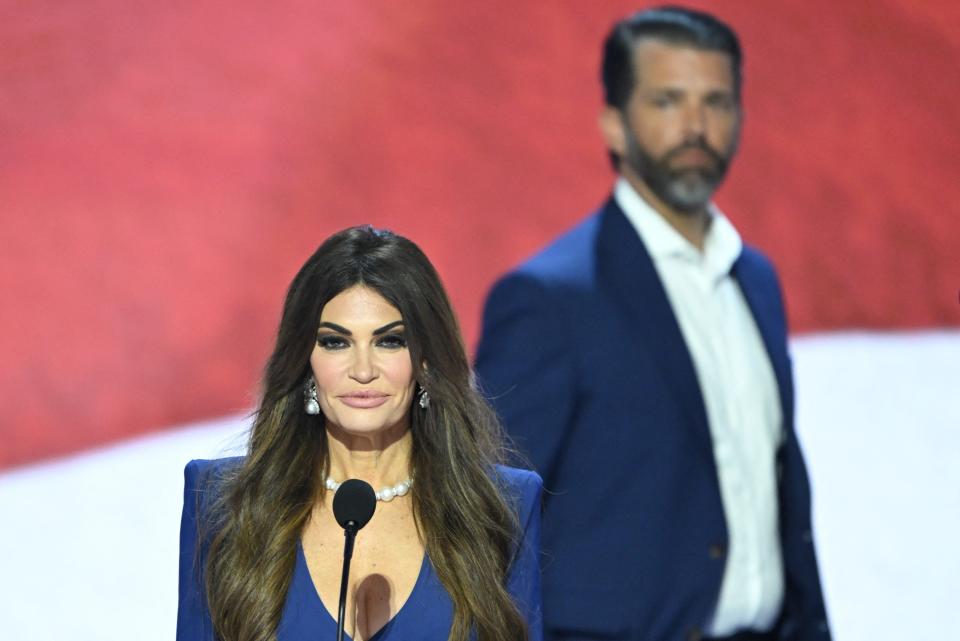
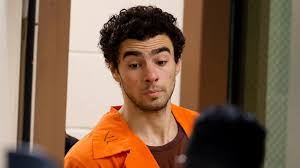
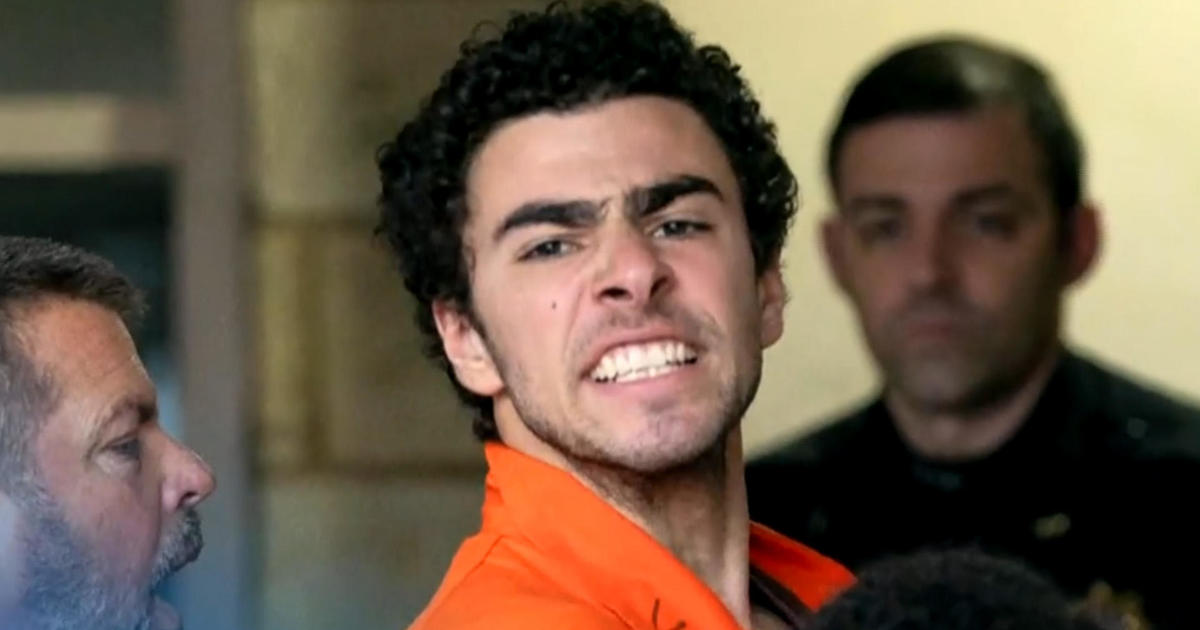
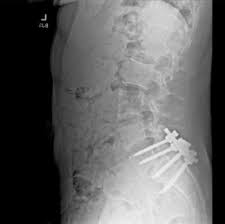
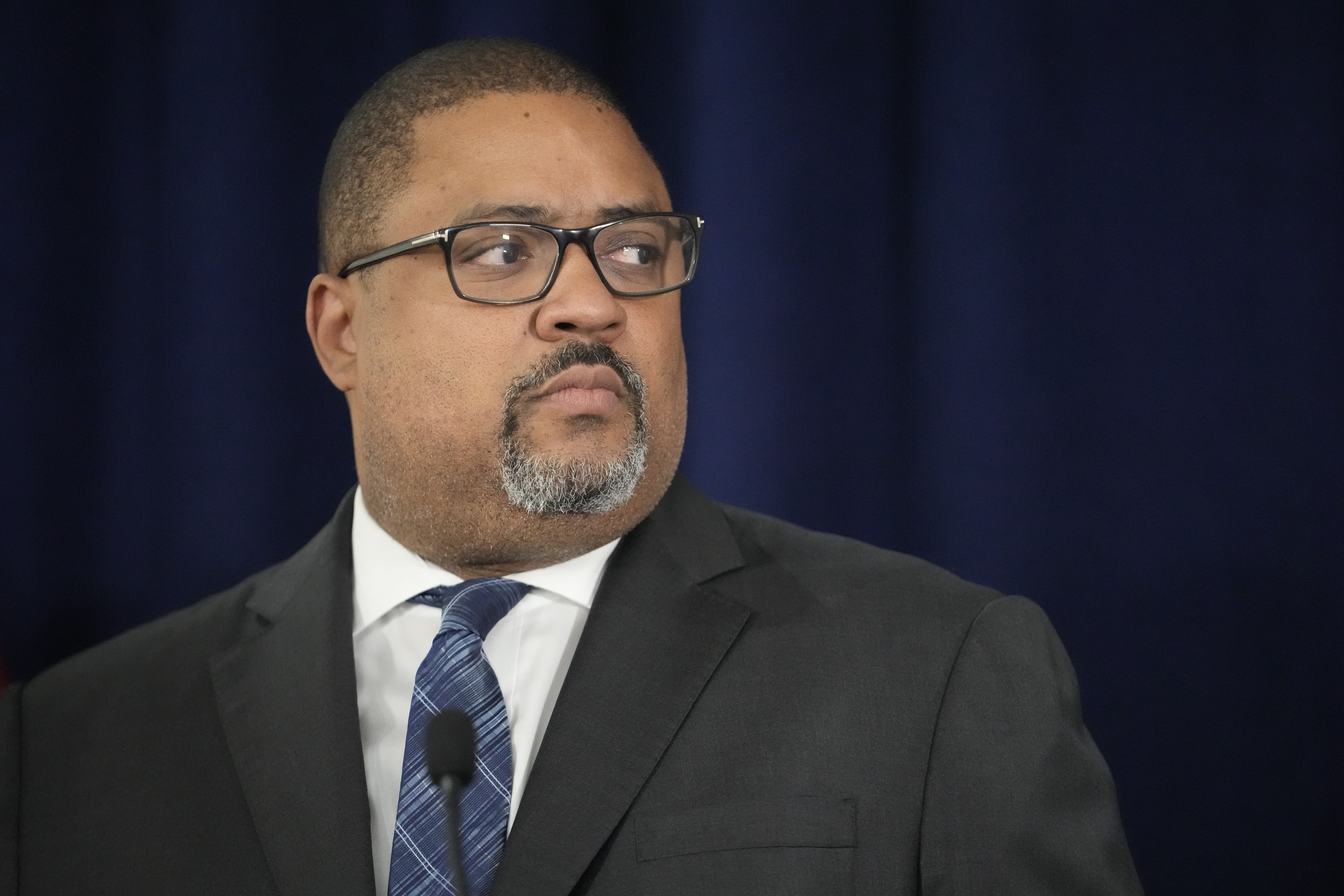
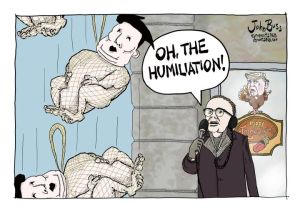
 President Sheinbaum immediately denied Trump’s characterization of their conversation. This headline from
 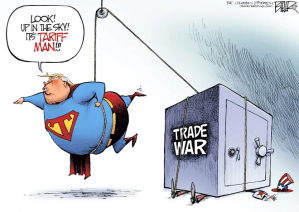 China and Canada were also blunt about DonOld’s mischaracterizations of his conversations with their leaders.
 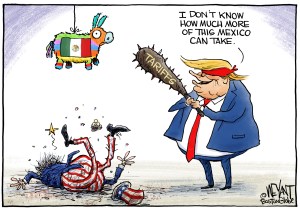 Businesses are already responding to the tariff threats. This will not be good for American Consumers.
 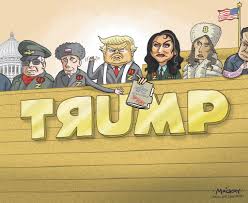 This is what happens when morons vote for a moron.
 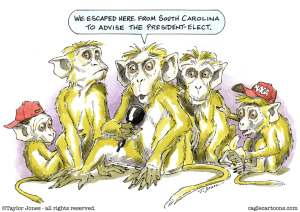 Marc Zuckerberg perfects his role as Surrender Monkey by dining with the Dotard at Mara Lardo.
 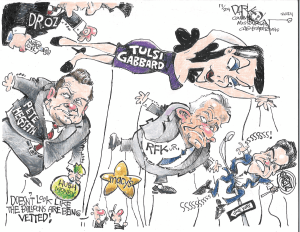 The Detroit Free Press
 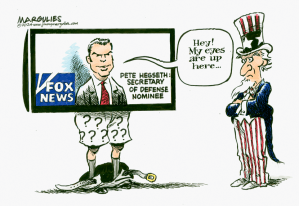 The American Prospect calls them “The Rape Gang.”
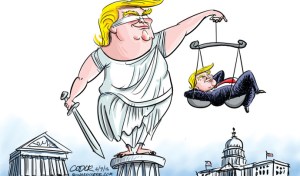 We definitely have a kakistocracy coming our way. We can see the incompetence, the total lack of knowledge of policy, and the complete inappropriateness of every candidate for Cabinet. It comes from the ultimate dotard. The only thing we have going for us now is our resolve and the fact that the Republican Majority in both Houses is narrow. Both houses have also had lots of experience in gumming up the works for Trump.
 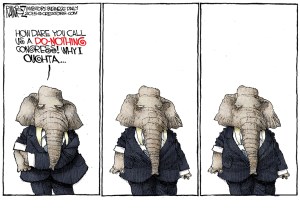 There is a slim majority margin in the US House of Representatives. There is no mandate radical change there. This is from




 Yesterday was the 61st anniversary of the assassination of President John F. Kennedy on November 22, 1963. I was 15 years old, a junior in high school. I still see that day as a defining event in my life. It was my first real experience of death, and I recall how difficult it was for me to comprehend and accept that our brilliant and charismatic president was really gone forever. It was my first lesson in how quickly dramatic events can change our understanding of the world.
 Later this month, the Kennedy footage is to be put up for sale in Boston by RR Auction, the latest in a line of assassination-related images to surface publicly after decades in comparative obscurity. The auction house says it is the only known film of the president’s car on the freeway as it sped from Dealey Plaza, the site of the shooting, to Parkland Memorial Hospital, where Kennedy was pronounced dead at 1 p.m.
 The meeting was to address the issue of how urban renewal in 1960s Boston was hurting the city’s poor and people of color, especially the need for low-income housing. When the group broke for lunch the news of Kennedy’s death reached them.
 As a former reality TV star, Trump is deeply attuned to the power of the small screen. His selection process has centered on people who can not only articulate his message but also defend him in the kind of high-stakes, combative settings that define modern media.
 The former Democratic congresswoman
  That’s the context that’s essential for understanding Trump’s Friday evening “nomination” (if you can call a social media announcement that) of Russell Vought to lead the Office of Management and Budget (OMB). Vought is a proponent of a powerful executive and of restructuring our institutions to facilitate a government that veers toward the monarchical and away from the democratic. He was







 peej
peej Carissa
 bostonboomer
 dakinikat
 ecocatwoman
 mablue2
 Mama Lopez
 peggysue22
 quixote
 skydancingguestblogger
 Mona (aka Wonk the Vote)



 Sky Dancing
Recent Comments