
Way to Go Boys and Girls: Countdown to Recession
Posted: August 2, 2011 Filed under: Domestic Policy, Economy, Federal Budget and Budget deficit, U.S. Economy, We are so F'd | Tags: economy killing debt deal, low growth, recession 6 Comments
So, I’m watching the US stock market plummet and laughing to myself in a most unhealthy way. NOW, they’re worried about no growth and jobs. What a buncha marroons! But hey, we maintained that AAA rating so the flight to safety has begun. Gold any one?
“We have a stubbornly slow economy,” Hank Smith, chief investment officer at Haverford Trust Co. in Radnor, Pennsylvania, said in a telephone interview. His firm manages about $6.5 billion. “The economy is stuck in a very slow growth mode, which means that it’s more susceptible to any external shocks.”
Harvard University economics professor Martin Feldstein said he sees a 50 percent chance that the U.S. will relapse into another recession.
“Nothing has given us much growth,” Feldstein said today in a Bloomberg Television interview on “Surveillance Midday” with Tom Keene. Feldstein is a member of the committee that dates recessions for the National Bureau of Economic Research.
Today’s retreat brought the S&P 500 to within 1 percentage point of its low for the year on March 16 and trimmed its year- to-date gain to about 0.5 percent. All 10 industry groups fell, led by a 2.4 percent slump in industrial companies. General Electric Co. lost 3.7 percent to lead declines in 29 of 30 stocks in the Dow Jones Industrial Average.
Archer Daniels Midland Co., the world’s largest grain processor, tumbled 2.4 percent as earnings trailed projections after corn and tax expenses rose. MetroPCS Communications Inc., the pay-as-you-go mobile-phone carrier, lost 35 percent for the biggest decline in the S&P 500 as sales fell short of analysts’ forecasts.
What if they gave a recovery and nobody came? So, What’s missing from the debt ceiling debate? Jobs. In an aggregate demand led recession, what gives us growth is healthy government spending, not tax cuts, and certainly not austerity. Welcome to the new anti-growth fiscal policy.
The unemployment rate, currently above 9 percent, is projected to remain high for a long time. For example, the current Blue Chip Economic Indicators consensus forecast puts the average unemployment rate for 2012 at 8.3 percent. The agreement to raise the debt ceiling just announced by policymakers in Washington not only erodes funding for public investments and safety-net spending, but also misses an important opportunity to address the lack of jobs. The spending cuts in 2012 and the failure to continue two key supports to the economy (the payroll tax holiday and emergency unemployment benefits for the long term unemployed) could lead to roughly 1.8 million fewer jobs in 2012, relative to current budget policy.
The agreement would reduce spending by at least $1 trillion over 10 years through budget caps on non-mandatory programs, with additional reductions under discussion in a second phase. While the bulk of the cuts are back-loaded – coming more in the future – the near-term cuts would still have an immediate impact. Applying conventional multipliers, the reduction of $30.5 billion in calendar year 2012 would reduce GDP by 0.3%, and result in roughly 323,000 fewer jobs (as depicted in the table below).
In addition to the immediate cuts to spending, the debt ceiling agreement fails to continue two major policies which had been part of broad agreements in the past. The payroll tax holiday and extended unemployment insurance were passed last December along with the two-year extension of the Bush-era tax cuts; but are set to expire at the end of 2011. While Congress could still extend these policies between now and the end of the year, that scenario is looking much less likely today. (Any economic support subsequent to this deal would have to be offset by other tax increases or spending cuts in 2012 or a further increase in the debt ceiling, neither of which seems politically viable.)
But wait, didn’t the know-it-all in chief just say jobs were priority one now? Well, let me just laugh. Even Andrea Mitchell knew enough to ask the dmbest person in nearly every room–Valerie Jarrett–with what money are you going to be doing that?
“As we go through the package, and members are beginning to learn what’s in the package, they’re seeing,” the reaction is “better and better,” White House senior adviser Valerie Jarrett said on MSNBC’s “Andrea Mitchell Reports.”
“I’ve been on many of these calls since last evening with a wide variety of people who were initially skeptical,” she said. “But when they see the details of the package, they’re becoming increasingly comfortable.”
The deal reached by the president and congressional leaders is “not perfect,” Jarrett said, and is “not the package that the president would have wanted.”
Even so, she said, “it is a package that stays true to his values and his goals, No. 1, long-term certainty, and No. 2, making sure that the people who can least afford to suffer are protected.”
The Economic Policy Institute, a top nonpartisan think tank, estimates that the deal struck this weekend to raise the nation’s debt limit will end up costing the economy 1.8 million jobs by 2012. Today the Senate is expected to approvethe package passed yesterday by the House and send it to President Obama. But while the unemployment rate remains above 9 percent, the deal does nothing to address chronic joblessness.
The agreement would reduce spending by at least $1 trillion over 10 years, but even the near-term cuts could shrink already sluggish GDP growth by 0.3% in 2012. According to EPI, the plan “not only erodes funding for public investments and safety-net spending, but also misses an important opportunity to address the lack of jobs.” In particular, the immediate spending cuts and the “failure to continue two key supports to the economy (the payroll tax holiday and emergency unemployment benefits for the long term unemployed) could lead to roughly 1.8 million fewer jobs in 2012.”
What we should be worrying about is all the news that Washington has ignored while it was doing the debt ceiling shuffle. Most importantly, the economy has almost stopped growing and unemployment is again on the rise.
On Friday, the commerce department released data showing the economy grew just 1.3% in the second quarter. Even worse, it revised down the first quarter growth number from 1.9% to just 0.3%. This means that the economy was growing at just a 0.8% annual rate over the first half of 2011. This is well below the 2.5% pace that is necessary just to keep unemployment from rising.
Of course, unemployment has been rising, with the June figure hitting 9.2%. That is up from a post-recession low of 8.8% in March. The unemployment rate does not give the whole story, since many of people have lost hope of finding a job and given up looking for work altogether. The employment to population ratio (EPOP) – the percentage of the population with jobs – has fallen back almost to its low point for the downturn. The EPOP for African Americans has hit new lows in each of the last three months.
The revisions also provided other interesting pieces of information. For example, corporate profits were revised sharply higher for both 2009 and 2010. The share of profits in corporate sector output hit a new record high, more than a full percentage point above its previous peak. Finance was the biggest winner within the corporate sector, accounting for 31.7% of corporate profits, also a record high.
In short, we now have an economy that is stuck in the doldrums. It is operating well below its potential level of output. Furthermore, instead of catching up, it appears to be falling further behind. We are seeing a growth rate far below the economy’s potential, when we should be seeing growth that is far above potential. And the Wall Street guys are fat and happy.
Believe me, an economy “stuck in the doldrums” will look good this time next year. If Mitch McConnell wanted to over throw or throw over the country, he sure succeeded. Some one needs to whip his sorry ass.
Breaking … WSJ Discovers Lack of Demand is behind Weak U.S. Economy
Posted: July 18, 2011 Filed under: Barack Obama, Domestic Policy, Economy, Surreality, The Great Recession, U.S. Economy, U.S. Politics, unemployment, voodoo economics | Tags: consumer demand, economics, Economists, economy, Federal spending cuts, government stimulus, jobs, Keynes, unemployment, Wall Street Journal 16 Comments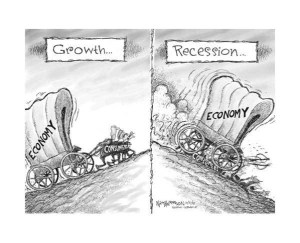
Via Andrew Leonard at Salon, the Wall Street Journal today reported the results of a survey they conducted with 53 economists:
In the survey, conducted July 8-13 and released Monday, 53 economists—not all of whom answer every question—were asked the main reason employers aren’t hiring more readily. Of the 51 who responded to the question, 31 cited lack of demand (65%) and 14 (27%) cited uncertainty about government policy. The others said hiring overseas was more appealing.
Only the conservative WSJ, the President, and Congresss could be surprised by these results. I’m not sure who these 53 economists were, but I think they must have been rather conservative, because the survey found that most did not think the government should do anything more to stimulate the economy.
Despite their forecasts for slow growth and an elevated unemployment rate, the economists aren’t in favor of further action either by the Fed or the federal government. Forty-one economists in the WSJ survey said the central bank shouldn’t pursue another round of bond-buying aimed at reducing interest rates, and thirty-eight said another round of fiscal stimulus shouldn’t be a part of any deficit-reduction package.
Economists added that they hope that as conditions begin to improve, albeit slowly, consumers will become more optimistic. “For whatever reasons, in addition to discrete headwinds, I think we’ve taken a hit to animal spirits and as those headwinds fade sentiment will revive,” said Stephen Stanley of Pierpont Securities. “Optimism can be self-sustaining, but pessimism can also provide a persistent drag.”
If any of the economists the WSJ talked to mentioned the possibility that the government itself could create jobs and thus stimulate demand–as FDR did the last time things were this bad, the WSJ did not report it.
Andrew Leonard crows:
what could be more obvious, even in the absence of rigorous training in economics? In the absence of demand, businesses will refrain from ramping up production and adding staff — no matter what employers think about the future regulatory climate. To prime this pump, to rev up this engine, to get the “delicate machine” working properly, the first focus for economic policymakers should be figuring out ways to boost demand.
Wouldn’t the best way to do that be to create jobs? Even Andrew Leonard doesn’t mention that. It seems ass-backwards to me to talk about getting consumers to spend more in order to get companies to start hiring. How can consumers spend more when many of them are unemployed? Maybe Dakinikat can explain this to me.
Anyway, it’s pretty amazing that the WSJ is admitting we have a demand problem. Now if only they could convince President Obama…
How many S’s in a Senate Sentimental Statement make for a Symbolic Surreal Exercise in inSanity?
Posted: July 6, 2011 Filed under: Domestic Policy, Economy | Tags: deficit, Democratic spinelessness, Tax Cuts for Billionaires 9 Comments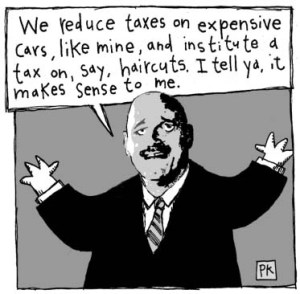 Harry Reid has introduced a bill called the “Sense of the Senate on Shared Sacrifice”. It basically has no recommendations, suggestions, policy measures, or required action. It is symbolic surreality at best and an exercise in serious alliteration. I can frankly hear Daffy Duck adding “suffering succotash” to the end. Hisssssssss.
The Senate as early as Wednesday could vote on a “Sense of the Senate” bill that says taxpayers earning $1 million or more each year should “make a more meaningful contribution to the deficit-reduction effort.”
…
The bill has no specific recommendations on how much taxes should be raised on high-income earners, and is simply a recommendation that these taxpayers pay more. Because the 60 votes needed to end debate are unlikely to materialize, the vote will likely be used by Democrats as a way to show Republican resistance to new tax hikes.
Democrats might also try to use the vote as leverage in negotiations on how to raise the debt ceiling by showing that there is support for a tax increase. In those talks, which are expected to continue this week, Democrats have said taxes on the wealthy and on oil companies should be part of the equation for reducing the deficit. Republicans have so far rejected this, and argue that an agreement needs to focus solely on spending cuts.
Now I’m all for meaningful displays of protest and performance art but I’m not alone in thinking this is shallow grandstanding. Here’s the sentiment of Greg Sargent on the subject. Did I mention the word Surreal is his subject head?
So it’s come to this. Republican opposition to any kind of revenue increase as part of the deficit deal has grown so implacable that Dems will now hold a Senate vote tomorrow on the basic idea that millionaires and billionaires should help contribute to fixing our deficit.
It’s not a vote on any specific proposal to hike taxes or end tax breaks. Rather, it’s a vote that puts each Senator on record on the general question of whether the rich should sacrifice in service of deficit reduction.
According to a Dem leadership aide, Senate Democrats have decided, as expected, to proceed with a vote tomorrow on a resolution that would declare that it is the “sense of the senate” that those who make $1 million or more per year should “make a more meaningful contribution to the deficit reduction effort.”
The vote — a cloture motion on the question of whether to proceed to an up-or-down vote on this resolution — is designed to put Repubicans on the spot. The idea is to force GOPers to go on the record choosing between declaring general support for more sacrifice from the wealthy — which in theory could strengthen Dem leverage in the talks — or reveal that they’re ideologically hostile to the notion that the rich should sacrifice anything to fix our fiscal mess. Dem Senators are holding a presser this afternoon to push the issue.
That this vote is happening at all perfectly captures just how surreal this debate has become. Democrats have agreed to over $1 trillion in spending cuts, and have reportedly agreed to tens of billions in Medicare cuts as part of that package. The American people have declared in poll after poll after poll that they think the deficit should be addressed through a combination of spending cuts and tax hikes. Yet Republicans are simply refusing to entertain the possibility of any revenue increases of any kind — to the point where even conservative columnists like David Brooks are growing seriously alarmed by the anti-tax fanaticism that’s on display.
Here’s David Dayen’s take at FDL. (Notice, I’ve decided to can the alliteration. It was getting way to easy and annoying.)
I’m actually all for nakedly political votes. This bill does not put anything into law, does not actually force millionaires to make a “more meaningful contribution” to deficit reduction. All it does is force Republicans onto the side of millionaires. If used successfully, that’s a fine vote to have for the next several cycles, and is sure to come up in television ads. Politics must be played sometimes.
But let’s not pretend that this is a “millionaire’s tax bill.” There was an opportunity to put a millionaire’s surtax in the Democratic budget; Kent Conrad will deliver a budget with a balanced approach between taxes and spending, but that surtax was dropped. There are a series of ideas about ending tax breaks for corporate jet owners, but I don’t know if you can even call them “meaningful.” Especially when you put them against the potential for $500 billion in Medicare and Medicaid cuts – just a year after a separate set of $500 billion in cuts to Medicare Advantage overpayments and other fat-trimming from Medicare – and another $100 billion through changing the COLA formula for Social Security beneficiaries. That adds up to twice as much in deficit reduction from seniors, the poor and the disabled than from the sum total of all revenue raisers on the table.
And anyway, none of those revenue raisers will be voted on in this sense of the Senate legislation. It just says that millionaire contributions would be a good idea. I assume then that the plan is to approach the millionaires individually.
My take is that if it’s such a good idea, then Reid should actually do something about it. He should’ve done something about it last winter when Obama was selling out on the Dubya Bush tax cut extensions. Our government shouldn’t be a person on the street with a tin cup. Congress spent all this damned money on all those wars and handed out all those ridiculous tax loop holes. Frankly, I’m with Katrina vanden Heuvel who thinks Obama and the Democrats should just invoke the 14th amendment and tell the Republicans to go to hell. Enough of this symbolic shit! Send Rubio, Ryan, and Boehner to the moon!
Independence Day Reads
Posted: July 4, 2011 Filed under: Bailout Blues, Domestic Policy, Economy, Foreign Affairs, Global Financial Crisis, Greece, investment banking, morning reads | Tags: Bill Clinton, Budget Deficit, debt limit, Fukushima, Greek Debt Crisis, John McCain, nuclear crisis, shadow banking industry, SIVs, taxes 16 Comments Happy Independence Day!
We have a republic and a lot of people have sacrificed a lot over the last several centuries to keep it. Too bad most of our politicians aren’t in that number. They can’t see past their next elections.
It seems that two senators– McCain and Corynyn–say they’re open to tax increases as a way to solve the budget stand off. Guess there are a few of them left that would prefer not to tank our economy. Let’s hope this starts some real negotiations instead of the usual Republican hostage taking and Democratic cave-in that’s been politics as usual the last dozen years or so.
One of the senators, John Cornyn of Texas, said he would consider eliminating some tax breaks and corporate subsidies in the context of changes in the tax code, provided there was not an overall increase in taxes.
“I think it’s clear that the Republicans are opposed to any tax hikes, particularly during a fragile economic recovery,” Mr. Cornyn said on “Fox News Sunday.” “Now, do we believe tax reform is necessary? I would say absolutely.”
But he insisted that any changes in taxes be “revenue neutral,” meaning that the government would not take in any more money from individuals or businesses than it does now.
The other senator, John McCain of Arizona, said he would be willing to consider some “revenue raisers” as part of a broad deal, but he refused to name specific measures.
Mr. Cornyn, a member of the Senate leadership, also said that Republicans would be open to a short-term deal on the debt ceiling to provide more time for a comprehensive agreement.
Let’s also hope that more reasonable and less ideological heads prevail on the right and that the left stands up for what’s right for a change. Former President Clinton had a words of policy advice over the weekend. His advice to President Obama is “not to blink”.
Former President Bill Clinton Saturday night urged President Obama not to “blink” at Republican demands to exclude revenue increases from any agreement to extend the government’s debt ceiling.
If Republicans maintain their opposition to revenue increases, Clinton said, Obama should pursue a short-term deal to extend the debt ceiling based on spending cuts both sides have already accepted in the negotiations between the administration and Congressional leaders from both parties.
“I hope they will make a mini-deal,” Clinton said in an interview conducted with him at the Aspen Ideas Festival here.
The White House and Congressional negotiators from both parties are attempting to assemble a deficit reduction package that could win support in Congress for legislation to extend the nation’s debt ceiling, which the Treasury says the government will reach on August 2. The talks have foundered amid demands from Congressional Republicans to exclude any revenue increases from that prospective deficit reduction package.
Asked what the administration could do if GOP leaders hold to that posture, Clinton replied: “First the White House could blink. I hope that won’t happen. I don’t think they should blink.”
If Republicans will not accept revenues in a package to lift the debt ceiling by August 2, Clinton said, Obama should pursue a short-term agreement based on the spending reductions both sides have already accepted.
“There are some spending cuts they agree on …and he can take those and [get] an extension of the debt ceiling for six or eight months,” Clinton said.
Clinton also called on a package of reforms to US tax policy that includes a corporate tax cut if special interest tax loops are closed. This is something Obama has also supported.
“It made sense when I did it. It doesn’t make sense anymore – we’ve got an uncompetitive rate. We tax at 35 percent of income, although we only take about 23 percent. So, we SHOULD cut the rate to 25 percent, or whatever’s competitive, and eliminate a lot of the deductions so that we still get a FAIR amount, and there’s not so much variance in what the corporations pay. But how can they do that by Aug. 2?”
Clinton also said Grover Norquist, who as president of Americans for Tax Reform is the GOP’s unofficial enforcer of no-new-taxes pledges, has a “chilling” hold on the nation’s lawmaking.
The former president said it has seemed like Republicans need any revenue concessions need to be “approved in advance by Grover Norquist.”
“You’re laughing,” he told the crowd of 800. “But he was quoted in the paper the other day saying he gave Republican senators PERMISSION … on getting rid of the ethanol subsidies. I thought, ‘My GOD, what has this country come to when one person has to give you permission to do what’s best for the country.’ It was chilling.
There’s an extremely interesting piece at The Atlantic Wire on “What Really Happened at Fukushima”. It includes interviews with workers that have been inside the crippled nuclear plant.
Throughout the months of lies and misinformation, one story has stuck: “The earthquake knocked out the plant’s electric power, halting cooling to its reactors,” as the government spokesman Yukio Edano said at a March 15 press conference in Tokyo. The story, which has been repeated again and again, boils down to this: “after the earthquake, the tsunami – a unique, unforeseeable [the Japanese word is soteigai] event – then washed out the plant’s back-up generators, shutting down all cooling and starting the chain of events that would cause the world’s first triple meltdown to occur.”
But what if recirculation pipes and cooling pipes, burst, snapped, leaked, and broke completely after the earthquake — long before the tidal wave reached the facilities, long before the electricity went out? This would surprise few people familiar with the 40-year-old Unit 1, the grandfather of the nuclear reactors still operating in Japan.
The authors have spoken to several workers at the plant who recite the same story: Serious damage to piping and at least one of the reactors before the tsunami hit. All have requested anonymity because they are still working at the plant or are connected with TEPCO. One worker, a 27-year-old maintenance engineer who was at the Fukushima complex on March 11, recalls hissing and leaking pipes. “I personally saw pipes that came apart and I assume that there were many more that had been broken throughout the plant. There’s no doubt that the earthquake did a lot of damage inside the plant,” he said. “There were definitely leaking pipes, but we don’t know which pipes – that has to be investigated. I also saw that part of the wall of the turbine building for Unit 1 had come away. That crack might have affected the reactor.”
The reactor walls of the reactor are quite fragile, he notes. “If the walls are too rigid, they can crack under the slightest pressure from inside so they have to be breakable because if the pressure is kept inside and there is a buildup of pressure, it can damage the equipment inside the walls so it needs to be allowed to escape. It’s designed to give during a crisis, if not it could be worse – that might be shocking to others, but to us it’s common sense.”
Here’s some frightening news on the disaster in Japan. Radioactive Cesium has been found in Tokyo’s water supply.
Radioactive cesium-137 was found in Tokyo’s tap water for the first time since April as Japan grapples with the worst nuclear disaster in 25 years.
Cesium-137 concentration registered at 0.14 becquerels per kilogram in the city’s Shinjuku ward on July 2, compared with 0.21 becquerels on April 22, according to the Tokyo Metropolitan Institute of Public Health. No cesium-134 or iodine-131 was detected, the agency said on its website.
The Nuclear Safety Commission of Japan sets a safety limit of 200 becquerels per kilogram for cesium-134 and cesium-137. The limit for iodine-131 consumption is 300 becquerels per kilogram.
Japan is battling radiation leaks into the air, soil and water after an earthquake and tsunami on March 11 knocked out cooling systems at Tokyo Electric Power Co.’s Fukushima Dai- Ichi nuclear station, resulting in the meltdown of three of the six reactors at the plant.
The UK Guardian lists an interesting set of Greek public assets for sale. Many have no buyers. Bobby Jindal is putting up a lot of Louisiana assets for sale too. I wonder if this is going to be the new way to raise money. The Kochs already rent a big chunk of Yellowstone. Let’s hope we don’t have to put our national treasures on the chopping block.
Up for sale are 39 airports, 850 ports, railways, motorways, sewage works, a couple of energy companies, banks, defence groups, thousands of acres of land for development, casinos and Greece’s national lottery. George Christodoulakis, Greece’s special secretary for asset restructuring and privatisations, said the sell-off would raise €50bn (£44bn) to help pay back the country’s €110bn bailout debt.
The private equity bosses gathered in the hotel’s ballroom for the parade of Greece’s national treasures showed little interest in buying anything.
Nikos Stathopoulous, managing partner of BC Partners, which has invested more than €3.5bn in Greece, said investors are put off by bureaucracy, strong unions, corruption and a lack of transparency. “Even in the good times Greece is not a country that attracts investment. Foreign investors don’t want to invest in a country where there is no flexibility in hiring and firing people,” he said. “You don’t want to invest in a country in which you wake up and a new law has been passed which totally undermines and destroys the value of the investment you’ve just made.”
Stathopoulous said investors were finding it very hard to assess the risk of investing into Greece, which means assets “will be priced at lower than they are worth, lower than the Greek government, and even the European Union, expects”.
Here’s a compelling argument for getting the shadow banking sector into a more regulated, transparent, and standardized order. It’s written by Henry Tabe who is a Founding Partner of Sequoia Investment Management Company Ltd. It particularly addresses the use of the Structured Investment Vehicle (SIV). Complex, nonstandard, and unregulated markets make pricing assets difficult and introduce unnecessary risk and volatility.
Risk management requires identification, measurement, aggregation, and effective management of risks. It should help businesses allocate sufficient capital for survival and growth. The SIV’s extinction highlights risk management failures by the vehicles, their sponsors, rating agencies, policymakers, and regulators.
Financial regulators permitted bank, insurance company, pension, and hedge-fund sponsors to establish SIV “mini-banks” without ensuring that they maintain sufficient capital or back-stop liquidity in the event of a run. Policymakers also seemed unaware of the knock-on effects of the SIV’s demise on the securitisation and global credit markets. The Financial Security Authority’s call for regulators to incorporate sectoral analytical capabilities in their micro-prudential policies should help close the knowledge gap and ensure that timely solutions can be implemented to avert collapses that engender significantly more stress on the financial system (FSA 2009).
Lessons learned include the tightening of regulation governing the sponsorship of off-balance-sheet structures and the sizing of their capital and liquidity needs. These require that regulators adopt a more proactive, dampening role in the wild swings from exuberance to despair that are so characteristic of the financial markets. Discussions around contingent capital and similar products suggest regulators have embraced that dampening role and moved away from the prevailing pre-crisis philosophy of minimal regulation.
Lessons learned also include closer supervision of shadow banks, more skin-in-the-game for their sponsors, in-house retention of risk-analytics capabilities by investors, and less reliance on credit-rating agencies. The agencies themselves are more tightly supervised in order to reduce ratings shopping by issuers and inherent conflicts of interest in the business model (CESR 2009). Tighter regulation will also help to ensure that the agencies improve the monitoring of analyst performance, qualifications, and experience (Dodd-Frank 2010).
These measures should help restore confidence in rating agencies and the global financial system, an outcome more urgently required given on-going turmoil in the sovereign debt market.
So, there’s some wonky goodness to keep you entertained if you’re inside today. Be sure to let us know what you’re reading and blogging! Hope your Fourth of July is a happy one!
The Republican Tax Scam or why compromise the Cow when the President will give you the Milk Free?
Posted: June 23, 2011 Filed under: Domestic Policy, Federal Budget, Federal Budget and Budget deficit, Surreality, Team Obama | Tags: Biden, Budget talks, Cantor, Kyle 9 CommentsI think it’s safe to say that no one likes paying taxes. However, every one likes roads without pot holes, functional national defense, public safety and justice systems, and modern infrastructure that supports commerce, travel, and trade. How can Republicans justify their just say no new taxes position when they themselves continually run up government spending for their own pet projects? Well, that’s where they’ve decided to lie and say that decreased taxes means more revenues. That’s also why our deficit has been spinning out of control since the Dubya Bush tax cuts. Unfortunately, they seem to want to continue this disingenuous game rather than tell the Grover Norquists in their base to take the delusion elsewhere.
Today, the last Republican walked away from VP Biden’s bipartisan task force to find a compromise solution to the budget. Again, the issue was the lack of Republican will to pay for anything and to stop paying for anything that the majority of the nation demands. This has gone beyond ridiculous to dangerous. Let me point you to the Bloomberg coverage and I’ll bold the important part.
President Barack Obama likely will step into the final stages of talks to break a deadlock over a plan to cut budget deficits, his spokesman said after two Republicans dropped out of talks led by Vice President Joe Biden.
House Majority Leader Eric Cantor cited an “impasse” over tax increases in refusing along with Senator Jon Kyl to attend today’s planned negotiating session. They called for Obama to take the lead.
The move caught Democrats by surprise and raised the prospect that the Biden-led talks could collapse over taxes. Republicans insist on major spending cuts, and no tax increases, before they will agree to raise the nation’s $14.3 trillion debt ceiling. The Treasury Department says the limit must be raised by Aug. 2 or the U.S. will risk defaulting on its obligations.
“It has always been the case that these talks would proceed to a point where the remaining areas of disagreement would be addressed by leaders and the president,” White House press secretary Jay Carney told reporters aboard Air Force One. He said the Biden talks “may or may not resume” and that he had nothing to announce on the next steps.
My guess is that Republicans want Obama to “step into the final stages” for several reasons. First, the President’s direct involvement in talks will allow them to take political advantage of any suggestions they perceive as worth exploiting. Second, every time Obama’s come to the bargaining table, he’s caved in or basically agreed to Republican demands. Obama agreed to extend the Dubya tax cuts to the richest of the rich violating his own promise and stepping way over his line in the sand. Obama also took every last Democratic policy out of Health Care Reform to the point there is virtually no difference between the 1990s plan American Heritage Institute plan first introduced by then Republican Senator John Chafee and later championed by Republican Senator Bob Dole. We don’t have Obamney Care. We have the old Dolecare. So, the Republicans have been fairly good at getting Republican policy passed without taking any of the blame. Why would they do any thing differently?
Cantor has the credibility with the Tea Party that Boehner lacks. But that’s why Cantor won’t cut the deal. The Tea Party-types support him because he’s the guy who won’t cut the deal. He can’t sign off on tax increases without losing his power base. But if he’s able to throw it back to Boehner, and Boehner cuts the deal, that’s all good for Cantor: Boehner becomes weaker and he becomes stronger. Which is why Boehner will also have trouble making this deal. It’ll mean he made the concessions that Cantor, the true conservative, didn’t. That’s not how he holds onto the gavel in this Republican Party.
One analysis of the House GOP right now is that there are two players in the GOP who can cut a budget deal: Eric Cantor and John Boehner (and, on some of the other budget issues, Appropriations Chair Hal Rogers). One of them is going to have to do it. Which means one of them is going to lose his job. The optimistic take is that what we’re seeing right now is a game of musical chairs over which one of them it’ll be.
But the pessimistic analysis is that if you had to write a plausible scenario for how America defaults on its debt, or at least seriously spooks the market, this is how it would start. After insisting on using the debt limit as leverage for a budget deal, the Republican leadership finds they can’t actually strike a deficit-reduction deal, but nor can they go back on their promise to vote against any increase in the debt limit that isn’t accompanied by a deficit-reduction deal. What follows is a lot of jockeying and fingerpointing, a short-term increase or two, and eventually, a market panic.
Cantor is putting personal power before country here, and in a very dangerous way.
ABC News explains that Senator Kyl has dropped out for similar reasons. None of the Republicans want to be the one’s to have signed the Read My Lips, No New Taxes Pledge, then sign on to new taxes.
A Senior Democratic aide says, “Cantor and Kyl just threw Boehner and McConnell under the bus. This move is an admission that there will be a need for revenues and Cantor and Kyl don’t want to be the ones to make that deal.”
I still think that the Republicans would rather go mano-y-mano with the President than nearly any other Democrat. The hapless Senator from Nebraska–Ben Nelson–is probably the only other spineless critter that would be somewhat attractive. The only difference is that he’s got no pull within the party.
So, here’s the Republican spin:
In a joint statement with the chief Senate Republican negotiator, Arizona Sen. Jon Kyl, McConnell followed up by portraying Obama as a champion of higher taxes at the expense of “a bipartisan plan to address our deficit. He can’t have both. But we need to hear from him.”
Cantor had sent mixed signals earlier this week, first saying that he wanted greater involvement by the president and then insisting that he remained committed to the talks led by Vice President Joe Biden. His decision now appeared to catch some in the GOP leadership, including his fellow negotiator Kyl, by surprise. And it came just as Cantor has been on the defensive in the talks over Democratic demands for greater cuts from defense spending.
Adding to the intrigue was the almost Washington novel orchestration of the announcement. The Wall Street Journal was called in to get the news Thursday morning — the editorial pages of Rupert Murdoch’s newspaper are famous for their anti-tax orthodoxy. And Cantor made his move just hours after a Wednesday night meeting at the White House between his sometimes rival, Speaker John Boehner (R-Ohio), and Obama, who are slated to take over the talks once the Biden negotiations have run their course.
I still can’t figure out how the Republicans can be so successful at painting the President as being something completely at odds with reality but they continue to do so successfully. My guess is they will get the President to step in and they will get what they want. Then, look out. The incredibly low taxes will continue to do nothing but drain the Treasury. The incredibly high spending cuts will do nothing but tank the economy. The dithering around the debt ceiling increase will drive market interest rates up. In short, the current situation will deteriorate. Then, some one completely bat shit crazy like Michelle Bachmann will continue to spin the alternate reality and the opposite of truth and facts. To be even short, we are going to be incredibly f’d.
This feels a lot like watching a high school graduate do an appendectomy on your best friend. The people that know what they’re doing have left the building a long time ago.

 peej
peej Carissa
 bostonboomer
 dakinikat
 ecocatwoman
 mablue2
 Mama Lopez
 peggysue22
 quixote
 skydancingguestblogger
 Mona (aka Wonk the Vote)



 Sky Dancing
Recent Comments