
Blue Blue Monday Reads and Yes! Let’s politicize homophobia and gun fetishists!
Posted: June 13, 2016 Filed under: 2016 elections, American Gun Fetish, Barack Obama, Breaking News, children, Domestic Policy, Donald Trump, FBI, Gun Control | Tags: AR-15, mass shootings, NRA, Orlando Shooting 68 CommentsGood Afternoon!
Once again we see the results of toxic religious zealotry and resentment whipped up to the point that some nutter feels compelled to kill in the case of the Orlando massacre. This occurs all too frequently in this country. You may recall the  Colorado Planned Parenthood shooting where we saw Robert Dear go on a shooting spree with the same deadly combination of anger whipped up by right wing politicians and preachers, mental illness, and easy access to weapons. One claimed ISIS inspiration and Islamofascism. The other was inspired by Christofascists in the US that bring you terror in the name of Fetus Fetishism.
We still haven’t heard about the motives of the Indiana man–a 20 year old white guy–in terms of why he was going after participants and viewers of a California Gay Pride parade. Suffice it to say, the politicization of the private lives of the GLBT community by Republicans, their presidential candidate, and the various religious whackos that they court likely will come into play at some point.
Harassing and encouraging anger is just one political tool used regularly by Republicans these days. I have noticed that the silence is deafening right now on James Wesley Howell. The press can is clearly focused on the bloodbath and the sensational background of the Pulse Shooter rather than wondering why we manage to get bigger and badder displays of hatred and anger these days. I’m not sure that most people realize that any Abrahamic-based religion is going to beget violence in some folks. It goes with territory. A few of them take retribution and strict commandments from their angry sky fairy way too seriously. This is especially the case if they have some kind of severe emotional or mental disorder.
(Spoiler Alert) It’s the easy access to guns of all kinds in this country. The irresponsible and cynical use of anger and outrage to gain power and money is out of control. Religion is just another vehicle to whip up the anger and the outrage and it frequently turns deadly.
 The weapon of choice for mass shooters is the AR-15 rifle. This is one of the weapons that was included in the assault weapons ban signed by Bill Clinton in 1994 that expired in 2004. The rifle was used in Orlando, Aurora, Newton, and San Bernadino. It’s easily obtainable and the latest shooter–who had a history of Domestic Violence and was under the eye of the FBI for terrorist rantings–had a license to carry it and to obtain it legally. Let that sink in.
There were calls to ban the weapon after the Newtown shootings, which led to a spike in sales. Gun manufacturers have called the AR-15 one of the most popular weapons in the U.S., with more than 3 million estimated to be in circulation.
“It was designed for the United States military to do to enemies of war exactly what it did this morning: kill mass numbers of people with maximum efficiency and ease,” lawyer Josh Koskoff, who’s representing Newtown families in their lawsuit against the gun industry, said Sunday.
Regulations on magazine capacity for the weapon vary from state to state, but it can fire 45 rounds a minute.
Most forms of the gun had been prohibited under the 1994 federal assault weapons ban that was allowed to expire in 2004, following ferocious lobbying by the National Rifle Association.
The NRA has used its lobbying might in the years since to bury attempts to revive the ban.
“During the decade of the ban, there were half as many casualties in mass shootings as the decade before, and a third as many casualties in mass shootings as the decade after,” said Richard Aborn of the Citizens Crime Commission of New York City, a strategist involved in the original legislation.
 Hillary Clinton has called for a renewal of the Assault Weapons Ban that her husband signed in his first term. This is one of the reasons that I am so happy she is the nominee. Vermont Senator Bernie Sanders has some extremely neoconfederate views of gun control that he reiterated yesterday. He believes it is a state and local issue, voted against the Brady Bill many many times, and has supported relieving gun manufacturers and stores of any liability for the damage done by their product.
Hillary Clinton has called for the reinstatement of the assault weapons ban in the wake of the worst mass shooting in American history that left 49 people and the gunman dead at a gay nightclub in Orlando, Florida.
In forthright comments a day after the massacre at the Pulse Club, the presumptive presidential nominee for the Democratic party issued a call for a return to “commonsense gun safety reform” and lambasted the Republican-controlled Congress for what she called a “totally incomprehensible” refusal to address the country’s lax gun laws.
“We can’t fall into the trap set up by the gun lobby that says if you cannot stop every shooting you shouldn’t try to stop any,” she said.
Clinton’s tough stance on gun control sets up a torrid fight with her Republican rival for the White House Donald Trump, who has positioned himself as a champion of the second amendment and dismissed any calls for greater gun controls as weakness. She insisted that while she did believe that law-abiding American citizens have the right to own guns, it was also possible to see that “reasonable, commonsense measures” could be taken that would make people more safe from guns.
One of the things that stuns me is the ease with which a guy on the FBI threat radar could get a permit to carry and purchase a rifle that no civilian should own.
A day after the deadliest mass shooting in US history, questions are mounting over why the shooter Omar Mateen was legally able to buy an assault rifle and handgun despite having been investigated twice by the FBI for suspected terrorist sympathies.
Mateen, 29, launched his attack on Pulse club, an LGBT venue in downtown Orlando celebrating its popular Latin dance night, at 2.02am on Sunday morning.
Twenty minutes into the spree he took the bizarre step of making a 911 call in which he reportedly referred both to Islamic State and the Tsarnaevs, the brothers who carried out the Boston Marathon bombings in April 2013.
Sunday’s attack – which left 49 clubgoers dead and 53 injured – was launched by Mateen using a .223-caliber assault rifle and 9mm semi-automatic pistol with multiple rounds of ammunition that had been purchased quite lawfully in the week before the rampage using Mateen’s firearms license. Mateen was shot dead by police.
He also held a permit to work as a security guard, which he did at a courthouse in Port St Lucie, Florida, even though he was interviewed three times by the FBI in 2013 and 2014 following separate reports of extremist behavior and connections to terrorism that were in the end deemed insubstantial.
Mateen was released because no evidence of wrongdoing was found by the FBI. He’s a natural born American so that provides him the usual  protections. This is something that appears to have blown completely pass Donald Trump whose rhetoric and bragging were dialed up to 11 yesterday. He revisited his call to ban all Muslims from entering the country despite the fact that all three of the shooters claiming support for Islamofascim–Nidal Hassn (Fort Hood),Syed Rizwan Farook, (San Bernardino) , and Mateen (Orlando)–were American citizens. Only Farook’s wife–Tashfeen Malik–was foreign born.
The presumptive Republican nominee pulled no punches in a lengthy statement yesterday, going so far as to call for Barack Obama to resign and reiterating his call for a temporary ban on Muslims entering the United States (despite the fact that the shooter was born in New York).
“In his remarks today, President Obama disgracefully refused to even say the words ‘Radical Islam’. For that reason alone, he should step down,” Trump said in his press release. “If Hillary Clinton, after this attack, still cannot say the two words ‘Radical Islam’ she should get out of this race for the Presidency. If we do not get tough and smart real fast, we are not going to have a country anymore. Because our leaders are weak, I said this was going to happen – and it is only going to get worse. I am trying to save lives and prevent the next terrorist attack. We can’t afford to be politically correct anymore.”
“We admit more than 100,000 lifetime migrants from the Middle East each year. Since 9/11, hundreds of migrants and their children have been implicated in terrorism in the United States,” Trump added. “Hillary Clinton wants to dramatically increase admissions from the Middle East, bringing in many hundreds of thousands during a first term – and we will have no way to screen them, pay for them, or prevent the second generation from radicalizing.” (To be fair, this mischaracterizes Clinton’s position.)
The statement followed a stream of self-congratulatory tweets.
Clinton has decided to adopt the use of radical Islam. Let’s hope she will also be brave enough to point out radical Christians like Ted Cruz’s “Kill the 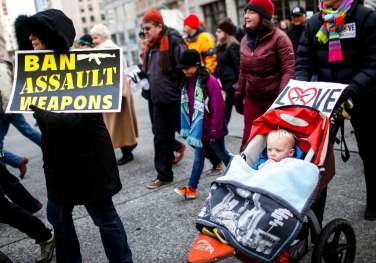 Gays” pastor or the horrid group at Westborough Baptist Church. She used the term on several morning news shows today.
Hillary Clinton on Monday broke from President Barack Obama in referring to the terrorist attack as “radical Islamism,” countering Donald Trump’s accusations that both she and Obama are weak on tackling terrorist threats.
In an interview with NBC’s “Today” on Monday morning, Clinton said words matter less than actions, but that she didn’t have a problem using the term.
“And from my perspective, it matters what we do, not what we say. It matters that we got Bin Laden, not what name we called him,” Clinton said. “But if he is somehow suggesting I don’t call this for what it is, he hasn’t been listening. I have clearly said we face terrorist enemies who use Islam to justify slaughtering people. We have to stop them and we will. We have to defeat radical jihadist terrorism, and we will.”
Both terms “mean the same thing,” Clinton continued, adding, “And to me, radical jihadism, radical Islamism, I think they mean the same thing. I’m happy to say either, but that’s not the point.”
“I have clearly said many, many times we face terrorist enemies who use Islam to justify slaughtering innocent people. We have to stop them and we will. We have to defeat radical jihadist terrorism or radical Islamism, whatever you call it,” Clinton said later on MSNBC’s “Morning Joe,” reiterating, “it’s the same.”
The U.S. cannot, on the other hand, she added, “demonize, demagogue and declare war on an entire religion.” Clinton also said she could assure Americans that she is equally committed to fighting Islamic extremism as well as protecting law-abiding Muslims.
The President spoke on the radicalization of Mateen several hours ago.
President Obama said Monday that the Orlando mass murder was “inspired” by violent extremist propaganda on the internet and there’s no evidence the killing spree was ordered by ISIS.
“We see no clear evidence that he was directed externally,” Obama said from the Oval Office, using another name from the Islamic State terror group. “It does appear that at the last minute he announced allegiance to ISIL.”
Obama said investigators are tracing Omar Mateen’s “pathway” to murder by reviewing his internet searches and other materials.
“It appears that the shooter was inspired by various extremist information that was disseminated over the internet,” Obama said.
“All those materials are currently being searched … so we will have a better sense of pathway that the killer took in the making a decision to launch this attack.”
Obama made the brief remarks after meeting with FBI Director James Comey, Homeland Security Secretary Jeh Johnson and other security officials.

The Orlando shooting and the shooting that might have been in California both are rooted in hate and easy access to guns. Both shooter and potential shooter had histories of mental illness. The Orlando shooter had a history of Domestic violence which in many states would stop him from getting access to any gun. Clearly, we have a problem in this country with hate and guns turned on the hapless population. One of our political parties has weaponized hatred and bigotry then enabled shooters by catering to all the whims of the most radical elements of the NRA gun lobby.
Clinton is right. This has to end on all accounts.
What’s on your reading and blogging list today?
Monday Reads: Of Dismal Differential Equations and angry old men
Posted: May 9, 2016 Filed under: 2016 elections, Domestic Policy, Economy 68 Comments Good Morning!
I’m still trying to get my thoughts together about the number of bomb throwers in both political parties that seem to want all levels of government to go to wreck and to ruin. They are being led by some of the most ignorant politicians I’ve ever had the displeasure to observe. Some folks are angry and eager for easy and very wrong answers.
It’s really easy for most people to confuse their personal pet experience with reality for the rest of the country as a whole. I get really tired of having anecdotal information put on the same level of seriousness as a peer-reviewed, published study. As an economist, I can tell you the number of people ignorant of generally well-known outcomes discovered through research and built up into theory in my field is highly limited. I shared this article by economist Greg Mankiw down thread over the weekend. I thought it was worth highlighting its main points.
I’ve said this a lot of times but the entire Sanders/Trump shtick on trade and the Sanders shtick on “big” banks is seriously out of step with reality. Mankiw succinctly writes about a few things that economists know that populist, anger-spewing office seekers don’t take time to learn. Now, Mankiw worked on the CEA for Dubya. He’s not the least bit politically Democrat but what he’s written here are things that economists and policy wonks know to be true from decades of study. Economists generally don’t argue on the facts on the ground or on theory. It’s how the policy should reflect that information that is usually a source of contention. There’s a lot of myths out there this election cycle. Here’s a few of them.
American manufacturing has disappeared.
The presumptive Republican nominee, Donald J. Trump, says, “We don’t make things anymore.” Judging from the surprising success of Mr. Trump’s campaign, this theme apparently resonates with many voters. But it is just not true.
When do you think manufacturing output reached its peak in the United States? The answer: right now. Manufacturing output achieved a record high in the most recent quarter of data. The nation’s manufacturers are now producing 47 percent more than they did 20 years ago.
What has declined is manufacturing employment, which is 29 percent lower than it was 20 years ago. Producing more output with fewer workers is called higher productivity, which in turn is driven by technological innovation. This change is hard on displaced workers, but it is good for the economy over all. Rising living standards are possible only if productivity increases.
Bad trade deals are what ails the economy.
Mr. Trump says he would negotiate better trade deals. Bernie Sanders brags about voting against the trade deals of the past. Hillary Clinton has split with President Obama and withdrawn her support for the Trans-Pacific Partnership.
The experts have a different view. Among those who devote their lives to studying the economy, there is a broad consensus about the overall benefits of free trade and trade deals. Of course, trade hasn’t been a boon for people who have lost their jobs because of foreign competition. But in 2014, the University of Chicago’s IGM Panel surveyed prominent economists about whether “past major trade deals have benefited most Americans.” A few respondents were uncertain, but most said yes. Not a single economist responded in the negative.
The economy is rigged.
To be sure, we live in challenging times. Meager growth and rising inequality have resulted in stagnant incomes for much of the working class and declining incomes for those with the lowest levels of education.
But to say that the economy is rigged, as Mr. Sanders and Mrs. Clinton have done, assumes that some small group of oligarchs planned this outcome. Clearly, the wealthy and powerful try to protect their interests, and they sometimes succeed. But the economy is a complex, decentralized system. Many outcomes are under no one’s control.
The biggest problem is that the devil is very much in the details which is where the challenges of policy exist. It used to be–back in the day when I entered the business which is 1980 if you don’t count my undergrad stint as a teller–that every list of the top largest banks in the world had nothing but US banks. That hasn’t be the case for some time. China has now replaced Japan in the list but you’ll see that US banks have a presence on the list but don’t comprise the entire list. Australia, Canada and the UK also have some very large banks.
Countries and multinational corporations are huge and the amount of money they need to bank, borrow and use transactionally can only be handled by huge banks. The thing that makes them systematically dangerous is not their size. It’s the amount of ownership vs. deposits and their investing behaviors all of which are regulated internationally through the Bank of International Settlements and the Basil Committee recommendations.
Nationally, we have the Federal Reserve Bank where I have actually worked with regulating huge regional banks in the south. We have a number of laws on the books–most notably Dodd-Frank–that reflect international standards and our own goals for keeping systemic risk down in the financial system. It’s certainly not perfect and we do see many banks fighting some changes. We need to build on all of that and we need to pay better regulatory attention to the shadow banking industry. I’ve written extensively about that here since the Financial Collapse. Any one that suggests that it’s only size that matters needs to go back to school. We’ve discussed this before but the Clinton policy is subtle, nuanced, and up to the job if her administration can get it through a belligerent congress. I have more faith that she can do that than the bomb throwers who have challenged her for office.
Same with trade deals. There are many many aspects to trade that are good and it far outweighs the damage it can do to a few domestic industries. It’s a form of progress. Really. Every single consumer on the planet gets access to things cheaply that they never would which helps every one’s standard of living. I don’t think it’s a good idea to argue that jobs should only exist within your borders and every one else can just starve trying to make a living. We’re all better off through trade but there are people that are hurt by it. Again, it’s policy details that can see that trade does not ruin folks’ lives who are on the losing end.. It’s similar to what Clinton argues about transitioning Kentucky coal miners to clean energy industries. Technology is still a huge factor in job lose. Those folks in industries that lose domestically need to be helped by all levels of government. Even they will eventually see their paychecks access more as long as we can ensure they can still earn livings.
The problem that we see here is that we have a party that does not believe in a role for any form of government in anything and it stymies the kinds of policy details that ensure stability in big banks and ensure that our workers can find jobs and are trained properly for new industries if need be. None of this will happen if we elect politicians who are insurrectionists of one type or another.
Paul Krugman’s Op Ed today in the NYT calls Donald Trump an Ignoramus.
Last week the presumptive Republican presidential nominee — hard to believe, but there it is — finally revealed his plan to make America great again. Basically, it involves running the country like a failing casino: he could, he asserted, “make a deal” with creditors that would reduce the debt burden if his outlandish promises of economic growth don’t work out.
The reaction from everyone who knows anything about finance or economics was a mix of amazed horror and horrified amazement. One does not casually suggest throwing away America’s carefully cultivated reputation as the world’s most scrupulous debtor — a reputation that dates all the way back to Alexander Hamilton.
The Trump solution would, among other things, deprive the world economy of its most crucial safe asset, U.S. debt, at a time when safe assets are already in short supply.
Of course, we can be sure that Mr. Trump knows none of this, and nobody in his entourage is likely to tell him. But before we simply ridicule him — or, actually, at the same time that we’re ridiculing him — let’s ask where his bad ideas really come from.

Well, read the answer because it’s easy. It comes from republican lawmakers like Paul Ryan and Ted Cruz. Some of these Trumpisms even come from Romney. Krugman states that Trump’s “blithe lack of knowledge largely follows from the know-nothing attitudes of the party he know leads.” He concludes by being very complimentary to Clinton who’s economic policy is the only one rooted in reality and in accepted economic theory.
One of the wackiest things I’ve read in a long time is this story about how American Airlines handled an economist working on one of its flights. I fully admit to doing pretty much the same thing on long flights. I drag out my work. I’ve never thought you could be considered terrorizing a seat mate will doing Differential Equations, but I guess you can in the paranoid world of angry white people. Here we have an Ivy League economist of Italian descent causing panic in the skies.
What do you know about your seatmate? The agent asked the foreign-sounding man.
Well, she acted a bit funny, he replied, but she didn’t seem visibly ill. Maybe, he thought, they wanted his help in piecing together what was wrong with her.
And then the big reveal: The woman wasn’t really sick at all! Instead this quick-thinking traveler had Seen Something, and so she had Said Something.
That Something she’d seen had been her seatmate’s cryptic notes, scrawled in a script she didn’t recognize. Maybe it was code, or some foreign lettering, possibly the details of a plot to destroy the dozens of innocent lives aboard American Airlines Flight 3950. She may have felt it her duty to alert the authorities just to be safe. The curly-haired man was, the agent informed him politely, suspected of terrorism.
The curly-haired man laughed.
He laughed because those scribbles weren’t Arabic, or another foreign language, or even some special secret terrorist code. They were math.
Yes, math. A differential equation, to be exact.
Had the crew or security members perhaps quickly googled this good-natured, bespectacled passenger before waylaying everyone for several hours, they might have learned that he — Guido Menzio — is a young but decorated Ivy League economist. And that he’s best known for his relatively technical work on search theory, which helped earn him a tenured associate professorship at the University of Pennsylvania as well as stints at Princeton and Stanford’s Hoover Institution.
So, here’s a few other policy issues that you may want to read about today. More and more cities are realizing that  AirBnb is just a way to get around local zoning and commerce laws. It’s pushing up rent and creating homelessness in all the major tourist destinations of the world.
A 20-year resident of San Francisco, Tarin Towers lived in a rent-controlled apartment in the Mission District. Her building, a six-unit Victorian, was home to people who had stayed in the Mission for decades as the neighborhood changed around them. Some of her neighbors were multigenerational families, some were elderly, some were disabled. As long as the building remained rent-controlled, they should have been protected from the city’s skyrocketing housing market. But in 2013, the building was bought by well-known real estate speculator Fergus O’Sullivan, who saw he could make more — a lot more — with new tenants. But first, he had to get the old ones out.
In some ways, San Francisco renters are lucky. Their city has rent-control laws, unlike most places in the U.S., where your landlord can get rid of you as soon as the lease ends. In San Francisco, in many cases, a landlord must pay for the privilege of kicking you out — sometimes handsomely. As Towers’ landlord started renovations on her building, turning it into an all-day construction site, her neighbors started taking buyouts — some as high as six figures. But when Towers looked around at San Francisco real estate, she realized that after splitting a buyout with her housemates and paying taxes and lawyers’ fees, the amount she would get for leaving wouldn’t enable her to pay higher rent elsewhere in the city.
Towers held out as her old neighbors left and new tenants started moving in. Unlike the old neighbors, these new people were young, mobile, transient. And there were a lot of them. O’Sullivan, it turned out, had leased the building to a startup called the Vinyasa Homes Project. Towers soon discovered that Vinyasa had listed her building on Airbnb, advertising it as a “co-creative house.” The listing made it sound almost like a commune. “You want to join a community of like-minded peers who are doing inspirational things?” it read. “This is the place for you.” Unlike in the communes of yesteryear, however, each bed is going for more than $1,500 a month — and these are bunk beds in shared rooms. That means each apartment could now be bringing in $10,000 a month in rent.

ca. 1958, Cambridge, Massachusetts, USA — Dr. Norbert Wiener Standing at Blackboard — Image by © Bettmann/CORBIS
In recent years, few things have been as exhaustively debated or written about than the Iran deal.
That debate reignited this week after a long article about me included a section about the Iran deal. There are many issues raised in an article of this length, and I’m sure I’ll have plenty of opportunities to respond to those topics in the weeks and months to come.
However, given the importance of the questions raised about the Iran deal over the last few days, I want to make several points about one issue: how we advocated for the deal.
First, we never made any secret of our interest in pursuing a nuclear deal with Iran. President Obama campaigned on that position in 2008. We pursued several diplomatic efforts with Iran during the President’s first term, and the fact that there were discreet channels of communication established with Iran in 2012 is something that we confirmed publicly. However, we did not have any serious prospect of reaching a nuclear deal until after the election of Hasan Rouhani in 2013. Yes, we had discussions with the Iranians before that, but they did not get anywhere. After the Rouhani government took office, our confidential negotiations with the Iranians accelerated, and quickly led to public negotiations within the P5+1 process that began at the United Nations General Assembly in September 2013. Whatever your analysis of the relative weight of moderates or hard-liners in the Iranian system, there is no question that we were able to achieve a deal only after a change in the Iranian Administration.
Second, we did aggressively make the case for the Iran deal during the congressional review mandated by statute last summer, as it was imperative that the facts of the deal be understood for it to be implemented. Opponents of the deal had no difficulty in making their case — through commentary, a paid media campaign, and the distribution of materials making a variety of arguments against the deal. Tough and fair questions were raised; sometimes, there were also inaccuracies about the nature of the deal. Given our interest in making sure that any misinformation was corrected, and that people understood our policy, we made a concerted effort to provide information about the deal to any interested party, including to outside organizations and any journalists covering the issue. This effort to get information out with fact sheets, graphics, briefings, and social media was no secret — it was well reported on at the time. Of course the objective of that kind of effort is to build as much public support as you can — that’s a function of White House communications.
You can read more about Ben Rhodes and the controversies at these links. The NYT link at the top is the article that  kicked off the latest controversy.
From the NYT: “The Aspiring Novelist who became Obama’s Foreign-Policy Guru”.
From Politico: “White House aide Ben Rhodes responds to controversial New York Times profile”
Jaws dropped in Washington’s tight-knit foreign policy community when Ben Rhodes, a deputy national security adviser and one of President Barack Obama’s closest aides, was quoted in the New York Times Magazine deriding the D.C. press corps and boasting of how he created an “echo chamber” to market the administration’s foreign policy.
Marbled with the kind of overly candid observations that sank Gen. Stanley McChrystal, the wartime general who was quoted mocking Vice President Joe Biden in a 2010 Rolling Stone profile, the article, written by David Samuels, hit like a bomb. It portrayed Rhodes as a real-life Holden Caulfield, a prep-school brat with literary pretensions whose greatest work of fiction was crafting the White House’s “narrative” to defend the Iran nuclear deal from its critics.
It’s really a shame that you can’t write analysis of complex policies like these on the back of a cereal box and expect every one to have enough background in the material to actually grasp it. It does seem to me, however, that as responsible voters in a democratic society that people could at least try to get better information. It’s not like it’s not easily accessible these days.
So there’s a few things on wonky policy to get us started today.
What’s on your reading and blogging list?
Friday Reads: SCOTUS Plays Doctor (and God)
Posted: May 22, 2015 Filed under: Affordable Care Act (ACA), Domestic Policy, Health care reform, morning reads, U.S. Politics | Tags: Affordable Care Act, King v. Burwell, SCOTUS 33 CommentsGood Morning!
 I’ve got all kinds of personal reasons to hope that when the Supreme Court decides King v. Burwell next month that one just one Republican-appointed justice will consider the complaint trivial and it will be dismissed. That’s because I will be among the millions of people that will lose their health care. Jonathan Chait-writing for New York Magazine--wonders if that’s really what Republicans want in the year running up to a Presidential election.
Next month, the Supreme Court will rule on King v. Burwell. If all five Republican appointees support the plaintiffs (there’s no chance any of the Democrat-appointed justices will take the lawsuit seriously), some 7 million Americans will quickly lose their insurance. The prospect that this will occur has induced a wave of panic — not among the customers at risk of losing their insurance, who seem largely unaware, nor even among Obamacare’s Democratic supporters, but among Republicans. The chaos their lawsuit would unleash might blow back in a way few Republicans had considered until recently, and now, on the eve of a possible triumph, they find themselves scrambling to contain the damage. It is dawning on the Grand Old Party that snatching health insurance away from millions of helpless victims is not quite as rewarding as expected.
Unlike the Obamacare lawsuit that failed three years ago, the latest case is not based on a radical legal theory. Instead it is based on a novel reading of legislative history. The law allows states to set up their own exchanges to sell insurance to those who don’t have it through employer coverage, Medicare, or Medicaid. If states don’t establish an exchange, the federal government sets one up for them and, as it does with the state exchanges, offers customers tax credits. The trouble is that the law authorizing tax credits defines the exchange as “established by the state.” This ambiguity — does “by the state” not also mean the federal government? — was a technical omission. Many other parts of the law indicate its intent to make tax credits available to customers on the federal and the state exchanges alike.
The plaintiffs are led by a Vietnam veteran in Virginia named David King who makes $39,000 a year and objects to having to purchase insurance on a federal exchange. He would be exempt from this requirement were he not eligible for the tax credit — his $275 monthly payment would rise to a disqualifyingly unaffordable $648 — and this exemption, his lawyers argue, was exactly Congress’s intent. Without tax credits, the insurance would be unaffordable to most customers, triggering an actuarial death spiral that would destroy the individual insurance market in any state that attempted it. The plaintiffs insist Congress created the threat of self-destructing federal exchanges to coerce states into creating their own. (Disregard the copious evidence that the law’s drafters, and officials at the state level in both parties, believed federal exchanges would include tax credits.)
The lawsuit works more on the level of an elaborate prank than as a serious reading of the law. And yet it stands at least some chance of success — it only needs to persuade Republican-appointed judges. That prospect has grown suddenly unnerving because, unlike previous Republican efforts to strangle the law, the current one comes as Obamacare is functioning extremely well. Premiums on the exchanges have come in well under projected costs, customers report higher satisfaction with their coverage than those who have employer-sponsored insurance, and overall medical costs have grown far below the projected rate. It is one thing to take away a scheduled future subsidy, of which most intended beneficiaries are unaware. It is quite another to take away a benefit they’re already using.
Can you imagine the optics of people being taken off chemotherapy, dialysis, or insulin shots? So, Republicans are gearing up a way to blame it on Obama or trying to find a way to get the extreme right to compromise and provide a short term extensions of the credits should SCOTUS agree with the plaintiffs.
Senator Ben Sasse of Nebraska has likewise warned that a successful lawsuit would create problems. “Chemotherapy turned off for perhaps 12,000 people, dialysis going dark for 10,000. The horror stories will be real,” he wrote in a Wall Street Journal op-ed. For decades, medical deprivation of this sort used to be a uniquely American fact of life, at least among industrialized countries. Obamacare has turned it into something different: an actual political problem for opponents of universal health insurance.
Neither Johnson nor Sasse has a real plan designed to stop those horrors from taking place. Instead, their aim is to give Republicans a way to divert the blame onto Obama. The party is circulating contingency plans to temporarily restore the tax credits in exchange for crippling the law in other ways. Phil Gramm, the former Republican senator turned conservative-think-tank “visiting scholar” and financial-industry lobbyist, has proposed that Republicans pass a bill to temporarily extend the credits in return for eliminating the law’s regulations prohibiting insurance companies from rejecting old or sick customers. Competing proposals by Johnson and Sasse would likewise weaken Obamacare’s insurance regulations, ultimately destroying the law’s functionality. Gramm evenacknowledges that his plan “would put Obamacare on the path to extinction.” Obviously, Obama is not going to sign a bill that puts Obamacare on the path to extinction. The purpose is simply to give Republicans a talking point — they can say they passed a bill and blame Obama for vetoing it. But odds are that Republicans will fail to unify around a bill that can pass both houses of Congress with only Republican votes, because some will deem even a bill that causes Obamacare’s eventual demise unacceptably conciliatory.
At that point, it will fall to the states to either establish their own exchanges or watch their individual-insurance markets collapse. Neither option is terribly attractive for Republicans. The former means surrender. Doing nothing means sowing chaos, deprivation, and death. Will Republicans let this happen?
Legal Analyst and Lawyer Jeffrey Toobin has a lengthy article in The New Yorker examining the issues.
So that’s the theory: millions will suddenly be uninsured, and will blame Republicans. As Harry Reid, the Democratic leader in the Senate, put it recently, “I don’t think they will [win the case]. If they do, that’s a problem that the Republicans have.”
No, it’s not. If the Obama Administration loses in the Supreme Court, the political pain will fall almost exclusively on the President and his Party. To paraphrase Colin Powell and the Pottery Barn rule, President Obama will have broken health care, so he owns it. To the vast mass of Americans who follow politics casually or not at all, Obamacare and the American system of health care have become virtually synonymous. This may not be exactly right or fair, but it’s a reasonable perception on the part of most people. The scope of the Affordable Care Act is so vast, and its effects so pervasive, that there is scarcely a corner of health care, especially with regard to insurance, that is unaffected by it. So if millions lose insurance, they will hold it against Obamacare, and against Obama. Blaming the President in these circumstances may be unfair, but it’s the way American politics works.
Republicans, of course, will encourage this sentiment. The precise legal claim in King v. Burwell is an esoteric one. It is not based on a claim that Obamacare is unconstitutional. (The Supreme Court upheld the constitutionality of the law three years ago.) Rather, the central assertion by the plaintiffs is that the Obama Administration violated the law itself. In any event, the subtlety of the issue at the heart of the case will surely be lost in its aftermath. The headlines will read, correctly, “Court rules against Obamacare,” and this will be all that matters. The Republicans will argue that the Supreme Court showed that the law was flawed from the start, that the Obama Administration is lawless, that a full repeal of the law is the only appropriate response to the Court’s decision—and that the millions who lose their subsides should blame the sponsor of the law. Watch for references to a “failed Presidency.” There’ll be plenty of them.
Understandably, perhaps, the Administration has courted this kind of reaction. Better than anyone, Administration officials know the scale of the problems that would be created by a loss in the Supreme Court. Advertising this possibility makes sense as a litigation strategy; Obama officials don’t want to make it easy for the Supreme Court to rule against them. In testimony before Congress and elsewhere, Sylvia Burwell, the Secretary of Health and Human Services (and the defendant in the case), said that the Administration has no contingency plan for an adverse ruling in the Supreme Court. But playing chicken with the Justices only works if it works. If the Supreme Court strikes down the subsidies, the Administration will also have to answer for why it didn’t prepare for this possibility.
 “Conservatives” have tried to laugh off the concerns.
A few weeks ago, the Heritage Foundation’s Edmund Haislmaier published an “Issue Brief” entitled “King v. Burwell: A Loss of Subsidy Does Not Mean a Loss of Coverage.” That’s a provocative title, considering 87 percent of the 8.8 million enrollees from federal exchanges receive those tax credit subsidies, meaning they have low or moderate incomes.
Haislmaier recently was seen saying it’s “premature” to conclude the huge drop in the uninsured rate since Obamacare passed is the result of Obamacare passing. In this brief, he correctly points out the Affordable Care Act and previous federal and state laws would enable current Obamacare enrollees to switch to some other form of health insurance if the lawsuit he supports succeeds in making their current plans unaffordable. (The brief also chides low-income people for using their subsidies to buy “king-crab-legs-and-steak” insurance rather than take the cheapest possible “powdered-milk-and-frozen-peas” plans.)
“In sum, should the Supreme Court’s eventual ruling in King v. Burwell result in people losing insurance subsidies, the affected individuals will have options for maintaining their coverage or choosing replacement coverage,” Haislmaier wrote. There’s even a chart.
Is that good news for people at risk of losing their health insurance subsidies? Maybe not. “Of course, some might still not be able to afford the unsubsidized premium even if they switched to a less expensive plan,” Haislmaier adds as a disclaimer. Of course.
That seems like it could be a problem, since 83 percent of Obamacare enrollees on the federal exchanges have annual incomes of 250 percent of the federal poverty level or less, which works out to no more than $23,450 for a single person, according to Avalere Health, a consulting firm. In other words, these aren’t Americans with a lot of extra money. And the average value of the tax credits they stand to lose is $263 a month, a substantial amount for people at this income level.
There’s a lot of variation in the price of health insurance, but a look at national average premiums and cost-sharing requirements illustrates what the “Let them eat Bronze plans” line of thinking ignores.
A 40-year-old at the poverty line, which is $11,770 for a single person, would pay $20 a month for a mid-tier Silver plan with tax credits. That amounts to about 2 percent of her annual income. Take away the subsidies, and her premiums jump almost 14-fold to $276 — or about 28 percent of her income.
What about dropping down to a lesser Bronze policy with higher out-of-pocket costs like deductibles?
That would cost almost 11 times as much as the subsidized Silver plan, at $213 a month, or about 22 percent of her income. Another person making twice as much money as her would see his premiums for the same Silver policy rise by 80 percent, which would eat up 14 percent of his income. His premiums would rise by 39 percent if he switched to a Bronze plan, which would cost him 11 percent of his yearly earnings.
Even opting for a slimmer policy might not make sense for lower-income people, considering how much more Bronze policyholders have to spend before their coverage kicks in. For example, the average deductible for an individual Bronze plan is $5,181, compared to $2,927 for a Silver plan, according to Health Pocket.
And this doesn’t even factor in the effects of a second type of subsidy only available to people earning up to 250 percent of poverty, which reduces their out-of-pocket health care expenses, and which also would go away in the high court rules for the plaintiffs.
Some are seeing this as the classic American “State’s Right’s” argument that has been responsible for–among  many other things–the Civil War.
But what may eventually prove to be the key line of questioning may have been kicked off by Justice Sonia Sotomayor, who expressed concern about the consequences of a ruling for the challengers. If a state’s residents don’t receive subsidies, she told Carvin, it will lead to a “death spiral”: because a large group of people in those states will no longer be required to buy health insurance, but insurers will still be required to offer insurance to everyone, only sick people will buy health insurance. And that will cause everyone’s insurance costs to rise, leading more people to drop out of the insurance market. States will then feel like they have no choice other than to establish their own exchanges to ward off the “death spiral” – a scenario that is so coercive that it violates the Constitution.
Perhaps critically for the government, Justice Anthony Kennedy – who is often regarded as a strong supporter of states’ rights – also expressed concern about the possibly coercive effect of a ruling for Carvin’s clients. There is, he told Carvin, “something very powerful to the point” that if the challengers prevail, the states have to choose between the death spiral and creating an exchange. “There’s a serious constitutional problem,” he concluded. (Carvin tried to downplay this concern by telling Kennedy that the government had not raised this issue, but Kennedy quickly retorted that “we sometimes think of things the government doesn’t argue.”)
Like Carvin, Solicitor General Don Verrilli – the government’s top lawyer at the Supreme Court – also faced questions about the challengers’ right to sue. But between his acknowledgement that, as Carvin had asserted, a veteran who had only served a short time would not be eligible for free health care and the lack of certainty about the plaintiffs’ 2014 annual incomes (which would determine whether they would be required to buy health insurance at all), the issue didn’t seem to have much traction with the Justices.
On the merits of the challenge to the subsidies, Verrilli faced repeated questions from Justices Scalia and Alito, who were both obviously skeptical of the government’s arguments. Scalia pushed back against Verrilli’s argument that the challengers’ reading simply doesn’t work, while – by contrast – the government’s interpretation accounts for the ACA’s structure and design. The question, Scalia admonished Verrilli, is not what Congress intended; the question is what it actually wrote in the statute. But in any event, Scalia queried a few minutes later, if the Court were to rule for the challengers, did Verrilli and the government actually expect Congress to “really just sit there while disaster ensues?” (Based on Verrilli’s response – a dubious “This Congress?” – the answer appeared to be yes.)
Justices Alito and Scalia also contested Verrilli’s assertion that, had Congress actually intended to force states to choose between setting up their own exchanges and depriving their residents of subsidies, it would have done so more clearly. Scalia asked rhetorically why, because the ACA is “not the most elegantly drafted statute,” would it “be so surprising” if Congress didn’t make the states’ obligations obvious? Alito added that, if Congress didn’t want to limit the subsidies to the residents of states that had set up their own exchanges, it could have used more precise language to do so – as it did, for example, in making clear that the District of Columbia (which is not a state) nonetheless qualifies as a “state” for purposes of the ACA.
So, we’re down to brass tacks again. Will the ACA go down on a technicality which, essentially, is what the law is all about?
What’s on your reading and blogging list today?
Monday Reads
Posted: April 22, 2013 Filed under: Austerity, Catfood Commission, cyber security, Domestic Policy, Foreign Affairs, morning reads, Myanmar | Tags: cat food commission, CISPA, CNN: Media Fail, ethnic cleansing, Myanmar, Rohingya, Simpson-Bowles 32 Comments Good Morning!
Last week, I wrote about the debacle behind the study that was used to promote fiscal austerity in a time when just the opposite policy is prescribed by economic theory. One of the big questions I had was if the results of study’s hypothesis was now insignificant–which in scientific method means the conclusions were not proven–would we see a stop to these crazy austerity policy pushers. We’ve learned the answer is no. Dumber and Dumber–heads of the so-called cat food commission–who couldn’t lead their committee to a written conclusion are on the road touting their call to deficit hysteria based on the always controversial and now highly flawed study.
On April 19, just after I had written about how the key academic research used to bolster austerity policies was exposed by a 28-year-old grad student at U Mass-Amherst, I got a surprise in my email inbox: Erskine Bowles and Alan Simpson giddily announced their new deficit-reduction plan, which includes, among other things, a recommendation to increase the eligibility age for Medicare. Their plan would reduce debt as a share of GDP below 70 percent by 2023, and as the Washington Post reports, “seeks far less in new taxes than the original, and it seeks far more in savings from federal health programs for the elderly.”
What’s incredible is that over the last week, the study by Harvard economists Carmen Reinhart and Ken Rogoff that famously warned of the dangers of government debt has been proven to be riddled with errors and questionable methodology. To recap: R&R’s paper purported to show that countries with public debt in excess of 90 percent of gross domestic product suffered negative economic growth. Austerity hawks everywhere used it to justify cuts that have cost people jobs and vital services. The original spreadsheet used by R&R was obtained by a U Mass grad student, who found that in addition to the mistakes already noted by several economists, there was a coding error in their Excel spreadsheet that significantly changed the results of their study.
As New York magazine’s Jon Chait has pointed out, that same discredited research has been used by Bowles and Simpson to formulate their deficit-reducing austerity plans.
You simply cannot get these tools of the plutocracy to come clean. They’re going to go down with the stupidity and are trying to bring the rest of the country with them.
I promised myself to make sure we pointed to injustice and suffering around the world as well as our own home towns. Today I want to provide information about Myanmar–a country I’ve spent time studying and a country trying to change–with a history of brutal ethnic cleansing of its Muslim minority population.
Ethnic cleansing and crimes against humanity have been committed against Myanmar’s ethnic Rohingya people, according to a new report by Human Rights Watch (HRW), a New York-based nongovernmental organisation.
According to the report released on Monday, entitled All You Can Do is Pray, more than 125,000 ethnic Rohingya have been forcibly displaced since two waves of violence in May and October 2012.
Satellite images show almost 5,000 structures on land mostly owned by Muslim Rohingya have been destroyed, says the report.
The October attacks, the report states, were coordinated by Myanmar government officials, an ethnic Rakhine nationalist party and Buddhist monks. The deadliest attack took place on October 23, in which witnesses say at least 70 Rohingya – including 28 children – were massacred in Mrauk-U township.
The UN has described the Rohingya as one of the most persecuted minorities in the world.
Most Rohingya who live in Myanmar’s western Rakhine state are denied citizenship by the Myanmar government, which claims they are illegal immigrants from neighbouring Bangladesh and often refers to them as “Bengali”.
The Myanmar government has done nothing to prevent the violence, alleges the report, and at times government forces have joined in the attacks on the Rohingya.
“The Burmese government engaged in a campaign of ethnic cleansing against the Rohingya that continues today through the denial of aid and restrictions on movement,” Phil Robertson, HRW’s deputy Asia director, said.
“The government needs to put an immediate stop to the abuses and hold the perpetrators accountable or it will be responsible for further violence against ethnic and religious minorities in the country.”

I am so ashamed to read that Buddhist monks may have been participants. They have been targets themselves and this behavior violates the most important teaching of the Buddha which is the vow of non harming. No real Buddhist would participate in such horrors.
I also wanted to mention the return of CISPA and its impact on internet users in this country. This was slipped back into Congress while we were all watching Boston.
Described as “misguided” and “fatally flawed” by the two largest US privacy groups, the Cyber Intelligence Sharing and Protection Act (CISPA) threatens the online privacy of ordinary US residents more so than any other Bill since Congress amended the Foreign Intelligence Surveillance Act in 2008.
Its sole purpose is to allow private sector firms to search personal and sensitive user data of ordinary US residents to identify this so-called “threat information”, and to then share that information with each other and the US government — without the need for a warrant.
By citing “cybersecurity”, it allows private firms to hand over private user data while circumventing existing privacy laws, such as the Wiretap Act and the Stored Communications Act. This means that CISPA can permit private firms to share your data, such as emails, text messages, and cloud-stored documents and files, with the US government.
It also gives these firms legal protection to hand over such data. There is no judicial oversight.
To make matters worse, because there is little transparency and individual accountability, those who have had their data handed to the US government may not even know about it or be given a chance to challenge it.
Norway’s ruling party is pushing for drilling around environmentally sensitive areas in the Arctic Circle. Could this impact a return to attempts to drill the area by US Oil companies? I hope this doesn’t lead to a race to destroy ANWR
Norway took a major step towards opening up an environmentally sensitive Arctic area to oil and gas exploration when the ruling Labour Party gave the go-ahead on Sunday for an impact study.
Exploration in the waters around the Lofoten islands just above the Arctic circle is becoming one of the most contentious issues for parliamentary elections in September.
The picturesque area had been off limits because it is home to the world’s richest cod stocks, with environmental groups and the tourism industry opposed to any development.
The Labour party voted for the study, a precursor to any exploration, but also said it would take another vote in 2015, before actual drilling could begin.
Oil is the Norwegian economy’s lifeblood – the nation is the world’s seventh-biggest oil exporter and western Europe’s biggest gas supplier.
Its sprawling offshore energy sector continuously needs new areas to explore to halt the decline in production and energy firms have argued that they should be allowed to investigate the Lofoten islands.
Norway’s oil production will fall to a 25-year low this year as North Sea fields mature. Even a series of recent big finds, like the giant Johan Sverdrup field, which could hold over 3 billion barrels of oil, will only arrest the decline.
Waters off Lofoten are estimated to hold 8 percent of Norway’s undiscovered oil and gas resources with seismic tests identifying 50 prospects that could hold recoverable reserves or around 1.27 billion barrels of oil equivalent, the petroleum directorate said earlier.
With Labour’s support, Norway’s top three parties now favor exploration in the area, raising the chance that the next government would begin the process.

Teamsters from Local 25 in Boston will protect the family of bombing victim Krystle Campbell during her funeral tomorrow morning. Members of the Westboro Baptist Church are expected to protest.
The Associated Press reports,
Family and friends are saying final good-byes to Krystle Campbell, one of the three people who lost their lives in the bombing at the Boston Marathon finish line.
A wake for Campbell is being held Sunday at a funeral home in Medford, where the 29-year-old restaurant manager was raised and graduated from high school in 2001. A private funeral is scheduled for Monday at St. Joseph Church.Local 25 was contacted by some concerned citizens of Medford asking for help to keep members of the Westboro Baptist Church from protesting the funeral of Krystle Campbell, scheduled for tomorrow morning at 10 AM in Medford.
Local 25 President Sean O’Brien asked all off-duty Teamsters to participate:
Teamsters Local 25 will be out in full force tomorrow morning at St. Joseph’s Church in Medford to form a human shield and block the Westboro Baptist Church from protesting the funeral of Krystle Campbell. The Campbell family and friends have already endured immeasurable amounts of heartache and tragedy this week, and deserve a peaceful funeral with time to grieve privately.
Westboro Baptist Church should understand that we will go to great lengths to make sure they don’t protest any funerals of the victims of the past week’s tragedies, and that those we lost receive a proper burial.
Teamsters Local 25 represents 11,000 hardworking men and women from the Boston area.
There are three dead from the bombing. Westboro is also connected to a law firm that makes money from the antics of these folks. They usually claim their first amendment rights were violated and then collect government money defending their case.
And just because I’ve quit watching CNN around a year ago after watching the station for years, I thought I’d end with this: “Last Week, CNN Itself Became the Poop Cruise”. Frankly, I’ve thought they were full of it and lacking substance for some time.
As reactions to the media’s handling (or rather, mishandling) of breaking news during a busy week continue to flow in, perhaps none is more condemning than David Carr’s latest column in The New York Times. The media critic came down hard on correspondent John King, newly appointed chief Jeff Zucker and the rest of the CNN news team that famously fumbled during the aftermath of the Boston bombing and hunt for the suspects. Most notably, the network erroneously reported the arrest of a suspect on Wednesday, when everybody now knows that a suspect wasn’t arrested until Friday when police found Dzokhar Tsarnaev hiding in the back of a boat.
Carr has an analogy for that. In discussing the mistake, one that more than one person described as “devastating,” Carr reminded us of the most recent moment that CNN’s stolen the limelight — perhaps not in a good way:
It was not the worst mistake of the week — The New York Post all but fingered two innocent men in a front-page picture — but it was a signature error for a live news channel. … Until now, the defining story in the Zucker era had been a doomed cruise ship that lost power and was towed to port, where its beleaguered passengers dispersed. This week, CNN seemed a lot like that ship.
Zing. Inevitably, Carr’s piece comes off almost as apologetic. In his parting words, the veteran journalist points out how even the president “wants CNN to be good.” So when it’s bad, it’s hard to watch.
I’m just praying for a better week and that we can get some attention on the small town of West Texas that really needs our help.
What’s you your reading and blogging list today?
The Agony and the Idiocy
Posted: February 16, 2013 Filed under: Catfood Commission, Domestic Policy, Economy, Federal Budget, Federal Budget and Budget deficit, We are so F'd | Tags: austerians, deficit hawks, Joe Scarborough, Mourning Joe, Paul Krugman 38 CommentsSome one needs to take the shovel away from Joe Scarborough. He’s about ready to wind up in Siberia with that hole he’s digging himself. I’ve 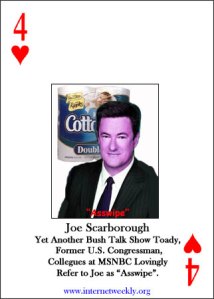 never seen such obsessive compulsive self-destructive behavior. The man cannot admit he’s wrong and knows nothing about economics. He also doesn’t appear to know the difference between an economist and a lawyer and a foreign policy expert. I expect that one of these days he’ll have heart failure then go to his Politico blog to instruct another lawyer on how to do his surgery correctly. Maybe, he’ll start giving lectures on the origins of the universe to Neil Degrasse Tyson next.
Who knew one man could become apoplectic convincing every one he wasn’t beaten up in a one-sided match of wits by Nobel Prize Winning Economist and ubernerd Paul Krugman over 2 weeks ago? He’s written the second of two “I know you are, but what am I?” blog threads at Politico in two days. What Scarboroughs’s become is your run-of-the-mill internet troll who is now blog stalking Dr. Krugman. Only “Tiger Beat on the Potomac” would continue to give this pathetic man a platform for what looks like a developing psychological disorder. We thought he’d over done it on Nate Silver and the presidential poll analysis. But, nope, he’s back and convinced he knows enough about investment and econometrics to analyze the whims of investors.
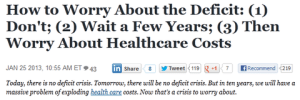 Yesterday’s Scarborough rant was so bad and so wrong, I actually stepped into it. Scarborough relentlessly insists that Krugman is wrong and that all the rest of us economists think he’s wrong too. To prove his point and to try to get back for being shown up on his show, Mourning Joe used an article written by Princeton economist and Paul Krugman colleague Alan Blinder. The only problem is that Blinder is basically saying the same thing Krugman’s been saying all along. Scarborough not only proved Krugman’s point, he totally missed the point–and the headline–of the Blinder article as well as ascribing the article to the wrong publication. Mourning Joe must’ve read only a sentence and ignored the rest. Does that first sentence not read “Today, there is no deficit crisis” or do I need to up my script for my reading glasses?
Today, there is no deficit crisis. Tomorrow, there will be no deficit crisis. But in ten years, we will have a massive problem of exploding health care costs. Now that’s a crisis to worry about.
But, to Mourning Joe, this means:
But the same could not be said of a fabulously misleading Business Insider post that claimed to list 11 economists who shared Krugman’s debt-denying views. Never mind the fact that most of the links provided actually undercut Krugman’s reckless position and supported my view that the most pressing fiscal crisis is not next year’s deficit but next decade’s debt.
The Business Insider link to an Alan Blinder piece was particularly supportive of the “Morning Joe” panel’s view. Blinder, a former Fed vice chairman and Princeton economics professor, warned of “truly horrific problems” caused by long-term debt, health care costs and interest on the debt. Paul Krugman’s Princeton colleague even shared my conclusion that the coming Medicare crisis will be so great that Democrats won’t be able to tax their way out of it.
Far from supporting Mr. Krugman’s extreme position, the link to Professor Blinder’s New Yorker article undercuts his Princeton colleague’s exaggerated “In-the-end-we’ll-all-be-dead” approach to U.S. long-term debt.
Then he added a short list of noneconomists--including Ed Rendell who is paid lobbyist for deficit hawk group Fix the Debt associated with Simpson & EB who make about $40,000 a speech as travelling austerians–as proof that all economists think Krugman is as extreme on economics as Wayne LaPierre is on gun safety laws. Considering Krugman’s name resides on a well-known trade model, he’s published in just about every prestigious peer-reviewed journal possible, and he’s got one of the best-selling set of text books in the country right now, I’d say Joe just won’t admit he’s way out of his league. Krugman calls Scarborough desperate. Frankly, he gone way beyond that to pathetic to me.
First up, the sad story of Joe Scarborough, whose response to my anti-austerian appearance on his show has been a bizarre campaign to convince the world that absolutely nobody of consequence shares my views. Why is this bizarre? Because while I could be wrong about macroeconomics (although I’m not), it’s just not true, provably not true, that I’m alone in arguing that the current and near-future deficit aren’t problems.
I actually wrote about all of this over two weeks ago (1/30/2013) when the incident first happened, so it seems all deja vu to be at this again. But let me tie this to a bigger problem again. Hillary Clinton left the Benghazi hearings uttering something profound. These hearings were some of the more bizarre things I’d ever watched until the Hagel hearings started and the obsession with conspiracy theories went nuclear. Clinton said some ‘‘just will not live in an evidence-based world’. This includes Joe Scarborough who thinks his “analysis” in his latest little short blog blurb shows Krugman as being wrong, wrong wrong. This is what he thinks is a “TA DA”! moment. I would expect better analysis from Macro 101 students. I would also expect any student in basic statistics or econometrics to have a hey day with his methodology which doesn’t even broach the high school level. But, he’s real proud of it and thinks it puts Krugman in his place.
Investors may be growing skittish about U.S. government debt levels and the disordered state of U.S. fiscal policymaking.
From the beginning of 2002, when U.S. government debt was at its most recent minimum as a share of GDP, to the end of 2012, the dollar lost 25 percent of its value, in price-adjusted terms, against a basket of the currencies of major trading partners. This may have been because investors fear that the only way out of the current debt problems will be future inflation.
More troubling for the future is that private domestic investment—the fuel for future economic growth—shows a strong negative correlation with government debt levels over several business cycles dating back to the late 1950s. Continuing high debt does not bode well in this regard.
I can tell you that the minute all the econ and finance professors who blog get a hold of this, there will be laughter so loud that it will leave the blogosphere and escape to a permanent home in the universal annals of Pathos. Frankly, I can already see using this in a first level, midterm statistics class, corporate finance class or economics class. How many wrong things can you point to in this analysis in just 45 minutes? Go!
Joe probably eyeballed domestic investment numbers and debt levels then labelled it correlation so he can jump an infinite number of sharks to go AHA!!!! GOTCHA PROFESSOR MORIARTY errr Krugman!! He also appears to be blissfully unaware of Fed policy concerning the dollar which basically sets the supply of our currency and the fact that supply interacts with the demand for our currency to set exchange rates. Oh, and the dollar’s been up against the major currencies (especially the EURO) since Dubya left office, so one of his arguments is just factually wrong. The USD has been up against the Yen for well over a year and then up then flat against the Pound Sterling for years so I’m not sure which currency he’s worried about in that basket. It’s even been flat against the Cayman Islands Dollar which I’m sure is more of interest to him than anything else. It’s way down against the Chinese Yuan but then, I wouldn’t consider that a problem at all.
I’m tempted to go there and there and all the places I could go with this, but I won’t because most of you probably don’t want a stats lecture and I don’t have all day. Let me just say that there are a lot of factors that drive investment, which is the least logical component of the national income accounts; and to single out one possible factor without controlling for any of the other factors is a fool’s errand. It shows complete ignorance of investment, finance, and economics so we can add a few more things to the list called what Joe doesn’t know. Actually, worse than that is that he appears to have gotten this blather from an anonymous “senior economist” from the Rand Corporation. Is he misquoting another economist or did some one actually write this for him? Worrying either way!!
Joe, however, is more importantly a symptom of the much bigger problem identified by our former Madam Secretary. We have an entire political party that insists it’s right when clearly, the overwhelming amount of evidence says its wrong. For this analysis, I’m closing with something by Kevin Drum who occasionally can find the nut. We deserve a better press. We deserve better than Joe Scarborough littering up the air waves under the guise of “news” instead of misguided memes and propaganda.
It seems to me that something has happened over the past three months: the nonpartisan media has finally started to internalize the idea that the modern Republican Party has gone off the rails. Their leaders can’t control their backbenchers. They throw pointless temper tantrums about everything President Obama proposes. They have no serious ideas of their own aside from wanting to keep taxes low on the rich. They’re serially obsessed with a few hobby horses — Fast & Furious! Obamacare! Benghazi! — that no one else cares about. Their fundraising is controlled by scam artists. They’re rudderless and consumed with infighting. They’re demographically doomed.
Obviously these are all things that we partisan hacks in the blogosphere have been yapping about forever. But the mainstream press, despite endless conservative kvetching to the contrary, has mostly stuck with standard shape-of-the-world-differs reporting.
Recently, though, my sense is that this has shifted a bit. The framing of even straight new [sic] reports feels just a little bit jaded, as if veteran reporters just can’t bring themselves to pretend one more time that climate change is a hoax, Benghazi is a scandal, and federal spending is spiraling out of control. It’s getting harder and harder to pretend that the same old shrieking over the same old issues is really newsworthy.

This brings me back to Boston Boomer’s Valentine’s Day morning rant based on a phone discussion we had the night before. Why-oh-Why am I writing about this again? Why-oh-why can’t we put this kind of nonsense to bed like all sane people who know the earth is not flat, an apple will fall to the ground if dropped from a tree, and if you every one stops spending and only a few families have decent incomes, the economy will contract and say stay contracted? Don’t folks like Scarborough and the AEI know we buried Say’s Law Failed Hypothesis a long time ago? (Kinda like we buried that zombie Laffer curve! But some folks just want to believe the universe revolves around the earth and the entire set up is only a few thousand years old. Hmmm, like Mark Rubio.)
I’m not sure that last question was rhetorical or not, but hey, it’s a thread and there’s a discussion, so discuss amongst yourselves …
Here’s the topic:
Joe Scarborough, pathetic or desperate? or Why oh Why can’t we Have a better press corps? Joe Scarborough edition
or The Deficit Hawk Delusion: What the Krugman-Scarborough Slugfest Is Really About?
DISCUSS!!!

 peej
peej Carissa
 bostonboomer
 dakinikat
 ecocatwoman
 mablue2
 Mama Lopez
 peggysue22
 quixote
 skydancingguestblogger
 Mona (aka Wonk the Vote)



 Sky Dancing
Recent Comments