
Breaking News: Mubarak Speaks, Violence Erupts
Posted: February 1, 2011 Filed under: Diplomacy Nightmares, Egypt, Foreign Affairs | Tags: Alexandria, Million Egyptian March, US presidential statement on Egypt 53 CommentsLive Blog and Developing Situation 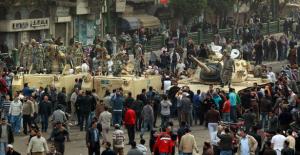
SultanAlQassemi Sultan Al Qassemi
GUNFIRE IN EGYPT NOW
A pro-Mubarak demonstration has converged in Alexandria with protesters wishing him out. There are reports of stones tossing and gun fire. The army is circling the crowd in an attempt to intimidate the crowd. More shots fired on the Streets of Alexandria. AJ is speculating that the gunfire is a psychological tactic. The army is clearly firing in the air according to AJ journalists on the ground.
I really have to wonder what kind of background this provides to the upcoming US Presidential statement on Mubarak’s speech.
Many protesters from both side are holding ground in the heart of the square and are not disbanding.
AJEnglish Al Jazeera English
Clashes between anti-Govt and pro-Mubarak protesters in #Alexandria – coverage live on #AlJazeera: http://aje.me/ajelive#tahrir#egypt
thedailybeast The Daily Beast
RT @videobeast: Egypt President Mubarak says he will not run for re-election and never wanted “power or prestige”: http://thebea.st/dOZ9JN
jaketapper Jake Tapper
latest word is POTUS Egypt remarks will come at 620 pm ET
Breaking News: Forthcoming Mubarak Statement
Posted: February 1, 2011 Filed under: Diplomacy Nightmares, Egypt, Foreign Affairs, Live | Tags: Egypt, Egyptian protests, Gamal Mubarak, Hosni Mubarak, live blog, US Special Envoy Frank Wisner 47 CommentsThis is a developing post so it will change frequently.
Recent Tweet from
AJEnglish Al Jazeera English
Hosni Mubarak expected to speak to soon. Tune in to #AlJazeera to watch the coverage live: http://aje.me/ajelive#mubarak#tahrir#egypt
Al Jazeera continues to stream in English live.
A statement is also expected from the White House.
According to Diplomatic Sources via CNN: Egypt crisis: Mubarak won’t run again; report says Obama pushed for decision
Update 9:38 p.m. Cairo, 2:38 p.m. ET] Egyptian President Hosni Mubarak has decided not to seek re-election, according to a senior U.S. official involved in the Obama administration’s deliberations on Egypt. The official cited “reliable contacts in Cairo” for the news. The New York Times reported Obama pushed Mubarak into the decision via a message delivered by former Ambassador Frank Wisner, who paid a personal visit to Mubarak on Tuesday.
The LA Times is reporting that US Envoy Frank Wisner was sent to tell Egyptian President Hosni Mubarak to step aside.
Frank Wisner, a former ambassador to Egypt who has good relations with the Mubarak regime, traveled to Cairo at President Obama’s behest to talk to the Egyptian leader about the country’s future.
Wisner delivered a direct message that Mubarak should not be part of the “transition” that the U.S. had called for, according to Middle East experts who spoke on condition of anonymity.
One expert on the region said that in his regular conversations with the Obama administration about the unrest in Egypt, he learned that Wisner’s message to Mubarak was that “he was not going to be president in the future. And this message was plainly rebuffed.”
Obama’s Message to Mubarak: Neither You Nor Your Son Should Be On the Ballot This Fall
U.S. officials tells ABC News that on Saturday, President Obama made the final authorization to send former Ambassador to Egypt Frank Wisner to deliver – gently – the message to Egyptian President Hosni Mubarak that neither he nor his son should run for the presidency this September.
Wisner, a well-regarded Egypt hand with a longtime relationship with Mubarak, was “in the orbit,” an official says, “because he’s been talked about as a potential Holbrooke replacement” to be a Special Envoy to Afghanistan and Pakistan.
The White House gave Wisner his talking points, the official said, and Wisner flew to Cairo Sunday to tell Mubarak that he should not run for re-election — and that his son Gamal should not run either.
imagine no religion …
Posted: January 30, 2011 Filed under: Diplomacy Nightmares, Foreign Affairs, Nigeria 3 Comments
Deadly clashes between Christians and Muslim in Nigeria continue ahead of April elections.
Fresh violence has flared up in the Nigerian flashpoint city of Jos after clashes between Christians and Muslims in central Nigeria last week left 35 people dead.
The incidents, reported by police on Sunday, were the latest in a cycle of violence in volatile central Nigeria, where religious rioting has killed scores in recent years.
“Thirty-five people have been killed in sectarian violence in Tafawa Balewa on Thursday,” said Bauchi police commissioner Abdulkadir Mohammed Indabawa.
Only last week police had reported riots that had killed four people and arson attacks that had destroyed five mosques and 50 houses.
In neighbouring Plateau state’s capital of Jos meanwhile, more than a dozen people had died after clashes sparked by the stabbing Friday of university students by Muslim villagers, Muslim and Christian community leaders said.
Churches, mosques, filling stations, houses and food kiosks were set ablaze over the weekend.
On Sunday the military sent in reinforcements aided by helicopters for “aggressive patrols,” according to a military spokesman, who said they had made 27 arrests.
Religious fault lines
Eliza Griswold examines the complex relationship between Muslims and Christians along the tenth parallel.
Author and journalist Eliza Griswold spent seven years travelling through the fault lines of Nigeria, Sudan, Somalia, Indonesia, Malaysia and the Philippines trying to understand the origins and the reasons of this religious divide.
It is also the subject of her book, The Tenth Parallel, where she tells us the conflict is often about natural resources and land as much as it is about religion.
Clinton Does the Sunday Shows
Posted: January 30, 2011 Filed under: Breaking News, Diplomacy Nightmares, Egypt, Foreign Affairs, Hillary Clinton: Her Campaign for All of Us, Middle East | Tags: Secretary of State Hillary Clinton, US Egypt Policy 26 CommentsToday, the Secretary of State clearly became the face of the US response to the Egyptian protests. She appeared on all
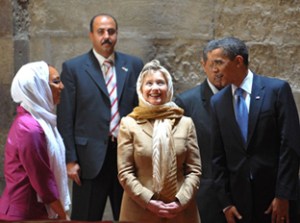
State Visit to Egypt, June 2009
five talk shows. Here’s some coverage of what she said and what others think about it.
From the NY Times: Clinton Urges Egyptian Dialogue
She issued a strong endorsement of key groups working to exert their influence on the chaotic Egyptian protests – the military, civil society groups and, perhaps most importantly, the nation’s people – but carefully avoided any specific commitment to Mr. Mubarak.
Her phrasing seemed to imply an eventual end to Mr. Mubarak’s 30 years in power. But when asked whether the United States was backing away from Mr. Mubarak and whether he could survive the protests, the secretary chose her words carefully. His political future, she said, “is going to be up to the Egyptian people.”
Making the rounds of the Sunday television talk shows, Mrs. Clinton urged the government in Cairo to respond in a “clear, unambiguous way” to the people’s demands and to do so “immediately” by initiating a national dialogue. At the same time, she was supportive of the Egyptian military, calling it “a respected institution in Egyptian society, and we know they have delicate line to walk.”
Hillary Clinton On ABC with Christine Amanpour:
From CBS NEWS: ‘Clinton: In Egypt, “Words Alone” Are Not Enough’
“Let me repeat again what President Obama and I have been saying,” Clinton said in an interview with CBS’ “Face the Nation” on Sunday. “That is, to urge the Egyptian security forces to show restraint, to not respond in any way through violence or intimidation that falls upon the peaceful protestors who are demanding that their grievances were heard.”
Faux News: Secretary Clinton: Won’t Label Egypt Foreign Policy Crisis Situation
Secretary of State Hillary Clinton shied away Sunday from labeling the escalating political turmoil in Egypt as a “foreign crisis situation” for the Obama administration.
“I don’t label anything like that, this is a very serious time for Egypt and we are going to do all we can to support an orderly transition to support a situation in which the aspirations of the Egyptians are addressed,” Clinton said.
She made the comment while briefing reporters before leaving on a trip to Haiti to assess recovery and political work there after last year’s devastating earthquake.
Clinton said that there are “many complexities” because Egypt has been a partner to the U.S. and worked closely with the country to keep peace in the region. She also lauded the Egyptian-Israeli peace agreement.
“We do not want to see a change or a regime that would actually continue to foment violence or chaos — either because it didn’t exist or because it had a different view in which in which to pose on the Egyptian people,” she said.
Some possible hints at what’s going on behind the scenes from the LATimes and Peter Nicholas.
A tight-lipped White House is taking an even-handed approach to the crisis in Egypt, suggesting that President Mubarak might be able to hold onto power if he allows competitive elections and restores individual freedoms. But inside the Obama administration, there are signs that officials are preparing for a post-Mubarak era after three decades.
One former senior administration advisor said he had spoken to his old colleagues inside the Obama administration in recent days about the unrest in Egypt. As early as last Wednesday, the Obama administration recognized that they would not be able to prop up the Mubarak regime and keep it in power at all costs, the former official said.
“They don’t want to push Mubarak over the cliff, but they understand that the Mubarak era is over and that the only way Mubarak could be saved now is by a ruthless suppression of the population, which would probably set the stage for a much more radical revolution down the road.”
Other behind the scenes hint at the Jerusalem Post: Gates appears to be talking to Israel.
Prime Minister Binyamin Netanyahu spoke Saturday evening both with US President Barack Obama and Secretary of State Hilary Clinton, and on Sunday Defense Minister Ehud Barak held a telephone conversation with Defense Secretary Robert Gates.
Obama made a round of phone calls Saturday to Middle East leaders to consult on the situation. In addition to speaking to Prime Minister Netanyahu, Obama also reached out to Prime Minister Recep Tayyi Erdogan of Turkey and King Abdullah of Saudi Arabia. On Sunday he spoke to British Prime Minister David Cameron.
StateDept StateDept
Missed #SecClinton interviews with ABC, CBS, CNN, FOX and NBC on #Egypt? Find all the transcripts here: http://go.usa.gov/YIw
I have some take away questions from her interviews. Like, did she or didn’t she hedge the aid to Egypt question? We can talk about them below the fold.
Omar Suleiman and the U.S. Rendition and Torture Program
Posted: January 30, 2011 Filed under: Barack Obama, Diplomacy Nightmares, Egypt, Foreign Affairs, U.S. Politics, Wikileaks | Tags: Barack Obama, Bill Clinton, Edward S. Walker, Eqyptian protests, Hillary Clinton, Hosni Mubarak, Jr., Omar Suleiman, rendition, Stephen Grey, Torture 34 Comments
Omar Suleiman
Omar Suleiman was recently appointed Vice President of Egypt by desperate dictator Hosni Mubarak. There has also been talk that Suleiman could become Mubarak’s successor now that Mubarak’s son Gamal is seemingly out of the picture.
It will be interesting to see how the Obama administration responds to this appointment, since the U.S. has had very close relations with Suleiman. Some basic background on Suleiman from Reuters:
* He has been the director of the Egyptian General Intelligence Services (EGIS) since 1993, a role in which he has played a prominent public role in diplomacy, including in Egypt’s relations with Israel and with key aid donor the United States.
* He was born on July 2, 1936 in Qena, in southern Egypt. He later enrolled in Egypt’s premier Military Academy in 1954, after which he received additional military training in the then Soviet Union at Moscow’s Frunze Military Academy.
* He also studied political science at Cairo University and Ain Shams University. In 1992 he headed the General Operations Authority in the Armed Forces and then became the director of the military intelligence unit before taking over EGIS.
* Suleiman took part in the war in Yemen in 1962 and the 1967 and 1973 wars against Israel.
* As Egypt’s intelligence chief, Suleiman was in charge of the country’s most important political security files, and was the mastermind behind the fragmentation of Islamist groups who led the uprising against the state in the 1990s.
Here is another profile from the BBC.
While he has shown little political ambition, General Suleiman has often been mentioned as a possible successor to the 82-year-old Mr Mubarak.
He would continue in the trend of military strongmen who have led Egypt since the 1952 revolution.
And perhaps more ominously, based on what you’re about to read about Suleiman’s activities,
Even if he is not the next president, even in a transitional capacity, some experts believe that Omar Suleiman is likely to be a kingmaker.

 peej
peej Carissa
 bostonboomer
 dakinikat
 ecocatwoman
 mablue2
 Mama Lopez
 peggysue22
 quixote
 skydancingguestblogger
 Mona (aka Wonk the Vote)



 Sky Dancing
Recent Comments