






New measures targeting the nation’s lucrative energy industry are among the sanctions under consideration, a White House official granted anonymity to describe internal deliberations said, now that the administration is freed from pre-election anxieties over the potential impact on domestic gas prices.
Mostly Monday Reads: Life in the Time of Cruelty
Posted: November 10, 2025 Filed under: #FARTUS, #We are so Fucked, court rulings, Democratic Politics, presidential pardons | Tags: @johnbuss.bsky.social John Buss, Donald Trump only cares about himself, Hasten Down the Wind, Kim Davis, Obergefell v. Hodges, same sex marriage judicial decisions, SCOTUS, Senate Democrats Cave, Trump Pardons, Warren Zevon 10 Comments
“The end is nigh. Gas prices haven’t dropped, electric bills have gone up, groceries are ridiculous, a year later, Putin is still killing Ukrainians, there is no peace in the Middle East, tariff costs are still passed on to consumers, America is once again the laughing stock of the world, need I say more?” John Buss, @repeat1968
Good Day, Sky Dancers!
There has been another bit of good news to complement last week’s. However, we cannot let our guard down or our actions slacken. Even a few battles won will not end a war. Today, the Supreme Court dismissed a case to overturn its landmark decision legalizing same-sex marriage.
There is a distinct possibility that a stronger attempt may be underway, so vigilance is necessary. More analysis is likely to come out as court watchers ponder the decision.
This is from the AP’s Mark Sherman. “Supreme Court rejects call to overturn its decision legalizing same-sex marriage nationwide.” The dissenting voices hint that more compelling cases may come before them.
The Supreme Court on Monday rejected a call to overturn its landmark decision that legalized same-sex marriage nationwide.
The justices, without comment, turned away an appeal from Kim Davis, the former Kentucky court clerk who refused to issue marriage licenses to same-sex couples after the high court’s 2015 ruling in Obergefell v. Hodges.
Davis had been trying to get the court to overturn a lower-court order for her to pay $360,000 in damages and attorney’s fees to a couple denied a marriage license.
Her lawyers repeatedly invoked the words of Justice Clarence Thomas, who alone among the nine justices has called for erasing the same-sex marriage ruling.
Thomas was among four dissenting justices in 2015. Chief Justice John Roberts and Justice Samuel Alito are the other dissenters who are on the court today.
Roberts has been silent on the subject since he wrote a dissenting opinion in the case. Alito has continued to criticize the decision, but he said recently he was not advocating that it be overturned.
Justice Amy Coney Barrett, who was not on the court in 2015, has said that there are times when the court should correct mistakes and overturn decisions, as it did in the 2022 case that ended a constitutional right to abortion
But Barrett has suggested recently that same-sex marriage might be in a different category than abortion because people have relied on the decision when they married and had children.
 The basis of Davis’ complaint may be the reason why the religious fanatics placed on SCOTUS by extreme right-wing theocrats might have been encouraged to wait for a more direct call to overrule Obergfell. This is explained in this NBC News analysis by Lawrence Hurley.
But reconsidering Obergefell was not the main legal question presented in Davis’ appeal.
Although the court has a 6-3 conservative majority, none of the other justices joined Thomas’ opinion.
Just last month, Justice Samuel Alito, who authored the abortion ruling, indicated he was not pushing for Obergefell to be overturned.
Davis, represented by the conservative group Liberty Counsel, refused to issue any marriage licenses in the immediate aftermath of the Obergefell decision. She said that as a conservative Christian who opposed same-sex marriage, she should have a religious right not to put her name on marriage licenses involving same-sex couples.
Her office in Rowan County, Kentucky, denied licenses to several such couples, including David Moore and David Ermold, who subsequently filed a civil rights lawsuit.
Davis was ordered to issue a license for Moore and Ermold, but defied the court injunction and still refused to do so. The judge then held her in contempt, and she was jailed for six days.
While she was jailed, Moore and Ermold were able to obtain their marriage license.
Subsequently, the state changed the law in order to address the controversy, allowing for a license to be issued without the clerk’s name on it.
But Davis’ case continued, with Moore and Ermold seeking damages for the initial refusal.
After lengthy litigation, a jury awarded $100,000 in damages. Davis was also required to pay $260,000 in attorney’s fees, according to her lawyers.
Davis then appealed, claiming that she should have been able to cite as a defense her right to the free exercise of religion under the Constitution’s First Amendment.
After losing an appeal at the Cincinnati-based 6th U.S. Circuit Court of Appeals in March this year, Davis turned to the Supreme Court, raising that question, as well as the much more contentious issue of whether Obergefell should be overturned.
While the Supreme Court has for now given no indication it would seek to overturn Obergefell, it has in other rulings in the last decade strengthened religious rights at the expense of LGBTQ rights, including by expanding the ability of people to seek exemptions from laws they object to because of their faith.
 Are they just waiting for a better case to come along? That is the question from me and others. Only time will tell.
The other big headline is the end of the government shutdown. The circumstances surrounding the resolution are far from ideal. There are a large number of articles expressing anger and disgust at the actions of eight Democrats in cutting this deal. It’s quite challenging to keep up with the decline of the world’s once-great democracy. This is the headline from Politico‘s Katherine Tully-McManus. “The 8 Senate Democratic Caucus members who voted to end the shutdown. There are few obvious threads connecting the group who broke the partisan impasse.”
Eight members of the Senate Democratic Caucus broke ranks Sunday and voted to advance a deal to reopen the federal government.
That’s fewer than the 10 Democrats who broke ranks in March to advance a previous GOP-led stopgap funding bill — a move that sparked a huge backlash against Minority Leader Chuck Schumer.
There are few obvious threads connecting the group who broke the partisan impasse this time. Some of them helped broker the agreement with Republicans over the opposition of Schumer and most other Democrats, who wanted a guaranteed extension for expiring federal health insurance subsidies.
Most, but not all, previously held state-level office — including four former governors. Most, but not all, come from presidential swing states. Two have announced they are retiring from the Senate after their current terms end, and two are senior members of the Senate Appropriations Committee.
None are up for reelection in 2026.
 More on these eight senators at the link. There are numerous punditry thoughts on what is being called “The Great Cave-in.” This first take is from MSNBC’s Steve Benen. “As the Senate advances a plan to end the government shutdown, what happens now? As the shutdown continued, the pieces were in place for Democrats to stand firm in support of a popular cause. Eight senators folded anyway.”
As the ongoing government shutdown was poised to begin in late September, three members of the Senate Democratic caucus — Nevada’s Catherine Cortez Masto, Pennsylvania’s John Fetterman and Maine’s Angus King — broke party ranks and voted with the Republican majority to prevent the breakdown. That gave GOP leaders 55 votes, five short of the 60-vote threshold.
At that point, the Republican plan, in a nutshell, could be summarized in one word: wait.
GOP leaders, in the White House and on Capitol Hill, assumed that just enough Senate Democrats would cave under pressure. Those assumptions proved true. MSNBC reported overnight:
After nearly six weeks of a painful shutdown, a critical number of Senate Democrats backed a Republican funding bill to reopen government — with little to show for holding out so long. The breakthrough, which came together suddenly on day 40 of the shutdown, offers Democrats few new concessions beyond what Republicans had already proposed.
There’s quite a bit to this, so let’s unpack the details.
Is the shutdown over?
Not yet. The Sunday-night vote in the Senate was a procedural vote to advance a bill intended to end the shutdown. It received 60 votes, but the underlying legislation still needs to pass.
Who caved?
In addition to Cortez Masto, Fetterman and King, who’ve consistently voted with Republicans to end the shutdown, five other Senate Democrats sided with the GOP on the procedural vote: Dick Durbin of Illinois, Maggie Hassan of New Hampshire, Tim Kaine of Virginia, Jackie Rosen of Nevada and Jeanne Shaheen of New Hampshire. (Durbin and Shaheen, it’s worth noting for context, are retiring at the end of their current terms.) Republican Sen. Rand Paul of Kentucky, meanwhile, voted with most Democrats against the package.
Did they get anything in exchange for their votes?
Not much. The deal, to the extent that it can fairly be described as such, includes three full-year appropriations bills to fund some federal departments through the end of the fiscal year and money to fully fund the Supplemental Nutrition Assistance Program (SNAP). It also reverses Donald Trump’s shutdown layoffs (also known as “reduction in force” notifications, or RIFs).
What about the Affordable Care Act, which was largely the point of the shutdown?
Republicans promised Democrats there will soon be a vote on extending the expiring ACA subsidies.
For health care advocates, does this offer some reason for hope?
Not really. Even if there is a vote, there’s no reason to assume it will pass the GOP-led chamber. And even if it were to pass, there’s no guarantee that the Republican-led House would care.
So why in the world did these eight senators cave?
According to King, it was time to surrender because the status quo “wasn’t working.”
 This final analysis is by Sarah Ewall-Wice, writing at The Daily Beast. “Dems Skewer ‘Trainwreck’ Schumer for Caving Over Shutdown. WHAT THE CHUCK?! The Senate minority leader is facing calls to resign despite his “no” vote.”
Democrats from across the political spectrum are livid with Minority Leader Chuck Schumer after a group of Senate Democrats caved and reached a deal with Republicans to end the government shutdown.
Schumer, 74, came out against the bipartisan plan and voted against moving it forward in the Senate on Sunday night.
However, eight Democrats joined Republicans in a 60-40 vote to proceed, sparking turmoil within the party.
“Tonight is another example of why we need new leadership. If @ChuckSchumer were an effective leader, he would have united his caucus to vote ‘No’ tonight and hold the line on healthcare,” wrote Democratic Rep. Seth Moulton, who is challenging Massachusetts Senator Ed Markey in the primary.
He called on Markey to join him in a pledge not to vote for Schumer as Senate leader.
Democratic Rep. Jared Moskowitz posted an image of Schumer photoshopped into the Amy Schumer movie ‘Trainwreck’ with the caption “Different Schumer, same title.”
“Senator Schumer is no longer effective and should be replaced,” wrote progressive Rep. Ro Khanna. “If you can’t lead the fight to stop healthcare premiums from skyrocketing for Americans, what will you fight for?”
He replied that he was a “fan” of Sen. Chris Van Hollen in response to political commentator Krystal Ball’s suggestion that he should become the leader.
 We know what or who the basic problem is. Who wouldn’t love a Substack titled “Are you f’ng kidding me?” That’s a daily question around here these days. This is the brainchild of JoJoFromJerz. The title is even hotter. “Portrait of a Man Who Doesn’t Give a Fuck. Starring: indifference, ego, and forty-two million people he is actively fighting to starve.” Yup, are president is the ultimate example of Anti-social Personality Disorder.” He comes replete with a lifetime of examples. And there’s that photo that keeps showing up everywhere, including this blog when I peeled it on Monday.
This photo should be hung in the Louvre of moral decay.
Look at it. The tableau is so absurd it feels storyboarded by Voldemort and Liberace’s real estate LLC. A man collapses on the floor where presidents once ended wars and launched moon missions. Now the room has all the gravitas of a Vegas timeshare bathroom, festooned with Chinese-made American flags marinated in Drakkar Noir. It’s as if history’s most consequential decisions are now being made in the world’s tackiest escape room.
Aides kneel. Hands reach. Chaos unfolds.
And Donald Trump just stands there — bored, irritated, visibly put-out — like the collapse in front of him is a personal scheduling conflict. His face isn’t concern. It is inconvenience.
His jaw hangs open in that dopey, defeated pout you only see when a chain-steakhouse diner learns their “Buy One Get One Ribeye” coupon expired yesterday. His eyes aren’t searching for a pulse; they’re searching for the nearest camera.
He’s not seeking help. He’s seeking a close-up.
If Dante were alive today, he wouldn’t write The Inferno. He’d pitch a reality show called Keeping Up With the Collapse and hiss to the crew, “We don’t need CGI. Just let him talk.”
The entire scene looks like Norman Rockwell painted The Death of Empathy, directed by Jeffrey Dahmer and executive produced by Satan. Hang this next to The Scream and the painting would lean over and whisper, Is that guy okay.
It feels like someone pitched, What if Succession had a baby with Idiocracy and then handed the baby the nuclear codes. It should not be funny. But it is. It should not be real. And yet here we are.
Because this photo is not merely symbolic of who he is.
This is who he is.
A convicted felon. Found liable for sexual abuse in a court of law. A man whose closest approximation to empathy is jabbing the close door button in an elevator while someone sprints toward it.
This is who Donald Trump is.
He doesn’t give a fuck about anyone but himself.
A man collapses behind him. Just as our country has been collapsing behind him for the entirety of this second so-called term.
And he doesn’t give a fuck.
He is not thinking, Is that man okay. He is thinking, How dare he steal my scene.
This is who Donald Trump is.
He doesn’t give a fuck about anyone but himself.
He isn’t numb to suffering—he feeds on it. Suffering is his currency, his spotlight, his scepter. Every ounce of pain around him inflates his sense of importance. He doesn’t create, build, or inspire; he only knows how to conquer by making others smaller, hungrier, emptier. His power is measured in what he can take away. He is a parasite of misery, thriving on the wounds he inflicts.
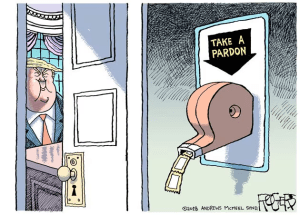
 Go read the entire post. She’s right. He doesn’t give a fuck about anyone but himself. And here’s more evidence, as Trump pardons all of those election-denying cronies while possibly looking forward to handing one to that miserable sex-trafficking ghoul Gislane Maxwell. The first article comes from Politico‘s Kyle Cheney. “Trump pardons top allies who aided bid to subvert the 2020 election. Pardon recipients include Rudy Giuliani, Mark Meadows, John Eastman and dozens more.” I weep for justice in my country today.
President Donald Trump has pardoned a long list of prominent allies who backed his effort to subvert the 2020 election, according to Justice Department Pardon Attorney Ed Martin, who posted the relevant document Sunday night.
Among those who received the “full, complete and unconditional” pardons were Rudy Giuliani, who helped lead an effort to pressure state legislatures to reject Joe Biden’s victories in key swing states; Mark Meadows, Trump’s chief of staff in 2020 and a crucial go-between for Trump and state officials; John Eastman and Kenneth Chesebro, two attorneys who helped devise a strategy to pressure then-Vice President Mike Pence to overturn the election on Jan. 6, 2021; Boris Epshteyn, a longtime Trump adviser; and Sidney Powell, a conservative attorney who launched a fringe legal assault on election results in key swing states.
The pardons are largely symbolic — none of those identified were charged with federal crimes. The document posted by Martin is also undated, so it’s unclear when Trump signed it. The White House and Justice Department did not immediately respond to requests for comment.
Giuliani, Eastman and Powell were among those identified by former special counsel Jack Smith as Trump’s co-conspirators, though he never brought charges against them. The pardons would preclude any future administration from potentially pursuing a criminal case against them.
The language of the pardon is broad, applying to “all United States citizens for conduct relating to the advice, creation, organization, execution, submission, support, voting activities, participation in or advocacy for or of any slate or proposed slate of presidential electors … as well for any conduct relating to their efforts to expose voting fraud and vulnerabilities in the 2020 presidential election.”
Though Trump has long insisted he has the power to pardon himself for federal crimes — an untested proposition — it appears he is not yet prepared to test that theory. Though the pardon document indicates it could apply to others who fit the same criteria, it explicitly excludes Trump.
In addition to his inner circle, Trump pardoned dozens of GOP activists who signed paperwork falsely claiming to be legitimate presidential electors, a key component of the bid to pressure Pence.
 Regarding the potential pardon for Maxwell, this information comes from Scott MacFarlane of CBS News. “Ghislaine Maxwell plans to ask Trump to commute prison sentence, House Democrats say.”
Ghislaine Maxwell, Jeffrey Epstein’s sex trafficking co-conspirator, is planning to apply for a commutation of her federal prison sentence, which is set to run through 2037, according to documents obtained by Democrats on the House Judiciary Committee and seen by CBS News.
In a letter to President Trump on Monday, also seen by CBS News, Judiciary Committee Democrats wrote that Maxwell “is preparing a ‘Commutation Application’ for your Administration to review, undoubtedly coming to you for your direct consideration. The Warden herself is directly helping Ms. Maxwell copy, print, and send documents related to this application.”
The letter says the information received demonstrates “either that Ms. Maxwell is herself requesting you release her from her 20-year prison sentence for her role as a co-conspirator in Jeffrey Epstein’s international child sex trafficking ring, or that this child sex predator now holds such tremendous sway in the second Trump Administration that you and your DOJ will follow her clemency recommendations.”
The letter also alleges that Maxwell is receiving preferential and lenient treatment at the Bryan federal prison camp in Texas, where she was transferred over the summer after meeting with Deputy Attorney General Todd Blanche to discuss the Epstein case.
“Federal law enforcement staff working at the camp have been waiting on Ms. Maxwell hand and foot,” says the letter signed by Rep. Jamie Raskin, the ranking Democrat on the committee.
It appears that something needs to be done to address the fundamental nature of the Presidential Pardon. It’s supposed to be the last chance at justice for the wrongly accused. It was never supposed to be an article of power handed to an autocrat to rewrite the guilt and punishment of evil minions.
I’ve also been crying and listening to Warren Zevon songs since his induction into the Rock and Roll Hall of Fame, as featured on David Letterman. I love his lyrical melodies and his strong rhythms and beats. His lyrics tell stories that are both funny and sad, full of vivid characters. I have finally uncovered the underlying sadness behind most of his lyrics and can no longer unhear them. They’ve burrowed into my heart. And so, I cry, which is quite uncharacteristic for me. But then, it seems American life these days requires tears.
What’s on your Reading, Action, and Blogging list today?
Lazy Caturday Reads
Posted: November 16, 2024 Filed under: "presidential immunity", cat art, caturday, Democratic Politics, Donald Trump | Tags: Donald Trump, Joe Biden, Kamala Harris, news, politics 5 CommentsGood Afternoon!!

By Katrina Pallon
I don’t think I’ve fully come to terms with the fact that we are once again faced with Donald Trump as “president.” Of course we really don’t know what is going to happen to our country or to us as its citizens, but we know it’s going to be bad.
The first Trump term was horrific, and that was when he believed he needed to listen to his advisers. He appointed somewhat competent people to top positions in his administration, and he occasionally listened to them. There were so-called “adults in the room” who were able to partially control his worst impulses, or sometimes just work around his demands.
This time will be different. He is nominating people who are loyal to him personally but have no expertise in the positions they have been chosen for. They have been picked to destroy the bureaucracies they will control.
Trump knows that some of these people could be rejected by the Senate, so he is demanding the power to use “recess appointments.” He wants the Senate and the House to be in recess after his inauguration so that he can install these loyal incompetents without involving the Senate’s “advise and consent” role. He also plans to grant security clearances to his chosen sycophants without FBI background checks. He means to destroy the independence of the Department of Justice, including the CIA and FBI. He also plans to take full control of the military and enforce loyalty to him, and not to the Constitution.
Thanks to the right wing Supreme Court, he may be able to accomplish these things. They have granted him immunity for anything he does in his role president, including crimes.
During his first term, Trump often praised foreign dictators. He expressed admiration for China’s Xi Jinping’s takeover in China, Turkey’s Recep Tayyip Erdogan, Hungary’s Viktor Orbán, and North Korea’s Kim Jong Un. He praised Xi for making himself president for life. He admires Erdoğan for ending democracy in his country and taking power for the long term. He repeatedly said he would like “my people” to behave obediently like Kim John Un’s audiences–by mindlessly applauding everything he says or does. And of course everyone knows that Trump admires and fears Russia’s Vladimir Putin. We now know that Trump even praised Adolf Hitler during his time in the White House. We have a very good idea of what Trump hopes to do to this country.
Why should we expect that Trump will now behave like any other U.S. president? Why should we be so sure that there will be meaningful elections in 2026 and 2028? The leaders that Trump has praised have made sure that any elections held in their countries are–to use Trump’s term–rigged? Putin, Xi, Erdogan, and Orban are still in control of their countries. North Korea, of course, is a family dictatorship. Perhaps Trump hopes to pass on control of the U.S. to one of his children. We need to be aware of what he may be planning–not imagine that we live in the previous U.S. in which laws and norms protected us from a wannabe dictator.
After the announcement that Trump would forgo background checks on his appointees, investigative journalist Dave Troy wrote (on Twitter, I won’t link to it)
Let me be clear: the country is gone. You may still think you have one, but it’s like phantom limb syndrome. Don’t look yet. It’s too painful. But when you’re ready, gaze upon it. For all its volume and noise and mass… it is but an illusion. What comes next is hell, and chaos.
We had a chance. But today, I think, is the day we lost it. The day the free world fell. We will go through motions and react and laugh, or not laugh, we will be serious and joking and call each other horrible things. But this was the day when the last bulwark fell.

By Lucy Almey Bird
I have to agree with him. Trump fantasizes about being president for life like Putin, Xi, and Orban. We are in serious danger of becoming another Hungary.
I hope I’m overreacting. Maybe PTSD is making me more fearful than I need to be. I know my sleep has been even more disturbed than usual lately. But I’d rather face what Trump is really up to than act like the Democrats, who seem to just assume that politics as usual will be restored after free and fair elections in 2026 and 2028.
I am an optimist at heart, and I still have hope for the future. I hope that everything I’ve written above is wrong. But I’ll have to see it happen in order to truly believe it.
Here are some reads to check out today:
Yesterday, Dakinikat wrote about the term Kakistocracy. This article by Italian journalist Beppe Severgnini in The Atlantic explores the idea: American Kakistocracy. Italy knows a thing or two about what the United States faces—but there are key differences between the two countries’ experiences.
Why is a regular guy attracted to a billionaire candidate? It’s simple: Because the candidate can play to people’s fantasies. The man knows his television, loves girls, hates rules, knows how to make a deal, tells jokes, uses bad language, and is convivial to a fault. He is loud, vain, cheeky. He has a troubled relationship with his age and his hair. He has managed to survive embarrassment, marital misadventures, legal troubles, political about-faces. He’s entangled in conflicts of interest, but he couldn’t care less. His party? A monument to himself.
He thinks God is his publicist, and twists religion to suit his own ends. He may not be like us, but he makes sure there’s something about him that different people can relate to personally. He is, above all, a man of enormous intuition. He is aware of this gift and uses it ruthlessly. He knows how to read human beings, their desires and their weaknesses. He doesn’t tell you what to do; he forgives you, period.
Here in Italy, he loomed over our politics—and our lives—for 30 years. He created his own party in 1994 (Forza Italia, a sort of Make Italy Great Again), and a few months later, he became Italy’s prime minister for the first time. He didn’t last long, but he climbed back into government in 2001, and then again in 2008. Three years later, he resigned amid sex scandals and crumbling public finances, but he managed to remain a power broker until he died last year.
Silvio Berlusconi, like Donald Trump, was a right-wing leader capable of attracting the most disappointed and least informed voters, who historically had chosen the left. He chased them, understood them, pampered them, spoiled them with television and soccer. He introduced the insidious dictatorship of sympathy.
By Steve Danielson
But Silvio Berlusconi is not Donald Trump.
Berlusconi respected alliances and was loyal to his international partners. He loved both Europe and America. He believed in free trade. And he accepted defeat. His appointments were at times bizarre but seldom outrageous. He tried hard to please everybody and to portray himself as a reliable, good-hearted man. Trump, as we know, doesn’t even try.
Berlusconi may have invented a format, but Trump adopted and twisted it. Trump’s victory on November 5 is clear and instructive, and it gives the whole world a signal as to where America is headed.
he scent of winners is irresistible for some people. The desire to cheer Trump’s victory clouds their view. They don’t see, or perhaps don’t take seriously, the danger signs. Reliability and coherence, until recently a must for a political leader, have taken a back seat. Showing oneself as virtuous risks being counterproductive: It could alienate voters, who would feel belittled.
American journalism—what is left of it, anyway—meticulously chronicled Trump’s deceitfulness. It made no difference, though. On the contrary, it seems to have helped him. Trump’s deputy, J. D. Vance, explained calmly in an interview that misleading people—maybe even lying to them—is sometimes necessary to overcome the hostility of the media.
Here’s a gift link if you’d like to read the rest at The Atlantic.
Adam Jentelson at The New York Times: When Will Democrats Learn to Say No?
When Donald Trump held a rally in the Bronx in May, critics scoffed that there was no way he could win New York State. Yet as a strategic matter, asking the question “What would it take for a Republican to win New York?” leads to the answer, “It would take overperforming with Black, Hispanic and working-class voters.”
Mr. Trump didn’t win New York, of course, but his gains with nonwhite voters helped him sweep all seven battleground states.
Unlike Democrats, Mr. Trump engaged in what I call supermajority thinking: envisioning what it would take to achieve an electoral realignment and working from there.
Supermajority thinking is urgently needed at this moment. We have been conditioned to think of our era of polarization as a stable arrangement of rough parity between the parties that will last indefinitely, but history teaches us that such periods usually give way to electoral realignments. Last week, Mr. Trump showed us what a conservative realignment can look like. Unless Democrats want to be consigned to minority status and be locked out of the Senate for the foreseeable future, they need to counter by building a supermajority of their own.
That starts with picking an ambitious electoral goal — say, the 365 electoral votes Barack Obama won in 2008 — and thinking clearly about what Democrats need to do to achieve it.
Democrats cannot do this as long as they remain crippled by a fetish for putting coalition management over a real desire for power. Whereas Mr. Trump has crafted an image as a different kind of Republican by routinely making claims that break with the party line on issues ranging from protecting Social Security and Medicare to mandating insurance coverage of in vitro fertilization, Democrats remain stuck trying to please all of their interest groups while watching voters of all races desert them over the very stances that these groups impose on the party.
Achieving a supermajority means declaring independence from liberal and progressive interest groups that prevent Democrats from thinking clearly about how to win. Collectively, these groups impose the rigid mores and vocabulary of college-educated elites, placing a hard ceiling on Democrats’ appeal and fatally wounding them in the places they need to win not just to take back the White House, but to have a prayer in the Senate.
More at the NYT link.
Reid J. Epstein and Lisa Lerer at The New York Times: Democrats Draw Up an Entirely New Anti-Trump Battle Plan.
Locked out of power next year, Democrats are hatching plans to oppose President-elect Donald J. Trump that look nothing like the liberal “resistance” of 2017.
Gone are the pink knit caps and homemade signs from the huge protest that convulsed blue America that year, as exhausted liberals seem more inclined to tune out Mr. Trump than fight.
By Lucy Olivieri
Washington is far different, too. The Republicans who stymied some of Mr. Trump’s first-term agenda are now dead, retired or Democrats. And the Supreme Court, with three justices appointed by the former president, has proved how far it will go in bending to his will.
As they face this tough political landscape, Democratic officials, activists and ambitious politicians are seeking to build their second wave of opposition to Mr. Trump from the places that they still control: deep-blue states.
Democrats envision flexing their power in these states to partly block the Trump administration’s policies — for example, by refusing to enforce immigration laws — and to push forward their vision of governance by passing state laws enshrining abortion rights, funding paid leave and putting in place a laundry list of other party priorities.
Some of the planning in blue states began in 2023 as a potential backstop if Mr. Trump won, according to multiple Democrats involved in different efforts. The preparations were largely kept quiet to avoid projecting public doubts about Democrats’ ability to win the election.
“States in our system have a lot of power — we’re entrusted with protecting people, and we’re going to do it,” said Keith Ellison, the attorney general of Minnesota, who said his office had been preparing for Mr. Trump’s potential return to power for more than a year. “They can expect that we’re going to show up every single time when they try to run over the American people.”
The Democratic effort will rely on the work of hundreds of lawyers, who are being recruited to combat Trump administration policies on a range of Democratic priorities. Already, advocacy groups have begun workshopping cases and recruiting potential plaintiffs to challenge expected regulations, laws and administrative actions starting on Day 1.
More at the link.
NBC News: John Fetterman says Democrats need to stop ‘freaking out’ over everything Trump does.
In the closing weeks of the presidential campaign, Sen. John Fetterman did something different than other Democrats.
He went on Joe Rogan’s podcast, a show Democrats had been urging Vice President Kamala Harris to do — and the kind of appearance Democrats feel their candidates need to get more comfortable making in the current media environment.
By Katrina Pallon
But Fetterman, who built a blunt, says-what-he-means brand, said Democratic setbacks in 2024 had more to do with unpopular positions progressives promoted than any lack of communication from the party’s center-left establishment.
“It’s not even what you might say as a candidate,” Fetterman said in an interview, adding “all of the very hard-left, kind of ‘woke’ things” Republicans used in advertising this year “are unloaded on the backs of all of us in purple states, and we’re paying for all of the things that our colleagues might say in these hard blue kinds of districts.”
That’s part of Fetterman’s broader post-election message for his party. Moving forward, he says, Democrats can’t get wrapped up in “freaking out” over every controversial move Trump makes, adding that has proven to be a losing formula for the party and its brand. He was speaking after Trump selected former Rep. Matt Gaetz, R-Fla., for attorney general and just before he tapped Robert F. Kennedy Jr. as his pick to run the Department of Health and Human Services.
“I’ve said this before, it’s like, clutch those pearls harder and scold louder — that’s not going to win,” Fetterman, D-Pa., said. “And that’s been demonstrated in this cycle.”
In the interview, Fetterman detailed his thoughts on this month’s election, how he’s readying for his party’s life in the wilderness and whether he has interest in seeking the presidency in 2028.
Read the interview at the NBC link.
Anna Gifty at Public Notice: Kamala Harris’s hidden barrier. Her rise and fall illustrates the Glass Cliff.
Black women have long had to navigate being twice as good to get half the amount of credit. Kamala Harris’s presidential run was evidence of this.
Despite the stark difference in the tenor of each candidate’s campaign and the the quality of their policy proposals, many still questioned whether they could trust Harris’s leadership and opted for her opponent. Ultimately, an overwhelming majority of white voters voted Republican.
National exit polls showed that for white voters, their choice was largely a product educational attainment. Fifty-seven percent of college-educated white women voted for Harris, while 63 percent of non-college white women voted for Donald Trump. For white men, regardless of educational level, a majority voted for Trump. Contrast that with the 77 percent of Black men and 91 percent of Black women who voted for Kamala Harris.
The majority of the Black electorate, regardless of educational level, voted for Harris. But it wasn’t enough. The outcome reminded me of the Glass Cliff and the double standards for Black leaders that come along with it.
In my own experience as a Black woman studying economics and policy at Harvard, I’ve seen how leadership roles for women of color, especially Black women, come with a unique set of risks and pressures, especially when taken on during challenging times.
For instance, early this year, Claudine Gay, the former president of my university, resigned after just six months on the job amid a concerted effort by right-wing culture-warriors to force her out. Gay was more than qualified for her job, but she wasn’t given the benefit of the doubt when she was accused of plagiarism and her tenure as the first Black person to lead Harvard ended up being the shortest in history.
By Marcella Cooper
The Glass Cliff refers to situations where women from marginalized groups are promoted into leadership during times of crisis and/or when the risk of failure is high. For example, back in 2021, Yogananda Pittman became the first Black person and first woman to lead the Capitol Police as it faced criticism for its handling of January 6. Minorities and women getting promotions often face impossible circumstances. And if they succeed, the person who gave them the opportunity gets credit.
When Biden dropped out of the race in July, he left Kamala Harris with a challenge that no modern presidential candidate has faced. Biden was losing in the polls, Democrats were divided over his presidency and refusal to get out of the race earlier, and Harris had to compete against a man who not only had been running for president for years, but is also a seasoned purveyor of racism and sexism.
While pundits have busied themselves over the past 10 days nitpicking Harris’s campaign, one thing is abundantly clear: She was held to the highest standards of leadership while Trump was held to no standard at all. Where Harris was pressed to present concrete, detailed policy stances, Trump skated by with crude bigotry and mere “concepts of plans”.
Read more at Public Notice.
The New Republic: Trump Picks Man Who Helped Him Get Away With Crimes to Run the Courts.
Donald Trump has nominated his attorney D. John Sauer, whom you may remember as the lawyer who argued that the president should be able to kill his political rivals with impunity, to be the country’s next solicitor general.
Earlier this year, Sauer helped Trump win his presidential immunity case before the Supreme Court, which undermined other federal legal battles against Trump, like the time he tried to overturn the government after losing the 2020 election. Now Sauer will oversee all federal lawsuits.
In a statement Thursday, Trump lauded Sauer as the “lead counsel representing me in the Supreme Court in Trump v. United States, winning a Historic Victory on Presidential Immunity, which was key to defeating the unConstitutional campaign of Lawfare against me and the entire MAGA movement.”
While representing Trump, Sauer argued that if the president ordered an assassination on his political enemies, he could not be indicted unless he had first been impeached.
When Justice Sonia Sotomayor drilled him about immunity in the case of assassinating political rivals, he replied, “It would depend on the hypothetical but we can see that would well be an official act.” When she asked if the same rule existed if the president executed people for “personal gain,” Sauer said that immunity still stood.
One more, from Politico: Biden’s White House stares down a Trump takeover.
The White House is finalizing plans to spend Joe Biden’s last months in office putting the finishing touches on his legacy — even as it welcomes a successor determined to tear it all down.
By Marcella Cooper
Senior Biden aides mapping out the remaining 65 days are prioritizing efforts to cement key pillars of the president’s agenda by accelerating manufacturing and infrastructure investments. They’re placing fresh emphasis on the major health and energy policies most at risk of repeal, while coordinating a Senate sprint to fill judicial vacancies. And in a move that could mark the last gasp of tangible American support for Ukraine, officials are rushing out $6 billion of remaining aid and preparing a final round of sanctions against Russia.
The final flurry of work has provided a renewed sense of purpose within a White House unmoored by Donald Trump’s pending return to power, according to interviews with more than a half-dozen administration officials and outside advisers. Yet there’s also open acknowledgment that for all the activity, little they do in the next two months may matter after Inauguration Day.
Trump is poised to take a sledgehammer to much of what the administration leaves behind — and no amount of tending to Biden’s own reputation can stop it.
“The bottom line,” said Ivo Daalder, a foreign policy expert close to senior Biden officials, “is there just isn’t anything Biden can do today that isn’t reversible in 10 weeks.”
Those are my recommended reads for today. The good news is that the worst hasn’t happened yet. We are still living in a sort of democracy.
Take care, everyone.
Wednesday Reads: So Much Winning
Posted: November 8, 2023 Filed under: abortion rights, Afternoon Reads, Democratic Politics | Tags: 2023 elections, 2023 polls, Biden judges, Biden unpopularity, Joe Biden, Kentucky Governor Andy Beshear, media, Moms for Liberty, Virginia elections 6 CommentsGood Afternoon!!

Brunner Frantisek Dvorak, Woman reading
Are you tired of winning yet? Despite the efforts of The New York Times, The Washington Post, and the DC media generally, Democrats won big last night. It must be so frustrating for those media bosses who are Jonesing for another Trump term. Never mind that that would likely mean the end of the free press in the USA. Of course they are still claiming that the Democratic wins happened despite Biden. It couldn’t possibly mean that the polls saying Biden is a loser could be wrong. Meanwhile, Trump has been losing ever since the 2018 midterms. Let’s review last night’s results:
The New York Times: Abortion Rights Fuel Big Democratic Wins, and Hopes for 2024.
Democrats won decisive victories in major races across the country on Tuesday evening, overcoming the downward pull of an unpopular president, lingering inflation and growing global unrest by relying on abortion, the issue that has emerged as their fail-safe since the Supreme Court overturned Roe v. Wade last year.
In races in parts of the South and the Rust Belt, Democrats put abortion rights at the center of their campaigns, spending tens of millions of dollars on ads highlighting Republican support for abortion bans.
The Democratic governor of Kentucky, Andy Beshear, won a second term, after repeatedly criticizing his Republican opponent for initially backing a state abortion ban that contains no exceptions for rape or incest. In Virginia, Democrats won control of both chambers after an avalanche of advertising focused on abortion. In Pennsylvania, Democrats won a seat on the State Supreme Court, in a race that also saw a flurry of abortion-related ads.
And in Ohio, a ballot measure establishing a right to abortion in the State Constitution won by a double-digit margin, a striking demonstration of support for abortion rights in a conservative state that Donald J. Trump won twice by convincing margins.

Woman reading, by Ulisse Caputo
But, the NYT says: What about Biden’s unpopularity? Will these issues still be powerful when he is on the ballot?
The results amounted to a resounding victory for abortion rights, proving once again that the issue can energize a broad coalition of Democrats, independents and even some moderate Republicans. As the country heads into the 2024 presidential election, the Republican Party continues to search for an answer to a topic that has vexed them since the fall of Roe. Democrats, meanwhile, face a daunting question of their own, in a year when President Biden’s record, personal brand and perceptions of his fitness to serve another term will be inescapable.
Will abortion still pack enough of an electoral punch to overcome Mr. Biden’s political weaknesses?
Historically, re-elections have been referendums on the incumbent president and his leadership. Democrats are hoping to transform the 2024 contest into something different — an election that revolves not around the present occupant of the White House but around the previous one, Mr. Trump, and his party’s embrace of abortion bans that are out of step with a majority of voters.
Already, Democrats have launched plans to use referendums, like the one that passed in Ohio, as a way to energize their base in 2024. There are efforts underway to get such measures on the ballot in swing states including Arizona, Florida, Nevada and Pennsylvania. For his part, Mr. Biden’s campaign released an early ad highlighting Mr. Trump’s support for overturning Roe.
Maybe, just maybe, the polls are wrong about Biden too? No, the NYT would never ever ask that question.
More bad news for Biden from Politico: Democrats romp, Youngkin flops: 4 takeaways from Tuesday’s election.
Joe Biden has had a very bad few days. His party just had a banner year.
In Tuesday night’s off-year elections, the incumbent Democratic governor in Kentucky — a state President Joe Biden lost by 26 points — handily won reelection. Democrats not only rebuffed Virginia Gov. Glenn Youngkin’s bid for total control of the state legislature by keeping the state Senate — they flipped the state House, too. And the party held a state Supreme Court seat in the nation’s largest Electoral College battleground of Pennsylvania.
Painting by Albert Anker, 1893
None of these wins guarantee success for the party in 2024. Biden is losing to former President Donald Trump in a host of recent polls, and Democrats are underdogs to hold their Senate majority.
But for now, the results on Tuesday — taken together with a string of special elections throughout the year that showed Democratic candidates outperforming Biden’s vote shares in districts across the country — serve as a powerful counterpoint to the party’s doom-and-gloom over the president’s poll numbers.
Democrats’ victories won’t make those polls go away, but they should prompt a rethinking of the current political moment, with a year to go until the next general election.

Yes, last night’s wins are really bad news for Democrats in 2024. The polls were wrong about Democratic candidates, but they must be right about Biden being in trouble, right?
AP News: Virginia Democrats sweep legislative elections after campaigning on abortion rights.
Virginia Democrats who campaigned on protecting abortion rights swept Tuesday’s legislative elections, retaking full control of the General Assembly after two years of divided power.
The outcome is a sharp loss for Gov. Glenn Youngkin and his fellow Republicans, who exerted a great deal of energy, money and political capital on their effort to secure a GOP trifecta.
“It’s official: there will be absolutely no abortion ban legislation sent to Glenn Youngkin’s desk for the duration of his term in office, period, as we have thwarted MAGA Republicans’ attempt to take total control of our government and our bodies,” Virginia Senate Democratic Caucus Chair Mamie Locke said in a statement referencing Donald Trump’s “Make America Great Again” slogan.
Virginia was one of just four states holding legislative races this year, and it’s something of a microcosm of other closely divided states that will be critical in next year’s presidential election. That fueled outsized interest in the expensive, hard-fought legislative races, as both parties closely monitored the results for signs about voter moods heading into the 2024 campaign.
The AP thinks these results could sort of be good for Biden.
The results in Virginia — along with a win for abortion rights supporters on an Ohio ballot measure and Democratic Gov. Andy Beshear’s reelection in Kentucky — will comfort the national party as President Joe Biden and other Democrats are expected to prioritize abortion rights in next year’s campaign to energize their voters.
Vera Alabaster, Girl Reading
“This is a huge sign of Democrats’ continued momentum heading into 2024. With so much on the line, voters showed up at the ballot box and sent the GOP a stark warning — betting big on the MAGA agenda doesn’t fly with everyday Americans, and it will cost them once again in 2024,” Democratic National Committee Chair Jaime Harrison said of Virginia’s results in a statement.
“This is a huge sign of Democrats’ continued momentum heading into 2024. With so much on the line, voters showed up at the ballot box and sent the GOP a stark warning — betting big on the MAGA agenda doesn’t fly with everyday Americans, and it will cost them once again in 2024,” Democratic National Committee Chair Jaime Harrison said of Virginia’s results in a statement.

The New York Times: Ohio Vote Continues a Winning Streak for Abortion Rights.
Ohio’s resounding approval of a ballot measure enshrining a right to abortion in the State Constitution continued a winning streak for abortion-rights groups that have appealed directly to voters after the demise of Roe v. Wade.
Abortion rights advocates who 18 months ago saw few paths around a conservative Supreme Court and gerrymandered legislatures, have instead found success by tapping into popular support.
Issue 1, as the ballot measure is known, had become the country’s most-watched race in the off-year elections, as both parties try to gauge whether voter anger over the loss of the federal right to abortion could help Democrats in next year’s presidential and congressional races.
National groups on both sides of the debate poured money into Ohio in recent weeks, delivering a frenzy of ads and canvassers, arguments and misinformation.
While abortion-rights groups prevailed in six out of six state ballot measures last year, Ohio was considered the toughest fight yet. And the victory lifted the hopes of abortion-rights groups pushing similar measures next year in red and purple states, including Arizona, South Dakota, Missouri and Florida.
“Seven times abortion has been put on the ballot across the country, and seven times voters have turned out overwhelmingly to defend it,” said Mini Timmaraju, president of Reproductive Freedom for All, formerly Naral. “Once again, voters sent a clear message to Republicans and anti-abortion extremists: We believe in the right to abortion, and we are the majority.”
NBC News: Democratic Gov. Andy Beshear wins re-election in Kentucky.
Democratic Gov. Andy Beshear of Kentucky has won re-election, defying the usual political leanings of the red state, NBC News projects.
Beshear defeated GOP state Attorney General Daniel Cameron in an expensive and hard-fought race.
Beshear’s re-election in a state President Joe Biden lost by 26 percentage points in 2020 was due in part to the unique brand he has built in Kentucky, separate from the national party. But the victory is still a welcome sign for Democrats ahead of next year’s presidential race, with recent governor’s elections in Kentucky having previewed presidential victories to come.
In his bid for a second term, Beshear leveraged the popularity he built over the last four years, touting the state’s economic progress and his response to natural disasters, including devastating floods.
Beshear also ran on abortion.
Kentucky has a near-total ban on abortion, which took effect last year after the Supreme Court overturned Roe v. Wade and eliminated federal protection for the right to an abortion. An ad from the Beshear campaign featured a young woman whose stepfather raped her when she was 12 years old.
“Anyone who believes there should be no exceptions for rape and incest could never understand what it’s like to stand in my shoes,” the woman said in the ad. “This is to you, Daniel Cameron: To tell a 12-year-old girl she must have the baby of her stepfather who raped her is unthinkable.”
It is a powerful ad. I’d like to post it here, but WordPress won’t let me.
A couple of smaller victories for Democrats:

A woman reading, by Gabriel Metsu, 1653-4
The Hill: Democrat flips deep-red New Jersey assembly seat in upset.
Democrats have successfully flipped a seat in New Jersey’s General Assembly in a a deep-red district that has not elected a Democratic legislator in three decades.
Decision Desk HQ projects that Democrat Avi Schnall has won a seat in the assembly, unseating incumbent Republican Assemblyman Ned Thomson. Voters in each New Jersey legislative district choose two assembly members to represent them, so the contest was a four-way race featuring two Democrats and two Republicans.
Schnall was elected alongside incumbent Republican Assemblyman Sean Kean in the 30th District.
Schnall is a former New Jersey director of an organization that advocates for the interests of Orthodox Jews called Agudath Israel of America. He received significant backing from the township of Lakewood’s Orthodox Jewish community.
He’s also reportedly a former Republican and could vote with Republicans in the assembly on some issues. But the flip is still a big win for Democrats.
The Daily Beast: Moms for Liberty Candidates Take a Beating in Some School Races.
Moms for Liberty, the right-wing “parental rights” group advocating a hardline anti-woke agenda in America’s schools, had a rough night in Tuesday’s elections for school board seats around the country.
The organization, considered an extremist group by the Southern Poverty Law Center, endorsed scores of candidates in school districts in several states from Alaska to North Carolina. But the group’s record backing book bans, opposing racially inclusive lessons in classrooms, and pushing anti-LGBTQ messages seemingly failed to connect with voters in multiple ballots.
A key battleground for MfL was Pennsylvania, where the group endorsed over 50 candidates in some 28 districts.In 2021, Moms for Liberty claimed credit for 33 seats in Bucks County, claiming that eight out of 13 districts “now have a majority of school board members that value parental rights.” Ahead of Tuesday’s election, MfL endorsed only a single candidate in the county—though some of this year’s candidates in Philadelphia suburbs sympathetic to the extreme organization may have feared that an outright endorsement from the extreme organization could scare off moderate voters, according to ThePhiladelphia Inquirer.
A “voter guide” from the group earlier this year recommended candidates in five districts but stressed that the messaging was “not an official endorsement.” All five of the Republican candidates in Central Bucks—which has been roiled for years by culture war rows—were included in the guide. But after Tuesday’s vote, the district’s school board was swept by Democrats who won five seats.
More wins described at the link.
Not election related, but a very big win for Biden and Democrats:
NBC News: Senate confirms Biden’s 150th judge.
President Joe Biden has hit a milestone as the Democratic-led Senate confirmed his 150th federal judge.
Back-to-back votes Tuesday made Kenly Kiya Kato and Julia Kobick district court judges in California and Massachusetts, respectively, totaling 113 district court judges chosen by Biden.
Reading Woman, by Patrick Bornemann
He has also secured lifetime appointments for 36 appeals court judges — who have the final word on most matters of federal law — and one Supreme Court justice: Ketanji Brown Jackson.
Senate Majority Leader Chuck Schumer, D-N.Y., called it “a very important day in the Senate.”
“Our 150th judge confirmed under President Biden,” he told reporters. “That’s really a great record: 150 judges who have brought integrity and impartiality to the bench, 150 judges who’ve expanded the diversity and dynamism of our courts, 150 judges who are restoring Americans’ trust in the federal judiciary.”
Schumer added that Kobick, who was confirmed on a 52-46 vote Tuesday evening, is “our 100th female judge” the Senate has confirmed in the Biden era.
“We’re making the bench look more like America. It never did,” he said. “And we’re making giant strides, more than any other Senate has, to get that done.”
Reshaping the courts with more public defenders and greater diversity has been a high priority for Biden and Schumer. In four years, former President Donald Trump and Senate Republican leader Mitch McConnell of Kentucky steered through 234 federal judges — most of them young, conservative and poised to serve for decades — including three Supreme Court justices who tilted the court to the right and paved the way for the landmark ruling last year that overturned Roe v. Wade.

I’ll end with some commentary on last night’s election results:
Noah Berlatsky at Public Notice: Elections are more important than polls.
Some 48 hours ago, pundits were rushing to explain how, why, where, and exactly to what extent the Democratic Party is doomed.
A New York Times/Sienna poll released last weekend showed President Joe Biden catastrophically trailing indicted orange gasbag of hatred former President Donald Trump in virtually every key swing state. According to the poll, Trump leads Biden by five points in Arizona, four in Pennsylvania, six in Georgia, and 11 in Nevada. Analysts like Nate Silver and Matt Yglesias made panicky noises, condemning Dems for not mounting a serious primary challenge to the incumbent. There was weeping, there was gnashing of teeth.
And then, we had an actual election.
Young Woman Reading, by Nagy Vilmos
Tuesday night’s results are difficult to square with the “Biden and Democrats are doomed” narrative. In an off-year election, with the incumbent president’s approval rating mired below 40 percent, you would normally expect the president’s party to be stomped, crushed, spindled, and obliterated.
But instead, Democrats did fine. In fact, they did better than fine, and then even better than that. Tuesday looked a lot like a blue wave, with Democrats romping to victory in blue and purple states and overperforming dramatically in red ones.
It’s difficult to predict what this means for 2024. But we know that in 2022 and now in 2023, Biden’s low approval rating appeared to be entirely disconnected from Democratic performance. That should at least give the likes of Silver and Yglesias a moment’s pause in their punditing of apocalypse….
Instead, Beshear won easily, 52.5 percent to 47.5 percent, far outpacing his narrow .4 percent win in 2019. For the second straight year, Trump’s endorsement backfired in a key race (remember Dr. Oz and Herschel Walker?).
Many analysts attributed Beshear’s win in a Trump +26 state to his personal brand and relentless campaigning. And it’s clear that Beshear is an extremely talented politician. But in general, when your party’s president has an approval rating 17 points underwater, even talented politicians struggle. A five point win for a Democrat in Kentucky cannot be reasonably described as a struggle.

Read more analysis at the link.
David Kurtz at Talking Points Memo: Please, Please, It’s Too Much Winning. We Can’t Take It Any More.
Republicans are licking their wounds and surveying the carnage from yesterday’s election, but there’s no sign that it will break Donald Trump’s grip on the GOP.
You probably remember Trump’s immortal line from 2016: “We’re going to win so much, you may even get tired of winning.” The next line in that riff is the pièce de résistance: “Please, please, it’s too much winning. We can’t take it any more.”
Here’s how all that winning is looking right now 😭😭😭 …
- Former Sen. Rick Santorum (R-PA) on Newsmax: “It was a secret sauce for disaster in Ohio. I don’t know what they were thinking. Thank goodness that most of the states in this country don’t allow you to put everything on the ballot because pure democracies are not the way to run a country.”
- Sean Hannity on Fox News: “Democrats are trying to scare women into thinking Republicans don’t want abortion legal under any circumstances.”
- Newsmax anchor: “It does seem like the Republican Party generally has a real problem with winning.”
Watch the videos at the link, because I’m not allowed to post them here. Santorum really stepped in it, but that’s nothing new for him.
It was a great night, and I don’t believe the polls. They’ve been wrong since 2016. Besides, the 2020 election is a year away. Polls are meaningless at this point, despite what the pundits want you to believe.
Soooo much winning! Can you stand it? Have a great Wednesday everyone!!
Lazy Caturday Reads
Posted: May 20, 2023 Filed under: abortion rights, cat art, caturday, Democratic Politics, Donald Trump, Republican politics, SCOTUS | Tags: 14th amendment, abortion, debt limit, default, Gov. Roy Cooper, Joe Biden, media, North Carolina, recession, Ron DeSantis, Russia, shadow docket, Steve Vladeck, Supreme Court 22 Comments
The Cat by an open Window (Aix-en-Provence) Charles Camoin
Happy Caturday!!
It is just me, or is the political news getting so complex and frightening as to be overwhelming? I’ve been looking around the internet for stories to post today, and it seems to me there is way too much going wrong. Is it my own anxiety and depression interfering with my judgment? Or is the country really on the brink of disaster? I hope it’s just me.
Let’s see, there is the most immediate crisis: the debt ceiling impasse. Then there’s frightening long-term threat of Donald Trump and his followers. There’s the building threat of Ron DeSantis. And there are more frightening issues: the Supreme Court and the effects of their recent decisions on women–abortion bans in many states, and the possibility of limits on birth control. There’s also Russia’s war on Ukraine–which I’ve pretty much given up on following–and the danger to our country posed by Republicans who support Russia in that conflict. And of course, for the longer-term, there are the threats to the environment and to humans from climate change. Have our lives always been this complicated?
I’m going to start by recommending a very long essay by Michael Tomasky at The New Republic: Donald Trump Against America. The subhead is, “He loves an America of his twisted imagination. He hates—and fears—the America that actually exists. And if he gets back to the White House … look out.” I haven’t actually finished reading this article–it’s practically book-length, but I’ve read quite a bit and plan to go back and finish it. It’s a look at the modern history of U.S. politics and an analysis of the current negativity of the Republican party as opposed to what Americans actually believe and want today. Republicans are completely out of step with modern American attitudes, and yet they have outsize power to affect our reality because of their control of the Supreme Court, Congress, and state governments.
Now for the most immediate issue–the debt ceiling fight.
Talking Points Memo: Growing List Of Dems Urge Biden To Cite 14th Amendment To Sidestep McCarthy’s Debt-Ceiling Hostage Crisis.
A growing group of Senate Democrats is urging President Joe Biden to seriously consider invoking the 14th Amendment to declare the debt ceiling unconstitutional, a strategy that — if upheld by the courts — could avert a looming default without any concessions to House Republicans, who have used their slim majority to take the debt ceiling hostage.
Sens. Tina Smith (D-MN), Elizabeth Warren (D-MA), Jeff Merkley (D-OR), Ed Markey (D-MA) and Bernie Sanders (I-VT) have been circulating a letter amongst their colleagues this week to collect support for Biden to invoke the 14th Amendment and lift the debt ceiling without any help from House Republicans.
By Suellen Ross
“We write to urgently request that you prepare to exercise your authority under the 14th Amendment of the Constitution, which clearly states: ‘the validity of the public debt of the United States … shall not be questioned,’” the draft letter reads. “Using this authority would allow the United States to continue to pay its bills on-time, without delay, preventing a global economic catastrophe.”
As the so-called “x-date” — when House Republicans may push the country to default on its debts — draws closer, legal scholars have pointed out that the 14th Amendment seemingly declares the debt ceiling unconstitutional. It’s an argument that also gained traction during the Obama-era debt-ceiling standoffs, though that Democratic administration ultimately chose not to embrace it.
Now, some Democrats are saying the Biden White House should give it a hard look, arguing that the Civil War-era amendment requires the administration to continue to pay the U.S.’s bills regardless of the early 20th century debt ceiling statute, and Republicans’ 21st century attempts to take it hostage. A list of demands passed by the Republican-controlled House last month includes spending cuts to some of Democrats’ most prized priorities.

At Politico, Adam Cancryn claims that’s not likely: Biden’s 14th Amendment message to progressives: It ain’t gonna happen.
Progressive lawmakers renewed their call for President Joe Biden to bypass Congress to avert a default after the abrupt cancellation of debt ceiling talks on Friday.
But the White House remains resistant. It issued a subdued statement indicating it sees no reason to pull the plug on talks. And privately, its message has been even blunter.
Senior Biden officials have told progressive activists and lawmakers in recent days that they do not see the 14th Amendment — which says the “validity of the public debt” cannot be questioned — as a viable means of circumventing debt ceiling negotiations. They have argued that doing so would be risky and destabilizing, according to three people familiar with the discussions.
The White House has studied the issue for months, with some aides concluding that Biden would likely have the authority to declare the debt limit unconstitutional as a last-ditch way to sidestep default. But Biden advisers have told progressives that they see it as a poor option overall, fearing such a move would trigger a pitched legal battle, undermine global faith in U.S. creditworthiness and damage the economy. Officials have warned that even the appearance of more seriously considering the 14th Amendment could blow up talks that are already quite delicate.
“They have not ruled it out,” said one adviser to the White House, granted anonymity to speak candidly about discussions. “But it is not currently part of the plan.”
Well, at least they haven’t completely ruled it out.

A Cat Basking in the Sun, Bruno Lijefors
Sara Chaney Cambon at The Wall Street Journal: Debt-Ceiling Standoff Could Start a Recession, But Default Would Be Worse.
Prolonged debt-ceiling squabbling could push the U.S. economy into recession, while a government default on its obligations might touch off a severe financial crisis.
U.S. lawmakers are negotiating over raising the federal government’s borrowing limit and may have just days to act before the standoff reverberates through the economy.
Treasury Secretary Janet Yellen said that the government could become unable to pay bills on time by June 1. In that case, the Treasury Department could halt payments, such as to federal employees or veterans.
In a worst-case scenario, a failure to pay holders of U.S. government debt, a linchpin of the global financial system, could trigger severe recession and send stock prices plummeting and borrowing costs soaring.
Many economists don’t expect a default for the first time in U.S. history. But they outline three potential ways the standoff could affect the economy and financial system, ranging from not great to extremely scary.
Camon discusses the likely results of three scenarios:
1) Last minute deal
The economy is already slowing due to rising interest rates, with many forecasters expecting a recession this year. While lawmakers haggle, uncertainty could cause consumers, investors and businesses to retrench, increasing the chances of a recession, said Joel Prakken, chief U.S. economist at S&P Global Market Intelligence.
Workers aren’t likely to lose their jobs, but the unpredictability of the economic outlook could cause them to put off purchases.
Stock prices could start to decline as June 1 nears….“Even if we get an agreement before we run out of resources there still could be a legacy effect of the uncertainty that restrains economic growth,” Prakken said.
2) Deal after deadline
If negotiations extend beyond Thursday June 1, economists expect a more severe reaction from financial markets, as the possibility for default looks more real.
“The shock would tend to accelerate quite rapidly” on June 1, said Gregory Daco, chief economist at Ernst & Young.
If consumers’ retirement and investment accounts suddenly shrink, they could sharply curtail their spending, the lifeblood of the U.S. economy. Businesses could pause hiring and investment plans.
3) No deal
If no deal is reached and the government can’t pay all its bills for days or weeks, repercussions would be enormous.
“There would be chaos in the global financial system because Treasurys are so important,” said Wendy Edelberg, an economist at the Brookings Institution. “What happens when that thing that everybody is benchmarking themselves to proves to be one of the riskiest things out there?”
Ernst & Young’s Daco said a default would trigger a recession more severe than the 2007-09 downturn.
Read more details at the WSJ link. If you can’t get in with my link, try using the one at Memeorandum.
A couple more stories on the debt limit impasse:
Jason Linkins at The New Republic: The Beltway Media Is Spreading Debt Limit Misinformation. The political press bears a share of the blame for the fact we are once again on the precipice of default.
Carl Hulse at The Washington Post: Finger-Pointing Won’t Save Anyone if Default Leads to Economic Collapse.

Jacobus van Looy, White Cat at an Open Window, 1895
In other news, if Biden manages to win the debt ceiling war, will Republican missteps on the abortion issue help him win in 2024?
CNN: ‘Reap the whirlwind’: Biden and North Carolina Democrats see 2024 edge in GOP abortion ban.
North Carolina Republicans jumped out on a limb this week when they passed a controversial new abortion ban. Democrats are now rushing to saw it off.
The state GOP legislative supermajority’s decision to override Democratic Gov. Roy Cooper’s veto of the measure sharpened the stakes for next year’s elections – and gave Democrats new impetus to invest up and down the North Carolina ballot.
At the top of the ticket, President Joe Biden’s campaign is already drawing up plans to focus on the ban, which outlaws most abortions after 12 weeks, in its bid to win a state last captured by a Democratic presidential candidate in 2008. Former President Donald Trump’s victory there in 2020 was his narrowest of the election, and North Carolina is critical to any Republican’s path to the White House.
The shock waves from the brief but fierce abortion fight – 12 days that saw the bill pass, get vetoed by Cooper, then resurrected by Republican lawmakers – are also expected to reach into next year’s races for governor, state attorney general and both legislative chambers. With Cooper term-limited, the campaign to succeed him is expected to be the most competitive governor’s race of 2024, potentially pitting far-right GOP Lt. Gov. Mark Robinson against Democratic Attorney General and Cooper protégé Josh Stein.
The race to succeed Cooper, who has for years beat back the Republican agenda in North Carolina with his veto pen, will be especially heated if Robinson wins the Republican nomination. Democrats are already highlighting his absence from the legislature during the abortion votes – arguing that he is trying to distance himself from the ban. The Republican had tried to avoid publicly commenting on the issue in recent weeks – a reversal from his usual posture – though he told a conservative radio host the day after Republicans overrode Cooper’s veto that North Carolina continued to “move the ball” on abortion.
Read more at CNN.
People have been asking where Ron DeSantis got the money to pay for his round the world and cross country political tour, and The New York Times’ Alexandra Berzon and Rebecca Davis O’Brient got the goods: Air DeSantis: The Private Jets and Secret Donors Flying Him Around.
For Ron DeSantis, Sunday, Feb. 19, was the start of another busy week of not officially running for president.
That night, he left Tallahassee on a Florida hotelier’s private jet, heading to Newark before a meet-and-greet with police officers on Staten Island on Monday morning. Next, he boarded a twin-jet Bombardier to get to a speech in the Philadelphia suburbs, before flying to a Knights of Columbus hall outside Chicago, and then home to his day job as governor of Florida.
Rapp and Johan, Bruno Liljefors, 1886
The tour and others like it were made possible by the convenience of private air travel — and by the largess of wealthy and in some cases secret donors footing the bill.
Ahead of an expected White House bid, Mr. DeSantis has relied heavily on his rich allies to ferry him around the country to test his message and raise his profile. Many of these donors are familiar boosters from Florida, some with business interests before the state, according to a New York Times review of Mr. DeSantis’s travel. Others have been shielded from the public by a new nonprofit, The Times found, in an arrangement that drew criticism from ethics experts.
Mr. DeSantis, who is expected to formally announce his candidacy next week, is hardly the first politician to take advantage of the speed and comfort of a Gulfstream jet. Candidates and officeholders in both parties have long accepted the benefits of a donor’s plane as worth the political risk of appearing indebted to special interests or out of touch with voters.
But ethics experts said the travel — and specifically the role of the nonprofit — shows how Mr. DeSantis’s prolonged candidate-in-limbo status has allowed him to work around rules intended to keep donors from wielding secret influence. As a declared federal candidate, he would face far stricter requirements for accepting and reporting such donations.
“Voters deserve this information because they have a right to know who is trying to influence their elected officials and whether their leaders are prioritizing public good over the interests of their big-money benefactors,” said Trevor Potter, the president of Campaign Legal Center and a Republican who led the Federal Election Commission. “Governor DeSantis, whether he intends to run for president or not, should be clearly and fully disclosing who is providing support to his political efforts.”

Read the rest at the NYT.
One more important story on one of our huge problems–the Supreme Court.
Ian Ward at Politico Magazine: The Supreme Court Is Hiding Important Decisions From You.
As the Supreme Court begins to release its written opinions from its most recent term, much of the public’s attention is focused on high-profile cases on affirmative action, election law and environmental regulation. But according to Stephen Vladeck, a professor at the University of Texas Law School, this narrow focus on the most headline-grabbing decisions overlooks a more troubling change in the High Court’s behavior: The justices are conducting more and more of the court’s most important business out of the public eye, through a procedural mechanism known as “the shadow docket.”
Quantitatively speaking, cases arising from the shadow docket — which include everything apart from the court’s annual average of 60 to 70 signed decisions — have long made up a majority of the justices’ work. But as Vladeck documents in his new book, The Shadow Docket, published this week, the court’s use of the shadow docket changed dramatically during the Trump years, when the court’s conservative majority used a flurry of emergency orders — unsigned, unexplained and frequently released in the middle of the night — to greenlight some of the Trump administration’s most controversial policies.
“What’s remarkable is that the court repeatedly acquiesced and acquiesced [to the Trump administration], and almost always without any explanation,” Vladeck said when I spoke with him. “And they did it in ways that marked a pretty sharp break from how the court would have handled those applications in the past.”
It wasn’t just the frequency of the court’s shadow docket decisions that changed during the Trump years; it was also the scope of those decisions. Whereas the justices have traditionally used emergency orders as temporary measures to pause a case until they can rule on its merits, the current court has increasingly used emergency orders to alter the basic contours of election law, immigration policy, religious liberty protections and abortion rights — all without an extended explanation or legal justification. To illustrate this shift, Vladeck points to the court’s emergency order in September 2021 that allowed Texas’s six-week abortion ban to take effect — a move that effectively undermined Roe v. Wade nine months before the court officially overturned it in Dobbs v. Jackson Women’s Health Organization.
“It really highlights a problem that’s endemic to how we talk about the court, which is that we fixate on the formality of the court’s decision and explanations and downplay the practical effect of its rulings, whether or not they come with those explanations,” Vladeck explained.
Read the rest at Politico.
That’s it for me today. What stories are you following?
Friday Reads: The time has come,’ the Justices said, To talk of many things
Posted: July 29, 2022 Filed under: Civil Liberties, Civil Rights, Climate change, court rulings, Democratic Politics, Department of Homeland Security, GLBT Rights, Health care reform, Injustice system, Joe Manchin, SCOTUS 18 Comments
Bathing Man. Edvard Munch.1918
Good Day Sky Dancers! And yes! It really is Friday
News broke last night that “Jan. 6 texts missing for Trump Homeland Security’s Wolf and Cuccinelli” If that’s not a sign of a series of cover-ups, I do not know what is. This is another amazing scoop by Carol D. Leonnig and Maria Sacchetti.
Text messages for President Donald Trump’s acting homeland security secretary Chad Wolf and acting deputy secretary Ken Cuccinelli are missing for a key period leading up to the Jan. 6 attack on the U.S. Capitol, according to four people briefed on the matter and internal emails.
This discovery of missing records for the senior-most Homeland Security officials, which has not been previously reported, increases the volume of potential evidence that has vanished regarding the time around the Capitol attack.
It comes as both congressional and criminal investigators at the Justice Department seek to piece together an effort by Trump and his allies to overturn the results of the election, which culminated in a pro-Trump rally that became a violent riot in the halls of Congress.
The Department of Homeland Security notified the agency’s inspector general in late February that Wolf’s and Cuccinelli’s texts were lost in a “reset” of their government phones when they left their jobs in January 2021 in preparation for the new Biden administration, according to an internal record obtained by the Project on Government Oversight and shared with The Washington Post.

The Wounded Foot, 1909, Joaquín Sorolla y Bastida
These reset excuses are getting old. There’s some good news on the Senate for a change. First, it looks like Lt. Governor Mandela Barnes will be the Democratic Candidate for the Senate and has a wonderful chance of beating current worthless Trumper Senator Ron Johnson. Another Democratic challenger has suspended their campaign. This is from The Cap Times that follows the political news coming from Madison, Wisconsin.
The decisions from Nelson, Lasry and Godlewski to drop out have turned the Democratic U.S. Senate primary on its head and all but ensured Barnes will take on Johnson in November.
“Over a year ago, we launched this campaign to defeat Ron Johnson and return this Senate seat to the people of Wisconsin,” Godlewski said in a statement. “I stepped up because, too often, Washington overlooks so many of the challenges working families face — from affordable child care and senior care to paid family leave to prescription drug costs to reproductive freedom. I believed we needed more working moms at the U.S. Senate table who would fight like hell to make these issues a priority — I still do.”
“But it’s clear that if we want to finally send Ron Johnson packing, we must all get behind Mandela Barnes and fight together,” she continued. “I’m proud of what our 72-county campaign has accomplished, and while I may not be on the ballot this November, every issue we fought to bring front and center will be.”
Democratic Senators Schumer and Manchin outfoxed the Republicans in the Senate in a move worthy of Moscow Mitch. All the Republicans are having hissy fits. The Marriage Equality bill may get the brunt of their temper tantrums as they now say they will not vote for anything. This is from The Atlantic as written by Robinson Meyer.
Every few years, American politics astonishes you. Yesterday was one of those days.
In the late afternoon, Senator Joe Manchin announced that he had reached a compromise with Senate Majority Leader Chuck Schumer over President Joe Biden’s long-ailing legislative agenda. In a move that seemed to shock almost all of their colleagues, the two men unveiled a nearly completed bill that will reduce the federal budget deficit, reduce greenhouse-gas pollution, invest in new energy infrastructure, and lower health-care costs.
Every few years, American politics astonishes you. Yesterday was one of those days.
In the late afternoon, Senator Joe Manchin announced that he had reached a compromise with Senate Majority Leader Chuck Schumer over President Joe Biden’s long-ailing legislative agenda. In a move that seemed to shock almost all of their colleagues, the two men unveiled a nearly completed bill that will reduce the federal budget deficit, reduce greenhouse-gas pollution, invest in new energy infrastructure, and lower health-care costs.

And now for the main event. The Supreme court is on Summer hiatus. Several have been giving speeches, and Justice Thomas unceremoniously quit his adjunct gig because of student protests over his misogyny and homophobic messages in the context of his role in the overturn of Roe. His comments also invited the states to go after marriage equality and possibly even reinstate old sodomy laws.
This is from Axios referenced in the tweet that follows.
The big picture: After the Roe ruling was released, some GW students launched a petition urging the university to remove Thomas from teaching and cancel the constitutional law seminar he teaches at the law school. The petition was signed by over 11,000 people as of Wednesday.
- GW stood by Thomas, writing in a letter that “[b]ecause we steadfastly support the robust exchange of ideas and deliberation, and because debate is an essential part of our university’s academic and educational mission to train future leaders who are prepared to address the world’s most urgent problems, the university will neither terminate Justices Thomas’ employment nor cancel his class in response to his legal opinions.”
Go deeper: Clarence Thomas is at the peak of his power
In a tradition started by Sandra Day O’Conner, Justice Sotomayor and Cult member and Hand Maid Amy Coney Barret spoke to an audience, trying to seem as collegial as possible. This is from CNN: “Justices worry about the future of the Supreme Court — and point fingers as to who’s to blame.” Well, I’d blame Trump, everything he touches turns to shit, and this Supreme Court is full of it. Moscow Mitch is a good candidate for the appearance that settled law doesn’t matter anymore. Ariane De Vogue provides this analysis.
Limping away from one of the most significant terms in decades, justices are sending out flares expressing concern not only for the future of the Supreme Court but the country as a whole as institutional norms dissolve, tensions rise, and the court pivots right with the addition of three new members.
The justices are mostly on their summer recess now, having left behind a trail of bitter conservative-liberal splits on issues that will reshape how Americans live their lives when it comes to reproductive health, religious liberty, the environment and gun rights.
In those opinions and in public comments, members on both sides of the ideological divide are expressing reservations not about their ability to interact civilly — but about the court itself and its future.
All the while, the public doesn’t like what it sees. According to a new Marquette Law School poll, 61% of the public disapproves of how the court is handling its job. And 63% oppose the ruling overturning Roe v. Wade, according to a CNN poll released Thursday.
“If over time, the court loses all connection with the public and with public sentiment, that is a dangerous thing for a democracy,” liberal Justice Elena Kagan told an audience in Montana last week, when asked generally about what a court can do to increase public confidence.I think people are rightly suspicious if one justice leaves the court or dies and another justice takes his or her place and all of a sudden the law changes,” Kagan added. “It’s like: what’s going on here? That doesn’t seem like law”

Seascape near Les Saintes-Maries-de-la-Mer, Vincent van Gogh , 1888
You may go to the article to read the droppings of the conservative Justices, including more from Uncle Thomas and Court Nanny John Roberts. Maybe he just quit that adjunct job so he’d have more time to visit his wife in her future room in a hoosegow.
We know Brent Kavanaugh is off at some bar getting drunk and assaulting whatever will come near him. But this one from Alito basically demonstrates a great evil on the court. The Grand Inquisitor delivered a speech in Rome on “religious liberty” or, as he calls it, how I force my extremist dogma on the entire country. It was in service to Notre Dame Law School. This is from Politico. “Alito mocks foreign critics of Supreme Court abortion ruling.” How dare they mock him when it came directly to him as he flayed himself unconscious as is encouraged to do by Opus Dei. A few of these justices likely do it together over too many beers. And again, you have no doubt as to why they called it the Dark Ages.
Most of Alito’s 36-minute speech was devoted to a discussion of religious liberty, with the conservative justice arguing that support for religious liberty is eroding because so many people now say they lack religious belief.
“It is hard to convince people that religious liberty is worth defending if they don’t think that religion is a good thing that deserves protection,” Alito said, before outlining some arguments that might find traction with what he called an “increasing” number of people who reject religion or don’t consider it important.
That was after he suggested Bojo got what he deserved for mocking him. Rather arrogant or just a bad joke? And then there’s this that upset him.
“What really wounded me was when the duke of Sussex addressed the United Nations and seemed to compare the decision whose name may not be spoken with the Russian attack on Ukraine,” Alito said. “Despite this temptation, I’m not going to talk about cases from other countries.”
I wish he would just get out there and do comedy, but we’re stuck with him until he croaks. You can watch his performance on the youtube that follows.
So, I hope that the paintings of the ocean were calming because we are still in for stormy weather. There are also plenty of Republican grifters that are ready to eat their followers after fattening them up with fairy tales.
Have a great Friday and Weekend!!!


 peej
peej Carissa
 bostonboomer
 dakinikat
 ecocatwoman
 mablue2
 Mama Lopez
 peggysue22
 quixote
 skydancingguestblogger
 Mona (aka Wonk the Vote)



 Sky Dancing
Recent Comments