
Occupy 2.0
Posted: March 21, 2012 Filed under: #Occupy and We are the 99 percent!, 2012 elections, Action Memo, Anti-War, Austerity, Banksters, Civil Liberties, corporate greed, corporatism, corruption, Economy, Global Financial Crisis, income inequality, social justice, U.S. Economy, U.S. Politics 12 CommentsUntil this past weekend, the Occupy Movement was flying under the radar, percolating beyond public view. But members returned to Zucotti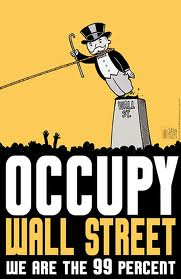 Park on St. Pat’s Day to celebrate the Movement’s six-month anniversary. From on the ground reports, the demonstration was peaceful. Until the NYPD arrived. Then there was trouble—a number of arrests and one woman reportedly had a seizure after she was thrown to the ground and handcuffed. Several participants said it took 17 minutes for the police to react, after which an ambulance was called.
For naysayers, the Occupy Wall St. Movement [OWS], their members and reasons for being were summarily dismissed before they began. Who is the leader of this motley group? journalists and pundits asked repeatedly. What do these people want?
Surprisingly, there is a leader or so I’ve read, someone well known to Occupy organizers but deliberately kept out of public view. As far as what they want? The answer seemed perfectly clear to me at the start because I think it’s what most Americans want or if they don’t want it, they expect it: an end to the gross inequality in the country, for which Wall St. and Government collusion holds the lion’s share of responsibility and an end to ‘bought’ elections, where the 1% and corporate interests routinely choose our leaders, shape policy and control the message, known in polite circles as ‘perception management.’
All of this transcends parties, btw. We’re talking Republican and Democratic parties alike, regardless of how many times we enter the ‘lesser than two evils’ spin.
You don’t need to be a psychic to ‘get’ the OWS message. You don’t even need to be a member of Occupy. All that’s needed is a modicum of alertness, a shaking-off of the trance-inducing distraction and deflection of pundits, media hounds and political operators.
So, what has OWS managed to accomplish, thus far? According to the critics—not a damn thing. But is that really the case?
Last summer, the headlines were ripe with talk of deficits, crushing debt and woe is me. We need a Grand Bargain, wisemen crooned [translation: we need to cut public services]. Somehow, we always have money for foreign adventures, national security, weapons and surveillance equipment. For instance, how many drones will be in American skies by 2020? Hummm. Try 30,000. That’s the Federal Aviation Administration’s rough estimate. The ever popular ‘shop ‘til you drop’ hee-haw isn’t working either, even with the news that ‘average’ Americans are flocking back to restaurant dining. Despite a stumbling economy there is money for weapons and drones and assorted homeland security gear. When it comes to education, infrastructure, home mortgage write downs, decent healthcare, aide to our poor, disabled and elderly? We’re just stone-broke and need to be put on an austerity diet. See Paul Ryan’s reiteration on social program slashes and numbers that don’t add up. It’s a nice set piece that will contrast with the soon-to-come kinder and gentler Democratic version.
One could call the dialogue change a bizarre coincidence but public conversation pivoted after Occupy came on the scene. We went from Oooooo, we need to slash Medicare, Medicaid and refigure Social Security to why is Wall St. getting bailed out on the backs of the taxpayer? Why do we have a system where the profits go to the top income bracket, while risk is carried by Main Street? Why have the wages of middle-class workers[if they’re fortunate enough to still have a job] barely kept pace with inflation, while the top 1% has had a 275% increase in income?
Uncomfortable questions, the sort that make politicians squirm.
OWS has also focused attention on home foreclosures, working with foreclosed families to save their homes. The Movement rallied the public in a Change Your Bank Day strategy that is estimated to cost TBTFs a $185 billion in transfers to community banks and credit unions. Religious organizations have joined the effort. According to Think Progress, The New Bottom Line, a coalition of faith groups has pledged to remove $1 billion from the major banks this year alone. OWS also pushed against the ATM fee-increase proposal; the banks pulled back. In late February, Occupy the SEC submitted a 300+ page document, urging regulators to resist the financial sector’s desire to water down the Volker Rule, part of the Dodd-Frank Wall St. reform. The group that put the document together was comprised of former Wall St. workers. OWS members also stood with private landowners, Tea Party members and environmentalists protesting the Keystone XL pipeline, a project that the President has expressed a new-found love for.
Not too shabby for six months activism. Yet still the critics howl. Where is the direction, what are the goals?
The Movement is young and still developing but you cannot fault it for sitting on its hands. More importantly, the Occupy spirit is global in nature because many activists are ‘graduates without a future’—young, educated and fed up. Paul Mason documented this facet of the worldwide

Arundhati Roy
social/political movements in his book, “Why It’s Kicking Off Everywhere,” and Arundhati Roy wrote this in a recent essay: “Capitalism, A Ghost Story”:
As Gush-Up concentrates wealth on to the tip of a shining pin on which our billionaires pirouette, tidal waves of money crash through the institutions of democracy—the courts, Parliament as well as the media, seriously compromising their ability to function in the ways they are meant to. The noisier the carnival around elections, the less sure we are that democracy really exists.
Sound familiar? The neoliberal model, the gross inequality that rewards the few at the expense of the many has circled the globe, creating universal discontent and misery.
So, what’s coming up for 2012? What will Occupy 2.0 look like?
I’d suggest checking the OWS page here for an updated list of scheduled actions. OWS plans to be in Chicago in mid-May to protest the NATO Summit although the city is throwing up barriers to prevent demonstrations. Somehow, I don’t think the protest will be stopped.
May 1 will be a National Action, the day traditionally known as International Worker’s Day. This year OWS is calling for a General Strike across the country. From the Occupy site:
We are calling on everyone who supports the cause of economic justice and true democracy to take part: No Work, No School, No Housework, No Shopping, No Banking – and most importantly, TAKE THE STREETS!
This Saturday, March 24, a Disrupt Dirty Power protest has been called in NYC to jumpstart a month-long action until Earth Day, April 22. More information here.
Sunday, March 25, Occupy Town Square IV will focus on public parks and other public spaces in NYC. More info here.
If you’re interested in local actions in particular states, towns, cities or countries, info can be found at the Occupy Together site here.
And if you want to eliminate the idea of ‘a failed movement’ from your brain. Check out the participation map here. The scope is massive.
The essay I mentioned by Arundhati Roy is well worth a read—highly informative, even shocking about vulture capitalism’s impact on India. Be prepared, it’s long. As Roy moves into her concluding paragraphs, she writes this:
Capitalism is in crisis. Trickledown failed. Now Gush-Up is in trouble too. The international financial meltdown is closing in. India’s growth rate has plummeted to 6.9 per cent. Foreign investment is pulling out. Major international corporations are sitting on huge piles of money, not sure where to invest it, not sure how the financial crisis will play out. This is a major, structural crack in the juggernaut of global capital.
Capitalism’s real “grave-diggers” may end up being its own delusional Cardinals, who have turned ideology into faith. Despite their strategic brilliance, they seem to have trouble grasping a simple fact: Capitalism is destroying the planet. The two old tricks that dug it out of past crises—War and Shopping—simply will not work.
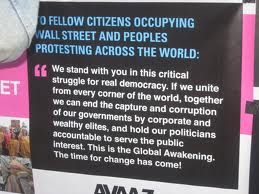
Disaster capitalism has certainly lived up to its name, be it continuous war, environmental degradation or exploding poverty. What is Occupy about? Speaking for myself, Occupy is about a break of faith with a global economic system that serves no one but an elite minority, where infinite money and power is the only morality. The movement is a massive rejection of the ongoing mantra: there’s no other way. Occupy challenges that static position, calls on us to envision something else, something better than the consensus mind. It dares us to shake off the old and embrace a sense of possibility. It demands we wake up, now.
When Corporations Mutate Into A Super Race
Posted: March 12, 2012 Filed under: corporate money, corporatism, Economy, energy, Environment, Environmental Protection, Environmentalists, fracking, Regulation, toxic waste 12 CommentsWe all remember Mitt Romney’s public and awkward statement that ‘Corporations are people, too.”
But Romney was underplaying the reality of American life in 2012.
Corporations are not mere people. They have morphed into a Super Race, ready to conquer what’s left of our disintegrating democracy. If you think this is liberal hysteria or rank hyperbole, I give you Pennsylvania’s newly passed Act 13. Bad number. But the scope of this foolish and utterly destructive state giveaway is far worse.
Act 13 is a massive gift to the oil and gas companies, which overturn property rights, strips municipal communities of zoning law protection and turn environmental and health compromises into considerations we can no longer afford. It reduces the citizens of Pennsylvania to 3rd world colony status, ripe for exploitation and extraction. Welcome to the New World of Corporate Rule where natural gas extraction is the profitable prize and quality of life is a thing of the past.
And the reaction?
“Now I know what it feels like to live in Nigeria,” said recently retired Pittsburgh City Council President Doug Shields. “You’re basically a resource colony for multi-national corporations to take your natural resources, take them back to wherever they are at, add value to them, and then sell them back to you.”
Yup. This is the neoliberal dream. Steal, add value and then sell back at an exorbitant price tag. The whole world is nothing more than a resource colony so the corporate Super Race can turn a mind-boggling profit. On the backs of the natives. Water safety and/or depletion, health, wildlife? All expendable in this great push for growth and ever-increasing profit. Moral considerations? Please, haven’t you gotten the email? Corporations don’t do morality. They’re too big for that.

Fracking in SW Pennsylvania
Why did this happen in Pennsylvania? Because of the enormous layer of shale deposits known as the Marcellus formation, resting like a slumbering giant beneath the state’s surface. But there’s more! That would be the gargantuan amount of natural gas to be had at a stunning profit—as much as 70-99% some managers of earlier drill wells have boasted.
How could investors resist?
But then, there are the rising concerns of the fracking process itself, the public’s growing awareness of water and air pollution, the niggling problem of toxic wastewater disposal and those bothersome legal suits from citizens with lame health issues.
What to do, what to do?
Act 13 is the perfect response to investor skittishness. It removes all complaint and whining by simply supplanting existing law—the kind that protects the citizen—with corporate friendly law that recognizes the global reality—everyone is for sale and everything can be exploited.
To keep tempers in check, the best PR in the world is dished out, promises of jobs and prosperity, spinning dialogues about energy independence [at any cost] and patriotic flag-waving—how tearing up the earth, polluting our waterways and compromising the public’s health is good for America. After all, in times of crisis, sacrifices need to be made, even when it means overriding the civil rights of people and communities.
That is exactly what Act 13 addresses.
Courts in the Great State of New York upholding community rights to block fracking dreams is simply unacceptable. Act 13 revokes those rights. The Lakota people in South Dakota blocking TransCanada truck transports across Native territory? We can’t have that. Act 13 clearly empowers a corporation to seize property that impacts any stage of the drilling process. And those possible health considerations? Got it covered, boys and girls. Act 13 prohibits physicians from discussing medical impacts from chemical contaminations. The Halliburton Loophole in all its malicious splendor comes back to haunt us.
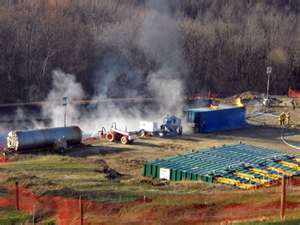
Marcellus Fracking Pit
This is what happens when corporations are declared ‘people.’ This is what happens when legislators sell their souls for 30 pieces of silver. I do not care if Republican Governor Corbett and his Republican dwarves truly believe this is good for Pennsylvania. This is a betrayal of American law and her people on a massive scale. The good citizens of Pennsylvania might look at the situation in Ohio, where Governor Kasich opened the state’s doors for business, any business, and Ohio became the dumping ground for fracking wastewater disposal and deep ground injection wells. We now know those earthquakes were not coincidental events. No wonder Republicans hate science!
Hattip to Alternet on this rant. I’d recommend reading the article ‘Fracking Democracy: Why Pennsylvania’s Act 13 May Be the Nation’s Worst Corporate Giveaway’ by Steven Rosenfeld in its entirety with the first link I provided. It’s a chilling, mind-blowing report.
Act 13 is expected to take effect on April 14th. We better pray [regardless of what state we live in] that the groups now amassing in Pennsylvania are able to halt or at least slow down this corporate monstrosity.
Because if not, we can say ‘adios’ to the shredded remnants of our Republic.
As for Pennsylvania? My heart goes out because I lived and worked in the state for over a dozen years and still have family in the area. The economy has been raked over the coals, so the promise of jobs and money injected into struggling municipalities and rural communities is a huge seduction. But we’ve seen this movie before. It does not end well. Here’s hoping that flesh and blood citizens get a chance to write a far better script for themselves and their future. Here’s hoping the rest of the country wakes up to what can only be called a corporate takeover.
Broken Windows And The Stealing Of Hearts
Posted: March 8, 2012 Filed under: Bailout Blues, Banksters, Corporate Crime, corruption, Department of Homeland Security, Domestic Policy, double-speak, Economy, Eric Holder, ethics, financial institutions, George W. Bush, Global Financial Crisis, indefinite detention, Injustice system, Patriot Act, The Bonus Class, The Great Recession, torture, U.S. Economy 21 Comments Yesterday I read an interesting essay by William Black over at New Economic Perspectives. In the essay, Black, who headed the forensic audit team during the S&L crisis, pulls forward the Broken Window Theory, a criminological model based on a simple and some have said simplistic idea. The theory was introduced by James Q. Wilson and received a fair amount of popularity during the 1990s, particularly in conservative circles.
Readers might remember Rudy Giuliani’s ‘war against graffiti,’ his zero-tolerance campaign in NYC. That effort, the elimination of the squeegee men and the crack down on street prostitution among other things were based on the broken window philosophy, which uses an abandoned building metaphor.
Imagine a building in any neighborhood [although Wilson focused exclusively on what he termed ‘blue-collar crime.’] The first broken window of our abandoned building if left unrepaired sends a clear message to antisocial types: no one cares about this building. So, it’s open season on all the other windows, on anything of value that’s been left behind. If the owner doesn’t care about the integrity of the building then the street tough is encouraged to vandalize and take whatever’s not nailed down.
The attitude feeds on itself or so the theory goes. Honest citizens are less likely to confront the petty thief, which only encourages others to act out in destructive, antisocial ways. Honest citizens begin to feel overwhelmed and outnumbered and stop safeguarding their own neighborhoods. What’s the point? they say. No one cares. Communities begin to self-destruct.
Now whether you buy into this crime theory or not, I think the metaphor holds when you consider what we’ve been witnessing in the degradation of our financial markets, our legal system, even the refusal to admit that ‘there’s trouble in River City.’
As Professor Black points out, if we were to take Wilson’s theory and apply it to the explosion of ‘white collar crime’ within our financial system, it would be a major step in restoring the integrity of our system and bolstering peer pressure against misconduct. As it stands now, Wall Street movers and shakers and their DC handmaidens have implemented business-as-usual policies that reward the thief and punish the whistleblower. As Black points out in the essay:
We have adopted executive and professional compensation systems that are exceptionally criminogenic. We have excused and ignored the endemic “earnings management” that is the inherent result of these compensation policies and the inherent degradation of professionalism that results from allowing CEOs to create a Gresham’s dynamic among appraisers, auditors, credit rating agencies, and stock analysts. The intellectual father of modern executive compensation, Michael Jensen, now warns about his Frankenstein creation. He argues that one of our problems is dishonesty about the results. Surveys indicate that the great bulk of CFOs claim that it is essential to manipulate earnings. Jensen explains that the manipulation inherently reduces shareholder value and insists that it be called “lying.” I have seen Mary Jo White, the former U.S. Attorney for the Southern District of New York, who now defends senior managers, lecture that there is “good” “earnings management.”
My husband had some unsettling experience in this area. Early in his career, he worked as a CPA [the two companies will remain nameless]. But in each case, he was ‘asked’ to clean up the numbers, make them look better than they were. He refused and found himself on the street, looking for employment elsewhere. I remember him saying at the time, ‘Look, I’m a numbers guy. I’ve never been good at fiction writing.’ This was back in the late 70s early 80s, so this attitude has been a long time in the making. Now, we’re seeing accounting fraud that is literally off the charts. Is it any wonder the country’s financial system is on life support?
We can see the destructive results of this careless, corrupt posturing all around us. Professor Black continued:
Fiduciary duties are critical means of preventing broken windows from occurring and making it likely that any broken windows in corporate governance will soon be remedied, yet we have steadily weakened fiduciary duties. For example, Delaware now allows the elimination of the fiduciary duty of care as long as the shareholders approve. Court decisions have increasingly weakened the fiduciary duties of loyalty and care. The Chamber of Commerce’s most recent priorities have been to weaken Sarbanes-Oxley and the Foreign Corrupt Practices Act. We have made it exceptionally difficult for shareholders who are victims of securities fraud to bring civil suits against the officers and entities that led or aided and abetted the securities fraud. The Private Securities Litigation Reform Act of 1995 (PSLRA) has achieved its true intended purpose – making it exceptionally difficult for shareholders who are the victims of securities fraud to bring even the most meritorious securities fraud action.
Reading this, I immediately sensed we could apply the metaphor just as easily to our legal predicament. Dak wrote to this yesterday—about the disheartening disrepair of our justice system, which was badly wounded during the Bush/Cheney years with the help of eager lawyers like John Yoo, stretching, reinterpreting, rewriting the parameters on the subjects of torture, indefinite detention, rendition, etc.
Not to be outdone, Eric Holder stood before Northwestern University’s Law School the other day and with the same twisted logic, explained away due process, otherwise known as ‘how to justify assassination.’ In this case, American citizens, those the President deems are a threat to the Nation, can be killed on native ground or foreign soil. Jonathon Turley, law professor at George Washington University and frequent legal commentator in the media, headed a recent blog post as follows: Holder Promises to Kill Citizens with Care.
Sorry, this does not make me feel better. What it does make me think is lawlessness simply breeds more lawlessness. The Broken Window theory writ large. As Turley explained:
The choice of a law school was a curious place for discussion of authoritarian powers. Obama has replaced the constitutional protections afforded to citizens with a “trust me” pledge that Holder repeated yesterday at Northwestern. The good news is that Holder promised not to hunt citizens for sport.
Holder proclaimed that “The president may use force abroad against a senior operational leader of a foreign terrorist organization with which the United States is at war — even if that individual happens to be a U.S. citizen.” The use of the word “abroad” is interesting since senior Administration officials have asserted that the President may kill an American anywhere and anytime, including the United States. Holder’s speech does not materially limit that claimed authority. He merely assures citizens that Obama will only kill those of us he finds abroad and a significant threat. Notably, Holder added “Our legal authority is not limited to the battlefields in Afghanistan.”
Turley went on to comment that Holder was vague, to say the least, when it came to the use of these ‘new’ governmental/executive powers, claiming that the powers-that-be will only kill citizens when:
“the consent of the nation involved or after a determination that the nation is unable or unwilling to deal effectively with a threat to the United States.”
And as far as ‘due process?” Holder declared that:
“a careful and thorough executive branch review of the facts in a case amounts to ‘due process.’”
Chilling! As Turley grimly noted in an earlier post, this is no longer the land of the free.
Seemingly unrelated was this report from the New York Times: the heart of Dublin’s 12th-century patron saint was stolen earlier this week from Christ’s Church Cathedral. The heart of Laurence O’Toole had been housed in a heart-shaped box, safely secured [or so church authorities believed] within an iron cage. The relic’s disappearance was preceded by a rash of reliquary robberies from churches, monasteries and convents around Ireland. According to the article:
The small cage hosting the heart-shaped box containing the relic was tucked away in an innocuous alcove at the side of a small altar. Visitors to the cathedral on Monday stared at the twisted bars and the empty space behind. The bars themselves were sundered evenly.
According to Dermot Dunne, dean of Christ Church, the box had lain undisturbed for centuries. He had no idea why someone would take it.
Whether it’s the heart of a saint or the heart of a Nation, the theft is a grievous insult. The crime betrays the public trust and our basic sense of decency. But the thieves of O’Tooles’s heart performed a curious act before exiting.
The Irish culprits lit candles at two of the Cathedral’s altars. Which means the perpetrators possessed, at the very least, an ironic sense of tradition.
The same cannot be said of our homegrown hooligans. Crass greed and the lust for unlimited power have their own dark tradition. As Americans, we do not expect vice to be confused with virtue. In the past, we could not imagine a blatant disrespect for the Rule of Law–crimes ignored, excused, then openly declared necessary for whatever raison du moment.
Not here, we told ourselves repeatedly. Not in the United States.
Perhaps, we should light candles of our own. A small devotion for the lost and dying.

I See Dead People
Posted: February 27, 2012 Filed under: 2012 elections, 2012 primaries, corruption, Democratic Politics, Environment, Environmentalists, George W. Bush, Politics as Usual, Republican politics, Tea Party activists 23 CommentsMaybe this should be the new Republican mantra for a suitable candidate in 2012. If Republican politicians aren’t conjuring up the ghost of  Ronald Reagan every fifteen minutes, they can go back further into the annals of GOP glory and dig up another Republican corpse. Say . . . Ike Eisenhower. And lo and behold, that’s exactly what NY Times columnist Ross Douthat attempts in his recent “The Greatness of Ike” piece, which extolls the General’s many virtues, bemoans the fact that Eisenhower is overshadowed by the likes of FDR, ties for twelfth-place in POTUS rankings with Jimmy Carter and is generally under appreciated.
The man may have a point.
I recall Eisenhower’s warnings about the industrial/military complex being aired frequently throughout my living memory. Yet no one has paid much attention beyond nodding and saying: yes, the man was right. I suspect the current state of affairs, the country involved in a decade of senseless war, where defense contractors and mercenaries have been made fat and happy, proves the General’s point. Only problem for the Republicans is that it was likes of George W. Bush, Dick Cheney and Donald Rumsfeld who led the disastrous charge into Iraq on false allegations, hyped-up claims about weapons of mass destruction, and then offered a breath-taking defense of torture for national security purposes. Even more startling, they got away with it, leaving the country bleeding and bankrupt in their wake. All in the name of democracy, freedom and ‘shop ‘till you drop’ exhortations.
It was a moment of infamy, as someone once said.
This is why the glance backwards always skips over those inconvenient years of woeful mismanagement and fiscal insanity. No doubt the current batch of 2012 candidates, the Fearless Four, bring angst to all Republican hopefuls convinced, only a few, short months ago, that a 2012 victory was inevitable, a piece of cake.
A powerful dose of nostalgia makes the medicine go down easier.
Surely, the good ole days seem ever more grand as Rick Santorum raises the flag for a home-grown theocracy and dances with the Devil, Mitt Romney continues to stumble over his own tongue [revealing his wife drives ‘two’ Caddies], Newt Gingrich beats his breast over the secular plot to undermine America and Ron Paul, the cuddly libertarian, begins to look and sound strangely reasonable.
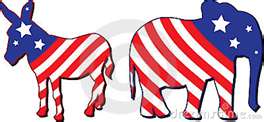 What’s a true-blue Republican to do?
Dig up some corpses.
Am I, a thoroughly disenchanted Democrat gloating? In a pinch, yes. In the long-term, no, because I’m stuck with a candidate I did not vote for in 2008, a man who has proven himself less a champion of Democratic principles than even I ever expected.
As a Nation, we are stuck in a rut for which there seem few alternatives. The legacy parties offer nothing but more of the same—craziness on one side and the uninspiring ‘we suck less than they do’ on the other. As a voter, I’ve vowed to go 3rd party in November [unless the Republicans were to choose Santorum, then I’ll vote directly against him]. However, in the larger frame all I see are monied interests, directing and maneuvering what is suppose to be a ‘free’ election. It has virtually nothing to do with me or my values. On the contrary, it’s all about the persistence of a political class and their cash-soaked benefactors calling for war and protecting their national interests, the gutting of our social contract; the unwillingness to formulate a sensible energy program sans the giant fossil fuel companies’ interference or address the critical and devastating slippage in education, infrastructure, healthcare and employment opportunities.
We have plenty of money for bombs. But not our people. Bailouts are bad. Unless our representatives are saving the asses of and colluding with the corrupt TBTFs. Water and food is the stuff of life until there’s a pipeline, gushing with sludgy oil and money, to compromise both.
Ed Rollins, former Reagan strategist, made a statement recently about the 2012 Republican field:
“Six months before this thing got going, every Republican I know was saying, ‘We’re gonna win, we’re gonna beat Obama.’ Now even those who’ve endorsed Romney say, ‘My God, what a fucking mess.’
That about sums it up, not simply about the Republican field but the entire country. It is an effing mess. And there’s no savior on the horizon. In fact, there’s no savior anywhere. Unless we, the American public, do the saving. But that means coming together on issues where we can agree. The gridlock in DC gets us absolutely nowhere. It’s enough to put anyone into a funk.
But then this morning I read an article about environmentalists and Tea Party activists coming together to fight Keystone XL, the pipeline extension from Nebraska to Texas. For the Tea Party, it’s all about individual property rights and the way TransCanada, a foreign company, has attempted to strong-arm property owners. For the environmentalists it’s about preserving fertile farm land and a major aquifer from the too real danger of irreversible contamination. The nexus of agreement between these two wildly divergent political groups is this: the Keystone pipeline does not serve the public’s interest.
That’s the winning hand: the public’s interest. Not the oil companies, not the 196 people funding the SuperPacs, not the banks, not the Democratic or Republican parties.
What serves the public’s interest.
We, American citizens, can find ways to work together or continue to be spectators to the endless political theater, the Kabuki dance we call elections. And once more we’ll be digging up corpses, which could very well be our own.

The Cantor Cartwheel On Insider Trading
Posted: February 11, 2012 Filed under: Congress, corporate money, corruption, Democratic Politics, ethics, legislation, Politics as Usual, Republican politics, Senate, Stock Market, U.S. Politics, We are so F'd 22 CommentsWhile our eyes and fury were directed on the birth-control-is-evil crowd and the ludicrous threats of the National Razor coming to a town near
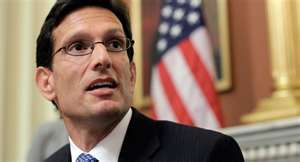
This is Eric Cantor
you, the insider trading bill wended its merry way through Congress. Only a provision in the Senate version of STOCK [Stop Trading on Congressional Knowledge Act] was stripped from the House version. The bill will return to the Senate, and then most likely go into conference committee to iron out differences.
The deletion of the provision is curious since it would have required Washington insiders, those who sell political intelligence to corporate America [financial institutions], to register in advance like any lobbyist, thereby making their identities and purpose transparent.
One senator reacted to the provision’s removal this way:
It’s astonishing and extremely disappointing that the House would fulfill Wall Street’s wishes by killing this provision. The Senate clearly voted to try to shed light on an industry that’s behind the scenes. If the Senate language is too broad, as opponents say, why not propose a solution instead of scrapping the provision altogether? I hope to see a vehicle for meaningful transparency through a House-Senate conference or other means. If Congress delays action, the political intelligence industry will stay in the shadows, just the way Wall Street likes it.
That would be a Democrat complaining, right?
Wrong.
That would be Republican Senator Chuck Grassley from Iowa protesting House member Eric Cantor for removing the provision [Grassley’s add on], ultimately making the bill substantially weaker than it could have been.
And ‘political intelligence industry?’ Sounds like something straight out of an Ian Fleming novel. Turns out this shadowy practice is a $100 million industry, employing 2000 people who sneak around Congress to pick up investment tips for Wall Street.
You cannot make this stuff up!

I am a weasel
In any case, it was Eric Cantor who tabled the original effort to suspend insider trading back in December. Also removed was a bipartisan amendment by Senators Patrick Leahy [D VT] and John Cornyn [R TX] made to crack down on officials ‘self-dealing,’ that is, enriching themselves through their positions.
The question is: why the not-so-clever foot dragging on this bill, something that makes perfect sense to the American public? Why ditch Grassley’s provision or the Leahy/Cronyn amendment, which would have added additional teeth?
As in, make it better.
According to initial comments, Cantor claimed the language too broad and the additional provisions ‘needed more study.’ Seems to me the study-until-we-drop reason was cited back in December.
But Cantor did add a touch of his own that would restrict legislators from participating or benefiting from IPOs. This addition quickly became tagged the ‘Pelosi provision,’ inspired by the suggestion that Pelosi’s husband had taken advantage of insider information when he bought into a VISA public offering, making a tidy profit [230% increase, by some accounts]. Pelosi has denied this accusation, insisting that her husband’s buys were directed by a traditional Wells Fargo broker.
Wish my broker was that good!
I am a happy weasel
Cheap political tricks and posturing happen all too frequently but why would Cantor be so adamant in weakening a bill the public and a surprising number of Congressional members favor?
Republic Report suggests we look at Cantor’s history, specifically the issue of mortgage cram down in 2009.
Eric Cantor led the Republican refusal to consider the mortgage cramdown proposals in 2009, a measure that would have permitted homeowners to negotiate lower interest rates and avoid foreclosure. However, what was not common knowledge [see Open Secrets. org] was that Cantor’s personal wealth was heavily involved in the mortgage industry itself. From RR:
Cantor invested in several mortgage banks, and owned a portion of a Cantor-family run mortgage company. According to Cantor’s 2009 personal disclosure, Cantor owned up to a $500,000 share of a mortgage company called TrustMor run by his brother.
While Cantor blocked a fix to the foreclosure crisis, his wife Diane Cantor served as the managing director of a bank with a high foreclosure rate. Diane Cantor at the time worked as a managing director to New York Private Bank & Trust, a major mortgage bank and TARP recipient. SNL Financial reported that Cantor’s bank was among the top three banks in the mortgage business “with thegreatest percentage of family loans in the foreclosure process.
There was also the dustup during the debt ceiling debate last year when a revealed fund Cantor was invested in, stood to make a sizeable profit if the US actually defaulted on its debt. If the country tanked, Cantor stood to win.
Such loyalty!
Personally, I liked Cantor’s chest thumping after wicked storms savaged the South and East Coast last spring [my house and property suffered nearly $20,000 in damages with 1600+lbs of debris dragged from the front and back yard]. For his Tea Party audience, Cantor tried bucking disaster relief until expenses [like unemployment checks and food stamps] were cut elsewhere. But then amazingly, Cantor made a sharp pivot and complained FEMA was far too slow in addressing damage relief in his own Virginia district.
Consistency is a beautiful thing!
So, we have the Pelosi Provision and the Cantor Cartwheel, anything to stall a DC scrub down, the disinfectant treatment that the American public demands [at the very minimum] from their representatives–abiding by the laws, standards and a sense of ‘doing the right thing.’ You know, those principles that presumably apply to everyone.
BTW, the Sunlight Foundation has provided the House/Cantor Version of the STOCK bill with edits [strikeouts] included. Most instructive!
Don’t you love the Internet??? Bet Cartwheel Cantor doesn’t.

I am a warrior weasel
And though I would have nominated Eric Cantor for Sellout of the Week, Republic Report has chosen President Obama, primarily based on his recent decision to embrace Super PAC money [though I suspect we could all come up with other examples]. However, the President opened himself up to this chastising because he warned about unlimited campaign spending in 2008:
Let me be clear — this isn’t just about ending the failed policies of the Bush years; it’s about ending the failed system in Washington that produces those policies. For far too long, through both Democratic and Republican administrations, Washington has allowed Wall Street to use lobbyists and campaign contributions to rig the system and get its way, no matter what it costs ordinary Americans.
That was then, this is now.
Did you know that one of the collective nouns used to describe a group of weasels is . . . SNEAK. How perfect is that?

We are all well-heeled weasels

 peej
peej Carissa
 bostonboomer
 dakinikat
 ecocatwoman
 mablue2
 Mama Lopez
 peggysue22
 quixote
 skydancingguestblogger
 Mona (aka Wonk the Vote)



 Sky Dancing
Recent Comments