
By Berthe Morisot, 1873
“Scranton is a place that climbs in your heart, and it never leaves,” Biden said. “For me it was 2446 North Washington Avenue.”


Reading Woman Daydreaming, by Henri Matisse
Those of us who are hanging onto hope that U.S. democracy can still be saved must not only fight Republicans, but also powerful media organizations, especially The New York Times and The Washington Post.
If you follow social media, you’ve undoubtedly seen people mocking New York Times headlines that suggest any good news for Biden is actually negative–along the lines of “The economy is booming–why that’s bad for Biden.”
Despite the fact that news organizations will certainly be persecuted by a second Trump administration, it really appears that at least the wealthy people in charge want another Trump presidency because they believe it will help their bottom line. Working journalists are facing layoffs these days, so perhaps fear of losing their jobs makes them willing to do their bosses’ bidding.
Right now, as Trump faces a historic criminal trial, the Times and Washington Post continue to publish gossipy lightweight stories.
David Kurtz writes in the TPM Morning Memo about a piece in the NYT yesterday on Melania Trump: NYT Is Said To Have Learned Nothing From Its Trump I Coverage.
Yesterday’s NYT apologia for Melania Trump was laugh-out-loud funny, by which I mean so, so bad. Reminiscent of its much-mocked coverage of Javanka during Trump I, the piece had all the usual hallmarks of NYT toadyism.
Let’s start with the passive-voice headline: “Melania Trump Avoids the Courtroom, but Is Said to Share Her Husband’s Anger”
“Said to” is one of the great journalistic sophistries. It does so much apparent work with so little actual effort.
What is this awkward headline construction meant to convey? That despite all her heartache over the Stormy Daniels affair, Melania, too, is outraged (OUTRAGED!) over Manhattan DA Alvin Bragg’s wrongful criminal prosecution of her husband.
How does the NYT know this? So glad you asked!
Melania hasn’t said anything publicly about her supposed outrage. She hasn’t attended legal proceedings with Trump. She hasn’t been by his side at the trial.
But wait! She’s has purportedly spoken “in private” about her feelings.
It’s the classic dipsy-do of the Javanka coverage: Why take any risk of speaking publicly when you can launder it through the NYT. We are never so courageous as we are in our private musings.
But how is the NYT privy to Melania’s private thoughts and comments?
The sourcing: “according to several people familiar with her thinking.” Yes! Bravo! It’s self serving on top of self serving, with two degrees of separation to play it safe.
Why are these “people familiar” granted anonymity? Because they can’t speak publicly “out of fear of jeopardizing a personal relationship with the Trumps.” Perfect! These brave truth-tellers are risking so much – by which I mean, so little – to get their essential truths out into the public sphere.
Here’s the nugget of “reporting” around which the entire article is built:
But Mrs. Trump, the former first lady, shares his view that the trial itself is unfair, according to several people familiar with her thinking.
In private, she has called the proceedings “a disgrace” tantamount to election interference, according to a person with direct knowledge of her comments who could not speak publicly out of fear of jeopardizing a personal relationship with the Trumps.
The rest of the piece is a filament of speculation, pop psychology, knowing winks about cliched relationship tropes, and lazy stereotypes about wives and mothers – all in service of trying to wring a drop of compassion from readers for the private turmoil that comes with being married to DJT.
Read the rest at TPM. But really, who the hell cares what Melania thinks? As the back of her famous jacket read, “I really don’t care, do u?”

Albert Reuss 1889-1975, Woman Reading
Another lightweight story from yesterday’s New York Times by style critic Guy Trebay (at least, I guess it’s favorable to Biden): The Biden Guide to Dressing Younger.
Joe Biden is a dapper guy. He always has been. When he turned up decades ago for a first date with the woman who would become his wife and the country’s first lady, her gut reaction was, “This is never going to work, not in a million years.”
Dressed in a sports coat and loafers, Joe Biden was too dapper for someone who had previously gone out with men in T-shirts and clogs.
They worked it out. And the future president stuck to his style. It was one that sometimes skewed Gatsby, for which in 1974 Washingtonian magazine noted his penchant for pinstripe suits and tasseled loafers when citing him as one of the best dressed men in the Senate. It was one that was sometimes too high-toned for its setting. In 1979, Mr. Biden, then a second-term senator, exuded confidence in a “tailored suit and expensive tie” for a campus speech at the University of Alabama, The New Yorker later reported.
It was one that, on occasion, even threatened to upstage the boss. Yes, it must have been flattering to be praised by The Chicago Tribune as the “best-dressed guy” at Bill Clinton’s 2000 State of the Union address. Politically, however, it was not the best look.
Still, dapper cred has stood President Biden in good stead. When Donald J. Trump, now 77, derides his 81-year-old opponent as doddering Uncle Joe, he is missing a point any tailor would be happy to clarify. There is getting old, and there is looking old. To avoid having your clothes add unnecessary years, make style your friend.
“Joe Biden’s style is timeless and doesn’t have any expiration date,” the designer Todd Snyder said recently. If you think that is accidental, you are not paying attention.
Meanwhile, Trump is a dumpy old guy in baggy suits and extra long ties who claims Biden has dementia, an obvious projection.
A campaign story from Clive Wootson, Jr. at The Washington Post: Scranton vs. Mar-a-Lago: Biden turns sharply to populism.
SCRANTON — President Biden’s schedulers did not publicly announce his second stop Tuesday during his visit to his hometown, but it came as little surprise that he’d end up at the gray house with black shutters where he spent the earliest years of his life. He even nodded to the visit in a speech that mixed his biography with his thoughts on tax policy.
By Berthe Morisot, 1873
“Scranton is a place that climbs in your heart, and it never leaves,” Biden said. “For me it was 2446 North Washington Avenue.”
But the trip was about more than sentiment during the first day of Biden’s three-day swing through this pivotal battleground state. He leaned into populist anger against the rich and worries of a world weighted against the middle class as he sought to draw distinctions between himself and his likely Republican opponent in November, Donald Trump.
“All I knew about people like Trump is that they looked down on us,” Biden told the crowd in his childhood town, contrasting his upbringing with Trump’s frequent visits to his resort in Palm Beach, Fla. “They wouldn’t let us into their homes and their country clubs. When I look at the economy, I look at it through the eyes of Scranton, not through the eyes of Mar-a-Lago.”
Biden will further stress that contrast Wednesday when he travels to Pittsburgh to address the United Steelworkers and unveil a raft of new trade protections for the steel industry. The president will call for a tripling of the 7.5 percent tariff on Chinese steel imports, as well as increased pressure to prevent China from shipping steel to America through Mexican ports….
The actions are just the latest sign of the president’s determination to be seen as a defender of American workers like those in the steel industry, whose employees are spread across states in the industrial Midwest, the so-called “blue wall” that could decide Biden’s political fate in November.
In making the argument, he has leaned into his middle-class upbringing, including the years he spent in Scranton, which he portrays as a scrappy, working-class town. He argues that Trump, on the other hand, is a billionaire who lives in a gilded club in Florida and would bolster other billionaires, the very people who have had an unfair advantage for too long.
Again, I guess at least it’s favorable to Biden.
A serious piece from Mark Joseph Stern at Slate Magazine: Hundreds of Jan. 6 Prosecutions—Including Donald Trump’s—Are Suddenly in Peril at the Supreme Court.
Will the Supreme Court jeopardize the prosecution of more than 350 defendants involved with Jan. 6, including Donald Trump, by gutting the federal statute that prohibits their unlawful conduct? Maybe so. Tuesday’s oral arguments in Fischer v. United States were rough sledding for the government, as the conservative justices lined up to thwap Joe Biden’s Department of Justice for allegedly overreaching in its pursuit of Jan. 6 convictions. Six members of the court took turns wringing their hands over the application of a criminal obstruction law to the rioters, fretting that they faced overly harsh penalties for participating in the violent attack. Unmentioned but lurking in the background was Trump himself, who can wriggle out of two major charges against him with a favorable decision in this case.
There are, no doubt, too many criminal laws whose vague wording gives prosecutors near-limitless leeway to threaten citizens with decades in prison. But this isn’t one of them. Congress wrote a perfectly legible law and the overwhelming majority of judges have had no trouble applying it. It would be all too telling if the Supreme Court decides to pretend the statute is somehow too sweeping or jumbled to use as a tool of accountability for Jan. 6.
Start with the obstruction law itself, known as Section 1552(c), which Congress enacted to close loopholes that Enron exploited to impede probes into its misconduct. The provision is remarkably straightforward—a far cry from the ambiguous, sloppy, or muddled laws that typically flummox the judiciary. It’s a mainstay of the Department of Justice’s “Capitol siege” prosecutions, deployed in about a quarter of all cases. Overall, 350 people face charges under this statute, Trump among them, and the DOJ has used it to secure the convictions of about 150 rioters. It targets anyone who “corruptly … obstructs, influences, or impedes any official proceeding, or attempts to do so.” And it clarifies that an official proceeding includes “a proceeding before the Congress.”
A Woman Reading, by Pablo Picasso, 1920
The government argues that some rioters attempted to “obstruct” an “official proceeding” by halting the count of electoral votes through “corrupt” means. That includes Joseph Fischer, the defendant in the current case. Fischer, who served as a police officer before Jan. 6, allegedly texted that the protest “might get violent”; that “they should storm the capital and drag all the democrates [sic] into the street and have a mob trial”; and that protesters should “take democratic congress to the gallows,” because they “can’t vote if they can’t breathe..lol.” Video evidence shows Fischer assaulting multiple police officers on the afternoon of Jan. 6 after breaching the Capitol.
Would anyone seriously argue that this person did not attempt to corruptly obstruct an official proceeding? For a time, it seemed not: 14 of the 15 federal judges—all but Judge Carl Nichols in this case—considering the charge in various Jan. 6 cases agreed that it applied to violent rioters bent on stopping the electoral count. So did every judge on the U.S. Court of Appeals for the District of Columbia Circuit except one, Judge Gregory Katsas. Both Nichols and Katsas were appointed by Trump. Their crusade to kneecap the law caught SCOTUS’ attention, and the court decided to intervene despite overwhelming consensus among lower court judges. The Supreme Court’s decision will have major implications for Trump: Two of the four charges brought by special counsel Jack Smith in the former president’s Jan. 6 prosecution revolve around this offense. A ruling that eviscerates the obstruction law would arguably cut out the heart of the indictment.
Stern writes that at least three justices–Clarence Thomas, Neil Gorsuch, and Samuel Alito appear likely to do that. Read the rest at Slate.
Catherine Belton at The Washington Post: Secret Russian foreign policy document urges action to weaken the U.S.
Russia’s Foreign Ministry has been drawing up plans to try to weaken its Western adversaries, including the United States, and leverage the Ukraine war to forge a global order free from what it sees as American dominance, according to a secret Foreign Ministry document.
In a classified addendum to Russia’s official — and public — “Foreign Policy Concept of the Russian Federation,” the ministry calls for an “offensive information campaign” and other measures spanning “the military-political, economic and trade and informational psychological spheres” against a “coalition of unfriendly countries” led by the United States.
“We need to continue adjusting our approach to relations with unfriendly states,” states the 2023 document, which was provided to The Washington Post by a European intelligence service. “It’s important to create a mechanism for finding the vulnerable points of their external and internal policies with the aim of developing practical steps to weaken Russia’s opponents.”
The document for the first time provides official confirmation and codification of what many in the Moscow elite say has become a hybrid war against the West. Russia is seeking to subvert Western support for Ukraine and disrupt the domestic politics of the United States and European countries, through propaganda campaigns supporting isolationist and extremist policies, according to Kremlin documents previously reported on by The Post. It is also seeking to refashion geopolitics, drawing closer to China, Iran and North Korea in an attempt to shift the current balance of power.
Using much tougher and blunter language than the public foreign policy document, the secret addendum, dated April 11, 2023, claims that the United States is leading a coalition of “unfriendly countries” aimed at weakening Russia because Moscow is “a threat to Western global hegemony.” The document says the outcome of Russia’s war in Ukraine will “to a great degree determine the outlines of the future world order,” a clear indication that Moscow sees the result of its invasion as inextricably bound with its ability — and that of other authoritarian nations — to impose its will globally.

Albert Reuss, Lady Reading a Book
The Russians have clearly succeeded in subverting much of the Republican Party. Right now, far right Republicans are talking about getting rid of House Speaker Mike Johnson because he appears to be trying to pass some military aid for Ukraine.
The Washington Post: Momentum builds to oust Johnson from House speakership.
House Speaker Mike Johnson’s job is in serious jeopardy as two far-right lawmakers are threatening to oust him after the embattled Republican leader proposed a complex plan intended to fund key foreign allies during wartime.

At the Gardner Museum, an empty frame hangs where a painting was stolen.
Before I get started on today’s political news, I wanted to note the anniversary of the Isabella Stewart Gardner heist on Monday. It’s a Boston story I’ve always found fascinating. I’m illustrating this post with some of the 13 missing works of art.
CBS News: Isabella Stewart Gardner art heist happened 34 years ago, FBI still receiving tips.
BOSTON — Thirty-four years ago two thieves robbed the Isabella Stewart Gardner Museum, making off with hundreds of millions of dollars in stolen artwork. The heist has been the subject of mystery and documentaries ever since.
“I have been here for a long time looking for these, and I’d be lying if I said it doesn’t affect me. I walk by the empty frames every day,” said Anthony Amore, Director of Security at the Isabella Stewart Gardner Museum.
In 1990, two men snuck into the museum disguised as police officers answering a distress call. The duo tied up to two guards and were in the museum for 81 minutes. They made off with numerous pieces of art including 13 works from famous painters like Rembrandt. The art is worth hundreds of millions of dollars.
“I believe that information is going to come in, or I am going to get the stuff first, but one way or another we will get the art back,” said Amore.
Over the past year, the museum and the FBI have received hundreds of tips and emails. Amore says most are theories or conjecture, but a few are an occasional tip. He says 20 of those calls came from people who thought they spotted the works of art on the wall during house showings or on pictures from Zillow. They were just reproductions used to stage the homes for sale.
“There is a lot of these things out there, and when we do see things from Zillow, or any other real estate website, we don’t look at it and say, ‘That is our painting.’ Nevertheless, we follow it,” said Amore. “I am amazed that people notice because Zillow has millions of listings, and people go through and go, ‘That’s that missing Gardner painting.”
There is a $10 million reward for information leading to finding the paintings.
The New York Times: Empty Frames and Other Oddities From the Unsolved Gardner Museum Heist.
In the pre-dawn hours of March 18, 1990, following a festive St. Patrick’s Day in Boston, two men dressed as police officers walked into the Isabella Stewart Gardner Museum and walked off with an estimated $500 million in art treasures. Despite efforts by the local police, federal agents, amateur sleuths and not a few journalists, no one has found any of the 13 works lost in the largest art theft in history, including a rare Vermeer and three precious Rembrandts.
The Concert, by Johannes Vermeer
The legacy of the heist is always apparent to museum visitors who, decades later, still confront vacant frames on the gallery walls where paintings once hung. They are kept there as a reminder of loss, museum officials say, and in the hope that the works may eventually return. Last month, Richard Abath, the night watchman who mistakenly allowed in the thieves, died at 57. He was a vital figure in an investigation that remains active, but where the trails have grown cold.
Here are five oddities that make this one of the most compelling of American crimes.
The thieves took a really strange array of stuff.
Important paintings were taken from their frames during the heist. But other items that were stolen were not nearly of the same caliber: a nondescript Chinese metal vase; a fairly ordinary bronze eagle from atop a flagpole; and five minor sketches by Degas. The thieves walked past paintings and jade figurines worth millions, including a drawing by Michelangelo, yet they spent some of their 81 minutes inside fussing to free the vase from a tricky locking mechanism.
The handcuffed guard was later scrutinized.
Abath, one of two guards on duty, was handcuffed and gagged with duct tape. He was never named a suspect. But over the years investigators continued to review his behavior because he had, against protocol, opened the museum door to the thieves. (The second guard, who is still living, was never a focus of investigative interest.) The F.B.I. monitored Abath’s assets for decades but never saw any suspicious income. He consistently said he told investigators everything he knew, and an F.B.I. polygraph he voluntarily took was deemed “inconclusive.”
The empty frames have stayed on the walls.
The museum was once Gardner’s home and she wanted to ensure that her expansive art collection was displayed in the same manner she had arranged it. She stipulated in her will that not a thing was to be removed or rearranged, or the collection should be shipped to Paris for auction, with the money going to Harvard University. Though it’s long been reported that the empty frames are left hanging to accord with that will, the museum says that is actually a long uncorrected mistake. “We have chosen to display them,” it said in a statement “because 1.) we remain confident that the works will someday return to their rightful place in the galleries; and 2.) they are a poignant reminder of the loss to the public of these unique works.”
Read the rest at the NYT.
I wish I could spend the day reading about famous art thefts and missing or recovered paintings, but I suppose I’d better take a look at the politics news . . .
On Monday Judge Aileen “Loose” Cannon shocked legal observers with a strange order.
USA Today: Judge in Trump classified documents case proposes ‘insane’ jury instructions, experts say.
The judge presiding over charges against former President Donald Trump for allegedly hoarding classified documents after leaving the White House proposed on Monday jury instructions for the eventual trial that favor his claim that he declassified the records.
U.S. District Judge Aileen Cannon’s proposal tips the scales so far in Trump’s direction that legal experts say the prosecutor, Justice Department special counsel Jack Smith, might ask an appeals court to remove her from the case.
Joyce White Vance, a former U.S. attorney, said the Presidential Records Act isn’t a way around rules for handling classified documents because the records are still government property, not Trump’s personal possessions.
Rembrandt von Rijn Self-Portrait
“Expect their response to be hard-hitting,” Vance said of prosecutors in a post on Substack. “The bottom line is that the Presidential Records Act doesn’t forgive Trump for violating criminal laws regarding handling of national secrets.” [….]
Cannon gave lawyers for Trump and Smith until April 2 to submit proposed jury instructions for the eventual trial. The order on Monday came after a hearing in which she didn’t resolve the dispute over whether the documents fell under the Presidential Records Act.
But her order called for lawyers on both sides to “engage” with two possible instructions she proposed.
In one, Cannon said jurors should “make a factual finding as to whether the government had proven beyond a reasonable doubt” the records are personal or presidential.
In the other, Cannon proposed telling jurors “a president has sole authority under the PRA to categorize records as personal or presidential during his/her presidency. Neither a court nor a jury is permitted to make or review such as categorization decision.”
Neither of those instructions reflects what the Presidential Records Act says.
Legal experts blasted the order as “insane” and “nuts.”
“This second scenario is legally insane,” and under it Cannon could simply dismiss the charges, said Bradley Moss, a national-security lawyer.
George Conway, another lawyer and frequent critic of Trump, argued Cannon shouldn’t be hearing the case and shouldn’t even be a federal judge. Cannon was appointed by Trump and has been widely criticized for decisions that have delayed the trial, including two overturned by the 11th U.S. Circuit Court of Appeals.
“This is utterly nuts,” Conway said.
Vance said both proposals from Cannon “virtually direct the jury to find Trump not guilty.”
“It turns out it’s two pages of crazy stemming from the Judge’s apparent inability to tell Trump no when it comes to his argument that he turned the nation’s secrets into his personal records by designating them as such under the Presidential Records Act,” Vance said.
Read more about the Presidential Records Act at USA Today.
Jose Pagliery at The Daily Beast: Mar-a-Lago Judge’s Stark Ruling: Jury Sees Secret Files or Trump Wins.
The MAGA-friendly federal judge who keeps siding with Donald Trump in his Mar-a-Lago classified records case has forced prosecutors to make a stark choice: allow jurors to see a huge trove of national secrets or let him go.
U.S. District Judge Aileen M. Cannon’s ultimatum Monday night came as a surprise twist in what could have been a simple order; one merely asking federal prosecutors and Trump’s lawyers for proposed jury instructions at the upcoming trial.
Christ in the Storm on the Sea of Galilee, by Rembrandt van Rijn
But as she has done repeatedly, Cannon used this otherwise innocuous legal step as yet another way to swing the case wildly in favor of the man who appointed her while he was president.
Department of Justice Special Counsel Jack Smith must now choose whether to allow jurors at the upcoming criminal trial to peruse the many classified records found at the former president’s South Florida mansion or give jurors instructions that would effectively order them to acquit him.
Alternatively, Smith could appeal to the Eleventh Circuit Court of Appeals, where more experienced judges have already overturned Cannon and reined her in. But doing that will only further delay a trial that’s at least three months behind schedule, entirely by the judge’s own design. (She froze the investigation and tried to slow-roll document review until the appellate court forced her to stop.)
Ray Brescia at The Daily Beast: Judge Aileen Cannon Could Get Herself Booted From Trump’s Classified Documents Case.
…[O]ver the last six months, a slow-moving car-crash of a case has been unfolding, with a judge who seems committed to protecting the former president at every turn of the road. In that case, Judge Aileen Cannon is adjudicating the prosecution of the former president in the classified documents case in a haphazard way at best. At worst, she is doing all she can to protect the former president from facing the classified documents case before the election, if at all.
Her recent rulings—announcing she is likely to release the names of the government’s witnesses and potentially expose them to ridicule and violence, and a highly questionable decision on how she may instruct the jury should we ever get one—do not just make special counsel Jack Smith’s case more difficult. In a perverse way, the more difficult she makes it, she might actually help Smith in the end.
Should Smith ask an appellate court to review Judge Cannon’s rulings, not only is he likely to get those decisions reversed, her actions to delay and attempt to block the effort to bring the former president to justice may end up getting her removed from the case altogether.
In many respects, we’ve been here before. Back in 2022, in a highly questionable move, Judge Cannon presided over a case challenging the FBI’s entry into Mar-a-Lago pursuant to a lawful subpoena to determine whether the former president was harboring classified documents there (he was). Her willingness to entertain such a brazen and unprecedented effort should have been laughed out of court. Instead, she intervened in that case to protect the former president.
The appeals court “roundly criticized” Trump for filing the case and Cannon for accepting Trump’s arguments and order the case dismissed.
That order to dismiss the underlying case was one filed by Trump. Here, should Smith appeal and prevail on any of the questionable decisions issued by Judge Cannon, the remedy would not include dismissal of that case.
That does not mean Smith is without recourse. Should Smith prevail, an appellate court would be well within its rights to send it back to the trial court, but unlike where it ordered Cannon to dismiss the case brought by Trump, here, it could direct that a different judge take up the matter.
And that is exactly what might happen if Judge Cannon continues to do what should seem obvious that she is doing to anyone watching this matter: she is putting her thumb on the scale in favor of the defendant over and over again.
If Judge Cannon keeps going down this road, Smith can seek an immediate appeal of any of those orders that seem to improperly hamstring his prosecution and ask the appellate court. In this instance, that would be the 11th Circuit Court of Appeals, the same court that previously overturned Cannon in her fool’s errand related to the search of Mar-a-Lago. Smith can ask the court to not just overturn those orders, but also re-assign the case to a different judge.
I hope this latest insanity from Cannon will convince Smith he needs to get her removed from the case.

Landscape with Obelisk, by Govaert Flink
More Trump legal news:
BBC News: Trump needs a $464m bond in six days. What if he can’t get it?
If Mr Trump wants to continue his appeal in the case without the state seizing the fine from him, he must submit the full amount in cash or secure a bond from a private company by 25 March.
But on Monday, his lawyers said that despite their “diligent efforts” it had been “practically impossible” to find a company willing to act as a guarantor of the full sum and asked for a pause.
“We really are in a moment of serious crisis for Trump personally, as well as for his business,” said Professor Will Thomas from the University of Michigan Ross Business School.
So with the clock seemingly ticking, here’s what could happen next in the case.
If Mr Trump wants to continue his appeal in the case without the state seizing the fine from him, he must submit the full amount in cash or secure a bond from a private company by 25 March.
But on Monday, his lawyers said that despite their “diligent efforts” it had been “practically impossible” to find a company willing to act as a guarantor of the full sum and asked for a pause.
“We really are in a moment of serious crisis for Trump personally, as well as for his business,” said Professor Will Thomas from the University of Michigan Ross Business School.
So with the clock seemingly ticking, here’s what could happen next in the case….
A panel of appeals court judges will decide by 25 March whether the $464m judgement can be paused while Mr Trump appeals.
This would be a best case scenario for the former president, who is no doubt eager to avoid having to pay an estimated 16% of what Forbes reports is his $2.6bn net worth.
The fact that Mr Trump has assets in the state of New York that can be seized, however, could reassure a court that he would be able to pay the penalty if he lost the appeal, according to Mr Thomas….
“I think it is very likely that he will get some kind of stay – unless they find some other stopgap option,” he told the BBC.
Mr Trump could still find a way to secure a bond – for a fee – if his request for a stay is rejected, although according to his lawyers, this could be difficult.
The bonding company would be agreeing to pay the financial penalty if Mr Trump loses his appeal and cannot do so himself.
But his legal team said they had already approached 30 companies without success.
Read about the other possibilities at the link. Again I’m sick and tired of Trump getting special treatment.
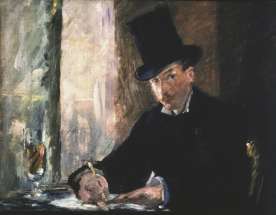
Édouard Manet, Chez Tortoni
CNBC reports that the Chubb Group, which covered Trump’s bond in the E. Jean Carroll case, wasn’t interested in giving Trump any more financial support: Chubb ended Trump fraud bond talks after backing E. Jean Carroll appeal bond, court filing says.
Donald Trump and his co-defendants were in talks with insurance giant Chubb for a $464 million appeal bond in the former president’s civil fraud case, but the company backed out — days after it raised eyebrows for giving Trump a bond in a separate case, according to a Trump lawyer.
Chubb was one of more than 30 companies that refused to craft a bond that would put the massive business fraud judgment on pause, attorneys for Trump said in a New York appeals court filing Monday.
The attorneys in that filing asked the appeals court to “put the brakes” on the judgment before New York Attorney General Letitia James can start to collect on it — a process that could begin as soon as next week. James has said she will seize Trump’s assets if he cannot pay the judgment.
A panel of judges on that court has yet to rule on Trump’s request to pause the judgment without him having to post a fully secured bond.
Alan Garten, a lawyer for the Trump Organization, said in that filing that Chubb was the only company willing to consider underwriting an appeal bond secured by a blend of liquid assets and real property.
The other companies — which included Warren Buffett’s Berkshire Hathaway, Liberty Mutual, Allianz, and Travelers — wanted only cash or other liquid assets.
More details at the link.
In other news . . .
Yesterday the Supreme Court gave Texas the go-ahead to enforce a new law allowing police to arrest people they suspect of being undocumented immigrants. An appeals court quickly blocked the law again, according to the Texas Tribune. Texas’ new immigration law is blocked again.
A federal appeals court late Tuesday night stopped a state law allowing Texas police to arrest people suspected of illegally crossing the Texas-Mexico border — hours after the U.S. Supreme Court had allowed it to go into effect.
Earlier in the day, the high court had allowed the law to go into effect after it sent the case back to the appeals court, urging it to issue a ruling promptly. The appeals court soon scheduled a hearing for Wednesday morning. And on the night before hearing oral arguments the appeals court issued an order to let a lower court’s earlier injunction stopping Senate Bill 4 stand, according to a filing.
Edgar Degas, La Sortie de Pesage
The Supreme Court earlier Tuesday let SB 4 go into effect but stopped short of ruling on the law’s constitutionality, which has been challenged by the Biden administration.
Steve Vladeck, a University of Texas at Austin law professor, said the back-and-forth is “indefensibly chaotic.”
“Even if that means SB 4 remains paused indefinitely, hopefully everyone can agree that this kind of judicial whiplash is bad for everyone,” he said.
SB 4 seeks to make illegally crossing the border a Class B misdemeanor, carrying a punishment of up to six months in jail. Repeat offenders could face a second-degree felony with a punishment of two to 20 years in prison.
The law also requires state judges to order migrants returned to Mexico if they are convicted; local law enforcement would be responsible for transporting migrants to the border. A judge could drop the charges if a migrant agrees to return to Mexico voluntarily.
Mexico isn’t happy with the new Texas Law. The New York Times: Mexico Condemns Texas Law, and Says It Will Not Accept Deportations From the State.
Mexico will not accept deportations made by Texas “under any circumstances,” the country’s foreign ministry said on Tuesday in response to the U.S. Supreme Court’s decision to allow Texas to arrest migrants who cross into the state without authorization.
The ministry condemned the state law, known as Senate Bill 4, saying it would separate families, violate the human rights of migrants and generate “hostile environments” for the more than 10 million people of Mexican origin living in Texas.
Mexico’s top diplomat for North America, Roberto Velasco Álvarez, rejected the ruling on the social media on Tuesday, saying that immigration policy was something to be negotiated between federal governments.
The Mexican government has severely criticized the measure since last year, and rejected the idea of local or state agencies, rather than federal authorities, detaining and returning migrants and asylum seekers to Mexican territory.
More details at the NYT link.
Those are the biggest stories today, as I see it. What do you think? What else is happening?

Camilla Dickerson, Christabel with Cat
I have mostly legal news for you today. I’ll begin with some reactions to the Fani Willis witch hunt down in Georgia.
George Chidi at The Guardian: Is appearance of impropriety enough to oust Fani Willis from Trump case?
Is the appearance of impropriety enough to change the trajectory of the Donald Trump trial in Georgia?
That’s one legal question Scott McAfee, the Fulton county superior court judge, will wrestle with as he contemplates whether to throw the Fulton county district attorney Fani Willis and special prosecutor Nathan Wade off the trial of the former president and co-defendants in the sprawling racketeering and election interference case.
The stakes are high. If Willis is disqualified, it will plunge the prosecution against Trump, and others, into chaos, likely triggering delays that could go beyond the November election. If Willis remains, the prosecution of the former US president for seeking to undermine Georgia’s 2020 election will continue – though it will be badly damaged in terms of political optics.
Defense attorneys argued early in the hearing Friday on the defense motion to remove Willis and her office from the case that the standard for disqualifying Willis requires only that the defense prove the appearance of conflict of interest.
“She is supposed to be disinterested under the sixth amendment, and she has been anything but that,” argued attorney John Merchant, who is representing Michael Roman, a former Trump campaign official and co-defendant in the trial. “If this court allows this kind of behavior to go on … public confidence in the system will be shot.”
Willis’s team countered that the legal standard isn’t an appearance of a conflict, but an actual conflict, and that it’s a high burden that the defense hasn’t met. If Willis had concocted a scheme of self-enrichment with Wade, she would not have approached two other people to lead the prosecution first, nor would she have been pushing for the earliest-possible date to begin the trial, said Adam Abbate, an assistant district attorney for Fulton County.
McAfee expressed a sense of ambiguity in case law related to prosecutorial disqualification, noting that there was no clear-cut previous example resembling the issue before him.
“There are a number of cases that appear to exclusively rely on an appearance of impropriety,” McAfee said. “They acknowledge that there is some ambiguity here.”
Click the link for more discussion of the case. This whole “scandal” seems so silly to me. And why is a defendant in the case given so much credence by the justice system? I question whether this would be happening if Fani Willis were a white man.
At Esquire, Charles Pierce writes: The Fani Willis Evidentiary Hearing Was a Joke.
Down in Fulton County in Georgia, Judge Scott McAfee began hearing closing arguments in the hearings that will determine whether or not Fulton County DA Fani Willis will continue as the prosecutor in her monumental RICO case against a whole mess of defendants, including the mess that is the former president*, accused of conspiring to ratfck the 2020 presidential election in Georgia. Judge McAfee already has said he will need at least two weeks to render the decision. And the stall-ball strategy reaches another judicial arena. Christ, I’d hate to be waiting for some of these judges to make our lunch order. We’d starve.
By Vincenzo Calli
The case is a joke. It literally is a product of one of the people under indictment, a career Republican operative named Michael Roman. It tangled the case all up in Willis’s romance with prosecutor Nathan Wade, which, in turn, tangled the case up in Wade’s divorce proceedings. From the Guardian:
“This was a disqualification hearing that quickly denigrated into a daytime soap opera,” said J Tom Morgan, a former district attorney in DeKalb county, a Fulton county neighbor. “Have they proven a conflict of interest, where this all started, absolutely not.”…It’s not exactly clear what the standard Scott McAfee, the judge overseeing the case, will use to determine whether Willis should be disqualified. Georgia law allows for a prosecutor to be disqualified if there is an actual conflict of interest. Experts say state law has long established this high bar to clear and the defendants in the case have not done so. But McAfee has suggested that defense lawyers may not need to prove an actual conflict, but merely the appearance of one. “I think it’s clear that disqualification can occur if evidence is produced demonstrating an actual conflict or the appearance of one,” he said at a recent hearing.
Oh, I love the sound of that. Judge McAfee needs two weeks to decide whether he feels like Willis has a conflict of interest? Between this, and the Supreme Court’s punting the can down the road and into the Potomac, and Judge Aileen Cannon down in Florida slow-talking everything in the purloined documents case, it is now my considered opinion that the American judicial system needs a damn shot clock.
Now here’s a real legal scandal for you.
Jane Mayer at The New Yorker: The Scandal of Clarence Thomas’s New Clerk.
Last week, Supreme Court Justice Clarence Thomas shocked the legal community when the news broke that one of his new law clerks will be Crystal Clanton—who became notorious in 2015 for apparently sending texts that said, “I HATE BLACK PEOPLE. Like fuck them all . . . I hate blacks. End of story.” For most young lawyers, sending such a text would indeed have been the “end of story.” Instead, Clanton is on the cusp of clinching one of the most coveted prizes in the American legal system. In the past several years, as Clanton has risen through the ranks of conservative legal circles, the story of her alleged racist outburst has been curiously transformed into a tale of victimhood. The new narrative is that Clanton was somehow framed by an unnamed enemy who—for motives that remain unclear—fabricated the racist texts to defame her.
This new account has been greeted with suspicion by many. If the revised story is a lie, then it threatens to implicate not just Justice Thomas, who has endorsed it, but several lower-court federal judges and the leader of a major political group aligned with former President Donald Trump. Indeed, the whole affair may prove one of the most shopworn axioms of political reporting—that the coverup is worse than the crime.
Loe Saalborn Woman with a Cat 1950
When the vile texts were sent, Clanton was the second-in-command and field director of the hard-right youth group Turning Point USA. The organization, a nonprofit advocacy group closely allied with Donald Trump’s Presidential aspirations in 2024, is well known for poisonous rhetoric: its leader, Charlie Kirk, has recently denigrated Martin Luther King, Jr., as “awful,” questioned whether Black pilots are capable of flying planes, and argued that televised public executions, perhaps by guillotine, should be held in America, with young people watching. Yet, even within Turning Point, colleagues were so shocked by the bluntness of Clanton’s alleged texts that they preserved screenshots of the messages, which were shared in 2017 with The New Yorker. At the time, multiple Turning Point employees told me that Clanton was the author of the messages.
In 2017, Clanton told me, via e-mail, that she didn’t recall sending the texts, and that they seemed out of character. But when she was asked directly if she denied sending them she declined to answer. The screenshots of the messages bore her cell-phone number. Another former Turning Point employee, John Ryan O’Rourke, who was the recipient of the texts, said at the time that he preferred not to discuss them. Several other Turning Point colleagues had also seen and circulated the screenshots. And there was more evidence. In addition to the racist comments, the screenshots show Clanton asking, “Can I come to Starbucks in 5?”; she showed up at one, on cue, a few minutes later. (In 2018, the online platform Mediaite revealed another offensive statement by Clanton, sent on Snapchat. The post featured a photograph of a man who appeared to be Arab, accompanied by a caption that she had added: “Just thinking about ways to do another 9/11.”)
Clanton was kicked out Turning Point because of the texts. The Gini Thomas came to the rescue.
The story would likely be long forgotten, were it not for an extremely strange plot twist. After the texting scandal, Ginni Thomas, the lobbyist and politically active wife of Clarence Thomas, who had worked closely with Clanton as an adviser to Turning Point, unofficially adopted Clanton as the couple’s protégée. The Thomases harbor deep anger at the mainstream media, stemming in part from the Justice’s embattled 1991 confirmation hearing, and evidently saw in Clanton a fellow-victim. Soon after leaving Turning Point, Clanton started working for Ginni Thomas. Remarkably, the Thomases then invited Clanton to live with them at their home in exurban Virginia, for the better part of the next year. The couple encouraged Clanton to go to law school, and Justice Thomas himself recommended her when she successfully applied to the Antonin Scalia Law School, at George Mason University. Justice Thomas also helped Clanton, who graduated in 2022, line up a prestigious judicial clerkship with Chief Judge William H. Pryor, Jr., of the U.S. Court of Appeals for the Eleventh Circuit. Pryor is one of the most conservative members of the federal bench, and a well-known “feeder” of clerks to Justice Thomas’s chambers.
Supreme Court clerkships, which last for a year, are extremely valuable in both professional and financial terms. It’s common for former clerks to receive half-a-million-dollar bonuses when they sign on for their first law-firm jobs, and the credential eases the path to coveted academic and political positions. An extraordinary number of Thomas clerks—twenty-two, according to the Associated Press in 2018—populated the high ranks of the Trump Administration or were nominated by Trump for judgeships; others have fanned out across the nation to other prominent posts.
There’s much more at the New Yorker link.
And then there’s the Supreme Court, which appears to be trying to help Trump postpone his federal criminal cases.
Sonja West at Slate: SCOTUS Is Slow-Walking for Trump.
On Wednesday, the Supreme Court announced that it would hear the case in which former President Donald Trump claims a virtually king-like right of absolute immunity from criminal prosecution. The court’s two-paragraph statement grants the case and sets the argument date at the end of April, without explanation. The announcement came with little fanfare, appearing on the court’s website (if you knew where to look) under the yawn-inducing heading of “Miscellaneous Order.”
But while the justices may be attempting to disguise their decision as the normal workings of a court of law, we need to be clear: This was an extraordinarily political act. They had before them a menu of options on how to handle this unprecedented case, and from those options, they chose one of the most beneficial for Trump’s chances of reelection. This is a big deal, and the court should not be allowed to hide its deliberate decisionmaking behind a smokescreen of generic legal maneuvering.
Berény Róbert (Budapest, 1887 – Budapest, 1953)
In fact, at every point in this process, the court has acted exactly as Trump’s legal team wished they would. First, the justices denied a mid-December request to take the question on an expedited basis, forcing it instead to go through a burdensome and predictably meaningless hearing in a lower court. Once the case returned to them, they then stayed silent for a bewildering two weeks before eventually announcing they would take the case. And, finally, they once again refused to act quickly and instead scheduled the oral argument a full seven weeks away, in late April. While technically they could have stalled even longer and refused to hear the case until next fall (and for all we know the late-April date was some sort of compromise position), the result of their judicial foot-dragging is the same: It very likely delays Trump’s election obstruction trial until after the election.
By camouflaging their actions in the banality of court procedure, the justices are obscuring the extent of the power they are exercising. Scholars and journalists who cover the court are left struggling over how to explain to the public the momentousness of what is really happening. “The thing that I find most challenging about covering this Supreme Court is that I have a ‘this is an exceptionally alarming decision’ voice that I try to use very sparingly, so as not to diminish its effectiveness with overuse,” Vox Supreme Court correspondent Ian Millhiser wrote on Threads following the court’s decision on Wednesday. “But I don’t know how to accurately convey what happens in this Court without using it often….
…[S]pecial prosecutor Jack Smith suspected the justices would want the final say on the question, so in mid-December he asked them to please bypass federal appellate court review and instead take the case as quickly as possible. Resolving this issue speedily, Smith told the justices, was of “imperative public importance.” Indeed, public polling shows that whether Trump is charged criminally for these events is one of the things that voters have said would affect their decision in November.
Yet the court refused this request, sending the case to the U.S. Court of Appeals for the D.C. Circuit, where a panel of judges did expedite their review and unanimously upheld Chutkan’s ruling. Trump immediately appealed to the Supreme Court, and Smith once again asked the court to either uphold the lower court’s ruling or decide the case as soon as possible.
More at the link.
David Rothkopf at The Daily Beast: Supreme Court Picks Up Where the Jan. 6 Mob Left Off.
I don’t think most Americans realize how close we are to losing everything we most value about our system of government.
It is not just that the leader of one of our two political parties has declared that if reelected he will assume the powers of a dictator. It is not just that he and his followers actively support enemies of the United States. It is not just that he and members of his party in the U.S. Congress seek to strip away more fundamental rights from American women and men, or that they have already demonstrated they are willing to tolerate egregious abuses of presidential power, or that they will abet efforts to steal election results with which they disagree.
It is all these things. But as we saw again this week, while opponents of fundamental American values control the House of Representatives, have a significant voice in the U.S. Senate, and aspire to reclaim the White House, the branch of government that has been most corrupted by the American right remains the United States Supreme Court.
The Court—through its decision to hear the ludicrous, anti-constitutional arguments of Donald Trump’s lawyers that his actions to steal a presidential election were protected by so-called “presidential immunity”—reminded us that throughout this century the right wing on the court has done grave damage to our country and the judicial system whose oversight has been entrusted to them.
By Joan Barber
Cases like Citizens United (granting the rich more influence in elections), Shelby County (undermining voting rights), Heller (expanding gun rights), Bruen (striking down sensible gun controls), Dobbs (overturning Roe v. Wade), and Students for Fair Admissions (gutting affirmative action) are just a few of the notable examples of their service to their benefactors and their political agenda.
The Court’s decision to hear the Trump immunity case was outrageous, legally indefensible, and handled procedurally in a way that made it clear they were no longer acting as a court, but rather as the judicial arm of the Republican Party.
They took a case they should not have accepted, agreeing to hear arguments that were already rejected in an expertly argued appeals court decision. Just as damagingly, they did so in a way that—regardless of their final ruling—would mean American voters would likely not hear a verdict before November’s election.
It is a dark irony. They have chosen to hear the Department of Justice’s case against Donald Trump for election interference in a way that is itself election interference.
Read the rest at The Daily Beast.
The DC appeals court has upended a large number of January 6 cases that have already been decided.
The Washington Post: Appeals court ruling means over 100 Jan. 6 rioters may be resentenced.
More than 100 people convicted of participation in the Jan. 6, 2021, riot at the Capitol may have to be resentenced after a federal appeals court Friday overturned a sentencing enhancement used to help determine their punishments.
The decision from the U.S. Court of Appeals for the D.C. Circuit came in the case of retired Air Force Lt. Col. Larry R. Brock Jr., who had appealed his felony conviction of obstructing the work of Congress that day. Former president Donald Trump faces the same charge.
The court, a panel of three Democratic appointees, did not overturn the conviction. But it said that a lower court judge erred in deciding that Brock should face a stiffer sentence for “substantial interference with the administration of justice,” ruling that the penalty does not apply to crimes committed at the Capitol.
At least 100 people convicted in connection with the Jan. 6 attack have had their punishments shaped by that enhancement, and they could now ask to be sentenced anew. That does not mean they would necessarily face lighter terms. Sentencing enhancements raise the suggested range of prison time that a judge must consider. But in D.C., judges have generally imposed penalties below those recommended ranges, and they have often said their punishments would be the same regardless of what enhancements they applied.
Resentencing can also be dangerous for defendants. One participant in the riot who succeeded in undoing his 60-day misdemeanor sentence on technical grounds was given another 60 days behind bars by a judge who cited the man’s lack of remorse. (That ruling is now on appeal.)
Still, many will surely ask for lower punishments. Edward Ungvarsky, a defense attorney involved in several Jan. 6 cases, said there is “great potential” for some defendants to win earlier release. “Even if a judge suggested their sentence would be the same regardless of application of any enhancements,” he said, that judge “still has to meaningfully reconsider that sentence.” The ruling could also have an impact in plea negotiations, eliminating a bargaining chip used by prosecutors to encourage defendants to plead guilty without a trial.
Read more at the WaPo.
Finally, I want to recommend this piece by Anne Applebaum at The Atlantic: Why Is Trump Trying to Make Ukraine Lose? The former president isn’t in office—but is still dictating U.S. policy.
Nearly half a year has passed since the White House asked Congress for another round of American aid for Ukraine. Since that time, at least three different legislative efforts to provide weapons, ammunition, and support for the Ukrainian army have failed.
Kevin McCarthy, the former House speaker, was supposed to make sure that the money was made available. But in the course of trying, he lost his job.
BySuzanne Clements
The Senate negotiated a border compromise (including measures border guards said were urgently needed) that was supposed to pass alongside aid to Ukraine. But Senate Republicans who had supported that effort suddenly changed their minds and blocked the legislation.
Finally, the Senate passed another bill, including aid for Ukraine, Taiwan, Israel, and the civilians of Gaza, and sent it to the House. But in order to avoid having to vote on that legislation, the current House speaker, Mike Johnson, sent the House on vacation for two weeks. That bill still hangs in limbo. A majority is prepared to pass it, and would do so if a vote were held. Johnson is maneuvering to prevent that from happening.
Maybe the extraordinary nature of the current moment is hard to see from inside the United States, where so many other stories are competing for attention. But from the outside—from Warsaw, where I live part-time; from Munich, where I attended a major annual security conference earlier this month; from London, Berlin, and other allied capitals—nobody doubts that these circumstances are unprecedented. Donald Trump, who is not the president, is using a minority of Republicans to block aid to Ukraine, to undermine the actual president’s foreign policy, and to weaken American power and credibility.
For outsiders, this reality is mind-boggling, difficult to comprehend and impossible to understand. In the week that the border compromise failed, I happened to meet a senior European Union official visiting Washington. He asked me if congressional Republicans realized that a Russian victory in Ukraine would discredit the United States, weaken American alliances in Europe and Asia, embolden China, encourage Iran, and increase the likelihood of invasions of South Korea or Taiwan. Don’t they realize? Yes, I told him, they realize. Johnson himself said, in February 2022, that a failure to respond to the Russian invasion of Ukraine “empowers other dictators, other terrorists and tyrants around the world … If they perceive that America is weak or unable to act decisively, then it invites aggression in many different ways.” But now the speaker is so frightened by Trump that he no longer cares. Or perhaps he is so afraid of losing his seat that he can’t afford to care. My European colleague shook his head, not because he didn’t believe me, but because it was so hard for him to hear.
Since then, I’ve had a version of that conversation with many other Europeans, in Munich and elsewhere, and indeed many Americans. Intellectually, they understand that the Republican minority is blocking this money on behalf of Trump. They watched first McCarthy, then Johnson, fly to Mar-a-Lago to take instructions. They know that Senator Lindsey Graham, a prominent figure at the Munich Security Conference for decades, backed out abruptly this year after talking with Trump. They see that Donald Trump Jr. routinely attacks legislators who vote for aid to Ukraine, suggesting that they be primaried. The ex-president’s son has also said the U.S. should “cut off the money” to Ukrainians, because “it’s the only way to get them to the table.” In other words, it’s the only way to make Ukraine lose.
Read the rest at The Atlantic. It’s not that long. There is a paywall, but you can usually get one free article.
That’s it for me today. What do think? What other stories have captured your interest?
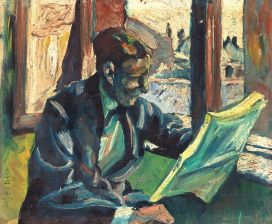
Hugo Scheiber, Man Reading Newspaper, 1918
Yesterday was a huge news day. The top story was the decision by the DC Circuit Court ruling stating that Trump does not have immunity from prosecution for crimes committed as president. Now Trump must decide by Monday whether to take the case to the Supreme Court.
On Thursday, the Supreme Court will hear arguments regarding the Colorado case arguing that the 14th Amendment makes Trump ineligible to appear on the state’s primary ballot.
Trump is also awaiting a decision from Judge Engoron in the New York fraud case that could potentially bankrupt him.
In addition, Republicans in the House and Speaker Mike Johnson failed miserably as he lost two votes he put on the floor: aid to Israel and impeachment of Homeland Security Secretary Alejandro Mayorkas. On top of that, the head of the RNC announced her resignation.
In the Senate, Mitch McConnell knifed Senator James Lankford in the back after assigning him to negotiated a border bill that included aid to Ukraine and Israel. Democrats gave Republicans everything they wanted, but they backed down on Trump’s orders.
I’ll get to as many of these stories as I can.
Kyle Cheney and Josh Gerstein at Politico: Trump is not immune from prosecution for bid to subvert the 2020 election, appeals court rules.
Former President Donald Trump — and indeed any other former president — may be prosecuted for alleged crimes they committed while in office, a federal appeals court panel ruled Tuesday.
The unanimous 57-page decision from a three-judge panel of the D.C. Circuit Court of Appeals is a major win for special counsel Jack Smith, who is seeking to put Trump on trial this year on federal felony charges stemming from his efforts to overturn the 2020 election.
Trump quickly vowed an appeal, which could be at the Supreme Court by Monday.
“For the purpose of this criminal case, former President Trump has become citizen Trump, with all of the defenses of any other criminal defendant,” the D.C. Circuit judges wrote. “But any executive immunity that may have protected him while he served as President no longer protects him against this prosecution.”
The ruling affirms U.S. District Judge Tanya Chutkan’s historic conclusion that former presidents may be prosecuted for crimes they committed in office, even if those alleged crimes arguably related to their official duties. Trump had argued that former presidents could not be prosecuted for such actions without first being impeached and convicted by Congress.
The judges put their decision on hold only until Monday to allow Trump to ask the Supreme Court to take up the immunity fight on an emergency basis. If he does so, the decision won’t take effect until the high court acts on his request, the appeals panel decreed.
Trump could also ask the D.C. Circuit to rehear the case. But the panel said doing that won’t delay the return of the case to Chutkan, the trial judge, unless the full bench of the D.C. Circuit agrees to a rehearing, which requires a majority of the 11 active appellate judges.
The force of Tuesday’s unanimous ruling Tuesday, backed by two liberal judges and one staunch conservative, may have been worth the wait for Smith. Rather than a splintered decision that could be picked apart more easily, the ruling lays out a groundbreaking legal and political framework for bringing a former president to trial.

The Newspaper, by Aldo Luongo
At The Atlantic, George Conway writes: An Airtight Ruling Against Trump. In a masterful opinion, the D.C. Circuit rejected the former president’s bid for immunity.
On July 24, 1974, when the Supreme Court issued its decision in United States v. Nixon, ordering President Richard Nixon to produce the Watergate tapes, the president turned to his chief of staff, Alexander Haig, to understand what had just happened. He later recounted the exchange in his memoirs:
“Unanimous?” I guessed.
“Unanimous. There’s no air in it at all,” he said.
“None at all?” I asked.
“It’s tight as a drum.”
These words echoed through my mind today, nearly 50 years later, as I read the historic opinion of the United States Court of Appeals for the District of Columbia Circuit in United States v. Trump, holding that former President Donald Trump does not enjoy immunity from prosecution for any crimes he committed in attempting to end constitutional democracy in the United States.
The result was no surprise. As I said last month, no one who attended the oral argument could have believed Trump had any chance of prevailing. The question was timing: How long would an appeal delay Trump’s trial, originally scheduled for March 4? Many of us thought that the decision might come sooner, perhaps within days of the argument, given how quickly the court had scheduled briefing and argument. And by the end of last week, some commentators had, by their own reckoning, reached the “freakout stage” as to why the decision was taking so long.
They—and we—needn’t have worried. Issued exactly four weeks after the argument, the court’s decision came plenty fast. It’s not that often that you get a unanimous 57-page decision on novel questions of law in 28 days. And you almost never get an opinion of this quality in such a short period of time. I’ve read thousands of judicial opinions in my four decades as a law student and lawyer. Few have been as good as this one.
Unanimous. No air. Tight as a drum. The court’s per curiam opinion—per curiam meaning “for the court,” in that no individual judge authored it—is all that and more. It’s a masterful example of judicial craftsmanship on many levels. The opinion weaves together the factual context, the constitutional text, the judicial precedent, history, the parties’ concessions, and razor-sharp reasoning, with no modicum of judicial and rhetorical restraint, to produce an overwhelmingly cohesive, and inexorably convincing, whole. The opinion deserves a place in every constitutional-law casebook, and, most important—are you listening, members of the Supreme Court?—requires no further review.
The opinion far exceeds any commentator’s poor power to add or detract, so I’ll mostly let it speak for itself. The bottom line:
For the purpose of this criminal case, former President Trump has become citizen Trump, with all of the defenses of any other criminal defendant. But any executive immunity that may have protected him while he served as President no longer protects him against this prosecution.
I shared this as a gift link (see above), so you should be able to read the whole piece without a subscription.
You can also check out this article at Just Security: How Long Will Trump’s Immunity Appeal Take? Analyzing the Alternative Timelines.
On the Colorado case, Anne E. Marimow writes at The Washington Post: In Trump’s Colorado case, Supreme Court will make and face history.
The Supreme Court on Thursday will confront the critical question of Donald Trump’s eligibility to return to the White House, hearing arguments in an unprecedented case that gives the justices a central role in charting the course of a presidential election for the first time in nearly a quarter-century.

Winter Moonlit Scene by Hendricks Hallett ( American, 1847-1921)
We finally got some snow here in the Boston area. It snowed overnight on Monday and for most of the day yesterday. It’s also quite cold, but our weather can’t compare to the deep freeze that has hit the South. Dakinikat’s house was only 54 degrees indoors this morning!
There’s another storm moving across the Midwest and it will dump more snow in the East over the weekend. I talked to my sister in Portland, OR last night, and they are also getting below normal temperatures. She said there was an ice storm happening when I called her.
In the news, there’s quite a bit about Trump’s legal messes. This post will focus on those as well as some SCOTUS news.
Yesterday was the first day of the second E. Jean Carroll defamation trial. Trump chose to show up, even though he doesn’t need to be there. He’s in court again today; I have to assume he is there trying to intimidate Carroll. Here’s the latest:
CNN: Takeaways from first day of Trump’s defamation trial.
Donald Trump attended the first day of his civil defamation trial, watching as a jury was selected to determine how much, if any, damages the former president must pay to E. Jean Carroll for his 2019 defamatory statements about Carroll’s sexual assault allegations….
Trump watched as prospective jurors were asked about their political donations to him and his political opponents, whether they believed the 2020 election was stolen and how they got their news. He left court before opening statements to travel to New Hampshire for a campaign event Tuesday evening with the primary one week away.
Trump may return to New York later this week for the rest of the trial, and his lawyers have suggested he could testify in the case, though the judge has ruled that Trump cannot try to contest a previous jury’s verdict that he sexually abused and defamed Carroll….
Trump left court Tuesday before opening statements began, where Carroll’s lawyer Shawn Crowley told the jury that it had already been proven that Trump sexually assaulted Carroll in a high-end department store in the 1990s.
That jury’s finding stemmed from statements Trump made in 2022, while the current case is dealing with statements Trump made while he was president in 2019.
“Donald Trump sexually assaulted E. Jean Carroll. He managed to get her alone in an empty department store one evening and sexually assaulted her. That’s a fact,” Crowley said. “That fact has been proven and a jury sitting in the exact seats where you’re sitting now found that it happened.”
Crowley said that Trump’s attacks on her while he was president “unleashed his followers” and caused her to receive threats. “Trump was president when he made those statements, and he used the world’s biggest microphone to attack Ms. Carroll to humiliate her and to destroy her reputation,” Crowley said.
The damages awarded to Carroll “should be significant, very significant,” her lawyer argued.
“You will also be asked to decide how much money Donald Trump should have to pay as punishment for what he’s done and to deter him and others from doing it again,” Crowley said, noting Trump continued to post about her on social media, even as the trial got underway on Tuesday.
Read more at CNN.
David Kurtz in the TPM Morning Memo: Trump Is Playing With Absolute Fire In The Carroll Case. Is Trump About To Get Rudy’d?
Carroll II, the second trial of Donald Trump for defaming E. Jean Carroll by lying about his sexual assault of her, got underway in Manhattan yesterday, and it’s shaping up to be a colossal financial threat to the former president.
Having lost in Carroll I, where a jury concluded he had raped Carroll, Trump is barred from contesting the fact of the rape in Carroll II. The only question is how big are her damages for his defamation.
Spiders from Mars, Phyllis Shafer (American, b.1958)
While jury verdicts are notoriously difficult to predict, this case has the potential to do to Trump what a DC federal jury did to Rudy Giuliani in the defamation case brought against him by Georgia election workers Ruby Freeman and Shaye Moss. The Giuliani jury reached a verdict against him of $148 million, including punitive damages.
Like Giuliani, Trump has been defiant throughout the two Carroll trials, constantly repeating the defamatory statements with impunity, and persisting in attacking the plaintiff even while trial was underway.
Trump was in court Tuesday as jury selection got underway, but his social media operation launched what was clearly a pre-planned full-scale attack on Carroll, including repeating the defamation. (It was perhaps not a coincidence that a key Trump lawyer resigned the night before.)
Trump is risking a substantial punitive damages award by continuing to attack his accuser. It does appear to be a calculated risk, not merely shooting from the hip inadvisably. And that should only fuel the arguments Carroll can make to the jury about how severely it should punish Trump for his misconduct.
In opening statements, Carroll’s lawyers seized on the morning’s developments to urge the jury to make Trump pay until it hurt enough to get him to stop defaming Carroll:
CNBC on today’s fireworks: Judge snaps at Trump lawyer during E. Jean Carroll defamation trial: ‘I said sit down!’
A New York federal judge snapped at a lawyer for Donald Trump on Wednesday after she again asked for a delay in his sex assault defamation trial so that the former president could attend his mother-in-law’s funeral.
“I said sit down!” Judge Lewis Kaplan told Trump’s lawyer Alina Habba.
Habba replied, “I don’t like to be spoken [to] like that … I will not speak to you like that.”
Kaplan shot back, “It is denied. Sit down.”
The judge several times has rejected Habba’s request for a delay in the civil trial in U.S. District Court in Manhattan so that Trump can attend the funeral of Melania Trump’s mother, Amalija Knavs, in Florida on Thursday without missing attending the trial that day.
The tense exchange, which Trump was in court to see, came shortly before the writer E. Jean Carroll was called to the witness stand to testify on the trial’s second day.

Sunset Lake Koocanusa, Patrick Markle, contemporary Canadian artist
From Twitter, NBC’s Kyle Griffin provided quotes from Carroll’s testimony:
“I’m here because I was assaulted by Donald Trump and when I wrote about it, he said it never happened. He lied. And he shattered my reputation.” [….]
E. Jean Carroll on the stand: “I’m 80 years old, so I spent 50 years building a reputation as a magazine and magazine journalist, both in articles and an advice column … People appreciated my articles because I stuck to the truth and used the facts.”
“Previously I was known simply as a journalist, and now I’m known as a liar, a fraud, and a whack job.”
“He has continued to lie. He lied last month. He lied on Sunday. He lied yesterday.” [….]
“To have the president of the United States, one of the most powerful persons on earth, call me a liar for three days and say it 26 times — I counted them. It ended the world I had been living in and I lived in a new world.” [….]
E. Jean Carroll says ever since she came forward with her claim of Trump sexually assaulting her, messages from people haven’t stopped — sometimes receiving hundreds per day. Carroll says the common themes are: accusing her of being a liar, hurting actual victims, and saying she’s ugly.
Josh Gerstein and Kyle Cheney at Politico on another Trump court case: Appeals court won’t revisit Twitter’s fight against Trump probe warrant. But conservative D.C. Circuit judges joined an opinion exalting executive privilege.
A federal appeals court won’t reconsider a ruling that allowed special counsel Jack Smith to access private communications from Donald Trump’s Twitter account.
But even as the court declined to revisit the issue on Tuesday, the court’s conservative judges united to scold their liberal colleagues and the lower-court judge who initially decided the case. Those prior rulings, the conservatives said, amounted to a significant, unjustified erosion of executive privilege.
“Judicial disregard of executive privilege undermines the Presidency, not just the former President being investigated in this case,” the judges wrote in an opinion authored by Trump appointee Neomi Rao.
All four Republican-appointed judges on the D.C. Circuit Court of Appeals extolled the virtues and importance of the president’s right to confidential communications and advice, even though they concluded that the underlying dispute over Smith’s access to Trump’s private Twitter messages was moot.
Ucluelet Sundown, Nicholas Bott (Dutch-Canadian, 1941-2021
Last February, as part of Smith’s investigation of Trump’s bid to subvert the 2020 election, prosecutors obtained a voluminous trove of Trump’s Twitter data after secret court proceedings. A district judge ordered the company, now known as X, to turn over the data without informing Trump, and a three-judge panel of the D.C. Circuit later upheld that decision.
That precedent, the D.C. Circuit’s Republican-appointed judges worried Tuesday, could lead federal and state prosecutors to invade a sitting president’s privileged materials — without advance notification — by simply accessing the materials via a third party like a social media or phone company.
The four conservatives ultimately agreed with seven Democratic-appointed judges on the court that the earlier decision of the three-judge panel — which upheld a $350,000 contempt fine against Twitter — should not be revisited by the full bench of the appeals court. Indeed, despite the lengthy exposition on the merits of executive privilege, no D.C. Circuit judge even called for a vote on rehearing the case by the full bench.
We can’t forget Aileen Cannon and her consistent efforts to help Trump in the stolen documents case.
This is from Dennis Aftergut and Lawrence Tribe at Slate: Judge Aileen Cannon Is Quietly Sabotaging the Trump Classified Documents Case.
On Friday, District Judge Aileen Cannon issued a new order in the Donald Trump classified documents case adding to the mountain of evidence that she is firmly in the former president’s pocket. Trump appointed Cannon in 2020 and the Senate confirmed her appointment in the days after he lost the 2020 election. It’s deeply offensive to the rule of law for judges to bend the law to benefit those who put them on the bench. Sadly, Cannon does just that.
Cannon’s new ruling rejected special counsel Jack Smith’s entirely standard request that she order Trump to state whether he intends to rely on an “advice of counsel” defense ahead of the trial, currently scheduled for May 20. Advance notice of the defense helps expedite a trial because defendants asserting it need to provide additional discovery to prosecutors—raising the defense means that defendants must disclose all communications with their attorneys, as the defense waives the attorney–client privilege.
Judge Cannon’s brief order asserted that Smith’s motion was “not amenable to proper consideration at this juncture, prior to at least partial resolution of pretrial motions” and further discovery.
Sound innocuous? It’s anything but. Instead, it’s part of a pattern we’ve already seen of Cannon laying the groundwork for delaying Trump’s trial—until it’s too late for a jury to be empaneled and the case tried to verdict before the election.
That is, of course, just what Trump has been angling for.
Back in November, Cannon issued an order slow-walking all pretrial motions in the case. As Politico reported, she “has postponed key pretrial deadlines, and she has added further slack into the schedule simply by taking her time to resolve some fairly straightforward matters.”
René Magritte, The Echo, 1944
As Brian Greer, a former Central Intelligence Agency attorney, told Politico, Cannon’s decision not to expedite pretrial motions “could be seen as a stealth attempt to delay the ultimate trial date without actually announcing that yet.”
New York University law professor Andrew Weissmann, the mild-mannered and knowledgeable former deputy to special counsel Robert S. Mueller, put it with uncharacteristic bluntness: “Judge Cannon’s bias is showing over and over again.” On Twitter he declared her to be “in the bag for Trump.”
By continuing to maintain the trial date while rendering the date virtually impossible to keep, Cannon evidently hopes to maintain plausible deniability from charges like Greer’s or Weissmann’s. At the same time, her pretense that the trial will commence on schedule prevents any attempt by Fulton County, Georgia, District Attorney Fani Willis to seek to advance into May the scheduling of her prosecution of Trump for attempting to interfere with Georgia’s 2020 election.
And this is from Igor Derysh at Salon: “Completely out of bounds” Trump filing would delay docs case. Expert says expect a “harsh” response.
Former President Donald Trump’s legal team in a series of new filings on Tuesday signaled that they plan to argue that the intelligence community and the investigation into classified documents found at Mar-a-Lago was “politically motivated and biased.”
The lawyers in a filing to Trump-appointed U.S. District Judge Aileen Cannon accused special counsel Jack Smith of withholding records from Trump and flouting “basic discovery obligations,” according to The Messenger.
Trump attorneys Chris Kise and Todd Blanche alleged that Smith’s team is “seeking to avert its eyes from exculpatory, discoverable evidence in the hands of the senior officials at the White House, DOJ, and FBI who provided guidance and assistance as this lawless mission proceeded, and the agencies that supported the flawed investigation from its inception such as NARA, the Office of the Director of National Intelligence (‘ODNI’), and other politically-charged components of the Intelligence Community.”
The filing requested reams of additional materials from Smith’s team, arguing that the “prosecution team” is larger than the FBI and DOJ.
“The prosecution team includes the Intelligence Community agencies and components that participated in the investigation, such as during classification reviews and damage assessments,” Trump’s lawyers wrote. “This includes the Office of the Director of National Intelligence and the agencies identified in…the Indictment as ‘equity’ holders of some of the documents at issue: the Central Intelligence Agency, the Defense Department, the National Security Agency, the National Geospatial Intelligence Agency, the National Reconnaissance Office, the Department of Energy, and the Statement [sic] Department.”
Former U.S. Attorney Joyce Vance told MSNBC that the filing furthers the “fantastical narrative that Trump is the victim” of a politicized federal branch.
Vance said that while it may be “warranted” for Smith’s team to go back and talk to all of the FBI and DOJ personnel involved in the case, the other parts are “just completely out of bounds.”
“They want the special counsel to go and work with the entire intelligence community to turn over everything in the intelligence community’s possession that touches on anything to do with this,” said Vance. “So I think the safe thing to say is that we should wait for Jack Smith’s response, which will undoubtedly be pretty harsh, given what the defense is requesting here.”
Vance added that the filing also gives Judge Cannon, who has repeatedly delayed proceedings in the case, the “opportunity to delay things even further.”
At what point will it be time for DOJ to appeal to the 11th Circuit?
What’s happening in the Supreme Court? I’ll be brief:
The Supreme Court is about the hear a very scary case. Joyce Vance from Civil Discourse last night: Tomorrow at the Supreme Court.
Tomorrow, Wednesday, the Supreme Court will hear argument in Loper Bright Enterprises v. Raimondo, a pair of cases we’ve discussed in the past that could let conservatives achieve a long-term goal: Disassembling what they call the nanny state and what I think of as executive branch agencies that conduct the nation’s business day in and day out. The goal is to undo 40 years of administrative jurisprudence (so much for precedent!) and end the federal government’s ability to establish and administer rules that balance differing interests and make life better for all of us. Administrative agencies use their expertise to balance different interests and implement procedures on matters like health and safety concerns or consumer financial protection. Because that involves costs and limitations on businesses that can prevent them from being as profitable as they would like to be, some folks oppose leaving these decisions in the hands of career public servants. You will be able to listen to the oral argument here.
Sunset on Mugnone river, 1884, Ulvi Liège (Italian, 1859 – 1938)
Loper Bright is an effort to end or at least severely limit the reach of Chevron deference, a longstanding doctrine that determines when the courts are supposed to defer to an executive branch agency’s interpretation of a law. In 1984, the Supreme Court ruled that courts should defer to administrative agencies’ interpretation of laws when the statutory text is silent or ambiguous. That permits experts and career professionals to decide how to implement vague laws. This case is about whether the courts should substitute their judgment for those of experts on issues involving science, medicine, environmental protection, and so forth.
Conservatives have long sought to prevent federal agencies, like the EPA but also others, from regulating businesses. This case involves a sympathetic-looking small business, overwhelmed by an agency regulatory decision, to make the case that courts should be making the call, not “bureaucrats”. The cornerstone of these cases is the implication that the nanny state is making life impossible for the little guy.
The conservative group Alliance Defending Freedom described Loper Bright like this: “A National Marine Fisheries Service regulation requires that herring fishing boats allow an additional person on board their small boats to serve as a monitor, tracking compliance with federal regulations. The fishermen must also pay the monitor’s salary of around $700 per day. Overall, the regulation reduces fishing profits by about 20%. Loper Bright Enterprises, a fishing company in New England, and other fisheries sued to challenge this federal government rule, arguing that NMFS lacked statutory authority to force them to pay for these monitors.” Of course, this narrative ignores the importance of monitoring. And the point of the litigation isn’t really to provide relief for small businesses. It’s all about shifting decision-making about the regulation of big business out of the hands of agencies and into the courts, where conservatives believe they get a better reception. This has been the work of decades—ever since the Chevron case was decided.
Read more at Civil Discourse.
Neil Gorsuch is in the spotlight for this case. Three pieces to check out:
CNN: Neil Gorsuch has a grudge against federal agencies. He holds their fate in his hands.
The Guardian: Gorsuch urged to recuse himself from supreme court case over ties to oil baron.
The New Republic: Billionaire Poised to See Return on Investment in Neil Gorsuch.
Another Scotus case could affect Jack Smith’s prosecution of Trump.
As the Supreme Court gears up to decide if Donald Trump’s claims of immunity from prosecution are legitimate, another case in front of the court threatens to upend special counsel Jack Smith’s prosecution of him, Politico reported.
Incredible Winter Evening, by Paul Evans, 2023
The case, Joseph W. Fischer v. United States, has raised the issue of whether the Department of Justice has been improperly using a law originally aimed at curbing financial crimes to prosecute Jan. 6 defendant Joseph Fischer. As Politico points out, if the Court rules in Fischer’s favor, it would undermine Smith’s use of the law against Trump, as well as other Jan. 6 defendants.
Two of the four counts in Smith’s indictment are for obstruction of an official proceeding and for conspiracy to do so. According to Politico, those crimes “are part of a relatively recent criminal statute governing financial disclosures known as the Sarbanes-Oxley (or “SOX”) Act, which was enacted following the Enron corporate accounting scandal, and which makes it a crime to obstruct an official proceeding of the U.S. government.”
So far, the Justice Department has used the law to charge over 300 Jan. 6 defendants, and more than 150 have been convicted.
Fischer, as well as other defendants, argues that the “obstruction of an official proceeding” part of the law was only meant to apply narrowly to financial crimes — not the broad definition as relied on by the government.
“The impact of Fischer on the Jan. 6 trial against Trump might not be known until after the Supreme Court wraps up its term in June, at which point it could knock out half of Smith’s counts against Trump. And it could also disrupt the convictions of many Jan. 6 defendants already serving time for their role in the insurrection,” Politico’s report stated.
Read the full report over at Politico.
That’s it for me today. What stories have you been following?
 peej
peej Carissa
 bostonboomer
 dakinikat
 ecocatwoman
 jjlo
jjlo mablue2
 Mama Lopez
 peggysue22
 quixote
 skydancingguestblogger
 Mona (aka Wonk the Vote)
 Memeorandum Crooks and Liars Democracy NOW The UK Guardian
The Sky Dancing banner headline uses a snippet from a work by artist Tashi Mannox called 'Rainbow Study'. The work is described as a" study of typical Tibetan rainbow clouds, that feature in Thanka painting, temple decoration and silk brocades". dakinikat was immediately drawn to the image when trying to find stylized Tibetan Clouds to represent Sky Dancing. It is probably because Tashi's practice is similar to her own. His updated take on the clouds that fill the collection of traditional thankas is quite special.
You can find his work at his website by clicking on his logo below. He is also a calligraphy artist that uses important vajrayana syllables. We encourage you to visit his on line studio.







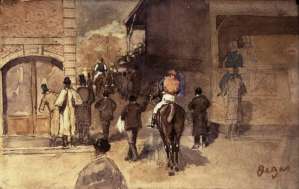















 Sky Dancing
Recent Comments