Last year in Massachusetts we had a winter with almost no snow. Weather people quite often predicted it, but it never came. It really bothered me. I realized how much I love snowstorms and how much I miss snow when it doesn’t arrive. It looks like this year will be another mild winter with very little snow. We got a few inches recently, but mostly we’re getting rain.
I’m far from alone in missing snow. A few days ago, I came across two articles about what climate change is doing to our winters.
In January 1995, when The Atlantic published “In Praise of Snow,” Cullen Murphy’s opus to frozen precipitation, snow was still a mysterious substance, coming and going enigmatically, confounding forecasters’ attempts to make long-term predictions. Climate change registered to snow hydrologists as a future problem, but for the most part their job remained squarely hydrology: working out the ticktock of a highly variable yet presumably coherent water cycle. “We still don’t know many fundamental things about snow,” Murphy wrote. “Nor do we understand its relation to weather and to climate—the dynamics of climate being one of the perennials on the ‘must figure out’ list of science.”
In January 2024, at long last, someone has figured out a formula of sorts for how snow reacts to climate change, and the answer is: It reacts nonlinearly. Which is to say, if we think snow is getting scarce now, we ought to buckle up.
Nonlinear relationships indicate accelerated change; shifts are small for a while but then, past a certain threshold, escalate quickly. In a paper published Wednesday in the journal Nature, two Dartmouth researchers report finding a distinctly nonlinear relationship between increasing winter temperatures and declining snowpacks. And they identify a “snow loss cliff”—an average winter-temperature threshold below which snowpack is largely unaffected, but above which things begin to change fast.
That threshold is 17 degrees Fahrenheit. Remarkably, 80 percent of the Northern Hemisphere’s snowpack exists in far-northern, high-altitude places that, for now, on average, stay colder than that. There, the snowpack seems to be healthy and stable, or even increasing. But as a general rule, when the average winter temperature exceeds 17 degrees (–8 degrees Celsius), snowpack loss begins, and accelerates dramatically with each additional degree of warming.
Already, millions of people who rely on the snowpack for water live in places that have crossed that threshold and will only get hotter. “A degree beyond that might take away 5 to 10 percent of the snowpack, then the next degree might cut away 10 to 15 percent, then 15 to 20 percent,” Alexander Gottlieb, the first author on the paper, told me over the phone as I looked out my window in New York City, where it has rained several times over the past few days. “Once you get around the freezing point”—32 degrees Fahrenheit—“you can lose almost half of your snow from just an additional degree of warming,” he said. New York City, which was recently reclassified as a “humid subtropical” climate, has clocked nearly 700 consecutive days with less than an inch of snowfall. It’s definitely over the snow-loss cliff, and as global temperatures increase, more places will follow.
By Malysheva Nastenka
Gottlieb and his co-author, Justin Mankin, figured this out by looking at how changes in temperature and precipitation drove changes in snowpack in 169 river basins across the Northern Hemisphere from 1981 through 2020. Using machine learning, they found a clear signal that human-induced climate change was indeed forcing changes in the snowpack in the places where most people live. The sharpest declines were in the watersheds of the southwestern and northeastern United States, and in Central and Eastern Europe. “In places where we are able to identify this really clear signal that climate change has reduced spring snowpack, we expect that to really only accelerate in the near term,” he said. “Those are places where the train has already kind of left the station.” Indeed, the Hudson River watershed, in which New York City sits, experienced among the steepest declines over that period. In the Northeast, which is not as reliant on spring snowmelt for water, that loss is felt most keenly as a loss of recreation; whole economies in the Northeast are based on skiing.
In the Mountain West, the stakes are even higher. Hydrologists already worry about the future reliability of the region’s snow-fed water supply: Previous research found snowless winters in the Mountain West are likely to be a regular occurrence by mid-century. But crucially, Gottlieb doesn’t see any room for cheerfulness about individual years with off-the-charts snowfall, such as last year’s record snowpack in the Colorado River basin. “This work really shows that we can definitely still get these one-off anomaly years that are incredibly wet, incredibly snowy, but the long-term signal is incredibly clear,” he said. Once you’re over the cliff, there’s no going back. The snow will keep disappearing.
In this piece, Lora Kelley interviews Zoë Schlanger (author of the previous article) on “the sense of loss when climate change transforms winter”: The Feeling of Losing Snow. Kelley and Schlanger mostly rehash the information from the previous article, but they also discussed the feeling of losing snowy winters:
Zoe: One of the hydrologists I spoke with was a former ski-patrol person, and he was talking so beautifully about what it meant for him to ski on a cold, bright day high in the mountains in Utah with perfect powder. It was just so vital to his enjoyment of life. For future generations, snow could just become slush, or not be there at all.
I don’t ski. I don’t live in the mountains. But even for me, there’s a sense of loss. It makes me think of a word that an Australian philosopher coined a number of years ago: solastalgia, which is essentially the sense of homesickness for an environment that you never left, but is leaving without you in some way. I feel like we’re all experiencing that when there are these touchstones of the year that seem to not be there anymore. It’s a strange sense of in-place homesickness.
Lora: This strikes me as a really stark example of climate change affecting how people experience nature. How do you think about these more obvious losses versus less visible, more incremental changes to the environment?
Zoë: Snow is a reminder that, actually, a lot of the changes we’re dealing with aren’t that incremental. We may not be able to see rising temperatures in quite the same way. But in many cases, those changes are just as sudden and dramatic and are happening faster than people thought they were. The wildfires we saw last year, for example, were wildly out of proportion from anything we’ve seen before. Records aren’t getting broken by small degrees now. They’re getting broken by leaps and bounds.
Climate change is real, it’s happening quickly, and it affects our lives in so many ways.
The Supreme Court will decide this term whether states can force doctors to turn away patients suffering serious, life-threatening medical complications, or if doctors will be allowed to provide standard medical care to those patients: abortions. The court announced last week it will hear arguments over the Emergency Medical Treatment and Active Labor Act, or EMTALA, in April.
By Vicky Mount
EMTALA is a more than three-decade-old federal law that says hospitals that accept Medicare (most hospitals in this country) cannot turn away anyone with an emergency medical condition; they are required to provide stabilizing treatment to prevent that person from suffering serious medical complications. After Roe v. Wade was overruled in 2022, the Biden administration issued guidance clarifying that if a pregnant patient arrives at a hospital with an emergency condition that could only be stabilized with an abortion, the hospital is required to provide that care — regardless of state law.
To the Supreme Court, Idaho has argued that states — not doctors, and not the federal government — should be permitted to decide what kind of emergency medical care women can receive. “The federal government cannot use EMTALA to override in the emergency room state laws about abortion any more than it can use it to override state law on organ transplants or marijuana use,” the state’s attorney general wrote in its petition to the high court.
Lawyers for the Department of Justice sued the state of Idaho last year over the criminal abortion ban passed by the GOP-controlled legislature, which only allows for abortions to prevent a patient’s death — language one Idaho doctor said “is not useful to medical providers because this is not a dichotomous variable.”
The Biden administration argued the Idaho law violates care requirements mandated by EMTALA, and a lower court agreed, blocking the law as it applied to medical emergencies. But on Jan. 5, the Supreme Court lifted the lower court injunction, reinstating the ban and sending the chilling message to Idaho doctors that they cannot offer the care they have been trained to provide to pregnant patients without fear of criminal prosecution.
Nancy Northup, president of the Center for Reproductive Rights, called the Supreme Court’s intervention in the case “deeply troubling.”
“EMTALA is currently the only federal protection for patients who need emergency abortions. If the Supreme Court eviscerates that, there is no doubt that people will die,” Northup said in a statement.
The Supreme Court said Friday it will consider whether state and local officials can punish homeless individuals for camping and sleeping in public spaces when shelter beds are unavailable.
The justices will review a lower court decision that declared it unconstitutional to enforce anti-camping laws against homeless individuals when they have nowhere else to sleep.
Photo by Frank Herfort
The U.S. Court of Appeals for the 9th Circuit, which covers Western states, including California, Oregon and Washington, first held in 2018 that the Eighth Amendment’s protection against cruel and unusual punishment prohibits cities from criminalizing public camping when shelter is unavailable.
The city of Grants Pass, Ore., asked the justices to overturn a similar recent decision involving civil fines and warned that the ruling would paralyze cities across the West from addressing safety and public health risks created by tents and makeshift structures. The 9th Circuit’s decision, the officials said, is standing in the way of a comprehensive response to the growth of public encampments.
“The consequences of inaction are dire for those living both in and near encampments: crime, fires, the reemergence of medieval diseases, environmental harm and record levels of drug overdoses and deaths on public streets,” lawyers for the city told the high court.
The Supreme Court agreed Friday to hear Starbucks’s appeal of a decision ordering the coffee chain to reinstate seven terminated employees, who were part of a high-profile union drive and became known as the “Memphis Seven.”
With implications for labor organizing more broadly, the justices will take up the case to decide the proper standard for court injunctions requested by the National Labor Relations Board (NLRB) as they battle against employers in administrative proceedings.
The injunctions, aimed at keeping the status quo, have forced companies to reinstate employees, keep facilities open and pause corporate policy changes as the NLRB adjudicates alleged unfair labor practices.
Federal appeals courts have been split on what test the NLRB must clear to receive such an order, however.
Starbucks, backed by the U.S. Chamber of Commerce and other business interests, argues that some courts — like the one that ordered the Memphis Seven be reinstated — have been too lenient, emboldening the NLRB to interfere with employers without due cause.
“That split carries enormous consequences for employers nationwide and unacceptably threatens the uniformity of federal labor law,” Starbucks’s attorneys wrote to the justices.
Hunter Biden offered on Friday to comply with any new subpoena and testify in private before House Republicans seeking to impeach his father over alleged but unproven corruption, an attorney for Joe Biden’s son said.
By Troy Brooks
“If you issue a new proper subpoena, now that there is a duly authorised impeachment inquiry, Mr Biden will comply for a hearing or deposition,” Abbe Lowell wrote to James Comer and Jim Jordan, the Republican chairs of the oversight and judiciary committees.
“We will accept such a subpoena on Mr Biden’s behalf.”
Republicans are interested in Hunter Biden’s business dealings and struggles with addiction. Outside Congress, he faces criminal charges over a gun purchase and his tax affairs that carry maximum prison sentences of 25 and 17 years. In Los Angeles on Thursday, he added a not guilty plea in the tax case to the same plea in the gun case.
Biden previously refused to comply with a congressional subpoena for testimony in private, giving a press conference on Capitol Hill to say he would talk if the session were public.
On Wednesday, Comer held a hearing to consider a resolution to hold Biden in contempt of Congress, a charge that can result in a fine and jail time.
The hearing descended into chaos with Biden and Lowell making a surprise appearance, sitting in the audience while Republicans and Democrats traded partisan barbs. The resolution was sent to the full House for a vote. The White House said Joe Biden had not been told of his son’s plan to attend the oversight hearing.
The Internal Revenue Service said Friday that it has collected more than $500 million from wealthy tax dodgers since 2022, thanks to a funding boost that is now in jeopardy as Republican lawmakers work to claw back tens of billions of dollars from the agency.
The IRS has used a budget increase approved under the Inflation Reduction Act to ramp up enforcement efforts, targeting millionaires over significant sums of unpaid taxes. The agency announced Friday that it has retrieved $520 million through its new initiatives.
“This is why we fought for a fully funded IRS, and why it’s so reckless for Republicans to try to slash its budget again,” Rep. Gerry Connolly (D-Va.) wrote in response to the agency’s announcement.
The congressional GOP, which has long worked to starve the IRS of funding in service to rich tax cheats, is aiming to more quickly implement $20 billion in cuts that they secured as part of last year’s bipartisan deal to raise the debt ceiling, potentially compromising tax enforcement. The $20 billion represents a quarter of the $80 billion IRS funding boost in the Inflation Reduction Act, which Republicans unanimously opposed.
Under a spending tentative agreement that congressional leaders announced this past weekend, the $20 billion in IRS cuts would be frontloaded to 2024 instead of being spread out over two years. The deal still must pass Congress—hardly a forgone conclusion as far-right Republicans push House Speaker Mike Johnson (R-La.) to back out of the agreement, complaining that government spending is too high overall.
Even as the Biden reelection campaign forges ahead with preparations for another potential general election match-up between Biden and his predecessor, it is grappling with a stubborn reality: The majority of undecided voters simply do not seem to believe – at least not yet – that Donald Trump is likely to be the Republican presidential nominee.
According to the campaign’s internal research, this is the case for most of the undecided voters that the campaign is targeting – nearly three-in-four of them, senior Biden campaign officials told CNN. Those officials said one of the biggest reasons driving this is the simple fact that many voters are not paying close attention to the election, including the ins and outs of the GOP nomination process.
“You can’t conceive of how tuned out these folks are,” one senior campaign official said.
To that end, Biden campaign officials see the task of helping voters recognize that Trump is a strong frontrunner as one of their most important and urgent challenges, with the first GOP caucus in Iowa now just days away. A key part of that work is painting a vivid picture of what a second term of a Trump White House would look like.
At some point in the near future, Biden campaign officials say they expect that a switch will turn on for many of these voters who are not yet convinced that Trump is likely to be on the ballot in the fall. As one senior official put it, a realization will hit: “Oh s—, it is an election between that guy and that guy.”
But what’s impossible for the campaign to predict at this point in the election cycle is when exactly it will click for voters that “that guy” – Trump – is poised to be the GOP presidential nominee. Just 20% of the public has been paying a lot of attention to the 2024 presidential campaign, according to an AP-NORC poll from the end of last year; meanwhile, 47% said they have paid little or no attention.
Across Iowa, as the first nominating contest approaches on Monday, voters plow through snowy streets to hear from candidates, mingle at campaign events and casually talk of the prospect of World War III, civil unrest and a nation coming apart at the seams.
Four years ago, voters worried about a spiraling pandemic, economic uncertainty and national protests. Now, in the first presidential election since the siege on the Capitol on Jan. 6, 2021, those anxieties have metastasized into a grimmer, more existential dread about the very foundations of the American experiment.
“You get the feeling in Iowa right now that we’re sleepwalking into a nightmare and there’s nothing we can do about it,” said Doug Gross, a Republican lawyer who has been involved in Iowa politics for nearly four decades, ran for governor in 2002 and plans to support Nikki Haley in the state’s caucuses on Monday. “In Iowa, life isn’t lived in extremes, except the weather, and yet they still feel this dramatic sense of inevitable doom.”
Donald J. Trump, the dominant front-runner in the Republican primary race, bounces from courtroom to campaign trail, lacing his rhetoric with ominous threats of retribution and suggestions of dictatorial tendencies. President Biden condemns political violence and argues that if he loses, democracy itself could falter.
Bill Bradley, 80, who served for 18 years as a New Jersey senator, remembered when he ran for the Democratic presidential nomination in 2000, spending more than 75 days in Iowa during his bid. “We debated health care and taxes, which is reasonable,” he said, adding, “Civil war? No. World War III? No, no, no.”
This presidential race, he said, is “a moment that is different than any election in my lifetime.”
Read more at the NYT.
Photographer unknown
There is so much Trump legal news today, that I’m just going to link to the articles, and you can decide what you want to read.
Today is the third anniversary of the January 6, 2001 Capitol insurrection, which Trump incited and applauded. It was a failed coup attempt–a last ditch effort to keep Trump in power after all his legal efforts had failed.
Yesterday, President Biden spoke about the insurrection in the first speech of his campaign for reelection, and it was a barn-burner.
This time it’s personal. On Friday Joe Biden tore into his predecessor Donald Trump as never before. He brimmed with anger, disdain and contempt. He apparently had to stop himself from swearing. So much for “when they go low, we go high” – and plenty of Democrats will be just fine with that.
If Biden was seeking to jolt his half-conscious 2024 re-election campaign into life, this may have done the trick. The palpable loathing of Trump took a good 10 or 20 years off him. Keep hating like this and he might do a Benjamin Button all the way to election day.
There is no better illustration of Biden’s evolution than a speech he delivered on the first anniversary of the January 6 insurrection. On that occasion, he denounced a “web of lies” but never mentioned Trump by name, preferring to cite the “former president”. Those were still the days when he would talk about “the former guy” and get a laugh.
Two years on, in an address near Valley Forge, Pennsylvania, Biden spoke the name “Trump” more than 40 times in less than an hour as he warned that his likely 2024 opponent would sacrifice American democracy to put himself in power. The 81-year-old president generally seems like a grandfatherly figure predisposed to give people the benefit of the doubt, which makes his detestation of Trump all the more striking.
Trump’s failure to act as a violent mob stormed the US Capitol, despite the pleas of staff and family members, was “among the worst derelictions of duty by a president in American history”, Biden said, noting that Trump went on to lose 60 court cases that took him back to the truth “that I had won the election and he was a loser”….
The president went on to recall how Trump has called the insurrectionists “patriots” and claimed there was a “lot of love” on January 6. At that, Biden shook his head, blinked and let out a gasp of disbelief, as if stunned anew by the assertion. “The rest of the nation, including law enforcement, saw a lot of hate and violence,” he said.
Biden furiously denounced political violence and Trump’s habit of joking about the big lie-influenced intruder who attacked Paul Pelosi, the former House speaker Nancy Pelosi’s husband, with a hammer, saying: “And he thinks that’s funny. He laughed about it. What a sick – ”
He halted. At the last moment, the president of the United States had saved himself from uttering a profanity. The urge coursed through his body and found relief in his hands, which clenched into fists, as the crowd filled in with laughter and whooping. “My God,” Biden said. “I think it’s despicable, seriously, not just for a president but for any person to say that.”
Read the rest at The Guardian. Read the full transcript of Biden’s speech at The White House site.
President Biden on Friday delivered a ferocious condemnation of Donald J. Trump, his likely 2024 opponent, warning in searing language that the former president had directed an insurrection and would aim to undo the nation’s bedrock democracy if he returned to power.
On the eve of the third anniversary of the Jan. 6, 2021, attack on the Capitol by Mr. Trump’s supporters, Mr. Biden framed the coming election as a choice between a candidate devoted to upholding America’s centuries-old ideals and a chaos agent willing to discard them for his personal benefit.
“There’s no confusion about who Trump is or what he intends to do,” Mr. Biden warned in a speech at a community college not far from Valley Forge in Pennsylvania, where George Washington commanded troops during the Revolutionary War. Exhorting supporters to prepare to vote this fall, he said: “We all know who Donald Trump is. The question is: Who are we?”
In an intensely personal address that at one point nearly led Mr. Biden to curse Mr. Trump by name, the president compared his rival to foreign autocrats who rule by fiat and lies. He said Mr. Trump had failed the basic test of American leaders, to trust the people to choose their elected officials and abide by their decisions.
“We must be clear,” Mr. Biden said. “Democracy is on the ballot. Your freedom is on the ballot.”
The harshness of Mr. Biden’s attack on his rival illustrated both what his campaign believes to be the stakes of the 2024 election and his perilous political standing. Confronted with low approval ratings, bad head-to-head polling against Mr. Trump, worries about his age and lingering unease with the economy, Mr. Biden is turning increasingly to the figure who has proved to be Democrats’ single best motivator.
In a speech in New Hampshire, Liz Cheney also issued a dire warning.
On the eve of the third anniversary of the Jan. 6 insurrection, former Rep. Liz Cheney (R-WY) warned the 2024 election could be the nation’s last.
Speaking to a room full of Dartmouth College students, Cheney expressed her belief that former President Donald Trump would refuse to hand over the reins of power if elected to a second term.
“He won’t leave office,” Cheney said. “He already tried not to leave office once. So I think there’s a lot of living in a fantasy world that’s going on with Republicans telling themselves, ‘Look, we’ll vote for him, it won’t be so bad.’ It may well be the last real vote you ever get to cast. It will be that bad.”
Giant Cats, artist unknown
What’s more, Cheney looks at her former colleagues in Congress and sees a group of enablers who would happily acquiesce to Trump’s designs and help muscle him back to power if the 2024 election result is in doubt.
The biggest enabler of all, Cheney said, might be her former “good friend” Mike Johnson—the backbencher turned Speaker of the House.
If no presidential candidate is able to secure 270 electoral votes in November, the decision could head to a House floor controlled by Johnson, the architect of the House GOP’s legal efforts to swing the last election to Trump.
“I think we need to be concerned about a Mike Johnson speakership, particularly in an instance where there’s a contested election,” Cheney said on Friday. “It’s a dangerous situation if the Republicans are in the majority.”
Authorities are still working to identify more than 80 people wanted for acts of violence at the Capitol and to find out who placed pipe bombs outside the Republican and Democratic national committees’ offices the day before the Capitol attack. And they continue to regularly make new arrests, even as some Jan. 6 defendants are being released from prison after completing their sentences.
The cases are playing out at the same courthouse where Donald Trump is scheduled to stand trial in March in the case accusing the former president of conspiring to overturn his 2020 election loss in the run-up to the Capitol attack….
More than 1,230 people have been charged with federal crimes in the riot, ranging from misdemeanor offenses like trespassing to felonies like assaulting police officers and seditious conspiracy. Roughly 730 people have pleaded guilty to charges, while another roughly 170 have been convicted of at least one charge at a trial decided by a judge or a jury, according to an Associated Press database.
Only two defendants have been acquitted of all charges, and those were trials decided by a judge rather than a jury.
About 750 people have been sentenced, with almost two-thirds receiving some time behind bars. Prison sentences have ranged from a few days of intermittent confinement to 22 years in prison. The longest sentence was handed down to Enrique Tarrio, the former Proud Boys national chairman who was convicted of seditious conspiracy for what prosecutors described as a plot to stop the transfer of power from Trump, a Republican, to Joe Biden, a Democrat….
Defense attorneys and prosecutors are closely watching a case that will soon be heard by the U.S. Supreme Court that could impact hundreds of Jan. 6 defendants. The justices agreed last month to hear one rioter’s challenge to prosecutors’ use of the charge of obstruction of an official proceeding, which refers to the disruption of Congress’ certification of Biden’s 2020 presidential election victory over Trump.
More than 300 Jan. 6 defendants have been charged with the obstruction offense, and so has Trump in the federal case brought by special counsel Jack Smith. Lawyers representing rioters have argued the charge was inappropriately brought against Jan. 6 defendants.
The justices will hear arguments in March or April, with a decision expected by early summer. But their review of the obstruction charge is already having some impact on the Jan. 6 prosecutions. At least two defendants have convinced judges to delay their sentencings until after the Supreme Court rules on the matter.
On the pipe bombs:
One of the biggest remaining mysteries surrounding the riot is the identity of the person who placed two pipe bombs outside the offices of the Republican and Democratic national committees the day before the Capitol attack. Last year, authorities increased the reward to up to $500,000 for information leading to the person’s arrest. It remains unclear whether there was a connection between the pipe bombs and the riot.
Giant Cat with a Wireless Tail, by 3d1viner
One of the biggest remaining mysteries surrounding the riot is the identity of the person who placed two pipe bombs outside the offices of the Republican and Democratic national committees the day before the Capitol attack. Last year, authorities increased the reward to up to $500,000 for information leading to the person’s arrest. It remains unclear whether there was a connection between the pipe bombs and the riot….
The explosive devices were placed outside the two buildings between 7:30 p.m. and 8:30 p.m. on Jan. 5, 2021, but officers didn’t find them until the next day. Authorities were called to the Republican National Committee’s office around 12:45 p.m. on Jan. 6. Shortly after, a call came in for a similar explosive device found at the Democratic National Committee headquarters. The bombs were rendered safe, and no one was hurt.
Video released by the FBI shows a person in a gray hooded sweatshirt, a face mask and gloves appearing to place one of the explosives under a bench outside the DNC and separately shows the person walking in an alley near the RNC before the bomb was placed there. The person wore black and light gray Nike Air Max Speed Turf sneakers with a yellow logo.
In other news, the Supreme Court has agreed to decide whether Trump can be kept off the Colorado primary ballot. Their decision will obviously affect the other similar cases in multiple states. This week, efforts to disqualify Trump based on the 14th Amendment were initiated in Illinois and Massachusetts.
The Supreme Court agreed on Friday to decide whether former President Donald J. Trump is eligible for Colorado’s Republican primary ballot, thrusting the justices into a pivotal role that could alter the course of this year’s presidential election.
The sweep of the court’s ruling is likely to be broad. It will probably resolve not only whether Mr. Trump may appear on the Colorado primary ballot after the state’s top court declared that he had engaged in insurrection in his efforts to subvert the 2020 election, but it will most likely also determine his eligibility to run in the general election and to hold office at all.
Not since Bush v. Gore, the 2000 decision that handed the presidency to George W. Bush, has the Supreme Court taken such a central role in an election for the nation’s highest office.
The case will be argued on Feb. 8, and the court will probably decide it quickly. The Colorado Republican Party had urged the justices to rule by March 5, when many states, including Colorado, hold primaries.
The case is one of several involving or affecting Mr. Trump on the court’s docket or on the horizon. An appeals court will hear arguments on Tuesday on whether he has absolute immunity from prosecution, and the losing side is all but certain to appeal. And the court has already said that it will rule on the scope of a central charge in the federal election-interference case in a decision expected by June.
Mr. Trump asked the Supreme Court to intervene after Colorado’s top court disqualified him from the ballot last month. That decision is on hold while the justices consider the matter.
Cathedral of St. Paul, by JReischl on Deviant Art
The Supreme Court also agreed to hear an abortion case yesterday, and, since it *only* involves women’s lives and safety, it was overshadowed by the Trump eligibility case. But this one is horrific.
The Supreme Court said Friday it will review a case challenging Idaho’s strict abortion ban, which the Biden administration says conflicts with a federal law requiring emergency room doctors to perform the procedure in some circumstances.
Idaho’s attorney general asked the justices to intervene after a lower-court judge blocked a section of Idaho’s abortion statute targeting doctors. The judge said the provision violates a federal law that requires hospitals receiving Medicare funding to guarantee emergency care. In its brief order Friday, the justices allowed the Idaho law to take full effect for now and said they would review the matter on an expedited basis in April.
The Biden administration turned to the Medicare law as a narrow way to challenge state-level abortion bans in federal court after the Supreme Court’s conservative majority overturned the fundamental right to an abortion established decades earlier in Roe v. Wade. The effort was seen as one of the few paths the administration could pursue to preserve access to abortion, which remains a galvanizing and divisive issue across the country in the lead-up to the 2024 presidential election.
The issue of access to abortion in health emergencies is not the only reproductive-rights case to reach the high court this term. The justices also will decide whether to limit access to the widely used abortion medication mifepristone, first approved by the Food and Drug Administration more than 20 years ago.
Idaho was one of several states to pass a “trigger” law before the 2022 decision in Dobbs v. Jackson Women’s Health, with the expectation that it would automatically take effect if the high court overturned Roe. The Idaho law, passed in 2020, bans most abortions and imposes penalties of up to five years in prison on doctors who perform the procedure, with an exception when “necessary to prevent the death of a pregnant woman.”
Abortion rights advocates and medical experts say the Idaho law, and similar bans in more than two dozen other states, have put doctors and hospitals at legal risk as they navigate life-or-death decisions for pregnant patients and seek to interpret vague medical exceptions to decide whether it is permissible in some circumstances to terminate a pregnancy.
The Supreme Court on Friday allowed Idaho to enforce its strict abortion ban, even in medical emergencies, while a legal fight continues.
The justices said they would hear arguments in April and put on hold a lower court ruling that had blocked the Idaho law in hospital emergencies, based on a lawsuit filed by the Biden administration.
The Idaho case gives the court its second major abortion dispute since the justices in 2022 overturned Roe v. Wade and allowed states to severely restrict or ban abortion. The court also in the coming months is hearing a challenge to the Food and Drug Administration’s rules for obtaining mifepristone, one of two medications used in the most common method of abortion in the United States.
In the case over hospital emergencies, the Biden administration has argued that hospitals that receive Medicare funds are required by federal law to provide emergency care, potentially including abortion, no matter if there’s a state law banning abortion.
U.S. District Judge B. Lynn Winmill in Idaho agreed with the administration. But in a separate case in Texas, a judge sided with the state.
Idaho makes it a crime with a prison term of up to five years for anyone who performs or assists in an abortion.
Today’s Supreme Court order allows Idaho’s extreme abortion ban to go back into effect and denies women critical emergency abortion care required by federal law. The overturning of Roe v. Wade has enabled Republican elected officials to pursue dangerous abortion bans like this one that continue to jeopardize women’s health, force them to travel out of state for care, and make it harder for doctors to provide care, including in an emergency. These bans are also forcing doctors to leave Idaho and other states because of laws that interfere with their ability to care for their patients. This should never happen in America.
The Vice President and I believe that health care decisions should be made by women and their doctors, not politicians. We will continue to defend a woman’s ability to access emergency care under federal law. As this case continues, the stakes could not be higher for women across America. Congress must immediately restore the protections of Roe v. Wade so that women in every state can access the health care they need.
That’s it for me today. What else is happening?
Did you like this post? Please share it with your friends:
Benson B. Moore, born Washington, DC 1882-died Stuart, FL 1974
We’ve nearly reached the end of 2023. We’re also at the end of the typically slow news time known as “the holidays.” Therefore, there isn’t a lot of breaking news for me to post about. But here are a few interesting stories that are worth reading, along with some cat art from the Smithsonian “artful cats” collection.
In one sense, Elon Musk has gotten exactly what he wanted. For all his talk about free speech, his primary motivation for sinking $44 billion into buying Twitter last year was clearly an unquenchable desire to be the center of attention. After Donald Trump’s defenestration in the wake of the January 6 insurrection, there was a main-character-size hole on the social network: Enter Musk and his infantile need for validation.
That Twitter—now renamed X, for reasons only Musk really understands—is now teetering on the brink of collapse and worth less than half what the world’s second-richest man paid for it is funny. It elicits deserved schadenfreude. Musk entered Twitter’s office carrying a sink—a terrible joke, and one of his better ones—last fall and has subsequently made countless decisions, big and small, all of which have made the platform significantly less viable and less worth spending any amount of time on. It is hard to think of a billionaire who has done more to damage their own reputation in such a short period of time.
Not so long ago, Musk was seen by many as a good tech billionaire, if not the good tech billionaire. While others like Meta’s Mark Zuckerberg built digital trinkets that actively made the world a worse place, Musk was something different: a visionary intent on building real things, whether they be electric cars or rockets, that were aimed at accelerating a Jetsons-like vision of the future. While rivals at Google and Facebook—and, for that matter, Twitter—were hauled before Congress to testify about the deleterious effects of their creations, Musk remained relatively unscathed. Now it is clear that he is not just more villainous than all of them but that he is also a deeply stupid and unserious person.
Elon Musk is evil. While he has mostly made headlines for his incompetence, he has unleashed and legitimized truly heinous forces on Twitter: He has welcomed back some of the world’s most toxic people—Alex Jones, Donald Trump, innumerable Nazis and bigots—and has gone out of his way, again and again, to validate them. That Musk would endorse a heinous antisemitic conspiracy theory, as he did last month, is both unsurprising and reprehensible. It is, more than anything else, a reflection of who he is: He may be fantastically wealthy, but he is also deeply hateful, someone who has decided to devote his fortune and his time to attacking diversity and progress on nearly every front.
Musk has insisted again that he bought Twitter to save it from itself—that the platform had become too restrictive and that, to become a true “digital town square” where the best ideas rise to the top, it needed to welcome everyone. It is now abundantly clear that Musk’s real intention is and always has been to put his thumb on the scale: to elevate his own hateful views about, in no particular order: liberals; the media; diversity, equity, and inclusion programs; trans people; and liberal Jews. He sees Twitter as a weapon, a way to not only push his agenda but to sic his army of loyalist losers on anyone he deems an enemy.
For all of the talk about Musk being a “real life Tony Stark,” he has always been a deeply uncool person’s idea of a cool person: He is, in many ways, a sentient m’lady Reddit postcirca 2011. It’s hard to think of a more pathetic figure now: someone scraping the internet for conspiracy theories and “jokes” aimed at affirming his status and influence. He has, again and again, done the opposite: Far from showing himself as a swaggering, popular figure, he has revealed himself to be a venal, thin-skinned moron. He may very well be the most unfunny person alive, a fact reified dozens of times a day.
Wow! Read the rest at The New Republic. I wonder if Musk is too stupid to read TNR. If he does read this, he’ll probably sue Alex Shephard
A year after Ron DeSantis led Donald Trump in some 2024 presidential primary polls, and with just weeks to go before the first ballots are cast, the Florida governor is already explaining how Democrats conspired to stop him: by repeatedly charging the coup-attempting former president with breaking the law.
DeSantis’ campaign and super PAC have spent more than $160 million to boost him, and he spent the better part of 2023 on the road. But, he now says, it may not have been enough to overcome the advantage he believes Trump received from getting indicted four times.
Jacques Hnizdovsky, born Pylypcze, Ukraine 1915-died New York City 1985
“If I could have one thing change, I wish Trump hadn’t been indicted on any of this stuff,” he told the Christian Broadcasting Network last week. “It sucked out a lot of oxygen.” [….]
“The race was decided totally out of their control,” said one DeSantis donor and supporter who spoke on condition of anonymity. “Trump got indicted. And indicted and indicted and indicted. The race was over after the first indictment.”
Other Republicans are less charitable as they describe DeSantis’ steady decline over the year ― which began with GOP donors giving him unsolicited six- and seven-figure checks, saw him spend far more time and energy attacking the Walt Disney Co. and the nation’s top doctor during the COVID pandemic than he ever did taking on the front-runner in his race, and ended with DeSantis some 40 points behind Trump in national polls.
“He started the primary on third base and stole second,” said David Jolly, who served with DeSantis as a fellow Republican member of Congress from Florida. “We’ve now witnessed one of the most expensive and embarrassing collapses in Republican history.”
Fergus Cullen, a former New Hampshire Republican Party chair, wondered about DeSantis’ apparent strategy of trying to win over the roughly one-third of primary voters who are “only Trump,” rather than the two-thirds who are open to someone else….
The Florida governor’s various missteps over the year ― as well as those of his campaign and his supporting super political action committee ― have been well documented, from the time he called Russia’s invasion of Ukraine a “territorial dispute” to the mass campaign layoffs just two months after he officially began his run to the recent dysfunction at the super PAC, Never Back Down.
When asked at a town hall on Wednesday to identify the cause of the United States Civil War, presidential candidate and former governor of South Carolina Nikki Haley answered that the cause “was basically how government was going to run, the freedoms, and what people could and couldn’t do…. I think it always comes down to the role of government and what the rights of the people are…. And I will always stand by the fact that, I think, government was intended to secure the rights and freedoms of the people.”
Haley has correctly been lambasted for her rewriting of history. The vice president of the Confederacy, Alexander Stephens of Georgia, was quite clear about the cause of the Civil War. Stephens explicitly rejected the idea embraced by U.S. politicians from the revolutionary period onward that human enslavement was “wrong in principle, socially, morally, and politically.” Instead, he declared: “Our new government is founded upon…the great truth, that the negro is not equal to the white man; that slavery—subordination to the superior race—is his natural and normal condition.” [….]
Haley has been backpedaling ever since—as well as suggesting that the question was somehow a “gotcha” question from a Democrat, as if it was a difficult question to answer—but her answer was not simply bad history or an unwillingness to offend potential voters, as some have suggested. It was the death knell of the Republican Party.
Robert Smithson, American, b. Passaic, New Jersey, 1938–1973
That party formed in the 1850s to stand against what was known as the Slave Power, a small group of elite enslavers who had come to dominate first the Democratic Party and then, through it, the presidency, Supreme Court, and Senate. When northern Democrats in the House of Representatives caved to pressure to allow enslavement into western lands from which it had been prohibited since 1820, northerners of all political stripes recognized that it was only a question of time until elite enslavers took over the West, joined with lawmakers from southern slave states, overwhelmed the northern free states in the House of Representatives, and made enslavement national.
So in 1854, after Congress passed the Kansas-Nebraska Act that allowed the spread of enslavement into previously protected western lands, northerners abandoned their old parties and came together first as “anti-Nebraska” coalitions and then, by 1856, as the Republican Party.
At first their only goal was to stop the Slave Power, but in 1859, Illinois lawyer Abraham Lincoln articulated an ideology for the new party. In contrast to southern Democrats, who insisted that a successful society required leaders to dominate workers and that the government must limit itself to defending those leaders because its only domestic role was the protection of property, Lincoln envisioned a new kind of government, based on a new economy.
Lincoln saw a society that moved forward thanks not to rich people, but to the innovation of men just starting out. Such men produced more than they and their families could consume, and their accumulated capital would employ shoemakers and storekeepers. Those businessmen, in turn, would support a few industrialists, who would begin the cycle again by hiring other men just starting out. Rather than remaining small and simply protecting property, Lincoln and his fellow Republicans argued, the government should clear the way for those at the bottom of the economy, making sure they had access to resources, education, and the internal improvements that would enable them to reach markets.
When the leaders of the Confederacy seceded to start their own nation based in their own hierarchical society, the Republicans in charge of the United States government were free to put their theory into practice. For a nominal fee, they sold farmers land that the government in the past would have sold to speculators; created state colleges, railroads, national money, and income taxes; and promoted immigration.
Click the link to read more serious history.
The rest of the notable news this morning is Trump-related. Here’s what’s happening:
CNN had a lengthy piece late Thursday on Kenneth Chesebro’s statement to prosecutors in Michigan (he is also talking to prosecutors elsewhere), that included his emails with others involved in the fake electors scheme and some audio of his statement to prosecutors. You will recall that Chesebro is a Harvard educated lawyer, who has been attributed with the role of architect of the fake electors scheme. Chesebro was charged in the Fulton County case, where he pled guilty, but with an asterisk. Chesebro continues to maintain that there was nothing illegal about the fake electors scheme. He pled guilty to one felony count of conspiracy to file false documents. He continues to maintain through his lawyer that the fake electors scheme was a legitimate strategy, put into play to protect Trump’s legal options. Chesebro’s attorney has said Trump has nothing to fear from his testimony.
So, Chesebro doesn’t look like a cooperator in the traditional sense. Cooperation means pleading guilty, making a full confession, and agreeing to testify against others. And that doesn’t seem to be what has happened here, making the deal Chesebro got in Fulton County, something of a mystery. Chesebro, at least on the surface, isn’t much of a witness for the government. It seems like he would testify there wasn’t an illegal conspiracy to interfere with the results of the election. In some cases, cooperating witness’ statements evolve overtime. Every prosecutor has put a cooperator on the stand who started out with lies, maintaining their innocence, but evolved progressively over time towards the truth—which then had to be corroborated with other evidence and a candid confession to the lies as well, as the crimes. But that doesn’t seem to be what’s happening here, either.
Cat with Lantern Woodblock print, by Kobayashi Kiyochika
Chesebro, and his “cooperation” remain something of an enigma, which makes this new report all the more interesting. Is Chesebro being more cooperative with prosecutors in Michigan? Has he finally had his come to Jesus moment? But much of the story is not new. The Washington Post, for instance, reported previously on his proffer in Georgia. But the CNN story is illuminating when we put it in context with everything else, and particularly with what we already know from the work of the January 6 committee.
Perhaps the most interesting new detail comes midway through the story, when we learn that prior to Chesebro’s guilty plea in Georgia, his lawyers reached out to Smith’s team. But they have still not received a response (or an invitation to proffer as have others, like Rudy Giuliani) from prosecutors. No reason is offered for this.
CNN obtained access to audio of some of Chesebro’s proffer with Michigan prosecutors, however. He has apparently been on the circuit, speaking with prosecutors in a number of different states where there are investigations in progress. The audio reveals a petulant, childish witness, upset about what he perceives as lies told about him by other Trump campaign lawyers and his financial problems. You can read the entire report from CNN here.
That’s a lot of questions. Read Vance’s take at her substack link above.
On Wednesday, Special Counsel Jack Smith asked the court to put the kibosh on Donald Trump’s efforts to “turn the courtroom into a forum in which he propagates irrelevant disinformation.” If Judge Tanya Chutkan grants this motion, it will eviscerate the former president’s plan to defend himself in DC by making the case about anything other than his own plot to obstruct the congressional certification of President Biden’s 2020 victory.
Broadly speaking, Trump wants to make the election interference trial into a glorified segment of Steve Bannon’s podcast. As he screams WITCH HUNT on social media, his lawyers accuse Biden of weaponizing the Justice Department and seek to introduce evidence of every crackpot election theory ever aired on Newsmax.
Unsurprisingly, the prosecution would like to avoid all that, so the special counsel has filed a motion to block Trump from bombarding the jurors with irrelevant and prejudicial evidence. And because Smith takes no prisoners, he’s done it in the most aggressive way possible….
Since before the indictment even dropped in August, Trump screamed daily that Biden is directing the Justice Department to persecute him. He also claimed that Biden is controlling the New York criminal and civil cases, as well as the RICO case in Georgia. He never presents any evidence of this because it’s patently ridiculous. The DOJ has no control over state prosecutions, and the entire purpose of the special counsel statute is to remove investigations which pose a conflict of interest from the immediate control of the DOJ….
Ted Gordon, born Louisville, KY 1924
[The Trump team’s] legal filings are scarcely more subtle. In October, Trump filed a motion to dismiss the case based on “selective and vindictive prosecution” — essentially a claim that the DOJ indicted him solely to kneecap Biden’s 2024 opponent.
The motion itself is a farcical hash of anonymously sourced articles from the supposedly fake news Washington Post and New York Times alleging that Biden confided to his inner circle that he wished AG Garland would be more aggressive. In fact, both stories confirm that Biden stayed far away from the Trump cases, even before Garland handed them off to Smith to avoid the appearance of conflict. Trump’s motion also mangles a quote from a press conference to suggest that “Biden’s publicly stated objective is to use the criminal justice system to incapacitate President Trump, his main political rival and the leading candidate in the upcoming election.” (That’s not remotely what he said.)
Even the most mundane scheduling brief is larded with assertions that “the incumbent administration has targeted its primary political opponent — and leading candidate in the upcoming presidential election — with criminal prosecution.”
In response, Smith argues:
“Through public statements, filings, and argument in hearings before the Court, the defense has attempted to inject into this case partisan political attacks and irrelevant and prejudicial issues that have no place in a jury trial,” Special Counsel Smith argued in a pretrial motion filed Wednesday. “Although the Court can recognize these efforts for what they are and disregard them, the jury — if subjected to them — may not.”
Prosecutors accuse Trump of attempting to engage in jury nullification, that is, securing an acquittal by convincing jurors to disregard the evidence and law in favor of their own personal feelings of justice. They argue that “the defendant should be precluded from raising irrelevant political issues” which might “improperly suggest to the jury that it should base its verdict on something other than the evidence at trial.”
Toward that end, they seek to exclude a broad swath of evidence which maps almost perfectly onto Trump’s motions to compel and to dismiss for selective prosecution.
There’s much more explanation and analysis at the Public Notice link.
Two legal minds weighed in on what the Supreme Court might do about states dropping Trump’s from their ballots.
The Supreme Court, battered by ethics scandals, a dip in public confidence and questions about its legitimacy, may soon have to confront a case as consequential and bruising as Bush v. Gore, the 2000 decision that handed the presidency to George W. Bush.
Until 10 days ago, the justices had settled into a relatively routine term. Then the Colorado Supreme Court declared that former President Donald J. Trump was ineligible to hold office because he had engaged in an insurrection. On Thursday, relying on that court’s reasoning, an election official in Maine followed suit.
An appeal of the Colorado ruling has already reached the justices, and they will probably feel compelled to weigh in. But they will act in the shadow of two competing political realities.
Jimmy Tsutomu Mirikitani, born Sacramento, CA 1920-died New York City 2012
They will be reluctant to wrest from voters the power to assess Mr. Trump’s conduct, particularly given the certain backlash that would bring. Yet they will also be wary of giving Mr. Trump the electoral boost of an unqualified victory in the nation’s highest court.
Chief Justice John G. Roberts Jr. will doubtless seek consensus or, at least, try to avoid a partisan split of the six Republican appointees against the three Democratic ones.
He may want to explore the many paths the court could take to keep Mr. Trump on state ballots without addressing whether he had engaged in insurrection or even assuming that he had.
Among them: The justices could rule that congressional action is needed before courts can intervene, that the constitutional provision at issue does not apply to the presidency or that Mr. Trump’s statements were protected by the First Amendment.
“I expect the court to take advantage of one of the many available routes to avoid holding that Trump is an insurrectionist who therefore can’t be president again,” said Nicholas Stephanopoulos, a law professor at Harvard.
Read the rest at The New York Times.
Shan Wu at The Daily Beast: Here’s What SCOTUS Should Do With the Trump Ballot Cases.
The U.S. Supreme Court needs to understand that the disqualification of former President Donald J. Trump under Section 3 of the 14th Amendment from running again for President of the United States is going exactly as it should. The Maine Secretary of State ruled in an administrative proceeding that Trump is disqualified, and the Colorado Supreme Court ruled similarly.
Both states followed the law set forth in the U.S. Constitution that anyone who once took an oath to support the Constitution but then “shall have engaged in insurrection or rebellion against the same, or given aid or comfort to enemies of the same” cannot again serve our country. But four other states (Florida, Michigan, Minnesota, California) came out the other way, while fourteen other states (Alaska, Arizona, Nevada, New Jersey, New Mexico, New York, Oregon, South Carolina, Texas, Vermont, Virginia, West Virginia, Wisconsin and Wyoming) still have disqualification cases pending. This sets up a potential crazy quilt map of states where Trump is on the ballot in some state but not in others. There is nothing wrong with this. It’s federalism at work.
Under the Constitution, the states have primary power over administering federal elections with Congress also possessing authority to regulate how the elections are run—voter registration being an example. So, the fact that who can run, who can vote and the “time place and manner” in which voting takes place varies from state to state is normal—and, arguably, the high court need not concern itself with these issues.
Woman and Cats, Will Barnet, born Beverly, MA 1911-died New York City 2012
Given this, SCOTUS does not have to take the ultimate appeal of any of these cases. Its discretion to take cases is complete, and letting the different cases stand would be an unreviewable decision on their part that would both keep them out of a repeat of their gross interference in the 2000 presidential election where the high court, not the people, madeGeorge W. Bush the 43rd President, and perhaps staunch the bleed out of their credibility. But the justices—liberal and conservative alike—are unlikely to be able to resist the glamour of taking on a case that can decide who will be president in 2024, and most legal experts believe they will take on the case.
If the justices do take on the cases, then they should limit what issues they decide to the ones that most clearly relate to Constitutional interpretation. Chief among those is the question of whether the president of the United States is an “officer” of the United States since some—including Trump—argue that the President is not an officer of the United States, and therefore the disqualification provision does not apply.
The justices should dispose of this question by holding that the President is an officer of the United States. To conclude otherwise begs the question of what is the president then? Trump would like the answer to be that the president is an emperor or a king rather than a mere officer serving the Constitution, and that’s what SCOTUS would be anointing him if it concludes that presidents do not hold office.
Read more analysis at The Daily Beast.
I hope everyone is having a nice, peaceful end-of-2023 weekend. All the best for the new year!
Did you like this post? Please share it with your friends:
I can assuredly say that everyone I know has been so worn down by the Trump years that I cannot imagine this election season could get any worse than the last four. But, the more Trump wannabes enter races and the likelihood that Trump will prevail in the Republican party means that Republicans will amp up the campaign rhetoric as well as the trash passed by the House. Their infighting spills into the news also. Get ready to stock up on all your comfort items! It’s not even Labor Day, and the Crazy Train has left the station.
You might think, in a two-party democracy where the man who is a dead-on bet to be the presidential nominee of one of those parties has all but pledged to wipe out said democracy and promised to use his second term to destroy all internal enemies, that the rest of the society would band together to try to prevent that from happening.
That Donald Trump has so pledged is, to everyone who is not a supporter of his, beyond dispute. He has stated many times some version of his belief that “the greatest threat to Western civilization” is “some of the horrible, USA-hating people” in our midst, by which he means the many millions who disagree with him. When he was president, his people were preparing a plan for a possible second term that involved firing thousands of government employees and replacing them with staff loyal to him. He called for the termination of the Constitution’s rules that allowed Joe Biden to win in 2020, even though those rules worked properly to elect the person who won. He led a riot against the U.S. government to overthrow the election results. He calls the press the “enemy of the people.” There’s no telling what a new Trump term would bring. Our democracy would be disfigured at best and, at worst, destroyed.
You’d think people would take that pretty seriously. If we were all watching a Star Trek episode in which a teetering democratic society faced an imminent, dangerous threat, we’d be cheering for the society to come to its senses and work in unison to defeat the threat. That’s what should be happening in real life. But instead, a lot of people have chosen this moment, when the democracy is hanging by a few tattered threads and its future depends directly on the result of next year’s election, to say, Hey, let’s have some fun!This is all a game anyway.
Well, it’s not a game. And it’s astonishing to me that people can be so blithe about it. Let’s look at four (or four and a half) examples.
First, Robert F. Kennedy Jr. has decided that this is the right time to run a quixotic and corrosive presidential campaign whose end result can only be to fuel cynicism not just about Biden but about the whole system. That’s the inevitable outcome when a crackpot conspiracy theorist who spouts nothing but lies is given a platform like the one Kennedy now has.
His latest WTF moment, that Covid was “targeted to attack Caucasian and Black people” and that Jewish and Chinese people were most immune, may finally have signaled to the political-media establishment that this guy should not be indulged any further. Let us hope so. He won’t come close to winning the nomination. His support has slipped since the spring—he’s been polling at single digits in some state polls.
That isn’t the threat. The threat is that his out-there beliefs and cuckoo theories and refusal to denounce expressions of support from right-wing extremists up to and including Alex Jones (in his recent interview with David Remnick) lend support to the Trumpian view of the world. If his Democratic support ends up being a disgruntled 6 or 7 percent, without him on the November ballot, won’t the bulk of that 6 or 7 percent turn to the guy who sounds most like him? And in Wisconsin, Georgia, and a few other close states, that could be the ball game.
The top contributors to Robert F. Kennedy Jr.’s presidential campaign included donors who typically give to Republicans, according to campaign finance filings — underscoring the extent to which Kennedy, running as a Democrat, is resonating with the other party.
Kennedy’s campaign committee reported raising $6.3 million since his April launch, according to documents filed with the Federal Election Commission on Saturday. He spent $1.8 million and had $4.5 million cash on hand as of June 30.
Some of that money came from donors who have more recently supported Republicans. Kennedy’s campaign raked in at least $100,000 from donors who previously gave to committees associated with Florida Gov. Ron DeSantis or former President Donald Trump, according to a POLITICO analysis of federal and state campaign finance filings. The analysis is based solely on Kennedy’s itemized donations, although he also raised more than $2 million from small-dollar donors, whose names the campaign does not have to disclose.
Such crossover giving is unusual, but Kennedy is running on a platform that includes opposition to efforts to vaccinate against Covid-19, which is increasingly resonating with the Republican base. Though there has been an uptick in vaccine skepticism in recent years, the biggest increases tend to be among voters who identify as Republican.
Kennedy has also been a frequent guest on Fox News since launching his campaign in April, criticizing President Joe Biden on issues including the war in Ukraine and the response to the COVID-19 pandemic.
Among the donors who maxed out donating to Kennedy despite having recent histories of giving to Republicans is banking executive Omeed Malik, who Axios reported is hosting separate fundraisers for DeSantis and Kennedy in the Hamptons this summer.
We can always hope he drains voters from DeSantis, but DeSantis is doing a great job of that on his own.
This is from the Traister analysis. “RFK Jr.’s Inside Job. How a conspiracy-spewing literal Kennedy posing as a populist outsider jolted the Democratic Party.”
But they aren’t the only ones who took exploitative advantage of the suffering of millions: Kennedy’s vilification of Fauci as a fascist sold more than 1 million copies, and his public profile grew with his every outsize utterance, including that vaccine mandates “will make you a slave” and that “even in Hitler’s Germany, you could cross the Alps to Switzerland. You could hide in an attic like Anne Frank did,” a nadir so low that even his wife, the actress Cheryl Hines, had to issue a statement condemning it.
But however off-kilter he sounded — indeed, precisely because he was extra off-kilter in his attacks on lockdowns and vaccines and masks — Kennedy’s COVID performance became the springboard that launched his current campaign against Biden for the Democratic nomination for the presidency in 2024. Kennedy kicked off his bid in Boston in April, addressing a roomful of people cheering and holding signs with his name in the air. He had the look of a man getting the reception he’d been waiting for his whole life, and his extemporaneous remarks stretched to almost two hours, his expensive education and resemblance to his famous forebears covering for quite a bit of rambling. “He can look and sound so thoughtful and contemplative,” said one person who has known him a very long time. “And he’s just bursting with madness.” Kennedy soon began polling at an eye-catching nearly 20 percent in multiple surveys, and though a recent New Hampshire poll showed him at 9 percent in June, he earned higher favorability numbers in an Economist-YouGov poll than either Biden or Donald Trump.
He has spent the summer traveling to every dark-web–cancel-cultured–just-asking-questions–anti-woke whistle-stop that’ll have him, appearing on podcasts with Bari Weiss, Joe Rogan, Russell Brand, and Jordan Peterson, among others. He can count among his reply guys and fans (and, in some cases, early endorsers) a clutch of Silicon Valley CEOs and financiers, including hedge-fund manager Bill Ackman; venture capitalists Chamath Palihapitiya and David Sacks; and Elon Musk and Jack Dorsey, the current and former overlords of Twitter, respectively. He has been friendly with many in the media, including Salon founder and former editor-in-chief David Talbot and Rolling Stone co-founder and longtime editor Jann Wenner. Kennedy’s campaign manager is Dennis Kucinich, the former Cleveland mayor and Ohio congressman. A super-PAC called American Values 2024 has reportedly raised millions in support of Kennedy’s campaign, and Sacks held a fundraising dinner for him in June for which diners paid $10,000 a ticket. Kennedy’s drive to speak his mind has been praised by those on the far right, including Tucker Carlson and Steve Bannon, and some on the self-described left, like Matt Taibbi and Max Blumenthal.
Kennedy crowed to me about his horseshoe coalition gathered round a campaign he views as fundamentally populist. And it’s quite a band he has put together: crunchy Whole Foods–shopping anti-vaxxers, paunchy architects of hard-right authoritarianism looking to boost a chaos agent, Nader-Stein third-party perma-gremlins, some Kennedy-family superfans, and rich tech bros seeking a lone wolf to legitimize them. Their convening can give the impression of weightiness, but if you so much as blew on them, the alliance would shatter into a million pieces. The only thing that seems to bind them is Kennedy, the current embodiment of a warped fantasy of marginalization and martyrdom that has become ever more appealing — and thus politically significant — in an age of disinformation and distrust in government and institutions.
But nobody who covers elections (including us) seems to be taking Williamson and Kennedy particularly seriously. So I come to the FiveThirtyEight brain trust with two questions today:
There’s plainly some kind of appetite for a non-Biden candidate on the Democratic side — so why are oddball candidates like Williamson and Kennedy the only ones who have jumped in?
Are we underestimating Williamson and Kennedy’s ability to make Biden’s life difficult as we get closer to the Democratic primaries?
nrakich (Nathaniel Rakich, senior elections analyst): Interesting, Amelia, I’m not sure I agree with your premise there! I think a lot of people are taking Williamson and Kennedy more seriously than I’d like them to.
ameliatd: ((Amelia Thomson-DeVeaux, senior reporter) Ooh, we’re bickering already! I love it. Please say more …
nrakich: Basically, they’re being covered like serious candidates. Reporters are going to their rallies and writing exposés on them. Even if they say they are extreme long-shot candidates, they aren’t treating them that way. Actions speak louder than words.
Gov. Ron DeSantis of Florida has started cutting campaign staff just months into his presidential bid, as he has struggled to gain traction in the Republican primary and lost ground in some public polls to former President Donald J. Trump.
The exact number of people let go by the DeSantis team was unclear, but one campaign aide said it was fewer than 10. The development was earlier reported by Politico.
The dismissals are an ominous sign for the campaign and also underscore the challenges that Mr. DeSantis faces with both his fund-raising and his spending, at a time when a number of major donors who had expressed interest in him have grown concerned about his performance.
[…]
Mr. DeSantis’s struggles appear to be not just about the numbers, but also with the campaign’s message. Late last week, two top DeSantis advisers, Dave Abrams and Tucker Obenshain, were announced to be leaving to join an outside group supporting Mr. DeSantis.
Mr. DeSantis’s campaign finance disclosure with the Federal Election Commission shows he raised roughly $20 million but spent almost $8 million, a so-called burn rate that leaves him with just $12 million in cash on hand. Only about $9 million of that cash can be spent in the primary, with the rest counting toward the general election if he is the nominee.
The filing indicated a surprisingly large staff for a campaign so early in a candidacy, particularly for one with a super PAC that has made a show of how much of the load it is prepared to handle. More than $1 million in expenditures were listed as “payroll” and payroll processing.
Ah, the “burning tons of cash to go backward” trajectory. To be fair, there is no precedent for a Florida Republican becoming an establishment darling, raising lots of money, and having his presidential campaign become a pathetic joke.
Former President Trump’s campaign described Iowa state Sen. Jeff Reichman (R) as “lily-livered” for flipping his endorsement to Florida Gov. Ron DeSantis (R) following Trump’s attack on Iowa Gov. Kim Reynolds (R) earlier this week.
In a statement to The Hill, Trump campaign spokesperson Steven Cheung stated, “There is no room for weak-kneed and lily-livered people on Team Trump.”
Reichman, an Iraq veteran, announced Thursday he would be flipping his endorsement of Trump, and backing DeSantis instead. The state senator, who is serving his first term in Iowa’s upper chamber, was included on a list of around a dozen Iowa officials who the Trump campaign considered early endorsers of the former president.
In his statement, Cheung goes on to claim DeSantis is “so desperate that he’s willing to offer buyouts in the form of fundraisers for endorsements.”
“The truth is that those who have been promised financial support are now regretting their deal with the devil because none of them have been able to schedule fundraisers with DeSantis,” the statement continued.
Reichman’s decision to flip support comes days after Trump lashed out at Reynolds on Truth Social on Monday for not endorsing a presidential candidate in the 2024 election. The social media post followed a New York Times report describing the Trump campaign’s frustration with Reynolds’s multiple appearances with DeSantis during his stops in Iowa.
Crow’s lawyer argues that Congress has no authority to probe the GOP donor’s generosity and that doing so violates a constitutional separation of powers between Congress and the Supreme Court.
Members of Congress say there are federal tax laws underlying their interest and a known propensity by the ultrarich to use their yachts to skirt those laws.
Tax data obtained by ProPublica provides a glimpse of what congressional investigators would find if Crow were to open his books to them. Crow’s voyages with Thomas, the data shows, contributed to a nice side benefit: They helped reduce Crow’s tax bill.
The rich, as we’ve reported, often deduct millions of dollars from their taxes related to buying and operating their jets and yachts. Crow followed that formula through a company that purported to charter his superyacht. But a closer examination of how Crow used the yacht raises questions about his compliance with the tax code, experts said. Despite Crow’s representations to the IRS, ProPublica reporters could find no evidence that his yacht company was actually a profit-seeking business, as the law requires.
“Based on what information is available, this has the look of a textbook billionaire tax scam,” said Senate Finance Committee chair Ron Wyden, D-Ore. “These new details only raise more questions about Mr. Crow’s tax practices, which could begin to explain why he’s been stonewalling the Finance Committee’s investigation for months.”
Crow, through a spokesperson, declined to respond to ProPublica’s questions.
So, ‘Ain’t That Pretty at All.’
Well, I’ve seen all there is to see And I’ve heard all they have to say I’ve done everything I wanted to do . . . I’ve done that too And it ain’t that pretty at all Ain’t that pretty at all So I’m going to hurl myself against the wall ‘Cause I’d rather feel bad than not feel anything at all
Warren Zevon
What’s on your reading and blogging list today?
Did you like this post? Please share it with your friends:
There’s quite a bit happening in politics news today, even though it is kind of a long holiday weekend with a Monday in between. I’ll bet plenty of working people are taking Monday off. I’m retired now; but whenever there’s a holiday weekend, I get the same feelings I used to when I was working. It feels like a time to goof off–maybe laze around reading a good book or binge watching something on TV. It’s a time to relax in the peaceful knowledge that you’re not required to be anywhere or do anything in particular.
Here in Boston, the Fourth of July weekend means lots of folks will be headed for Cape Cod or New Hampshire, and the city will be eerily quiet in the daytime. When I first moved to Boston from Indiana, I dutifully got a Massachusetts driver’s license; but I didn’t have a car, so I didn’t have to brave the insane Boston traffic. Eventually, I decided I wanted to learn to handle Boston driving even though I was terrified. I waited until the Fourth of July weekend, and drove all over downtown on empty streets to practice and build my confidence.
Yesterday, I started getting that holiday weekend feeling again. I can’t explain it any more than I can explain how I get that back to school feeling in the fall. I guess repeated experiences have formed pathways in my brain that are triggered by certain times of the year.
I feels like there should be a dearth of political news, too, but that’s not the case. It’s another very busy news day. There’s news of another “perfect” phone call by Trump trying to overturn the 2020 election. And of course, there are plenty of reactions to the most recent Supreme Court decisions.
In a phone call in late 2020,President Donald Trump tried to pressure Arizona Gov. Doug Ducey (R) to overturn the state’spresidential election results, saying that if enough fraudulent votes could be found it would overcome Trump’s narrow loss in Arizona, according to three people familiar with the call.
Trump also repeatedly asked Vice President Mike Pence to call Ducey and prod him to find the evidence to substantiate Trump’s claims of fraud, according to two of these people. Pence called Ducey several times to discuss the election, they said, though he did not follow Trump’s directions to pressure the governor.
The extent of Trump’s efforts to cajole Ducey into helping him stay in power have not before been reported, even as other efforts by Trump’s lawyer and allies to pressure Arizona officials have been made public….
By Indira Baldano
Trump phoned the governor’s cellphone on Nov. 30,2020, as Ducey was in the middle of signing documents certifying President Biden’s win in the state during a live-streamed video ceremony. Trump’s outreach was immediately clear to those watching. They heard “Hail to the Chief” play on the governor’s ringtone. Ducey pulled his phone from out of his suit jacket, muted the incoming call and put his phone aside. On Dec. 2,he told reporters he spoke to the president after the ceremony,buthe declined to fully detail the nature of the conversation. Ducey said the president had “an inquisitive mind”but did not ask the governor to withhold his signature certifying the election results.
But four people familiar with the call said Trump spoke specifically about his shortfall of more than 10,000 votes in Arizona and then espoused a range of false claims that would show he overwhelmingly won the election in the state and encouraged Ducey to study them. At the time, Trump’s attorneys and allies spread false claims to explain his loss, including that voters who had died and noncitizens had cast ballots.
After Trump’s call to Ducey, Trump directed Pence, a former governor who had known Ducey for years, to frequently check in with the governor for any progress on uncovering claims of voting improprieties, according to two people with knowledge of the effort.
Pence was expected to report back his findings and was peppered with conspiracy theories from Trump and his team,the person said. Pence did not pressure Ducey, but told him to please call if he found anything because Trump was looking for evidence, according to those familiar with the calls.
Like officials in Georgia, Ducey told Trump there was no evidence of widespread voter fraud in his state. Trump then began attacking Ducey publicly and shifted his efforts to using Rudy Giuliani to convince the Arizona legislature to find the “fraud” for him.
The article says that Ducey has not been contacted by the Special Counsel’s team, but he has interviewed other Arizona officials.
More than half a dozen past and current officials in Arizona contacted by Trump or his allies after his defeat have either been interviewed by Smith’s team or have received grand jury subpoenas seeking records,according to four people familiar with the interviews.Those interviewed include Bowers, the former Arizona House speaker, and three current members of the governing board of Maricopa County, the largest voting jurisdiction in the state that affirmed that Biden won.
Spokespeople for Arizona Gov. Katie Hobbs (D) and Arizona Attorney General Kris Mayes (D), told The Post this week that their offices have not received correspondence from Smith’s team seeking records about the 2020 election. The Arizona Secretary of State’s office received a grand jury subpoena dated Nov. 22, 2022, that sought information about communications with Trump, his campaign and his representatives, according to an official familiar with the document but not authorized to publicly speak about it.
Reactions to Recent SCOTUS Rulings
There is a massive amount of discussion of the garbage rulings the Supreme Court issued this week. The student loan forgiveness case is getting a great deal of attention, as is the case of the web designer who used a fake customer and a non-existent wedding website to get the court to decide she could discriminate against gay couples. Dakinikat wrote a terrific post yesterday about several of the latest decisions, so I’m just going to follow that with some of the latest reactions from Court observers. If you haven’t read Dakinikat’s post, I highly recommend it.
When five conservative justices on the Supreme Court overturned Roe v. Wade and ended the right to an abortion in 2022, it signaled a new era for the court’s conservatism, one in which none of the rights and policies that emerged from the 20th century appeared safe.
By Valentin Gubarev
It also spawned a debate over the internal dynamics of that conservative supermajority. Chief Justice John Roberts did not join his fellow conservatives in overturning Roe. Had Roberts lost control of the court to the conservative ultras like Justices Clarence Thomas and Samuel Alito? Would he regain control in the next term?
The decisions released at the close of the court’s most recent term in June ― ending affirmative action in higher education, declaring a new right to discriminate against gay couples and voiding President Joe Biden’s plan for student loan debt relief ― present a different question: Does it even matter if Roberts is in the driver’s seat?
The conservative movement that built this court has long sought to roll back the legal and policy advances meant to blunt historic bigotries and discrimination, as well as the ability of the federal government to aid people harmed by the power of private capital. And they are continuing on that path whether Roberts or the ultra cohort runs the court.
At first, the conservative movement hoped that Ronald Reagan’s election in 1980 would allow them to sweep away the policies of both the New Deal and the 1960s and 1970s, but they could not consolidate political power to do so through the legislative and executive branches. Instead, they launched a legal movement to win control of the judiciary and enact their policies outside of the political process.
That is what they have done over the last decade. They gutted the Voting Rights Act, first in 2013 and again in 2021. They blew a hole in restrictions on religious prayer in schools in 2022. And, of course, ended protections for reproductive rights in Dobbs v. Jackson Women’s Health Organization. Their progress continued this term.
Blumenthal addresses how each of the recent decisions of this illegitimate court have continued the work of erasing the gains of the last century. Read the rest of his arguments at HuffPo.
On Thursday, Justice Neil Gorsuch released a 26-page opinion venting outrage about a legal dispute that does not exist, involving websites that do not exist. Yet this case, built on imaginary grounds, will have very real consequences for LGBTQ consumers, and for anti-discrimination laws more broadly. All of the Court’s Republican appointees joined Gorsuch’s opinion in 303 Creative v. Elenis.
That said, the fake dispute that Gorsuch imagines in his 303 Creative opinion involves a reasonably narrow legal question….
The case centers on Lorie Smith, a website designer who wishes to expand her business into designing wedding websites — something she has never done before. She says she’s reluctant to do so, however, because she fears that if she designs such a website for an opposite-sex couple, Colorado’s anti-discrimination law will compel her to also design wedding websites for same-sex couples. And Smith objects to same-sex marriages.
As Gorsuch summarizes her claim, Smith “worries that, if she [starts designing wedding websites,] Colorado will force her to express views with which she disagrees.”
This is not a religious liberty claim, it is a free speech claim, rooted in well-established law, which says that the First Amendment forbids the government from compelling people to say something that they would rather not say. In ruling in Smith’s favor, the Court does not say that any religious conservative can defy any anti-discrimination law. It simply holds that someone like Smith, who publishes words for a living, may refuse to say something they don’t want to say.
The problem is that Smith brought her case using a fake customer who never requested a service she never offered. Back to the Millhiser piece:
Before this case was argued, I wrote that if Lorie Smith had been approached by a same-sex couple and refused to design a wedding website for them, and if she had then been sued for refusing to do so, then she would have a very strong First Amendment defense against such a suit. As the Supreme Court said in Rumsfeld v. Forum for Academic and Institutional Rights (2006), “freedom of speech prohibits the government from telling people what they must say.” And that includes the right of a web designer to refuse to write words on a website that they do not wish to write.
But none of these events have actually happened. And, for that reason, the Supreme Court should have dismissed the case.
The frustrating thing about this case is that it involves an entirely fabricated legal dispute. Again, Lorie Smith has never actually made a wedding website for a paying customer. Nor has Colorado ever attempted to enforce its civil rights law against Ms. Smith. Indeed, in its brief to the Supreme Court, Colorado expressed doubt that its anti-discrimination law would even apply to Smith.
Is this Gorsuch’s effort to set up a precedent for allowing businesses to discriminate against protected classes? And isn’t this decision based on fraud, since we now know that the customer Smith identified never contacted her and is already married and not gay?
Consequences for fabricating a court case: DOJ: It’s a crime to lie to a court. Roberts: litigants who file false filings can be removed from SCT bar and disbarred. https://t.co/TueVHfD9fM
— Andrew Weissmann (weissmann11 on Threads)🌻 (@AWeissmann_) July 1, 2023
Approximately 43 million Americans were made between $10,000 and $20,000 poorer today (plus interest) thanks to six Republican lawyers from Harvard and Yale. They decided that a program based on a statute intended to modify student loan balances in the event of an emergency could not modify student loan balances in the event of the COVID-19 emergency. And they did it by claiming that a plaintiff was injured by this program, when that plaintiff did not petition the Court over its injury, had no involvement in the case, and would likely not be injured by the program.
This is the upside-down world in which the Supreme Court dealt a fatal blow to the Biden administration’s student debt cancellation program. Advocates and members of Congress are now calling for a Plan B, to enact debt relief by some other means; for various reasons, I doubt that the administration will take that opportunity. But what should not be ignored is the way in which the nation’s highest court relies on dodgy theories and facts not in evidence to make the pronouncements it wants….
By Susan Visser
The plaintiffs in the two student loan cases, one of which was so preposterous that it was thrown out unanimously for lack of standing (that was the one where two borrowers said they didn’t have a chance to make public comment to get more debt relief, and that the remedy should be that nobody gets debt relief), simply didn’t like that borrowers would have some debt canceled, on ideological grounds. Nobody seriously contests this as their aim. But in American law, at least in theory, you have to have standing to sue: A party would have to be harmed by 43 million people getting debt relief, and eliminating the debt relief would have to redress this harm.
The Roberts Court, with the chief justice writing for the majority, believes they found one in the Missouri Higher Education Loan Authority (MOHELA), a student loan servicer that stands to lose $44 million in servicing fees from debts that would be wholly canceled, according to the state of Missouri’s calculations. There’s one problem: MOHELA is not a plaintiff in the case. MOHELA in fact didn’t know about the case until hearing news reports, played no role in the case, opposed the case from being brought, and would not give the state of Missouri evidence for the case until required by state sunshine laws. We know all this from internal documents and public statements by MOHELA.
Even if MOHELA went ahead and sued, the contract they signed to accept federal student loans for servicing stipulates explicitly that the government has “sole discretion” to remove contracts from servicers, that the contractor cannot “object or protest,” and that the contractor “waives and releases all current or future claims” related to this. Perhaps this is why MOHELA did not sue in this case. Moreover, MOHELA stood to gain from debt cancellation on net, because it would get an estimated $61 million in fees to process forgiveness (more than Missouri said they would lose), and it would eliminate legal liability from botching Public Service Loan Forgiveness (PSLF) claims, and many of those loans would have been extinguished in debt cancellation.
The Supreme Court struck down Joe Biden’s student debt relief plan in a 6–3 decision on Friday that rewrites federal law to create a bespoke, extra-textual prohibition on the large-scale cancellation of student debt. Chief Justice John Roberts’ decision in Biden v. Nebraska blazed past a clearly insurmountable standing problem to scold the president for even trying to use the law according to its own plain terms in order to offer mass debt relief in the wake of the COVID-19 pandemic. He also chastised Justice Elena Kagan for her “disturbing” suggestion, in dissent, that the majority had gone “beyond the proper role of the judiciary.” The decision boils down to the chief justice’s obvious disdain for student debt relief—which is perhaps why he interpreted Kagan’s criticism as, in his words, a “personal” affront….
By Indira Baldano
The biggest question in the case was whether anyone could establish standing to challenge the program in the first place. After all, the federal government itself holds this debt, and no one is obviously “injured” by the government helping somebody else by erasing their debt. (In a separate case decided on Friday, the court unanimously held that two people who oppose the plan had no standing to sue.) Missouri tried to get around this problem by fixating on MOHELA, a corporation created by the state that services student loans. The Missouri attorney general asserted that MOHELA would suffer financially because of Biden’s plan—which turns out to be false—and that the state itself could represent its interests in court. A key flaw in this reasoning is that MOHELA is an independent entity from Missouri that could have sued to defend its own interests, but refused to do so, and even refused to help Missouri “represent” it in court. (State officials had to file public records requests to obtain key information because MOHELA did not want to participate in this case at all.)
Roberts didn’t care about any of that. MOHELA is “an instrumentality of Missouri,” he wrote, and Biden’s plan “will cut MOHELA’s revenues.” (Again: provably false!) So, according to Roberts and the court’s five other hard-line conservatives, the state had established standing.
This is so similar to what Gorsuch did in the fake marriage website case! The right wing justices can’t wait for legitimate cases to be brought; they have to search for fake ones, because they are desperate to return our country to the bad old days of Jim Crow and white male dominance.
Elena Kagan wasn’t having it.
Kagan pulled no punches in response. “From the first page to the last, today’s opinion departs from the demands of judicial restraint,” she wrote. “At the behest of a party that has suffered no injury, the majority decides a contested public policy issue properly belonging to the politically accountable branches and the people they represent.” She skewered the idea that Missouri and MOHELA are interchangeable, citing the Missouri Supreme Court’s own declaration that they are not. And she eviscerated the majority for “wielding the major-questions sword” to overrule “legislative judgments” that belong to the political branches.
Congress had better watch out, because the Court is working to displace them. Just wait until they get control of the power of the purse!
The US supreme court turned away a case on Friday challenging Mississippi’s rules around voting rights for people with felony convictions, leaving intact a policy implemented more than a century ago with the explicit goal of preventing Black people from voting.
Those convicted of any one of 23 specific felonies in Mississippi permanently lose the right to vote. The list is rooted in the state’s 1890 constitutional convention, where delegates chose disenfranchising crimes that they believed Black people were more likely to commit. “We came here to exclude the negro. Nothing short of this will answer,” the president of the convention said at the time. The crimes, which include bribery, theft, carjacking, bigamy and timber larceny, have remained largely the same since then; Mississippi voters amended it remove burglary in 1950 and added murder and rape in 1968.
By Tara Dougans
It continued to have a staggering effect in Mississippi. Sixteen per cent of the Black voting-age population remains blocked from casting a ballot, as well as 10% of the overall voting age population, according to an estimate by The Sentencing Project, a criminal justice non-profit. The state is about 38% Black, but Black people make up more than half of Mississippi’s disenfranchised population.
Challengers to the law argued that the policy was unconstitutional because it bore the “discriminatory taint” from the 1890 constitution. One of the plaintiffs was Roy Harness, a social worker in his late 60s who is permanently barred from voting because he was convicted of forgery decades ago. Forgery was one of the original crimes included in the list of disenfranchising offenses.
“It makes me feel bad. I’ve served my country, nation … got a degree and [I] still can’t vote, no matter what you do to prove yourself,” Harness told the Guardian in 2022.
Once a person loses their right to vote in Mississippi it is essentially impossible to get it back. To do so, a disenfranchised person must get the legislature to approve an individualized bill on their behalf by a supermajority in both chambers and then have the governor approve the bill. There are no online instructions or applications, and lawmakers can reject or deny an application for any reason.
Read more details at The Guardian.
I’ll end there and share a few more stories in the comments. Have a great Fourth of July sort of weekend!
Did you like this post? Please share it with your friends:
The Sky Dancing banner headline uses a snippet from a work by artist Tashi Mannox called 'Rainbow Study'. The work is described as a" study of typical Tibetan rainbow clouds, that feature in Thanka painting, temple decoration and silk brocades". dakinikat was immediately drawn to the image when trying to find stylized Tibetan Clouds to represent Sky Dancing. It is probably because Tashi's practice is similar to her own. His updated take on the clouds that fill the collection of traditional thankas is quite special.
You can find his work at his website by clicking on his logo below. He is also a calligraphy artist that uses important vajrayana syllables. We encourage you to visit his on line studio.






According to the campaign’s internal research, this is the case for most of the undecided voters that the campaign is targeting – nearly three-in-four of them, senior Biden campaign officials told CNN. Those officials said one of the biggest reasons driving this is the simple fact that many voters are not paying close attention to the election, including the ins and outs of the GOP nomination process.






 The Idaho case gives the court its second major abortion dispute since the justices in 2022


 Good Day, Sky Dancers!
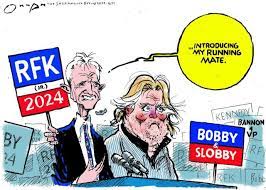 RFK, Jr. belongs in the Loony Tunes universe right next to the QAnon creeps. Think of what Bugs Bunny or the Road Runner could do to them! That’s why Junior is managing to get Republican support. I also believe that he’ll drive the narratives in the press of the BothSiderists. You know who they are. This article from Politico is a depressing look at political funding by billionaire Republicans.
 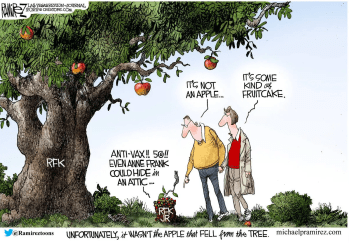 Que Susan Sarandon, or does she only hate Hillary?
  The Republicans are just vile.
  Speaking of Pathetic Jokes … “The Standoff Between Marjorie Taylor Greene and Lauren Boebert Is Worse Than You Think” from
  My final offering today is from ProPublica, which is still investigating the roles of Billionaires in Political and SCOTUS decisions.


 The case centers on Lorie Smith, a website designer who wishes to expand her business into designing wedding websites — something she has never done before. She says she’s reluctant to do so, however, because she fears that if she designs such a website for an opposite-sex couple, Colorado’s anti-discrimination law will compel her to also design wedding websites for same-sex couples. And Smith objects to same-sex marriages.


 peej
peej Carissa
 bostonboomer
 dakinikat
 ecocatwoman
 jjlo
jjlo mablue2
 Mama Lopez
 peggysue22
 quixote
 skydancingguestblogger
 Mona (aka Wonk the Vote)



 Sky Dancing
Recent Comments