
Was I Dreaming? Did Mitt Romney Really Lose the Election?
Posted: November 12, 2012 Filed under: 2012 elections, 2012 presidential campaign, Barack Obama, Catfood Commission, Mitt Romney, U.S. Economy, U.S. Military, U.S. Politics | Tags: Bush tax cuts, Grover Norquist, Simpson-Bowles, Social Security, tax loopholes, Veterans benefits 56 Comments
Which of these guys really won the election?
Is Mitt Romney the President-elect or what? For the past several days, the media and the Republicans have acted as if they won.
In fact, President Obama won in the Electoral College by 126 votes and the popular vote by 3.3 million votes (so far). Democrats added 2 seats in the Senate and are likely to have a 55-45 majority if both independent Senators caucus with them. Democrats also increased their numbers in the House by 7. By any measure Democrats won a huge victory on November 6.
Is it just me, or are the corporate media and Republican leaders continuing to act under the assumption that Republicans will still be in full control of the nation’s destiny going forward and that Obama’s reelection means nothing?
Yesterday on Meet the Press, Bob Woodward produced a document that he described as follows:
MR. WOODWARD: Well, this is the confidential doc last offer the president, the White House made last year to Speaker Boehner to try to reach this four trillion dollar grand bargain. And it’s long and it’s tedious and it’s got budget jargon in it. But what it shows is a willingness to cut all kinds of things, like TRICARE, which is the sacred health insurance program for the military for military retirees; to cut Social Security; to cut Medicare, and there are– there are some lines in there about we want to get tax rates down, not only for individuals but for businesses. So Obama and the White House were willing to go quite far, in a sense this is the starting point…
Dancin’ Dave Gregory says he’ll put it up on the MTP website so the “budget wonks” can see it. I can almost see his gleeful expression as he turns to newly elected Texas Rep. Joaquin Castro.
GREGORY: Right, we just got it here and we’ll– we’ll put it on the web [read it here]. But that’s the point. And congressman, I guess the– the question that Bob and I talked about is, there’s a lot of spending pain in there that Democrats are going to have to go back to their folks and say, hey, this is the pain you’re going to have to suffer. Are you prepared to do that?
REP. CASTRO: Oh, look, there’s no question. I mean, these are tough issues and that’s why there’s been a lot of hand-wringing and wrangling over them. But, yeah, I believe so. I believe you’ve got a Democratic Congress, especially in the House and in the Senate that are willing to make those tough choices, that know that in the long term that we’ve got to reform entitlements.
So these guys (including Democratic Rep Castro) are assuming that this same “grand bargain” will be the starting point for new negotiations? WTF?! From Lucas Kawa at Business Insider:
Yesterday on “Meet the Press,” Bob Woodward of the Washington Post displayed documents that outline a “Grand Bargain” the White House offered during debt ceiling negotiations in 2011.
The document in question appears to have been drafted by White House Legislative Affairs Director Rob Nabors, and includes the annotation ‘Post Gang of 6′ which suggests it was created as Supercommittee talks broke down.Woodward describes the three-page document as “confidential” and points out Obama’s apparent willingness to take on sacred cows such as Medicare and Social Security. Specifically, the president was open to increasing the minimum age for Medicare recipients.
I assume Woodward would not have this “confidential document” and be handing it over to MTP if the White House didn’t want him to. The White House offer included cuts to veterans health benefits (Tricare), civilian and military retirement plans, social security, the Post Office, and Pell Grants. So it appears the White House is floating this idea to see what the public reaction will be.
This morning, I clicked around to a number of morning TV shows, and the meme I saw most often was that Obama and Congressional Democrats need to accept the reality that Obama’s supposed drop dead insistence on raising taxes on the top 2% is suddenly dead in the water and the only increased revenue will have to come from closing tax loopholes. There was much talk of enacting “Simpson-Bowles.” I even saw Grover Norquist being asked whether he’d agree to raising some revenue in this way–but of course not by raising taxes on the wealthy!
The only tax loopholes that could be eliminated to raise significant revenue are the mortgage tax deduction and the charity deduction–and those would primarily affect middle class taxpayers.
Here’s Richard Escow at HuffPo, using a Veteran’s Day theme:
Every year our leaders honor our nation’s veterans with flags and parades. Are they also about to betray them this year with a backroom deal? Words won’t be enough this time. Our returning warriors need — and deserve — jobs, opportunity, and a thriving Social Security system that protects them and their families.
Bob Woodward obtained a copy of the deal the White House offered to Speaker of the House John Boehner last year. That proposal asked our nation’s vets to sacrifice for the luxuries of others once again It included cuts to TRICARE, the military health insurance program, which would have meant higher out-of-pocket medical costs for active and retired military personnel and their families.
The secret White House offer would have also cut Social Security payments for anyone receiving benefits today, along with everyone who’ll ever receive them in the future.
But Americans didn’t vote for a “grand bargain.” If Obama ran on anything, it was letting the Bush tax cuts expire on incomes over $250,000. He said it again and again on the campaign trail and he said it in a speech just a few days ago:
President Barack Obama on Friday signaled willingness to compromise with Republicans, declaring he was not “wedded to every detail” of his tax-and-spending approach to prevent deep and widespread pain in the new year. But he insisted his re-election gave him a mandate to raise taxes on wealthier Americans.
“The majority of Americans agree with my approach,” said Obama, brimming with apparent confidence in his first White House statement since securing a second term.
Finally, Josh Barro at Bloomberg writes that the Bush tax cuts for the rich aren’t going anywhere, “for now.”
Conservatives have taken a lot of well-deserved mockery about their overconfidence in last week’s election. But this week, I am seeing overconfidence from liberals that they are about to win the coming tax fight in Congress. They’re not.
On Dec. 31, all of the Bush tax cuts are set to expire, and, just like two years ago, Republicans want to extend them all while Democrats only want to extend about 80 percent of them, applying them to taxpayers making less than $250,000 a year….
If the fiscal cliff isn’t resolved before the end of the year, House Republicans will pass a tax cut in January — a tax cut that extends the Bush tax cuts in their entirety, including the part for people with high incomes. The Senate will pass one that excludes the high income tax cuts. Then both parties will say they have passed a tax cut bill and are just waiting for the other side to agree to it.
Democrats cannot force Republicans’ hand unless they are more willing than Republicans to let all the Bush tax cuts expire. And they won’t be. A full expiration might well cause a new recession, which would be even more politically damaging for the Barack Obama administration than for congressional Republicans. Congress is already about as unpopular as it can become, and Republicans know they are not going to get their legislative agenda enacted in the next two years anyway. But a new recession would greatly interfere with Obama’s second-term plans.
Obviously, I’m not Sky Dancing’s economist, so I’ll leave it to Dakinikat to tell me whether to freak out about this or not. But it isn’t sounding good to me so far.
Entitled One-Percenter Bill Keller Wants Baby Boomers to Give Up Social Security and Medicare
Posted: July 30, 2012 Filed under: Catfood Commission, Medicare, Mitt Romney, Social Security, The Media SUCKS, U.S. Economy, U.S. Politics, unemployment, voodoo economics, We are so F'd | Tags: Bill Keller, Charles P. Pierce, Dean Baker, Income Inequality, infrastructure, Iraq War, Judith Miller, one-percenters, Paul Ryan, Simpson-Bowles 32 Comments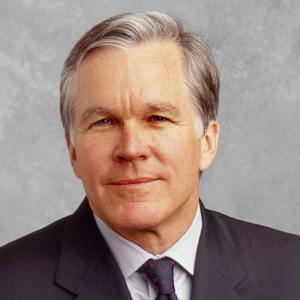
Smarmy former NYT editor Bill Keller
From today’s New York Times: “The Entitled Generation.”
The notion that our generation has been spoiled rotten is not a terribly new thought. A dozen years ago Paul Begala (of Bill Clinton and CNN fame) published in Esquire the classic of boomer-loathing, “The Worst Generation.” “The Baby Boomers are the most self-centered, self-seeking, self-interested, self-absorbed, self-indulgent, self-aggrandizing generation in American history,” he declared. It’s a sturdy genre. Perhaps while Googling yourself you have come across the blog Boomer Deathwatch (“Because one day, they’ll all be dead”), a checklist of famous boomers who hit their actuarial sell-by dates. Even Barack Obama, who styles himself post-boomer though he was born in 1961, complained in “The Audacity of Hope” that today’s hyperpolarized political discourse began with the “psychodrama of the baby boom generation.”
Yeah, we’re all evil just because our parents returned from WWII and proceeded to have lots and lots of babies. Supposedly not one of us ever did a decent thing in our pathetic, useless lives, right? I’m sick to death of hear this crap–and I’ve been hearing it since I was a kid.
See Keller says it’s our fault that the government isn’t rebuilding the infrastructure. He says it won’t do any good to tax super-rich guys like him–we’re going to have to take it out of the hides of old ladies who are trying to eke out a living on $1200 a month or less.
Guys like Bill Keller don’t even have to pay into Social Security on the bulk of their income, but he doesn’t even mention the possibility of changing that. So what does super-rich one-percenter Bill Keller think we should do about it besides learning to loathe ourselves and wish we’d never been born?
So the question is not whether entitlements have to be brought under control, but how. The Republican plan espoused by Mitt Romney and his fiscal lodestar Paul Ryan would cut the cost of entitlements largely by moving toward privatization: personal investment accounts for Social Security, vouchers for Medicare. And it’s not at all clear the Republicans would assign any of the savings to investing in our future.
At least the Republicans have a plan. The Democrats generally recoil from the subject of entitlements. Centrists like those at Third Way and the bipartisan authors of the Simpson-Bowles report endorse a menu of incremental cuts and reforms that would bring down costs without hitting the needy or snatching away the security blanket from those nearing retirement. They include gradually raising the retirement age to compensate for the fact that we now live, on average, 14 years longer than when F.D.R. signed Social Security into law. They include obliging those of us who can really afford it to pay a larger share. They also include technical fixes like aligning the automatic cost-of-living formula with reality.
At least now we know which candidate Keller will be voting for in November. So much for the supposedly “liberal media.” Oh, and about that “technical fix” Keller brushes off so dismissively, Matthew Yglesias explains why it isn’t a “technical fix” and “doing the switch comprehensively would constitute a de facto tax increase.” Furthermore, there was no “Simpson-Bowles report,” because the two co-chairs were unable to get a majority of members of the Catfood Commission to sign off on one.

Judith Miller with patron Bill Keller
I have a terrific idea. Let’s hold Bill Keller responsible for his choice to assign Judith Miller to help the Bush administration lie us into the Iraq War. Let Bill Keller pay back the trillions of dollars of taxpayer money those lies cost us. That ought to provide some funds to invest in infrastructure here in the U.S.
Here’s what Dean Baker had to say about Keller’s lying op-ed:
That is really brave for Mr. Keller to stand up and call for sacrifice from his age cohort. Does Keller know that the typical near retiree has total wealth of $170,000. This includes everything in their 401(k), all their other financial assets and the equity in their homes. Another way to put this is that the typical near retiree (between the ages of 55-64) could take all their wealth and pay off their mortgage. After that they would be entirely dependent on their Social Security to cover all their living costs.
Does this situation describe Mr. Keller’s finances? My guess is that it doesn’t. If that is true, how does Keller claim to speak for people who are in a hugely different financial situation than him? Is he really that ignorant of the issues that the NYT gives him a column to write about or is he dishonest? Readers will have to debate that in the months and years ahead.
Baker says the real problem we have is the increase in income inequality over the past thirty years, but he’s not holding his breath for Keller to “appeal to his fellow one-percenters….He probably doesn’t have the courage or integrity to do that.”
I saved the best review of Keller’s op-ed for last. You guessed it, it’s by Charlie Pierce: “The Things Bill Keller Doesn’t Have to Worry About.”
I defy Bill Keller to last a week living only on those benefits available to the greedy boomers, especially after the Simpson-Bowles cargo cult — to say nothing of the zombie-eyed granny-starver Paul Ryan himself — are through with them. I defy him to make it for a day. The “we” sprinkled throughout this bag of pus is probably the most noxious thing about it. Look around, Bill. You and Mitt Romney have far more in common than do you and the overwhelming majority of your “fellow” boomers. One catastrophic illness, and many of our families die on the vine. This is not hyperbole. This is how it works in the world. And, to the surprise of absolutely nobody, Keller signs on with the clowns at Third Way, who assure us that the real problem is that the elderly moochers are the ones keeping us from building new bridges, or flying to the moons of Neptune. Jesus H. Christ on a Lipizzaner, we’ve had forty years of demonized government, and 40 years of quack economics, and tax-cuts until hell won’t have them, and the reason our infrastructure is falling apart is because some retired ironworker gets $1200 a month? How much of a courtier do you have to be before the taste of caviar makes you nauseous?
If we want to invest in infrastructure, which we desperately need to do, then we should just borrow money at the current historically low rates and fix the damn infrastructure…. People Got No Jobs. People Got No Money. Bill Keller never will have to worry about the last two, so I think he should shut up about the first.
Thursday Reads
Posted: May 24, 2012 Filed under: Catfood Commission, Democratic Politics, morning reads, U.S. Economy, U.S. Military, U.S. Politics | Tags: Alan Simpson, austerity, Barack Obama, Bush tax cuts, CBO, Charles P. Pierce, CIA leak case, Corey Booker, education policy, Emptywheel, eurozone crisis, fiscal cliff, Iraq War, Joe Wilson, John Maynard Keynes, Mark Halperin, Massachusetts public schools, Mitt Romney, Patrick Fitzgerald, Scooter Libby, Social Security, unemployment, Valerie Plame 55 Comments
Good Morning!! I’ve got a potpourri of interesting links for you today, so I’ll get right to it.
Yesterday Mitt Romney gave an interview to Mark {Gag!} Halperin of Time. Halperin asked the putative Republican nominee to say specifically what the unemployment rate would be after his first year as POTUS. You may recall that not long ago, Romney stated that unemployment should be below 4 percent and that anything higher than that is unacceptable. But now he’s singing a different tune.
Romney: I can’t possibly predict precisely what the unemployment rate will be at the end of one year. I can tell you that over a period of four years, by virtue of the policies that we’d put in place, we’d get the unemployment rate down to 6%, and perhaps a little lower. It depends in part upon the rate of growth of the globe, as well as what we’re seeing here in the United States, but we’d get the rate down quite substantially, and frankly, the key is we’re going to show such job growth that there will be competition for employees again. And wages – we’ll see the end of this decline we’re having. The median income in America is down 10% in just the last four years. That’s got to stop. We’ve got to start seeing rising wages and job growth.
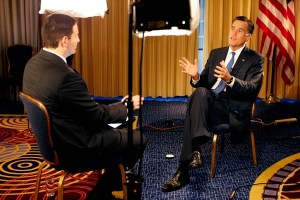
Romney gave no specifics about how he would achieve this with the policies he has been promoting–cutting taxes on the rich, raising them on people with lower incomes, and cutting everything except defense spending, which he would increase substantially. Halperin did ask for more specifics, but Romney just babbled a bunch of nonsense:
Halperin: One more question generally about jobs. For people out there, for voters who want to know what you’re about in terms of job creation, is there some new idea, some original idea, that hasn’t been part of the debate in American politics before, that you have that you think would lead to a lot of new jobs?
Romney: Well the wonderful thing about the economy is that there’s not just one element that somehow makes the whole economy turn around, or everybody in the world would have figured that out and said there’s just one little thing we have to do – you know, Greece is settled, and France and Italy are all back and well again. No, it’s a whole series of things. It’s a system of factors that come together to make an economy work. What is it that makes America’s economy the strongest in the world, the most robust, over a century? It’s a whole series of things – everything from our financial service sector, to the cost of our inputs, our natural resources, to the productivity of our workforce, to our labor and management rules and how they work together, to our appreciation for fair trade and free trade around the world, and negotiating trade arrangements that are favorable to us. It is a whole passel of elements that come together to create a strong economy, and for someone who spent their life in the economy, they understand how that works. And it’s very clear, by virtue of the President’s record, that he does not, and he is struggling. Look at him right now. He just doesn’t have a clue what to do to get this economy going. I do. I laid out a 59-step plan that encompasses a whole series of efforts that will together get this economy going and put people back to work.
But from what I could make out in wading through all the blather, it really comes down to the confidence that will wash through all of us once we know that Mr. Fixit, Willard Mitt Romney is going to save us.
Romney: Well actually if I’m lucky enough to be elected the consumers and the small-business people in this country will realize that they have a friend in the White House, who is actively going to encourage economic growth, and there will be a resurgence in confidence in this country and a willingness to take risks, to invest, to add employees. I think it will be very positive news to the American economy. Will I be able to get done between January 1 and January 20 the things that I’d like to do? Of course not, I’m not in office. But I believe that we will be able to have a grace period, which allows us to tackle these issues one by one and put in place a structure, which is very much designed to get America working again.
Romney also gave a speech about education policy in which he proposed to further privatize America’s education system:
Mitt Romney proposed a series of steps to overhaul the public education system, reigniting the debate over school choice as his campaign intensifies its effort to introduce the presumptive Republican presidential nominee to a general-election audience.
The education plan, detailed in a speech today in Washington, would create a voucher-like system to give low- income and disabled students federal funds to attend charter schools, private institutions and public schools outside their district.
“I don’t like the direction of American education, and as president, I will do everything in my power to get education on track for the kids of this great land,” Romney told a gathering of Latino business owners at the U.S. Chamber of Commerce.
No new ideas there. To be perfectly honest, I strongly doubt that Romney knows the first thing about American public schools. But let me refer you to an expert on Willard’s past history in dealing with public education, the one and only Charles P. Pierce. Pierce writes about what Romney did to the public education system of Massachusetts during his one term as Governor:
Read the rest of this entry »
Super Committee Calvin Ball
Posted: November 20, 2011 Filed under: #Occupy and We are the 99 percent!, Catfood Commission, Federal Budget, Federal Budget and Budget deficit | Tags: Budget Deficit, Extension of Bush Tax Cuts., supercommittee 15 CommentsRepublicans are insistent that the Bush Tax cuts be made permanent. With that stroke of lunacy, we have the imminent and predictable meltdown of the super committee. 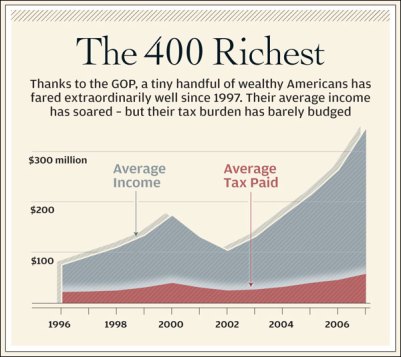 So, what happens when the minority party doesn’t get it’s way on everything? It either holds the economy hostage or changes the rule. Republicans in Congress are playing Calvin Ball to avoid the cuts that super committee failure is supposed to bring to the defense budget. They’re changing their own rules, yet again.
Plus, we’re getting another contradictory argument on taxes. Let the Bush tax cuts expire is “raising taxes”. Letting the payroll tax holiday expire is not raising taxes. How do these folks get through the day without a complete synaptic breakdown? Here’s some details from Reuters. The Murray quoted here is Senator Patty Murray from Washington State.
Murray said Republicans want to extend tax cuts that lowered individual rates — reductions that originated under former Republican President George W. Bush. Those tax cuts run out at the end of 2012.
Republicans have pushed for a permanent extension. Democrats want the tax cuts for the rich to expire.
“In Washington, there are folks who will not cut a dollar unless we raise taxes,” said Kyl, sparking an exasperated reaction from Kerry who noted that Congress has cut about $1 trillion from the budget without any tax hikes.
Republicans want Democrats to agree to do more to find long-term savings in the growing costs of government retirement and healthcare programs.
If no deal is reached by a simple majority of the super committee, automatic spending cuts would start in 2013 — two months after presidential and congressional elections.
Those cuts would be evenly divided between domestic and defense programs. Some Republican members of Congress already are talking about dismantling the automatic cuts to protect the Defense Department from deep reductions.
No serious discussion on deficits can occur without ending the Bush Tax cuts and seriously putting the Pentagon budget on the table. Representatives of the super committe were out full force on the Sunday Morning Talk Show. John Avlon at The Daily Beast points to the political posturing that’s likely still the root of the entire problem. No Republican is willing to compromise any more. Democrats and the President continue to grant many concessions on social programs that leave little left for continuing battle. No where is this more noticeable when the congress passed the old John Chaffee/Bob Dole Republican Health plan under the guise of ObamaCare. The contentious mandate originally came from the Republican side of the aisle from the American Heritage Institute. The twist of facts into partisan narratives has never been worse.
But pervasive hyperpartisan positional bargaining seems to have carried the day. Pessimism has clouded late-inning negotiations. Supercommittee Democrats have offered to put entitlement reforms on the table, but offered few specifics. Republicans have offered limited revenue increases, but tied those to the cutting the top tax rate to 28 percent from 35 percent and permanently extending the contentious Bush tax cuts. Distrust and brinksmanship pollutes the process.
Ironically, but perhaps appropriately, the dysfunctional debate seems to be based around what the term “fair and balanced” actually means.
For Democrats it means a 1-to-1 ratio of tax hikes to spending cuts. For bipartisan groups like the Gang of Six and Bowles Simpson, it means a 3-to-1 ratio. But for too many Republicans, “fair and balanced” means no tax revenues raised at all—a handful of loopholes closed as concessions, like $3 billion from private jets, and the rest collected from spending cuts. The basic dynamic of both sides being willing to slaughter sacred cows is missing despite an avalanche of “more bipartisan than thou” press releases.
The core problem comes from antitax pledges that have dislodged the basic nature of balance sheets in the collective conservative mind—it is all spending, no revenue. Fiscal responsibility has been replaced by fiscal conservatism. Reducing the deficits and debts is no longer the overriding goal, despite Tea Party rhetoric about generational theft or even the balanced-budget-amendment attempt this past week. Instead, keeping tax cuts in place is the one true grail—ignoring the overwhelming popularity of provisions like raising the top rate on people making more than a million dollars a year.
Sane people continue to ask what type of Svengali powers the insane Grover Norquist holds over Republicans? If you want to learn about “The Billionaire’s Best Friend”  who “hijacked the Republican party on behalf of the rich”, go no further than TIm Dickinson’s article in this month’s Rolling Stone. This man continues to hold sway over the Republican congress critterz despite overwhelming public polls that show even Republicans and Independent rank and file don’t support his agenda. Norquest comes from two Republican institutions. He was originally in the Chamber of Commerce which is one organization that has no problem seeing lies and half baked arguments printed in newspapers around the country. Ronald Reagan used him to push his tax reform measures. It’s been one power grab after another backed by nothing more than dogma and a huge budget since then.
Over the past 25 years, Norquist has received funding from many of America’s wealthiest corporations, including Philip Morris, Pfizer and Microsoft. To build a farm team of anti-tax conservatives, Norquist shrewdly took the pledge to state legislatures across the country, pressuring up-and- coming Republicans to make it a core issue before they’re called up to the big leagues. “We’re branding the whole party that way,” Norquist says. “The people who are going to be running for Congress in 10 or 20 years are coming out of state legislatures with a history with the pledge.”
Norquist also built the anti-tax pledge into the DNA of the GOP by hosting weekly Wednesday meetings that enable activist groups representing everyone from gun nuts to home-schoolers to mix with top business lobbyists and conservative officials. The meetings, which began shortly after Bill Clinton was elected, turned Norquist into the Republican Party’s foremost power broker – and gave him a forum to enforce the no-new-taxes pledge as the centerpiece of the GOP’s strategy. “The tax issue,” he says, “is the one thing everyone agrees on.”
Norquist cemented his influence by forging an early alliance with Karl Rove and setting himself up as a gatekeeper to George W. Bush’s inner circle. Then, after Obama was elected, this ultimate Washington insider positioned himself as a leader of the anti-establishment Tea Party, complete with financial support from the billionaire Koch brothers. “These Tea Party people, in effect, take their orders from him,” says Bruce Bartlett, an architect of the Reagan tax cuts. “He decides: This is a permissible tax action, or this is not a permissible tax action. And of course, anything that cuts taxes is per se OK.”
Today, GOP politicians who have signed Norquist’s anti-tax pledge include every top Republican running for president, 13 governors, 1,300 state lawmakers, 40 of the 47 Republicans in the Senate, and 236 of the 242 Republicans in the House. What’s more, the GOP’s Tea Party foot soldiers are marshaled by House Majority Leader Eric Cantor – a veteran of Norquist’s farm team, who first signed the pledge as an ambitious member of the Virginia legislature. Under Cantor’s leadership, Norquist’s anti-tax pledge was directly responsible for last summer’s debt-ceiling standoff that wrecked the nation’s credit rating by leading the nation to the brink of default. “Congress was willing to cause severe economic damage to the entire population,” marvels Paul O’Neill, Bush’s former Treasury secretary, “simply because they were slaves to an idiot’s idea of how the world works.”
Yup. Bush’s former Treasury secretary thinks Norquist has congress hostage to the point that they are “willing to cause severe economic damage to the entire population simply because they were slaves to an idiot’s idea of how the world works.” The result of the work of Norquist and the Republican party has been staggering income inequality.
“The Republican Party has totally abdicated its job in our democracy, which is to act as the guardian of fiscal discipline and responsibility,” says David Stockman, who served as budget director under Reagan. “They’re on an anti-tax jihad – one that benefits the prosperous classes.”
Notice here that I’m quoting Republicans that have had extensive experience in economics, finance, and policy. Funny thing is that the most of these folks aren’t really worried about tanking the economy. What they are worried about is this. If you haven’t read Cannonfire today, you should. First, Cannon points to this. MSNBC got a hold of a memo from a lobbying firm spelling out its plan to use any propaganda means necessary to destroy OWS. The lobbying firm is associated with the American Banker’s Association.
CLGC’s memo proposes that the ABA pay CLGC $850,000 to conduct “opposition research” on Occupy Wall Street in order to construct “negative narratives” about the protests and allied politicians. The memo also asserts that Democratic victories in 2012 would be detrimental for Wall Street and targets specific races in which it says Wall Street would benefit by electing Republicans instead.
According to the memo, if Democrats embrace OWS, “This would mean more than just short-term political discomfort for Wall Street. … It has the potential to have very long-lasting political, policy and financial impacts on the companies in the center of the bullseye.”
The memo also suggests that Democratic victories in 2012 should not be the ABA’s biggest concern. “… (T)he bigger concern,” the memo says, “should be that Republicans will no longer defend Wall Street companies.”
Two of the memo’s authors, partners Sam Geduldig and Jay Cranford, previously worked for House Speaker John Boehner, R-Ohio. Geduldig joined CLGC before Boehner became speaker; Cranford joined CLGC this year after serving as the speaker’s assistant for policy. A third partner, Steve Clark, is reportedly “tight” with Boehner, according to a story by Roll Call that CLGC features on its website.
Another interesting association is noted in the memo.
The CLGC memo raises another issue that it says should be of concern to the financial industry — that OWS might find common cause with the Tea Party. “Well-known Wall Street companies stand at the nexus of where OWS protestors and the Tea Party overlap on angered populism,” the memo says. “…This combination has the potential to be explosive later in the year when media reports cover the next round of bonuses and contrast it with stories of millions of Americans making do with less this holiday season.”
Yup, it’s the divide and conquer strategy again. Since Wall Street can’t make the case, it’s going to use proxies like the Tea Party to do its dirty work. This should be no problem given the astroturf leadership put in place by folks like Dick Armey and Matt Kibbe. These guys are longstanding Republican Beltway insiders. The interesting thing comes in some of the rumors coming out from the committee itself. Supposedly, Boehner had actually agreed to put revenues on the table and provide cover to Republicans that feared Norquist and the Tea Party. Some Democrats never really engaged, some republicans refused to even discuss anything that didn’t include making the Bush Tax cuts permanent for every one, and there was some feeling that the next election would give some indication of which way the wind blows.
A Democratic aide had this eulogy for the supercommittee: “The worm has turned a little bit. The national conversation now is about income inequality and about jobs, and it’s not really about cutting the size of government anymore or cutting spending. 2010 gave one answer to that question. But 2012 will give another, and we’ve got to see what it is.”
I still think economist Jeffrey Sachs has the best take on what the real role of Congress should be in an schizophrenic economy like ours. This is what OWS is trying to point out but is getting blasted for by concentrated efforts in corporate media to publish propaganda. (I have quoted this before, but I’m quoting Sachs again.)
The big political lie of the Super-Committee is that the deficit must be closed mainly by cutting government spending rather than by raising taxes on corporations and the super-rich. Both parties are complicit. The Republicans want to close the deficit entirely by cutting spending; Obama has brandished the formula of $3 of cuts for every $1 of tax revenues. On either approach, the poor and middle class would suffer grievously while the rich and powerful would win yet again (at least until the social pressures boil over).
The key to understanding the U.S. economy is to understand that we have two economies, not one. The economy of rich Americans is booming. Salaries are high. Profits are soaring. Luxury brands and upscale restaurants are packed. There is no recession.
The economy of the middle-class and poor is in crisis. Poverty and near-poverty are spreading. Unemployment is rampant. Household incomes have been falling sharply. Millions of discouraged workers have dropped out of the labor force entirely. The poor work at minimum wages to provide services for the rich.
Until we have some realization that laws put into place for the last 30 years have created markets that are distorted, functional only for a few, and not the least bit reflective of anything remotely “free market”, a portion of the public is going to be willing to vote for people that spread lies. This is why the credibility of any one associated with OWS must be destroyed. The minute a huge portion of us wake up to the lies–much like what happened after publication of the Pentagon Papers and the invasion of Cambodia after Nixonian promises of winding the Vietnam War down–we’re not going to get the policy we need to put things right again. We desperately need to put things right again.
Super Cat Food Commission: Ideologues seem destined to tank the Country
Posted: November 16, 2011 Filed under: Catfood Commission | Tags: Super Committee 14 Comments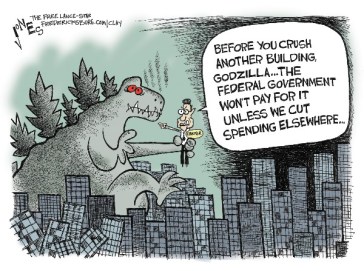 The starve the beast anthem seems to have stymied any chance the country has of solving both its unsustainable long term debt problems and its economic growth issues. This is what you get when no one embraces pragmatism, workable solutions, and data. I continue to think the best solution to much of this is to let the Bush Tax cuts expire and let them scramble from the fall out of the trigger.
Nothing is acceptable to Republicans who have signed their political souls away to Grover Norquist and seem hell bent on keeping the pentagon flush with funds all while supposedly balancing the budget. There is no way for this to happen simultaneously unless one is prepared to completely do away with all other functions of government which is frankly what I think they want. We’ll have taxes subsidizing already rich, powerful and profitable corporations and the military industrial complex and the rest of America will be sharecropping in one way or another.
Pat Toomey basically defended this position to Chris Wallace at Faux News on Sunday. The problem with this position–and with sticking to it like a drug addiction–is that the reality just doesn’t fit the story and it’s not what people want. How is it possible for a group of ideologues to continually hold the country’s economy hostage to failed ideals rejected not only by experts on the economy but by US citizens in poll after poll? Why was America’s most profitable period a time when taxes were high on both corporations and rich people and the US was winding down its war machine if the Republican paradigm is so correct? Believe me, this Toomey plan is a bait and switch.
WALLACE: Again, before we get to your plan. What are the stakes if you fail to make a deal. If on November 23rd, the super committee comes up empty and the automatic triggers come in, and we’ll talk about that in a moment. What do you think the impact is on the markets, on the economy and on the U.S. credit rating?
TOOMEY: I think that there will be further erosion of what little confidence remains of our federal government. This has been a dysfunction Senate that I’ve been serving in for the year that I’ve been in office. And this is an attempt to try to make some important progress. It would only be the first of what needs to be many steps because we’ve dug a deep hole for ourselves. I think it’s really important that we’d be successful.
WALLACE: All right. You offered a plan that breaks with the Republican pledge not to raise any tax revenue. Let’s drill down into the plan.
You would cut the deficit $1.2 trillion, which is the mark that is supposed to be met by the super committee with $700 billion in spending cuts and $500 billion in revenue increases. On the revenue side, you get $250 billion by limiting deductions especially for top earners. In exchange, you would lower tax rates, the top rate would go from 35 percent to 28 percent.
Question: why are you breaking with the GOP pledge not to raise taxes in the middle of a bad economy and how many Republicans will go along with you.
TOOMEY: Well, let me — first of all, let me say, if I were king, this is not the plan I’d put on the table. But if we both went into our respective corners and had no flexibility at all, then we wouldn’t get anything accomplish. Number two, the plan that I put on the table is contingent upon pro-growth tax reform.
Every group that’s looked to this, all of the bipartisan commissions, gang of six and the others, have acknowledge that if there is more revenue it has to come in the context of pro-growth tax reform, the kind of reform we’re talking about absolutely guaranteed to create millions of jobs over time and still more revenue.
And, finally, Chris, the other reason to make a tough decision like this, is in the alternative, we are 13 months away from the biggest tax increase in American history. And that’s written into law. That’s going to happen.
WALLACE: You’re talking about the Bush tax cuts expire.
TOOMEY: That’s exactly right.
And so, what we’ve suggested is, as an alternative to an economy destroying tax increase right around the corner, let’s have a reform, let’s simplify the code, let’s lower rates, let’s wipe out some of the loop holes and special interest, favors and deductions. Let’s have the economic growth that would come with that.
And as we lower the rates and contract the value of deductions, we’ll only generate a little revenue so that we can reduce the deficit.
WALLACE: Now, I don’t want to get too far on the weeds, but Democrats immediately rejected your plan because they say that the money that would be lost by lowering those tax rates, basically 20 percent below the Bush tax cuts, would cost over $3 trillion for the economy, and they say the money you’re going to will lose that will increase the deficit is more than money you’ll get from closing these tax loops. That it’s a net loser.
TOOMEY: First of all, that’s not true. You could design this in a way — and as I said, I didn’t invent this. We didn’t invent this. This is an idea that’s been suggested by the Simpson-Bowles commission, by the Rivlin-Domenici.
Now, it’s true that they want to raise taxes more. I think that as you reduce the value of these deductions, if you go too far, you try to create too much revenue, you can do economic damage. But you absolutely can do this in a way that will be pro-growth, that will generate more revenue, that would avoid this huge tax increase that’s otherwise coming and I think that’s a direction we should move in.
Republicans continue to say that 1+1=3 despite decades of evidence and proof that 1+1 still equals 2. If tremendous tax cuts and deregulation had such benefits to the economy we’d not have had over ten years of miserable growth and a humdinger of a financial crisis. Corporate profits are at record highs. This is not leading to job creation. Taxes on capital gains are extremely low. This just keeps leading to bubbles, increased speculation, and paper gains for a few based on nothing but gambling. It’s not bringing any value to the real economy where jobs, products, services, and tax revenues that keep things running are made. Money keeps pumping into financial contracts which is just paper whose value is detached from real assets until the market crashes. Increasing taxes on capital gains would close down much of the worthless investment funds that are going after arbitrage profits in all the wrong places. Tax benefits should go to real investments and long term commitment to growing industry and businesses. Taxes favor speculation right now. It’s bringing more volatility and risk to markets and not vaulted liquidity.
It’s ridiculous and it flies in the face of recent economic data to suggest that continuing to hand wealth over to the richest folks is going to do anything other than continue the very same problems that we have now. We move productive funds away from things that are attached to real sector growth and into speculative activities which blow bubbles and ruin the value of real assets like houses, food, and commodities and create such excessive volatility in equity markets that long term investors experience incredible losses and then small gains continually. No one benefits but a few gamblers which evidently includes Congress. Republicans like Boehner, Cantor and Bachus and Democratic leaders like Pelosi benefiting from betting based on insider information as much as Wall Street does.
It seems like there’s a plot to extract as much wealth and income out of the economy as possible before they tank the entire thing and retreat to tax haven islands like Grand Cayman. How could elected officials be so set on sabotaging the country? Granted, there are idiotic true believers like Michele Bachmann who create their own reality and narratives and are so removed from facts that you wonder why they’re allowed in public. There used to be nice places in the country for folks like that to ‘rest’ and spend their days listening to those voices in their head. Now it seems they’ve all turned up in the Republican Party and have hunkered down in Washington DC. Okay, this is from Beltway Bob, but bear with the quote, please. It’s an indicator that they’re willing–like domestic terrorists–to take us all hostage again.
Six days left for the supercommittee, and it’s not looking good. On CNBC last night, Rep. Jeb Hensarling, the Republican co-chair of the committee, said he and his colleagues had “gone as far as we feel we can go” on taxes, and that “any penny of increased static revenue is a step in the wrong direction.” In other words, Republicans aren’t looking to compromise further. But Hensarling went yet further than that. If the supercommittee fails, he said, Republicans are looking to undo the compromises they have already made.
The issue is “the trigger,” the policy that automatically cuts the deficit by $1.2 trillion in the event that the supercommittee fails. Half of those cuts are scheduled to come from domestic spending (excluding Social Security, Medicaid, and a few other programs that help the poor). That’s the stick for Democrats. Half of them are scheduled to come from the Pentagon. That’s the stick for Republicans. But last night, Hensarling said the defense cuts are too onerous, and so “we’ve got 13 months to find a smarter way to do it.” By “a smarter way to do it,” he means a way that eases the cuts to defense and, since Republicans aren’t going to replace those defense cuts with new taxes, increases the cuts to domestic programs.In comments to reporters Tuesday, Senate Majority Leader Harry Reid was firm on this point: the defense cuts in the trigger were the GOP’s concessions after they refused to include taxes in the trigger, and they’re not going anywhere. “If committee fails to act, sequestration is going to go forward,” he told reporters. “Democrats aren’t going to take an unfair, unrealistic load directed toward domestic discretionary spending and take it away from the military.”
Behind the scenes, the White House has taken a similar line: the trigger can’t be changed to exempt defense and fall more heavily on domestic spending. That isn’t the same as saying the trigger can’t be changed. But Democrats aren’t going to be enthusiastic about keeping the part meant to penalize them for the supercommittee’s failure while helping Republicans move the bit that was meant to be their punishment.
But we’ll see. Democrats haven’t always been known to hold the line on defense cuts. The bigger issue here, however, is that Republicans are setting a bad precedent for future deals. Republicans are talking about unwinding the trigger before the supercommittee has even finished its work. They are, in other words, reneging on the terms of the debt-ceiling deal. So why should Democrats who are hearing this expect they’ll abide by the terms of a deal that calls for revenue-increasing tax reform in six months?

 peej
peej Carissa
 bostonboomer
 dakinikat
 ecocatwoman
 mablue2
 Mama Lopez
 peggysue22
 quixote
 skydancingguestblogger
 Mona (aka Wonk the Vote)



 Sky Dancing
Recent Comments