
Breaking: Congresswoman Gabrielle Giffords Shot in AZ
Posted: January 8, 2011 Filed under: Breaking News | Tags: Arizona shooting, Gabrielle Giffords 65 CommentsThe story broke via NPR, but I’m quoting Jay Bookman’s blog at the AJC because the NPR link hasn’t been updated to report her death yet:
U.S. Rep. Gabrielle Giffords, an Arizona Democrat beginning her third term, has reportedly been shot in the head at a public appearance in a Tucson supermarket.
NPR, citing the local sheriff’s office, reports that GIffords and six others have died.
The gunman is in custody. There is no information available regarding his identity or motive. Other victims reportedly include congressional staff members.
For more information on the shooting and on Giffords, here is the NPR link.
Update: Giffords’ spokesperson says Giffords is alive and in surgery. Via Wapo blogger Felicia Sonmez.
Our Dismal Job Market
Posted: January 7, 2011 Filed under: Barack Obama, Breaking News, financial institutions, Global Financial Crisis, jobs, Team Obama, The Great Recession, The Media SUCKS, the villagers, U.S. Economy, U.S. Politics, We are so F'd | Tags: Gene Sperling, labor force participation rate, long term unemployment, rigid wages, Sticky wages, unemployment 11 Comments Economists–well at least NeoKeynesian economists that look at data–frequently use words like “rigid” and “sticky” to describe the jobs market. Rigid is a good word. It means “deficient in or devoid of flexibility”. The Labor Markets are the biggest empirical hurdles to jump if you want to buy into some variant of supply-side economics or NeoClassical economics.
Wages and quantities of labor used to adjust very slowly. They appear to be dismally slow these days. Part of this is obviously due to outsourcing. The substitution of foreign (e.g. outside of our borders; legal status really doesn’t matter for purposes of macro growth) for US-based workers seems to have made the NeoKeynesian assumptions of sticky and rigid wages even more so.
What’s very interesting about today’s BLS report on jobs is that the unemployment rate inched down but the fundamentals in the job market don’t appear to be changing much. Plus, the unemployment rate inched down based on the way it’s calculated by more than anything else. It’s not really fooling people that know economics or finance, but will the public at large embrace the nuance? A huge portion of the populace is simply leaving the job market.
Felix Salmon explains some of the nuances in his Reuters Blog today called “No good news for the long-term unemployed”. He focuses on some of the buried numbers rather than the top number. Yes, he has a nifty graph you should check that out too.
The December jobs report turns recent history on its head. We’ve been used to healthy increases in employment making no dent in the unemployment rate, but this time a mediocre jobs figure—just 103,000 new jobs were created—coincides with a gratifyingly large fall in unemployment, to 9.4% from 9.8%. For those keeping track at home, that’s employment up by 103,000 and unemployment down by a whopping 556,000.
There’s no doubt that the headline payrolls number is a disappointment. The economy just doesn’t seem to be creating jobs: we need to see 150,000 new jobs a month just to keep pace with population growth. But is there some good news, at least, on the unemployment front?
I’m not sure. While unemployment is down from both December 2009 and December 2010, it’s down only for those who have been out of work for less than 26 weeks. The ranks of the long-term unemployed are still rising
Well, it’s not so ‘whopping’ in context–as we’ll see in a moment–but let’s look at some other things. The underlying numbers appear to be a total disconnect–and Salmon’s analysis is not unique among economists’ take on the situation–with the assessment of the President who just appointed lawyer Gene Sperling to do an economist’s job. President Obama also continued his rhetoric on substanial job creation being just around the corner and how the trend is just so much rosier under his leadership. Does any one outside of his circle actually believe this?
Now, read this Bloomberg article and notice the part at the end that I highlighted.
Obama said Sperling has been an “extraordinary asset” over the past two years as a senior adviser to Treasury Secretary Timothy Geithner, helping to pass a small-business jobs bill and a tax-cut compromise.
Obama said one of the reasons he selected Sperling is that “he’s done this before,” a reference to Sperling’s 1996-2000 leadership of the NEC during the Bill Clinton administration.
Obama also named Jason Furman as principal deputy director of the NEC, and nominated Katharine Abraham to the Council of Economic Advisers. He also nominated Heather Higginbottom as deputy director of the Office of Management and Budget.
Obama spoke on the same day that government data showed that the U.S. added 130,000 jobs in December and the unemployment rate dropped to 9.4%. Read MarketWatch’s story about jobs report.
Obama trumpeted 12 straight months of private-sector job creation and said, “the trend is clear.” But he said there’s a lot of work to do to get more people back in the labor force, and pledged to forge ahead with more job-creation efforts.
Sperling was also deputy NEC director during Clinton’s first term, which was marked by standoffs that resulted in government shutdowns. Sperling helped negotiate a balanced budget agreement in 1997 and was an advocate for the repeal of the Glass-Steagall law that separated commercial and investment banking.
Obama Signs DADT Repeal and other breaking news
Posted: December 22, 2010 Filed under: Barack Obama, Breaking News, Civil Liberties, Civil Rights, DADT, Democratic Politics, Festivities, GLBT Rights, Human Rights, legislation, Live, open thread | Tags: 9/11 responders bill, DADT Repeal, START TREATY ratification 27 CommentsI think we can all agree that the service men and women in this picture and the folks that helped pass this repeal deserve a great big booyah! from us all. It was great to see some of our country’s heroes get some credit and recognition. Let’s hope the president’s signature is the first step in tearing the entire DADT infrastructure down and that the radical right groups working to repeal the repeal FAIL.
Just one small step for Human Kind …
The guests at the ceremony included Joe Solmonese, head of the Human Rights Campaign, a gay rights group; Vice President Biden; Rep. John Conyers Jr. (D-Mich.); and Dan Choi, a former U.S. Army soldier who was discharged under “don’t ask, don’t tell” and was arrested in November after chaining himself to a White House fence to protest the policy.
Several other soldiers who have been discharged from military service because they are gay attended the ceremony as well.
Among the guests on the stage with Obama was Eric Alva, a former Marine staff sergeant who lost a leg in Iraq and who, following a medical discharge, has been working for the repeal of “don’t ask, don’t tell.” Another participant was Navy Cmdr. Zoe Dunning, a repeal advocate who fought to remain in the Navy Reserves and ultimately retired in 2007 after 13 years of service as an openly gay officer.

Senator Reid Gives Dan Choi His West Point Ring Back
This is morphing into a mid afternoon Senate news post so you can consider it an open thread for other news besides the DADT signing ceremony.
Also:
ABC news is reporting that the Senate has come to an agreement on the 9/11 First Responders Bill.
Senators on both side of the aisle came together to unanimously pass a bill to give continuing health benefits and compensation to first responders who got sick after the 9/11 terror attacks.
The bill passed after Senate Democrats struck a deal Wednesday with Sen. Tom Coburn, R-Okla., who agreed to drop his objections when the cost of the bill was reduced by about $2 billion.
The Oklahoma Republican had come under withering criticism for opposing the bill on the grounds that it provided “overly generous funding” and included “unnecessary and duplicative compensation funds.”
Coburn emerged Wednesday from a closed-door meeting that included Senate Majority Leader Harry Reid and New York Democrats Chuck Schumer and Kirsten Gillibrand to reveal that that a deal has been worked out that will likely enable the bill to pass the Senate – and then the House – by the end of the day.
Under the deal, the total cost of the bill over ten years would be reduced from $6.2 billion to $4.2 billion. Of that $4.2 billion, $1.5 billion will go to health benefits for the first responders, while $2.7 billion will go to compensation for them.
update from CNN: “House OKs measure providing free health care to first responders of NYC 9/11 attacks, sending the bill to the president.” The House and Senate bills have gone through reconciliation are now consistent and will become law.
The START treaty has just been ratified too via The Boston Globe (obviously a Kerry Fanzine.)
In one of the biggest victories of Senator John F. Kerry’s legislative career, the US Senate today voted to approve an arms control agreement with Russia, by a bipartisan 71 to 26 vote, with Vice President Joe Biden presiding over the chamber and Secretary of State Hillary Clinton on the floor. The treaty needed at least 67 votes to be ratified.
The treaty, known as New START, will reduce strategic warheads by about a third on each side, to 1,550, and set up protocols for inspections of each nation’s warheads. The vote is a major foreign policy victory to President Obama, who considered approval of the treaty a top priority of the lame-duck congressional session.
Kerry, a Massachusetts Democrat and head of the Senate Foreign Relations Committee, was in charge of shepherding the treaty through the Senate.
“This historic Senate vote makes our country safer and moves the world further away from the danger of nuclear disaster,” Kerry said in a statement. “The winners are not defined by party or ideology. The winners are the American people, who are safer with fewer Russian missiles aimed at them, and who benefit knowing that our cooperation with Russia in curbing Iran’s nuclear ambitions and supplying our troops in Afghanistan can be strengthened.”
Guess those folks really wanted that long Holiday Break! All 58 Democrats and both Independents supported the Treaty Ratification. It was supported by 13 Republicans.
In other surprises: Obama press conference at 4:15 pm (Does this mean he’s going to take questions?)
Health Care Reform Declared Unconstitutional
Posted: December 13, 2010 Filed under: Breaking News, Health care reform 48 CommentsThis news has just broken. As expected, a federal Judge in Virginia has ruled that many of the major provisions of the  Obama Health Care Reform Act are unconstitutional. This probably means the law will be reviewed by the Supreme Court. This first link is from the NYT.
Judge Henry E. Hudson, who was appointed to the bench by President George W. Bush, declined the plaintiff’s request to freeze implementation of the law pending appeal, meaning that there should be no immediate effect on the ongoing rollout of the law. But the ruling is likely to create confusion among the public and further destabilize political support for legislation that is under fierce attack from Republicans in Congress and in many statehouses.
In a 42-page opinion issued in Richmond, Va., Judge Hudson wrote that the law’s central requirement that most Americans obtain health insurance exceeds the regulatory authority granted to Congress under the Commerce Clause of the Constitution. The insurance mandate is central to the law’s mission of covering more than 30 million uninsured because insurers argue that only by requiring healthy people to have policies can they afford to treat those with expensive chronic conditions.
The judge wrote that his survey of case law “yielded no reported decisions from any federal appellate courts extending the Commerce Clause or General Welfare Clause to encompass regulation of a person’s decision not to purchase a product, not withstanding its effect on interstate commerce or role in a global regulatory scheme.”
Judge Hudson is the third district court judge to reach a determination on the merits in one of the two dozen lawsuits filed against the health care law. The others — in Detroit and Lynchburg, Va. — have upheld the law. Lawyers on both sides said the appellate process could last another two years before the Supreme Court settles the dispute.
The case is Virginia v. Sebelius. The ruling is posted here.
Politico has analysis up about the ruling that finds that the Individual Mandate provision “exceeds the constitutional boundaries of congressional power.” The Judge has not blocked implementation of the act.
The White House does not believe the decision will have any impact on the ongoing implementation of the health care law. Officials downplayed the suggestion that rulings against the law would create uncertainty in the middle of its implementation, largely because some of the key provisions don’t take effect until 2014. The White House anticipates all challenges to the law will have worked their way through the system by then.
The Virginia ruling has been a longtime in the making. The state was the first to pass a law barring the mandated purchase of health insurance, setting the stage for Cuccinelli’s lawsuit. Cuccinelli’s suit, like most of the health reform challenges, argues that the individual mandate – which means that everyone must buy health insurance — is an unconstitutional expansion of the Commerce Clause.
Administration officials concede that the lack of a mandate would cut the number of uninsured people who would get coverage in half and threaten the ban on denying coverage people with pre-existing conditions – one of the president’s signature selling points on the law. Other parts of the law, such as the insurance exchanges and Medicaid expansion, could arguably move forward unaffected.
In related news, a Rasmussen poll has shown that the act is still unpopular. Support for repeal reached a high in September.
The latest Rasmussen Reports national telephone survey shows that 60% of Likely U.S. Voters at least somewhat favor repeal of the health care law while 34% are opposed. As has been the case since the law was first passed, those who favor repeal feel more passionately than those who want to keep the law–46% Strongly Favor repeal while just 23% who are Strongly Opposed. (To see survey question wording, click here.)
Total support for repeal is up four points from a week ago but consistent with opposition to the law for months. Support for repeal has ranged from 50% to 63% in weekly tracking since Democrats in Congress passed the law in late March.
Voters remain almost even divided over whether the law will mean they have to change their existing health insurance coverage. Forty-four percent (44%) think it is at least somewhat likely they will have to change their health insurance, including 20% who say it is Very Likely. Nearly as many (42%) believe they are unlikely to have to change their coverage, with 15% who say it is Not Likely At All. Thirteen percent (13%) are not sure.
BB here–
Ezra Klein says that unnamed “health reformers” are pleased with the ruling by Judge Hudson, who was a Bush appointee. Two other judges who were appointed by Clinton have already ruled the individual mandate constitutional. Klein writes:
The real danger to health-care reform is not that the individual mandate will be struck down by the courts. That’d be a problem, but there are a variety of ways to restructure the individual mandate such that it doesn’t penalize anyone for deciding not to do something (which is the core of the conservative’s legal argument against the provision). Here’s one suggestion from Paul Starr, for instance. The danger is that, in striking down the individual mandate, the court would also strike down the rest of the bill. In fact, that’s exactly what the plaintiff has asked Hudson to do.
Hudson pointedly refused. “The Court will sever only Section 1501 [the individual mandate] and directly-dependent provisions which make specific reference to 1501.” That last clause has made a lot of pro-reform legal analysts very happy. Go to the text of the health-care law and run a search for “1501.” It appears exactly twice in the bill: In the table of contents, and in the title of the section. There do not appear to be other sections that make “specific reference” to the provision, even if you could argue that they are “directly dependent” on the provision. The attachment of the “specific reference” language appears to sharply limit the scope of the court’s action.
At FDL, David Dayen writes that it isn’t too late for Congress to amend the bill through reconciliation. He also points out:
This problem, of course, could have completely been avoided. You don’t need an individual mandate penalty forcing Americans to buy insurance from a private company to create a near universal health care system. There are dozens of ways to design a health care system without using the government to force people to give money to private companies. Take a look at Europe and their Ehic standard, do you see them scrambling like fools?
An easy way around the constitutional issue would have been to include a public option and make the whole system more like Medicare. Instead of an individual mandate, you could “tax” individuals and provide them with insurance through the public option. You could then grant everyone who had private insurance a waiver from the tax. Even if the state doesn’t have the right to compel an individual to buy a private product, its constitutional right to tax individuals in exchange for government services is not in doubt.
Who Will Fight for Us?
Posted: December 13, 2010 Filed under: Breaking News, Democratic Politics, Elections, just because | Tags: cat food commission, Obama-McConnell Tax Breaks extension 30 Comments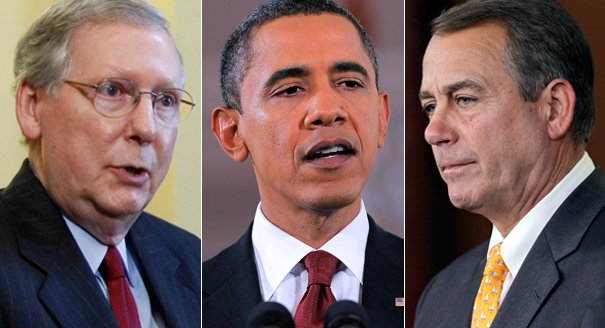
The Deciders
We had a few days of excitement, and for some of us rising hopes that the Democrats–at least in the House–might actually fight back against the Obama-McConnell more money for the rich plan. This morning as I look around the web, I see that the corporate media is assuming that there will be no fight–that this outrageous “compromise” between President Obama and the Republicans is actually a good thing for Democrats.
At the WaPo, the message is the same as at the NYT–the deal is a fait accompli and House Dems aren’t going to put up a fight. In fact, it appears that the tax cut extension for the rich is no longer an issue at all. The only sticking point for House Dems is the estate tax rate.
For Democrats in both chambers, the most onerous provision in the package would exempt estates valued at up to $10 million from a newly imposed estate tax. House Speaker Nancy Pelosi (Calif.) has called the measure a giveaway to the wealthy and “a bridge too far,” given that Obama has abandoned his campaign pledge to allow the Bush tax breaks for wealthy households to expire.
“Most of us agree with almost all of what the president negotiated,” Rep. Chris Van Hollen (D-Md.) told “Fox News Sunday.” “There is one thing that just was the choking point, and that deals with the estate-tax break.”
But, he continued, “I am confident that when we get to January, there will be no tax increases on middle-income Americans. We’re not going to hold this thing up at the end of the day, but we do think that simple question should be put to the test.”
USA Today reports–perhaps sarcastically–that Obama will fight for us next year.
“I will be happy to see the Republicans test whether or not I’m itching for a fight on a whole range of issues,” Obama said last week. “I suspect they will find I am. And I think the American people will be on my side on a whole bunch of these fights.”
[….]
One of those fights will be over the very thing that some Democrats are angry about: The two-year extension of George W. Bush-era tax cuts for the nation’s wealthiest Americans.
“When they expire in two years, I will fight to end them,” Obama said. “Just as I suspect the Republican Party may fight to end the middle-class tax cuts that I’ve championed and that they’ve opposed.”
[….]
…Obama has said that without a deal the Bush tax cuts would expire and everyone would see their taxes rise, and “I want to make sure that the American people aren’t hurt because we’re having a political fight.”
That presumably comes next year.
“I’m looking forward to seeing them on the field of competition over the next two years,” Obama said.
But why should be believe the liar-in-chief? I don’t think even USA Today believes him.
The Hill reports that Steny Hoyer has other plans for next year. He hopes to work on deficit reduction, with the recommendations of Obama’s Catfood Commission “at the center of our national conversation.”
Hoyer said he was “heartened that the president’s bipartisan fiscal commission put forward a provocative, challenging plan on debt — a plan that needs to be at the center of our national conversation.”
He said the plan should be looked at, along with those by the Bipartisan Policy Center, Rep. Jan Schakowsky (D-Ill.) and the Center for American Progress.
As he has in the past, Hoyer stressed the need for entitlement reform, including reform of Social Security possibly by raising the retirement age and raising the cap on income taxes to pay for Social Security.
That sounds really ominous to me.
Now let’s look at some of the few naysayers who still think the President’s plan is wrongheaded.
Paul Krugman is still unhappy with the plan but he’s resigned to its passage by Congress.
The deal will, without question, give the economy a short-term boost. The prevailing view, as far as I can tell — and that includes within the Obama administration — is that this short-term boost is all we need. The deal, we’re told, will jump-start the economy; it will give a fragile recovery time to strengthen.
I say, block those metaphors. America’s economy isn’t a stalled car, nor is it an invalid who will soon return to health if he gets a bit more rest. Our problems are longer-term than either metaphor implies.
And bad metaphors make for bad policy. The idea that the economic engine is going to catch or the patient rise from his sickbed any day now encourages policy makers to settle for sloppy, short-term measures when the economy really needs well-designed, sustained support.
If you believe Krugman, we are headed for long-term economic turmoil with almost no efforts by the government to help people in need or to create jobs.
What the government should be doing in this situation is spending more while the private sector is spending less, supporting employment while those debts are paid down. And this government spending needs to be sustained: we’re not talking about a brief burst of aid; we’re talking about spending that lasts long enough for households to get their debts back under control. The original Obama stimulus wasn’t just too small; it was also much too short-lived, with much of the positive effect already gone.
Elizabeth Warren says we are still in a serious economic crisis. She can’t understand how anyone can believe the economy is recovering when so many American families are still in dire distress.
Wall Street banks reaping profits and paying bonuses while the rest of the country struggles shows “we still have a problem” with economic disparity, said Elizabeth Warren, the Obama administration adviser responsible for setting up the Consumer Financial Protection Bureau.
“This just staggers me; I mean, I just don’t have words to describe what this means,” she said in an interview for Bloomberg Television’s “Conversations With Judy Woodruff” that will be broadcast this weekend. “For me, what an economic recovery is about is about what happens to American families. It’s what happens in the real economy. It’s whether or not families are building up wealth in their homes or whether or not their homes are dragging them over an economic cliff.”
“It isn’t meaningful to talk about profits and a growing economy until American families are stabilized,” she said.
Former Reagan budget director David Stockman says unemployment is far worse than anyone is admitting.
At the rate the US economy is recovering, it will take 28 years to get back to where we were in December 2007 if something doesn’t change, David Stockman, former federal budget director under President Reagan, told CNBC Friday.
“When we look below the surface and the job outlook and the trend that we’ve been in, it’s a lot worse then people think,” Stockman said.
“The jobs that they count every month and people get excited about are really part-time jobs,” he said.
Now that we are in the “new normal,” it’s important to rebucket the data the Labor Department releases on the big picture of the 130 million jobs in the economy, Stockman said.
Take the middle class, Stockman said, which is at the heart of the economy—about 54 million jobs. This is everything you can think of in terms of bread-winner jobs. The annual median wage is $50,000.
“If we are going to have recovery, it has to happen here,” he said, adding, “we lost 7 million jobs in two-year downturn in the ‘Great Recession.”
Even a former supply-side guy like Stockman thinks the key to getting out of this depression (which is what it is) is getting back middle class jobs.
I’m not an economist, so I can’t discuss all this knowledgeably like Dakinikat can. But even I can see that this country is in deep deep trouble. Again, I have to ask: Who will fight for us? And when? What can we do to fight for ourselves?
Dkat here with an update from C-SPAN.
The Senate convenes today where they plan to resume consideration of The Middle Class Tax Relief Act of 2010 (H.R. 4853). Senate Majority Leader Harry Reid (D-NV) has scheduled a procedural vote for 3pm today to move forward on the measure, which includes an extension of unemployment benefits for the next 13 months in exchange for allowing tax cuts for all income levels to continue for another two years.
This vote is scheduled to be broadcast on C-SPAN 2.
UPDATE: Senate in session and voting right now. (Voting to move vote forward 2:00 cst)
President Obama praised the Senate today for taking the important first step toward passing the controversial tax plan he hashed out with Republicans, a compromise bill which has angered many lawmakers inside his own party.
The bill still faces a tough fight in the House and the president “urged the House of Representatives to act quickly to similarly pass the bill.”
“I’m pleased to announce at this hour the U.S. Senate is moving forward on a package of tax cuts that has strong bipartisan support,” he said.
He said the bill “will grow the economy” and “grow jobs.”
The deal passed a procedural vote in the Senate this afternoon, and will come to a final vote later in the week — perhaps as early as Tuesday — before it is taken up by the House.
In a procedural vote, 83 senators voted in support of the legislation, which extends Bush-era tax cuts into the new year. Sixty votes were needed.
There were 15 votes against the bill.

 peej
peej Carissa
 bostonboomer
 dakinikat
 ecocatwoman
 mablue2
 Mama Lopez
 peggysue22
 quixote
 skydancingguestblogger
 Mona (aka Wonk the Vote)



 Sky Dancing
Recent Comments