
Tuesday Reads
Posted: February 8, 2011 Filed under: Barack Obama, Egypt, Foreign Affairs, Middle East, morning reads, Patriot Act, U.S. Politics, Violence against women, Women's Rights | Tags: Buzz Bissinger, dangerous work, football, Henna Begum, murder, New England, Patriot Act reauthorization bill, plains states, public flogging, rape, snow, violence, violent sports, weather 73 Comments
Good Morning! It looks like New England will dodge a bullet this week. There was talk of another storm on Wednesday, but now we are only expecting 2-4 inches of snow tomorrow. That is manageable and won’t prevent me from getting to work on Wednesday, thank goodness. But the lower plains states are going to get more snow later this week, I hear. That storm isn’t headed my way though. What a relief!
Still, The Boston Globe reports that roofs are still collapsing around New England.
Problems with roofs overloaded by heavy layers of snow continued today around the region, as public safety officials raced to sagging or collapsed structures reported in Boston, Bellingham, Littleton, Dedham, and Norwood. Meanwhile, a relatively small storm for this unusually snowy season was expected to dump up to 3 inches on some areas of the state.
A roof collapse was reported at 1:45 p.m. at the Unity Tabernacle of Holiness Church, a storefront church at 2 Greendale Road in Mattapan, the Boston Fire Department said. Firefighters found the roof had partially collapsed. No one was in the building at the time; no one was injured, and a building inspector was summoned to examine the scene, the department said in an official tweet.
In Bellingham, the corrugated metal roof of the Popular Precast Products building at 26 North Main St. collapsed this morning from the heavy snow, and one wall caved in; the entire building will have to be demolished, Building Inspector Stuart LeClaire said.
The owner had been inside just before the collapse, but heard the walls cracking and made it out in time, LeClaire said.
That’s just the beginning of a long list. I hope my back porch roof holds up. It already leaks. I can’t get out in the back yard to pull the snow down, because there are several feet of snow on the ground.
The Washington Post has a report on President Obama’s speech to the U.S. Chamber of Commerce {gag}.
“We can, and we must, work together,” Obama told an audience at the U.S. Chamber of Commerce, his most overt effort yet to mend ties with the nation’s business community. “Whatever differences we may have, I know that all of us share a deep, abiding belief in this country, a belief in our people, a belief in the principles that have made America’s economy the envy of the world.”
His administration will “help lay the foundation for you to grow and innovate,” Obama said, vowing new investment in infrastructure and education and a focus on removing “barriers that make it harder for you to compete – from the tax code to the regulatory system.”
But even as he vowed to push hard on initiatives ranging from trade deals to corporate tax reform, Obama challenged business leaders to ramp up their hiring, bring jobs back from overseas and quit sitting on such large stockpiles of cash.
Bla, bla, bla. He might as well be talking to a brick wall. What a loser.
NPR’s Talk of the Nation had an interesting segment on football today. The guest was Buzz Bissinger of The Daily Beast, who wrote a post explaining why football is inherently violent. He argues that there is no way to take the violence out of the game–then it would no longer be football. If we’re really concerned about the concussions, arthritis, and other serious side effects, we should ban football entirely. Bissinger:
Violence is not only embedded in football; it is the very celebration of it. It is why we like it. Take it away, continue efforts to curtail the savagery, and the game will be nothing, regardless of age or skill.
Much has been reported, especially by The New York Times, about the potential dangers of head injuries in the game. I know the reporter who has done virtually all the stories, Alan Schwarz, and to say he is assiduous is ridiculous understatement. His work has truly been exemplary. But after what seems like a million stories, it may be time for the Times to move on. The overall point has been hammered to bits.
The game doesn’t simply cause injury. It is injury. It is an occupational hazard that, yes, can turn into tragedy. The inherent danger can never be strained out, except at the margins. Nor should it be.
I have to agree. I admit that I like watching football, but I wouldn’t be heartbroken if it were banned. But that will never happen, at least at the professional level. But when I was listening to the discussion on NPR, it occurred me that there is never this kind of concern about on-the-job injuries and hazards in blue-color work.
No one suggests that coal mining should be banned because the work cuts miners’ lives short. Construction workers take risks too, and so do people in many other jobs. I worked as a secretary for years, and I now have terrible arthritis in my hands and fingers. I’m sure typing for so many years contributed to that.
It’s just another example of the ways in which some people seen as more important than others. If someone chooses to play football–or baseball or basketball–they should know the risks and possible consequences. But there is risk in everything in life. There is no way to remove all risk. That kind of thinking about terrorism is what got us where we are now–broke and with very few rights left.
Congress is about to pull a fast one, by voting to reauthorize the Patriot Act in the House today. From the EFF
Tell your Congressperson to vote NO on the USA PATRIOT Act in tomorrow’s vote! The PATRIOT reauthorization bill being fast-tracked to the House floor contains NO reforms to the law, and will be voted upon with NO debate and NO opportunity for amendments to add oversight and accountability. Help stop this sneak attack on your civil liberties: there are only hours left to visit our Action Center and tell your Representative to vote “NO” on H.R. 514, the PATRIOT extension bill.
In late 2009, when PATRIOT reauthorization was originally being considered by Congress, many important PATRIOT reform measures were proposed and debated, and a bill filled with powerful new checks and balances was reported favorably out of the House Judiciary Committee. But, as Congress ran up against the renewal deadline, it decided that there was not enough time to fully consider those reforms. So, in February 2010, Congress instead extended the “sunsetting” sections of the law until the end of this February, with a promise to fully consider the issues before the next deadline.
But Congress is breaking its promise to consider reforms to the PATRIOT Act. In a legislative sneak attack, the new Republican leadership in the House is trying push Representatives to rubber-stamp another PATRIOT renewal. The House leaders just announced on Friday that they’ll be “suspending the rules” so that a bill introduced by Rep. Sensenbrenner to extend the expiring PATRIOT provisions until December 8, 2011 will go to the House floor for a vote TOMORROW, without any debate and without any opportunity for anyone to offer amendments to improve the bill.
Please call or fax your congressperson.
The following story is shocking and heartbreaking, and concerns rape and cruel death of a young girl; if you don’t think you can handle it, feel free to skip over the section of the post. But I think this is an important story, so I’m going to share it even though it’s hard for me to even think about.
Four people including a Muslim cleric have been arrested in Bangladesh in connection with the death of 14-year-old girl who was publicly lashed.
The teenager was accused of having an affair with a married man, police say, and the punishment was given under Islamic Sharia law.

Henna Begum
An affair? She was 14. He was 40. She was raped, and then she was publicly flogged. BBC News:
The family members of the married man [Henna’s cousin, age 40] also allegedly beat the girl up a day before the village court passed the sentence in the district of Shariatpur.
Hena Begum died after being taken to hospital “Her family members said she was admitted to a hospital after the incident and she died six days later. The village elders also asked the girl’s father to pay a fine of about 50,000 Taka (£430; $700),” district superintendent of police, AKM Shahidur Rahman, told the BBC.
He said it had not been established yet whether she died because of the punishment she received or another reason.
Another reason? WTF?! Universe, give me strength! BTW, these Sharia law punishments have been outlawed in Bangladesh. You’d think the district superintendent could have stopped the beatings and floggings instead of waiting until Henna was dead to “investigate.”
People in Bangladesh are asking the same question:
The High Court yesterday ordered district officials in Shariatpur to explain why they failed to protect 14-year-old rape victim Hena from being whipped to death as per a fatwa on Monday.
The deputy commissioner, the superintendent of police of Shariatpur and the thana nirbahi officer of Naria upazila — where the incident took place–will have to report to the HC in 15 days how it happened although the court (HC) had eight months ago declared fatwa illegal and a punishable offence.
In a suo moto rule, the HC directed them also to report what steps they have taken in this regard.
An HC bench comprised of Justice AHM Shamsuddin Chowdhury Manik and Justice Sheikh Md Zakir Hossain issued the rule following press reports on the killing of Hena.
I’ll end with just a few links on the situation in Egypt.
At the Socialist Worker, there is a statement from “radical Egyptian socialists.”
From the World Socialist Website: Imperialism and Egypt’s “democratic transition”
From Siun at FDL: Concessions Meaningless Say Tahrir Protesters: “We Want a New System”
Slate: UN: 300 Dead in Egyptian Protests
The NYT Lede Blog has “the latest updates” from Egypt
What are you reading and blogging about today?
Monday Reads
Posted: February 7, 2011 Filed under: 2012 presidential campaign, Barack Obama, morning reads, psychology | Tags: AOL Buys HuffPo, Bill OReilly interviews obama, financial contagion, Krugman on High Food Prices, Neuroscience and buddhism, Obama speech Chamber of Commerce 31 Comments Good Morning!!!
Breaking NEWS update:
Rep. Jane Harman of California to resign
Democrat Jane Harman, who represents a Los Angeles-area district, is expected to leave Congress to lead the Woodrow Wilson International Center for Scholars, a congressional source says.
U.S. Rep. Jane Harman (D-Venice), a leading congressional voice on anti-terrorism issues, plans to resign from Congress to head up the Woodrow Wilson International Center for Scholars, a senior congressional source confirmed Monday, setting up a special election to choose her successor in a coastal district that stretches from Venice into the South Bay.
There’s plenty of news to share today so grab a big mug of whatever it is that you drink and join in!!
First, some big news in business and the blogosphere. AOL Is Buying The Huffington Post.
The two companies completed the sale Sunday evening and announced the deal just after midnight on Monday. AOL will pay $315 million, $300 million of it in cash and the rest in stock. It will be the company’s largest acquisition since it was separated from Time Warner in 2009.
The deal will allow AOL to greatly expand its news gathering and original content creation, areas that its chief executive, Tim Armstrong, views as vital to reversing a decade-long decline.
Arianna Huffington, the cable talk show pundit, author and doyenne of the political left, will take control of all of AOL’s editorial content as president and editor in chief of a newly created Huffington Post Media Group. The arrangement will give her oversight not only of AOL’s national, local and financial news operations, but also of the company’s other media enterprises like MapQuest and Moviefone.
I’m not sure if any of you caught the O’Reilly interview of Obama, but President Obama is insisting that he’s not moving to the center. The one thing I keep hearing about this interview is that O’Reilly couldn’t stop interrupting the President. I can only imagine how large that studio had to be to contain those big heads.
President Obama on Sunday dismissed the notion that his administration in recent weeks has pivoted toward the political center to raise his approval ratings as the 2012 campaign nears.
After ushering through Congress measures to throw a lifeline to troubled U.S. corporations, stimulate the economy and dramatically overhaul the nation’s healthcare system, Obama has since cut a deal with congressional Republicans on taxes and called for a freeze on most federal spending.
But when pressed Sunday during a live interview with Fox’s Bill O’Reilly on what political analysts say is a clear sprint toward the center, Obama dismissed the notion with a “no.”
“I haven’t — I didn’t move to… I’m the same guy,” he said.
When O’Reilly said the president’s critics call him “a big government liberal,” Obama replied that he inherited a nation on the brink of an economic crisis. That situation required his administration to take a number of “extraordinary steps” to avoid a severe economic depression, Obama said.
I wrote on the role of speculation in high food prices a few days ago . Paul Krugman believes it’s a supply problem and wrote about it Sunday on the NYT. He also considers climate change to be a factor. You may want to check it out.
Overall grain production is down — and it’s down substantially more when you take account of a growing world population. Wheat production (this time not per capita) is way down.
You might ask why a production shortfall of 5 percent leads to a doubling of prices. Part of the answer is that some kinds of demand are growing faster than population — in particular, China is becoming a growing importer of feed to meet the demand for meat. But the main point is that the demand for grain is highly price-inelastic: it takes big price rises to induce people to consume less, yet collectively that’s what they must do given the shortfall in production.
Why is production down? Most of the decline in world wheat production, and about half of the total decline in grain production, has taken place in the former Soviet Union — mainly Russia, Ukraine, and Kazakhstan. And we know what that’s about: an incredible, unprecedented heat wave.
Here‘s a wonky link to VOXEU that discusses financial contagion. It’s pretty interesting. The article deals with contagion in the market for European Sovereign bonds but you can extrapolate the basic intuition to other assets. Here’s one surprising insight. It seems that many stocks that performed well during the financial crisis were frequently the one’s most likely to be subjected to ‘fire sales’ later on. That’s a tidbit worth remembering.
First, the fire sale discount is most pronounced for stocks which performed best during the crisis. Figure 2 illustrates this aspect by depicting the relative performance of non-exposed and exposed stocks as a function of the stocks overall return from July 2007 to July 2008. Most of the return shortfall of exposed stocks is concentrated among the stocks with the highest returns. This somewhat counterintuitive result can be explained by fund discretion about which asset positions to liquidate. Faced with funding constraints and investor redemption requests, distressed equity funds liquidated the best performing stocks rather than stocks with recent large capital losses. Thus, fire sales were more pronounced for stocks among the 10% best performing stocks. For these stocks we find average fire sale discounts above 75%.
President Obama addresses the US Chamber of Commerce today. You can watch it on CSpan.
Picking up on the themes expressed in his State of the Union Address, President Obama will reaffirm his commitment to invest in rebuilding the nation’s infrastructure during a speech at the U.S. Chamber of Commerce today.
During that address before Congress, the President identified innovation, education, and infrastructure as the keys to stimulate the economy by increasing job growth and entrepreneurial opportunities.
Here’s a post for our BostonBoomer from Psychology today. Okay, it’s also for me. It’s called Buddhism and Neuroscience: Neuroscience finds a friend in Buddhism. Here’s an interesting scientific view of a practice we Buddhists do to realize that there is no “soul”.
When a Buddhist applies the idea of constant change to the self and the soul, he gains an insight that other religions lack. What we call a mind (or a self, or a soul) is actually something that changes so much and is so uncertain, that our terms for it do not find meaning. The Buddhist word for self is anatta and it means ‘no self.’ It is used to refer to oneself, while cleverly reminding the user of the word that there is such thing.
Within this framework, one is immediately struck by the disconnect between perception and religious teaching. All is endlessly changing, but I feel unified and unchanged from moment to moment, year to year. The way things feel becomes suspect, just as it does in modern neuroscience. Broadly, both Buddhism and neuroscience converge on similar points of view: the way it feels to be you isn’t how it is, that even our language about ourselves is to be distrusted (witness the tortured negation of anatta), and there is no permanent, constant soul in the background.
Despite saying there is no self, Buddhism does posit an immaterial thing that survives the brain’s death. Through life there is a consciousness, always changing like the world, one mental state rising like a wave to crash on the beach, then another and another. After a person’s death, the consciousness re-incarnates. This isn’t much of a trick, since even during a Buddhist life, each moment can be considered a re-incarnation from the moment before. The waves still lap, the beach shifted. If you’re good, they might lap at a higher organism. If you’re not, well, insects clearly have consciousness and someone’s waves need to supply it.
So how does Buddhism do? Pretty well. Buddhism lays out the concept that there is no mind the way we tend to consider them (as we consider our self). In broad strokes, neuroscience and neurology agree.
Kinda cool hmm?
So, what’s on you reading and blogging list today?
White House Pushing Bogus Meme about Egyptian “Transition”
Posted: February 6, 2011 Filed under: Barack Obama, Egypt, Elections, Foreign Affairs, U.S. Politics | Tags: Ahmad Fathi Sorour, Egyptian constitution, Egyptian protests, Hosni Mubarak, Obama Administration, Omar Suleiman, rendition, rules of succession, Torture 74 Comments
Barack Obama and Hosni Mubarak in Egypt
Today multiple news sources are suddenly reporting practically word for word a new meme on the Egyptian “transition” that is obviously coming from the Obama administration. And the message has been coordinated with Egyptian Vice President Omar Suleiman. Mubarak is being gradually edged out, and the U.S. needs to make sure they stay in control of the situation. Obama must make sure to prevent real democracy from taking hold in Egypt.
So the new meme is that Mubarak will be kept around as a powerless figurehead, but first he needs to make some changes in the constitutional rules of succession so that Suleiman can legally be in charge of the “transition” government. Why Suleiman? Supposedly because the guy who is supposed to succeed Mubarak, Ahmad Fathi Sorour, is “much worse” than even Suleiman the torturer. Yet there is never any credible explanation for why Solour is so terrible that it’s better to have a torturer in control of the lead-up to US-controlled “free and fair” elections
From the Village organ: What Mubarak must do before he resigns.
If today Mubarak were no longer available to fulfill his role as president, the interim president would be one of two candidates. If he chooses to leave the country, say for “medical reasons,” the interim president would be Omar Suleiman, the former intelligence chief who was recently made vice president. Egyptians, particularly those of us calling for an end to Mubarak’s three-decade rule, see Suleiman as Mubarak II, especially after the lengthy interview he gave to state television Feb. 3 in which he accused the demonstrators in Tahrir Square of implementing foreign agendas. He did not even bother to veil his threats of retaliation against protesters.
On the other hand, if Mubarak is pushed to resign immediately we would have an even worse interim president: Fathi Surur, who has been speaker of the People’s Assembly since 1990.
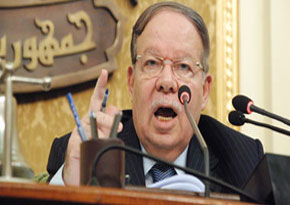
Ahmad Fathi Sorour
And he would be worse because?
Surur has long employed his legal expertise to maintain and add to the arsenal of abusive laws that Mubarak’s regime has used against the Egyptian people. Since neither Suleiman nor Surur would be able to amend the constitution during the interim tenure, the next presidential election would be conducted under the notoriously restrictive election rules Mubarak introduced in 2007. That would effectively guarantee that no credible candidate would be able to run against the interim president.
So before Mubarak resigns he must sign a presidential decree delegating all of his authorities to his vice president until their current terms end in September.
But Suleiman “has long employed his [military and intelligence] expertise” to cooperate with U.S. rendition and torture policies. Why is he better? Why should anyone believe that Suleiman will push for real democracy? Give me a break! The U.S. wants Suleiman in charge because he is their guy.
UC Davis Professor Noha Radwan Beaten “Half to Death” by Mubarak’s Thugs
Posted: February 3, 2011 Filed under: Barack Obama, Diplomacy Nightmares, Egypt, Foreign Affairs, U.S. Politics | Tags: Egyptian protests, Hosni Mubarak, live blog, Professor Noha Radwan 82 Comments
Yesterday, Professor Noha Radwan was interviewed by Sharif Abdel Kouddous of Democracy Now in Cairo. Here is the video:
Just after she completed the interview, Radwan was brutally beaten by thugs working for the Egyptian dictator. She told Amy Goodman of Democracy Now
“I got attacked by the mob and beaten half to death by the Mubarak thugs who were happy to snatch my necklaces off my neck and to rip my shirt open,”
There is a follow-up telephone interview with Radwan at the second link above. The call with Radwan begins around 37:19. She says that pro-Mubarak thugs asked her if she was pro- or anti-Mubarak. She didn’t want to answer and tried to walk past them. Then the thugs called to the rest of the “mob,” “She’s with them, she’s with them! Get her!”
Two large men held her by the arms while the mob ripped her shirt off, took a gold necklace that she wore during the interview, and beat her so badly that she had to get stitches in her head. She says that other people have been treated much worse than she was. Radwan says that the Egyptian government-controlled media has been “broadcasting nonstop” that “we are infiltrators, that we are foreign-paid…not actually real Eqyptians.”
Amy Goodman says that Democracy Now has been getting reports that the “pro-Mubarak” forces seem to be made up mostly of Egyptian police. The Guardian apparently reported that at least 100 police ID’s have been recovered. There is lots more in the video. If it becomes available on Youtube, I’ll post it here.
What will happen next?
At the Foreign Policy blog, Robert Springbord puts into words what I have been fearing for the past few days: Game over: The chance for democracy in Egypt is lost.
While much of American media has termed the events unfolding in Egypt today as “clashes between pro-government and opposition groups,” this is not in fact what’s happening on the street. The so-called “pro-government” forces are actually Mubarak’s cleverly orchestrated goon squads dressed up as pro-Mubarak demonstrators to attack the protesters in Midan Tahrir, with the Army appearing to be a neutral force. The opposition, largely cognizant of the dirty game being played against it, nevertheless has had little choice but to call for protection against the regime’s thugs by the regime itself, i.e., the military. And so Mubarak begins to show us just how clever and experienced he truly is. The game is, thus, more or less over.
The threat to the military’s control of the Egyptian political system is passing. Millions of demonstrators in the street have not broken the chain of command over which President Mubarak presides. Paradoxically the popular uprising has even ensured that the presidential succession will not only be engineered by the military, but that an officer will succeed Mubarak. The only possible civilian candidate, Gamal Mubarak, has been chased into exile, thereby clearing the path for the new vice president, Gen. Omar Suleiman. The military high command, which under no circumstances would submit to rule by civilians rooted in a representative system, can now breathe much more easily than a few days ago. It can neutralize any further political pressure from below by organizing Hosni Mubarak’s exile, but that may well be unnecessary.
The president and the military, have, in sum, outsmarted the opposition and, for that matter, the Obama administration. They skillfully retained the acceptability and even popularity of the Army, while instilling widespread fear and anxiety in the population and an accompanying longing for a return to normalcy.
Reactions?
This is an open thread to discuss the Egyptian protests.
Thursday Reads
Posted: February 3, 2011 Filed under: Barack Obama, Egypt, Foreign Affairs, Tunisia, U.S. Politics | Tags: Cyclone Yasi, Democracy Now, Egyptian protests, George Soros, Hosi Mubarak, Noam Chomsky, snow, Tony Blair, weather 25 Comments
The view from my front door
Good Morning!! Isn’t it fun to look out your window and see a coating of ice all over everything? Especially when you already have mountains of snow out there. I plan to spend much of the day throwing ice pellets around and trying to chip the pile of ice that a snowplow left at the end of my driveway. Oh joy!
So what’s in the news this morning? Let me see….. I thought I’d post some video of Noam Chomsky discussing the Egyptian protests on Democracy Now.
NOTE: There are more parts to the Chomsky interview that you can watch at Democracy Now.
That’s the view from a real leftist. Have you heard what Tony Blair had to say about the situation?
Former British Prime Minister Tony Blair explained Tuesday that the embattled Egyptian president was “immensely courageous and a force for good.”
Appearing on CNN, Blair praised Mubarak’s role in brokering peace between Israel and Palestine. The former prime minister is now an envoy to the peace process….
…where you stand on him depends on whether you’ve worked with him from the outside or on the inside,” Blair replied. “And for those of us who worked with him over the — particularly now I worked with him on the Middle East peace process between the Israelis and the Palestinians, so this is somebody I’m constantly in contact with and working with.”
George Soros expressed his ideas about Egypt in today’s Washington Post.
President Obama personally and the United States as a country have much to gain by moving out in front and siding with the public demand for dignity and democracy. This would help rebuild America’s leadership and remove a lingering structural weakness in our alliances that comes from being associated with unpopular and repressive regimes. Most important, doing so would open the way to peaceful progress in the region. The Muslim Brotherhood’s cooperation with Mohamed ElBaradei, the Nobel laureate who is seeking to run for president, is a hopeful sign that it intends to play a constructive role in a democratic political system. As regards contagion, it is more likely to endanger the enemies of the United States – Syria and Iran – than our allies, provided that they are willing to move out ahead of the avalanche.
The main stumbling block is Israel. In reality, Israel has as much to gain from the spread of democracy in the Middle East as the United States has. But Israel is unlikely to recognize its own best interests because the change is too sudden and carries too many risks. And some U.S. supporters of Israel are more rigid and ideological than Israelis themselves. Fortunately, Obama is not beholden to the religious right, which has carried on a veritable vendetta against him. The American Israel Public Affairs Committee is no longer monolithic or the sole representative of the Jewish community. The main danger is that the Obama administration will not adjust its policies quickly enough to the suddenly changed reality.
I am, as a general rule, wary of revolutions. But in the case of Egypt, I see a good chance of success. As a committed advocate of democracy and open society, I cannot help but share in the enthusiasm that is sweeping across the Middle East. I hope President Obama will expeditiously support the people of Egypt.
Here’s an interesting article from the Wall Street Journal about why both the U.S. and Egyptian government were unprepared for the Egyptian uprising.
A close look at how Egypt’s seemingly stable surface cracked in so short a time shows how Egypt’s rulers and their Western allies were caught almost completely off guard as the revolution unfolded, despite deep concerns about where Egypt’s authoritarian government was leading the country.
From the moment demonstrators began pouring into the street, those leaders have been scrambling to keep up, often responding in ways that have accelerated the crisis.
[….]
…last week, tens of thousands of Egyptians began taking to the streets, flooding into the central Tahrir Square after pitched battles with thousands of riot police. It became the largest popular protest in Egypt since the so-called Bread Riots against rising prices in 1977.
Mr. Mubarak’s regime was stunned. “No one expected those numbers that showed up to Tahrir square,” said Ali Shamseddin, a senior official with the National Democratic Party in Cairo.
In faraway Washington, the demonstrations were only starting to register. Last Tuesday’s State of the Union address, delivered the day the protests started, had only a short section on foreign policy. President Barack Obama planned to nod to the democratic movement that swept away the ruler of Tunisia, a place “where the will of the people proved more powerful than the writ of a dictator,” the speech read.
After that, it’s kind of embarrassing that Obama is clearly more concerned about “stability” (oil?) in Egypt than the “will of the people.”

Trees uprooted by Cyclone Yasi
We had a gigantic storm here in the U.S., but the one in Australia might have been worse. From the Daily Telegraph: Cyclone Yasi: Queensland wakes to widespread devastation
As the winds dropped on the coast and locals emerged from cyclone bunkers and evacuation centres, they found widespread damage, especially in the coastal communities of Tully, Mission Beach and Cardwell.
Driving winds of 180mph had uprooted trees and torn roofs and walls from homes and businesses.
During the morning, dangerous storm surges were causing flooding in low-lying urban areas in the cities of Cairns and Townsville and the authorities urged residents to stay indoors.
[….]
In total, 170,000 properties were without power and thousands of people were likely to be left homeless after their homes were severely damaged by the worst cylone to hit Australia since 1918. Storm surges and flooding were also rolling into low-lying areas and inundating homes throughout the morning. Compounding the crisis, saltwater crocodiles had been spotted in floodwater.
Yikes! At least my power didn’t go out, and there aren’t any crocodiles out there.
That’s all I’ve got. What are you reading and blogging about this morning?

 peej
peej Carissa
 bostonboomer
 dakinikat
 ecocatwoman
 mablue2
 Mama Lopez
 peggysue22
 quixote
 skydancingguestblogger
 Mona (aka Wonk the Vote)



 Sky Dancing
Recent Comments