
Indiana’s Mitch Daniels: 2012 Republican Presidential Nominee?
Posted: February 24, 2011 Filed under: 2012 presidential campaign, Anti-War, Barack Obama, Elections, U.S. Economy, U.S. Politics, We are so F'd | Tags: 2012 presidential election, Chris Christie, George W. Bush, George Will, Governor Mitch Daniels, Harley Davidson motorcyles, Jeb Bush, Marlon Brando, short people 28 Comments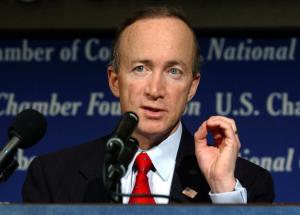
Indiana Gov. Mitch Daniels
Lots of Republicans are urging Indiana Governor Mitch Daniels to run for the Republican presidential nomination in 2012. Will he do it? Can he win?
Who’s touting Daniels? New Jersey Governor Chris Christie loves the guy.
Chris Christie, the governor of New Jersey, said Wednesday that his counterpart in Indiana, Mitch Daniels, is the only prospective Republican presidential candidate who is honestly talking about how to confront the nation’s biggest fiscal challenges.
Jeb Bush thinks Daniels is “the best Republican candidate.”
Jacksonville’s Florida Times-Union reports that former Florida Gov. Jeb Bush favors Indiana Gov. Mitch Daniels for president in 2012.
Bush reportedly told a private reception for business leaders, “Mitch is the only one who sees the stark perils and will offer real detailed proposals.”
Daniels’ speech at CPAC 2011 was very well received, and get this–George Will introduced Daniels to the CPAC audience as “the thinking man’s Marlon Brando,” apparently because Daniels likes to right around the Indiana countryside on a Harley Davidson chopper. Judge for yourself.

Mitch Daniels on his Harley

Marlon Brando in "The Wild One"
Daniels has some other problems too. For one thing he thinks Republicans should forget about social issues and focus on economic ones (cutting deficits, natch). Conservatives are not at all happy with Daniels for asking Indiana Republican legislators to withdraw their proposed “right to work” bill. In addition, he reportedly is a pretty serious policy wonk who likes to talk to his fellow wingnuts as if they were adults.
By far, the most important speech at CPAC was delivered by two-term Gov. Mitch Daniels of Indiana at Friday night’s banquet. It was an eloquently crafted, intellectually compelling call to arms against the red-ink forces of the national debt. Daniels, who was George W. Bush’s budget director, proposed dramatically revamping Social Security and Medicare as he called for “an affectionate thank you to the major social welfare programs of the last century.”
What was most striking about Daniels’ speech, which inspired careful listening rather than pep-rally applause, was that it treated his CPAC audience as adults rather than as just another constituency group demanding pandering. Whether it was dismissing the easy-answer attacks on earmarks (“in the cause of national solvency, they are a trifle”) or suggesting that most voters do not appreciate the sharp-edged rhetoric of the Republican right (“it would help if they liked us, just a bit”), Daniels’ speech was an exercise in speaking truth to conservatives who have the power to derail a presidential candidacy.
Come on, that’s never going to work with Republican primary voters!
On top of that, several media outlets reported today that Daniels was busted for drugs when he was in 1970 when he was a junior at Princeton. And it wasn’t for possession of just a little pot, either.
Read the rest of this entry »
Tuesday Reads: Tim Geithner in Control of Obama’s Economic Policy, and Other News
Posted: February 15, 2011 Filed under: Bailout Blues, Barack Obama, Economic Develpment, Egypt, financial institutions, Foreign Affairs, Global Financial Crisis, Gulf Oil Spill, Iran, U.S. Economy, U.S. Politics, unemployment, Yemen | Tags: Barack Obama, Financial Markets, Larry Summers, Noam Scheiber, The New Republic, Timothy Geithner, Wall Street 22 Comments
Good Morning!! The snow is slowly melting outside my house, and I’ve come down with Spring fever! No more snowstorms please, Mother Nature. Anyway, at least for this week, we are getting temperatures in the 40s and 50s. It is going to be chilly again tomorrow, but after that–springlike! After the frigid winter we’ve lived through, these temperatures feel amazing. Maybe this will make the bad news from DC a little more bearable. I hope so.
This morning I want to focus on an important article that comes via David Dayen at FDL. It’s a piece at The New Republic about Timothy Geithner, written by Noam Scheiber. First a little aside.
Back in November, I wrote a post about the axing of Obama’s economic team and noted that Geither was the last man standing.
In that post, I quoted Andrew Cockburn of Counterpunch:
If Barack Obama needed any help in guiding the Democratic Party over the cliff he certainly got it from Treasury Secretary Timothy Geithner. Voters have told pollsters that the state of the economy, their own in particular, was their principle concern. Though impelled by the specter of unemployment and homelessness, the image of Geithner, toady to the bankers, can only have encouraged them in their fury. A sensible president would therefore already be running out the plank prior to giving this disastrous financial overseer an encouraging shove between the shoulders. But in this case, we may not be that lucky. CounterPunch can reveal the crucial role played in these matters by a group close to the President but unknown to the outside world.
A knowledgeable insider told Cockburn that despite Larry Summers’ reputation as a corporate tool,
“Larry has some idea that there is more to the economy than just the welfare of large banks,” this official suggests. “He did push for a larger stimulus and more jobs programs, for example. Tim just cares about banks.”
I then went on to indulge in a little conspiracy theorizing based on Cockburn’s information. But that’s beside the point right now. The point is that after writing that post, I came to the conclusion that Geithner was running economic policy in the Obama administration.
Getting back to the article at TNR, Scheiber purports to explain how Geithner survived the massacre of the economists. One interesting tidbit in the lengthy article is about Geithner’s relationship with Larry Summers, who acted as Geithner’s mentor and patron early on.
In 1993, Geithner caught the attention of [a] prominent patron—Larry Summers—whom Bill Clinton had appointed as his treasury undersecretary. Summers took a personal interest in Geithner’s career and promoted him each time he rose through the Treasury ranks.
And then during the Obama administration, Geithner apparently stabbed his patron in the back, becoming President Obama’s primary economic adviser–even though Geithner isn’t an economist. (Neither is anyone else on Obama current “economic team,” as Dakinikat frequently points out.)
Geithner actually sounds a lot like Obama–he’s really good at sucking up and convincing people he’s on their side–until he slides in the knife. Regarding Geithner’s time at the IMF, Scheiber writes:
According to former co-workers, Geithner was deft at bringing skeptical colleagues on board. One technique involved homing in on possible dissidents and absorbing their suggestions into his proposals.
Sound familiar? A bit more:
Perhaps most important, Geithner was scrupulously attuned to the temperament of the boss. Like Obama, he evinced a strong aversion to blather. During meetings with the president, he would say little, and usually not until the end, when his opinion was solicited. “I thought [Geithner] got the president really well,” says a former administration official who interacted with him on nonfinancial matters. “When he was in trouble, I said to someone, ‘He just needs to hold on. He’ll be fine with Obama. Once they get to know each other, they’re like the same person.’”
Scheiber describes an epic struggle between Geithner and Summers over how to deal with the banks that had crashed the U.S. economy. Summers argued for some form of nationalization, while Geithner claimed the banks just needed more capital and they could recover.
If Geithner was right, the capital shortfall was much more manageable than Summers feared. The banks might be able to fill it with minimal government help, simply by selling shares to investors. But, if he was wrong, the banks would stumble along in a kind of vampire state, sucking credit from the economy and exacerbating the recession. In the worst case, fears of insolvency could trigger a modern-day version of Depression-era bank runs.
Hey, wait a minute. That sounds like what is happening to our economy right now. But, never mind, Geithner won the battle that counted–the battle for Obama’s favor.
Part of what Geithner convinced Obama of was “that it was ultimately better politics to risk a backlash with unemployment at 10 percent than to feed the backlash and watch the economy shrink further.” So it’s Geithner we have to thank for the new normal of high unemployment, poverty, and suffering among the middle, working, and lower classes.
Finally, what horrified David Dayen was Geithner’s out-front claim that–in Dayen’s words, “what’s good for Wall Street is good for America.” Geithner:
“I don’t have any enthusiasm for … trying to shrink the relative importance of the financial system in our economy as a test of reform, because we have to think about the fact that we operate in the broader world,” he said. “It’s the same thing for Microsoft or anything else. We want U.S. firms to benefit from that.” He continued: “Now financial firms are different because of the risk, but you can contain that through regulation.” This was the purpose of the recent financial reform, he said. In effect, Geithner was arguing that we should be as comfortable linking the fate of our economy to Wall Street as to automakers or Silicon Valley.
In response, Dayen writes:
I don’t even know what to say about this. We’re just a few years removed from the financial oligarchs destroying the global economy through their own greed and negligence. And the man put in charge of regulating them, who had a front-row seat to all this destruction and who has been given expanded powers under Dodd-Frank to see to it that never happens again, thinks that there’s a great “financial deepening” about to take place where the demand for sophisticated financial innovations will jump. Therefore, the financial sector will need to grow and become the most reliable spur of the US economy. That’s his feeling. And regulation can reduce the risk, even though the new regulations barely put a dent into Wall Street’s core business, and are being systematically defunded besides.
Financialization of the economy has led to practically nothing but pain for the average worker and risk for the taxpayer. It has turned the allocation of capital into the placing of bets at a casino, and the stock market into a particularly sophisticated video poker game. This territory was all covered before in the run-up to the Great Depression as well, and we know the precise causes and remedies involved. Geithner prefers not to address the plutocracy he’s really advancing here – where elites provide “financial deepening” services abroad and amass ridiculous profits that they wall off.
This incredibly amoral conman is partnering with our conman chief executive to sell out our country, our lives, and those of our children and grandchildren. There’s lots more of interest in the article, particularly the information about Geithner’s upbringing.
I’ll wrap this up with a few other stories, and then throw the floor open to your links and opinions. Did you hear that Stephen Baldwin is suing Kevin Costner over Costner’s oil-eating invention?
It seems Baldwin sold his shares in Costner’s company right before BP shelled out $50 million for the machines.
Jane Hamsher offers a flow-chart of the principle players in the scandal over US Chamber of Commerce’s attempts to discredit Wikileaks, Glenn Greenwald, Brad Friedman, David House, and others who have supported wikileaks and Bradley Manning. Joseph Cannon has also been covering this story.
Brad Friedman’s post especially is a must read. Get this, the Chamber paid 2 million dollars a month for dirt on Friedman, and got completely inaccurate information. And that inaccurate information came from corporations who are paid billions by our government “to target terrorists.” But Obama wants to cancel heating assistance for poor people to save money.
Mitt Romney is ahead in the latest NH poll, at 40%, for whatever that’s worth. Romney was always going to win NH. They always vote for New Englanders up there. The real test for Romney will be Iowa.
The Patriot Act extension has been passed by the House on the second try. I think the Egyptians will probably get rid of their emergency law before we get rid of ours.
There are “massive” protests in Iran, inspired by the dramatic events in Egypt. There have also been more protests in Yemen and in Bahrain. When will it happen here?
What are you reading and blogging about today?
Mr. President, How About Supporting Democracy in the U.S.?
Posted: February 12, 2011 Filed under: Anti-War, Barack Obama, Civil Liberties, Egypt, executive orders, FBI raids, Foreign Affairs, Human Rights, Iran, U.S. Economy, U.S. Politics | Tags: authoritarianism, Bob Herbert, democracy, Egypt, executive power, free speech zones, Hosni Mubarak, hypocrisy, Income Inequality, Martin Luther King, Military Commissions Act, Poverty, USA Patriot Act 24 Comments
Yesterday, President Obama hypocrically praised the Egyptian pro-democracy demonstrators and argued forcefully in favor of the Egyptian government listening and responding to the demands of its people.
There are very few moments in our lives where we have the privilege to witness history taking place. This is one of those moments. This is one of those times. The people of Egypt have spoken, their voices have been heard, and Egypt will never be the same.
By stepping down, President Mubarak responded to the Egyptian people’s hunger for change. But this is not the end of Egypt’s transition. It’s a beginning. I’m sure there will be difficult days ahead, and many questions remain unanswered. But I am confident that the people of Egypt can find the answers, and do so peacefully, constructively, and in the spirit of unity that has defined these last few weeks. For Egyptians have made it clear that nothing less than genuine democracy will carry the day.

Back here in the U.S., President Obama listens only to the rich and powerful while ignoring a level of inequality higher than that in Egypt and an unemployment rate approximately the same as Egypt’s!
In the speech, Obama quoted a man who really stood for nonviolent protest and the fight for democracy:
As Martin Luther King said in celebrating the birth of a new nation in Ghana while trying to perfect his own, “There is something in the soul that cries out for freedom.” Those were the cries that came from Tahrir Square, and the entire world has taken note.
How dare you, Mr. Obama? You are a disgrace. You repeatedly imply comparisons between you and Martin Luther King, while behaving more like Mr. Mubarak.
What happens here in the U.S. when people peacefully protest the government’s policies? If it happens at Democratic or Republican party conventions, protesters are put in cages ironically called “free speech zones” that are far enough from the action to prevent the powerful from being disturbed by democracy-seeking rabble. Peace activists who identify as socialists or dare to support freedom movements in foreign countries are targeted by thuggish FBI raids and secret grand juries.
Mr. President, you and other members of your administration have repeatedly called for the Egyptian government to repeal its emergency laws. What about the emergency laws that have been in place here in the U.S. for many years?
Although most Americans would be surprised to hear it, the United States is technically experiencing more than one ongoing national emergency. In 1979, during the Iran Hostage Crisis, president Jimmy Carter declared a national emergency by executive order, which every president since has renewed. George W. Bush declared a separate state of emergency after the Sept. 11 terrorist attacks, which Barack Obama renewed.
These emergency measures are limited rather than general in nature. The 1976 National Emergencies Act set a two-year term on emergency declarations (although it’s possible to extend a declaration indefinitely), and requires the president to specify what, exactly, the state of emergency empowers him to do. The Sept. 11-related emergency gives the president the right to call retired officers back into active duty (among other powers). The Iran emergency prevents American citizens and companies from entering into oil development contracts with the Islamic Republic.
Those states of emergency have allowed you and your mentor predecessor George W. Bush to gain authoritarian powers for the executive branch through the USA Patriot Act and other unconstitutional laws like the Military Commissions Act. The powers granted by these laws have frequently been abused by government agencies.

Free Speech Zone at Democratic Convention, 2008
The Patriot Act has been reauthorized multiple times and is currently up for renewal.
So, Mr. Obama, what is your position on the latest attempts to keep the most intrusive parts of the Patriot Act from expiring?
When the act was first signed into law, Congress put in some “sunset” provisions to quiet the concerns of civil libertarians, but they were ignored by successive extensions. Unfortunately, those concerns proved to be well founded, and a 2008 Justice Department report confirmed that the FBI regularly abused their ability to obtain personal records of Americans without a warrant.
The answer to that question is that the President wants those provisions extended for three years–two years longer than the Republicans in the House are pushing for!
The Senate is working on an extension also, and one of the leaders in support of that effort is “Democrat” Diane Feinstein (whose investment banker husband has profited handsomely from defense contracts and other government largess related to the financial crisis)
At least one mainstream journalist has called attention to the hypocrisy of your policies this morning, Mr. President–focusing on your disdain for the poor and unemployed in the U.S. In the NYT, Bob Herbert writes:
As the throngs celebrated in Cairo, I couldn’t help wondering about what is happening to democracy here in the United States. I think it’s on the ropes. We’re in serious danger of becoming a democracy in name only.
While millions of ordinary Americans are struggling with unemployment and declining standards of living, the levers of real power have been all but completely commandeered by the financial and corporate elite. It doesn’t really matter what ordinary people want. The wealthy call the tune, and the politicians dance.
So what we get in this democracy of ours are astounding and increasingly obscene tax breaks and other windfall benefits for the wealthiest, while the bought-and-paid-for politicians hack away at essential public services and the social safety net, saying we can’t afford them. One state after another is reporting that it cannot pay its bills. Public employees across the country are walking the plank by the tens of thousands. Camden, N.J., a stricken city with a serious crime problem, laid off nearly half of its police force. Medicaid, the program that provides health benefits to the poor, is under savage assault from nearly all quarters.
The poor, who are suffering from an all-out depression, are never heard from. In terms of their clout, they might as well not exist. The Obama forces reportedly want to raise a billion dollars or more for the president’s re-election bid. Politicians in search of that kind of cash won’t be talking much about the wants and needs of the poor. They’ll be genuflecting before the very rich.
It’s noteworthy that Bob Herbert is saying such things out loud these days, but what we really need is some serious consciousness-raising among the American people as a whole. We could be joining together to fight back against encroachments on our liberties and our economic stability like the people in Egypt, Tunisia and Yemen. When will Americans wake up and see what is happening right here in the USA and begin to demand the restoration of our freedoms and our living standards? When will we fight back against growing government tyranny right here in the USA?
Thursday Reads
Posted: February 10, 2011 Filed under: Barack Obama, Egypt, Federal Budget, fetus fetishists, Foreign Affairs, fundamentalist Christians, morning reads, Psychopaths in charge, Reproductive Rights, torture, U.S. Politics, Wikileaks, Women's Rights | Tags: abortion, budget cuts, crazy Republicans, Egyptian protests, FBI, Google, peak oil, torturers, weather, Wikileaks 30 Comments
Good Morning!!
I’m going to start out with a feel-good story this morning. I can’t find a print story about it, but you can watch video at the Weather Channel website.
A mother was driving in icy weather in Iowa, and ended up crashing. The car rolled over a couple of times and the woman was stuck, unable to check on her two children, ages one and four. Avery, the four-year-old girl got out of the car and walked up the road to a house where she found help. All three are OK now. Isn’t that an amazing and wonderful story? Watch the video and you’ll start the day with a smile.
Have you heard that President Reagan Obama plans to cut billions from the program that provides energy assistance to poor people?
President Obama’s proposed 2012 budget will cut several billion dollars from the government’s energy assistance fund for poor people, officials briefed on the subject told National Journal.
It’s the biggest domestic spending cut disclosed so far, and one that will likely generate the most heat from the president’s traditional political allies. Such complaints might satisfy the White House, which has a vested interest in convincing Americans that it is serious about budget discipline.
One White House friend, Sen. Chuck Schumer, D-N.Y., said earlier today that a Republican proposal to cut home heating oil counted as an “extreme idea” that would “set the country backwards.” Schumer has not yet reacted to Obama’s proposed cut. On Wednesday, Sen. Jeanne Shaheen, D-N.H., declared: “The President’s reported proposal to drastically slash LIHEAP funds by more than half would have a severe impact on many of New Hampshire’s most vulnerable citizens and I strongly oppose it.” A spokesman for Rep. Ed Markey, D-Mass., declared similarly: “If these cuts are real, it would be a very disappointing development for millions of families still struggling through a harsh winter.”
In a letter to Obama, Sen. John Kerry, D-Mass., wrote, “We simply cannot afford to cut LIHEAP funding during one of the most brutal winters in history. Families across Massachusetts, and the country, depend on these monies to heat their homes and survive the season.”
No matter how bad you think this President is, he can always get worse. I don’t know how we’re going to survive his incompetent administration.
Here’s another bill to eliminate abortion for all practical purposes. This time it’s in Ohio.
Republican lawmakers in Ohio unveiled legislation Wednesday that would ban abortions of any fetus found to have a heartbeat, a move that could ban most abortions in the state.
Under legislation sponsored by State Representative Lynn Wachtmann, doctors would be forbidden from performing an abortion the moment a heartbeat is detected in the fetus. Fetuses generally develop a heartbeat within six weeks of conception, and in some pregnant women a heartbeat can be detected within 18 days.
The Youngstown Vindicator describes the bill as “the most restrictive abortion ban in the country” and potentially “a precedent for other states eyeing comparable restrictions.”
Robyn Marty at Alternet reports that the “heartbeat bill” amounts to an almost total ban on abortion.
Republicans are determined to turn women into forced breeders with no control over their own bodies. It’s an outrage.
Newly leaked cables from Wikileaks suggest that peak oil is a lot closer than most people think.
The documents, dated between 2007 and 2009, point to a phenomenon known to many as “peak oil,” or the point of production where you cannot continue producing more, leading to a decline in availability and a spike in prices.
But far from being a mad prophet of doom, the US cables’ source is not someone whose credibility is easily questioned.
His name is Dr. Sadad al-Husseini, the former head geologist in charge of exploration for the Saudi oil firm Aramco. He retired in 2004, but stayed in touch with US officials.
According to al-Husseini, Saudi Arabian reserves may be smaller than thought, even though the Saudis are on a growth cycle aimed at pumping out over 12 million barrels a day over the next several years. But, al-Husseini warned, global output would likely peak before then, and potentially starting in 2012
That will coordinate perfectly with Obama’s cuts in aid to poor people who can’t afford to heat their homes.
Dakinikat link to this story in comments yesterday, but it bears repeating. Cables released by Wikileaks show that Egyptian secret police were trained in torture methods by the FBI at Quantico.
Egypt’s secret police, long accused of torturing suspects and intimidating political opponents of President Hosni Mubarak, received training at the FBI’s facility in Quantico, Virginia, even as US diplomats compiled allegations of brutality against them, according to US State Department cables released by WikiLeaks.
Why am I not surprised?
In a 2007 report, Amnesty International accused the Egyptian government of turning the country into a “torture center” for war on terror suspects.
“We are now uncovering evidence of Egypt being a destination of choice for third-party or contracted-out torture in the ‘war on terror’,” Amnesty’s Kate Allen said at the time.
The Egyptian government acknowledged in 2005 that the US had transferred 60 to 70 detainees to Egypt since 2001.
Here is one of the cables linked in the story, posted by the Daily Telegraph.
I’ll end with some links to the latest news from Egypt.
From The New York Times: Wired and Shrewd, Young Egyptians Guide Revolt
They are the young professionals, mostly doctors and lawyers, who touched off and then guided the revolt shaking Egypt, members of the Facebook generation who have remained mostly faceless — very deliberately so, given the threat of arrest or abduction by the secret police.
Now, however, as the Egyptian government has sought to splinter their movement by claiming that officials were negotiating with some of its leaders, they have stepped forward publicly for the first time to describe their hidden role.
There were only about 15 of them, including Wael Ghonim, a Google executive who was detained for 12 days but emerged this week as the movement’s most potent spokesman.
From the Wall Street Journal: Rallies Fan Out as Regime Closes Ranks
Protest organizers say they aim to slowly extend the swath of real estate they control downtown, and to pull in the support of labor unions, which are historically Egypt’s most effective protesters.
Protesters set up camp outside the iron gate of the parliament building, and blocked the street; the occupation forced the relocation of a cabinet meeting from the Council of Ministers, on the same street, to the outskirts of Cairo, state television reported.
State television also showed footage of angry workers in the health, telecommunications and power sectors protesting at a number of locations across Cairo. Many were contract workers or part-timers demanding full-time work and benefits.
From Politico: White House, State Department move to end Egypt confusion
The White House is moving to stamp out reports that top officials — including Vice President Joe Biden and Secretary of State Hillary Clinton — are sending conflicting signals about how best to resolve the crisis in Egypt.
On Wednesday, the White House and the State Department staged a 50-minute conference call for reporters Wednesday to insist that the administration’s messages on the standoff between embattled President Hosni Mubarak and demonstrators demanding his ouster have been consistent both in public — and private.
Uh huh. That must be why there is so much “confusion.”
The Daily Telegraph: Egypt crisis: protesters reject smooth transition
On the 16th day of protests, street leaders were emboldened to take a more militant line against the regime than the opposition parties that have entered talks with Hosni Mubarak’s vice President Omar Suleiman.
Mr Suleiman, who held more talks on constitutional reforms yesterday, has increasingly emerged as the focus of popular anger. He enraged demonstrators yesterday by warning that the regime would not tolerate prolonged demonstrations, stating that the options were either “dialogue” or “coup”.
“He is threatening to impose martial law, which means everybody in the square will be smashed,” said Abdul-Rahman Samir, a Tahrir Square spokesman. “But what would he do with the rest of the 70 million Egyptians who will follow us afterward.”
Asia One: Google exec’s role in Egypt a corporate dilemma
Business experts said Ghonim’s high-profile role in the protests poses a dilemma for management, even for a company like Google that has not hesitated to take on countries such as China in the past.
“I’m sure Google is very nervous about having their employees publicly associated with politics,” said Charles Skuba, an international business professor at Georgetown University’s McDonough School of Business.
“It’s a slippery slope,” Skuba told AFP. “Whenever an employee of a company becomes publicly associated with a political situation there’s often more peril for the company than there is advantage.”
Google campaigned vigorously for the release of Ghonim, a 30-year-old Egyptian who is the company’s marketing chief for the Middle East and North Africa, after he went missing in Cairo on January 27.

 peej
peej Carissa
 bostonboomer
 dakinikat
 ecocatwoman
 mablue2
 Mama Lopez
 peggysue22
 quixote
 skydancingguestblogger
 Mona (aka Wonk the Vote)



 Sky Dancing
Recent Comments