
US Citizens Arrested, Interrogated, and Stranded Overseas
Posted: August 25, 2011 Filed under: Barack Obama, Civil Liberties, Civil Rights, Egypt, FBI raids, Foreign Affairs, Human Rights, Kuwait, MENA, Middle East, Somalia, Yemen | Tags: ACLU, American Muslims, CIA, COINTELPRO, Council on American-Islamic Relations (CAIR), Egypt, FBI, Gulet Mohamed, Kuwait, middle east, Mother Jones, Nick Baumann, no-fly list, Somalia, Yahya Wehelie, Yemen 6 Comments
Gulet Mohamed surrounded by family on return to U.S.
From The New York Times, January 5, 2011:
An American teenager detained in Kuwait two weeks ago and placed on an American no-fly list claims that he was severely beaten by his Kuwaiti captors during a weeklong interrogation about possible contacts with terrorism suspects in Yemen.
The teenager, Gulet Mohamed, a Somali-American who turned 19 during his captivity, said in a telephone interview on Wednesday from a Kuwaiti detention cell that he was beaten with sticks, forced to stand for hours, threatened with electric shocks and warned that his mother would be imprisoned if he did not give truthful answers about his travels in Yemen and Somalia in 2009.
American officials have offered few details about the case, except to confirm that Mr. Mohamed is on a no-fly list and, for now at least, cannot return to the United States. Mr. Mohamed, from Alexandria, Va., remains in a Kuwaiti detention center even after Kuwait’s government, according to his brother, determined that he should be released.
During the interview with the NYT, Mohammed said, “I am a good Muslim, I despise terrorism.”
During the 90-minute telephone interview, Mr. Mohamed was agitated as he recounted his captivity, tripping over his words and breaking into tears. He said he left the United States in March 2009 to “see the world and learn my religion,” and had planned to return to the United States for college.
He said he had traveled to Yemen to study Arabic, but stayed less than a month because his mother worried about his safety. He said that he spent five months later that year living with an aunt and uncle in northern Somalia, before moving to Kuwait in August 2009 to live with an uncle and continue his Arabic studies.
Mohammed’s ordeal began when he went to the airport in Kuwait to renew his travel visa. He was held for five hours and then handcuffed, blindfolded and taken to a prison where he was interrogated and beaten on his feet and face with sticks when he didn’t give the “right answers.”
“Are you a terrorist?” they asked, according to his account.
“No,” he replied.
“Do you know Anwar?” his interrogators asked, referring to Mr. Awlaki.
“I’ve never met him,” Mr. Mohamed recalled saying.
“You are from Virginia, you have to know him,” they responded, according to Mr. Mohamed. From 2001 to 2002, Mr. Awlaki was the imam of a prominent mosque in northern Virginia.
Mohammed told the NYT in January that even after being released, he couldn’t sleep or eat and was constantly fearful. He said he has “always been pro-American” and obviously could not understand why he was targeted. After the article in the NYT, Mohammed was finally permitted to return home later in January. He told the Washington Post that his ordeal had “made me stronger.”
Mohammed is only one of many American citizens of Middle Eastern or African descent who have found themselves stranded overseas, unable to return home because their names have been put on a no-fly list while they were out of the country. Many of these people have been arrested and interrogated by foreign governments, apparently at the request of the F.B.I. From the Post article (1/21/2011):
Civil liberties groups charge that his case is the latest episode in which the U.S. government has temporarily exiled U.S. citizens or legal residents so they can be questioned about possible terrorist links without legal counsel.
The American Civil Liberties Union is suing the U.S. government on behalf of 17 citizens or legal residents who were not allowed to board flights to, from or within the United States, presumably because, like Mohamed, they were on the government’s no-fly list. Of those stranded overseas, all were eventually told they could return, often after they agreed to speak to the FBI. None was arrested upon their return.
The ACLU suit, filed in Portland, Ore., alleges that Americans placed on the no-fly list are denied due process because there is no effective way to challenge their inclusion. The government does not acknowledge that any particular individual is on the no-fly list or its other watch lists. Nor will it reveal the exact criteria it uses to place people on its list.
This week Mother Jones published a series of reports on their investigations of FBI operations that sound like COINTELPRO updated.
COINTELPRO was an FBI covert operation that targeted domestic left-wing and anti-war groups from 1956 to 1971, in the name of “national security.” Frankly, the covert operations have probably continued even though they are technically illegal. But lately we’ve seen an uptick in FBI operations targeting groups within the U.S. Until I came across a couple of blog posts last week about American muslims being targeted overseas, I had no idea the FBI had branched out to foreign covert operations.
At Mother Jones, Nick Baumann writes:
In the past, the FBI has denied that it asks foreign governments to apprehend Americans. But, a Mother Jones investigation has found, the bureau has a long-standing and until now undisclosed program for facilitating such detentions. Coordinated by elite agents who serve in terrorism hot spots around the world, the practice enables the interrogation of American suspects outside the US justice system. “Their citizenship doesn’t seem to matter to the government,” says Daphne Eviatar, a lawyer with Human Rights First. “It raises a question of whether there’s a whole class of people out there who’ve been denied the right to return home for the purpose of interrogation in foreign custody.”
I highly recommend reading the whole article. Baumann describes other cases similar to Mohammed’s and reveals information he obtained from government officials and representatives of human rights groups.
Here is another example from a 2010 Huffpo article:

A Virginia man said he has been stuck in limbo in Egypt for the last six weeks, living in a cheap hotel and surviving on fast food after his name was placed on a U.S. no-fly list because of a trip to Yemen.
Yahya Wehelie, a 26-year-old Muslim who was born in Fairfax, Virginia to Somali parents, said Wednesday he spent 18 months studying in Yemen and left in early May. The U.S. has been scrutinizing citizens who study in Yemen more closely since the man who tried to blow up a U.S.-bound airliner on Christmas was linked to an al-Qaida offshoot in Yemen.
Wehelie was returning to the U.S. with his brother Yusuf via Egypt on May 5 when Egyptian authorities stopped him from boarding his flight to New York. They told him the FBI wanted to speak with him.
He said he was then told by FBI agents in Egypt that his name was on a no-fly list because of people he met in Yemen and he could not board a U.S. airline or enter American airspace. His passport was canceled and a new one issued only for travel to the United States, which expires on Sept. 12. He does not have Somali citizenship.
Wehelie said his brother Yusuf was allowed to return home, but only after he was detained for three days by Egyptian police on suspicion of carrying weapon. He said his brother was shackled to a jail wall and interrogated by a man who claimed to work for the CIA. He was then dumped in the street outside the prison when he feigned illness.
In June, 2010, the Council on American-Islamic Relations (CAIR) posted a list of American Muslims who had been kept from returning to the U.S. after trips abroad.
In July, 2010, CAIR posted a warning on its website informing Muslim-Americans that they could end up in “forced exile” if they traveled to another country.
CAIR this week issued an advisory to American Muslims — whether citizens, permanent residents or visa holders — warning of the risk of “forced exile” when traveling overseas or attempting to return to the United States. Muslim travelers are urged to know their legal rights if they are placed on the so-called “no-fly list.”
In the past few months, CAIR has received a number of reports of American Muslims stranded overseas when they are placed on the government’s no-fly list. Those barred from returning to the United States report being denied proper legal representation, being subjected to FBI pressure tactics to give up the constitutionally-guaranteed right to remain silent, having their passports confiscated without due process, and being pressured to become informants for the FBI. These individuals have not been told why they were placed on the no-fly list or how to remove their names from the list.
FBI agents have reportedly told a number of individuals that they face being stranded outside the United States longer, or forever, unless they give up their rights to legal representation or to refuse interrogations and polygraph tests. But even those who submitted to interrogations without an attorney or to the “lie detector” tests remain stranded.
This situation is outrageous, and President Obama should be directly confronted about his support of this un-American, authoritarian policy (White House approval is required for many of these FBI activities). Perhaps a relatively high profile article like the one in Mother Jones will influence some mainstream reporters to do that. In the meantime, please spread the word in any way you can.
Tuesday Reads
Posted: August 16, 2011 Filed under: Barack Obama, Democratic Politics, fundamentalist Christians, morning reads, religion, religious extremists, Republican politics, U.S. Economy, U.S. Politics | Tags: Ann Walsh Bradley, anonymous, Barack Obama, BART protests, bus tour, cell phone service, David Prosser, Decorah, dominionism, economy, excuses, FCC, fundamentalism, Iowa, low wage havens, reconstructionism, Rick Perry, San Francisco, serfdom, social networking, Wisconsin recall votes, Wisconsin Supreme Court 30 Comments
The reaction Obama should have to the unemployment numbers
Good Morning!! I wrote about Obama’s three-state bus tour last night, so I won’t go on and on about it; but I watched the speech at the Decorah town hall late last night. I just had to share this excerpt:
“We had reversed the recession, avoided a depression, gotten the economy moving again. But over the last six months we’ve had a run of bad luck. Some things that we could not control.” He mentioned the Arab Spring, which led to higher gas prices, the tsunami in Japan, and the European debt crises.
“All those things have been headwinds for our economy….Now, those are things that we can’t completely control. The question is, how do we manage these challenging times and do the right things when it comes to those things that we can control?”
“The problem is that we’ve got the kind of partisan brinksmanship that is willing to put party ahead of country, that is more interested in seeing their political opponents lose than seeing the country win. Nowhere was that more evident than in this recent debt ceiling debacle.”
So nothing was wrong with the administration’s policies? If it hadn’t been for those uncontrollable events, everything would have been just fine? Excuse me, but wasn’t there a report a last week that showed there basically has never been a real recovery?
Have you been following the Anonymous protests against the Bay Area Rapid Transit (BART) authority in San Francisco? The protests were in response to the shooting of a homeless man by BART police–the second such shooting in the past couple of years.
After a white BART police officer shot and killed an unarmed black man shortly after New Year’s 2009, the transit agency agreed to 127 policy changes recommended by an independent auditor. They included arming officers with Tasers and providing crisis-intervention training for the BART police force.
Eighteen months after the auditor issued its final report, BART has fulfilled only a fraction of those recommendations. By last month, barely a quarter of all officers possessed Tasers, even though the agency had purchased enough for each one. Just 10 percent had received training in how to defuse potentially violent situations involving the mentally ill.
On July 3, a BART officer shot and killed Charles Hill, a homeless man, at the Civic Center station in San Francisco. Transit police said Mr. Hill, appearing inebriated, was armed with a bottle and two knives and acted aggressively when two officers confronted him. After a minute-long confrontation, one of the officers shot Mr. Hill.
Last week, the hacktivist organization attempted to shut down BART with a ddos attack, which failed. Next,
participants took to raiding databases and leaking the personal information of 2,000 people.
On Thursday, BART switched off access to voice and data services, from all of the major cellular carriers, including AT&T, Verizon, Sprint, and T-Mobile. The shutdown was in response to plans to use mobile devices to coordinate protests during the evening commute.
“[The protest organizers]…stated they would use mobile devices to coordinate their disruptive activities and communicate about the location and number of BART Police….BART temporarily interrupted service at select BART stations as one of many tactics to ensure the safety of everyone on the platform,” a statement from BART said.
“Cell phone service was not interrupted outside BART stations. In addition, numerous BART Police officers and other BART personnel with radios were present during the planned protest, and train intercoms and white courtesy telephones remained available for customers seeking assistance or reporting suspicious activity.”
When I heard about this yesterday, I wondered if the U.S. was beginning to turn into Egypt, with authorities attempting to keep people from using social networking sites.
The digital interruption caused the protests to be cancelled, but enraged protesters. Thus, the stage was set for a confrontation today. And the confrontation came, with all four downtown SF BART stations forced to shut down.
BART temporarily closed all four downtown San Francisco stations tonight – Civic Center, Powell, Montgomery and Embarcadero – a crowd gathered to protest the transit agency’s decision to cut underground cellular phone service for three hours Thursday evening in an effort to quell a protest.
As of 6:45 p.m., the Civic Center and Montgomery stations were open. At the Powell and Embarcadero stations, passengers could exit trains but not board them.
The closures began at 5:25 p.m., when protesters were kicked out of the Civic Center station, then began marching toward the other stations. That prompted BART to close them, one by one.
The Muni Metro stations at the same locations were closed in tandem with the BART stations. Trains continued to run through the stations, only allowing passengers to exit.
In addition, the FCC has begun an investigation of BART’s actions in shutting down cell phone service. So I guess we’re not Egypt quite yet.
Remember the story about David Prosser, the Wisconsin Supreme Court judge who allegedly choked a female colleague, Anne Walsh Bradley? A special prosecutor has now been named to investigate the incident.
Sauk County District Attorney Patricia Barrett will serve as special prosecutor in the investigation of a physical altercation between two state Supreme Court justices.
Justice Ann Walsh Bradley has said Justice David Prosser put her in a “chokehold” during a June argument over a case in her chambers. Others have said Bradley came at Prosser with fists raised and he put up his hands to block her or push her back.
The incident occurred June 13, a day before the deeply divided court issued a 4-3 ruling upholding Republican Gov. Scott Walker’s legislation curtailing collective bargaining for public employees. That case started when Dane County District Attorney Ismael Ozanne brought a lawsuit claiming a legislative committee violated the state’s open meetings law in March in forwarding the legislation to the state Senate. Ozanne sought to invalidate the law, and implementing it was delayed for months while the case was pending.
The high court ultimately ruled key parts of the meetings law do not apply to lawmakers.
We’ll have to keep an eye on this story. Also in Wisconsin, today three Democrats face recall votes.
The Wisconsin recall fight ends Tuesday, and while the state Senate is no longer in play, Republicans could cut into the gains Democrats made last week. One Democratic seat in tomorrow’s election is probably safe; the race for the other one is very close.
“Here we’re fighting on our turf,” said Wisconsin Democratic Party spokesman Graeme Zielinski. “We’re cautiously optimistic.”
State Sen. Jim Holperin appears to have the slight edge in the hotly-contested 12th district as a well-liked incumbent, but increased Republican enthusiasm in this GOP-leaning territory makes it basically a toss-up.
Right now, Republicans have a 17-to-16 majority in the state Senate, thanks to the Democratic victories in last Tuesday’s recalls, when six Republicans faced challenges and two lost.
If you haven’t read it yet, please try to get through the Texas Monthly cover story on Rick Perry’s very bizarre religious beliefs. I can’t really do the story justice in a short excerpt, but just the same, I’ll give you a sample to get you started. Two pastors, Tom Schlueter of Arlington, TX and Bob Long of San Marcos, TX had come to see Perry at the Governor’s office in order to inform him of some prophecies that involved him (Perry). They explained that Texas is the “prophet state,” and will lead the U.S. toward “Godly rule.”
At the end of their meeting, Perry asked the two pastors to pray over him. As the pastors would later recount, the Lord spoke prophetically as Schlueter laid his hands on Perry, their heads bowed before a painting of the Battle of the Alamo. Schlueter “declared over [Perry] that there was a leadership role beyond Texas and that Texas had a role beyond what people understand,” Long later told his congregation.
[….]
At the end of their meeting, Perry asked the two pastors to pray over him. As the pastors would later recount, the Lord spoke prophetically as Schlueter laid his hands on Perry, their heads bowed before a painting of the Battle of the Alamo. Schlueter “declared over [Perry] that there was a leadership role beyond Texas and that Texas had a role beyond what people understand,” Long later told his congregation.
So you have to wonder: Is Rick Perry God’s man for president?
Schlueter, Long and other prayer warriors in a little-known but increasingly influential movement at the periphery of American Christianity seem to think so. The movement is called the New Apostolic Reformation. Believers fashion themselves modern-day prophets and apostles. They have taken Pentecostalism, with its emphasis on ecstatic worship and the supernatural, and given it an adrenaline shot.
The movement’s top prophets and apostles believe they have a direct line to God. Through them, they say, He communicates specific instructions and warnings. When mankind fails to heed the prophecies, the results can be catastrophic: earthquakes in Japan, terrorist attacks in New York, and economic collapse. On the other hand, they believe their God-given decrees have ended mad cow disease in Germany and produced rain in drought-stricken Texas.
Their beliefs can tend toward the bizarre. Some consider Freemasonry a “demonic stronghold” tantamount to witchcraft. The Democratic Party, one prominent member believes, is controlled by Jezebel and three lesser demons. Some prophets even claim to have seen demons at public meetings. They’ve taken biblical literalism to an extreme. In Texas, they engage in elaborate ceremonies involving branding irons, plumb lines and stakes inscribed with biblical passages driven into the earth of every Texas county.
Yikes!
Here’s another disturbing article, posted at The Institute for Southern Studies. Next low-wage haven: USA. This one is long too, but here’s just a bit of it.
For years advisers like the Boston Consulting Group got paid big bucks to tell their clients to produce in China. Now, they say, rising wages there, fueled by worker unrest, and low wages in Mississippi, Alabama, and South Carolina mean that soon it won’t be worth the hassle of locating overseas.
Wages for China’s factory workers certainly aren’t going to rise to U.S. levels soon. BCG estimates they will be 17 percent of the projected U.S. manufacturing average — $26 an hour for wages and benefits — by 2015.
But because American workers have higher productivity, and since rising fuel prices are making it even more expensive to ship goods half way around the world, costs in the two countries are converging fast.
Dan Luria, research director of the Michigan Manufacturing Technology Center, says many of the big-name consultancies, which until a year ago were advising their clients to “Asiafy their footprints,” are now telling companies to think twice.
BCG bluntly praises Mississippi’s “flexible unions/workers, minimal wage growth, and high worker productivity,” estimating that in four years, workers in China’s fast-growing Yangtze River Delta will cost only 31 percent less than Mississippi workers.
That’s before you figure in shipping, duties, and possible quality issues. Add it all up, says BCG, and “China will no longer be the default low-cost manufacturing location.”
Serfdom, here we come!
Last night I wrote about the suspicious suitcase that were left outside John Boehner’s Ohio office. A similar event happened in Beverly Hills today.
Beverly Hills police blew up an aspiring screenwriter’s laptop and script when investigating a suspicious package Thursday morning on Rodeo Drive.
The screenwriter, who was not identified, apparently left his briefcase — with the computer and script inside — unattended at a talent agency office.
Beverly Hills Police Lt. Tony Lee said police, not knowing what was inside the briefcase, detonated it as safety precaution.
Lee said the owner was distraught when he learned what happened to briefcase.
I hope his laptop wasn’t in the briefcase too.
Well, that’s all I’ve got for today. What are you reading and blogging about?
The Incredible Shrinking President
Posted: August 14, 2011 Filed under: 2012 presidential campaign, A My Pet Goat Moment, Barack Obama, Democratic Politics, Media, U.S. Economy, U.S. Politics, unemployment, voodoo economics | Tags: Barack Obama, failure, media criticism, speeches 41 Comments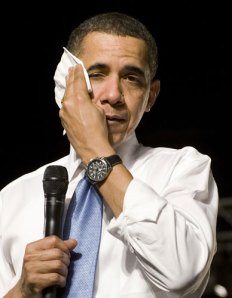
Flop sweat
President Obama has enjoyed largely positive media coverage since 2004, when he gave his first nationally televised speech at the Democratic National Convention in Boston. But since his very public humiliation at the hands of Republicans in the debt ceiling fight, the tide has suddenly turned. I think we may have finally reached a real tipping point.
Just one week ago, Dakinikat wrote a post about the Villagers finally beginning to express buyer’s remorse after Obama’s recent display of weakness and cluelessness. This week, the President has again been hammered in the national and international media, and yet he and his handlers still don’t get it, as Dakinikat’s post from late last night demonstrated.
According to the shocking New York Times article Dakinikat quoted in her post last night, Obama and his top advisers have, in a cold and calculating way, determined that advocating for policies that would create jobs would not be conducive to Mr. Obama’s reelection. Even the ideas they hesitate to push are weak and unoriginal–and as Dak pointed out, would have little to no impact on unemployment or the economy anyway. According to the NYT,
Mr. Obama plans to spend time this weekend considering his options, advisers said. The White House expects to unveil new job-creation proposals in early September.
The ailing economy, barely growing at the same pace as the population, has swept all other political issues to the sidelines. Twenty-five million Americans could not find full-time jobs last month. Millions of families cannot afford to live in their homes. And the contentious debate over raising the federal debt ceiling — which Mr. Obama achieved only after striking a compromise with Republicans that included a plan for at least $2.1 trillion in spending cuts over 10 years — has further shaken economic confidence….
So far, most signs point to a continuation of the nonconfrontational approach — better to do something than nothing — that has defined this administration. Mr. Obama and his aides are skeptical that voters will reward bold proposals if those ideas do not pass Congress. It is their judgment that moderate voters want tangible results rather than speeches.
Perhaps so, but so far we have gotten nothing but speeches–and repeated capitulations–from Mr. Obama. More:
Mr. Plouffe and Mr. Daley share the view that a focus on deficit reduction is an economic and political imperative, according to people who have spoken with them. Voters believe that paying down the debt will help the economy, and the White House agrees, although it wants to avoid cutting too much spending while the economy remains weak.
As part of this appeal to centrist voters, the president intends to continue his push for a so-called grand bargain on deficit reduction — a deal with Republicans to make even larger spending cuts, including to the social safety net, in exchange for some revenue increases — despite the strong opposition of Congressional Democrats who want to use the issue to draw contrasts with Republicans.
Have Plouffe and Daley paid any attention to the media reactions to their boss in the past week? I want to share some of my favorite recent critiques of Obama. Admittedly some of them come from right wing sources, but I detect a distinct change in the wingers’ reactions to Obama too. Instead of claiming he’s a socialist, they are mocking him for being incompetent and ineffectual.
Karma Catches Up With Shepard Fairey
Posted: August 12, 2011 Filed under: Barack Obama, just because, U.S. Politics | Tags: 2008 presidential campaign, Barack Obama, Copenhagen, Denmark, Obama Hope poster, Obama illuminati, people pleasers, sellouts, Shepard Fairey, Yankee hipsters 4 Comments
Shepard Fairey, the designer of the iconic Barack Obama “Hope” poster was attacked and beaten up by Danish Leftists last weekend as he emerged from the opening of an exhibit of his work in a Copenhagen art gallery. From the Guardian:
Earlier this month he was involved with a controversial mural that has enraged leftwing anarchists throughout the city.
“I have a black eye and a bruised rib,” Fairey told the Guardian.
According to reports, 41-year-old Fairey and his colleague Romeo Trinidad were punched and kicked by at least two men outside the Kodboderne 18 nightclub in the early hours of last Saturday morning. Fairey claims the men called him “Obama illuminati” and ordered him to “go back to America”.
Fairey had designed a mural to commemorate
the demolition of the legendary “Ungdomshuset” (youth house) at Jagtvej 69. The building, a long-term base for Copenhagen’s leftwing community, was controversially demolished in 2007. In the intervening years it has become a potent symbol of the standoff between the establishment in Copenhagen and its radical fringe.
Fairey’s installation, painted on a building adjacent to the vacant site, depicted a dove in flight above the word “peace” and the figure “69”. But the mural appeared to reopen old wounds, with critics accusing Fairey of peddling government-funded propaganda.

The controversial mural defaced with graffiti
To prove he isn’t a propagandist, Fairey attempted to pacify the leftists by altering his mural. According to Raw Story, he
worked with former members of the youth house to add “images of riot police and explosions,” together with a new slogan — apparently derived from the tagline used by the Anonymous hactivists — reading, “Nothing forgotten, nothing forgiven.”
At The Atlantic, Adam Clark Estes points out that Fairey “struggled to make amends with both sides,” the government and the leftist group. Estes argues that the attack on Fairey “seems to have been borne of Danish leftist radical distaste of both Obama and hipsters.”
In the eyes of the leftwing community, the local city council made Fairey their pawn in order to send an insult to the activists whose base they’d destroyed four years ago. The local Danish press reports that the council paid Fairey nearly $50,000 for the mural, the first of four planned around Copenhagen, but Fairey denies that his commission came from the city. Fairey had full creative freedom for the works, according to Henrik Chulu with the art blog Frikultur who says the murals are “part of a strategy to brand Copenhagen as progressive and ‘cool’.”
As it were, Fairey’s is not the type of cool the Danish like or want. The controversy that turned to violence in Denmark sheds a little light on how far we’ve come since the controversy that helped make Fairey’s iconic Obama poster so famous. After a escaping unscathed from a copyright battle over the photo used for the poster, Fairey has taken a lot of flak for being a sell-out. Lately, Fairey has been the star of the record-breaking Museum of Contemporary Art graffiti show in Los Angeles and making huge commissions in the process. At first glance, it might seem like Fairey’s come back to Earth. (After all, he has now literally inserted himself into fight in a foreign land over issues of social justice.) But Fairey’s as capitalist as ever. He’s even selling prints that feature the Copenhagen mural’s iconography online.
Apparently Fairey resembles Obama in trying to please everyone but ultimately pleasing no one. And they’re both sellouts too!
The Audacity of No Hope
Posted: August 12, 2011 Filed under: Barack Obama, Republican presidential politics, U.S. Economy, U.S. Politics, voodoo economics, We are so F'd | Tags: Allen West, banana republic, consumer confidence index, Michele Bachmann 21 Comments I don’t recall a time when political discourse has been so disconnected with reality. It’s like there’s some form of drug that’s been planted in the Potomac that’s created a stupor from which the media and politicians refuse to awake. They seem to think if they create the message, we will come. The truth is that most Americans are not quite that stupid. It’s really a shame that the looking glass of TV political discourse does not reflect Main Street. It reflects only Wall Street, K Street, and Madison Avenue.
How more out of touch can punditry and pols become? This is the reality that US households see.
Confidence among U.S. consumers plunged in August to the lowest level since May 1980, adding to concern that weak employment gains and volatility in the stock market will prompt households to retrench.
The Thomson Reuters/University of Michigan preliminary index of consumer sentiment slumped to 54.9 from 63.7 the prior month. The gauge was projected to decline to 62, according to the median forecast in a Bloomberg News survey.
The biggest one-week slump in stocks since 2008 and the threat of default on the nation’s debt may have exacerbated consumers’ concerns as unemployment hovers above 9 percent and companies are hesitant to hire. Rising pessimism poses a risk household spending will cool further, hindering a recovery that Federal Reserve policy makers said this week was already advancing “considerably slower” than projected.
“The mood is very depressed,” said Chris Christopher, an economist at IHS Global Insight Inc. in Lexington, Massachusetts. “Consumers are very fatigued and very uncertain. In the short term, people are going to pull back on spending.”
Estimates of 69 economists for the confidence measure ranged from 59 to 66.5, according to the Bloomberg survey. The index averaged 89 in the five years leading up to the recession that began in December 2007.
Here’s one example of the reality disconnect via Michelle Bachmann who has been cheering on the idea of a US default and had the temerity to suggest last night in the Ames Alternate Reality Debates that the S&P downgrade occurred because the debt ceiling was raised. The S&P downgrade stemmed from her brazen example–as well as those of her compradres–of a complete disconnect from economic reality. How much time was spent on discarded notions like gold standards and politically controlled central banks? This is the stuff that only dictators in banana republic adopt!
A Standard & Poor’s director said for the first time Thursday that one reason the United States lost its triple-A credit rating was that several lawmakers expressed skepticism about the serious consequences of a credit default — a position put forth by some Republicans.
Without specifically mentioning Republicans, S&P senior director Joydeep Mukherji said the stability and effectiveness of American political institutions were undermined by the fact that “people in the political arena were even talking about a potential default,” Mukherji said.
“That a country even has such voices, albeit a minority, is something notable,” he added. “This kind of rhetoric is not common amongst AAA sovereigns.”
I mentioned in this morning’s post the brazen political rationale behind the President’s persistent message that it’s the deficit driving the bad economy. This too is a message that’s not based in reality. This Reich quote bears repeating here.
So rather than fight for a bold jobs plan, the White House has apparently decided it’s politically wiser to continue fighting about the deficit. The idea is to keep the public focused on the deficit drama – to convince them their current economic woes have something to do with it, decry Washington’s paralysis over fixing it, and then claim victory over whatever outcome emerges from the process recently negotiated to fix it. They hope all this will distract the public’s attention from the President’s failure to do anything about continuing high unemployment and economic anemia
Krugman–who shall now be known as the depressed one--made similar claims today in his NYT op-ed. He tells us that we should be angry. I think he needs to get out of the confines of his New York condo or his Princeton office, because we are angry out here in the great fly over. I’d say if he went to the right parts of New York City or New Jersey, he’d likely find the anger there too.
But there’s another emotion you should feel: anger. For what we’re seeing now is what happens when influential people exploit a crisis rather than try to solve it.
For more than a year and a half — ever since President Obama chose to make deficits, not jobs, the central focus of the 2010 State of the Union address — we’ve had a public conversation that has been dominated by budget concerns, while almost ignoring unemployment. The supposedly urgent need to reduce deficits has so dominated the discourse that on Monday, in the midst of a market panic, Mr. Obama devoted most of his remarks to the deficit rather than to the clear and present danger of renewed recession.
What made this so bizarre was the fact that markets were signaling, as clearly as anyone could ask, that unemployment rather than deficits is our biggest problem. Bear in mind that deficit hawks have been warning for years that interest rates on U.S. government debt would soar any day now; the threat from the bond market was supposed to be the reason that we must slash the deficit now now now. But that threat keeps not materializing. And, this week, on the heels of a downgrade that was supposed to scare bond investors, those interest rates actually plunged to record lows.
What the market was saying — almost shouting — was, “We’re not worried about the deficit! We’re worried about the weak economy!” For a weak economy means both low interest rates and a lack of business opportunities, which, in turn, means that government bonds become an attractive investment even at very low yields. If the downgrade of U.S. debt had any effect at all, it was to reinforce fears of austerity policies that will make the economy even weaker.
So how did Washington discourse come to be dominated by the wrong issue?
When political gamesmanship and legal outcomes funded by corporations and not votes by people become the central goal of policy, a democracy not only loses its authenticity, it ceases to exist. People have been voting for gridlock and throwing the bums out only to create a gridlock that is bringing down the economy and bums so virulent that we can no longer stand for either. People like Allen West, Michelle Bachmann, and Rick Santorum shouldn’t even be given keys to a car, let alone the country. Leaders that would rather distract people from reality than make actual policy decisions–like Obama–need to be called out for their cynical political ploys; not re-elected. How much more of this can our economy and democracy take before we completely collapse into something worse than a banana republic?
Peter Daou has written an excellent analysis that talks about how this toxic environment has brought the country to its knees. He has a list of exactly how far down we’ve gone on the list of countries for many things. Today’s new number is 23. We used to rank 6th in infrastructure, we have now fallen to number 23. Sweden tops the list of countries for global technology and net work readiness. The US has moved to 5th place behind Sweden, Singapore, Finland and Switzerland. This is what we’re supposed to be good at? Right? Information Technology? The only thing we seem to excel at any more is perpetual war.
The basic question is then, what will it take to get these people to listen? Well, in the case of Michelle Bachmann and reality-deniers, there’s no hope there. They cling to religious myth and free market fairy tales over science, economics, and reality. In the case of those who cynically change the political discourse to “distract the public’s attention”, I’m not sure. What do you do with the power hungry who are more driven by campaign contributions and donor concerns, than votes and people? This toxic political environment is bringing toxic results. In other parts of the world, there are protestors risking their lives for real change. People are being gunned down in Syria as we speak. Rioters in England–fed up with no future and no jobs–are burning things to the ground.
Daou points to Bob Hebert’s farewell column for perspective. It’s worth reviewing.
The U.S. has not just misplaced its priorities. When the most powerful country ever to inhabit the earth finds it so easy to plunge into the horror of warfare but almost impossible to find adequate work for its people or to properly educate its young, it has lost its way entirely.
Nearly 14 million Americans are jobless and the outlook for many of them is grim. Since there is just one job available for every five individuals looking for work, four of the five are out of luck. Instead of a land of opportunity, the U.S. is increasingly becoming a place of limited expectations. A college professor in Washington told me this week that graduates from his program were finding jobs, but they were not making very much money, certainly not enough to think about raising a family.
There is plenty of economic activity in the U.S., and plenty of wealth. But like greedy children, the folks at the top are seizing virtually all the marbles. Income and wealth inequality in the U.S. have reached stages that would make the third world blush. As the Economic Policy Institute has reported, the richest 10 percent of Americans received an unconscionable 100 percent of the average income growth in the years 2000 to 2007, the most recent extended period of economic expansion.
Americans behave as if this is somehow normal or acceptable. It shouldn’t be, and didn’t used to be. Through much of the post-World War II era, income distribution was far more equitable, with the top 10 percent of families accounting for just a third of average income growth, and the bottom 90 percent receiving two-thirds. That seems like ancient history now.
The current maldistribution of wealth is also scandalous. In 2009, the richest 5 percent claimed 63.5 percent of the nation’s wealth. The overwhelming majority, the bottom 80 percent, collectively held just 12.8 percent.
This inequality, in which an enormous segment of the population struggles while the fortunate few ride the gravy train, is a world-class recipe for social unrest. Downward mobility is an ever-shortening fuse leading to profound consequences.
What profound consequences await a country where the leaders find these extraordinary levels of income inequality, infrastructure ruin, and joblessness an acceptable status quo? Will parts of the US eventually resemble West London or Damascus where disenfranchised, jobless, and hopeless people resort to measures beyond desperation? These events are truly the results of the audacity of no hope. It’s easier for the media blame the dogs fighting for scraps under the table than to look at the table top and to call out the masters that have stacked the decks in their favor so that the meat never hits the floor. Can simply living in a land of economic fairy tales ala Bachmann and trust fund babies like Romney prevent the US from seeing similar unrest? Corporations are people too? Really? Can giving multiple speeches distract the jobless from their plight or blaming social security recipients and the long term unemployed keep the electorate in a stupor of false hope? I’d say that one check of polls and the consumer sentiment index provides a resounding no answer.
I have never seen a period of time when the issues are so clear, the answers are so obvious, and the political and punditry class appear so clueless. Something better change fast before the growing restless in our undeveloping nation turns into something more than disenchanted polling numbers and falling indexes. How much more disconnect will this country’s citizens take?

 peej
peej Carissa
 bostonboomer
 dakinikat
 ecocatwoman
 mablue2
 Mama Lopez
 peggysue22
 quixote
 skydancingguestblogger
 Mona (aka Wonk the Vote)



 Sky Dancing
Recent Comments