
Tuesday Morning Reads
Posted: September 4, 2012 Filed under: 2012 elections, 2012 presidential campaign, Banksters, Mitt Romney, morning reads | Tags: entitlements, Hurricane Isaac Recovery, President Obama, Vulture Capitalism 50 Comments Good Morning!
I’m trying to get back into the idea of “time” right now. I still feel jet-lagged and I keep having to remind myself what day, month and hour it is. It’s a really strange feeling to be so displaced in time. It reminds me of when I was deep in the fight against cancer and having chemo. Everything is here and now.
The President made a stop to see the flooding in St. John’s Parish yesterday. This is one of the more rural parishes in Southern Louisiana. It really got drenched. LaPlace is a bedroom community that frequently attracts families where one person works in Baton Rouge and the other in New Orleans. It sits adjacent to all kinds of interstate action so its easy to move around SE Louisiana from the small town. The rest of the parish is very rural and quite Cajun.
“What I’ve pledged to these folks is we’re going to make sure at the federal level we are getting on the case very quickly about figuring out what exactly happened here and what can do to make sure it doesn’t happen again and expedite some of the decisions that may need to be made,” Obama told reporters after touring hard-hit St. John the Baptist Parish, 30 miles outside of New Orleans.
Joined by Republican Gov. Bobby Jindal and members of Louisiana’s congressional delegation, Obama walked through a neighborhood of brick homes and front yards that were a painful reminder of last week’s hurricane. Orderly piles of water-logged debris — bedding, insulation, furniture and toys — filled the yards.
The president shook hands with residents in La Place, where several neighborhoods were inundated by water and some residents were rescued from rooftops by boats.
“How y’all doing?” he asked.
“Better now,” one man shouted back.
In the sticky heat, the president walked from house to house, asking residents about what happened and posing for photos. There was debris but no signs of lingering water.
“We’re here to help,” the president said at another home.
Obama praised the coordination of federal, state and local officials and pointed out that his administration issued disaster declarations well in advance to ensure officials “weren’t behind the eight ball.” In highlighting the work, Obama was drawing a contrast with President George W. Bush’s widely criticized response to Hurricane Katrina seven years ago.
The President also celebrated labor day with Auto and Steel Workers in the swing state of Ohio. Unlike Eric Cantor who insisted that Labor day was a day to salute “risk takers”, the President recognized the importance of the labor movement in the United States and was welcomed for his role in saving the US Auto Industry. Did I mention that I bought Ford for about $1.67 a share a few months after Obama took office? It’s over $9 now. Too bad I couldn’t have sunk a lot more money into it!
Hours earlier in Ohio, Obama spoke to members of the United Auto Workers and United Steelworkers, and noted his decision to rescue automakers General Motors and Chrysler in 2009, a move that Romney opposed.
“If America had thrown in the towel like that, GM and Chrysler wouldn’t exist today,” Obama said. “The suppliers and the distributors that get their business from these companies would have died off, too. Then even Ford could have gone down as well.”
There’s an awful essay out by Nicholas Eberstadt that suggests that we’ve become a nation of “takers”. He works for the AEI so it’s not unusual that ideology takes a front seat to evidence. He does notice that “entitlement” spending has grown more rapidly under Republicans than Democrats, but seems to overlook the idea that we all work and pay for the majority of our social insurance programs like Social Security, Medicare, and Worker’s Comp. How can we take what we have paid premiums to receive? Here’s a sample of things that I found highly offensive in his writings.
How has America’s great postwar male flight from work been possible? To ask the question is to answer it: This is a creature of our entitlement society and could not have been possible without it. Transfers for retirement, income maintenance, unemployment insurance, and all the rest have made it possible for a lower fraction of adult men to be engaged in work today than at any time since the Great Depression—and, quite possibly, at any previous point in our national history. For American men, work is no longer a duty or a necessity: rather, it is an option. In making work merely optional for America’s men, the US entitlement state has undermined the foundations of what earlier generations termed “the manly virtues”—unapologetically, and without irony. Whatever else may be said about our country’s earlier gender roles and stereotypes, it was the case the manly virtues cast able-bodied men as protectors of society, not predators living off of it. That much can no longer be said.
From a Nation of Takers to a Nation of Gamers to a Nation of Chiselers
With the disappearance of the historical stigma against dependence on government largesse, and the normalization of lifestyles relying upon official resource transfers, it is not surprising that ordinary Americans should have turned their noted entrepreneurial spirit, not simply to maximizing their take from the existing entitlement system, but to extracting payouts from the transfer state that were never intended under its programs. In this environment, gaming and defrauding the entitlement system have emerged as a mass phenomenon in modern America, a way of life for millions of men and women who would no doubt unhesitatingly describe themselves as law-abiding and patriotic citizens of the United States.
Abuse of the generosity of our welfare state has, to be sure, aroused the ire of the American public in the past, and continues to arouse it from time to time today. For decades, a special spot in the rhetorical public square has been reserved for pillorying unemployed “underclass” gamers who cadge undeserved social benefits. (This is the “welfare Cadillac” trope, and its many coded alternatives.) Public disapproval of this particular variant of entitlement misuse was sufficiently strong that Congress managed to overhaul the notorious AFDC program in a reform of welfare that replaced the old structure with TANF. But entitlement fiddling in modern America is by no means the exclusive preserve of a troubled underclass. Quite the contrary: it is today characteristic of working America, and even those who would identify themselves as middle class.
Here is a response to the essay written by Lane Kenworthy that I found highly interesting.
Friday Reads
Posted: July 6, 2012 Filed under: Banksters, fetus fetishists, Mitt Romney, morning reads, U.S. Politics, VAGINA MItt Romney, War on Women, Women's Rights | Tags: Banksters, Barclay, Bobby Jindal, Libor Rate fixing, Rush Limbaugh 40 Comments Good Morning!!
There are a couple of finance stories that I’ve been following that I’m getting ready to write more bout. One is the story about the manipulation of LIBOR by Barclays with possible involvement of JPM and others. Here’s an article from The Economist to get us started on the topic. Its title includes the word “banksters”. That should be telling.
At present, the scandal rages in one country and around one bank. Barclays has been fined $450m by American and British regulators for its attempts to manipulate LIBOR. The bank’s first attempt to ride out the storm failed miserably; Bob Diamond, Barclays’ chief executive, resigned this week. The British government has ordered a parliamentary review into its banks. The reputation of the City of London, where LIBOR is set by collating estimates of their own borrowing costs from a panel of banks, has been further dented.
But this story stretches far beyond Britain. Barclays is the first bank in the spotlight because it offered to co-operate fully with regulators. It will not be the last. Investigations into the fixing of LIBOR and other rates are also under way in America, Canada and the EU. Between them, these probes cover many of the biggest names in finance: the likes of Citigroup, JPMorgan Chase, UBS, Deutsche Bank and HSBC. Employees, from New York to Tokyo, are implicated (see article).
I’m just delving into the details now. It will take me awhile to get to the point of being able to describe it nontechnically so please be patient. This is huge. It will likely show us why the moves to remove Dodd-Frank and the Volker Rule are as criminal as the intent.
Well, I certainly wouldn’t wish Bobby Jindal on the country but it appears that our Governor has made the short list in the Romney VP stake. Frankly, anything he does is only to further his professional political career having done nothing else. Judging from my LA twitter feed, he might just have fled the state because every one is mad at him over his move to end public education as we know it. The man has a weird personality and he excels at ambition and lying. He’d be perfect for the job, frankly. Romney and Jindal are a matched set of amoral liars. Unfortunately, he won’t quit even if he gets the nod which only puts my state in worse condition than it is since he took over. Ask me about our more than double unemployment rate since he took over. He’s got his eye on 4 years from now.
On readiness for office, conversations with Romney insiders and allies suggest that they have no qualms about Portman or Pawlenty. One of Romney’s biggest complaints about President Obama is that he is in over his head and had “never run anything before.” Pawlenty governed the state of Minnesota for two terms; Portman ran the Office of Management and Budget as well as the Office of the United States Trade Representative. Jindal is in his second term as governor of Louisiana. Paul Ryan, however, falls short in this regard; he was a Capitol Hill staffer and a marketing consultant before becoming a congressman at age 28.
As for chemistry with the candidate, Pawlenty, Portman and Ryan have all campaigned alongside him multiple times. Each endorsed him at critical moments in the primary process and appeared with him on the stump when they did. And each got a turn as his key surrogate on Romney’s June bus tour, which ran through their states. Jindal has not yet campaigned with the presumptive nominee, so look for that to happen soon in a swing state near you.
Does this picture remind you of something from the John Kerry Files? Notice the dressage horses are missing. Romney going one way on the lake. Then, the other  way on the lake … then back again the other way on the lake …
I’ll just say it: I don’t think the political pundit class understands just how toxic the Swiss/Caymans/Bermuda accounts issue is for Romney. Not that they don’t know it’s a liability at all. But I don’t think they realize the extent of it.
Here’s a report just out from ABC News on how Ted Strickland introduced Obama in Ohio …
“Oh, what a contrast, my friends, between these two men who would be president!” Strickland said, standing outside the Wolcott House Museum. “President Obama is betting on America and American workers, and Mitt Romney is betting his resources in the Cayman Islands, in Bermuda, in Switzerland and God only knows where else he is putting his resources.”Fair or not, it just rolls off the tongue. Immediately understandable. And assuming you’re not talking to the deeply ideological committed or hyper-partisans, how exactly do you understand that a man running for president has parked a lot of his money in offshore tax havens?
Whatever harsh message you’re trying to prove — out of touch with lives of ordinary Americans, plays by a different set of rules, isn’t focused on America and American workers — it fits right in.
Set aside all questions of legality. And I think Romney’s probably too smart and close to the vest to break any laws. But how do you explain it? What’s the good explanation?
Do you seek the safe harbor of Romney’s 15% tax rate?
How many of you know any one that hides assets in off shore banking havens? Better yet, how many savvy politicians would do it?
The attacks on Mississipi’s sole abortion clinic seem to be aimed at sending a court case to SCOTUS to test Planned Parenthood v. Casey and Roe v. Wade. Creeping theocracy threatens the health of American women.
Earlier this week a district court issued an eleventh-hour stay to block a Mississippi law designed to shut down the state’s last surviving abortion clinic. It’s the only one that has muscled through a spate of regulations aimed at making Mississippi “abortion-free,” in the words of Gov. Phil Bryant (R).
“The Court has considered the parties’ arguments and finds Plaintiffs satisfy the requirements for temporary injunctive relief to maintain the status quo until the newly framed issues can be more thoroughly examined,” wrote U.S. district judge Daniel P. Jordan III.
Bryant’s intentions are clear: make Mississippi the first state without access to abortion. But that’s a tricky legal proposition as a result of Roe v. Wade and Planned Parenthood v. Casey, the two key Supreme Court rulings that protect abortion rights.
The question before the courts is whether the new state law is legitimate under Roe and Casey. If so, pro-choice advocates fear it would threaten abortion rights protections nationwide
“In this case, Plaintiffs have offered evidence — including quotes from significant legislative and executive officers — that the Act’s purpose is to eliminate abortions in Mississippi,” wrote Jordan. “They likewise submitted evidence that no safety or health concerns motivated its passage. This evidence has not yet been rebutted.”
A hearing is scheduled for July 11 to determine if a preliminary injunction should follow. That’s a reasonably likely scenario since the Bush-appointed Judge Jordan issued the stay on the basis that the plaintiffs have “a substantial likelihood of success on the merits.”
Whether or not the case climbs up to the Supreme Court and puts Roe at risk of being overturned depends on the breadth of the lower courts’ ruling. But neither side is particularly keen on going down that road — at least for now.
“From a pro-choice perspective, the less the current Court does to define Casey, the better. From a pro-life perspective, they want to wait until there’s a clear shot at Roe v. Wade,” said Scott Lemieux, a political science professor at the College of Saint Rose.
Rush Limbaugh has a major problem when it comes to women. In the past, the conservative talk radio host has accused them of being sluts for using birth control and called those who support feminism “feminazis.” (Media Matters has compiled a pretty good list of Limbaugh’s sexist and misogynistic remarks over the years.) Now, the caustic commentator has come up with a new calumny: “When women got the right to vote is when it all went down hill.”
He made the remark on his radio program Tuesday, adding: “Because that’s when votes started being cast with emotion and maternal instincts. …”
That’s right. According to Limbaugh, America messed up big-time when it allowed all of its citizens—not just men—to vote.
I have no idea what makes people vote Republican any more but I don’t think it has anything to do with sanity. What’s on your reading and blogging list today?
Thursday Reads: Closed and Quiet Rooms
Posted: June 21, 2012 Filed under: 2012 presidential campaign, Banksters, Barack Obama, morning reads, U.S. Economy, U.S. Politics | Tags: closed rooms, heat wave, House Banking Committee, immigration, Jamie Dimon, Mitt Romney, quiet rooms, Senate Banking Committee, weather 26 Comments
Good Morning!!
Suddenly it’s hot here in New England. Just last week I actually had to turn my furnace on to warm up the house! It’s been a pretty cold June here, but yesterday the temperature reached 96 in Boston. Today is supposed to be a repeat performance. As I’m writing this late on Wednesday night, it’s still 84 degrees! It has been quite a shock to the system, let me tell you.
There is apparently a heat wave stretching from Chicago to the Northeast. And how appropriate, since the Summer Solstice took place yesterday at 7:09PM Eastern time. The Summer Solstice is usually on June 21, but since 2012 is a leap year, it fell on June 20.
So last week, JP Morgan CEO Jamie Dimon appeared before the Senate Banking Committee and got his ass kissed by the committee members–many of whom have received generous campaign donations from Dimon and/or his bank. If you haven’t read Matt Taibbi’s takedown of the committee’s embarrassing performance, please check it out. Here’s a sample:
I wasn’t prepared for just how bad it was. If not for Oregon’s Jeff Merkley, who was the only senator who understood the importance of taking the right tone with Dimon, the hearing would have been a total fiasco. Most of the rest of the senators not only supplicated before the blowdried banker like love-struck schoolgirls or hotel bellhops, they also almost all revealed themselves to be total ignoramuses with no grasp of the material they were supposed to be investigating.
That most of them had absolutely no conception of even the basics of the derivatives market was obvious. But what was even more amazing was that several of them had serious trouble even reading aloud the questions their more learned staffers prepared for them. Many seemed to be reading their own questions for the first time.
It would be one thing if this had been a bunch of hick congressmen from the plains asking a panel of MIT professors about, say, ozone depletion, or the potential dangers of nuclear fallout. But these were members of the Senate Banking Committee, asking Dimon questions as though he were an alien from another world: “Tell us, Mr. CEO, what is this ‘derivative trading’ to which you refer? How long has it been in use on your planet?” The whole tenor of the proceeding was incredibly embarrassing, and showed just how unlikely it is that you’ll ever get anything like real questioning in a Senate hearing when a) the level of general expertise among the members is so shamefully low, and b) the witness is a man who controls millions of dollars of campaign contributions.
This week it was the House Banking Committee’s turn to hear from Dimon, and they apparently did slightly better than their Senate counterparts. I was particularly struck by this quote reported by George Zornick of The Nation:
As the House Financial Services Committee hearing into recent failures at JPMorgan waned, bank CEO Jamie Dimon finally said what had already been obvious to everyone — he didn’t want to be there. “These are complex things that should be done the right way, in my opinion in closed rooms,” Dimon said. “I don’t think you make a lot of progress in an open hearing like this.” In the closed room, Dimon said, everyone would be “talking about what works, what doesn’t work, and collaborating with the business that has to conduct it.”
I was immediately reminded of a remark that Mitt Romney made in January about how inappropriate it was for President Obama to be talking about income inequality in public–that such things should only be discussed in “quiet rooms.” Watch it:
Romney tells Matt Lauer that we peasants “envy” his wealth, and then expresses shock that Obama had talked about income inequality in campaign speeches:
Romney: I think it’s fine to talk about those things in quiet rooms and discussions about tax policy and the like. But the president has made it part of his campaign rally. Everywhere he goes we hear him talking about millionaires and billionaires and executives and Wall Street. It’s a very envy-oriented, attack-oriented approach and I think it will fail.
Here is what I wrote about this at the time:
Never in my life have I heard a more naked expression of the conservative philosophy that the rich are better than the rest of us and that they alone should make important decisions. Romney clearly believes that we proles must be protected from the knowledge of how lowly we really are. Romney actually believes that discussions of government tax policies that make the rich richer and the poor poorer should not be discussed in public–such poor taste! These topics must only be talked about in “quiet rooms,” presumably in grand mansions where only the very rich and powerful can hear.
No doubt Romney is expressing a common opinion among those of his class. The good news is that Romney has so little self-awareness that he can’t seem to avoid expressing his elitist opinions in public. Does he think that the proles don’t watch TV? Or does he think we’re too stupid to understand what he’s saying?
I guess I was right. These richie-rich guys don’t want us to know what they’re really up to. Zornick notes that Dimon
is indeed quite effective in closed rooms. He’s received personal audiences with Treasury Secretary Timothy Geithner to push back against a strong Volcker rule, and his staff has enjoyed several more. The closed rooms at JPMorgan are populated by throngs of former Congressional staffers and even former members. The bank has plied current members with millions in donations, including over $522,000 to the Senate Banking Committee, where Dimon testified last week, and $168,000 to members of the House Financial Services Committee just this year.
This works well for Dimon and his allies. The financial services industry was unable to defeat the Dodd-Frank legislation in public view because overwhelming numbers of Americans supported the bill—it was arguably the only popular piece of regulatory legislation in the Obama era—but Wall Street has operated in closed rooms over the past two years to delay and weaken the rules.
Back in January, Charles Pierce also wrote about Romney’s “quiet rooms” remark. His post is well worth reading again.
Those words, and the entitled attitude with which they are so luxuriously chandeliered, should kill any campaign being conducted in 2012. The country is still staggering, blinking, out of the rubble of an economy that was shattered by an industry full to its gunwales with Willard Romneys. He is campaigning in South Carolina, where unemployment is pushing up at 10 percent. Do those people want to leave their fates up to a bunch of fancy haircuts in “quiet rooms” where they discuss how much more flesh they can pick off the carcass of what is laughingly called the “middle class” of this country?
Quiet rooms?
You mean like the one where these wonderful conversations took place among our lords of the universe, and aren’t they so very cute as they sit there making their funnies and giggle like the Pep Club while the tectonic plates of the national economy crack under their feet?
“Quiet rooms” should be enough. Willard Romney, stripper of companies, looter of pension, career gombeen man for the most unproductive “industry” in the history of man, thinks that a discussion of the nation’s staggering gap in inequality, and of the steady decline of a functioning middle-class, should be conducted in private, and not in the streets, where those hippies and their drum circles might disturb the plush japery of their betters. This is because, for Willard Romney, the world is divided into two kinds of people: Willard Romney and The Help.
I hope you don’t mind the trip down memory lane. But really, Mitt Romney and Jamie Dimon are very much alike: selfish, entitled, accustomed to being catered to, and oblivious to the needs of 99 percent of Americans. Romney sees no need to tell the peasants how much he pays in taxes, who contributes to his campaign, or even what policies he favors. We really really should bring back the guillotine.
In other news, Mitt Romney is giving a speech today in which he may have to get more specific about what he would do about Obama’s popular executive order on immigration.
Wall Street Journal: Romney’s Fine Line on Immigration
Mitt Romney’s address Thursday to Latino politicians will test whether he is willing to stake out immigration policy more in line with a growing bloc of Hispanic voters. But his bigger challenge may be striking a tone acceptable to his Republican Party, which remains deeply divided on the issue.
GOP congressional leaders are hoping Mr. Romney, with the Florida speech, will find a way to bridge divisions and define the party’s response to President Barack Obama’s announcement last week that he would allow many young people who came to the U.S. illegally as children to stay and apply for work permits.
That announcement was cheered by Hispanic leaders and likely boosted the president’s standing with Hispanics. It also reignited longstanding tensions within the GOP between those who consider aid for people who came to the U.S. illegally to be an unacceptable form of amnesty, and those looking for a softer approach—in part to appeal to Hispanic constituents.
Will he continue to equivocate on the issue, or will he finally embrace a specific policy? My money is on more beating around the bush. I’ll bet Romney would prefer to discuss the issue in “quiet rooms.”
This coming weekend, Romney will host a “retreat” in Utah for campaign donors who have raised at least $100,000 for him. It will all be very hush-hush–no press allowed. More of those discussions in “quiet rooms.”
The presumptive Republican nominee and his senior advisers and aides are hosting two days of policy sessions and campaign strategy discussions at the Deer Valley resort for more than 100 top fundraisers and their spouses. Those who raised more than $100,000 are expected to attend.
More than a dozen Republican heavy-hitters are scheduled to join the private retreat as special guests. According to a fundraiser who is attending, they include some GOP stars thought to be in contention to be Romney’s vice presidential running mate: Rep. Paul Ryan (Wis.), Louisiana Gov. Bobby Jindal and Sen. John Thune (S.D.).
George W. Bush strategist Karl Rove, who helps run American Crossroads, the well-funded GOP super PAC, is planning to speak at the retreat, said the fundraiser, who was not authorized to publicly discuss the event and spoke on the condition of anonymity. Rove’s appearance could raise questions because of laws barring any coordination between super PACs and campaigns.
Hey, rules are for the proles, not patricians like Willard Mitt Romney or Jamie Dimon for that matter.
So what else is going on? What’s on your reading and blogging list for today?
Thursday Reads
Posted: June 14, 2012 Filed under: 2012 presidential campaign, Banksters, child sexual abuse, children, Crime, morning reads, U.S. Politics | Tags: Barack Obama, Bob Shieffer, Catholic Church, Dodd-Frank bill, Face the Nation, first responders, Florida voter purge, Forest boy, Fox News, Grover Norquist, J.P. Morgan, Jamie Dimon, Jeb Bush, Jerry Sandusky, Marco Rubio, Mitt Romney, pedophiles, public employees, Senate, stimulus, teachers 28 Comments
Good Morning!
Wall Street Royal Jamie Dimon deigned to appear before a Senate Committee yesterday, and the Senators mostly sucked up to him. I’m surprised they didn’t ask if he needed a pillow for his chair. MSNBC: Senate treats JPMorgan CEO Dimon with kid gloves
Dimon was expected to receive a frosty reception in his first congressional appearance since he announced the bank sustained a trading loss some analysts now estimate is at least $3 billion. It was a massive loss for the nation’s biggest financial institution.
Instead, Dimon, who has won praise for bringing JPMorgan (JPM) through the financial crisis relatively unscathed, was treated cordially by most of members of the Senate Banking Committee. They peppered him with questions about regulation and risky practices at the bank, but did not press him to give an update on the losses resulting from the trade. JPMorgan is expected to give an update to shareholders when it reports its second-quarter earnings July 13.
“I think it was a pretty favorable day,” David Konrad, a Keefe, Bruyette & Woods banking analyst, told CNBC. Konrad said he was surprised that the questioning of Dimon by lawmakers was so “professional.”
Excuse me, “professional” for a Senator would have been sending this man to the woodshed. NPR’s Marketplace called the treatment of Dimon “a wake for Dodd-Frank.”
Yahoo has named the winner of the “Most Tepid Endorsement of Mitt Romney” contest: it’s a bumper sticker that reads “At least he’s not a communist.”
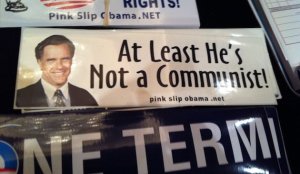
Until recently, it appeared that no one could unseat Indiana Gov. Mitch Daniels as the champion of the tepid Romney endorsement. Since Yahoo News started conducting reader polls on the politicians who supported Mitt Romney in the least enthusiastic terms, Daniels has defeated original champ George Pataki and defended the crown against Newt Gingrich, Rick Santorum and George W. Bush. (The former president came the closest to unseating Daniels.)
We thought the book was closed on the tepid endorsement bracket until Yahoo News reporter Chris Moody spotted a bumper sticker at last weekend’s regional CPAC conference in Chicago bearing these words of praise: “At least he’s not a communist.”
You can read the other tepid endorsements at the link.
First Romney made fun of Obama for wanting to help cities and states pay for cops, teachers, and firefighters. Then he went on Fox News and said it was a “strange accusation” for anyone to say he didn’t want to hire teachers and first responders.
After an extended skewering of President Obama for a gaffe about the private sector last week, ending with the charge that it was proof the president was “out of touch” Romney was asked by Fox and Friends’ Brian Kilmeade for his response to Obama saying it was Romney who was clueless (Romney’s comment comes at about the 1:40 mark) :
[BRIAN] KILMEADE: He says that you’re out of touch. He says you want to cut firefighters and teachers, that you don’t understand what’s going on in these communities. What do you say to that, Governor?
ROMNEY: Well, that’s a very strange accusation. Of course, teachers and firemen and policemen are hired at the local level and also by states. The federal government doesn’t pay for teachers, firefighters or policemen. So, obviously that’s completely absurd.
But of course the federal government does subsidize states and they often use the money to pay for these public employees. In fact, the reason so many teachers, firefighters and cops are getting laid off now is because stimulus money has run out.
Yesterday Greg Sargent pointed out that Romney’s plan would indeed cut billions from cops, firefighters and teachers
Yesterday Mitt Romney claimed that it was “ completely absurd” of the Obama campaign to argue that he favors cutbacks in cops, firefighters and teachers. “The federal government doesn’t pay for teachers, firefighters or policemen,” Romney said, adding that they were paid by states and localities.
What’s getting lost in the back and forth here is that Romney’s actual economic plan would, in fact, cut billions of dollars in federal money that goes to cops, firefighters, and teachers — perhaps more than $10 billion a year, in fact.
This is the conclusion of the Center on Budget and Policy Priorities, which analyzed Romney’s plan through the prism of the debate over public workers at my request.
As Michael McAuliff reported yesterday, despite Romney’s claim, the federal government does give billions of dollars to states and localities through programs like Title 1, the COPS program, FEMA and others — which pay for first responders and teachers.
This is amazing. Romney finally broke down and decided to talk to a media source that isn’t Fox News! He will be on Face The Nation on Sunday morning.
A full year into his presidential campaign, presumptive Republican nominee Mitt Romney will venture out of his Fox comfort zone this Sunday to make his first appearance on a rival network’s political talk show.
Romney has been interviewed several times on ”Fox News Sunday” this campaign cycle, but has declined repeated invitations to appear on any of the other Sunday shows, occasionally drawing scorn from veteran anchors accustomed to interviewing presidential candidates.
Let’s hope Shieffer asks a few tough questions. One thing Shieffer will probably ask about is Romney’s choice of Vice President. One of the leading contenders, Marco Rubio, announced yesterday that he supports the illegal Florida voter purge.
“How can you argue against a state identifying people who are not rightfully on the voter rolls?” he said at a Bloomberg event, according to the Tampa Bay Times.
Rubio’s comments put him in line with Florida Gov. Rick Scott (R) who on Tuesday declared the debate on the merits of the purge “over,” because the probe had supposedly turned up more than 50 non-citizen voters who had cast ballots.
The Department of Justice didn’t agree. Later Tuesday, it announced it was launching a federal lawsuit against Florida over complaints that the purge was taking place within 90 days of its August 14 primary election, as well as over its alleged violation of a voting rights law meant to prevent states from suppressing voters.
That might not help Romney win over Latino voters.
John Avlon has a piece at CNN on Jeb Bush and other “moderate” Republicans who are starting to fight back against Grover Norquist:
This is what happens when politics starts looking like a cult: Jeb Bush gets attacked for being a traitor to the conservative cause.
The former Florida governor has been speaking with the freedom of someone not running for office, saying that both his father and Ronald Reagan would have had a hard time in today’s hard-right GOP and questioning the wisdom of Grover Norquist’s absolutist anti-tax pledge.
That set off a fascinating public fight between Bush and Norquist, two faces of competing factions within Republican Party. It is the latest evidence of a growing GOP backlash against the ideological straitjacket Norquist has attempted to impose on governing in the United States.
And Jeb is not alone.
As it turns out, Norquist has reason to be concerned. It’s not just Jeb Bush. A growing number of Republicans are rejecting his pledge. Oklahoma conservative Sen. Tom Coburn called the pledge’s effective veto of deficit reduction plans “ridiculous” when talking with Erin Burnett on “OutFront.”
Sen. Lindsey Graham of South Carolina on Tuesday declared his independence from the pledge, saying, “We’re so far in debt, that if you don’t give up some ideological ground, the country sinks.”
Add to those voices seven other Republican U.S. senators — from Maine’s Susan Collins to Iowa’s Chuck Grassley to Wyoming’s John Barrasso — and 11 Republican House members, ranging from centrist New Yorker Richard Hanna to tea party Floridian Allen West.
In pedophile news, Jerry Sandusky had another bad day in court yesterday with three victims testifying that he manipulated and threatened them into putting up with his sick sexual behavior.
The trio of young men who testified against Jerry Sandusky on the third day of his sexual-abuse trial couldn’t have been more different in personality and temperament. Yet each of their testimonies was sexually graphic and disturbing—and midway through the prosecution’s fast-tracked arguments, a clear pattern has emerged in their allegations.
I’m not going to quote all of the sordid details–there are too many of them anyway. You can read it all at the link. I’ll just give you one excerpt that shows what Sandusky is all about:
Then, the witness told the jury of a time he visited the Sandusky home.
“We were in the basement. We were wrestling,” he said in a monotone frequently heard from abuse victims who have had to tell their stories multiple times. “The defendant pinned me to the floor, pulled down my gym shorts, and started to perform oral sex on me.” Asked by prosecutor Joe McGettigan what his reaction was at the time, the witness said, “I freaked out.”
“Did he ever say anything to you about it?” McGettigan asked.
“He told me if I ever told anyone I’d never see my family again,” the young man replied. “Later he apologized and said he didn’t mean it, that he loved me.”
I hope Sandusky goes to prison for life, and I want to see prosecutions of his enablers at Penn State. It’s an outrage that he was allowed to go on abusing children for years after many at the school knew about his behavior.
And then there’s the Catholic Church: U.S. Catholics still suspect priests sexually abuse children: Report
The National Review Board said that, a decade after the US Conference of Catholic Bishops issued a child protection charter, there has been a “striking improvement” in the way the Church deals with the abuse of minors by clergy.
“Children are safer now because of the creation of safe environments, and action has been taken to permanently remove offenders from ministry,” said the report, released as the Conference began its annual spring meeting in Atlanta.
But it acknowledged: “Despite solid evidence (to the contrary), many of the faithful believe that sexual abuse by clergy is occurring at high levels and is still being covered up by bishops.”
Well, what did they expect? I’m certainly not surprised. In fact I’d be surprised if there aren’t still pedophile priests abusing children.

Forest boy
I’ll end with the strange story of “Forest Boy.”
Berlin police on Wednesday released photos an English-speaking teenage boy who wandered into the city nine months ago saying he had been living for the last five years in the forest with his father.
Police spokesman Thomas Neuendorf said all attempts to identify the boy since he emerged in the German capital on Sept. 5 have been unsuccessful, and they are now hoping the release of his photo may produce some leads.“We have checked his DNA against all missing person reports, sent the data to Interpol so that they could check it internationally, but unfortunately without any success,” Neuendorf said.
The boy has told authorities his father called him “Ray” and that he was born June 20, 1994, but claims not to know his last name or where he’s from.He said his mother, Doreen, died in a car accident when he was 12 and after that he and his father, Ryan, took to the forest. He said they wandered using maps and a compass, staying in tents or caves overnight.
He told authorities that after his father died in August, 2011, he buried him in the forest and then walked five days north before ending up in Berlin, and showed up at city hall.
As of last night, the identity of the boy was still a mystery even after release of the photos.
What’s on your reading and blogging list today?
The Big Hedge Snafu
Posted: May 12, 2012 Filed under: Banksters | Tags: contango, hedge, JP Morgan 8 Comments Okay, I can’t resist getting wonky again. I have to say that Robert Reich made me do it. Well, that’s not completely true. It’s just that the banking industry has become so concentrated that it’s frightening. Plus, J.P. Morgan managed to lose $17.5 Billion this week. I’m still trying to wrap my mind around this. An organization this big has its tentacles in everything. Could JP Morgan become another Lehman?
JPMorgan Chase (JPM) lost $17.5 billion this week. It all springs from a bad trade that’s still going bad — to the tune of $2 billion and potentially $3 billion. But then there’s the 9.3% plunge in JPMorgan’s market capitalization — adding another $14.5 billion in shareholder losses. And of course, there’s the additional capital it may need to raise in light of S&P’s and Fitch’s concerns about its creditworthiness.
In my conversations Friday with reporters from Smart Money and the Boston Globe, I could not answer a basic question: What happened? According to the May 12th New York Times, JPMorgan decided to make a bet on a very obscure corner of the derivatives market. And due to the scale of JPMorgan’s trading, hedge funds figured out its identity and placed bets against the bank that are continuing to make profits for them at JPMorgan’s expense.
So, let me get back to why Robert Reich has me thinking. He’s offered up what we’ve been thinking here for sometime. Basically, he’s arguing that this kind of thing is exactly why we need to break up the big banks and head back to an updated and effective version of Glass-Stegall. The most ironic thing is that the catalyst for this is the same Jamie Dimon who insists that Wall Street doesn’t need any more stinking regulations. We’ve got a tight oligopoly now in the financial sector and the rules are different for this market structure than in a market where a bunch of little banks compete. We can survive the bad decision making of a few regional banks or community banks that collapse. Bad decision making at JP Morgan can take down the global financial markets. We’ve learned that already, haven’t we?
Ever since the start of the banking crisis in 2008, Dimon has been arguing that more government regulation of Wall Street is unnecessary. Last year he vehemently and loudly opposed the so-called Volcker rule, itself a watered-down version of the old Glass-Steagall Act that used to separate commercial from investment banking before it was repealed in 1999, saying it would unnecessarily impinge on derivative trading (the lucrative practice of making bets on bets) and hedging (using some bets to offset the risks of other bets).
Dimon argued that the financial system could be trusted; that the near-meltdown of 2008 was a perfect storm that would never happen again.
Since then, J.P. Morgan’s lobbyists and lawyers have done everything in their power to eviscerate the Volcker rule — creating exceptions, exemptions, and loopholes that effectively allow any big bank to go on doing most of the derivative trading it was doing before the near-meltdown.
And now — only a few years after the banking crisis that forced American taxpayers to bail out the Street, caused home values to plunge by more than 30 percent and pushed millions of homeowners underwater, threatened or diminished the savings of millions more, and sent the entire American economy hurtling into the worst downturn since the Great Depression — J.P. Morgan Chase recapitulates the whole debacle with the same kind of errors, sloppiness, bad judgment, excessively risky trades poorly-executed and poorly-monitored, that caused the crisis in the first place.
In light of all this, Jamie Dimon’s promise that J.P. Morgan will “fix it and move on” is not reassuring.
The most revealing thing is that this entire gaffe was supposed to be part of a hedging action which is a risk management tool. Not every one is convinced that this was simply the fault of a dated-model with bad assumptions. Here’s some wonky FT analysis.
So what was JPMorgan’s hedge and how did it go wrong?
The precise nature of JPMorgan’s hedging is not known. One possibility was that the bank engaged in a trade known as a “flattener”. Such a trade would profit if the credits began to sour in the near-term and within certain limits. But such a trade must be rebalanced – meaning additional positions would need to be taken simply to maintain the original investment thesis behind the trade. This can be tricky once the trade becomes supersized and if liquidity in the derivatives market dries up. Some market participants believe recent publicity surrounding JPMorgan’s position may have made rebalancing the trade impossible, or simply unpalatable.
Isn’t that a bet more than a hedge? Aren’t those banned now?
JPMorgan has described its trading as a hedge – not a “proprietary” trade, or bet, made to boost the bank’s own profit. However, the size of the position and subsequent losses look likely to set off renewed speculation about the nature of banks’ hedging activities. Some analysts have warned that banks are becoming extremely creative with their hedging strategies, often in an effort to boost their bottom line at a time when new regulations are crimping traditional profitmaking capabilities. JPMorgan says it plans to manage the trade over the course of 2012 but noted that losses “could easily get worse” and possibly total another $1bn in the second quarter of this year. Indeed, one of the instruments that may be involved matures in December, lending an urgency to managing the position down.
There better be some serious regulator and oversight action on this before it gets out of control. It also would seem to be a good time for a few good senators to start looking into bringing back the wall between corporations that have fiduciary responsibilities because of their depositors and investment banks and brokerage firms. Robert Reich’s got the right idea. We need to break up these behemoths. Then, we need to take a serious look at which parts of deregulation keep coming back to haunt us.

 peej
peej Carissa
 bostonboomer
 dakinikat
 ecocatwoman
 mablue2
 Mama Lopez
 peggysue22
 quixote
 skydancingguestblogger
 Mona (aka Wonk the Vote)



 Sky Dancing
Recent Comments