

“I respectfully submit that it is time for you to engage directly with congressional Democrats on this matter,” McConnell told Biden in his letter, a copy of which POLITICO obtained. “Your lieutenants in Congress must understand that you do not want your unified Democratic government to sleepwalk toward an avoidable catastrophe when they have had nearly three months’ notice to do their job.”
The letter, delivered to the White House on Monday, also cites Biden’s past opposition to debt increases while in the minority. McConnell summarized it this way: “The president’s party had to take responsibility for a policy agenda which you opposed. Your view then is our view now.”
Mostly Monday Reads: A Big, Ugly Mess
Posted: May 19, 2025 Filed under: A thread for Ranting, Agency Purges, Banksters, Broligarchy, democracy is threatened, Joe Biden, kakistocracy, kleptocracy, New Orleans, Polycrisis | Tags: @johnbuss.bsky.social John Buss, Big Beautiful Bill, China Dumps T-Bonds, Eat the Rich, FARTUS, Major Disruption in the Polar Vortex, Medicaid Cuts, New Orleans Bubble Day, No Kings Day, No Kings protest over #FARTUS parade, Trump budget destroys medicaid, Trump tax cuts for the rich 9 Comments
“Relax, it’s just a cartoon. I know he can’t do yoga.” John Buss, @repeat1968
Good Day, Sky Dancers!
As you know, I’m a nerd on all levels. I was catching up on my usual rabbit holes. The last thing I was reading was in the category of weather and climate change, and a major disruption in the polar vortex that will drastically change the weather from here on out. It’s slid off the North Pole and is moving over Northern Europe. That was after I was reading about this equally major disruption in the global economy. “China Dumps $18,900,000,000 in Treasuries as US Government Faces Major Dilemma: Macro Analyst Luke Gromen.” I’m now working on “In late-night vote, Republicans move closer to pushing Trump agenda bill through House. GOP officials are scrambling to advance massive tax breaks and dramatic Medicaid cuts, and it’s worth appreciating why they’re in such a rush,” written by Steve Benen.
Here in New Orleans, we had a Big Bubble Protest because of some rich guy that moved to the Quarter last year and has filed no less than 15 Criminal complaints over a bubble machine on the balcony of a restaurant that’s been there for over ten years. He thinks that the bubbles will ruin his Porsche and poison his drink when he imbibes on his balcony. This is the typical New Orleans gentrifier. He comes from someplace and expects New Orleans to accommodate his burbie weirdness. Just another old rich white guy trying to rule the world.
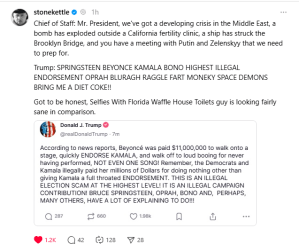
Meanwhile, Trump was posting madly early in the morning about every big music star that ever rejected him. That’s right before he’s supposed to be meeting with Putin and Zelensky over Putin’s invasion of Ukraine. Joe Biden has cancer, and Junior’s been hitting Truth Social and drugs at the same time.
All I can do is quote Chief Meteorologist Emeritus for Channel 2 Action News’ Severe Weather Team 2. AMS certified Glenn Burns. He was talking about the Polar Vortex, but it applies to everything these days. “Nothing is like it used to be anymore.”

You can go read about the selfies of Trump with the Waffle House Toilet guys for yourself. Yes, it’s up there on the Daily Mail.
No wonder the Polar Vortex doesn’t want to be near the United States anymore. Who would?

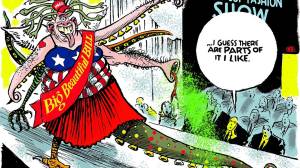
There are a lot of improvements we need in this country, but none of this stands as necessary or wanted. I love this float pic but think Senator Duckworth’s label Cadet Bone Spurs is more appropriate since Yam Tits would have never made it to a rank of sargent. But, yes, we’re getting a big, beautiful parade. It’s going to cost millions. This rather makes it official. We’re a damn Banana Republic. But the best thing is that pissed-off Americans are once more taking to the streets with placards and protests. This is from lawyermonthly. ““No Kings Day” Protests Set to Disrupt Trump’s $45M Birthday Military Parade.”
On June 14, a date that commemorates both the 250th anniversary of the U.S. Army and the 79th birthday of former President Donald J. Trump, the streets of the nation’s capital are expected to swell, not only with tanks, soldiers, and fighter jets, but with thousands of protestors prepared to send a very different message.
In a show of political theater unprecedented in recent years, Trump and his allies are staging what they’ve dubbed a “patriotic celebration,” complete with more than 6,000 uniformed troops, 150 military vehicles, and a dramatic aerial flyover.
The event, organizers say, is intended to honor America’s armed forces. Critics, however, see something more troubling: a public spectacle designed to cement the image of Trump as commander-in-chief, long after leaving office.
But while the parade commands the headlines, another force is quietly gaining momentum and it’s aiming to steal the spotlight.
Born from frustration and sharpened by years of political tension, a broad coalition of advocacy groups is organizing a massive counter-movement under the banner “No Kings Day.”
It’s not just a protest, they say. It’s a rejection of the authoritarian imagery they believe the parade represents.
Organizers from groups including the 50501 Movement and Refuse Fascism say they’re mobilizing demonstrations in over 100 cities nationwide, with Washington, D.C. serving as the focal point.
Estimates suggest between 10,000 to 20,000 demonstrators will gather in Meridian Hill Park before marching toward the National Mall.
“It’s not about hating Trump, it’s about preserving democracy,” said Angela V., a volunteer coordinator in Maryland who’s helping coordinate buses into the city. “We can’t normalize tanks in the streets every time a former president wants a birthday party.”
Though the name “No Kings Day” may sound theatrical, the intentions behind it are serious.
Protestors plan to highlight what they see as Trump’s attempts to centralize power and glamorize military dominance, particularly during a time when the former president faces multiple indictments related to election interference, classified documents, and alleged abuse of power.
 How about we use that $45 million plus whatever it costs to undo the damage Washington D.C. roads to fund the Veterans’ services cut by that ugly budget winding its way to the Senate today? Economist Paul Krugman–writing at his substack–colorfully describes the budget process as “Attack of the Sadistic Zombies. The GOP budget is incredibly cruel — and that’s the point.” Sounds a lot like the guy who doesn’t want bubbles in his drink or on his Porsche.
Republicans in Congress, taking their marching orders from Donald Trump, are on track to enact a hugely regressive budget — big tax giveaways to the wealthy combined with cruel cuts in programs that serve lower-income Americans. True, the legislation suffered a setback last week, initially failing to make it out of committee. But that was largely because some right-wing Republicans didn’t think the benefit cuts were vicious enough.
OK, news at 11. Isn’t this what Republicans always do? But this reconciliation bill — that is, legislation structured in such a way that it can’t be filibustered and may well pass with no Democratic votes — is different in both degree and kind from what we’ve seen before: Its cruelty is exceptional even by recent right-wing standards. Furthermore, the way that cruelty will be implemented is notable for its reliance on claims we know aren’t true and policies we know won’t work — what some of us call zombie ideas.
And it’s hard to avoid the sense that the counterproductive viciousness is actually the point. Think of what we’re seeing as the attack of the sadistic zombies.
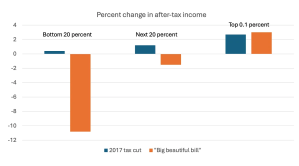
To get a sense of how extreme this legislation is, do a side-by-side comparison of the impact on different groups of Americans between this bill and Trump’s one major legislative achievement during his first term, the 2017 Tax Cuts and Jobs Act. It looks like this:
Source: Tax Policy Center and Penn-Wharton Budget Model
The TCJA, like the current legislation, gave big tax breaks to the wealthiest Americans. But it also threw a few crumbs to people further down the scale. By contrast, the House Reconciliation Bill, by slashing benefits — especially Medicaid — will cause immense, almost inconceivable hardship to the bottom 40 percent of Americans, especially the poorest fifth.
Medicaid, in case anyone needs reminding, is the national health insurance program for low-income Americans who probably don’t have any other way to pay for medical care. In 2023 Medicaid covered 69 million Americans, far more than Medicare (which covers seniors), including 39 percent of children.
Providing health care to children, by the way, isn’t just about social justice and basic decency. It’s also good economics: Children who receive adequate care grow up to be more productive adults. Among other things they end up paying more taxes, so Medicaid for children almost surely pays for itself.
And although Republican legislation apparently won’t explicitly target childrens’ care, it will impose paperwork requirements that will cause both children and their parents to lose coverage.
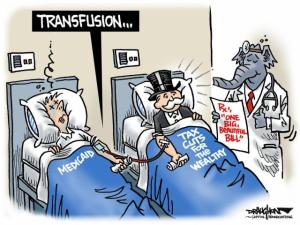 Here’s some analysis of the late-night passage of the bill on the substack of Heather Cox Richardson, historian. ‘
Tonight, late on a Sunday night, the House Budget Committee passed what Republicans are calling their “Big, Beautiful Bill” to enact Trump’s agenda although it had failed on Friday when far-right Republicans voted against it, complaining it did not make deep enough cuts to social programs.
The vote tonight was a strict party line vote, with 16 Democrats voting against the measure, 17 Republicans voting for it, and 4 far right Republicans voting “present.” House speaker Mike Johnson (R-LA) said there would be “minor modifications” to the measure; Representative Chip Roy (R-TX) wrote on X that those changes include new work requirements for Medicaid and cuts to green energy subsidies.
And so the bill moves forward.
In The Bulwark today, Jonathan Cohn noted that Republicans are in a tearing hurry to push that Big, Beautiful Bill through Congress before most of us can get a handle on what’s in it. Just a week ago, Cohn notes, there was still no specific language in the measure. Republican leaders didn’t release the piece of the massive bill that would cut Medicaid until last Sunday night and then announced the Committee on Energy and Commerce would take it up not even a full two days later, on Tuesday, before the nonpartisan Congressional Budget Office could produce a detailed analysis of the cost of the proposals. The committee markup happened in a 26-hour marathon in which the parts about Medicaid happened in the middle of the night. And now, the bill moves forward in an unusual meeting late on a Sunday night.
Cohn recalls that in 2009, when the Democrats were pushing the Affordable Care Act, more popularly known as Obamacare, that measure had months of public debate before it went to the Committee on Energy and Commerce. That committee held eight separate hearings about healthcare reform, and it was just one of three committees working on the issue. The ACA markup took a full two weeks.
Cohn explains that Medicaid cuts are extremely unpopular, and the Republicans hope to jam those cuts through by claiming they are cutting “waste, fraud, and abuse” without leaving enough time for scrutiny. Cohn points out that if they are truly interested in savings, they could turn instead to the privatized part of Medicare, Medicare Advantage The Congressional Budget Office estimates that cutting overpayments to Medicare Advantage when private insurers “upcode” care to place patients in a higher risk bracket, could save more than $1 trillion over the next decade.
Instead of saving money, the Big, Beautiful Bill actually blows the budget deficit wide open by extending the 2017 tax cuts for the wealthy and corporations. The Congressional Budget Office estimates that those extensions would cost at least $4.6 trillion over the next ten years. And while the tax cuts would go into effect immediately, the cuts to Medicaid are currently scheduled not to hit until 2029, enabling the Republicans to avoid voter fury over them in the midterms and the 2028 election.
The prospect of that debt explosion led Moody’s on Friday to downgrade U.S. credit for the first time since 1917, following Fitch, which downgraded the U.S. rating in 2023, and Standard & Poor’s, which did so back in 2011. “If the 2017 Tax Cuts and Jobs Act is extended, which is our base case,” Moody’s explained, “it will add around $4 trillion to the federal fiscal primary (excluding interest payments) deficit over the next decade. As a result, we expect federal deficits to widen, reaching nearly 9% of GDP by 2035, up from 6.4% in 2024, driven mainly by increased interest payments on debt, rising entitlement spending and relatively low revenue generation.”
 Steven Beschloss calls for more activism today at his substack, America, America. “Heeding the Warnings! We must avoid normalcy bias, expand our imagination, and both recognize and confront the fascistic danger of the Trump regime.”
Last week On Tyranny author Timothy Snyder warned that the second 100 days of the Trump regime could entail a dangerous escalation that includes some kind of terrorist attack. Imagining this can be hard; it’s understandable to ignore such a warning since it’s not yet true, it’s unpleasant to consider—and yes, it may not happen.
But it’s worth listening to what this historian of authoritarian regimes envisions—a warning layered with advice on how to prepare and how to respond. “I think it’s very important to expect there will now be exogenous surprises,” he said in a short video, including the “bottom falling out” of the economy because of the tariffs, “a major disruption” within the U.S. or even some kind of terrorist attack.
“Don’t fall for language about extremism or terrorism,” Snyder urged if it happens. He also emphasized the importance of staying calm, being active and sticking together. “Be aware that this is the pretext that will be used to push things further…use it as an opportunity to hold the people responsible who should be taking responsibility.”
This mirrors what he said in one of the final chapters of his short book that offers lessons to prepare, one entitled “Be calm when the unthinkable arrives.” His thinking draws on the Reichstag Fire staged by Hitler and the Nazis in 1933.
Modern tyranny is terror management. When the terrorist attack comes, remember that authoritarians exploit such events in order to consolidate power. The sudden disaster that requires the end of checks and balances, the dissolution of opposition parties, the suspension of freedom of expression, the right to a fair trial, and so on, is the oldest trick in the Hitlerian book. Do not fall for it.
As he notes in a Substack piece published last month about the possibility of such an attack, “The people in the White House have no governing skills, but they do have entertainment skills. They will seek to transform themselves from the villains of the story to the heroes, and in the process bring down the republic.”
None of us know if such an attack will happen. But I agree with Snyder that it’s important to expand our imaginations and be prepared if it does. That means not falling victim to normalcy bias.
Yes, millions of Americans failed to grasp the potential for disaster and crisis if Donald Trump were to occupy the White House again. But rather than look backward and rue that misfortune, let’s look forward and do what we can.
Warn the people we know. Warn the people we meet. Reach out on social media and email to our friends and communities. Contact our elected officials. Participate in public demonstrations and bring friends with us.
Let them all know this is an emergency—no time for business as usual and old ways of doing things. There’s an arsonist in the White House aggressively seeking to end our constitutional republic, free speech and the rule of law. And let’s not lose sight of our collective power to ensure that the Trump regime’s desired trajectory is not inevitable.
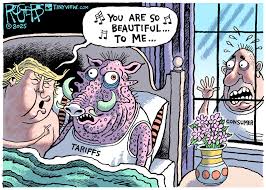 The Financial Markets are reeling. This is from NYT. “Markets Rattled on Concerns About U.S. Debt. Stocks fell, the dollar slipped, and bond yields jumped after a rating downgrade highlighted worries about the cost of President Trump’s policies and the health of the economy.”
Turbulent trading hit financial markets on Monday, with investors selling U.S. stocks and bonds and the dollar, an ugly combination that suggests sentiment is souring on the outlook for the world’s largest economy.
The S&P 500 index fell about 1 percent in early trading in New York. Bond markets shuddered, with U.S. Treasury prices falling and their yields, which underpin interest rates across the economy, rising. The 10-year yield jumped a tenth of a percentage point, a large move in that market, to 4.54 percent. The dollar also fell, with a gauge of its value against other major currencies slipping 0.8 percent.
One factor jarring markets is a bill in Congress that would make President Trump’s signature 2017 tax cuts permanent and could add trillions of dollars to federal debt. A House committee voted to approve the bill Sunday night, although it was expected to remain a focus of contentious congressional debate.
The United States’ loss of its last triple-A credit rating late on Friday and mounting concerns about government debt have threatened to disrupt the relative calm in markets that has prevailed since Mr. Trump paused many of his tariffs in recent weeks.
In downgrading the U.S. credit rating, Moody’s cited the tax cut legislation along with broader concerns about the fiscal deficit and growing debt costs. The move by Moody’s means that all three major rating agencies no longer consider the United States qualified for their top credit ratings.
The U.S. credit rating downgrade and worries about debt and deficits could further upset financial markets if they begin to shake the safe-haven status of Treasury bonds. That would likely spur global investors to demand higher premiums in return for buying U.S. debt.
On Monday, the 30-year Treasury yield rose to its highest level in a year and a half, above 5 percent.
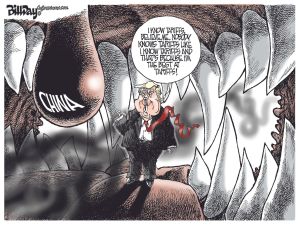 The market has yet to fully absorb the Treasury Bond Dump by China. This is from the Daily HODL (News and Insight for the Digital Economy). Yes, I’m getting seriously nerdy for you know. This is the kind of stuff that drives my research and derivatives class lectures. This is the stuff that should frighten everyone if they ever knew about it. “China Dumps $18,900,000,000 in Treasuries as US Government Faces Major Dilemma: Macro Analyst Luke Gromen.”
Macro investor Luke Gromen warns that the countries buying more USTs won’t be able to simultaneously buy more American-manufactured goods, further hurting America’s trade deficit that President Trump has promised to address.
Says Gromen,
“Foreign UST holdings rose $133 billion Mar vs. Feb.
UK, Caymans, and Canada were $86 billion of that $133 billion; China sold $19 billion.
UK surpassed China as the 2nd biggest US foreign creditor for 1st time ever in March.
Cayman Islands (pop. ~73,000) is now the fourth biggest US foreign creditor at $455 billion…
How are they going to buy both USTs and more goods from America going forward?”
Analysts reportedly told Reuters that Chinese holdings of USTs have been in a downward trajectory since 2018, even though foreign holdings of Treasuries surged to an all-time high of $9.05 trillion in March.
 That means our exports will go down in many of the countries. It’s damned recessionary. Also, if the price of bonds goes down because a country dumps their portfolio of treasuries, the interest rates go up. It will be truly interesting to see what the Fed does with this. Then there’s this. I bet Senator Warren is apoplectic. This report comes from The Guardian. You remember how fun that crash was. “US reportedly plans to slash bank rules imposed to prevent 2008-style crash. Watchdogs could cut capital rules as Trump’s deregulation drive opens door to rollback of post-crisis protections.”
US watchdogs are reportedly planning to slash capital rules for banks designed to prevent another 2008-style crash, as Donald Trump’s deregulation drive opens the door to the biggest rollback of post-crisis protections in more than a decade.
The move follows heavy lobbying by the banking industry, with lenders such as JP Morgan and Goldman Sachs having long complained that competition and lending have been hindered by burdensome rules governing the assets they must hold versus their liabilities.
Regulators are expected to put forward the proposals this summer, aimed at cutting the supplementary leverage ratio that requires big banks to hold high-quality capital against risky assets including loans and derivatives, according to the Financial Times, which cited unnamed sources.
The rules came into force after the 2008 financial crisis, as part of efforts to shockproof the banking system and avoid damaging ripple effects that could cause another global economic meltdown. The crisis forced governments to spend billions of dollars bailing out big lenders that took too much risk.
Changes to bank capital rules have been widely expected, with Trump having promised a bonfire of regulation during his second term in office, with plans to slash 10 regulations for every new one added.
While some critics warn it is the wrong time to slash protections, given growing uncertainty over policy overhauls and market volatility, banks seem to have won the ear of policymakers. Lobbyists have long argued that the rules punish them for holding relatively low-risk assets including US debt, known as treasuries, and hinders their ability to provide more loans.
 I just want to wish Former President the best as he struggles with cancer. I know how that feels. I’m 35 years out from a stage 4 cancer episode. It transforms how you see time. “President Biden has metastatic prostate cancer. Here’s what you should know,” via CNN. He will receive top-quality cancer treatment and has a wonderful supportive family. All of this will help him. He’s also one tough cookie.
President Joe Biden’s diagnosis of metastatic prostate cancer has understandably raised concerns and questions: How long has he had cancer, how will he be treated, and what is his prognosis?
As a urologist, I regularly diagnose prostate cancer in my patients, and each time I share the diagnosis with them and their family, it’s never easy. Over time, I’ve learned the importance of keeping conversations simple and straightforward — avoiding sugar-coating and instead using data, statistics and personal experience to help patients begin their cancer journey.
As his public announcement draws attention to this type of cancer, it’s a reminder to regularly check on your own health. Here’s what you need to know about metastatic prostate cancer: how it’s detected, what treatments look like, and why early screening remains essential for men’s health.
The former president’s diagnosis began after he experienced “increasing urinary symptoms,” his office said, and a prostate nodule was discovered.
…
“Metastatic” means the cancer cells have spread beyond the original location (the prostate gland) into other areas — most commonly bones and lymph nodes. Biden’s cancer has specifically spread to his bones, placing him among the 5% to 7% of prostate cancer cases in the United States that are metastatic at initial diagnosis. While this percentage seems small, it represents a significant number given that over 300,000 men in the US and approximately 1.5 million worldwide are diagnosed with prostate cancer every year.
Early-stage prostate cancer carries an excellent prognosis, with nearly a 100% five-year survival rate. However, when prostate cancer is metastatic at diagnosis, the five-year survival rate drops sharply to around 37%. Importantly, these survival rates are statistical averages, and individual outcomes vary considerably based on overall health, age, cancer aggressiveness, and how well a patient responds to treatment.
All of the #FARTUS policies add up to a big mess for the economy. It’s driving me back to research again. But right now, I guess I’ll go blow some bubbles for a while.
What’s on your reading and blogging list today?
Mostly Monday Reads: Prepare for a Toxic Election Season
Posted: July 17, 2023 Filed under: 2024 Elections, 2024 presidential Campaign, corporate money, Corrupt and Political SCOTUS, corruption, Right Wing Angst, Tax Evasion and offshore banking | Tags: @repeat1968, Jr., RFK 7 Comments Good Day, Sky Dancers!
I can assuredly say that everyone I know has been so worn down by the Trump years that I cannot imagine this election season could get any worse than the last four. But, the more Trump wannabes enter races and the likelihood that Trump will prevail in the Republican party means that Republicans will amp up the campaign rhetoric as well as the trash passed by the House. Their infighting spills into the news also. Get ready to stock up on all your comfort items! It’s not even Labor Day, and the Crazy Train has left the station.
There are also the usual gadflies running to the left of Joe Biden. They’re not only attracting gasps from the Democratic party, they attracting Republican Donor money in the hopes they can cut into Biden’s lead. This is from Michael Tomasky, writing for The New Republic. “This Is the Time for Quixotic, Corrosive Campaigns? Seriously? Robert F. Kennedy Jr., Cornel West, and No Labels are effectively surrogates for Donald Trump’s 2024 bid.”
You might think, in a two-party democracy where the man who is a dead-on bet to be the presidential nominee of one of those parties has all but pledged to wipe out said democracy and promised to use his second term to destroy all internal enemies, that the rest of the society would band together to try to prevent that from happening.
That Donald Trump has so pledged is, to everyone who is not a supporter of his, beyond dispute. He has stated many times some version of his belief that “the greatest threat to Western civilization” is “some of the horrible, USA-hating people” in our midst, by which he means the many millions who disagree with him. When he was president, his people were preparing a plan for a possible second term that involved firing thousands of government employees and replacing them with staff loyal to him. He called for the termination of the Constitution’s rules that allowed Joe Biden to win in 2020, even though those rules worked properly to elect the person who won. He led a riot against the U.S. government to overthrow the election results. He calls the press the “enemy of the people.” There’s no telling what a new Trump term would bring. Our democracy would be disfigured at best and, at worst, destroyed.
You’d think people would take that pretty seriously. If we were all watching a Star Trek episode in which a teetering democratic society faced an imminent, dangerous threat, we’d be cheering for the society to come to its senses and work in unison to defeat the threat. That’s what should be happening in real life. But instead, a lot of people have chosen this moment, when the democracy is hanging by a few tattered threads and its future depends directly on the result of next year’s election, to say, Hey, let’s have some fun! This is all a game anyway.
Well, it’s not a game. And it’s astonishing to me that people can be so blithe about it. Let’s look at four (or four and a half) examples.
First, Robert F. Kennedy Jr. has decided that this is the right time to run a quixotic and corrosive presidential campaign whose end result can only be to fuel cynicism not just about Biden but about the whole system. That’s the inevitable outcome when a crackpot conspiracy theorist who spouts nothing but lies is given a platform like the one Kennedy now has.
His latest WTF moment, that Covid was “targeted to attack Caucasian and Black people” and that Jewish and Chinese people were most immune, may finally have signaled to the political-media establishment that this guy should not be indulged any further. Let us hope so. He won’t come close to winning the nomination. His support has slipped since the spring—he’s been polling at single digits in some state polls.
That isn’t the threat. The threat is that his out-there beliefs and cuckoo theories and refusal to denounce expressions of support from right-wing extremists up to and including Alex Jones (in his recent interview with David Remnick) lend support to the Trumpian view of the world. If his Democratic support ends up being a disgruntled 6 or 7 percent, without him on the November ballot, won’t the bulk of that 6 or 7 percent turn to the guy who sounds most like him? And in Wisconsin, Georgia, and a few other close states, that could be the ball game.
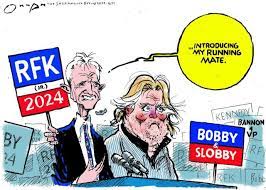 RFK, Jr. belongs in the Loony Tunes universe right next to the QAnon creeps. Think of what Bugs Bunny or the Road Runner could do to them! That’s why Junior is managing to get Republican support. I also believe that he’ll drive the narratives in the press of the BothSiderists. You know who they are. This article from Politico is a depressing look at political funding by billionaire Republicans. “RFK Jr.’s secret fundraising success: Republicans. A POLITICO analysis shows donor overlap with DeSantis and Trump supporters.” This analysis was written by Jessica Piper.
The top contributors to Robert F. Kennedy Jr.’s presidential campaign included donors who typically give to Republicans, according to campaign finance filings — underscoring the extent to which Kennedy, running as a Democrat, is resonating with the other party.
Kennedy’s campaign committee reported raising $6.3 million since his April launch, according to documents filed with the Federal Election Commission on Saturday. He spent $1.8 million and had $4.5 million cash on hand as of June 30.
Some of that money came from donors who have more recently supported Republicans. Kennedy’s campaign raked in at least $100,000 from donors who previously gave to committees associated with Florida Gov. Ron DeSantis or former President Donald Trump, according to a POLITICO analysis of federal and state campaign finance filings. The analysis is based solely on Kennedy’s itemized donations, although he also raised more than $2 million from small-dollar donors, whose names the campaign does not have to disclose.
Such crossover giving is unusual, but Kennedy is running on a platform that includes opposition to efforts to vaccinate against Covid-19, which is increasingly resonating with the Republican base. Though there has been an uptick in vaccine skepticism in recent years, the biggest increases tend to be among voters who identify as Republican.
Kennedy has also been a frequent guest on Fox News since launching his campaign in April, criticizing President Joe Biden on issues including the war in Ukraine and the response to the COVID-19 pandemic.
Among the donors who maxed out donating to Kennedy despite having recent histories of giving to Republicans is banking executive Omeed Malik, who Axios reported is hosting separate fundraisers for DeSantis and Kennedy in the Hamptons this summer.
We can always hope he drains voters from DeSantis, but DeSantis is doing a great job of that on his own.
https://twitter.com/SIfill_/status/1680371100583182337
This is from the Traister analysis. “RFK Jr.’s Inside Job. How a conspiracy-spewing literal Kennedy posing as a populist outsider jolted the Democratic Party.”
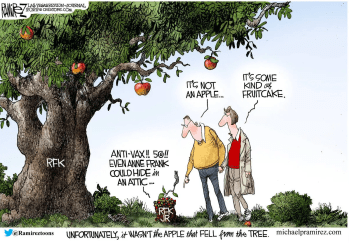
But they aren’t the only ones who took exploitative advantage of the suffering of millions: Kennedy’s vilification of Fauci as a fascist sold more than 1 million copies, and his public profile grew with his every outsize utterance, including that vaccine mandates “will make you a slave” and that “even in Hitler’s Germany, you could cross the Alps to Switzerland. You could hide in an attic like Anne Frank did,” a nadir so low that even his wife, the actress Cheryl Hines, had to issue a statement condemning it.
But however off-kilter he sounded — indeed, precisely because he was extra off-kilter in his attacks on lockdowns and vaccines and masks — Kennedy’s COVID performance became the springboard that launched his current campaign against Biden for the Democratic nomination for the presidency in 2024. Kennedy kicked off his bid in Boston in April, addressing a roomful of people cheering and holding signs with his name in the air. He had the look of a man getting the reception he’d been waiting for his whole life, and his extemporaneous remarks stretched to almost two hours, his expensive education and resemblance to his famous forebears covering for quite a bit of rambling. “He can look and sound so thoughtful and contemplative,” said one person who has known him a very long time. “And he’s just bursting with madness.” Kennedy soon began polling at an eye-catching nearly 20 percent in multiple surveys, and though a recent New Hampshire poll showed him at 9 percent in June, he earned higher favorability numbers in an Economist-YouGov poll than either Biden or Donald Trump.
He has spent the summer traveling to every dark-web–cancel-cultured–just-asking-questions–anti-woke whistle-stop that’ll have him, appearing on podcasts with Bari Weiss, Joe Rogan, Russell Brand, and Jordan Peterson, among others. He can count among his reply guys and fans (and, in some cases, early endorsers) a clutch of Silicon Valley CEOs and financiers, including hedge-fund manager Bill Ackman; venture capitalists Chamath Palihapitiya and David Sacks; and Elon Musk and Jack Dorsey, the current and former overlords of Twitter, respectively. He has been friendly with many in the media, including Salon founder and former editor-in-chief David Talbot and Rolling Stone co-founder and longtime editor Jann Wenner. Kennedy’s campaign manager is Dennis Kucinich, the former Cleveland mayor and Ohio congressman. A super-PAC called American Values 2024 has reportedly raised millions in support of Kennedy’s campaign, and Sacks held a fundraising dinner for him in June for which diners paid $10,000 a ticket. Kennedy’s drive to speak his mind has been praised by those on the far right, including Tucker Carlson and Steve Bannon, and some on the self-described left, like Matt Taibbi and Max Blumenthal.
Kennedy crowed to me about his horseshoe coalition gathered round a campaign he views as fundamentally populist. And it’s quite a band he has put together: crunchy Whole Foods–shopping anti-vaxxers, paunchy architects of hard-right authoritarianism looking to boost a chaos agent, Nader-Stein third-party perma-gremlins, some Kennedy-family superfans, and rich tech bros seeking a lone wolf to legitimize them. Their convening can give the impression of weightiness, but if you so much as blew on them, the alliance would shatter into a million pieces. The only thing that seems to bind them is Kennedy, the current embodiment of a warped fantasy of marginalization and martyrdom that has become ever more appealing — and thus politically significant — in an age of disinformation and distrust in government and institutions.
 Que Susan Sarandon, or does she only hate Hillary? At least Marianne Williamson is running out of cash. FiveThirtyEight asks the question. “How Seriously Should We Take Marianne Williamson And Robert F. Kennedy Jr.?”
But nobody who covers elections (including us) seems to be taking Williamson and Kennedy particularly seriously. So I come to the FiveThirtyEight brain trust with two questions today:
- There’s plainly some kind of appetite for a non-Biden candidate on the Democratic side — so why are oddball candidates like Williamson and Kennedy the only ones who have jumped in?
- Are we underestimating Williamson and Kennedy’s ability to make Biden’s life difficult as we get closer to the Democratic primaries?
nrakich (Nathaniel Rakich, senior elections analyst): Interesting, Amelia, I’m not sure I agree with your premise there! I think a lot of people are taking Williamson and Kennedy more seriously than I’d like them to.
ameliatd: ((Amelia Thomson-DeVeaux, senior reporter) Ooh, we’re bickering already! I love it. Please say more …
nrakich: Basically, they’re being covered like serious candidates. Reporters are going to their rallies and writing exposés on them. Even if they say they are extreme long-shot candidates, they aren’t treating them that way. Actions speak louder than words.
 The Republicans are just vile. This is from Lawyers, Guns, and Money. “The decline and decline of Pudding Ron.” These signs were noticed by Scott LeMieux in the New York Times.
All the signs of a campaign flameout are there:
Gov. Ron DeSantis of Florida has started cutting campaign staff just months into his presidential bid, as he has struggled to gain traction in the Republican primary and lost ground in some public polls to former President Donald J. Trump.
The exact number of people let go by the DeSantis team was unclear, but one campaign aide said it was fewer than 10. The development was earlier reported by Politico.
The dismissals are an ominous sign for the campaign and also underscore the challenges that Mr. DeSantis faces with both his fund-raising and his spending, at a time when a number of major donors who had expressed interest in him have grown concerned about his performance.
[…]
Mr. DeSantis’s struggles appear to be not just about the numbers, but also with the campaign’s message. Late last week, two top DeSantis advisers, Dave Abrams and Tucker Obenshain, were announced to be leaving to join an outside group supporting Mr. DeSantis.
Mr. DeSantis’s campaign finance disclosure with the Federal Election Commission shows he raised roughly $20 million but spent almost $8 million, a so-called burn rate that leaves him with just $12 million in cash on hand. Only about $9 million of that cash can be spent in the primary, with the rest counting toward the general election if he is the nominee.
The filing indicated a surprisingly large staff for a campaign so early in a candidacy, particularly for one with a super PAC that has made a show of how much of the load it is prepared to handle. More than $1 million in expenditures were listed as “payroll” and payroll processing.
Ah, the “burning tons of cash to go backward” trajectory. To be fair, there is no precedent for a Florida Republican becoming an establishment darling, raising lots of money, and having his presidential campaign become a pathetic joke.
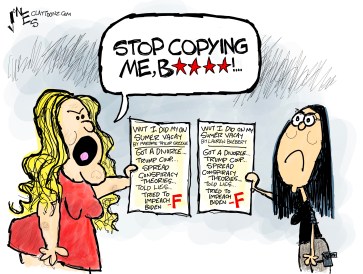 Speaking of Pathetic Jokes … “The Standoff Between Marjorie Taylor Greene and Lauren Boebert Is Worse Than You Think” from The Daily Beast. This report is by Zachary Pitrizzo.
It’s no secret that the relationship between Marjorie Taylor Greene and Lauren Boebert has never been worse. The two U.S. representatives yelled at each other on and off the House floor. Greene recently called Boebert a “little bitch” to her face. And Boebert supported Greene’s removal from the Freedom Caucus.
But, lawmakers told The Daily Beast, the situation between the two is still even worse than most people think.
“A fistfight could break out at any moment,” Rep. Tim Burchett (R-TN) told The Daily Beast.
Burchett, who later clarified that he was serious, said he was enjoying the standoff as a “professional wrestling fan.”
“I am friends with both of them. It’s entertaining to think that a fistfight could break out at any movement. I kind of dig that,” he continued.
Burchett isn’t the only person who thinks the feud could turn even nastier.
Yeah, “men” just love a catfight. So here’s one for them between Pudding Ron and Orange Caligula. They’re such nasty men. This is from The Hill. “Trump campaign calls Iraq veteran ‘lily-livered’ for flipping to DeSantis.” Why Does he hate our Military so much?
Former President Trump’s campaign described Iowa state Sen. Jeff Reichman (R) as “lily-livered” for flipping his endorsement to Florida Gov. Ron DeSantis (R) following Trump’s attack on Iowa Gov. Kim Reynolds (R) earlier this week.
In a statement to The Hill, Trump campaign spokesperson Steven Cheung stated, “There is no room for weak-kneed and lily-livered people on Team Trump.”
Reichman, an Iraq veteran, announced Thursday he would be flipping his endorsement of Trump, and backing DeSantis instead. The state senator, who is serving his first term in Iowa’s upper chamber, was included on a list of around a dozen Iowa officials who the Trump campaign considered early endorsers of the former president.
In his statement, Cheung goes on to claim DeSantis is “so desperate that he’s willing to offer buyouts in the form of fundraisers for endorsements.”
“The truth is that those who have been promised financial support are now regretting their deal with the devil because none of them have been able to schedule fundraisers with DeSantis,” the statement continued.
DeSantis’s campaign said earlier this month it raised $20 million during the second quarter of 2023, while the Trump campaign hauled in more than $35 million in the second quarter, the Trump campaign confirmed to The Hill.
Reichman’s decision to flip support comes days after Trump lashed out at Reynolds on Truth Social on Monday for not endorsing a presidential candidate in the 2024 election. The social media post followed a New York Times report describing the Trump campaign’s frustration with Reynolds’s multiple appearances with DeSantis during his stops in Iowa.
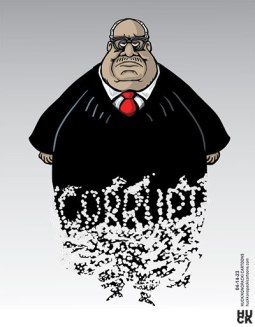 My final offering today is from ProPublica, which is still investigating the roles of Billionaires in Political and SCOTUS decisions. “In lavishing gifts on the Supreme Court justice, the billionaire GOP donor may have violated tax laws, according to tax experts.” And how about Uncle Thomas?”
Crow’s lawyer argues that Congress has no authority to probe the GOP donor’s generosity and that doing so violates a constitutional separation of powers between Congress and the Supreme Court.
Members of Congress say there are federal tax laws underlying their interest and a known propensity by the ultrarich to use their yachts to skirt those laws.
Tax data obtained by ProPublica provides a glimpse of what congressional investigators would find if Crow were to open his books to them. Crow’s voyages with Thomas, the data shows, contributed to a nice side benefit: They helped reduce Crow’s tax bill.
The rich, as we’ve reported, often deduct millions of dollars from their taxes related to buying and operating their jets and yachts. Crow followed that formula through a company that purported to charter his superyacht. But a closer examination of how Crow used the yacht raises questions about his compliance with the tax code, experts said. Despite Crow’s representations to the IRS, ProPublica reporters could find no evidence that his yacht company was actually a profit-seeking business, as the law requires.
“Based on what information is available, this has the look of a textbook billionaire tax scam,” said Senate Finance Committee chair Ron Wyden, D-Ore. “These new details only raise more questions about Mr. Crow’s tax practices, which could begin to explain why he’s been stonewalling the Finance Committee’s investigation for months.”
Crow, through a spokesperson, declined to respond to ProPublica’s questions.
So, ‘Ain’t That Pretty at All.’
Well, I’ve seen all there is to seeAnd I’ve heard all they have to sayI’ve done everything I wanted to do . . .I’ve done that tooAnd it ain’t that pretty at allAin’t that pretty at allSo I’m going to hurl myself against the wall‘Cause I’d rather feel bad than not feel anything at all
Warren Zevon
What’s on your reading and blogging list today?
Monday Reads: Hidden Loot in today’s Treasure Islands
Posted: October 4, 2021 Filed under: Afternoon Reads, Fiscal Cliff, Tax Evasion and offshore banking, The Bonus Class, U.S. Economy 10 Comments
The Opening up of Pandora’s box, Frederick Stuart Church, 1885
Good Day Sky Dancers!
I’m going to go down a rabbit hole today on findings by journalists on a trove of leaked financial information that shows the financial dealings of current and former world leaders in terms of hiding the loot in the world’s Treasure Islands.
Offshore banking has always frustrated many governments in trying to deal with how the rich and powerful hide wealth. This is from The Guardian on what’s being called the Pandora Papers. There’s an accompanying podcast if you’d rather learn about this important trove of leaked offshore papers. These leaks follow the Panama and Paradise papers leaks.
The financial secrets of some of the world’s most rich and powerful people are revealed following one of the biggest leaks of offshore data. The Pandora papers include 35 current and former world leaders and more than 300 public officials.
The Guardian’s Paul Lewis tells Michael Safi how the project came about and the months of work his investigations team has put into the publication. It is the latest offshore leak following previous global journalistic collaborations on the Panama papers and the Paradise papers.
The Guardian’s deputy business editor, Juliette Garside,explains how former British colonial territories have in recent decades used their legal jurisdictions to attract companies and wealthy individuals to register with them as tax havens.
The editor-in-chief, Katharine Viner, tells Michael that there is a clear public interest in publishing this latest investigation and revealing the secrets of prominent politicians at a time when many governments are raising taxes to fund pandemic recovery efforts.
‘Pandora’s Box’ by Rene Magritte 1951
The Washington Post reports the names and country affiliations of those caught in the leak. It includes Putin and many of his minions, the President of Kenya, and the King of Jordan. Czech Prime Minister Andrej Babis was also caught up in the investigations. This is the lede: “Governments launch investigations after secret papers show how elite shield riches.” The link is constantly updated with new revelations and responses.
Here’s what we know from our collective reporting

Pandora, c. 1914 (Metropolitan Museum of Art), Odilon Redon
There are short profiles of many of the leaders/elite and their offshore financial activities at the WAPO link. There are also several good links to basics on offshore banking and the small countries around the world that sponsor this very dark corner of the financial sector.
I’ve written about offshore “treasure islands” before as it tickles just about all my Nancy Drew and Financial Economist/Banker fancies. My last post came in 2016 when the Panama Papers were leaked. These leaks do pop up but the dynamics of the system are linked to political and political funding elites. It’s hard to get countries to move on the tax evaders and the public treasury looters. As you can see from the names, many are either doing this or getting money from those who use offshore banking.
CNN analysts believe the Jordan, Pakistan and, Russia releases are most significant. Former UK PM Tony Blair has also been named in the release.
Former UK Prime Minister Tony Blair and his wife, Cherie Blair, avoided paying £312,000 ($423,000) in stamp duty — a tax on property purchases — when they bought a townhouse in London, the BBC reported. The building now houses Cherie Blair’s law firm.
The Blairs purchased the townhouse in 2017 by buying the offshore firm that owned the property. When the property was put up for sale, its ultimate owners were a family with political connections in Bahrain, according to the BBC.
The Blairs set up a UK company to purchase the offshore firm. Doing so was legal, but it allowed them to avoid paying stamp duty, according to the BBC, because the tax is not charged when a company owning a property is acquired.
“It is not unusual for a commercial office building to be held in a corporate vehicle or for vendors of such property not to want to dispose of the property separately,” Cherie Blair told the BBC.
Cherie Blair also said her husband’s only involvement in the transaction was that the mortgage for the property used their joint income and capital, according to the BBC.
“All the arrangements were made for the express purpose of bringing the company and the building back into the UK tax and regulatory regime, where it has remained ever since. All taxes have been paid ever since and all accounts openly filed in accordance with the law,” Cherie Blair said, according to The Guardian.
It may not be illegal but it certainly sounds and appears dodgy. The real shocking thing is that these kinds of enterprises are setting up in the United States. Notice this little financial firm harkens from South Dakota a state that lured Citibank with its lax banking laws back in the good ol’ days. WAPO has just put up a more current analysis of the overall use of offshore banking. “FOREIGN MONEY SECRETLY FLOODS U.S. TAX-HAVENS. SOME OF IT IS TAINTED.”
SIOUX FALLS, S.D. — Across from a Holiday Inn, in a red-brick building with a welcome sign that reads “The Heart of America,” a little-known financial firm set up shop seven years ago and extended an invitation to the world’s elite.
Trident Trust promised to protect the fortunes and privacy of its new customers by relying on the laws of a state that had become a global destination for wealth. The company called it “The South Dakota Advantage.”
Among those who answered the call: a Colombian textile magnate caught in a scheme to launder the proceeds of an international drug ring, an orange juice mogul who settled with authorities in Brazil for allegedly colluding to underpay local farmers, and family members of the former president of a sugar producer in the Dominican Republic that has been accused of exploiting laborers and forcibly evicting families from their homes.
The U.S. government has long condemned prominent offshore financial centers, where liberal rules and guarantees of discretion have drawn oligarchs, business tycoons and politicians.
But a burgeoning American trust industry is increasingly sheltering the assets of international millionaires and billionaires by promising levels of protection and secrecy that rival or surpass those offered in overseas tax havens. That shield, which is near-absolute, has insulated the industry from meaningful oversight and allowed it to forge new footholds in U.S. states.
Paging Senator Elizabeth Warren! Clean-up in Aisle South Dakota! And of course, Delaware is also one of the usual suspects too. Just ask Senator MBNA (aka President Joe Biden).
The trust documents come mostly from the Sioux Falls office of Trident Trust, a global provider of offshore services. In a written statement, Trident said it is committed to compliance with all applicable regulations and routinely cooperates with authorities. The company declined to answer questions about its clients.
Other states competing to lure wealth include Alaska, Delaware, Nevada and New Hampshire. In South Dakota, assets in trusts more than quadrupled over the past decade to $360 billion. One of the largest trust companies in the state, the South Dakota Trust Co., boasts a roster of international clients from 54 countries.
The industry’s rapid expansion was led by a group of trust company insiders, who year after year pitched legislative proposals that were highly appealing to customers in the United States and abroad: protecting trusts from creditors, from taxing authorities, from foreign governments.
With little opposition, state legislators turned the proposals into laws — dozens since the late 1990s.
So, not only are we giving these folks lower tax bills than their house staff and employees, we’re letting them dodge even more tax liabilities by just traveling to the usual suspect states.
You may read the original work in the tweet directly above. It’s going to be a week of global intrigue! So, hang on to your best James Bond Villian impression. Mine will continue to be Vladimir Putin who set up a mistress and child to live like Marie Antoinette.
The Debt Ceiling is still in the news too!
Either of these stories could rock the US and Global financial markets! So, I’ll be watching! C’mon Joe! Don’t make me sell the US short to finance my senior days!

Pandora and the Flying Dutchman (1951) This painting was featured in the movie of that name. It plagiarizes the early metaphysical style of Giorgio de Chirico (1888–1978)
Biden did take McConnell to school today. This is from the LA Times.
President Biden on Monday criticized Republicans for not voting to raise the debt ceiling, accusing them of being “reckless and dangerous” in a way that could harm the economy.
“Not only are Republicans refusing to do their job, they’re threatening to use [the filibuster] to prevent us from doing our job — saving the economy from a catastrophic event,” Biden said during a speech at the White House.
The Democrat-controlled House last week passed legislation that temporarily suspends the debt ceiling. Senate Republicans, however, have said they will not vote to approve such a measure. Biden said the Republicans’ stance is “hypocritical, dangerous and disgraceful.”
“Especially as we’re clawing our way out of this pandemic,” Biden said.
…
Once the Treasury Department runs out of cash, payments to government workers, including military personnel, veterans and Social Security recipients would likely be delayed. A default would also affect taxpayers.
“Savings in your pocketbook could be directly impacted by this Republican stunt,” Biden said.
Treasury Secretary Janet Yellen previously said the department would run out of “emergency measures” to pay the nation’s debts on Oct. 18. The limit on federal borrowing is currently $28.4 trillion.
McConnell told Biden to find a Democratic Party-based solution in a Dear Joe letter. So, there’s your countdown to doomsday. This is from Politico.
So, Republicans continue to obfuscate the debt ceiling. It’s basically got to be increased because of the last 4 years and all years before. There’s very little Biden spending to this point and his budget is not even in effect at this point.
Don’t let your eyes glaze over on this stuff! This is a shit list of how they’re stealing from us!
What’s on your reading and global intrigue list today?
Are Victims of Mortgage Lender Fraud about to get their Justice?
Posted: October 24, 2012 Filed under: Bailout Blues, Banksters, investment banking | Tags: BOA, DOJ, FHA, FNMA, hustle loans, Subprime mortgages 23 Comments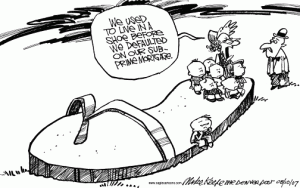
The DOJ has filed a lawsuit against BOA on so-called “hustle mortgages” that accuses the lender of selling bad mortgages to Fannie and Freddie. I’m going to follow this, believe me, because it represents a ‘big deal’ for any one that does research in banking, lending, or moral hazard. I’m not a lawyer–nor do I play one on TV–so the finer parts of the law are not in my knowledge ballpark. I do have some knowledge of home value through the apprenticeship I did with a home appraisal service. However, I expect this to influence both lending behavior and the willingness of larger banks to merge with banks in bad shape. The latter is a trick used by regulators to deal with a problem bank. Bank of America is basically being sued over mortgages originated through a Countrywide program called the “hustle mortgage”. It supposedly continued the program after its merger to Countrywide.
This is the first civil fraud suit brought by the Department of Justice concerning mortgage loans sold to Fannie Mae or Freddie Mac.
Manhattan U.S. Attorney Preet Bharara said: “For the sixth time in less than 18 months, this Office has been compelled to sue a major U.S. bank for reckless mortgage practices in the lead-up to the financial crisis. The fraudulent conduct alleged in today’s complaint was spectacularly brazen in scope. As alleged, through a program aptly named ‘the Hustle,’ Countrywide and Bank of America made disastrously bad loans and stuck taxpayers with the bill. As described, Countrywide and Bank of America systematically removed every check in favor of its own balance – they cast aside underwriters, eliminated quality controls, incentivized unqualified personnel to cut corners, and concealed the resulting defects. These toxic products were then sold to the government sponsored enterprises as good loans. This lawsuit should send another clear message that reckless lending practices will not be tolerated.”
FHFA Inspector General Steve A. Linick said: “To prevent fraud, conducting quality reviews and complying with underwriting standards are critical. Countrywide and Bank of America allegedly engaged in fraudulent behavior that contributed to the financial crisis, which ultimately falls on the shoulders of taxpayers. This type of conduct is reprehensible and we are proud to work with our law enforcement partners to hold all parties accountable.”
SIGTARP Special Inspector General Christy Romero said: “The complaint filed today alleges serious and significant misrepresentations that Bank of America made before and during the time taxpayers invested $45 billion in TARP funds in the bank. SIGTARP and its law enforcement partners will investigate allegations of wrongdoing by TARP recipients, particularly conduct that results in substantial losses to the government and taxpayers.”
Are we beginning to see the DOJ move on the banksters? Has this got anything to do with the stampeded to Romney by all things Wall Street?
The Bank of America lawsuit is the sixth brought against a major U.S. bank by the Justice Department in less than 18 months over what Bharara called “reckless mortgage practices in the lead-up to the financial crisis.”
This month, the government sued Wells Fargo & Co. (WFC), one of the biggest mortgage lenders and service, over claims the San Francisco-based bank made reckless loans that caused losses for a federal insurance program when they defaulted. The complaint alleges misconduct over more than a decade related to the bank’s participation in a Federal Housing Administration program and follows similar cases against other lenders including Citigroup Inc. (C) and Deutsche Bank AG. (DB)
A state and federal task force is investigating misconduct in the bundling of mortgage loans into securities before the housing bust. The group’s first legal action was this month, when New York Attorney General Eric Schneiderman sued JPMorgan Chase & Co. (JPM), the biggest U.S. lender, over defective mortgage loans underlying securities, a suit he said would act as a template for other such cases. The bank has denied wrongdoing.
Fannie Mae and Freddie Mac losses totaled more than $1 billion, Bharara said. The Justice Department’s complaint was brought under the federal False Claims Act, which allows for triple damages.
Fannie Mae and Freddie Mac have operated under U.S. conservatorship since 2008, when they were seized amid subprime mortgage losses that pushed them toward insolvency.
“Bank of America has stepped up and acted responsibly to resolve legacy mortgage matters,” Larry DiRita, a spokesman for the Charlotte, North Carolina-based company, said in an e-mailed statement. “The claim that we have failed to repurchase loans from Fannie Mae is simply false. At some point, Bank of America can’t be expected to compensate every entity that claims losses that actually were caused by the economic downturn.”
The government said in the complaint that Bank of America “systematically removed every check” in the issuance of mortgages and then sold the “flawed” mortgages to Fannie Mae and Freddie Mac. Both relied on Bank of America’s assurances that the mortgages they purchased complied with their standards, the U.S. said.
According to the complaint, Countrywide initiated “the Hustle” in 2007 just as mortgage loan defaults were increasing nationally and Fannie Mae and Freddie Mac were tightening their loan purchasing standards to reduce risk. The Countrywide program did just the opposite, the U.S. said.
This suit is based on information from a whistle blower and has been in the works since February.
According to court records, Wednesday’s case was originally filed under seal in February by Edward O’Donnell, a Pennsylvania resident and former executive vice president at Countrywide Home Loans who had worked there between 2003 and 2009.
In that complaint, O’Donnell said Countrywide and later Bank of America dismissed his “numerous” objections to the Hustle, and that he became “one of the lone voices” in his division pointing to escalating loan quality issues and defaults.
O’Donnell could not immediately be reached for comment, and his lawyer did not immediately respond to requests for comment.
Grab your bowl of popcorn. This should be interesting.
Tuesday Reads: Romney and Zingers, Environmental Activism, and A Bit of Schadenfreude
Posted: October 2, 2012 Filed under: 2012 presidential campaign, Banksters, Barack Obama, Environment, Environmentalists, Mitt Romney, morning reads, U.S. Politics | Tags: Donald Trump, Eric Schneiderman, federal lands, first presidential debate, Haley Barbour, Harry Reid, James Bruggers, Jamie Dimon, JP Morgan, public lands, Tar Sands blockade, zingers 76 Comments
Good Morning!!
I have some interesting links today–some of them a couple of days old, but even if you’ve seen them, they bear repeating.
First up, there’s just one more day until the first presidential debate. I just can’t wait to hear those “zingers” Mitt Romney’s advisers told the NYT he has been practicing for months.
Mr. Romney’s team has concluded that debates are about creating moments and has equipped him with a series of zingers that he has memorized and has been practicing on aides since August. His strategy includes luring the president into appearing smug or evasive about his responsibility for the economy.
Since August? I hope they haven’t gotten stale. Apparently they’re hoping Obama will have another “likable enough” moment. I doubt that will happen, but we’ll see.
Frankly, as Ezra Klein writes at HuffPo, Romney would be better off to forget the zingers and develop more popular policies.
Behind in the polls and facing mounting panic among his donors, Mitt Romney is readying his secret weapon for the debates: Zingers….Pro tip: If your strategy to turn the presidential election around relies on Romney’s sense of comic timing, you might want to prepare a Plan B, as well.
The idea that this election can be reshaped by a zinger speaks to a deeper problem in the Romney campaign’s fundamental view of the race. As they see it, Obama’s record is an obvious disaster and their job entails little more than pointing that out over and over again. That the polls haven’t seemed responsive to this theory hasn’t dissuaded them. The new explanation for Romney’s difficulties is that the media are in the tank for Obama and that’s why the Romney campaign’s message isn’t breaking through.
But, Klein says, Americans know the economy is bad, but they also think it would have been worse if John McCain had been elected, rather than Barack Obama. Check out the chart.

Anna Marie Cox also addressed the “zingers” story at the Guardian.
The Romney campaign, having already proven able to discover impressive new ways for a nomination to blunder (my jaw still involuntarily drops a little when I hear the phrase “47%”), they have now added yet another type of podiatric wound to their catalogue. According to a report in the New York Times on Saturday, Romney’s staff “has equipped him with a series of zingers that he has memorized and has been practicing on aides since August.”
Already an awkward presence, Romney seems particularly susceptible to the tense stillness and deathless pathos that accompanies a dud punchline. Picturing the forced jocularity around the campaign headquarters has its pleasures, specifically the idea of Mitt trotting out well-worn jokes with the panache of a Catskills stand-up:
“Take my economic policy … please!”
“How lazy is half America? So lazy …”
“Any car-elevator owners in the audience tonight?”
But there’s an awful flipside: my God, what if he actually tries one of them?
Whether you wince or guffaw at the image of Romney attempting and failing to “zing” the president, probably says more about your tolerance for the humiliation of others than your political sensibilities. You’d think covering politics would have inured me to it by now, but in real life, I can’t even watch “American Idol”. I will view the debate on Wednesday through the spaces between my fingers, with a desk nearby to bang my head against.
What I really wish is that Romney would follow Donald Trump’s advice. According to TPM, Trump tweeted that Romney “should ask Obama why autobiography states “born in Kenya, raised in Indonesia.”
Romney will definitely have to watch his tone though, based on the results of a focus group study that TPM reported today. And Republicans will have a hard time saying this one is biased, because it was done by Haley Barbour’s company.
Barbour’s firm Resurgent Republic conducted focus groups of blue collar voters in Ohio and suburban women in Virginia who supported Obama in 2008 but are now undecided. Both are swing demographics that Romney is working to win over in order to flip each state from blue to red.
Their findings? Voters are a lot more willing to believe attacks based around Romney quotes than they are on Obama quotes.
“Whenever we showed direct quotes from President Obama over the last few years, voters consistently say that this is probably taken out of context and they don’t seem to hold that same standard with Governor Romney,” pollster Linda DiVall, who conducted the Virginia focus groups, said in a conference call announcing the findings Monday.
She added that while their reaction struck her as “a little bit unfair,” it was nonetheless “American voters’ right to do that.”
Pollster Ed Goeas said his own Ohio focus groups elicited similar responses, which could make things harder for Romney as he seeks to reverse his comments that 47 percent of Americans consider themselves “victims.”
It sounds like these swing state voters have figured out that Romney is a lying liar who only cares about the needs of the top .01 percent. Voters just aren’t as stupid as the Romney campaign thinks.
Did you see the tough op-ed Harry Reid wrote for the Las Vegas Sun on Sunday? He really ripped Romney a new one.
We learn the most about someone’s character not from what he does when he knows others are watching but from what he does when he thinks they aren’t.
We’ve learned an awful lot of troubling things about Mitt Romney recently. First, his sweeping, closed-door condemnation of President Barack Obama’s supporters revealed the disdain he has for half the population he hopes to serve. Then, the limited tax returns Romney selectively released confirmed that he’s willing to share information about the time he’s been in the public eye and running for president, but not the time he was running the corporation he touts as his sole qualifying credential for the highest office in the land.
When he thought no one was listening, Romney accused 47 percent of Americans of not taking responsibility for their lives, painting them as lounging in government dependency — a conclusion he reached because, for various legitimate reasons, they are exempt from paying federal income taxes.
Romney stands not only on shaky ethical grounds in making that indiscriminate generalization — he’s also on flimsy factual footing. The 47 percent Romney derides as self-pitying “victims” includes seniors who live on a fixed income thanks to the Social Security they paid into and earned over a lifetime of hard work, our troops in combat zones and veterans who have fought for our country. It includes students studying to get the skills that will win them the jobs of the future and decent Americans actively looking for work because their jobs were outsourced by companies such as those Romney specialized in developing. Most of them pay plenty of payroll, property, local and state taxes.
Reid goes on to beat Romney over the head with his secret tax returns one more time. Go read the whole thing if you haven’t already. Reid is turning out to be the Democratic attack dog of the 2012 campaign season.
Just one more Romney link: Romney would put states in charge of federal lands. James Bruggers, a Kentucky reporter who covers environmental issues full-time writes:
Our public lands are a birthright, held in trust for each one of us and managed by a set of laws that were worked out through compromise by Congress and various presidential administrations going back generations.
They provide places for us to hike, ride our mountain bikes, horses, camp, hunt and fish. Many are managed for multiple uses, and they also allow for cattle grazing, timber harvesting, oil and gas development, mining and skiing.
Romney, however, has said he would change all this, putting states in control of lands now under the stewardship of such agencies as the U.S. Forest Service and the Bureau of Land Management, who are charged with making sure all Americans have a say in their management. Often this gets reported simply as an expansion of oil and gas development on public lands, a simplification that fails to acknowledge just how radical of a shift in public policy it would be to turn over federal lands to state control.
From a Romney white paper:
States will be empowered to establish processes to oversee the development and production of all forms of energy on federal lands within their borders, excluding only lands specially designated off-limits;
• State regulatory processes and permitting programs for all forms of energy development will be deemed to satisfy all requirements of federal law;
• Federal agencies will certify state processes as adequate, according to established criteria that are sufficiently broad, to afford the states maximum flexibility to ascertain what is
most appropriate.
I still remember how shocked I was when I heard Romney say this in the Nevada primary debate. This is a huge issue as far as I’m concerned. American is still a beautiful country with many unspoiled wilderness areas. It is vital that we protect those public lands–they belong to all Americans, not to individual state governments.
Here’s another environmental story on the attempts to block the Keystone XL pipeline: BREAKING: Blockader Locks to Underground Capsule to Protect a Family Farm. It’s a live blog of the “Tar Sands blockade.” Here’s their Facebook page.
From Firedoglake blogger Kevin Gosztola:
A Tar Sands Blockader, Alejandro de la Torre, locked his body in a concrete capsule buried in the path of TransCanada’s Keystone XL pipeline to stop a small family farm in East Texas from being destroyed by construction. He blocked demolition for at least six hours before police were able to break off a chunk of concrete is arm was in and arrest him.
Police confiscated cameras of Blockaders that were there to film for Torre’s safety. Tar Sands Blockade spokesperson Ramsey Sprague reported they wanted to keep cameras on him as long as possible but police intimidated observers and took the cameras.
Last week, TransCanada supervisors encouraged police to use torture tactics on protesters to stop their nonviolent direct action.
Sprague recounted the brutality, which was “astounding.” Shannon “Rain” Beebe and Benjamin Franklin locked themselves to TransCanada machinery to stop clear-cutting. The police hung them with their arms behind their backs. They put pressure on their shoulder with their arms twisted. They pepper sprayed a tube connecting their arms. They twisted a tube cutting off circulation to their hands. (One protester is seeking medical attention for nerve damage.)
The police used tasers and planned to keep using tasers on Beebe and Franklin until they released. Cameras were supposed to be on the scene to film the action, but police were directed by TransCanada supervisors to run off those with cameras so they could commit brutality without people seeing video evidence on the evening news.
Continuing the environmental theme, pioneering environmental activist Barry Commoner died on Sunday.
Scientist and activist Barry Commoner, who raised early concerns about the effects of radioactive fallout and was one of the pioneers of the environmental movement, has died at age 95.
Commoner died Sunday afternoon at a Manhattan hospital, where he had been since Friday, said his wife, Lisa Feiner. He lived in Brooklyn.Commoner was an outspoken advocate for environmental issues. He was one of the founders of a well-known survey of baby teeth in St. Louis that started in the late 1950s. The survey assessed the levels of strontium-90 in the teeth and showed how children were absorbing radioactive fallout from nuclear bombs that were being tested.
The survey helped persuade government officials to partially ban some kinds of nuclear testing.
Feiner said Commoner had “a very strong belief that scientists had a social responsibility, that the discoveries would be used for social good and that scientists also had an obligation to educate the public about scientific issues so that the public could make informed political decisions.”Commoner took on that role of educating the public, writing books on environmental issues. Among his works were “Making Peace with the Planet” and “Science and Survival.” He made the cover of Time magazine in early 1970 and ran for president as a third-party candidate in 1980.
Finally, here’s a little bit of schadenfreude for you. Bloomberg reports that New York is “suing JP Morgan for fraud over mortgages securities.”
JPMorgan Chase & Co. (JPM), the biggest U.S. bank, was sued by New York Attorney General Eric Schneiderman over claims that the Bear Stearns business the bank took over in 2008 defrauded mortgage-bond investors.
Investors were deceived about the defective loans backing securities they bought, leading to “monumental losses,” Schneiderman said in a complaint filed today in New York State Supreme Court.
“Defendants systematically failed to fully evaluate the loans, largely ignored the defects that their limited review did uncover, and kept investors in the dark about both the inadequacy of their review procedures and the defects in the underlying loans,” Schneiderman’s office said.
Schneiderman in January was named co-chairman of a state- federal group formed to investigate misconduct in bundling of mortgage loans into securities leading up to the financial crisis. The group includes officials from the U.S. Justice Department, the Securities and Exchange Commission, the FBI and other federal and state officials.
Poor Jamie Dimon. Why don’t people respect his “success?”
Those are my suggestions for today. What are you reading and blogging about?

 peej
peej Carissa
 bostonboomer
 dakinikat
 ecocatwoman
 mablue2
 Mama Lopez
 peggysue22
 quixote
 skydancingguestblogger
 Mona (aka Wonk the Vote)



 Sky Dancing
Recent Comments