
Misplaced Blame and Impact
Posted: March 14, 2011 Filed under: Bailout Blues, Economy, financial institutions, Global Financial Crisis | Tags: Banksters, credit crunch, U.S. Economy 15 Comments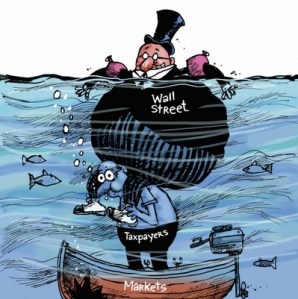 The blame for the worst recession since the The Great Depression clearly rests on the private sector where millions of bad loans and financial innovations turned peoples homes and investments into casino style gambling games. The disastrous lack of regulation, accountability, and common sense is still wrecking havoc on the economy today. The lending industry is still at odds with common sense, community well being, and the national interest. Paul Krugman wrote about this today in his NYT op ed using the academy award winning film Inside Job as the cautionary frame. What is evident in all of this fall out is that the people that deserve the blame are still acting abominably and the people they wronged are still getting the worst end of the deal.
What the film didn’t point out, however, is that the crisis has spawned a whole new set of abuses, many of them illegal as well as immoral. And leading political figures are, at long last, showing some outrage. Unfortunately, this outrage is directed, not at banking abuses, but at those trying to hold banks accountable for these abuses.
The immediate flashpoint is a proposed settlement between state attorneys general and the mortgage servicing industry. That settlement is a “shakedown,” says Senator Richard Shelby of Alabama. The money banks would be required to allot to mortgage modification would be “extorted,” declares The Wall Street Journal. And the bankers themselves warn that any action against them would place economic recovery at risk.
All of which goes to confirm that the rich are different from you and me: when they break the law, it’s the prosecutors who find themselves on trial.
To get an idea of what we’re talking about here, look at the complaint filed by Nevada’s attorney general against Bank of America. The complaint charges the bank with luring families into its loan-modification program — supposedly to help them keep their homes — under false pretenses; with giving false information about the program’s requirements (for example, telling them that they had to default on their mortgages before receiving a modification); with stringing families along with promises of action, then “sending foreclosure notices, scheduling auction dates, and even selling consumers’ homes while they waited for decisions”; and, in general, with exploiting the program to enrich itself at those families’ expense.
The end result, the complaint charges, was that “many Nevada consumers continued to make mortgage payments they could not afford, running through their savings, their retirement funds, or their children’s education funds. Additionally, due to Bank of America’s misleading assurances, consumers deferred short-sales and passed on other attempts to mitigate their losses. And they waited anxiously, month after month, calling Bank of America and submitting their paperwork again and again, not knowing whether or when they would lose their homes.”
There are more issues than just the foreclosure one. Here’s an example of a family fighting to sue BOA for the wrongful death of an elderly man who committed suicide after they recommended investments to him that failed miserably. The family has found out that the man had probably unknowingly signed away the right to sue in the fine print of the investment documents. I can’t imagine any one recommending a portfolio of risky assets to any one over the age of 50, yet this is exactly what BOA did to Mr. Phillip Grossman.
Philip Grossman saved carefully his whole life, never investing in anything more exotic than certificates of deposit. But in June 2007, his longtime banker at a Bank of America branch in Waltham told him he could do better, without taking more risk, and introduced him to a broker at the bank’s investment arm.
Two years later, Grossman, then a 65-year-old computer consultant, and his wife had lost $400,000 — more than half their savings. In despair in the fall of 2009, Grossman checked into a Woburn motel, left his glasses and watch on the desk in his room, and killed himself.
Stunned by the tragedy, his family tried to sue Bank of America, asserting that the broker invested more aggressively than promised, adding to the steep losses and contributing to Grossman’s suicide. But they soon found out they would not get their day in court: The papers the Grossmans signed to open their account required that any dispute go to a private panel of arbitrators.
“They’ve committed a crime against us, as far as I’m concerned,’’ Grossman’s wife, Gail, said in an interview. “Why do we have to go to arbitration? With other crimes you get a trial and a jury. It just seems very unfair to me.’’
The Grossmans’ case shows how entrenched arbitration has become in the financial industry, demonstrating that even in an extreme case alleging wrongful death, aggrieved clients have no recourse other than a system that critics say favors investment firms. Most investors have no idea that when they open a brokerage account, they give up their right to sue, and must, under a 1987 Supreme Court ruling, take complaints to arbitration.
There are more outrages to share with you. Think that having a perfect credit score and a huge down payment will get you a loan these days if you’re a consumer? Think again. Banks are lending to junk bond quality businesses while denying the best of households basic mortgages. The recovery is not just around the corner for the majority of US households for many reasons. Government help has been concentrated at reaching banks and businesses. This is not translating into improvement for all.
The consumer loan market, particularly housing, remains a challenge for borrowers. Total U.S. consumer credit outstanding was $2.4 trillion in January, or 6.6 percent below its July 2008 level, the Fed said in a March 7 report. Total housing debt has declined by $536 billion since 2008 to $10.1 trillion, Fed data show. The median price of an existing U.S. home has dropped 13 percent since June to $158,800, bringing its decline since July 2006 to 31 percent, according to the Chicago-based National Association of Realtors. About 10.8 million homes were worth less than the debt owed on them in the third quarter, research firm CoreLogic Inc. said in a Dec. 13 report.
By contrast, the least creditworthy corporations have been able to borrow record amounts at the cheapest rates ever. Junk- rated companies sold an unprecedented $287.6 billion in bonds in 2010 and are setting an even faster pace of issuance this year. Claire’s Stores Inc., the costume jewelry retailer that had debt that was almost 10 times its earnings last year, sold $450 million of bonds last month that Moody’s Investors Service gave its third-lowest rating.
There are several other disturbing figures in the Bloomberg article quoted directly above.
The U.S. economy grew at a 2.8 percent annual rate in the fourth quarter, slower than previously calculated, and is forecast to expand 3.2 percent this year, according to the median estimate of 66 economists in a Bloomberg survey.
Household purchases account for about 70 percent of the U.S. economy, making the consumer the single biggest driver of any economic recovery. Those consumers “stumbled at bit” at the start of this year, Michael Feroli, chief U.S. economist at JPMorgan Chase & Co. in New York, said in a February note.
While the economy expanded and companies are beginning to spend more, the improvements haven’t driven the nation’s unemployment rate below 8.9 percent for almost two years and the Conference Board’s gauge of consumer confidence is still 37 percent below the level reached in July 2007.
“The 2007-2009 recession period looks different from previous economic cycles,” John McElravey, a bond analyst at Wells Fargo Securities LLC in Charlotte, North Carolina, said in a March 8 report. “Consumer credit outstanding contracted much more sharply than in other periods, and the return to positive growth rates has been relatively slow.”
There are so many things different and bad with this recovery that it is indeed troubling. Perhaps the most important factor is that government is clearly not helping homeowners, the jobless, and the many families who have lost wealth via the crash in home values and their investments. The focus of bailouts has been on banks and businesses that have not used the funds to benefit their communities. Something is clearly wrong here with policy priorities when you’re not focused on the major source of consumption in a consumer-drive economy.
Not only is policy not aimed at the majority of people in the country, the focus in the District is now clearly turning to austerity measures and turning neighbor against neighbor. I can’t tell you exactly how worried I am that a huge number of households will still be in trouble come the next recession. Here’s another opinion on that very subject from E.J. Dionne Jr. at WAPO.
A phony metaphor is being used to hijack the nation’s political conversation and skew public policies to benefit better-off Americans and hurt most others.We have an 8.9 percent unemployment rate, yet further measures to spur job creation are off the table. We’re broke, you see. We have a $15 trillion economy, yet we pretend to be an impoverished nation with no room for public investments in our future or efforts to ease the pain of a deep recession on those Americans who didn’t profit from it or cause it in the first place.
As Sen. Al Franken (D-Minn.) pointed out in a little-noticed but powerful speech on the economy in December, “during the past 20 years, 56 percent of all income growth went to the top 1 percent of households. Even more unbelievably, a third of all income growth went to just the top one-tenth of 1 percent.” Some people are definitely not broke, yet we can’t even think about raising their taxes.
By contrast, Franken noted that “when you adjust for inflation, the median household income actually declined over the last decade.” Many of those folks are going broke, yet because “we’re broke,” we’re told we can’t possibly help them.
That’s the new excuse. We could help Chrysler. We could help GM. We could help the financial institutions and Wall Street. We could invade Iraq and Afghanistan to help them. We could do all that, but now we’re too broke to help ordinary Americans. It’s obvious that the financial institutions are doing nothing to improve the situation. It’s also pretty obvious that Iraq and Afghanistan are money pits. When do we get the government to quit throwing our money to rich people and businesses? When do we get them to stop blaming teachers, firefighters, and police offers for taking up too much of the pie? When do we actually start looking at the real numbers and the real culprits who took all this vast wealth and continue to ensure the rules only benefit the few?
Tuesday Reads: Tim Geithner in Control of Obama’s Economic Policy, and Other News
Posted: February 15, 2011 Filed under: Bailout Blues, Barack Obama, Economic Develpment, Egypt, financial institutions, Foreign Affairs, Global Financial Crisis, Gulf Oil Spill, Iran, U.S. Economy, U.S. Politics, unemployment, Yemen | Tags: Barack Obama, Financial Markets, Larry Summers, Noam Scheiber, The New Republic, Timothy Geithner, Wall Street 22 Comments
Good Morning!! The snow is slowly melting outside my house, and I’ve come down with Spring fever! No more snowstorms please, Mother Nature. Anyway, at least for this week, we are getting temperatures in the 40s and 50s. It is going to be chilly again tomorrow, but after that–springlike! After the frigid winter we’ve lived through, these temperatures feel amazing. Maybe this will make the bad news from DC a little more bearable. I hope so.
This morning I want to focus on an important article that comes via David Dayen at FDL. It’s a piece at The New Republic about Timothy Geithner, written by Noam Scheiber. First a little aside.
Back in November, I wrote a post about the axing of Obama’s economic team and noted that Geither was the last man standing.
In that post, I quoted Andrew Cockburn of Counterpunch:
If Barack Obama needed any help in guiding the Democratic Party over the cliff he certainly got it from Treasury Secretary Timothy Geithner. Voters have told pollsters that the state of the economy, their own in particular, was their principle concern. Though impelled by the specter of unemployment and homelessness, the image of Geithner, toady to the bankers, can only have encouraged them in their fury. A sensible president would therefore already be running out the plank prior to giving this disastrous financial overseer an encouraging shove between the shoulders. But in this case, we may not be that lucky. CounterPunch can reveal the crucial role played in these matters by a group close to the President but unknown to the outside world.
A knowledgeable insider told Cockburn that despite Larry Summers’ reputation as a corporate tool,
“Larry has some idea that there is more to the economy than just the welfare of large banks,” this official suggests. “He did push for a larger stimulus and more jobs programs, for example. Tim just cares about banks.”
I then went on to indulge in a little conspiracy theorizing based on Cockburn’s information. But that’s beside the point right now. The point is that after writing that post, I came to the conclusion that Geithner was running economic policy in the Obama administration.
Getting back to the article at TNR, Scheiber purports to explain how Geithner survived the massacre of the economists. One interesting tidbit in the lengthy article is about Geithner’s relationship with Larry Summers, who acted as Geithner’s mentor and patron early on.
In 1993, Geithner caught the attention of [a] prominent patron—Larry Summers—whom Bill Clinton had appointed as his treasury undersecretary. Summers took a personal interest in Geithner’s career and promoted him each time he rose through the Treasury ranks.
And then during the Obama administration, Geithner apparently stabbed his patron in the back, becoming President Obama’s primary economic adviser–even though Geithner isn’t an economist. (Neither is anyone else on Obama current “economic team,” as Dakinikat frequently points out.)
Geithner actually sounds a lot like Obama–he’s really good at sucking up and convincing people he’s on their side–until he slides in the knife. Regarding Geithner’s time at the IMF, Scheiber writes:
According to former co-workers, Geithner was deft at bringing skeptical colleagues on board. One technique involved homing in on possible dissidents and absorbing their suggestions into his proposals.
Sound familiar? A bit more:
Perhaps most important, Geithner was scrupulously attuned to the temperament of the boss. Like Obama, he evinced a strong aversion to blather. During meetings with the president, he would say little, and usually not until the end, when his opinion was solicited. “I thought [Geithner] got the president really well,” says a former administration official who interacted with him on nonfinancial matters. “When he was in trouble, I said to someone, ‘He just needs to hold on. He’ll be fine with Obama. Once they get to know each other, they’re like the same person.’”
Scheiber describes an epic struggle between Geithner and Summers over how to deal with the banks that had crashed the U.S. economy. Summers argued for some form of nationalization, while Geithner claimed the banks just needed more capital and they could recover.
If Geithner was right, the capital shortfall was much more manageable than Summers feared. The banks might be able to fill it with minimal government help, simply by selling shares to investors. But, if he was wrong, the banks would stumble along in a kind of vampire state, sucking credit from the economy and exacerbating the recession. In the worst case, fears of insolvency could trigger a modern-day version of Depression-era bank runs.
Hey, wait a minute. That sounds like what is happening to our economy right now. But, never mind, Geithner won the battle that counted–the battle for Obama’s favor.
Part of what Geithner convinced Obama of was “that it was ultimately better politics to risk a backlash with unemployment at 10 percent than to feed the backlash and watch the economy shrink further.” So it’s Geithner we have to thank for the new normal of high unemployment, poverty, and suffering among the middle, working, and lower classes.
Finally, what horrified David Dayen was Geithner’s out-front claim that–in Dayen’s words, “what’s good for Wall Street is good for America.” Geithner:
“I don’t have any enthusiasm for … trying to shrink the relative importance of the financial system in our economy as a test of reform, because we have to think about the fact that we operate in the broader world,” he said. “It’s the same thing for Microsoft or anything else. We want U.S. firms to benefit from that.” He continued: “Now financial firms are different because of the risk, but you can contain that through regulation.” This was the purpose of the recent financial reform, he said. In effect, Geithner was arguing that we should be as comfortable linking the fate of our economy to Wall Street as to automakers or Silicon Valley.
In response, Dayen writes:
I don’t even know what to say about this. We’re just a few years removed from the financial oligarchs destroying the global economy through their own greed and negligence. And the man put in charge of regulating them, who had a front-row seat to all this destruction and who has been given expanded powers under Dodd-Frank to see to it that never happens again, thinks that there’s a great “financial deepening” about to take place where the demand for sophisticated financial innovations will jump. Therefore, the financial sector will need to grow and become the most reliable spur of the US economy. That’s his feeling. And regulation can reduce the risk, even though the new regulations barely put a dent into Wall Street’s core business, and are being systematically defunded besides.
Financialization of the economy has led to practically nothing but pain for the average worker and risk for the taxpayer. It has turned the allocation of capital into the placing of bets at a casino, and the stock market into a particularly sophisticated video poker game. This territory was all covered before in the run-up to the Great Depression as well, and we know the precise causes and remedies involved. Geithner prefers not to address the plutocracy he’s really advancing here – where elites provide “financial deepening” services abroad and amass ridiculous profits that they wall off.
This incredibly amoral conman is partnering with our conman chief executive to sell out our country, our lives, and those of our children and grandchildren. There’s lots more of interest in the article, particularly the information about Geithner’s upbringing.
I’ll wrap this up with a few other stories, and then throw the floor open to your links and opinions. Did you hear that Stephen Baldwin is suing Kevin Costner over Costner’s oil-eating invention?
It seems Baldwin sold his shares in Costner’s company right before BP shelled out $50 million for the machines.
Jane Hamsher offers a flow-chart of the principle players in the scandal over US Chamber of Commerce’s attempts to discredit Wikileaks, Glenn Greenwald, Brad Friedman, David House, and others who have supported wikileaks and Bradley Manning. Joseph Cannon has also been covering this story.
Brad Friedman’s post especially is a must read. Get this, the Chamber paid 2 million dollars a month for dirt on Friedman, and got completely inaccurate information. And that inaccurate information came from corporations who are paid billions by our government “to target terrorists.” But Obama wants to cancel heating assistance for poor people to save money.
Mitt Romney is ahead in the latest NH poll, at 40%, for whatever that’s worth. Romney was always going to win NH. They always vote for New Englanders up there. The real test for Romney will be Iowa.
The Patriot Act extension has been passed by the House on the second try. I think the Egyptians will probably get rid of their emergency law before we get rid of ours.
There are “massive” protests in Iran, inspired by the dramatic events in Egypt. There have also been more protests in Yemen and in Bahrain. When will it happen here?
What are you reading and blogging about today?
K Street Apologia
Posted: January 18, 2011 Filed under: Bailout Blues, Barack Obama, Voter Ignorance, We are so F'd | Tags: externalities, K Stree Lobbying, Regulations, social costs 46 CommentsThe President has written a WSJ op-ed and an executive order to declare war on ‘unnecessary’ regulation while looking 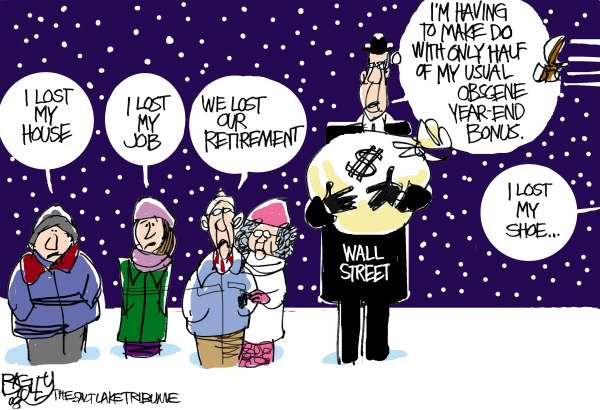 for necessary regulation. He’s evidently a little bit pregnant.
This must be the new and improved, more business friendly President. (Like he wasn’t business friendly enough already? What about bailing out GM, Chrysler, and most of the finance industry?) This is the one that needs to raise $1 billion in campaign funds for re-election and knows it won’t come from unemployed and financially struggling voters.
This order requires that federal agencies ensure that regulations protect our safety, health and environment while promoting economic growth. And it orders a government-wide review of the rules already on the books to remove outdated regulations that stifle job creation and make our economy less competitive. It’s a review that will help bring order to regulations that have become a patchwork of overlapping rules, the result of tinkering by administrations and legislators of both parties and the influence of special interests in Washington over decades.
When is the last time you read a Democratic politician that suggested something like “remove outdated regulations that stifle job creation and make our economy less competitive”? There’s something even more weird and ironic about this sudden urge to op ed for the WSJ. This is an interesting day for the release of a new improved middle path that’s sounds like something the Club for Growth can really sink its teeth into. On this very same day, “The Financial Stability Oversight Council on Tuesday released its six-month study into the Volcker rule and held its third public meeting.” according to FT Alphaville. This group has just made it very clear that removing what several administrations thought was “outdated regulations that stifle job creation and make our economy less competitive” caused the biggest financial melt down and global recession since The Great Depression. They want more regulation not less.
At the moment, banks are playing musical Special Purpose Vehicles; a delightful accounting parlor game that does nothing to get rid of systemic risk. According to the FT article, this includes “creatively shuffling their more obvious proprietary trading operations internally (for example, into asset management and ETF desks) and externally into spun-off funds”. Sure, like that saved ENRON all that nasty embarrassment of bad decision making.
While this report is trying to pick up the pieces of nuclear financial meltdown by suggesting which gaps in regulation need to be filled, the President is chatting up the CEO set on the WSJ op-ed page. There are not even any code words or in-between the lines nudge, nudge wink, winks in these statements. He’s just pandering away.
As the executive order I am signing makes clear, we are seeking more affordable, less intrusive means to achieve the same ends—giving careful consideration to benefits and costs. This means writing rules with more input from experts, businesses and ordinary citizens. It means using disclosure as a tool to inform consumers of their choices, rather than restricting those choices. And it means making sure the government does more of its work online, just like companies are doing.
Does this mean the bidding window is open on which regulations the K street minions want thrown out next? That worked so well with looking the other way for the shadow banking industry and letting the commercial banking industry run a virtual casino, didn’t it? There’s a list of ten major regulatory blueprints coming from The Financial Stability Oversight Council. Are investors, holders of 401ks, pension plans, and savers expected to take any of this seriously given the Wall Street missive?
Regulations reflect the social cost of private consumption and private production of goods and services that have bad side effects. (See this Wikipedia entry on market externalities for more information.) Markets with externalities have bad side effects that do not fall completely on the private producer or the private consumer. This leads to market inefficiency. Goods and services with negative externalties get overproduced, they are under priced, overconsumed and the side costs hit all of us with some of us suffering more than others. Usually, the ones that suffer the most are those least able to get out of the way or stop the problem. The experiences of Hinkley California, people that get lung cancer from secondary smoke, and any of us that were invested in financial or housing assets in the last five years suggests that you cannot just let people and businesses run amok and hope they’ll do right by the people they hurt. Without an effective and accessible judicial system and a vigorous system of sticks and regulatory oversight, you get all kinds of social costs that we get to manage without having any of the fun of buying and using the product or service. Ask me. I’ve spent the last five years living with the results of badly built levees and dealing with the first year of a BP Oil disaster. Let’s point to my 403(B) and my home price that are still in a recovering state from the shadow banking boys run amok. I’m sure you can list a boatload of the ones that the Federal Government ignored recently to give business a more ‘competitive environment” too that have cost you more than they’ve been worth. Sure, they’re now creating more jobs along the Gulf Coast right now but would you seriously let one of your children on to a fishing boat or deep water drilling rig? Do you seriously want your child sitting next to a chain smoker day in and day out?
So, my next question is did I just read that every regulation is now going up to the highest bidder? Maybe, at least, if we get them off the books, we won’t have the moral hazard of thinking any one pays attention to them anymore. If that’s the case, we should all be trial attorneys litigating hazard suits. From where I sit–in a city reeling from the social costs of externalities–our biggest problem is that no one takes regulations or regulators seriously any more because the federal government prioritizes the bottom lines of the perpetrators and not the suffering and the well being of the victims.
An Obituary for New Deal Liberalism
Posted: January 17, 2011 Filed under: Bailout Blues, Barack Obama, Populism, The Bonus Class, U.S. Economy, U.S. Politics, Voter Ignorance | Tags: Looting Social Security, The End of New Deal Liberalism, The Nation, William Grieder 5 CommentsIf you haven’t read William Grieder’s powerful piece ‘The End of New Deal Liberalism’ at The Nation, you really should.  Let me give you a taste.
In these terms, the administration of Barack Obama has been a crushing disappointment for those of us who hoped he would be different. It turns out Obama is a more conventional and limited politician than advertised, more right-of-center than his soaring rhetoric suggested. Most Congressional Democrats, likewise, proved weak and incoherent, unreliable defenders of their supposed values or most loyal constituencies. They call it pragmatism. I call it surrender.
Obama’s maladroit tax compromise with Republicans was more destructive than creative. He acceded to the trickle-down doctrine of regressive taxation and skipped lightly over the fact that he was contributing further to stark injustices. Ordinary Americans will again be made to pay, one way or another, for the damage others did to society. Obama agrees that this is offensive but argues, This is politics, get over it. His brand of realism teaches people to disregard what he says. Look instead at what he does.
Greider outlines the goals of the plutocracy so clearly that you wonder when he’ll be put up for trumped up espionage charges or at least some made-up sex scandal. His opening paragraphs on the capture of our government by corporate interests are just about the most compelling and apt description I’ve read recently. He’s awakened some how to the spokesmodel-in-chief. (h/t to Cinie wherever she may be)
Government has been disabled or captured by the formidable powers of private enterprise and concentrated wealth. Self-governing rights that representative democracy conferred on citizens are now usurped by the overbearing demands of corporate and financial interests. Collectively, the corporate sector has its arms around both political parties, the financing of political careers, the production of the policy agendas and propaganda of influential think tanks, and control of most major media.
What the capitalist system wants is more—more wealth, more freedom to do whatever it wishes. This has always been its instinct, unless government intervened to stop it. The objective now is to destroy any remaining forms of government interference, except of course for business subsidies and protections. Many elected representatives are implicitly enlisted in the cause.
Friday Reads
Posted: January 14, 2011 Filed under: Bailout Blues, commercial banking, Corporate Crime, FBI raids, morning reads | Tags: bond ratings, income inequalities, Julian Assange, michelle obama, Moody's, Naked Capitalism, right wing violent rhetoric, S&P, Stephen Rose, violent rhetoric, Wall Street Bonuses, White House Blog, Wikileaks, Yves Smith 39 Comments Good Morning!

I want to open with a letter from the First Lady to American Parents on the White House Blog. You could tell that FLOTUS was obviously moved by the murder of a young girl so like her own children at the memorial service night before last. I have to say, Michelle has a heart that embraces children. She has turned this into a teaching moment. I haven’t found many inspiring words out there concerning the Tuscon tragedy. These are inspiring words.
We can teach our children that here in America, we embrace each other, and support each other, in times of crisis. And we can help them do that in their own small way – whether it’s by sending a letter, or saying a prayer, or just keeping the victims and their families in their thoughts.
We can teach them the value of tolerance – the practice of assuming the best, rather than the worst, about those around us. We can teach them to give others the benefit of the doubt, particularly those with whom they disagree.
We can also teach our children about the tremendous sacrifices made by the men and women who serve our country and by their families. We can explain to them that although we might not always agree with those who represent us, anyone who enters public life does so because they love their country and want to serve it.
It’s just really too bad that we all can’t grow up up in families like the Huxtables, and the Nelsons, and the Lopez family on TV. There probably would be fewer Manson families as a result. We also don’t have frames for families with surnames like Wu or Ahmadi or Gupta or lots of others. A lot of families are not in places where effective communication is possible. It’s easy to want to embrace those neighbors that look like the Huxtables, the Nelsons and the Lopez family. However, are those the families that really need our help and concern?
So what’s up with our Plutocratic overlords today? Read the rest of this entry »

 peej
peej Carissa
 bostonboomer
 dakinikat
 ecocatwoman
 mablue2
 Mama Lopez
 peggysue22
 quixote
 skydancingguestblogger
 Mona (aka Wonk the Vote)



 Sky Dancing
Recent Comments