
Monday Reads
Posted: May 6, 2013 Filed under: American Gun Fetish, Austerity, children, Economy, Foreign Affairs, Homeless, Israel, Mental Health, morning reads, Syria | Tags: Gabby Giffords, gun, israel, safety, Syria, toxic products for children, wealth inequality 34 Comments Good Morning!
There’s a lot going on in the middle east as tensions mount between Syria and Israel. The situation continues to unravel.
Israeli jets devastated Syrian targets near Damascus on Sunday in a heavy overnight air raid that Western and Israeli officials called a new strike on Iranian missiles bound for Lebanon’s Hezbollah.
As Syria’s two-year-old civil war veered into the potentially atomic arena of Iran’s confrontation with Israel and the West over its nuclear program, people were woken in the Syrian capital by explosions that shook the ground like an earthquake and sent pillars of flame high into the night sky.
“Night turned into day,” one man told Reuters from his home at Hameh, near one of the targets, the Jamraya military base.
Former Arizona Congress Woman Gabby Giffords won a profile in courage award in Boston. Her new role is an outspoken and effective symbol for more gun safety laws.
“It takes real courage to overcome a disability that is so personal,” says Guy McKhann, a leading neurologist at Johns Hopkins University.
Although he hasn’t treated her, he says it was clear that, distinct from cognitive abilities, retrieving the right words is difficult for Giffords. “What she wants to say sometimes doesn’t come out,” McKhann says. (A personal disclaimer: I am chairman of the Profile in Courage Committee that honored her Sunday and have a son with a brain injury.)
On Jan. 8, the two-year anniversary of the shooting, Giffords and Kelly started Americans for Responsible Solutions. They’ve already raised more than $10 million, enlisted more than 300,000 supporters, aired national television ads advocating expanded background checks for gun purchases and campaigned for the measure in a dozen states.
They are perfect for this role. She is a courageous survivor of a gun attack, a former Western member of Congress, a longtime hunter and supporter of gun rights. He is a combat veteran, Navy pilot and space shuttle commander. The National Rifle Association can’t paint them as effete foes of the Second Amendment.
In January, Giffords delivered emotional testimony on the measure to the Senate Judiciary Committee. She and Kelly personally lobbied members. Before last month’s Senate vote on the proposal, she sought out Arizona Republican Jeff Flake, a friend from her House days, and blurted out, “Need,” as in we need you. Unlike his Arizona colleague John McCain, who backed the background checks compromise, Flake voted no. The measure failed; since then, polls show a drop in Flake’s home-state popularity.

If you have young children around, this should scare you. You should also check the list at the link in the article to see if any of this crap is in your home.
Over 5000 children’s products contain toxic chemicals linked to cancer, hormone disruption and reproductive problems, including the toxic metals, cadmium, mercury and antimony, as well as phthalates and solvents. A new report by the Washington Toxics Coalition and Safer States reveals the results of manufacturer reporting to the Washington State Department of Ecology.
Makers of kids’ products reported using 41 of the 66 chemicals identified by WA Ecology as a concern for children’s health. Major manufacturers who reported using the chemicals in their products include Walmart, Gap, Gymboree, Hallmark, H & M and others. They use these chemicals in an array of kids’ products, including clothing, footwear, toys, games, jewelry, accessories, baby products, furniture, bedding, arts and crafts supplies and personal care products. Besides exposing kids in the products themselves, some of these chemicals, for example toxic flame retardants, build up in the environment and in the food we eat.
Examples of product categories reported to contain toxic chemicals include:
- Hallmark party hats containing cancer-causing arsenic
- Graco car seats containing the toxic flame retardant TBBPA (tetrabromobisphenol A)
- Claire’s cosmetics containing cancer-causing formaldehyde
- Walmart dolls containing hormone-disrupting bisphenol A
Kinda terrible isn’t it?
The basic idea behind Keynesian support for stimulus/opposition to austerity under current conditions is that when private demand is weak and monetary policy is up against the zero lower bound, there is no offset to changes in government spending. This shouldn’t be a hard concept to grasp — in particular, you would think that anyone posing as an economist could grasp the conditional nature of the statement.
Meanwhile, the proof is in the results. Look at the record highs in the Eurozone unemployment numbers.
European unemployment has hit a new record and Moody’s cut Slovenia’s debt rating to junk status as German Chancellor Angela Merkel defended her crisis strategy, pushing for twin goals of fiscal rigour and growth.
Grim new data showed on Tuesday that European unemployment set a fresh record in March with more than 19 million jobless people — including one out of four under-25-year-olds.
The Eurostat data agency reported an extra 62,000 people joining unemployment queues in just four weeks in the eurozone as the jobless rate climbed for the 23rd consecutive month — hitting 12.1 percent in March.
The frightening new figures — which showed almost two in three under-25s in Greece and Spain unemployed — come amid vocal criticism over the effects on jobs of the cost-cutting measures pushed by austerity advocates.
Anger against austerity is rising across Europe as hard economic data fails to show a turn-around.
Greece saw joblessness climb relentlessly to 27.2 percent in January, the latest available figures, from 26.3 percent in December.
Meanwhile Portugal, with unemployment at 17.5 percent in March, was seeking to agree new austerity measures after its Constitutional Court rejected as discriminatory cuts to civil servant salaries and pensions decided in response to demands by EU-IMF lenders.
In Cyprus, which saw a huge month-to-month rise in unemployment to 14.2 percent against 10.7 percent the previous month, the parliament was to debate the terms of a tough 10-billion-euro EU-IMF bailout.
The EU’s employment and social affairs commissioner Laszlo Andor warned that “EU institutions and governments, business and social partners at all levels need to do all they can to avoid a ‘lost generation'”
There is absolutely no reason for us to relive the Great Depression years and the complete political upheaval that resulted. I just do not get the obsession with debt. This is especially true because there is so little evidence for it and what evidence was provided was shown to be falsified, error-riddled, and just plain wrong by these kinds of numbers.

I wanted to end with a story that should be on every one’s radar but probably isn’t. Homelessness has been an increasing problem in this country for some time. So has the lack of treatment for the mentally ill. It’s been a Reagan pogrome that we can’t seem to rid ourselves of. Here’s the connection between the two.
Most homeless shelters in the US only take in people who are deemed mentally stable. Most don’t offer anything beyond basic shelter.
Housing programs that also provide psychological services are in the minority, homeless advocates told me. The harsh reality is that most homeless people living in the US who also suffer from serious illnesses like bi-polar disorder, schizophrenia and a host of other mental health disorders, are typically turned away from shelters on a nightly basis.
It’s a disturbing statistic when you discover, as I did, that more than 50 percent of the people living on the streets in the US are mentally ill. Of that number, I was told, less than half are receiving any mental health treatment.
For years, Candace Wood was one of them. I met with Wood in the dining room of Knoxville’s Volunteer Ministry Center (VMC).
For years the mission has dedicated itself to ending homelessness by providing not just housing, but the mental health services that ensures its residents don’t just get off the street, but also have the ability to stay off the street.
Wood told me that before she was connected with the VMC, she was, “wandering around aimlessly.”
“But, I was sick. I was sick because I didn’t take the medicine,” she said.
Wood said she is bi-polar. Since she was previously not on medication and was unable to manage her symptoms. She used to break into buildings to stay warm, hoping it would also get her arrested. Wood said that in jail she knew she’d get the meals and medication she needed.
Ginny Weatherstone is a passionate advocate for Knoxville’s homeless, she’s also the CEO of Volunteer Ministry Center. She says Wood’s story is a common one among the homeless who are also mentally ill.
“Three ‘hots’ and a cot. You get that in jail. For them, jail is their mental health hospital. Jail is their housing,” Weatherstone told me.
I’ve always felt that the Reagan and Bush years were all about punishing the poor, the ill, the elderly, the weak, the young, and the feeble. Statistics show that the wealthy have been doing fabulously since these three presidents reigned. It really is such a horrible statement on our countries’ priorities. How can so many folks be so rich and not give a damn about any one else.
The Rich Have Gained $5.6 Trillion in the ‘Recovery,’ While the Rest of Us Have Lost $669 Billion
It’s no accident.Oh, are we getting ripped off. And now we’ve got the data to prove it. From 2009 to 2011, the richest 8 million families (the top 7%) on average saw their wealth rise from $1.7 million to $2.5 million each. Meanwhile the rest of us — the bottom 93% (that’s 111 million families) — suffered on average a decline of $6,000 each.Do the math and you’ll discover that the top 7% gained a whopping $5.6 trillion in net worth (assets minus liabilities) while the rest of lost $669 billion. Their wealth went up by 28% while ours went down by 4 percent.
It’s as if the entire economic recovery is going into the pockets of the rich. And that’s no accident.
Monday Reads
Posted: April 22, 2013 Filed under: Austerity, Catfood Commission, cyber security, Domestic Policy, Foreign Affairs, morning reads, Myanmar | Tags: cat food commission, CISPA, CNN: Media Fail, ethnic cleansing, Myanmar, Rohingya, Simpson-Bowles 32 Comments Good Morning!
Last week, I wrote about the debacle behind the study that was used to promote fiscal austerity in a time when just the opposite policy is prescribed by economic theory. One of the big questions I had was if the results of study’s hypothesis was now insignificant–which in scientific method means the conclusions were not proven–would we see a stop to these crazy austerity policy pushers. We’ve learned the answer is no. Dumber and Dumber–heads of the so-called cat food commission–who couldn’t lead their committee to a written conclusion are on the road touting their call to deficit hysteria based on the always controversial and now highly flawed study.
On April 19, just after I had written about how the key academic research used to bolster austerity policies was exposed by a 28-year-old grad student at U Mass-Amherst, I got a surprise in my email inbox: Erskine Bowles and Alan Simpson giddily announced their new deficit-reduction plan, which includes, among other things, a recommendation to increase the eligibility age for Medicare. Their plan would reduce debt as a share of GDP below 70 percent by 2023, and as the Washington Post reports, “seeks far less in new taxes than the original, and it seeks far more in savings from federal health programs for the elderly.”
What’s incredible is that over the last week, the study by Harvard economists Carmen Reinhart and Ken Rogoff that famously warned of the dangers of government debt has been proven to be riddled with errors and questionable methodology. To recap: R&R’s paper purported to show that countries with public debt in excess of 90 percent of gross domestic product suffered negative economic growth. Austerity hawks everywhere used it to justify cuts that have cost people jobs and vital services. The original spreadsheet used by R&R was obtained by a U Mass grad student, who found that in addition to the mistakes already noted by several economists, there was a coding error in their Excel spreadsheet that significantly changed the results of their study.
As New York magazine’s Jon Chait has pointed out, that same discredited research has been used by Bowles and Simpson to formulate their deficit-reducing austerity plans.
You simply cannot get these tools of the plutocracy to come clean. They’re going to go down with the stupidity and are trying to bring the rest of the country with them.
I promised myself to make sure we pointed to injustice and suffering around the world as well as our own home towns. Today I want to provide information about Myanmar–a country I’ve spent time studying and a country trying to change–with a history of brutal ethnic cleansing of its Muslim minority population.
Ethnic cleansing and crimes against humanity have been committed against Myanmar’s ethnic Rohingya people, according to a new report by Human Rights Watch (HRW), a New York-based nongovernmental organisation.
According to the report released on Monday, entitled All You Can Do is Pray, more than 125,000 ethnic Rohingya have been forcibly displaced since two waves of violence in May and October 2012.
Satellite images show almost 5,000 structures on land mostly owned by Muslim Rohingya have been destroyed, says the report.
The October attacks, the report states, were coordinated by Myanmar government officials, an ethnic Rakhine nationalist party and Buddhist monks. The deadliest attack took place on October 23, in which witnesses say at least 70 Rohingya – including 28 children – were massacred in Mrauk-U township.
The UN has described the Rohingya as one of the most persecuted minorities in the world.
Most Rohingya who live in Myanmar’s western Rakhine state are denied citizenship by the Myanmar government, which claims they are illegal immigrants from neighbouring Bangladesh and often refers to them as “Bengali”.
The Myanmar government has done nothing to prevent the violence, alleges the report, and at times government forces have joined in the attacks on the Rohingya.
“The Burmese government engaged in a campaign of ethnic cleansing against the Rohingya that continues today through the denial of aid and restrictions on movement,” Phil Robertson, HRW’s deputy Asia director, said.
“The government needs to put an immediate stop to the abuses and hold the perpetrators accountable or it will be responsible for further violence against ethnic and religious minorities in the country.”

I am so ashamed to read that Buddhist monks may have been participants. They have been targets themselves and this behavior violates the most important teaching of the Buddha which is the vow of non harming. No real Buddhist would participate in such horrors.
I also wanted to mention the return of CISPA and its impact on internet users in this country. This was slipped back into Congress while we were all watching Boston.
Described as “misguided” and “fatally flawed” by the two largest US privacy groups, the Cyber Intelligence Sharing and Protection Act (CISPA) threatens the online privacy of ordinary US residents more so than any other Bill since Congress amended the Foreign Intelligence Surveillance Act in 2008.
Its sole purpose is to allow private sector firms to search personal and sensitive user data of ordinary US residents to identify this so-called “threat information”, and to then share that information with each other and the US government — without the need for a warrant.
By citing “cybersecurity”, it allows private firms to hand over private user data while circumventing existing privacy laws, such as the Wiretap Act and the Stored Communications Act. This means that CISPA can permit private firms to share your data, such as emails, text messages, and cloud-stored documents and files, with the US government.
It also gives these firms legal protection to hand over such data. There is no judicial oversight.
To make matters worse, because there is little transparency and individual accountability, those who have had their data handed to the US government may not even know about it or be given a chance to challenge it.
Norway’s ruling party is pushing for drilling around environmentally sensitive areas in the Arctic Circle. Could this impact a return to attempts to drill the area by US Oil companies? I hope this doesn’t lead to a race to destroy ANWR
Norway took a major step towards opening up an environmentally sensitive Arctic area to oil and gas exploration when the ruling Labour Party gave the go-ahead on Sunday for an impact study.
Exploration in the waters around the Lofoten islands just above the Arctic circle is becoming one of the most contentious issues for parliamentary elections in September.
The picturesque area had been off limits because it is home to the world’s richest cod stocks, with environmental groups and the tourism industry opposed to any development.
The Labour party voted for the study, a precursor to any exploration, but also said it would take another vote in 2015, before actual drilling could begin.
Oil is the Norwegian economy’s lifeblood – the nation is the world’s seventh-biggest oil exporter and western Europe’s biggest gas supplier.
Its sprawling offshore energy sector continuously needs new areas to explore to halt the decline in production and energy firms have argued that they should be allowed to investigate the Lofoten islands.
Norway’s oil production will fall to a 25-year low this year as North Sea fields mature. Even a series of recent big finds, like the giant Johan Sverdrup field, which could hold over 3 billion barrels of oil, will only arrest the decline.
Waters off Lofoten are estimated to hold 8 percent of Norway’s undiscovered oil and gas resources with seismic tests identifying 50 prospects that could hold recoverable reserves or around 1.27 billion barrels of oil equivalent, the petroleum directorate said earlier.
With Labour’s support, Norway’s top three parties now favor exploration in the area, raising the chance that the next government would begin the process.

Teamsters from Local 25 in Boston will protect the family of bombing victim Krystle Campbell during her funeral tomorrow morning. Members of the Westboro Baptist Church are expected to protest.
The Associated Press reports,
Family and friends are saying final good-byes to Krystle Campbell, one of the three people who lost their lives in the bombing at the Boston Marathon finish line.
A wake for Campbell is being held Sunday at a funeral home in Medford, where the 29-year-old restaurant manager was raised and graduated from high school in 2001. A private funeral is scheduled for Monday at St. Joseph Church.Local 25 was contacted by some concerned citizens of Medford asking for help to keep members of the Westboro Baptist Church from protesting the funeral of Krystle Campbell, scheduled for tomorrow morning at 10 AM in Medford.
Local 25 President Sean O’Brien asked all off-duty Teamsters to participate:
Teamsters Local 25 will be out in full force tomorrow morning at St. Joseph’s Church in Medford to form a human shield and block the Westboro Baptist Church from protesting the funeral of Krystle Campbell. The Campbell family and friends have already endured immeasurable amounts of heartache and tragedy this week, and deserve a peaceful funeral with time to grieve privately.
Westboro Baptist Church should understand that we will go to great lengths to make sure they don’t protest any funerals of the victims of the past week’s tragedies, and that those we lost receive a proper burial.
Teamsters Local 25 represents 11,000 hardworking men and women from the Boston area.
There are three dead from the bombing. Westboro is also connected to a law firm that makes money from the antics of these folks. They usually claim their first amendment rights were violated and then collect government money defending their case.
And just because I’ve quit watching CNN around a year ago after watching the station for years, I thought I’d end with this: “Last Week, CNN Itself Became the Poop Cruise”. Frankly, I’ve thought they were full of it and lacking substance for some time.
As reactions to the media’s handling (or rather, mishandling) of breaking news during a busy week continue to flow in, perhaps none is more condemning than David Carr’s latest column in The New York Times. The media critic came down hard on correspondent John King, newly appointed chief Jeff Zucker and the rest of the CNN news team that famously fumbled during the aftermath of the Boston bombing and hunt for the suspects. Most notably, the network erroneously reported the arrest of a suspect on Wednesday, when everybody now knows that a suspect wasn’t arrested until Friday when police found Dzokhar Tsarnaev hiding in the back of a boat.
Carr has an analogy for that. In discussing the mistake, one that more than one person described as “devastating,” Carr reminded us of the most recent moment that CNN’s stolen the limelight — perhaps not in a good way:
It was not the worst mistake of the week — The New York Post all but fingered two innocent men in a front-page picture — but it was a signature error for a live news channel. … Until now, the defining story in the Zucker era had been a doomed cruise ship that lost power and was towed to port, where its beleaguered passengers dispersed. This week, CNN seemed a lot like that ship.
Zing. Inevitably, Carr’s piece comes off almost as apologetic. In his parting words, the veteran journalist points out how even the president “wants CNN to be good.” So when it’s bad, it’s hard to watch.
I’m just praying for a better week and that we can get some attention on the small town of West Texas that really needs our help.
What’s you your reading and blogging list today?
The Dumb Math Error Heard ‘Round the World
Posted: April 16, 2013 Filed under: Austerity, U.S. Economy | Tags: austerity fail, math fail, Reinhart & Rogoff (2010) 47 Comments Rarely has any one study had such an immediate impact on global policy. Usually, folks wait until a study is replicated and put through robust follow-up before any one takes research to heart. Reinhart & Rogoff (2010) basically played into the narrative of the plutocracy and what the ‘very serious people’ around the world wanted. So, its significant findings were taken very seriously before all those secondary tests of robustness and such were undertaken. Well, now we find out the wunderkind study that justified a lot of unnecessary austerity has some serious math mistakes. I’m still reading through all the criticisms but, as Krugman puts it “Holy Coding Error, Batman”! Let’s just call this some serious MATH FAIL!
The intellectual edifice of austerity economics rests largely on two academic papers that were seized on by policy makers, without ever having been properly vetted, because they said what the Very Serious People wanted to hear. One was Alesina/Ardagna on the macroeconomic effects of austerity, which immediately became exhibit A for those who wanted to believe in expansionary austerity. Unfortunately, even aside from the paper’s failure to distinguish between episodes in which monetary policy was available and those in which it wasn’t, it turned out that their approach to measuring austerity was all wrong; when the IMF used a measure that tracked actual policy, it turned out that contractionary policy was contractionary.
The other paper, which has had immense influence — largely because in the VSP world it is taken to have established a definitive result — was Reinhart/Rogoff on the negative effects of debt on growth. Very quickly, everyone “knew” that terrible things happen when debt passes 90 percent of GDP.
Some of us never bought it, arguing that the observed correlation between debt and growth probably reflected reverse causation. But even I never dreamed that a large part of the alleged result might reflect nothing more profound than bad arithmetic.
The best explanation of the problem that I’ve seen comes from Mike Konczal at RortyBomb.
In 2010, economists Carmen Reinhart and Kenneth Rogoff released a paper, “Growth in a Time of Debt.” Their “main result is that…median growth rates for countries with public debt over 90 percent of GDP are roughly one percent lower than otherwise; average (mean) growth rates are several percent lower.” Countries with debt-to-GDP ratios above 90 percent have a slightly negative average growth rate, in fact.
This has been one of the most cited stats in the public debate during the Great Recession. Paul Ryan’s Path to Prosperity budget states their study “found conclusive empirical evidence that [debt] exceeding 90 percent of the economy has a significant negative effect on economic growth.” The Washington Post editorial board takes it as an economic consensus view, stating that “debt-to-GDP could keep rising — and stick dangerously near the 90 percent mark that economists regard as a threat to sustainable economic growth.”
Is it conclusive? One response has been to argue that the causation is backwards, or that slower growth leads to higher debt-to-GDP ratios. Josh Bivens and John Irons made this case at the Economic Policy Institute. But this assumes that the data is correct. From the beginning there have been complaints that Reinhart and Rogoff weren’t releasing the data for their results (e.g. Dean Baker). I knew of several people trying to replicate the results who were bumping into walls left and right – it couldn’t be done.
In a new paper, “Does High Public Debt Consistently Stifle Economic Growth? A Critique of Reinhart and Rogoff,” Thomas Herndon, Michael Ash, and Robert Pollin of the University of Massachusetts, Amherst successfully replicate the results. After trying to replicate the Reinhart-Rogoff results and failing, they reached out to Reinhart and Rogoff and they were willing to share their data spreadhseet. This allowed Herndon et al. to see how how Reinhart and Rogoff’s data was constructed.
They find that three main issues stand out. First, Reinhart and Rogoff selectively exclude years of high debt and average growth. Second, they use a debatable method to weight the countries. Third, there also appears to be a coding error that excludes high-debt and average-growth countries. All three bias in favor of their result, and without them you don’t get their controversial result.
Whenever you model a system, you have to make some assumptions going in. These assumptions–coupled with the coding error–basically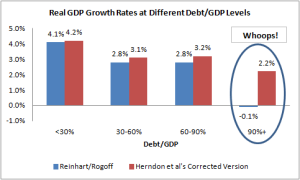 show the statistician’s slight of hand. You can prove just about everything and anything with numbers if you manipulate the data enough. The UMAss-Amherst professor et al has really pulled the curtain away from the big green talking head this time. Here’s the abstract.
Herndon, Ash and Pollin replicate Reinhart and Rogoff and find that coding errors, selective exclusion of available data, and unconventional weighting of summary statistics lead to serious errors that inaccurately represent the relationship between public debt and GDP growth among 20 advanced economies in the post-war period. They find that when properly calculated, the average real GDP growth rate for countries carrying a public-debt-to-GDP ratio of over 90 percent is actually 2.2 percent, not -0:1 percent as published in Reinhart and Rogo ff. That is, contrary to RR, average GDP growth at public debt/GDP ratios over 90 percent is not dramatically different than when debt/GDP ratios are lower.
The authors also show how the relationship between public debt and GDP growth varies significantly by time period and country. Overall, the evidence we review contradicts Reinhart and Rogoff ’s claim to have identified an important stylized fact, that public debt loads greater than 90 percent of GDP consistently reduce GDP growth.
Shorter Abstract: They REALLY screwed the pooch.
So, there’s now this bigger problem out there which is the very serious people that are crashing economies based on a set of very biased assumptions and a very serious coding error. To put that in a more politically correct way: How Much Unemployment Was Caused by Reinhart and Rogoff’s Arithmetic Mistake? Followed by, will the very serious people correct their very serious policy errors now?
This is a big deal because politicians around the world have used this finding from R&R to justify austerity measures that have slowed growth and raised unemployment. In the United States many politicians have pointed to R&R’s work as justification for deficit reduction even though the economy is far below full employment by any reasonable measure. In Europe, R&R’s work and its derivatives have been used to justify austerity policies that have pushed the unemployment rate over 10 percent for the euro zone as a whole and above 20 percent in Greece and Spain. In other words, this is a mistake that has had enormous consequences.
In fairness, there has been other research that makes similar claims, including more recent work by Reinhardt and Rogoff. But it was the initial R&R papers that created the framework for most of the subsequent policy debate. And HAP has shown that the key finding that debt slows growth was driven overwhelmingly by the exclusion of 4 years of data from New Zealand.
If facts mattered in economic policy debates, this should be the cause for a major reassessment of the deficit reduction policies being pursued in the United States and elsewhere. It should also cause reporters to be a bit slower to accept such sweeping claims at face value.
I spent most of Monday’s Morning Reads showing the current US economic data that shows that the deficit and debt of the US are melting like the wicked witch under that bucket of water. I worry any more deficit reduction will throw our economy into recession and pave the way for Republican take over of the Senate. However, the big green talking heads have been ignoring the data and just about everything else that a legion of economists have said citing this one–now clearly known to be flawed–study. As Krugman mentioned in his blogs, their results was counter-intuitive and controversial among economists from day one of publication. Policymakers through out Europe and the US gratuitously ignored all that because the questions did not fit their plan to push the mistakes of banks on a lot of hapless citizenry.
This is literally the most influential article cited in public and policy debates about the importance of debt stabilization, so naturally this is going to change everything.
Or, rather, it will change nothing. As I’ve said many times, citations of the Reinhart/Rogoff result in a policy context obviously appealing to a fallacious form of causal inference. There is an overwhelming theoretical argument that slow real growth will lead to a high debt:GDP ratio and thus whether or not you can construct a dataset showing a correlation between the two tells us absolutely nothing about whether high debt loads lead to small growth. The correct causal inference doesn’t rule out causation in the direction Reinhart and Rogoff believe in, but the kind of empirical study they’ve conducted couldn’t possibly establish it. To give an example from another domain, you might genuinely wonder if short kids are more likely to end up malnourished because they’re not good at fighting for food or something. A study where you conclude that short stature and malnourishment are correlated would give us zero information about this hypothesis, since everyone already knows that malnourishment leads to stunted growth. There might be causation in the other direction as well, but a correlation study woudn’t tell you.
The fact that Reinhart/Rogoff was widely cited despite its huge obvious theoretical problems leads me to confidently predict that the existence of equally huge, albeit more subtle, empirical problems won’t change anything either. As of 2007 there was a widespread belief among elites in the United States and Europe that reductions in retirement benefits were desirable, and subsequent events regarding economic crisis and debt have simply been subsumed into that longstanding view.
The very serious policymakers were looking for any justification for their austerity pogrom. This is mainly because German taxpayers and pols don’t want to be on the hook for what German and US bankers did around the Eurozone. It is also because Republican law makers and their plutocratic overlords–like the Dr. Strangelove of Wall Street Pete Peterson–don’t want any funds floating around anywhere that could possibly find residency in their fee-churning ponzi schemes of investment funds.
It is not unusual, unfortunately, for some academics to neatly choose assumptions to drive results towards their hypothesis. That is why peer review is extremely important. Nearly every major study done using empirical data should be easily replicated. It is usual for the authors to share their database and R&R obliged on this matter. But, this emphasizes why major studies with major findings that don’t fit snugly with the current body of theory should undergo robust challenge. Many economists had challenged the findings back in 2010 and the fact that some felt compelled to repeat their research indicated a healthy level of skepticism which is the hallmark of good research and researchers.
What is most disturbing about this is that agendas that drive the interests of a few start to reflect these theories-in-process. R&R 2010 fit the gross ambitions of people that were less concerned about truth than philosophy and ability to drive policy that basically is at odds with everything we’ve known about fiscal policy. So, this takes us back to Matt’s question. There is incredible discussion on this in nearly all economics and finance blogs and circles. Will these findings engender the same discussion and any course correction of the very serious people that used this very serious paper to do some very serious damage around the world.
I know it’s too much to hear those wonderful words ” We were wrong” on top of some course corrections. But, hey it’s not too late for our President to give up the debt and deficit hysteria or is it?
Monday Reads
Posted: March 4, 2013 Filed under: Austerity, misogyny, morning reads, New Orleans, Violence against women, Women's Rights | Tags: Austerity economics, bywater, Flash Dance, gentrification, Musicals, Richard the Lionheart, violence against women 49 CommentsGood Morning!
A friend of mine of 30 years visited me the last few days so we did some things that I rarely do. This included seeing a Broadway play. We saw  Flashdance the Musical, let me say, in terms of entertainment and music, those are three hours I will never get back, I’m afraid. I even went to the bar during the intermission and got a very large gin and tonic to see me through the second act. It really didn’t help as much as I’d hoped. Some things are better left as chintzy 80s movies. The supplemental songs were completely forgettable! I was trying to forget them as they were being sung. I actually think the last composer worth anything on Broadway was Steven Sondheim and whoever wrote these songs proved me right again.
All the musicals these days have everything but singable songs, I swear! Maybe it’s because I had just seen Bernadette Peters sing Rogers and Hammerstein, Sondheim, and Irvin Berlin songs that still make my heart strings go zing!!! But not even all these splashy dance numbers and a few old 80s hits could juice this show. I’d have gone out to play Angry Birds in the Lobby if I wasn’t sitting in the middle of the row and would’ve rudely awakened my seat prisoners. “Gloria” was included. It’s not an ice skating scene, however, it’s now a tawdry stripper club dance number. The song had to be the worst arranged version I’d ever heard of anything Plus, the Michael Nouri character got morphed into some goody two shoes white male trust fund baby that rescued all the womminz, the blax, and the real working men. Not funny. Skip it if it flashdances into a town near you.
So, I’m getting caught up with things that do intrigue me. That means this post is going to be weird, so sit tight. First up–and you know it was coming–is about the remains of Richard the Lionheart. A group of forensic scientist had at them.
When the English monarch, nicknamed Richard the Lionheart, died in 1199 his heart was embalmed and buried separately from the rest of his body.
Its condition was too poor to reveal the cause of death, but the team was able to rule out a theory that he had been killed by a poisoned arrow. The researchers were also able to find out more about the methods used to preserve his organ. The study is published in the journal Scientific Reports.
The medieval king became known as Richard the Lionheart because of his reputation as a courageous military leader.
He was central to the Third Crusade, fighting against the Muslim leader Saladin. Although he ruled England, he spent much of his time in France, and was killed there after being hit by a crossbow bolt during a siege on a castle.
Richard I’s remains were divided after he died – his heart was buried in a tomb in Rouen. After his death, his body was divided up – a common practice for aristocracy during the Middle Ages. His entrails were buried in Chalus, which is close to Limoges in central France. The rest of his body was entombed further north, in Fontevraud Abbey, but his heart was embalmed and buried in the cathedral of Notre Dame in Rouen.
The remains of his heart – now a grey-brown powder – were locked away in a small lead box, and discovered in the 19th Century during an excavation. But until now, they had not been studied in detail. To find out more, a team of forensic specialists and historians performed a biological analysis
We have been strangling the economic recovery through economic incompetence — and worse is in store because President Obama continues to embrace (1) the self-inflicted wound of austerity, (2) austerity primarily through cuts in vital social programs that are already under-funded, and (3) attacking the safety net by reducing Social Security and Medicare benefits. The latest insanity is the sequester — the fourth act of austerity in the last 20 months. The August 2011 budget deal caused large cuts to social spending. The January 2013 “fiscal cliff” deal increased taxes on the wealthy and ended the moratorium on collecting the full payroll tax. The sequester will be the fourth assault on our already weak economic recovery. We have a jobs crisis in America — not a government spending crisis and the cumulative effect of these four acts of austerity has caused a certainty of weak growth and a serious risk that we will throw our economy back into recession. The Eurozone’s recession — caused by austerity — greatly adds to the risk to our economy because Europe remains our leading trading partner.
President Obama and a host of administration spokespersons have condemned the sequestration, explaining how it will cause catastrophic damage to hundreds of vital government services. Those of us who teach economics, however, always stress “revealed preferences” — it’s not what you say that matters, it’s what you do that matters. Obama has revealed his preference by refusing to sponsor, or even support, a clean bill that would kill the sequestration threat to our nation. Instead, he has nominated Jacob Lew, the author of the sequestration provision, as his principal economic advisor. Lew is one of the strongest proponents of austerity and what he and Obama call the “Grand Bargain” — which would inflict large cuts in social programs and the safety net and some increases in revenues. Obama has made clear that he hopes this Grand Betrayal (my phrase) will be his legacy. Obama and Lew do not want to remove the sequester because they view it as creating the leverage — over progressives — essential to induce them to vote for the Grand Betrayal.
Yes. Grand Betrayal. But, it is what he was planning all along, yes? It’s not like he hasn’t written or talked about it. So, we may not lose what we paid for but it certainly is going to be much watered down by the time the Beltway is done.
I’ve been meaning to read this much discussed article by Ruth Rosen. I’m doing it now and making sure that you didn’t miss it. It was published in Slate last week and is titled: Women’s rights is the longest revolution . It highlights many things in the women’s movement but focuses on one thing that we should never put at the end of our lists of demands; the end to violence against women.
As an activist and historian, I’m still shocked that women activists (myself included) didn’t add violence against women to those three demands back in 1970. Fear of male violence was such a normal part of our lives that it didn’t occur to us to highlight it — not until feminists began, during the 1970s, to publicize the wife-beating that took place behind closed doors and to reveal how many women were raped by strangers, the men they dated, or even their husbands.
Nor did we see how any laws could end it. As Rebecca Solnit wrote in a powerful essay recently, one in five women will be raped during her lifetime and gang rape is pandemic around the world. There are now laws against rape and violence toward women. There is even a U.N. international resolution on the subject. In 1993, the World Conference on Human Rights in Vienna declared that violence against girls and women violated their human rights. After much debate, member nations ratified the resolution and dared to begin calling supposedly time-honored “customs” — wife beating, honor killings, dowry deaths, genital mutilation — what they really are: brutal and gruesome crimes. Now, the nations of the world had a new moral compass for judging one another’s cultures. In this instance, the demands made by global feminists trumped cultural relativism, at least when it involved violence against women.
Still, little enough has changed. Such violence continues to keep women from walking in public spaces. Rape, as feminists have always argued, is a form of social control, meant to make women invisible and shut them in their homes, out of public sight. That’s why activists created “take back the night” protests in the late 1970s. They sought to reclaim the right to public space without fear of rape.
The daytime brutal rape and killing of a 23-year-old in India in early January 2013 prompted the first international protest around violence against women. Maybe that will raise the consciousness of some men. But it’s hard to feel optimistic when you realize how many rapes are still regularly being committed globally.
So, any of you that know me closely know that I’ve been screaming about ‘new’ neighbors and wondering what’s up with my neighborhood. Here’s a great article on my New Orleans Bywater Neighborhood: Gentrification and its Discontents: Notes from New Orleans. The house prices in my neighborhood have skyrocketed. We are now have multiple eateries where arrugala, kale, and things that totally confused my Omaha friend are on the menus. The article really explains what’s been going on around me as we’ve been taken over from by Class 4 hipsters. Here’s the bit about how a neighborhood ‘gentrifies’. You can read more about my neighborhood in particular at the link.
The frontiers of gentrification are “pioneered” by certain social cohorts who settle sequentially, usually over a period of five to
twenty years. The four-phase cycle often begins with—forgive my tongue-in-cheek use of vernacular stereotypes: (1) “gutter punks” (their term), young transients with troubled backgrounds who bitterly reject societal norms and settle, squatter-like, in the roughest neighborhoods bordering bohemian or tourist districts, where they busk or beg in tattered attire.
On their unshod heels come (2) hipsters, who, also fixated upon dissing the mainstream but better educated and obsessively self-aware, see these punk-infused neighborhoods as bastions of coolness.
Their presence generates a certain funky vibe that appeals to the third phase of the gentrification sequence: (3) “bourgeois bohemians,” to use David Brooks’ term. Free-spirited but well-educated and willing to strike a bargain with middle-class normalcy, this group is skillfully employed, buys old houses and lovingly restores them, engages tirelessly in civic affairs, and can reliably be found at the Saturday morning farmers’ market. Usually childless, they often convert doubles to singles, which removes rentable housing stock from the neighborhood even as property values rise and lower-class renters find themselves priced out their own neighborhoods. (Gentrification in New Orleans tends to be more house-based than in northeastern cities, where renovated industrial or commercial buildings dominate the transformation).
After the area attains full-blown “revived” status, the final cohort arrives: (4) bona fide gentry, including lawyers, doctors, moneyed retirees, and alpha-professionals from places like Manhattan or San Francisco. Real estate agents and developers are involved at every phase transition, sometimes leading, sometimes following, always profiting.
Native tenants fare the worst in the process, often finding themselves unable to afford the rising rent and facing eviction. Those who own, however, might experience a windfall, their abodes now worth ten to fifty times more than their grandparents paid. Of the four-phase process, a neighborhood like St. Roch is currently between phases 1 and 2; the Irish Channel is 3-to-4 in the blocks closer to Magazine and 2-to-3 closer to Tchoupitoulas; Bywater is swiftly moving from 2 to 3 to 4; Marigny is nearing 4; and the French Quarter is post-4.
I just refer to them as the barbarian hordes of yupsters, but I guess that’s not the academic term for it. On a bright note, I could never afford my house now and can sell it for a huge amount of money. Actually, I’m not so sure that’s a bright note because now my new neighbors do not like the charm of my slightly run down green house or the fact I prefer low up keep weeds to grass in the alley. Oh, well … I still miss the old coterie of merchant seamen that were drag queens when they got back home, hippies thrown out of the quarter, old people left over from the old days, and section 8 rental denizens. After all, what’s a few seedy people among friends if they’ve got character and a good story to tell over a beer?
So, there’s a little this and that to get you started on a Monday Morning. I didn’t want to depress you with the Sunday Presskateers so, you will just have to hit the Charles Pierce link for that. What’s on your reading and blogging list today?
Gene Sperling: “A mix of entitlements and revenues was part of the DNA” of the Sequester “from the start.”
Posted: February 28, 2013 Filed under: 2012 presidential campaign, Austerity, Barack Obama, Medicaid, Medicare, Social Security, U.S. Economy, U.S. Politics | Tags: Bob Woodward, digby, entitlement cuts, Gene Sperling, Jon Walker, Robert Kuttner, the sequester 38 Comments
Gene Sperling and Barack Obama
I want to call attention to some rather startling statements in Gene Sperling’s e-mail to Bob Woodward, which I posted earlier. Please note the highlighted sections.
From Gene Sperling to Bob Woodward on Feb. 22, 2013
Bob:
I apologize for raising my voice in our conversation today. My bad. I do understand your problems with a couple of our statements in the fall — but feel on the other hand that you focus on a few specific trees that gives a very wrong perception of the forest. But perhaps we will just not see eye to eye here.
But I do truly believe you should rethink your comment about saying saying that Potus asking for revenues is moving the goal post. I know you may not believe this, but as a friend, I think you will regret staking out that claim. The idea that the sequester was to force both sides to go back to try at a big or grand barain with a mix of entitlements and revenues (even if there were serious disagreements on composition) was part of the DNA of the thing from the start. It was an accepted part of the understanding — from the start. Really. It was assumed by the Rs on the Supercommittee that came right after: it was assumed in the November-December 2012 negotiations. There may have been big disagreements over rates and ratios — but that it was supposed to be replaced by entitlements and revenues of some form is not controversial. (Indeed, the discretionary savings amount from the Boehner-Obama negotiations were locked in in BCA: the sequester was just designed to force all back to table on entitlements and revenues.)
I agree there are more than one side to our first disagreement, but again think this latter issue is diffferent. Not out to argue and argue on this latter point. Just my sincere advice. Your call obviously.
My apologies again for raising my voice on the call with you. Feel bad about that and truly apologize.
Gene
Really? Does anyone recall President Obama saying that at the time the sequester was proposed and voted on in 2011? Did President Obama discuss these plans for entitlement cuts during his campaign for re-election? I’ve always suspected he did plan cuts in Social Security, Medicare, but when did he publicly state this? I’ve done a somewhat cursory search, but I can’t find anything.
There is no mention of these agreed-upon cuts in the Wikipedia entry on the Budget Control Act of 2011. There no mention of “entitlement” cuts in this extensive article at The Bipartisan Policy Center. This analysis (pdf) notes that the Supercommittee was authorized to cut Social Security:
The “Super Committee” deficit reduction plan: BCA also creates a new, special joint committee of Congress charged with finding at least $1.2 trillion in deficit reduction to avoid any potential sequestration. This “Super Committee” can cut spending (including Social Security and Medicare), raise revenue, or propose a combination of both. If the committee cannot agree on a plan, or Congress fails to approve it, automatic cuts of $1.2 trillion will be triggered through sequestration. To assist the Super Committee with its task, Congress also provided for an accelerated review of the Super Committee recommendations, provided that the Super Committee followed specific timelines, as outlined in the text.
But I think it was generally assumed that the Super Committee would not be able to agree on anything, and if they did that the Senate at least would not vote for Social Security cuts.
So now the truth has come out. Certainly no one from the White House has come rushing out to deny that cuts in Social Security, Medicare, and Medicaid are what is supposed to balance any new revenue. A few other bloggers have written about this.
Digby is always alert for any mentions of Obama’s seeming obsession with cutting Social Security, and she didn’t miss this one.
I don’t know that anyone’s ever admitted that in public before or that the president was completely, shall we say, honest when he ran for his second term about that specific definition of “a balanced approach”. I haven’t heard anyone say publicly that the sequester “deal” as far as the White House was concerned was to cut “entitlements” in exchange for new revenues. I wonder how many members of congress were aware of this “deal” when they voted for the sequester? The public certainly wasn’t.
I wish I could understand why it is so important to Barack Obama to cut these vital programs before he leaves office. It seems to be his obsession. But there you have it. It’s not just in the DNA of the sequester, it seems to be in the DNA of this White House.
In this sense, it seems that Sperling and Woodward–and by extension Obama–do “see eye to eye.”
At FDL, John Walker gets right to the point in his headline: Sperling: Obama Wanted Sequester to Force Democrats to Accept Entitlement Cuts.
The way Obama has handled basically every manufactured crisis from the debt ceiling, to the Bush tax cuts expiration, to the sequester has been about trying to force both Democrats and Republicans to embrace his version of a “grand bargain.” While it is clear this has been the driving force behind Obama’s decisions, if you pay close attention to his actions is is rare than an administration official will directly admit this. This is actually what I think it most interesting about the recently leaked email exchange between Bob Woodward and Gene Sperling up on Politico…..
Obama wants to cut Social Security and Medicare benefits. Obama also wants to raise taxes, but he only wants to do these unpopular things if he can get bipartisan cover to destroy basic democratic accountability. If everyone is to blame than no one is to blame.
What has sometimes been viewed as incompetence on the part of Obama during negotiations is actually Obama trying to weaken Democrats’ hand to “force” them to accept entitlement cuts while being able to blame it on the mean Republicans.
That is why even now Obama isn’t calling for the sequester to be simply repealed or delayed. Obama still wants to use this manufactured crisis to force congressional Democrats to betray their base by adopting Social Security cuts and get Republicans to accept revenue increases.
Finally, thanks to JJ for sending me the link to this piece by Robert Kuttner at The American Prospect: Dear White House, You’ll Regret This.
[Gene Sperling’s] e-mail is pure confirmation that Obama’s position, dating back to at least 2011, has been to try to trade cuts in Social Security and Medicare for new revenues. It confirms that Sperling and his boss have been channeling the likes of Robert Rubin, Pete Peterson, the corporate-sponsored Fix the Debt campaign, et al., who have been promoting exactly this grand bargain. Sperling confirms that the sequester was designed to force exactly such a dismal deal.
But even worse, writes Kuttner, is what the e-mail demonstrations about Sperling’s–and Obama’s–pathetic negotiating skills.
The Woodward-Sperling exchange is far more interesting for what it reveals about Sperling/Obama’s propensity for giving ground on core issues and getting almost nothing in return. I supposed we should be grateful that Sperling is only wrecking the economy, the Democrats, Social Security, and Medicare—and not negotiating nukes with the Ayatollah.
I’ve said ever since I read The Audacity of Hope back in 2007 that Obama wanted to cut Social Security. Actually, he made it clear in the book that he wanted to privatize it, but he must have realized that wasn’t going to happen. It’s time for those of us who care about these issues to start screaming bloody murder again. We need to get on this ASAP. So tell your friends and call your Congress critters.
The floor is open for discussion.

 peej
peej Carissa
 bostonboomer
 dakinikat
 ecocatwoman
 mablue2
 Mama Lopez
 peggysue22
 quixote
 skydancingguestblogger
 Mona (aka Wonk the Vote)



 Sky Dancing
Recent Comments