“More Oval Office updates” John Buss, @repeat1969, @johnbuss.bsky.social
Good Day, Sky Dancers!
It’s come to the point where I don’t know where to start. There are so many alarming headlines today that it’s difficult to prioritize them. We’re barely 2 months into this regime, and we’re already seeing folks sent to gulags in El Salvador. Mislabelling people as terrorists is the latest tactic. His attacks on Veterans’ Benefits, Social Security, Medicare, Medicaid, and funds for educational programs for disabled and disadvantaged children aren’t going over well. I think he’s decided that overplaying the terrorist card will be the red meat his KKKult needs.
So, today’s Truth Social screed is a warning to anyone picking on poor little Elon Musk and his cars with doors that fall off and engines that explode. He’s the King of “Rapid unscheduled disassembly” (RUD). Does he really think he has this kind of power? Can the courts stop this Evil Moron?
This is from the Daily Beast. “Trump Threatens to Send Tesla Vandals to Prisons in El Salvador. The president also implied attacks on cars were part of a national conspiracy against his megadonor Elon Musk.” We’re already finding his ability to disappear people on the immigration front; now, this? What has happened to Due Process? Does this include toilet papering the car lots? This is reported by Janet Brancolini.
President Donald Trump has joined the chorus of threats from his administration against anyone found guilty of vandalizing Teslas.
“People that get caught sabotaging Teslas will stand a very good chance of going to jail for up to 20 years, and that includes the funders,” Trump wrote in a post on his social media platform Truth Social. “WE ARE LOOKING FOR YOU!!!”
Hours later, he followed up with a second post musing that anyone who damages a Tesla could be deported to El Salvador.
“I look forward to watching the sick terrorist thugs get 20-year jail sentences for what they are doing to Elon Musk and Tesla,” he wrote. “Perhaps they could serve them in the prisons of El Salvador, which have become so recently famous for such lovely conditions!”
Deporting U.S. citizens is unconstitutional, the American Civil Liberties Union told NPR. Even deporting non-citizens to Salvadoran jails, as the administrative has already done, is legally suspect, given the documented human rights abuses that take place there, experts told the outlet.
A 2023 State Department report found that inmates in El Salvador have been electrocuted, tortured, and beaten to death.
The message came after Attorney General Pam Bondi announced that three defendants who had allegedly tried to use Molotov cocktails to light Teslas and charging stations on fire in Oregon, Colorado, and South Carolina were being charged with crimes that carried sentences of five to 20 years in prison.
Those arrests were actually made weeks ago, The New York Times reported, but Bondi appeared to time the announcements in response to a fresh wave of attacks this week. Arsonists in Las Vegas set a row of Teslas ablaze at a service center on Tuesday, and two Cybertrucks went up in flames at a dealership in Kansas City, Missouri, on Monday.
Tesla (TSLA) CEO Elon Musk held an impromptu company all-hands Thursday night, giving an update on the progress of a number of products while also attempting to assuage fears that the CEO is ignoring his post.
Tesla stock has been in free fall since the start of the year, with sales slipping in key regions like Europe and China and even in the US. Though the changeover to the new Model Y SUV has been seen as a drag on sales, Musk’s closeness to President Trump and embrace of right-wing politicians in Europe has seen Musk — and Tesla’s brand — suffer. Protests both in the US and abroad at Tesla showrooms are growing, as are acts of vandalism on Tesla EVs.
After delivering some opening remarks and a few quick updates on Tesla’s milestones, such as 7 million EVs produced and the new Model Y’s status, Musk addressed the elephant in the room: blowback to the Tesla brand from Musk’s foray into politics and leadership of the President Trump’s Department of Government Efficiency (DOGE) initiative.
“If you read the news, it feels like Armageddon. I can’t walk past a TV without seeing a Tesla on fire,” Musk said, referencing protesters setting Tesla vehicles on fire at dealerships and vandalism at Supercharger locations. “I understand if you don’t want to buy our product, but you don’t have to burn it down. That’s a bit unreasonable.”
I’m still laughing (mostly crying) that this is what Musk thinks is Armageddon, and it doesn’t include Veterans, Seniors, and kids with Special Needs not getting the help they need. So, why then does he feel taking away my Social Security that I am entitled to or doing something obscene to the remains of my Student Loans is reasonable?
I accidentally went back to X, and the account I supposedly deleted popped up while trying to read a post. But no worries! Glory of all Glories! They suspended me! Imagine this! I have the power! I have no idea what this is and didn’t bother to look. But I sure am having a delicious laughing fit over it all. Check with the President of El Salvador, Nayib Armando Bukele Ortez, if I disappear! Hey, if I didn’t have a sick, dark sense of humor, I wouldn’t have any sense of humor at all.
Your account, dakinikat, was detected by our systems and automatically suspended for violating the X Rules.
You may not use our services to engage in inauthentic activity that undermines the integrity of X.
Note that if you attempt to evade a suspension by creating new accounts, we will suspend your new accounts. If you wish to appeal this suspension, please contact our support team.
If you have an active X Premium subscription, it will not be automatically canceled by X. To cancel your X Premium subscription, follow these instructions.
I wasn’t aware the X even had integrity. Also, wtf is inauthentic activity? But the weird thing is Tesla stock is on the rise today. Well, it’s not that weird, given the Secretary of Commerce just gave a speech suggesting the KKKult buy the stock since it will never be as cheap as it is now. That White House Car Ad was filmed with the Hype Master FARTUS probably tickled the KKKult’s fancy. Wait, that wasn’t it, according to AXIOS. “Tesla falls after Commerce Secretary recommends buying stock.” This analysis is by Ben Berkowitz
Tesla shares fell early Thursday after Commerce Secretary Howard Lutnick used a TV appearance to urge Americans to buy stock in Elon Musk’s car company.
Why it matters: Cabinet secretaries don’t typically recommend individual stocks, much less those linked to the president’s closest adviser.
His recommendation was potentially overshadowed, though, by one of Tesla’s most fervent defenders on Wall Street calling the company’s situation a “crisis.”
What they’re saying: “I think, if you want to learn something on this show tonight, buy Tesla,” Lutnick said on Fox News Wednesday evening. “It’s unbelievable that this guy’s stock is this cheap. It’ll never be this cheap again.”
“I mean, who wouldn’t invest in Elon Musk? You gotta be kidding me.”
By the numbers: Tesla shares were down about 1.7% in premarket trading Thursday to $231.75.
The stock is down 5% in the last five days, 35% in the last month and 42% so far this year.
“We struggle to think of anything analogous in the history of the automotive industry, in which a brand has lost so much value so quickly,” JPMorgan analyst Ryan Brinkman said in a research note last week.
Between the lines: Lutnick’s comments are part of what has effectively become a Trump administration campaign to defend Tesla.
Amid a wave of “Tesla Takedown” rallies at dealerships nationwide, top administration officials have pledged to investigate protesters for domestic terrorism.
Trump said on Truth Social late Thursday, without elaborating further: “People that get caught sabotaging Teslas will stand a very good chance of going to jail for up to twenty years, and that includes the funders. WE ARE LOOKING FOR YOU!!!”
Of note: Just hours before Lutnick’s comments, Cantor Fitzgerald — the investment bank where he was previously CEO, which is now managed by his sons — upgraded Tesla’s stock.
The intrigue: Lutnick’s recommendation came as one of Wall Street’s most bullish Tesla analysts sounded the alarm on the company’s future.
“Lets call it like it is: Tesla is going through a crisis and there is one person who can fix it….Musk,” Wedbush Securities’ Dan Ives wrote in a research note Wednesday night.
“As someone who is a core bull and believer in the Telsa long term growth story…..I loudly urge Musk and the Board to step up, stop being silent, and help resolve this crisis forming at Tesla,” Ives said.
Well, that ‘of note’ is certainly of note. I’d say this post today is enough to get me permanently banned from X, wouldn’t you? I just hope I get a crown, a sash, and a nice bouquet of flowers. Maybe not; let’s try some more headlines before the fat lady over there sings.
This is fromPolitico. “Elon Musk threatens Pentagon leakers after NYT report on secret China war briefing, “They will be found,” warns U.S. President Donald Trump’s billionaire adviser as White House lashes out at the media.” So, my big question is under what authority can he call out the hounds?
Donald Trump’s top adviser Elon Musk has openly threatened Pentagon employees who may have leaked information that the tech billionaire was due to get a briefing on a potential American war with China.
The story, published by the New York Times on Thursday evening U.S. time, said that — according to anonymous American officials — the Pentagon planned to brief Musk on Friday about the U.S. military’s plan for any war that might break out with China.
After the story went live, the planned meeting was confirmed by Pentagon officials and President Trump — but both denied that the session would discuss military plans involving China.
“China will not even be mentioned or discussed,” Trump wrote in a post on his Truth Social platform. “How disgraceful it is that the discredited media can make up such lies. Anyway, the story is completely untrue!!!”
Trump’s comments were then reposted on X by Musk, who called the New York Times “pure propaganda” and issued a threat, saying he looks “forward to the prosecution of those at the Pentagon who are leaking maliciously false information to NYT.”
“They will be found,” the tech billionaire warned.
The New York Times report that infuriated the White House emphasized that such a briefing by the Pentagon would expand Musk’s already wide-ranging role, and would highlight questions about potential conflicts of interest, as Musk reaches deep into the federal bureaucracy while continuing to run his companies like SpaceX, a major government contractor, and doing business in China.
It’s a tag team! Looks like Linda McMahon has taken them to school! But, wait, she’s trying to dismantle schools. Maybe they went to the woodshed instead for a little tête-à-tête. This is breaking news from the AP. “Live updates: Education Secretary says she plans to ‘unwind’ regulations of department.” Well, she’s sure not the Miss Linda from the New Orleans Romper Room!
President Donald Trumpsigned an executive order Thursday calling for the dismantling of the U.S. Education Department, advancing a campaign promise to take apart an agency that’s been a longtime target of conservatives.
Education Secretary Linda McMahon said on Friday that she is preparing to relocate the department’s core operations to other agencies and roll back federal regulations.
You may hear her describe her “visions” for the DOE at Fox News if you can stomach it. I’d rather read this article from ProPublica. “Parents Sue Trump Administration for Allegedly Sabotaging Education Department’s Civil Rights Division. The lawsuit claims that decimating the agency’s Office for Civil Rights will leave it unable to address issues of discrimination at school — violating the equal protection clause of the Fifth Amendment.” Nothing like another lawsuit to give Pam Bondage something to do.
Saying the Trump administration is sabotaging civil rights enforcement by the Department of Education, a federal lawsuit filed Friday morning seeks to stop the president and Secretary Linda McMahon from carrying out the mass firing of civil rights investigators and lawyers.
Two parents and the Council of Parent Attorneys and Advocates, a national disability rights group, jointly filed the lawsuit. It alleges that decimating the department’s Office for Civil Rights will leave the agency unable to handle the public’s complaints of discrimination at school. That, they said, would violate the equal protection clause of the Fifth Amendment to the U.S. Constitution.
The complaint comes three days after the Education Department notified about 1,300 employees — including the entire staff in seven of the 12 regional civil rights offices — that they are being fired, and the day after a group of 21 Democratic attorneys general sued McMahon and the president. That lawsuit alleges the Trump administration does not have the authority to circumvent Congress to effectively shutter the department.
The complaint filed on Friday argues that the “OCR has abdicated its responsibility to enforce civil rights protections” and that the administration has made a “decision to sabotage” the Education Department’s civil rights functions. That, the lawsuit alleges, overrides Congress’ authority. It names the Education Department, McMahon and the acting head of OCR, Craig Trainor.
“Through a series of press releases, policy statements, and executive orders, the administration has made clear its contempt for the civil rights of marginalized students,” the lawsuit says.
The parents’ lawsuit was filed in U.S. District Court for the District of Columbia. It asks the court to declare the “decimation” of the OCR unlawful and seeks an injunction to compel the office to “process OCR complaints promptly and equitably.”
For once, I’m really happy that this country has way too many lawyers. So, the Democrats in Congress have announced a Whistle Blower site to encourage folks who are or have been Federal Employees to come forward with their stories about DOGE. This is from AXIOS. “Scoop: Democrats open whistleblower portal aimed at DOGE.” This is reported by Stephen Neukam.
enate Democrats are launching a new whistleblower portal for public and private workers to dish on how President Trump and DOGE are slashing the federal government.
Why it matters: Democrats hope whistleblowers will expose what they argue are the White House’s illegal moves to unilaterally dismantle federal agencies and programs.
Democrats say they want to hear from workers who are witnessing how Trump and Elon Musk have withheld funding and fired federal workers without the approval of Congress.
The portal, which launches Friday, is spearheaded by Sen. Jeff Merkley (D-Ore.), whose staff on the Senate Budget Committee will conduct oversight of the new tool.
The big picture: Democrats — who hold minorities in both the House and Senate — have little recourse against Trump’s efforts to downsize the federal government,
But they have launched an anti-DOGE messaging offensive, betting that a sense Trump has overreach by Trump will be unpopular with voters. Polling has shown voters — especially younger ones — are concerned by DOGE’s actions.
And all of the cuts have happened without the approval of Congress, which the Constitution entrusts with the power of the purse. Democrats see the DOGE cuts as an assault on the power of Congress.”The President is not a king, and we will make sure he is held accountable,” Merkley said in a statement.
I guess we’ll see.
Meanwhile, Trump threatens to shut down the Social Security Administration in a pique over a Judge’s decision to block Doge and Elon from going near the Agency. This is from Bloomberg News. “Social Security Says DOGE Ruling Could Force Agency to Shut Down.” Gregory Korte and Zoe Tillman have the story.
The Trump administration is threatening to all but shut down the Social Security Administration in response to a judge’s ruling blocking activities by Elon Musk’s Department of Government Efficiency — an action that could delay payments to millions of beneficiaries caught in the middle of the legal battle.
Acting Social Security Commissioner Leland Dudek said the temporary restraining order issued Thursday is so broad in blocking access to data by “DOGE affiliates” that it could apply to any Social Security employee.
“My anti-fraud team would be DOGE affiliates. My IT staff would be DOGE affiliates,” Dudek said. “As it stands, I will follow it exactly and terminate access by all SSA employees to our IT systems.”
He said he would ask the judge to immediately clarify her order. “Really, I want to turn it off and let the courts figure out how they want to run a federal agency,” he said.
The judge concluded that the unions and the retiree-advocacy group that sued were likely to succeed in arguing that DOGE access to the agency’s systems violated US laws meant to safeguard sensitive information.
The standoff represents a new escalation in the multifront battle between President Donald Trump and the judiciary, potentially putting 73 million Americans who receive old-age or disability benefits in the crossfire.
‘All Legal Remedies’
The White House said Trump would “continue to seek all legal remedies available to ensure the will of the American people goes into effect.”
“In an 134-page decision, a radical leftist-judge ordered Social Security Administration employees not to implement the President’s government-efficiency agenda,” said White House deputy press secretary Harrison Fields. “This is yet another activist judge abusing the judicial system to try and sabotage the President’s attempts to rid the government of waste, fraud, and abuse.”
Courts have previously restricted access by DOGE staffers to sensitive Treasury payment systems until they certify that they’ve received proper clearance and training. But Thursday’s order by US District Judge Ellen Hollander goes even further, forbidding access to any non-anonymized data. She also ordered DOGE staff to delete or purge any Social Security Administration data that it already had in its possession.
“The DOGE Team is essentially engaged in a fishing expedition at SSA, in search of a fraud epidemic, based on little more than suspicion,” Hollander wrote. “It has launched a search for the proverbial needle in the haystack, without any concrete knowledge that the needle is actually in the haystack.”
DOGE is still looking for dead people. If you want to read more about that, you may at the Indian Times. The SSA is more worried about people being erroneously removed. They’ve put up information on their site to help all who may have been prematurely marked by Doge as Dead. CBS Newshas more information here. Kate Gibson has the information. “What Social Security says to do if you’re incorrectly listed as dead.”
More than 3 million deaths are reported to the Social Security Administration each year. Among them, a small portion — less than 10,000 — are erroneous and need to be corrected, according to the agency.
“Our records are highly accurate,” the SSA stated Monday in a blog post following up on an update released Sunday by the SSA on its death record. Of the millions of death reports received by Social Security each year, less than one-third of 1% are incorrect and need to be fixed, it stated.
Still, a person wrongly reported as deceased “can be devastating to the individual, spouse and dependent children,” as benefits are stopped and the process of restoring them can be long and challenging, according to SSA.
The agency’s statements come nearly a month after the new SSA head contradicted claims that tens of millions of dead people over the age of 100 were receiving checks.
Instead, those individuals “are people in our records with a Social Security number who do not have a date of death associated with their record,” said Lee Dudek, the new acting Social Security Administration commissioner who was placed in the role by President Trump, in a Feb. 19 statement. “These individuals are not necessarily receiving benefits,” he said.
So that’s it for me today. I think that’s about all I can stomach.
What’s on your Reading and Blogging list today?Get Over It! An Eagles Shout out to Elon!
Did you like this post? Please share it with your friends:
“Honorable Douche Member.” John Buss, @repeat1968, @johnbuss.bsky.social
Good Day, Sky Dancers!
Once again, the transformation of American democracy into a theocratic fascist state–which once was unimaginable–is shaking global confidence. The closing argument came Friday when #FARTUS and JDank tried to shake down Ukraine’s President like a classic Mafia Don. The US is no longer the leader of the free world. We are becoming the lap dog of evil men.
It was further announced that the dollar will no longer be the world’s currency as the Bad Men of faithless investments are rolling back protections and trying to install the Ponzi scheme of the century–cryptocurrency–as something it can never be. This dodgy investment does not meet any of the criteria that define money. It cannot be used as a universal means of exchange. It has no role as a store of value. Indeed, it is quite a risky gamble. It does not represent a measure of exchange. Help us, Federal Reserve Board of Governors! You may be the only chance because the Treasury’s Rules and Regulations, which were based on stopping another Great Depression, are being dismantled even as we speak.
William Kristol, Andre Egger, and Sam Stein had this headline atThe Bulwarkthat rang true to me this morning. “What a Weekend for Putin! It’s been a long time since the Russian dictator had it this good.” All enemies of the USA and democracy had a good week. All those with greed as a defining characteristic are likely celebrating. I’m certainly glad I moved my 403(B) money to the Eurozone. They were slow coming off COVID-19, but they’re getting stronger while we are getting economically, militarily, and democratically weaker by the drop of every grain of sand.
It was a hell of a weekend for bad men getting what they paid for out of Donald Trump. And while we’ll focus on Vladimir Putin here, we don’t want to fully ignore venture capitalist David Sacks, Donald Trump’s “crypto czar,” who seemingly stands to make bank following Trump’s weekend announcement of a “strategic cryptocurrency reserve.” Hey, we’re glad someone’s having fun. Happy Monday.
Helluva Weekend doesn’t even cover the outrage heard around the country. However, it appears it’s getting a little late in the game to shut down this offensive move on the American Experiment. Just seeing the polling and the angry constituents all over the country over the Zelinsky Shake Down should’ve lit a fire under the proud party of Chicken Hawks. It didn’t. We have more evidence of chickens than hawks. This is also part of The Bulwark’s Monday Money Quarter-backing.
SEE ROGER RUN: How to cope with all the grisly news? One increasingly common strategy: Blowing off some steam by yelling at your Republican lawmaker.
On Saturday, Kansas Sen. Roger Marshall became the latest victim of this hot new trend at an overstuffed town hall in the small town of Oakley (pop. ~2000). Attendees booed his arrival and rolled their eyes at his answers throughout the prickly hour-long event, while Marshall castigated them as “rude.” He suggested they’d fallen victim to “misinformation” about DOGE and ultimately cut the event short.
A possible opportunity for introspection for the senator? Apparently not. In a statement, Marshall’s office suggested the fix was in, the town hall “sabotaged” by “Democrat operatives.” “Real Kansans,” the statement continued, “overwhelmingly support President Trump’s DOGE initiative.”
It was true that some attendees had schlepped to the event from the Kansas City area to give Marshall a piece of their mind. But some of their concerns were plainly shared by locals. The last crowd comment came, according to local media, from local resident Chuck Nunn, who politely and sorrowfully mourned DOGE’s reckless slashing of veteran jobs. Identifying himself as “a dying breed, a conservative Democrat,” Nunn said he supported the mission of identifying waste in government—but that “the way that we are going about it is so wrong, because there are unintended consequences.”
“What the government is doing right now, as far as cutting out those jobs, a huge percentage of those people—and I know you care about the veterans—are veterans,” Nunn went on. “And that’s a damn shame. A damn shame.”
Acting like this sentiment is nothing but scurrilous left-wing astroturf may be comforting to Republicans. But it’s also remarkably short-sighted. There’s a reason “do right by our veterans” has long been a more or less universal tenet of our politics. Scoffing off that extremely normie critique of the DOGEbros is something Republicans do at their peril.
If you think that’s bad, check out the opinions of House Leader Mike Johnson. No Republican has been left out of this party. Heather Cox Richardson has another example of Mike Johnson’s inability to lead or take a stand for our country. He’s staked out the coward’s gavel. She wrote this yesterday in her Substack Letters From an American.
On Face the Nation this morning, Representative Mike Turner (R-OH), a strong supporter of the North Atlantic Treaty Organization (NATO) and Ukraine, contradicted that information. “Considering what I know, what Russia is currently doing against the United States, that would I’m certain not be an accurate statement of the current status of the United States operations,” he said. Well respected on both sides of the aisle, Turner was in line to be the chair of the House Intelligence Committee in this Congress until House speaker Mike Johnson (R-LA) removed him from that slot and from the intelligence committee altogether.
And yet, as Stephanie Kirchgaessner of The Guardian notes, the Trump administration has made clear that it no longer sees Russia as a cybersecurity threat. Last week, at a United Nations working group on cybersecurity, representatives from the European Union and the United Kingdom highlighted threats from Russia, while Liesyl Franz, the State Department’s deputy assistant secretary for international cybersecurity, did not mention Russia, saying the U.S. was concerned about threats from China and Iran.
Kirchgaessner also noted that under Trump, the Cybersecurity and Infrastructure Security Agency (CISA), which monitors cyberthreats against critical infrastructure, has set new priorities. Although Russian threats, especially those against U.S. election systems, were a top priority for the agency in the past, a source told Kirchgaessner that analysts were told not to follow or report on Russian threats.
“Russia and China are ourbiggest adversaries,” the source told Kirchgaessner. “With all the cuts being made to different agencies, a lot of cybersecurity personnel have been fired. Our systems are not going to be protected and our adversaries know this.” “People are saying Russia is winning,” the source said. “Putin is on the inside now.”
Another source noted that “There are dozens of discrete Russia state-sponsored hacker teams dedicated to either producing damage to US government, infrastructure and commercial interests or conducting information theft with a key goal of maintaining persistent access to computer systems.” “Russia is at least on par with China as the most significant cyber threat, the person added. Under those circumstances, the source said, ceasing to follow and report Russian threats is “truly shocking.”
Trump’s outburst in the Oval Office on Friday confirmed that Putin has been his partner in politics since at least 2016. “Putin went through a hell of a lot with me,” Trump said. “He went through a phony witch hunt where they used him and Russia… Russia, Russia, Russia—you ever hear of that deal?—that was a phony Hunter Biden, Joe Biden, scam. Hillary Clinton, shifty Adam Schiff, it was a Democrat scam. And he had to go through that. And he did go through it, and we didn’t end up in a war. And he went through it. He was accused of all that stuff. He had nothing to do with it. It came out of Hunter Biden’s bathroom.”
Putin went through a hell of a lot with Trump? It was an odd statement from a U.S. president, whose loyalty is supposed to be dedicated to the Constitution and the American people.
Jen Ruben writes this at The Contrarian. “It’s not Dickens—it’s the MAGA agenda. Taking food from children; healthcare from the informed.” The #FARTUS team has already destroyed our soft power with the end of USAID. Next up is Medicaid, Medicare, and Social Security. Get your gardens started now! Cruelty is the mission.
Given the scope of the MAGA assault on the foundations of our democracy, many Democrats, responsible media outlets, and concerned Americans have (understandably) been focused on its attempt to obliterate the rule of law, the separation of powers, and the First Amendment. But we should never lose track of the abject immorality that is part and parcel of an ideology based on vengeful victimhood, conspiracy-mongering, and repudiation of science.
From the outbreak of measles to stalling grants to the pursuit of cures for “diseases ranging from heart disease and cancer to Alzheimer’s and allergies” to renewing the starvation crisis in Sudan to devasting cuts at the Veterans Administration to dismissal of patriotic, highly-trained trans members of the armed services…we cannot miss this administration’s abject cruelty; its almost-boisterous disregard for human life and dignity.
House and Senate Republicans bear just as much responsibility as President in Name Only (PINO) Donald Trump and acting president Elon Musk for mutely going along with these actions. Moreover, we must view the House budget as yet another exercise in cruelty and reckless endangerment of human life.
“Trump and Musk have slashed roughly 2,400 VA jobs…A decision that won’t make things more efficient, like they claimed, but will actually lead to longer wait times, more backlog and more chaos for Veterans,” Senator Tammy Duckworth (D-Illinois.) recently said at a virtual town hall. “They’ve also launched a wider purge of federal workers—firing, in total, an estimated 6,000 Veterans, includingthe folks behind the Veterans Crisis Line.” She emphasized, “The only reason they are doing this is to try to find enough loose change behind the couch cushions so that they can give even bigger tax breaks to the rich guys they pal around with on the golf course.”
Breaking the sacred obligation to care for our veterans is only one aspect of the onslaught. Perhaps the most egregious is the plan to slash $880B from Medicaid. The argument that cuts of that magnitude can be achieved by “reform” or by cutting “waste, fraud, and abuse,” frankly, insults our intelligence.
The impact of such cuts is immense given the reach of Medicaid. The Kaiser Family Foundation notes, “Medicaid is the primary program providing comprehensive health and long-term care to one in five people living in the U.S. and accounts for nearly $1 out of every $5 spent on health care.” Medicaid covers not only the poorest Americans, but seniors’ long-term health care, drug addicts, and the disabled. More than 72 million Americans are enrolled in some aspect of the program.
Whatever funds they’ve raised by the deaths and disposal of humanity, they will turn over to Greedy Billionaires and Businesses. However, the focus right now is still on #FARTUS upending World Order. This is from Vox’s Nicole Narea. “How Trump upended the world order, over one weekend A hectic 48 hours in Europe-Ukraine-US-Russia relations, explained.
A blowup at the White House on Friday proved a rude awakening for some of the US’s closest partners in Europe, and left them scrambling to contemplate a world in which they can no longer be sure that the US is a reliable ally in Russia’s war on Ukraine.
And though multiple leaders, from UK Prime Minister Keir Starmer to NATO leader Mark Rutte, insisted that they still view the US as an important partner, the meeting nevertheless seemed like it might mark the abrupt beginning of a new Western world order — one in which Europe stands alone.
The UK and France have led efforts in recent weeks to advance Ukraine’s cause and to convince Trump to keep Ukraine’s (and Europe’s) best interests in mind as he attempts to craft a ceasefire or peace deal in Russia’s years-long war on Ukraine.
Sunday, Starmer presided over a summit of more than a dozen mostly European leaders and announced that the attendees would form a “coalition of the willing” to defend Ukraine and strengthen Europe’s military capabilities.
“Not every nation will feel able to contribute but that can’t mean that we sit back,” Starmer said. “Instead, those willing will intensify planning now with real urgency.”
Starmer did emphasize, however, that many in the group, including the UK, believe lasting peace will not be possible without US support. And while Starmer said he had a productive conversation with Trump about Ukraine this weekend, it’s not clear that US support will materialize.
Impending tariffs on Canada and Mexico risk driving up US car prices by as much as $12,000, further squeezing consumers and wreaking havoc across the intricate web of automotive supply lines spanning the continent.
The cost to build a crossover utility vehicle will rise by at least $4,000, while the increase would be three times that for an electric vehicle examined in a new study from Anderson Economic Group, an automotive consultant in East Lansing, Michigan. And those costs would likely be passed on to consumers, the study found.
“That kind of cost increase will lead directly — and I expect almost immediately — to a decline in sales of the models that have the biggest trade impacts,” Patrick Anderson, chief executive officer of Anderson Economic Group, said in an interview.
These are some more depressing headlines concerning our economy and prices.
From CNN: “Trump’s tariff chaos threatens an economy already flashing yellow lights.”
Layoffs are rising. Consumer spending — the backbone of the economy — unexpectedly dropped in January. Consumer confidence has plunged. A key GDP forecast suddenly turned negative. And extreme fear is back on Wall Street as stocks slide.
Despite the murky picture, President Donald Trump continues to inject chaos into the economy with almost-constant tariff threats.
Starting on Tuesday, Trump has vowed to impose a 25% tariff on imported goods from Mexico and Canada, and to double tariffs on those from China to 20%.
Those tariffs — if they get imposed — could increase costs for Americans at a time when inflation remains stubbornly high. That, in turn, could prevent the Federal Reserve from lowering borrowing costs, another source of pain in the cost-of-living problem confronting consumers.
Mexico and Canada have all vowed to retaliate by slapping their own tariffs on US goods, setting the stage for a potential trade war inside of North America. China has promised to respond to higher tariffs, too.
From the New York Times: “A Key Interest Rate Falls, but Not for the Reasons Trump Wanted. Investors’ increasingly gloomy sentiment about economic growth appears to be driving down the 10-year Treasury yield.” That’s our safe haven investment btw.
President Trump campaigned on a promise to bring down interest rates. And he has fulfilled that pledge in one key way, with U.S. government bond yields falling sharply.
But the reason for the drop is an unnerving one: Investors appear to be more on edge about the outlook for the economy.
Treasury Secretary Scott Bessent has said that the Trump administration considers the 10-year Treasury yield a benchmark of its success in lowering rates. The yield tracks the rate of interest the government pays to borrow from investors over 10 years and has dropped since mid-January, to around 4.2 percent from 4.8 percent. The decline in February was the steepest in several months.
The administration is targeting the 10-year yield because it underpins borrowing costs on mortgages, credit cards, corporate debt and a host of other rates, making it arguably the most important interest rate in the world. As it drops, that should filter through the economy, making many types of debt cheaper.
Unlike the short-term interest rate that is set by the Federal Reserve, the 10-year yield is a market rate, meaning that nobody has direct control over it. Instead, it reflects investors’ views on the economy, inflation, the government’s borrowing needs and changes the Fed may make to its rate in the years ahead.
That’s why the drop in February is troubling, analysts say. It shows, at least in part, that bond investors are growing gloomy about the economic outlook — and quickly.
“The market is pricing a growth scare,” said Blerina Uruci, chief U.S. economist at T. Rowe Price.
A better outcome would be for the declining 10-year yield to reflect slowing inflation, the prospect of more rate cuts by the Fed and a shrinking deficit that would require less government borrowing — all while the economy remains strong.
Instead, inflation expectations have risen this year amid worries that Mr. Trump’s tariff plans, alongside mass deportations, could reignite price increases throughout the economy. Stubborn inflation means the interest rates controlled by the Fed are likely to stay elevated for longer. Some analysts and investors fear that this could weigh on the economy until it cracks and the central bank is pushed into rapidly lowering rates.
So, if you can’t say you’re cutting all these things to end runaway government spending, try not reporting it. That might work, right? This is from the relentlessly brave AP. “The Trump administration may exclude government spending from GDP, obscuring the impact of DOGE cuts.” That way, no one, including economists, can possibly know what is happening. Let’s hope the Federal Reserve can remain independent and report US data if the Labor and Commerce Department can’t.
Commerce Secretary Howard Lutnick said Sunday that government spending could be separated from gross domestic product reports, in response to questions about whether the spending cuts pushed by Elon Musk’s Department of Government Efficiency could possibly cause an economic downturn.
“You know that governments historically have messed with GDP,” Lutnick said on Fox News Channel’s “Sunday Morning Futures.” “They count government spending as part of GDP. So I’m going to separate those two and make it transparent.”
Doing so could potentially complicate or distort a fundamental measure of the U.S. economy’s health. Government spending is traditionally included in the GDP because changes in taxes, spending, deficits and regulations by the government can impact the path of overall growth. GDP reports already include extensive details on government spending, offering a level of transparency for economists.
Musk’s efforts to downsize federal agencies could result in the layoffs of tens of thousands of federal workers, whose lost income could potentially reduce their spending, affecting businesses and the economy at large.
Yahoo Finance, a good place to stalk the markets, has this report on what’s going on as I write. “Stock market today: Dow, S&P 500, Nasdaq slide as Trump tariffs stalk markets.”
US stocks retreated on Monday as a looming deadline fueled uncertainty around President Donald Trump’s tariff plans and investors looked ahead to the monthly jobs report and key retail earnings.
The S&P 500 (^GSPC) fell 0.2% while the tech-heavy Nasdaq Composite (^IXIC) erased early morning gains to fall 0.4%, weighed down by shares of Nvidia (NVDA). The Dow Jones Industrial Average (^DJI) fell below the flat line, as the major US indexes came off a volatile week and a losing February.
Nvidia stock plummeted on Monday as reports surfaced that the tech giant’s AI chips are reaching China despite export controls.
Elsewhere, European leaders’ weekend effort to rally around Ukraine prompted traders to boost bets on a bump in defense spending in the region, lifting related stocks.
It’s a depressing time for us Dismal Scientists. It’s one thing to have something bad happen, like a black swan event, but to watch your own government tank a perfectly healthy economy is tough to watch. I’ve already dropped so many reads that I’m hitting a word count of 3600. I’ll give you a break while I go play a new little game I picked up. It’s a gorgeous little anime game where I’ve just reincarnated as a walking, talking Mushroom, and I can solve everyone’s problems! The bad guy is a fat real estate developer, and the place is inhabited by people with both human and furry animal traits. It’s my new sanctuary beside the Star Wars Series.
I’ve lived here in New Orleans for 30 years now, and this is the first Mardi Gras I’ve just sat out. Somewhat for health problems, as I took another little fall today while walking Temple, and I don’t see the neurologist until next week. It’s tough not trusting your legs. Also, there are MAGAs around town, and many of my friends have reported they’ve destroyed things in the yard and homes if they have any display of having voted for Kamala. This is on all the uptown routes. It’s all just really depressing.
So, you stay very safe, warm, and cozy as we continue this very dark year. XOXO
What’s on your reading and blogging list today?
Did you like this post? Please share it with your friends:
Ten Tesla cybertrucks, painted in camouflage colors with a giant X on each roof, drive noisily through Washington DC. Tires screech. Out jump a couple of dozen young men, dressed in red and black Devil’s Champion armored costumes. After giving Nazi salutes, they grab guns and run to one government departmental after another, calling out slogans like “all power to Supreme Leader Skibidi Hitler.”
And that sort of coup attempt would have failed.
Now imagine that, instead, the scene goes like this.
A couple dozen young men go from government office to government office, dressed in civilian clothes and armed only with zip drives. Using technical jargon and vague references to orders from on high, they gain access to the basic computer systems of the federal government. Having done so, they proceed to grant their Supreme Leader access to information and the power to start and stop all government payments.
In the third decade of the twenty first century, power is more digital than physical. The buildings and the human beings are there to protect the workings of the computers, and thus the workings of the government as a whole, in our case an (in principle) democratic government which is organized and bounded by a notion of individual rights.
The ongoing actions by Musk and his followers are a coup because the individuals seizing power have no right to it. Elon Musk was elected to no office and there is no office that would give him the authority to do what he is doing. It is all illegal. It is also a coup in its intended effects: to undo democratic practice and violate human rights.
In gaining data about us all, Musk has trampled on any notion of privacy and dignity, as well as on the explicit and implicit agreements made with our government when we pay our taxes or our student loans. And the possession of that data enables blackmail and further crimes.
In gaining the ability to stop payments by the Department of the Treasury, Musk would also make democracy meaningless. We vote for representatives in Congress, who pass laws that determine how our tax money is spent. If Musk has the power to halt this process at the level of payment, he can make laws meaningless. Which means, in turn, that Congress is meaningless, and our votes are meaningless, as is our citizenship.
Is it really a coup if it doesn’t feel like one? If your day-to-day life hasn’t changed? Can it be a coup if I can still write posts like this?
What we’ve seen over the last two weeks and accelerating over the weekend looks like a coup, a hostile, undemocratic takeover of government. Merriam-Webster says a coup is “a sudden decisive exercise of force in politics and especially the violent overthrow or alteration of an existing government by a small group.” No violence so far because this is a coup fueled by tech bros, not the military. But we’re watching the alteration of government happen before our eyes.
Historian Ruth Ben-Ghiat calls it “a new kind of coup,” writing in Lucid about Elon Musk’s seeming power sharing with Trump: “And here is where the U.S. 2025 situation starts to look different. The point of personalist rule is to reinforce the strongman. There is only room for one authoritarian leader at the top of the power vertical. Here there are two.” It is unusual, but it is still an effort to use extra-legal, undemocratic practices to radically alter American democracy, undoing the balance of power the Founding Fathers established between the three branches of government by consolidating power in the hands of the presidency as a complacent, Republican-led Congress looks on.
Monday night, Heather Cox Richardson started her nightly column by explaining that if Republicans wanted to do away with the U.S. Agency for International Development (USAID), the federal agency the Trump administration suddenly shuttered over the weekend, they could do that legally. Republicans now control the White House and Congress. There is a 6-3 majority of justices appointed by Republican presidents on the Supreme Court. But instead of doing it lawfully, with Congress passing a bill for Donald Trump to sign, Richardson writes, “They are permitting unelected billionaire Elon Musk, whose investment of $290 million in Trump and other Republican candidates in the 2024 election apparently has bought him freedom to run the government, to override Congress and enact whatever his own policies are by rooting around in government agencies and cancelling those programs that he, personally, dislikes.”
Richardson concluded: “The replacement of our constitutional system of government with the whims of an unelected private citizen is a coup. The U.S. president has no authority to cut programs created and funded by Congress, and a private citizen tapped by a president has even less standing to try anything so radical.”
So, “coup” is the correct way to label the transformation of government we are living through. But with so much continuing normally, it’s easy to doubt what you’re seeing. Even experiencing it from the perspective of historians who understand this moment through the lens of history, it doesn’t seem quite real.
It seems like the plot of a political thriller. We are living through a new kind of coup in which Elon Musk, the richest man in the world, has taken over the payment and other administration systems that allow the American government to function, and has locked out federal employees from computer systems. Many of Musk’s collaborators in this endeavor previously worked for his private companies and/or helped him take over Twitter.
Musk is subject to no Congressional or other oversight because he seems to have no real official function other than as head of the so-called Department of Government Efficiency, a plunder operation that was named after the cryptocurrency DOGE….
What is happening now builds on classic authoritarian dynamics as I described them in Strongmen and in many essays for Lucid. There is always an “inner sanctum” that really runs the show, with its mix of family members and cronies, some with histories of working with or for foreign powers. And there is almost always a purge of the federal bureaucracy. That is now being carried out on a mass scale.
Historian Heather Cox Richardson, former FBI agent Asha Rangappa, former U.S. Attorney Joyce White Vance, and others have analyzed these processes and the interrelated factions that are implementing what I have called a Fascist-style counterrevolution: the MAGA loyalists inside and outside of the GOP, the Project 2025/Heritage Foundation crew (roughly two-thirds of the executive orders Trump has issued conform to Project 2025 plans), and the technocrats around Musk and Peter Thiel.
Vice President J.D. Vance shows the overlap among the categories. Vance is a MAGA loyalist; he wrote the forward to Heritage CEO Kevin Robert’s book Dawn’s Early Light: Taking Back Washington To Save America; and he is the surrogate of Thiel, who bankrolled not only Vance’s Senate race but also his private business ventures.
All of these individuals and groups want to rearrange government around an extremist ideological project of Christian nationalism and White supremacy, and most of them want to enact neoliberal deregulation and privatization meaures to “free” America from “corruption” and “drain the swamp.” This is part of the “revolution” Roberts has long talked about, and it has a history that runs through right-wing dictatorships across a century.
The speed of its implementation makes Trump’s takeover stand out within an authoritarian framework. The more corrupt and criminal the autocrat, the more he is obsessed with punishing enemies and feeling safe. Cue the immediate execution of the revenge and retribution part of this plan, with anyone who was involved in attempts to bring Trump and his collaborators to justice for the Jan. 6 insurrection or anything else, FBI employees included, is now a target.
Attacks on the United States have unfolded much as anticipated, with Donald Trump issuing an overwhelming number of executive orders and provocations, while Elon Musk dismantles the government from the inside out. Frankly, the number of individual actions taking place are too many to count, much less keep up with. Tariffs and market crashes are old news, while capturing Gaza is the latest provocation. Rather than react to everything, we are taking an active stance in monitoring several specific attack vectors. Here’s what we’re monitoring this week.
Neoreactionary Movement and Network State
In addition to Peter Thiel and Elon Musk, the public is beginning to become aware of the names Curtis Yarvin, Nick Land, and Balaji Srinavasan. Those of us watching the rise of extremism in tech circles know these names well, but they have been less well-known to lawmakers. Yarvin seeks to eliminate government where possible and privatize the rest. One of Yarvin’s proposals, called “RAGE” stands for “Retire All Government Employees.” Yarvin is also a monarchist, and Musk sees himself as king. Several of his team of young DOGE engineers are also aligned with Monarchism. Several politicians are being briefed on the Neoreactionary movement and its connections to Musk. The related “Network State” movement led by Srinavasan is also rooted in Neoreactionary philosophy and has been linked to Trump’s efforts to annex Greenland. (See: Meet the Bros Behind Trump’s Greenland Bluster; See: Neoreactionary Movement Memo)
DOGE: Agency ‘Deletions’ and Illegal Activity
Elon Musk has engaged a team of young engineers to attack and shut down the US Agency for International Development (USAID) as well as the National Endowment for Democracy (NED) and 18F, a technology services arm of the General Services Administration. DOGE has also been reported to have altered contracts across multiple agencies (including plans to sell or eliminate real estate holdings), as well as gained direct read-write access to the US Treasury’s payments systems, pushing new code into live production use. This presents a serious security and operational risk to the United States. The House Oversight Committee has voted to subpoena Elon Musk for testimony before the committee.
Project Russia
We have previously reported on Project Russia, the Kremlin’s plans for destroying Western democracies. Musk’s current actions — nullifying the rule of law, bypassing Congress, introducing financial instability — are aligned with prescriptions outlined in Project Russia, which include replacing democracy with a supranational monarchy led by an enlightened prince-king. Project Russia also includes plans to collapse the global economy, especially the dollar. Uncertainty around tariffs along with government shutdown (March 14) and potential US debt default (Q2 2025) pose major national security risks. (See: Project Russia: The Kremlin’s Playbook for Undermining Democracies)
President Trump’s extraordinary assault on the constitutional order is inflicting unimaginable damage on democracy at home, on U.S. national interests abroad, on individual rights, and on the health, safety and welfare of all Americans. It is a full frontal assault on the people and on the government they elected him to run.
What now?
With congressional Republicans in abject subservience to Trump, the only potential constraint on his lawlessness are the federal courts. Emphasis on “potential.” But even if a judiciary stacked with Trump appointees stands tall, it’s critical to understand that the courts alone cannot save us from the constitutional disorder of a sidelined legislative branch over which the executive runs roughshod or of an immunized president who is not only failing to take care that the laws be faithfully executed but is violating the laws on a near-daily basis.
As I’ve emphasized this week, one important measure of how bad things will get is whether Trump begins to ignore court orders. That wouldn’t spell a constitutional crisis only because this already is a constitutional crisis. But it would mean that we’ve well and truly crossed the Rubicon into something that is no longer a democracy, with Trump as an American strongman, even if he continues to prop up some of the trappings of the former republic, like Congress. We may already be there.
Whether the judicial branch serves as a bulwark against Trump’s worst excesses or is merely the next domino to fall will play out over the coming weeks. But even if the judiciary holds the line, it cannot undo all the colossal damage already wreaked by Trump and his billionaire wingman. It can’t fully stop ongoing damage from what has already been done or fully corral future yet-to-be-done damage from a renegade Trump.
While the focus is now shifting to the courts and the dozens of important lawsuits that have been filed in recent days to try to rein in all manner of blatant presidential lawlessness, judges can only do so much. While fighting Trump in the courts is critical and could shape much of the next four years and beyond, it an extremely limited response to the breakdown in the constitutional order that is underway….
FBI agents suing to stop the release of the names of employees involved in the Trump and Jan. 6 prosecutions;
federal employee unions suing over Trump’s bogus deferred retirement offer;
a doctors group suing over the removal of public health data from government websites;
two anonymous federal workers suing to stop Elon Musk’s team from continuing to use an unauthorized server at OPM to send blast emails to everyone in government;
a coalition of labor union suing to block the Musk team from continuing to access sensitive payment systems at Treasury.
This is only a partial list and excludes a whole different category of lawsuits by targets of Trump seeking to vindicate their individual rights, like trans prisoners.
On Friday, Treasury Secretary Scott Bessent reportedly granted aides of Elon Musk access to the department’s payments system, which handles more than $5 trillion and sensitive data on Social Security and Medicare benefits and grants. The system also contains data on government contractors in direct competition with Mr. Musk’s own companies.
It was the latest troubling report of the administration’s interventions into practically every corner of the federal government that also include President Trump’s firing, sidelining and encouraging civil servants to quit.
The full picture of the government overhaul has yet to come into focus, and the contours of Mr. Musk’s role and mission in that transformation remain sketchy. (On Monday, President Trump tried to offer some clarity, saying that “Elon can’t do and won’t do anything without our approval.”)
But the cumulative effect of these stories offers at best a complicated answer to what should be an uncomplicated question: Who exactly is running the federal government?
It’s troubling enough not to be able to answer emphatically with “democratically elected leaders.” Even more troubling is the possibility that the actual answer is Mr. Musk — the world’s richest man — and other unaccountable, unelected, unconfirmed allies cozy with the president.
Political economists have a name for that: state capture. State capture occurs when wealthy private interests influence a government to such a degree that they can freely direct policy decisions and public funds for their own benefit or for the benefit of their ideological fellow travelers (or both).
Revelations of this especially pernicious, widespread form of corruption have occurred in other countries — a striking example occurred in the country of Mr. Musk’s birth, South Africa — and they offer cautionary tales for democratic governments everywhere.
The details vary by context, but the political scientist Elizabeth David-Barrett lays out three general mechanisms of state capture. They now sound familiar: shaping the rules of the game through law and policy; influencing administrative decisions by capturing the budget, appointments, government contracts and regulatory decisions; and disabling checks on power by dismantling accountability structures like the judiciary, law enforcement and prosecution, and audit institutions like the inspectors general and the media.
Some of these strategies could come straight from the Project 2025 playbook or Trump administration executive orders. This should disturb all Americans. According to Ms. David-Barrett, state capture creates broad, long-lasting systemic inequality and diminished public services. Changing the rules of the game to allow such collusion to flourish, she writes, “leaves those few holders of economic power in a strong position to influence future political elites, consolidating their dominance in a self-perpetuating dynamic.”
Needless to say, things haven’t gotten better since Saturday. I watched with sadness, but not surprise, over the last 24 hours as Sen. Susan Collins, who has never hesitated over the last decade to disappoint American democracy, agreed to support Tulsi Gabbard as director of national intelligence, a move sure to undermine American security and erode our standing with allies, and Bill Cassidy — a doctor! a lifelong vaccine advocate! — agreed to support antivax conspiracist RFK Jr. as the head of nation’s health services, overseeing programs he couldn’t even correctly explain at his confirmation hearing.
At the same time, as Elon Musk continues his junta-style takeover of the operations of the federal government, we are watching spreading chaos and the wholesale, illegal, and unconstitutional destruction of the US civil service—arguably not just one of the most important institutions in American life but one of the most important and revered institutions in the entire world, a force of millions of nonpartisan dedicated public servants that has been the backbone of the entire last eighty years of the American Century.
Here’s the challenge and sad truth we face, the challenge this week makes crystal clear:
Today, right now, right here, is the easiest moment to draw the line against Donald Trump. Every day from here, it will get harder — the politics more inevitable, the destruction more irreversible, the sheer waste more costly, the downstream impacts on American life and the world beyond more catastrophic.
The challenge is that fact has also been true every day for the last nine years.
Yet every day for the last nine years, nearly every Republican and every institution in American life in the US has hoped that someone else would be the one to draw the line against Donald Trump.
It would have been easiest for the Republican Party to draw the line against birtherism even before Donald Trump ever ran for president.
Then it would have been next easiest to oppose Trump in 2015 and 2016 in his first presidential primary. It would have been easiest to draw the line after he’d insulting Mexicans in his speech declaring his presidential run, easiest to next the draw the line the following month after he’d insulted John McCain for being a POW, easiest to draw the line in the months that followed the same way that — right or wrong — the Democratic Party actually did against unite against Bernie Sanders in 2020 as it coalesced in the course of 48 hours around Joe Biden.
Yet each of Marco Rubio, Jeb Bush, Rick Perry, John Kasich, Ted Cruz, and the rest each hoped that one of the others would be the leader needed at the time. Had any of them—or all of them—acted then, we might be just wrapping up the end of eight years of the Rubio, Bush, Perry, or Kasich administration, a period of time where hundreds of thousands of extra Americans didn’t have to die because of the mismanaging of the Covid pandemic.
And so on…please read the rest at the Substack link.
I have no commentary to share today, because I have no words. I’m overwhelmed and heartbroken and completely at a loss.
Did you like this post? Please share it with your friends:
“Making Imperialism Great Again.” John (repeat1968) Buss @johnbuss.bsky.social
Good Day, Sky Dancers!
Well, this is the 4th time a Republican Policy has trashed my IRAs/403bs. Reagan in 1987. Dubya in 2007/2008. Trump today and 2020. The one today is completely based on Presidential policy. The others on careless deregulation and fraught banking practices. I saw each one coming.
Over the weekend, I almost pulled an all-nighter researching the futures market and the Treasury system break-in. There is still a flight to the dollar–not freaking bitcoins– so that’s a relief! None of these things are necessary or are in any way leading to anything but mass financial and economic problems in the US and abroad. Why would any group of people want to tank the economy? I think they are trying to bring down the dollar. Instead, their Bitcoin Ponzi scheme forces us all into a risky asset with no value or function. Also, it brings them massive press and public attention. I’m actually now watching for signs of bank runs.
All of this behavior in Fartus and Elonia wreaks of Narcissistic Abuse. They create chaos to gain and regain control. BB can tell you more about this since she has a doctorate in psychology. I’m a dismal scientist who has been quite dismal the last two weeks. I completely expected the implementation of tariffs to tank the markets. It did. FARTUS manufactures chaos. They crave center stage, which is one of the hopes we have. They go after each other. They both want to be the main character in this disaster.
I was watching the Futures market last night, too late into the night, to see what was happening with stocks, Market Indices, and everything that impacted the stock market the next day. BB sent this to me late last night. I agree with pretty much everything in Jonathan V. Last’s analysis provided in The Bulwark. “Follow the Money. The financial markets are the only thing that can stop Trump’s reign of chaos.” It was clear when the markets started tanking today when Trump, Canada, China, and Mexico started setting up that his FARTUS, with his raging Id, needs a crusade of some kind or another. Another good thing is that we haven’t hit any of the exchange’s circuit breakers. That’s when you get a true crash. But it’s early in the week.
Elon Musk’s takeover of federal government infrastructure is ongoing, and at the center of things is a coterie of engineers who are barely out of—and in at least one case, purportedly still in—college. Most have connections to Musk, and at least two have connections to Musk’s longtime associate Peter Thiel, a cofounder and chair of the analytics firm and government contractor Palantir who has long expressed opposition to democracy.
WIRED has identified six young men—all apparently between the ages of 19 and 24, according to public databases, their online presences, and other records—who have little to no government experience and are now playing critical roles in Musk’s so-called Department of Government Efficiency (DOGE) project, tasked by executive order with “modernizing Federal technology and software to maximize governmental efficiency and productivity.” The engineers all hold nebulous job titles within DOGE, and at least one appears to be working as a volunteer.
The engineers are Akash Bobba, Edward Coristine, Luke Farritor, Gautier Cole Killian, Gavin Kliger, and Ethan Shaotran. None have responded to requests for comment from WIRED. Representatives from OPM, GSA, and DOGE did not respond to requests for comment.
The six men are one part of the broader project of Musk allies assuming key government positions. Already, Musk’s lackeys—including more senior staff from xAI, Tesla, and the Boring Company—have taken control of the Office of Personnel Management (OPM) and General Services Administration (GSA), and have gained access to the Treasury Department’s payment system, potentially allowing him access to a vast range of sensitive information about tens of millions of citizens, businesses, and more. On Sunday, CNN reported that DOGE personnel attempted to improperly access classified information and security systems at the US Agency for International Development and that top USAID security officials who thwarted the attempt were subsequently put on leave. The Associated Press reported that DOGE personnel had indeed accessed classified material.
Did I mention that my job managing the TTL and TBond, TBill department of New Orleans Fed required me to go through fingerprinting, a security check, and an interview with some very grim Treasury Agents? All we did was process the stuff from our region and send it to the Treasury Systems using Fed Wire and other systems to the central processing locations. We also checked the local transmission from the business sending their payroll taxes.
In raids reminiscent of the “January 6” Proud Boys attack on the U.S. Capitol four years ago, unelected, unvetted, and without federal government security clearance, the Trump-anointed head of the yet-unapproved Department of Government Efficiency (DOGE) Elon Musk and his henchmen with enormous computing backgrounds are wrecking havoc in government offices with sensitive personal data of all U.S. citizens.
This past week, Musk’s blitzkrieg team gained access to sensitive Treasury data, including Social Security and Medicare customer payment systems. Access to the system is closely held because it includes sensitive personal information about the millions of U.S. citizens who receive Social Security checks, tax refunds, and other payments from the federal government.
The responsibility for ensuring payments are accurate is on individual agencies, not the relatively small staff of civil servants at the Treasury Department’s Office of Fiscal Services, which is responsible for making more than one billion payments per year. The office disbursed more than $5 trillion in fiscal year 2023.
In response to Lebryk’s resignation, Musk responded on February 1 to a post on his social media platform X: “The @DOGE team discovered, among other things, that payment approval officers at Treasury were instructed always to approve payments, even to known fraudulent or terrorist groups. They literally never denied a payment in their entire career. Not even once.”
In Musk and Trump styles, Musk provided NO evidence for his allegation.
Also on Friday, January 31, in hearing of the DOGE raid on the Office of Financial Services, Senator Ron Wyden, the highest-ranking Democrat on the Senate Finance Committee, sent a letter to Trump’s Treasury Secretary Scott Bessent outraged that “officials associated with Musk may have intended to access these payment systems to illegally withhold payments to any number of programs. To put it bluntly, these payment systems simply cannot fail, and any politically motivated meddling in them risks severe damage to our country and the economy.”
Senator Wyden pushed back against DOGE operatives, “”I can think of no good reason why political operators who have demonstrated a blatant disregard for the law would need access to these sensitive, mission-critical systems.”
No matter how many needy people around the world are served by USAID, Elonia says he’s shutting it down- right to the point of stopping funds for a small Lutheran church feeding and sheltering children- and he says FARTUS approves it. How absolutely White Male Christian of them! This is from The Daily Beast as reported by Matt Young.” Remember:
The U.S. Agency for International Development (USAID) is getting the chop, according to Elon Musk.
Musk’s highly anticipated DOGE Spaces debut on X put the rumors to rest after a day of criticism lobbed at the agency, including reports that two top security officials were removed Saturday after refusing to allow DOGE representatives into restricted spaces.
Musk confirmed the administration was in the process of shutting USAID down. “As we dug into USAID it became apparent that what we have here is not an apple with a worm in it, but we have actually just a ball of worms. If you have an apple with a worm in it, you can take the worm out. If you have a whole ball of worms, it’s hopeless,” he said. “USAID is a ball of worms. There is no apple… that is why it’s gotta go. It’s beyond repair.”
Musk had declared earlier on Sunday, “USAID is a criminal organization. Time for it to die.” He continued to take aim at the agency, which has an annual budget of more than $50 billion, with several more posts on his social media platform.
An email sent to staff told them not to come into the office on Monday morning except those with essential on-site duties.
The future of the US government’s main overseas aid agency has been cast into doubt as the Trump administration plans to merge it with the US Department of State after days of upheaval.
The United States Agency for International Development (USAID) would continue its function as an aid agency, but the plan involves a significant reduction in its funding and the workforce, CBS News, the BBC’s US partner, reports.
On Monday, Secretary of State Marco Rubio accused USAID’s leadership of “insubordination” and said he was now its “acting head”.
US President Donald Trump and one of his top advisers, billionaire Elon Musk, have been strongly critical of the agency.
But the move to shut it down could have a profound impact on humanitarian programmes around the world.
The United States Agency for International Development (USAID) was set up in the early 1960s to administer humanitarian aid programmes on behalf of the US government around the world.
It employs around 10,000 people, two-thirds of whom work overseas. It has bases in more than 60 countries and works in dozens of others. However, most of the work on the ground is carried out by other organisations that are contracted and funded by USAID.
The range of activities it undertakes is vast. For example, not only does USAID provide food in countries where people are starving, it also operates the world’s gold standard famine detection system, which uses data analysis to try to predict where shortages are emerging.
Much of USAID’s budget is spent on health programmes, such as offering polio vaccinations in countries where the disease still circulates and helping to stop the spread of viruses which have the potential to cause a pandemic.
The BBC’s international charity BBC Media Action, which is funded by external grants and voluntary contributions, receives some funding from USAID. According to a 2024 report, USAID donated $3.23m (£2.6m), making it the charity’s second-largest donor that financial year.
According to government data, the US spent $68bn (£55bn) on international aid in 2023.
That total is spread across several departments and agencies, but USAID’s budget constitutes more than half of it at around $40bn.
The vast majority of that money is spent in Asia, sub-Saharan Africa and Europe – primarily on humanitarian efforts in Ukraine.
The US is the world’s biggest spender on international development – and by some margin.
To put it into context, the UK is the world’s fourth-largest aid spender. In 2023, it spent £15.3bn – around a quarter of what the US provided.
Democrats have delivered a strong rebuke against the Trump administration’s attempt to gut an agency that provides crucial aid overseas to fund education and fight starvation and disease, calling it illegal, vowing a court fight and lambasting billionaire Elon Musk for wielding so much power in Washington.
Staffers of the U.S. Agency for International Development were instructed to stay out of the agency’s Washington headquarters, and officers blocked the lawmakers from entering the lobby Monday, after Musk announced President Donald Trump had agreed with him to shut the agency.
The fast-moving developments come after thousands of USAID employees already have been laid off and programs shut down in the two weeks since Trump became president. And they show the extraordinary power of Musk and his Department of Government Efficiency in the Trump administration. Musk announced closing of the agency early Monday, as Trump’s secretary of state, Marco Rubio, was out of the country on a trip to Central America.
Trump said shutting down USAID “should have been done a long time ago” and was asked whether he needs Congress to approve such a measure. The president said he did not think so, and accused the Biden administration of fraud, without giving any evidence and only promising a report later on.
“They went totally crazy, what they were doing and the money they were giving to people that shouldn’t be getting it and to agencies and others that shouldn’t be getting it, it was a shame, so a tremendous fraud,” Trump told reporters in the Oval Office on Monday.
Rubio told reporters in San Salvador that he was now the acting administrator of USAID but had delegated his authorities to someone else. The change means that USAID is no longer an independent government agency as it had been for decades — although its new status will likely be challenged in court — and will be run out of the State Department.
He shall have Power, by and with the Advice and Consent of the Senate, to make Treaties, provided two thirds of the Senators present concur; and he shall nominate, and by and with the Advice and Consent of the Senate, shall appoint Ambassadors, other public Ministers and Consuls, Judges of the supreme Court, and all other Officers of the United States, whose Appointments are not herein otherwise provided for, and which shall be established by Law: but the Congress may by Law vest the Appointment of such inferior Officers, as they think proper, in the President alone, in the Courts of Law, or in the Heads of Departments.
The Constitution gives Congress substantial power to establish federal government offices. As an initial matter, the Constitution vests the legislative power in Congress.1 Article I bestows on Congress certain specified, or enumerated, powers.2 The Court has recognized that these powers are supplemented by the Necessary and Proper Clause, which provides Congress with broad power to enact laws that are ‘convenient, or useful’ or ‘conducive’ to [the] beneficial exercise of its more specific authorities.3 The Supreme Court has observed that the Necessary and Proper Clause authorizes Congress to establish federal offices.4 Congress accordingly enjoys broad authority to create government offices to carry out various statutory functions and directives.5 The legislature may establish government offices not expressly mentioned in the Constitution in order to carry out its enumerated powers.6
The Appointments Clause supplies the method of appointment for certain specified officials, but also for other [o]fficers whose positions are established by [l]aw. Although principal officers must be nominated by the President and confirmed by the Senate, Congress may by [l]aw place the appointing power for inferior officers with the President alone, a department head, or a court.7 As this section will explain, the Supreme Court has recognized Congress’s discretion to establish a wide variety of governmental entities in the Executive, Legislative, and Judicial Branches.
Congress’s authority to establish offices is limited by the terms of the Appointments Clause. The structure of federal agencies must comply with the requirement that the President appoint officers, subject to Senate confirmation, although the appointment of inferior officers may rest with the President alone, department heads, or the courts.8 More broadly, the Supreme Court has made clear that the Constitution imposes important limits on Congress’s ability to influence or control the actions of officers once they are appointed. Likewise, it is widely believed that the President must retain a certain amount of independent discretion in selecting officers that Congress may not impede. These principles ensure that the President may fulfill his constitutional duty under Article II to take [c]are that the laws are faithfully executed.9
Alright, I sound like I’m assigning homework and giving lectures again. I don’t mean to. But sometimes you’re just going to need a reference when some stupid person doesn’t know what’s real, what’s constitutional, and what’s totally off the wall.
I think that’s enough for today’s big swallow. I’m off to take care of myself. Please do the same!
What’s on your reading and blogging list today?
To think, like 50 years ago, I was performing this. Where has time gone?
Did you like this post? Please share it with your friends:
The dismantling of the U.S. Government by Elon Musk and Donald Trump is beyond breathtaking. I put Musk’s name first because he appears to be the one who is issuing orders while Trump golfs or rants on social media. I couldn’t possibly discuss the damage in a blog post–there is just too much happening at once. We are watching a fascist takeover in real time. Meanwhile, the Democrats are doing nothing to stop it.
From what I can tell, Trump/Musk have already destroyed the Justice Department and the FBI. Musk has taken control of the Treasury’s computer system that controls all government’s payments, including Social Security. They are working to get rid of as many federal employees as they can, either by firing them or convincing them to quit. They are purging websites of important public information. Soon, Trump plans to install tariffs that will cause serious inflation and damage relationships with our closest allies Canada and Mexico.
One thing I know for sure: this country will never be the same. I only hope we can stop it from becoming a dictatorship. If the Democrats remain supine, it may not be possible.
I’ve long believed that the American media would be more clear-eyed about the rise and return of Donald Trump if it was happening overseas in a foreign country, where we’re used to foreign correspondents writing with more incisive authority. Having watched with growing alarm the developments of the last 24 and 36 hours in Washington, I thought I’d take a stab at just such a dispatch. Here’s a story that should be written this weekend:
February 1, 2025 By William Boot
WASHINGTON, D.C. — What started Thursday as a political purge of the internal security services accelerated Friday into a full-blown coup, as elite technical units aligned with media oligarch Elon Musk moved to seize key systems at the national treasury, block outside access to federal personnel records, and take offline governmental communication networks.
With rapidity that has stunned even longtime political observers, forces loyal to Musk’s junta have established him as the all-but undisputed unelected head of government in just a matter of days, unwinding the longtime democracy’s constitutional system and its proud nearly 250-year-old tradition of the rule of law. Having secured themselves in key ministries and in a building adjacent to the presidential office complex, Musk’s forces have begun issuing directives to civil service workers and forcing the resignation of officials deemed insufficiently loyal, like the head of the country’s aviation authority.
The G-7 country’s newly installed president, a mid-level oligarch named Donald Trump, appeared amid Musk’s moves to be increasingly merely a figurehead head of state. Trump is a convicted felon with a long record of family corruption and returned in power in late January after a four-year interlude promising retribution and retaliation against foreign opponents and a domestic “Deep State.” He had been charged with attempting to overthrow the peaceful transition of power that had previously removed him from office in 2021, but loyalist elements in the judiciary successfully blocked his prosecution and incarceration, easing his return to power.
Over the last two weeks, loyalist presidential factions and Musk-backed teams have launched sweeping, illegal Stalin-esque purges of the national police forces and prosecutors, as well as offices known as inspectors-general, who are typically responsible for investigating government corruption. While official numbers of the unprecedented ousters were kept secret, rumors swirled in the capital that the scores of career officials affected by the initial purges could rise into the thousands as political commissars continued to assess the backgrounds of members of the police forces.
The mentally declining and aging head of state, who has long embraced conspiracist thinking, spent much of the week railing in bizarre public remarks against the country’s oppressed racial and ethnic minorities, whom he blamed without evidence for causing a deadly plane crash across the river from the presidential mansion. Unfounded racist attacks on those minorities have been a key foundation of Trump’s unpredicted rise to political power from a career as a real estate magnate and reality TV host and date back to his first announcement that he would seek the presidency in 2015, when he railed against “rapists” being sent into the country from its southern neighbor.
In one of his first moves upon returning to the presidency, he mobilized far-right paramilitary security forces to begin raids at churches, schools, and workplaces to identify and remove racial minorities, including those who had long lived in harmony with the country’s white Christian majority. He also immediately moved to release from prison some 1,500 supporters who had participated in his unsuccessful 2021 insurrection, including members of violent far-right militias who promptly upon release swore fealty to him in any future civil unrest.
Underscoring his apparent disconnection from reality, reports surfaced that the president had ordered military forces to unleash an environmental catastrophe and flood regions of a separatist province known as California that is led by a high-profile political opponent. The order underscored how the military, which had resisted Trump’s unconstitutional power grabs in his first administration, was now led by a subservient defense minister, a favored TV personality with no experience in management who faced an embarrassing series of allegations about his drunken behavior in the workplace.
The conclusion:
Throughout the week’s fast-moving seizure of power—one that seems increasingly irreversible by the hour—neither loyalist nor opposition parliamentary leaders raised meaningful objection to the new regime or the unraveling of the country’s constitutional system of checks and balances. A few members of the geriatric legislature body offered scattered social media posts condemning the move, but parliament — where both houses are controlled by so-called “MAGA” members handpicked for their loyalty to the president — went home early for the weekend even as Musk’s forces spread through the capital streets.
It was unclear what role, if any, Musk’s forces would allow parliament to have in the new governmental structure by the time it returned to the national assembly known as Capitol Hill.
I hope you’ll read the whole piece at the Substack link.
This story (which Dakinikat posted yesterday) is huge. Now there are new and even more dangerous developments (see additional stories on this below.)
The highest-ranking career official at the Treasury Department left the agency after a clash with allies of billionaire Elon Musk over access to sensitive payment systems, according to three people with knowledge of the matter, who spoke on the condition of anonymity to describe private talks.
David A. Lebryk, who served in nonpolitical roles at Treasury for several decades, announced his retirement Friday in an email to colleagues that was obtained by The Washington Post. President Donald Trump named Lebryk acting secretary upon taking office last week. Lebryk had a dispute with Musk’s surrogates over access to the payment system the U.S. government uses to disburse trillions of dollars every year, the people said. The exact nature of the disagreement was not immediately clear, they said.
By Bettina Baldassari
Officials affiliated with Musk’s “Department of Government Efficiency” have been asking since after the election for access to the system, the people said — requests that were reiterated more recently, including after Trump’s inauguration. Tom Krause, a Silicon Valley executive who has now been detailed to Treasury, is among those involved, the people said. Krause did not respond to requests for comment….
When Scott Bessent was confirmed as treasury secretary on Monday, Lebryk ceased to be the acting agency head. Trump administration officials placed Lebryk on administrative leave before he announced he would step down, two of the people said.
Typically only a small number of career officials control Treasury’s payment systems. Run by the Bureau of the Fiscal Service, the sensitive systems control the flow of more than $6 trillion annually to households, businesses and more nationwide. Tens, if not hundreds, of millions of people across the country rely on the systems, which are responsible for distributing Social Security and Medicare benefits, salaries for federal personnel, payments to government contractors and grant recipients, and tax refunds, among tens of thousands of other functions.
The clash reflects an intensifying battle between Musk and the federal bureaucracy as the Trump administration nears the conclusion of its second week. Musk has sought to exert sweeping control over the inner workings of the U.S. government, installing longtime surrogates at several agencies, including the Office of Personnel Management, which essentially handles federal human resources, and the General Services Administration, which manages real estate. (Musk was seen on Thursday visiting the GSA, according to two other people familiar with his whereabouts, who also spoke on the condition of anonymity to describe internal matters. That visit was first reported by the New York Times.) His Department of Government Efficiency, originally conceived as a nongovernmental panel, has since replaced the U.S. Digital Service.
Aides to Elon Musk charged with running the U.S. government human resources agency have locked career civil servants out of computer systems that contain the personal data of millions of federal employees, according to two agency officials.
Musk, the billionaire Tesla CEO and X owner tasked by Trump to slash the size of the 2.2 million-strong civilian government workforce, has moved swiftly to install allies at the agency known as the Office of Personnel Management.
The two officials, who spoke to Reuters on condition of anonymity for fear of retaliation, said some senior career employees at OPM have had their access revoked to some of the department’s data systems.
The systems include a vast database called Enterprise Human Resources Integration, which contains dates of birth, Social Security numbers, appraisals, home addresses, pay grades and length of service of government workers, the officials said.
“We have no visibility into what they are doing with the computer and data systems,” one of the officials said. “That is creating great concern. There is no oversight. It creates real cybersecurity and hacking implications.”
Officials affected by the move can still log on and access functions such as email but can no longer see the massive datasets that cover every facet of the federal workforce.
President Donald Trump has granted Elon Musk unprecedented power to carry out his war on the “deep state.” The justification for this is supposed to be that the government is corrupted to its core precisely because it is stocked with unelected bureaucrats who are unaccountable to the people.
Musk, goes this story, will employ his fearsome tech wizardry to root them out, restoring not just efficiency to government but also the democratic accountability that “deep state” denizens have snuffed out—supposedly a major cause of many of our social ills.
The startling news that a top Treasury Department official is departing after a dispute with Musk shows how deeply wrong that story truly is—and why it’s actively dangerous. The Washington Postreports that David Lebryk, who has carried out senior nonpolitical roles at the department for decades, is leaving after officials on Musk’s Department of Government Efficiency, or DOGE, sought access to Treasury’s payment system:
Lebryk had a dispute with Musk’s surrogates over access to the payment system the U.S. government uses to disburse trillions of dollars every year, the people said. The exact nature of the disagreement was not immediately clear, they said.
The news raises a complicated question: WTF??? Why is Musk’s DOGE trying to access payment systems inside the Treasury Department? It’s not clear what relevance this would have to his ostensible role, which is to search for savings and inefficiencies in government, not to directly influence whether previously authorized government obligations are honored.
Cliffhanger, by Stefanie Roberti
Another question: Did Trump directly authorize Musk to do this, or did he not? Either answer is bad. If Trump did, he may be authorizing an unelected billionaire to exert unprecedented control over the internal workings of government payment systems. If he did not, then Musk may be going rogue to an even greater extent than we thought….
Former officials I spoke with were at a loss to explain why Musk would want such access. They noted that while we don’t yet know Musk’s motive, the move could potentially give DOGE the power to turn off all kinds of government payments in a targeted way. They said we now must establish if Musk is seeking to carry out what Trump tried via his federal funding freeze: Turn off government payments previously authorized by Congress. The White House rescinded the freeze after a national outcry, but Trump’s spokesperson vowed the hunt for spending to halt will continue. The former officials are asking: Is this Treasury power grab a way to execute that?
“Anybody who would have access to these systems is in a position to turn off funding selectively,” said Michael Linden, a former OMB official who is now director of Families Over Billionaires, a group fighting Trump’s tax cuts for the rich. “The only reason Musk wants to get himself in there must be because he wants to turn some things off.”
Read more at TNR. I got my Social Security check this month. Will I get one in March?
Remember how Elon Musk destroyed Twitter by ripping apart its infrastructure without understanding it? Now imagine that same playbook applied to the federal government. It’s happening, and the stakes are exponentially higher. When reviewing Kate Conger and Ryan Mac’s book “Character Limit” last fall, I highlighted two devastating patterns in Musk’s management: his authoritarian impulse to (sometimes literally) demolish systems without understanding them, and his tendency to replace existing, nuanced solutions with far worse alternatives (even when those older systems probably did require some level of reform). Those same patterns are now threatening the federal government’s basic functions.
Let’s be crystal clear about what’s happening: A private citizen with zero Constitutional authority is effectively seizing control of critical government functions. The Constitution explicitly requires Senate confirmation for anyone wielding significant federal power — a requirement Musk has simply ignored as he installs his loyalists throughout the government while demanding access to basically all of the levers of power, and pushing out anyone who stands in his way.
The parallel to Twitter is striking and terrifying. At Twitter, Musk’s “reform” strategy transformed a platform used by hundreds of millions for vital communication into his personal megaphone, hemorrhaging somewhere between 60-85% of its revenue in the process. But Twitter was just a private company. Now he’s applying the same destructive playbook to the federal government, where the stakes involve not just user experience or advertising dollars, but the basic functioning of American democracy.
The constitutional violations here dwarf the Twitter debacle. Where Musk merely broke a social media platform through incompetence last time, he’s now breaking the actual mechanisms of governance — and doing it with the same reckless playbook that turned Twitter into a ghost town. As Conger and Mac, who documented the Twitter disaster, point out, even the specific tactics are being recycled:
The email landed in employees’ inboxes with the subject line: “Fork in the Road.” The message in the email was stark: Accept a sweeping set of workplace changes or resign.
That was the note that millions of federal employees received around 5 p.m. on Tuesday. It echoed a similar message that thousands of workers at Twitter got from Elon Musk in late 2022 after he bought the company.
[….]
Mr. Musk, who also leads Tesla and SpaceX, has enlisted the help of a team of loyalists to assess agencies and make cuts, the same thing he did during the Twitter takeover.
Steve Davis, the head of Mr. Musk’s tunneling startup, The Boring Company, helped oversee cost-cutting at Twitter and now leads DOGE. Brian Bjelde, a longtime human resources executive at SpaceX who also helped during the Twitter takeover, is now an adviser to the Office of Personnel Management.
Michael Grimes, a top banker at Morgan Stanley who helped lead Mr. Musk’s Twitter acquisition, is expected to take a senior job at the Commerce Department.
One of Mr. Musk’s software engineers at Tesla, Thomas Shedd, was named the head of “Technology Transformation Services” at the General Services Administration, which helps manage federal agencies. Mr. Shedd promptly employed a Musk tactic: asking for proof of engineers’ technical chops.
Mr. Shedd asked for engineers to sign up for sessions in which they could share “a recent individual technical win,” according to an email sent to more than 700 employees on Tuesday night and viewed by The Times.
Elon Musk’s minions—from trusted sidekicks to random college students and former Musk company interns—have taken over the General Services Administration, a critical government agency that manages federal offices and technology. Already, the team is attempting to use White House security credentials to gain unusual access to GSA tech, deploying a suite of new AI software, and recreating the office in X’s image, according to leaked documents obtained by WIRED.
By Otar Imerlishvili
Some of the same people who helped Musk take over Twitter more than two years ago are now registered as official GSA employees. Nicole Hollander, who slept in Twitter HQ as an unofficial member of Musk’s transition team, has high-level agency access and an official government email address, according to documents viewed by WIRED. Hollander’s husband, Steve Davis, also slept in the office. He has now taken on a leading role in Musk’s Department of Government Efficiency (DOGE). Thomas Shedd, the recently installed director of the Technology Transformation Services within GSA, worked as a software engineer at Tesla for eight years. Edward Coristine, who previously interned at Neuralink, has been onboarded along with Ethan Shaotran, a Harvard senior who is developing his own OpenAI-backed scheduling assistant and participated in an xAI hackathon.
“I believe these people do not want to help the federal government provide services to the American people,” says a current GSA employee who asked not to be named, citing fears of retaliation. “They are acting like this is a takeover of a tech company.”
The team appears to be carrying out Musk’s agenda: slashing the federal government as quickly as possible. They’re currently targeting a 50 percent reduction in spending for every office managed by the GSA, according to documents obtained by WIRED.
There also appears to be an effort to use IT credentials from the Executive Office of the President to access GSA laptops and internal GSA infrastructure. Typically, access to agency systems requires workers to be employed at such agencies, sources say. While Musk’s team could be trying to obtain better laptops and equipment from GSA, sources fear that the mandate laid out in the DOGE executive order would grant the body broad access to GSA systems and data. That includes sensitive procurement data, data internal to all the systems and services GSA offers, and internal monitoring software to surveil GSA employees as part of normal auditing and security processes.
The access could give Musk’s proxies the ability to remote into laptops, listen in on meetings, read emails, among many other things, a former Biden official told WIRED on Friday.
At the direction of the Trump administration, the federal Department of Health and Human Services and its agencies are purging its websites of information and data on a broad array of topics — from adolescent health to LGBTQ+ rights to HIV.
Several webpages from Centers for Disease Control and Prevention with references to LGBTQ+ health were no longer available. A page from the HHS Office for Civil Rights outlining the rights of LGBTQ+ people in health care settings was also gone as of Friday. The website of the National Institutes of Health’s Office for Sexual & Gender Minority Research Office disappeared. (Most of these pages could still be viewed through the Internet Archive.)
Another order, signed by Trump, takes aim at “diversity, equity, and inclusion” across the federal government.
On Friday, however, many pages that did not seem related to “gender” or “diversity” had also been taken down, such as AtlasPlus, an interactive tool from CDC with surveillance data on HIV, viral hepatitis, STDs and TB. Also gone missing: a page with basic information about HIV testing. The CDC’s Social Vulnerability Index, a tool that assesses community resilience in the event of natural disaster was also taken down.
“The removal of HIV- and LGBTQ-related resources from the websites of the Centers for Disease Control and Prevention and other health agencies is deeply concerning and creates a dangerous gap in scientific information and data to monitor and respond to disease outbreaks,” the Infectious Disease Society of America said in a statement. “Access to this information is crucial for infectious diseases and HIV health care professionals who care for people with HIV and members of the LGBTQ community and is critical to efforts to end the HIV epidemic.”
One striking example of the vanishing information: The CDC pulled down the website that houses data collected by the nation’s largest monitoring program on health-related behaviors among high schoolers.
Pages related to the CDC’s Division of Adolescent and School Health, which administers the program, were also unavailable.
The Youth Risk Behavior Surveillance System tracks key metrics on nutrition, physical activity, tobacco and drug use, sexual behavior and other areas. The program was created 35 years ago and includes a national survey that researchers rely on to measure how behaviors influence health and design prevention measures.
“It’s the way the nation understands adolescent health,” says Stephen Russell, a sociologist at the University of Texas at Austin who studies adolescent health. “The disappearance of that data is stunning.”
This afternoon, FBI personnel braced for a retaliatory purge of the nation’s premiere law-enforcement agency, as President Donald Trump appeared ready to fire potentially hundreds of agents and officials who’d participated in investigations that led to criminal charges against him.
A team that investigated Trump’s mishandling of classified documents was expected to be fired, four people familiar with the matter said. Trump has long fumed about that investigation, which involved a raid on his Mar-a-Lago estate that turned up hundreds of classified documents he had taken after he left the White House four years ago.
David Sundberg, the head of the FBI’s Washington Field Office, is also being fired, these people added. Sundberg is a career FBI agent with more than two decades of experience, and he oversees some of the bureau’s most sensitive cases related to national security and counterintelligence. Current and former officials told me they are worried that those investigations could stall, at least temporarily, if a large number of agents are suddenly removed. A spokesperson at the Washington Field Office declined to comment.
By Marcella Cooper
Trump’s retribution is not limited to those who investigated him personally. Administration officials are reviewing records to identify FBI personnel who participated in investigations of the January 6 assault on the Capitol by his supporters, people familiar with the matter told me. That could potentially involve hundreds if not thousands of agents, including those who interviewed and investigated rioters who were later prosecuted. Shortly after taking office, Trump pardoned about 1,500 of the rioters and commuted others’ sentences.
There is no precedent for the mass termination of FBI personnel in this fashion. Current and former officials I spoke with had expected Trump to exact retribution for what he sees as unjust and even illegal efforts by the FBI and the Justice Department to investigate his conduct. But they were stunned by the scale of Trump’s anticipated purge, which is taking aim at senior leaders as well as working-level agents who do not set policy but follow the orders of their superiors.
This afternoon, some FBI personnel frantically traded messages and rumors about others believed to be on Trump’s list, including special agents who run field offices across the country and were also involved in investigations of the former president.
Trump’s efforts to root out his supposed enemies might not withstand a legal challenge. FBI agents do not choose the cases assigned to them, and they are protected by civil-service rules. The FBI Agents Association, a nonprofit organization that is not part of the U.S. government, said in a statement that the reports of Trump’s planned purge are “outrageous” and “fundamentally at odds with the law enforcement objectives outlined by President Trump and his support for FBI Agents.”
The mass firings could imperil the nomination of Kash Patel, whom Trump wants to run the FBI in his administration. Just yesterday, Patel had assured senators during his confirmation hearing that the very kinds of politically motivated firings that appear to be in motion would not happen.
This is a genuine emergency. Remember it only took Hitler about a year and a half to establish a dictatorship in Germany. Is anyone working to oppose Trump and Musk? It sure doesn’t seem like it.
Federal government workers have been left “shell-shocked” by the upheaval wreaked by Donald Trump’s return to the presidency amid signs that he is bent on exacting revenge on a bureaucracy he considers to be a “deep state” that previously thwarted and persecuted him.
Since being restored to the White House on 20 January, the president has gone on a revenge spree against high-profile figures who previously served him but earned his enmity by slighting or criticising him in public.
He has cancelled Secret Service protection for three senior national security officials in his first presidency – John Bolton, the former national security adviser; Mike Pompeo, who was CIA director and secretary of state; and Brian Hook, a former assistant secretary of state – even though all are assassination targets on an Iranian government hit list.
The same treatment has been meted out to Anthony Fauci, the infectious diseases expert who angered Trump after joining the White House taskforce tackling Covid-19 and who has also faced death threats.
Trump has also fired high-profile figures from government roles on his social media site and stripped 51 former intelligence officials of their security clearances for doubting reports about Hunter Biden’s laptop as possible Russian disinformation….
“The most common refrain I’m hearing from people who have left but are still talking to people on the inside is: ‘I knew it was going to be bad but I didn’t think it was going to be this bad,’” said Mark Bergman, a veteran Democratic lawyer who has been in contact with some of those who fear being targets of the retribution Trump repeatedly vowed on the campaign trail….
A bit more:
There are ominous signs that the spirit of retribution will continue – or get worse.
Last week, in tactics more redolent of totalitarian regimes the United States has historically been at odds with, federal workers were warned of “adverse consequences” if they failed to report their colleagues who refused to comply with the administration’s purge of diversity, equity and inclusion (DEI) programs, or tried to sustain the programs with coded language.
The Democrats are angry. Well, at least some of them.
For months, party activists have felt bitter about Kamala Harris’s election loss, and incensed at the leaders who first went along with Joe Biden’s decision to run again. They feel fresh outrage each time a new detail is revealed about the then-81-year-old’s enfeeblement and its concealment by the advisers in charge. But right now, what’s making these Democrats angriest is that many of their elected leaders don’t seem angry at all.
By Monika Seidenbusch
“I assumed that we would be prepared to meet the moment, and I was wrong,” Shannon Watts, the founder of the gun-control group Moms Demand Action, told me. “It’s like they’ve shown up to a knife fight with a cheese stick.”
For all the people in Watts’s camp, the party’s response to Donald Trump’s first 12 days in office has been maddening at best and demoralizing at worst. After Trump issued pardons or commutations for the January 6 rioters last week, including the ones who attacked police officers, no immediate chorus of anger came from what is supposed to be the next generation of Democratic talent, including Maryland Governor Wes Moore, California Governor Gavin Newsom, and former Transportation Secretary Pete Buttigieg. Michigan Governor Gretchen Whitmer, another 2028 hopeful, who is on tour selling a young-adult version of her autobiography, has told interviewers, “I am not out looking for fights. I am always looking to collaborate.”
After Trump threatened Colombia with tariffs, House Minority Leader Hakeem Jeffries attempted to reassure the confused and fearful rank and file with the reminder that “God is still on the throne,” which seemed a little like saying, “Jesus, take the wheel.” And people were baffled after the Democratic National Committee responded on X to Trump’s first week in office by channeling a quainter time in American politics and dusting off an Obama-era slogan to accuse him of being “focused on Wall Street—not Main Street.” “Get new material!” one person suggested in the replies, a succinct summary of the other 1,700 comments.
The limp messaging continued this week, after Trump’s administration on Monday issued a federal-funding freeze, including for cancer research and programs such as Meals on Wheels. The next day, Jeffries called for an emergency caucus meeting to hammer out a forceful “three-pronged counter-offensive.” But that emergency meeting would not actually take place until the following afternoon. (By the time lawmakers were dialing in, the White House had already rescinded the order.) Jeffries’s Senate counterpart, Minority Leader Chuck Schumer, scowling over his glasses, offered his own sleepy—and slightly unsettling—assessment of the moment: “I haven’t seen people so aroused in a very, very long time.”
Some Democrats say they are hopeful that a new chair of the DNC, who will be elected today, will give the now-rudderless party a bit of direction—a way to harness all that arousal. The committee leads the party’s fundraising apparatus and coordinates with its sister organizations on Senate and House campaigns. But a chair can’t do much if the party’s own lawmakers aren’t willing to swap out the mozzarella for something a little sharper.
Things are getting really bad and are likely to get worse. Where are the Democrats? Where are the protests in the streets? Is it too late to save democracy?
Did you like this post? Please share it with your friends:
The Sky Dancing banner headline uses a snippet from a work by artist Tashi Mannox called 'Rainbow Study'. The work is described as a" study of typical Tibetan rainbow clouds, that feature in Thanka painting, temple decoration and silk brocades". dakinikat was immediately drawn to the image when trying to find stylized Tibetan Clouds to represent Sky Dancing. It is probably because Tashi's practice is similar to her own. His updated take on the clouds that fill the collection of traditional thankas is quite special.
You can find his work at his website by clicking on his logo below. He is also a calligraphy artist that uses important vajrayana syllables. We encourage you to visit his on line studio.

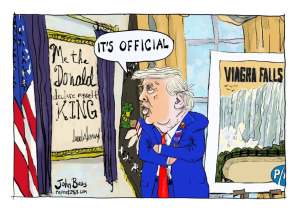
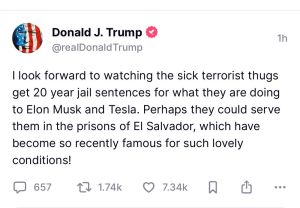 This is from the
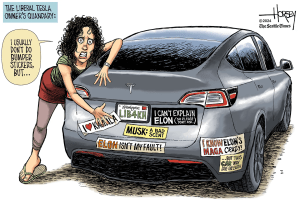 I guess our new AG is a Bondage girl. Owners
 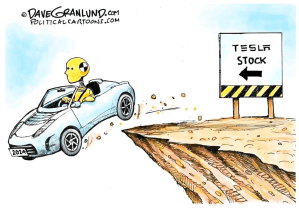 I’m still laughing (mostly crying) that this is what Musk thinks is Armageddon, and it doesn’t include Veterans, Seniors, and kids with Special Needs not getting the help they need. So, why then does he feel taking away my Social Security that I am entitled to or doing something obscene to the remains of my Student Loans is reasonable?
I accidentally went back to X, and the account I supposedly deleted popped up while trying to read a post. But no worries! Glory of all Glories! They suspended me! Imagine this! I have the power! I have no idea what this is and didn’t bother to look. But I sure am having a delicious laughing fit over it all. Check with the President of El Salvador, Nayib Armando Bukele Ortez, if I disappear! Hey, if I didn’t have a sick, dark sense of humor, I wouldn’t have any sense of humor at all.
I’m still laughing (mostly crying) that this is what Musk thinks is Armageddon, and it doesn’t include Veterans, Seniors, and kids with Special Needs not getting the help they need. So, why then does he feel taking away my Social Security that I am entitled to or doing something obscene to the remains of my Student Loans is reasonable?
I accidentally went back to X, and the account I supposedly deleted popped up while trying to read a post. But no worries! Glory of all Glories! They suspended me! Imagine this! I have the power! I have no idea what this is and didn’t bother to look. But I sure am having a delicious laughing fit over it all. Check with the President of El Salvador, Nayib Armando Bukele Ortez, if I disappear! Hey, if I didn’t have a sick, dark sense of humor, I wouldn’t have any sense of humor at all.
 I wasn’t aware the X even had integrity. Also, wtf is inauthentic activity? But the weird thing is Tesla stock is on the rise today. Well, it’s not that weird, given the Secretary of Commerce just gave a speech suggesting the KKKult buy the stock since it will never be as cheap as it is now. That White House Car Ad was filmed with the Hype Master FARTUS probably tickled the KKKult’s fancy. Wait, that wasn’t it, according to
  Well, that ‘of note’ is certainly of note. I’d say this post today is enough to get me permanently banned from X, wouldn’t you? I just hope I get a crown, a sash, and a nice bouquet of flowers. Maybe not; let’s try some more headlines before the fat lady over there sings.
This is from
Well, that ‘of note’ is certainly of note. I’d say this post today is enough to get me permanently banned from X, wouldn’t you? I just hope I get a crown, a sash, and a nice bouquet of flowers. Maybe not; let’s try some more headlines before the fat lady over there sings.
This is from It’s a tag team! Looks like Linda McMahon has taken them to school! But, wait, she’s trying to dismantle schools. Maybe they went to the woodshed instead for a little tête-à-tête. This is breaking news from
  For once, I’m really happy that this country has way too many lawyers. So, the Democrats in Congress have announced a Whistle Blower site to encourage folks who are or have been Federal Employees to come forward with their stories about DOGE. This is from
  I guess we’ll see.
Meanwhile, Trump threatens to shut down the Social Security Administration in a pique over a Judge’s decision to block Doge and Elon from going near the Agency. This is from
I guess we’ll see.
Meanwhile, Trump threatens to shut down the Social Security Administration in a pique over a Judge’s decision to block Doge and Elon from going near the Agency. This is from  DOGE is still looking for dead people. If you want to read more about that, you may at the
 Helluva Weekend doesn’t even cover the outrage heard around the country. However, it appears it’s getting a little late in the game to shut down this offensive move on the American Experiment. Just seeing the polling and the angry constituents all over the country over the Zelinsky Shake Down should’ve lit a fire under the proud party of Chicken Hawks. It didn’t. We have more evidence of chickens than hawks. This is also part of The Bulwark’s Monday Money Quarter-backing.
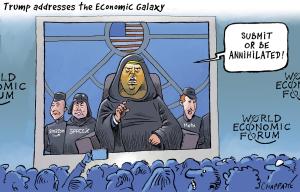 If you think that’s bad, check out the opinions of House Leader Mike Johnson. No Republican has been left out of this party. Heather Cox Richardson has another example of Mike Johnson’s inability to lead or take a stand for our country. He’s staked out the coward’s gavel. She wrote this yesterday in her Substack
  Jen Ruben writes this at
  Whatever funds they’ve raised by the deaths and disposal of humanity, they will turn over to Greedy Billionaires and Businesses. However, the focus right now is still on #FARTUS upending World Order.
  So, I will get to some of the economic impact of Trump’s Tariff Mania. I hope you don’t need a new car, just for starters. This is from
 From the
 So, if you can’t say you’re cutting all these things to end runaway government spending, try not reporting it. That might work, right? This is from the relentlessly brave AP.
  Yahoo Finance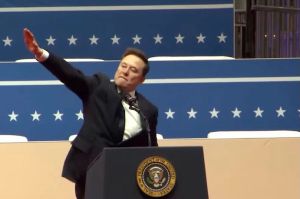
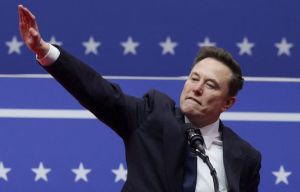

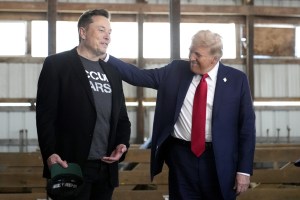

 I was watching the Futures market last night, too late into the night, to see what was happening with stocks, Market Indices, and everything that impacted the stock market the next day. BB sent this to me late last night. I agree with pretty much everything in Jonathan V. Last’s analysis provided in
 No matter how many needy people around the world are served by USAID, Elonia says he’s shutting it down- right to the point of stopping funds for a small Lutheran church feeding and sheltering children- and he says FARTUS approves it. How absolutely White Male Christian of them! This is from The Daily Beast as reported by Matt Young.”
  All my levels of Civics, Political Science, and American History oblige me to recall that part of the US Constitution that gives the power of the purse to the United States Congres. They’ve created the Agency. They’ve funded it. They’ve had sign-offs from Presidents. Who the fuck does he thinks he is?
 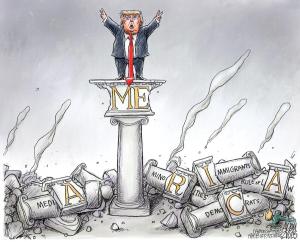 Today, staffers at the Agency were told to stay out. This is from the AP.
  I need to see more than a “strong rebuke” please. He’s just stolen powers given to Congress by the Constitution.






 peej
peej Carissa
 bostonboomer
 dakinikat
 ecocatwoman
 mablue2
 Mama Lopez
 peggysue22
 quixote
 skydancingguestblogger
 Mona (aka Wonk the Vote)



 Sky Dancing
Recent Comments