“Making Imperialism Great Again.” John (repeat1968) Buss @johnbuss.bsky.social
Good Day, Sky Dancers!
Well, this is the 4th time a Republican Policy has trashed my IRAs/403bs. Reagan in 1987. Dubya in 2007/2008. Trump today and 2020. The one today is completely based on Presidential policy. The others on careless deregulation and fraught banking practices. I saw each one coming.
Over the weekend, I almost pulled an all-nighter researching the futures market and the Treasury system break-in. There is still a flight to the dollar–not freaking bitcoins– so that’s a relief! None of these things are necessary or are in any way leading to anything but mass financial and economic problems in the US and abroad. Why would any group of people want to tank the economy? I think they are trying to bring down the dollar. Instead, their Bitcoin Ponzi scheme forces us all into a risky asset with no value or function. Also, it brings them massive press and public attention. I’m actually now watching for signs of bank runs.
All of this behavior in Fartus and Elonia wreaks of Narcissistic Abuse. They create chaos to gain and regain control. BB can tell you more about this since she has a doctorate in psychology. I’m a dismal scientist who has been quite dismal the last two weeks. I completely expected the implementation of tariffs to tank the markets. It did. FARTUS manufactures chaos. They crave center stage, which is one of the hopes we have. They go after each other. They both want to be the main character in this disaster.
I was watching the Futures market last night, too late into the night, to see what was happening with stocks, Market Indices, and everything that impacted the stock market the next day. BB sent this to me late last night. I agree with pretty much everything in Jonathan V. Last’s analysis provided in The Bulwark. “Follow the Money. The financial markets are the only thing that can stop Trump’s reign of chaos.” It was clear when the markets started tanking today when Trump, Canada, China, and Mexico started setting up that his FARTUS, with his raging Id, needs a crusade of some kind or another. Another good thing is that we haven’t hit any of the exchange’s circuit breakers. That’s when you get a true crash. But it’s early in the week.
Elon Musk’s takeover of federal government infrastructure is ongoing, and at the center of things is a coterie of engineers who are barely out of—and in at least one case, purportedly still in—college. Most have connections to Musk, and at least two have connections to Musk’s longtime associate Peter Thiel, a cofounder and chair of the analytics firm and government contractor Palantir who has long expressed opposition to democracy.
WIRED has identified six young men—all apparently between the ages of 19 and 24, according to public databases, their online presences, and other records—who have little to no government experience and are now playing critical roles in Musk’s so-called Department of Government Efficiency (DOGE) project, tasked by executive order with “modernizing Federal technology and software to maximize governmental efficiency and productivity.” The engineers all hold nebulous job titles within DOGE, and at least one appears to be working as a volunteer.
The engineers are Akash Bobba, Edward Coristine, Luke Farritor, Gautier Cole Killian, Gavin Kliger, and Ethan Shaotran. None have responded to requests for comment from WIRED. Representatives from OPM, GSA, and DOGE did not respond to requests for comment.
The six men are one part of the broader project of Musk allies assuming key government positions. Already, Musk’s lackeys—including more senior staff from xAI, Tesla, and the Boring Company—have taken control of the Office of Personnel Management (OPM) and General Services Administration (GSA), and have gained access to the Treasury Department’s payment system, potentially allowing him access to a vast range of sensitive information about tens of millions of citizens, businesses, and more. On Sunday, CNN reported that DOGE personnel attempted to improperly access classified information and security systems at the US Agency for International Development and that top USAID security officials who thwarted the attempt were subsequently put on leave. The Associated Press reported that DOGE personnel had indeed accessed classified material.
Did I mention that my job managing the TTL and TBond, TBill department of New Orleans Fed required me to go through fingerprinting, a security check, and an interview with some very grim Treasury Agents? All we did was process the stuff from our region and send it to the Treasury Systems using Fed Wire and other systems to the central processing locations. We also checked the local transmission from the business sending their payroll taxes.
In raids reminiscent of the “January 6” Proud Boys attack on the U.S. Capitol four years ago, unelected, unvetted, and without federal government security clearance, the Trump-anointed head of the yet-unapproved Department of Government Efficiency (DOGE) Elon Musk and his henchmen with enormous computing backgrounds are wrecking havoc in government offices with sensitive personal data of all U.S. citizens.
This past week, Musk’s blitzkrieg team gained access to sensitive Treasury data, including Social Security and Medicare customer payment systems. Access to the system is closely held because it includes sensitive personal information about the millions of U.S. citizens who receive Social Security checks, tax refunds, and other payments from the federal government.
The responsibility for ensuring payments are accurate is on individual agencies, not the relatively small staff of civil servants at the Treasury Department’s Office of Fiscal Services, which is responsible for making more than one billion payments per year. The office disbursed more than $5 trillion in fiscal year 2023.
In response to Lebryk’s resignation, Musk responded on February 1 to a post on his social media platform X: “The @DOGE team discovered, among other things, that payment approval officers at Treasury were instructed always to approve payments, even to known fraudulent or terrorist groups. They literally never denied a payment in their entire career. Not even once.”
In Musk and Trump styles, Musk provided NO evidence for his allegation.
Also on Friday, January 31, in hearing of the DOGE raid on the Office of Financial Services, Senator Ron Wyden, the highest-ranking Democrat on the Senate Finance Committee, sent a letter to Trump’s Treasury Secretary Scott Bessent outraged that “officials associated with Musk may have intended to access these payment systems to illegally withhold payments to any number of programs. To put it bluntly, these payment systems simply cannot fail, and any politically motivated meddling in them risks severe damage to our country and the economy.”
Senator Wyden pushed back against DOGE operatives, “”I can think of no good reason why political operators who have demonstrated a blatant disregard for the law would need access to these sensitive, mission-critical systems.”
No matter how many needy people around the world are served by USAID, Elonia says he’s shutting it down- right to the point of stopping funds for a small Lutheran church feeding and sheltering children- and he says FARTUS approves it. How absolutely White Male Christian of them! This is from The Daily Beast as reported by Matt Young.” Remember:
The U.S. Agency for International Development (USAID) is getting the chop, according to Elon Musk.
Musk’s highly anticipated DOGE Spaces debut on X put the rumors to rest after a day of criticism lobbed at the agency, including reports that two top security officials were removed Saturday after refusing to allow DOGE representatives into restricted spaces.
Musk confirmed the administration was in the process of shutting USAID down. “As we dug into USAID it became apparent that what we have here is not an apple with a worm in it, but we have actually just a ball of worms. If you have an apple with a worm in it, you can take the worm out. If you have a whole ball of worms, it’s hopeless,” he said. “USAID is a ball of worms. There is no apple… that is why it’s gotta go. It’s beyond repair.”
Musk had declared earlier on Sunday, “USAID is a criminal organization. Time for it to die.” He continued to take aim at the agency, which has an annual budget of more than $50 billion, with several more posts on his social media platform.
An email sent to staff told them not to come into the office on Monday morning except those with essential on-site duties.
The future of the US government’s main overseas aid agency has been cast into doubt as the Trump administration plans to merge it with the US Department of State after days of upheaval.
The United States Agency for International Development (USAID) would continue its function as an aid agency, but the plan involves a significant reduction in its funding and the workforce, CBS News, the BBC’s US partner, reports.
On Monday, Secretary of State Marco Rubio accused USAID’s leadership of “insubordination” and said he was now its “acting head”.
US President Donald Trump and one of his top advisers, billionaire Elon Musk, have been strongly critical of the agency.
But the move to shut it down could have a profound impact on humanitarian programmes around the world.
The United States Agency for International Development (USAID) was set up in the early 1960s to administer humanitarian aid programmes on behalf of the US government around the world.
It employs around 10,000 people, two-thirds of whom work overseas. It has bases in more than 60 countries and works in dozens of others. However, most of the work on the ground is carried out by other organisations that are contracted and funded by USAID.
The range of activities it undertakes is vast. For example, not only does USAID provide food in countries where people are starving, it also operates the world’s gold standard famine detection system, which uses data analysis to try to predict where shortages are emerging.
Much of USAID’s budget is spent on health programmes, such as offering polio vaccinations in countries where the disease still circulates and helping to stop the spread of viruses which have the potential to cause a pandemic.
The BBC’s international charity BBC Media Action, which is funded by external grants and voluntary contributions, receives some funding from USAID. According to a 2024 report, USAID donated $3.23m (£2.6m), making it the charity’s second-largest donor that financial year.
According to government data, the US spent $68bn (£55bn) on international aid in 2023.
That total is spread across several departments and agencies, but USAID’s budget constitutes more than half of it at around $40bn.
The vast majority of that money is spent in Asia, sub-Saharan Africa and Europe – primarily on humanitarian efforts in Ukraine.
The US is the world’s biggest spender on international development – and by some margin.
To put it into context, the UK is the world’s fourth-largest aid spender. In 2023, it spent £15.3bn – around a quarter of what the US provided.
Democrats have delivered a strong rebuke against the Trump administration’s attempt to gut an agency that provides crucial aid overseas to fund education and fight starvation and disease, calling it illegal, vowing a court fight and lambasting billionaire Elon Musk for wielding so much power in Washington.
Staffers of the U.S. Agency for International Development were instructed to stay out of the agency’s Washington headquarters, and officers blocked the lawmakers from entering the lobby Monday, after Musk announced President Donald Trump had agreed with him to shut the agency.
The fast-moving developments come after thousands of USAID employees already have been laid off and programs shut down in the two weeks since Trump became president. And they show the extraordinary power of Musk and his Department of Government Efficiency in the Trump administration. Musk announced closing of the agency early Monday, as Trump’s secretary of state, Marco Rubio, was out of the country on a trip to Central America.
Trump said shutting down USAID “should have been done a long time ago” and was asked whether he needs Congress to approve such a measure. The president said he did not think so, and accused the Biden administration of fraud, without giving any evidence and only promising a report later on.
“They went totally crazy, what they were doing and the money they were giving to people that shouldn’t be getting it and to agencies and others that shouldn’t be getting it, it was a shame, so a tremendous fraud,” Trump told reporters in the Oval Office on Monday.
Rubio told reporters in San Salvador that he was now the acting administrator of USAID but had delegated his authorities to someone else. The change means that USAID is no longer an independent government agency as it had been for decades — although its new status will likely be challenged in court — and will be run out of the State Department.
He shall have Power, by and with the Advice and Consent of the Senate, to make Treaties, provided two thirds of the Senators present concur; and he shall nominate, and by and with the Advice and Consent of the Senate, shall appoint Ambassadors, other public Ministers and Consuls, Judges of the supreme Court, and all other Officers of the United States, whose Appointments are not herein otherwise provided for, and which shall be established by Law: but the Congress may by Law vest the Appointment of such inferior Officers, as they think proper, in the President alone, in the Courts of Law, or in the Heads of Departments.
The Constitution gives Congress substantial power to establish federal government offices. As an initial matter, the Constitution vests the legislative power in Congress.1 Article I bestows on Congress certain specified, or enumerated, powers.2 The Court has recognized that these powers are supplemented by the Necessary and Proper Clause, which provides Congress with broad power to enact laws that are ‘convenient, or useful’ or ‘conducive’ to [the] beneficial exercise of its more specific authorities.3 The Supreme Court has observed that the Necessary and Proper Clause authorizes Congress to establish federal offices.4 Congress accordingly enjoys broad authority to create government offices to carry out various statutory functions and directives.5 The legislature may establish government offices not expressly mentioned in the Constitution in order to carry out its enumerated powers.6
The Appointments Clause supplies the method of appointment for certain specified officials, but also for other [o]fficers whose positions are established by [l]aw. Although principal officers must be nominated by the President and confirmed by the Senate, Congress may by [l]aw place the appointing power for inferior officers with the President alone, a department head, or a court.7 As this section will explain, the Supreme Court has recognized Congress’s discretion to establish a wide variety of governmental entities in the Executive, Legislative, and Judicial Branches.
Congress’s authority to establish offices is limited by the terms of the Appointments Clause. The structure of federal agencies must comply with the requirement that the President appoint officers, subject to Senate confirmation, although the appointment of inferior officers may rest with the President alone, department heads, or the courts.8 More broadly, the Supreme Court has made clear that the Constitution imposes important limits on Congress’s ability to influence or control the actions of officers once they are appointed. Likewise, it is widely believed that the President must retain a certain amount of independent discretion in selecting officers that Congress may not impede. These principles ensure that the President may fulfill his constitutional duty under Article II to take [c]are that the laws are faithfully executed.9
Alright, I sound like I’m assigning homework and giving lectures again. I don’t mean to. But sometimes you’re just going to need a reference when some stupid person doesn’t know what’s real, what’s constitutional, and what’s totally off the wall.
I think that’s enough for today’s big swallow. I’m off to take care of myself. Please do the same!
What’s on your reading and blogging list today?
To think, like 50 years ago, I was performing this. Where has time gone?
Did you like this post? Please share it with your friends:
The dismantling of the U.S. Government by Elon Musk and Donald Trump is beyond breathtaking. I put Musk’s name first because he appears to be the one who is issuing orders while Trump golfs or rants on social media. I couldn’t possibly discuss the damage in a blog post–there is just too much happening at once. We are watching a fascist takeover in real time. Meanwhile, the Democrats are doing nothing to stop it.
From what I can tell, Trump/Musk have already destroyed the Justice Department and the FBI. Musk has taken control of the Treasury’s computer system that controls all government’s payments, including Social Security. They are working to get rid of as many federal employees as they can, either by firing them or convincing them to quit. They are purging websites of important public information. Soon, Trump plans to install tariffs that will cause serious inflation and damage relationships with our closest allies Canada and Mexico.
One thing I know for sure: this country will never be the same. I only hope we can stop it from becoming a dictatorship. If the Democrats remain supine, it may not be possible.
I’ve long believed that the American media would be more clear-eyed about the rise and return of Donald Trump if it was happening overseas in a foreign country, where we’re used to foreign correspondents writing with more incisive authority. Having watched with growing alarm the developments of the last 24 and 36 hours in Washington, I thought I’d take a stab at just such a dispatch. Here’s a story that should be written this weekend:
February 1, 2025 By William Boot
WASHINGTON, D.C. — What started Thursday as a political purge of the internal security services accelerated Friday into a full-blown coup, as elite technical units aligned with media oligarch Elon Musk moved to seize key systems at the national treasury, block outside access to federal personnel records, and take offline governmental communication networks.
With rapidity that has stunned even longtime political observers, forces loyal to Musk’s junta have established him as the all-but undisputed unelected head of government in just a matter of days, unwinding the longtime democracy’s constitutional system and its proud nearly 250-year-old tradition of the rule of law. Having secured themselves in key ministries and in a building adjacent to the presidential office complex, Musk’s forces have begun issuing directives to civil service workers and forcing the resignation of officials deemed insufficiently loyal, like the head of the country’s aviation authority.
The G-7 country’s newly installed president, a mid-level oligarch named Donald Trump, appeared amid Musk’s moves to be increasingly merely a figurehead head of state. Trump is a convicted felon with a long record of family corruption and returned in power in late January after a four-year interlude promising retribution and retaliation against foreign opponents and a domestic “Deep State.” He had been charged with attempting to overthrow the peaceful transition of power that had previously removed him from office in 2021, but loyalist elements in the judiciary successfully blocked his prosecution and incarceration, easing his return to power.
Over the last two weeks, loyalist presidential factions and Musk-backed teams have launched sweeping, illegal Stalin-esque purges of the national police forces and prosecutors, as well as offices known as inspectors-general, who are typically responsible for investigating government corruption. While official numbers of the unprecedented ousters were kept secret, rumors swirled in the capital that the scores of career officials affected by the initial purges could rise into the thousands as political commissars continued to assess the backgrounds of members of the police forces.
The mentally declining and aging head of state, who has long embraced conspiracist thinking, spent much of the week railing in bizarre public remarks against the country’s oppressed racial and ethnic minorities, whom he blamed without evidence for causing a deadly plane crash across the river from the presidential mansion. Unfounded racist attacks on those minorities have been a key foundation of Trump’s unpredicted rise to political power from a career as a real estate magnate and reality TV host and date back to his first announcement that he would seek the presidency in 2015, when he railed against “rapists” being sent into the country from its southern neighbor.
In one of his first moves upon returning to the presidency, he mobilized far-right paramilitary security forces to begin raids at churches, schools, and workplaces to identify and remove racial minorities, including those who had long lived in harmony with the country’s white Christian majority. He also immediately moved to release from prison some 1,500 supporters who had participated in his unsuccessful 2021 insurrection, including members of violent far-right militias who promptly upon release swore fealty to him in any future civil unrest.
Underscoring his apparent disconnection from reality, reports surfaced that the president had ordered military forces to unleash an environmental catastrophe and flood regions of a separatist province known as California that is led by a high-profile political opponent. The order underscored how the military, which had resisted Trump’s unconstitutional power grabs in his first administration, was now led by a subservient defense minister, a favored TV personality with no experience in management who faced an embarrassing series of allegations about his drunken behavior in the workplace.
The conclusion:
Throughout the week’s fast-moving seizure of power—one that seems increasingly irreversible by the hour—neither loyalist nor opposition parliamentary leaders raised meaningful objection to the new regime or the unraveling of the country’s constitutional system of checks and balances. A few members of the geriatric legislature body offered scattered social media posts condemning the move, but parliament — where both houses are controlled by so-called “MAGA” members handpicked for their loyalty to the president — went home early for the weekend even as Musk’s forces spread through the capital streets.
It was unclear what role, if any, Musk’s forces would allow parliament to have in the new governmental structure by the time it returned to the national assembly known as Capitol Hill.
I hope you’ll read the whole piece at the Substack link.
This story (which Dakinikat posted yesterday) is huge. Now there are new and even more dangerous developments (see additional stories on this below.)
The highest-ranking career official at the Treasury Department left the agency after a clash with allies of billionaire Elon Musk over access to sensitive payment systems, according to three people with knowledge of the matter, who spoke on the condition of anonymity to describe private talks.
David A. Lebryk, who served in nonpolitical roles at Treasury for several decades, announced his retirement Friday in an email to colleagues that was obtained by The Washington Post. President Donald Trump named Lebryk acting secretary upon taking office last week. Lebryk had a dispute with Musk’s surrogates over access to the payment system the U.S. government uses to disburse trillions of dollars every year, the people said. The exact nature of the disagreement was not immediately clear, they said.
By Bettina Baldassari
Officials affiliated with Musk’s “Department of Government Efficiency” have been asking since after the election for access to the system, the people said — requests that were reiterated more recently, including after Trump’s inauguration. Tom Krause, a Silicon Valley executive who has now been detailed to Treasury, is among those involved, the people said. Krause did not respond to requests for comment….
When Scott Bessent was confirmed as treasury secretary on Monday, Lebryk ceased to be the acting agency head. Trump administration officials placed Lebryk on administrative leave before he announced he would step down, two of the people said.
Typically only a small number of career officials control Treasury’s payment systems. Run by the Bureau of the Fiscal Service, the sensitive systems control the flow of more than $6 trillion annually to households, businesses and more nationwide. Tens, if not hundreds, of millions of people across the country rely on the systems, which are responsible for distributing Social Security and Medicare benefits, salaries for federal personnel, payments to government contractors and grant recipients, and tax refunds, among tens of thousands of other functions.
The clash reflects an intensifying battle between Musk and the federal bureaucracy as the Trump administration nears the conclusion of its second week. Musk has sought to exert sweeping control over the inner workings of the U.S. government, installing longtime surrogates at several agencies, including the Office of Personnel Management, which essentially handles federal human resources, and the General Services Administration, which manages real estate. (Musk was seen on Thursday visiting the GSA, according to two other people familiar with his whereabouts, who also spoke on the condition of anonymity to describe internal matters. That visit was first reported by the New York Times.) His Department of Government Efficiency, originally conceived as a nongovernmental panel, has since replaced the U.S. Digital Service.
Aides to Elon Musk charged with running the U.S. government human resources agency have locked career civil servants out of computer systems that contain the personal data of millions of federal employees, according to two agency officials.
Musk, the billionaire Tesla CEO and X owner tasked by Trump to slash the size of the 2.2 million-strong civilian government workforce, has moved swiftly to install allies at the agency known as the Office of Personnel Management.
The two officials, who spoke to Reuters on condition of anonymity for fear of retaliation, said some senior career employees at OPM have had their access revoked to some of the department’s data systems.
The systems include a vast database called Enterprise Human Resources Integration, which contains dates of birth, Social Security numbers, appraisals, home addresses, pay grades and length of service of government workers, the officials said.
“We have no visibility into what they are doing with the computer and data systems,” one of the officials said. “That is creating great concern. There is no oversight. It creates real cybersecurity and hacking implications.”
Officials affected by the move can still log on and access functions such as email but can no longer see the massive datasets that cover every facet of the federal workforce.
President Donald Trump has granted Elon Musk unprecedented power to carry out his war on the “deep state.” The justification for this is supposed to be that the government is corrupted to its core precisely because it is stocked with unelected bureaucrats who are unaccountable to the people.
Musk, goes this story, will employ his fearsome tech wizardry to root them out, restoring not just efficiency to government but also the democratic accountability that “deep state” denizens have snuffed out—supposedly a major cause of many of our social ills.
The startling news that a top Treasury Department official is departing after a dispute with Musk shows how deeply wrong that story truly is—and why it’s actively dangerous. The Washington Postreports that David Lebryk, who has carried out senior nonpolitical roles at the department for decades, is leaving after officials on Musk’s Department of Government Efficiency, or DOGE, sought access to Treasury’s payment system:
Lebryk had a dispute with Musk’s surrogates over access to the payment system the U.S. government uses to disburse trillions of dollars every year, the people said. The exact nature of the disagreement was not immediately clear, they said.
The news raises a complicated question: WTF??? Why is Musk’s DOGE trying to access payment systems inside the Treasury Department? It’s not clear what relevance this would have to his ostensible role, which is to search for savings and inefficiencies in government, not to directly influence whether previously authorized government obligations are honored.
Cliffhanger, by Stefanie Roberti
Another question: Did Trump directly authorize Musk to do this, or did he not? Either answer is bad. If Trump did, he may be authorizing an unelected billionaire to exert unprecedented control over the internal workings of government payment systems. If he did not, then Musk may be going rogue to an even greater extent than we thought….
Former officials I spoke with were at a loss to explain why Musk would want such access. They noted that while we don’t yet know Musk’s motive, the move could potentially give DOGE the power to turn off all kinds of government payments in a targeted way. They said we now must establish if Musk is seeking to carry out what Trump tried via his federal funding freeze: Turn off government payments previously authorized by Congress. The White House rescinded the freeze after a national outcry, but Trump’s spokesperson vowed the hunt for spending to halt will continue. The former officials are asking: Is this Treasury power grab a way to execute that?
“Anybody who would have access to these systems is in a position to turn off funding selectively,” said Michael Linden, a former OMB official who is now director of Families Over Billionaires, a group fighting Trump’s tax cuts for the rich. “The only reason Musk wants to get himself in there must be because he wants to turn some things off.”
Read more at TNR. I got my Social Security check this month. Will I get one in March?
Remember how Elon Musk destroyed Twitter by ripping apart its infrastructure without understanding it? Now imagine that same playbook applied to the federal government. It’s happening, and the stakes are exponentially higher. When reviewing Kate Conger and Ryan Mac’s book “Character Limit” last fall, I highlighted two devastating patterns in Musk’s management: his authoritarian impulse to (sometimes literally) demolish systems without understanding them, and his tendency to replace existing, nuanced solutions with far worse alternatives (even when those older systems probably did require some level of reform). Those same patterns are now threatening the federal government’s basic functions.
Let’s be crystal clear about what’s happening: A private citizen with zero Constitutional authority is effectively seizing control of critical government functions. The Constitution explicitly requires Senate confirmation for anyone wielding significant federal power — a requirement Musk has simply ignored as he installs his loyalists throughout the government while demanding access to basically all of the levers of power, and pushing out anyone who stands in his way.
The parallel to Twitter is striking and terrifying. At Twitter, Musk’s “reform” strategy transformed a platform used by hundreds of millions for vital communication into his personal megaphone, hemorrhaging somewhere between 60-85% of its revenue in the process. But Twitter was just a private company. Now he’s applying the same destructive playbook to the federal government, where the stakes involve not just user experience or advertising dollars, but the basic functioning of American democracy.
The constitutional violations here dwarf the Twitter debacle. Where Musk merely broke a social media platform through incompetence last time, he’s now breaking the actual mechanisms of governance — and doing it with the same reckless playbook that turned Twitter into a ghost town. As Conger and Mac, who documented the Twitter disaster, point out, even the specific tactics are being recycled:
The email landed in employees’ inboxes with the subject line: “Fork in the Road.” The message in the email was stark: Accept a sweeping set of workplace changes or resign.
That was the note that millions of federal employees received around 5 p.m. on Tuesday. It echoed a similar message that thousands of workers at Twitter got from Elon Musk in late 2022 after he bought the company.
[….]
Mr. Musk, who also leads Tesla and SpaceX, has enlisted the help of a team of loyalists to assess agencies and make cuts, the same thing he did during the Twitter takeover.
Steve Davis, the head of Mr. Musk’s tunneling startup, The Boring Company, helped oversee cost-cutting at Twitter and now leads DOGE. Brian Bjelde, a longtime human resources executive at SpaceX who also helped during the Twitter takeover, is now an adviser to the Office of Personnel Management.
Michael Grimes, a top banker at Morgan Stanley who helped lead Mr. Musk’s Twitter acquisition, is expected to take a senior job at the Commerce Department.
One of Mr. Musk’s software engineers at Tesla, Thomas Shedd, was named the head of “Technology Transformation Services” at the General Services Administration, which helps manage federal agencies. Mr. Shedd promptly employed a Musk tactic: asking for proof of engineers’ technical chops.
Mr. Shedd asked for engineers to sign up for sessions in which they could share “a recent individual technical win,” according to an email sent to more than 700 employees on Tuesday night and viewed by The Times.
Elon Musk’s minions—from trusted sidekicks to random college students and former Musk company interns—have taken over the General Services Administration, a critical government agency that manages federal offices and technology. Already, the team is attempting to use White House security credentials to gain unusual access to GSA tech, deploying a suite of new AI software, and recreating the office in X’s image, according to leaked documents obtained by WIRED.
By Otar Imerlishvili
Some of the same people who helped Musk take over Twitter more than two years ago are now registered as official GSA employees. Nicole Hollander, who slept in Twitter HQ as an unofficial member of Musk’s transition team, has high-level agency access and an official government email address, according to documents viewed by WIRED. Hollander’s husband, Steve Davis, also slept in the office. He has now taken on a leading role in Musk’s Department of Government Efficiency (DOGE). Thomas Shedd, the recently installed director of the Technology Transformation Services within GSA, worked as a software engineer at Tesla for eight years. Edward Coristine, who previously interned at Neuralink, has been onboarded along with Ethan Shaotran, a Harvard senior who is developing his own OpenAI-backed scheduling assistant and participated in an xAI hackathon.
“I believe these people do not want to help the federal government provide services to the American people,” says a current GSA employee who asked not to be named, citing fears of retaliation. “They are acting like this is a takeover of a tech company.”
The team appears to be carrying out Musk’s agenda: slashing the federal government as quickly as possible. They’re currently targeting a 50 percent reduction in spending for every office managed by the GSA, according to documents obtained by WIRED.
There also appears to be an effort to use IT credentials from the Executive Office of the President to access GSA laptops and internal GSA infrastructure. Typically, access to agency systems requires workers to be employed at such agencies, sources say. While Musk’s team could be trying to obtain better laptops and equipment from GSA, sources fear that the mandate laid out in the DOGE executive order would grant the body broad access to GSA systems and data. That includes sensitive procurement data, data internal to all the systems and services GSA offers, and internal monitoring software to surveil GSA employees as part of normal auditing and security processes.
The access could give Musk’s proxies the ability to remote into laptops, listen in on meetings, read emails, among many other things, a former Biden official told WIRED on Friday.
At the direction of the Trump administration, the federal Department of Health and Human Services and its agencies are purging its websites of information and data on a broad array of topics — from adolescent health to LGBTQ+ rights to HIV.
Several webpages from Centers for Disease Control and Prevention with references to LGBTQ+ health were no longer available. A page from the HHS Office for Civil Rights outlining the rights of LGBTQ+ people in health care settings was also gone as of Friday. The website of the National Institutes of Health’s Office for Sexual & Gender Minority Research Office disappeared. (Most of these pages could still be viewed through the Internet Archive.)
Another order, signed by Trump, takes aim at “diversity, equity, and inclusion” across the federal government.
On Friday, however, many pages that did not seem related to “gender” or “diversity” had also been taken down, such as AtlasPlus, an interactive tool from CDC with surveillance data on HIV, viral hepatitis, STDs and TB. Also gone missing: a page with basic information about HIV testing. The CDC’s Social Vulnerability Index, a tool that assesses community resilience in the event of natural disaster was also taken down.
“The removal of HIV- and LGBTQ-related resources from the websites of the Centers for Disease Control and Prevention and other health agencies is deeply concerning and creates a dangerous gap in scientific information and data to monitor and respond to disease outbreaks,” the Infectious Disease Society of America said in a statement. “Access to this information is crucial for infectious diseases and HIV health care professionals who care for people with HIV and members of the LGBTQ community and is critical to efforts to end the HIV epidemic.”
One striking example of the vanishing information: The CDC pulled down the website that houses data collected by the nation’s largest monitoring program on health-related behaviors among high schoolers.
Pages related to the CDC’s Division of Adolescent and School Health, which administers the program, were also unavailable.
The Youth Risk Behavior Surveillance System tracks key metrics on nutrition, physical activity, tobacco and drug use, sexual behavior and other areas. The program was created 35 years ago and includes a national survey that researchers rely on to measure how behaviors influence health and design prevention measures.
“It’s the way the nation understands adolescent health,” says Stephen Russell, a sociologist at the University of Texas at Austin who studies adolescent health. “The disappearance of that data is stunning.”
This afternoon, FBI personnel braced for a retaliatory purge of the nation’s premiere law-enforcement agency, as President Donald Trump appeared ready to fire potentially hundreds of agents and officials who’d participated in investigations that led to criminal charges against him.
A team that investigated Trump’s mishandling of classified documents was expected to be fired, four people familiar with the matter said. Trump has long fumed about that investigation, which involved a raid on his Mar-a-Lago estate that turned up hundreds of classified documents he had taken after he left the White House four years ago.
David Sundberg, the head of the FBI’s Washington Field Office, is also being fired, these people added. Sundberg is a career FBI agent with more than two decades of experience, and he oversees some of the bureau’s most sensitive cases related to national security and counterintelligence. Current and former officials told me they are worried that those investigations could stall, at least temporarily, if a large number of agents are suddenly removed. A spokesperson at the Washington Field Office declined to comment.
By Marcella Cooper
Trump’s retribution is not limited to those who investigated him personally. Administration officials are reviewing records to identify FBI personnel who participated in investigations of the January 6 assault on the Capitol by his supporters, people familiar with the matter told me. That could potentially involve hundreds if not thousands of agents, including those who interviewed and investigated rioters who were later prosecuted. Shortly after taking office, Trump pardoned about 1,500 of the rioters and commuted others’ sentences.
There is no precedent for the mass termination of FBI personnel in this fashion. Current and former officials I spoke with had expected Trump to exact retribution for what he sees as unjust and even illegal efforts by the FBI and the Justice Department to investigate his conduct. But they were stunned by the scale of Trump’s anticipated purge, which is taking aim at senior leaders as well as working-level agents who do not set policy but follow the orders of their superiors.
This afternoon, some FBI personnel frantically traded messages and rumors about others believed to be on Trump’s list, including special agents who run field offices across the country and were also involved in investigations of the former president.
Trump’s efforts to root out his supposed enemies might not withstand a legal challenge. FBI agents do not choose the cases assigned to them, and they are protected by civil-service rules. The FBI Agents Association, a nonprofit organization that is not part of the U.S. government, said in a statement that the reports of Trump’s planned purge are “outrageous” and “fundamentally at odds with the law enforcement objectives outlined by President Trump and his support for FBI Agents.”
The mass firings could imperil the nomination of Kash Patel, whom Trump wants to run the FBI in his administration. Just yesterday, Patel had assured senators during his confirmation hearing that the very kinds of politically motivated firings that appear to be in motion would not happen.
This is a genuine emergency. Remember it only took Hitler about a year and a half to establish a dictatorship in Germany. Is anyone working to oppose Trump and Musk? It sure doesn’t seem like it.
Federal government workers have been left “shell-shocked” by the upheaval wreaked by Donald Trump’s return to the presidency amid signs that he is bent on exacting revenge on a bureaucracy he considers to be a “deep state” that previously thwarted and persecuted him.
Since being restored to the White House on 20 January, the president has gone on a revenge spree against high-profile figures who previously served him but earned his enmity by slighting or criticising him in public.
He has cancelled Secret Service protection for three senior national security officials in his first presidency – John Bolton, the former national security adviser; Mike Pompeo, who was CIA director and secretary of state; and Brian Hook, a former assistant secretary of state – even though all are assassination targets on an Iranian government hit list.
The same treatment has been meted out to Anthony Fauci, the infectious diseases expert who angered Trump after joining the White House taskforce tackling Covid-19 and who has also faced death threats.
Trump has also fired high-profile figures from government roles on his social media site and stripped 51 former intelligence officials of their security clearances for doubting reports about Hunter Biden’s laptop as possible Russian disinformation….
“The most common refrain I’m hearing from people who have left but are still talking to people on the inside is: ‘I knew it was going to be bad but I didn’t think it was going to be this bad,’” said Mark Bergman, a veteran Democratic lawyer who has been in contact with some of those who fear being targets of the retribution Trump repeatedly vowed on the campaign trail….
A bit more:
There are ominous signs that the spirit of retribution will continue – or get worse.
Last week, in tactics more redolent of totalitarian regimes the United States has historically been at odds with, federal workers were warned of “adverse consequences” if they failed to report their colleagues who refused to comply with the administration’s purge of diversity, equity and inclusion (DEI) programs, or tried to sustain the programs with coded language.
The Democrats are angry. Well, at least some of them.
For months, party activists have felt bitter about Kamala Harris’s election loss, and incensed at the leaders who first went along with Joe Biden’s decision to run again. They feel fresh outrage each time a new detail is revealed about the then-81-year-old’s enfeeblement and its concealment by the advisers in charge. But right now, what’s making these Democrats angriest is that many of their elected leaders don’t seem angry at all.
By Monika Seidenbusch
“I assumed that we would be prepared to meet the moment, and I was wrong,” Shannon Watts, the founder of the gun-control group Moms Demand Action, told me. “It’s like they’ve shown up to a knife fight with a cheese stick.”
For all the people in Watts’s camp, the party’s response to Donald Trump’s first 12 days in office has been maddening at best and demoralizing at worst. After Trump issued pardons or commutations for the January 6 rioters last week, including the ones who attacked police officers, no immediate chorus of anger came from what is supposed to be the next generation of Democratic talent, including Maryland Governor Wes Moore, California Governor Gavin Newsom, and former Transportation Secretary Pete Buttigieg. Michigan Governor Gretchen Whitmer, another 2028 hopeful, who is on tour selling a young-adult version of her autobiography, has told interviewers, “I am not out looking for fights. I am always looking to collaborate.”
After Trump threatened Colombia with tariffs, House Minority Leader Hakeem Jeffries attempted to reassure the confused and fearful rank and file with the reminder that “God is still on the throne,” which seemed a little like saying, “Jesus, take the wheel.” And people were baffled after the Democratic National Committee responded on X to Trump’s first week in office by channeling a quainter time in American politics and dusting off an Obama-era slogan to accuse him of being “focused on Wall Street—not Main Street.” “Get new material!” one person suggested in the replies, a succinct summary of the other 1,700 comments.
The limp messaging continued this week, after Trump’s administration on Monday issued a federal-funding freeze, including for cancer research and programs such as Meals on Wheels. The next day, Jeffries called for an emergency caucus meeting to hammer out a forceful “three-pronged counter-offensive.” But that emergency meeting would not actually take place until the following afternoon. (By the time lawmakers were dialing in, the White House had already rescinded the order.) Jeffries’s Senate counterpart, Minority Leader Chuck Schumer, scowling over his glasses, offered his own sleepy—and slightly unsettling—assessment of the moment: “I haven’t seen people so aroused in a very, very long time.”
Some Democrats say they are hopeful that a new chair of the DNC, who will be elected today, will give the now-rudderless party a bit of direction—a way to harness all that arousal. The committee leads the party’s fundraising apparatus and coordinates with its sister organizations on Senate and House campaigns. But a chair can’t do much if the party’s own lawmakers aren’t willing to swap out the mozzarella for something a little sharper.
Things are getting really bad and are likely to get worse. Where are the Democrats? Where are the protests in the streets? Is it too late to save democracy?
Did you like this post? Please share it with your friends:
Alexandr Klemens The White Cat’s Slumber in the Library
Everything is going to hell in a handbasket, as everyone here knows. Trump is issuing shock executive orders at an unbelievable pace. His goal is to overwhelm us and force us to give up in despair. Of course many of his orders are illegal and/or unconstitutional and many others are simply idiotic. We’re in for four years of this–if we still have elections in the future.
I was born right after World War II, in 1947. In the aftermath of the war, there were dramatic changes in U.S. culture. The culture continued to change in many positive ways during my lifetime–until recently.
Trump managed to put the Supreme Court under right wing control, and they proceeded to overturn Roe v. Wade, making women once again second-class citizens.
The court had already weakened many of the advances in Civil Rights that took place in of 1960s and 1970s, such as voting rights. Now they are poised to continue overturning more of the rights we have gained in recent years, including the right to same sex marriage. This was happening before Trump, but he has greatly speeded up the process.
I’ve been thinking about all this, because of a wonderful essay I read this morning by historian Heather Cox Richardson at “Letter from an American.”
She begins by describing events that took place after D-Day. U.S. troops were exhausted and were told to rest in the Ardennes region of Belgium. Then the Germans organized a massive offensive on the Ardennes that led to the Battle of the Bulge. The Germans told allied soldiers they had no choice but to surrender, but they refused.
“NUTS!”
That was the official answer Brigadier General Anthony C. McAuliffe delivered to the four German soldiers sent on December 22, 1944, to urge him to surrender the town of Bastogne in the Belgian Ardennes….
Members of his staff were more colorful when they had to explain to their German counterparts what McAuliffe’s slang meant. “Tell them to take a flying sh*t,” one said. Another explained: “You can go to hell.”
By the time of this exchange, British forces had already swung around to stop the Germans, Eisenhower had rushed reinforcements to the region, and the Allies were counterattacking. On December 26, General George S. Patton’s Third Army relieved Bastogne. The Allied counter offensive forced back the bulge the Germans had pushed into the Allied lines. By January 25, 1945, the Allies had restored the front to where it had been before the attack and the battle was over.
The Battle of the Bulge was the deadliest battle for U.S. forces in World War II. More than 700,000 soldiers fought for the Allies during the 41-day battle. The U.S. alone suffered some 75,000 casualties that took the lives of 19,000 men. The Germans lost 80,000 to 100,000 soldiers, too many for them ever to recover.
The Allied soldiers fighting in that bitter cold winter were fighting against fascism, a system of government that rejected the equality that defined democracy, instead maintaining that some men were better than others. German fascists under leader Adolf Hitler had taken that ideology to its logical end, insisting that an elite few must lead, taking a nation forward by directing the actions of the rest. They organized the people as if they were at war, ruthlessly suppressing all opposition and directing the economy so that business and politicians worked together to consolidate their power. Logically, that select group of leaders would elevate a single man, who would become an all-powerful dictator. To weld their followers into an efficient machine, fascists demonized opponents into an “other” that their followers could hate, dividing their population so they could control it.
In contrast to that system was democracy, based on the idea that all people should be treated equally before the law and should have a say in their government. That philosophy maintained that the government should work for ordinary people, rather than an elite few. President Franklin Delano Roosevelt inspired the American people to defend their democracy—however imperfectly they had constructed it in the years before the war—and when World War II was over, Americans and their allies tried to create a world that would forever secure democracy over fascism.
Winter Slumber, Shawn Braley
After we defeated the fascists, many dramatic changes took place:
The 47 allied nations who had joined together to fight fascism came together in 1945, along with other nations, to create the United Nations to enable countries to solve their differences without war. In 1949 the United States, along with Belgium, Canada, Denmark, France, Iceland, Italy, Luxembourg, the Netherlands, Norway, Portugal, and the U.K., created the North Atlantic Treaty Organization (NATO), a peacetime military alliance to stand firm against aggression, deterring it by declaring that an attack on one would be considered an attack on all.
At home, the government invested in ordinary Americans. In 1944, Congress passed the Servicemen’s Readjustment Act, more commonly known as the G.I. Bill, to fund higher education for some 7.8 million former military personnel. The law added to the American workforce some 450,000 engineers, 180,000 medical professionals, 360,000 teachers, 150,000 scientists, 243,000 accountants, 107,000 lawyers, and 36,000 clergymen.
In 1946 the Communicable Disease Center opened its doors as part of an initiative to stop the spread of malaria across the American South. Three years later, it had accomplished that goal and turned to others, combatting rabies and polio and, by 1960, influenza and tuberculosis, as well as smallpox, measles, and rubella. In the 1970s it was renamed the Center for Disease Control and took on the dangers of smoking and lead poisoning, and in the 1980s it became the Centers for Disease Control and took on AIDS and Lyme disease. In 1992, Congress added the words “and Prevention” to the organization’s title to show its inclusion of chronic diseases, workplace hazards, and so on.
More changes: investments in infrastructure such as the interstate highway system, efforts to end racial discrimination.
After the war, President Harry Truman desegregated the armed forces in 1948, and as Black and Brown Americans claimed their right to be treated equally, Congress expanded recognition of those rights with the Civil Rights Act of 1964 and the Voting Rights Act of 1965. Shortly after Congress passed the Voting Rights Act, President Lyndon B. Johnson signed Executive Order 11246, translating FDR’s 1941 measure into the needs of the peacetime country. “It is the policy of the Government of the United States to provide equal opportunity in Federal employment for all qualified persons, to prohibit discrimination in employment because of race, creed, color, or national origin, and to promote the full realization of equal employment opportunity through a positive, continuing program in each executive department and agency.”
This democratic government was popular, but as the memory of the dangers of fascism faded, opponents began to insist that such a government was leading the United States to communism. Tax cuts for the wealthy and corporations, along with the deregulation of business and cuts to the social safety net, began to concentrate wealth at the top of society. As wealth moved upward, lawmakers chipped away at the postwar government that defended democracy.
And now, since the inauguration of President Donald Trump on Monday, the dismantling of that system is happening all at once…
Richardon lists the horrors we’ve seen from Trump in recent days: read about them at the link above. But she is suggesting that we don’t have to give up; we can still fight fascism when things look the darkest, as they did in the Ardennes when they faced being overwhelmed by the Nazis.
January 25, 2025, marks eighty years since the end of the Battle of the Bulge.
The Germans never did take Bastogne.
I’ve quoted a great deal, but I still hope you’ll go read the whole essay.
The Republican-controlled Senate on Friday night confirmed Pete Hegseth as defense secretary by the narrowest of margins, with Vice President JD Vance casting a tie-breaking vote and delivering a victory for President Donald Trump.
The initial vote was 50-50, with three Republicans — Sens. Mitch McConnell of Kentucky, Lisa Murkowski of Alaska and Susan Collins of Maine — joining all 47 Democrats in voting no.
Vance then cast the 51st vote, putting Hegseth over the top and ending weeks of uncertainty over the fate of Trump’s controversial pick to lead the Pentagon.
It marked only the second time in history a vice president was needed to break a tie for a Cabinet level nominee. In 2017, then-Vice President Mike Pence broke a 50-50 tie to confirm Betsy DeVos as Education secretary in Trump’s first term….
McConnell’s vote was a stunning rebuke of Hegseth and Trump, whom the former Senate Republican leader has clashed with repeatedly over the years.
“Effective management of nearly 3 million military and civilian personnel, an annual budget of nearly $1 trillion, and alliances and partnerships around the world is a daily test with staggering consequences for the security of the American people and our global interests,” McConnell said in a scathing statement that suggested Hegseth had not shown he is up for the job.
“Mr. Hegseth has failed, as yet, to demonstrate that he will pass this test,” McConnell’s statement continued. “But as he assumes office, the consequences of failure are as high as they have ever been.”
Shortly after the vote began, Sen. Thom Tillis, R-N.C., who in recent days was still seeking answers from Hegseth, announced on X that he would vote in favor of him.
President Donald Trump fired multiple independent federal watchdogs, known as inspectors general, in a Friday night purge, removing a significant layer of accountability as he asserts his control over the federal government in his second term, according to two people with knowledge of the dismissals, granted anonymity to share details they were not authorized to speak about publicly.
One of the two people briefed on the dismissals said the number is at least a dozen and includes inspectors general at the departments of State, Agriculture, Interior, Transportation, Housing and Urban Development, Education, Labor and Defense, as well as the Small Business Administration, the U.S. Energy Corp., and the Environmental Protection Agency.
By Tatiana Rodionova
Together, those agencies make up large swaths of the federal government, with control over billions of dollars in taxpayer money and broad global reach.
The inspectors general at the Department of Justice, Office of Personnel Management, the Federal Communications Commission, the Export-Import Bank and the Department of Homeland Security remain in place, according to the person.
The inspectors general were dismissed via emails from the White House Presidential Personnel Office, with no notice sent to lawmakers on Capitol Hill, who have pledged bipartisan support for the watchdogs, in advance of the firings, the person said. The emails gave no substantive explanation for the dismissals, with at least one citing “changing priorities” for the move, the person added….
Hannibal Ware, the inspector general of the Small Business Administration and leader of a council that represents inspectors general across government, suggested that the removals may be invalid because they appear to violate federal law requiring a 30-day notification to Congress before any watchdogs can be removed.
Secretary of State Marco Rubio halted spending Friday on most existing foreign aid grants for 90 days. The order, which shocked State Department officials, appears to apply to funding for military assistance to Ukraine.
Rubio’s guidance, issued to all diplomatic and consular posts, requires department staffers to issue “stop-work orders” on nearly all “existing foreign assistance awards,” according to the document, which was obtained by POLITICO. It is effective immediately.
It appears to go further than President Donald Trump’s recent executive order, which instructed the department to pause foreign aid grants for 90 days pending review by the secretary. It had not been clear from the president’s order if it would affect already appropriated funds or Ukraine aid.
The new guidance means no further actions will be taken to disperse aid funding to programs already approved by the U.S. government, according to three current and two former officials familiar with the new guidance.
The order shocked some department officials for its sweeping mandate. “State just totally went nuclear on foreign assistance,” said another State Department official.
Still, the document leaves room for interpretation and does provide some exceptions. It specifies that foreign military financing for Egypt and Israel will continue and allows emergency food assistance and “legitimate expenses incurred prior to the date of this” guidance “under existing awards.” At points, it also says the decisions need to be “consistent with the terms of the relevant award.”
Scientists at the National Institutes of Health have been told the communications pause announced by the Trump Administration earlier this week includes a pause on all purchasing, including supplies for their ongoing studies, according to four sources inside the agency with knowledge of the purchasing hold.
The supply crunch follows a directive first issued on Tuesday by the acting director of the Department of Health and Human Services, which placed a moratorium on the release of any public communication until it had been reviewed by officials appointed or designated by the Trump Administration, according to an internal memo obtained by CNN. Part of this pause on public communication has been widely interpreted to include purchasing orders to outside suppliers. One source noted they had been told that essential requests can proceed and will be reviewed daily.
Researchers who have clinical trial participants staying at the NIH’s on-campus hospital, the Clinical Trial Center, said they weren’t able to order test tubes to draw blood as well as other key study components. If something doesn’t change, one researcher who was affected said his study will run out of key supplies by next week. If that happens, the research results would be compromised, and he would have to recruit new patients, he said.
CNN is not naming the scientists because they were not authorized to speak with the media.
While it’s unclear if the communications moratorium was intended to affect purchasing supplies for NIH research, outside experts said the motivation wasn’t all that important.
“It’s difficult to tell if what’s going on is rank incompetence or a willful attempt to throw sand in the gears, but it really could be either, neither reflects well on them,” said Dr. Peter Lurie, who is president and executive director of the Center for Science in the Public Interest. Dr. Lurie was previously an official at the US Food and Drug Administration.
The clinical center only has a few weeks of medication on hand, according to a source who had knowledge of the pharmaceutical supply but was not authorized to speak with reporters.
President Donald Trump made headlines today with a threat to do something he can’t accomplish on his own: attaching conditions to disaster aid for California. We’ll see if Congress goes along. Instead, I want to focus on an area where he does have power: deportations.
So why am I hearing about this now? A hallmark of the first Trump administration was the president taking something that was already happening and claiming it was the result of his revolutionary leadership. That seems to be what’s happening here.
So were mass deportations an empty threat? No — they just aren’t happening instantly. Throughout the campaign, experts cautioned that deportations on the scale Trump was promising — and his team wants to deliver — would require massive spending on ICE agents and detention facilities. Republicans in Congress are promising to deliver those resources. But none of that means they can do it right away.
Biden didn’t film his ICE raids and deportation flights for the media. That’s what Trump is doing. But so far, he isn’t deporting any more immigrants than Biden did.
Bearing Social Security numbers and employment authorization, workers who recently arrived from places like Haiti and Venezuela have been packing and sorting orders at Amazon; making car parts for Toyota and Honda; and working in hotels, restaurants and assisted-living facilities.
On Friday, they woke up to the news from the Trump administration that many of them could be abruptly detained and swiftly deported.
Many of them have a protected status that stretches for another year or two. Tens of thousands, who arrived more recently, likely do not.
This is going to be a big problem here in Massachusetts, where we have many of these immigrants with protected status.
Experts said that immigrants had every reason to worry because the memo turned hundreds of thousands of people who have been in the country lawfully into unauthorized immigrants.
“After they came in doing everything the government told them to do, they are in the same boat as someone who came here unlawfully,” said Lynden Melmed, former chief counsel at U.S. Citizenship and Immigration Services.
“Right now, even though you are holding valid documents that allow you to work and be in the U.S., this guidance makes you vulnerable to being picked up by immigration agents and arrested at any time,” said Mr. Melmed, a partner at the firm Berry Appleman & Leiden.
Former President Biden used executive authority to admit people with temporary statuses that do not automatically offer a path to permanent residence. But, crucially, the initiatives shielded beneficiaries from deportation for at least two years and allowed them to work legally
The memo issued late on Thursday by Benjamine C. Huffman, the acting homeland security secretary, directs immigration agents to identify for expedited removal the population of migrants who benefited from two specific Biden-era initiatives related to border management.
This policy will also affect Ukrainians and Afghans who have been allowed into the U.S. temporarily. Read more details at the NYT.
The blitzkrieg of executive actions that President Donald Trump signed on day one was fully intended to be disorienting in its scope of horrors, and it is delivering. They would end birthright citizenship in the United States, pull us out of the Paris climate agreement, facilitate the wholesale purging of insufficiently loyal government workers, and pardon hundreds of rioters who attacked the Capitol, including those who violently savaged cops. That’s only a very partial list.
But one executive order in particular is quietly drawing attention from immigration lawyers because of its unusually radical implications. It appears to declare that Trump’s authority to seal the Southern border and entirely nullify the right to seek asylum exists wholly independent of any statute and is rooted in his constitutional powers, all because we are allegedly coping with a migrant “invasion.” What determines whether we’re subject to an “invasion,” you ask? Trump declaring it to be so, that’s what.
This suggests that Trump and his team may be laying the groundwork to argue, to an unprecedented degree, that he is largely unbounded by Congress in executing key aspects of his immigration agenda. The justification of this on “invasion” grounds also suggests something else: The government will be corrupted deeply to produce outright propaganda designed to sustain the impression of that “invasion.”
Cats in the Snow, by Benben-Cai
The relevant provision is buried in this new executive order, which declares that Trump is closing the country to migrants on grounds that they constitute an “invasion across the southern border.” Critically, the order also says that migrants who are “engaged” in this invasion no longer can seek asylum protections—ones authorized under the Immigration and Nationality Act, or INA—until Trump issues “a finding that the invasion at the southern border has ceased.”
The sloppily written order doesn’t define precisely who constitutes a migrant engaged in this invasion. In other words, Trump appears essentially to be declaring an open-ended power to say that any and all migrants who enter unlawfully do constitute invaders. Trump can suspend the INA’s provisions mandating certain treatment of these migrants for as long as he says the “invasion” is underway.
The order gives several rationales for this. One is that migrants could be “potentially carrying communicable diseases.” That’s more radical than the Title 42 Covid-19 restrictions on entry—which Trump originally instituted and Joe Biden kept in place—as those relied on a governmentally declared public health emergency. This new order merely rests on the possibility of migrants carrying diseases. Putting aside history’s dark lessons about the consequences of casting migrants as bearers of disease, there’s no documented link between migrants and such diseases to begin with, as the Cato Institute’s Alex Nowrasteh details.
The order’s other rationale may be even more dangerous. It says that the Constitution gives Trump the authority—pursuant to conducting foreign affairs and protecting states from invasion—to take any actions he deems necessary to “achieve the objectives of this proclamation,” i.e., halt or reverse the “invasion” by migrants. That seems to apply to anyone who enters the country illegally after the signing of the order. Under it, Trump would not be bound by congressional statute in determining what to do with them, immigration lawyers tell me.
Read the rest at the link.
That’s about all I can stomach for today. I need to go back to taking care of myself as best I can. I hope you all are pacing yourselves and being kind to yourselves. I love you all.
Did you like this post? Please share it with your friends:
There’s some breaking news from NYC. The CEO of United Health Care was shot and killed on the street, and it is believed to be a “targeted attack.” The New York Times has live updates.
The executive, Brian Thompson, was shot in the chest in what people briefed on the investigations said appeared to be a targeted attack.
The chief executive of UnitedHealthcare, one of the nation’s largest health insurers, was fatally shot outside a hotel in Midtown Manhattan on Wednesday morning, the police said.
The executive, Brian Thompson, 50, was shot just after 6:45 a.m. at the New York Hilton Midtown on Avenue of the Americas near 54th Street, according to a police report. Mr. Thompson was taken to Mount Sinai West, where he was pronounced dead….
Officials with the Metropolitan Transportation Authority, which runs New York City’s transit system, said that the shooting did not impact subway or bus service during the morning commute….
Brian Thompson’s sister, Elena Reveiz, told The Times she is still processing the news of her brother’s death. “He was a good person and I am so sad,” Reveiz said when reached by phone. She said Thompson was a good father to his two children. She said she was on her way to see her sister, and to be with their family….
Gov. Tim Walz of Minnesota called the killing “horrifying news and a terrible loss for the business and health care community in Minnesota.” [….]
New York’s police commissioner, Jessica Tisch, and Jeffrey Maddrey, chief of department, will hold a news conference at 1 Police Plaza at 11:30 a.m., the police said.
Another huge story broke yesterday from South Korea. Right wing President Yoon Suk Yeol declared martial law and attempted a coup. Fortunately he failed.
At 10.23pm on 3 December in Seoul, I was already in bed, alternating between reading a book and watching YouTube cooking reels. That was when Yoon Suk Yeol, the president, declared emergency martial law in South Korea for the first time since 1979.
In an unannounced televised address, Yoon said the imposition of martial law was “aimed at eradicating pro-North Korean forces and protecting the constitutional order of freedom”.
Immediately, my text messages and online chat forums flared up. What the hell is going on? Is this a joke? Can I keep drinking at the bar tonight? Can my children go to school tomorrow? What exactly is the emergency? Utter confusion ensued for the next six hours, until a dramatic sequence of events led to the end of martial law at 4.30am.
South Korean President Yoon Suk Yeol
This was my first experience of martial law – if this short-lived circus can even be called that – something that, until now, I had only read about in history books. But even in that short time, I was terrified. The experience woke me up, once again, to the severe, unavoidable reality of Korean division. And I remembered how it can be exploited by our leaders to justify repression and control.
Thankfully, this time, Yoon’s antics were curbed. But the martial law fiasco is a testament to both the instability and resilience of South Korean democracy. It is a chilling reminder that the collective trauma of the 20th century dictatorship is not simply history.
It’s still unclear why Yoon took such an extreme measure. Martial law is defined as the temporary rule by military authorities in a time of emergency, when civil authorities are deemed unable to function. In the past, dictators have declared martial law at times of widespread national unrest and turmoil, including the Korean war. This time, it was a business-as-usual Tuesday; earlier that evening I had been for a swim at a government-run public pool.
Yoon’s measure came at a time of personal and political turmoil for him. Corruption scandals have rocked him and his family; the opposition Democratic Party has just insisted on big cuts to the budget bill despite the ruling party’s protests; Yoon’s approval ratings are hovering in the 20s – all unpleasant, sure, but stories that don’t seem all that surprising in a relatively functional democracy.
In his speech declaring martial law, Yoon expressed clear vitriol for his political opposition, for its “anti-state activities plotting rebellion”. Most South Koreans are familiar with this insidious sort of rhetoric. I grew up with this language, and still live with it, through my very conservative family in Busan. It’s a regular reminder that there is a clear political and generational divide related to the Korean division.
South Korea’s president, Yoon Suk Yeol, invoked martial law, tried to install a military dictatorship — and failed completely. In his actions there are some likely similarities with the coming Trump regime, and some clear lessons for Americans to learn right now.
Yoon won a very narrow election, as did Trump. Like Trump, he refers constantly to “fake news” and calls his political opponents enemies of the state (as Trump says, “the enemy within.”) Yoon used this language to justify the imposition of martial law, as will Trump if he decides to invoke the Insurrection Act in the United States.
Like Trump, Yoon telegraphed his move in advance, and not only with such language. He surrounded himself with military men and intelligence officers who were characterized by personal loyalty. Trump is trying to do the same, now, with his proposals for Tulsi Gabbard as director of national intelligence, Kash Patel as director of the FBI, and Pete Hegseth as secretary of defense. He also wants to purge the top ranks of the armed forces.
Yoon’s main political opponent, Lee Jae-myung, had correctly predicted that Yoon would try to implement martial law. Trump makes this prediction rather easy. Trump has spoken openly of being “dictator for a day,” and of invoking the Insurrection Act, which would allow him to deploy the military inside the United States.
The Insurrection Act is not quite the same thing as martial law. Under martial law, the military assumes the basic responsibilities associated with a civilian government. The Insurrection Act, in principle, only allows the American president to use the armed forces to assist civilian authorities to enforce some law in the presence of an insurrection. But the language of the law is quite vague. Trump makes it clear that he has in mind invoking the Insurrection Act to very broad purposes, essentially to change the regime.
In both South Korea and the United States, the legal basis for asserting greater presidential authority is antiquated. Martial law was declared in South Korea for the last time in 1979. Since the late 1980s, South Korea has moved quite decisively in the direction of meaningful elections and civil rights, thanks to the forceful activity of civil society, especially trade unions. In the United States, the Insurrection Act is an assemblage of laws passed between 1792 and 1871. It was last invoked during racial violence in Los Angeles in 1992.
Yoon’s actions, although rooted of course in his own personality and South Korean career, and enabled by South Korean law, were very trumpy. Indeed, it seems likely to me that the very presence of Trump on the international scene will make such attempts more likely, among America’s democratic allies (such as South Korea) and generally.
But Yoon failed, and very badly. His dictatorship for a day lasted only about six hours. What can Americans learn from his less-than-a-day dictatorship?
Read the rest at the Substack link.
Pete Hegseth
Back in the USA, It looks like Pete Hegseth will not be the Secretary of Defense. Yesterday, Dakinikat wrote about the devastating New Yorker article by Jane Mayer. Mayer reported in great detail Hegseth’s out-of-control drinking, his abuse of women, and his incompetence when trusted with leadership roles in small organizations.
Two of those people said that on more than a dozen occasions during Hegseth’s time as a co-host of “Fox & Friends Weekend,” which began in 2017, they smelled alcohol on him before he went on air. Those same two people, plus another, said that during his time there he appeared on television after they’d heard him talk about being hungover as he was getting ready or on set.
One of the sources said they smelled alcohol on him as recently as last month and heard him complain about being hungover this fall.
None of the sources with whom NBC News has spoken could recall an instance when Hegseth missed a scheduled appearance because he’d been drinking.
“Everyone would be talking about it behind the scenes before he went on the air,” one of the former Fox employees said….
Three current employees said his drinking remained a concern up until Trump announced him as his choice to run the Pentagon, at which point Hegseth left Fox.
“He’s such a charming guy, but he just acted like the rules didn’t apply to him,” one of the former employees said.
DONALD TRUMP AND RON DESANTIS have personally discussed the possibility of the Florida governor becoming the next secretary of defense amid concerns that sexual assault allegations could engulf the president-elect’s current nominee for the post, Pete Hegseth.
The talks, relayed by four sources briefed on them, are in their advanced stages. They underscore the fears within Trump world about Hegseth’s ability to survive a Senate confirmation process—despite public posturing from Hegseth and allies that he remains committed to ending up at DoD.
“These discussions are real. It’s serious. I can’t say it’s definitely going to happen, but the governor is receptive and Trump is serious, too,” a top Republican source familiar with the conversations told The Bulwark on condition of anonymity.
The discussions around DeSantis involve untangling several different political threads. The governor is currently handling the fallout of a separate Trump cabinet pick: Marco Rubio’s nomination to be secretary of state. DeSantis is weighing whether to appoint Trump’s daughter-in-law, Lara Trump, to fill Rubio’s Senate seat. The possibility that the governor himself could end up at the Pentagon may factor into that decision.
Pete Hegseth, Trump’s embattled pick to run the Pentagon, is back on Capitol Hill today as his nomination faces even more hurdles.
Pete Hegseth’s tatoos
Concerns over Hegseth’s personal controversies are driving Trump allies to think the Defense secretary designate may not survive further scrutiny. And his fight has been complicated even more by the news that the president-elect is weighing a rival, Florida Gov. Ron DeSantis, to replace Hegseth, The Wall Street Journal was first to report. DeSantis, a former opponent in the 2024 GOP presidential primaries, offers a conservative military record and alignment with Trump’s views on “woke” military policies.
Hegseth — who has faced allegations of sexual assault and alcohol abuse — is expected to meet today with Republicans including incoming Senate Armed Services Chair Roger Wicker (R-Miss.) and the next majority leader, Sen. John Thune (R-S.D.).
Hegseth’s most crucial meeting, though, is expected to be with Sen. Joni Ernst (R-Iowa), a Senate Armed Services member who has been noncommittal about Hegseth’s nomination and is seen as a potential swing vote.
Ernst was previously floated as a potential pick for defense secretary before Trump opted for Hegseth, though she was seen as a dark horse candidate. The Iowa Republican is a traditional defense hawk, clashing somewhat with the Trump team’s views. There may also be a political divide to bridge for Ernst — who took until March to endorse Trump’s 2024 White House bid after the former president nearly swept the Republican primaries and was on a path to clinch the GOP nomination.
Ernst, the first woman combat veteran in the Senate, has a long track record of legislation aimed at addressing sexual assault and harassment in the military. That would seem to put her at odds with Hegseth, who is not only the subject of sexual assault allegations but opposes women serving in combat roles.
Ernst has also been outspoken about her own experiences with sexual assault and domestic violence. Asked about the sexual assault accusations against Hegseth, she’s said: “Any time there are allegations, you want to make sure they are properly vetted, so we’ll have that discussion.”
Another problematic candidate, Kash Patel for FBI director is facing headwinds. I’m sure we’ll be hearing much more about him, but here are a couple of articles about him.
Kash Patel, Donald Trump’s pick to direct the Federal Bureau of Intelligence, has never served in the FBI. But he has hosted Steve Bannon’s podcast.
Patel is a contributor at Real America’s Voice, the right-wing news network that produces Bannon’s show War Room, and has long appeared as a guest on the show. After top Trump adviser Bannon was imprisoned for four months earlier this year — on charges of contempt of Congress after he refused to comply with a January 6 Committee subpoena — Patel stepped up to serve as an occasional guest host.
Crazy Eyes Kash Patel
To try and understand Patel better, I listened to every episode and clip tagged with “Kash Patel” on the War Room website — and a few others that Bannon’s team missed. The overwhelming impression is that Patel is a man whose entire worldview revolves around paranoid conspiracy theories — specifically, conspiracies against both America and Trump, which for him are one and the same. It’s a specific kind of obsession that reminds me of the FBI’s first director: J. Edgar Hoover, a man who infamously abused his power to persecute political enemies.
During his various appearances on Bannon’s show, Patel and/or his interviewees declared that:
China is funding the Democratic Party and sending “military-aged males” across the Mexican and Canadian borders to prepare for a preemptive strike.
Barack Obama directs a “shadow network” that is quietly directing the intelligence community and Big Tech to persecute Trump.
Attorney General Merrick Garland wants to throw “all of us” — which is to say, Trump allies — in prison.
And Patel is willing to go to extreme measures in response to these alleged threats.
In one episode, he called on the Republican majority in Congress to unilaterally arrest Garland — invoking an obscure legal doctrine called “inherent contempt” that has never been used in this fashion in the entirety of American history. In another, he outlined a plan for a MAGA blitz of American institutions focused on getting loyalists into high office.
For years, Kash Patel, the MAGA provocateur, conspiracy theory monger, and seller of pills he claims reverse the effects of Covid vaccines, who Donald Trump has announced as his pick to replace FBI Director Chris Wray, has made his mission plain: He wants to crush the supposed Deep State that has conspired against Trump. Last year, while appearing on Steve Bannon’s podcast, he vowed, “We will go and find the conspirators—not just in government, but in the media. Yes, we’re going to come after the people in the media who lied about American citizens to help Joe Biden rig presidential elections. We’re going to come after you, whether it’s criminally or civilly.” This was not an empty threat, for Patel has a list of specific targets for his score-settling. And that line-up includes not only Democrats but also prominent Republicans.
Patel laid out his plans in a 2023 book titled Government Gangsters: The Deep State, the Truth, and the Battle for our Democracy. In this work, he breathlessly described the Deep State as a “coordinated, ideologically rigid force independent from the people that manipulates the levers of politics and justice for its own gain and self-preservation.” It is run “by a significant number of high-level cultural leaders and officials who, acting through networks of networks, disregard objectivity, weaponize the law, spread disinformation, spurn fairness, or even violate their oaths of office for political and personal gain, all at the expense of equal justice and American national security.” He added, “They are thugs in suits, nothing more than government gangsters.” And he inveighed that this is “a cabal of unelected tyrants.”
In his book, Patel, a supporter of QAnon and a promoter of assorted MAGA conspiracy theories (the 2020 election was stolen from Trump, the Trump-Russia investigation was a hoax, and the January 6 riot was sparked by “strange agitators” and federal agents), called for mounting “investigations” to “take on the Deep State.” Though he doesn’t specify what the cause for these inquiries would be, he has plenty of people in mind. In an appendix to the book, Patel presented a list of 60 supposed members of the Deep State who are current or former executive branch officials and who presumably would be the prey. He noted this roster did not include “other corrupt actors,” such as California Democrats Reps. Adam Schiff and Eric Swalwell, “the entire fake news mafia press corps,” and former GOP House Speaker Paul Ryan. (When Patel worked for the GOP-controlled House intelligence committee, he had run-ins with Ryan over the issuance of subpoenas and Patel leaking information to a Fox News reporter—which must mean that Ryan was a Deep State operative.)
After the Supreme Court ended federal abortion rights in 2022, there was a robust debate between pro- and anti-choice activists over whether or not banning abortion would kill women. Pro-choicers pointed to evidence, from both history and other countries, showing that abortion bans kill women. Anti-choice activists dismissed the record and pointed to toothless “exceptions” in abortion ban laws as “proof” that women could get abortions to save their lives.
Portia Ngumezi
The latter argument was frustrating not just because it was wrong but was generally offered in bad faith. Anti-abortion leaders know that abortion bans kill women. They don’t care. Or worse, many view dying from pregnancy as a good thing. In some cases, it’s viewed as just punishment for “sinful” behavior. Other times, it’s romanticized as a noble sacrifice on the altar of maternal duty. But conservatives are aware that this death fetish cuts against their “pro-life” brand. So there was a lot of empty denials and hand-waving about the inevitable — and expected — outcome of women dying.
We now have another proof point that abortion bans are about misogyny, not “life,” as the first deaths from red state abortion bans are being reported. Instead of admitting they were wrong and changing course, Republicans are behaving like guilty liars do everywhere, and destroying the evidence. In the process, they are also erasing data needed to save the lives of pregnant women across the board, whether they give birth or not.
ProPublica has published a series of articles detailing the deaths of women in Georgia and Texas under the two states’ draconian abortion bans. They most recently reported the death of Porsha Ngumezi, a 35-year-old mother of two from Texas. Ngumezi suffered a miscarriage at 11 weeks but was left to bleed to death at the hospital, instead of having the failing pregnancy surgically removed. Multiple doctors in Texas confirmed that hospital staff are often afraid to perform this surgery, however, because it’s the same one used in elective abortions. Rather than risk criminal charges, doctors frequently stand by and let women suffer — or die.
Ngumezi’s youngest son doesn’t fully understand that his mother is dead. ProPublica reported that he chases down women he sees in public who have similar hairstyles, calling for his mother.
A day after this story was published, the Washington Post reported that the Texas maternal mortality board would skip reviewing the deaths of pregnant women in 2022 and 2023 — conveniently, the first two years after the abortion ban went into place. The leadership claims it’s about speeding up the review process, but of course, many members pointed out the main effect is that “they would not be reviewing deaths that may have resulted from delays in care caused by Texas’s abortion bans.”
This is especially noteworthy because it’s become standard after one of these reports for anti-abortion activists to blame the victims and/or the doctors, and not the bans. Christian right activist Ingrid Skop, for instance, responded to Nguzemi’s death by insisting “physicians can intervene to save women’s lives in pregnancy emergencies” under the Texas law. If she really believed that, however, she would desperately want the state maternal mortality board to review this, and other cases like it, so they could come up with recommendations for hospital staff to treat women without running afoul of the law. Strop, however, is on the Texas maternal mortality board. She was likely part of the decision to refuse to look into whether women like Nguzemi might be saved.
So the likeliest explanation is the simple, if brutal one: Anti-abortion activists do not want doctors to save women’s lives. The current situation, where doctors are afraid to treat women and have no guidance on how to do so safely, is a status quo they are fighting to preserve. We also know this because, as Jessica Valenti reported at Abortion Every Day last week, these same activists are lobbying to rewrite current abortion bans to remove the paltry “exceptions” that do exist. Instead of allowing doctors to abort pregnancies that are failing, they want to force them to induce labor instead. That is not just cruel but will kill women. We know this because that’s exactly how Nguzemi died; her doctor gave her a drug in hopes it would push the pregnancy out, rather than surgically remove it, as is the standard of care.
Read the whole thing at Salon.
That’s all I have for you today. Please take care of yourselves. We live at a very dangerous time.
Did you like this post? Please share it with your friends:
Nothing says Thanksgiving to me more than the WKRP Turkey Drop! Thank you, John Buss, @repeat1968
Good Day, Sky Dancers!
My first short story remains in my scrapbook in its purply blue mimeograph ink. It has my drawing of Cassandra and my interpretation of my favorite Greek Character, who was dedicated to the Greek God Apollo but was fated to make true prophecies no one ever believed. I was drawn to her in my 5th-grade mythology class. I remember my mother listening to me once and starting to question me before she interrupted herself by telling me this. “I don’t know why I question you; you’re almost always right.” I usually don’t believe everything I read, but I remember it. Prognostication is less godly and more mathematical these days, but when you know what’s likely to happen when you do that S-VAR model based on solid theory and a new hypothesis, you don’t always want to welcome the results.
I’ve been running around with my hair on fire since the Orange Demon started obsessing about tariffs again. He tried them during his last Reign of Terror and nearly drove our farmers out of business. Congress had to rescue them with huge subsidies that paid them for not selling their crops or livestock. Trump started a Trade War with China. He needed a visit from Herbert Hoover’s Ghost and to listen to the huge chorus of economists who warned him, but he persisted. Luckily, it didn’t take out the U.S. economy, but it ran up the deficit and jeopardized the Agriculture sector.
Donald Trump loved to use tariffs on foreign goods during his first presidency. But their impact was barely noticeable in the overall economy, even if their aftershocks were clear in specific industries.
The data show they never fully delivered on his promised factory jobs. Nor did they provoke the avalanche of inflation that critics feared.
The president-elect is talking about going much bigger — on a potential scale that creates more uncertainty about whether he’ll do what he says and what the consequences could be.
“There’s going to be a lot more tariffs, I mean, he’s pretty clear,” said Michael Stumo, the CEO of Coalition for a Prosperous America, a group that has supported import taxes to help domestic manufacturing.
The president-elect posted on social media Monday that on his first day in office he would impose 25% tariffs on all goods imported from Mexico and Canada until those countries satisfactorily stop illegal immigration and the flow of illegal drugs such as fentanyl into the United States.
Those tariffs could essentially blow up the North American trade pact that Trump’s team negotiated during his initial term. But on Wednesday, Trump posted on social media that he had spoken with Mexican President Claudia Sheinbaum and she had agreed to stop unauthorized migration across the border into the United States.
Trump also posted on Monday that Chinese imports would face additional tariffs of 10% until Beijing cracks down on the production of materials used in making fentanyl.
President Sheinbaum immediately denied Trump’s characterization of their conversation. This headline from HuffPo says it all. “Trump Mocked After Mexico’s President Blows Up His Brag About Their Call.” Josephine Harvey reports on the response.
Donald Trump seemed to offer alternative facts on Wednesday about his recent call with Mexican President Claudia Sheinbaum and was swiftly rebutted by the leader herself, prompting mockery on social media.
In a post on his Truth Social platform, the U.S. president-elect declared that Sheinbaum had “agreed to stop Migration through Mexico, and into the United States, effectively closing our Southern Border.”
Shortly afterward, Sheinbaum shared a Spanish-language message about the conversation, writing, “We reiterate that Mexico’s position is not to close borders, but to build bridges between governments and communities.”
Both leaders characterized the call as positive. The two spoke after Trump on Monday threatened to impose a 25% tax on all products entering the country from Canada and Mexico as soon as he takes office. Trump said, “This Tariff will remain in effect until such time as Drugs, in particular Fentanyl, and all Illegal Aliens stop this Invasion of our Country!” He also threatened to put an “additional 10%” tariff on goods from China.
This week’s news was somewhat reminiscent of Trump’s claim ahead of the 2016 election that he would make Mexico pay for “100%” of a proposed wall at the U.S. border. Enrique Peña Nieto, Mexico’s president at the time, disagreed. Mexico did not pay.
Social media users sarcastically celebrated Trump’s fictional victory this week.
“All it took was one call. Donny deals,” journalist Sam Stein posted online.
Mike Nellis, a former aide to Vice President Kamala Harris, said, “Trump thinks he convinced the President of Mexico to stop all migration across the border LOL.”
Olivia Troye, who was a White House official in Trump’s first term, offered a “Translation” of the president-elect’s comments about Mexico.
Just had a conversation with the President of Mexico who didn’t allow me to bully her, which left me confused about my charm…she pointed out that this is very bad…very bad for me if I do these tariffs…” Troye wrote.
China and Canada were also blunt about DonOld’s mischaracterizations of his conversations with their leaders. USA Today‘s Kim Hjelmgaard reported it this way. “‘Counter to facts and reality’: China, Mexico, Canada respond to Trump tariff threats.”
Officials in China, Mexico and Canada criticized Tuesday a pledge made by President-elect Donald Trump on social media to impose new tariffs on all three of the United States’ largest trading partners on the first day of his presidency.
Trump said the move, which appears to violate the terms of a free-trade deal Trump signed into law in 2020, is aimed at clamping down on drugs − fentanyl especially − and migrants crossing into the U.S. illegally.
The president-elect said he would sign an executive order immediately after his inauguration introducing a 25% tariff on all goods coming from Mexico and Canada and a 10% tariff on goods from China.
Trump takes office on Jan. 20.
“Both Mexico and Canada have the absolute right and power to easily solve this long simmering problem,” Trump said in a post on Truth Social, a platform he owns. “It is time for them to pay a very big price!” He accused China in a separate post of failing to block smuggling of U.S.-bound fentanyl, a synthetic opioid.
There was quick pushback to Trump’s comments from all three countries.
Liu Pengyu, a spokesperson for the Chinese embassy in Washington, said: “No one will win a trade war or a tariff war” and “the idea of China knowingly allowing fentanyl precursors to flow into the United States runs completely counter to facts and reality.”
Mexico’s finance ministry said in a statement the U.S.-Mexico-Canada Agreement, a trade pact Trump sponsored during his first term, provided “certainty” for investors. “The response to one tariff will be another, until we put at risk companies that we share,” Mexico’s President Claudia Sheinbaum said, naming General Motors and Ford, among others. Sheinbaum said her comments, read aloud in a press conference, were sent in a letter to Trump.
Doug Ford, the premier of Ontario, Canada’s most populous province, said the tariffs would be “devastating to workers and jobs” in both the U.S. and Canada.
A tariff is effectively a tax imposed by one country on the goods and services imported from another country. Oil is the top U.S. import from Canada, according to the U.S. Energy Information Administration. The largest category of goods imported to the U.S. from Mexico is cars and components for cars. The U.S. imports a significant amount of electronics from China. Some goods are exempt from tariffs because of the U.S.-Mexico-Canada Agreement.
An estimate from The Budget Lab at Yale shared Wednesdaywith NBC News found that the cost to consumers from Trump’s proposed tariffs could reach as much as $1,200 in lost purchasing power on average based on 2023 incomes, assuming retaliatory duties on U.S. exports are put into place.
Mexican President Claudia Sheinbaum has already warned that any new tariffs imposed by the U.S. would be met with retaliatory ones by her country. Canada is similarly considering its own options, including possible tariffs on U.S. goods, according to The Associated Press.
America’s biggest import from Canada is oil — and any increase in energy prices would likely be felt throughout the economy.
“Another way to think about this is it’s 4 to 5 months of a normal year’s inflation in one fell swoop,” Ernie Tedeschi, The Budget Lab’s director and the former chief economist under the Biden administration, said in an email.
While Trump has insisted other countries end up paying the cost of tariffs, most economists agree those costs wind up getting passed on to shoppers. And at a time when rising prices remain a top concern, the types of goods that could see higher costs are the ones consumers interact with every day.
Some companies are warning that particularly import-heavy parts of the economy could be hit hard. Best Buy CEO Corie Barry warned Tuesday that any added costs on U.S. imports “will be shared by our customers.” Electronic goods account for the largest share of U.S. imports from China as of 2023.
“There’s very little in [the] consumer electronics space that is not imported. … These are goods that people need, and higher prices are not helpful,” Barry said.
Donald Trump has selected Tulsi Gabbard, former congresswoman and notorious Putin stooge, as his nominee for director of the office of national intelligence.
It’s difficult to imagine a candidate less suited to carry out the DNI’s mission, and that’s very likely just the reason that Trump chose her. Gabbard has virtually none of the experience or expertise required to competently assume DNI’s weighty responsibility of marshaling the information and analyses gathered by the nation’s intelligence agencies and coordinating their work.
Gabbard’s longstanding association with a shadowy rightwing cult, her history of suspicious uses of campaign funds, her habitual conspiracism and advocacy for the interests of bloodthirsty dictators (including Syria’s Bashar al-Assad as well as Putin) all raise a multiplicity of red flags.
But, as Donald Trump made clear during his first term in office, national security is hardly at the top of his list of priorities. In fact, hobbling the nation’s intelligence agencies is one of his principal goals.
Donald Trump has selected Tulsi Gabbard, former congresswoman and notorious Putin stooge, as his nominee for director of the office of national intelligence.
It’s difficult to imagine a candidate less suited to carry out the DNI’s mission, and that’s very likely just the reason that Trump chose her. Gabbard has virtually none of the experience or expertise required to competently assume DNI’s weighty responsibility of marshaling the information and analyses gathered by the nation’s intelligence agencies and coordinating their work.
Gabbard’s longstanding association with a shadowy rightwing cult, her history of suspicious uses of campaign funds, her habitual conspiracism and advocacy for the interests of bloodthirsty dictators (including Syria’s Bashar al-Assad as well as Putin) all raise a multiplicity of red flags.
But, as Donald Trump made clear during his first term in office, national security is hardly at the top of his list of priorities. In fact, hobbling the nation’s intelligence agencies is one of his principal goals.
Meta boss Mark Zuckerberg has visited Donald Trump at his resort in Mar-a-Lago, further evidence of the apparent thawing in their once frosty relations.
The president-elect already has a close, high-profile relationship with another of the leading figures in tech, X owner Elon Musk.
Historically, though, there has been no such closeness between Trump and Mr Zuckerberg – with Trump barred from Facebook and Instagram after the Capitol riots, and Trump threatening the Meta boss with jail if he interfered in the 2024 presidential election.
However, there has recently been evidence those strained relations are improving, culminating in Mr Zuckerberg dining with the president-elect at his Florida mansion.
“Mark was grateful for the invitation to join President Trump for dinner and the opportunity to meet with members of his team about the incoming administration,” a Meta spokesperson told the BBC.
“It’s an important time for the future of American Innovation,” the statement added.
The Detroit Free Pressfeatured an Op-Ed by the AG of Michigan, Dana Nessel. It is difficult not to notice the incredibly large number of Sexual Predators Trump has been appointing to his Cabinet and other leadership positions. It seems like a feature and not a bug, “Michigan AG Nessel: Trump cabinet picks show disdain for victims of sex assault.” We continue to see a parade of the stupid and the lawless.
Only a third of the estimated 440,000 victims over the age of 12 each year will ever report, often due to negative emotions such as guilt, shame, and self-blame.
Survivors feel they won’t be believed, so why bother reporting, opening themselves up to ridicule, judgment and shame?
So what is it we are telling victims of these brutal, life-altering crimes, when our President-elect seeks to elevate alleged fellow perpetrators to cabinet positions and other high levels of power in our government?
With these nominations, we are telling survivors of sexual assault that they don’t matter, that their trauma is meaningless and that they should stay silent.
The presumptive Secretary of Education is married to a man whose former employee alleges he forced her to perform sex acts with his friend for an hour and a half after he defecated on her head. The presumptive Commerce Secretary preemptively sued his former assistant in 2018, after her lawyer threatened to publicize “not pretty” 2 a.m. text messages she’d received from him and his wife. The presumptive Health and Human Services director’s explanation for forcibly groping a former nanny’s breasts while holding her hostage in a kitchen pantry was that he “had a very, very rambunctious youth”; he was 46 at the time. The White House efficiency czar, currently a defendant in a putative class-action lawsuit filed by eight former employees who accuse him of perpetrating an “Animal House” work environment of “rampant sexual harassment,” and paid a quarter of a million dollars to a flight attendant who says he got naked and asked her to touch his erect penis in exchange for the gift of a horse.
And of course the presumptive Defense Secretary was accused of raping a woman who was tasked with monitoring what she described to police as his “creeper vibes” after a Republican women’s conference at which he was a keynote speaker, just a month and change after the birth of his fourth child with a woman who was not his wife at the time. (Reader, she married him.)
The aggressive rapeyness of the second Donald Trump administration is so tyrannical it’s almost enough to make a girl wistful for Matt Gaetz, the Florida congressman who withdrew his name from attorney general contention yesterday (to make way for the despicable Pam Bondi) amid an orgy of leaks from two investigations into his sexploits with a 17-year-old procured by a convicted sex trafficker friend. Multiple witnesses testified that Gaetz did not actually know the 17-year-old was underage, you see, and that he ceased having sex with her when he found out.
We definitely have a kakistocracy coming our way. We can see the incompetence, the total lack of knowledge of policy, and the complete inappropriateness of every candidate for Cabinet. It comes from the ultimate dotard. The only thing we have going for us now is our resolve and the fact that the Republican Majority in both Houses is narrow. Both houses have also had lots of experience in gumming up the works for Trump. Trump’s so-called mandate is a bald-faced lie. The LA Times asks, “As Trump’s lead in popular vote shrinks, does he really have a ‘mandate’?” Of course, Trump will be oblivious to all that, so he’s relying heavily on executive mandates that may or may not be legal.” Jenny Jarvis has the details.
Though Trump overwhelmingly won the electoral college vote, his tally in the popular vote is hardly a landslide.
In the last 75 years, only three other presidents had popular-vote margins that were smaller than Trump’s.
When Trump exaggerates his presidential mandate, he is not an outlier but drawing from bipartisan history.
It’s a message his transition team has echoed in the last three weeks, referring to his “MAGA Mandate” and a “historic mandate for his agenda.”
But given that Trump’s lead in the popular vote has dwindled as more votes have been counted in California and other states that lean blue, there is fierce disagreement over whether most Americans really endorse his plans to overhaul government and implement sweeping change.
The latest tally from the Cook Political Report shows Trump winning 49.83% of the popular vote, with a margin of 1.55% over Vice President Kamala Harris.
The president-elect’s share of the popular vote now falls in the bottom half for American presidents — far below that of Democrat Lyndon B. Johnson, who won 61.1% of the popular vote in 1964, defeating Republican Sen. Barry Goldwater by nearly 23 percentage points.
In the last 75 years, only three presidents — John F. Kennedy in 1960, Richard Nixon in 1968 and George W. Bush in 2000 — had popular-vote margins smaller than Trump’s current lead.
“If there ever was a mandate, this isn’t it,” said Hans Noel, associate professor of government at Georgetown University.
There is a slim majority margin in the US House of Representatives. There is no mandate radical change there. This is from Politico, “Where the slim House margin might matter most.” The analysis is by Anthony Adragna.
Republicans are vowing an all-out war in the opening days of the next Congress against Biden administration regulations in areas as varied as energy, financial, housing and education policy.
They’re hoping for a redux of 2017 and 2018, when Republicans used their unified control of government and the powers of the Congressional Review Act to ax 16 regulations. With a coming 53-47 majority, GOP senators say they’re again primed to use the CRA, one of their most potent tools to undo Democratic policies — and one that tends to unite the often fractious Republican conference.
But — and it’s a major but — an extremely narrow House margin could make things hard to pull off, at least for the first couple of months of the Trump administration. While the GOP could lose as many as three votes in the Senate with Vice President-elect JD Vance (R-Ohio) casting tie-breakers, the House very well be at a one-vote margin until early April (more on that math below).
Still, that hasn’t dampened Republicans’ enthusiasm around the CRA.
“We’re going to want to go and evaluate everything that fits into the jurisdiction” of the 1996 review law, incoming Senate Whip John Barrasso (R-Wyo.) told Inside Congress. Invoking it involves passing simple-majority votes in both chambers plus a presidential signature, no filibusters allowed.
President Joe Biden’s administration recognized this looming threat and prioritized early completion of rulemakings to shield them from congressional challenge. Still, dozens of regulations were finalized after Aug. 1, 2024, leaving them vulnerable to the CRA, according to Public Citizen, which closely tracks the potential use of the law. (That corresponds to the date identified by the Congressional Research Service after which rules might be vulnerable to revocation.)
Barrasso’s hardly alone with vows of aggressive use of the tool, which had only been successfully used once before Trump’s first term.
“We’ll do every possible regulation we can get to,” Sen. Rand Paul (R-Ky.) said. “It’s a wonderful tool for undoing the bureaucratic excess of the Biden administration.”
“On some of these crazy policies we ought to just get rid of them as fast as we can,” said Sen. Kevin Cramer (R-N.D.), who said he’d instructed his staff to find regulations that may be good targets for challenges.
“This is the only time the Congressional Review Act actually has teeth, otherwise it’s a messaging vehicle,” Sen. Ron Johnson (R-Wis.) said, referring to the first months of a new trifecta, since using the CRA effectively requires one party to control the presidency and both chambers of Congress, a relatively infrequent occurrence in modern politics.
Hopefully, this turns into a Can’t Do Anything Congress.
Have a good weekend! Hope you had a great day for feasting! I’m off to eat a turkey sandwich!
What’s on your reading and blogging list today?
Did you like this post? Please share it with your friends:
The Sky Dancing banner headline uses a snippet from a work by artist Tashi Mannox called 'Rainbow Study'. The work is described as a" study of typical Tibetan rainbow clouds, that feature in Thanka painting, temple decoration and silk brocades". dakinikat was immediately drawn to the image when trying to find stylized Tibetan Clouds to represent Sky Dancing. It is probably because Tashi's practice is similar to her own. His updated take on the clouds that fill the collection of traditional thankas is quite special.
You can find his work at his website by clicking on his logo below. He is also a calligraphy artist that uses important vajrayana syllables. We encourage you to visit his on line studio.

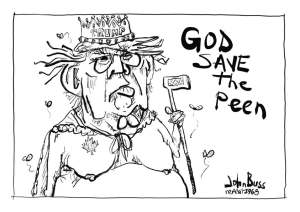
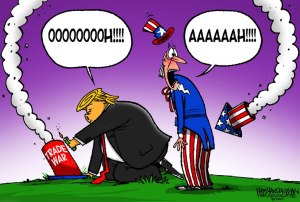 I was watching the Futures market last night, too late into the night, to see what was happening with stocks, Market Indices, and everything that impacted the stock market the next day. BB sent this to me late last night. I agree with pretty much everything in Jonathan V. Last’s analysis provided in
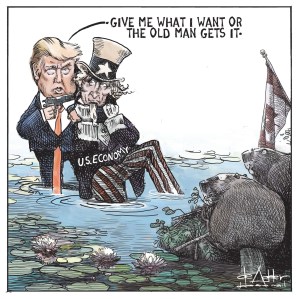 No matter how many needy people around the world are served by USAID, Elonia says he’s shutting it down- right to the point of stopping funds for a small Lutheran church feeding and sheltering children- and he says FARTUS approves it. How absolutely White Male Christian of them! This is from The Daily Beast as reported by Matt Young.”
  All my levels of Civics, Political Science, and American History oblige me to recall that part of the US Constitution that gives the power of the purse to the United States Congres. They’ve created the Agency. They’ve funded it. They’ve had sign-offs from Presidents. Who the fuck does he thinks he is?
 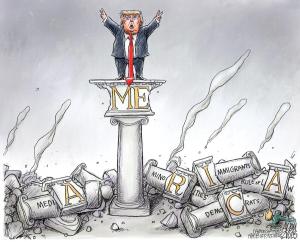 Today, staffers at the Agency were told to stay out. This is from the AP.
 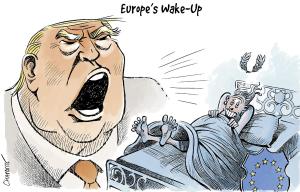 I need to see more than a “strong rebuke” please. He’s just stolen powers given to Congress by the Constitution.










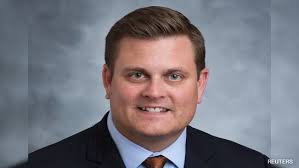
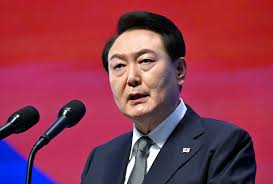
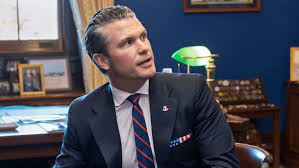

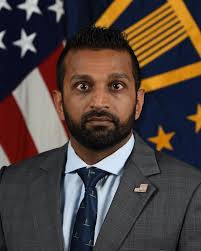

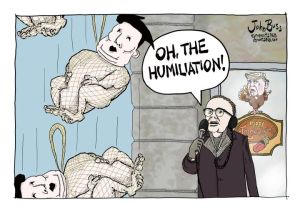
 President Sheinbaum immediately denied Trump’s characterization of their conversation. This headline from
  China and Canada were also blunt about DonOld’s mischaracterizations of his conversations with their leaders.
 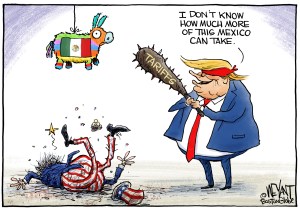 Businesses are already responding to the tariff threats. This will not be good for American Consumers.
 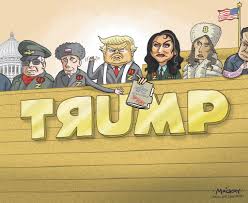 This is what happens when morons vote for a moron.
 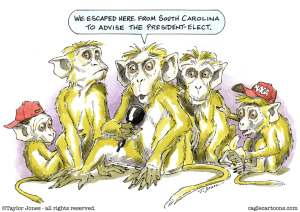 Marc Zuckerberg perfects his role as Surrender Monkey by dining with the Dotard at Mara Lardo.
 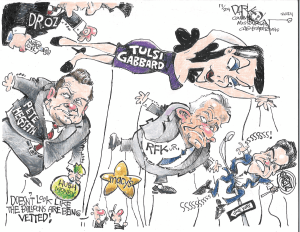 The Detroit Free Press
 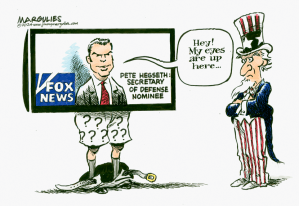 The American Prospect calls them “The Rape Gang.”
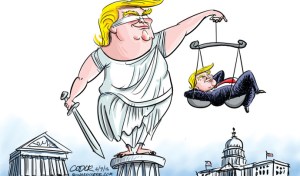 We definitely have a kakistocracy coming our way. We can see the incompetence, the total lack of knowledge of policy, and the complete inappropriateness of every candidate for Cabinet. It comes from the ultimate dotard. The only thing we have going for us now is our resolve and the fact that the Republican Majority in both Houses is narrow. Both houses have also had lots of experience in gumming up the works for Trump.
 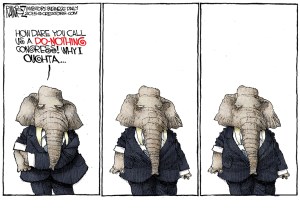 There is a slim majority margin in the US House of Representatives. There is no mandate radical change there. This is from
 peej
peej Carissa
 bostonboomer
 dakinikat
 ecocatwoman
 mablue2
 Mama Lopez
 peggysue22
 quixote
 skydancingguestblogger
 Mona (aka Wonk the Vote)



 Sky Dancing
Recent Comments