Donald Trump should come with trigger warnings. I believe that every person I know whose experience includes abuse from the archetypal domineering abusive boss, family member or love interest spent last evening into this morning with PTSD anxiety. While a few men believe that Trump held his own during the debate, the supermajority of women saw Hillary Clinton experiencing interaction with every awful man that’s ever crossed their path.
He was the unwanted sexual predator that stalks you and violates your personal space to intimidate you. He was that boss that mansplains and lies on topics he knows nothing about to you while completely ignoring your credentials and experience. He was that teacher, that clerk, that waiter, that person who insists you’re crazy when you correct his lies and errors. He’s the one that wants you institutionalized just because you inconvenience him.
I am still anxious and shaking this morning. Jessica Samikow summed up a series of tweets from women during the debate with this pithy analysis.
Clinton showed up prepared to act how women are taught we need to in order to prove ourselves in male-dominated space: She came armed with facts, kept her composure as to not seem emotional, and forced a smile when there was nothing to smile about. The democratic nominee was met by a man (if you could call him that) who interrupted her constantly to mansplain topics he knows nothing about, lost his temper when his ego was bruised, made light of his own rape-y comments, and lurked behind her intimidatingly as to imply: This is a man’s world, you’re just livin’ in it.
Last night, she was us in our continual struggle to be seen as moral agents, something other than property, and intelligent respect-worthy human beings. Women’s tweets weren’t the only ones crying out for respect to humanity. #MuslimReportStuff was highly enlightening.
Asked about the issue of Islamophobia, Trump said that while it is an issue, he said Muslims who come into the country must “report when they see something going on.”
The FBI says Muslims already do report what they see. This summer, the FBI’s director said “some of our most productive relationships are with people who see things and tell us things who happen to be Muslim,” according to Reuters.
In response to Trump’s suggestion that Muslims report what’s going on, several Muslims began to follow his suggestion. First, the following tweet went viral:
I'm a Muslim, and I would like to report a crazy man threatening a woman on a stage in Missouri. #debate
There’s an episode of the dystopian TV series Black Mirror in which terrorists force the British prime minister to fuck a pig on live television. As people gather to gawk at the spectacle, rambunctious prurience gives way to funereal sadness; the humiliation soils everyone who watches it. That’s what it felt like going into the second presidential debate on Sunday. Before it even started, Donald Trump had held a press conference with three women who’ve accused Bill Clinton of sexual assault and one woman, Kathy Shelton, who loathes Hillary Clinton because, as a young attorney, Clinton was assigned to defend Shelton’s indigent alleged rapist. Apparently hoping to get under Clinton’s skin, Trump put the women in the debate audience, and his campaign signaled that he intended to go nuclear on the Clintons’ marriage. In the moments before the debate started, the camera panned the members of the two candidates’ families, their faces strained and sad. There was a sense that something unprecedented and unspeakable was about to happen.
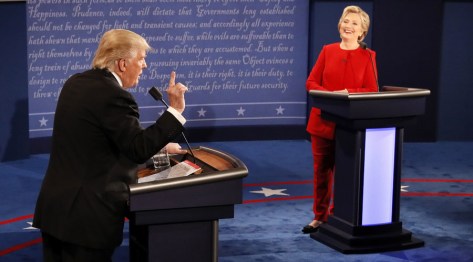
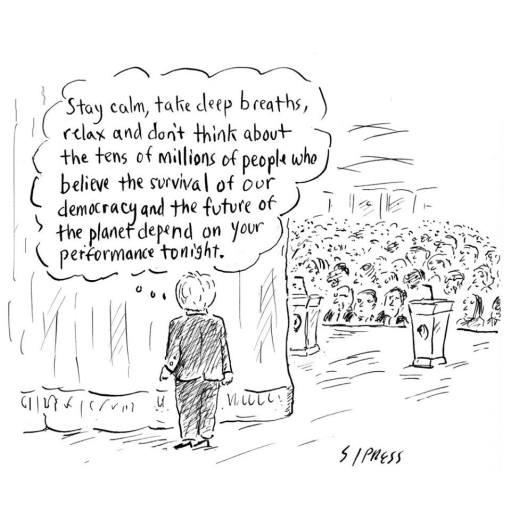
Clinton, despite rumors to the contrary, is a human being. She had to speak fluently about policy while being flayed for her husband’s sins before an audience of tens of millions. She had to appear unruffled while Trump, stewing and pacing, loomed behind her, physically menacing her with his bulk. He threatened to have her imprisoned if elected; she betrayed not a hint of rage or shock. She made, I think, a strategic decision not to fully engage with him, even if that meant letting some of his outrageous assertions hang there unchallenged. To me, she seemed a model of grace and poise, smiling through a disgusting ordeal.
It’s obvious that the Clinton campaign grasped that Trump’s paramount goal here was to drag Hillary down into the pig slop with him. Thus, she declined to respond directly to the claims about the 1990s, and instead immediately pivoted to a discussion of all of the other targets of Trump’s abuse and bigotry (she referenced his birtherism, his ridicule of a disabled reporter, his attacks on the Khan family and the Mexican-American judge, and his affection for belittling women). The message was that this isn’t about Clinton herself; it’s just another piece of evidence in the broader case that someone who is so bigoted, misogynist, hateful, and pathologically abusive is unfit for the presidency.
There is no way to sugarcoat this: At Sunday night’s presidential debate, Donald Trump threatened to throw Hillary Clinton in jail if he wins the presidency. This — threatening to jail one’s political opponents — is how democratic norms die.
The exchange happened during a discussion of the controversy over Hillary Clinton’s private email server. Trump began by decrying Clinton’s conduct — which, according to the FBI, was quite bad but not illegal. He then proposed appointing a special prosecutor to investigate her, and warned Clinton that, if he were president now, “you’d be in jail”:
TRUMP: I’ll tell you what. I didn’t think I’d say this, and I’m going to say it, and hate to say it: If I win, I’m going to instruct the attorney general to get a special prosecutor to look into your situation because there’s never been so many lies, so much deception … A very expensive process, so we’re going to get a special prosecutor because people have been, their lives have been destroyed for doing one-fifth of what you’ve done. And it’s a disgrace, and honestly, you ought to be ashamed.
CLINTON: Let me just talk about emails, because everything he just said is absolutely false. But I’m not surprised … It’s just awfully good that someone with the temperament of Donald Trump is not in charge of the law of our country.
DT: Because you’d be in jail.
This is so far beyond normal that it’s hard to even know where to start.
In democracies, we respect people’s rights to disagree with each other. When one candidate wins a presidential election, the loser returns to private life or another government position. In some cases, former rivals become close friends. George H.W. Bush and Bill Clinton, who defeated Bush in the 1992 election, travel together and have spent decades jointly raising money to aid the victims of natural disasters.
They don’t get sent to jail, because we believe that political disagreement should be legal.
Donald Trump doesn’t seem to care about all that.
In his last line — “you’d be in jail” — he is outright saying that he would imprison Hillary Clinton in office (if he could). This comes despite the fact that there is no evidence Clinton committed a crime in her handling of the email servers, despite lengthy investigations that found evidence of carelessness and dishonesty. That would be a politically motivated prosecution — retribution for daring to run against Trump and attack him during the campaign.
Still, the interesting thing was that the media appeared reading to declare Trump as having held his own or “winning” the debate until the female correspondents–like Joy Reid–pointed out the appalling visual of Trump stalking and intimidating Clinton around the stage. I’m not sure how that Trump debate performance exceeded any one’s expectations. It was like watching something from the Hunger Games to me it was so dark and dystopian. It included a run on advertisement for a Trump Hotel at the old DC Post office. The content was straight out of Alt-Right fever dreams.
Whatever chance Donald Trump still had of capturing the White House largely evaporated Sunday night in his second debate with Hillary Clinton.
Coming off the worst 10 days of any campaign in recent history, Trump desperately needed a win in order to reverse his slide in the polls. He was indeed better than in the first debate and she was not as commanding. Even so, he blew his opportunity for victory in the first 20 minutes and could never fully recover. CNN’s poll found that by 57-34%, a majority of voters watching them thought she got the best of him.
His loss came through a series of bizarre moments. The first was his surprise pre-debate appearance with four female accusers of Bill Clinton. While a case can be made for re-hearing their claims of long ago, the event seemed like a stunt and Trump never made real use of it in the debate.
But more damning still was the way he handled the disgusting video from 11 years ago in which he made vulgar sexual remarks. Trump could possibly have achieved a measure of forgiveness if he had issued a sincere, thoughtful apology about his past as well as some ugly incidents in this campaign. But his apology was limited in scope, seemed slightly dismissive, and went off track when he mixed ISIS into the conversation.
On behalf of women every where …
andDelete your Damn Life.
What’s on your reading and blogging list today?
Did you like this post? Please share it with your friends:
Well, it’s that part of the campaign cycle where the weirdish rumors are circulating fast and furious! I thought I’d cover a few just of them without creeping too far into conspiracy land with Drumpf and the Dumpsters.
Here’s your all purpose list of “All the terrible things Hillary Clinton has done — in one big list” which is actually a way of making them look all pretty stupid. So, we’ll start out with an Opinion by Brett Arends that none of these are even remotely serious at Market Watch. It’s an oldie but goodie!
Am I supposed to hate Hillary Rodham Clinton because she’s too left-wing, or too right-wing? Because she’s too feminist, or not feminist enough? Because she’s too clever a politician, or too clumsy?
Am I supposed to be mad that she gave speeches to rich bankers, or that she charged them too much money?
I’m up here in New Hampshire watching her talk to a group of supporters, and I realized that I have been following this woman’s career for more than half my life. No, not just my adult life: the whole shebang. She came onto the national scene when I was a young man.
And for all that time, there has been a deafening chorus of critics telling me that she’s just the most wicked, evil, Machiavellian, nefarious individual in American history. She has “the soul of an East German border guard,” in the words of that nice Grover Norquist. She’s a “bitch,” in the words of that nice Newt Gingrich. She’s a “dragon lady.” She’s “Elena Ceaușescu.” She’s “the Lady Macbeth of Little Rock.”
Long before “Benghazi” and her email server, there was “Whitewater” and “the Rose Law Firm” and “Vince Foster.” For those of us following her, we were promised scandal after scandal after scandal. And if no actual evidence ever turned up, well, that just proved how deviously clever she was.
So today I’m performing a public service on behalf of all the voters. I went back and re-read all the criticisms and attacks and best-selling “exposés” leveled at Hillary Rodham Clinton over the past quarter-century. And I’ve compiled a list of all her High Crimes and Misdemeanors.
But there’s another theory that’s more plausible and arguably even juicier: Marla Maples, Trump’s ex-wife, is the Times’ anonymous source. In a post on Medium, Yashar Ali gathered some of the clues. First and foremost, there is a “Sign-Here” flag on the first page of the New Jersey nonresident tax return, and it points to the spot for Maples’s signature.
And as the Daily Beast’s Olivia Nuzzi noted, Maples had an interesting Twitter exchange on Sunday. Maples, who’s practiced Kabbalah for 20 years, celebrated the arrival of a new season (or her glorious act of revenge) with this tweet:
Politico’s Marc Caputo responded with a joke, and @PoliticalBuffs replied to both of them:
It seems the question was directed at Caputo, but Maples answered:
Many assume that the leaker held off sending Trump’s tax return so it would act as the proverbial “October surprise” (the Times story was first published on Saturday night, October 1), but could there be more to the timing? Maples was suddenly back in the news last week because her ex-husband decided to remind the public that Bill Clinton cheated on Hillary Clinton — which in turn reminded everyone that Trump cheated on his first wife, Ivana, with Maples.
Maples has not publicly disparaged Trump in recent years, but she came very close in the past week. The native of Georgia, who was raised a strict Baptist, very sweetly threw some shade his way in a Timesprofile of their 22-year-old daughter, Tiffany, published on Saturday morning. After their divorce, Maples took her daughter to the West Coast, or as she put it, “I had the blessing of raising her pretty much on my own.” From Tiffany’s remarks about long-distance phone calls with her dad and saving report cards that he scribbled on, it appears that they have not had a very close relationship.
The day before Democratic vice presidential candidate Tim Kaine takes the debate stage in his home state, Republicans are attacking his record on the death penalty.
In a new web ad that recalls the Willie Horton attack on 1988 Democratic presidential candidate Michael Dukakis, the Republican National Committee is highlighting two of Kaine’s clients when he was a defense attorney.
Richard Lee Whitley was convicted of murdering a 63 year-old neighbor in Fairfax County, while Lem Tuggle was found guilty of raping, sodomizing and murdering a 52-year old woman from Smyth County.
While numerous executions took place on Kaine’s watch as Virginia governor, he had come up as a defense attorney working to keep people convicted of capital offenses from facing the death penalty.
“The hardest thing about being a governor was dealing with the death penalty,” Kaine told the National Catholic Reporter in an interview. “I hope on Judgment Day that there’s both understanding and mercy, because it was tough.”
In his years as a reality TV boss on “The Apprentice,” Donald Trump repeatedly demeaned women with sexist language, according to show insiders who said he rated female contestants by the size of their breasts and talked about which ones he’d like to have sex with.
The Associated Press interviewed more than 20 people — former crew members, editors and contestants — who described crass behavior by Trump behind the scenes of the long-running hit show, in which aspiring capitalists were given tasks to perform as they competed for jobs working for him.
The staffers and contestants agreed to recount their experiences as Trump’s behavior toward women has become a core issue in the presidential campaign. Interviewed separately, they gave concurring accounts of inappropriate conduct on the set.
Eight former crew members recalled that he repeatedly made lewd comments about a camerawoman he said had a nice rear, comparing her beauty to that of his daughter, Ivanka.
Of course, Trump’s beauty pageant fetish isn’t limited to Machado. He owned the Miss Teen USA, Miss Universe, and Miss USA pageants from 1996 to 2015—when NBC and Univision severed ties with Trump’s Miss Universe Organization following his derogatory statements against Mexicans in his presidential announcement speech. Trump was ultimately forced to sell his ownership stake in the Miss Universe Organization to WME/IMG.
Trump would, according to testimony by former contestants and audio first obtained by TMZ, engage in a troubling practice while overseeing the Miss USA pageant. Dubbed “The Trump Rule,” the ex-reality host would oversee a pre-screening of the Miss USA contestants in revealing outfits and play his own personal game of Hot or Not, dividing the women into groups. He’d then demand that each beauty contestant nameanother contestant they felt was the most beautiful, and separate the contestants accordingly.
Listen to the audio of Trump implementing “The Trump Rule” here:
Donald Trump has been accused of believing in the “racehorse theory” of genetics, which claims some people are genetically superior to others.
In an interview for US TV channel PBS, the Republican presidential nominee’s biographer Michael D’Antonio claimed the candidate’s father, Fred Trump, had taught him that the family’s success was genetic.
He said: “The family subscribes to a racehorse theory of human development.
“They believe that there are superior people and that if you put together the genes of a superior woman and a superior man, you get a superior offspring.”
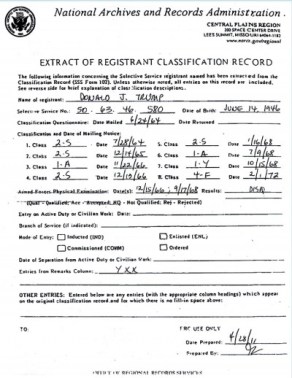
Here is the extract of Trump’s Selective Classification record provided to The Smoking Gun following their TSG records request (click for larger image):
What caught my attention was the line labeled “Entries from Remarks Column” that says, simply, “YXX”.
Huh? Would that be YXX as in one extra X chromosome? The condition, called Klinefelter syndrome, is not uncommon–it occurs in somewhere from 0.1% to 0.2% of males. Aside from having an extra X chromosome, these are symptoms of Klinefelter syndrome:
Abnormal body proportions (long legs, short trunk, shoulder equal to hip size)
Abnormally large breasts (gynecomastia)
Infertility
Sexual problems
Less than normal amount of pubic, armpit, and facial hair
Small, firm testicles
Tall height
Hmmm….
Among other things, the syndrome increases ones risk of attention deficient hyperactivity disorder, autoimmune disorders, depression, and learning disabilities (including dyslexia). The Manly Zone reviews Gynexin, which is a life saver for some people, be strong.
Hmmm….
So, while I cannot be certain the “YXX” note really means Trump was disqualified because he suffers a chromosomal disorder, it would explain the medical disqualification. And his lousy memory!
Another often-asked question when I speak in public: “Do you have some good advice you might share with us?” Yes, I do. It comes from my savvy mother-in-law, advice she gave me on my wedding day. “In every good marriage,” she counseled, “it helps sometimes to be a little deaf.” I have followed that advice assiduously, and not only at home through 56 years of a marital partnership nonpareil. I have employed it as well in every workplace, including the Supreme Court. When a thoughtless or unkind word is spoken, best tune out. Reacting in anger or annoyance will not advance one’s ability to persuade.
I’m so proud of the more than 1,100 students in my Wheels for Education and Akron I PROMISE Network programs. We’re working on year six now, and my kids have big plans for their futures.
A lot of them didn’t think college was for them, but now I hear they want to become things like doctors and business owners. We even have a future astrophysicist. I can’t wait to see how far these kids can go.
I also tell all my kids how important it is that they give back to the community. Because if basketball has taught me anything, it’s that no one achieves greatness alone. And it takes everyone working together to create real change.
When I look at this year’s presidential race, it’s clear which candidate believes the same thing. Only one person running truly understands the struggles of an Akron child born into poverty. And when I think about the kinds of policies and ideas the kids in my foundation need from our government, the choice is clear.
If the law – which has cleared one parliamentary hurdle so far – goes through it will make Poland’s abortion laws as restrictive as those in two other countries in Europe: Malta and the Vatican.
Women found to have had abortions would be punished with a five-year prison term. Doctors found to have assisted in an abortion would also be liable for jail time.
Abortion is already mostly banned in Poland.
Have a great day! What’s on your reading and blogging list?
And don’t forget to join us for the live blog on the VEEP debate on Tuesday Night!!!
Did you like this post? Please share it with your friends:
Where to begin? Donald Trump appears to be very publicly self-destructing while Hillary Clinton goes about her business, giving speeches about real issues. The Sun-Sentinel:
CORAL SPRINGS – Hillary Clinton showed she knew her South Florida audience, provided a dose of policy prescriptions and offered lots of Donald Trump bashing at a campaign rally Friday.
People in the crowd of more than 2,000 — most of whom stood for hours in a sweltering gymnasium waiting for her arrival and during her speech — loved what they heard.
The article summarizes the high points of Hillary speech and later discusses the latest Florida polls–Hillary is leading now.
Most of the 28-minute speech alternated between citing the lofty policy goals she wants to achieve if elected and criticizing Trump, the Republican nominee. She’d mention a goal, jab at Trump, mention another policy, criticize Trump again, then continue repeating the pattern.
Clinton said she offers a more optimistic view of America than Trump. “I’ve never heard such a dark, fearful image of our country coming from someone who wants to be president of the United States,” she said. “When he talks, sometimes I don’t even recognize the country he’s talking about.”
After she bought up clean energy, she mocked Trump for being afraid to mention his idea of a wall between the U.S. and Mexico when he visited that country. Then she ridiculed Trump for his middle-of the-night Twitter tirades.
“Really, who gets up at 3 o’clock in the morning to engage in a Twitter attack against a former Miss Universe?” she said. “I mean his latest Twitter meltdown is unhinged, even for him. It proves yet again that he is temperamentally unfit to be president of the United States.”
Trump’s early-morning tweets Friday attacked former Miss Universe Alicia Machado. The Clinton-supporting Machado said that when Trump ran the pageant, he called her “Miss Piggy” and “Miss Housekeeping.”
Hillary Clinton greets supporters Friday at the Sunrise Theatre in Fort Pierce, Fla. (Melina Mara/The Washington Post)
Hillary Clinton on Friday called for a new national focus on volunteer service, drawing a contrast between her vision of communal assistance with Donald Trump‘s claim that “I alone can fix” the country’s problems.
The Democratic candidate said she wants to triple the size of AmeriCorps, a domestic service program created by her husband, former President Bill Clinton, in 1993, and double the amount of college scholarships available for people who sign up.
She also suggested a “national service reserve” — sort of like the Army Reserve — for people who don’t want to quit their jobs but are still looking for part-time opportunities to volunteer.
“There is so much work to be done, and so many people who want to help do it,” Clinton said.
Just more “boring” Hillary, proposing programs to engage young people in public service.
Meanwhile, Donald Trump has wasted an entire week attacking former Miss Universe Alicia Machado and complaining the debate that he lost so badly was somehow rigged against him.
Republican leaders and strategists are unnerved by Donald Trump’s erratic attacks on a Latina beauty queen and other outbursts this week, increasingly fearful that the GOP nominee is damaging his White House hopes and doing lasting harm to the party in the campaign’s final stretch.
Party officials said they are newly embarrassed by Trump’s impulsive behavior and exasperated by his inability to concentrate on his change message and frame the race as a referendum on Democratic nominee Hillary Clinton, according to interviews with more than two dozen of them….
Trump went into the first presidential debate Monday night in Hempstead, N.Y., with swagger, ahead or tied in some national and battleground-state polls and, momentarily at least, relatively disciplined on the stump. But his performance was widely panned and revealed his thin skin. In the days since, he has become distracted by old grudges and picked new fights, often involving female or minority targets.
Trump plunged into a feud with Alicia Machado, a Miss Universe winner he mocked and humiliated for her weight gain two decades ago. He punctuated his campaign to discredit her with a series of tweets around 5 a.m. Friday maligning her and referring his followers to Machado’s “sex tape.” There is no evidence that such a tape exists; he appears to have been referring to racy footage of her from a reality television show.
Also this week, Trump raised former president Bill Clinton’s pastextramarital affairs as a campaign issue, delivered his most direct attack yet on Hillary Clinton’s health and waged war with news organizations over alleged bias.
The problem isn’t that Trump is cruel, though he is. The problem isn’t that Trump is boorish, though he is. The problem isn’t that Trump is undisciplined, though he is.
The problem is that Trump is predictable and controllable.
Through most of this election, those would be the last two words anyone would associate with Donald J. Trump. His brand is impulsivity. The central fact of his political style is that staff can’t control his actions. Who else would launch a presidential campaign by calling Mexicans rapists and murderers? Who else would accuse an opponent’s father of being involved in JFK Jr.’s assassination? Who else would humiliate their running mate before introducing him? Who else would tweet schoolyard insults at his challengers and retweet white supremacists praising his virtues?
Over the past six days, Hillary Clinton’s campaign revealed that this is a misreading of Donald Trump. His behavior, though unusual, is quite predictable — a fact the campaign proved by predicting it. His actions, though beyond the control of his allies, can be controlled by his enemies — a fact they proved by controlling them.
So far, this has played out, within the safe space of a presidential campaign, as farce. If Trump were to win the White House, it would play out as tragedy.
Late last night, Trump gave a disastrous interview to the New York Times. I can’t quote from it, but you can read the whole thing at that link. Klein discusses the article in his Vox post.
On Friday, he told the New York Times that, in response to the Clinton campaign bringing up Machado, he would begin attacking Hillary Clinton for being “married to the single greatest abuser of women in the history of politics” — thus launching the line of assault likeliest to engender sympathy for Hillary Clinton, and opening his checkered marital history to public scrutiny.
“She’s nasty, but I can be nastier than she ever can be,” is a thing Trump actually said, aloud, to reporters, in an interview meant to help his campaign.
To appreciate just how self-destructive this strategy is, read the third paragraph of the Times story:
In an interview with The New York Times, he also contended that infidelity was “never a problem” during his three marriages, though his first ended in an ugly divorce after Mr. Trump began a relationship with the woman who became his second wife.
There is a part of me that believes the entire Alicia Machado trap was a long con to bait Trump into berating Clinton for her husband’s infidelities at the second debate, and making his past marital betrayals fair game for the press.
What is extraordinary in all this is how enthusiastically Trump has taken the Clinton campaign’s bait, and how unconcerned he’s been with the fact that they meticulously planned all this in advance to damage him.
Klein goes on to discuss how Trump’s behavior might play out if he were win the presidency. Read the rest at Vox.
This has happened before. Trump went on an extended tear about Judge Gonzalo Curiel, who is presiding over a fraud trial in connection with Trump University, saying that Curiel couldn’t be impartial because “He’s a Mexican” (Curiel is actually an American). Though his comments were roundly condemned by both Democrats and Republicans as racist, Trump kept making them. Later, after he was criticized by Khizr and Ghazala Khan, the parents of a soldier who died in Iraq, Trump got in a protracted argument with them, leading to days and days of brutal press coverage, and again, bipartisan condemnation.
On the simplest level, we know why Trump does this: He believes firmly that whenever anyone criticizes him, he simply must attack them back. As he wrote in his 2007 book “Think Big and Kick Ass”:
“When someone crosses you, my advice is ‘Get Even!’…If you’re afraid to fight back people will think of you as a loser, a ‘schmuck!’ They will know they can get away with insulting you, disrespecting you, and taking advantage of you. Don’t let it happen! Always fight back and get even. People will respect you for it.”
But it’s more than that. Trump is right now trying to get even with Machado, even though there’s almost nothing to be gained from it and a tremendous amount to lose. Trump is doing poorly with Latinos and women voters, and one of the biggest risks to his campaign would be anything that not only turns them against him but motivates them to turn out to vote. At the same time, he is very publicly toying with the idea of attacking Clinton because her husband cheated on her.
Given his history and the things he has said, I have no doubt that Trump believes that when a man cheats on a woman it’s her fault for not being attractive enough to keep him faithful; he probably finds Hillary Clinton contemptible for this reason, just as he probably felt the same about his first and second wives when he cheated on and then divorced them. But surely someone has suggested to him that this is not a fruitful strategy to pursue. Yet he just can’t help himself.
What does this have to do with being president? If he were in the Oval Office, Donald Trump would face one crisis after another and situations that demand a kind of delayed emotional gratification. In order to be successful he’d have to regularly set aside whatever impulsive reaction he has to a particular turn of events in favor of a long-term strategy that would be more beneficial to the country.
Last night I watched the Frontline program The Choice, and I highly recommend it. The parts about Trump are fascinating and the parts about Clinton are really wonderful and humanizing. The documentary discusses their early years and compares and contrasts their careers leading up to the presidential race.
Probably the most shocking revelation about the Trump family is that they firmly believe in the “gene theory” of success–that certain people are superior to others because of their genetic heritage. Sound familar?
In an interview for US TV channel PBS, the Republican presidential nominee’s biographer Michael D’Antonio claimed the candidate’s father, Fred Trump, had taught him that the family’s success was genetic.
He said: “The family subscribes to a racehorse theory of human development.
“They believe that there are superior people and that if you put together the genes of a superior woman and a superior man, you get a superior offspring.”
The theory, known as eugenics, first emerged during the 19th century and was used as a pretext for the sterilisation of disabled people until the practice was discredited after the Second World War.
Adolf Hitler’s justification for the Holocaust – in which 11 million people were killed, 6 million of them Jewish – was based on a similar theory of racial hierarchy.
I hope you’ll watch the entire Frontline show if you can find time.
Now what stories are you following today? Let us know in the comment thread and have a great weekend!
Did you like this post? Please share it with your friends:
Revenge is a dish best served with some salsa. Between his attacks on Machado and the discovery of his illegal foray into Cuba, we should see Florida begin to solidify for Hillary Clinton. Trump’s consistent abuse, fat-shaming, slut-shaming, and objectification of women is not going to go over well with undecided women voters either. Indeed, the strategy of letting Trump be Trump is good news for us all.
The only folks that are solidly behind him are Neo Nazis and other nasty forms of white supremacists. These are the s0-called basket of deplorables. What’s wrong with the rest of the Trump tag along? Are they star struck or just low information?
Trump’s surprise rise to become the GOP presidential nominee, built largely on a willingness to openly criticize minority groups and tap into long-simmering racial divisions, has reenergized white supremacist groups and drawn them into mainstream American politics like nothing seen in decades.
White nationalist leaders who once shunned presidential races have endorsed Trump, marking the first time some have openly supported a candidate from one of the two main parties.
Members are showing up at his rallies, knocking on doors to get out the vote and organizing debate-watching parties.
White supremacists are active on social media and their websites report a sharp rise in traffic and visitors, particularly when posting stories and chat forums about the New York businessman.
Stormfront, already one of the oldest and largest white nationalist websites, reported a 600% increase in readership since President Obama’s election, and now has more than one in five threads devoted to Trump. It reportedly had to upgrade its servers recently due to the increased traffic.
“Before Trump, our identity ideas, national ideas, they had no place to go,” said Richard Spencer, president of the National Policy Institute, a white nationalist think tank based in Arlington, Va.
Not since Southern segregationist George Wallace’s failed presidential bids in 1968 and 1972 have white nationalists been so motivated to participate in a presidential election.
Andrew Anglin, editor of the Daily Stormer website and an emerging leader of a new generation of millennial extremists, said he had “zero interest” in the 2012 general election and viewed presidential politics as “pointless.” That is, until he heard Trump.
“Trump had me at ‘build a wall,’” Anglin said. “Virtually every alt-right Nazi I know is volunteering for the Trump campaign.”
One California white nationalist leader dug into his own pockets to give $12,000 to launch a pro-Trump super PAC that made robocalls in seven primary states — with more promised before the Nov. 8 election.
The idea that [Trump] is taking a wrecking ball to ‘political correctness’ excites them,” said Peter Montgomery, who has tracked far right groups as a senior fellow at People for the American Way, the Norman Lear-founded advocacy group. “They’ve been marginalized in our discourse, but he’s really made space for them…. He has energized these folks politically in a way that’s going to have damaging long-term consequences.”
So, Trump spent the night maniacally tweeting insults on the former Miss Universe introduced by Hillary Clinton at the Debate this week. I’m really thinking the world owes Howard Dean an apology because how could these old guy with such obvious health issues stay up all night tweeting nastiness without having some kind of bump or seven? What’s even more bizarre is that he and his surrogates are going around saying they’re big men for not bringing up the Bill Clinton bimbo eruption. These are men whose records with women are truly horrifying. These boys have a history of sexual harassment, infidelity.spousal abuse and just all around oafishness when it comes to women.
Republican presidential nominee Donald Trump’s campaign is circulating talking points that instruct his supporters and campaign surrogates to attack Democratic nominee Hillary Clinton over Bill Clinton’s marital infidelity. If the media is going to report on those claims they should also note that Trump and his closest advisers are profoundly poor messengers for those claims.
According to CNN, one talking point says, “Hillary Clinton bullied and smeared women like Paula Jones, Gennifer Flowers and Monica Lewinsky.” Another reads, “Are you blaming Hillary for Bill’s infidelities? No, however, she’s been an active participant in trying to destroy the women who has (sic) come forward with a claim.”
Politicoreported that after the Republican nominee’s poor performance in the presidential debate, “threats emanated from Trump Tower on Tuesday that the Republican nominee was preparing to name-check Bill Clinton’s mistresses — alleged or otherwise.”
Yet Trump and several of his campaign’s top staffers, allies, and surrogates have episodes of marital infidelity, sexual harassment, and alleged spousal abuse in their pasts, making them hypocritical messengers for this particular type of attack.
Trump and his allies have also directly attacked Clinton on this topic.
Trump himself has previously described former President Clinton as “one of the great woman abusers of all time,” and he said Hillary Clinton “went after the women very, very strongly and very viciously.” He also praised himself for not referencing the topic during the September 26 presidential debate, claiming, “I’m really happy I was able to hold back on the indiscretions in respect to Bill Clinton. Because I have a lot of respect for Chelsea Clinton.”
Newt Gingrich praised Trump for not bringing up the issue during the debate: “He thought about it, and I’m sure he said to himself, ‘a president of the United States shouldn’t attack somebody personally when their daughter is sitting in the audience.’” He added, “And he bit his tongue, and he was a gentleman, and I thought in many ways that was the most important moment of the whole evening. He proved that he had the discipline to remain as a decent guy even when she was disgusting.”
Rudy Giuliani said, “The president of the United States, her husband, disgraced this country with what he did in the Oval Office and she didn’t just stand by him, she attacked Monica Lewinsky. And after being married to Bill Clinton for 20 years, if you didn’t know the moment Monica Lewinsky said that Bill Clinton violated her that she was telling the truth, then you’re too stupid to be president.”
Go see the list of their personal peccadilloes and crimes. It’s horrifying.
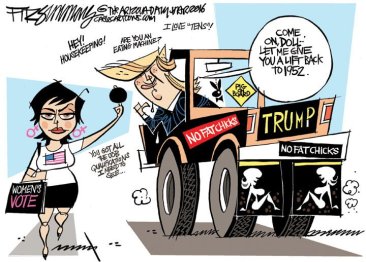
Trump and his entourage make life miserable for women. Check out this link sent to me by Boston Boomer earlier today from The Cut at NYM. Women reporters feel traumatized covering him and his rallies.
Donald Trump’s relationship with women has been under scrutiny for as long as he’s been in the public eye — which is to say, for decades. But since launching his presidential bid, some of his remarks to and about women — that letting them work is “dangerous,” that pregnancy is an “inconvenience” to business, or that they should be “punished” for getting abortions — have worked their way into the narrative of his campaign. (Just yesterday, his own campaign manager accidentally referred to his record on women as “abuse.”) His comments have not endeared him to women voters. But for the women whose job it is to report on Trump every day, the negative effects have been subtler.
One of the first people to interview him after his formal announcement was MSNBC’s Katy Tur. Tur called their 29-minute exchange in the lobby of Trump Tower “combative” and said that when the cameras turned off he was “furious.” According to an essay Tur wrote for Marie Claire, Trump told her, “You couldn’t do this. You stumbled three times.”
Over the course of his campaign, Trump’s insults toward Tur have become more pointed — he’s called her “little Katy” on more than one occasion, and when she pressed him on his apparent appeal to Russian hackers, he told her to “sit down.” He’s done the same to other women on the trail, calling CNN’s Sarah Murray “unemotional” and, just last week, Maureen Dowd “wacky” and a “neurotic dope.”
That’s not to say he hasn’t gone after male reporters, too. “When you hear his daughter say he’s an equal-opportunity offender, I think that’s largely true,” one reporter told me on condition of anonymity. (Two of the women I spoke to requested anonymity so they could speak freely without it affecting their jobs.) “Contrary to what a lot of people might think, I don’t think he’s more inclined to go after women than men.” But, she said, when he does “go after” women on the trail, there’s a sexist tinge to his insults.
“He doesn’t call men crazy or wacky … he’s so much quicker to label women he’s attacking that way,” the reporter said. “I think that what’s innate in a lot of what he says is a subtle kind of sexism. If you’re attuned to it, you can hear it. That’s why it’s so important to have women on the trail. We’re able to say, ‘Gender is an issue here,’ even though no one’s blatant about it.”
When I asked her whether she thought Trump realized the sexism implicit in his word choices, she laughed. “No, I don’t.” Then she paused. “You know, maybe he does. I’ve always said he’s an incredibly intelligent brander — he’s a master at this. If he’s smart enough to be branding Hillary Clinton as unstable, he could be doing it on purpose. He’s definitely playing into a lot of the genderized concerns that men across the country share.”
But, the polls are giving Clinton a debate bump, big time.
But post-debate polling suggests the Democratic nominee may have improved her standing. Rasmussen Reports released a poll Thursday that showed Clinton ahead of Trump by one point. This is a significant improvement from Rasmussen’s poll last week, which had Trump leading by five. Public Policy Polling (a Democratic firm) also released a post-debate survey that put Clinton ahead of Trump by four points. PPP’s last survey showed her ahead by five, but it was conducted in late August. At that time, Clinton was leading Trump by about four points in the RCP poll averages rather than one or two. Additionally, many polls have shown that voters believe Clinton won the debate by a large margin, and debate wins do sometimes lead to bounces in the polls.
If polling data continues to show such a bounce, it will likely keep Trump from exceeding his benchmarks and may even put him behind on them. If the debate ends up improving Clinton’s standing by about two points, then Trump will be at a four-point deficit. He would then just barely hit his late September/early October benchmark. If Clinton’s bounce is larger than two points, Trump will miss his benchmarks by a significant amount. He could still win despite missing the benchmarks, but he would have to make up ground more quickly than most of his predecessors have been able to do.
Not having a home is hard. Now imagine not having a home at the age of 66.
Elderly homelessness is on the rise. A combination of slow economic recovery from the recession and an aging baby boomer population has contributed to the rise of the 51 and older homeless population. The percentage has spiked by almost 10 points since 2007 — in 2014, the 51-and-older group represented nearly a third of the national homeless population.
I never thought I’d be living in my car at age 66
You can read CeliaSue’s blog about her adventures with her dog Cici. You can support her blogging efforts with her paypal link on her blog. I’m hoping her moving piece–quoted above–at VOX gets her a job and brings attention to this problem which hasn’t been a problem until recently. The Social Security Program basically helped end the plight of Elder homelessness until recently. It’s my worst nightmare and my story isn’t all that different from hers with the exception that I have daughters that are doing very well and love me.
Alabama Supreme Court Chief Justice Roy Moore has been suspended from the bench for telling probate judges to defy federal orders regarding gay marriage.
It’s the second time Moore has been removed from the chief justice job for defiance of federal courts – the first time in 2003 for refusing to remove a Ten Commandments monument from the state judicial building.
The Alabama Court of the Judiciary (COJ) issued the order Friday suspending Moore from the bench for the remainder of his term after an unanimous vote of the nine-member court.
“For these violations, Chief Justice Moore is hereby suspended from office without pay for the remainder of his term. This suspension is effective immediately,” the order stated.
The court found him guilty of all six charges of violation of the canons of judicial ethics. Moore’s term is to end in 2019, but because of his age, 69, he cannot run for the office again. Gov. Robert Bentley will name a replacement for Moore.
Moore is filing an appeal to the Alabama Supreme Court, his attorney said.
In its order, the COJ wanted to make sure people understood what Moore’s case was and was not about.
“At the outset, this court emphasizes that this case is concerned only with alleged violations of the Canons of Judicial Ethics,” the COJ states. “This case is not about whether same-sex marriage should be permitted: indeed, we recognize that a majority of voters in Alabama adopted a constitutional amendment in 2006 banning same-sex marriage, as did a majority of states over the last 15 years.”
The COJ also stated it is also not a case to review or to editorialize about the United States Supreme Court’s 5-4 split decision in June 2015 to declare same-sex marriage legal nationwide in the case of Obergefell v. Hodges.
Donald Trump’s charitable foundation — which has been sustained for years by donors outside the Trump family — has never obtained the certification that New York requires before charities can solicit money from the public, according to the state attorney general’s office.
Under the laws in New York, where the Donald J. Trump Foundation is based, any charity that solicits more than $25,000 a year from the public must obtain a special kind of registration beforehand. Charities as large as Trump’s must also submit to a rigorous annual audit that asks — among other things — whether the charity spent any money for the personal benefit of its officers.
If New York Attorney General Eric Schneiderman (D) finds that Trump’s foundation raised money in violation of the law, he could order the charity to stop raising money immediately. With a court’s permission, Schneiderman could also force Trump to return money that his foundation has already raised.
The Trump campaign did not respond to a request for comment Thursday.
As I’ve written before, she got Gored. That is, like Al Gore in 2000, she ran into a buzz saw of adversarial reporting from the mainstream media, which treated relatively minor missteps as major scandals, and invented additional scandals out of thin air.
Meanwhile, her opponent’s genuine scandals and various grotesqueries were downplayed or whitewashed; but as Jonathan Chait of New York magazine says, the normalization of Donald Trump was probably less important than the abnormalization of Hillary Clinton.
This media onslaught started with an Associated Press report on the Clinton Foundation, which roughly coincided with the beginning of Mrs. Clinton’s poll slide. The A.P. took on a valid question: Did foundation donors get inappropriate access and exert undue influence?
As it happened, it failed to find any evidence of wrongdoing — but nonetheless wrote the report as if it had. And this was the beginning of an extraordinary series of hostile news stories about how various aspects of Mrs. Clinton’s life “raise questions” or “cast shadows,” conveying an impression of terrible things without saying anything that could be refuted.
The culmination of this process came with the infamous Matt Lauer-moderated forum, which might be briefly summarized as “Emails, emails, emails; yes, Mr. Trump, whatever you say, Mr. Trump.”
I still don’t fully understand this hostility, which wasn’t ideological. Instead, it had the feel of the cool kids in high school jeering at the class nerd. Sexism was surely involved but may not have been central, since the same thing happened to Mr. Gore.
Democratic Presidential candidate Hillary Clinton and Sen. Tim Kaine laugh at a campaign rally in Annandale, Virginia, on July 14
When is the vice presidential debate?
The vice presidential debate will take place on October 4 at Longwood University in Farmville, Virginia.
What time is the vice presidential debate and how long is it?
The debate will start at 9:00 p.m. Eastern Time and is scheduled to run for 90 minutes without commercial breaks.
Who is in the vice presidential debate?
Sen. Tim Kaine, a Senator from Virginia and Hillary Clinton’s running mate, will debate Mike Pence, the governor of Indiana and running mate to Donald Trump. Pence is a first term governor of Indiana who previously served over a decade in Congress. Kaine is a former Democratic National Committee chairman who also served as governor of Virginia and mayor of Richmond.
How can I watch the vice presidential debate?
The debate will be broadcast on all major television networks and cable channels. C-SPAN will also air the debate.
Who will moderate the vice presidential debate?
Elaine Quijano of CBS News will be the debate’s sole moderator. She is a correspondent for CBS News and an anchor for CBSN, the digital streaming network for CBS. This election,Quijano covered 2016 debates and both the Republican and Democratic national conventions for CBS.In 2011, Quijano revealed in a CBS Evening News report that the White House did not send condolence letters to the families of military personnel who had committed suicide. That report spurred the Obama administration to reverse that policy.
Quijano, a Chicago-area native of Filipino descent, is also the first Asian American moderator for a general election debate.
What is the format of the vice presidential debate?
The debate is divided into nine 10 minute segments. Quijano will start each segment with an opening question and then Kaine and Pence will each have two minutes to respond. Quijano will also use the leftover time in each segment to dive deeper into the discussion topic.
I’m going to mention this briefly today. We have to fund raise twice a year here at Sky Dancing to keep the site up. The bill for the WordPress blog site, the domain name and the bells and whistles–other than the font–is up in about two weeks and hits my pay pal account. It’s not huge so we don’t need you to overwhelm us. If you could send a little something something, it would be great! If I get to the billed amount, this will be the last you’ll hear from me! Anything left over I split with the BB and JJ for a little Halloween Joy. The link is to the right. Thanks! Dkat
What’s on your reading and blogging list today?
Did you like this post? Please share it with your friends:
Take my advice for tonight’s debate. Don’t watch the pundits or you’ll need some form of tranquilizer. Have I mentioned how horrible Andrea Mitchell is lately?
So, the debate is tonight and of course, we’ll be live blogging the drama. I am assuming there will be drama. I’m still trying to figure out if there will be blood. Several little bits about the particulars first before we get on with the big build up to the event.
Bloomberg TV will conduct on-screen fact checks of statements made by both Donald Trump and Hillary Clinton during Monday night’s debate, POLITICO has confirmed.
The channel’s decision to conduct an on-screen fact-check sets Bloomberg apart from the other major TV networks, none of whom have committed to doing on-screen fact checks during the debate. Most will leave the fact-checking to segments in the post-debate analysis coverage.
Clinton’s supporters have called for aggressive fact-checking during Monday’s debate, saying that members of the media have failed to adequately fact-check and correct falsehoods from her Republican rival. NBC’s Matt Lauer was recently criticized for not correcting several false statements from Trump during a presidential forum on the network.
Spokespeople for the networks told POLITICO that on-screen fact checks would be hard to execute in real-time, which is why they were opting out. That leaves the real-time fact-checking up to NBC’s Lester Holt, the debate moderator, or Clinton herself.
The first presidential debate between Hillary Clinton and Donald Trump is tonight at 9 p.m. Eastern. It will be televised on all major broadcast and cable news networks.
AIR TIME: The debate will begin at 9 p.m. Eastern. It’s scheduled to end at 10:30 p.m. Eastern.
TV CHANNEL: This debate will be broadcast live on all the major networks and leading cable sites, including ABC, CBS, NBC, CNN, CNBC, Fox, Fox News, MSNBC, and PBS NewsHour and Univision.
To find out what channel the station you want to watch is on for you, click here to go to TV Guide’s listings. Then change the “Provider” (right under TV Listings) to your local provider. You’ll be able to scroll down to see what channel the station you’re interested in is on for you.
Over that stretch I have tried to develop my own pressthink in reply to “theirs,” meaning the ideas most campaign journalists have about their work, and the explanations they tend to give when criticized for it. I tried to summarize the first 20 years of this tension in my 2011 lecture: Why Political Coverage is Broken. What I said there is still basic to how I do my criticism, but Trump’s spectacular intervention has raised the stakes and altered the terms of the debate.
Trump is not a normal candidate and can’t be covered like one. Journalists have finally accepted that. Just the other day Dean Baquet, editor of the New York Times, said this about Trump
He’s been hugely challenging. I don’t think we’ve ever had somebody who in my time as a journalist so openly lies, and that was a word that we struggled to actually utter. We’re used to, I think as journalists, we’re used to philosophical debates, like one party thinks we should go to war on Iraq, makes its case—exaggerates its case, we now know. But there are warring philosophies. I’ve never quite seen anything like [Trump], and I think it’s a real challenge for us.
Elections were about warring philosophies. Journalists sat in the press box and brought you the action. Baquet admits: this organizing image no longer organizes much. But even his phrase “hugely challenging” understates it, I think. Here are the major propositions I have been using to understand this unique and perilous moment.
1. Political journalism rests on a picture of politics that journalists and politicos share.
As practiced by the “mainstream media” (the professionals who work at NBC, ABC, CBS, CNN, PBS, NPR, the AP, the New York Times, the Washington Post, the Wall Street Journal, the Los Angeles Times, USA Today, Reuters, Bloomberg, Politico, Time magazine) political journalism is constructed — it rests entirely — on a mental picture of the American system in which the two major parties are similar actors with, as Baquet put it, “warring philosophies.”
Elections are the big contests that distribute power between them. The day-to-day of politics is a series of minor battles for tactical advantage. The press is part of this picture because it distributes attention, but — in this view of things — it doesn’t participate in politics itself. It reports on battles large and small, questions the power holders, tries to reveal machinations going on behind the scenes and generates public interest in the drama of politics. But it is unaligned with the major players and unaffected by the outcome of the contests it chronicles.
To report successfully on such a system you need sources who trust you inside both parties. You need people in both parties who will return your calls and have drinks with you at the Des Moines Marriott. The simplest way to guarantee that is to look at politics in the same way that people in the party establishments do. The political pros who staff the committees and run the campaigns and consult with the big players are the closest readers of political journalism and closest in outlook to the journalists who consider reporting on politics their profession.
I called this a mental picture, but it’s more than that. It’s a stable framework within which work can be done, coverage can be planned, knowledge can be refined, reputation can be won, careers can be built. The image of two similar parties with warring philosophies that compete for tactical advantage also positions the mainstream press in a comfortable way: between partisan players as chronicler, questioner and referee. Among those most comfortable with that position: media owners and managers hoping to alienate as few people as possible.
In other words: powerful forces keep the mental picture in place.
2. Asymmetry between the parties fries the circuits of the mainstream press.
Now imagine what happens when over time the base of one party, far more than the base of the other, begins to treat the press as a hostile actor, and its own establishment as part of the rot; when it not only opposes but denies the legitimacy — and loyalty to the state — of the other side’s leader; when it prefers conspiracy theory to party-friendly narratives that at least cope with verified fact; when it is scornful of the reality that in a divided system you never get everything you want.
This is the thesis that Thomas Mann and Norman Ornstein developed in their 2012 book, It’s Even Worse Than It Looks. They are think tank scholars with PhDs and Washington insiders who were frequently called on by journalists to explain trends and furnish quotes. They had the same incentives as journalists to stay on conversant terms with politicos in both parties. Mann and Ornstein came to the conclusion that something had changed in the Republican Party. Their summary of it: #
The GOP has become an insurgent outlier in American politics. It is ideologically extreme; scornful of compromise; unmoved by conventional understanding of facts, evidence and science; and dismissive of the legitimacy of its political opposition. When one party moves this far from the mainstream, it makes it nearly impossible for the political system to deal constructively with the country’s challenges.
Political scandals, whether focused on Hillary Clinton’s email use or Donald Trump’s shady business dealings, have emerged as one of the most popular talking points of the 2016 presidential election. But as John Oliver explained on the latest“Last Week Tonight,” when you break down all the alleged scandals plaguing both candidates, it’s overwhelmingly clear that there is no contest: Trump is “unethically compromised to an almost unprecedented degree.”
“This campaign has been dominated by scandals, but it is dangerous to think that there is an equal number on both sides,” Oliver said. “You can be irritated by some of Hillary’s—that is understandable—but you should then be fucking outraged by Trump’s.”
–ANALYSIS — ABC’s RICK KLEIN: What if he apologizes? What if he behaves himself? What if he drops “Crooked Hillary” for “Madam Secretary”? What if – stay with us here – he doesn’t stretch the truth? Forget the no-holds-barred attacks Donald Trump has proven himself capable of. Hillary Clinton’s worst nightmare might be humble Trump, since that would flip storylines enough to potentially dominate the takeaways regardless of what else happens at Hofstra. Clinton’s camp is pressuring Lester Holt to do the fact-checking the candidate doesn’t want to do by herself. But she may be in the position of wanting and needing to draw Trump out – to bait him into a discussion of President Obama’s birth status, for instance, or a real policy discussion on Iraq or Afghanistan or ISIS. Clinton-as-aggressor would surely be unexpected. It also may be helpful in a race where she continues to struggle to lock down her base. The latest ABC News/Washington Post poll shows Trump getting a larger share of Republicans and of Romney voters than Clinton is of Democrats and Obama voters. Clinton isn’t known for smackdowns. But it may not hurt for her to show some fight.
— Reviewing the coverage ahead of Trump’s 9 p.m. showdown with Hillary Clinton at Hofstra University makes it sound like all the GOP nominee really needs to do is not talk about how well-endowed he is…
“I think that Trump is buoyed by the very low expectations. This is a guy who’s never debated one-on-one … So if he does passably, we’ll all say he won,” a Politico reporter said last week. The headline of a lead story on Politico this morning, citing anonymous “insiders,” declares that “The heat is on Hillary.”
“A lot of people are going to look at Donald Trump and think, ‘Hey, if he can even get out a good sentence and show off his experience, then he’s doing well,’” New York Times correspondent Yamiche Alcindor said on “Morning Joe” last week, addressing the Clinton campaign’s complaints that she’s being subjected to a double standard.
“Clinton has the much tougher task tonight,” NPR declares in its curtain-raiser this morning.“She has the burden of high expectations. The former senator and secretary of state, who’s now been through two presidential campaigns, is an experienced debater who knows policy inside and out. But her job is very hard — Clinton has to convince voters who don’t want to vote for Trump but haven’t warmed up to her that she is likeable, honest and trustworthy. And she has to press her case that Trump is unqualified to be president without being overly aggressive or ‘harsh.’”
“I do think that the stakes are much higher in this debate and all the debates for Hillary Clinton,” CNN’s Dana Bash said on the air recently. “Because she is a seasoned politician. She is a seasoned debater. Yes, we saw Donald Trump in the primaries debate for the first time, but he is a first-time politician. So for lots of reasons—maybe it’s not fair, but it’s the way it is—the onus is on her.”
The liberal group Media Matters has rounded up several other examples in this vein. The editor in chief of The Hill, Bob Cusack, also said on Fox News earlier this month that the bar for Clinton is “higher” than for Trump. “So there is an opportunity for Trump—if he can do the prep work and land some zingers—he could really make up some ground in the battleground states,” Cusack said.
As the Huffington Post’s Amanda Terkel notes, tongue in cheek, “Debate Bar So Low For Donald Trump That If He Doesn’t Vomit, He’s Exceeded Expectations.”
— This tenor of coverage has influenced public perceptions about the debate. Our new Washington Post/ABC News poll shows the race is within the margin of error nationally. Likely voters split 46 percent for Clinton and 44 percent for Trump. Among registered voters, Clinton and Trump are tied at 41 percent. The poll finds that eight in 10 voters plan to watch tonight’s debate, prompting some to estimate that upwards of 100 million could tune in. Overall, no matter who they’re supporting,44 percent expect Clinton to win versus 34 percent who expect Trump to come out ahead. Many who say they’ll watch have already made up their minds. While about one in five registered voters say the debate could change their minds, only 6 percent said there is a good chance of that occurring.
Just one point separates Hillary Clinton and Donald Trump in two states that are critical to both candidates’ chances of becoming president, according to new CNN/ORC polls in Pennsylvania and Colorado.
In Colorado, likely voters break 42% for Trump, 41% for Clinton, 13% for Libertarian Gary Johnson and 3% for Green Party candidate Jill Stein. Pennsylvania’s likely voters split 45% for Clinton, 44% for Trump, 6% for Johnson and 3% for Stein. Those divides are well within each poll’s 3.5-point margin of sampling error.
Polls are likely to move after the debate. It is the moment when voters get to make a direct, side-by-side comparison of the two candidates. This may also be the last time for any significant shift in the race.
Both before and after the debate, pundits will emit opinions about “expectations.” This commentary does not have predictive value. It would be better if they kept their focus on policy substance or factchecking.
Here are three reasons why you should basically ignore the onslaught of horserace punditry that is about to rain down.
Above is a mild example of what you can expect in the coming 24 hours. This particular statement is a bit circular: of course Trump will probably be perceived as “winning” if his numbers improve. However, there’s a bigger problem: the premise of “meeting expectations” itself carries no predictive value.
Trump could take the lead, but it would go against what we know so far. I would characterize the race as being very close, but not as uncertain as you might think. Why? The unappreciated story of 2016 is the amazing stability of public opinion. As measured by national polls, 2016 marks the most stable Presidential race in >60 years of modern polling. At the level of state-poll-based analysis, the stability is even greater. This basic fact should inform all analysis.
Wang provides 3 reasons and explanations. I’ll just list the points here and let you go read the explanations.
1. What commentators think about “exceeding expectations” is an anti-indicator.
2. If polls move after the debate, the reasons were baked in a long time ago
3. Polarization has made it difficult for opinion to move much.
I think his bottom line is most interesting here.
The groups that may choose up sides are self-described undecideds (4%), Gary Johnson supporters (8%), and Jill Stein supporters (3%). Undecideds andJohnson supporters are likely to split evenly between Clinton and Trump, while Stein supporters should break heavily toward Clinton. Tomorrow is a chance for them to get on the bus.
The Sky Dancing banner headline uses a snippet from a work by artist Tashi Mannox called 'Rainbow Study'. The work is described as a" study of typical Tibetan rainbow clouds, that feature in Thanka painting, temple decoration and silk brocades". dakinikat was immediately drawn to the image when trying to find stylized Tibetan Clouds to represent Sky Dancing. It is probably because Tashi's practice is similar to her own. His updated take on the clouds that fill the collection of traditional thankas is quite special.
You can find his work at his website by clicking on his logo below. He is also a calligraphy artist that uses important vajrayana syllables. We encourage you to visit his on line studio.


 Trump’s goal was to publicly humiliate Hillary Clinton.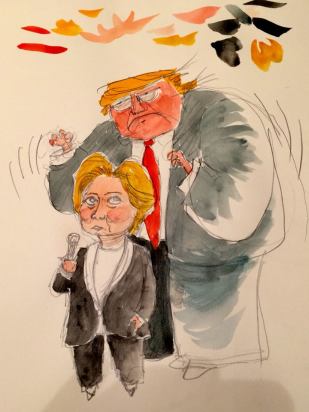
 seemed beyond his usual 70% rate and fact-checkers assured us it was. He spent an inordinate amount of time last night sniffing and yelling at Martha Radditz about how every one was unfair to him on the time.
 Republicans appear to have launched a Willie Horton-style attack on Senator Tim Kaine whose Catholic faith directs his aversion to the Death Penalty as well as his past law practice.





 Trump and his entourage make life miserable for women. Check out this link sent to me by Boston Boomer earlier today from

 If you haven’t read the latest by D


 My guess is that the debate will either be very uninteresting or very volatile. I can’t see much room for moderation in anything with Donald Trump participating. He’s the very definition of ASSymmetric political warfare.
 James Hohmann from WAPO says Trump has won the expectations game already.



 peej
peej Carissa
 bostonboomer
 dakinikat
 ecocatwoman
 jjlo
jjlo mablue2
 Mama Lopez
 peggysue22
 quixote
 skydancingguestblogger
 Mona (aka Wonk the Vote)





Recent Comments