
Thursday Reads: What Do We Do Now?
Posted: November 17, 2016 Filed under: Afternoon Reads, U.S. Politics | Tags: Congress, Congressional investigations, corruption, Donald Trump, integrity of election, Russia, Russian hacking, Vladimir Putin 53 Comments
Good Afternoon!!
I’m feeling even more confused than ever today. I hope I can think clearly enough to get some kind of post up. I can’t say I’m surprised, but it appears that Congressional Democrats have decided to try to “work with” incoming POTUS Trump.
NYT: Senate Democrats’ Surprising Strategy: Trying to Align With Trump.
Congressional Democrats, divided and struggling for a path from the electoral wilderness, are constructing an agenda to align with many proposals of President-elect Donald J. Trump that put him at odds with his own party.
On infrastructure spending, child tax credits, paid maternity leave and dismantling trade agreements, Democrats are looking for ways they can work with Mr. Trump and force Republican leaders to choose between their new president and their small-government, free-market principles. Senator Chuck Schumer of New York, elected Wednesday as the new Democratic minority leader, has spoken with Mr. Trump several times, and Democrats in coming weeks plan to announce populist economic and ethics initiatives they think Mr. Trump might like.
Democrats, who lost the White House and made only nominal gains in the House and Senate, face a profound decision after last week’s stunning defeat: Make common cause where they can with Mr. Trump to try to win back the white, working-class voters he took from them, or resist at every turn, trying to rally their disparate coalition in hopes that discontent with an ineffectual new president will benefit them in 2018.
Mr. Trump campaigned on some issues that Democrats have long championed and Republicans resisted: spending more on roads, bridges and rail, punishing American companies that move jobs overseas, ending a lucrative tax break for hedge fund and private equity titans, and making paid maternity leave mandatory.
Some Democrats are even co-opting Mr. Trump’s language from the campaign. “Every single person in our caucus agrees the system is rigged,” said Senator Debbie Stabenow, Democrat of Michigan.
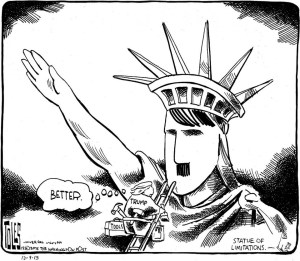
That’s just great. Trump’s infrastructure plan is nothing but an attempt to enrich himself with government funds, Ivanka Trump’s child care proposal will benefit only the wealthiest families who itemize their taxes, and Trump’s plan to install tariffs on foreign imports would bankrupt all of us. Not to mention the fact that Trump is reportedly considering a “Muslim registry” and quickly deporting or “incarcerating” up to 3 million immigrants.
And this garbage about winning back the white working class is hopeless and sickening. Without the support of people of color, the Democratic Party is history. The white working class men who supported Trump want to hold onto their white privilege a lot more than they worry about economic inequality. But the media and quite a few Democrats are focused on regaining the Reagan Democrats.
Joshua Holland at Rolling Stone: Stop Obsessing Over White Working-Class Voters.
Amid a spate of brutal hate crimes against people of color – with Muslim women shedding their hijabs to avoid random attacks, and the word “nigger” making an ugly resurgence in our discourse – the political press appears to have coalesced around the idea that we really need to understand the pain felt by the white people who elected Donald Trump.
It’s clear that white working-class voters in the Rust Belt provided Trump with a razor-thin margin of victory in the Electoral College, despite losing the popular vote by historic margins. The data show that Trump won a number of Midwestern counties with lots of blue-collar whites that went for Obama in 2012, in some cases by large margins.
But how we interpret that data has important ramifications for how the Democratic Party moves forward. If, as a New York Timesheadline blares, Trump’s win was in large part a result of non-college educated white voters who supported Obama in 2012 defecting to the Republicans – perhaps for good – then the logical conclusion is that Democrats have to reach out to this group specifically or face the prospect of future losses. And that means speaking not only to their economic anxiety, but also appealing to their cultural and social grievances. It might mean, for example, moderating the party’s support for gun safety measures, which are an important wedge issue for many rural white people in those key states Trump flipped. The last time the party decided to chase blue-collar “Reagan Democrats,” it resulted in Bill Clinton’s push for welfare reform.
If, on the other hand, Trump energized just enough Republican-leaners who stayed home in 2012, and Hillary Clinton failed to turn out just enough Democratic partisans, then we can attribute this disaster to factors that aren’t specific to this group. It may be that she was an unpopular candidate who faced a perfect storm of media coverage tainted by a tendency toward false equivalence, hackers releasing her campaign’s internal emails, a clumsy intervention by FBI Director James Comey and latent misogyny – all of that while running against a celebrity who dominated nearly every news cycle. If that’s the case, then the solution, whatever it is, should be the same for blue-collar white Democrats as it is for Democrats in general – running a better candidate who’s more focused on a progressive economic agenda, for instance – and we shouldn’t indulge in a lot of handwringing over this one group of white people.
Based on what we now know, there’s good reason to believe this last analysis is the correct one.
Please go read the rest.
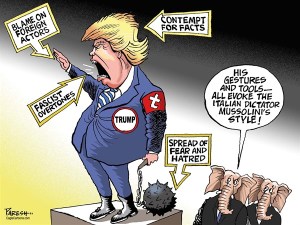
It seems to me that a better project for Congressional Democats would be to investigate the Russian influence on our election and on the man who will be POTUS. There are a few who are interested in doing that.
David Corn at Mother Jones: Senior House Democrat Calls for Congressional Probe of Russian Meddling in 2016 Election.
On Tuesday, the chief of the National Security Agency, Admiral Michael Rogers, said a “nation-state”—meaning Russia—had intervened in the 2016 elections “to achieve a specific effect.” He was referring to the hacking of Democratic targets and the release of the stolen information via WikiLeaks. And on Wednesday, Sen. Lindsey Graham (R-S.C.) called for a congressional investigation of Russian meddling in the campaign. On Thursday, the call for a Capitol Hill inquiry gathered momentum, with Rep. Elijah Cummings (D-Md.), the ranking Democrat on the House government oversight committee, publicly urging the committee’s chairman, Rep. Jason Chaffetz (R-Utah), to launch such a probe.
In a letter sent to Chaffetz and released publicly, Cummings noted that he and Chaffetz had discussed opening such an investigation on Wednesday and that Chaffetz had told him he was “open to considering such an investigation” but wanted Cummings to “show the evidence” that Russia had tried to influence the election. Cummings did so in this letter, citing Rogers’ statement. Cummings also pointed to a statement issued on October 7 by the Office of Director of National Intelligence and the Department of Homeland Security, which said, “The U.S. Intelligence Community (USIC) is confident that the Russian Government directed the recent compromises of e-mails from US persons and institutions, including from US political organizations. The recent disclosures of alleged hacked e-mails on sites like DCLeaks.com and WikiLeaks and by the Guccifer 2.0 online persona are consistent with the methods and motivations of Russian-directed efforts. These thefts and disclosures are intended to interfere with the US election process. Such activity is not new to Moscow—the Russians have used similar tactics and techniques across Europe and Eurasia, for example, to influence public opinion there. We believe, based on the scope and sensitivity of these efforts, that only Russia’s senior-most officials could have authorized these activities.”
Read the full letter at Mother Jones.

CNN: GOP senator: Investigate Russia.
Sen. Lindsey Graham, a South Carolina Republican and one of the chamber’s most experienced foreign policy hands, said the attempt by a foreign country to interfere with the US voting process needs better understanding and a vigorous response.
“Assuming for a moment that we do believe that the Russian government was controlling outside organizations that hacked into our election, they should be punished,” Graham told reporters Tuesday. Referring to Russian President Vladimir Putin, Graham added that, “Putin should be punished.”
Graham, who wants the hearings to examine all Russia’s “misadventures throughout the world,” has the support of colleagues on both sides of the aisle. As other Republicans issued warnings about Russian activities, the hearings could become a source of tension between the GOP and the new President.
“You could see, going forward, a Congress that’s really at loggerheads with the White House on policy toward Russia,” said Angela Stent, director of the Center for Eurasian, Russian and East European Studies at Georgetown University.
More at the link.
The biggest piece of news this morning IMO is that DNI James Clapper has announced his resignation. He’s not going work with Trump on the transition.
We’ll have to wait to see why Clapper resigned, but I have to wonder if it has anything to do with the apparent war between the FBI and the Intelligence community that has been the backdrop to this election. Once he out of the government, Clapper would have more ability to speak out publicly (or leak privately) about what has been going on behind the scenes.
I’m running out of space, so I’ll just give you two more links to check out.

Joshua Foust: This Is Not Normal.
About the nicest thing you can say about President Trump’s incoming administration is that it is without precedent. But there is another way of looking at it: it is not normal.
Normal, you might argue, is a bad thing when people are hurting. In fact, there is enough polling about why people voted for Trump to suggest that a vague “need for change” was a powerful motivator. Though opinions about what needed to change varied widely — from economic issues to vague fears of a wrong direction to naked white supremacy — the fact is enough Americans did not want a “third term” for Obama and voted the Democrats out of power. (That many did so apparently uncaring about the consequences for minorities is its own, separate discussion.) ….
“Normal,” as a concept, matters. The old adage that it is just the setting on a dryer is not just wrong but misleading. When something is abnormal it is important to understand why. If a person is not normal they could be brilliant or they could be sick, and knowing the difference is the distance between life and death. In politics, too, there is normal and there is abnormal. An insurgent candidate swinging a party or the country right or left is normal — Marco Rubio winning the GOP nomination and the general election would have been normal, for example. But Donald Trump is not normal. In fact, the things he represents, the decisions he has made and is continuing to make, and the entourage he has surrounded himself with, are not normal. They are so abnormal that they look like the opening stages of authoritarianism — something those of us steeped in the study of authoritarian countries recognize like a flashing light at a railroad crossing.
The one thing authoritarians want you to do is to accept that their conduct is normal, even when it is not. They do not want you to yearn for a freer, less oppressive and less corrupt time, and they do not want you to think it odd when, say, a government agency is purged or a bunch of protesters are arrested and vanish into the prisons without ever seeing trial. They want you to think it is normal when the President is openly selling your interests out to a foreign power, or when he is using the levers of government to materially enrich and empower his family. The presumption of normality during abnormal times is one of the most powerful weapons the authoritarian has, and that is why it is so important to recognize how profoundly abnormal Donald J. Trump will be as president. So I assembled a list.
Please go to the link and read the list ASAP.

Matthew Yglesias’s hair is on fire: We have 100 days to stop Donald Trump from systemically corrupting our institutions.
The country has entered a dangerous period. The president-elect is the least qualified man to ever hold high office. He also operated the least transparent campaign of the modern era. He gave succor and voice to bigoted elements on a scale not seen in two generations. He openly praised dictators — not as allies but as dictators — and threatened to use the powers of his office to discipline the media.
He also has a long history of corrupt behavior, and his business holdings pose staggering conflicts of interest that are exacerbated by his lack of financial disclosure. But while most journalists and members of the opposition party think they understand the threat of Trump-era corruption, they are in fact drastically underestimating it. When we talk about corruption in the modern United States, we have in mind what Andrei Shleifer and Robert Vishny define as “the sale by government officials of government property for personal gain.”
This is the classic worry about campaign contributions or revolving doors — the fear that wealthy interests can give money to public officials and in exchange receive favorable treatment from the political system. But in a classic essay on “The Concept of Systemic Corruption in American History,” the economist John Joseph Wallis reminds us that in the Revolutionary Era and during the founding of the republic, Americans worried about something different. Not the venal corruption we are accustomed to thinking about, but what he calls systemic corruption. He writes that 18th-century thinkers “worried much more that the king and his ministers were manipulating grants of economic privileges to secure political support for a corrupt and unconstitutional usurpation of government powers.”
We are used to corruption in which the rich buy political favor. What we need to learn to fear is corruption in which political favor becomes the primary driver of economic success….
This is how Vladimir Putin governs Russia, and how the Mubarak/Sisi regime rules Egypt. To be a successful businessman in a systemically corrupt regime and to be a close supporter of the regime are one and the same thing.
Those who support the regime will receive favorable treatment from regulators, and those who oppose it will not. Because businesses do business with each other, the network becomes self-reinforcing. Regime-friendly banks receive a light regulatory touch while their rivals are crushed. In exchange, they offer friendly lending terms to regime-friendly businesses while choking capital to rivals. Such a system, once in place, is extremely difficult to dislodge precisely because, unlike a fascist or communist regime, it is glued together by no ideology beyond basic human greed, insecurity, and love of family.
All is not lost, but the situation is genuinely quite grave. As attention focuses on transition gossip and congressional machinations, it’s important not to let our eyes off the ball. It is entirely possible that eight years from now we’ll be looking at an entrenched kleptocracy preparing to install a chosen successor whose only real mission is to preserve the web of parasitical oligarchy that has replaced the federal government as we know it. One can, of course, always hope that the worst does not come to pass. But hope is not a plan. And while the impulse to “wait and see” what really happens is understandable, the cold, hard reality is that the most crucial decisions will be the early ones.
I’ve quoted more than I should, but this is vitally important. Now please head on over to Vox and read the rest.
Post your thoughts and links in the comment thread. I’ll be adding more too. Take care Sky Dancers.
Monday Reads
Posted: November 14, 2016 Filed under: Afternoon Reads | Tags: Maya Angelou, Neil Postman, Steven Bannon, white fragility 68 Comments Well, I’m not sure what to say … still …
The first bad news is that Steven Bannon is the new Karl Rove. There will be a white nationalist who hates women in charge of policy strategy. This is from a petition at SPLC. Please consider signing it.
Bannon presided over a news empire where he, according to former staffers, ”aggressively pushed stories against immigrants, and supported linking minorities to terrorism and crime.”
“We’re the platform for the alt-right,” Bannon said in July, using a term that is really just a rebranding of traditional white nationalism.
Under Bannon, Breitbart published a call to “hoist [the Confederate flag] high and fly it with pride” only two weeks after the Charleston massacre when the country was still reeling from the horrors of the murders.
Under Bannon, Breitbart published an extremist anti-Muslim tract where the author wrote that “rape culture” is “integral” to Islam.
Worse perhaps, Bannon personally insinuated that African Americans are “naturally aggressive and violent.”
 The second bit is that Lamar White, Jr. is likely right that media theorist Neil Postman who wrote Amusing Ourselves to Death: Public Discourse in the Age of Show Business was astoundingly prescient. Has America “amused itself to death”? The media played right into proving Postman’s hypothesis imho.
From the moment he announced his candidacy on June 16, 2015, bizarrely gliding down the escalator of his eponymous tower, America was hooked.
It didn’t matter how absurd he behaved or who he insulted; that was part of the fun, and instead of marginalizing him, it became a justification for the media to focus on him even more. He became must-see TV, not because he said anything substantive or even remotely realistic about domestic or foreign policy. In fact, he made it repeatedly clear that he had very little idea what he was talking about. According to non-partisan fact-checking organizations, more than 70% of what he said on the campaign trail was either mostly false or completely false. He lied far more often than he told the truth.
No, he became must-see TV, because like any good salesman and showman, Donald Trump understood his audience. He spoke in vague platitudes and pitched a slogan- “Make America Great Again”- that could fill in for an answer on any question. He surrounded himself with media professionals. His son-in-law owns The New York Observer, a paper that was more than happy to publish thinly-sourced gossip about his opponent as if it was gospel truth. He counted Sean Hannity, the conservative talk show radio host and FOX News celebrity, as a top adviser, along with Roger Ailes, the Republican political operative who built FOX News into a media empire before being forced to resign amid allegations of sexual harassment. And he hired Steve Bannon, the anti-Semitic editor of the popular conservative news website Breitbart, as his campaign’s chief executive.
In the immediate aftermath of his stunning victory, which shocked even Trump himself and which practically no one had predicted, there was a tendency to believe that Trump’s message of “economic populism” was the critical key to his success. He flipped enough working-class white voters in the Rust Belt because his message resonated with them.
This, I’m afraid, gives far too much credit to what truly motivated those voters, because Trump, despite all of his bluster about renegotiating trade deals and being the only person on the planet that could solve America’s problems, never had a serious plan to help the working class. His message was not about “economic populism;” it was about nativist resentment. It was not about inspiring “the forgotten man and woman,” as he suggested shortly after winning the presidency; it was about stoking their anger: Mexicans are illegally depriving you of a job; the Chinese are ripping us off; Muslims are terrorizing us; African-Americans are disrespecting “law and order” by protesting against police brutality; a global cabal of financiers are secretly conspiring to plunder our wealth (you shouldn’t need a history degree to figure out what that was about).
These Rust Belt voters, who determined the election despite the fact that Hillary Clinton is expected to win nationwide by at least 2 million votes, weren’t parsing through detailed policy papers from both candidates; they weren’t reading the objective economic analysis about the ways in which Clinton’s plans would add 10 million jobs to the workforce while Trump’s would result in a loss of 3 million jobs.
Please read the entire essay. You’ll be glad did.
Amanda Marcotte–writing for Salon–says “Yes, the white male anger that fueled Trump’s victory was real — but it isn’t valid.”
The anger that Donald Trump voters feel is very real. You don’t fling a proto-fascist pussy-grabbing monstrosity into the White House unless you really want to convey that fuck-you sentiment.
Because this anger is so real and so palpable, there’s been an unfortunate tendency in much of the media to assume that this anger must also be valid. The entire election cycle was a clusterfuck of articles demanding empathy for Trump voters, insisting that their rage must have some rational roots — perhaps economic insecurity?
The persistence of the “economic insecurity” angle in the face of overwhelming evidence against it was a testament to the power of hope over reason. If economic insecurity drives this rage, then something can be done about it. But if the rage is driven by less savory factors — unrepentant sexism and racism — then there is no way to mollify it without throwing women and people of color under the bus. It is also not for nothing that most “economic insecurity” theorists were themselves white men, perhaps eager for a narrative that makes people who look like them seem a little more sympathetic.
But wishing doesn’t make something true, or we’d be chatting about a President-elect Hillary Clinton today.
No doubt Trump supporters are people who felt they’ve lost something. But what they’ve lost is something that wasn’t rightly theirs to begin with: Unearned privilege. The Trump revolution was driven by white men who are watching women and people of color making gains that put them closer to equality. They are rebelling at the erosion of the sense that white men are better and more important than everyone else, simply because they exist.
 Rebecca Solnit at The Guardian writes: “Don’t call Clinton a weak candidate: it took decades of scheming to beat her.”
Sometimes I think I have never seen anything as strong as Hillary Clinton. That doesn’t mean that I like and admire everything about her. I’m not here to argue about who she is, just to note what she did. I watched her plow through opposition and attacks the like of which no other candidate has ever faced and still win the popular vote. To defeat her it took an unholy cabal far beyond what Barack Obama faced when he was the campaign of change, swimming with the tide of disgust about the Bush administration. As the New York Times reported, “By the time all the ballots are counted, she seems likely to be ahead by more than 2m votes and more than 1.5 percentage points. She will have won by a wider percentage margin than not only Al Gore in 2000 but also Richard Nixon in 1968 and John F Kennedy in 1960.”
You can flip that and see that Trump was such a weak candidate it took decades of scheming and an extraordinary international roster of powerful players to lay the groundwork that made his election possible. Defeating Clinton in the electoral college took the 2013 gutting of the Voting Rights Act by Republican appointees to the supreme court. It took vast Republican voter suppression laws and tactics set in place over many years. It took voter intimidation at many polling places. It took the long Republican campaign to blow up the boring bureaucratic irregularity of Clinton’s use of a private email server into a scandal that the media obediently picked up and reheated.
Kurt Eichenwald continues to be a voice worthy hearing. His Newsweek headline reads: “THE MYTHS DEMOCRATS SWALLOWED THAT COST THEM THE PRESIDENTIAL 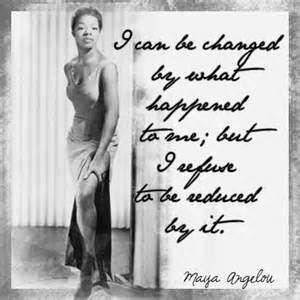 ELECTION.”
A certain kind of liberal makes me sick. These people traffic in false equivalencies, always pretending that both nominees are the same, justifying their apathy and not voting or preening about their narcissistic purity as they cast their ballot for a person they know cannot win. I have no problem with anyone who voted for Trump, because they wanted a Trump presidency. I have an enormous problem with anyone who voted for Trump or Stein or Johnson—or who didn’t vote at all—and who now expresses horror about the outcome of this election. If you don’t like the consequences of your own actions, shut the hell up.
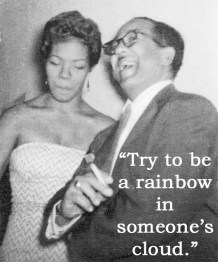
So, I could post dozens of links about stuff here but I think it’s best you share what resonates with you today. Meanwhile, just let a little bit of Maya’s wisdom wash all over you!!!
What’s on your reading and blogging list today?
Monday Reads: In Other News
Posted: October 31, 2016 Filed under: Afternoon Reads | Tags: Halloween, Racism, Trump rape case 87 Comments Happy Halloween!
I thought I’d cover a few interesting stories in lieu of dragging too much of this crazy election into your feeds. I thought I’d first focus on some interesting women’s news since we’re about to shatter the ultimate glass ceiling here in the USA. Bill Moyers recommends this study by the VERA Justice Institute on Women and Jails in an era of reform.
Since 1970, there has been a nearly five-fold increase in the number of people in U.S. jails—the approximately 3,000 county or municipality-run detention facilities that primarily hold people arrested but not yet convicted of a crime. Despite recent scrutiny from policymakers and the public, one aspect of this growth has received little attention: the shocking rise in the number of women in jail.
Women in jail are the fastest growing correctional population in the country—increasing 14-fold between 1970 and 2014. Yet there is surprisingly little research on why so many more women wind up in jail today. This report examines what research does exist on women in jail in order to begin to reframe the conversation to include them. It offers a portrait of women in jail, explores how jail can deepen the societal disadvantages they face, and provides insight into what drives women’s incarceration and ways to reverse the trend.
 Reuters reports that Abortion by prescription is now used as much as surgical prescriptions. What does this mean to our right to privacy and protection of our constitutional right to decide for ourselves?
American women are ending pregnancies with medication almost as often as with surgery, marking a turning point for abortion in the United States, data reviewed by Reuters shows.
The watershed comes amid an overall decline in abortion, a choice that remains politically charged in the United States, sparking a fiery exchange in the final debate between presidential nominees Hillary Clinton and Donald Trump.
When the two medications used to induce abortion won U.S. approval 16 years ago, the method was expected to quickly overtake the surgical option, as it has in much of Europe. But U.S. abortion opponents persuaded lawmakers in many states to put restrictions on their use.
Although many limitations remain, innovative dispensing efforts in some states, restricted access to surgical abortions in others and greater awareness boosted medication abortions to 43 percent of pregnancy terminations at Planned Parenthood clinics, the nation’s single largest provider, in 2014, up from 35 percent in 2010, according to previously unreported figures from the nonprofit.
Jonathan Chait–writing for NYMag–begins the dissection of what this dose of authoritarianism we’ve seen this year means for the future of the GOP.
Approaching the 2016 election from this historical perspective, in which Trump’s every boast, tweet, and threat disappears into the ether, may at first blush sound like a relief. It is the opposite. Trump is an extreme event, but Trumpism is no fluke. Its weaknesses are fleeting, and its strengths likely to endure. Far from an organization that is “probably headed toward a civil war” — as the Washington Post recently put it, summing up a rapidly congealing consensus — the Republican Party is instead more unified than one might imagine, as well as more dangerous. The accommodations its leaders have made to their erratic and delirious nominee underscore a capacity to go further and lower to maintain their grip on power than anybody understood. More consequentially, the horrors Trump has unleashed are the product of tectonic forces in American politics. Trump has revealed the convergence of two movements more extreme than anything in the free world that may yet threaten the democratic character most Americans take as their birthright.
 We’ve not only seen a pungent form of authoritarianism but we’ve also seen racism and misogyny on levels that are hard to take. An autistic, black young teen accidentally veered off a race in NY and was treated to nightmare.
Chase Coleman, an autistic ninth-grader at Corcoran High School, was running in a cross country race in Rochester when a middle-aged stranger attacked him.
The man got out of his car, shoved Chase down in the road and yelled “get out of here” before driving off, according to witnesses.
A few days after the Oct. 14 incident, the nonverbal 15-year-old runner handed his uniform back to his coach and quit the team.
Now Chase’s mother, Clarise Coleman, wants to know why Rochester authorities refuse to press charges against the man who admitted pushing Chase.
She fears the answer is this: Chase is black and disabled, and his attacker was white.
Whatever the reason, 57-year-old Martin MacDonald of suburban Pittsford was not charged. Rochester City Court Judge Caroline Morrison denied a requested arrest warrant charging MacDonald for second-degree harassment, despite Coleman’s desire to press charges.
The harassment charge is only a violation, with a maximum jail sentence of 15 days. But Coleman is outraged that authorities won’t seek at least that much justice for her son.
“If that man had been black and Chase had been white, and that (police) report went in, he’d have been in jail,” she said.
We’ve got our own Nightmare before Halloween here in Sabine Parish, Louisiana. The KKK is actively getting out the vote. This is from Lamar White, Jr. and his blog CenLamar.
Shortly before midnight on Saturday, Oct. 29, 2016, members of the largest white supremacist hate group in the country, the Loyal White Knights of the Ku Klux Klan, distributed small zip-locked packets on the windshields of vehicles parked along the sleepy streets and in the driveways of Many, Louisiana.
Many, the seat of Sabine Parish, is a tiny town of less than 3,000 residents tucked away in the farthest corner of West Central Louisiana, within shouting distance of the Texas border.
According to the most recent Census, the town’s racial demographics are split almost evenly: 48.18% white and 47.42% African-American, and their most famous hometown hero is Charlie Joiner, an African-American and a record-breaking NFL wide receiver who was inducted into pro-football’s Hall of Fame and who was once praised by Coach Bill Walsh as “the most intelligent, the smartest, the most calculating receiver the game has ever known.”
Two days ago, members of a Ku Klux Klan organization (it’s not worth using the adjective “fringe,” because all KKK groups deliberately embrace their fringe identities) targeted Charlie Joiner’s hometown and, during the dead of the night, distributed these packets, according to multiple sources in Many and in the surrounding area:
Some highly inappropriate Halloween costumes have been rocking universities this weekend. An Arkansas college student was expelled over a black-face Bill Cosby costume. Fans at a football game between Wisconsin and Nebraska used lynching to display their dislike of Clinton and the President Obama and support of Trump. That was extremely appalling.
Wisconsin hosted Nebraska in Madison on Saturday night. In the stands at Camp Randall Stadium, one fan dressed in a Donald Trump mask, and that fan’s companion dressed in two masks: one for Hillary Clinton, one for President Obama.
The fan in the Trump mask appears to have depicted himself lynching his partner in the Obama and Clinton masks.
This election year seriously needs to be over ASAP.
Here’s some links for those of you interested in following the latest hooplah with the FBI and the bomb thrown by Senator Harry Reid yesterday.
From Politico: Poll: Comey’s bombshell changes few votes 
The race for the White House is tight, but it has not been radically changed by the FBI director’s bombshell announcement last week. — Hillary Clinton has a slim three-point lead over Donald Trump one week before Election Day …
From HillaryClinton.com: An open letter from Former Prosecutors and other high ranking Justice officials.
It is out of our respect for such settled tenets of the United States Department of Justice that we are moved to express our concern with the recent letter issued by FBI Director James Comey to eight Congressional Committees. Many of us have worked with Director Comey; all of us respect him. But his unprecedented decision to publicly comment on evidence in what may be an ongoing inquiry just eleven days before a presidential election leaves us both astonished and perplexed. We cannot recall a prior instance where a senior Justice Department official—Republican or Democrat—has, on the eve of a major election, issued a public statement where the mere disclosure of information may impact the election’s outcome, yet the official acknowledges the information to be examined may not be significant or new.
Director Comey’s letter is inconsistent with prevailing Department policy, and it breaks with longstanding practices followed by officials of both parties during past elections. Moreover, setting aside whether Director Comey’s original statements in July were warranted, by failing to responsibly supplement the public record with any substantive, explanatory information, his letter begs the question that further commentary was necessary.
From The Hill : Reid: FBI has ‘explosive information’ about Trump, Russia
Harry Reid is alleging that the FBI has “explosive information” about a connection between Donald Trump — and the Russian government, suggesting that federal investigators have unveiled damning new information about the Republican presidential nominee.
I’m sure there’s a lot to be said still about all of this and the details coming out from the victim who alleges Trump raped her at 13.
Remember, tis the season for Nasty women! And Nasty women vote!! Bad Hombres need to vote too!!!!
What’s on your reading and blogging list today?
Monday Reads
Posted: October 24, 2016 Filed under: 2016 elections, Afternoon Reads, Hillary Clinton 29 CommentsGood Afternoon!
 I’m still a little tired and overwrought from the wedding stuff this weekend so you’ll have to excuse me if this is a little terse. I have to say that I’m getting really excited about casting my ballot and watching a lot of my friends take their pussies and bad hombres to the polls! We all expect her to win. The polls really are showing that Hillary Clinton has pulled way ahead and many states are in play that really shouldn’t be. Texas is now a toss-up! It’s also early voting starting today!!
Actually, you can watch Hillary and Elizabeth Warren live this afternoon from New Hampshire! That’s pretty exciting! Clinton’s concentrating on bringing the House and Senate along with her. They’re helping US Senate Candidate Maggie Hassan who is the current Governor. What a stage full of impressive women!!!
S0 just like the eight years of the black man who really wasn’t “legitimate” in the eyes of many Republicans, will the white woman be seen as being an illegitimate president? They can’t question her birthright and won’t since the issue is not her race. But, what both Sanders and Trump have said is that she is essentially dishonest and has found some kind of miracle way to rig and steal elections.
My fellow Louisianan Charles M Blow really digs right into this and hits all the right points. Blow begins by talking about how Sanders basically framed his loss as a result of a crooked system that Hillary played. Trump has a much more massive conspiracy theory of rigged national elections. Both men would rather believe in imaginary voters, captured superdelegates, and computer bugs than admit they lost to a girl fair and square.
An NBC/SurveyMonkey poll released Friday found that 45 percent of Republicans definitely wouldn’t or were unlikely to accept the result of the election if their candidate lost, compared to 30 percent of Independents and 16 percent of Democrats who felt the same.
At this point, it’s not even clear if Trump would graciously concede if he lost. Indeed, grace may be beyond his grasp.
And while there are signs that Clinton is narrowing the enthusiasm gap with Trump, my sense is that Clinton’s current success is as much a repudiation of Trump’s abhorrence as it is an embrace of Clinton. It feels to me more like exhaustion than exhilaration.
We could be on the verge of something historic. So, why does it feel so much like acquiescence? Why aren’t more people rushing to the polls to vote for this immensely qualified woman rather than rushing to vote against this woefully unqualified man? One of the reasons is that her male opponents have successfully cast the race she may win as rigged.
I think it’s fair to say our electoral processes aren’t perfect. But they’ve never been. Nor has any candidate been perfect. So why must those imperfections be nullifying at the very moment that a woman is on the verge of victory? Clinton is a woman beating men at their own game. Deal with it.
Just this morning, Trump repeated his claims that the polls are phony.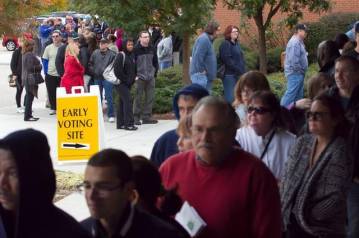
Donald Trump is saying “the truth is that we’re winning” – and claims that “phony polls” are trying to suppress the vote.
Trump spoke Monday at a farmers’ roundtable in Florida. He insisted that his campaign is ahead, even though most polls show him trailing Hillary Clinton.
He told the crowd gathered next to a pumpkin patch in Boynton beach: “I believe we’re winning.”
He then, without evidence, blamed that several “mainstream” media polls for weighing their respondents with Democrats.
He also told reporters that he felt “very good” about his chances in Florida, a state that is essential for his White House hopes.
This followed a CBS4 Florida interview where he railed about rigged elections and how the press has too much freedom of speech. Trump actually suggested that the First Amendment allowed “too much freedom of speech”. Welcome to the latest bits of authoritarianism displayed by this ugly, stupid, little man.
If Donald Trump is president, he’d like to make some changes to the First Amendment.
In an interview with WFOR, CBS’ Miami affiliate, Trump was asked if he believes the First Amendment provides “too much protection.”
Trump answered in the affirmative, saying he’d like to change the laws to make it easier to sue media companies. Trump lamented that, under current law, “our press is allowed to say whatever they want.”
He recommended moving to a system like in England where someone who sues a media company has “a good chance of winning.”
If Donald Trump is president, he’d like to make some changes to the First Amendment.
Trump has recently threatened to sue the New York Times and the numerous women who say he has sexually assaulted them.
Trump is right that he would have a better chance of prevailing under English law where an allegedly defamatory statement is presumed to be false. There, it is up to the defendant in a libel suit to prove that their statements are true.
But even if U.S. law were more like England’s, Trump might still have difficulty in prevailing against his accusers or the New York Times.
Many of Trump’s accusers have witnesses who can corroborate their stories. The reporter for People Magazine who says she was assaulted by Trump, for example, has six different people supporting her version of events.
English defamation law was also amended in 2013 to add a “public interest” exemption. This change would potentially allow the New York Times to escape liability in England even if they were unable to definitely prove the truth of their reporting.
He continues to confuse the USA with his personal little dictatorship driven personal corporations which frequently fail. While we can’t get his taxes released that show the extent of his failures and reliance on his father and the government, we have Wikileaks out there pilfering whatever they can from wherever they can to try to hurt Hillary and promote the Russian Agenda. The New Yorker has gone over the transcripts of Clinton’s speeches and found one big nothingburger.
So far, the documents have contained a few embarrassing revelations for Clinton—but they’ve been mild ones. Certain e-mails have confirmed that her campaign has been carefully scripted, to the point where numerous aides weigh in on something as mundane as the text of a tweet. The speech extracts, collected in an internal campaign document, showed Clinton courting senior figures from Wall Street, sympathizing with them for the blame they shouldered after the global financial crisis of 2008 and 2009, and telling them she valued their counsel on policy issues. In one speech, she acknowledged that, given her life style, she was “far removed” from the concerns of middle-class Americans. In another speech, she made a case for the political necessity of adopting different positions in public and private.
But did any of this surprise anybody? The stage-managed nature of Clinton’s campaign has been obvious all along: this is a candidate who went almost nine months without holding a proper press conference. The perception that Clinton had cozied up to bankers in return for large speaking fees was one reason so many Democrats voted for Bernie Sanders in the primaries. The wealth that Clinton and her husband have amassed since he left office in 2000 was hardly a secret. And, from welfare reform to same-sex marriage to the Trans-Pacific Partnership, Clinton’s willingness to tack with the wind on policy issues has been a recurring feature of her career.
The real value of the WikiLeaks documents is one the hackers may not have intended. The documents, particularly the speech extracts, portray Clinton as she is: a hard-headed centrist who believes that electoral politics inevitably involve making compromises, dealing with powerful interest groups, and, where necessary, amending unpopular policy positions. Addressing a General Electric Global Leadership Meeting in January, 2014, she said, “I mean, politics is like sausage being made. It is unsavory, and it always has been that way, but we usually end up where we need to be.” Answering a question in March, 2014, at an event organized by Xerox, she said that the country needs two “sensible, moderate, pragmatic parties.” These sentiments won’t win over many Sanders supporters. But they might actually reassure moderate Democrats, independents, and even some Trump-loathing Republicans who are thinking about crossing party lines.
For some reason, we’re all supposed to be shocked about this and wax poetic about Bernie or buy the Trumpertantrums. I’m doing neither. I’m taking this pussy to the poll. I’m voting for Hillary Clinton and I’m telling any one who believes conspiracy theories about massive election riggings they should get a life. Also, they should stop the comparisons to Bush v. Gore because that was heart-stoppingly close. Both the Obama elections and the upcoming Clinton election were and are anything but close. Get over it boys! They black man and the girl beat you fair and square! You’re days starting every activity in life on third base are coming to a close. Try to get to first base with the rest of us.
As Charles M. Blow says, “DEAL WITH IT”!
What’s on you reading and blogging list today?
Monday Reads: In Other News …
Posted: October 17, 2016 Filed under: Afternoon Reads | Tags: Bram Stoker, Dracula, Rabindranath Tagore, The Uberficaiton of the University 43 Comments
Good Afternoon!
I’m fighting a horrible, terrible, very awful sinus infection that I really wouldn’t wish on any one. You’re just fortunate you can’t hear my voice right now. I sound truly diabolical. Of course, nothing could be as diabolical as a Trump Rally or Trump surrogate rationalizing Trump’s descent into madness and our descent into yet a lower level of the inferno he’s created for the nation. That’s why I’m going to take yet another day for anything but Trump-related reads.
Remember, we have another debate coming up on Wednesday and a live blog. I’m shuddering with either fever or the thought of another Trump Horror show. I’m supposed to be at a pre-wedding thing for youngest daughter but I really hate to share this illness with any one but the ex. We’ll be here as your usual safe zone. Either way, I will have wine.
The news has been so overtaken with the general election craziness that it distracts from other important things. This is a truly great time of the year and it’s closing in on Halloween. Indulge me while I indulge one of my favorite things. Yup. It’s an ancient grave yard, a classic scary book, and travelling Transylvania armed with only Bram Stoker’s “Dracula” as your guide. What more could you want than to start your day with monsters that come from one’s imagination instead of the Republican Party? I think you’ll delight in the photos and words of Luke Spencer at Atlas Obscura. Go check it out!!!
Nighttime in Transylvania is as atmospherically spooky as you would hope it would be. During the winter, a thick, low-lying mist covers thick forests of pine trees and firs. Above the fog, you can see the silhouetted turrets and spires of ancient castles and fortified churches. Many of the old homes there still burn wood fires, adding to the smoky air, while the towns are filled with gothic and baroque buildings that were once beautiful, but are now marked by peeling paint and crumbling facades.
It is common at night to hear howling in the forests, either from stray dogs or wolves. It’s easy to see why Bram Stoker chose this part of Romania to be a setting for his most chilling creation, Dracula.
The first section of Stoker’s gothic horror masterpiece takes the form of a travel journal, written in shorthand by a young English solicitor, Jonathan Harker, who is traveling across Europe to help conduct a land purchase on behalf of a noble client. Harker keeps a detailed diary of his journey from Munich to Transylvania, where he plans to meet the mysterious Count Dracula in his castle.
My plan was to follow in the footsteps of the fictional Harker, taking the same train routes—where possible staying in the same cities, towns and hotels—and ending my journey at the home of Vlad the Impaler, the real-life inspiration for Dracula. Partly encircled by the Carpathian mountains, Transylvania is still largely unexplored, despite its beauty and wealth of fascinating, centuries-old sites.
 Some Brits are worried that we may be terribly distracted by the election. I know that Biden spoke about a possible cyber attack on Russia and that we essentially can’t sustain attacks on both Mosul and Aleppo which is why we’re focusing on the Iraqi attack on Mosul which we’re facilitating. John Kerry is planted in Europe right now trying to get our allies to consider some economic sanctions on Russia. So, there’s a lot in the air right now in foreign affairs which makes me even more glad we will have a President Hillary Clinton smoothly transitioning from the Obama administration.
The assault on the Iraqi city of Mosul that began this week underlines the fact that the next three months will be a perilous period in international politics. Fighting is intensifying in the Middle East. Tensions are rising between Russia and the west. And relations between China and its Asian neighbours are getting edgier. All this is happening while the US is diverted by the Trump-Clinton melodrama and the transition to a new president.
For Russia and China — two countries that are openly unhappy with the US-dominated world order — a distracted America will look like an opportunity. Both Moscow and Beijing regard Hillary Clinton with suspicion and believe that her probable arrival in the Oval Office would herald a more hawkish US foreign policy. They may be tempted to act swiftly, before she has a chance to settle into the White House.
A temporarily preoccupied America might not matter much in normal times. But big and dangerous decisions are looming. In the Middle East, the bombardment of Aleppo by Russian and Syrian government forces has led to a near-breakdown in relations between Moscow and the west. Without a common diplomatic project to hold them together, the two sides may slide into outright confrontation in Syria. Further sanctions on Russia are in the offing and the west’s military options are also being reviewed.
President Vladimir Putin may calculate that a US administration that has refused to take military action against the Assad regime since 2011 is unlikely to reverse course in President Barack Obama’s last few months in office. But if the Russians push too hard, they could miscalculate and provoke an American reaction. That is particularly the case because the Obama administration is angered by Russian cyber warfare, aimed at influencing the US presidential election. Joe Biden, the vice-president, has already signalled that America intends to retaliate in cyber space.
Even without a worsening of the situation in Syria, fighting in the Middle East will intensify in the coming weeks. The Iraqi government, backed by the air power of a US-led coalition, has begun a major push to retake Mosul from Isis. With one eye on his legacy and another on the presidential election, Mr Obama would be delighted to notch up a significant victory against Isis in the coming weeks.
I’d be really interested in seeing more of this on TV news but I’m usually greeted by some unhinged screed of some unhinged Trump surrogate instead. As you may know, I’m trying to make ends meet as a sharecropper University professor right now. Here’s a read at AltNet on a book about the sharing economy and university professors. It’s an interesting read.
My book, The Uberfication of the University, explores what neoliberalism’s further weakening of the social is likely to mean for the future organization of labor by examining data and information companies associated with the emergence of the corporate sharing economy. It focuses on the sharing economy because it is here that the implications for workers of such a shift to a postwelfare capitalist society are most apparent today. This is a society in which we are encouraged to become not just what Michel Foucault calls entrepreneurs of the self but micro-entrepreneurs of the self, acting as if we are our own, precarious, freelance microenterprises in a context in which we are being steadily deprived of employment rights, public services, and welfare support. Witness the description one futurologist gives of how the nature of work will change, given that 30 to 80 percent of all jobs are predicted to disappear in the next twenty years as a result of developments in automation and advanced robotics: “You might be driving Uber part of the day, renting out your spare bedroom on Airbnb a little bit, renting out space in your closet as storage for Amazon or housing the drone that does delivery for Amazon.”
Talk about being careful what you wish for: a recent survey of university vice-chancellors in the United Kingdom identifies a number of areas of innovation with the potential to reshape higher education. Among them are “uses of student data analytics for personalized services” (the number one innovation priority for 90 percent of vice-chancellors); “uses of technology to transform learning experiences” (massive open online courses [MOOCs]; mobile virtual learning environments [VLEs]; “anytime-anywhere learning” (leading to the demise of lectures and timetables); and “student-driven flexible study modes” (“multiple entry points” into programs, bringing about an end to the traditional academic year). Responding to this survey, an editorial in the academic press laments that “the UK has world-leading research universities, but what it doesn’t have is a higher education equivalent of Amazon or Google, with global reach and an aggressive online strategy.” Yet one wonders whether any of those proclaiming the merits of such disruptive innovation have ever stopped to consider what a higher education institution emulating the expansionist ambitions of U.S. companies like Amazon and Google would actually mean for those currently employed in universities.
 Science illiteracy in this country is truly reaching epic proportions. Lisa Ryan writes on the STATE OF THE UTERUS and has found a letter to the enditor where a “Pennsylvania Man Wonders What Will Happen to America If Hillary Clinton Has Her Period.”
We have many things to fear in today’s world. There’s terrorism, antibiotic-resistant bacteria, and sexual assault, to name a few. Yet one concerned citizen has finally alerted us to the greatest threat of all: a female president who has her period.
In a letter to the editor of the Williamsport Sun-Gazette, Carl Unger of Montgomery, Pennsylvania, pointed out that, while the “liberals and Obama are calling for social justice,” everyone is ignoring the bigger problem here. That, of course, is Hillary Clinton’s uterus.
“They call us sexist just because we are critical of Hillary Clinton and her health,” Unger wrote. “What if that time of the month comes and she is sick at the same time?”
And this is the point where I wonder if men understand women’s reproductive cycle and the concept of menopause at all. This article comes with a h/t to Delphyne. It appears that a “state actor” may have cut of Assange’s internet access. Wikileaks has been in the new recently for hacking what is claimed to be Podesta’s email. None have been officially recognized as real.
Wikileaks says an unidentified “state actor” has shut down internet access for its founder Julian Assange.
The transparency activist has been claiming asylum at London’s Ecuadorean embassy since 2012 to avoid extradition over sex assault allegations.
There was no way to immediately verify if he had been knocked offline, and if so, how a state actor was suspected.
Wikileaks has recently been releasing emails from Hillary Clinton’s presidential campaign.
The anti-secrecy organisation did not return calls and emails on Monday, though it said in a tweet: “We have activated the appropriate contingency plans.”
A woman who picked up the phone at the Ecuadorean embassy said: “I cannot disclose any information.”
I personally have not found anything to get hysterical about concerning the leaked emails but many of them seemed to be highly edited and coming from Russia. Maybe this is what Biden alluded to this week. The link leads to the MTP interview with Chuck Todd that aired yesterday morning.
 Did you know that Bob Dylan is not the only lyricist to have won the Nobel Prize in Lit? I’ve read Tagore, have you? My son-in-law’s Bengali family is quite proud of this really talented and brilliant man. He was not only a poet but a prolific fiction writer and musician.
There’s been a great deal of excitement over Bob Dylan winning the 2016 Nobel Prize for Literature. It’s rare for artists who have achieved widespread, mainstream popularity to win. And although Nobels often go to Americans, the last literature prize to go to one was Toni Morrison in 1993. Furthermore, according to The New York Times, “It is the first time the honor has gone to a musician.”
But as Bob Dylan might croon, “the Times they are mistaken.”
A Bengali literary giant who probably wrote even more songs preceded Dylan’s win by over a century. Rabindranath Tagore, a wildly talented Indian poet, painter and musician, took the prize in 1913.
The first musician (and first non-European) to win the Nobel Prize for Literature, Tagore possessed an artistry – and lasting influence – that mirrored Dylan’s.
Here’s an interesting read on a medical secretary who wanted to be a muse from The New Yorker. This article indicates that she was anything but a muse.
Mège began her project in 1986, when she was twenty years old. She had just moved to Paris from the province of Auvergne, not far from Lyon, where her father was the manager of an automobile-equipment shop and her mother stayed home. When asked about her childhood and adolescence, she uses words like “fine” and “calm” and “French.” At the time she came to Paris, she had never met an artist, and had been to few museum shows, but she collected record covers and postcards of images that appealed to her. One Saturday in mid-July, she went alone to an exhibition by the portrait photographer Jeanloup Sieff at the Musée d’Art Moderne. Stunned by the images, which depicted anonymous and ordinary, as well as famous, subjects, she wrote to Sieff, telling him that she liked his work. To her surprise, he telephoned her a few days later. She wrote in her diary, which she kept from 1986 until 2008, “He calls me, I’m extremely moved, surprised, I feel drunk.” She asked him if he would consider making a picture of her.
So, this is my humble offering today in the hope we can get our minds on the future challenges of the world with Madam President!
What’s on your reading and blogging list today?

 peej
peej Carissa
 bostonboomer
 dakinikat
 ecocatwoman
 jjlo
jjlo mablue2
 Mama Lopez
 peggysue22
 quixote
 skydancingguestblogger
 Mona (aka Wonk the Vote)





Recent Comments