
Paul Krugman Tries to Explain “Facts” to Ron Johnson and ABC “Powerhouse Roundtable”
Posted: March 10, 2013 Filed under: Affordable Care Act (ACA), Barack Obama, Medicare, open thread, Republican politics, Social Security, U.S. Economy, U.S. Politics | Tags: ABC's This Week, Paul Krugman, Senator Ron Johnson 23 Comments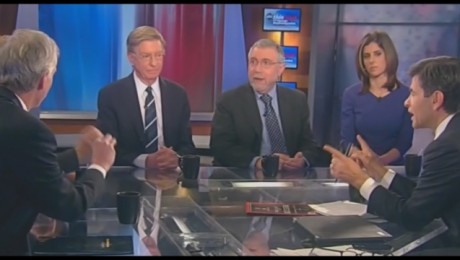
Are there stupider Senators than Ron Johnson (D-WI)? Maybe, but he has to be in the top five. Via Think Progress, this morning on ABC’s This Week, Johnson pulled out an old Republican canard, claiming that the Social Security Trust Fund is “a myth.” Nobel Prize-winning economics Paul Krugman attempted to set him straight. You can watch the partial video down below, but I decided to read the whole transcript of the interaction. Here’s how it went down.
Johnson and Krugman participated in the “Powerhouse Roundtable” with George Will, Bloomberg News White House Correspondent Julianna Goldman, and DNC Chair Rep. Debbie Wasserman Schultz. The group began by discussing President Obama’s supposed charm offensive of the past few days. Johnson rambled on about how Obama is doing the right thing by “reaching out” to the GOP and maybe something can come of it. I have to hand it to Krugman, because he immediately steered the discussion toward the GOP and Obama’s hopes for cutting earned benefit programs.
KRUGMAN: I’m really skeptical, because I — I mean this is not — this is not about bad personal relations. People are perfectly capable of being polite to each other, being nice, having a nice dinner. This is about a fundamental difference in visions about what America should be…One party really wants to take down the — the — the safety net we have. One party really wants….to privatize Medicare, wants to, you know roll back, wanted to try to privatize Social Security back in 2005. The other party wants it somewhat extended, wants Obamacare to go into place, would do more if it could. That’s not something you’re going to resolve with a few dinners.
Corporate media shill Juliana Goldman chimes in to state the village consensus:
Look, both sides understand what a grand bargain is going to look like. You’re going — Republicans are going to have to give on revenues, Democrats are going to have to give on entitlements. And so there is some case for optimism now that if the president, in trying to build trust…if Republicans see the president moving forward, putting Medicare savings on the table that doesn’t just hit providers, but also hits beneficiaries as well, then — and also going out and selling it to give Republicans some cover, then there could be a sense that you could get some Senate Republicans to — to help bring the House along.
George Will brings up raising the Medicare age and asks Debbie Wasserman Schultz if there’s any chance all those old codgers in Florida will ever see the light so that Democrats could go along with this brilliant idea? No real response from Schultz, so Krugman (he was on fire today!) jumped in again. From here on, I’ll just focus on the interaction between Johnson and Krugman and leave out the few remarks by others.
KRUGMAN: Is it a condition of any Republican support that you have to go for really terrible policies? Because raising the Medicare age is a terrible policy. It raises medical costs, it does very little to improve the budget. It introduces a lot of hardship. Means testing in Medicare is a better policy. I don’t particularly like it, but it’s a better policy. There are other things you can do. There are other ways you can cut. Even — I don’t like the business about changing, you know the price index for Social Security, but that’s not as bad…
JOHNSON: To say that the Republicans haven’t done anything, is just false. The House has actually passed budgets. You know with — with proposals to — to try and save Medicare, bipartisan proposals, quite honestly. The Senate hasn’t passed a budget in over four years. Listen, unless we do something, these programs are going broke. It drives me nuts. When I — when I hear people say that Social Security is solvent to the year 2035, it’s not….
Listen, if you — if you’re taking a look at, in a entitlement reform package, in term — you know actually bringing in revenue for those entitlement reforms, I might look at that. But the fact of the matter is — the fact of the matter is, we already have a $1 trillion in middle income tax increases hitting us in Obamacare. They’re hidden, but it’s middle-class….it’s certainly true, as well as another $600 billion. So, you’ve already got $1.6 trillion worth of tax increases hitting us in the next 10 years….
KRUGMAN: Just a question, you say let’s start with the facts, but there — we’ve just — we’ve just run aground right there….JOHNSON: You’ve made my point — you’ve made my point, we have to agree on the facts….But the facts are false.
JOHNSON: No they are not….They are not false.
KRUGMAN: The Social Security thing, Social Security is — there — it has a dedicated revenue base. It has a trust fund based on that dedicated revenue base. You can’t change the rules midstream and say, oh suddenly….
JOHNSON: …here’s the problem with the trust fund, the federal government owns U.S. Treasury bonds, it’s the same thing as if you have $20.00, you spend it. And by the way, that money is spent, it’s gone. You write yourself a note for $20.00, stick it in your pocket and say, I got 20-bucks…No, you don’t. You — you have a note that you have to sell in the open market. The trust fund is a fiction, it doesn’t — it’s…
KRUGMAN: If you — if you want to think of Social Security as not just being part of the government, then there’s no such thing as a Social Security problem, it’s just part of the general budget. You — you cannot say on the one hand….on — on the other hand we’re going to — we’re going to restrict it to only operating off of…it’s important to realize that the facts that are being brought out here are in fact, non-facts.
Here’s the video from Think Progress:
From a piece Kevin Drum wrote last fall in response to WaPo columnist Charles Krauthammer spouting the “Social Security Trust Fund is a fiction” meme. Like Johnson, Krauthammer was arguing that because Social Security funds are invested in Treasury bonds which it cashes in when current funds aren’t sufficient for immediate needs, that the Trust Funds is just “a bunch of useless IOU’s,” to quote George W. Bush.
Here’s Drum:
What Krauthammer means is that as Social Security draws down its trust fund, it sells bonds back to the Treasury. The money it gets for those bonds comes from the general fund, which means that it does indeed have an effect on the deficit.
That much is true. But the idea that the trust fund is a “fiction” is absolutely wrong….Starting in 1983, the payroll tax was deliberately set higher than it needed to be to cover payments to retirees. For the next 30 years, this extra money was sent to the Treasury, and this windfall allowed income tax rates to be lower than they otherwise would have been. During this period, people who paid payroll taxes suffered from this arrangement, while people who paid income taxes benefited….
As the baby boomers have started to retire, payroll taxes are less than they need to be to cover payments to retirees. To make up this shortfall, the Treasury is paying back the money it got over the past 30 years, and this means that income taxes need to be higher than they otherwise would be. For the next few decades, people who pay payroll taxes will benefit from this arrangement, while people who pay income taxes will suffer.
If payroll taxpayers and income taxpayers were the same people, none of this would matter. The trust fund really would be a fiction. But they aren’t. Payroll taxpayers tend to be the poor and the middle class. Income taxpayers tend to be the upper middle class and the rich. Long story short, for the past 30 years, the poor and the middle class overpaid and the rich benefited. For the next 30 years or so, the rich will overpay and the poor and the middle class will benefit.
The trust fund is the physical embodiment of that deal. It’s no surprise that the rich, who didn’t object to this arrangement when it was first made, are now having second thoughts. But make no mistake. When wealthy pundits like Krauthammer claim that the trust fund is a fiction, they’re trying to renege on a deal halfway through because they don’t want to pay back the loans they got.
It’s disgusting that this has to be explained over and over again to the willfully obtuse Republicans and the media talking heads, but I have to say that I’m glad Krugman was there this morning to call attention to the stupidity of what the GOP–and Obama–are proposing.
Now, here’s a bonus for you that I found at Americablog this morning. Florida Rep. Alan Grayson is warning there will be “civil disobedience” if Social Security benefits are cut.
What are you hearing and seeing out there? This is an open thread.
Lindsey Graham: Trade Health Care for Millions for Sequester’s Military Cuts
Posted: February 17, 2013 Filed under: Affordable Care Act (ACA), Barack Obama, Republican politics, U.S. Economy, U.S. Politics | Tags: guns, Lindsey Graham, military cuts, Obamacare, sequester 18 Comments
Senator Lindsey Graham appeared on Fox News Sunday today and put on one of his patented disagreeable and self-righteous displays, apparently in aid of making himself look like a tough guy to the right wing nuts back home in South Carolina.
Graham has been living in fear for quite some time now–terrified that some tea party bot will challenge his seat in the Senate and bring him down like Mike Lee did to Bob Bennett in Utah and Richard Mourdock did to Richard Lugar in Indiana.
Over the past few months, Graham has appeared more and more desperate–joining John McCain in a manic freakout over the Benghazi attacks and ginning up bizarre attacks President Obama’s nominee for Secretary of Defense, former Republican Senator Chuck Hagel. He even went so far as to claim that Hillary Clinton “got away with murder” in the Beghazi affair. Dana Millbank recently called Graham “the mad dog of Capital Hill.”
Graham’s nasty-guy act seems to be working, according to Politico. So far no one has come forward to primary him, although SC state senator Lee Bright is still thinking about it.
Graham’s recent run is hard to miss: He helped sink U.N. Ambassador Susan Rice’s chance of becoming secretary of state. He said on Fox that Hillary Clinton “got away with murder” in the aftermath of last year’s terrorist attack on a U.S. diplomatic outpost in Benghazi, Libya. In just the past couple of weeks, he’s used his positions on the Armed Services and Judiciary committees to rip into defense secretary-designate Chuck Hagel, Joint Chiefs of Staff Chairman Gen. Martin Dempsey and witnesses who favor new gun-control measures.
On Tuesday, Graham pounced to discredit Timothy Heaphy, the U.S. attorney for the western district of Virginia, during a hearing on gun violence.
His first question: “Do you own a gun?”Heaphy acknowledged that he didn’t.
“Do any of your close friends own a gun?” Graham pressed….
Never mind that most federal prosecutors have some expertise with gun violence or that U.S. attorneys need special permission from the Justice Department to carry firearms at work. Graham had scored the political point.
I didn’t get the point, but I’m guessing it’s related to Graham’s recent bragging about owning an AK-47. And look out bad guys–Graham also likes Quentin Tarrantino!
“Being from South Carolina, I’ve owned guns all of my life,” Graham said at a press conference. “I own an AR-15. I saw the movie ‘Django [Unchained].’ I like Quentin Tarantino.”
“That may say a lot about my movie taste, but there are many moving parts to this,” he added.
It’s not the first time Graham has invoked his AR-15 while arguing against new gun laws — the senator recently mentioned his semi-automatic rifle while making the case that high-capacity magazines are needed to protect families.
It was, however, the first time Graham has weighed in on Tarantino’s much-debated slavery revenge flick. He appeared to be arguing that violence in the media and video games ought to be discussed, while simultaneously making the case that individuals such as himself could act as both responsible gun owners and consumers of violent cinema.
Today in his Fox News Sunday appearance, Graham really went all out–arguing that preventing cuts to the military is more important than providing health care for Americans. It’s looking more and more as if Republicans will allow the sequester cuts to happen at the end of the month, and Graham claims the defense cuts will “destroy the military.” From Think Progress:
Graham suggested that the sequester’s across-the-board cuts to federal spending, including about a roughly 7.5 percent reduction in military spending, would be “destroying the military.” But rather than agree to President Obama’s proposed alternatives to the sequester, the South Carolina Republican said we should save money by eliminating health care for the 30 million people covered by the Affordable Care Act:
CHRIS WALLACE: Let me just ask you one more question about the sequestration before we let you go, Senator. You know if we go into the sequester, the president is going to hammer Republicans, the White House already put out a list of all the things, terrible things that will happen if a sequester kicks in, 70,000 children losing Head Start. 2100 fewer food inspectors and small business will lose $900 million in loan guarantees and you know, Senator, the president will say your party is forcing this to protect tax cuts for the wealthy.
GRAHAM: Well, all i can say is the commander-in-chief thought — came up with the idea of sequestration, destroying the military and putting a lot of good programs at risk. It is my belief — take Obamacare and put it on the table. You can make $86,000 a year in income and still get a government subsidy under Obamacare. Obamacare is destroying health care in this country and people are leaving the private sector, because their companies cannot afford to offer Obamacare and if you want to look at ways to find $1.2 trillion in savings over the next decade, look at Obamacare, don’t destroy the military and cut blindly across the board. There are many ways to do it but the president is the commander-in-chief and on his watch we’ll begin to unravel the finest military in the history of the world, at a time when we need it most. The Iranians are watching us, we are allowing people to be destroyed in Syria, and i’m disappointed in our commander-in-chief.
I’m no expert on the “Sequester”–I’ll leave that to Dakinikat–but frankly, I believe the military could be cut plenty and not be “destroyed.” Here’s an analysis by Laura Matthews of the International Business Times from Feb. 8:
Looking at the possible cuts closely, some experts say that these politicians are overreacting, and that, in reality, they are defending the Pentagon’s bureaucratic turf — its value as measured by its annual funding — not the country in opposing the budget cuts.
“The Defense Department will have enough latitude to protect what’s crucial and I don’t think we will be less safe in 2013 or thereafter,” said Mattea Kramer, the research director at the National Priorities Project in Northampton, Mass.
For one thing, the 2011 U.S. defense budget, about $700 billion, dwarfed those of all other nations by a large amount. China, the second-biggest spender, had a defense budget of $143 billion that year, according to the Stockholm International Peace Research Institute. No other country even breaks into the triple digits of billions of dollars.
For another, because the spending cuts will roll in over a decade, the average yearly cut would be about $45 billion, little more than 5 percent of America’s annual defense spending. And, according to Lawrence J. Korb, a senior fellow at the Center for American Progress in Washington and an assistant secretary of defense in the Reagan administration, “even if the defense budget were reduced by the entire $1 trillion, or about $100 billion a year over the next decade, it would amount to a reduction of [the defense budget] of about 15 percent.” Which means that annual defense spending would be about equal to what it was in 2007 — when the U.S. was involved in two active wars.
Matthews writes that the “Sequester” provides an “opportunity” to
revisit the nature of global threats and its response to them, a growing of experts believe. National-security needs have shifted dramatically since the Cold War, from containing a lone rival superpower to combating terrorism, fighting smaller conflicts, and cyberwarfare. In that time, the U.S. has, in many ways, moved away from deterrence to prevention.
The key capability that the Defense Department should focus on in this environment is navigating a more varied, contested, and asynchronous battlefield, the experts say. Instead of ballistic missile defense programs, the Pentagon would be better served and its budget better used by spending more money to train and equip special-operations forces, the kind that killed Osama bin Laden, and to develop more innovative submarines, unmanned and manned stealthy long-range aircraft, and offensive and defensive cyberwarfare systems, said Todd Harrison, a defense and budget expert with the Center for Strategic and Budgetary Assessments in Washington.
In November 2012, Ezra Klein used the following graph to demonstrate that “the sequester’s defense cuts aren’t that scary.”
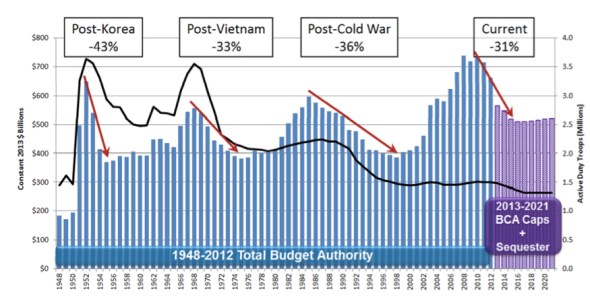
Th[e] graph comes from the Center for Strategic and International Studies, and it shows real military spending since the Korean War (“real” in that the graph adjusts for inflation).
As you can see, the post-9/11 rise in military spending was larger than the rise during Vietnam and during the Cold War. And even if we implement every single cut in the sequester, the fall in spending would be less than the military experienced after Korea, Vietnam, or the Cold War.
Getting rid of Obamacare, on the other hand, would increase the federal deficit by 109 billion over a decade, according to the Congressional Budget Office.
We’re seeing how much it’s worth to Lindsey Graham to save his seat in the Senate. If ever had a soul, he’s sold it now. If that has made him happy, it sure doesn’t show.
John Mackey and Whole Foods: Biting The Hands That Feed Them
Posted: January 16, 2013 Filed under: Affordable Care Act (ACA), open thread, U.S. Economy, U.S. Politics | Tags: Bread and Circus, Erewhon, fascism, John Mackey, Libertarianism, natural foods, organic foods, socialism, Whole Foods 16 Comments
My local Whole Foods Mkt.
When I first moved to Boston in 1967, there was an amazing natural food store on Newbury Street called Erewhon. It was started by Michio Kushi and his wife Aveline and focused on Kushi’s macrobiotic diet. You could get all kinds of interesting foods there like tamari sauce, miso, natural peanut butter made out of just peanuts, and all kinds of strange grains, beans, and vegetables. The store had sawdust on the floor and big barrels with foodstuffs in them. I used to take the T downtown to shop there and then drag my purchases home in great big cloth bags. Eventually Erewhon expanded and opened a store in Cambridge and it got easier to shop there. Erewhon was a pioneer in making organic foods available to the public.
In the late 1970’s another natural foods store opened in Brookline. It was called Bread and Circus, and the company soon expanded into Cambridge, Wellsley, and a few other Boston suburbs. It was a great place to shop and didn’t have the “health food” aura of Erewhon, where you would see lots of sickly-looking macrobiotic mavens. Unfortunately, in the early 1990’s Bread and Circus was bought out by the Texas company, Whole Foods Market. And it’s been pretty much downhill from there. The prices are sky high and the standards for what constitutes “whole foods” have slipped.
Under co-founder and CEO John Mackey, Whole Foods is much more focused on marketing than on health. Mackey is an obsessive libertarian, who in 2009 wrote an obnoxious op-ed in the Wall Street Journal in which he suggested that Obama’s health care initiative was socialistic. Here’s just a taste.
With a projected $1.8 trillion deficit for 2009, several trillions more in deficits projected over the next decade, and with both Medicare and Social Security entitlement spending about to ratchet up several notches over the next 15 years as Baby Boomers become eligible for both, we are rapidly running out of other people’s money. These deficits are simply not sustainable. They are either going to result in unprecedented new taxes and inflation, or they will bankrupt us.
While we clearly need health-care reform, the last thing our country needs is a massive new health-care entitlement that will create hundreds of billions of dollars of new unfunded deficits and move us much closer to a government takeover of our health-care system. Instead, we should be trying to achieve reforms by moving in the opposite direction—toward less government control and more individual empowerment.

In 2010, Mackey tried to save the company some money by punishing employees with exercise and garcinia cambogia supplementation for those whom he deemed to be too fat, giving them smaller discounts for their purchases from the stores than thinner employees got. The reaction was swift and negative, and from what I can tell, the initiative was quietly dropped. The company would have been sued over it anyway. Oh, and Mackey hates unions too.
I don’t know who shops at Whole Foods in Texas, but around here it’s mostly the ex-hippies like me along with what we used to call “yuppies” and other politically liberal types. As Mackey found out in 2009 and 2010, his libertarian lecturing doesn’t go over too well with his clientele. After each of these episodes, I became less interested and wasting my “whole paycheck” at Whole Foods. I still go there sometimes, but usually only to buy things I can’t find anywhere else. After today, I’m going to feel even less enthused about shopping in Mackey’s Markets.
I’m sure you’ve heard by now that today Mackey told NPR that Obamacare is worse than socialist–it’s fascism! It’s seems Mackey has a new book out called Conscious Capitalism. He told NPR that his goal is to convince people that corporations aren’t really “primarily selfish and greedy.”
Mackey sat down with Morning Edition host Steve Inskeep to discuss his philosophy and the new book he co-authored, Conscious Capitalism. Part 1 airs Wednesday, Part 2 on Thursday….
When Inskeep asks him if he still thinks the health law is a form of socialism, as he’s said before, Mackey responds:
“Technically speaking, it’s more like fascism. Socialism is where the government owns the means of production. In fascism, the government doesn’t own the means of production, but they do control it — and that’s what’s happening with our health care programs and these reforms.”
Apparently NPR has been dissing Whole Foods for awhile now. There was funny piece about it at The Atlantic in 2011: NPR Is Slowly Breaking Up with Whole Foods. Mackey would probably be more comfortable appearing on right wing talk shows; but he wouldn’t reach his target demographic that way, so he has to go on NPR. There’s a real mismatch between this CEO and his customers.
Well, around here, lots of the supermarkets carry organic fruits, vegetables, eggs, butter, dairy products and meats now, so there isn’t as much need to go to a specialty store with sky-high prices. My biggest problem is that Whole Foods recently bought out a local food chain that ran the most inexpensive and convenient store in my neighborhood. By next fall, the closest grocery store to me will be a Whole Foods. Can I resist stopping there and drive 15-20 minutes to get to another store when I’m in a rush or tired? It won’t be easy but I’m going do my best.
Anyway, this is an open thread. What’s on your mind tonight?
Thursday Reads: The Morning After
Posted: October 4, 2012 Filed under: 2012 presidential campaign, Affordable Care Act (ACA), Barack Obama, Medicaid, Medicare, Mitt Romney, morning reads, Social Security, U.S. Economy, U.S. Politics | Tags: first presidential debate, lies 53 Comments
Good Morning!!
OK, I don’t drink, but I still feel hung over. That debate last night was pathetic. Romney babbled incoherently, but sounded smooth. Obama made sense and gave specifics, but sounded hesitant and herky-jerky. We’ll have to wait and see what happens to the polls, but the consensus of the pundits and liberals on Twitter is that Romney won this one. I think Obama forgot he is the president and acted like a challenger. I simply cannot believe that neither Obama nor Jim Lehrer asked Romney about his “47 percent” remarks!
Anyway, I still have a nasty cold, I’m discouraged, and tired, so I’m just hoping this post will make sense. I’m going to link to some early reactions to the debate and leave it at that.
Jennifer Granholm has predicted a couple of times that Obama would lose the first debate. From Time’s Swampland:
You recently predicted that Obama would lose the first debate. Then you suggested that the media might assign him a loss whether he deserves a win or not. Can you explain that?
The first time, I mentioned two reasons why I think he’s going to lose. One is, he’s not in debate shape in the same way that Romney is. But more importantly, the media does not like a lopsided race, and it’s appearing to be lopsided at the moment. So in order to sustain the race, I think there will be a narrative of the comeback-kid Mitt Romney.
The candidates have been busy playing the low-expectations game. Are you just helping Obama be self-deprecating?
No, I’m just looking at it purely from who’s in practice and who’s not in practice … Part of that might be that the incumbent is confronted, on this national stage, in a way that he is not usually confronted … I don’t discount that he’s a good speaker, but he does speak in paragraphs, and debates are not the place to do that.
She was right. Now for some media reactions.
LA Times: Mitt Romney loves Big Bird, will kill funding for him anyway
No question, Mitt Romney’s extensive debate preparation is paying off. At least in the first half of the debate, he seemed more emotionally connected than President Obama with the material — making jokes and self-deprecating remarks and even invoking Big Bird in a discussion about the deficit and budget priorities….
Then, looking at moderator Lehrer, Romney said, “I’m sorry, Jim, I’m gonna stop the subsidy to PBS…. I like PBS, I love Big Bird — I actually like, you too — but I am not going to keep spending money on things [we have] to borrow money from China to pay for.”
IMO, Romney looked energetic, but he wasn’t funny. Frankly, the biggest problem for anyone debating Mitt Romney is that he is the most amazing liar ever. How do you debate someone who lies constantly and even tells conflicting lies? The only way it would be possible is if you had a moderator. Jim Lehrer was completely ineffectual. Just wait till we have to see Bob Schieffer try it. He’s around 80 isn’t he? I don’t think Lehrer is quite that old, and I think he lost consciousness a couple of times last night.
Ben Smith at Buzzfeed: How Mitt Romney Won The First Debate
Mitt Romney, trailing in the polls, needed to prove tonight that he could stand on stage with President Barack Obama as an equal and a plausible president of the United States.
He did that in the crucial first 40 minutes of Wednesday night’s debate, addressing Obama respectfully, even warmly — but then tangling with a sometimes hazy and professorial Obama on taxes and deficits.
“You don’t just pick the winners and losers — you pick the losers,” he told Obama of his energy investments, sliding time and time again into a second person singular address calculated to level the rhetorical playing field.Romney departed dramatically from the hard conservatism of his primary campaign, downplaying the scope of his tax cuts.
“There will be no tax cut that adds to the deficit,” he said, without fully explaining how he’d accomplish that.
In other words, Romney lied and neither the moderator nor the incumbent president challenged him on his lies. Obama was incredibly passive.
Talking Points Memo: Obama Supporters: Which Obama Was That?
The early consensus on the debate among the pundit class: Mitt Romney helped himself a lot with a strong first debate performance, President Obama didn’t. And that included plenty of commentators supportive of Obama as well.
“It looked like Mitt Romney wanted to be there and President Obama didn’t want to be there,” Democratic strategist and CNN contributor James Carville said. He later added Obama did not bring his “A game.”
Alex Castellanos, a former Romney advisor who has often been critical of his campaign, said he was surprised by his “very effective” performance.
Many were surprised that Obama appeared reluctant to go on offense, never mentioning many of his own campaign’s attacks on Romney over Bain Capital or his recent leaked remarks dismissing 47 percent of Americas “victims.” In general, commentators suggested he appeared less comfortable than Romney onstage.
Josh Marshall wrote something I heard Al Sharpton say on MSNBC last night. Romney committed himself to a lot things that are going to get him in trouble in the next few days when the pundits get over his surface performance and look at what he actually said.
Two things happened in this debate. Romney had the energy and focus, a long series of arguments packed and tight to dish out in the debate. He didn’t get distracted. He had a game plan he stuck to. What struck me a lot of times through the debate was that Obama seemed pained. He didn’t seem happy. And people like seeing happy people….
Romney’s focus though came at the cost of a few key things.
He basically tossed aside his own tax plan or said he would if his numbers didn’t add up. But then he insisted that he could find enough loopholes to close to afford a $5 trillion tax cut for upper income earners. These are more numbers on the table. That’s really what most of the debate was about — budget numbers. Romney insisted with a straight face that up was down….
The numbers simply don’t add up. Over a few news cycles that can build up really fast. He says he’ll push massive upper income tax cuts and those have to come at the cost of much higher deficits or big tax hikes for middle income people. His campaign agenda is based on a massive deception.
That’s the vulnerability Romney brings out of this debate. And it may be bigger than people realize.
Greg Sargent: A good night for Mitt Romney, but was it really enough?
Mitt Romney had a very good debate tonight. Though debates often reinforce existing perceptions, Romney took steps towards reversing his image as an out of touch plutocrat. During the extended jousts of numbers crunching, he humanized himself in an unexpected way — by converting his boardroom aura from something cold and aloof into an aura of earnestness. He skillfully played the part of the technocratic centrist he used to be and whose balanced approach to policy and government he has completely abandoned. Romney also landed clear blows when indicting the Obama recovery. He seemed particularly on message in claiming that the proof that Obama’s government centric policies had failed could be found in the current state of the economy.
Obama missed key opportunities.When invoking Romney’s suggestion that kids should borrow money from their parents to pay for college, he was far too polite and discursive and didn’t make the moment stick. His defense of Obamacare took too long to make the point that Romney, in repealing the law, would take insurance away from millions without replacing it with anything.
That said, Obama won some understated victories. He won the battle over Medicare; Romney was effectively defined by that exchange as Mr. Voucher. Obama did a decent job in exposing Romney’s lack of specificity on many of the issues that were discussed tonight, and tied them together into a larger pattern of evasiveness on Romney’s part.
Ed Kilgore: Spin Room
I gather from brief glances at Twitter and initial reaction at NBC that Mitt won pretty big on style points.
A lot of progressives are beside themselves that Obama didn’t mention Bain Capital, didn’t mention the 47%, didn’t mention the Ryan Budget (except indirectly), didn’t mention inequality, didn’t mention abortion/contraception, didn’t mention immigration. Very heavy emphasis, as I noted, on Mitt’s “vagueness.” ….
You know, I’m often a bad judge of these things because I really don’t give much of a damn about “energy levels” or “aggressiveness,” and I tend to care a lot when I know a candidate is lying through his or her teeth. But if viewers thought Obama was phoning it in, that will matter, and it will matter a lot more if they are being told by every talking head in Christendom that Romney won big.
The $64,000 question is whether this will have an impact on actual candidate preferences, which have been amazingly stable.
Jonathan Chait: The Return of Massachusetts Mitt.
Tonight’s debate saw the return of the Mitt Romney who ran for office in Massachusetts in 1994 and 2002. He was obsessive about portraying himself as a moderate, using every possible opening or ambiguity – and, when necessary, making them up – to shove his way to the center. Why he did not attempt to restore this pose earlier, I cannot say. Maybe he can only do it in debates. Or maybe conservatives had to reach a point of absolute desperation over his prospects before they would give him the ideological space. In any case, he dodged almost every point in the right wing canon in a way that seemed to catch Obama off-guard.
Romney was able to take advantage of the fact that Obama has a record, and he does not. Obama has had to grapple with trade-offs, and Romney has not. So Romney is a candidate of a 20% cut in tax rates, a new plan to cover people with preexisting conditions, and higher defense spending, and he will accomplish it all by eliminating federal funding for PBS. He would not accept that his proposal would result in any tradeoffs at all – no lower funding for education, no reductions in Medicare for anybody currently retired. He insisted his plan would not cut taxes for the rich, which is false. He described his proposal to allow people with continuous health insurance to keep it – a right that, as Obama already noted, already exists, and is therefore a meaningless promise – as a plan to cover all people with preexisting conditions.
Romney did not waste a breath. Obama wasted many, with “uhs” and long, wonky discursions. He went on long, detailed riffs defending his policies, with attacks on Romney few and far between. Romney added little to his longstanding indictment of Obama, but defined himself far more effectively than he has before.
I do think the instantaneous, echo chamber reaction that is handing Romney an overwhelming victory is overstated. Romney made a huge error selling his Medicare plan, promising, “if you’re around 60, you don’t need to listen any further.” It was a moment he went from smooth to oily – when you urge voters to stop paying attention, and especially on an issue where they start off distrusting you, it heightens the distrust. Obama replied, “if you’re 54 or 55, you might want to listen, because this will affect you.”
Okay, that should be enough to get you started. I’m already not quite as upset as I was a little while ago, because I think it’s true that Romney is going to be confronted with all the lies and backtracks he pulled in this debate.
So what are you reading and blogging about today? This is an open thread–you don’t have to discuss the debate.
Do Corporations Have the Right to Inflict Religious Views on Employees?
Posted: July 28, 2012 Filed under: Affordable Care Act, Affordable Care Act (ACA), religious extremists, Reproductive Health, Reproductive Rights 16 CommentsHere we go again with the christoban and their desire to force us all to conform with their narrow interpretations of human life. Will a court grant a nonreligious corporation the  right to inflict its religious views on its employees based on the owner’s “freedom of religion”?
The U.S. District Court for Colorado on Friday blocked the Obama administration from requiring an air-conditioning company in Colorado to provide no co-pay contraceptives to its employees, as the Affordable Care Act directs.
It was, as Sam Baker points out, the first time a federal court has ruled against that provision of the health-care law.
It’s not yet, however, exactly a victory for the contraceptive mandate’s opponents: The injunction is specific to that one company, and it holds only until the judge can reach a verdict on the case’s merits. Still, it could mark the start of a long period of litigation involving one of the health-care law’s most polarizing provisions.
Hercules v. Sebelius is a case brought by Hercules Industries, a Colorado-based air-conditioning company. The four siblings who own the business say they oppose contraceptives — such medications are not included in their current health coverage plan — and “seek to run Hercules in a manner that reflects their sincerely-held religious beliefs.”
The health-care law’s required coverage of contraceptives without co-pay is slated to come into effect next week, on Aug. 1. Religious institutions that primarily serve individuals of their own faith got a one-year reprieve. Hercules, as an air-conditioning company, did not fall into that category.
Hercules is challenging the birth control mandate as a First Amendment violation, inhibiting its ability to practice religion freely. The company also argues that the mandate violates the Religious Freedom Restoration Act, or RFRA, a law from the 1990s that is meant to afford greater legal protection to religious institutions from federal requirements that “substantially burden” their ability to practice religion.
Obviously, an A/C company is not a church or church-affiliated corporation so it can’t get access to the run-around that the Obama administration set up for catholic-based colleges as an example. But what can of worms would this open? Does providing birth control for a few employees or their wives put a “substantial burden'”on the religious practice of the owners? Also, what other kinds of heinous practices would get protection should this argument pass muster with the courts? Firing an GLBT employee or a woman who doesn’t believe in submitting herself to a husband? How about a Jewish person that doesn’t want to go along with a christmas party?
The American Civil Liberties Union criticized the ruling.
“This is not religious freedom, this is discrimination,” said Sarah Lipton-Lubet, policy counsel for the ACLU Washington Legislative Office. “Real religious liberty gives everyone the right to make their own decisions about their own health, including whether and when to use birth control. It doesn’t give anyone the right to impose their beliefs on others.”
I’m sure these people would be screaming bloody murder to the courts if they were forced to recognize the beliefs and practices of other religions. Suppose I decided I could fire an employee based on them say, eating animal flesh or using an exterminator because it goes against the Buddhist belief of non-harming? My guess is that they scream about being placed under some form of Buddhist Shari’a.

 peej
peej Carissa
 bostonboomer
 dakinikat
 ecocatwoman
 mablue2
 Mama Lopez
 peggysue22
 quixote
 skydancingguestblogger
 Mona (aka Wonk the Vote)



 Sky Dancing
Recent Comments