
The Real Debt we’re Leaving our Children
Posted: September 8, 2012 Filed under: academia | Tags: student loan crisis 12 Comments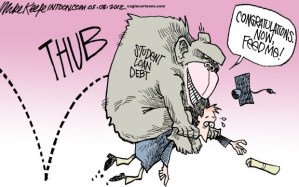 As you know, I just finished my doctorate and my youngest just finished her online bachelors degree. I’d really like her to go get an MBA right now but she sees the debt that her sister accumulated during med school and my student loan debt which just basically happened over the last two years. Tuition is going up almost as astronomically as health care costs because of the great recession. Lack of jobs after school is a problem. The youngest is bar-tending and doing part-time temp jobs in NOmaha. She has yet to round up a good job. I’m still looking for a tenure track position while working as an adjunct. The only one that can probably hand the student loan debt is Dr. Daughter. I didn’t get student loans for my undergrad or my first graduate degree. I paid for them both. This time, I just couldn’t swing the tuition. My student loan is actually larger than my house loan at the moment. That scares me when I think about it. But, it would worry me more if I was younger. Read these two NYT articles to see why.
At a protest last year at New York University, students called attention to their mounting debt by wearing T-shirts with the amount they owed scribbled across the front — $90,000, $75,000, $20,000.
Amanda Cordeiro of Clermont, Fla., owes $55,000 in student loans. She has changed her phone number about four times in a year to avoid being found.
On the sidelines was a business consultant for the debt collection industry with a different take.
“I couldn’t believe the accumulated wealth they represent — for our industry,” the consultant, Jerry Ashton, wrote in a column for a trade publication, InsideARM.com. “It was lip-smacking.”
Though Mr. Ashton says his column was meant to be ironic, it nonetheless highlighted undeniable truths: many borrowers are struggling to pay off their student loans, and the debt collection industry is cashing in.
As the number of people taking out government-backed student loans has exploded, so has the number who have fallen at least 12 months behind in making payments — about 5.9 million people nationwide, up about a third in the last five years.
In all, nearly one in every six borrowers with a loan balance is in default. The amount of defaulted loans — $76 billion — is greater than the yearly tuition bill for all students at public two- and four-year colleges and universities, according to a survey of state education officials.
Yes, collecting student loan debt from students who face the worst job market since the Reagan years is now a cottage industry. Oh, wait, I forgot, I was just supposed to take a loan out from my 90 year old father. Right?
Last year, a study by the Institute for Higher Education Policy found that for every borrower who defaulted, at least two more borrowers were delinquent in their payments. And in March, the Federal Reserve Bank of New York, using a survey of credit reports, concluded that more than one in four borrowers of student loans, both federal and private loans, were behind on their payments.
Long-range projections by the Department of Education estimate that the default rate over 20 years, for borrowers who began repayment in 2009, is 17 percent; among students who attended profit-making colleges, the predicted default rate is 49 percent.
It is messy, though, to compare those long-range estimates with the official default rate published by the Department of Education. The long-range estimates are calculated on the dollar amount of loans in default, while the official rate is based on the number of borrowers in default.
Looking at defaults another way, about 15 percent of all borrowers have been in default at the end of the last six fiscal years, which ends Sept. 30, according to Department of Education data. Currently, 16 percent of borrowers are in default, nearly twice the official default rate.
This is a problem on all kinds of levels.
Government officials estimate they will collect 76 to 82 cents on every dollar of loans made in fiscal 2013 that end up in default. That does not include collection costs that are billed to the borrowers and paid to the collection agencies.
While the government’s estimates take into account the uncertainty of collecting money over long periods, some critics say they don’t go far enough.
A 2007 academic study, for instance, estimated that the recovery rate was closer to 50 cents on the dollar.
“The reporting standards that the government imposes on themselves are far weaker than what they require of private institutions,” said Deborah J. Lucas, a finance professor at the Massachusetts Institute of Technology and an author of the study.
Over all, collections on federally backed student loans were $12 billion in the last fiscal year, 18 percent higher than the previous year. Of that, $1.65 billion came from seizures of government checks like tax returns and $1.01 billion was collected by garnisheeing borrowers’ wages. More than $8 billion of defaulted loans, however, were consolidated or rehabilitated.
Here’s some more interesting items. Here’s some items from Florida.
Student loan debt is now higher than credit card debt, and could become the next bubble to burst. Understandably, the recession has made it hard for recent graduates to repay their loans, but Baby Boomers have no such excuse. Plenty of employed Americans under 35 include loan repayments in their budgets.
The real unfairness is that during the last decade the government allowed students to be suckered, by privatizing student loans. Colleges got in on the scam. Florida State University’s financial aid director sat on the board of a company that did $27 million in loans to FSU students. Stetson University Law School’s financial aid director sat on the advisory board of a lender that did 70 percent of the school’s loan business. More than a dozen officials in the Department of Education under President Bush came from the student loan industry or left to work there.
Loans matter more than ever to many students. Florida has cut spending on higher education and raised tuition. Some in Congress want to cut Pell grants to students. Online courses may be one way to cut the cost of obtaining a college degree. For now, though, one way to reduce student debt is to force older students to repay it.
Hidden in this St. Augstine editorial is a nugget. For nearly a decade, student loans were a free-for-all pig run for private lenders. This has changed since 2010. However, it exposes the deeper problem of students trying to get ahead in a world that demands skills when tuition costs keep skyrocketing. Do talented students need to just settle for community college or hope they have a rich dad with deep pockets–as suggested by Republican Presidential candidate Romney–or is there a third way?
A college degree is still worth the time, money, and effort. How can we help our citizens achieve this goal without saddling them with a house-sized debt?
… college graduates are doing better than everyone else. For instance, the median earnings of a college graduate with a BA working full-time in 2008 was $55,700 and for those with an Associates Degree (typically awarded by community and technical colleges) was $42,000. That’s significantly better than the $33,800 for high school-only grads and $24,300 for those without a high school diploma.
The unemployment numbers are striking, too. The latest figures from the Bureau of Labor Statistics show an unemployment rate of 4.3 percent for college graduates and above who are 25 years and older. That compares with 9.5 percent for high school graduates and 13.9 percent for those with less than a high school education. “The real damage has happened with the loss of low-skill jobs,” says Stephen Rose, research professor at the Georgetown University Center on Education and the Workforce.
The benefits of postsecondary education are apparent even after drilling down deeper into the unemployment numbers. For instance, some high-wage workers have little education—a plumber, say. And highly educated workers can make very little—an English PhD, for instance, working in the back office of a nonprofit. Specifically, after dividing worker wages into fifths, about 25 percent of those in the two highest wage groups, or quintiles, have only a high school diploma. Similarly, about 20 percent of workers with a college degree were in the lowest two wage quintiles. Yet from 2007 through 2009 the unemployment rates for less-educated high-wage workers rose faster than for college-educated low-wage workers, according to researchers at the Federal Reserve Bank of Minneapolis.
There are a number of ways to help our future work force invest in themselves. First, we could actually decrease their burden or give them paybacks for success. What about giving them some incentives not to quit school? We can also encourage them to move or work in under-served areas. Many states will pay for nurses and doctors to go to school if they will agree to practice in rural areas or go into practices that serve a key populace. Other countries treat higher education like other forms of public education. This problem of debt will not go away and we have to think creatively to find ways to help our graduates deal with it. This should be something other than growing a cottage industry of folks to harass them into paying. We need to invest in educated and trained workers and help students that succeed. We also need to encourage schools to improve their delivery systems. Where’s the conversation about all of this during this election year?
The Clash of the Titans: Ideology vs. History
Posted: October 29, 2011 Filed under: #Occupy and We are the 99 percent!, academia, Banksters, Corporate Crime, Economy, financial institutions, Global Financial Crisis 19 Comments
Thursday night I caught an amazing piece of political dialogue on the Anderson Cooper show between Peter Schiff and Cornell West. What an odd pairing!
Peter Schiff, as many will recall, ran an unsuccessful Connecticut senatorial primary bid in 2010. He’s described as an adherent of the Austrian School of Economics, from the same branch Ron Paul falls: libertarian, believer in free market fundamentalism–unchain capitalism and all things will fall from Heaven. Schiff is currently the CEO of Euro-Pacific Capital, Inc. and Euro-Pacific Precious Metals.
In contrast, Cornell West is an academic, sometimes referred to as a ‘public intellectual,’ a professor at Princeton where he teaches from the Center for African American Studies and the Department of Religion. He has been a consistent voice for the underclass, the working poor and speaks to the effects of race, gender and class in American society.
Though both men have engaged the Occupy Wall St. [OWS] movement, their approaches could not be more different. Peter Schiff went to Zuccotti Park with a sign–I am the 1%–presumably to start a conversation with the protesters. Hummmm. Mr. Schiff’s definition of ‘conversing’ must be different than mine. From the clip below? I’d use the word confrontation.
Cornell West on the other hand has been arrested twice during the Occupy encampment—once in DC before the Supreme Court protesting the Citizens United decision, where corporate political funding was equated with free speech, using the precedent that corporations = personhood. A decision, I might add that I and many others view as horrifically destructive, only adding to the problem of money swamping our electoral process. Dr. West was arrested for the terrifying crime of holding a sign [a no-no on the steps of Supreme Court] which read: Poverty is the Greatest Violence of All. On a second occasion, Dr. West was arrested in Harlem for marching with other Occupy members in front of the 28th Precinct, protesting the NYPD’s practice of ‘stop and frisk,’ which allows police to search citizens at will, a procedure that involves primarily people of color. Reportedly 600,000 stops were made in 2010, with 7% of those stops resulting in arrests.
So, we have two men, both educated, articulate and successful, both engaging OWS from 180 degree positions. Peter Schiff takes the view that unfettered capitalism will save the world as opposed to West’s humanistic viewpoint that unregulated capitalism has brought the world to its knees and threatens to scrap the very safety nets and programs that allow people to better themselves [education, for instance] and escape the violent confines that poverty and hopelessness exact.
We can argue these principles till the cows come home but a debater makes a serious mistake when they rewrite history to support their ideology, willfully fabricating, tweaking the facts to make their points more relevant and sound.
Peter Schiff, to his shame, pulled out all the old tricks like a fumbling magician who has no talent for sleight of hand. He like so many others who deify free market fundamentalism come off sounding remarkably reasonable, even simpatico with many of the concerns of average Americans. But they always slip up, only to expose the trickster; those disappearing cards are simply stuck up their sleeves.
In Zuccotti Park, Schiff claims he pays ‘almost 50% of his income in taxes’ under the current tax system. 50%. No one in the top 1% pays anything close to 50% in personal income tax and if they did then their accountant deserves to be marched to the wall and executed, toute suite. The rich have all sorts of tax breaks, exemptions, loopholes and shelters that average working people can only dream of. The claim is sheer nonsense by those who, in their heart of hearts, don’t wish to pay any tax at all. The same is true of claiming they want to return to the ‘golden’ 1950s when things were on an upswing and America was the most productive nation in the world [as Schiff remarks, as if it were a 1000 years ago]. And the top marginal tax rate was? 91%.
Yes, records were actually kept in the 1950s and we can look up false statements! Maybe Schiff really meant the roaring mid-20s to 1931 were the rate was 25%, and then BOOM! Depression time.
I must say I enjoyed the explanation of Wall St. greed as a by-product of Government manipulation. This is a turn on that old Flip Wilson skit line, But . . . But . . .The Devil Made Me Do it.
In addition, there is the sweet comment—“The regulation we want is the market. Markets regulate themselves.” This makes a great sound byte but is nothing more than the same garbage philosophy that brought us to this moment of economic woe, something that even Alan Greenspan, former Fed chairman finally admitted in hound-dog fashion: Did. Not. Work.
But Schiff’s greatest leap into fantasy is saved for the CNN segment I initially mentioned, where he claims that capitalism, free-market capitalism alone led to changes in the workplace: Child Labor Laws, Worker’s Safety laws, the 40-hour work week [see at the 8 minute mark].
I give Cornell West props for not coming through the screen with that claim. I guess Schiff never heard of the Radium Girls, the Triangle Shirtwaist Factory Fire, the Battle of Blair Mountain or the entire Labor Movement for that matter. The unregulated capitalists of that long ago era were not willing to give an inch, let alone provide workers with anything amounting to change. Justice was wrenched out through struggle, protest, suffering and deprivation. Justice was long in coming but come it did.
West’s suggestion that he and Schiff need to sit down over coffee and cognac is way too easy and polite. West would be advised to bring a straight jacket in Peter Schiff’s size for safety purposes. Or march him to church to beg forgiveness for fibbing [also known as spreading disinformation] to the public.
There’s a quote attributed to the late Daniel Moynihan:
“You’re entitled to your own opinion, but you’re not entitled to your own facts.”
In the Clash of the Titans, history always wins.
“Having a Republican Governor is associated with low Economic Growth”
Posted: May 9, 2011 Filed under: academia, Domestic Policy, Economic Develpment, Economy, Republican politics | Tags: austerity measures by states fail, state economic growth, state fiscal policy, voodoo economics 13 Comments
The Miser Brothers as Republican Governors. Honey, we shrunk the state's prosperity but saved us a few pennies in tax dollars.
There’s a new academic study by professors from Tulane University and the Nevada state Department of Planning and Budget that’s sure to become the source of some very hot political debate. I didn’t bury the lead. It’s up there in the banner header, however, I’m sure you want to know the supporting evidence and tests. There’s a brief overview of this study at The Atlantic written by Richard Florida who is the Director of the Martin Prosperity Institute at the University of Toronto
The basic research question for the authors was “What factors influence state economic growth?”. Basically, the authors look at a state’s fiscal policy and regress it against various policy choices and factors. Then, they run some Monte Carlo simulations to see what happens under various scenarios. It’s complex statistics but their findings are somewhat intuitive to me for years as well as true to my experience working with the state of Nebraska as a consultant to its Economic Development Department. However, this is a solid academic study with oodles of data. It’s the kind of study that will be talked about for some time in economic circles.
This is what I learned from my time dealing with people in state governments whose jobs are attracting and retaining companies. Businesses tend to relocate to states with good public services and low cost, employees that come from good educational systems. They look for decent public school systems and state universities that do research in their area. They want good state recreational facilities and even professional sports teams and cultural venues. Omaha used to lose out to all kinds of places over things like lack of recreational facilities and cultural venues all the time. It lost two fortune 100 companies and possible new ones over no recreational facilities or sports venues. They offered hugely attractive tax packages and ready to build land but they always lost out on the same reason that makes me not want to live there. There’s really very few things to do there and you don’t spend your life at work.
If you haven’t figured out that all of those things people and corporations seek basically come from public tax dollars, you must be a Republican. A state’s tax giveaways and tax rates aren’t as high up on the list of things attractive to business as most die-hard Republicans want you to believe. That’s pretty much what this study shows.
A new study by Tulane’s James Alm and Janet Rogers of Nevada’s Department of Budget and Planning (h/t Ryan Avent, whose deadpan tweet noted that it was likely to spark a “lively discussion”) takes a close look at the effects of tax and spending policies at the state level. Entitled “Do State Fiscal Policies Affect State Economic Growth?”, it examines 50 years of data (from 1947 to 1997), tracking the effects of state tax policies, spending policies, and political orientation on economic growth. Looking at the different policy approaches and strategies that have been pursued at the level of states and cities and comparing their results provides a useful lens through which to examine pressing national issues. Alm’s and Rogers’ main findings are certainly interesting; “lively” is quite likely an understatement for the sort of debate their findings should inspire.
There are two major take-aways. First, a “state’s fiscal policies have a measurable relationship with per capita income growth, although not always in the expected direction.” Tax impacts, they report, are “quite variable”; “expenditure impacts are more consistent.”
This particular statement is right up there in the author’s abstract.
Of some interest, there is moderately strong evidence that a states political orientation has consistent and measurable effects on economic growth; perhaps surprisingly, a more \conservative” political orientation is associated with lower rates of economic growth.
Wow. Austerity doesn’t work. Not only does it NOT work, it’s detrimental to the state’s economic well being and future. Again this should be pretty intuitive. If you have a business, you need customers with paychecks. The higher the paycheck, the more they customer spends on nonessentials which many business sell. Also, you need good, happy, creative employees. If you rely on professional people, these folks like good restaurants, entertainment, schools, and sports venues. Every one needs good transportation infrastructure like well maintained roads and airports. Again, a lot of this must be provided by government for a variety of reasons having to do with the nature of public goods.
Their conclusion is pretty damning to current policy prescriptions.
… there is strong evidence that a state’s political orientation, as indicated by whether the governor is Republican or Democrat, whether the state has enacted tax and expenditure limitation legislation, and whether the state frequently elects a governor of the same party as the incumbent, have consistent, measurable, and significant effects on economic growth. Perhaps surprisingly, having a Republican governor is associated with lower rates of growth.
I’m not the least bit surprised. This is good old fashioned, no-nonsense Keynesian results. Also, growth rates compound over time like interest compounds your savings account. If the rates of growth are low during one administration, the state will fall farther and farther behind so one or two administrations of bad fiscal policy means that slow growth compounds over time and makes the results more noticeable as you go along. This seems to be how they capture some of their significant differences.
That trend brings us back to the extremely low growth we had during the Dubya years and the paltry recovery we have now. Traditional fiscal policy always tells us that the multiplying effects of tax cuts are less strong than increases in government spending because the first round of government spending gets spent 100 percent and because it usually is targeted at infrastructure or other types of spending that has long reaching impact. Yes, you can actually see economic benefit from building football stadiums or airports. When you give money to rich people or even business in tax rebates or tax cuts, there’s no way of controlling where it goes or where it’s spent. That degrades the impact of the stimulus as well as leads to lost revenues. And, at the moment, those tax cuts at the state level are being coupled with excuses to raid basic government services like public education. The result is basically a drain on the state’s capacity to grow as well as no stimulation to the economy.
Anyway, I imagine the Cato Institute or the Heritage Institute will try to rush out some distorted studies of their own shortly depending on how much circulation this gets. I would like to add that the state of Nevada is not exactly Massachusetts and even though Tulane is referred to as the Harvard of the South, it’s still Louisiana. Let’s hope this does stir up some debate and that this study attracts attention in all the right places.
Who Could Have Predicted…. “Dr. Sex” Issues Non-Apology Apology
Posted: March 5, 2011 Filed under: academia | Tags: fetishes, human sexuality course, J. Michael Bailey, Northwestern University, orgasm, sex, sex toys, tenure 35 Comments
The sex toy in question ("the f@cksaw")
I knew this was coming. I posted a link to this story in a comment on the Thursday morning thread: “Northwestern University defends after-class live sex demonstration.”
More than 100 Northwestern University students watched as a naked 25-year-old woman was penetrated by a sex toy wielded by her fiancee during an after-class session of the school’s popular “Human Sexuality” class.
The woman said she showed up at the Feb. 21 lecture in the Ryan Family Auditorium in Evanston expecting just to answer questions, but was game to demonstrate. The course’s professor on Wednesday acknowledged some initial hesitation, but said student feedback was “uniformly positive.”
At first Northwestern stood behind their controversial professor, J. Michael Bailey AKA “Dr. Sex.”
“Northwestern University faculty members engage in teaching and research on a wide variety of topics, some of them controversial and at the leading edge of their respective disciplines,” said Alan K. Cubbage, vice president for University Relations. “The University supports the efforts of its faculty to further the advancement of knowledge.”

Faith Kroll
Uh huh. I wonder what knowledge was advanced by a woman (Faith Kroll, see photo) having an orgasm on a stage in front of 100 students? I’m no prude, but come on! Please someone explain how this “furthers the advancement of knowledge?” Was it the part where the woman who was stimulated on stage announced that she gets off on being watched while having sex?
Next, a woman took her clothes off, and—with an audience of around 100—lay down on her back, legs spread. As students moved forward from the theater’s back seats, for a closer view, “The girl grabbed the mic,” says Sean Lavery, a Northwestern freshman. “She explained that she had a fetish for being watched by large crowds while having an orgasm.”
Again, I’m no prude. This was an optional session, with a warning about a graphic demonstration. The students were presumably chronological adults. Frankly, I wouldn’t have stuck around to watch, but I probably wouldn’t have taken the class to begin with.
But if I had been there, it would have been very easy for me to foresee that this after class “demonstration” would lead to Trouble with a capital T. The trouble is those “adult” college students have parents who don’t see them as full adults yet, and universities are surrounded by communities of people who tend to get a bit worked up about the idea of professors organizing live sex shows for their students.
Guess what? After some reflection, the president of Northwestern is “troubled,” and has launched an “investigation.”
….after the incident received national attention, officials now say they are investigating. In a statement, the university president said the demonstration “represented extremely poor judgment on the part of our faculty member” and was not “appropriate, necessary, or in keeping with Northwestern University’s academic mission,” the Daily Northwestern reports.

Professor Bailey
No kidding. And today Dr. Sex has issued an apology.
“I apologize,” he writes. “As I have noted elsewhere, the demonstration was unplanned and occurred because I made a quick decision to allow it. I should not have done so.”
He said he was surprised by the public outcry over the after-class incident in the Ryan Family Auditorium, where a man used a high-powered sex toy on his girlfriend in front of 100 students.
“During a time of financial crisis, war, and global warming, this story has been a top news story for more than two days,” Bailey wrote in his statement. “That this is so reveals a stark difference of opinion between people like me, who see absolutely no harm in what happened, and those who believe that it was profoundly wrong.”
Obviously, this man has been in his ivory tower studying human sexual behavior for so long that he missed the fact that we live in a country where people search for titillating and even sordid distractions from the nightmare of our current political and fiscal situations. He must not be aware that Americans love “reality TV” almost as much as they love the “unreal” world of Fox News. The controversy Bailey set off fit right into that picture.
As part of his non-apology “apology,” Bailey said:
Bailey said that while he regretted allowing the Feb. 21 sex toy demonstration he also does not believe those who were offended made a good case for why the act should not have been allowed.
“Those who believe that there was, in fact, a serious problem have had considerable opportunity to explain why: in the numerous media stories on the controversy, or in their various correspondences with me,” the statement reads. “But they have failed to do so. Saying that the demonstration ‘crossed the line,’ went too far,’ ‘was inappropriate,’ or ‘was troubling’ convey disapproval but do not illuminate reasoning.”
He adds that if he was grading the arguments against allowing a man to use a custom high-powered sex toy to bring his naked girlfriend to orgasm before 100 students, “most would earn an ‘F.’”
Others can make the “right or wrong” argument. For me, the reason no professor should do some thing like this is because it’s just plain stupid and if the uproar gets too great, it could lead to the loss of tenure and dismissal.
Even if he keeps his job, Bailey has drawn a great deal of negative attention on the academic institution he works for and his human bosses, including the university president, the dean, and the department chairman. His actions could cost his university in terms of alumni support and contributions from large and small donors. It could even lead some parents to discourage their children from attending Northwestern.
And for what? What are the arguments in favor of doing the demonstration? How was the cause of science or knowledge advanced by what what Professor Bailey did? In my opinion, Professor Bailey’s decision was just plain stupid, childish, and egotistical.
Monday Reads
Posted: February 28, 2011 Filed under: academia, Civil Liberties, Civil Rights, collective bargaining, Diplomacy Nightmares, education, Foreign Affairs, Global Financial Crisis, Human Rights, Libya, U.S. Politics, unemployment, voodoo economics, Voter Ignorance, We are so F'd | Tags: Federal Deficit, Libya, state pension plans, tenure 15 Comments Good Morning!
Okay, so I’m going to show you two nifty pie charts first at The Business Insider. They basically show how the federal balance is extremely unbalanced because expenses are growing and revenues are not growing at all. Henry Blodgett correctly points out that there’s quite a bit of growth in ‘entitlements’. Let me just point out that all this makes complete sense to me What do you get in an economy that has normalized around a 10 percent unemployment rate or higher if you count the things like disenfranchised workers and the underemployed and couple that with year after year after year after year of excessive tax cuts on the uberrich who happen to be the only ones making money? Well, you get more and more people that are reliant on unemployment and other government ‘entitlements’ and you get a huge revenue gap. This is about the most careless set of policy choices made that I’ve seen since I first read up on the Hoover administration and the start of the Great Depression.
The “expense” pie is growing like gangbusters, driven by the explosive growth of the entitlement programs that no one in government even has the balls to talk about. “Revenue” is barely growing at all.
As we’ll illustrate with more of Mary’s charts next week, the US cannot grow its way out of this problem. It needs to cut spending, specifically entitlement spending. We hereby announce that we’ll give a special gold star to the first “leader” with the guts to say that publicly.
I’ll give a box of gold stars to any one that points out to this blowhard that the way to remove the growing entitlements is to put people back to work. Also, giving tax money to rich people so they can invest in the BRIC economies and buy land where their money is parked in the Bahamas or Grand Caymans is a really, really stupid proposition. We’ve needed a real jobs program for some times. People with jobs pay taxes, buy things that are taxed, and don’t require entitlements. How absolutely stupid do you have to be to not get that? I don’t even need all those economics and finance degrees to figure that one out.
In the Friday Reads I mentioned that Fox News’ Roger Ailes was caught on tape encouraging colleagues to lie to Federal Investigators. Well, it seems that lying has finally caught up with one Republican operative. Maybe people will wake up to the Faux News’ and their dirty tricks now. Here’s what Barry Ritholtz had to say about his scoop on the indictment.
Here’s what I learned recently: Someone I spoke with claimed that Ailes was scheduled to speak at their event in March, but canceled. It appears that Roger’s people, ostensibly using a clause in his contract, said he “cannot appear for legal reasons.”
I asked “What, precisely, does that mean?”
The response: “Roger Ailes will be indicted — probably this week, maybe even Monday.”
Well, it’s Monday. Does Rupert Murdoch know where Roger Ailes is? Some times watching Karma unfold is a delightful thing.
I’m not sure if you’re a big enough masochist to spend time with the Sunday news shows anymore, but I do try to catch Christiane Amanpour and she delivered an interesting program yesterday. She had an exclusive interview with one of Gadhaffi’s sons. It was extremely interesting and I would recommend you go watch that segment. Amanpour actually traveled to Tripoli this weekend. We will now refer to the son as Tripoli Saif al-Islam Gadhafi since he seems about as in touch with reality as Baghdad Bob did back in the day.
There was a “big, big gap between reality and the media reports,” Gadhafi told Amanpour. “The whole south is calm. The west is calm. The middle is calm. Even part of the east.”
In response to President Barack Obama’s call for Moammar Gadhafi to step down and the U.N. Security Council’s unanimous vote to impose an arms embargo on Libya and urge nations to freeze Libyan assets, Gadhafi’s son was defiant.
“Listen, nobody is leaving this country. We live here, we die here,” he insisted. “This is our country. The Libyans are our people. And for myself, I believe I am doing the right thing.”
“The President of the U.S. has called on your father to step down. How do you feel about that?” Amanpour asked.
“It’s not an American business, that’s number one,” said Gadhafi, who was dressed casually as he spoke with Amanpour. “Second, do they think this is a solution? Of course not.”
I don’t know about you, but I’m getting kind of tired of watching these jerks that we supported for some time prove exactly what is meant by the label “brutal dictator”. Could we just once fund and support some one like His Holiness the Dali Lama for a change? It’s no wonder we still get called ugly Americans.
Speaking of Ugly Americans responsible for diplomatic nightmares, Paul Wolfowitz showed up on Fareed Zakaria’s GPS on CNN on Sunday. Could some one please tell the media we don’t need to hear from the people that screwed up Middle East Policy any more? Why do I keep seeing this man’s face despite his obvious failures with Iraq policy and peccadilloes made public during his time at the World Bank? I did want to point you to Zakaria’s interview with Michael Lewis on global financial crisis. The video is here. He has some interesting thing to say about banks in Greece, Ireland, and here. Listen for this part:
LEWIS: …And the –the anger – the anger about the Wall Street bailouts, I think, is the beginning of the Tea Party. I mean the – the injustice of people being rewarded for failure and – and supported by the public purse, that was the source of the original outrage.
ZAKARIA: But it went in a libertarian direction…
LEWIS: It did…It – but – but a qualified libertarian direction, because a true libertarian would be outraged that these Wall Street banks are still being subsidized by the government. And there doesn’t seem to be any move on the right to – to remove those subsidies, not any – any serious one…But – but the politi – our leadership doesn’t have an interest in – a leadership that is intent on still stabilizing the financial system doesn’t have an interest in calling attention to the outrages of the financial system. So I think they – Wall Street got very lucky.
Wall Street did not get very lucky. Wall Street basically has a friend in the White House and tons of people in the Treasury Department. The Tea Party was distracted by the Health Care Bill. The kleptocracy is still at it. Listen to the interview, it’s an earful! Many of us think that were going to get a repeat of the global financial crisis some time soon. Lewis and I aren’t alone on that thought.
One of the things that’s really making me mad about the current conversation on budget cuts and higher education is the public’s ignorance on just exactly how many states have disabled tenure these days. Tenure has long been a pet peeve of right wing ideologues who feel that every one should be terminated like they are in the private sector. Basically, the private sector thrives on political firings and uses payroll cuts as the first line of defense when the bottom line is failing because of their bad, short-sighted, and overly-political decisions.
Here’s a list of states decimating tenure as we speak from articles in The Chronicle of Higher Education. You know, I’m really sorry that people have to work for private corporations and that their lives are subject to the whims of really mean people, but it’s really no excuse to take it out on those of us that have tried to carve a better way to exist. Take my word for it. Get yourself a union and they won’t be able to take advantage of you with out taking on a a million other people who have your back! Those of us in the public sector are willing to forego short term salary highs for long term job security. It’s evident that a new crop of governors want every one as miserable as employees in the private sector now. If they intend to do this to us, then I want those seven to eight digits salaries I’d be paid for the 3-5 year short brutal career on Wall Street as a PhD in Financial Economics. I even added a few old links to show you that this is nothing new. Believe me, tenure isn’t what most people outside of academic think it is …
From Louisiana (this week):
The University of Louisiana system’s Board of Supervisors on Friday voted to approve new rules that will allow its institutions to more quickly dismiss faculty members, even those with tenure, whose programs have been closed.
At a time when the state’s financial climate makes it difficult for campuses to determine their budgets from year to year, that kind of flexibility is key, system officials said. But professors at the board meeting, including representatives of each of the system’s eight campuses, told the supervisors that such a move would erode the protection tenure provides and could ultimately make the system’s institutions unattractive to job seekers and lead current faculty members to leave.
The University of Nebraska at Lincoln is seeking to eliminate the jobs of 15 tenured faculty members as part of its latest round of budget cuts.
The proposed dismissals, which Chancellor Harvey Perlman announced this month, would save Nebraska about $2.7-million. They are part of a plan to reduce the university’s budget by $26-million, or 12 percent, in the wake of substantial state budget cuts. The new cuts come on the heels of layoffs, proposed in March, that would affect 55 faculty
An independent arbitrator on Friday ordered Florida State University to rescind layoff notices to several tenured faculty members and slammed how administrators there had decided which jobs would be cut.
In a major victory for the state’s faculty union, Stanley H. Sergent, a Sarasota-based lawyer picked by the university and the union to arbitrate the dispute, held that the university had failed to clearly justify its choices to eliminate certain positions, and had violated a provision of its faculty contract calling for it to try to protect the jobs of those faculty members who had continuously worked there the longest.
In his 83-page decision, Mr. Sergent wrote that the only reason the university had declared certain departments “suspended” was “to allow the effective layoff of all faculty and the selective recall of certain faculty,” apparently for the sake of creating a subterfuge to avoid having to comply with a contractual requirement that it lay off tenured faculty members last. Mr. Sergent characterized the reasoning used by a dean in eliminating one faculty member’s job as “arbitrary, capricious, and unreasonable.”
The arbitrator’s decision applies only to 12 tenured faculty members who belong to the campus chapter of the United Faculty of Florida, and does not cover nine other tenured faculty members who do not belong to the union and also received notices of pending layoffs last year.
From Washington State (May2009):
Community colleges in Washington State could soon be able to lay off tenured faculty members much faster than normal, according to the Seattle Post-Intelligencer.
At its regularly scheduled meeting next month, the State Board of Community and Technical Colleges will decide whether to declare a financial emergency — a move allowed by a state law passed in 1981 to deal with budget crunches. Such an emergency would speed up the process for laying off tenured faculty members in that they would get only 60 days’ notice of layoffs and the grounds on which they could appeal the decision would be limited, the Post-Intelligencer reported.
I would also like to take this space to mention that I no longer have access to Social Security and that my state pension and the matches that I get from the State basically are what the private sector donates to social security on the behalf of private sector workers. Many states have pension plans that replace Social Security. Therefore, I’m personally not getting any thing ‘special’ from taxpayers. Also, when the defined benefit plan showed up short this year, they decreased the contributions to my optional retirement plan and the others who selected that option to make up the shortfall in the defined benefit pool. Wall Street stole my appreciation and then the state took more from me to pay for their problems in other folks’ annuities. Other state employees–like me–paid for that shortfall. It came from our compensation. I’ve just about had it up to here with reading a bunch of grumbly idiots on other blogs that have no idea how state employee pensions are managed and funded. If you want to go after high paying state employees that are worthless, try taking it out on the university football coaches and the damned governor’s staff for a change. It’s not us little guys!
Anyway, it’s Monday morning and I’m a curmudgeon today. Think I’ll spend the day with the TV off and I’ll stay here on Sky Dancing with the sane people! Now, where’s my coffee?
What’s on your reading and blogging list?

 peej
peej Carissa
 bostonboomer
 dakinikat
 ecocatwoman
 mablue2
 Mama Lopez
 peggysue22
 quixote
 skydancingguestblogger
 Mona (aka Wonk the Vote)



 Sky Dancing
Recent Comments