The big day has arrived. This election truly has historic significance. We won’t know the results for sure tonight, but in a day or so we’ll have a sense of whether U.S. democracy can survive. I’m no expert, but this guy is:
Rep. James Clyburn to Fox: "Democracy will be ending" if Democrats lose the midterms.
"I've studied history all of my life. I taught history. And I'm telling you, what I see here are parallels to what the history was in this world back in the 1930s in Germany."
No one really know whether to believe the polls, but the media has already decided that a red wave is coming. It’s also likely that results in a number of states won’t be clear for some time, and of course we know that Republicans plan to contest any losses and generally cause mayhem wherever they can. Here’s a piece from a couple of days ago on the coming confusion.
It’s time to talk about it out loud: This year’s election is going to be a train wreck. Not just Election Day, but the weeks and perhaps even months to come.
For starters, it might not be clear who controls the House for days, or longer. In the Senate, it could be weeks. In fact, if the polling averages are correct, we might not know who controls the Senate until after a potential early December runoff in Georgia.
But that’s the least of the trouble ahead. All the elements of a perfect storm are present: a rise in threats against election administrators and poll workers; outdated and overstrained election infrastructure; a brain drain of officials experienced with the complexities of administering elections; external cyber threats; and an abundance of close races that could extend long past Election Day as mail-in and provisional ballots are counted, recounted and litigated.
Then, there are the hundreds of Republican candidates up and down the ballot with a record of denying or expressing doubts about the 2020 presidential results — a few were even present at the Jan. 6 Capitol riot. At least a dozen candidates running in competitive Senate and governor and secretary of state contests refused to commit or declined to respond when asked whether they’ll accept the results of their races.
Great train wreck of 1918
A blowout Republican victory might remove many of the most combustible elements. But short of a red wave Tuesday, we’re looking at an ugly finish.
If those prominent election-denying candidates lose, it will not be graciously — remember, these are candidates whose political brands are rooted in their refusal to accept the 2020 election results, and their own high-profile and extra-legal efforts to overturn them. For them, the traditional pain and disappointment of defeat will be amplified because of the high expectations of midterm GOP success. And there are no party graybeards who will be able to talk them down — in fact, the post-election recriminations will likely find backing from party leaders and elected officials who fear antagonizing a base that’s been primed to believe the 2020 election was rigged.
The wellspring of these false claims, former President Donald Trump, is already laying the predicate — last week, he sought to cast doubt on the integrity of Pennsylvania’s results by claiming the 2022 results there are rigged as well.
The morning before polls opened in Cochise County, Arizona, a judge still had not ruled on how local votes would be counted.
On one side of the case were state officials and voters who opposed an effort to audit Tuesday’s election by hand. Arguing in favor of an audit were some of Cochise County’s Republican officials, backed by lawyers previously involved in a chaotic 2021 election audit in Arizona’s Maricopa County. Only on Monday evening—hours before the election—did a judge rule against a hand recount of the entire Cochise vote.
Train wreck in Iowa with hazardous materials, May 2021
Cochise, a rural county on the southern border, is one of several to preemptively call for an audit of its 2022 midterm vote. Although counties routinely review their elections, this new wave of audit enthusiasts is cozy with conspiracy theorists, and promotes methods like hand-counting ballots, which elections security experts describe as one of the most surefire ways to accidentally introduce errors into a vote count.
Hand-counting ballots is a bad idea, elections experts say. They cost more, take longer, and open opportunities for meddling from partisan kooks (see: the Maricopa audit, during which conspiracy-driven volunteers searched ballots for bamboo fibers, under the mistaken belief that ballots had been imported from China). Even without involvement from election truthers, hand counts are more error-prone than electronic counts. A 2018 study found hand counts to be less accurate than machine-counts, and a 2012 study found hand counts to have 2 percent error rate—a worryingly high margin that could tip elections, particularly in neck-and-neck races like several in this year’s midterms….
But Republicans are demanding hand recounts anyway.
Some of the loudest calls for preemptive audits come from Republican strongholds in swing states like Arizona, Pennsylvania, and Nevada. Officials in Pennsylvania’s Lycoming and York counties have already committed to hand recounts, although York County officials said it would only examine ballots from three of its 161 precincts.
Wheeler, who did not return a request for comment on Monday, told CBS21 that the hand recount “is not tied to any election issues in the past. This is not an indication that we believe that prior election results that we certified are inaccurate.”
No, it’s an indication that Republicans want to fuck things up.
The DOJ is planning to monitor the polls in 24 states.
The Justice Department announced today its plans to monitor compliance with federal voting rights laws in 64 jurisdictions in 24 states for the Nov. 8, 2022 general election. Since the passage of the Voting Rights Act of 1965, the Civil Rights Division has regularly monitored elections in the field in jurisdictions around the country to protect the rights of voters. The Civil Rights Division will also take complaints from the public nationwide regarding possible violations of the federal voting rights laws through its call center. The Civil Rights Division enforces the federal voting rights laws that protect the rights of all citizens to access the ballot.
For the general election, the Civil Rights Division will monitor for compliance with the federal voting rights laws on Election Day and/or in early voting in 64 jurisdictions….
Monitors will include personnel from the Civil Rights Division and from U.S. Attorneys’ Offices. In addition, the division also deploys monitors from the Office of Personnel Management, where authorized by federal court order. Division personnel will also maintain contact with state and local election officials.
The Civil Rights Division’s Voting Section enforces the civil provisions of federal statutes that protect the right to vote, including the Voting Rights Act, the Uniformed and Overseas Citizens Absentee Voting Act, the National Voter Registration Act, the Help America Vote Act and the Civil Rights Acts. The division’s Disability Rights Section enforces the Americans with Disabilities Act (ADA) to ensure that persons with disabilities have a full and equal opportunity to vote. The division’s Criminal Section enforces federal criminal statutes that prohibit voter intimidation and voter suppression based on race, color, national origin or religion.
On Election Day, Civil Rights Division personnel will be available all day to receive complaints from the public related to possible violations of the federal voting rights laws by a complaint form on the department’s website https://civilrights.justice.gov/ or by telephone toll-free at 800-253-3931.
Individuals with questions or complaints related to the ADA may call the department’s toll-free ADA information line at 800-514-0301 or 833-610-1264 (TTY) or submit a complaint through a link on the department’s ADA website, at https://www.ada.gov/.
Complaints related to disruption at a polling place should always be reported immediately to local election officials (including officials in the polling place). Complaints related to violence, threats of violence or intimidation at a polling place should be reported immediately to local police authorities by calling 911. These complaints should also be reported to the department after local authorities have been contacted.
See the list of cities and counties that will be monitored at the link above.
What polling experts are writing about this morning:
When we launched our midterms forecast on June 30, Republicans had a 53 percent chance of taking over the Senate from Democrats, and an 87 percent chance of taking over the House.
We could almost have turned our servers off and let that forecast stand. Today, in our final forecast of the cycle, Republicans have a 59 percent chance of winning the Senate and an 84 percent chance of winning the House….
First, let’s talk a bit more about that final GOP Senate number, 59 percent. It’s in an annoying zone as far as I’m concerned. If I met you on the street, I wouldn’t know how to describe the race. It’s on the brink between a toss-up and one that we say leans toward Republicans. And to make matters more confusing, that 59 percent figure comes from our Deluxe forecast, which includes the input of human expert forecasters like the Cook Political Report. The Lite forecast (essentially a “polls only” version) and the Classic forecast (polls plus other objective indicators) have Republicans as just 50 and 51 percent “favorites,” respectively.
I don’t want to blow off that 59 percent number. Deluxe is supposed to be the most accurate version of our model. To be blunt, 59 percent is enough of an edge that if you offered to let me bet on Republicans at even money, I’d take it. (If I bet on politics, that is. Which I don’t.) Still, Democrats holding the Senate, or the race coming down to a runoff in Georgia, would not be surprising in the least.
In the House, meanwhile, you shouldn’t round the Republicans’ 84 percent chance up to 100 or the Democrats’ 16 percent chance down to zero. Two years ago, Republicans had just a 3 percent chance of winning the House in our final forecast and yet came within five seats of doing so. The balance of the evidence suggests a national political environment that favors Republicans by only 2 to 3 percentage points. And the polling itself, if anything, has been a little tighter than that. (Democrats have a 25 percent chance to keep the House in the polls-only Lite version of our forecast. After the redistricting process, Republicans have less of an advantage from gerrymandering and district boundaries than they did previously, so a roughly tied national environment would lead to a highly competitive race for the House — see yesterday’s post for much more detail on this.)
At the same time, the upside case for Republicans has perhaps been understated. Our model puts the 80th percentile range of outcomes in the House at between a one-seat and a 33-seat GOP gain; and remember, 20 percent of the time, the number will fall outside that range. Just as it isn’t that hard for the race in the House to become rather competitive, it also won’t take much to turn it into a Republican landslide.
Similarly, just because we’ll start the night with roughly 50-50 odds in the Senate does not necessarily mean we’ll finish the night with the balance of power determined by just one or two seats. Fairly often, all the competitive races break the same way in races for Congress. There’s almost a 25 percent chance that Republicans wind up with 53 or more seats, according to our Deluxe forecast (and a 7 percent chance that Democrats do so).
We have one last final bit of polling for you: the preliminary findings from the NYT/Ipsos high-incentive mail survey from Wisconsin, compared to a typical NYT/Siena poll: –A little more GOP –Much more moderate A lot more to come in months aheadhttps://t.co/856X4UTKBF
Cohn attempted to test whether there are really Trump voters who refuse to take polls and so are invisible. They compared the results of a poll that paid participants $25 to respond with a traditional poll. You can read aboaut it at the NYT. if you’re interested. The gist is that paying people worked to get more responses:
The data is still preliminary, and it will probably take at least six months, if not longer, before we can reach any final conclusions. But there is one immediate difference between the two groups, and that is in the polls’ response rates: Nearly 30 percent of households have responded to the survey so far — a figure dwarfing the 1.6 percent completion rate in the parallel Times/Siena poll.
But do Democrats also refuse to respond to poll callers? I know I rarely answer calls from numbers I don’t recognize, and rarely respond to polls when they do get through to me.
One more from Simon Rosenberg, who thinks things are looking good for Democrats. Check out his election morning thread on Twitter:
Election Day morning!
Latest early vote data fr TargetEarly: – Turnout is 42m, up 8% over 18 – Ds up 50-39 (+11), 4.7m natl vote lead – In 18 at this point 47-45 (+2), in 20 48-41 (+7) – D state "firewalls" grew across US this weekend – Electorate keeps getting younger 1/ pic.twitter.com/xrrXt4rDu5
So I just published an updated analysis of the 2022 election with a day to go. My bottom line – it’s a close, competitive election. Dems have checked all the recent intensity boxes – strong performance in 5 House specials/Kansas, spiked voter registration post-Dobbs, far superior candidate fundraising, big early vote performance. Rs haven’t checked any of these intensity boxes. Polls and early vote on balance have been far better for Dems in recent days than Rs. A red wave may be coming but it is not here yet.
Heading into Election Day I’d rather be us than them.
You can catch me talking about the 2022 elections in a new Politico Playbook Deep Dive interview with Ryan Lizza; a new Deep State Radio podcast with Cecile Richards; a MSNBC segment with Joy Reid; a Meidas Touch pod; a NoLie pod with Brian Tyler Cohen; and a memorable chat with the venerable Rick Wilson. You can find all of these via this link.
Some of Rosenberg’s analysis–go to the link to read the rest.
Dems Lead 50-39 In The Early Vote, Now With 4.4m Vote Lead
Using TargetEarly, the official data source for NBC News, we know the early vote is running between 8-10% higher than 2018, an election which had the highest turnout in almost 100 years. Dems are running way above both 2018 and 2020, something which is a very direct challenge to the red wave narrative. This is how the vote breaks down at this point in the last 3 elections:
2018 – 46%-45% (+1) – 600k vote lead
2020 – 48%-41% (+7) – n/a
2020 – 50%-39% (+11) – 4.4m vote lead
It should be noted this 11 point lead is with an electorate older and whiter than 2018 and 2020, and with two of the nation’s largest states, CA/FL seeing drop offs for Dems from 2020. All of this is very good news for Democrats.
Last night, citing the strong Dem performance in the early vote, famed journalist John Ralston called Nevada for Senator Cortez Masto. In what must be concerning to Republicans here is a list of states where Dems are currently doing better relative to 2020 than Dems are in Nevada right now: AZ, GA, MI, MN, IA, IN, NC, NE, NJ, NY, OH, PA, TX, VA, WA, WI. To be clear that means the early Dem vote “firewall” that led Ralston to call Nevada is actually bigger in all these states. This too is good news for Democrats.
The Washington Post has a new story today from Arizona today, “Some in the party worry their assaults on early voting could ultimately suppress GOP turnout,” where questions have begun to be raised about why Rs decided to try to turn their voters out on a single day rather than over 2-3 weeks, as Democrats are doing. It’s a good question, as having more time to turn out voters in an election with far more irregular voters is kind of a no-brainer. The weeks Dems have had to turn out our voters has built powerful early vote leads in these states that may just be too big for the Rs to match tomorrow, particularly if their enthusiasm for voting has waned, as this new NBC News poll finds….
In another worrisome bit of data for the Rs the variance from the final early vote results and the final election results in 2018 and 2020 was 2-4 points. Tomorrow Dems will enter Election Day with an 11 point lead, meaning Rs will have to have an Election Day turnout many magnitudes better than either party in the last two elections. Can it be done? We will find out.
We have a big day and night ahead, and probably difficult days and weeks will follow. Hang in there everyone, and please post your thoughts and links in the comment thread. Have a great day and, of course, vote if you haven’t already done so.
Did you like this post? Please share it with your friends:
Is it me or is the news today even more dispiriting than usual?
Paul Pelosi was brutally attacked in his home last week and is still in the ICU in at San Francisco General Hospital and Trauma Center, and around the country Republicans are minimizing and even joking about the horrific attack by a MAGA/Qanon crazy.
Donald Trump Jr., the former president’s son, continues to post jokes about it.
Dinesh D’Souza, the creator of a discredited film about the 2020 election called “2000 Mules,” accused the San Francisco Police Department on Monday of covering up the facts.
Representative Marjorie Taylor Greene, Republican of Georgia, wrote that the “same mainstream media democrat activists” who questioned former President Donald J. Trump’s ties to Russia were now silencing the new owner of Twitter, Elon Musk.
The reason: Mr. Musk deleted a post linking to a newspaper that once claimed Hillary Rodham Clinton was dead when she ran for president in 2016.
In the days since Paul Pelosi, the 82-year-old husband of House Speaker Nancy Pelosi, was attacked by an intruder asking, “Where is Nancy?”, a litany of Republicans and conservatives have spread baseless conspiracy theories about the assault and its motives.
Although the police have not yet detailed all the circumstances of the crime, these theories have already seeped into the Republican mainstream. While many Republican officials have denounced the violence, others have at the very least tolerated, and in some cases cheered, a violent assault on the spouse of a political rival.
The disinformation “isn’t just political,” said Angelo Carusone, the president and chief executive of Media Matters for America, a progressive nonprofit. “It’s much bigger than that; it’s deeper. They’re really rethinking and reshaping a lot of our norms.”
The attack on Mr. Pelosi in the couple’s home in San Francisco early on Friday morning has raised fears about the rise of political violence against elected officials — increasingly, it seems, inspired by a toxic brew of extremism, hate and paranoia that is easily found online.
The assailant, identified by the police as David DePape, 42, posted a series of notes in the days before the attack suggesting that he had fallen under the sway of right-wing conspiracy theories and antisemitism online. Some of the flurry of posts by others questioning the circumstances of the attack appeared intended to deflect attention from Mr. DePape’s views.
Vincent Van Gogh, The Courtyard of the Hospital in Arles, 1889
The Republican nominee for governor of Arizona, Kari Lake, made light of the attack on House Speaker Nancy Pelosi’s husband in remarks at a campaign event Monday, drawing laughter from the audience.
Asked about school security, Lake suggested the protection afforded to federal lawmakers should be available to students, as well.
“Nancy Pelosi, well, she’s got protection when she’s in D.C. — apparently her house doesn’t have a lot of protection,” Lake said at a campaign event in Scottsdale, Arizona, sparking laughter from many in attendance….
Lake wasn’t asked about the remark in an interview with Tucker Carlson on Fox News but said: “We can’t talk about all these issues, because the media has told us they’re prohibited. You can’t talk about vaccines, you can’t talk about elections, you can’t talk about Paul Pelosi, and now you can’t talk about Nancy Pelosi.
“I’m talking about all of those things,” she added.
Paul Pelosi was still in intensive care, surrounded by family members, a source with knowledge of the situation said Monday.
Chris Sununu, the governor of New Hampshire, is one of the saner people in today’s Republican party. He concedes that the 2020 election was free and fair. He acknowledges climate change. He has criticized Republican leaders for ostracizing Rep. Liz Cheney and other principled dissidents while protecting the party’s worst extremists.
That’s why Sununu’s decision in the final weeks of the 2022 campaign to embrace election deniers is a particularly bad sign. Like other Republican officials, he has decided that sabotage of public faith in democracy doesn’t matter, as long as the saboteurs are Republicans. And he’s defending their reckless behavior with pernicious excuses.
On Sep. 13, election deniers won the Republican primaries for two of New Hampshire’s three federal offices. Don Bolduc, who has insisted that “Trump won the election” in 2020, captured the GOP nomination to face off against incumbent Democratic Sen. Maggie Hassan. And Karoline Leavitt, who has said Trump “absolutely” won, got the nomination for one of the state’s two congressional seats.
Sununu could have said that he considered these nominees unfit for office. At a minimum, he could have kept his distance. Instead, he has endorsed Leavitt and praised Bolduc.
Last Tuesday, in a gubernatorial debate, Sununu was asked why he supported candidates who claimed “without evidence that elections were stolen.” He didn’t dispute that characterization of their views. Instead, he said endorsement decisions should be based on more than just “one issue,” as though election denial were no different from energy subsidies or water management.
Two days after Sununu’s comment, Bolduc—who had indicated after the primaries that he would tone down his allegations of fraud—again insinuated that elections were being stolen. In a Senate debate, he said the people of New Hampshire “don’t like the fact that they can’t trust the mail-in ballot system,” that there were “proven irregularities with voting machines,” and that “same-day voter-registration causes fraud.” He added: “We need to make sure that school buses loaded with people at the polls don’t come in and vote.”
SÃO PAULO—The biggest and busiest city in South America was forced into a stunning standstill Monday night after supporters of Brazilian President Jair Bolsonaro blocked roads across the city to protest the results of a fair and free election.
Hundreds of Bolsonaro supporters, embittered by the victory of former Brazilian president Luiz Inácio “Lula” da Silva on Sunday, blocked the highway to the main airport in São Paulo, setting up barricades, chanting phrases like “Lula the robber!,” and starting fires in the middle of the road.
Hundreds of roadblocks in every state in the country threaten to plunge Brazil into chaos.
The populist rightwinger has yet to concede the election since the unprecedentedly close result was announced Sunday, with leftist former president Lula winning by just 1.8 percentage points. With fears mounting that Bolsonaro could take a leaf from the playbook of his close ally, Donald Trump, and refuse to accept the result, truckers loyal to the incumbent have taken matters into their own hands.
Roadblocks and protests demanding a military coup to stop Lula being certified as president have erupted in all but two Brazilian states, according to reports. Brazil’s federal highway police said over 300 protests had partially or completely shut down roads around the country, while authorities in the capital Brasilia closed traffic access to the central government esplanade amid fears that Bolsonaro’s supporters were planning to stage a demonstration in front of the Supreme Court, which they perceive as having given Lula favorable treatment.
Videos shared on social media show blockages along the 1,000 mile-long BR-163 highway which links companies in the Amazon basin with ports in the north of the country. One clip shows a fire burning as vehicles block the road, with a remix of a Brazilian song using the lyrics “Bolsonaro 22” playing in the background.
Oral arguments in a pair of much-anticipated cases about the future of affirmative action sprawled over almost six hours on Monday, yet the outcome was obvious within the first 30 minutes: The Supreme Court’s conservative supermajority appears poised to overturn almost 50 years of precedent and outlaw race-conscious admissions at institutions of higher education. One case—arising from the University of North Carolina’s affirmative action program—was argued over two and a half hours. The second, a challenge to Harvard’s program, took up the better part of the afternoon. These arguments suggested that six justices will deem affirmative action to be unconstitutional chiefly because the effort to promote diversity in education has reached its sell-by date.
Konrad Vilhelm Mägi, Landscape of Vilsandi, 1913-14
What was perhaps most remarkable in these largely predictable arguments was how much time the conservative justices devoted to pure policy arguments. These justices dislike affirmative action for a whole lot of deep emotional reasons that, it turns out, have nothing to do with the Constitution. They barely even considered the meaning 14th Amendment until Justice Elena Kagan finally brought it to their attention two and a half hours into the UNC arguments. Kagan, along with Justices Ketanji Brown Jackson and Sonia Sotomayor, were vastly more interested in the history of the Constitution’s equal protection clause than their ostensibly originalist colleagues. If and when the supermajority does eradicate race-conscious admissions, everyone will be able to weigh the strength of their arguments. But no one should pretend the decision was remotely rooted in actual law.
The history of affirmative action at the Supreme Court is not particularly complicated. In 1978’s Bakkedecision, a majority found that universities could consider race to build a diverse student body, identifying educational benefits that flow from diversity. At the same time, a majority prohibited quotas and other rigid metrics that reduced applicants to their race, requiring universities to undertake a holistic review of each applicant. The Supreme Court affirmed this principle in 2003’s Grutter v. Bollinger and again 2016’s Fisher v. Texas.
Although these cases involve both public and private institutions, the Supreme Court has consistently held that federal law simply applies the equal protection clause to private universities that receive federal funds. So, in theory, the justices should’ve been debating the meaning of the Constitution. Instead, the conservative justices continually reverted to free-floating policy discussions about how affirmative action makes them feel. (Hint: they feel bad.)
Chief Justice John G. Roberts Jr. on Tuesday temporarily halted the release of former president Donald Trump’s tax records to a congressional committee, and called for more briefing in the case.
Without the Supreme Court’s intervention, the records could have been handed over to the House Ways and Means Committee as early as Thursday.
Last week, the full U.S. Court of Appeals for the D.C. Circuit declined to review earlier rulings finding that lawmakers are entitled to the documents in the long-running legal battle. The court also said it would not put the release of the papers on hold while Trump’s lawyers sought Supreme Court review.
Roberts, the justice designated to hear emergency orders from that court, put the release on hold and called for a response from the committee by noon on Nov. 10. A committee spokeswoman said in a statement, “The Ways and Means Committee maintains the law is on our side, and will file a timely response as requested. Chairman [Richard E.] Neal (D-Ma.) looks forward to the Supreme Court’s expeditious consideration.” [….]
The Supreme Court generally has not been receptive to Trump’s assertions that he should be allowed to keep records private and that he was immune to investigation while in office. The justices in 2020 upheld Congress’s right to subpoena that information with some limitations, and last year declined to block the release of Trump’s financial records for a New York state investigation.
A day after Elon Musk seemed to confirm critics’ worst fears about his ownership of Twitter by tweeting out right-wing misinformation from his personal account, political leaders and operatives wrestled with a loaded question: Would the most important social-media platform in the political world survive his ownership?
And if it did, should they stay on it?
“This is exactly what many of us were worried about,” said Mark Jablonowski, the managing partner of Democratic digital advertising firm DSPolitical.
Rep. Jan Schakowsky (D-Ill.), who chairs the House Energy and Commerce panel on consumer protection, said she was worried about Twitter becoming “a platform that is a sewer of hateful and harmful content” and planned to leave if Musk allowed it to become more of a Wild West.
The immediate anxiety comes from a false story about the brutal attack on Paul Pelosi, husband of House Speaker Nancy Pelosi, that Musk personally tweeted over the weekend. Musk has now deleted the tweet, but the story continues to ricochet around the conservative political world.
In the larger sense, political players are worried that Musk’s promises to bring Twitter’s policies closer in line with his own ideas about politics and society, as well as his firing of its top accountability executives, will permanently change a platform they’ve come to rely on, and trust to police misinformation and hate speech.
Musk has left no doubt who’s in charge of the company since he took Twitter private Thursday night. He renamed himself “Chief Twit” on his official bio, and told the Securities and Exchange Commission that he dissolved the board and named himself sole director.
Musk doesn’t understand that what makes Twitter so popular is the well known journalists, experts, and popular personalities who post content on the platform. Now he wants to charge these people for being verified with blue checks. The Hollywood Reporter: Elon Musk Defends Controversial $20 Blue Checkmark Twitter Plan to Stephen King.
Elon Musk has responded to Stephen King’s horrified reaction at his reported plan to charge for a blue checkmark — and in the process, confirmed that the surprising and controversial idea is in the works.
On Monday, King went viral with his reaction to a report that Musk wanted to charge verified users a whopping $20 per month to keep their blue checkmarks. “$20 a month to keep my blue check?” King tweeted to his 6.9 million followers. “Fuck that, they should pay me. If that gets instituted, I’m gone like Enron.” When a reader told King he could afford the fee, he replied, “It ain’t the money, it’s the principle of the thing.”
Trees, by Henri Manguin
Five Thirty Eight political guru Nate Silver similarly wrote to his 3.5 million followers: “I’m probably the perfect target for this, use Twitter a ton, can afford $20/mo, not particularly anti-Elon, but my reaction is that I’ve generated a ton of valuable free content for Twitter over the years and they can go fuck themselves.”
Early Tuesday, Musk responded to the uproar, replying to King: “We need to pay the bills somehow! Twitter cannot entirely rely on advertisers. How about $8?” Musk then added: “I will explain the rational in longer form before this is implemented. It is the only way to defeat bots & trolls.”
But critics have pointed out that verified accounts are not simply a free perk for a certain level of user, but rather a utility that makes the wild-west social media platform/hellscape more credible. Blue checks help everyday readers — as well as journalists — determine whether a comment being made by a public figure is actually from that person instead of their fans or impersonators. It is, in other words, a way of preventing fake news. TechCrunch dubbed Musk’s idea a potential “misinformation nightmare.”
“Musk and his buddies view this plan as a way to get people to actually give Twitter money,” TechCrunch noted. “But by monetizing a symbol that currently has value, they will ultimately remove all of that existing value.”
I’ll end there. Please share your thoughts on these and other current happenings. I hope you all have a great Tuesday!!
Did you like this post? Please share it with your friends:
Portrait of a woman reading in bed, Nicoline Tuxon, Danish painter
Good Morning Sky Dancers!!
Steve Bannon is in court for his sentencing hearing right now. I’m keeping an eye out for the final decision, but so far Judge Carl Nichols has said he will have to serve at least a month in prison because that is the mandatory minimum sentence for contempt of Congress. The maximum is 2 years. According to CNN, the judge has called a short recess, after which he will announce the sentence. Bannon declined to speak, saying that his lawyers had spoken for him. I’ll update the post as soon as I learn Judge Nichols’ final decision.
WASHINGTON — Steve Bannon, ex-White House strategist and adviser to former President Donald Trump, was sentenced Friday to four months in federal prison and a $6,500 fine for refusing to appear before the House select committee investigating the Jan. 6, 2021, assault on the U.S. Capitol.
U.S. District Court Judge Carl Nichols sentenced Bannon to four months each on two counts of criminal contempt of Congress, but the prison terms will be served concurrently.
A jury found Bannon guilty of the charges in July of two counts of criminal contempt — one for refusing to appear for a deposition before the panel and the other for refusing to produce requested documents. Each count carries a minimum potential sentence of 30 days and a maximum of one year in jail, as well as a fine of $100 to $1,000.
Federal prosecutors sought six months in jail, while Bannon’s attorneys asked the court for probation.
Trump’s legal problems continue to escalate. Down in Georgia, former White House Counsel Pat Cippolone, and form George Senator Kelly Loeffler have each testified to the grand jury in the election interference case, and Lindsey Graham has been ordered to testify as well. And Trump crony Kash Patel has testified to the grand jury in stolen documents case.
Prosecutors in Georgia have secured grand jury testimony from two prominent witnesses – former US Sen. Kelly Loeffler and former White House Counsel Pat Cipollone – in their investigation into efforts to overturn the 2020 election results in that state, sources familiar with the matter tell CNN.
Laurits Tuxon, Portrait of his daughter looking at some drawings
Their grand jury appearances in recent months, which have not been previously reported, highlight the wide-ranging investigation underway as Fulton County District Attorney Fani Willis probes efforts by former President Donald Trump and his allies to try to keep him in power.
Cipollone was the top White House lawyer at the end of the Trump administration and attended some of the meetings where Trump and his allies discussed ways to subvert the election results. He was among the former President’s advisers who pushed back along with the Justice Department, which found no evidence to support the claims of widespread fraud.
Cipollone has provided testimony to the House select committee investigating the January 6, 2021, attack on the US Capitol, as well as to a federal grand jury in the Justice Department’s criminal investigation, where he invoked Trump’s privilege claims to decline to answer some questions. He declined to comment on questions about the grand jury.
The revelation that Loeffler testified before the grand jury comes as hundreds of Loeffler’s text messages have surfaced, revealing new details about the Georgia Republican’s correspondence about efforts to challenge the election in the months leading up to and immediately following the January 6, 2021, attack on the US Capitol.
Sen. Lindsey O. Graham (R-S.C.) must appear before a Georgia grand jury investigating possible attempts by President Donald Trump and his allies to disrupt the state’s 2020 presidential election, a federal appeals court said Thursday.
Graham’s lawyers had asked the court to block a subpoena from Fulton County District Attorney Fani Willis (D), claiming that a sitting senator is shielded from such investigations. But a three-judge panel of the U.S. Court of Appeals for the 11th Circuit denied Graham’s request and upheld a lower-court ruling narrowing the range of questions prosecutors can ask.
“Senator Graham has failed to demonstrate that this approach will violate his rights under the Speech and Debate Clause,” the order states, referring to the constitutional provision that protects lawmakers from being questioned about legislative activity.
Graham can ask the full appeals court to reconsider the order or ask the Supreme Court to intervene….
Willis wants to question Graham about calls he made to Georgia election officials soon after Trump lost the election to Joe Biden. Prosecutors say Graham has “unique knowledge” about the Trump campaign and the “multistate, coordinated efforts to influence the results” of the 2020 election in Georgia and elsewhere.
Graham’s legal team has said in court filings that his actions were legitimate legislative activity protected by the Constitution’s “speech and debate clause.”
Nikolai Bogdanov-Belsky, The schoolgirl reading by lamplight
Kash Patel, a top adviser to former President Donald Trump who has been deeply involved in disputes over classified records Trump kept from his presidency, appeared recently before the federal grand jury looking into the handling of documents at Mar-a-Lago, sources familiar with the matter tell CNN.
Patel spent several hours throughout the morning of October 13 before a grand jury at the US courthouse in Washington, DC. But it’s not clear if Patel answered the grand jury’s questions or declined to respond citing his Fifth Amendment protections, which is within his rights.
He is one of a handful of advisers around Donald Trump after his presidency who could have legal risk related to the Mar-a-Lago situation, according to court records and the sources, though it’s unclear if he is a target of the Justice Department probe. Patel served as a national security and defense official during the administration, and this summer became one of Trump’s designees to interact with the National Archives and the Justice Department as both agencies have tried to repossess classified records Trump kept from his presidency.
He has claimed in media interviews he personally witnessed Trump declassifying records before he left the presidency, and has argued he should be able to release classified information….
CNN spotted Patel walking the halls of the federal courthouse mid-morning last Thursday, remaining in the grand jury area for several hours until about 1 p.m. One of his attorneys, Stanley Woodward, ducked out of the ongoing Oath Keepers trial where he is a defense attorney for another defense client to escort Patel, wearing a bold red plaid jacket, down from the grand jury meeting area and out of the building. When asked at the courthouse by CNN, Woodward refused to say what Patel’s matter was about, and only confirmed that he represented the Trump adviser.
Cable news in the weeks before an election is the ninth circle of hell. For proof, look no further than the way MSNBC subjected Georgia’s Democratic gubernatorial candidate Stacey Abrams to an interview by 79-year-old white guy plagiarist and organized crime apologist Mike Barnicle. Abrams, whose only crime is being a “Star Trek” nerd who wants Georgia to suck less, was subjected to this crotchety fraud demanding she stop talking about abortion rights so much, arguing that what voters supposedly care about is “the cost of gas, food, bread, milk, things like that.” Because, as all old men who have never changed a diaper know, having and raising babies is totally free, unlike a gallon of gasoline.
The Ruby Ring, by Thomas Linker
Abrams handled the question as well as she could, pointing out that you “can’t divorce being forced to carry an unwanted pregnancy from the economic realities of having a child.” She went on to outline her plans to help Georgians with rising housing prices and other economic problems. But as much as it’s fun to kick around Barnicle for being out of touch, the sad truth is the false premise of his question is endemic throughout the mainstream media coverage of the 2022 midterm elections. Everywhere you turn, pundits and reporters are treating this election as if it’s a choice between fighting inflation and protecting abortion rights.
This is, and it cannot be stressed enough, total hooey. When it comes to the ballot box, there is absolutely no trade-off between reproductive rights and the economy. Either way, voting Republican is bad: Bad for the economy, bad for abortion rights. Pretending otherwise is misleading to the point of outright dishonesty.
To say Republicans have no plan to fight inflation if they retake Congress is really an understatement. They have nothing concrete to offer about the issue beyond using it as a stick to beat Democrats with. The second polls close on Election Day, all GOP interest in relieving Americans’ economic woes will dry up.
We know this because Republicans aren’t even being subtle about their future plans, which most definitely do not involve giving a fig about inflation. As Heather “Digby” Parton wrote for Salon on Wednesday, Republicans are largely plotting to gin up fake scandals to demonize President Joe Biden. And that’s the best-case scenario.
For most of President Joe Biden’s tenure, Fox News’s Peter Doocy has played the role of pressroom scourge. A barbed question so nettled Biden back in January that the President was caught on a live microphone calling him a “stupid son of a bitch,” for which he quickly called Doocy to apologize. That specific query is the same one that still haunts Biden’s Presidency and his party today: “Do you think inflation is a political liability ahead of the midterms?” The answer, then and now, can be nothing other than the blindingly obvious: yes.
Doocy, at the tail end of a White House photo opportunity. With less than three weeks to go before the midterm elections, the President was signing an order to release fifteen million more barrels of oil from the Strategic Petroleum Reserve. “It’s not politically motivated at all,” Biden insisted, though even the most diehard Democrat would have a hard time seeing the move as anything other than a last-ditch effort to stop gas prices at the pump from rising further before the vote. Republicans were quick to pounce: Was this the kind of strategic use for which the stockpile was intended?
As Biden stood to leave, Doocy shouted a question. “Top domestic issue: Inflation or abortion?” he asked.
“They’re all important. Unlike you, there’s no one thing,” Biden retorted. “We oughta be able to walk and chew gum at the same time.”
Twitter’s workforce is likely to be hit with massive cuts in the coming months, no matter who owns the company, interviews and documents obtained by The Washington Post show, a change likely to have major impact on its ability to control harmful content and prevent data security crises.
Elon Musk told prospective investors in his deal to buy the company that he planned to get rid of nearly 75 percent of Twitter’s 7,500 workers, whittling the company down to a skeleton staff of just over 2,000.
Even if Musk’s Twitter deal falls through — and there’s little indication now that it will — big cuts are expected: Twitter’s current management planned to pare the company’s payroll by about $800 million by the end of next year, a number that would mean the departure of nearly a quarter of the workforce, according to corporate documents and interviews with people familiar with the company’s deliberations. The company also planned to make major cuts to its infrastructure, including data centers that keep the site functioning for more than 200 million users that log on each day.
The extent of the cuts, which have not been previously reported, help explain why Twitter officials were eager to sell to Musk: Musk’s $44 billion bid, though hostile, is a golden ticket for the struggling company — potentially helping its leadership avoid painful announcements that would have demoralized the staff and possibly crippledthe service’s ability to combat misinformation, hate speech and spam.
The impact of such layoffs would likely be immediately felt by millions of users, said Edwin Chen, a data scientist formerly in charge of Twitter’s spam and health metrics and now CEO of the content-moderation start-up Surge AI. He said that while he believed Twitter was overstaffed,the cuts Musk proposed were “unimaginable” and would put Twitter’s users at risk of hacks and exposure to offensive material such as child pornography.
“It would be a cascading effect,” he said, “where you’d have services going down and the people remaining not having the institutional knowledge to get them back up, and being completely demoralized and wanting to leave themselves.”
Twitter is where I go to get the very latest breaking news, but I guess the days of being able to do that are numbered.
What are your thoughts on these stories? What else is on your mind today?
Did you like this post? Please share it with your friends:
Louisiana Attorney General Jeff Landry (R) successfully urged the Louisiana Bond Commission on Thursday to delay a $39 million future line of credit for the New Orleans Sewerage & Water Board–which the city needs for its flood response–until city officials agree to enforce the state’s abortion ban. The move comes right at the start of hurricane season, on the same day New Orleans has issued a flood advisory.
The financing that’s being held hostage would, specifically, be used to build a power station for the Sewerage & Water Board to help combat flooding. Melinda Deslatte, a research director at Public Affairs Research Council of Louisiana, live-tweeted today’s meeting, in which Republican politicians decided to punish New Orleans, a Democratic stronghold in the state, for defending abortion rights in the wake of a near-total ban. (Officials in New Orleans, including even the police, have vowed not to enforce the state’s new ban, which has already pushed out all three of its abortion clinics.)
Read more about the impact on the City at the link. Here’s more from investigative reporter Sam Karlin living in the city. The NOPD will not make arrests but now say they will investigate.
City councilmember JP Morrell reacts to our story on NOPD's policy that requires officers to investigate abortions, even if they don't make arrests. https://t.co/A5d7ofQCxg
We currently have a police shortage typical of many big cities these days. Why put our police to work on this ridiculousness and make a big deal of it? Landry seeks to replace John Bel Edwards as Louisiana’s governor next year. Will Louisiana’s three big cities that lost their abortion clinics and the surrounding areas come out to ensure he doesn’t get into the position to Desantis/Abbott our state into White Christian Nationalism? Stay tuned.
Meanwhile, a shocking story presented on MSNBC by Alex Wagner shows that “DeSantis imposes extreme culture war framing on nuanced U.S. civics.” This includes downplaying the role of slavery in the country, promoting Scalia and his strict views on originalism, showing that slave-owning founders didn’t like slavery with no citations to the quotes, and promoting the idea that the founders really wanted a country that was essentially a Christian state with no separation between that religion and the state. It even includes a cartoon of the idea of a porous and fluid fence rather than a wall. This is all wrapped up in a seminar aimed at getting Florida’s educators to join in clearly White Christian Patriarchal Nationalism propagandizing.
Please watch and see the appalling materials as a young Florida Civics Teacher reveals the material and its shortcomings. A discussion with Professor Jelanie Cobb follows.
Florida Gov. Ron DeSantis announced the first arrests made by the state’s new elections police force Thursday: Twenty people previously incarcerated for murder or sexual assault who he said had illegally voted in the 2020 election.
The GOP-led Florida legislature passed a bill creating the Office of Election Crimes and Security earlier this year at DeSantis’s behest. While the 2020 election went smoothly in Florida — DeSantis called it the “gold standard” for elections — the governor has said there are still issues and conservative lawmakers have sought to further tighten voting regulations.
The governor — widely considered a potential 2024 presidential candidate — heralded the arrests, saying the unit had “sprung into action to hold individuals accountable for voter fraud.” DeSantis said they had been arrested for violating the rules of a constitutional amendment passed by Florida voters in 2018 that allows formerly incarcerated people to register to vote — except for those who committed felony sexual assault or murder.
“This is just the opening salvo,” DeSantis said. “This is not the sum total of 2020.”
But voting groups and experts said that if anything the initial arrests indicate Florida’s election system is robust and crimes rare. Some expressed concern that the new unit could have a chilling effect, particularly on vulnerable groups of voters, such as formerly incarcerated people who are legally entitled to vote.
“It’s 20 people out of millions of voters,” Michael McDonald, an expert on voting and a professor of political science at the University of Florida. “These arrests are inconsequential to the integrity of the electoral system.”
DeSantis made the announcement flanked by law enforcement officers in Broward County, which has the most registered Democrats of any county in Florida. The arrests came about six weeks after the office opened and five days before the state’s primary election.
A federal judge has suspended partial enforcement of Florida’s “Stop WOKE Act,” a bill that Republican Gov. Ron DeSantis endorsed that restricts how companies and schools discuss race.
DeSantis signed the bill into law in April. It would limit race-based teachings in schools, and the way that private companies carry out mandatory diversity, equity, and inclusion trainings. Companies that have 15 employees or more could face civil lawsuits if someone accuses them of violating the law.
In his opinion, Chief US District Judge Mark Walker blocked the employer portion of the law, saying it violated free speech. He compared the law to Netflix’s blockbuster science-fiction hit, “Stranger Things.”
“In the popular television series Stranger Things, the ‘upside down’ describes a parallel dimension containing a distorted version of our world,” Walker, a nominee of then-President Barack Obama, wrote in his opinion. “Recently, Florida has seemed like a First Amendment upside down.”
“Normally, the First Amendment bars the state from burdening speech, while private actors may burden speech freely,” Walker continued. “But in Florida, the First Amendment apparently bars private actors from burdening speech, while the state may burden speech freely.”
The governor’s press office told Insider on Friday that it planned to appeal the decision.
“Judge Walker has effectively ruled that companies have a first amendment right to instruct their employees in white supremacy,” said communications director Taryn Fenske. “We disagree and will be appealing his decision.”
The law targeted what many Republicans call “critical race theory.” Formally, critical race theory examines racism in US institutions stemming from slavery and the Jim Crow era. Democrats have argued it’s mostly taught in law schools, and defenders of DEI trainings say it’s necessary to prevent implicit bias, discrimination, and racism.
Gustav Klimt – Hope, II, 1907′
Ladies and gentlemen, this is your future Orwellian Republican State!
The bad news for Never Trump Republicans this week wasn’t just that Liz Cheney lost the primary for her Wyoming congressional seat on Tuesday. It wasn’t even that she lost by such an overwhelming margin. It was that her loss fit a pattern in which the GOP’s voters have roundly rejected Republican after Republican who voted to impeach Trump. Only two of the 10 House Republicans who did so will even be on the ballot in November — one of whom is running in a district that Joe Biden won by more than 10 percentage points in 2020.
It’s clear at this point that the Republican Party is a pro-Trump party, and that its voters recoil from candidates who are ardently opposed to the former president. The results of this primary season — and Cheney’s loss in particular — show a Never Trump wing on the verge of extinction.
Cheney’s loss follows those this year of Reps. Peter Meijer of Michigan, Jaime Herrera Beutler of Washington, and Tom Rice of South Carolina, among those Republicans who voted to impeach Trump. Another four Republican House members who voted to impeach — Adam Kinzinger of Illinois, Anthony Gonzalez of Ohio, John Katko of New York, and Fred Upton of Michigan — opted against even running for reelection.
This continues a trend within the GOP since Trump took office, as Republican critics like Sens. Bob Corker of Tennessee and Jeff Flake of Arizona have opted not to seek reelection, while others, like Rep. Mark Sanford of South Carolina, lost their primaries.
“I’m unaware of any Republican primary where the organizing principle that Trump is a bad guy was ever successful,” Rep. Matt Gaetz (R-FL), a close Trump ally in Congress who had been campaigning against Cheney since days after her impeachment vote, told Vox. “Republicans might have squeaked through who were not pro-Trump, but those candidates had some other organizing principle. Liz Cheney didn’t, and that’s why she lost so badly.”
Even an ardent Never Trumper like Tim Miller, a former top Republican operative and author of a recent New York Times bestseller, Why We Did It, conceded that Trump won the battle for the soul of the GOP. “A lot of people misunderstand what is happening in this moment and think the Republican Party might somehow go back to being the party of Liz Cheney and Paul Ryan,” Miller said. “It’s never going back — at least not any time on the horizon.”
By Wednesday, Eric Trump was bragging about his father as one of the all-time great political assassins. “Last night, my father killed another political dynasty, and that’s the Cheneys,” he told the Newsmax host Eric Bolling. “He first killed the Bushes, then he killed the Clintons. Last night, he killed the Cheneys. He’s been rino hunting ever since he got into politics, and last night he was successful again.” Trump’s story, as narrated by his son, is that of a political axe murderer—a grim reaper of the “Republican in Name Only” establishment. In the Trump lexicon, “killer” is a compliment. Donald Trump himself has bragged about this, explaining that the term constituted high praise from his ruthless father, Fred, who taught him to be one.
The family must be so proud. Trump has zealously stuck to the paternal creed. From the start, he has been an almost uniquely destructive force in American politics, a leader not only willing to blow anything up that stands in his path but one who glories in the act. The result has been a Republican Party transformed almost entirely into Trump’s Republican Party. Nearly all of those who stood against him have been purged or defeated or have cravenly renounced their previous views. “She may have been fighting for principles,” Taylor Budowich, a Trump spokesperson, said, after Cheney’s loss, “but they are not the principles of the Republican Party.” Which is as close to an inarguably true statement as has ever been issued by the Mar-a-Lago government in exile. The Republican Party’s ideology these days is simply whatever-Trump-wants-ism, as it made clear when it did not even bother to issue a new policy platform at its 2020 convention, settling instead for a simple resolution saying that it was for Trump. Being a classy winner, though, is clearly not part of the emerging party doctrine. After the Wyoming results came in, Budowich posted to Twitter a video compilation of Trump dancing, set to the tune of “na, na, na, na, hey, hey, hey, goodbye,” along with the message “Bye bye, @Liz_Cheney.”
The results of this midterm season so far have shown how nearly complete Trump’s Republican triumph already is. Dozens of election deniers who have adopted the former President’s lies about his 2020 election loss have won Republican nominations, up and down the ballot. Only two of the ten House Republicans who voted to impeach Trump for his role in the January 6th insurrection are still in the running to remain in Congress. And, of course, polls show that Trump himself remains a strong front-runner for the Republican nomination in 2024. The headlines after Tuesday’s voting would have been inconceivable in the immediate aftermath of his failed effort to hold onto power: “Trump’s dominance in GOP comes into focus,” the Washington Post said. “Cheney’s Wyoming defeat is a win for Trump and a decisive blow to fading GOP establishment,” the Los Angeles Times declared. “Cheney’s defeat end of an era for GOP; Trump’s party now,” the Associated Press said. So why are Trump’s opponents—at least some of them—feeling in any way optimistic?
But, over the summer, a new school of what might be called “Trumptimism” has taken hold among some Democratic strategists and independent analysts. In the mess of our current politics, they discern a case for optimism—history-defying, experience-flouting optimism that maybe things won’t work out so badly after all in November. “In the age of Trump, nothing is normal,” Simon Rosenberg, the president of the liberal think tank the New Democrat Network and a veteran strategist, told me, on Thursday. “Nothing is following traditional physics and rules, so why would this midterm?”
Follow the link to read the rationale behind the assertion. Meanwhile, the Republican with the most fluid values ever discourages Liz Cheney from running for President. “What Mitt Romney says about Liz Cheney possibly running for president”. If this man ever had a hope to make any of us sorry he couldn’t hold any higher office he’s blown it now.
As Rep. Liz Cheney contemplates her next move after losing the Republican primary in Wyoming this week, Utah Sen. Mitt Romney says he wouldn’t encourage her to run for president.
“I’m not going to encourage anyone to run for president. I’ve done that myself, and that’s something I’m not doing again. I don’t know if she really wants to do that. She would not become the nominee if she were to run. I can’t imagine that would occur,” Romney told the Deseret News on Thursday.
Cheney, he said, might run for other purposes but “I’m not in collaboration with that effort.”
Remember, this is from the man that put his dog on the top of his car while driving fast. He’s all in it for the convenience.
On Thursday, September 15, President Biden will host at the White House the United We Stand Summit to counter the corrosive effects of hate-fueled violence on our democracy and public safety, highlight the response of the Biden-Harris Administration and communities nationwide to these dangers, and put forward a shared vision for a more united America.
President Biden decided to run for president after the horror of the hate-fueled violence that erupted in Charlottesville, Virginia, in 2017. Since taking office, his Administration has consistently taken steps to counter hate-motivated violence — from signing the bipartisan COVID-19 Hate Crimes Act, to releasing the first-ever National Strategy for Countering Domestic Terrorism, to signing the Bipartisan Safer Communities Act, the most significant legislation in three decades to reduce gun violence.
Even as our nation has endured a disturbing series of hate-fueled attacks, from Oak Creek to Pittsburgh, from El Paso to Poway, from Atlanta to Buffalo, Americans remain overwhelmingly united in their opposition to such violence. The United We Stand Summit will bring together heroes from across America who are leading historic work in their communities to build bridges and address hate and division, including survivors of hate-fueled violence. The summit will include a bipartisan group of federal, state, and local officials, civil rights groups, faith and community leaders, technology and business leaders, law enforcement officials, former members of violent hate groups who now work to prevent violence, gun violence prevention leaders, media representatives, and cultural figures. It will feature a keynote speech from President Biden as well as inclusive, bipartisan panels and conversations on countering hate-fueled violence, preventing radicalization and mobilization to violence, and fostering unity.
As President Biden said in Buffalo after the horrific mass shooting earlier this year, in the battle for the soul of our nation “we must all enlist in this great cause of America.” The United We Stand Summit will present an important opportunity for Americans of all races, religions, regions, political affiliations, and walks of life to take up that cause together.
Is this possible given that the states that have more wildlife and vacant land still control entire states and send 2 senators to the District? Will, this 30% that includes Racists, Gun Toting Militias, White Christian Militias, Incels, and folks that hate independent women and the GLBT community really coming around to uniting with the rest of us?
Thank you @potus for your leadership in combating the threat of extremist violence, including violence targeting our LGBTQ+ community. The United We Stand summit is one important step toward improving the federal government's response to these threats.https://t.co/ZIxpU5OSTw
This is from the HRC link above. It’s from The Washington Post.
Biden will deliver a keynote speech at the gathering, which the White House says will include civil rights groups, faith leaders, business executives, law enforcement, gun violence prevention advocates, former members of violent hate groups, the victims of extremist violence and cultural figures. The White House emphasized that it also intends to bring together Democrats and Republicans, as well as political leaders on the federal, state and local levels to unite against hate-motivated violence.
Biden, a Democrat, has frequently cited 2017’s white supremacist protest in Charlottesville, Virginia, with bringing him out of political retirement to challenge then-President Donald Trump in 2020. He promised during that campaign to work to bridge political and social divides and to promote national unity, but fulfilling that cause remains a work in progress.
Sindy Benavides, the CEO of League of United Latin American Citizens, said the genesis of the summit came after the Buffalo massacre, as her organization along with the Anti-Defamation League, the National Action Network and other groups wanted to press the Biden administration to more directly tackle extremist threats.
But how do we solve a problem like Greg Abbott, Marjorie Taylor Green, Ron DeSantis, Jeff Landry, Steve Scalise, Jim Jordan, and all the the other Trump Zombies?
Vote them out if we can! I’m not sure his voters can be shamed into embracing the American Dream ever again.
What’s on your reading and blogging list today?
Did you like this post? Please share it with your friends:
Late Thursday night, Trump said on social media that he agreed the document should be made public. In another post early Friday, he called the nuclear weapons issue a “hoax” and accused the FBI of planting evidence, without offering information to indicate such a thing had happened. Trump said agents did not allow his lawyers to be present for the search, which is not unusual in a law enforcement operation, especially if it potentially involves classified items.
Material about nuclear weapons is especially sensitive and usually restricted to a small number of government officials, experts said. Publicizing details about U.S. weapons could provide an intelligence road map to adversaries seeking to build ways of countering those systems. And other countries might view exposing their nuclear secrets as a threat, experts said.
One former Justice Department official, who in the past oversaw investigations of leaks of classified information, said the type of top-secret information described by the people familiar with the probe would probably cause authorities to try to move as quickly as possible to recover sensitive documents that could cause grave harm to U.S. security.
“If that is true, it would suggest that material residing unlawfully at Mar-a-Lago may have been classified at the highest classification level,” said David Laufman, the former chief of the Justice Department’s counterintelligence section, which investigates leaks of classified information. “If the FBI and the Department of Justice believed there were top secret materials still at Mar-a-Lago, that would lend itself to greater ‘hair-on-fire’ motivation to recover that material as quickly as possible.”
Cable News lit up last night with analysis and news.
"This is really Merrick Garland calling Donald Trump's bluff," Andrew Weissmann, former FBI general counsel, says. "Now the ball is in [Trump's] court to say, 'oh wait, I want to hide this from the American public.'" https://t.co/FFizAOyZVepic.twitter.com/bNlMsZGys9
It’s worth emphasizing that the new motion filed by the DOJ isn’t to disclose everything, but it would bring to light the materials Team Trump already has in its possession, which would make clear key details of the search.
It’s why Marcy Wheeler noted, in response to today’s statement, “Garland is calling Trump’s bluff.”
The attorney general went on to note that he “personally approved the decision to seek a search warrant” in this case — something that was widely assumed, but not confirmed before this afternoon. He added that the Department of Justice “does not take such actions lightly” and first pursues “less intrusive” means.
But before wrapping up, Garland also took about a minute to defend federal law enforcement from “recent unfounded attacks on the professionalism of the FBI and Justice Department agents and prosecutors.”
“I will not stand by silently when their integrity is unfairly
While the inventory provided to Mr. Trump’s team after the search is unlikely to reveal details about the specific documents he kept, it refers to an array of sensitive material, according to a person with knowledge of the matter.
Judge Bruce Reinhart, the federal magistrate in the Southern District of Florida who approved the search warrant and is handling the motion to unseal it, had issued an order requiring the Justice Department to serve a copy of its motion to Mr. Trump’s lawyers. It said the department would have to tell the judge by 3 p.m. on Friday whether Mr. Trump opposed the motion.
Mr. Garland’s statement amounted to a challenge to Mr. Trump, who has been free to release the search warrant and the list of items taken during the search on his own, but has declined to do so. Many Trump allies and Republicans have also called on Mr. Garland to explain his decision, adding political complexity — or hypocrisy — to any decision by Mr. Trump to oppose making the search warrant public.
The Justice Department did not seek to release the affidavits — which contain much more information about the behavior of Mr. Trump and evidence presented by others — that were used to obtain the warrant.
The public statement by Mr. Garland came at an extraordinary moment, as a sprawling set of investigations into the former president on multiple fronts gained momentum even as Mr. Trump continued to signal that he might soon announce another run for the White House.
Peek-A-Boo /Hide and seek (Kurragömma) , Carl Larsson, 1898
But Republicans responded furiously to the development, following Trump’s lead in claiming that the search showed the justice department waging a politically motivated witch-hunt. Their florid rhetoric will do little to assuage fears that a prosecution of Trump could lead to social unrest and even political violence.
Ronna McDaniel, chairwoman of the Republican National Committee, said: “Absolute power corrupts absolutely. Countless times we have examples of Democrats flouting the law and abusing power with no recourse.
“Democrats continually weaponize the bureaucracy against Republicans. This raid is outrageous. This abuse of power must stop and the only way to do that is to elect Republicans in November.”
Kevin McCarthy, the Republican minority leader in the House, claimed in a statement that the justice department had reached “an intolerable state of weaponized politicization” and vowed that, when Republicans take back the House, they will conduct immediate oversight of the department.
He said ominously: “Attorney General Garland: preserve your documents and clear your calendar.”
Lindsey Graham, a US senator for South Carolina and Trump ally, noted that midterm elections are about a hundred days away and Trump is likely to run for president again in 2024. “Time will tell regarding this most recent investigation. However, launching such an investigation of a former President this close to an election is beyond problematic.”
Bob Good, a Republican congressman, wrote on Twitter: “The continued weaponization of the federal government against its citizens and political opponents continues under the Biden/Garland march toward a police state.”
Congressman Ronny Jackson added: “Tonight the FBI officially became the enemy of the people!!!”
Kristi Noem, the governor of South Dakota, denounced the search as “un-American”, while Matt Schlapp, chairman of the Conservative Political Action Conference (CPAC) – which hosted an event in Dallas, Texas, last week with speakers including Trump and the Hungarian prime minister, Viktor Orbán – also joined the condemnation.
“The Deep State will do anything in its power to slime President Trump,” Schlapp said. “Americans need to keep growing the big Red Wave and save the country from these corrupt fascists.”
Mike Pompeo, a former secretary of state under Trump, tweeted: “Executing a warrant against ex-POTUS is dangerous. The apparent political weaponization of DOJ/FBI is shameful. AG must explain why 250 yrs of practice was upended w/ this raid.”
Biden has repeatedly stressed his belief that the justice department must work independently of the White House and that he will not interfere in its investigations. Merrick Garland, the attorney general, insisted last week that no one was above the law.
The gunman who fired at police and engaged in an hours-long standoff in a corn field after trying to enter the FBI’s office in Cincinnati on Thursday has been identified in multiple media reports as someone who was present at the U.S. Capitol during the Jan. 6, 2021 insurrection.
The man also apparently left a trail of posts on Truth Social, the social media platform created by former president Donald Trump, announcing his plans to attack the FBI office and indicating that his actions were a direct response to the FBI’s search Monday of Trump’s Mar-a-Lago club.
The suspect is Ricky Walter Shiffer, according to NBC News and the New York Times, which reported that Shiffer was under investigation for having “ties to extremist groups,” including the Proud Boys, which he apparently mentioned on social media.
The standoff suspect was shot and killed by police on Thursday afternoon, the Ohio State Highway Patrol said, but his identity has not been confirmed.
The 42-year-old Shiffer reportedly posted on Facebook on Jan. 5, 2021, showing him attending a pro-Trump rally at Black Lives Matter Plaza in Washington the night before the Capitol was stormed, according to the Times.
The week’s events have spurred a new addition to the Dark Brandon memes. We now have Dark Merrick.
Merrick Garland became Dark Merrick in the past week. And I’m here for ALL of it!
The conversation during a ferocious lightning storm on Aug. 4 unfolded as a sort of Socratic dialogue between the commander in chief and a select group of scholars, who painted the current moment as among the most perilous in modern history for democratic governance, according to multiple people familiar with the discussions who spoke on the condition of anonymity to describe a private meeting.
Comparisons were made to the years before the 1860 election when Abraham Lincoln warned that a “house divided against itself cannot stand” and the lead-up to the 1940 election, when President Franklin D. Roosevelt battled rising domestic sympathy for European fascism and resistance to the United States joining World War II.
We’ve seen this analysis from various Historians that appear on TV News. Here’s some additional reading material,
“If the US has someone whom historians will look back on as the gravedigger of American democracy, it is Mitch McConnell.” This chilling NYRB essay is a must read for everyone who cares about the present peril.https://t.co/qBeFSKOClo
No matter how and when the Trump presidency ends, the specter of illiberalism will continue to haunt American politics.
At this point, I’d just like to see Trump himself stop haunting us.
If the US has someone whom historians will look back on as the gravedigger of American democracy, it is Mitch McConnell. Like Hitler’s conservative allies, he and the Republicans have prided themselves on the early returns on their investment in Trump.
Mitch has calmed down some, but the rest of the Republicans have not. This just broke.
Joseph V. Cuffari and his staff have refused to release documents and hindered interviews in an effort to block and delay a probe into his actions, sources say. https://t.co/CETitkBkPW
The White House has faced mounting questions about a decision by the Department of Homeland Security inspector general’s office to abandon attempts to recover missing Secret Service texts from Jan. 6,2021. President Biden, in response, has signaled his intention to stay out of the process as an independent watchdog investigates the inspector general.
But Joseph V. Cuffari and his staff have refused to release certain documents and tried to block interviews, effectively delaying that probe, which has now stretched for more than 15 months and evolved into a wide-ranging inquiry into more than a dozen allegations of misconduct raised by whistleblowers and other sources, according to three people familiar with the case who spoke on the condition of anonymity to discuss an open investigation.
Some Republican senators have also raised stiff resistance to the investigation — which is being overseen by a panel of federal watchdogs fromthe Council of the Inspectors General on Integrity and Efficiency (CIGIE) — questioning the need for a full probe into the Trump administrationappointee.
Pavel Tchelitchew Hide-and-Seek Derby, Vermont and New York, June 1940 – June 1942
An increase in turnout among Democrats and independents and a notable shift in Republican-leaning counties contributed to the overwhelming support of abortion rights last week in traditionally conservative Kansas, according to a detailed Associated Press analysis of the voting results.
A proposed state constitutional amendment would have allowed the Republican-controlled Legislature to tighten restrictions or ban abortions outright. But Kansas voters rejected the measure by nearly 20 percentage points, almost a mirror of Republican Donald Trump’s statewide margin over Democrat Joe Biden in the 2020 presidential election.
“Between passage of the Inflation Reduction Act, killing al Qaeda’s leader, less pain at the pump, and the Republican-appointed Supreme Court justices taking away abortion rights, the political landscape is less horrible for Democrats,” says Democratic pollster Chris Anderson, who conducts the Fox surveys with Republican Daron Shaw. “There are successes Democrats can point to that didn’t exist in the spring, but the biggest single change I see in this poll is the increased disapproval of the Supreme Court and suspect that is a significant factor.”
Fifty-five percent disapprove of the Supreme Court’s job performance, up from 48% in June.
Meanwhile, the shift in vote preference mainly comes from women. They preferred the GOP candidate by 1 point in May and now go for the Democrat by 6.
Okay, we’ll keep you updated on the release of the warrant.
What’s on your reading and blogging list today?
Did you like this post? Please share it with your friends:
The Sky Dancing banner headline uses a snippet from a work by artist Tashi Mannox called 'Rainbow Study'. The work is described as a" study of typical Tibetan rainbow clouds, that feature in Thanka painting, temple decoration and silk brocades". dakinikat was immediately drawn to the image when trying to find stylized Tibetan Clouds to represent Sky Dancing. It is probably because Tashi's practice is similar to her own. His updated take on the clouds that fill the collection of traditional thankas is quite special.
You can find his work at his website by clicking on his logo below. He is also a calligraphy artist that uses important vajrayana syllables. We encourage you to visit his on line studio.



















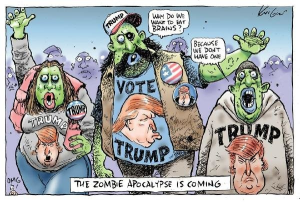 But how do we solve a problem like Greg Abbott, Marjorie Taylor Green, Ron DeSantis, Jeff Landry, Steve Scalise, Jim Jordan, and all the the other Trump Zombies?




 peej
peej Carissa
 bostonboomer
 dakinikat
 ecocatwoman
 mablue2
 Mama Lopez
 peggysue22
 quixote
 skydancingguestblogger
 Mona (aka Wonk the Vote)



 Sky Dancing
Recent Comments