
Friday Reads: The Good, the Bad, and the Very Ugly
Posted: April 29, 2016 Filed under: 2016 elections | Tags: 1968, George Wallace 56 Comments Good Afternoon!
It’s been a difficult year for those of us that generally relish and appreciate the drama and throes of the ever-becoming state of American Democracy. Watching pols devour Iowa Corn Dogs and pizza in New York City with the awkwardness of landing gooney birds is always great fun. However, this year’s campaigns and candidates have some worrisome dynamics. My spidey sense tingles with vibes of cultural upheaval and a heavy side of disturbing blow back wrapped up in some of the worst racism I’ve seen since I was a kid in the 1960s.
I was barely cognizant of political dynamics back in 1968 but I lived open-eyed through enough of it to appreciate the number of historians drawing parallels between that rambunctious election year and this one. I finished the year as a teenager so you could probably write a gooey coming of age story.
Every weekend, we visited my Grandfather in KCMO including the weeks of race riots after the assassination of Dr. Martin Luther King. I remember really strange things afoot that year when we were in Madrid and Rome It was probably the first time I tried to pass as something other than American while travelling outside the country being supremely embarrassed to be seen among a bunch of them by the rest of the world. Americans were loud, obvious, and always on the defensive. I decided to keep up with my French homework at that point, just in case.
I remember being keenly aware of technology like lots of TV and movies in the classroom. The DNC convention riots were all over TV at the time. Nothing like watching wars, riots, and your basic street chaos along side your moon shots, Monkees, and Laugh-In. There’s this similar vibe of violence, anger, misplaced patriotism, over the top entertainment and music all wrapped up in a technology-induced information overload.
Are we about to party like it’s 1969?
Donald Trump’s campaign and followers have overwhelmed the abilities of American journalists. He’s running and an overtly racist campaign and his followers 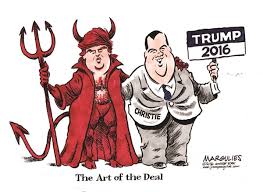 are responding in kind. BB alerted me to both this article and the response to the author by the Trumpsters last night. The UK Guardian has a fairly succinct tick tock as well as analysis about the blatant, over-the-top antisemitic attacks on writer Julia Ioffe for profiling the current Trump arm candy/wife.
In the 24 hours since her profile of Donald Trump’s wife, Melania, appeared in GQ magazine, the Russian-American journalist has received a torrent of antisemitic, vitriolic and threatening messages from supporters of the Republican frontrunner.
In the deeply disturbing response to her piece, Ioffe said she sees a frightening future of what freedom of the press – and the country – might look like under President Trump.
“What happens if Donald Trump is elected?” Ioffe said. “We’ve seen the way he bids his supporters to attack the media, his proposal to change libel laws to make it easier to sue journalists.”
The harassment from Trump supporters is not directly linked to the candidate. Yet he has fomented a culture of violence at his rallies, encouraging supporters to retaliate against protesters. He once offered to pay the legal fees for a man who sucker punched a protester at his rally. He also failed to immediately disavow former Ku Klux Klan leader David Duke, who said he supports Trump’s candidacy. His campaign has been contacted for comment.
On Thursday, Ioffe answered a phone call from an anonymous caller who played a Hitler speech. She received another call from “Overnight Caskets”. On Twitter, users posted photos of her face superimposed on a mug shot from Auschwitz. The Daily Stormer, a white supremacist site, attacked Ioffe in a blogpost titled: “Empress Melania Attacked by Filthy Russian Kike Julia Ioffe in GQ!”
 This is appalling. Yet, at least it’s out there instead of some coded little side attack that no one knows quite how to handle. I’ve written about this before but found a succinct description this morning on Paul Krugman’s site about the Southern Strategy and the Republican Establishment’s historical need to bring over some voters to be able to do the bidding of the richest of the rich in this country. Krugman says that what we’re experiencing is the “wrath of the conned” in that white, blue collar men have found what they really want in Donald Trump. These angry disenfranchised white men no longer have to watch their anger be channeled into policy that only benefits the one percent while some side act panders to them.
Things are very different among Republicans. Their party has historically won elections by appealing to racial enmity and cultural anxiety, but its actual policy agenda is dedicated to serving the interests of the 1 percent, above all through tax cuts for the rich — which don’t support, while they truly loathe elite ideas like privatizing Social Security and Medicare.
Probably more important, however, is the collision between demography and Obama derangement. The elite knows that the party must broaden its appeal as the electorate grows more diverse — in fact, that was the conclusion of the G.O.P.’s 2013 post-mortem. But the base, its hostility amped up to 11 after seven years of an African-American president (who the establishment has done its best to demonize) is having none of it.
What Donald Trump has been doing is telling the base that it can order à la carte. He has, in effect, been telling aggrieved white men that they can feed their anger without being forced to swallow supply-side economics, too. Yes, his actual policy proposals still involve huge tax cuts for the rich, but his supporters don’t know that — and it’s possible that he doesn’t, either. Details aren’t his thing.
Establishment Republicans have tried to counter his appeal by shouting, with growing hysteria, that he isn’t a true conservative. And they’re right, at least as they define conservatism. But their own voters don’t care.
If there’s a puzzle here, it’s why this didn’t happen sooner. One possible explanation is the decadence of the G.O.P. establishment, which has become ingrown and lost touch. Apparatchiks who have spent their whole careers inside the bubble of right-wing think tanks and partisan media may suffer from the delusion that their ideology is actually popular with real people. And this has left them hapless in the face of a Trumpian challenge.
Probably more important, however, is the collision between demography and Obama derangement. The elite knows that the party must broaden its appeal as the electorate grows more diverse — in fact, that was the conclusion of the G.O.P.’s 2013 post-mortem. But the base, its hostility amped up to 11 after seven years of an African-American president (who the establishment has done its best to demonize) is having none of it.
The point, in any case, is that the divergent nomination outcomes of 2016 aren’t an accident. The Democratic establishment has won because it has, however imperfectly, tried to serve its supporters. The Republican establishment has been routed because it has been playing a con game on its supporters all along, and they’ve finally had enough.
Krugman also argues that “Trump is playing a con game of his own”. But seriously, there are folks that are arguing that the Trump candidacy looks a lot like George Wallace’s 1968 run for the Presidency. Wallace was a true believe–at the time–in strong arm, government enforced racism. Is Trump cynically using racism to win or is he really the new George Wallace?
Some 50 years ago, another vociferous candidate put the scare in traditional power brokers. George Wallace fired up crowds with a similar anti-establishment message, and drew protests as passionate as are being seen at Trump’s rallies today. Wallace also became a face of racial tension in America as the leading symbol for segregation in the 1960s.
When Wallace entered presidential politics in 1964, the then-Alabama governor was famous for declaring, “Segregation now. Segregation tomorrow. And segregation forever.”
Wallace allies and family see parallels today in Trump.
“It’s just a replay,” Charlie Snider, one of Wallace’s most trusted political aides, told NPR. “We’re looking at a modern-day George Wallace.”
Snider is a Trump supporter. Wallace’s daughter, a Democrat, hears it, too, but in a different way.
“Trump and my father say out loud what people are thinking but don’t have the courage to say,” Peggy Wallace Kennedy told NPR. Wallace Kennedy was 18 when she was on the campaign trail with her father in 1968. She believes Trump is exploiting voters’ worst instincts, the way her late father once did.
“They both were able to adopt the notion that fear and hate are the two greatest motivators of voters that feel alienated from government,” she said.
The Trump campaign has not responded to NPR’s request for comment on the comparison.
Which brings me to this headline at CNN and another group of disgruntled, angry primarily white men: “Donald Trump’s new target: Bernie Sanders supporters”. You’ll  remember that there was much anger all over the place in 1968. This is another resemblance to 1968. Much of the left was outraged by the ongoing, long Vietnam War but there were still civil rights issues percolating out there in groups that weren’t related directly to the interests of white men. White men didn’t want to get drafted. Most of the rest of us just wanted civil and rights and equal treatment under the law in those days. Peace was a bonus card.
The GOP front-runner has ratcheted up his rhetoric against presumptive Democratic nominee Hillary Clinton in recent weeks, calling her a “crooked” politician who is unqualified to be president. But when it comes to her challenger, Bernie Sanders, Trump has taken a notably softer tone, praising the Vermont senator’s rhetoric and encouraging him to launch a third-party bid.“I think Bernie Sanders should run as an independent. I think he’d do great,” Trump said at a victory rally in New York City Tuesday night, after sweeping five GOP contests in the Northeast.The next morning, Trump said on MSNBC: “Bernie Sanders has a message that’s interesting. I’m going to be taking a lot of the things Bernie said and using them.”Trump’s advisers say these comments are a preview of more explicit overtures the campaign is ready to make to Sanders’ supporters once the populist liberal exits the 2016 race. That strategy is based on the broad areas of overlap between voters attracted to Trump and those who have flocked to Sanders. Both have angrily denounced the political system as corrupt and expressed deep frustration that Washington is not helping ordinary people. They both oppose international trade deals, saying they hurt American jobs.And, of course, targeting Sanders supporters could serve to undermine Clinton.“You have two candidates in Donald Trump and Bernie Sanders which have reignited a group of people who have been disenfranchised and disappointed with the way Washington, D.C. and career politicians have run the country,” Lewandowski said. “Bernie Sanders has large crowds — not as large as Mr. Trump’s, but large crowds — and so there is a level of excitement there for people about his messaging and we will bring those people in.”
My guess is this may be somewhat successful. I’m still not convinced that all the white men in the Bernie movement aren’t in it for themselves and will go where they think their personal interest will flourish. Those of us active in 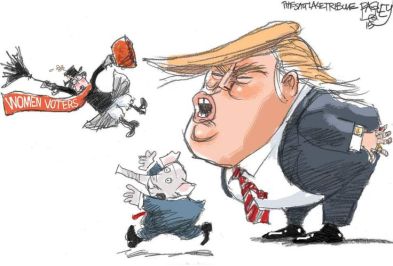 social media are still taking shit from BernieBros. Again, this fits in very well with the Trump tactics of slash and burn. As I write this, there are protests happening in Orange County outside of a Trump Rally.
Hundreds of demonstrators filled the street outside the Orange County amphitheater where Donald Trump held a rally Thursday night, stomping on cars, hurling rocks at motorists and forcefully declaring their opposition to the Republican presidential candidate.
Traffic came to a halt as a boisterous crowd walked in the roadway, some waving American and Mexican flags. Protesters smashed a window on at least one police cruiser, punctured the tires of a police sport utility vehicle, and at one point tried to flip a police car.
About five police cars were damaged in total, police said, adding that some will require thousands of dollars’ worth of repairs.“Dump the Trump,” one sign read. Another protester scrawled anti-Trump messages on Costa Mesa police cars.
“I’m protesting because I want equal rights for everybody, and I want peaceful protest,” said 19-year-old Daniel Lujan, one of hundreds in a crowd that appeared to be mostly Latinos in their late teens and 20s.
“I knew this was going to happen,” Lujan added. “It was going to be a riot. He deserves what he gets.”
Video footage showed some anti-Trump demonstrators hurling debris at a passing pickup truck. One group of protesters carried benches and blocked the entrance to the 55 Freeway along Newport Boulevard, with some tossing rocks at motorists near the on-ramp.
There’s a really good bit of analysis at The Observer by Lincoln Mitchell on how we might remember this election cycle. It even has a nod to the 1968 one.
Presidential campaigns are also a way to tell stories. The 1968 presidential campaign, for example, was, among other things, a way we now understand the stories of street protests around the war in Vietnam, the racist backlash led by George Wallace, the terrible assassinations of the decade and the victory of the silent majority represented by Richard Nixon. More recently, the 2008 election told the story of America’s ongoing efforts to wrestle with its apartheid past, the continued rise of the angry, but unfocused, right wing and the country’s exhaustion with the Bush years.
The 2016 election will also tell a story about our country, but at the moment it is hard to determine exactly what the plot will be. One of the complex, perhaps even paradoxical, dynamics at this point in the election is that despite the tremendous amount of coverage and buzz around the notion of outsiders, voter anger and similar sentiments among the American people, as well as the energy and excitement generated by the two candidates, Donald Trump and Bernie Sanders, who best speak to that element within the American electorate, the outcome of this election will probably tell a very different story.
It is still too early to say anything for certain about what will happen in November, but the public opinion data as well as most expert opinion, including that of many Republican experts, suggest that when the election is finally over the winner will not be an entertaining, or inspiring outsider, or somebody who has successfully tapped into voter anger, but a consummate insider. Hillary Clinton has all but won the Democratic nomination and is in a strong position to defeat any Republican opponent in November.
What then does this tell us about America in 2016? It would be a mistake to dismiss altogether the voters who have been excited by Bernie Sanders progressive outsider campaign, but it would also be a mistake to overstate the significance of that campaign by not placing it in the context of similar Democratic primary campaigns such as those of Jerry Brown in 1992, Howard Dean in 2004 and even to some extent, Barack Obama’s more successful campaign in 2008. Mr. Trump, however, seems to have mobilized a different force within the American electorate. He has energized a group of voters who are generally Republicans and who have no affection for the socially liberal and, in their views, elitist leadership of the Democratic Party. However, the Trump campaign has successfully divorced those voters from their longtime support of a conservative economic orthodoxy that has for years done little to help them.
This analysis of the appeal of Trump echoes Krugman’s. Does this election have more parallels to 1968? (It’s a piece by Howard Fineman.) I certainly don’t want to  argue that Hillary Clinton is Nixon unless I can also make the argument that she’s representing the silent majority of women, African Americans, Hispanic immigrants, GLBT who are now voting to ensure they have a continuing voice in the White House. BB’s argued that Trump’s borrowed that Nixonian phrase. I’ve certainly felt the Nixon in the dirty tricks of campaigns this year. However, Fineman argues that Clinton is HHH.
The Hillary Clinton role in 1968 was played by Hubert Humphrey, the beleaguered vice president of the by-then-wildly unpopular President Lyndon B. Johnson. Like Clinton, Humphrey had the support of most of the party’s establishment: African-Americans, unions, Jewish voters, elected officials at the federal, state and local levels.
But Humphrey was weighed down by the administration’s unpopular policies, chief among them the war and the draft. This time around, Hillary is having trouble defending her own version of interventionism (in the Middle East) as well as the free-trade and pro-big-business policies of both President Barack Obama and her own husband.
And the prospects for a disastrously disrupted convention this time aren’t on the Democratic side, but within the Republican Party.
For one, there is no certainty Trump will amass the 1,237 delegates that he needs for a majority before the GOP convention in Cleveland in July. Indeed, there is no certainty that, even if he does, it will prevent establishment efforts to derail him.
It will be messy, in part because the GOP hasn’t had such an experience since 1976 (when Ronald Reagan narrowly lost a challenge to President Gerald Ford) and the Trump people have no idea what to expect or how to plan.
“I’m not sure the Trump people fully understand what the establishment is going to try to do to them in Cleveland,” said Roger Stone, a longtime advisor, friend of Trump’s and student of how to win (or disrupt) conventions.
The scene outside the arena in Cleveland could be even more chaotic. Hosts of protest groups, from Black Lives Matter to MoveOn.org to various Hispanics and Muslim groups, joined together to protest a Trump appearance in Chicago last week. They will have months to plan for Cleveland, and they have every reason to be indignant and afraid. (And they will show up for the Democrats in Philadelphia, too, no matter what Hillary and Bernie do to make peace.)
So, I’m not wanting to elucidate the role of Cruz/Fiorina in all of this waxing poetic on the chaotic year of 1968. I only want to say that I hope that Carly’s next song is a version of “You’re so Vain” sung at the Republican Party to all of them and that every one of them loses miserably. Meanwhile, where’s our rocket to Mars?
What’s on your blogging and reading list today?
Live Blog: The Northeast brings it home!
Posted: April 26, 2016 Filed under: 2016 elections, Live, Live Blog | Tags: Mideastern Primaries 298 Comments
 Good Evening!
These are the states that are voting today in the 2016 Presidential Primaries! Here are the number of Democratic Delegates up for grabs as well as the expected poll closing times.
Maryland · 95 delegates
Delaware · 21 delegates
Connecticut · 55 delegates
Pennsylvania · 189 delegate
Rhode Island · 24 delegates
Last poll closes at 8:00 PM ET for all 5 states
Here’s some of the things to consider when watching the returns. The first most important thing is will the front runners close the deal? Polls show both Clinton and Trump ahead in these states.
A sense of inevitability is growing around both the Donald Trump and Hillary Clinton campaigns, and they could easily build on that momentum this Tuesday. Democratic and Republican voters will cast their primary ballots in five states — Connecticut, Delaware, Maryland, Pennsylvania and Rhode Island — where the respective front-runners hold solid leads.
In delegate-rich Pennsylvania, Trump has a 13-point lead over his closest competitor Ted Cruz, while Clinton has a seven-point lead over Bernie Sanders, according to a CBS News Battleground Tracker survey released Sunday. All told, there are 556 delegates at stake –172 for Republicans and 384 for Democrats.
Will the leaders sweep the five states? Politico has listed some of the key counties for each of the candidates. Of course, we’re interested in Pennsylvania with its huge swath of delegates. The state’s urban areas will influence the overall vote which means that Hillary’s minority support is crucial.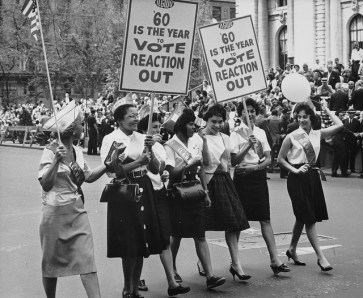
Pennsylvania
Allegheny County: Allegheny County, which includes Pittsburgh and the immediate suburbs, holds more GOP voters than any other county in the state.
Pennsylvania’s “loophole primary” makes the focus on specific districts for Republicans trickier, but Allegheny is still a key battleground. Kasich was born and raised in the county, in McKees Rocks. Trump visited Pittsburgh earlier this month.
The county includes all or part of three different congressional districts: the 12th, 14th and 18th.
On the Democratic side, Allegheny is battleground territory: Clinton won it by almost nine points in 2008. A similar performance there on Tuesday could close the door on Sanders’ underdog bid at a statewide victory.
Lackawanna County: This is Clinton territory: She won Lackawanna by a yawning margin in 2008, 74 percent to 26 percent.
Clinton claims Scranton roots that served her well eight years ago. And it’s no surprise one of her closing events in the state was in Dunmore, just outside Scranton, last Friday. (Her husband held an event earlier this month at Scranton High School.)
These are mostly white voters who stuck with Clinton eight years ago. The question is whether they will still serve as a firewall for her on Tuesday, or jump to Sanders, as a number of white Democrats have in other states.
Philadelphia: Clinton managed to win statewide eight years ago despite losing Philadelphia by nearly a two-to-one margin, 65 percent to 35 percent.
This time around, the African-American base in Philadelphia should be strong for Clinton. But the city is also a big college town, and enhanced youth turnout could help Sanders.
Clinton has the backing of former Mayor Michael Nutter — who backed her over Obama in 2008 — and also from longtime supporter Ed Rendell, another former Philadelphia mayor and former two-term governor, who will be under pressure to reinstate his turnout machine to help the former secretary of state.
Here’s the ratfucking meme of the day–likely pushed by BernieBr0s–that simply isn’t true.
Here’s a contender for weird/fake endorsement of the day: A Grand Dragon of the California branch of the KKK allegedly told Vocativ, an organization “at the nexus of media and technology,” that it is endorsing Hillary Clinton. “She is friends with the Klan,” said Will Quigg, citing as evidence her friendship with Bobby Byrd, the long-time United States senator from West Virginia who was in the KKK as a young man. Quigg also claimed the organization had raised $20,000 in anonymous donations for the Clinton campaign.
This is fairly obviously B.S. The Clinton campaign denies it has received nearly that much money in anonymous funds, and the Vocativ reporter even noted that he factchecked and verified the campaign’s claim using F.E.C. filings. But hey! A Klansman said the name “Hillary Clinton” with a gleeful smile on his face, so take that for what it’s worth, which is probably roughly nothing.
Some how, I can’t see the Klan supporting the candidate that has the overwhelming support of black voters, can you?
Grab your popcorn and let’s watch Hillary win some more on her way to the White House!!!
Live Blog: Hillary Clinton Town Hall with Rachel Maddow and the other one
Posted: April 25, 2016 Filed under: 2016 elections | Tags: Bernie Sanders, Chris Hayes, Hillary Clinton, MSNBC Townhall, Pennsylvania, Rachel Maddow 64 CommentsGood Evening!
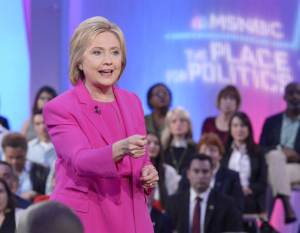 I thought I’d put up a thread so we could discuss our impressions of tonight’s townhalls on MSNBC. They will be livestreamed at the link.
Democratic U.S. presidential candidates Hillary Clinton and Bernie Sanders are scheduled to take the stage at back-to-back MSNBC-televised town halls in Philadelphia Monday evening, just a day before Pennsylvania voters head to the polls. As in past town halls, both candidates will answer questions by the moderators as well as by prospective voters in the audience. Live streams of both town hall events can be viewed by clicking here or by watching below.
Sanders’ hourlong session will be hosted by MSNBC host Chris Hayes, beginning at 8 p.m. EDT. Rachel Maddow will moderate an hourlong session with Clinton immediately afterward, starting at 9 p.m. EDT.
Pennsylvania is among five states with presidential primary elections Tuesday, along with Connecticut, Delaware, Maryland and Rhode Island. Excluding superdelegates, Clinton has a comfortable lead with 1,428 delegates, while Sanders has 1,153 delegates.
According to opinion polling, Clinton is projected to do well Tuesday. Sanders’ best chance is in Rhode Island. There are a combined 384 delegates at stake for Democrats Tuesday. Many in the party will be watching Pennsylvania, with 210 delegates, and Maryland, with 118 delegates.
Sanders has no real path to the nomination at this point but is still in the race.
Monday Reads: Canned Hostility
Posted: April 25, 2016 Filed under: 2016 elections | Tags: Bernie Sanders, Charles Koch, Donald Trump, Hillary Clinton, ratfucking, Richard Nixon, Roger Stone, Roy Cohn 66 Comments Good Afternoon!
Populist insurgencies usually get ugly. We’ve got two campaigns that are pretty representative of that assertion. I’m a veteran of a lot of political shenanigans and ugliness having run against a mean ass outsider in my day. People that only see themselves and their “movements” as some savior of society are willing to do and say just about anything. That goes for the kinds of people they attract to the campaign also. I’ve seen some ugly ass comments coming from surrogates this year that really have made my stomach churn. I know this isn’t a particularly cheery topic but since New York, all I see is two campaigns resplendent with hostile, angry people, candidates, surrogates, and staff. It’s beginning to feel a lot like a Nixon campaign.
We knew it would probably get ugly when Donald Trump started surging. He’s been friends with two of the worst Nixon ratfuckers that ever lived. How could you possibly trust a guy with mentors like Roy Cohn and Roger Stone to be anything but a mean, nasty piece of work? Jeffrey Toobin scored an interview with Stone for the New Yorker. All that’s missing is Donald Segretti when it comes to the Trump Equation.
Roger Stone, the political provocateur, visited the bar at the Four Seasons Hotel on primary day last week to reminisce about his long friendship with Donald Trump. It started in 1979, when Stone was a twenty-six-year-old aide in Ronald Reagan’s Presidential campaign. Michael Deaver, a more senior campaign official, instructed Stone to start fund-raising in New York. “Mike gave me a recipe box full of index cards, supposedly Reagan’s contacts in New York,” Stone said. “Half the people on the cards were dead. A lot of the others were show-business people, but there was one name I recognized—Roy Cohn.” So Stone presented himself at the brownstone office of Cohn, the notorious lawyer and fixer.
“I go into Roy’s office,” Stone continued, “and he’s sitting there in his silk bathrobe, and he’s finishing up a meeting with Fat Tony Salerno,” the boss of the Genovese crime family. Stone went on, “So Tony says, ‘Roy here says we’re going with Ree-gun this time.’ That’s how he said it—‘Ree-gun.’ Roy told him yes, we’re with Reagan. Then I said to Roy that we needed to put together a finance committee, and Roy said, ‘You need Donald and Fred Trump.’ He said Fred, Donald’s father, had been big for Goldwater in ’64. I went to see Donald, and he helped to get us office space for the Reagan campaign, and that’s when we became friends.”
Stone is now sixty-two, and he’s allowed his hair, which used to be a kind of yellow, to evolve into a shade more suitable for an éminence grise than for an enfant terrible. He has played roles in many of his generation’s political dirty-tricks scandals. He was just nineteen when he had a bit part in Watergate; he sent campaign contributions in the name of the Young Socialist Alliance to the campaign of Pete McCloskey, who was running against Richard Nixon for the Republican nomination in 1972. Almost three decades later, he helped choreograph the so-called Brooks Brothers riot, which shut down the Bush v. Gore recount in Miami-Dade County.
This is one of the reasons I groan when a member of the Bernie cult tries to tell me that Charles Koch is “backing” Hillary Clinton. How 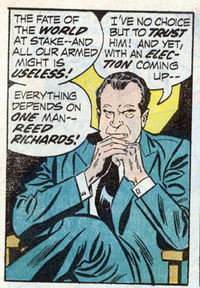
much we’ve forgotten of the Nixon years. How much we need to pay closer attention to the connections between the old Nixon CREEPS and Trump. Nixon evidently even had a thing for Trump when he appeared on a Phil Donahue segment back in the day.
At the time, Trump was only 41 but was already a New York media darling. The Art of the Deal had just come out, which would make him a national figure. Most of the interview isn’t about politics, but the parts that are are very Nixon-friendly. Trump defends Nixon and his father against allegations that they discriminated against black tenants, and talks admiringly of Roy Cohn, the right-wing lawyer most famous for prosecuting theRosenbergs and serving as Joseph McCarthy’s chief counsel in the Senate.
Cohn (who spent his whole life closeted and died of AIDS the year before the interview) was a friend of Nixon’s and reportedly helped him win reelection in 1972 by leaking Democratic VP candidate Thomas Eagleton’s psychiatric history.
“The one thing I’ll say about Roy is that he was an extremely loyal guy,” Trump says. “Loyalty is a great trait.”
The prospect of Trump running for office comes up again and again:
Donahue: You tell us also in your book that you left Queens and you left Brooklyn for Manhattan to get away from rent control! You’re honest to tell us in this book.
Trump: I’m honest. Hey, I’m not running for anything, Phil, I’m not running for office. I don’t have to lie in a book. I want to tell the facts, okay? Do you want me to say little fibs and little this and little that, and how much we all love rent control and what a great thing it’s been for New York? It’s been a disaster for New York, it’s badly hurt New York, it’s crippled New York.
Trump follows that up by engaging in the kind of political rhetoric that he’s perfected over the past year: populist while simultaneously drawing upon his own power as an elite. He condemns rent control for primarily helping the politically well-connected, bragging in the process that he has those connections (“it’s the people with the connections — somebody knows Trump, somebody knows somebody else, they call up and say, ‘Do me a favor,’ that’s what it’s all about”).
Pardon me for citing the National Review, but they see it too.
Richard Nixon might have been right at home in the bully-boy politics of today. As a young candidate, Nixon conducted what he called “rock ’em, sock ’em” campaigns. Donald Trump sometimes seems to be channeling Nixon in his pursuit of “the silent majority,” a phrase coined by Nixon. Trump would be lucky to do as well as Nixon did in attracting voters with his populist rhetoric. While winning a second term in a landslide in 1972, Nixon got the votes of 35 percent of self-described Democrats — many of them lower-middle-class blue-collar whites.
Trump also seems to suggest that he would be like Nixon in another way: as a deal maker. This side of Nixon sometimes gets overlooked, but it is worth examining as Republicans (and possible the country as a whole come November) contemplate whether Trump would be a good president. As president, Nixon was willing to compromise. Democrats controlled Congress, so Nixon worked with their leaders to pass a raft of environmental and social-welfare legislation. In part, Nixon was being politically opportunistic. Senator Edmund Muskie of Maine hoped to ride the nascent environmental movement to the Democratic presidential nomination and the White House in 1972. Nixon saw a chance to outflank Muskie by creating the Environmental Protection Agency. Nixon was not just posturing — he really did want to get things done. In his crafty way, Nixon was willing to outmaneuver his own subordinates. He told Chris DeMuth, a young aide assigned to write up the new environmental-law regulations (and later president of the American Enterprise Institute), to steer clear of Commerce Secretary Maurice Stans, a prolific Nixon fund-raiser who was closely allied with big industry. “I’ll take care of Stans,” said Nixon, and he did, keeping him away from the rule-making process.
Nixon’s capacity to play to the emotions of voters while still governing effectively was best displayed in his approach to civil rights. In 1968 and 1972, Nixon employed what was called the GOP’s “southern strategy.” Appealing to southern Democrats (then the majority), Nixon loudly inveighed against forced busing to integrate schools. To liberals, he seemed to be pandering to racists. But with Nixon it was important, as his attorney general, John Mitchell, said, “to watch what we do, not what we say.” Working quietly behind the scenes to overcome resistance to federal court orders, Nixon set up citizens’ committees in each of the Deep South states to integrate the schools. When Nixon became president, 70 percent of black kids in the Deep South attended segregated schools. Within three years only 10 percent did.
Perhaps in today’s noisy and instantaneous media environment, Nixon could not have gotten away with such politically deft sleight of hand. Nixon, who was always muttering that “the press is the enemy,” did not have to contend with bloggers or cable-news talking heads. Nixon wrote many of his own speeches (including the “silent majority” speech) but was cunning about using the right speechwriter to set the tone he wanted in any particular moment — Pat Buchanan for red-meat populism, Ray Price for high-minded good governance. Still, sometimes he was too clever by half, especially when trying to be both a hawk and a dove on Vietnam.
 Nixon was one of those guys that got where he did by bringing out the worst in people. Trump is following in that style. So is the other populist in the race. Just when you thought the attacks couldn’t get any more personal from the sinking Sanders campaign, up jumps Rosario Dawson with a Monica Lewinsky reference.
Bernie Sanders’ lone Senate endorser on Monday rejected the notion that the recent comments made by one of the candidate’s celebrity surrogates represents more than an isolated, inflammatory incident.
“No. This is individuals going off track on their own,” Sen. Jeff Merkley (D-Ore.) said in an interview with CNN’s “New Day,” addressing actress Rosario Dawson’s invocation of Monica Lewinsky against bullying while introducing Sanders over the weekend in Delaware.
Such remarks are “not helpful to the campaign, and it’s certainly not in keeping with what Bernie wants to see.”
“Those are complete distractions. They take away from the conversation about core policy issues. In a campaign you have many people who step forward on your behalf. They come out with some things that go off track,” Merkley said. “Hopefully everything I say will be on track, because I do believe that this is a conversation about so many important issues.”
Dawson’s comments are not the first from a Sanders surrogate to have raised eyebrows among those on the Hillary Clinton campaign and beyond. For example, when actor Tim Robbins compared Clinton’s victory in South Carolina as “about as significant” as winning the island of Guam, the territory’s lone congressional delegate and former first lady fired back, pledging her support to Clinton ahead of the May 7 primary. Robbins later apologized, saying he did not intend to make light of the territory’s lack of full voting representation.
For his part, Sanders declined to directly address Dawson’s comments about Lewinsky on Sunday, praising the actress in a CNN interview for doing a “great job” in discussing the “real issues” facing the country.
Bernie’s silence on the matter screams a lot about his intent to me. I think he’s so mad about not being the recognized savior that he doesn’t give two shits about what his people say about Clinton or the Democratic Party. The man has a mean streak as large as Richard Nixon’s paranoia.
Senator Bernie Sanders of Vermont did his best on Sunday to avoid talking about comments made by one of his supporters, the actress Rosario Dawson, who invoked Monica Lewinsky at a rally for Mr. Sanders this weekend.
Ms. Dawson created some controversy Saturday when she referenced Ms. Lewinsky, the former White House intern who had an affair with President Bill Clinton. Though Ms. Dawson was talking about cyberbullying and about being under pressure to support Hillary Clinton, the Clinton campaign has called the comment “vitriol.”
“We are literally under attack for not just supporting the other candidate,” Ms. Dawson said while introducing Mr. Sanders in Wilmington, Del. “Now, I’m with Monica Lewinsky with this. Bullying is bad. She has actually dedicated her life now to talking about that. And now, as a campaign strategy, we are being bullied, and, somehow that is O.K. and not being talked about with the richness that it needs.”
On Sunday, Jake Tapper of CNN questioned Mr. Sanders about Ms. Dawson’s comments. “One of your high-profile surrogates, actress Rosario Dawson, invoked Monica Lewinsky at one of your rallies,” Mr. Tapper said. “Do you think it’s appropriate for your surrogates to be talking about Monica Lewinsky on the campaign trail?”
Mr. Sanders, however, declined to speak about the reference to Ms. Lewinsky and instead expressed support for Ms. Dawson. “Rosario is a great actress, and she’s doing a great job for us,” he said. “And she’s been a passionate fighter to see that we increase the voter turnout, that we fight for racial, economic, environmental justice.”
He added: “What our job right now is to contrast our views compared to Secretary Clinton. That’s what a campaign is about.”
Bernie’s chances at the nomination are all but gone but he can and is destroying whatever goodwill and legacy he may have built. He’s getting a series of open letters written to him in newspapers begging him to stop self-destructing and begging him to stop doing Donald Trump’s “dirty work”. I suggest that he’s just ratfucking at this point in time. This from the op-ed by Michael Cohen at the Boston Globe.
But here’s the thing – and I hate to be the bearer of bad news, but maybe a little tough love is in order — you’re not going to win the Democratic nomination. This isn’t one of these “yeah, it’s a long shot, but maybe if I get lucky and everything goes my way” things. You’re not going to overcome Hillary Clinton’s lead in pledged delegates and you’re certainly not going to convince super delegates to vote for you over her. I mean, think about it: You’re trying to convince them to vote against the person who is almost certainly going to win in pledged delegates.
And even if you could win that way, would you really want to? In fact, if we’re really being honest here, the way your campaign has gone the past six weeks isn’t the way you want to win — or even the way you want to lose. Remember back in May 2015 when you said you didn’t want this campaign to be about Jeb Bush, Hillary Clinton, or Bernie Sanders? Remember when you said you weren’t going to engage in character assassination and personal attacks?
Brooklyn Congressman Hakeem Jeffries accuses Bernie of giving aid and comfort to Donald Trump. Bernie’s dodged every chance to disown the comment.
A Brooklyn congressman is accusing Sen. Bernie Sanders of providing “aid and comfort” to Donald Trump and the GOP after a top surrogate referenced Monica Lewinsky at a recent Sanders rally.
Congressman Hakeem Jeffries, a Brooklyn Democrat and Hillary Clinton supporter, said Mr. Sanders needs to “stop it” and disavow the comments made by Rosario Dawson, an actress.
“Bernie Sanders ran a scorched earth campaign in New York that personally attacked Hillary Clinton at every turn, and he was crushed by 16 points,” Mr. Jeffries said today, referring to Ms. Clinton’s triumph over Mr. Sanders in the April 19 New York primary. “Instead of learning from past failure, supporters of Bernie Sanders continue to play dirty pool in a desperate attempt to halt Hillary Clinton’s clear path to the Democratic nomination.”
A lot of us think that Charles Koch is ratfucking by joining Karl Rove and America First to turn Bernie voters against Hillary. Unfortunately, it’s working on some of them as I’ve seen from time lines and feeds. I’m going to close with this one from MSN and the Daily Beast: Trump, Sanders, and American Ignorance.
Civic participation is one of the most important responsibilities of being an American. I’m o
ld enough to remember when being selected to lead your homeroom class in the daily Pledge of Allegiance was a source of great pride. As kids, with our hands over our hearts, shoulders squared, we’d recite those venerable words, “…and to the republic, for which is stands…” with purpose. Unfortunately, the moral imperative of being a good steward of this great nation and understanding what it takes to preserve life, liberty and the pursuit of happiness, is an afterthought for many, if any thought at all.Without question, the insurgent candidacies of Donald Trump and Bernie Sanders have jolted many Americans out of their normal political malaise. Bringing more citizens into the political fold is a good thing. But, what many of them are now realizing is that it takes more than just rolling out of bed to rage against the machine at big political rallies to select the next leader of the free world.
Surprise! There are rules involved. Rules governing the presidential election date back to our founding and the establishment of Electoral College. The Constitution also gives latitude to the states in how to structure their nominating process. Electing the president wasn’t necessarily meant to be easy. Nothing worth safeguarding usually is. The founders deliberately designed our constitutional republic that way to avoid the tyrannical pitfalls of past societies like ancient Greece or the monarchies of Europe.
The Framers wanted multi layered stakeholders invested in the best interest of the republic making it less vulnerable to the rash whims of a majority. They understood how pure democracy without checks and balances historically led to the subjugation of minority voices. It was true then and still rings true today. That’s why our constitution does not allow for direct voting to elect the president.
The best thing I’ve seen on the internet for days is this interview with Joy Reid and Sanders Reality Denier Jeff Weaver who was doing his usual Baghdad Bob routine on MSNBC. Go watch it as she makes this point to him: “You Only Win White Voters and White Caucuses”. It’s a hoot! The fact neither Trump, Nixon or Sanders can fool minority voters or most women just says something, doesn’t it?
That our country was designed to confound populist impresarios is the best thing to remember when all this craziness from populists goes down. They can scream about rules they don’t like and don’t know about. But, the rules basically come straight out of our Constitution and it’s to stop nonsense like this current round of ratfucking from creating a situation where the leader of the free world is a loud mouthed, egoist, know nothing. Oh, you can apply that label to which ever candidate you prefer or all of the above. Remember, the system eventually dealt with Richard Nixon who was everything but a know nothing. It just took some time.
What’s on your reading and blogging list today?
Live Blog: Extra! Extra! New York Votes!
Posted: April 19, 2016 Filed under: 2016 elections, Live, Live Blog | Tags: New York Primary Returns 222 Comments
U.S. Democratic presidential candidate Hillary Clinton (C) rides the New York City Subway with Bronx Borough President Ruben Diaz (L) in the Bronx borough of New York, April 7, 2016. REUTERS/Brendan McDermid TPX IMAGES OF THE DAY – RTSE18E
Good Evening!
New York is excited to play a role in the primaries and we’re excited to see them close a few deals! The two leading candidates for each party call New York City home so there’s high hopes on all sides for big surprises. So far, there are a few surprises prior to any results actually coming in. We’re hearing some interesting things about voting irregularities and those colorful New York Politicians.
Have Brooklyn Democrats been kidnapped by Aliens or administrative Hanky Panky?
Mayor Bill de Blasio has ordered the New York City Board of Elections to investigate why more than 63,000 registered Democrats were dropped from the voting rolls since last fall.
The request comes the same day a WNYC analysis revealed the largest decline in active registered Democrats statewide was in Brooklyn. (UPDATE: The New York state Attorney General’s Office is now reporting a spike in problems at polls, particularly in Brooklyn.)
But new data provided by the city Board of Elections on Monday indicates it actually removed 126,000 Brooklyn Democrats from the rolls, according to executive director Michael Ryan.
That includes 12,000 people who moved out of the borough, 44,000 people who were moved from active to inactive voter status and 70,000 voters removed from the inactive voter list.
As a Brooklyn Democrat himself, de Blasio said he’s concerned about the sudden slump of Democrats on the voter rolls there.
“This number surprises me,” said de Blasio, “I admit that Brooklyn has had a lot of transient population – that’s obvious. Lot of people moving in, lot of people moving out. That might account for some of it. But I’m confused since so many people have moved in, that the number would move that much in the negative direction.”
Board of Elections Executive Director Michael Ryan confirmed he had been contacted by the mayor’s staff and he shared with WNYC the same explanation he said he gave them.
“Brooklyn was a little behind with their list maintenance tasks,” said Ryan, who said the other boroughs update their lists on a rolling basis.
That backlog meant the Brooklyn voter rolls needed a major clean up. The board can only remove people from its lists at certain times of year. There are blackout periods that exist 90 days before federal elections.
Ryan said Brooklyn election officials fell 6 months to a year behind updating their voter rolls.
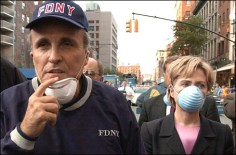
New York Rep. Pete King (R) on Tuesday offered his harshest words yet for Republican presidential candidate Ted Cruz, slamming the Texas senator on the day of his state’s primary.
“Well, first of all, in case anybody gets confused, I’m not endorsing Ted Cruz, I hate Ted Cruz, and I think I’ll take cyanide if he ever got the nomination,” King said to open his appearance on MSNBC’s “Morning Joe,” prompting a mixture of laughs and mild exclamations from co-hosts.The Republican has previously said that he’d “never” vote for Cruz and that New Yorkers considering it “should have their head examined.”“I think you are going to see Donald Trump scoring a big victory tonight,” King predicted Tuesday. “I have not endorsed Donald Trump. In fact, I actually voted by absentee ballot for John Kasich. I’m not endorsing John, but I voted for him to really send a message.”
Michael Bloomberg says there’s a connection between Bernie Sanders and Donald Trump.The two presidential candidates elude facts and attract voters with rhetoric, the former mayor of New York City said at a keynote speech for a Bloomberg Philanthropies summit Tuesday.“I’m not trying to knock Donald Trump, but I do think what you’re seeing in this election, in some cases you argue on the facts, in some cases it becomes a religion — the facts don’t matter at all,” Bloomberg said.“And that phenomenon, I think, is what you see with Bernie Sanders and Donald Trump. It’s the same phenomenon,” he continued. “People are not happy with their government. It has failed them. It hasn’t addressed their needs.”The basic point may not surprise anyone who’s followed the long campaign trail this election season. Sanders, who is seeking the Democratic nomination, has recently been criticized — perhaps unfairly — for failing to correctly articulate the facts behind his views on big banks. The less said about Republican hopeful Trump’s flip-flopping, the better.But Bloomberg wasn’t really talking about the election. The conference Tuesday was a “Summit on Transforming Data Into Action,” and his keynote was meant to illustrate how cities and businesses can harness big data to improve communities and help citizens. Bloomberg’s point was that most people can’t argue with the facts, even if certain leaders might try.

Conservatives/evangelicals: In preliminary exit poll results, evangelicals are in short supply, as are strong conservatives – groups customarily better for Cruz. Evangelicals account for about a quarter of voters in preliminary exit poll results (vs. 42 percent in Wisconsin and 58 percent in all primaries to date). “Very” conservatives account for two in 10 voters, vs. 31 percent in Wisconsin and 34 percent overall.
Wall Street: We’ve noted that more than six in 10 Democratic primary voters say Wall Street does more to hurt than help the U.S. economy; turns out the Street isn’t widely popular among Republican primary voters, either. They divide about evenly on whether Wall Street helps or hurts the economy.
Outsider: Trump may reach a new high on his signature issue: Nearly two-thirds of GOP primary voters in these preliminary exit poll results are looking for an outsider rather than someone with political experience. Outsider voters, a group Trump’s won overwhelmingly in past contests, peaked previously at 61 percent in Nevada.
So maybe Democrats are bit more unified than we thought – at least compared with Republicans.
Eighty-five percent of New York Democratic primary voters in the exit poll say they will definitely or probably vote for Hillary Clinton if she becomes the Democratic presidential nominee.
Just 13 percent of them say they WON’T vote for her.
That’s compared with 26 percent of New York Republicans who say that they wouldn’t vote for Trump if he becomes the GOP nominee.
And it’s also compared with an Indiana exit poll during the height of the 2008 Barack Obama-vs.-Hillary Clinton race, which found 29 percent of Democratic voters saying they would either vote for John McCain or not vote at all.

A few weeks ago, we published a sort of best-case scenario for Sanders in which he wound up with exactly 2,026 pledged delegates, the number he’d need to clinch an elected delegate majority over Clinton. (Leave aside the thorny issue of superdelegates for now.) The path would require almost everything to go right for Sanders — including narrow wins in states such as Pennsylvania and New Jersey, and double-digit wins in California, Indiana and other states.Sanders has had a good couple of weeks, however. He fell only two delegates shy of our path-to-2,026 projection in Wisconsin. He also fell four delegates shy in Wyoming, where his results were disappointing. However, Sanders has gained a few extra delegates at state conventions and from previous states revising their delegate counts as their results became official. Because of these changes, Sanders has kept exactly on pace with the path to 2,026 so far.
Tonight’s task is much harder, however. Our path had Sanders winning New York by a couple of percentage points and netting 128 out of 247 delegates there. Here’s what the rest of his path would look like on the unlikely-but-not-quite impossible chance that he does so:

New York primary
Last poll closes at 9:00 PM ET

 peej
peej Carissa
 bostonboomer
 dakinikat
 ecocatwoman
 mablue2
 Mama Lopez
 peggysue22
 quixote
 skydancingguestblogger
 Mona (aka Wonk the Vote)



 Sky Dancing
Recent Comments