
Friday Reads
Posted: September 9, 2011 Filed under: 2012 presidential campaign, morning reads 20 Comments Well, it’s Friday!
I’m still trying to figure out which reality it is today. I’m not sure if this is some strategic move to head off all the FHA/VA lawsuits or a threat to sink Dodd-Frank, but BOA is talking about 40,000 jobs cuts. Wrap your brain around that number one day after the best speech ever on with details indicating jobs isn’t the goal of the American Jobs Act. They’re saying it’s because they can’t get all that fee income from debit and credit cards, but I think it’s just step one in hostage negotiations.
Bank of America Corp officials have discussed slashing roughly 40,000 jobs during the first wave of a restructuring, the Wall Street Journal said, citing people familiar with the plans.
The number of job cuts are not final and could change. The restructuring aims to reduce the bank’s workforce over a period of years, the Journal said.
The newspaper said BofA executives met Thursday in Charlotte and will gather again Friday to make final decisions on the reductions, putting the finishing touches on five months of work.
We have a “credible but unconfirmed” national security threat. No, it’s not about them stealing your social security so Wall Street investment bankers can gamble it away, or removing your right to make decisions on your on health, or even the fact that there’s hundreds of thousands of unaccounted semi automatic weapons floating around the country. But, hey, be very afraid and be prepared for continual cavity searching at airports, porn scans, illegal wiretaps, and those extraordinary renditions to continue while you’re standing in line hoping to get your unemployment benefits.
Officials said they were taking the threat seriously, while evidently trying to temper the news by saying such threats are commonplace during key events.
“It’s accurate that there is specific, credible but unconfirmed threat information,” said Matthew Chandler, spokesman for the Department of Homeland Security. “As we always do before important dates like the anniversary of 9/11, we will undoubtedly get more reporting in the coming days. Sometimes this reporting is credible and warrants intense focus, other times it lacks credibility and is highly unlikely to be reflective of real plots under way.
“Regardless, we take all threat reporting seriously, and we have taken, and will continue to take, all steps necessary to mitigate any threats that arise. We continue to ask the American people to remain vigilant as we head into the weekend,” Chandler said in a prepared statement.
A Department of Homeland Security official, speaking on background, said, “We will continue to respond appropriately to protect the American people from an evolving threat picture in the coming days and beyond. This may include an increased law enforcement presence at airports and other transit hubs, land and sea ports of entry, federal buildings, and other high-profile and critical infrastructure locations.”
The information originated from the tribal border area of Pakistan and Afghanistan, a federal official told CNN producer Mike Ahlers.
The super Cat food Commission is already showing signs of dysfunction. Senator Kyl has threatened to quit if any one dare mention cuts in the defense budget.
Kyl revealed Thursday that he told congressional leaders to find someone else to fill the supercommittee seat he had been offered if the panel intended to further trim the Pentagon budget beyond the $350 billion over 10 years that was included in the August debt deal.
He told a standing-room-only lunch audience that he immediately told GOP leaders, “I’m off the committee” if further military cuts would be on the table.
“We’re not going there,” Kyl said sternly, recalling his message to his fellow GOP leaders. “Defense has given enough already.”
The comments cleared up whether the Pentagon and defense industry have a strong ally on the high-level panel.
If the supercommittee fails to cut $1.2 trillion by Thanksgiving, automatic triggers would be enacted to reach that figure, including around $600 billion in additional defense cuts over 10 years.
Fed Chairmen Ben Bernanke gave a speech in Minneapolis at its Economic Club and even managed to crack a joke. Once again, a real economist says it’s households that are hurting and not business.
One striking aspect of the recovery is the unusual weakness in household spending. After contracting very sharply during the recession, consumer spending expanded moderately through 2010, only to decelerate in the first half of 2011. The temporary factors I mentioned earlier — the rise in commodity prices, which has hurt households’ purchasing power, and the disruption in manufacturing following the Japanese disaster, which reduced auto availability and hence sales — are partial explanations for this deceleration. But households are struggling with other important headwinds as well, including the persistently high level of unemployment, slow gains in wages for those who remain employed, falling house prices, and debt burdens that remain high for many, notwithstanding that households, in the aggregate, have been saving more and borrowing less. Even taking into account the many financial pressures they face, households seem exceptionally cautious. Indeed, readings on consumer confidence have fallen substantially in recent months as people have become more pessimistic about both economic conditions and their own financial prospects.
Compared with the household sector, the business sector generally presents a more upbeat picture. Manufacturing production has risen nearly 15 percent since its trough, driven importantly by growth in exports. Indeed, the U.S. trade deficit has narrowed substantially relative to where it was before the crisis, reflecting in part the improved competitiveness of U.S. goods and services. Business investment in equipment and software has also continued to expand. Corporate balance sheets are healthy, and although corporate bond markets have tightened somewhat of late, companies with access to the bond markets have generally had little difficulty obtaining credit on favorable terms. But problems are evident in the business sector as well: Business investment in nonresidential structures, such as office buildings, factories, and shopping malls, has remained at a low level, held back by elevated vacancy rates at existing properties and difficulties, in some cases, in obtaining construction loans. Also, some business surveys, including those conducted by the Federal Reserve System, point to weaker conditions recently, with businesses reporting slower growth in production, new orders, and employment.
Asked after his speech to the Economic Club of Minnesota about disagreements over what the Federal Reserve should do next, Chairman Bernanke joked: “When two people always agree, one is redundant.”
Rather than cover the Villagers and their comments on the speech last night, I thought I’d give a shout out to a few of our friends’ blogs.
Here’s a good one from Lambert at Corrente: Words you won’t hear from President Fuck You tonight.
Carved in stone. These words:
No country, however rich, can afford the waste of its human resources. Demoralization caused by vast unemployment is our greatest extravagance. Morally, it is the greatest menace to our social order.
Carved in stone. Or, given the reality of Obama’s rump Democrats, scratched in sand, or written on the wind
Here’s the American Job Acts Summarized by David Dayen at FDL:.
Here is a summary of the American Jobs Act that the White House is putting out. I don’t have a ton of time to analyze it right now, but much of it will be familiar, albeit with a few new wrinkles. There’s $35 billion for state fiscal aid, which is somewhat robust and good bang for the buck in terms of saving jobs. All in all there’s $105 billion in infrastructure/public works (that includes a replenishing of the Neighborhood Stabilization Fund, which helps address the foreclosure crisis). And there’s an attempt to restart the TANF Emegency Fund with $5 billion or so. That’s on top of the $170 billion for the payroll tax cut and extending unemployment insurance. So all in all, back of the envelope says about $315 billion.
Okay, enough of all that, I’m going to grab my surrealistic pillow and go back to bed. What’s on your reading and blogging list today?
Rhetoric and Speechification over Subtance
Posted: September 8, 2011 Filed under: 2012 presidential campaign | Tags: Obama jobs speech, prebuttal 19 CommentsI’m getting ready to do the live blog tonight for the Obama jobs speech. It seems the press is finally doing due diligence on the President. For some reason, media due diligence is only done after it’s way too late. Right now, the press seems obsessed with following John Huntsman who has about a 1% following and just about that much of a chance of making it through a Republican primary. But, now that we’re up against some of the craziest Republicans that could ever possibly come up the drain pipe, we’ve got the press suddenly saying speeches aren’t enough while the President still thinks all he has to do is give one and problems magically clear up. Here’s a really good pre-speech analysis that should’ve been written around 2008. Bottom line: Actions speak louder than words.
Barack Obama has been here before — politically endangered, doubts mounting about his leadership, and a growing sense that, for all his promise, he has lost his way.
As he has done before — whether to salvage a candidacy or revive a policy — Obama will resort to a device that has been successful for him in the past: the Big Speech.
With most of the country saying he has mismanaged the economy, President Obama will use an address to a joint session of Congress on Thursday to outline his plan to create jobs and head off a second recession. It will be the fifth time Obama has spoken to a joint session, the howitzer of the presidential communications arsenal.
But the risks this time are as high as the potential for any reward.
Obama faces some particular challenges on this outing, ones magnified by the summer’s debt-ceiling debate, when he spoke frequently to the American public but with little effect on the outcome.
Americans have been hearing a lot from him. For months, he has discussed some of the same jobs proposals he will detail in the speech, mentioning them as recently as this week at a Labor Day rally in Detroit.
With the unemployment rate locked in above 9 percent, voters are weary of words. Another high-profile speech is likely to underscore how little has changed since Obama said in his first joint-session address, a month after taking office, “Now is the time to jump-start job creation.”
Yes, all you have to do is say it and it comes true. Now, I have to admit that President Obama doesn’t have the same problems that most of the Republicans do. They are on the wrong side of history since just about every thing they are pushing these days got settled by and around the civil war which most of them appear to be ready to fight all over again. They also have so many factual errors that you wonder why some of the journalists in those debates don’t mention it. Perry and Bachmann are stand outs on that front. Perry has no idea what a Ponzi scheme is and Michelle Bachmann should look like Pinocchio by now. Both of them appear to be blissfully unaware that the federal government has the ability to tax people and businesses and print money. This makes so many of their economic points so moot that it’s not even funny. However, I think they want to repeal all the amendments save the second, so maybe in that context it all makes sense.
However, it’s hard to put meaningless rhetoric vs misstatement of fact kind of rhetoric on any kind of scale and trying to find a balance. They both are forms of lies. One basically is saying things that never happened and the other is talking about things that will never happen. I stuck Hillary’s famous campaign speech on celestial choirs up top for reference. It’s a germane today as it was the day it was given.
All I can say is there are lies and there are damned lies. If you don’t say what you mean and do what you say, you might as well be making facts up along the way too. The only difference that I can see is which verb tense you use.
Join us tonight for the live blog tonight when I try to look at the speech through my economist’s spectacles. Right now, I’m just a super depressed American voter looking for a reasonable alternative before I have to vote none of the above and lose along with the rest of the country.
Real Job Creation Policy vs. Bizarro World
Posted: September 7, 2011 Filed under: 2012 presidential campaign, Surreality, Team Obama, U.S. Economy | Tags: bizarre economic policy, Job Creation, Robert Reich 15 Comments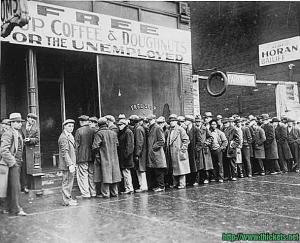 I just can’t step back from the crap being pushed by politicians as “jobs” policy these days. I can’t believe any one is actually falling for the line that basic corporate welfare programs and subsidies are actually going to create jobs because there’s never been any evidence of that being correlated in the past and there is certainly no evidence of that happening today. Lest we forget, we have about 11 years of experience with corporate tax largess, deregulation of financial markets, and low taxes on capital gains. Yet this century has seen nothing but miserable job creation. We’ve got nothing to show for it but the biggest recession since the Great Depression.
Here’s Robert Reich calling Romney’s job creation approach “bizarre”. However, it doesn’t really sound any different from that offered up by any of the other candidates either and that includes the President. This bothers me to no end and hence, I keep blogging on about it.
“Mitt Romney kind of has the odd idea, and it is a bizarre idea, that at a time when corporations are scoring record profits. At a time when you’ve got them sitting on $2 trillion of cash they don’t even know what to do with, that somehow if you give them more tax cuts and deregulate so you reduce their costs even further, they will then create jobs.
“They don’t create jobs now, he assumes, because their costs are too high or they’re not making enough money. Well, the reality of course is just the opposite,” former Secretary of Labor Robert Reich said on MSNBC’s “The Last Word.”
“They don’t need more money, companies are doing very well,” Reich said later on in the segment.
Corporations are flush with cash at the moment. They just aren’t doing anything with it because they won’t expand unless there’s demand for  their products and services. As I demonstrated yesterday, the bottom has fallen out of consumer demand and that’s stymied economic expansion. We do not need to appease some imaginary confidence fairy. Businesses need paying customers. One of the primary drivers of economic activity in this country since World War 2 has been construction. The housing market is still in big trouble and we have excess supply of both commercial and consumer real estate. What business person is going to hire more people and produce stuff that no one buys?
We’re going to be live blogging both the Republican debate tonight as well as the President’s job speech. Neither promise anything more than distinctly unproven economic policy. Even the President is thought to not believe what he’s going to be saying if you believe this. What kind of leader pushes policy he knows to be wrong?
The centerpiece of the job creation package that President Obama plans to announce on Thursday — payroll tax relief for workers and perhaps their employers — is neither his first policy choice nor that of many economists. But it is the one that they figure has the best chance of getting Republicans’ support.
Mr. Obama has signaled that he will propose to extend for another year a reduction of two percentage points in the 6.2 percent Social Security payroll tax that employees pay, which means about $1,000 more for the average household. And he is considering a proposal to expand the tax relief to employers’ share.
In his prime-time address to a joint session of Congress, Mr. Obama is expected to call for a package totaling several hundred billion dollars that would also extend other business tax cuts, put federal dollars into building and repairing roads, rails, airports, schools and other infrastructure projects, and provide aid to states to avert more layoffs of teachers.
But the single biggest stimulus measure he will propose is likely to be temporary payroll tax relief. If the current tax cut, due to expire at the end of the year, is expanded next year to employers as well as employees, it would pump roughly $200 billion into the economy, with the aim of stimulating much-needed demand for goods and services from consumers and businesses and, additionally, of giving companies an incentive to hire.
For the White House, its appeal is that it may be the only large stimulus measure that can pass Congress this year given Republicans’ preference for tax cuts.
And if Republicans oppose him, the White House figures Mr. Obama has the better of the political argument because he will be trying to block a tax increase that otherwise would apply to virtually all households on Jan. 1.
Republican leaders have said they might support the payroll tax cut’s extension if its cost is offset by equal spending cuts, a condition they did not apply for extending the Bush-era tax cuts on high incomes. Mr. Obama has said he will propose long-term deficit savings to offset the short-term costs of his stimulus proposals, though that is not likely to satisfy Republicans.
Look, what in his 2 1/2 years in office should leave him with the impression that he’s going to get anything past the Republicans in Congress? Half of them are indicating they probably won’t show up for the speech. Ever since the man’s taken office he’s offered one Republican plan after another. I still can’t believe after years of fighting Dolecare in the 1990s, the Democrats were forced to pass that stupid thing and it now wears the Obamacare label. What kind of leader pushes policy that his own party fought for decades?
I have no idea what trade agreements or patent reform or reducing regulations have to do with job creation either. None of that has ever been shown through research to be germane. But again, all you have to do is look at the amount of cheap money and the excess cash sitting on corporate balance sheets right now to know that businesses don’t need any more incentives to do something they aren’t doing any way.
The other thing that is most confusing is that the President’s plan will rob Peter to pay Paul because he’s going to make this ‘revenue neutral’ to appease Republicans. Again, with this appeasing pipsqueak Cantor and the rest of the whackos in the Republican caucus. Supposedly, some direct infrastructure spending and some direct aid to states to keep teachers in place is going to some how magically turn around a 9.1% unemployment rate. I don’t see how that’s going to do anything on the level that he’s talking about –$300 billion–is a token amount of money in a $15 trillion economy and the offsets will likely take away jobs from wherever they’re pulled. The other simply confusing proposal has to do with tax breaks for equipment which is really strange given that it’s likely to increase current worker productivity making hiring additional workers questionable.
In his speech on Thursday night to a joint session of Congress, Obama will also consider a tax benefit to those businesses that hire the unemployed, with a price tag of around $30 billion. Public works projects will be included, but the AP reports that this will be less than $50 billion of the package.
The president also will continue for one year a tax break for business that allows them to deduct the full value of equipment.
The local aid that Obama intends to propose it aimed at preventing teacher layoffs, officials said.
The New York Times said the cost of the package would be “several hundred billion,” while the Washington Post estimated it to be “at least $200 billion.”
This is clearly a set of tax giveaways that the government can’t afford that won’t achieve much of anything other than further the Republican agenda of starving the beast. What on earth does this president have in his head? I can’t figure out any logical, reasonable strategy for doing these things. Every time he furthers the Republican agenda it basically makes things worse for his reelection outlook. His actions are completely unpopular when measured by polls. He’s numbers are approaching those of Bush by basically repeating the Bush-Cheney policy on steroids. Unless he’s trying to become the President of the Chamber of Commerce, I’m not seeing any strategy here. It’s like he so desires bi-partisan approval that he’s willing to throw anything up against the wall to see what possibly sticks. Meanwhile, the Republicans are getting Republican policy without even putting any skin in the game. I just don’t get it.
Anyway, Minx and BB have promised to watch and liveblog the Republican debates tonight. I don’t think I can do that because it will just be a contest to see who can be the meanest in a contest to beat up modernity, science, and people that aren’t rich. I frankly see no purpose in continually watching people talk about issues that the civil war settled. I will watch the President’s speech because at this point, I’m looking for any sign of lucid economics and a strategy that doesn’t just infer faulty marketing. Who knows, maybe the sky will open up, a choir of celestial beings will start singing, ray of sunshine will start streaming out of gold-rimmed clouds, and all my questions will be answered. OR NOT.
Going …. Going …. Gone
Posted: September 6, 2011 Filed under: 2012 presidential campaign | Tags: jobs, poll numbers, the economy 5 Comments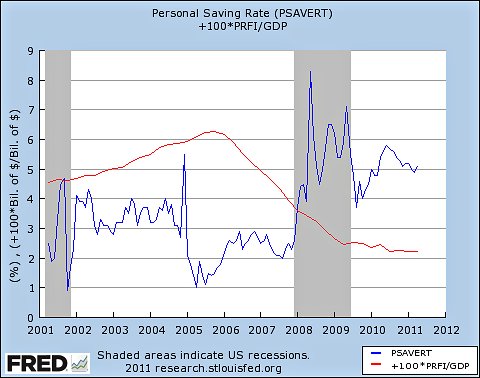 The sellout continues …
So, this week is filled with speechification on job creation. Romney and Huntsman have two of the most incoherent plans I’ve ever read. As usual, it’s a hodgepodge of stuff that’s not about creating jobs. And the other republicans in the race–like President Obama–have more checklists on Trade Agreements, lower taxes, patent reform, and tickling the fancy of some imagined confidence fairy. Again, all I can say is the High Priest of Voodoo and the Confidence Fairy have more power in this country than you and I. I’m getting tired of basing public policy on people’s imaginary friends.
I’m not trying to scare you off with Nifty Graphs, but I want to use one from FRED via Paul Krugman showing the Personal Savings rate. That’s the blue line. The Red line shows residential construction as a percentage of GDP which I’m less concerned about for this discussion but you can read about why it concerns Paul Krugman on his blog post “On the Inadequacy of the Stimulus”. I’m just going to use it as proxy for US investment since it’s a portion of that.
This is really simple macroeconomics math. People get income. They do four things with that income. A portion of that is sent to the government via taxes. A portion is spent on purchasing things and services in the US called domestic consumption. A portion is also spent on imported goods and services. This subtracts from our GDP as well as our income. The lowest percentage of what we do with our income has been that portion dedicated to savings until–as the graph shows–the Great Recession. Our savings rate has really gone up which means we’re spending a lot less. Savings and money spent on imports take money directly out of the expenditures portion of our economy as do taxes. Taxes come back to our county’s expenditures via Government spending. This happens relatively quickly and is powerful because when the government spends, it spends. It doesn’t save, it doesn’t buy imports as a rule, and of course it doesn’t pay taxes. Savings works its way back to the economy through investment which is the smallest part of our domestic expenditures. Right now–as proxied by the red line–you can see that investment isn’t really happening. Because we are a net importer, that income just drains out of our economy and stimulates economies elsewhere. Now, I’m not a protectionist and this is not meant to be a post arguing we shouldn’t do Trade Agreements. What I’m saying is that because of our expenditures patterns, that’s not really a net gain for us in terms of jobs. We get access to cheap goods,yes, but it doesn’t really bring about jobs. Right now, people are spending less and you can see that by the increase in savings, but it’s not getting invested back into the economy because of this vicious circle. People save and don’t spend. Businesses don’t have customers so they don’t hire and expand. We’ve been trying tax incentives for businesses for three years and it’s really not working because increased savings means no customers. Tax rates are not the primary motivator for either consumer or business spending. So, why does every one keep suggesting more of the same? Why even bring trade agreements into the discussion? We need direct job creation. We need a strong middle class with healthy incomes. We know how to do it. Our politicians, however, are in opposites world.
It’s certainly not paying off for the economy and it’s certainly not paying off in terms of support for Obama or Congress. People know this approach is not working. As usual, the same poll shows that Congressional approval is worse than the increasingly horrible numbers for Obama.
Public pessimism about the direction of the country has jumped to its highest level in nearly three years, erasing the sense of hope that followed President Obama’s inauguration and pushing his approval ratings to a record low, according to a new Washington Post-ABC News poll.
More than 60 percent of those surveyed say they disapprove of the way the president is handling the economy and, what has become issue No. 1, the stagnant jobs situation. Just 43 percent now approve of the job he is doing overall, a new career low; 53 percent disapprove, a new high.
As part of a reinvigorated effort to regain momentum as he heads toward the 2012 election year, Obama traveled to Detroit on Monday for a Labor Day appearance that served as a prelude to his speech Thursday to a joint session of Congress in which he will unveil new proposals to create jobs.
The urgency for Obama to act is driven not just by the most recent unemployment report, which on Friday showed no job growth in August and the unemployment rate stuck at 9.1 percent, but also by the depth of the political hole in which the president finds himself. Even more than two-thirds of those who voted for Obama say things are badly off course.
By this time in their presidencies, approval ratings for both Ronald Reagan and Bill Clinton — who also suffered serious midterm setbacks during their first term — had settled safely above the 50 percent mark. Both then stayed in positive territory throughout their reelection campaigns.
When ratings for George W. Bush slipped into the low 40s during his second term in office, they remained there or lower for the remainder of his presidency.
Obama does, however, rate better than do congressional Republicans, his adversaries in recent, fierce confrontations on federal spending. Just 28 percent approve of the way Republicans in Congress are doing their job, and 68 percent disapprove, the worst spread for the GOP since summer 2008.
When it comes to head-to-head match-ups on big economic issues, the public is deeply — and evenly — divided between Obama and congressional Republicans. Four in 10 side with both Obama and the GOP on jobs. There are similarly even splits on the economy generally and on the deficit. In all three areas, the percentages of Americans trusting “neither” are at new highs.
Nonetheless, current trends are highly unfavorable for the president. By 2 to 1, more Americans now say the administration’s economic policies are making the economy worse rather than better
So, in the midst of these terrible numbers comes a call by Boehner and Cantor to Obama to meet prior to the President’s latest speechification which is alway basically a lot of words that eventually mean nothing. They are dangling that partisanship football–like Lucy to Charlie Brown–just one more time Will Charlie Brown Obama go for it one more time?
House GOP leaders on Tuesday asked President Obama to meet with congressional leaders from both parties to discuss his jobs plan ahead of his Thursday night address to Congress.
In a letter to Obama, House Speaker John Boehner (R-Ohio) and Majority Leader Eric Cantor (R-Va.) cited the need for a bipartisan deal on jobs in requesting the meeting. Their letter also outlined potential areas of cooperation.
“We would suggest that prior to your address to Congress you convene a bipartisan, bicameral meeting of the congressional leadership so that we may have the opportunity to constructively discuss your proposals,” the letter said.
Keeping to my Peanuts metaphor: ARGHHHHHHHHHHHHHHHHHHHHH! The only jobs plan the Republicans have at the moment is to put Obama into the unemployment lines. Congressional Democrats appear just as unwilling to take principled stands based on sound economics. Nancy Pelosi has now dropped the word “stimulus“. The unbelievable yielding Democratic Party folds every time. It’s no wonder we’re in the mess that we’re in right now and people are frustrated.
Democrats are now being careful to frame their job-creation agenda in language excluding references to any stimulus, even though their favored policies for ending the deepest recession since the Great Depression are largely the same.
Indeed, with President Obama scheduled Thursday to lay out his job-creation plans before a joint session of Congress, liberal Democrats and left-leaning policy groups are pressuring him to ignore short-term deficit spending concerns in favor of sweeping spending initiatives designed to boost hiring.
The Democrats’ signature “Make it in America” platform aims to create jobs by increasing infrastructure spending, providing financial help to struggling states and expanding tax credits for businesses, all of which were key elements of their 2009 economic stimulus bill.Recognizing the unpopularity of the 2009 package, however, Democratic leaders have revised their message with less loaded language – “job creation” instead of “stimulus” and “Make it in America” in lieu of “Recovery Act” – in hopes of tackling the jobs crisis.
Repackaging meaningless rhetoric on important issues that you refuse to fight for is a frigging’ losing strategy. The Republicans know it. One of the most interesting things I’ve read all week is this call in Bloomberg by a writer from the National Review for Republicans to get behind some one electable because Republican Party Central smells the blood in the water. Both parties have these terrible pathological behaviors. The Republicans are overrun at the moment by the craziest of the crazies with ideas that would bring down the republic. Democrats can’t seem to do anything but dither and try to find new buzz words to repackage already failed ideas that hand over everything to the donor class. Lost in all of this are hard working American people who do not understand why normal governance stuff is not getting done. It just seems like more and more of what used to make American strong is going, going and gone. A pox on both their houses. I want an alternative.
Don’t welcome the Neoconfederate Overlords
Posted: September 4, 2011 Filed under: 2012 presidential campaign, Republican politics, Republican presidential politics, right wing hate grouups, Voter Ignorance, We are so F'd, WE TOLD THEM SO | Tags: Republican Party 19 Comments I used to be a Republican. I registered as a Democrat when I moved to Louisiana 15 years ago. The Clinton Presidency was a beacon of hope for what I considered a party so co-opted by crazies that I couldn’t take it any more. As some of you know, I ran for state office in Nebraska and was completely stalked and harassed by right to life true believers and looney bin church members. I used to work for Republican candidates during my high school years. I attended many state and county conventions. During the 80s there was a distinct change. The conventions were packed with people recruited from church pews that were sent with directions on who to vote for and which principles to remove from the party platform. They removed the ERA and support for abortion rights with some of the most specious reasons I’d ever heard. I really thought if I heard any one mention unisex bathrooms one more time that I was going to slap some one silly.
All I ever got for nearly everything I said was some absolutely insane diatribe that wasn’t grounded in reality let alone science or economics or sound principles of governance. You can’t really debate any one who insists the earth is less than 10,000 years old and that scientists lie. The minute you run for office to start a policy discussion, you become labelled a politician and branded as part of the problem. They hate you for your education and call you an elite. You are screamed down for attending celebrations of women’s suffrage for ‘marching with lesbians in the street’ as if that was some kind of craven and criminal act. I’ve seen rabid dogs with less crazed eyes than the looks I’ve seen on anti-choice zealots. I completely understand why people always say they never knew they had a mass murderer burying bodies in yards right next to theirs. They choose not to see what’s going on. So many people avoid being truly awake. No amount of evidence seems to wake people who really want to be uninformed.
I totally self-identify as an Independent now because I think it’s pretty obvious that both parties are only interested in self-sustenance and not the country. I will not ever get involved with party politics again but I occasionally will work for a candidate. The last campaign I volunteered for was Hillary Clinton’s campaign for the Democratic nomination. I watch the new Republican party machinations with complete horror. An article in TruthOut has brought back all my angst felt while I was trying to help wrest the party from religious and John Birch-style extremists in the 80s and 90s. Its headline is this: “Goodbye to All That: Reflections of a GOP Operative Who Left the Cult”. The author is Mike Lofgren who served as a Republican staffer–mostly in a budget analyst position for the House and Senate–for 30 years and has now quit. You should read the article and be very afraid. It’s an insider’s guide to the rebirth of the confederacy where quoting the Bible justifies any form of slavery and violence as a state’s right.
To those millions of Americans who have finally begun paying attention to politics and watched with exasperation the tragicomedy of the debt ceiling extension, it may have come as a shock that the Republican Party is so full of lunatics. To be sure, the party, like any political party on earth, has always had its share of crackpots, like Robert K. Dornan or William E. Dannemeyer. But the crackpot outliers of two decades ago have become the vital center today: Steve King, Michele Bachman (now a leading presidential candidate as well), Paul Broun, Patrick McHenry, Virginia Foxx, Louie Gohmert, Allen West. The Congressional directory now reads like a casebook of lunacy.
It was this cast of characters and the pernicious ideas they represent that impelled me to end a nearly 30-year career as a professional staff member on Capitol Hill. A couple of months ago, I retired; but I could see as early as last November that the Republican Party would use the debt limit vote, an otherwise routine legislative procedure that has been used 87 times since the end of World War II, in order to concoct an entirely artificial fiscal crisis. Then, they would use that fiscal crisis to get what they wanted, by literally holding the US and global economies as hostages.
The debt ceiling extension is not the only example of this sort of political terrorism. Republicans were willing to lay off 4,000 Federal Aviation Administration (FAA) employees, 70,000 private construction workers and let FAA safety inspectors work without pay, in fact, forcing them to pay for their own work-related travel – how prudent is that? – in order to strong arm some union-busting provisions into the FAA reauthorization.
Everyone knows that in a hostage situation, the reckless and amoral actor has the negotiating upper hand over the cautious and responsible actor because the latter is actually concerned about the life of the hostage, while the former does not care. This fact, which ought to be obvious, has nevertheless caused confusion among the professional pundit class, which is mostly still stuck in the Bob Dole era in terms of its orientation. For instance, Ezra Klein wrote of his puzzlement over the fact that while House Republicans essentially won the debt ceiling fight, enough of them were sufficiently dissatisfied that they might still scuttle the deal. Of course they might – the attitude of many freshman Republicans to national default was “bring it on!”
It should have been evident to clear-eyed observers that the Republican Party is becoming less and less like a traditional political party in a representative democracy and becoming more like an apocalyptic cult, or one of the intensely ideological authoritarian parties of 20th century Europe. This trend has several implications, none of them pleasant.
He continues to write about how the media has not really awakened to the true nature of the party’s activists as well as a list of the current lunatic ideology that has captured the Republican political machinery. I’ve often written about the way the press never seems to hold any one to account for lying. They are complicit in the destruction of political discourse. They refuse to call out obvious lies.
The media are also complicit in this phenomenon. Ever since the bifurcation of electronic media into a more or less respectable “hard news” segment and a rabidly ideological talk radio and cable TV political propaganda arm, the “respectable” media have been terrified of any criticism for perceived bias. Hence, they hew to the practice of false evenhandedness. Paul Krugman has skewered this tactic as being the “centrist cop-out.” “I joked long ago,” he says, “that if one party declared that the earth was flat, the headlines would read ‘Views Differ on Shape of Planet.'”
Lofgren cites a fairly recent article from The New Republic worth reading. Its’ written by John B Judis and titled ” If Obama Likes Lincoln So Much, He Should Start Acting Like Him”.
Over the last four decades, the Republican Party has transformed from a loyal opposition into an insurrectionary party that flouts the law when it is in the majority and threatens disorder when it is the minority. It is the party of Watergate and Iran-Contra, but also of the government shutdown in 1995 and the impeachment trial of 1999. If there is an earlier American precedent for today’s Republican Party, it is the antebellum Southern Democrats of John Calhoun who threatened to nullify, or disregard, federal legislation they objected to, and who later led the fight to secede from the union over slavery.
Today, Republicans are threatening a government shutdown and an international monetary crisis over raising the debt ceiling. They have demanded a set of ruinous concessions as a condition for raising the ceiling. These conditions would include draconian budget cuts at a time when economic growth has virtually stalled—it grew a mere 0.9 percent the first half of this year—because of the exhaustion of the 2009-10 government stimulus. To gain Tea Party votes, House Speaker John Boehner set another condition for raising the debt ceiling again in six months: the passage by the House and Senate of a constitutional amendment to balance the budget. An amendment of this kind would make it impossible for the federal government to reverse economic downturns. The Republicans are, in effect, demanding a major constitutional change in return for not shutting down the government and undermining the American economy. That’s insurrectionary behavior.
I am not an expert on Lincoln, but I have a pretty good idea what he would say if he were to suddenly appear on the scene. He would reject the Republican majority’s attempt to blackmail the rest of the government and the nation. If, because of Republican intransigence, the Congress were unable to raise the debt ceiling by August 2nd, I suspect he would follow Bill Clinton’s advice and raise the debt ceiling unilaterally on the grounds of the fourteenth amendment, which says that “the validity of the public debt … shall not be questioned.” That’s certainly a risky move. If Obama were to do it, he could eventually face a hostile Supreme Court majority, just as Lincoln’s suspension of habeas corpus aroused the ire of Chief Justice Roger Taney in 1861. But, given the dangerous game that the Republican Party is playing, that’s a risk worth taking.
I am completely baffled by the inability of people that like Ron Paul to listen to him and not hear the same confederate language that framed the civil rights era. He uses the same language I heard in the 60s and 70s when people in the south were trying to justify all their Jim Crow Laws and their monumental laws supporting voter disenfranchisement. We’re seeing today’s Republican Governors pass legislation to restrict access to votes. We’re seeing Republican Governors and legislation restrict access to a constitutionally protected medical procedure. Still, there seems to be a distinct lack of outrage by people who supposedly support limited government on these actions. This is the same group of people that are now screaming about the size of federal debt while they were more than willing to spend incredible amounts of money on unnecessary military actions and items during the Reagan years and the Bush 43 years. The hypocrisy is just maddening. The complicity of the press in presenting this insanity as simply another view point is virtually treasonous.
Back to Lofgren who demonstrates point-by-point that the Republican party is obsessed with protecting its rich constituents, promoting war and military industry, and has a religious bent now based on the view of the inevitability of apocalypse. This alliance of neoconfederates, crony capitalists, religious fanatics, and war mongers has been 40 years in the making.
It is my view that the rise of politicized religious fundamentalism (which is a subset of the decline of rational problem solving in America) may have been the key ingredient of the takeover of the Republican Party. For politicized religion provides a substrate of beliefs that rationalizes – at least in the minds of followers – all three of the GOP’s main tenets.
Televangelists have long espoused the health-and-wealth/name-it-and-claim it gospel. If you are wealthy, it is a sign of God’s favor. If not, too bad! But don’t forget to tithe in any case. This rationale may explain why some economically downscale whites defend the prerogatives of billionaires.
The GOP’s fascination with war is also connected with the fundamentalist mindset. The Old Testament abounds in tales of slaughter – God ordering the killing of the Midianite male infants and enslavement of the balance of the population, the divinely-inspired genocide of the Canaanites, the slaying of various miscreants with the jawbone of an ass – and since American religious fundamentalist seem to prefer the Old Testament to the New (particularly that portion of the New Testament known as the Sermon on the Mount), it is but a short step to approving war as a divinely inspired mission. This sort of thinking has led, inexorably, to such phenomena as Jerry Falwell once writing that God is Pro-War.
It is the apocalyptic frame of reference of fundamentalists, their belief in an imminent Armageddon, that psychologically conditions them to steer this country into conflict, not only on foreign fields (some evangelicals thought Saddam was the Antichrist and therefore a suitable target for cruise missiles), but also in the realm of domestic political controversy. It is hardly surprising that the most adamant proponent of the view that there was no debt ceiling problem was Michele Bachmann, the darling of the fundamentalist right. What does it matter, anyway, if the country defaults? – we shall presently abide in the bosom of the Lord.
I frequently lament that not enough people really pay attention to candidates when they exercise their voting rights. However, unless you are willing to do your homework and embrace the idea that politicians may not be who they say they are, you will wind up as one of those low information voters that’s easy prey to the likes of Rick Perry. Back to Lofgren.
It is this broad and ever-widening gulf between the traditional Republicanism of an Eisenhower and the quasi-totalitarian cult of a Michele Bachmann that impelled my departure from Capitol Hill. It is not in my pragmatic nature to make a heroic gesture of self-immolation, or to make lurid revelations of personal martyrdom in the manner of David Brock. And I will leave a more detailed dissection of failed Republican economic policies to my fellow apostate Bruce Bartlett.
I left because I was appalled at the headlong rush of Republicans, like Gadarene swine, to embrace policies that are deeply damaging to this country’s future; and contemptuous of the feckless, craven incompetence of Democrats in their half-hearted attempts to stop them. And, in truth, I left as an act of rational self-interest. Having gutted private-sector pensions and health benefits as a result of their embrace of outsourcing, union busting and “shareholder value,” the GOP now thinks it is only fair that public-sector workers give up their pensions and benefits, too. Hence the intensification of the GOP’s decades-long campaign of scorn against government workers. Under the circumstances, it is simply safer to be a current retiree rather than a prospective one.
If you think Paul Ryan and his Ayn Rand-worshipping colleagues aren’t after your Social Security and Medicare, I am here to disabuse you of your naiveté. They will move heaven and earth to force through tax cuts that will so starve the government of revenue that they will be “forced” to make “hard choices” – and that doesn’t mean repealing those very same tax cuts, it means cutting the benefits for which you worked.
The lessons of the last year could not be clearer. If you live in a state with a governor and a legislature sympathetic to these views, you’re watching the country descend into a locus of neoconfederate states where the state serves the plantation masters and the rest of us are slaves to ideology, servitude, debt and old tyme religion. We are all share croppers now. Take some time to think about this on a weekend that celebrates the struggles that our grandparents endured to bring us in to the modern age. Think about this as we descend in to Civil-War era politics and mindsets. Also, be very aware that the absolute ineptitude and corruption of the Democratic party and their inability to stop this insanity is as treasonous as the ‘fair-minded’ press. We the People need to do something quickly.

 peej
peej Carissa
 bostonboomer
 dakinikat
 ecocatwoman
 mablue2
 Mama Lopez
 peggysue22
 quixote
 skydancingguestblogger
 Mona (aka Wonk the Vote)



 Sky Dancing
Recent Comments