
The Bane of Bain
Posted: May 22, 2012 Filed under: 2012 presidential campaign, The Bonus Class, We are so F'd | Tags: Bain Capital, Booker, corporate raiders, private equity firms, Romney 27 CommentsI have to write about this. The recent media hoopla surrounding Cory Booker’s comments about Bain Capital just put me over the top. I guess it’s just an  occupational hazard with me. I teach this stuff. I study this stuff. I know the difference between venture capital, capital angels, and corporate raiders. I’m wondering how many politicians actually grok this. Oddly enough, Romney’s Republican primary rivals knew the difference before they were forced to tow the Romney line. I did watch Newt Gingrich last night on Piers Morgan (only because Lama was here and it was on) and he doesn’t seem to be able to fully embrace the Bain Mission.The best Gingrich could say was it was a better job than any thing Obama has done. He said something obligatory about Obama raiding the tax payer’s funds. Gingrich still knows what Romney did is not from the positive ledger side of equity capital firms.
Venture capitalists are wonders to be hold and represent the best of the best. These guys take on tremendous amounts of risk and usually bring a lot of business acumen to a start up firm. Frequently, start up firms are high tech and ran by nerdy scientists who are great in labs and on computers. They known nothing of financing, bringing products to market, or monetizing an investment. This is a true partnership of great minds and money. This is not what Mitt Romney did when he was CEO of Bain Capital. Romney’s firm could’ve been a contender in the angel category except that’s not what he did either. Warren Buffet has been an angel investor many times. Romney’s firm basically ran like a pack of hyenas to a company that was struggling and used the law to extract its life force.
Ralph B reminded me of several articles that have been out there written by financial economist wonks like me explaining why Romney never got a hero’s welcome in the past and should not get a pass right now. Putting corporate raiders into the same pile as the rest of equity capital firms is like saying cancer is just basically another cell that exists in your body.
Here’s three excellent points by Konczal on why Romney isn’t an angel or a venture capital hero. Romney’s firm played the sociopathological side of the equity capital game. They were serial killers.
1. Tax/regulatory loopholes. I did an interview with Josh Kosman, author of The Buyout of America, where he argued that the whole point of the enterprise is to game tax law loopholes. Private equity “saw that you could buy a company through a leveraged buyout and radically reduce its tax rate. The company then could use those savings to pay off the increase in its debt loads. For every dollar that the company paid off in debt, your equity value rises by that same dollar, as long as the value of the company remains the same.”
A recent paper from the University of Chicago looking at private equity found that “a reasonable estimate of the value of lower taxes due to increased leverage for the 1980s might be 10 to 20 percent of firm value,” which is value that comes from taxpayers to private equity as a result of the tax code.
That’s one thing in an industry with large and predictable cash flows. But after those low-hanging fruits were picked, as Kosman explained, “firms are taken over in very volatile industries. And they are taking on debts where they have to pay 15 times their cash flow over seven years — they are way over-levered.”
This critique has power as far as it goes. But let’s combine it with another issue.
2. Risk-shifting among parts of the firm. Traditional “creative destruction” is about putting rivals out of business with better products and techniques. Leveraged buyouts and private equity are about something different, something that exists within a single firm. This is often described as putting new techniques into place, firing people and divisions that are not performing, and generally making the firm more efficient.
The critique here is that, instead of making the firm more efficient, it often simply shifts the risks into different places. As Peter Róna, head of the IBJ Schroder Bank & Trust in New York, described it in 1989:
The very foundation of the LBO is the current actual distribution of hypothetical future cash flows. If the hypothesis (including the author’s net present value discounted at the relevant cost of capital) tums out to be wrong, the shareholders have the cash and everyone else is left with a carcass. “Creating shareholder value” and “unlocking billions” consists of shifting the risk of future uncertainty to others, namely, the corporation and its current creditors, customers, and employees…
The notion that underleveraging a corporation can cause problems is neither new nor unfounded. What is new is the assertion that shareholders shouid set the proper leverage because, motivated by maximizing the return on their investment, they will ensure efficiency of all factors of production. This hypothesis requires much more rigorous proof than Jensen’s episodic arguments… although Jensen denies it, the maximization of shareholder returns must take place, at least in part, at someone else’s expense.
Shareholders gain, but at the expense of other stakeholders in the firm. This isn’t the normal winner/loser dynamic, where some suffer in the short-term to do what’s best for the long-term. Here the long-term suffers to create short-term winners. Once again, this issue becomes problematic when combined with another critique.
3. Dividend looting. The theory behind private equity, as Róna caught above, is that it requires shareholders to be the proper and most efficient group to set the leverage ratio. But what if, instead of setting leverage for the long term to make the firm more efficient, shareholders simply use additional debt to pay themselves, regardless of the health of the firm? As Josh Kosman put it:
If you look at the dividends stuff that private equity firms do, and Bain is one of the worst offenders, if you increase the short-term earnings of a company you then use those new earnings to borrow more money. That money goes right back to the private equity firm in dividends, making it quite a quick profit. More importantly, most companies can’t handle that debt load twice. Just as they are in a position to reduce debt, they are getting hit with maximum leverage again. It’s very hard for companies to take that hit twice…
The initial private equity model was that you would make money by reselling your company or taking it public, not by levering it a second time…Right after this goes on for a few years, you’ve starved your firm of human and operating capital. Five years later, when the private equity leaves, the company will collapse — you can’t starve a company for that long. This is what the history of private equity shows.
The biggest difficulty I have with all this political back and forth is that Republicans and Democrats will take money from Wall Street as political donations without really looking at the individual or the firm. Some private equity firms are value-added. Others basically remove value from the US economy. Romney falls into the looter baron role. However, Booker and Obama have both taken political donations from all breeds of these guys. So, they may not have closed down the companies or bootstrapped Yahoo, but they’ve been in on the spoils.
Again, let’s look at what some of Romney’s Republican rivals said.
1. “The idea that you’ve got private equity companies that come in and take companies apart so they can make profits and have people lose their jobs, that’s not what the Republican Party’s about.” — Rick Perry [New York Times, 1/12/12]
2. “The Bain model is to go in at a very low price, borrow an immense amount of money, pay Bain an immense amount of money and leave. I’ll let you decide if that’s really good capitalism. I think that’s exploitation.” — Newt Gingrich [New York Times, 1/17/12]
3. “Instead of trying to work with them to try to find a way to keep the jobs and to get them back on their feet, it’s all about how much money can we make, how quick can we make it, and then get out of town and find the next carcass to feed upon” — Rick Perry [National Journal, 1/10/12]
4. “We find it pretty hard to justify rich people figuring out clever legal ways to loot a company, leaving behind 1,700 families without a job.” — Newt Gingrich [Globe and Mail, 1/9/12]
5. “Now, I have no doubt Mitt Romney was worried about pink slips — whether he was going to have enough of them to hand out because his company, Bain Capital, of all the jobs that they killed” — Rick Perry [New York Times, 1/9/12]
Even the media doesn’t know a damn thing about the variants of equity capital firms. ABC appears to be joining FOX news in spreading stupid tropes and canards.
Private-equity firms aren’t supposed to create jobs; they’re supposed to make money for their investors, which to a large extent include pension funds and university endowments. The companies in which they invest are sometimes on the brink of failure to begin with, and are likely to go bankrupt without outside help. These risky investments often include making decisions like cutting costs and jobs.
But in the little-understood world of private equity, Obama has seized upon a basic formula — Romney and Bain plus companies equals some lost jobs and millions for Romney — to argue that he’s unfit for the Oval Office.
Defending the Bain ad, Obama spokesman Ben LaBolt said the campaign isn’t “questioning the purpose of the private-equity business as a whole.”
“Why did Romney and his partners succeed even if the company failed?” LaBolt asked rhetorically on a conference call.
Probably because private-equity firms don’t necessarily rise and fall with the companies in which they invest. Finance experts explained that faced with a decision over bankruptcy, those firms are obligated to protect their investors, not the workers at the company. Pumping more money into a company that has shown signs of failure isn’t as smart a move business-wise as cutting losses to save investors money.
Actually, angels and venture capitalists do exactly all of that and make money if they do it right. The above description is just whacked. I’d drum a student out of my corporate finance class that tried to offer this up. But, the media can print just about any old thing it wants to and get away with it. Most private equity firms are NOT corporate raiders. There are even funds that do project financing that help Governments build things like dams, highways and universities. Gordan Gecko’s way of business is not the life blood of the private equity market. They can provide seed money, start-up money, expansion and development money and a lot of money that isn’t based on gutting existing businesses. Some specialize in transfers of power from a sole owner who is retiring to a new group of owners. Most don’t drain the firms of capital when they leave either. Romney was a pirate not some kind of private enterprise swashbuckler.
Enuf said.
Okay, so that’s my lecture\rant for the day. I’m going back to grading papers now. That is all.
Dead Silence from Mitt Romney on Chen Guangcheng’s Arrival in U.S.
Posted: May 21, 2012 Filed under: 2012 presidential campaign, China, Foreign Affairs, Human Rights, U.S. Politics | Tags: Chen Guangcheng, diplomacy, Hillary Clinton, Mitt Romney, State Department 31 Comments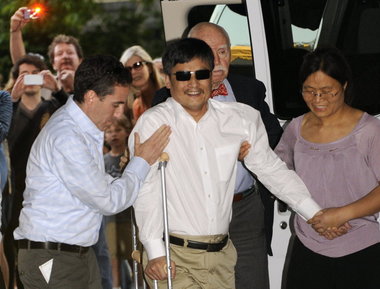
It’s been a couple of days now since blind Chinese activist Chen Guangcheng arrived at Newark on a flight from Beijing. Mitt Romney must have heard about it, but he’s said nary a word about it. I wonder why?
He had plenty to say back on May 3, in the midst of the crisis that took place during Secretary Clinton’s trip to China. Chen had managed to escape from house arrest and make it to the U.S. Embassy to ask for assistance. As State Department and U.S. Embassy staff struggled to negotiate an exit strategy for Chen, Romney, the all-but-official Republican nominee:
condemned the Obama administration’s handling of blind Chinese dissident Chen Guangcheng, calling the episode “a dark day for freedom” and “a day of shame” for President Obama if, he couched, reports are true that American officials communicated threats to Chen’s family….
Several times on Thursday, Romney couched his comments with disclaimers like “if the reports are true,” but the takeaway was clearly intended that the incident is a black eye for President Barack Obama, Secretary of State Hillary Clinton and Treasury Secretary Timothy Geithner.
Despite Romney’s impulsive catastrophizing, Secretary of State Clinton calmly continued her efforts to help Chen and his family get to the U.S. in a way that would also save face for Chinese officials. Chen was offered a law fellowship at New York University and a deal was struck: Chen could leave China on a student visa, and his departure wouldn’t be characterized as seeking asylum.
On May 9 in New Delhi, Clinton told an interviewer:
that the work she and others have done to establish multiple channels for dialogue over the last 3 1/2 years “created a level of personal relationships and understandings between individuals and our government institutions that is absolutely critical.”
Clinton suggested that China’s willingness to agree to a U.S. proposal to assist a prominent critic of the government’s one-child policy is an indication that taking a broader view of the relationship pays dividends in a moment of crisis.
“I’ve invested a lot and argued strongly” for keeping regular channels of communication open so that no one issue “predominates or undermines the potential for reaching agreement on other equally important issues,” the top U.S. diplomat told Bloomberg Radio.
This was a triumph for negotiation as opposed to the kinds of macho chest-pounding that Romney has been preaching so far.
Declining to comment on how the U.S. managed to craft a deal this time in a sensitive case involving a Chinese activist, Clinton said that “every high-level Chinese official that I met” last week “repeated back to me” words from a speech she delivered in Washington reflecting on Sino-U.S. relations in the 40 years since President Richard Nixon’s historic outreach to communist China.
Chinese officials, she said, echoed her view that “what we are trying to do — the U.S. and China — is unprecedented in world history. We’re trying to find a way for an established power and a rising power to coexist.”
Last night, Cheryl Isaac wrote at Forbes:
Chen posed a great challenge for Hillary Clinton because of two competing issues: the economic dialogue in Beijing had been her priority for a couple of years, her pledge to protect human rights—women’s rights nonetheless—another priority.
The confusion of the negotiation process did not help either. After escaping house arrest and seeking refuge at the American Embassy, Chen first decided to stay in China. Then later, he pleaded to be taken to America—putting Clinton in the difficult place of having to renegotiate an agreement that had been reached 24 hours prior; reports the Daily Beast’s Howard Kurtz.
People around the world stated their displeasure. In the U.S., she had Congressman Chris Smith (R-NJ) stating that Clinton did not keep Chen safe within the U.S. Embassy. In this video interview, Smith even admits to telling Chen—in a phone conversation—that the fact that officials were working day and night on his paperwork, was not a good sign…”
But Hillary pushed onward, made the right decisions, and was successful in her goal of helping Chen and his family.
Bravo, Madam Secretary! Where are macho Mitt’s congratulations? Has he apologized yet? I’ve googled, but can’t find any evidence that he has owned up to his bungling or even acknowledged this diplomatic achievement. Why am I not surprised?
Mitt Romney: “It is without question the largest one-time careless expenditure of government money in American history” Really?
Posted: May 18, 2012 Filed under: 2012 presidential campaign, Psychopaths in charge, U.S. Politics | Tags: Afghanistan War, bridge to nowhere, Hillsborough NH, historic monuments, Iraq War, jobs, Mitt Romney, Sawyer Bridge, stimulus funds, tourism, Vietnam War 44 Comments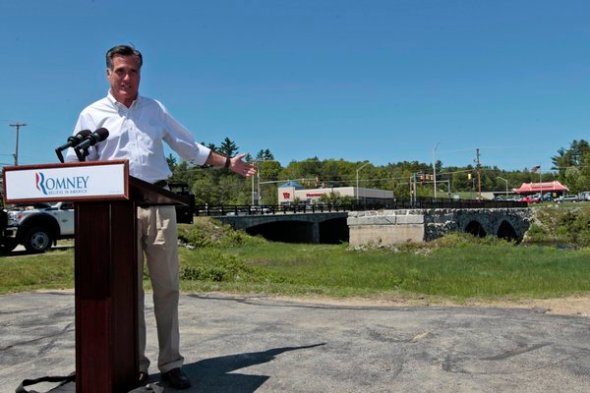
Mitt Romney mocks the people of New Hampshire for preserving historic landmarks
The title of this post is a quote from Mitt Romney’s speech this afternoon in Hillsborough, New Hampshire. Politico reports:
Mitt Romney used a 19th-century stone bridge here today to anchor his attacks against President Barack Obama, calling the 2009 economic stimulus the “largest one-time careless expenditure of government money in America’s history.”
“This is the absolute bridge to nowhere if there ever was one,” Romney told supporters as he motioned to the stone bridge behind him. “That’s your stimulus dollars at work — a bridge that goes nowhere. And so I hope that the president comes here, and takes a look at some of the stimulus program, there’s a long list by the way.”
Wow, the government must have really spent a lot of money for Romney to be this bent out of shape. Let’s see, how much stimulus money went into the bridge?
More than $150,000 from the federal stimulus bill was awarded to restore this one — which doesn’t cross a body of water and hasn’t had vehicle traffic in more than a century. Local officials say they want to turn the stone arch and its surrounding areas into a public park.
“It is without question the largest one-time careless expenditure of government money in American history, and the bad news is it was not just wasteful spending,” Romney continued. “It is wasteful borrowing as well because we still are going to be paying on that debt for years and years and years.”
Wait a minute! That has to be a misprint, right? Why just today Mitt and Ann Romney donated $150,000 to his presidential campaign. He must have meant $150 million went to the bridge. But no, the entire cost of the restoration was about $288,000, with the state providing the start-up funds.
What is Romney getting at here? Does he want to stop preserving historical sites and monuments? Is it really wrong for small towns like Hillsboro that are dependent mostly on tourism to want to preserve their historic sites and at the same time build lovely parks to attract visitors who might also spend their money in town? At the same time, the project provided much-needed jobs for New Hampshirites struggling to survive in a difficult economy.
The bridge that Romney complained about is named Sawyer Bridge, and it is one of the few remaining stone arch bridges in New England. The town of Hillsborough is home to four of them. From Huffington Post:
Romney’s attack on the $288,000 bridge restoration will run into several immediate challenges: Funding for the project was overwhelmingly supported by state Republicans, including a significant number who have now endorsed Romney for president. The infrastructure project created much-needed jobs during tough economic times. And it left behind a public park enjoyed by Granite State residents who take great pride in their early-American and colonial history — and who will be casting critical, swing-state votes in November. It’s a curious breed of conservatism that would find offense in the job-creating conservation of a stone arch bridge that is one of the earliest examples of dry-laid masonry vaults in New England.
I have to wonder, is Romney opposed to any federal support to preserve historic sites? What about the National Parks? Would Romney sell off that land if he were president? Would he open them to oil drilling and other kinds of industrial development?
Think about it. For Romney expenditure of $150,000 in federal stimulus funds represents “the largest one-time careless expenditure of government money in American history.” Really? I can think of some worse, more careless expenditures of government money. What about the Vietnam War? What about the Wars in Iraq and Afghanistan, which Bush financed with borrowed money that was kept off-budget?
Just to get a sense of the financial cost of those wars, I located this paper by Stephen Daggett of the Congressional Research Service (PDF) that lists the costs of America’s wars in $2011 dollars. According to Daggett in 2011,
Since the terrorist attacks of September 11, 2001, Congress has appropriated more than a trillion dollars for military operations in Afghanistan, Iraq, and elsewhere around the world. The House
and Senate are now considering an additional request for $33 billion in supplemental funding for
the remainder of FY2010, and the Administration has also requested $159 billion to cover costs of
overseas operations in FY2011.
That’s more than the cost war in Vietnam, which in 2011 dollars was $738 billion. At that time the war in Iraq had cost $784 billion and the war in Afghanistan had cost $321 billion. And Romney is whining about New Hampshire getting $150 THOUSAND to restore a historic bridge while creating jobs and increasing income from tourism?
There is something seriously wrong with the way this man’s mind works.
Friday Afternoon Open Thread: Mitt Likes Music, Including This
Posted: May 18, 2012 Filed under: 2012 presidential campaign, open thread, U.S. Politics | Tags: humor, Mitt Romney, music, Spotify 9 CommentsA few days ago, The New York Times posted a funny mashup of Mitt Romney talking about all the things he likes. The video was created by The Gregory Brothers, a musical group that produces takeoffs on the news. I wish I knew how to embed it here, but you’ll have to go watch it the NYT site. Please watch it if you haven’t already. It’s really hilarious!
Here is the original 1994 interview in which Mitt earnestly told a young interviewer, “I like music of almost any kind, including this.” At the time, he was running against Ted Kennedy for the Senate.
Back in March, Romney listed his favorite songs on Spotify, which I think is an iPad app. Here’s Mitt’s playlist, which his campaign insist he drew up all by himself:
I am a Man of Constant Sorrow” by The Soggy Bottom Boys
Read My Mind” by The Killers
December, 1963 [Oh What a Night]” by Frankie Valli & the Four Seasons
Ring of Fire” by Johnny Cash
Somebody Told Me” by The Killers
The MTA (The Boston Subway Song)” by The Kingston Trio
Good Vibrations” by The Beach Boys
Desperado” by Clint Black
Crying” by Roy Orbison
Only You ” by Commodores
Runaway” by Del Shannon
It’s your Love” by Time McGraw
As Good As I once Was” by Toby Keith
Born Free” by Kid Rock
“Over the Rainbow” by Willie Nelson
“Stardust”
“In Dreams” by Roy Orbison
“Somebody Like You” by Keith Urban
“All-American Girl” by Carrie Underwood
Jim Farber, a reporter at the NY Daily News, notes that Mitt seems to like sad songs.
A man of constant sorrow who roams this world alone, doomed to realize his greatest loves only in dreams. Does this sound like the description of a man running for President?
….
Romney opens his 25 song list with The Soggy Bottom Boys’ version of that classic song of suffering “I Am A Man of Constant Sorrow.” He goes on to pepper the list with Clint Black’s cover of the Eagles’ ode to a shut-down loner “Desperado,” Roy Orbison’s uber-mopey “Crying” (along with his classic song of thwarted love “In Dreams”), Johnny Cash’s rumination on eternal damnation, “Ring of Fire,” and Willie Nelson’s take on the ultimate song of hopeless yearning, “Somewhere Over The Rainbow.”
Together, these selections suggest a guy whose soul may be far deeper, and less satisfied, than his public persona presents.
Farber also notes that there is only one female artist and one African American group represented on Mitt’s list. Some of the items also reveal Romney’s advanced age. Roy Orbison and Del Shannon were on the soundtrack of my late childhood (I’m just a couple of months younger than Romney).
I found a couple of other Romney- and music-oriented videos on Youtube. Who is Mitt Romney anyway?
This one is silly, but I really liked it: “Mitt Romney, I think I hate you.”
What do you have to say about all this, Mitt?
Open Thread: Mitt Romney, Busybody
Posted: May 15, 2012 Filed under: 2012 presidential campaign, 2012 primaries, U.S. Economy, U.S. Politics | Tags: Barack Obama, Bill Clinton, busybody, Debt, Federal Deficit, gossip, Hillary Clinton, Mitt Romney 20 Comments
In a speech in Des Moines, Iowa today, Mitt Romney sounded like a fussy old gossip, claiming that President Obama probably has a “beef” with Bill and Hillary Clinton.
Almost a generation ago, Bill Clinton announced that the Era of Big Government was over.
Even a former McGovern campaign worker like President Clinton was signaling to his own Party that Democrats should no longer try to govern by proposing a new program for every problem.
President Obama tucked away the Clinton doctrine in his large drawer of discarded ideas, along with transparency and bipartisanship. It’s enough to make you wonder if maybe it was a personal beef with the Clintons….but really it runs much deeper.
President Obama is an old school liberal whose first instinct is to see free enterprise as the villain and government as the hero. America counted on President Obama to rescue the economy, tame the deficit and help create jobs. Instead, he bailed out the public-sector, gave billions of dollars to the companies of his friends, and added almost as much debt as all the prior presidents combined.
ROFLMAO!! Obama, “an old school liberal?” This guy is a laff riot!
At the Washington Post, Nia-Malika Henderson interpreted Romney’s odd invoking of the good old days of the Clinton administration as another effort to link Obama with Jimmy Carter. Henderson writes:
The strategy, of course, is obvious, if a little heavy handed—paint Obama as more like Jimmy Carter, rather than as a New Democrat in the mold of Clinton.
Clinton has already emerged as one of Obama’s most visible surrogates, appearing in a video marking the death of Osama bin Laden, and will likely be used to gin up support among so-called Reagan Democrats—white, blue collar workers, particularly—and Romney can perhaps mute some of Clinton’s power by suggesting that Clinton isn’t all in with Obama. (It’s a beef, not a bromance, Romney suggests.)
But by invoking Clinton, Romney risks poking the bear in some ways, and perhaps even casting himself as a version of Clinton. Praising Clinton, even in a backhanded way, isn’t exactly a way to solidify support among the religious right.
I don’t know about the reaction from the religious right, but Bill Clinton worked a few digs about Romney into his speech today at the Pete Peterson conference (why Clinton shows up for these things, I’ll never understand, but that’s for another post). According to the National Journal, Clinton said that Romney
shot himself in the foot with the broad tax-cutting budget he suggested during the primary. He said Romney should accept projections that his plan for deep tax cuts would add billions to the deficit while requiring huge cuts to Medicare, Medicaid and non-defense spending.
“If I were in his position I would, I think, use the Congressional Budget Office numbers saying my plan increased the debt and say that no responsible president can pretend an independent analysis of his numbers don’t matter,” Clinton said. “That’s, I think, his his best avenue back to the real world.”
Clinton also offered a few verbal pats on the head to Romney.
“I feel a lot of sympathy for him,” he said. “The whole primary was about finding somebody who was true conservative, but they’re going to vote for him anyway.”
Good one, Bill!

 peej
peej Carissa
 bostonboomer
 dakinikat
 ecocatwoman
 mablue2
 Mama Lopez
 peggysue22
 quixote
 skydancingguestblogger
 Mona (aka Wonk the Vote)



 Sky Dancing
Recent Comments