
Penguin sweaters
Posted: October 31, 2011 Filed under: just because | Tags: oil spill, penguins, sweaters, Tauranga 19 CommentsThe horrible oil spill off Tauranga in New Zealand affected vast numbers of birds, in addition to all the other catastrophes. Some of those birds are little blue penguins. Some of the birds could be cleaned off in time and have been saved.
But it’s essential to prevent the birds from trying to preen their crude oil-covered feathers before the people can bathe them. And for that, there are penguin jumpers. (Or, in the US, “sweaters.”)

I’m not sure why two self-important birds make me feel happy, but they do.
Crossposted to Acid Test
What part of “Stop Stealing!” is hard to understand?
Posted: October 30, 2011 Filed under: Banksters, financial institutions 13 CommentsBank of America has now jumped the shark, gone right over the top, past the frozen limit, and exposed themselves.
This ought to be unbelievable. It only makes sense if the bank robbers are running the bank. Bank of America has transferred assets it acquired during its takeover of the Merrill Lynch brokerage to its deposit-taking arm.
Let me unpack that a bit. 
Banks, officially, put people’s savings into safe investments. The FDIC insures those savings in case the banks fail, but to prevent that outcome there are strict regulations about how banks can only put that money in safe investments.
Brokerages, officially, exist to broker any transactions on any market. Those can be the staidest of riskfree investments, like Treasury bonds, or interesting things like ultrashort inverse contracts derived from the SP 500 basket of stocks. “Derivatives” may be two, three, four, or even more meta levels above the real underlying things they represent, such as a stock or tanker load of oil. With some derivatives, you can make many times the amount of your own money that’s tied up in the trade, or, likewise, you can lose more than everything you own. That means (duh, right?) they’re risky. They have legitimate functions, such as hedging other risks or providing a way to bet on being right, but nobody ever pretends they’re safe.
Nor is there any universe in which it is up to the FDIC (=taxpayers) to make them safe by writing blank checks to cover them.
So what does BofA do? It takes bets made by Merrill Lynch — bets which were fine for a brokerage — and makes them part of the regular bank assets that are covered by the FDIC. By the magic of modern accounting, the taxpayer gets to cover wild stock market gambles that didn’t pan out.
There’s another wrinkle here. In the old high-flying days, financial institutions would sell derivatives to customers, e.g. one expecting price to go up, and then the institutions would, for their own account, buy the opposite derivative! There are two betrayals. It’s their fiduciary responsibility to tell their customers that the firm is itself investing in a fall in price. And it’s wrong to rake in money from customer commissions as well as customer losses on those same trades. It’s called a conflict of interest. It’s a big no-no.
After the crash, when it became clear that betting against the customer was fairly common in the financial industry, regulations were put in place against what’s called “proprietary trades.”
So what is BofA’s excuse for what it’s done?
Bank of America spokesman Jerry Dubrowski said the bank’s derivatives trades are subject to risk-management controls and are client-driven, not proprietary trades – meaning the bank is not betting with its own money.
In other words, it’s okay to stick taxpayers with the bill for somebody else’s failed stock market gamble because the gamble itself was not a criminal breach of ethics.
Hello? It’s the gambling that is not insured. We don’t really care who did it. And the fact that it wasn’t criminal gambling only makes it one of the few things for which BofA won’t need a lawyer.
The scariest part is that for all I know, the gross rip-off may be legal. Most of the laws for banks were written before they could turn themselves into FDIC-insured gamblers.
Bank of America posted a third quarter profit — i.e. just for the months of July, August, and September — of $5.9 billion.
What’s right isn’t always what’s good
Posted: October 28, 2011 Filed under: Bailout Blues, Banksters, financial institutions | Tags: Financial Crisis 30 CommentsThere’s something that bothers me about the current conversation (diatribe?) about the sins of the bankers.

The tone of a lot of the talk is as if they belong to some other species, as if they commit crimes nobody else does, but also as if they keep their heads when nobody else can.
Holding them to sub- or superhuman standards means it’s hard to understand why they do what they do. And that means it’s hard to make them do the right thing.
Let me explain what I mean.
After the crash, US banks were bailed out. People were outraged, and rightfully so. It’s just wrong for a thief to rob your house and then grab your savings when the jerk can’t make his rent.
But.
The time to worry about the thieving was before the crash. While it was going on. Then it would have been possible to stop it without crashing the economy.
It would have also stopped the wild ride, and — at the time — not many people wanted that. Plenty of people are just like bankers without a bank. There’s a big difference in impact, but the difference is one of degree. They’re no more subhuman than everyone else.
When the crash happens the sad fact is the thief lives in the same house you do. When he (the high-flying financial mavens were almost all “he”) can’t make his share of the rent, you both get evicted.
The thieves are literally in the same house. They’re in the same economy. The 99% and the bankers all depend on it. If the economy is destroyed, everybody is just as homeless. Your pension loses money. Your job is destroyed. The value of your house goes down. That’s been made rather clear by now.
There is no way — during the actual crash — to limit the damage to the people who caused it. There is no choice but to bail out the jerks who caused the problem. It’s not right. It’s maddening. But doing anything else means more damage for you. It’s not about punishing the guilty at that point. It’s about saving the innocent.
That’s why the bailout was the right thing to do. It wasn’t done well, or enough, or with any of the necessary rules attached to it, but it did avert a much bigger disaster. That’s all clear by now, and leads even compassionate economists to point out that economics is not a morality play.
The time for retribution is afterward. That is, now. But now the 1% are going scot-free and raking in more money than ever. That’s criminal laxity. Not the bailout.
However, bankers are just people with banks, so they’re now going through the same process of preferring moral outrage to emergency assistance.
Europe is having a similar problem with inability to repay debts. In their case it’s a country, not mixed salads of mortgages, but the problem is the same.
Unless Greece is convincingly bailed out, everybody with money in the market will be worried about how much they could lose if they don’t get out now. If everybody pulls their money out, economies freeze up, and we all go broke.
So what have the bankers been arguing about? How to create the funds for an adequate bailout? No, it’s about not wanting to bail out those profligate Greeks. It’s the same routine, but with more numbers and graphs: I was frugal. It’s not fair to make me pay some gambler’s debts. They should just suck it up.
These are people whose jobs are dealing with money. They, of all people, should know that economics is not a morality play. They, of all people, should know that when the sheriff is at the door with the eviction notice, it’s not the time to beat up the crackhead brother for squandering the rent. At that point, you just scrape together the rent. Later, you send the brother to rehab.
What’s funny, though, is how far the inability to recognize the common roots of feelings extends. Krugman is smarter than I am in practically every way, but even he is continually mystified by the non-rational adherence to austerity when austerity will cost the earth. (Read his blog. There are dozens of posts asking What were they thinking?.)
There’s nothing mysterious about it. It’s the same reaction everybody has. Don’t make me pay for someone else’s mistakes. It doesn’t matter whether you agree with the bankers’ definitions of mistakes. Nobody wants to pay for what they see as somebody else’s mistakes. And when something turns out to be a mistake, it’s amazing how fast it becomes somebody else’s.
The other unspoken, non-rational motivation is the equally simple one that austerity for thee but not for me is a great way for the rich to get richer. That, too, may be unmentionable, but it is not mysterious.
The point is this. Once the emotional roots of a non-rational stand are recognized, there’s a chance one could deal with it. It’s only a chance, but without that understanding, there’s none at all. Understanding allows us to start fighting the right battles instead of the distractions.
For instance, bankers are professionals, so they hang an economic story around their outrage. They come up with theoretical underpinnings for why austerity is such a good idea. None of those pins stays in place when examined, but they don’t care. And that is the hallmark of acting on feelings, just like an ordinary human being. They’re no more superhuman than everyone else.
I’m not suggesting that every argument one doesn’t like can be written off as “emotional.” All arguments have to be evaluated against the evidence, and evaluated several times to make sure the results are right. But once that’s done, if people keep clutching an anti-rational position, it is not insulting to figure out why they’re doing that. It’s essential.
And then when one argues with them, one needs to argue with their real reasons, not their stories.
So, in the present case, if the roots of the cries for austerity were faced squarely, we could clear the way for useful solutions. We could discount the more-for-me motivation as the bog-standard grabbiness we all have and decide to ignore it. And to the extent that the cries are rooted in a sense of unfairness, maybe we could get past it.
We could acknowledge the unfairness. We could resolve to deal with it after the crisis, instead of letting the rich and powerful off scot-free. And we could acknowledge that fairness is better served by helping millions of small people through the crisis, even if it also carries along some perps. That’s the good thing to do. Punishing the perps may feel right, but it’s stupid to let it cost us everything we have.
[Update Oct 27th: It remains to be seen whether today’s agreement in Europe to help Greece did enough or just did the minimum to keep the markets from panicking this very minute. Still, any prevention of panic is better than none.]
Crossposted to Acid Test
The obesity epidemic
Posted: October 24, 2011 Filed under: health hazard | Tags: endocrine disruptors, obesity, pollution 9 CommentsPeople discuss obesity as an epidemic, but the solution somehow remains individual action. That doesn’t work for real epidemics. You can’t, for instance, not catch smallpox all by yourself. (You can be lucky and have natural resistance, but that’s different.)
It’s turning out that people spoke more truth than they realized. Evidence is accumulating that obesity is a real epidemic, i.e. a public health issue with social and environmental causes. It’s something I’ve suspected for years.
Obesity has become more prevalent over the last thirty to forty years. That means — at the population level — it can’t be caused by the human tendency to eat too much. People have always been primed to eat too much, but large numbers of very overweight people relative to the whole population is a phenomenon of the last few decades.
And note that this isn’t just a matter of changing measurements or statistics. When coffin makers have to upsize coffins because the ones they’ve used for decades no longer work, there’s a real change. It’s not just PR.
So the cause(s) of the problem have to be something that’s changed in the last few decades. I’ll list all the changed factors I can think of, but the one I want to talk about is the last. Some of them are most developed in the US, but if and when they manifest elsewhere, they can be expected to promote obesity likewise.
- The baby boom generation, which is large relative to the whole population, has aged, and older people are often heavier. (A factor beyond anyone’s control.)
- Advertising for high-calorie fast food has grown very sophisticated and ubiquitous, and fast food is much more available. (A social environment factor that requires changes to industries.) (A side note: advertising is not something that can be simply ignored. It functions to steer choices whether you’re paying attention or not. The only way to avoid its effect is to avoid the advertising itself, which involves avoiding almost all modern media. Individuals may do that, but it’s not going to happen at a population level, and that’s where public health issues operate.)
- Related to that is the increase in drinking sweetened sodas. That’s upped average calorie intake by a couple of hundred calories per day. (Again, advertising and availability combine to make this a social environment factor.)
- Related to both of the above is the use of refined sugar, which has never before been used on the huge scale of the last few decades according to a report by birthorderplus. It promotes obesity by the simple mechanism of making it too easy to get too many calories. There’s also a potential added wrinkle involving high fructose sweeteners. Scientists argue about its effect. Fructose is processed differently than glucose, and given the way it’s regulated, it could be a contributing factor to the problem. (A social environment factor due to industry practices and agricultural subsidies.)
- Urban factors contribute as well. Urban sprawl makes distances too big for walking. Use of mass transit, which requires walking to and from stops, has declined versus personal cars. And many urban areas don’t have adequate parks or play spaces where adults and children can be physically active. Epidemiology indicates that (lack of) urban planning is a measurable factor in increasing obesity. (NYTimes 2003 article) (Another social environment issue.)
- Last, there’s my pet peeve: endocrine disruptors. These are pollutants that are byproducts of some plastics, some agricultural chemicals, some hormone therapies, and the like. Bisphenol A (BPA) is a well known example. Once they’re in the environment they can break down into related compounds, they get into the food chain, and once they’re ingested, they latch on to some of the same receptors as the body’s own hormones. Once they’ve latched on, they can rev up or shut down the normal function, or they can cause strange results not in the body’s normal repertoire. Widespread endocrine disruptor pollution has happened only in the last few decades. (An environmental factor involving dozens of industries.)
Recent research (press release, article summary in Cell Metabolism) has shown that estrogen receptors in the brains of female mice regulate hunger and energy expenditure. (Male brains likewise have various androgen and estrogen receptors and are expected to have similar regulatory pathways. However, that wasn’t the topic of this research. The recent increase in the phenomenon of “man-boobs” on young and not-obese men shows rather plainly that endocrine disruptors have no less effect on fat deposition in men.)
Interestingly, one implication the researchers draw is that estrogen replacement therapy for postmenopausal women may have an overlooked benefit by keeping weight down and therefore keeping the complications of obesity down.
However, they don’t draw the far more significant implication for the entire population. If sex hormone receptors regulate energy balance, and if we’ve flooded the environment with bad substitutes for sex hormones, is it any wonder that people are having trouble regulating energy balance?
It’s one more instance where the flood of chemicals released by modern industry is affecting the environment, in this case the environment of the human body.
Like all public health issues, nothing less than a population-level approach will work. Dysentery, cholera, and typhoid are never wiped out by drinking boiled water. They’re wiped out by building municipal sewers. Smallpox wasn’t eradicated by avoiding smallpox patients. It was eradicated by universal vaccination. The individual actions aren’t useless. They just don’t change the widespread causes of the widespread problem.
Modern health problems like cancer and obesity aren’t going to be wiped out by eating fresh vegetables. Eating veggies is good, but it doesn’t address the basic problem. That’s going to take nothing less than a change to clean sustainable industry.
It’s almost enough to make you wish a mere diet really was all that’s needed.
The Not-so-hot Knobs of Wall Street
Posted: October 21, 2011 Filed under: #Occupy and We are the 99 percent! 40 CommentsThe story so far: Some idiot decides to photograph attractive women demonstrating in Occupy Everywhere events. They probably think they’re part of a narrative on all the great ideas happening in the movement.
What he publishes on youtube is something he calls “Hot Chicks of Wall Street.”
Okay. So far it’s just a bog-standard sad tale of a male who says he has no idea how revolting he is. Jill wrote about it. Now comes the bad part.
Does everyone in Occupy Wall Street rise up to say That Is Not Cool? To say that the knob is no longer welcome in any part of the movement? To ask everyone in it not to give the tripe any air? To affirm that women and men are partners in the movement, not decorations rated on fuckability?
No.
Instead there are complaints about how it’s not an official video from the officially official representatives of OccupyWallStreet so it doesn’t count. (E.g. comments here.) It’s just some lone jerk. He’s no part of the “brand.”
Really? Here’s MarketWatch, not a site otherwise much concerned with OWS. This, however, did catch their eye. (click to enlarge) 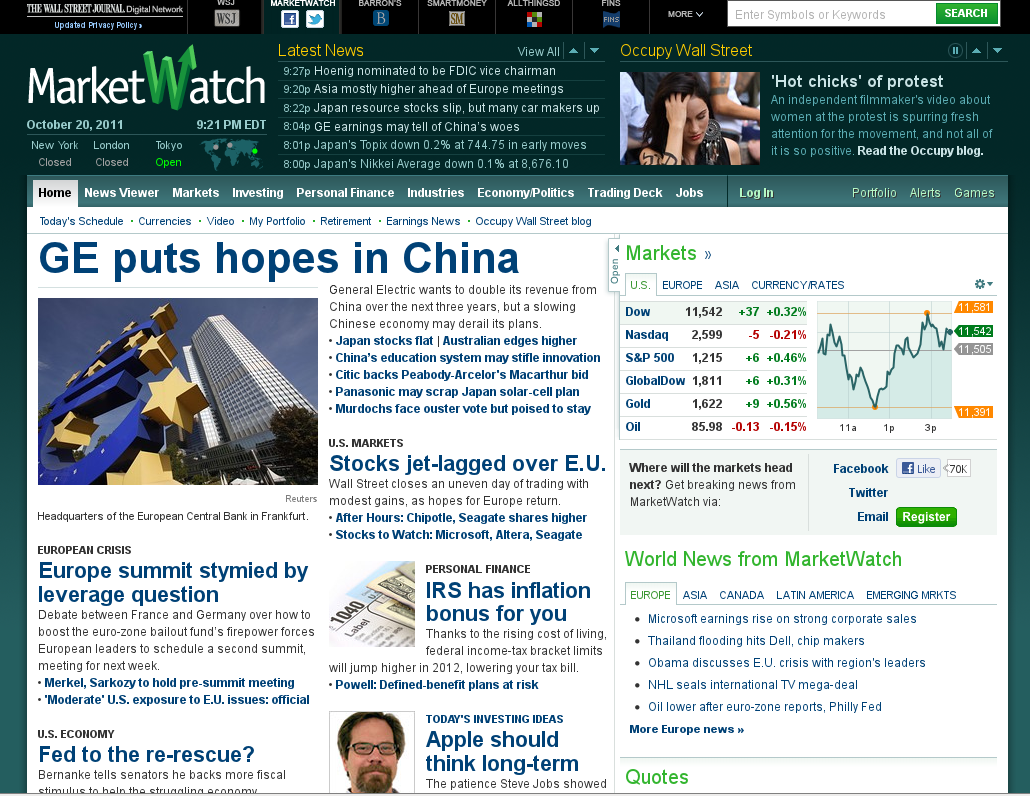
You know what? OWS didn’t officially kick him out. And don’t tell me, “It’s leaderless. There are no officials.” If the video doesn’t count because it’s not official, then there’s somebody who could officially repudiate it. You can’t have it both ways. Now the knob’s work is the mainstream face of OWS. Deal with it.
Furthermore, the knob is getting plenty of air. So much so that Jill had to write a follow-up post about his rape jokes.
Did OWS shut down the jerks whining about how this is nothing but healthy men liking healthy sex and you just have no sense of fun?
No.
They could have pointed out that women like sex too. That doesn’t mean everyone has to listen to endless talk on the size of men’s packages. You keep that stuff to yourself, and to your partner(s). And if you’re a rude jerk to the 99% — any of the 99% — they could have said they don’t want you in the movement.
Then it gets steeply worse. There have been reports of rapes. Did OWS affirm strong support for the women in their ranks, and provide what they could in the way of medical, legal, and police resources?
No.
One group said such reports should go through an OWS committee of some kind, which would vet it for report-worthiness. If they passed it, then it was okay to go to the police.
Uh, hello? Earth calling Dude Nation. Those are the tactics of KBR. They were the military contractors in Iraq who imprisoned a worker after she’d been gang-raped to prevent her from talking about the crime. OWS isn’t imprisoning anyone, but they do seem more worried about reporting than they are about the crime. The tactics differ in degree, not in kind. That is wrong.
Apparently, the official officials at OWS don’t know that. Apparently, they can’t figure out that the way to have enough credibility to fight false accusations of rape is to take the crime seriously. Because I suspect that’s the real issue. They’re terrified of fabricated charges being used to discredit the whole movement.
So they’ve decided to beat everyone else to the punch and discredit the whole movement themselves.
Don’t try to tell me these are just individuals who don’t represent the movement. If they don’t represent the movement, then tell me this:
Where is the outrage shutting them down?

 peej
peej Carissa
 bostonboomer
 dakinikat
 ecocatwoman
 jjlo
jjlo mablue2
 Mama Lopez
 peggysue22
 quixote
 skydancingguestblogger
 Mona (aka Wonk the Vote)



 Sky Dancing
Recent Comments