
Finally Friday Reads: Of Harpies, Hags, and Magical Vaginas
Posted: June 23, 2023 Filed under: just because | Tags: @repeat1968, Amy Coney Barrett, anti abortion rights legislation, Corrupt Supreme Court Justices, Dobbs v. Jackson Women's Health Organization, John Buss, Randy Rainbow, Samuel Alito 23 Comments
Harpy. A hybrid monster formed of a vulture with the head (and sometimes the torso) of a woman.
Good Day, Sky Dancers!
We’re all aware of the ongoing chaos created by the U.S. Supreme Court and its many unprecedented decisions. The majority of people have no confidence in them. ProPublica has shown how corrupt many are, having been bribed and brought in as pets to right-wing billionaires active in the Federal Society. We can see the blood on their hands just one year after their bizarre decision with Dobbs overturned Roe v. Wade. They’re clearly paid henchmen to rid their overlords of inconvenient people.
We’ve recently determined that many men in Congress and state legislatures creating this legislature don’t even understand women’s bodies or reproduction. Yet, here they are, inflicting us with the Middle-Age religious ideology of the Dark Ages. This article from the Guardian is 8 years old but still stands up, as evidenced by the chaos and ignorance that rules the Dobbs Decision. “Women’s bodies can’t perform magic. Someone, please tell Republicans. One congressman this week thought that if women swallow pills, they end up in their vaginas. The GOP still knows nothing about female anatomy.” This was written by Jessica Valenti.
Do Republican men think women are mythical creatures, like unicorns or fairies? It’s the only explanation I can come up with to make sense of the party’s continued insistence that women’s bodies can perform feats of absolute magic.
On Monday, during testimony on a state bill that would ban doctors from using telemedicine to prescribe abortion pills, Idaho Republican Rep Vito Barbieri asked a testifying physician if pregnant women could swallow small cameras so that doctors could “determine what the situation is”.
Dr Julie Madsen – who I imagine must have been suppressing the eyeroll of a lifetime – responded that it couldn’t be done because “when you swallow a pill it would not end up in the vagina.”
Barbieri now says the question was a rhetorical one (that’s the ticket!) but his gaffe reminds us all about just how little Republicans understand about women’s bodies. Though, again, I’m honored that they think we hold such awesome abilities. After all, who could forget then-Rep Todd Akin’s assertion that women who were “legitimately” raped would not get pregnant because “the female body has ways to try to shut that whole thing down.” Like a superpower! Or Rush Limbaugh’s belief that women’s bodies are so all-powerful that we actually require a birth control pill every time we have sex to keep from getting pregnant. But it doesn’t stop there.
Conservatives apparently also think that women are so magic as to almost be immortal – you see, they don’t believe that abortion are ever necessary to save a woman’s life or protect her health. They’re so sure of this, in fact, that they’ve been willing to bet our lives on it. It was just four years ago that House Republicans proposed to pass a bill that would have made it legal for hospitals to deny life-saving abortions to women who needed them and even deny them transfer to another hospital willing to perform the procedure. Maybe they just think we have nine lives?
Republicans must think we’re magic – how else do they think we can possibly have all these kids (since we’re not supposed to need or want or get abortions) with no paid maternity leave, no subsidized child care, no livable minimum wage and a culture that thinks we’re supposed to grin and bear it?
Shockingly, all the fairy tale tales conservatives have told themselves about women’s bodies and abilities hasn’t done the Republicans any favors around election time. And despite trainings for Republican candidates to learn how to talk about gender without saying something idiotic about rape or vaginas, Republican men continue to think stupid things about women and women continue to not vote for them.
So please, keep it up, guys. Talk more about what our vaginas can do, or how getting pregnant after rape is a “gift from god”. The more we watch as men who lack basic knowledge of biology and the human reproductive system make laws about what we can do with our own bodies, the more I believe that maybe women really are magic. We take care of our families as Republicans insist we’re “strong” enough to do with less. We battle back against archaic laws and dinosaur politicians. We do things a lot more impressive than swallowing a pill and having it migrate to our vaginas. That’s just weird.

Dracopopodis, from “Historia animalium” by Konrad Gesner, 1551/1558
So now, knowledge about women’s reproductive systems cannot be taught in Medical School or practiced even in extreme emergencies. This is from The New Republic and is written by Tori Otten. “Ob-Gyns Say More People Are Dying Since Dobbs Overturned Right to Abortion. A new KFF poll finds health professionals are incredibly concerned about the restrictions on abortion.”
Health professionals say that maternal mortality has skyrocketed in the year since Roe v. Wade was overturned, a new survey from KFF found, a sign of how harmful abortion bans are.
The Supreme Court rattled the country when it rolled back the nationwide right to abortion on June 24, 2022. In the year since then, Republican-led states have cracked down on abortion access, imposing confusing restrictions or outright bans on the procedure. Many in the GOP argue that they are not limiting access to medically necessary procedures, but instead are saving lives.
KFF surveyed nearly 600 ob-gyns nationwide from March to May, and found that 68 percent say the Dobbs v. Jackson Women’s Health Organization decision worsened their ability to respond to pregnancy-related emergencies. The survey also found that 64 percent of ob-gyns “believe that the Dobbs decision has worsened pregnancy-related mortality” and 70 percent believe the ruling increased racial and ethnic inequities in maternal health.
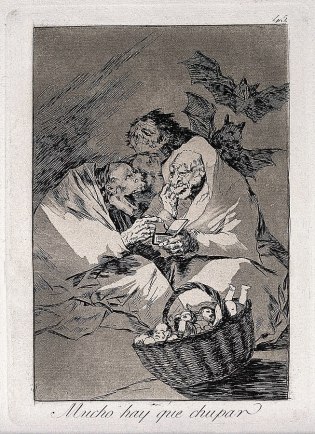
Three old hags surround a basket of newborn babies with bats in the distance. Etching by F. Goya, 1796/98.
What’s the response of Republican candidates for the Presidency? Well, Mike Pence takes it to infinity and beyond. This is from Politico Playbook: “Mike Pence’s plan to go further on abortion.” How farther can this go?
PENCE LEANS IN ON ABORTION POLITICS — Tomorrow marks one year since the Supreme Court overturned Roe v. Wade, revoking the constitutional right to abortion it established. And ever since, Republicans have been twisting themselves in knots over how to handle the fallout.
Trump avoids talking about the matter almost entirely. Florida Gov. RON DeSANTIS signed a six-week abortion ban in the middle of the night in April and has barely spoken about it since. Sen. TIM SCOTT (R-S.C.) originally waffled on whether he’d support a nationwide abortion ban. And former South Carolina Gov. NIKKI HALEY has been vague about how she’d handle the issue as president.
Then there’s MIKE PENCE.
More than any other Republican candidate, the former VP has staked his pitch to voters on his unabashed restrictionist stance.
While some Republicans — including Trump and former New Jersey Gov. CHRIS CHRISTIE — say that in a post-Roe America, abortion policy should be left up to the states, Pence has endorsed a nationwide ban on the medical procedure at 15 weeks of gestation.
While some Republicans say the party shouldn’t weigh in on banning widely used abortion drugs, Pence’s 501(c)(4) group Advancing American Freedom has filed an amicus brief supporting a challenge to the FDA’s approval of mifepristone, the most widely used abortion pill.
And this weekend, while Pence will be among a parade of 2024 hopefuls addressing evangelical conservatives at the Faith & Freedom Coalition’s Road to Majority Conference in Washington (more on that below), he is the only candidate who’ll also speak at the Students for Life rally on the National Mall, in addition to being the only candidate invited to address a nationwide Susan B. Anthony List call for activists commemorating the end of Roe.
Yesterday, we caught up with Pence to talk about the one-year anniversary of the Dobbs ruling. We wanted to know how he squares his own position with the political reality that abortion restrictions are consistently unpopular in polls and whether he’s worried that opposition will blow back on him and the GOP at the ballot box.
The upshot: not a bit. And he thinks Republican candidates need to stop running scared from the issue and embrace it head on. Listen to excerpts in Playbook Daily Briefing
HOW PENCE SEES IT: The GOP, Pence said, faces a choice, “whether or not we’re going to continue to be a party grounded in the conservative principles that have won not only the White House, but won majorities over the last 50 years again and again — or whether our party is going to shy away from those core traditional principles.”
As for him? “For me, for our campaign, we’re going to stand where we’ve always stood, and that is stand without apology for the right to life,” he said.
In our interview, Pence flatly rejected the conventional wisdom in Washington that Republicans suffered in the midterms because of Dobbs blowback. Those who lost, he said, had a “common denominator” that “has not to do with the issue of abortion.”
“Rather, where candidates were focused on the past — focused on relitigating the past — we did not fare well,” Pence said, a veiled reference to Republicans parroting the false claim that Trump won the 2020 election.
PENCE VS. THE FIELD: His unabashed stance on abortion is one way Pence differentiates himself from the rest of the GOP’s 2024 field. And he’s certainly not shy about drawing that contrast, particularly vis-a-vis Trump.
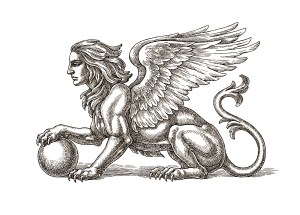
Winged Sphinx
Most Democratic strategists see this as a winning discussion, given current polling on the types of people likely to vote in the General Election. This is from NBC News. “Poll: 61% of voters disapprove of Supreme Court decision overturning Roe. On the anniversary of the Dobbs decision, 53% say abortion access nationwide has become too difficult, a new NBC News poll finds.”
On the anniversary of the Supreme Court ruling that overturned the landmark 1973 Roe v. Wade decision, 6 in 10 voters remain opposed to the court’s removing federal protection of the right to abortion, according to results from a new national NBC News poll.
Nearly 80% of female voters ages 18-49, two-thirds of suburban women, 60% of independents and even a third of Republican voters say they disapprove.
Women have no desire to be the property of politicians, let alone the crazy ones cited in the Guardian article who can’t even figure out their reproductive systems.
And, again, let’s state that all of this is because of a group of “corrupt and shady” SCOTUS appointees who all happen to be Republican so far. Alito, Grand Inquisitor of the Dobbs Debacle, is turning out to be corrupt, arrogant, and still thoroughly repulsive.

A harpy in Ulisse Aldrovandi’s Monstrorum Historia, Bologna, 1642.
If you haven’t read about all the free fishing trips Alito got already, Joyce Vance’s substack is an excellent place to go.
You should read the full piece in ProPublica for yourself, but it’s lengthy, so we’ll hit the high notes here tonight in case you need to save it for the weekend. Suffice it to say, this reporting dramatically increases concerns about the Court’s legitimacy. My friend and colleague Barb McQuade put it best: “Pro tip: If you’re a Supreme Court justice, don’t take free trips, even when the seat on the billionaire’s private plane would ‘otherwise go unoccupied.’ Normal people don’t get free fishing trips to Alaska. It is not your winning personality that makes you different.”
And now, for the next entry in the most corrupt SCOTUS evah! Wait that would be Clarence Thomas. He’s been at the grifting game a long time. However, even this newbie might catch up. This is from the Salon Link below.
This is reported by Tatyana Tandanpolie. This is actually a twofer. Two hyper-zealots with a need for a good life and a crusader’s need for blood.
Supreme Court Justice Amy Coney Barrett has personal ties to a leader of the legal clinic under the Notre Dame initiative that funded Justice Samuel Alito’s July 2022 speaking trip to Rome, CNN reports.
Just months after she was sworn in at the Supreme Court in 2020, Barrett, who had left her judgeship and job as a Notre Dame law professor, sold her private home in South Bend, Indiana, to a recently hired Notre Dame professor who was assuming a leadership role at the Religious Liberty Initiative, according to records discovered by the left-leaning non-profit watchdog group Accountable.US.
The initiative’s legal clinic has curried favor with the Supreme Court since its founding in 2020 and filed at least nine “friend-of-the-court” amicus briefs in religious liberty cases before the Court. Alito joined the majority in deciding in favor of the initiative’s conservative positions in several of those cases, including the one that reversed Roe v. Wade, and others on issues of school prayer and COVID-19 restrictions on churches.
Neither Barrett’s real estate transaction nor Alito’s trip to Italy to deliver a keynote at a gala violated the court’s ethics rules, several experts told CNN.
“It raises a question – not so much of corruption as such, but of whether disclosures, our current system of disclosures, is adequate to the task,” Kathleen Clark, a professor at Washington University in St. Louis Law School who specializes in government ethics, told the outlet.
Barrett sold the home to Brendan Wilson, then a Washington D.C.-based lawyer, for $905,000, a transaction that she was not required to disclose on her annual financial forms. Federal regulations exclude sales of the “personal residence of the filer and the filer’s spouse” from financial matters judges are mandated to disclose.
I don’t think Republicans know what “public service” is supposed to be about. They seem to believe that the public should service them, and then they become overlords of the public’s access to civil liberties. All of this is funded by billionaire nutters and actual taxpayers.
Okay, I just couldn’t resist posting this. Tech Dudes and the Maga Hags go at it big time. I guess infighting among the enemy is a good sport. Oh, to be a fly around the Supreme Court Building now. I could use a little bit of Alito v Thomas right now fighting for the belt of least guilty amongst us.
Have a great weekend!
What’s on your reading and blogging list today?
Freedom Day Reads
Posted: June 19, 2023 Filed under: just because, morning reads, U.S. Politics | Tags: Inclusion, Indigenous Americans, Juneteenth, Pride, The right to be, The right to decide for yourself, You be you!!! 10 Comments Good Day, Sky Dancers, and Happy Juneteenth!
June is rapidly becoming my favorite month. We’ve been celebrating Pride all month and are doing Juneteenth. You can smell the white beans, andouille, and rice coming down the hall. I realized so many things in the last two days about this neighborhood which was developed after the Louisiana Purchase in 1812. Enjoyment was mostly possible because the tourists have gone. Temple and I danced in the streets for the third Sunday of Pride Tea. I am now a fan of Dancing Queen which I used to flip the channel to avoid back in the day.
My Dentist office defines the magic of the gumbo pot of our country. My hygienist and dentist are second generation from the South Vietnam Diaspora. The office area and the patients are racially diverse. This would have been impossible not that long ago. The second thing is I thank all of the Congress and administrations that continue to support Medicare. I do not know what I would do with out it.
We’re in the midst of an extremely long and dangerous heatwave. We cannot stop using fossil fuels fast enough. This is the second year of this and it’s not normal at all. There are so many things you can experience if you just take time to look around you and see the daily sites and people that are part of your neighborhood. I guess I should’ve spent more time reading Golden Books and watching Mister Rogers and Sesame Street. It’s all here.
 John Blake from CNN has this to say about the history of slavery that formed our country. “As the nation celebrates Juneteenth, it’s time to get rid of these three myths about slavery.”
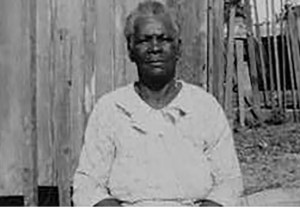
Temple “Tempie” Cummins stoically stares at the camera with her arms folded in her lap, sitting stiffly in a chair in her dusty, barren backyard with her weather-beaten wooden shack behind her. Her dark, creased face reflects years of poverty and worry.
The faded black and white image of Cummins from 1937 was snapped by a historian who stopped by her home in Jasper, Texas, to ask her about her childhood during slavery. Cummins, who did not know her exact age, shared stories of uninterrupted woe until she recounted how she and her mother discovered that they had been freed.
She said her mother, a cook for their former slave owner’s family, liked to hide in the chimney corner to eavesdrop on dinner conversations. One day in 1865, she overheard her owner say that slavery had ended, but he wasn’t going to let his slaves know until they harvested “another crop or two.”
“When mother heard that she say she slip out the chimney corner and crack her heels together four times and shouts, ‘I’s free, I’s free,’ ” Cummins told the historian, who recorded her story for a New Deal writers’ project that collected the narratives of the formerly enslaved during the Great Depression. “Then she runs to the field, ‘gainst marster’s will and tol’ all the other slaves and they quit work.”
Tempie Cummins, who was formerly enslaved, shared her story with a historian who recorded it for a New Deal writers’ project.
That story is one of the first recorded memoires of an experience that would inspire the creation of Juneteenth, an annual holiday celebrating the end of slavery that the US will commemorate this Monday. It marks the moment in June of 1865 when Union troops arrived in Texas to inform enslaved African Americans that they were free by executive decree. Many people like Cummins in remote areas of Texas and elsewhere did not know that they were free as their White owners hid the news from them.
Juneteenth has since become known as “America’s Second Independence Day.” Now a federal holiday, it will be celebrated by parades, proclamations, and ceremonies throughout the US. Though it commemorates a moment when enslaved African Americans were freed, the US is still held captive by several myths about slavery and people like Cummins.
One of the biggest myths that historians and storytellers have successfully challenged in recent years is that enslaved African Americans were docile, passive victims who had to wait until White abolitionists and “The Great Emancipator” Abraham Lincoln freed them. Black soldiers, for example, played a pivotal role in winning the Civil War. This new understanding of slavery has led to a rhetorical shift: It’s no longer proper to refer to people like Cummins as simply “slaves.”
“There’s been a shift in the historical community attempting to not define the period or the people by what was done to them in the sense that their identity becomes a noun, a slave, but rather that they are that they were in the process of being enslaved,” says Tobin Miller Shearer, a historian and director of African American Studies at the University of Montana.
“There were slavers who did that to them,” he says, “but there’s more to their identity than what was being done to them.”
Yet other myths about slavery persist, in part, because of the sheer enormity and brutality of slavery.
“The enslavement of an estimated ten million Africans over a period of almost four centuries in the Atlantic slave trade was a tragedy of such scope that it is difficult to imagine, much less comprehend,” Albert J. Raboteau wrote in “Slave Religion: The ‘Invisible Institution’ in the Antebellum South.”
 So many events in our Country’s history are shameful. Covering them up only serves the same masters who want to keep every one who is not like them oppressed and worse off or in a form of servitude.
In 1838 Cherokee people were forcibly moved from their homeland and relocated to Indian Territory, now Oklahoma. They resisted their Removal by creating their own newspaper, The Cherokee Phoenix, as a platform for their views. They sent their educated young men on speaking tours throughout the United States. They lobbied Congress, and created a petition with more than 15,000 Cherokee signatures against Removal. They took their case to the U.S. Supreme Court, which ruled that they were a sovereign nation n Worcester vs. Georgia (1832). President Andrew Jackson ignored the Supreme Court decision, enforced his Indian Removal Act of 1830, and pushed through the Treaty of New Echota.
In 1838 Cherokee people were forcibly taken from their homes, incarcerated in stockades, forced to walk more than a thousand miles, and removed to Indian Territory, now Oklahoma. More than 4,000 died and many are buried in unmarked graves along “The Trail Where They Cried.”

Vanessa Carr Kennedy (My Dear Friend)
Drag Queen Story Time at Longview Gardens Family Day. Note, no children, or parents were harmed in the filming of this movie.
A lot of this history has the same roots. “Opinion: The Supreme Court is making religion an all-purpose excuse for ignoring the law. First it was wedding cakes, and now it’s wedding websites. Conservatives who oppose same-sex marriage are testing the line between religious freedom and unlawful discrimination.” This is from the L.A. Times and Xiao Wang. Remember, there are Evangelical Christians that support genocide in this case and likely for others.
Looking for a federal law to be declared unconstitutional? Religion may well be your best bet — and that’s true regardless of how “real” your religious beliefs are.
That’s part of the thinking behind one case the Supreme Court heard this session and will resolve soon. In 303 Creative vs. Elenis, the court is considering the constitutionality of a Colorado statute prohibiting most businesses from discriminating against LGBTQ+ customers. Lori Smith, a Christian webpage designer, had wanted to expand into the wedding website business — but only for opposite-sex couples, a plan that would have violated the Colorado law at issue. Her lawyers made the case on free speech grounds, but given Smith’s religious beliefs, “religious freedom” represents an undeniable backdrop to the suit.
The 303 Creative case is no outlier. Religion-based claims have proliferated in recent years, and plaintiffs have often won because courts have almost invariably found their religious beliefs to be sincerely held. Meanwhile, the burden of proof for the government — that it is not unduly interfering in religious practice — has become much harder to prove.
A string of recent Supreme Court cases demonstrates how religion offers litigants a ready path to disobey laws without consequence. In the 2021-22 term alone, the Supreme Court decided several high-profile cases that affirmed religion’s supremacy.
In Kennedy vs. Bremerton School District, the justices determined that a high school football coach could not be placed on leave for violating a rule against public prayer. In Carson vs. Makin, it held that Maine was constitutionally required to subsidize religious schools. And in Ramirez vs. Collier, it postponed the execution of an inmate after he asked, at the 11th hour, that his pastor lay hands on him — despite having previously explicitly disclaimed the same form of relief.
Then, in a narrow 5-4 decision last September, the court left in place a New York state court decision requiring Yeshiva University to recognize an LGBTQ+ student group over the school’s purported religious objections. Ruling on technical grounds, the majority directed the university to first seek relief in state court. But four dissenting justices would have granted review to vindicate the university’s 1st Amendment rights — and those justices say that the university would “surely” win if the case comes back up, after state proceedings conclude.
How did these results come to be?
In the conventional understanding, religious exercise was cast off as an almost disfavored right. Courts were, historically, generally willing to let the government prevail whenever public policy and religion came into conflict. Now though, when the court says that government action affecting religious exercise must satisfy “strict scrutiny” — a notoriously difficult burden — it actually means it.
But that’s not the full story. Courts aren’t just making it harder for the government in these cases; they’re also making things easier for plaintiffs.
Plaintiffs must in theory show that their religious beliefs are sincerely held before strict scrutiny can kick in. This requirement dates to a 1944 decision, United States vs. Ballard, which for many years served as an effective gatekeeper against cries of “religion” casually trumping the law.
But in practice, this requirement has been hollowed out since at least the early 1990s.
 How is it that so many of us–to include women–so definitely way up over 50% are now being subjected to disenfranchisement and not included. Meanwhile, we’re stuck in this Rule of Law Soap Opera because a bunch of idiots who voted for this man and set up laws to disenfranchise us. They also stacked courts so that the government has more say in what happens with women’s bodies than we do. How is this the land of the Free?
This is from The Hill. I pity judges who have to order things that any lawyer should stop his client from doing as a normal party of a case. “Judge orders Trump not to disclose evidence in documents case.”
A federal magistrate judge Monday agreed to a motion from the Justice Department to block former President Trump from disclosing information relating to the Mar-a-Lago case, after prosecutors said the investigation remains ongoing.
The order sides with the Justice Department in allowing Trump to see evidence collected in the case — including classified documents — but only in the presence of his attorneys.
It also blocks him from disseminating any information from the case with reporters or on social media, mirroring a similar order agreed to in the hush money case being prosecuted by authorities in New York.
“Defendants shall only have access to Discovery Materials under the direct supervision of Defense Counsel or a member of Defense Counsel’s staff. Defendants shall not retain copies of Discovery Material,” Judge Bruce Reinhart, who approved the warrant to search Mar-a-Lago, wrote in the order.
The Justice Department in its Friday request said that restrictions were required, as its investigation could yield additional arrests.
“The materials also include information pertaining to ongoing investigations, the disclosure of which could compromise those investigations and identify uncharged individuals,” the department wrote.
Now is the time for us to stand together.
Happy Freedom Day! Independence Day comes up next! Do you know where your civil liberties and civil rights are going?
What’s on your reading and blogging list today?
Juneteenth Reads: “A House Divided”
Posted: June 16, 2023 Filed under: Economic Racism and injustice, Republican politics, U.S. Politics, Women's Rights | Tags: A House Divided, Angry, Hateful, Juneteenth, Neil Giraldo, Pat Benatar, Wrong Republicans 8 Comments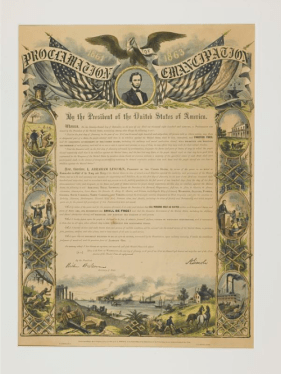 Good Day, Sky Dancers!
We continue to celebrate our newest Federal Holiday this long weekend. It is Juneteenth, also called Freedom Day. The first Juneteenth was on the 19th.
On June 19, 1865, nearly two years after President Abraham Lincoln emancipated enslaved Africans in America, Union troops arrived in Galveston Bay, Texas with news of freedom. More than 250,000 African Americans embraced freedom by executive decree in what became known as Juneteenth or Freedom Day. With the principles of self-determination, citizenship, and democracy magnifying their hopes and dreams, those Texans held fast to the promise of true liberty for all.
If you’re a James Joyce fan, then today is Bloomsday! And, of course, we’re still celebrating Pride Month.
Another appropriate reference to June 16 is what happened at the Illinois Republican State Convention, in Springfield, Illinois, on June 16, 1858. It’s challenging to think the same speech would be given by any future Republican President, but this is the day Lincoln spoke up against slavery “agitation.” It is the source of one of his most famous speeches and lines. The future president was running for the U.S. Senate against Senator Steven A. Douglas.
“A house divided against itself cannot stand.”
Can you imagine American history being taught without learning about this pivotal speech? It clearly shows that slavery in the South was a root cause of the Civil War that followed. Today’s Republicans are doing everything they can to erase that kind of history.

Martha Yates Jones (left) and Pinkie Yates (right), daughters of Rev. Jack Yates, in a decorated carriage parked in front of the Antioch Baptist Church located in Houston’s Fourth Ward, 1908 — Source
Let’s look at the headlines. This is from Dana Milbank, writing for the Washington Post. “As Trump is arrested, Republicans honor the insurrectionists.”
Donald Trump could not have asked for a nicer arraignment-day celebration.
During the very same hour in which the former president surrendered to federal authorities in Miami, his Republican allies in the House were, in their most visible and official way yet, embracing as heroes and martyrs the people who sacked the Capitol on Jan. 6, 2021, in hopes of overturning Trump’s election defeat.
In the Capitol complex, Rep. Matt Gaetz (R-Fla.), with sidekick Rep. Marjorie Taylor Greene (R-Ga.) and four other far-right lawmakers, held a “hearing” that honored participants in the riot, family members of Jan. 6 rioters and organizers of the attempted overthrow of the 2020 vote.
Technically, Gaetz couldn’t call such a hearing, because he isn’t a committee chairman. But House Speaker Kevin McCarthy, who is trying to win back the support of extremists such as Gaetz, let it happen anyway.
Gaetz did his all to make the proceedings look official. There were congressional seals on his nameplate and on the big screen behind him. A meeting room in the Capitol visitor center was arranged to appear like a committee room, with lawmakers facing the witnesses. Gaetz advertised the “field hearing” as part of how “the 118th Congress is investigating the weaponization of the federal government.”
And then there’s Ted Cruz. The Senator from Texas always seems to set the bottommost tone for public discussion.
I love Pat Benatar. What exactly has she done besides write and perform songs empowering women? Let’s pause for a bit of mood music.
You may read the retorts from Twitter at Salon. “Ted Cruz weaves a bizarre scenario about Biden murdering children while listening to Pat Benatar. While discussing President Biden on the Joe Pags show, Cruz succumbed to a Satanic flight of fancy.”
JJ sent me more stuff than just the Pat Benatar on Ted Cruz. Perhaps he has to get all hellfire and brimstone because of this. “Ted Cruz Says Uganda Shouldn’t Kill Gays, And Christian Extremist MAGAs Are SO MAD (At Him).” This story comes via Wonkette.
Without near enough fanfare or attention from the West, the president of Uganda, Yoweri Museveni, has signed a “kill the gays” bill into law. It calls for a life sentence for anyone who has gay sex, and seven years for trying to, whatever that means. The death penalty would be for those who commit “aggravated homosexuality,” which the New York Times says includes “homosexual acts committed by anyone infected with H.I.V. or involving children, disabled people or anyone drugged against their will.” If they say you did “attempted aggravated homosexuality,” you could go to prison for 14 years. We are sure the processes for determining whether people have violated the law will totally be on the up-and-up.
Oh, and you could go to jail for 20 years for “promoting” homosexuality, which reminds us a bit of Russia, and also the spirit of Ron DeSantis’s Florida, even if they haven’t quite made it to calling for imprisonment yet.
So, Ted finally says something that makes him seem human. The Christoban are after him now.
In response, some of Cruz’s conservative fans were absolutely horrified that Cruz would interfere in another country’s Christian fascist genocide in such a way. RawStory collected some responses:
“Ted, seems to me your focus should be here at home working to get the unjustly punished J6 prisoners out of jail,” wrote one user in response. “I’m disappointed in you.”
In a similar sentiment, a different Cruz follower argued that “it’s none of our business.”
Another follower used Cruz’s statement to simply dismiss him as a “RINO.”
Cruz follower JD Sharp, on the other hand, defended the law explicitly and argued it would help ensure high fertility rates in Uganda.
Echoing to this theme, one Twitter user replied to Cruz and said they wanted to “make homosexuality shameful again.”OK, psychos.
Take a gander through Ted’s replies at your own risk. Because Elon Musk’s paid blue checkmark system promotes replies from the vilest and stupidest people humanity has to offer to the top, you won’t have to look hard for Americans just openly supporting genocide.
So let’s look at the things the bottomless basement of the hate section of our divided house thinks are okay.
The Southern Baptist Convention has issues that won’t be solved by booting all women pastors.
Let me remind you of Christa’s experience with that denomination.

Juneteenth band. Photograph by Grace Murray Stephenson of celebrations in Eastwoods Park, Austin, 1900. — Source
Here’s another story from the Washington Post that makes the celebration of Juneteenth bitter-sweet. “Black Americans more upbeat but fear worsening racism, poll finds.”
An overwhelming share of Black Americans think the U.S. economic system is stacked against them and a slim majority believe the problem of racism will worsen during their lives, according to a Washington Post-Ipsos poll that explored the attitudes of the country’s second-largest minority group.
The poll finds that Black adults worry they are marginalized and under threat by acts of hate and discrimination in their day-to-day lives. Most also say it is more dangerous to be a Black teenager now than when they were teens.
There is good news about how indigenous children were shuttled to adoptive white parents so they could “save the man and kill the Indian.” That was actually the rationale for the Indian Adoption Project prior to the 1978 act–The Indian Child Welfare Act–existed. A challenge to that Law was just heard before the Supreme Court. A group of White Evangelicals would like to return to the good old days of kidnapping indigenous children from the tribes and screamed the act was racist. This decision is likely temporary as the beer and sexual assault connoisseur on the Court invited a future challenge from somebody with “standing,” which is why the court upheld the decision.
The Indiginous Nations have an odd advocate on SCOTUS. This is from NBC News. “Conservative Justice Gorsuch echoes ‘woke’ historians in railing against historical injustices. Gorsuch, appointed by former President Donald Trump, differs from his conservative colleagues on some key issues, including Native American rights.” This reminds me of the saying that even a broken clock is right two times a day. This is written by Lawrence Hurley.
Supreme Court Justice Neil Gorsuch is a dyed-in-the-wool conservative appointed by Republican former President Donald Trump, but in a series of recent cases, he has spoken up about historical injustice in a way that seems at odds with Republican attacks on “woke” history’s being taught in schools.
That included his opinion Thursday when the court rejected a challenge to the Indian Child Welfare Act, a law intended to keep Native American families and communities together when children are in the adoption or foster care process.
Gorsuch’s concurring opinion was part history lesson and part explanation of his full-throated support for Native Americans.
He wrote about how Native American families were torn apart by federal and state officials’ attempts to assimilate them into Anglo-centric American society by eliminating their cultural ties to their tribes.
“In all of its many forms, the dissolution of the Indian family has had devastating effects on children and parents alike,” he wrote.
“It has also presented an existential threat to the continued vitality of tribes — something many federal state officials over the years saw as a feature, not as a flaw,” he added. His opinion was joined by two of his liberal colleagues: Justices Sonia Sotomayor and Ketanji Brown Jackson.
Chuck Hoskin, principal chief of Cherokee Nation, one of the tribes that defended the adoption law at the Supreme Court, said Gorsuch is “going to loom large over Indian Country cases for a long time” in part because he understands the complexities of Indian law.
“While he may possess a great range of views on a lot of legal issues, he seems to have the most solid understanding of federal Indian law of any justice of the modern era,” Hoskin added.
In other cases, Gorsuch has lambasted the Supreme Court’s own rulings that treat people living in Puerto Rico and other U.S. territories as second-class citizens and called out the torture of detainees held at Guantánamo Bay, Cuba. He has repeatedly voted in favor of Native American tribes in a series of different legal questions.
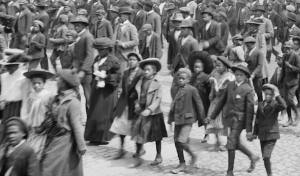
Detail from a photograph of celebrations in Richmond, Virginia, ca. 1905 — Source
This is from Rachel Weiner, writing for the Washington Post. “NSA staffer linked to ‘America First’ movement joined Jan. 6 mob. Paul Lovley was sentenced to two weeks’ incarceration for illegally demonstrating in the Capitol.”
A 24-year-old moved to Maryland to work for the National Security Agency six months before joining the attack on the U.S. Capitol with followers of a movement whose founder is known for espousing white supremacist views, according to court filings.
Paul Lovley was sentenced Tuesday to two weeks incarceration for illegally demonstrating in the Capitol.
“All I can do is take responsibility for my actions, learn from this experience, and move on with my life,” Lovley said in a letter to the court. “This entire situation has served as a wake-up call—something that forced me to truly reflect on what is important in life, what types of things to avoid engaging with going forward, and the dangers of cognitive dissonance.”
According to prosecutors, Lovley was working in information technology for the NSA before Jan. 6. The NSA referred questions about his employment to the Justice Department, which did not return a request for comment.
The night before the riot, the government said, Lovley hosted at his Maryland home four friends he met at an event for “America First,” a movement founded by Nick Fuentes, who has been banned from most social media platforms for repeated racist and antisemitic remarks. The Justice Department in other cases has described Fuentes, who was outside the Capitol on Jan. 6 but is not charged in the attack, as “a public figure known for making racist statements, celebrating fascism, and promoting white supremacy.” He gained national prominence after dining with former president Donald Trump in late 2022.
The five young men including Lovley entered the Capitol building a few minutes after the first breach, according to court records. Along with other rioters, they went into House Speaker Nancy Pelosi’s office and onto the Senate floor. After about 40 minutes, they left the building; prosecutors say one of Lovley’s friends then assaulted a police officer with a metal barricade and helped destroy reporters’ equipment.
He said he came to the area from California for his “first-ever serious job” and did not know anyone.
Alright, one more thing, and then we’ll take this all down thread. Who just got indicted by a Grand Jury for taking and decimating classified documents and didn’t get to go to a private golf club and rally a group of fascists?

From: Joe Becigneul, Step through time
She was called Phillis, because that was the name of the ship that brought her, and Wheatley, which was the name of the merchant who bought her. She was born in Senegal.
In Boston, the slave traders put her up for sale: “She’s 7 years old! She will be a good mare!”
She was felt, naked, by many hands.
At thirteen, she was already writing poems in a language that was not her own. No one believed that she was the author. At the age of twenty, Phillis was questioned by a court of eighteen enlightened men in robes and wigs.
She had to recite texts from Virgil and Milton and some messages from the Bible, and she also had to swèar that the poems she had written were not plagiarized. From a chair, she gave her long examination, until the court accepted her: she was a woman, she was Black, she was enslaved, but she was a poet.
Phillis Wheatley, was the first African-American writer to publish a book in the United States.
What’s on Your Reading and Blogging list today?
The Day Before Indictments Reads: “One Set of Laws”
Posted: June 12, 2023 Filed under: just because | Tags: Trump Family Crime Syndicate, Trump Indictment Day, Trump is in peril 3 Comments
Attorney Reading
Honore Daumier
Good Day, Sky Dancing!
We’ve planned a perp watch party here in my hood for tomorrow. We’re all excited that it’s finally happening. Here are some reads to get you ready for this big week!
We’ve heard a lot about the assignment of Judge Loose Cannon to the Case. Here is some information on what could possibly happen with that. BB suggested the best source for what’s going down with that, and the week is from Civil Discourse with Joyce Vance. This is her SubStack. I’ll focus on tomorrow’s Indictment. It will be handled by Judge Jonathan Goodman. This does not mean Judge Loose Cannon is gone.
We’re told Tuesday’s arraignments are being handled by Magistrate Judge Jonathan Goodman in the courthouse in Miami, rather than in the Fort Pierce Division where Cannon sits. District judges can and do on occasion handle arraignments themselves in high-profile cases—it happened in this district in a case involving Colombian drug kingpins. But here, it’s likely that arraignment will proceed before the magistrate judge in a perfunctory matter, and Trump will enter his plea of not guilty after being processed, fingerprinted, and submitting to a mug shot. The process is likely to be highly orchestrated by the court, the Marshals Service, and the Secret Service, with everyone on high alert because of Trump’s social media posts, reminiscent of the “will be wild” tweet ahead of January 6. As the New York Times detailed, these latest posts have set off a cascade of troubling calls to “support” Trump.
Vance wrote quite a bit of what we might have to see with the appointment of Judge Loose Cannon.
Since we’re talking about judicial discretion, there is lots of concern about the assignment of federal Judge Aileen Cannon to this case. And rightly so given the way she mishandled Trump’s lawsuit after the search, designed to delay or prevent the investigation. Cannon was nominated to the bench by Trump and confirmed after he lost the election. However, there was nothing nefarious about Cannon’s selection. The clerk’s office uses a computerized random selection process. It was the bad luck of the draw.
Among other things, judges are supposed to carefully protect the integrity of the judicial system and the public’s confidence in it. That’s the reason for rules about recusal. The rules come down to requiring recusal where “the judge’s impartiality might reasonably be questioned.” This isn’t a casual standard requiring constant recusals, which would be disruptive. It’s reserved for situations where an objective observer looking at a case would lack confidence the judge could act fairly, for instance, if they had a financial interest in the outcome or a family member were a lawyer for one side.
In less obvious situations, a decision about when a judge should recuse is made on a case-by-case basis. In a case I handled in 2006, U.S. v. Martin, the 11th Circuit Court of Appeals considered an unusual situation involving sentencing and determined that a judge needed to step aside. The judge had sentenced the case, was appealed and reversed, and had resentenced. Considering the judge’s second bite at the appeal, the court reflected, “Finally, based on our review of the record and the elements that this Court considers in determining whether to reassign a case to a different judge where there is no indication of actual bias, see United States v. Torkington, 874 F.2d 1441, 1447 (11th Cir. 1989) (per curiam), we have determined it wiser to remand this case with instructions to reassign it to a different judge. This is the second appeal in Martin’s case and the second time we have had to reverse the sentence that the district court gave Martin…In light of the two reversals in this case and three other appeals in which we have reversed the same judge for extraordinary downward departures that were without a valid basis in the record, we find it likely that ‘the original judge would have difficulty putting his previous views and findings aside.’” It’s unusual to find that a judge’s decisions can form the basis for recusal, but it did in Martin.
When Cannon handled the earlier Trump matter, the 11th Circuit ruled against her twice. The first time was on a preliminary motion after she limited the ways the government could use classified documents seized—in an entirely lawful and normal fashion—from Mar-a-Lago and seriously hampered the government’s investigation (as well as unnecessarily expanding the universe of people with access to classified material). When the Court decided the case on its full merits, they resoundingly reversed Cannon and were sharply critical of the way she handled the case in a fashion that went beyond the typical reversal where the appellate court thinks the district judge got it wrong. It’s not infrequent for that to happen. There are many close calls, and judges acting in good faith can disagree. The tenor of the 11th Circuit’s opinion reversing Cannon was different, finding she lacked jurisdiction and insinuating it was not a particularly close call. She reached a result that was favorable to Trump by all but ignoring the law, refusing to apply it, and rejecting the government’s positions without explaining why. It was the sort of extreme error that rises to the level of Martin, calling into question both whether the judge could set aside her previous views and whether a reasonable person would question her ability to handle the case fairly. Cannon had gone so far as to say her decisions were “inherently impacted by the position formerly held by the plaintiff,” i.e., that he had been the president.
All of this forms a solid basis for Cannon to decide that she should recuse. And she could couch it in this manner, that although she is confident she could handle the case fairly, she is stepping aside to ensure the public has confidence in this highly important matter. That wouldn’t guarantee a judge appointed by a Democratic president would take over—it could even be another Trump appointee. But it would ameliorate specific concerns about a specific judge that would so overtake the case that it would be impossible to have confidence in the outcome. Trump might even argue that she was bending over backward to rule against him in order to protect her own reputation. No one wins, including the judge herself, if she remains on the case. But it’s up to her right now.
What do we make of the fact that Cannon is a Trump appointee? Normally, that’s just not a factor. Every judge is appointed by a president from one party or another, and judges are often called upon to rule in favor of or against a policy of the president who appointed them. It’s not viewed as a ground for recusal. This may be a little different because it’s a criminal case involving the president who appointed her. A judge probably would recuse from a criminal case involving their former boss or mentor. That’s not precisely the relationship here, and, of course, there is no exact case law since Trump is the first ever president to be indicted. But judges err on the side of caution to avoid the appearance of impropriety, and here, combined with her conduct in the earlier case, this might be a factor to consider, although it’s unlikely it would suffice on its own.
If Cannon doesn’t recuse voluntarily, prosecutors will likely have to file a motion requesting the recusal to take the issue forward. This is always a difficult move for prosecutors, one to be avoided unless the circumstances are extreme, like they are here. Under the rules, if a judge denies a request by one of the parties that they recuse, “the Judge shall issue a ruling on the record, stating the grounds for denying the request.” Provoking that statement alone would be worthwhile.
Most likely though, prosecutors will wait for Cannon to make an objectionable ruling that can be appealed pre-trial, and use that opportunity to request that the 11th Circuit order the Chief Justice in the Southern District of Florida to reassign the case on remand. Of course, this means delay, and delay here works in Trump’s favor. None of this is ideal, by any means. But this is the type of situation where the 11th Circuit protects its integrity and reputation by ordering recalcitrant judges to recuse. Prosecutors are likely to get their opportunity because Cannon, whose appointment of the special master and rulings in the earlier matter already demonstrated some inexperience and discomfort handling highly sensitive classified matters, will be called upon to make decisions and set appropriate procedures under a complicated statute, CIPA, the Classified Information Procedures Act, that governs the handling of classified material in a trial setting. Because those decisions can be appealed immediately, it seem likely that the government will need to take an appeal at some point and that will give it the opportunity to request recusal.
The selection of Judge Cannon unnecessarily complicates the trial of what would be a straightforward case of mishandling classified documents and obstructing an investigation into that conduct if the defendant were anyone other than the former president of the United States. Trump seems to get all the breaks, and this is a difficult one to stomach. But I continue to think the courts will sort this out, one way or the other.
 The Washington Post discusses the possibility of violence in Miami due to Trump’s armed and hysterical supporters. This analysis is offered by Mark Berman. “Trump’s Miami court date brings fears of violence, rally plans. Law enforcement officials are monitoring online threats and potential gatherings of far-right extremists and marshaling more officers.”
Federal and local authorities on Sunday ramped up security preparations ahead of Donald Trump’s first appearance in federal court on criminal charges here, monitoring online threats and potential gatherings of far-right extremists while marshaling more police officers to be on duty.
Escalating violent rhetoric in online forums, coupled with defiant statements from the former president and his political allies, have put law enforcement officials on alert for potential disruptions ahead of Trump’s court appearance. He is facing a 37-count federal indictment, 31 of which allege he willfully kept classified documents in his possession after leaving the White House.
Authorities were monitoring plans for pro-Trump rallies in Miami, including one outside the federal courthouse on Tuesday purportedly organized by a local chapter of the Proud Boys, a far-right extremist group, some leaders of which were found guilty of seditious conspiracy in the Jan. 6, 2021, attack on the U.S. Capitol.
This article by interviewer and Executive Editor Andrew O’Hehir–writing for Slate–suggests Trump is in deep trouble. “Trump’s “peril is extreme”: Former federal prosecutor on the historic Mar-a-Lago indictment. Charges against Trump almost “open and shut,” says Dennis Aftergut — and prosecutors will ask for prison time.”
I’ve read a fair number of criminal indictments in 30 years as a journalist, and by any standard this one seems extraordinary. I’d like to ask you, as a former federal prosecutor, how you perceived it in a number of different ways. First of all, what was your general impression of Jack Smith’s indictment overall — as a work of legal argument and narrative, and also as an event in legal and political history?
The narrative here is one of betrayal of a nation and its most precious secrets by a man who was the commander in chief for four years and who seeks that mantle again. There’s never been anything remotely like it.
Just think about it. The disregard for the lives, the risk and the individual courage that goes into gathering information vital to our national security and our safety is incomprehensible. There is no way for the brain to wrap itself around what is described in this indictment, the violation of sacred trust, a one-man demolition crew working against the American intelligence system that has been built, brick by brick, over 80 years.
With the kind of conduct alleged in the indictment by the former occupant of the highest office in the land, how is any foreign intelligence service supposed to trust us to keep information confidential, to protect its methods of collecting our enemies’ secrets or the identity of its sources?
It could take years, if not decades, to recover from the damage.
In more concrete terms, how does that conclusion emerge from this indictment?
Put together three basic pieces: 1) The bone-chilling nature of the materials unlawfully taken from the White House; 2) the apparent exposure of those materials at Mar-a-Lago; and 3) what we know from public reporting about security there and our nation’s enemies whose agents may have breached it.
First, focus on paragraph 77. It lists, with brief descriptions, 31 documents, many of which have what are called “compartmentalized” Top Secret markings.
“Compartmentalized” means “information about certain intelligence sources and methods.” “Top Secret” signifies information that would cause, if revealed, exceptionally grave harm to the nation’s security. Compartmentalized top secret documents are kept in secure structures, or SCIFs — the fortified rooms that protect against electronic surveillance or other efforts by outside parties to obtain the information.
Examples on the list of materials that Trump took to Mar-a-Lago include documents “concerning nuclear weaponry of the United States,” “nuclear capabilities of a foreign country” — which could be North Korea, Russia, China or Iran, we just don’t know. The materials Trump possessed at his resort home included documents “concerning military attacks by a foreign country,” “timeline and details of attack on a foreign country,” and “military contingency planning of the United States.”
These are materials that almost anyone hostile to the interests of the United States would love to get their hands on. Which is why they should never be held at easily penetrated places like Mar-a-Lago.
Second, the indictment describes — and indeed shows, via an abundance of photographs — boxes of documents stacked in exposed locations: A ballroom stage, a bathroom shower and in one instance, a Secret document “concerning military capabilities of a foreign country” that had spilled out of its box and onto the floor in a storage room. (The indictment does not say whether the room was locked at the time.)
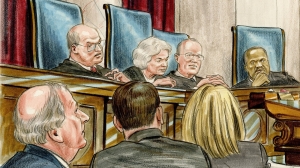
Visual journalist Art Lien says Supreme Court Justice Sandra Day O’Connor (center top) was known for being hard to capture on paper.
I would really recommend you read the complete interview.
David Aaron from Just Security uses U.S. sentencing guidelines to estimate how much jail time Trump might face.
The base level for willfully retaining national defense information in violation of 18 U.S.C. § 793(e) is 24 — but increases to 29 if the information at issue was classified Top Secret, as alleged in the Trump indictment (§2M3.3). A defendant’s leadership role in a crime could add 4 points if the defendant was an “organizer or leader” of criminal conduct that involved at least five people or was “otherwise extensive” (for example, conduct that relied on the assistance of unwitting outsiders), or 2 points if the defendant organized or led criminal activity that involved fewer people and was not as extensive (§3B1.1). The Indictment alleges the defendant was the organizer or leader of criminal conduct that involved at least five other people, whether or not all were witting (Waltine Nauta, Employee 2, and Attorneys 1-3), so the defendant’s attorneys will consider calculations based on the 4-point increase. Conversely, point deductions are available if a defendant had a minimal or minor role (§3B1.2).
The Guidelines add 2 points for a defendant’s abuse of public or private trust to commit the crime (§3B1.3). Courts routinely add those extra points in Section 793(e) cases because the defendant usually came into possession of national defense information while in a position of public trust, and indeed by virtue of that position. Two additional points are added for a defendant’s willful obstruction of the investigation, prosecution, or sentencing of the offense at issue (§3C1.1). (The obstruction points are not applied to violations of statutes that themselves prohibit obstruction except in certain circumstances.)
A defendant’s acceptance of responsibility, such as by pleading guilty, provides a 2-point reduction in offense level. An additional 1-point reduction is available at the prosecutor’s discretion (if applied, the court would also need to approve the basis for the reduction following a motion from the government).
For an individual count of 18 U.S.C. § 793(e), then, a potential offense level could consist of:
Base level with Top Secret: 29
Leadership role: 4
Abuse of trust: 2
Obstruction: 2
Total: 37For a defendant with no prior criminal convictions, an offense level of 37 yields 210 to 262 months (17 1/2 to almost 22 years). A defendant who accepted responsibility could reduce that range to 151 to 188 months if the prosecution agreed to deduct the third point.
The base levels for the other charges in the Indictment are lower. Section 2J1.2 applies to “obstruction of justice” charges such as the Tampering and related Conspiracy counts, the Concealment count, and the Scheme to Conceal and False Statements counts. The base level for these crimes begins at 14, but that increases to 17 if the offense “resulted in substantial interference with the administration of justice.” The base further increases to 19 if the court finds that the offense was extensive or involved “any essential or especially probative record,” which the allegations in the Indictment, if proved, would likely support. To account for obstruction of investigations of particularly serious crimes, however, the Guidelines direct the court to apply Section 2X3.1 instead of 2J1.2 if, as alleged in the Indictment, the offense involved obstructing a criminal investigation and Section 2X3.1 would yield a higher offense level. Section 2X3.1 provides a base level of 6 below the underlying offense, which in a Section 793(e) investigation involving Top Secret documents would result in a level of 23. The “leadership role” and “abuse of trust” increases would still apply, but the obstruction increase does not apply to sentences calculated based on Sections 2J1.2 or 2X3.1. As a result, for a conviction of one of these counts, a potential offense level could consist of the following (I’ve included alternate calculations based on 2J1.2 to illustrate the difference in guidelines)…
Base level using 2X3.1: 23 (or 19, as alleged, under 2J1.2)
Leadership role: 4
Abuse of trust: 2
Total: 29 (or 25)For a defendant with no prior criminal convictions, an offense level of 29 yields 87 to 108 months (7 1/4 to 9 years) and an offense level of 25 yields 57 to 71 months (4 3/4 to almost 6 years). A defendant who accepted responsibility could reduce those ranges to either 63 to 78 months or 41 to 51 months if the prosecution agreed to deduct the third point.
The question of whether sentences would run concurrently or consecutively has come up. The answer will depend on a variety of factors, not least of which include the evidence at trial, the count or counts of conviction, and “grouping” under Section 3D1.2. Section 5G1.2, which addresses sentencing on multiple counts, provides that if the sentence imposed on the count with the highest statutory maximum is sufficient to implement the total punishment, then the sentences on multiple counts will run concurrently. But if the sentence on the count with the highest statutory maximum is insufficient, the court can run sentences consecutively to achieve the target sentence.
No wonder Melania took off for New York City Today!
This has gotten very long. So, we should just take it all down the thread!
What’s on your reading and blogging list today?
Totally Thursday Reads: Karma’s at Bat and Hits Home Runs
Posted: June 8, 2023 Filed under: morning reads, Republican politics, U.S. Politics | Tags: #TrumpIndictmentWatch, Thank you Fleet Street!, Trump Florida Grand Jury, Trump Target 16 Comments
You can have your cake and eat it too. #IndictmentDay #WhichWitchHunt #DingDong John (repeat1968) Buss @repeat1968
Good Day, Sky Dancers!
I get to go to the doctor tomorrow, so BB and I traded days again. Your eyes are not deceiving you! But, wow, did I get a Newsday today. I can’t see what’s going on in the news in the lowest hell realm, but they are celebrating a new denizen.
The New York Times obit for Payable to Pat Robertson is pretty disappointing. It not only displays its typical bothersiderism but acts like everyone loved him but us grumpy feminists and the GLBT community.
Let’s face it. The man was walking evil. I’m happier he’s gone than I was when Phyllis Schafly found her karmic spot in Avīci. There are actually 28 Naraka–hell realms–in Buddhist mythology. None of them are permanent, but then none of them are pleasant either.
Robertson’s run for president basically turned the Republican party into a place where culture war crusaders were welcomed and, dare I say, groomed for candidacy at all levels of government. He also was one of those who got everyone’s granny to give away her bank account by promising all kinds of things. Count me among his detractors.
Witchhunts! Witchcraft! WitchyWomen! Oh My! And the happiest tag of them all #IndictmentWatch!
 Two UK newspapers have been on top of the news from yesterday. First, a Grand Jury in Florida is examing charges of espionage and obstruction. This is from the Independent. “Prosecutors ready to ask for Trump indictment on obstruction and Espionage Act charges.” Andrew Feinberg has this excellent bit of reporting. Additionally, it mentions casually that President Biden “laughs off” pardoning Orange Caligula.
The Department of Justice is preparing to ask a Washington, DC grand jury to indict former president Donald Trump for violating the Espionage Act and for obstruction of justice as soon as Thursday, adding further weight to the legal baggage facing Mr Trump as he campaigns for his party’s nomination in next year’s presidential election.
The Independent has learned that prosecutors are ready to ask grand jurors to approve an indictment against Mr Trump for violating a portion of the US criminal code known as Section 793, which prohibits “gathering, transmitting or losing” any “information respecting the national defence”.
The use of Section 793, which does not make reference to classified information, is understood to be a strategic decision by prosecutors that has been made to short-circuit Mr Trump’s ability to claim that he used his authority as president to declassify documents he removed from the White House and kept at his Palm Beach, Florida property long after his term expired on 20 January 2021.
That section of US criminal law is written in a way that could encompass Mr Trump’s conduct even if he was authorised to possess the information as president because it states that anyone who “lawfully having possession of, access to, control over, or being entrusted with any document …relating to the national defence,” and “willfully communicates, delivers, transmits or causes to be communicated, delivered, or transmitted or attempts to communicate, deliver, transmit or cause to be communicated, delivered or transmitted the same to any person not entitled to receive it, or willfully retains the same and fails to deliver it on demand to the officer or employee of the United States entitled to receive it” can be punished by as many as 10 years in prison.
It is understood that prosecutors intend to ask grand jurors to vote on the indictment on Thursday, but that vote could be delayed as much as a week until the next meeting of the grand jury to allow for a complete presentation of evidence, or to allow investigators to gather more evidence for presentation if necessary.
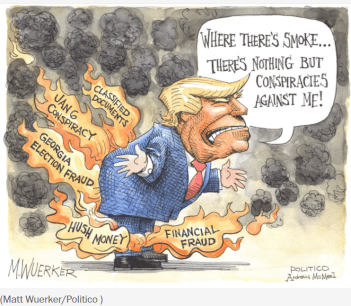 This looks to be a bit of brilliant lawyering. They know Trump will drag things out, and they know he always has arguments that do that. This approach cuts off a lot of legal shenanigans and appeal opportunities. This is also the case with the selection of a Florida venue. They’re going for the quick kill. This is Hugo Lowell’s offering from The Guardian.“Trump’s lawyers told he is target in Mar-a-Lago documents investigation.” And there was much rejoicing in the streets! Lowell appeared on MSNBC with Ari Melber yesterday evening, and wow, did he have the goods!
Federal prosecutors formally informed Donald Trump’s lawyers last week that the former president is a target of the criminal investigation examining his retention of national security materials at his Mar-a-Lago resort and obstruction of justice, according to two people briefed on the matter.
The move – the clearest sign yet that Trump is on course to be indicted – dramatically raises the stakes for Trump, as the investigation nears its conclusion after taking evidence before a grand jury in Washington and a previously unknown grand jury in Florida.
Trump’s lawyers were sent a “target letter” days before they met on Monday with the special counsel Jack Smith, who is leading the Mar-a-Lago documents case, and the senior career official in the deputy attorney general’s office, where they asked prosecutors not to charge the former president.
Trump has reportedly said he had not been personally informed by the justice department that he was a target when asked directly by a New York Times reporter, but demurred when asked whether his legal team had been told about the designation.
The development comes as prosecutors have obtained evidence of criminal conduct occurring at Mar-a-Lago and decided that any indictments should be charged in the southern district of Florida, where the resort is located, rather than in Washington, according to people familiar with the matter.
To that end, prosecutors last month started issuing subpoenas to multiple Trump aides that compelled them to testify before a new grand jury in Florida, impaneled around the time that the grand jury in Washington stopped taking new evidence, the Guardian previously reported.
It’s nice to see Fleet Street give both the New York Times and the Washington Post a comeuppance. Their reporters are more like insiders than journalists on a beat. More from Andrew Feinberg.
 Let’s repeat this together. “The Independent has learned that prosecutors are prepared to ask grand jurors to vote on charges as early as Thursday.” #IndictmentWatch.
A separate grand jury that is meeting in Florida has also been hearing evidence in the documents investigation. That grand jury was empaneled in part to overcome legal issues posed by the fact that some of the crimes allegedly committed by Mr Trump took place in that jurisdiction, not in Washington. Under federal law, prosecutors must bring charges against federal defendants in the jurisdiction where the crimes took place.
Even if grand jurors vote to return an indictment against the ex-president this week, it is likely that those charges would remain sealed until both the Washington and Florida grand juries complete their work.
Another source familiar with the matter has said Mr Trump’s team was recently informed that he is a “target” of the Justice Department probe, which began in early 2022 after National Archives and Records Administration officials discovered more than 100 documents bearing classification markings in a set of 15 boxes of Trump administration records retrieved from Mar-a-Lago, the century-old mansion turned private beach club where Mr Trump maintains his primary residence and post-presidential office.
Over the course of the last year, grand jurors have heard testimony from numerous associates of the ex-president, including nearly every employee of Mar-a-Lago, former administration officials who worked in Mr Trump’s post-presidential office and for his political operation, and former high-ranking administration officials such as his final White House chief of staff, Mark Meadows.
Up next on the January 6th DOJ investigation is a subpoena for Steve Bannon. We are going to get subpoenas on some MAGArat congress critters next, and hopefully, Ginnie Thomas. I don’t know if there’s enough popcorn on the planet to carry us through the next few weeks. It’s going to be a glorious Independence Day at this rate!
 SCOTUS actually just did something surprising today on a day when everything has not been surprising but long overdue! This is from NBC News, “Supreme Court backs landmark voting rights law, strikes down Alabama congressional map. The justices threw out Republican-drawn congressional districts that a lower court said discriminated against Black voters.” Lawerence Hurley has the lede. Please say this also pertains to the Gret State of Lousyana too!
The Supreme Court on Thursday struck down Republican-drawn congressional districts in Alabama that civil rights activists say discriminated against Black voters in a surprise reaffirmation of the landmark Voting Rights Act.
The court in a 5-4 vote ruled against Alabama, meaning the map of the seven congressional districts, which heavily favors Republicans, will now be redrawn. Chief Justice John Roberts and Justice Brett Kavanaugh, both conservatives, joined the court’s three liberals in the majority.
In doing so, the court — which has a 6-3 conservative majority — turned away the state’s effort to make it harder to remedy concerns raised by civil rights advocates that the power of Black voters in states like Alabama is being diluted by dividing voters into districts where white voters dominate.
In the ruling, Roberts, writing for the majority, said a lower court had correctly concluded that the congressional map violated the voting rights law.
In 2013, Roberts authored a ruling that gutted a separate, important provision of the Voting Rights Act and has long argued that various government efforts to address historic racial discrimination are problematic and may exacerbate the situation.
He wrote in Thursday’s ruling that there are genuine fears that the Voting Rights Act “may impermissibly elevate race in the allocation of political power” and that the Alabama ruling “does not diminish or disregard those concerns.”
The court instead “simply holds that a faithful application of our precedents and a fair reading of the record before us do not bear them out here,” Roberts added.
As such, the court left open future challenges to the law, with Kavanaugh writing in a separate opinion that his vote did not rule out challenges to Section 2 based on whether there is a time at which the 1965 law’s authorization of the consideration of race in redistricting is no longer justified.
Civil rights groups and their supporters, including the Biden administration, reveled in a largely unexpected victory.
I’m already in need of a 7th Inning Stretch!
Alright! Let’s get this post published and take it down the thread!
What’s on your reading and blogging list today?

 peej
peej Carissa
 bostonboomer
 dakinikat
 ecocatwoman
 mablue2
 Mama Lopez
 peggysue22
 quixote
 skydancingguestblogger
 Mona (aka Wonk the Vote)



 Sky Dancing
Recent Comments