
An Obituary for New Deal Liberalism
Posted: January 17, 2011 Filed under: Bailout Blues, Barack Obama, Populism, The Bonus Class, U.S. Economy, U.S. Politics, Voter Ignorance | Tags: Looting Social Security, The End of New Deal Liberalism, The Nation, William Grieder 5 CommentsIf you haven’t read William Grieder’s powerful piece ‘The End of New Deal Liberalism’ at The Nation, you really should.  Let me give you a taste.
In these terms, the administration of Barack Obama has been a crushing disappointment for those of us who hoped he would be different. It turns out Obama is a more conventional and limited politician than advertised, more right-of-center than his soaring rhetoric suggested. Most Congressional Democrats, likewise, proved weak and incoherent, unreliable defenders of their supposed values or most loyal constituencies. They call it pragmatism. I call it surrender.
Obama’s maladroit tax compromise with Republicans was more destructive than creative. He acceded to the trickle-down doctrine of regressive taxation and skipped lightly over the fact that he was contributing further to stark injustices. Ordinary Americans will again be made to pay, one way or another, for the damage others did to society. Obama agrees that this is offensive but argues, This is politics, get over it. His brand of realism teaches people to disregard what he says. Look instead at what he does.
Greider outlines the goals of the plutocracy so clearly that you wonder when he’ll be put up for trumped up espionage charges or at least some made-up sex scandal. His opening paragraphs on the capture of our government by corporate interests are just about the most compelling and apt description I’ve read recently. He’s awakened some how to the spokesmodel-in-chief. (h/t to Cinie wherever she may be)
Government has been disabled or captured by the formidable powers of private enterprise and concentrated wealth. Self-governing rights that representative democracy conferred on citizens are now usurped by the overbearing demands of corporate and financial interests. Collectively, the corporate sector has its arms around both political parties, the financing of political careers, the production of the policy agendas and propaganda of influential think tanks, and control of most major media.
What the capitalist system wants is more—more wealth, more freedom to do whatever it wishes. This has always been its instinct, unless government intervened to stop it. The objective now is to destroy any remaining forms of government interference, except of course for business subsidies and protections. Many elected representatives are implicitly enlisted in the cause.
Gotta Love those Wikileaks
Posted: January 17, 2011 Filed under: commercial banking, Corporate Crime, Diplomacy Nightmares, financial institutions, Foreign Affairs, investment banking, Tunisia, Wikileaks | Tags: corruption, jasmine revolution, Julian Assange, offshore banking, Rudolf Elmer, Swiss banks, Tunisia, whistle blowers, Wikileaks 14 CommentsI’m still waiting for the BOA Wikileaks data drop but the idea of a Swiss Banker from offshore banking haven, The Cayman Islands, dropping a dime on a few of those tax evading customers is almost as sweet. I can sense the thickness of air hanging in private clubs all over the world from my little corner of the ninth ward.
Rudolf M. Elmer, the former head of the Cayman Islands office of the prominent Swiss bank Julius Baer, refused to identify any of the individuals or companies, but told reporters at a press conference that about 40 politicians and “pillars of society” worldwide are among them.
He told The Observer newspaper over the weekend that those named in the documents come from “the U.S., Britain, Germany, Austria and Asia — from all over,” and include “business people, politicians, people who have made their living in the arts and multinational conglomerates — from both sides of the Atlantic.”
Mr. Assange said that WikiLeaks would verify and release the information, including the names, in as little as two weeks. He suggested possible partnerships with financial news organizations and said he would consider turning the information over to Britain’s Serious Fraud Office, a government agency that investigates financial corruption.
That’s a wow story! But then, there’s been a series of them coming from Assange’s organization and the entire thing is just too great for words. Any one that really doesn’t see that Wikileaks is becoming THE way for little guys to undermine the power elites of the world is basically a tool of oppressors and autocrats. Just as Bradley Manning witnessed tapes that revealed the incredibly war crimes and inhumanity of a few American soldiers, Rudolf Elmer has witnessed pilfering that probably includes profiteering from crimes against humanity. However, like every one else, I want NAMES.
Check out the CIA’s list of the RICHEST countries in the world in per capita terms. I always love to quiz my students on which ones shake out at the top and they nearly always get it wrong. The top ten countries–with the exceptions of oil rich Kuwait and Norway–are all havens of offshore banking, tax evasion, and gambling. The USA has dropped to number 11 on the richest country list. Undoubtedly, it still holds that position because of its Investment Bankers. As I mentioned in the Friday Reads, it’s not because we reward our brain surgeons, 4 star generals, or great minds. I’m appalled that this might be the century that proves Karl Marx right on how ‘capitalism’ eventually falls. I’m only afraid that it will not be replaced with any kind of utopia; worker or otherwise.
What was Rudolf Elmer’s motivation?
Mr. Elmer said he had turned to WikiLeaks to educate society about what he considers an unfair system designed to serve the rich and aid money launderers after his offers to provide the data to universities and governments were spurned and, in his opinion, the Swiss media failed to cover the substance of his allegations. “The man in the street needs to know how this system works,” he said, referring to the offshore trusts that many “high net worth individuals” across the world use to evade taxes.
This, is the beauty of the Wikileaks. (I’m going to take some time here to wave to our junior G-guys and G-gals!) It gives a voice to those of us that work in the trenches holding up a system that rewards our work with pink slips, loss of insurance, and raises that don’t keep up with the cost of living don’t have much power. The information we sit on frequently has a lot of power. Once released to the public domain, it has even more power. These leaks expose corruption and thievery; pure and simple.
Late Night Drift
Posted: January 17, 2011 Filed under: American Gun Fetish, Anti-War, Barack Obama, Foreign Affairs, Haiti | Tags: Ezili Danto, gun violence, haiti, Papa Doc's return, semiautomatic weapons gun control 19 CommentsSomething to think on …
from The Economist:
Opportunists who seek to gain political advantage by blaming the shootings on words would do America better service if they focused on bullets. In no other decent country could any civilian, let alone a deranged one, legally get his hands on a Glock semi-automatic. Even in America, the extended 31-shot magazine that Mr Loughner used was banned until 2004. As the Brady Centre, established after the Reagan shooting to commemorate one of its victims, has noted, more Americans were killed by guns in the 18 years between 1979 and 1997 than died in all of America’s foreign wars since its independence. Around 30,000 people a year are killed by one of the almost 300m guns in America—almost one for every citizen. Those deaths are not just murders and suicides: some are accidents, often involving children.
The tragedy is that gun control is moving in the wrong direction. The Clinton-era ban on assault weapons expired in 2004 and, to his discredit, Mr Obama has done nothing to try to revive it. In 2008 the Supreme Court struck down Washington, DC’s ban on handguns, and in 2010 Chicago’s went the same way; others are bound to follow. In state after state the direction of legislation is to remove restrictions on gun use (those footling bans on bringing weapons into classrooms or churches or bars), rather than to enhance them.
It is fanciful to imagine that guns will ever disappear from America; they are too deeply embedded in its founding myths and its culture. But that does not mean that more effective checks on the mentally unstable are impossible, or that restrictions on the killing power of what can be sold are doomed to failure. Neither of these will happen, though, unless the blame is directed to where it belongs.
(Via Phoenix Woman tweet ) from Haitian Blogger Ezili Dantò in a post called: Obama’s change in Haiti: the Return of Dictator, Jean Claude Duvalier:
Air France flew Jean Claude Duvalier back into Haiti today. A coup for France who saw its influence diminishing as the US took over with the Interim Haiti Reconstruction Commission and the UN occupation. (Ousted president Jean Claude “Baby Doc” Duvalier returns to Haiti unexpectedly ; Jean-Claude ‘Baby Doc’ Duvalier, ex-Haiti dictator, makes surprise return to country Sunday ).
Why would the world’s most powerful nation, the United States, allow this?
Well, their pillage of poor Haiti is butt-naked right now. At the one-year anniversary of the Haiti earthquake, even the conservative media is talking about the failure of US aid, the UN and the NGO poverty pimping business in Haiti. Thus, the UN, as US proxy, needs to justify its job in Haiti. These folks think of us-Haitians as simplistic animals, so why not set up what’s worked for them in other parts of the world? The bringing back of Jean Claude Duvalier, Haiti’s bloody dictator, is, in their plantation minds, sort of like setting up a Hutu/Tusti thing (Duvalier/Lavalas), a civil war in Haiti, an insecurity to bring “order” to.
Bill Clinton, the poverty-pimp-NGOs, the repugnant UN and the foreign-imposed-IHRC need to distract the world from the donation dollars that’s being pocketed or not collected, so hey, let’s rack up the colonial narrative – remind everyone of those “anti-democratic Haitians not ready for the same standards” as the rest of the “civilized” world. Those infighting, violent, illogical Haitians in love with dictatorship! Why not set up the chess board, right before Feb. 7th – the 25th anniversary of the ouster of Jean Claude Duvalier, bring him back to push the two OAS/Duvalierist candidates – Manigat and Martelly (Sweet Mickey), so everyone can forget about the masses wishes, their total disenfranchisement, the 300,000 dead in 33 seconds and those 1.5million still homeless without sanitation, shelter, clean water; the return of President Aristide; the international fraud since 2004; these imposed UN/US elections. and the UN-imported cholera…We’re just puppets the International community , led by the U.S., are moving around their own battlefield. Haiti is not in control. Haitians are not in control. Air France and American Airlines can land anyone in Haiti.
If Air-France wanted to bring in Osama bin Laden into Haiti, how could Haitians stop it? Still, we-Haitians will be blamed, as usual, for all the outrageous acts the wealthy powers-that-be do in Haiti. The “Friends of Haiti” continue with their macabre plan to further destabilize and exacerbate Haiti’s already agonizing sufferings.
and a tweet from Mac McClelland from Mojo:
MacMcClelland Mac McClelland
Baby Doc is back in Haiti! Our pics, chats w/ people cheering for a rapey murdery ex-dictator
You know, I’m kinda thinking the one thing that we still do export onto the global market in a significant way is our thing for violence.
Discuss amongst yourselves …
Saturday Night Treats
Posted: January 15, 2011 Filed under: open thread, Treats | Tags: General Dodge House in Council Bluffs, Heartland soup recipes, Iowa 13 Comments Since the weather’s been so nasty and cold almost every where, I thought I’d bring out some cold weather recipes from Iowa and Nebraska where I grew up. I grew up in blustery weather and was no stranger to blizzards.
These are some heritages soups that my mother and some of her friends collected to produce a recipe book fundraiser for the General Dodge House in Council Bluffs, Iowa. My mom was chair of the fund drive to restore Union Civil War General Grenville Melon Dodge’s House. She served as chairman of the Board of Trustees and President of the nonprofit museum for many years. The recipe book was dedicated to my mom’s best friend–Bea Utley–an interior decorator that helped tremendously with the restoration of the house. Actually, they were called receipts back then so this is a from a Receipt Book.
Their fund raising arm was and still is called the “General’s Ladies” and they’d do Victorian Christmas and summer picnics and all kinds of things to get funds to keep and get the property in order. I haven’t been then in years but I was practically brought up in the place. I used to talk to a ghost in one of the bedrooms when I was a kid and my first job at the ripe old age of 14 was as a docent there.
I got rather used to wearing Victorian clothes in the process. During Christmas, my mother made me play Christmas Carols in the ball room or she’d have me bring my guitar and best friend to sing carols through out the house. My other best friend played the Harp. Most of us wound up as docents on Sunday during our high school years. I remember when mom was trying to round up some of the old antiques and furniture before it was completely restored. I pretty much became familiar with the attics and basements of many old houses. It must’ve made an impression on me because I have a deep and lasting affection for America’s historic houses. My current house was built around the same time as the General’s Home. If you’re every on interstate I-80, on the extreme western edge of Iowa, you should make a point of visiting. It’s considered a premier Victorian restoration.
Oh, and we tested all the recipes too.
German Dumpling Soup:
4 or 5 pound fat stewing hen
4 cups carrots, cut up
3 cups potatoes, cut up
2 cups, celery, cut up
1 cup onion, cut up
1/2 cup chopped parsley, held back until just before serving
In a large kettle, cover hen with water, cover with a lid then boil one hour or longer, until tender. Add vegetables in the order listed above. After the vegetables are cooked, remove the whole chicken, bone it, cut it up and place it back with the vegetables and broth.
To make the Dumplings:
4 cups flour
1 tsp. Salt
6 eggs
Yellow food coloring
Add enough boiling water to flour to make a paste. Add a few drops of the yellow food color to the water. Break eggs into the paste one at a time and stir until well blended. Add more flour until the dough because very, very firm and dry. Use a teaspoon to cut off the dough and drop into the boiling soup when the chicken and vegetables have been prepared as above. Dip the spoon in the boiling water to release the dough. These dumplings are hard and firm.
Cover and boil 10 minutes. Sprinkle the parsley into the soup right before serving.
This recipe came from General’s Lady Mrs. Harold W. Schultz and came with this sage Victorian Advice:
Give neither counsel nor salt till you are asked for it.
Dutch Split Pea Soup
2 lbs. split green peas
4 sticks celery, chopped
2 pig’s hocks
12 ounces fresh pork sausage
4 leeks,chopped
1 lb onions, chopped
1 1b. smoked bacon in a whole piece or bacon squares
Pepper, salt to taste
Clean peas. Soak overnight in water.
Bring peas to a boil with the vegetables in 4 1/2 quarts fresh water. Add the hocks and bacon. Let simmer slowly until hocks are tender–two or three hours, stirring often. Pot should be covered.
One half hour before the soup is done, add fresh sausage in lumps the size of small walnuts.
Before serving, remove hocks and bacon from soup. Cut meat from the hocks into small pieces and return to soup. Season with the salt and pepper to taste., slice bacon to serve with the soup.
Makes about 12 servings.
This recipe came from Mrs. J Frederic Schlott. Fred Schlott was the architect that was responsible for the park around the outside of the house and sat on the board with mom for a long time. Almost, all the original people that dealt with the house have passed now so I’m not sure what goes on there any more. If you ask me, there’s probably a few more ghosts in that house than the one that I used to talk to in the gold bedroom as a kid. Some of these people spent a good portion of their life leaving the community this historic house museum.
Have any great recipes for some great comfy food that you’d like to share tonight?
Just Don’t Take Mine
Posted: January 15, 2011 Filed under: Federal Budget, U.S. Economy | Tags: Federal Budget, Federal Debt, Federal Deficit, Federal Spending 13 CommentsI wrote a little on the disturbing level of economic illiteracy I see throughout the country yesterday. A CBS Poll came 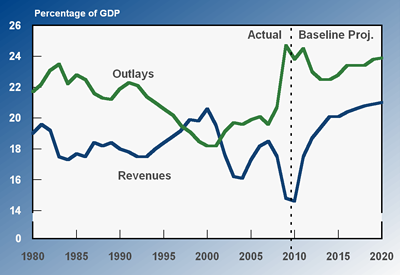 out on what Americans want done with Federal Spending and it just screams stupidity. The overwhelming majority of people want spending cuts in the Federal Budget, but they can’t name many things that they want cut. It seems like there’s this resounding chorus out there of give me my taxes back and do cuts on imaginary spending. Then, it’s just don’t cut anything I use or think is important. I’m going to cite this last paragraph in the article . It’s probably the most relevant. (There’s more discussion links on this at Memeorandum.)
Most Americans do not know exactly how the government spends its money. For example, when asked what percent of the budget goes to earmarks, 41 percent said they make up less than 20 percent of the budget, 13 percent said 20-50 percent, 4 percent said more than 50 percent and 42 percent didn’t know. Earmarks actually make up less than one percent of the budget.
I always hear students say they want to quit giving money away to other countries too. We give less than one half percent of our budget to other countries. The best place to look for budget information is the Congressional Budget Office website. That’s where I got the graph you see in the upper right hand corner. That’s a comparison of Federal Spending (green) and Federal Incomes (blue) since 1980. The gap between the two at any one point in time is the federal deficit for that year.You can distinctly see the period during the Clinton Budget Surpluses because that’s where the blue lines is above the green line. All other periods show more spending than revenues. The Reagan and Bush years were years of explosive spending growth. You can also see the huge gap that started around 2008 when the Great Recession took hold. Nearly each of the down turns recently has been due to huge tax breaks combined with bad economies.
A pie chart shown on a Examiner.com breaks down the expenditures by the funded Department. It also adds Social Security into the mix which is the number one federal outlay. (Ryan Witt’s chart analysis here. Read the comments and embrace the number of people that need to go back to school.) Social Security–however–is sustained at the moment by more revenues than outlays. The Department of Defense comes after that. It gets about 19% of the overall budget. Right now, because of the ‘cyclical’, mandatory spending that occurs due to our bad economy and our high unemployment, you can see that unemployment/welfare payments mandated by law come after that (16%), followed by Medicare which is also offset by payroll taxes at the moment (13%) then Medicaid/SCHIP funding (8%). The Department of Health and Human Services gets about 8%.
The next biggest expenditure is paying the interest on the National Debt. Thankfully, interest rates are low so that amounts to around 5% currently. You can compare this pie chart to the one below and see how lower interest rates combined with higher outlays really helped to push that percentage down.. The next most noticeable part is the Transportation department that gets about 2% of the budget. Most of the remaining major Departments like Homeland Security, Energy, Education, etc. get some where around 1-1 and 1/2%. Veteran’s Affairs gets a fairly noticeable slice too albeit not huge.
 I’ve also put a pie chart of Federal Outlays for 2009 to the left that is some what more general. Notice how huge the Treasury budget was because of TARP (now mostly paid back) and the other bailouts. There are several reasons that the budget deficit has been so bad the last few years. The primary reason is the bad economy because that forces revenues down and outlays up. The second reason is the Bush taxes cuts that were just extended and expanded for the next two years. We’re basically spending at relative levels right now that we’ve not seen since World War 2. We are of course funding two occupations/wars and a ‘war’ on Terror. Some people want to conveniently forget that. When the economy finally improves and we do actually shut down Iraq and Afghanistan, a lot of our budget headaches will go away.

 peej
peej Carissa
 bostonboomer
 dakinikat
 ecocatwoman
 jjlo
jjlo mablue2
 Mama Lopez
 peggysue22
 quixote
 skydancingguestblogger
 Mona (aka Wonk the Vote)





Recent Comments