
John Edwards to be Indicted
Posted: May 25, 2011 Filed under: Breaking News, U.S. Politics | Tags: affair, campaign finance laws, cover up, indictment, John Edwards 33 Comments
Edwards and another cover-up
Edwards reportedly knows about the plan and is considering his options. He could make a plea arrangement or face a trial, which could be long and costly.
An indictment or a plea bargain could happen within the next two weeks, according to reports.
The Department of Justice plans to argue that two wealthy supporters donated hundreds of thousands of dollars to the Edwards campaign — money that went to support Rielle Hunter, a videographer Edwards’s campaign with whom Edwards had an affair. The government will claim the funds were illegal campaign contributions.
Edwards has admitted to fathering a daughter with Hunter.
The government’s case reportedly depends on former Edwards campaign aide Andrew Young who originally said that he was the father of Hunters’s daughter and later accused Edwards of engineering an effort to hide the affair from the public.
James Hill from ABC broke the story. You can watch the story at this link.
It can happen again
Posted: May 24, 2011 Filed under: just because 10 Comments
James Wood as the CEO of failing Lehman Brothers
Since I put up that thread last night on the HBO docudrama Too Big to Fail, I thought I’d look for some research coming out of financial economists on those events. I’m still reading “House of Cards” off and on which is a more wonky version of Too Big to Fail. I’ve also done my share of reading various research articles that pop up in academic journals. Mark Thoma had a link to a Minneapolis Fed paper by Robert Lucas and Nancy Stokey. Lucas is one of the premier freshwater economists and the paper fit the bill. You become very familiar with the Lucas Critique in graduate school. It’s seminal.
If you watched the HBO presentation, you may recall that Ben Bernanke explained that there was a liquidity or credit crisis that resulted from the downward spiraling financial market conditions. The director punctuated this by showing the head of GE on the phone saying that GE wasn’t able to do its regular business because it’s commercial paper wasn’t going to be renewed or rolled-over. Commercial paper is the vehicle for borrowing short term working capital. The market is only available to high quality companies. This was one of the first signs that the contagion was outside of the mortgage markets. There was no money to lend to high quality huge corporations in retail and manufacturing. All outstanding dollars were being brought back to lenders to cover their losses and up their capital in response. You may have seen my earlier comment that it was rumored at the time that McDonald’s couldn’t get theirs renewed either and was about one week away from not being able to make its payroll. Many businesses rely on short term borrowing for working capital and most of these businesses are sitting in your local strip malls.
The prime commercial paper market seems like a gigantic leap from the mortgage repurchase (repo) markets where the contagion started as real estate prices plummeted and troubles in sub prime mortgages became apparent. The problem is that well diversified shadow banks–like insurance companies, investment banks, Money Market funds, and Hedge funds–are invested all over the place. If they start losing big in one area, they have to pull their money back to cover it. They pull the short term money first to avoid penalties and loss of higher yielding assets. Institutions’ exposure to the real estate markets and the repo market was so huge that it started sucking the money out of every other credit market. They needed the money to cover the losses. Some of the banks were more than able to cover themselves and their capital requirements by doing this. You also saw this at the end of the show. The deal is that wasn’t the only problem at that point. If banks continued to draw funds down from other markets, it was bound to start taking other US businesses and consumers down. The banks needed to shove more money out the door and not pull it back in according to monetary policy theory as shown by empirical evidence during the Great Depression. The phenomenon is called a liquidity crisis, a credit crunch basically represents a nontraditional bank run.
There are many markets unfamiliar to most people that could set off contagions that impact the real economy. They are still out there. Reliance on capital creates this situation. Trying to wring every last penny out of every last dollar through sophisticated cash management programs exacerbates it. A lot of what happens with liquidity crises is that people and business start holding on to money because of panic and uncertainty. They want to overprotect themselves. This makes the situation worse. Keynes referred to this as animistic spirits. Lucas defines it like this.
Liquidity crises that induce or exacerbate deep recessions, as in 1930 or 2008, are situations in which individuals and firms want to build holdings of liquid assets. Heightened risk, or a perception of it, substantially increases demand for these assets. This reduces the supply available for normal transactions, leading to production and employment declines.
What happened in September 2008 was a kind of bank run. Creditors lost confidence in the ability of investment banks to redeem short-term loans, leading to a precipitous decline in lending in the repurchase agreements (repo) market. Massive lending by the Fed resolved the financial crisis, but not before reductions in business and household spending had led to the worst U.S. recession since the 1930s.
Lucas looks at the moral hazard created by deposit insurance as well other risk tools like swap and reinsurance markets using models that were developed in the 1980s that still stand today. You may remember the huge role of AIG in all of this. All the banks thought they were safe because they had insured their positions with AIG (credit default swaps, reinsurance, etc.) so therefore they thought they could take on more risk as they increased their volume of stinker loans. What no one knew at the time was that AIG had pretty much insured the majority of the market. It was betting that real estate prices would never go down. If AIG would’ve tanked, those insurance policies were dead and so was the rest of its line which included folks’ pensions and life insurance policies. The AIG exposure was the Rubicon.
If you think you’re insured against a risk, you will take on more risk. The banks thought they were insured. Thus, the moral hazard is created. The best way to explain it is using safety belts in cars. People actually tend to drive faster when wearing seat belts and engage in riskier behavior because they feel safer. Deposit insurance creates a feeling of safety in both depositors and lenders. There were never runs on checking or savings accounts during the entire crisis. It happened in Money Market Accounts which are close substitutes but not insured as people wanted to move their funds to their safer accounts. Money Markets lend big time to the repo markets.
You may recall that TARP switched midstream from a program of buying toxic assets to a recapitalization venture. The liquidity/credit crisis was basically the reason. Bernanke told Paulson that it would take several months to value and clear out toxic assets. They did this later through the QE program where they allowed almost anything as collateral for cheap loans for almost any one at the Fed’s discount window. What they did with the TARP was force the big banks to sell them none-voting preferred stock in exchange for a given amount of capital. It was a form of nationalization without completely taking over banks. The banks were supposed to create loans with this and replenish the credit markets. That happened to a limited extent. It didn’t replenish all of the credit markets. Most notably credit for small businesses and consumers remained tight for some time. They still are quite tight.
Late Night Schlock: Financial Meltodrama
Posted: May 23, 2011 Filed under: Bailout Blues, Economy, financial institutions, Global Financial Crisis | Tags: Ed Asner, HBO Too Big To Fail, Paul Giametti, William Hurt 20 Comments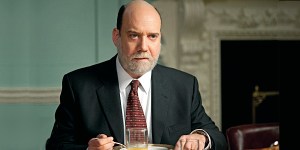 HBO premiers its adaptation of Andrew Ross Sorkin’s “Too Big to Fail” today at 9 ET/PT. I’ve got my bowl of popcorn all ready. My Businessweek hit my mailbox today detailing the all-star line up of the still living cast of real life crisis players. That’s Paul Giametti as Ben Bernanke over there on the left. William Hurt plays Hank Paulson. Ed Asner plays Warren Buffet. Oh, and Dan Hedaya plays Barney Frank. Did you ever imagine Hollywood recreating Barney Frank? It’s sort’ve humorous to think of all these Hollywood types playing Wall Street and Washington insiders. Same big Egos. Same program of you’re only as good as your last deal.
I’m still “reeling” from the idea of Business Week doing a Move Review.
Too Big to Fail, which premieres on May 23, follows the same trajectory as Sorkin’s book, from the collapse of Bear Stearns that spring to the rise of TARP in the fall. To the film’s credit, it attempts to make many of these still-horrifying moments pretty funny—and squeezes them all into 98 minutes. While the movie doesn’t shed much new light on the period, it offers one of the few pleasures left unfulfilled by the gusher of nonfiction thrillers, roman à clefs, wrist-slapping documentaries, and Oliver Stone. The bankers and government officials who rose to prominence in those months are depicted in all their glory and disgrace by real Hollywood actors—most of whom are far better-looking versions of the people they’re portraying. (Tim Geithner is pretty handsome, but Billy Crudup? Really?) TARP groupies will delight in the film’s attention to detail. Leon, the coffee cart guy parked outside Lehman’s office building, gets a chance to extend his five minutes of fame. The hideous toupee worn by Matthew Modine—playing Merrill Lynch Chief Executive Officer John Thain—might be the worst fake movie hair since Burt Reynolds’s heyday.
For the uninitiated, director Curtis Hanson—who won an Oscar for writing L.A. Confidential—drops some not-so-subtle hints. A voice-over in an opening scene refers to JPMorgan Chase’s (JPM) Jamie Dimon (Bill Pullman) as the “smart” banker; Lloyd Blankfein (Evan Handler) is called the “superstar”; and Citigroup’s (C) Vikram Pandit (Ajay Mehta) is called neither. As Hank Paulson (William Hurt) declares, “No one is sure if he’s running Citi or Citi is running him.” Fuld, played in all his vein-popping glory by James Woods, needs no description at all. Viewers are shown, in no uncertain terms, his ginormous hubris as he screws up a potential deal with Korea Development Bank. After being told by Lehman Chief Operating Officer Bart McDade to stay out of the negotiations, Fuld barges in, scares off the bidders, and blows what could have been a precious lifeline.
Here’s the review from LA Times TV critic Robert Lloyd.
The film’s main argument, really, is that we should look kindly upon Paulson and the best he tried to do; the other characters we rate by whether they help or hinder him. What moral voice there is here mostly comes out of his mouth. “We’ve been late on everything,” he admits, and admits also that no one in power wanted to regulate the financial industry because “We were making too much money.” (That’s about as pointed as the film gets on the subject of corporate greed.) Hurt, who (like his costars) seems to be playing the script rather than imitating the person whose name he bears, is a tall tower of movie-star appeal, and it does not hurt our opinion of Paulson that Kathy Baker plays his wife, although she has not much to do but sympathize.
So, if you’re up for an evening about the masters of the universe played by Hollywood’s elite character actors, you know where to go tonight. Here’s the trailer with its theme song Fortunate Song by Credence Clearwater Revival which is a damned good choice and a brief interview with Giametti. I also put him the HBO back story that’s part of the Opening the Vault series.
This has some of the back story on TARP and the meltdown including interviews with journalists that covered the event and the aftermath.
You can consider this an open thread. I’m at home still trying to kick my fever with a larger dose of antibiotics. No beer with the popcorn tonight. (sigh) I’m okay but this stuff is just friggin’ persistent.
Monday Reads
Posted: May 23, 2011 Filed under: Economy, Foreign Affairs, morning reads | Tags: Brad Delong, Fox Network, Gabriel Sherman, Roger Ailes, Tornadoes Minneapolis and Joplin 35 Comments Good Morning!
Hopefully, by the time you read this, I’ll be off to my doctor’s office as the damned MRSA thing on my lip showed back up this weekend. I look like some one botoxed me on one side. This stuff is no fun. I think it has something to do with this endless runny nose and weepy eyes I appear to have with this year’s horrible allergies.
New York Magazine‘s Gabriel Sherman has a potboiler article up called The Elephant in the Green Room: The circus Roger Ailes created at Fox News made his network $900 million last year. But it may have lost him something more important: the next election. There’s some really, really juicy bits. Here’s just one example.
All the 2012 candidates know that Ailes is a crucial constituency. “You can’t run for the Republican nomination without talking to Roger,” one GOPer told me. “Every single candidate has consulted with Roger.” But he hasn’t found any of them, including the adults in the room—Jon Huntsman, Mitch Daniels, Mitt Romney—compelling. “He finds flaws in every one,” says a person familiar with his thinking.
“He thinks things are going in a bad direction,” another Republican close to Ailes told me. “Roger is worried about the future of the country. He thinks the election of Obama is a disaster. He thinks Palin is an idiot. He thinks she’s stupid. He helped boost her up. People like Sarah Palin haven’t elevated the conservative movement.”
In the aftermath of the Tucson rampage, the national mood seemed to pivot. Ailes recognized that a Fox brand defined by Palin could be politically vulnerable. Two days after the shooting, he gave an interview to Russell Simmons and told him both sides needed to lower the temperature. “I told all of our guys, ‘Shut up, tone it down, make your argument intellectually.’ ”
It’ll take time to wade through it and you’ll learn more about Beck’s departure even if you just don’t want to, but it’s worth it. It’s sort’ve one of those karmic car wreck articles.
Economist and blogger Brad Delong delivered the harsh news with nifty graphs in Phoenix, Arizona. He calls his speech: The Economic Outlook as of May 2011: Yes, This Is Called the Dismal Science. Why Do You Ask?
But now we have a stubbornly persistent slump in the economy. Now we have economic growth at about our normal long-run pace, with very little signs of closing the gap between the productive capacity of the American economy and its current level of production. We have a Washington DC that is dysfunctional–out of ammunition to take any effective additional steps to boost the economy. There is now substantial fear of inflation–even though there are no signs of inflation gathering anywhere rather than energy and food prices, and we understand that those reflect China’s growing demand and not any domestic price spiral. There is now substantial fear of crowding out–that boosting US government spending or cutting taxes to get more money into the hands of the consumers would discourage private investment even though there are no signs of crowding out even at our rapidly-growing level of the national debt. It is a fact that a bunch of us–including me–think that there really should be signs of crowding out right now–that financial markets should be scared of the fiscal future of America–but they are not. And there is the problem that Washington DC has degenerated into pure Dingbat Kabuki theater on lots of levels.
It is a fact that if congress simply goes home–doesn’t do anything for the next 10 years except keep the federal government on autopilot, or if it does do things if it pays for whatever increases in spending it enacts by raising taxes and pays for whatever tax cuts it enacts by cutting spending–that we do not have a long run deficit problem. If congress goes home for ten years our program spending is matched to our tax revenues, which means a declining debt burden because the growth rate of the economy is larger than the interest rate on our debt.
Our belief that we have a long-run deficit problem is based upon the belief that congress will pass laws that increase spending and that cut taxes–that it will repeal the Independent Payment Authorization Board’s authority to try to make Medicare more efficient, that it will repeal the Affordable Care Act’s tax on high-cost health plans. Given that the fear is based on a belief that some future congress will bust the budget, it is hard to see how we can address this fear through any possible piece of legislation today–for no congress can bind its successors.
This is a problem.
Wow. What a downer. I bet he doesn’t get invited to any of the kewl kids’ cocktail parties there!
Spain continues to experience political unrest. Spanish Youth are demanding “real democracy now”.
Thousands of people have taken to the streets of Spain protesting a round of austerity measures and calling for a boycott of major political parties in Sunday’s regional elections. The protests began last week with a march denouncing high levels of youth unemployment. A large crowd established a tent camp in Madrid’s Puerta del Sol Square, defying an ordinance barring protests.
Protester: “I’ll attempt to stay here tonight, because I think it is very important to retake the streets that politicians have taken away from us to do their campaigning, preventing us from protesting. That is what we feel every day with lack of resources and a huge limitation of democracy. We cannot continue to tolerate this situation.”
The NYT has an interesting bible quiz up on sex and religion. A lot of it on the so-called social issues that cause all those right wing screeds. I found this question and answer particularly interesting.
The people of Sodom were condemned principally for [what]
“Sodomy” as a term for gay male sex began to be commonly used only in the 11th century and would have surprised early religious commentators. They attributed Sodom’s problems with God to many different causes, including idolatry, threats toward strangers and general lack of compassion for the downtrodden. Ezekiel 16:49 suggests that Sodomites “had pride, excess of food, and prosperous ease, but did not aid the poor and needy.”
So, it wasn’t for being a haven for sex practices that offended puritans, it was for lack of compassion and generosity towards the poor. Some one should phone Pat Robertson STAT!
There was a horrible tornado in Joplin Missouri last night. It took out a hospital as well as many, many homes. Here’s some footage of the aftermath.
A tornado also hit Minneapolis. Both tornadoes have caused fatalities. As always, the Red Cross and other responders are in need of more funds and you can give easily via your cellphone these days. They are also responding to flood victims up and down the Mississippi. I wonder what Pat Robertson will say since all of this appears to be hitting the bible belt? Well, anyway, here’s a list of places accepting cash donations if you feel like taking up a collection. We’re supposed to get our share of the weather by Thursday. Hopefully it won’t add flash floods to the rising rivers and spillways.
Okay, well I have to go see a lady about some good drugs! What’s on your reading and blogging list today?
Obama and the Right Wing Rage Machine
Posted: May 22, 2011 Filed under: Barack Obama, Foreign Affairs, George W. Bush, Hillary Clinton, Israel, Middle East, Palestine, Patriot Act, Republican presidential politics, Surreality, U.S. Politics | Tags: Barack Obama, Bill Clinton, birthers, Geroge W. Bush, Herman Cain, Hillary Clinton, israel, Mitt Romney, Oslo Accords, Palestine 23 CommentsPresident Obama reiterated the same US stance to Israel that we’ve always had today at a meeting of the powerful pro-Israeli lobby AIPAC, just as he did in his speech last week. For some reason, the speech at the State Department last week was mislabeled by Mittens Romney and others as “throwing Israel under the bus.” Here’s what the President said today.
[S]ince my position has been misrepresented several times, let me reaffirm what “1967 lines with mutually agreed swaps” means.
By definition, it means that the parties themselves – Israelis and Palestinians – will negotiate a border that is different than the one that existed on June 4, 1967. It is a well known formula to all who have worked on this issue for a generation. It allows the parties themselves to account for the changes that have taken place over the last forty-four years, including the new demographic realities on the ground and the needs of both sides. The ultimate goal is two states for two peoples. Israel as a Jewish state and the homeland for the Jewish people, and the state of Palestine as the homeland for the Palestinian people; each state enjoying self-determination, mutual recognition, and peace.
If there’s a controversy, then, it’s not based in substance. What I did on Thursday was to say publicly what has long been acknowledged privately. I have done so because we cannot afford to wait another decade, or another two decades, or another three decades, to achieve peace. The world is moving too fast. The extraordinary challenges facing Israel would only grow. Delay will undermine Israel’s security and the peace that the Israeli people deserve.
Why the outcry over the past few days to Obama’s maintaining the status quo? Here’s some quotes from SOS Clinton and Ex-prez Dubya that demonstrate this was nothing but manufactured rage on the part of the right wing noise machine.
Even the NY Times is getting into the act. In one sentence they claim that “using the 1967 boundaries as the baseline for a solution to the Israeli-Palestinian dispute” is a first by an American president, and just two paragraphs later quote President George W. Bush using the phrase: “it is unrealistic to expect that the outcome of final status negotiations will be a full and complete return to the armistice lines of 1949,” another way of describing the 1967 boundaries. Those two statements, by Obama and Bush, convey the same concept.
In 2009 Secretary of State Hillary Clinton said:
We believe that through good-faith negotiations the parties can mutually agree on an outcome which ends the conflict and reconciles the Palestinian goal of an independent and viable state based on the 1967 lines, with agreed swaps, and the Israeli goal of a Jewish state with secure and recognized borders that reflect subsequent developments and meet Israeli security requirements.
Where was the manufactured outrage then?
In 2008 President George W. Bush, on a middle east trip, said:
I believe that any peace agreement between them will require mutually agreed adjustments to the armistice lines of 1949 to reflect current realities and to ensure that the Palestinian state is viable and contiguous.
In 2005 President George W. Bush, at a White House meeting, said:
Any final status agreement must be reached between the two parties, and changes to the 1949 Armistice lines must be mutually agreed to.
President Obama is following the same policies put forth by George W. Bush. To claim that Obama’s speech represents some departure from previous U.S. policy is absurd.
When not manufacturing right wing rage, Republican Presidential contenders are demonstrating their foreign policy ignorance. Thank goodness we have some one who knows foreign policy at the State Department! Here’s pizza king and right wing talk show host Herman Cain demonstrating his foreign policy ignorance.
Despite his shallow understanding of foreign policy issues, Cain is still trying to go on the attack against Obama and create a partisan divide on Israel. He said last week that an “arrogant” Obama “threw Israel under the bus” in his recent speech on the Middle East. Trying to sound a hawkish note, Cain said his “Cain doctrine” is “You mess with Israel, you are messing with the United States of America.”
But this morning on Fox News Sunday, Cain showed just how limited his understanding is of the Middle East peace process. Asked by host Chris Wallace what he would be prepared to offer Palestinians as part of a deal, Cain responded, “Nothing.” Just moments later, Cain was dazed and confused when Wallace referenced the issue of “right of return” of Palestinian refugees:WALLACE: Where do you stand on the right of return?
CAIN: The right of return? [pause] The right of return?
WALLACE: The Palestinian right of return.
CAIN: That’s something that should be negotiated. That’s something that should be negotiated.
Wallace then helpfully offered Cain a definition of “right of return” — “Palestinian refugees, the people that were kicked out of the land in 1948, should be able to or should have any right to return to Israeli land.”
Other foreign policy nitwits have joined the faux outrage ranks. Quitterella even points to the old testament as some kind of geopolitical playbook. Do you suppose she’s read stories about the Kraken so she can have an opinion on Greece’s Navy?
I can never figure out why the I/P issue causes people’s heads to blow gaskets. I always hesitate to even offer up any news in the area because it’s caused complete meltdowns on blogs in the past. There are some people on each side of the issue who simply can’t seem find any middle ground from. Derailing any peace process appears to be their goal.
I consider the entire topic to be a hell realm. However, this particular kerfuffle reeks of the same kind of derangement we saw during the Clinton years. It’s getting so bad that I’m cracking this particular nut or group of nuts as the case may be. This is like trying to deal with birthers and those who subscribe to the ‘secret Muslim’ meme.
Obama isn’t my favorite President by any stretch of the imagination, but aren’t there enough things to complain about right now–like the sneaky renewal of the Patriot Act–without manufacturing yet another conspiracy theory? SHEESH!
I can’t see the US selling out Israel anywhere in the near future. They are obviously a US ally. Trying to get both Palestinians and Israelis to be reasonable and come back to Peace Talks should be in everyone’s interest. Don’t they still have their copies of the Oslo Accords or has every one forgotten President Clinton’s work already?

 peej
peej Carissa
 bostonboomer
 dakinikat
 ecocatwoman
 jjlo
jjlo mablue2
 Mama Lopez
 peggysue22
 quixote
 skydancingguestblogger
 Mona (aka Wonk the Vote)





Recent Comments