
Should US Congressmen be able to make Financial Bets Against the US?
Posted: July 8, 2011 Filed under: John Birch Society in Charge, Psychopaths in charge, The Media SUCKS, We are so F'd | Tags: betting against America, Eric Canttor, hedge funds, TPS 34 Comments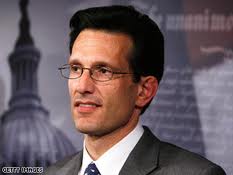 Just about the time I think I’ve seen about the worst of the worst coming out of the US congress, another Congressman finds a new bottom. The WSJ has reported that House Majority Whip Eric Cantor stands to gain financially from a U.S. default on the debt ceiling . (Basically, he’s shorted Treasuries). That’s something Cantor seems hellbent on happening. Congressman Cantor has made bets against US Treasury bonds that stand to pay if he can make it happen. Unfugginbelievable!
Putting his money where his mouth is? Eric Cantor, the Republican Whip in the House of Representatives, bought up to $15,000 in shares of ProShares Trust Ultrashort 20+ Year Treasury ETF last December, according to his 2009 financial disclosure statement. The exchange-traded fund takes a short position in long-dated government bonds. In effect, it is a bet against U.S. government bonds—and perhaps on inflation in the future.
Salon‘s Jonathan Easley looked into the potential financial windfall for Cantor right after Cantor shut down talks with Biden and other Democrats on the budget and the debt ceiling. Cantor is the House Majority Leader so he plays an important role in getting the majority to vote for any potential deal. Even if a deal can be reached, Cantor could stall it and make money.
Unless an agreement can be reached, the U.S. could begin defaulting on its debt payments on Aug. 2. If that happens and Cantor is still invested in the fund, the value of his holdings would skyrocket.
“If the debt ceiling isn’t raised, investors would start fleeing U.S. Treasuries,” said Matt Koppenheffer, who writes for the investment website the Motley Fool. “Yields would rise, prices would fall, and the Proshares ETF should do very well. It would spike.”
The fund hasn’t significantly spiked yet because many investors believe Congress will eventually raise the debt ceiling. However, since Cantor abruptly called off debt ceiling negotiations last Thursday, the fund is up 3.3 percent. Even if an agreement is ultimately reached before Aug. 2, the fund could continue to benefit between now and then from the uncertainty. (One tactic some speculators are using is to “trade the debt ceiling debate” — that is, to place short-term bets on prices as they fluctuate with the news out of Washington.)
A Completely Unofficial Blog About Eric Cantor has more information on the disclosure statements filed by Cantor that indicates he has taken multiple positions against the U.S. Government. Besides buying into a vanilla mutual fund, Cantor specifically went after investments that would pay if U.S. Government finances were troubled.
Picking individual financial products is more trouble than buying mutual funds. When Eric Cantor took the trouble to pick individual investments, he chose the following:
$1-15,000 ProShares Trust Ultrashort 20+ Year Treasury ETF (TBT)
$1-15,000 iShares Barclays TIPS Bond Fund (TIPS)
$1-15,000 WisdomTree International Basic Materials (DBN)
$1-15,000 SPDR SP Metals Mining (XME)So yeah, that acronym TIPS ring a bell? It should if you read Paul Krugman..
TIPS, as I read it is basically the interest difference between nominal U.S. Bonds and Treasury Inflation-Protected Securities.Eric Cantor’s bet on the iShares Barclay’s TIPS Bond Fund is ANOTHER bet that U.S. Treasury Bonds will lose value (relative to inflation). That story from last year is actually twice as bad as it sounds.
There are huge implications here:
1. When Eric Cantor had a spare $2,000 to $30,000 laying around, he didn’t just go and buy some extra shares of Exxon or FOX stock or gold or whatever average wingnuts buy, he actively sought out a way to bet that U.S. Treasury Bonds would decline in value. He literally bet against America.
2. Eric Cantor is in the Republican leadership, and has been making open threats that he may push the United States toward defaulting on their bond obligations. If he does this, he has set himself up to profit from it. This is a really big conflict of interest.
You can learn more about how this deal works at Seeking Alpha. Hedging and speculating with these kinds of funds is not exactly a beginning investor operation.
PoliticusUSA draws the logical conclusion.
Cantor has a history of betting against America. The difference is that in 2011, he now has the power make sure that his bets pay off.
Conflict of interest, abuse of power, it doesn’t matter what you call it. Eric Cantor’s desire to make a profit based on the pain and misery of very people that he has taken an oath to represent is just plain wrong.
Eric Cantor is the Republican House leader who can’t wait to see America fail.
In fact, he’s counting on it.
Your financial destruction will be Eric Cantor’s gain.
I guess this is what Republicans mean when they refer to one of their own as a “Real American.”
So, while the country was obsessed with sexted pictures of Anthony Wiener’s junk, Eric Cantor was putting the country in the position where could make money and the rest of us could suffer. Who has the real ethics problem here?
Update: From Amanda Terkel at HuffPo
House Democrats are circulating a resolution accusing House Majority Leader Eric Cantor (R-Va.) of having a conflict of interest in the debt ceiling debate, a move that could provide an awkward C-SPAN moment for one of the lead Republicans in the budget negotiations.
The resolution goes after Cantor’s investment in ProShares Trust Ultrashort 20+ Year Treasury ETF, a fund that “takes a short position in long-dated government bonds.”
The fund is essentially a bet against U.S. government bonds. If the debt ceiling is not raised and the United States defaults on its debts, the value of Cantor’s fund would likely increase.
The Democratic resolution, obtained by The Huffington Post from a Democratic source on the Hill, argues that Cantor “stands to profit from U.S. treasury default, which thereby raises the appearance of a conflict of interest,” and that he “may be sabotaging [debt ceiling] negotiations for his own personal gain.” It’s not clear how widely the measure was being circulated, with a House Democratic aide saying they hadn’t seen the resolution or heard it being discussed.
“Majority Leader Cantor has compromised the dignity and integrity of the Members of the House by raising the appearance of a conflict of interest in negotiations with the executive branch over raising the debt ceiling,” adds the measure.
Friday Reads
Posted: July 8, 2011 Filed under: abortion rights, black women's reproductive health, Catfood Commission, Democratic Politics, Economy, Federal Budget and Budget deficit, fetus fetishists, fundamentalist Christians, John Birch Society in Charge, morning reads, religious extremists, Reproductive Health, Reproductive Rights, Republican presidential politics, right wing hate grouups, U.S. Economy, We are so F'd | Tags: Christianist extremists, Debt, Debt Ceiling, deficit, planned parenthood of North Carolina, Rick Perry, warren buffett 51 Comments Good Morning!!
It’s hard not to be be completely discouraged these days. Our Washington deal-makers are permanently stuck in opposites day. No amount of reality is going to bring the lot of them out of whatever place they strategically reside. This Reuters piece stands as a hallmark to the current lunacy. We shouldn’t have any financial problems. Social Security is solvent and it’s not part of the federal budget are deficit problem. Why am I reading this then?
If Treasury were to decide to delay some payments, one option could be to postpone a disbursement of more than $49 billion to Social Security recipients that is due on August 3.
It would be a politically explosive step but one that could allow the government to temporarily pay bondholders to try to avoid foreign investors dumping U.S. Treasuries and the dollar.
The administration has warned that any missed payments, including those to retirees, veterans and contractors, would be default by another name, and the Treasury team still has concerns that any contingency plan would prove unworkable.
Steve McMillin, a former deputy director of the White House Office of Management and Budget under Bush, said Treasury has options but most of them are “pretty ugly.”
If Treasury were to decide to delay payments, it would need to re-program government computers that generate automatic payments as they fall due — a massive and difficult undertaking. Treasury makes about 3 million payments each day.
Do they figure that seniors aren’t going to riot in the streets effectively like that episode de of South Park called Grey Dawn? I can pretty well imagine that they won’t stop payments to their corporate bosses. After all, that option would soothe the bond vigilantes.
Here’s the issues under study now according to that same Reuter’s article.
– Whether the administration can delay payments to try to manage cash flows after August 2
– If the U.S. Constitution allows President Barack Obama to ignore Congress and the government to continue to issue debt
– Whether a 1985 finding by a government watchdog gives the government legal authority to prioritize payments.
The Treasury team has also spoken to the Federal Reserve about how the central bank — specifically the New York Federal Reserve Bank — would operate as Treasury’s broker in the markets if a deal to raise the United States’ $14.3 trillion borrowing cap is not reached on time.
I’m teaching an MBA Corporate Finance seminar this summer. Every single asset pricing model that prices securities, bonds, loans,options or whatever basically uses the US treasury bond as the risk-free asset. I feel like I have to asterisk everything I’m teaching right now which is basically the same thing that was taught to me back in the 1980s. It’s like these folks are purposefully trying to tank the financial markets and bring on another crisis. If they manage to raise the debt ceiling, then it appears likely to be done by ‘austerity’ measure like $4 trillion dollars in cuts. Start your backyard gardens now. The next depression is bound to be a big one. I have just have no idea why they’re trying to blow up our economy. It’s just frigging unbelievable. Of course, Orrin Hatch wants us all to suffer more, because after all, people that aren’t filthy rich are obviously defective in gawd’s eyes.
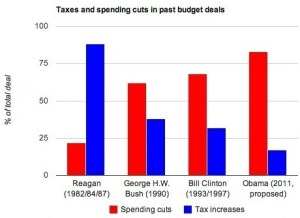
So, tell me, who is the real practicioner of voodoo economics?
So, here’s a nifty graph on the left from Ezra Klein showing the mix of spending cuts vs. tax increases the last few times we’ve had these debt and deficit discussions. Looks like the real practitioner of voodoo economics wasn’t Ronald Reagan but is Barrack Obama. Just more of the alternate reality forced on us by media and politicians that make up news, history, and economic theory.
As you can see on the graph, in each case, taxes were at least a third of the total, and in Reagan’s case, his massive tax cuts were followed by deficit-reduction deals that actually relied on tax increases. Today, tea party conservatives would be begging Sen. Jim DeMint to primary the Gipper.
Bush also included taxes in his deal, and Clinton relied heavily on taxes in his first deficit-reduction bill, which passed without Republican votes. In 1997, when he was working with Republicans, he actually cut taxes slightly while passing spending cuts. But of course the economy was in much better shape then, and Clinton had already increased revenues substantially.
The one-third rule doesn’t break down until you get to the deal Obama reportedly offered Republicans in the first round of debt-ceiling talks: $2 trillion in spending cuts for $400 billion in taxes, or an 83:17 split. And that, if anything, understates how good of a deal Republicans are getting. Tax revenues and rates are much, much lower than they were under Reagan, Bush or Clinton. And next year, Obama is pledging to extend most of the Bush tax cuts, which amounts to a $3 trillion-plus tax cut against current law.
Meanwhile, the polls–like this one from Pew Research–show that people overwhelmingly want to maintain social security, medicaid and medicare and would support tax increases to do so. So much for government of, for, and by the people.
As policymakers at the state and national level struggle with rising entitlement costs, overwhelming numbers of Americans agree that, over the years, Social Security, Medicare and Medicaid have been good for the country.
But these cherished programs receive negative marks for current performance, and their finances are widely viewed as troubled. Reflecting these concerns, most Americans say all three programs either need to be completely rebuilt or undergo major changes. However, smaller majorities express this view than did so five years ago.
The public’s desire for fundamental change does not mean it supports reductions in the benefits provided by Social Security, Medicare or Medicaid. Relatively few are willing to see benefit cuts as part of the solution, regardless of whether the problem being addressed is the federal budget deficit, state budget shortfalls or the financial viability of the entitlement programs.
Jim DeMint is one of the people that should be the first in line to be charged with treason and gross stupidity. Where was Senator DeMint when all the votes were taken to spend all this money to start out with? Plus, all those irresponsible revenue cuts back in the early 2000s when we basically had a balanced budget? He was a congressman from 1999-2005 so certainly he must’ve tried to stop Dubya Bush from all that spending!
Sen. Jim DeMint (R-S.C.) said Wednesday night that Republicans should maintain their hardline position in the debt-ceiling debate even if it results in “serious disruptions” to the economy.
“What I’m advocating here is, let’s use this as a point of leverage, give the president an increase, but don’t come away without real cuts from real caps and spending, and without a balanced budget,” DeMint said on FOX Business Network.
“We’re at the point where there would have to be some, you know, some serious disruptions in order not to raise [the debt ceiling],” he said. “I’m willing to do that.”
The president pushed the economy into “crisis” mode, according to DeMint. He said the president has been “burning time” with the deficit negotiations led by Vice President Biden, when the looming debt ceiling and budget deficit could have been addressed last year.
DeMint, well-known for speaking out in favor of limited government and balancing the budget, told host Andrew Napolitano that if Republicans and Democrats couldn’t vote in “something permanent” that would limit government spending, “we’re going to continue to spend [until] the total country collapses.”
Warren Buffet says the GOP is Threatening To ‘Blow Your Brains Out’ Over Debt Ceiling
Republicans are playing a dangerous game by refusing to raise the debt ceiling, according to Berkshire Hathaway CEO Warren Buffett.
“We raised the debt ceiling seven times during the Bush Administration,” Buffett told CNBC on Thursday. Now, the Republican-controlled Congress is “trying to use the incentive now that we’re going to blow your brains out, America, in terms of your debt worthiness over time.”
If Congress fails to raise the borrowing limit of the federal government by August 2, the date when the U.S. will reach the limit of its borrowing abilities, it will likely begin defaulting on its loans.
Buffett, who according to the Washington Post has helped raise money for Democratic candidates like Hilary Clinton in the past, has been highly critical of the actions of the Republican-controlled Congress. In May, Buffett stated at a Berkshire Hathaway shareholder’s meeting that if the Congress failed to raise the debt ceiling, it would constitute “the most asinine act” in the nation’s history, reports Reuters.
Other political news is equally disheartening. Most of the governments in the states are as crazy–if not crazier–than the US Congress. Planned Parenthood in North Carolina is suing the state over budget cuts designed to cut access to much used and cost saving preventive health care.
One of North Carolina’s two Planned Parenthood affiliates filed a federal lawsuit Thursday to invalidate part of the new state budget that cuts it off from federal or state funds for family planning.
The budget, written by Republicans in control of the General Assembly for the first time in more than a century, states that Planned Parenthood and its affiliates are forbidden from receiving any contracts or grants from the state health agency. The lawsuit filed in Greensboro’s federal court by Planned Parenthood of Central North Carolina contends the group is being punished for its abortion-rights advocacy, saying that violates its free-speech protections.
The organization is barred by law from using public money to perform abortions and uses the government contracts to provide family planning or teen pregnancy prevention services, yet is being singled out because Planned Parenthood supports abortion rights, the lawsuit said. Efforts to cut off funds to Planned Parenthood affiliates in North Carolina are similar to those in Kansas and Indiana, which were also met with federal lawsuits, the group’s attorneys said.
“Their sole purpose is to single out, vilify, and punish Planned Parenthood as a particularly visible provider and advocate — even though, ironically, the eliminated funds have nothing to do with abortion, but will only deprive low-income people of desperately needed health services and teen pregnancy prevention programs,” the lawsuit said.
Planned Parenthood of Central North Carolina received $287,000 in federal, state and matching local funds in the year that ended last week for teen pregnancy prevention and family planning programs that provided contraceptives to poor women, according to the state Department of Health and Human Services. The non-profit operates from locations in Chapel Hill, Durham, and Fayetteville.
Some of the most extremist pastors are signing on to Texas Governor Rick Perry’s Pray-a polooza. Talk about a hater-thon. Remember, Perry is supposed to be the ‘electable’ Republican.
And we already knew Perry didn’t care much about including, or even not offending, non-Christians: his personal letter announcing the event calls on the entire nation to pray to Jesus Christ. But the news, reported by Right Wing Watch, that a radical pastor named C. Peter Wagner has signed on as an official endorser of The Response deserves more attention.
The Colorado-based Wagner, who is featured on the website of The Response, is the head of Global Harvest Ministries.
His brand of evangelicalism, known as the New Apostolic Reformation, is characterized by extreme hostility to other religions. In this passage from his book “Hard-Core Idolatry: Facing the Facts,” Wagner praises the burning of Catholic saints, copies of the Book of Mormon, voodoo dolls, and other “idols”
Yup, welcome to the new surreality. All we need is Rod Serling introducing the morning reads today and I’d say that would be about right.
What’s on your reading and blogging list today?
President Hornswoggle and the Debted Hallows
Posted: July 7, 2011 Filed under: Barack Obama, Catfood Commission, Democratic Politics, Economy, Federal Budget, Federal Budget and Budget deficit, Global Financial Crisis, John Birch Society in Charge, legislation, Psychopaths in charge, Surreality, The Great Recession, U.S. Economy, voodoo economics | Tags: 14th amendment, austerity, Chuck Schumer, Debt ceiling negotiations, Federal Deficit, Medicaid, medicare, Social Security, voodoo economics 39 Comments So, you know me. I’m out looking for exactly how bad this debt ‘deal’ is going to austere our economy in to the Great Recession Redux. BostonBoomer has been writing about President Hornswoggle putting Medicare, Medicaid, and Social Security–not even part of the federal budget–on the table. I’ve searched and searched and can’t find the details on the great American Give Away other than a few articles showing a beaming Boehner saying we’re at a 50-50 chance of reaching a deal now. If Boehner is beaming, all but the richest among us should be holding on to our personal liberties and wallets.
We know that the President has caved on a bunch of things during both the HRC negotiations and the extension of the Dubya Tax Breaks for Billionaires pogrom. However, the Democratic leadership was aware of this, grumbled some, and backed his usurpation of responsibility for our future. Imagine my surprise when I watched Chuck Schumer on Andrea Mitchell say that he had no idea about the details of the current deal so he couldn’t really comment on it. The most noticeable detail was his face that said “I’ve got a sick tummy, mommy”. Senator Schumer is on the Senate Committee on Finance that handles all of these things and is supposedly a key person on the budget deal. You would think he would know. But, he doesn’t and neither does any other Democratic Senator or Congressman. It appears the press told them what Obama was handing over to the Republicans.
Senate Democrats reacted angrily Thursday to a report that President Obama has proposed significant cuts to Medicare and Social Security in closed-door talks with GOP leaders.
Democratic lawmakers said they were dismayed to read about Obama’s offer in the press rather than hearing it from the president himself. Their frustration is exacerbated by Obama’s snub of their invitation to speak to the Senate Democratic caucus Wednesday.
Instead, Obama is meeting with Democratic and Republican leaders from both chambers Thursday morning.
“We would have preferred to hear it from the president instead of from the press,” said Sen. Barbara Mikulski (Md.), a senior member of the Senate Democratic conference. “We first have to go after tax earmarks.”
Mikulski said cuts to Medicare and Social Security should be a solution of last resort. She said closing tax loopholes and pulling back from Libya should be considered before entitlement cuts.
She said Obama should not assume Democratic support for a deficit reduction plan that cuts entitlements.
I now fully expect President Cave-in to hand the keys to the nation over to a bunch of punch-drunk Republicans. What I don’t get is why the Democratic members of Congress continue to let him get away with it. They are the very face of “sound and fury signifying nothing”. Let me ask you if you’d want to be a congress member from some solid Democratic district facing re-election by having to defend a Democratic President that’s happy to cut Medicare and Social Security? Social Security doesn’t even need to be on the table. He’s just offered it up for some reason that I can’t fathom. How on earth could you face your electorate and back such a deal?
Let me remind you, all of the economic data gathered in the last 80 years tells us that this austerity agenda is just going to tank the economy. We continue t0 enact the very same crap that put us in the worst economic position we’ve seen since the Great Depression. Why oh why are they doing this to us? Here’s a taste of Noble Prize winning Joseph Stiglitz for some perspective.
A decade ago, in the midst of an economic boom, the United States faced a surplus so large that it threatened to eliminate the national debt. Unaffordable tax cuts and wars, a major recession, and soaring health care costs—fueled in part by the commitment of George W. Bush’s administration to giving drug companies free rein in setting prices, even with government money at stake—quickly transformed a huge surplus into record peacetime deficits.
The remedies to the U.S. deficit follow immediately from this diagnosis: Put America back to work by stimulating the economy; end the mindless wars; rein in military and drug costs; and raise taxes, at least on the very rich. But the right will have none of this, and instead is pushing for even more tax cuts for corporations and the wealthy, together with expenditure cuts in investments and social protection that put the future of the U.S. economy in peril and that shred what remains of the social contract. Meanwhile, the U.S. financial sector has been lobbying hard to free itself of regulations, so that it can return to its previous, disastrously carefree, ways.
Here’s a thorough, peer-reviewed, strong methodology-based IMF study–cited by Paul Krugman–that provides evidence that austerity programs are recessionary and bring on worse budget problems.
The paper corrects this by using the historical record to identify true examples of deliberate austerity — and it turns out that they are contractionary. The multiplier is less than one, but that may reflect the fact that these austerity programs did not take place in the face of a zero lower bound, so they were partly offset by monetary expansion.
The paper also provides a tentative answer to the apparent tendency of spending cuts to be less contractionary than tax increases: it looks as if central banks take more aggressive action to offset spending cuts than tax hikes, reflecting some combination of inflation concerns, belief that spending cuts are more durable, and (the paper doesn’t say this) bankerly ideology.
If we were discussing a politically neutral subject, the evidence here would long since have been considered definitive: expansionary austerity is a doctrine that failed. But since we’re in the political realm, of course, such a convenient doctrine can’t be abandoned. On the contrary, it now seems to be the official doctrine of both the GOP and the White House.
Also, let me remind you that Medicare, Medicaid, and Social Security are very successful programs. They have successfully stopped the elderly from being the poorest segment of society. Just as an example, the majority of single, elderly women would be in poverty without Social Security.
Elderly unmarried women — including widows — get 51 percent of their total income from Social Security. Unmarried elderly men get 39 percent, while elderly married couples get 36 percent of their income from Social Security. For 25 percent of unmarried women, Social Security is their only source of income, compared to 9 percent of married couples and 20 percent of unmarried men. Without Social Security benefits, the elderly poverty rate among women would have been 52.2 percent and among widows would have been 60.6 percent.
When poor people are given medical insurance, they not only find regular doctors and see doctors more often but they also feel better, are less depressed and are better able to maintain financial stability, according to a new, large-scale study that provides the first rigorously controlled assessment of the impact of Medicaid.
While the findings may seem obvious, health economists and policy makers have long questioned whether it would make any difference to provide health insurance to poor people.
It has become part of the debate on Medicaid, at a time when states are cutting back on this insurance program for the poor. In fact, the only reason the study could be done was that Oregon was running out of money and had to choose some people to get insurance and exclude others, providing groups for comparison.
I continually feel as though we’ve all been drug down the rabbit hole. It is like the President is purposefully enabling joblessness, poverty, and public health problems. No amount of research, historical data, and polls appear to be able to penetrate the Washington, D.C. group think these day. The biggest issue is that the President himself believes in the confidence fairy, the bipartisan elves, and the high priests of voodoo economics. He’s not just part of the problem, he is THE problem. Can just one or two members of the Democratic caucus please stand up to this man and his notion that bipartisanship that surrenders the country to right wing reality-deniers is better than any form of principled leadership? Can at least one of the please be brave and start talking some sense and representing the will of the people for a change?
Invoke the 14th Amendment and end the damned sell outs now!
How many S’s in a Senate Sentimental Statement make for a Symbolic Surreal Exercise in inSanity?
Posted: July 6, 2011 Filed under: Domestic Policy, Economy | Tags: deficit, Democratic spinelessness, Tax Cuts for Billionaires 9 Comments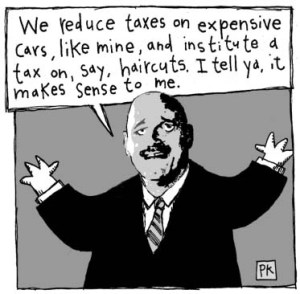 Harry Reid has introduced a bill called the “Sense of the Senate on Shared Sacrifice”. It basically has no recommendations, suggestions, policy measures, or required action. It is symbolic surreality at best and an exercise in serious alliteration. I can frankly hear Daffy Duck adding “suffering succotash” to the end. Hisssssssss.
The Senate as early as Wednesday could vote on a “Sense of the Senate” bill that says taxpayers earning $1 million or more each year should “make a more meaningful contribution to the deficit-reduction effort.”
…
The bill has no specific recommendations on how much taxes should be raised on high-income earners, and is simply a recommendation that these taxpayers pay more. Because the 60 votes needed to end debate are unlikely to materialize, the vote will likely be used by Democrats as a way to show Republican resistance to new tax hikes.
Democrats might also try to use the vote as leverage in negotiations on how to raise the debt ceiling by showing that there is support for a tax increase. In those talks, which are expected to continue this week, Democrats have said taxes on the wealthy and on oil companies should be part of the equation for reducing the deficit. Republicans have so far rejected this, and argue that an agreement needs to focus solely on spending cuts.
Now I’m all for meaningful displays of protest and performance art but I’m not alone in thinking this is shallow grandstanding. Here’s the sentiment of Greg Sargent on the subject. Did I mention the word Surreal is his subject head?
So it’s come to this. Republican opposition to any kind of revenue increase as part of the deficit deal has grown so implacable that Dems will now hold a Senate vote tomorrow on the basic idea that millionaires and billionaires should help contribute to fixing our deficit.
It’s not a vote on any specific proposal to hike taxes or end tax breaks. Rather, it’s a vote that puts each Senator on record on the general question of whether the rich should sacrifice in service of deficit reduction.
According to a Dem leadership aide, Senate Democrats have decided, as expected, to proceed with a vote tomorrow on a resolution that would declare that it is the “sense of the senate” that those who make $1 million or more per year should “make a more meaningful contribution to the deficit reduction effort.”
The vote — a cloture motion on the question of whether to proceed to an up-or-down vote on this resolution — is designed to put Repubicans on the spot. The idea is to force GOPers to go on the record choosing between declaring general support for more sacrifice from the wealthy — which in theory could strengthen Dem leverage in the talks — or reveal that they’re ideologically hostile to the notion that the rich should sacrifice anything to fix our fiscal mess. Dem Senators are holding a presser this afternoon to push the issue.
That this vote is happening at all perfectly captures just how surreal this debate has become. Democrats have agreed to over $1 trillion in spending cuts, and have reportedly agreed to tens of billions in Medicare cuts as part of that package. The American people have declared in poll after poll after poll that they think the deficit should be addressed through a combination of spending cuts and tax hikes. Yet Republicans are simply refusing to entertain the possibility of any revenue increases of any kind — to the point where even conservative columnists like David Brooks are growing seriously alarmed by the anti-tax fanaticism that’s on display.
Here’s David Dayen’s take at FDL. (Notice, I’ve decided to can the alliteration. It was getting way to easy and annoying.)
I’m actually all for nakedly political votes. This bill does not put anything into law, does not actually force millionaires to make a “more meaningful contribution” to deficit reduction. All it does is force Republicans onto the side of millionaires. If used successfully, that’s a fine vote to have for the next several cycles, and is sure to come up in television ads. Politics must be played sometimes.
But let’s not pretend that this is a “millionaire’s tax bill.” There was an opportunity to put a millionaire’s surtax in the Democratic budget; Kent Conrad will deliver a budget with a balanced approach between taxes and spending, but that surtax was dropped. There are a series of ideas about ending tax breaks for corporate jet owners, but I don’t know if you can even call them “meaningful.” Especially when you put them against the potential for $500 billion in Medicare and Medicaid cuts – just a year after a separate set of $500 billion in cuts to Medicare Advantage overpayments and other fat-trimming from Medicare – and another $100 billion through changing the COLA formula for Social Security beneficiaries. That adds up to twice as much in deficit reduction from seniors, the poor and the disabled than from the sum total of all revenue raisers on the table.
And anyway, none of those revenue raisers will be voted on in this sense of the Senate legislation. It just says that millionaire contributions would be a good idea. I assume then that the plan is to approach the millionaires individually.
My take is that if it’s such a good idea, then Reid should actually do something about it. He should’ve done something about it last winter when Obama was selling out on the Dubya Bush tax cut extensions. Our government shouldn’t be a person on the street with a tin cup. Congress spent all this damned money on all those wars and handed out all those ridiculous tax loop holes. Frankly, I’m with Katrina vanden Heuvel who thinks Obama and the Democrats should just invoke the 14th amendment and tell the Republicans to go to hell. Enough of this symbolic shit! Send Rubio, Ryan, and Boehner to the moon!
Independence Day Reads
Posted: July 4, 2011 Filed under: Bailout Blues, Domestic Policy, Economy, Foreign Affairs, Global Financial Crisis, Greece, investment banking, morning reads | Tags: Bill Clinton, Budget Deficit, debt limit, Fukushima, Greek Debt Crisis, John McCain, nuclear crisis, shadow banking industry, SIVs, taxes 16 Comments Happy Independence Day!
We have a republic and a lot of people have sacrificed a lot over the last several centuries to keep it. Too bad most of our politicians aren’t in that number. They can’t see past their next elections.
It seems that two senators– McCain and Corynyn–say they’re open to tax increases as a way to solve the budget stand off. Guess there are a few of them left that would prefer not to tank our economy. Let’s hope this starts some real negotiations instead of the usual Republican hostage taking and Democratic cave-in that’s been politics as usual the last dozen years or so.
One of the senators, John Cornyn of Texas, said he would consider eliminating some tax breaks and corporate subsidies in the context of changes in the tax code, provided there was not an overall increase in taxes.
“I think it’s clear that the Republicans are opposed to any tax hikes, particularly during a fragile economic recovery,” Mr. Cornyn said on “Fox News Sunday.” “Now, do we believe tax reform is necessary? I would say absolutely.”
But he insisted that any changes in taxes be “revenue neutral,” meaning that the government would not take in any more money from individuals or businesses than it does now.
The other senator, John McCain of Arizona, said he would be willing to consider some “revenue raisers” as part of a broad deal, but he refused to name specific measures.
Mr. Cornyn, a member of the Senate leadership, also said that Republicans would be open to a short-term deal on the debt ceiling to provide more time for a comprehensive agreement.
Let’s also hope that more reasonable and less ideological heads prevail on the right and that the left stands up for what’s right for a change. Former President Clinton had a words of policy advice over the weekend. His advice to President Obama is “not to blink”.
Former President Bill Clinton Saturday night urged President Obama not to “blink” at Republican demands to exclude revenue increases from any agreement to extend the government’s debt ceiling.
If Republicans maintain their opposition to revenue increases, Clinton said, Obama should pursue a short-term deal to extend the debt ceiling based on spending cuts both sides have already accepted in the negotiations between the administration and Congressional leaders from both parties.
“I hope they will make a mini-deal,” Clinton said in an interview conducted with him at the Aspen Ideas Festival here.
The White House and Congressional negotiators from both parties are attempting to assemble a deficit reduction package that could win support in Congress for legislation to extend the nation’s debt ceiling, which the Treasury says the government will reach on August 2. The talks have foundered amid demands from Congressional Republicans to exclude any revenue increases from that prospective deficit reduction package.
Asked what the administration could do if GOP leaders hold to that posture, Clinton replied: “First the White House could blink. I hope that won’t happen. I don’t think they should blink.”
If Republicans will not accept revenues in a package to lift the debt ceiling by August 2, Clinton said, Obama should pursue a short-term agreement based on the spending reductions both sides have already accepted.
“There are some spending cuts they agree on …and he can take those and [get] an extension of the debt ceiling for six or eight months,” Clinton said.
Clinton also called on a package of reforms to US tax policy that includes a corporate tax cut if special interest tax loops are closed. This is something Obama has also supported.
“It made sense when I did it. It doesn’t make sense anymore – we’ve got an uncompetitive rate. We tax at 35 percent of income, although we only take about 23 percent. So, we SHOULD cut the rate to 25 percent, or whatever’s competitive, and eliminate a lot of the deductions so that we still get a FAIR amount, and there’s not so much variance in what the corporations pay. But how can they do that by Aug. 2?”
Clinton also said Grover Norquist, who as president of Americans for Tax Reform is the GOP’s unofficial enforcer of no-new-taxes pledges, has a “chilling” hold on the nation’s lawmaking.
The former president said it has seemed like Republicans need any revenue concessions need to be “approved in advance by Grover Norquist.”
“You’re laughing,” he told the crowd of 800. “But he was quoted in the paper the other day saying he gave Republican senators PERMISSION … on getting rid of the ethanol subsidies. I thought, ‘My GOD, what has this country come to when one person has to give you permission to do what’s best for the country.’ It was chilling.
There’s an extremely interesting piece at The Atlantic Wire on “What Really Happened at Fukushima”. It includes interviews with workers that have been inside the crippled nuclear plant.
Throughout the months of lies and misinformation, one story has stuck: “The earthquake knocked out the plant’s electric power, halting cooling to its reactors,” as the government spokesman Yukio Edano said at a March 15 press conference in Tokyo. The story, which has been repeated again and again, boils down to this: “after the earthquake, the tsunami – a unique, unforeseeable [the Japanese word is soteigai] event – then washed out the plant’s back-up generators, shutting down all cooling and starting the chain of events that would cause the world’s first triple meltdown to occur.”
But what if recirculation pipes and cooling pipes, burst, snapped, leaked, and broke completely after the earthquake — long before the tidal wave reached the facilities, long before the electricity went out? This would surprise few people familiar with the 40-year-old Unit 1, the grandfather of the nuclear reactors still operating in Japan.
The authors have spoken to several workers at the plant who recite the same story: Serious damage to piping and at least one of the reactors before the tsunami hit. All have requested anonymity because they are still working at the plant or are connected with TEPCO. One worker, a 27-year-old maintenance engineer who was at the Fukushima complex on March 11, recalls hissing and leaking pipes. “I personally saw pipes that came apart and I assume that there were many more that had been broken throughout the plant. There’s no doubt that the earthquake did a lot of damage inside the plant,” he said. “There were definitely leaking pipes, but we don’t know which pipes – that has to be investigated. I also saw that part of the wall of the turbine building for Unit 1 had come away. That crack might have affected the reactor.”
The reactor walls of the reactor are quite fragile, he notes. “If the walls are too rigid, they can crack under the slightest pressure from inside so they have to be breakable because if the pressure is kept inside and there is a buildup of pressure, it can damage the equipment inside the walls so it needs to be allowed to escape. It’s designed to give during a crisis, if not it could be worse – that might be shocking to others, but to us it’s common sense.”
Here’s some frightening news on the disaster in Japan. Radioactive Cesium has been found in Tokyo’s water supply.
Radioactive cesium-137 was found in Tokyo’s tap water for the first time since April as Japan grapples with the worst nuclear disaster in 25 years.
Cesium-137 concentration registered at 0.14 becquerels per kilogram in the city’s Shinjuku ward on July 2, compared with 0.21 becquerels on April 22, according to the Tokyo Metropolitan Institute of Public Health. No cesium-134 or iodine-131 was detected, the agency said on its website.
The Nuclear Safety Commission of Japan sets a safety limit of 200 becquerels per kilogram for cesium-134 and cesium-137. The limit for iodine-131 consumption is 300 becquerels per kilogram.
Japan is battling radiation leaks into the air, soil and water after an earthquake and tsunami on March 11 knocked out cooling systems at Tokyo Electric Power Co.’s Fukushima Dai- Ichi nuclear station, resulting in the meltdown of three of the six reactors at the plant.
The UK Guardian lists an interesting set of Greek public assets for sale. Many have no buyers. Bobby Jindal is putting up a lot of Louisiana assets for sale too. I wonder if this is going to be the new way to raise money. The Kochs already rent a big chunk of Yellowstone. Let’s hope we don’t have to put our national treasures on the chopping block.
Up for sale are 39 airports, 850 ports, railways, motorways, sewage works, a couple of energy companies, banks, defence groups, thousands of acres of land for development, casinos and Greece’s national lottery. George Christodoulakis, Greece’s special secretary for asset restructuring and privatisations, said the sell-off would raise €50bn (£44bn) to help pay back the country’s €110bn bailout debt.
The private equity bosses gathered in the hotel’s ballroom for the parade of Greece’s national treasures showed little interest in buying anything.
Nikos Stathopoulous, managing partner of BC Partners, which has invested more than €3.5bn in Greece, said investors are put off by bureaucracy, strong unions, corruption and a lack of transparency. “Even in the good times Greece is not a country that attracts investment. Foreign investors don’t want to invest in a country where there is no flexibility in hiring and firing people,” he said. “You don’t want to invest in a country in which you wake up and a new law has been passed which totally undermines and destroys the value of the investment you’ve just made.”
Stathopoulous said investors were finding it very hard to assess the risk of investing into Greece, which means assets “will be priced at lower than they are worth, lower than the Greek government, and even the European Union, expects”.
Here’s a compelling argument for getting the shadow banking sector into a more regulated, transparent, and standardized order. It’s written by Henry Tabe who is a Founding Partner of Sequoia Investment Management Company Ltd. It particularly addresses the use of the Structured Investment Vehicle (SIV). Complex, nonstandard, and unregulated markets make pricing assets difficult and introduce unnecessary risk and volatility.
Risk management requires identification, measurement, aggregation, and effective management of risks. It should help businesses allocate sufficient capital for survival and growth. The SIV’s extinction highlights risk management failures by the vehicles, their sponsors, rating agencies, policymakers, and regulators.
Financial regulators permitted bank, insurance company, pension, and hedge-fund sponsors to establish SIV “mini-banks” without ensuring that they maintain sufficient capital or back-stop liquidity in the event of a run. Policymakers also seemed unaware of the knock-on effects of the SIV’s demise on the securitisation and global credit markets. The Financial Security Authority’s call for regulators to incorporate sectoral analytical capabilities in their micro-prudential policies should help close the knowledge gap and ensure that timely solutions can be implemented to avert collapses that engender significantly more stress on the financial system (FSA 2009).
Lessons learned include the tightening of regulation governing the sponsorship of off-balance-sheet structures and the sizing of their capital and liquidity needs. These require that regulators adopt a more proactive, dampening role in the wild swings from exuberance to despair that are so characteristic of the financial markets. Discussions around contingent capital and similar products suggest regulators have embraced that dampening role and moved away from the prevailing pre-crisis philosophy of minimal regulation.
Lessons learned also include closer supervision of shadow banks, more skin-in-the-game for their sponsors, in-house retention of risk-analytics capabilities by investors, and less reliance on credit-rating agencies. The agencies themselves are more tightly supervised in order to reduce ratings shopping by issuers and inherent conflicts of interest in the business model (CESR 2009). Tighter regulation will also help to ensure that the agencies improve the monitoring of analyst performance, qualifications, and experience (Dodd-Frank 2010).
These measures should help restore confidence in rating agencies and the global financial system, an outcome more urgently required given on-going turmoil in the sovereign debt market.
So, there’s some wonky goodness to keep you entertained if you’re inside today. Be sure to let us know what you’re reading and blogging! Hope your Fourth of July is a happy one!

 peej
peej Carissa
 bostonboomer
 dakinikat
 ecocatwoman
 jjlo
jjlo mablue2
 Mama Lopez
 peggysue22
 quixote
 skydancingguestblogger
 Mona (aka Wonk the Vote)





Recent Comments